Spandidos Publications Logo
  • About
    • About Spandidos
    • Aims and Scopes
    • Abstracting and Indexing
    • Editorial Policies
    • Reprints and Permissions
    • Job Opportunities
    • Terms and Conditions
    • Contact
  • Journals
    • All Journals
    • Oncology Letters
      • Oncology Letters
      • Information for Authors
      • Editorial Policies
      • Editorial Board
      • Aims and Scope
      • Abstracting and Indexing
      • Bibliographic Information
      • Archive
    • International Journal of Oncology
      • International Journal of Oncology
      • Information for Authors
      • Editorial Policies
      • Editorial Board
      • Aims and Scope
      • Abstracting and Indexing
      • Bibliographic Information
      • Archive
    • Molecular and Clinical Oncology
      • Molecular and Clinical Oncology
      • Information for Authors
      • Editorial Policies
      • Editorial Board
      • Aims and Scope
      • Abstracting and Indexing
      • Bibliographic Information
      • Archive
    • Experimental and Therapeutic Medicine
      • Experimental and Therapeutic Medicine
      • Information for Authors
      • Editorial Policies
      • Editorial Board
      • Aims and Scope
      • Abstracting and Indexing
      • Bibliographic Information
      • Archive
    • International Journal of Molecular Medicine
      • International Journal of Molecular Medicine
      • Information for Authors
      • Editorial Policies
      • Editorial Board
      • Aims and Scope
      • Abstracting and Indexing
      • Bibliographic Information
      • Archive
    • Biomedical Reports
      • Biomedical Reports
      • Information for Authors
      • Editorial Policies
      • Editorial Board
      • Aims and Scope
      • Abstracting and Indexing
      • Bibliographic Information
      • Archive
    • Oncology Reports
      • Oncology Reports
      • Information for Authors
      • Editorial Policies
      • Editorial Board
      • Aims and Scope
      • Abstracting and Indexing
      • Bibliographic Information
      • Archive
    • Molecular Medicine Reports
      • Molecular Medicine Reports
      • Information for Authors
      • Editorial Policies
      • Editorial Board
      • Aims and Scope
      • Abstracting and Indexing
      • Bibliographic Information
      • Archive
    • World Academy of Sciences Journal
      • World Academy of Sciences Journal
      • Information for Authors
      • Editorial Policies
      • Editorial Board
      • Aims and Scope
      • Abstracting and Indexing
      • Bibliographic Information
      • Archive
    • International Journal of Functional Nutrition
      • International Journal of Functional Nutrition
      • Information for Authors
      • Editorial Policies
      • Editorial Board
      • Aims and Scope
      • Abstracting and Indexing
      • Bibliographic Information
      • Archive
    • International Journal of Epigenetics
      • International Journal of Epigenetics
      • Information for Authors
      • Editorial Policies
      • Editorial Board
      • Aims and Scope
      • Abstracting and Indexing
      • Bibliographic Information
      • Archive
    • Medicine International
      • Medicine International
      • Information for Authors
      • Editorial Policies
      • Editorial Board
      • Aims and Scope
      • Abstracting and Indexing
      • Bibliographic Information
      • Archive
  • Articles
  • Information
    • Information for Authors
    • Information for Reviewers
    • Information for Librarians
    • Information for Advertisers
    • Conferences
  • Language Editing
Spandidos Publications Logo
  • About
    • About Spandidos
    • Aims and Scopes
    • Abstracting and Indexing
    • Editorial Policies
    • Reprints and Permissions
    • Job Opportunities
    • Terms and Conditions
    • Contact
  • Journals
    • All Journals
    • Biomedical Reports
      • Information for Authors
      • Editorial Policies
      • Editorial Board
      • Aims and Scope
      • Abstracting and Indexing
      • Bibliographic Information
      • Archive
    • Experimental and Therapeutic Medicine
      • Information for Authors
      • Editorial Policies
      • Editorial Board
      • Aims and Scope
      • Abstracting and Indexing
      • Bibliographic Information
      • Archive
    • International Journal of Epigenetics
      • Information for Authors
      • Editorial Policies
      • Editorial Board
      • Aims and Scope
      • Abstracting and Indexing
      • Bibliographic Information
      • Archive
    • International Journal of Functional Nutrition
      • Information for Authors
      • Editorial Policies
      • Editorial Board
      • Aims and Scope
      • Abstracting and Indexing
      • Bibliographic Information
      • Archive
    • International Journal of Molecular Medicine
      • Information for Authors
      • Editorial Policies
      • Editorial Board
      • Aims and Scope
      • Abstracting and Indexing
      • Bibliographic Information
      • Archive
    • International Journal of Oncology
      • Information for Authors
      • Editorial Policies
      • Editorial Board
      • Aims and Scope
      • Abstracting and Indexing
      • Bibliographic Information
      • Archive
    • Medicine International
      • Information for Authors
      • Editorial Policies
      • Editorial Board
      • Aims and Scope
      • Abstracting and Indexing
      • Bibliographic Information
      • Archive
    • Molecular and Clinical Oncology
      • Information for Authors
      • Editorial Policies
      • Editorial Board
      • Aims and Scope
      • Abstracting and Indexing
      • Bibliographic Information
      • Archive
    • Molecular Medicine Reports
      • Information for Authors
      • Editorial Policies
      • Editorial Board
      • Aims and Scope
      • Abstracting and Indexing
      • Bibliographic Information
      • Archive
    • Oncology Letters
      • Information for Authors
      • Editorial Policies
      • Editorial Board
      • Aims and Scope
      • Abstracting and Indexing
      • Bibliographic Information
      • Archive
    • Oncology Reports
      • Information for Authors
      • Editorial Policies
      • Editorial Board
      • Aims and Scope
      • Abstracting and Indexing
      • Bibliographic Information
      • Archive
    • World Academy of Sciences Journal
      • Information for Authors
      • Editorial Policies
      • Editorial Board
      • Aims and Scope
      • Abstracting and Indexing
      • Bibliographic Information
      • Archive
  • Articles
  • Information
    • For Authors
    • For Reviewers
    • For Librarians
    • For Advertisers
    • Conferences
  • Language Editing
Login Register Submit
  • This site uses cookies
  • You can change your cookie settings at any time by following the instructions in our Cookie Policy. To find out more, you may read our Privacy Policy.

    I agree
Search articles by DOI, keyword, author or affiliation
Search
Advanced Search
presentation
Biomedical Reports
Join Editorial Board Propose a Special Issue
Print ISSN: 2049-9434 Online ISSN: 2049-9442
Journal Cover
March-2015 Volume 3 Issue 2

Full Size Image

Sign up for eToc alerts
Recommend to Library

Journals

International Journal of Molecular Medicine

International Journal of Molecular Medicine

International Journal of Molecular Medicine is an international journal devoted to molecular mechanisms of human disease.

International Journal of Oncology

International Journal of Oncology

International Journal of Oncology is an international journal devoted to oncology research and cancer treatment.

Molecular Medicine Reports

Molecular Medicine Reports

Covers molecular medicine topics such as pharmacology, pathology, genetics, neuroscience, infectious diseases, molecular cardiology, and molecular surgery.

Oncology Reports

Oncology Reports

Oncology Reports is an international journal devoted to fundamental and applied research in Oncology.

Experimental and Therapeutic Medicine

Experimental and Therapeutic Medicine

Experimental and Therapeutic Medicine is an international journal devoted to laboratory and clinical medicine.

Oncology Letters

Oncology Letters

Oncology Letters is an international journal devoted to Experimental and Clinical Oncology.

Biomedical Reports

Biomedical Reports

Explores a wide range of biological and medical fields, including pharmacology, genetics, microbiology, neuroscience, and molecular cardiology.

Molecular and Clinical Oncology

Molecular and Clinical Oncology

International journal addressing all aspects of oncology research, from tumorigenesis and oncogenes to chemotherapy and metastasis.

World Academy of Sciences Journal

World Academy of Sciences Journal

Multidisciplinary open-access journal spanning biochemistry, genetics, neuroscience, environmental health, and synthetic biology.

International Journal of Functional Nutrition

International Journal of Functional Nutrition

Open-access journal combining biochemistry, pharmacology, immunology, and genetics to advance health through functional nutrition.

International Journal of Epigenetics

International Journal of Epigenetics

Publishes open-access research on using epigenetics to advance understanding and treatment of human disease.

Medicine International

Medicine International

An International Open Access Journal Devoted to General Medicine.

Journal Cover
March-2015 Volume 3 Issue 2

Full Size Image

Sign up for eToc alerts
Recommend to Library

  • Article
  • Citations
    • Cite This Article
    • Download Citation
    • Create Citation Alert
    • Remove Citation Alert
    • Cited By
  • Similar Articles
    • Related Articles (in Spandidos Publications)
    • Similar Articles (Google Scholar)
    • Similar Articles (PubMed)
  • Download PDF
  • Download XML
  • View XML
Article

Pediatric severe pseudomembranous enteritis treated with fecal microbiota transplantation in a 13-month-old infant

  • Authors:
    • Jiayi Wang
    • Yongmei Xiao
    • Kai Lin
    • Feifei Song
    • Ting Ge
    • Ting Zhang
  • View Affiliations / Copyright

    Affiliations: Department of Gastroenterology, Hepatology and Nutrition, Shanghai Children's Hospital, School of Medicine, Shanghai Jiao Tong University, Shanghai, P.R. China
  • Pages: 173-175
    |
    Published online on: December 15, 2014
       https://doi.org/10.3892/br.2014.403
  • Expand metrics +
Metrics: Total Views: 0 (Spandidos Publications: | PMC Statistics: )
Metrics: Total PDF Downloads: 0 (Spandidos Publications: | PMC Statistics: )
Cited By (CrossRef): 0 citations Loading Articles...

This article is mentioned in:


Abstract

Fecal microbiota transplantation (FMT) is a procedure used to restore the intestinal microbiota of a diseased individual using indigenous intestinal microorganisms from a healthy donor. The current case report presents the first case of a 13‑month‑old male with severe pseudomembranous enteritis (PME) treated with FMT. The infant was admitted to Shanghai Children's Hospital with a 2‑month history of diarrhea, and a 1.5‑month history of retractable edema, hypoalbuminemia, electrolyte disturbance and malnutrition. Besides necessary nutritional support, the patient was treated twice with oral metronidazole combined with or without vancomycin. Diarrhea was partially remitted. However, the infant had bloody or dark‑green feces, and a distended abdomen. On day 96 from the initiation of the disease, a single FMT via a nasal jejuna feeding tube was performed. From day 2 until 4 months post‑FMT, the patient presented with no diarrhea, normal feces and a satisfactory weight. To the best of our knowledge, this is the first pediatric PME treated with FMT. The current data show that FMT is an efficient choice for recurrent clostridium difficile infection and PME in adults and a few pediatric cases. Due to a lack of safety and effectiveness data, treatment should be cautiously applied in the pediatric population.

Introduction

Pseudomembranous enteritis (PME) is an acute inflammatory bowel disease affecting the total population. Clostridium difficile (C. difficile) is recognized as one of the most important pathogens responsible for antibiotic-associated colitis and accounts for 15–25% of nosocomial antibiotic-associated diarrhea cases (1). Up to 70% of infants may be asymptomatically colonized with C. difficile, including toxigenic strains. The rates of colonization decrease with age, falling to 6% by 2 years of age. The colonization rates in children over the age of 2 years are similar to those in adults (~3%) (2). Currently, the standard treatment recommendations for mild to moderate C. difficile infection (CDI) include metronidazole or vancomycin (1). However, the cure rates of severe CDI treated with metronidazole and vancomycin are only 76% and 97%, respectively. The chance of recurrent CDI within 8 weeks is 10–20%, but once a patient experiences recurrence, the rate of further recurrences increases to 40–65% (3). Given the effective outcome, low cost, apparent safety and availability of fecal microbiota transplantation (FMT), it has become an increasingly accepted option for treatment of CDI (4). Microbiota dysbiosis is the fundamental pathogenetic base of PME/CDI/antibiotic-associated diarrhea, and FMT provides a rapid solution to restore the intestinal microbiota (5). To the best of our knowledge, the current study presents the first case of a 13-month-old infant with severe PME who was treated with FMT in China (6, 7).

Case report

A 13-month-old male was admitted to the Shanghai Children's Hospital (Shanghai, China) with a 2-month history of diarrhea, loose, malodorous dark-green stools with variable mucus and blood, and a 1.5-month history of retractable edema, hypoalbuminemia, electrolyte disturbance and severe malnutrition. Initially, the infant presented with acute diarrhea for 1 day, followed by ileus and exploratory laparotomy and high ligation of inguinal hernia on day 3 without a noticeable food allergy, family history and vaccination. Multiple broad-spectrum antibiotics, including ceftazidime, amoxicillin, imipenem, metronidazole and vancomycin, were introduced daily to the patient during 2 months. The patient had a birth weight of 2,500 g with a 20-day history of diarrhea at the age of six months.

Physical examination revealed that the infant was conscious, weak and responding. The vital signs were stable, the weight was 8.4 kg and the eyelids were puffy and had dry skin and mucous. Abdominal examinations showed abdominal distention, pitting edema of the pretibial area and the dorsum, and normal neurological examination. The dark-green stools were loose, malodorous and had a frequency of 5–8 times per day with variable mucus and positive occult blood.

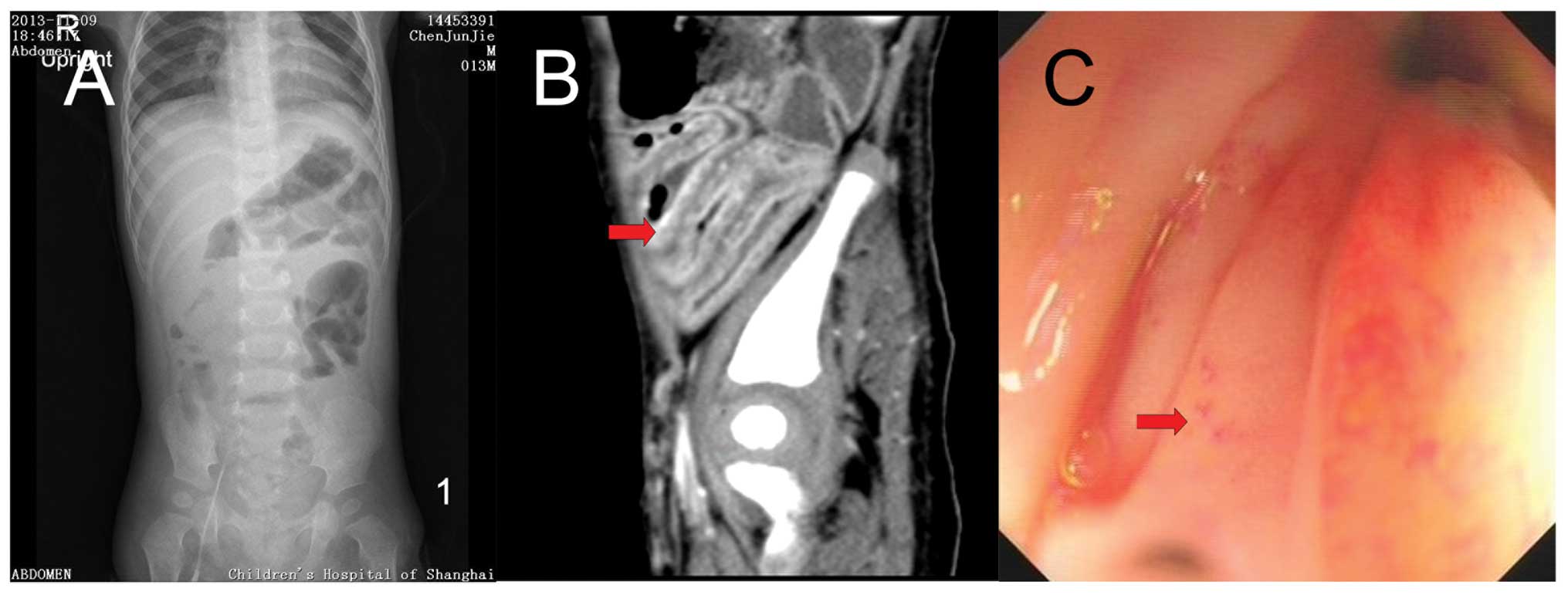
The routine blood examination showed white blood cells (WBC), 10.7–30.3 × 10⁹/1; hemoglobin, 85–129 g/1; platelet count, 305–616 × 109/1; and C-reactive protein, 3–19 mg/1. The blood biochemical examination demonstrated albumin, 11–38 g/1; globulin, 10–16 g/1; K+, 2.8-5.5 mmol/1; Na+, 131–143 mmol/1; and Ca2+, 1.69-2.25 mmol/1. The routine stool examination showed WBC, 2–20/high power (HP); red blood cells, 0–15/HP; and positive fecal occult blood test. Multiple stool cultivation was negative. The fecal bacteria population test showed 50% enterobacteria and 50% enterococcus on admission. Fecal C. difficile toxin A and B was negative during days 11–13 of hospitalization. Other laboratory tests showed no significant abnormalities. Abdominal images, including ultrasound, X-ray and enhanced computed tomography revealed a swallowed-segmented intestinal wall, cellulitis, ascites and pleural effusion. Colonoscopy on day 16 of hospitalization showed left colitis (Fig. 1).

Figure 1.

(A) X-ray showing a dilated bowel. (B) Enhanced abdominal computed tomography revealing a swallowed-segmented intestinal wall (red arrow). (C) Colonoscopy revealing left colitis with erosion, erythematous and edema (red arrow).

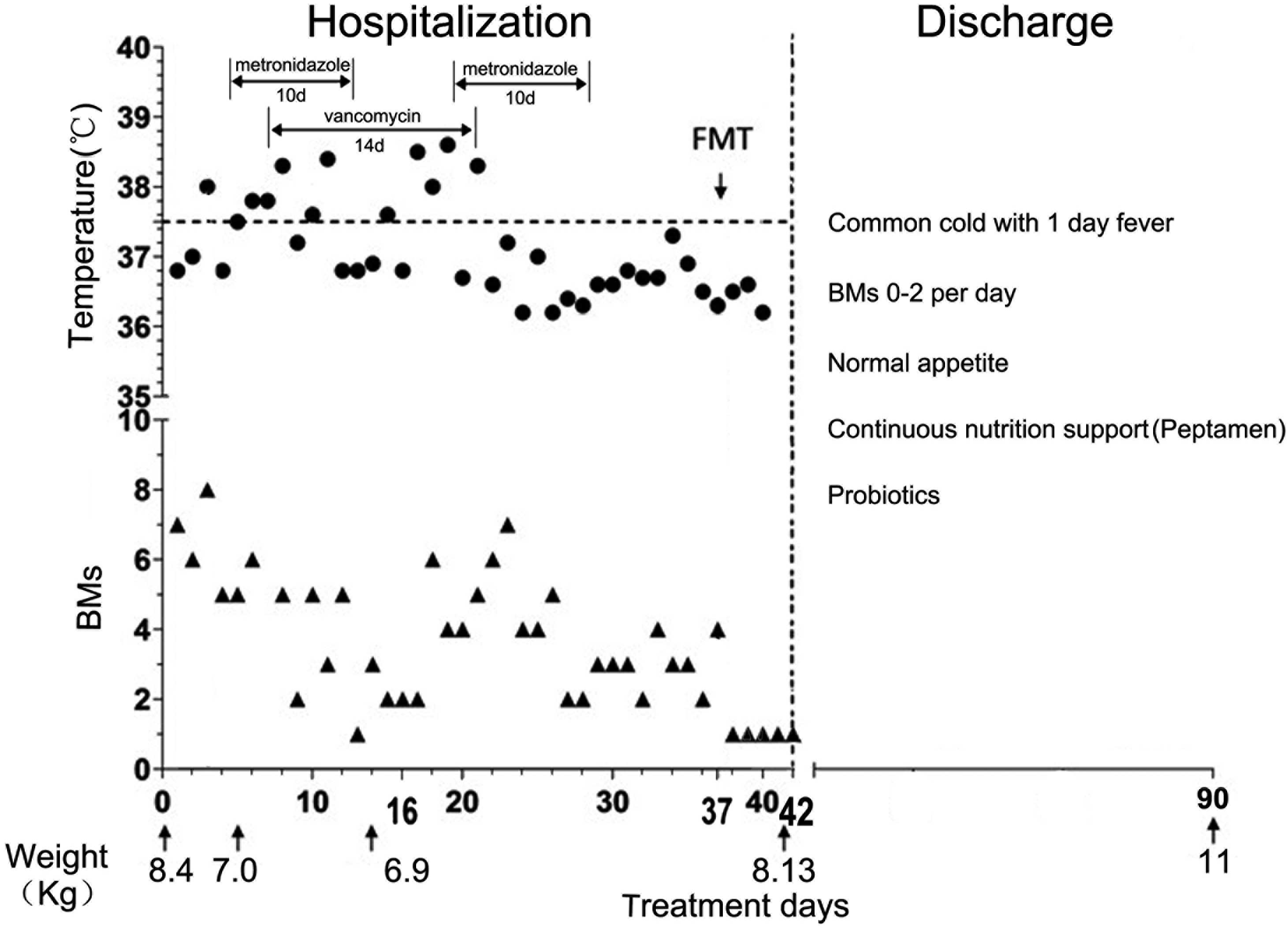
The condition of the infant was improved with nutritional support, correction of electrolytes, acid-base disturbance, supply of albumin, and intravenous immunoglobulin. Edema gradually faded on day 7 and completely disappeared on day 14 following hospitalization. The patient was treated with two rounds of oral metronidazole for 10 days, with vancomycin for 14 days, and finally a single FMT (the feces donor was the mother of the patient) was performed via a nasal jejunal feeding tube on day 96 following the initiation of the disease, which was day 37 from admission. The patient completely recovered and was released on day 5 post-FMT. The temperature, stool frequency, weight, major antibiotics and medical procedure patterns are shown in Fig. 2. Normal appetite, normal bowel movement frequency and satisfactory weight were exhibited during the 4 months post-FMT.

Figure 2.

Temperature, stool frequency, weight, major antibiotics and medical procedure patterns. BM, bowel movements (stool frequency); d, days.

Discussion

Based on the clinical features and the response of whole treatment, severe PME was the final diagnosis of the infant in the present study. The diagnosis of PME was based on the following reasons: i) Diarrhea was persistent, and there were intestinal mucosae in the stools more than once; ii) the patient presented risk factors, including multiple broad-spectrum antibiotics application, long-term fasting, exploratory laparotomy and high ligation of inguinal hernia; and iii) although the use of metronidazole and vancomycin in the Children's Hospital (Jiangxi, China) was ineffective, empirical treatment with adequate dosage and duration of metronidazole combined with vancomycin showed partial effectiveness in Shanghai Children's Hospital (Shanghai, China). The effectiveness of FMT was positive.

According to the guidelines by the Society for Healthcare Epidemiology of America (SHEA) and the Infectious Diseases Society of America (IDSA) (1), the definition for the usual presentation of CDI includes the following findings: i) The presence of diarrhea, defined as passage of ≥3 unformed stools in ≤24 consecutive hours; and ii) a stool test result positive for the presence of toxigenic C. difficile or its toxins, or colonoscopic or histopathological findings demonstrating pseudomembranous colitis. The guideline also indicated the difficulties for CDI diagnosis. SHEA-IDSA defined severe CDI as leukocytosis with a WBC of ≥15,000/l or a serum creatinine level ≥1.5 times the premorbid level (1). The European Society of Clinical Microbiology and Infectious Diseases defined severe CDI as serum albumin <3 g/dl plus one of the following; WBC >15×109/l and abdominal tenderness (3). Although, C. difficile toxin tests during the hospitalization were all negative, possibly due to the antibiotic treatment prior to the toxin tests. Colonscopy was not performed until the infant reached a stable general condition (day 16 of hospitalization). Relatively late timing may be the reason for missing the typical image findings and possible positive C. difficile detection.

In the present case, diarrhea was persistent, serum albumin was <1g/d1, and WBC was >15×109/1 for many examinations, with the highest being 30×109/1. Abdominal images revealed swallowed-segmented intestinal sigmoid colon and rectum. The temperature of the patient was >38.5°C. All the parameters of the present case assisted in the diagnosis of severe CDI. In China, there are only a few case reports regarding severe CDI (8–11). None of the studies are supported by the toxin, fecal bacteria population test and culture. Due to the population size of China, antibiotic abuse and the few cases reported, severe CDI is extremely under-recognized, particularly in children. In the next few years, more progress is required for pediatric CDI in China, including clinical diagnosis, treatment and research.

References

1 

Cohen SH, Gerding DN, Johnson S, Kelly CP, Loo VG, McDonald LC, et al: Clinical practice guidelines for Clostridium difficile infection in adults: 2010 update by the society for healthcare epidemiology of America (SHEA) and the infectious diseases society of America (IDSA). Infect Control Hosp Epidemiol. 31:431–455. 2010.PubMed/NCBI

2 

Sammons JS, Toltzis P and Zaoutis TE: Clostridium difficile Infection in children. JAMA Pediatr. 167:567–573. 2013. View Article : Google Scholar : PubMed/NCBI

3 

Surawicz CM, Brandt LJ, Binion DG, Ananthakrishnan AN, Curry SR, Gilligan PH, et al: Guidelines for diagnosis, treatment, and prevention of Clostridium difficile infections. Am J Gastroenterol. 108:478–498. 2013. View Article : Google Scholar : PubMed/NCBI

4 

Brandt LJ, Aroniadis OC, Mellow M, Kanatzar A, Kelly C, Park T, et al: Long-term follow-up of colonoscopic fecal microbiota transplant for recurrent Clostridium difficile infection. Am J Gastroenterol. 107:1079–1087. 2012. View Article : Google Scholar : PubMed/NCBI

5 

Borody TJ, Warren EF, Leis SM, Surace R, Ashman O and Siarakas S: Bacteriotherapy using fecal flora: toying with human motions. J Clin Gastroenterol. 38:475–483. 2004. View Article : Google Scholar : PubMed/NCBI

6 

Russell G, Kaplan J, Ferraro M and Michelow IC: Fecal bacteriotherapy for relapsing Clostridium difficile infection in a child: a proposed treatment protocol. Pediatrics. 126:e239–242. 2010. View Article : Google Scholar : PubMed/NCBI

7 

van Nood EI, Vrieze A, Nieuwdorp M, Fuentes S, et al: Duodenal infusion of donor feces for recurrent Clostridium difficile. N Engl J Med. 368:407–415. 2013. View Article : Google Scholar : PubMed/NCBI

8 

He JQ, Li JD and Mo QH: Severe pseudomembranous enterocolitis-one case report and review of literature. Hainan Med J. 19:137–138. 2008.(In Chinese).

9 

Li WH, Liu XL and Tian YL: Clinical analysis of 62 psendomembranons colitis patient. Chongqing Med J. 41:2379–2381. 2001.(In Chinese).

10 

Wang L, Gao J and Cheng WP: Clinical analysis of 9 psendomembranons colitis patient. Pract Clin Med. 13:22–30. 2012.(In Chinese).

11 

Zhang L, Zhang YD, Duan LF, Liang Y and Gong QM: Severe pseudomembranous colitic induced by antibiotics in 1 patient. Chin J Clin Pharmacol. 26:684–686. 2010.(In Chinese).

Related Articles

  • Abstract
  • View
  • Download
  • Twitter
Copy and paste a formatted citation
Spandidos Publications style
Wang J, Xiao Y, Lin K, Song F, Ge T and Zhang T: Pediatric severe pseudomembranous enteritis treated with fecal microbiota transplantation in a 13-month-old infant. Biomed Rep 3: 173-175, 2015.
APA
Wang, J., Xiao, Y., Lin, K., Song, F., Ge, T., & Zhang, T. (2015). Pediatric severe pseudomembranous enteritis treated with fecal microbiota transplantation in a 13-month-old infant. Biomedical Reports, 3, 173-175. https://doi.org/10.3892/br.2014.403
MLA
Wang, J., Xiao, Y., Lin, K., Song, F., Ge, T., Zhang, T."Pediatric severe pseudomembranous enteritis treated with fecal microbiota transplantation in a 13-month-old infant". Biomedical Reports 3.2 (2015): 173-175.
Chicago
Wang, J., Xiao, Y., Lin, K., Song, F., Ge, T., Zhang, T."Pediatric severe pseudomembranous enteritis treated with fecal microbiota transplantation in a 13-month-old infant". Biomedical Reports 3, no. 2 (2015): 173-175. https://doi.org/10.3892/br.2014.403
Copy and paste a formatted citation
x
Spandidos Publications style
Wang J, Xiao Y, Lin K, Song F, Ge T and Zhang T: Pediatric severe pseudomembranous enteritis treated with fecal microbiota transplantation in a 13-month-old infant. Biomed Rep 3: 173-175, 2015.
APA
Wang, J., Xiao, Y., Lin, K., Song, F., Ge, T., & Zhang, T. (2015). Pediatric severe pseudomembranous enteritis treated with fecal microbiota transplantation in a 13-month-old infant. Biomedical Reports, 3, 173-175. https://doi.org/10.3892/br.2014.403
MLA
Wang, J., Xiao, Y., Lin, K., Song, F., Ge, T., Zhang, T."Pediatric severe pseudomembranous enteritis treated with fecal microbiota transplantation in a 13-month-old infant". Biomedical Reports 3.2 (2015): 173-175.
Chicago
Wang, J., Xiao, Y., Lin, K., Song, F., Ge, T., Zhang, T."Pediatric severe pseudomembranous enteritis treated with fecal microbiota transplantation in a 13-month-old infant". Biomedical Reports 3, no. 2 (2015): 173-175. https://doi.org/10.3892/br.2014.403
Follow us
  • Twitter
  • LinkedIn
  • Facebook
About
  • Spandidos Publications
  • Careers
  • Cookie Policy
  • Privacy Policy
How can we help?
  • Help
  • Live Chat
  • Contact
  • Email to our Support Team