Introduction
Obstructive sleep apnea (OSA) is a common sleep
disorder, characterized by repeated intermittent hypoxia and/or
hypercapnia, frequent micro-arousals and sleep fragmentation
(1). Although the occurrence of OSA
contributes to anatomical and mechanical factors (e.g., repetitive
episodes of pharyngeal collapse) (2),
the exact pathophysiological mechanisms have not yet been
clarified. Growing evidence indicates that OSA is a complex
disorder involving multiple traits, particularly those with a
heritable component (3,4).
The macromolecule apolipoprotein E (ApoE) may play a
role maintaining patency of the pharyngeal airway by increasing the
activity of pharyngeal dilator muscles (5). ApoE is a plasma protein from the
lipoprotein transport system that plays a central role in
lipoprotein homeostasis and hyperlipidemia is a common risk factor
in patients with OSA (6,7). In addition, ApoE is confirmed to be a
risk factor for OSA-associated cardiovascular diseases (8,9). Thus, the
relationship between ApoE polymorphisms and risk of OSA has been
investigated extensively. Understanding the pathophysiological role
of the ApoE gene in OSA is essential for developing therapeutic
strategies.
The ApoE gene is located on chromosome 19q13.2, with
three common alleles: ε2, ε3 and ε4. Six ApoE phenotypes (ε2/ε2,
ε3/ε3, ε2/ε4, ε3/ε3, ε4/ε3 and ε4/ε4) are defined by these alleles
and the ε3/ε3 phenotype is the most common. Several multiple
case-control, cohort and family-based studies have investigated
ApoE polymorphisms and susceptibility to OSA (10–19).
However, contradictory data have been published and sample sizes
were relatively small. Thus, to obtain a more precise estimate of
the association, we systematically collected all published studies
and performed this meta-analysis to evaluate the association
between the ApoE ε2 and ε4 alleles and susceptibility to OSA.
Materials and methods
We performed this meta-analysis strictly abiding by
the recommendations of the Preferred Reporting Items for Systematic
Reviews and Meta-Analysis statement (20).
Literature search
The electronic databases PubMed and Embase were
searched to identify all eligible studies focusing on the
association between the ApoE polymorphism and OSA. The last search
was completed on April 30, 2014. The formats of the search terms
used were as follows: (sleep disordered breathing or SDB or
obstructive sleep apnea or OSA) and (apolipoprotein E or ApoE or
APOE). In addition, we manually searched relevant published or
ongoing studies and reviewed the reference lists of all eligible
studies to increase the yield of our search. This search work was
performed separately by two authors (Drs Xu and Qian). No language
restrictions were applied.
Inclusion and exclusion criteria
Studies included for the meta-analysis satisfied the
following criteria: i) evaluation of the ApoE polymorphism and OSA
susceptibility; ii) case-control, cohort, or family-based design
with case and control populations; and iii) had the ApoE genotype
carrier allele (i.e., a dominant model) distributions so odds
ratios (ORs) and 95% confidence intervals (CIs) could be estimated
or directly reported OR and 95% CI. Studies were excluded if they
were: i) reviews, abstracts, or conference papers not reporting
original research results; ii) no control population; iii) no
sufficient data of the ApoE genotype distribution to calculate OR
and 95% CI; and iv) did not use polysomnography (PSG) to diagnose
OSA.
Data extraction
Two investigators (Drs Xu and Qian) independently
extracted data from all included studies. If discrepancies existed,
a third reviewer (Dr Guan) participated and disputes were resolved
through consensus. The authors of the studies were contacted if
there were queries or further study details were needed. The
following information was collected from each eligible study: first
author, year of publication, country (ethnicity), general
information [e.g., age, body mass index (BMI), proportion of males
and apnea-hypopnea index (AHI)], sample size (including cases and
controls), genotype information, study design and genotyping
method.
Statistical analysis
Stata version 11.0 (StataCorp, College Station, TX,
USA) was used for all analyses. We examined ApoE ε2 and ε4 carrier
allele genotypes. ORs and 95% CIs were calculated from the number
of allele carriers included in each study. The strength of the
associations between the ε2 and ε4 alleles and OSA susceptibility
was estimated by ORs and 95% CIs. The aforementioned possession was
used according to the DerSimonian and Laird method and a
random-effects model was considered both between- and
within-studies (21). The
Hardy-Weinberg equilibrium (HWE) of genotype distributions was
examined in control subjects. We examined heterogeneity across the
eligible studies using the Q-test (P<0.1 was considered
significant) and I2 statistic (I2<25%,
I2=25–50%, I2=50–75% and I2>75%
represented no, moderate, large and extreme heterogeneity,
respectively) (22). Subgroup analyses
and meta-regression were performed to explore the source of the
heterogeneity. A sensitivity analysis was performed to assess the
stability of the results. We deleted one of the included studies at
a time to determine the contribution of their data to the pooled
ORs. The Begg and Egger's test was used to evaluate publication
bias (23,24).
Results
Search results and study
characteristics
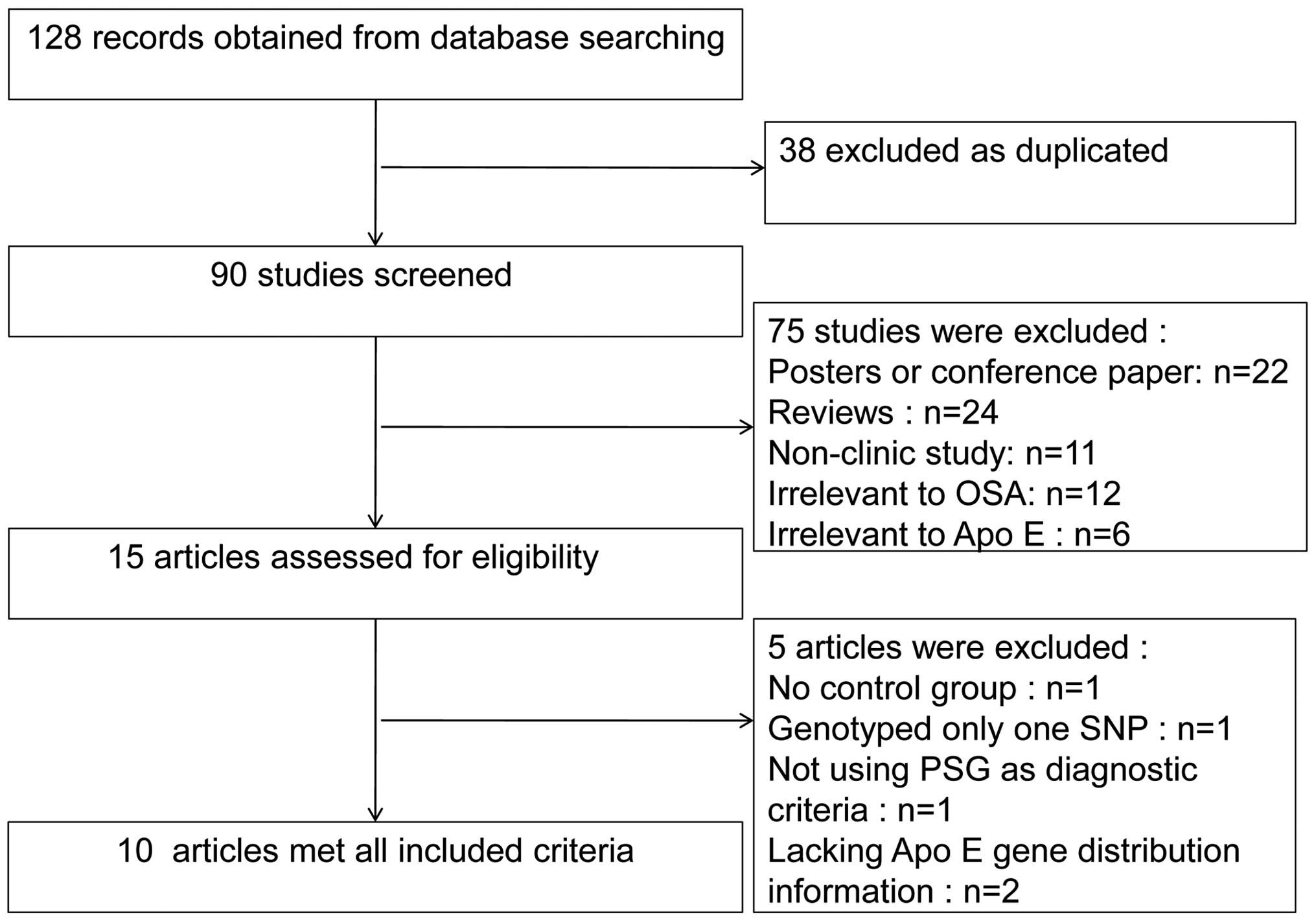
After the initial search, 128 citations were
identified from the electronic databases. Thirty-eight citations
were excluded because of duplication. Then, 90 potentially relevant
studies on the ApoE polymorphism and OSA risk were selected. After
we carefully read the titles and abstracts of these studies, an
additional 75 studies were excluded for the following reasons:
poster or conference study (n=22), review (n=24), non-clinical
study (n=11), irrelevant to OSA (n=12) and irrelevant to ApoE
(n=6). Then, 15 potentially appropriate studies were retained for
additional consideration. After carefully reading the content of
these articles, five were excluded for the following reasons: no
control group (25), genotyped only
one of the two single-nucleotide polymorphisms (26), did not use PSG as a diagnostic criteria
(27), or lacked ApoE gene
distribution information (28,29). Thus, 10 studies consisting of 1,696
cases/2,216 controls for the ε2 allele and 2,449 cases/5,592
controls for the ε4 allele were included in this meta-analysis
(10–19)
(Fig. 1). Among these studies, seven
were conducted in the USA (11–15,17,19), one in
Finland (10), one in Italy (16) and one in the UK (18). Five studies involved Caucasians
(10,12,16–18), one included Asians (11) and four included mixed populations
(13–15,19). Six
studies were performed with a case-control design (10,15–19) and the other four were performed as
cohort studies (11–14). The basic characteristics of the cases
and controls from the studies are listed in Table I. Polymorphisms were identified by
isoelectric focusing, cysteamine treatment, immunoblotting
(11), polymerase chain reaction (PCR)
(18,19)
or PCR-restriction fragment length polymorphism (12,14,16,17). Three
studies provided detailed genotypes of the ApoE distribution
(10,16,17) and the
HWE values of these studies were 0.39, 0.52 and <0.01
respectively.
 | Table I.Characteristics of all studies
included in the meta-analysis. |
Table I.
Characteristics of all studies
included in the meta-analysis.
|
|
|
|
| Obstructive sleep
apnea | Controls | Relative risk of
ε2+ | Relative risk of
ε4+ |
|
|
|
|---|
|
|
|
|
|
|
|
|
|
|
|
|
|---|
| Author (year) | Country | Ethnicity | Study design | No. | Age | Male(%) | BMI | AHI | No. | Age | Male(%) | BMI | AHI | OR | 95% CI | OR | 95% CI | Geno-typing | HWE | (Refs.) |
|---|
| Saarelainen et
al (1998) | Finland | Caucasian | Case-control | 291 | 53.3 (26–75) | 264 (90.7) | NR | ≥5 | 728 | 53.7 (39–70) | 565 (77.6) | NR | <5 | 0.80 | 0.52–1.25 | 1.00 | 0.75–1.33 | a | 0.39 | (10) |
| Foley et al
(2001) | USA | East Asian | Cohort | 302 | NR | NR | NR | ≥15 | 416 | NR | NR | NR | <15 | NR | NR | 0.78 | 0.53–1.16 | NR | CNC | (11) |
| Kadotani et
al (2001) | USA | Caucasian | Cohort | 67 | NR | NR | NR | ≥15 | 724 | NR | NR | NR | <15 | NR | NR | 1.83 | 1.09–3.06 | PCR-RFLP | CNC | (12) |
| Gottlieb et
al (2004) | USA | 88% Caucasian | Cohort | 338 | NR | NR | NR | ≥15 | 1,437 | NR | NR | NR | <15 | NR | NR | 1.25 | 0.96–1.63 | NR | Yes | (13) |
| Larkin et al
(2006) | USA | Caucasian and
African-American | Cohort | 415 | NR | NR | NR | ≥20 | 796 | NR | NR | NR | <20 | 1.46 | 1.02–2.08 | 0.75 | 0.58–0.97 | PCR-RFLP | CNC | (14) |
| Gozal et al
(2007) | USA | Mixed | Case-control | 146 | 6.3±0.3 | 79 (54) | 17±0.4 | 8.6±2b | 199 | 6.4±0.3 | 109 | 17±1 |
0.8±0.3b | NR | NR | 8.04 | 2.30–28.15 | PCR | CNC | (15) |
| Cosentino et
al (2008) | Italy | Caucasian | Case-control | 123 | 58.6±9.4 | 82 (65.7) | 36.1±7.3 | 45.5±27 | 121 | 57.±10.2 | 78 (65.5) | 30±10.6 | <15 | 1.25 | 0.48–3.28 | 1.21 | 0.64–2.31 | PCR-RELP | 0.52 | (16) |
| Nikodemova et
al (2013) | USA | Caucasian | Case-control | 697 | 50±11.2 | 458 (65.7) | 32.0±5.7 | 37.3±28.5 | 1,146 | 52.1±9.9 | 620 (54) | 28.9±5.6 | 1.4±1.4 | 0.93 | 0.70–1.22 | 0.90 | 0.73–1.11 | PCR-RFLP | <0.01 | (17) |
| Tisko et al
(2014) | UK | Caucasian | Case-control | 391 | 56.5±9.6 | 301 (77) | 34.3±7.4 | 17.6±15.0 | 128 | 47±12.1 | 68 (53) | 28.2±4.3 | 2.3±1.4 | 0.71 | 0.40–1.27 | CNC | CNC | PCR | CNC | (18) |
| Osorio et al
(2014) | USA | Mixed | Case-control | 70 | 68.4±7.5 | 29 (41.4) | 26.4±5.7 | 14.4±12.7 | 25 | 65.3±8.2 | 8 (32) | 24.2±3.9 | 2.3±1.2 | 0.59 | 0.18–1.97 | 1.18 | 0.43–3.23 | PCR | CNC | (19) |
Pooled analysis
ApoE ε2 and ε4 carriers and the risk
for OSA
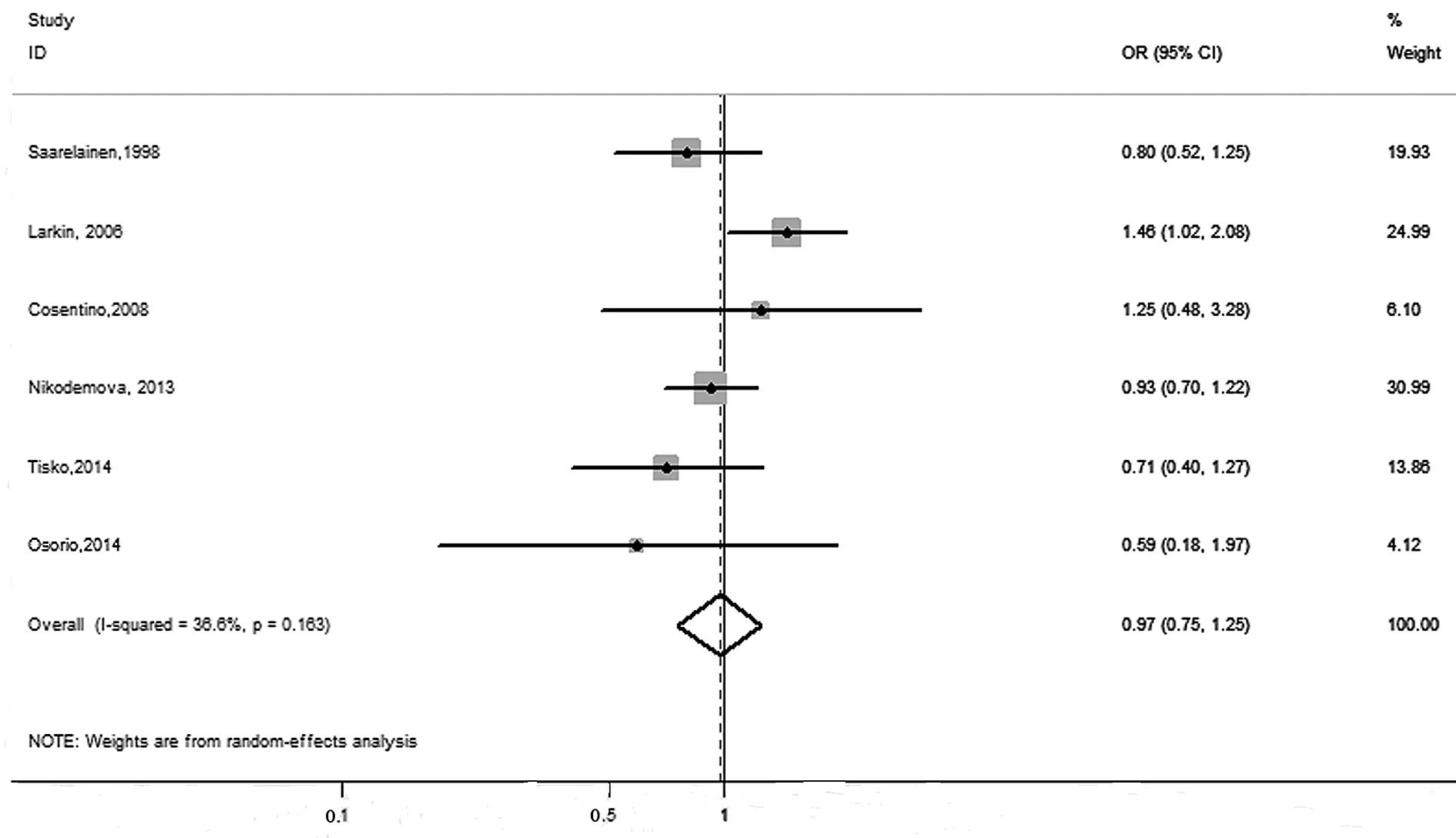
Of the 10 included studies, six focused on the
relationship between ApoE ε2 carriers and increased susceptibility
to OSA. Only one study (14) reported
a higher risk for OSA, whereas the other five studies (10,16–19) showed no association between OSA and the
ε2 allele. In the overall analysis, the pooled data showed no
association between the ε2 allele and the risk of OSA (OR=0.97, 95%
CI: 0.75–1.25). A moderate heterogeneity was found when all six
studies were combined for the ε2 carriers vs. the ε2 non-carriers
(I2=36.6%, P=0.16) (Fig.
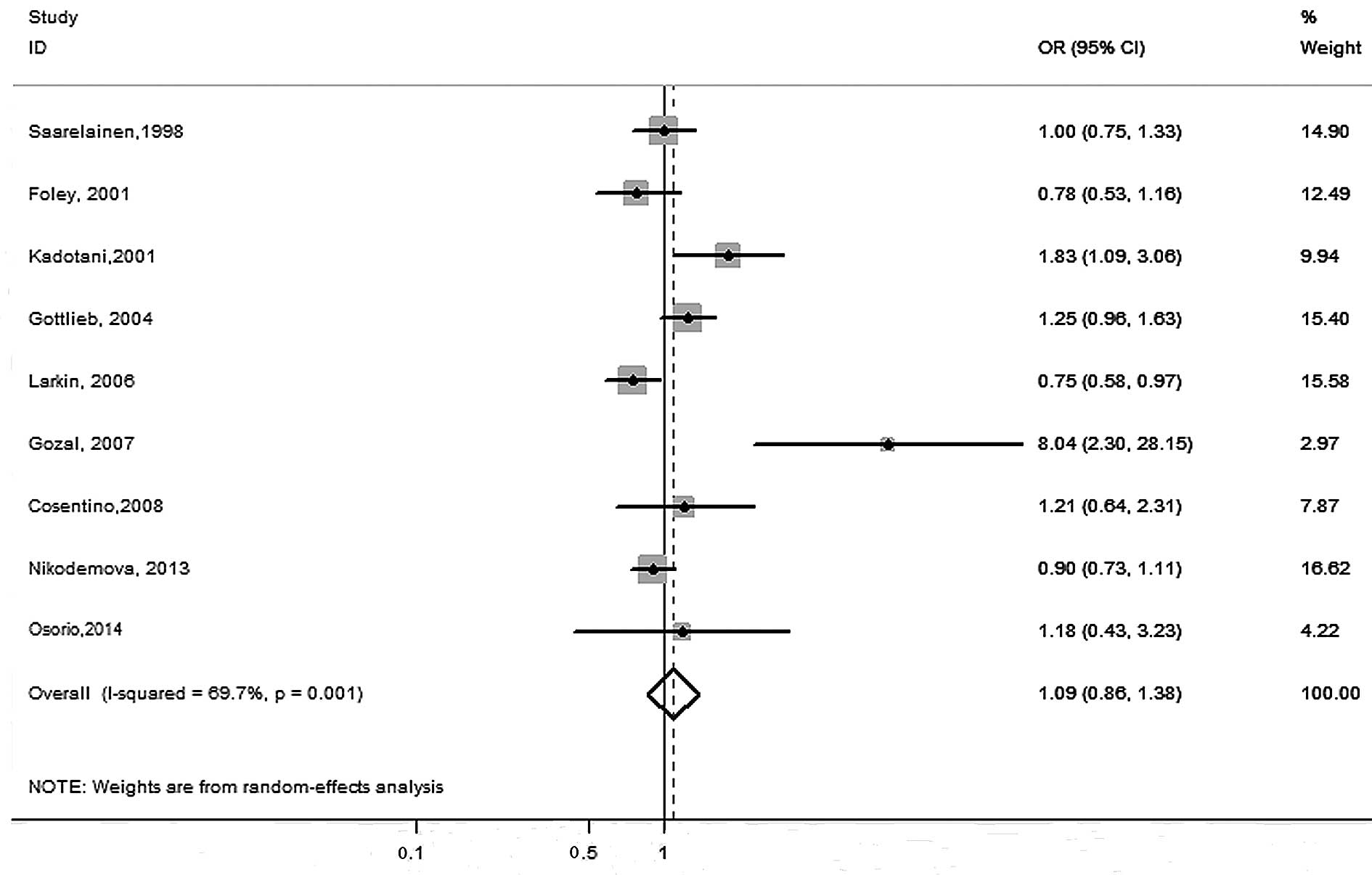
2). Nine studies included the ε4 carrier allele, but the
association with OSA susceptibility across the studies varied
widely. Among them, two studies (12,15) showed a
higher risk of OSA; however, that conducted by Larkin et al
(14) reported a decreased risk of
OSA. No association between OSA and the ε4 allele was found for the
remaining studies. Our meta-analysis combined all genotype
information and found no association between the ApoE ε4 carrier
allele and an increased susceptibility to OSA (OR=1.09, 95% CI:
0.86–1.38) (Fig. 3). Additionally,
high heterogeneity was found when all nine studies for the ε4
carriers vs. ε4 non-carriers were combined (I2=69.7%,
P=0.001) (Fig. 3).
Meta-regression and subgroup
analyses
We conducted a meta-regression analysis to determine
the source of the heterogeneity. The concrete results of the
meta-regression analysis are presented in Table II. No significant effects were
demonstrated with respect to any of the examined covariates,
including mean age, BMI and AHI, as well as the proportion of
males, proportion of subjects of European descent and ApoE ε2 or ε4
allele frequency, indicating that these factors did not
significantly explain the heterogeneity across the studies. We
sorted the available data and conducted sub-group meta-analyses
according to two potential confounders: origin of study (Europe or
North America) and source of study (community- or hospital-based)
to determine the source of the heterogeneity. The subgroup analysis
for the ε2 and ε4 carrier alleles showed that studies from Europe
were homogeneous (I2=0.0%, P=0.611; I2=0.0%,
P=0.595, respectively), whereas studies from the US were
heterogeneous (I2=58.7%, P=0.089; I2=76.9%,
P=<0.001, respectively); however, the ORs of these two subgroups
were not different [Europe: 0.81 (0.58–1.13), 1.03 (0.79–1.34);
North America: 1.08 (0.72–1.61), 1.12 (0.83–1.52), respectively].
The subgroup analysis showed that the heterogeneous ε2 and ε4
carrier alleles existed in community-based studies
(I2=50.6%, P=0.155; I2=72.3%, P=0.006,
respectively) and that the heterogeneous ε4 carrier allele existed
in the hospital-based studies (I2=74.8%, P=0.008);
however, the homogeneous ε2 carrier allele existed in
hospital-based studies (I2=0.0%, P=0.711). The summary
of the ORs was not different [community-based: 1.12 (0.50–2.51),
1.20 (0.79–1.83); hospital-based: 0.88 (0.71–1.09), 1.05
(0.75–1.47), respectively].
| Table II.Results of meta-regression analysis
examining the association of the ApoE ε2 and ε4 alleles with OSA
susceptibility. |
Table II.
Results of meta-regression analysis
examining the association of the ApoE ε2 and ε4 alleles with OSA
susceptibility.
|
| ApoE ε2 allele | ApoE ε4 allele |
|---|
|
|
|
|
|---|
| Meta-regression
variable | No. of studies | t | P-value | No. of studies | t | P-value |
|---|
| Mean age | 6 | −2.50 | 0.07 | 9 | −1.57 | 0.16 |
| Mean BMI | 5 | 0.21 | 0.85 | 8 | −1.44 | 0.20 |
| Mean AHI | 5 | −0.91 | 0.43 | 7 | −0.74 | 0.49 |
| Proportion of
males | 6 | −1.89 | 0.13 | 8 | 0.60 | 0.57 |
| Proportion of
subjects with European descent | 5 | −2.41 | 0.10 | 8 | 0.73 | 0.49 |
| ApoE ε2 or ε4
allele frequency | 6 | 1.12 | 0.33 | 9 | −1.15 | 0.29 |
Publication bias
Begg's funnel plots and Egger's linear regression
were used to evaluate publication bias. No evidence of publication
bias was detected for the association between either the ApoE ε2 or
ε4 carrier alleles with OSA according to Begg and Egger's tests
(P=0.71, P=0.61 and P=0.12, P=0.08, respectively). The Begg's
funnel plots were symmetrical (Figs. not shown).
Sensitivity analysis
A sensitivity analysis was performed to reflect the
influence of each of the studies to the pooled OR value. A
leave-one-out procedure was used to omit one study each time. ORs
(95% CIs) ranged from 0.87 (0.70–1.07) to 1.02 (0.78–1.35) and from
1.01 (0.84–1.21) to 1.17 (0.90–1.50) for the ApoE ε2 and ε4 carrier
allele model, respectively. These results demonstrate that none of
the studies influenced the pooled ORs of the ε2 and ε4 alleles.
Discussion
The present meta-analysis involving 10 publications
to evaluate the ApoE polymorphism and the risk of OSA included a
pool of 2,840 cases and 5,720 controls (1,696 cases/2,216 controls
for the ε2 allele and 2,449 cases/5,592 controls for the ε4 allele,
respectively). The results revealed that ApoE gene (i.e., ε2 or ε4
allele) expression was not associated with the risk of OSA.
Subgroup analyses did not show a significant association between
this polymorphism and OSA risk. Our findings show that ApoE
polymorphisms may have no role in the occurrence of OSA.
OSA is a polygenic and multi-factorial sleep
disorder disease based on sophisticated gene-environment or
gene-gene interactions (3,4). The association between the ApoE gene and
OSA has been investigated extensively. However, some studies
focused on the ApoE molecule as a cause of Alzheimer's disease
(19), cognitive deficit (15–17), or
lipid metabolism (18) in patients
with OSA. These results suggest that subjects with the ApoE
polymorphisms have higher risks for diseases other than OSA. The
results remain inconsistent when referring to OSA susceptibility.
Though one previous meta-analysis summarized the relationship
between the ApoE ε4 allele and the risk for OSA (30), the meta-analysis pooled only eight
studies on the ε4 allele (1,901 OSA cases and 4,607 controls) and
not pooled ApoE ε2 allele. Additionally, this meta-analysis
contained one inappropriate study (27), which made the conclusion questionable.
Therefore, it is essential for us to re-perform a meta-analysis to
evaluate the associations and the new combined results will be more
credible.
We found that variations in mean age, BMI, AHI,
gender, ethnic background and ApoE ε2 and ε4 alleles could not
explain the source of heterogeneity. We also formed subgroups
according to the origins or sources of the studies, but the
heterogeneity remained. Thus, other factors were likely involved in
the heterogeneity within studies. In addition, no significant
publication bias was found by the Begg and Egger's test.
Furthermore, our sensitivity analysis demonstrated that our results
were both reliable and stable.
Several limitations should be considered when
interpreting the results of our meta-analysis. First, eligible
studies that were not indexed or published may have resulted in
reporting bias. Second, moderate to large heterogeneity was
observed between the ApoE ε2 or ε4 alleles and OSA risk across all
the included studies. Although a random-effects model was used to
synthesize the data, the precision of the results may have been
affected. Third, only two of the included studies used the HWE.
Last, the overall sample size was relatively small; thus, our
meta-analysis may have been underpowered to detect a weak
association. Despite these limitations, this meta-analysis was
cost-effective and reasonable to evaluate these sporadic,
small-sample-size and inconsistent studies and to provide a robust
conclusion.
In conclusion, our meta-analysis suggested that
neither the ApoE ε2 allele nor the ε4 allele was associated with
the risk of OSA. Further well-designed studies with controls, use
of the HWE and larger samples are warranted to confirm these
findings.
Acknowledgements
No external funding sources were used for this
meta-analysis. The authors would like to thank Professors Paul E.
Peppard and Laurel Finn, Department of Population Health Sciences,
University of Wisconsin-Madison (Madison, WI, USA) for providing
original data on the genotype distributions of the ApoE
polymorphisms.
References
|
1
|
Malhotra A and White DP: Obstructive sleep
apnoea. Lancet. 360:237–245. 2002. View Article : Google Scholar : PubMed/NCBI
|
|
2
|
Patil SP, Schneider H, Schwartz AR and
Smith PL: Adult obstructive sleep apnea: pathophysiology and
diagnosis. Chest. 132:325–337. 2007. View Article : Google Scholar : PubMed/NCBI
|
|
3
|
Redline S, Tishler PV, Tosteson TD, et al:
The familial aggregation of obstructive sleep apnea. Am J Respir
Crit Care Med. 151:682–687. 1995. View Article : Google Scholar : PubMed/NCBI
|
|
4
|
Schwab RJ, Pasirstein M, Kaplan L, et al:
Family aggregation of upper airway soft tissue structures in normal
subjects and patients with sleep apnea. Am J Respir Crit Care Med.
173:453–463. 2006. View Article : Google Scholar : PubMed/NCBI
|
|
5
|
Akaaboune M, Villanova M, Festoff BW,
Sahuque M and Hantai D: Apolipoprotein E expression at
neuromuscular junctions in mouse, rat and human skeletal muscle.
FEBS Lett. 351:246–248. 1994. View Article : Google Scholar : PubMed/NCBI
|
|
6
|
Bennet AM, Di Angelantonio E, Ye Z, et al:
Association of apolipoprotein E genotypes with lipid levels and
coronary risk. JAMA. 298:1300–1311. 2007. View Article : Google Scholar : PubMed/NCBI
|
|
7
|
Dorasamy P: Obstructive sleep apnea and
cardiovascular risk. Ther Clin Risk Manag. 3:1105–1111.
2007.PubMed/NCBI
|
|
8
|
Stengard JH, Zerba KE, Pekkanen J, Ehnholm
C, Nissinen A and Sing CF: Apolipoprotein E polymorphism predicts
death from coronary heart disease in a longitudinal study of
elderly Finnish men. Circulation. 91:265–269. 1995. View Article : Google Scholar : PubMed/NCBI
|
|
9
|
Hung J, Whitford EG, Parsons RW and
Hillman DR: Association of sleep apnoea with myocardial infarction
in men. Lancet. 336:261–264. 1990. View Article : Google Scholar : PubMed/NCBI
|
|
10
|
Saarelainen S, Lehtimaki T, Kallonen E,
Laasonen K, Poussa T and Nieminen MM: No relation between
apolipoprotein E alleles and obstructive sleep apnea. Clin Genet.
53:147–148. 1998. View Article : Google Scholar : PubMed/NCBI
|
|
11
|
Foley DJ, Masaki K, White L and Redline S:
Relationship between apolipoprotein E epsilon4 and sleep-disordered
breathing at different ages. JAMA. 286:1447–1448. 2001.PubMed/NCBI
|
|
12
|
Kadotani H, Kadotani T, Young T, et al:
Association between apolipoprotein E epsilon4 and sleep-disordered
breathing in adults. JAMA. 285:2888–2890. 2001. View Article : Google Scholar : PubMed/NCBI
|
|
13
|
Gottlieb DJ, DeStefano AL, Foley DJ, et
al: APOE epsilon4 is associated with obstructive sleep
apnea/hypopnea: the Sleep Heart Health Study. Neurology.
63:664–668. 2004. View Article : Google Scholar : PubMed/NCBI
|
|
14
|
Larkin EK, Patel SR, Redline S, Mignot E,
Elston RC and Hallmayer J: Apolipoprotein E and obstructive sleep
apnea: evaluating whether a candidate gene explains a linkage peak.
Genet Epidemiol. 30:101–110. 2006. View Article : Google Scholar : PubMed/NCBI
|
|
15
|
Gozal D, Capdevila OS, Kheirandish-Gozal L
and Crabtree VM: APOE epsilon 4 allele, cognitive dysfunction, and
obstructive sleep apnea in children. Neurology. 69:243–249. 2007.
View Article : Google Scholar : PubMed/NCBI
|
|
16
|
Cosentino FI, Bosco P, Drago V, et al: The
APOE epsilon4 allele increases the risk of impaired spatial working
memory in obstructive sleep apnea. Sleep Med. 9:831–839. 2008.
View Article : Google Scholar : PubMed/NCBI
|
|
17
|
Nikodemova M, Finn L, Mignot E, Salzieder
N and Peppard PE: Association of sleep disordered breathing and
cognitive deficit in APOE epsilon4 carriers. Sleep. 36:873–880.
2013.PubMed/NCBI
|
|
18
|
Tisko R, Sopkova Z, Habalova V, et al:
Effects of apolipoprotein E genotype on serum lipids in obstructive
sleep apnoea. Eur Respir J. 43:1097–1105. 2014. View Article : Google Scholar : PubMed/NCBI
|
|
19
|
Osorio RS, Ayappa I, Mantua J, et al: The
interaction between sleep-disordered breathing and apolipoprotein E
genotype on cerebrospinal fluid biomarkers for Alzheimer's disease
in cognitively normal elderly individuals. Neurobiol Aging.
35:1318–1324. 2014. View Article : Google Scholar : PubMed/NCBI
|
|
20
|
Moher D, Liberati A, Tetzlaff J, Altman DG
and Group P: Preferred reporting items for systematic reviews and
meta-analyses: the PRISMA statement. Ann Intern Med. 151264–269.
(W264)2009. View Article : Google Scholar : PubMed/NCBI
|
|
21
|
DerSimonian R and Laird N: Meta-analysis
in clinical trials. Control Clin Trials. 7:177–188. 1986.
View Article : Google Scholar : PubMed/NCBI
|
|
22
|
Higgins JP and Thompson SG: Quantifying
heterogeneity in a meta-analysis. Stat Med. 21:1539–1558. 2002.
View Article : Google Scholar : PubMed/NCBI
|
|
23
|
Begg CB and Mazumdar M: Operating
characteristics of a rank correlation test for publication bias.
Biometrics. 50:1088–1101. 1994. View
Article : Google Scholar : PubMed/NCBI
|
|
24
|
Egger M and Smith GD: Bias in location and
selection of studies. BMJ. 316:61–66. 1998. View Article : Google Scholar : PubMed/NCBI
|
|
25
|
Pellegrino R, Mazzotti DR, Guindalini C,
Santos-Silva R, Bittencourt LR and Tufik S: Apolipoprotein E
polymorphisms and sleep quality in obstructive sleep apnea
syndrome. Clin Chim Acta. 412:2223–2227. 2011. View Article : Google Scholar : PubMed/NCBI
|
|
26
|
Kalra M, Pal P, Kaushal R, et al:
Association of ApoE genetic variants with obstructive sleep apnea
in children. Sleep Med. 9:260–265. 2008. View Article : Google Scholar : PubMed/NCBI
|
|
27
|
Craig D, Hart DJ and Passmore AP:
Genetically increased risk of sleep disruption in Alzheimer's
disease. Sleep. 29:1003–1007. 2006.PubMed/NCBI
|
|
28
|
O'Hara R, Schroder CM, Kraemer HC, et al:
Nocturnal sleep apnea/hypopnea is associated with lower memory
performance in APOE epsilon4 carriers. Neurology. 65:642–644. 2005.
View Article : Google Scholar : PubMed/NCBI
|
|
29
|
Lemoine P, Sassolas A, Lestra C, Laforest
L and Chamba G: Is there an interaction between sleep-disordered
breathing, depression and apolipoprotein E phenotype? Encephale.
30:360–362. 2004.(In French). View Article : Google Scholar : PubMed/NCBI
|
|
30
|
Thakre TP, Mamtani MR and Kulkarni H: Lack
of association of the APOE epsilon 4 allele with the risk of
obstructive sleep apnea: meta-analysis and meta-regression. Sleep.
32:1507–1511. 2009.PubMed/NCBI
|