Spandidos Publications Logo
  • About
    • About Spandidos
    • Aims and Scopes
    • Abstracting and Indexing
    • Editorial Policies
    • Reprints and Permissions
    • Job Opportunities
    • Terms and Conditions
    • Contact
  • Journals
    • All Journals
    • Oncology Letters
      • Oncology Letters
      • Information for Authors
      • Editorial Policies
      • Editorial Board
      • Aims and Scope
      • Abstracting and Indexing
      • Bibliographic Information
      • Archive
    • International Journal of Oncology
      • International Journal of Oncology
      • Information for Authors
      • Editorial Policies
      • Editorial Board
      • Aims and Scope
      • Abstracting and Indexing
      • Bibliographic Information
      • Archive
    • Molecular and Clinical Oncology
      • Molecular and Clinical Oncology
      • Information for Authors
      • Editorial Policies
      • Editorial Board
      • Aims and Scope
      • Abstracting and Indexing
      • Bibliographic Information
      • Archive
    • Experimental and Therapeutic Medicine
      • Experimental and Therapeutic Medicine
      • Information for Authors
      • Editorial Policies
      • Editorial Board
      • Aims and Scope
      • Abstracting and Indexing
      • Bibliographic Information
      • Archive
    • International Journal of Molecular Medicine
      • International Journal of Molecular Medicine
      • Information for Authors
      • Editorial Policies
      • Editorial Board
      • Aims and Scope
      • Abstracting and Indexing
      • Bibliographic Information
      • Archive
    • Biomedical Reports
      • Biomedical Reports
      • Information for Authors
      • Editorial Policies
      • Editorial Board
      • Aims and Scope
      • Abstracting and Indexing
      • Bibliographic Information
      • Archive
    • Oncology Reports
      • Oncology Reports
      • Information for Authors
      • Editorial Policies
      • Editorial Board
      • Aims and Scope
      • Abstracting and Indexing
      • Bibliographic Information
      • Archive
    • Molecular Medicine Reports
      • Molecular Medicine Reports
      • Information for Authors
      • Editorial Policies
      • Editorial Board
      • Aims and Scope
      • Abstracting and Indexing
      • Bibliographic Information
      • Archive
    • World Academy of Sciences Journal
      • World Academy of Sciences Journal
      • Information for Authors
      • Editorial Policies
      • Editorial Board
      • Aims and Scope
      • Abstracting and Indexing
      • Bibliographic Information
      • Archive
    • International Journal of Functional Nutrition
      • International Journal of Functional Nutrition
      • Information for Authors
      • Editorial Policies
      • Editorial Board
      • Aims and Scope
      • Abstracting and Indexing
      • Bibliographic Information
      • Archive
    • International Journal of Epigenetics
      • International Journal of Epigenetics
      • Information for Authors
      • Editorial Policies
      • Editorial Board
      • Aims and Scope
      • Abstracting and Indexing
      • Bibliographic Information
      • Archive
    • Medicine International
      • Medicine International
      • Information for Authors
      • Editorial Policies
      • Editorial Board
      • Aims and Scope
      • Abstracting and Indexing
      • Bibliographic Information
      • Archive
  • Articles
  • Information
    • Information for Authors
    • Information for Reviewers
    • Information for Librarians
    • Information for Advertisers
    • Conferences
  • Language Editing
Spandidos Publications Logo
  • About
    • About Spandidos
    • Aims and Scopes
    • Abstracting and Indexing
    • Editorial Policies
    • Reprints and Permissions
    • Job Opportunities
    • Terms and Conditions
    • Contact
  • Journals
    • All Journals
    • Biomedical Reports
      • Information for Authors
      • Editorial Policies
      • Editorial Board
      • Aims and Scope
      • Abstracting and Indexing
      • Bibliographic Information
      • Archive
    • Experimental and Therapeutic Medicine
      • Information for Authors
      • Editorial Policies
      • Editorial Board
      • Aims and Scope
      • Abstracting and Indexing
      • Bibliographic Information
      • Archive
    • International Journal of Epigenetics
      • Information for Authors
      • Editorial Policies
      • Editorial Board
      • Aims and Scope
      • Abstracting and Indexing
      • Bibliographic Information
      • Archive
    • International Journal of Functional Nutrition
      • Information for Authors
      • Editorial Policies
      • Editorial Board
      • Aims and Scope
      • Abstracting and Indexing
      • Bibliographic Information
      • Archive
    • International Journal of Molecular Medicine
      • Information for Authors
      • Editorial Policies
      • Editorial Board
      • Aims and Scope
      • Abstracting and Indexing
      • Bibliographic Information
      • Archive
    • International Journal of Oncology
      • Information for Authors
      • Editorial Policies
      • Editorial Board
      • Aims and Scope
      • Abstracting and Indexing
      • Bibliographic Information
      • Archive
    • Medicine International
      • Information for Authors
      • Editorial Policies
      • Editorial Board
      • Aims and Scope
      • Abstracting and Indexing
      • Bibliographic Information
      • Archive
    • Molecular and Clinical Oncology
      • Information for Authors
      • Editorial Policies
      • Editorial Board
      • Aims and Scope
      • Abstracting and Indexing
      • Bibliographic Information
      • Archive
    • Molecular Medicine Reports
      • Information for Authors
      • Editorial Policies
      • Editorial Board
      • Aims and Scope
      • Abstracting and Indexing
      • Bibliographic Information
      • Archive
    • Oncology Letters
      • Information for Authors
      • Editorial Policies
      • Editorial Board
      • Aims and Scope
      • Abstracting and Indexing
      • Bibliographic Information
      • Archive
    • Oncology Reports
      • Information for Authors
      • Editorial Policies
      • Editorial Board
      • Aims and Scope
      • Abstracting and Indexing
      • Bibliographic Information
      • Archive
    • World Academy of Sciences Journal
      • Information for Authors
      • Editorial Policies
      • Editorial Board
      • Aims and Scope
      • Abstracting and Indexing
      • Bibliographic Information
      • Archive
  • Articles
  • Information
    • For Authors
    • For Reviewers
    • For Librarians
    • For Advertisers
    • Conferences
  • Language Editing
Login Register Submit
  • This site uses cookies
  • You can change your cookie settings at any time by following the instructions in our Cookie Policy. To find out more, you may read our Privacy Policy.

    I agree
Search articles by DOI, keyword, author or affiliation
Search
Advanced Search
presentation
Biomedical Reports
Join Editorial Board Propose a Special Issue
Print ISSN: 2049-9434 Online ISSN: 2049-9442
Journal Cover
September-2015 Volume 3 Issue 5

Full Size Image

Sign up for eToc alerts
Recommend to Library

Journals

International Journal of Molecular Medicine

International Journal of Molecular Medicine

International Journal of Molecular Medicine is an international journal devoted to molecular mechanisms of human disease.

International Journal of Oncology

International Journal of Oncology

International Journal of Oncology is an international journal devoted to oncology research and cancer treatment.

Molecular Medicine Reports

Molecular Medicine Reports

Covers molecular medicine topics such as pharmacology, pathology, genetics, neuroscience, infectious diseases, molecular cardiology, and molecular surgery.

Oncology Reports

Oncology Reports

Oncology Reports is an international journal devoted to fundamental and applied research in Oncology.

Experimental and Therapeutic Medicine

Experimental and Therapeutic Medicine

Experimental and Therapeutic Medicine is an international journal devoted to laboratory and clinical medicine.

Oncology Letters

Oncology Letters

Oncology Letters is an international journal devoted to Experimental and Clinical Oncology.

Biomedical Reports

Biomedical Reports

Explores a wide range of biological and medical fields, including pharmacology, genetics, microbiology, neuroscience, and molecular cardiology.

Molecular and Clinical Oncology

Molecular and Clinical Oncology

International journal addressing all aspects of oncology research, from tumorigenesis and oncogenes to chemotherapy and metastasis.

World Academy of Sciences Journal

World Academy of Sciences Journal

Multidisciplinary open-access journal spanning biochemistry, genetics, neuroscience, environmental health, and synthetic biology.

International Journal of Functional Nutrition

International Journal of Functional Nutrition

Open-access journal combining biochemistry, pharmacology, immunology, and genetics to advance health through functional nutrition.

International Journal of Epigenetics

International Journal of Epigenetics

Publishes open-access research on using epigenetics to advance understanding and treatment of human disease.

Medicine International

Medicine International

An International Open Access Journal Devoted to General Medicine.

Journal Cover
September-2015 Volume 3 Issue 5

Full Size Image

Sign up for eToc alerts
Recommend to Library

  • Article
  • Citations
    • Cite This Article
    • Download Citation
    • Create Citation Alert
    • Remove Citation Alert
    • Cited By
  • Similar Articles
    • Related Articles (in Spandidos Publications)
    • Similar Articles (Google Scholar)
    • Similar Articles (PubMed)
  • Download PDF
  • Download XML
  • View XML
Article

Hypocretin/orexin prevents recovery from sickness

  • Authors:
    • Susumu Tanaka
    • Hiromi Toyoda
    • Yoshiko Honda
    • Yasuko Seki
    • Takeshi Sakurai
    • Kazuki Honda
    • Tohru Kodama
  • View Affiliations / Copyright

    Affiliations: Sleep Disorders Project, Department of Psychiatry and Behavioral Science, Tokyo Metropolitan Institute of Medical Science, Tokyo 156‑8506, Japan, Department of Molecular Neuroscience and Integrative Physiology, Faculty of Medicine, Kanazawa University, Kanazawa, Ishikawa 920‑8640, Japan
  • Pages: 648-650
    |
    Published online on: July 17, 2015
       https://doi.org/10.3892/br.2015.491
  • Expand metrics +
Metrics: Total Views: 0 (Spandidos Publications: | PMC Statistics: )
Metrics: Total PDF Downloads: 0 (Spandidos Publications: | PMC Statistics: )
Cited By (CrossRef): 0 citations Loading Articles...

This article is mentioned in:


Abstract

Sickness behavior is defined as states of lethargy, depression, anxiety, loss of appetite, hypersomnia, hyperalgesia, reduction of grooming and failure to concentrate that can be induced by inflammatory diseases, such as infections and cancer. Recent findings revealed that the lipopolysaccharide (LPS) injection causes lethargy as a consequence of the inhibition of hypocretin signaling. The hypocretin system maintains the vigilance state in various physiological processes. In order to investigate the sleep arousal system against sickness behavior, LPS‑induced sickness behavior was examined in hypocretin‑ataxin‑3 transgenic mice, whose hypocretin neurons were postnatally ablated. Sleep‑wake activity was determined following the administration of LPS at Zeitgeber time (ZT) 8.0 in ataxin‑3 transgenic mice, and the age‑, gender‑matched wild‑type littermates. LPS injection induced increases in non‑rapid eye movement (REM) sleep in the matched wild‑type littermates. In addition, a further increase in periods of sleep according to the loss of hypocretin neurons was identified in the ataxin‑3 transgenic mice. A marked reduction of awakening during ZT12‑ZT18 was observed as expected following LPS injection in the mouse lines. The increase in the period of non‑REM sleep was not observed on the next day following LPS administration in either of the mouse lines. Complete recovery of physical activity was not observed in the matched wild‑type littermates. Ataxin‑3 transgenic mice recovered their physical activity to the same level as that on the first day before LPS administration. These results suggest the possibility that a faster recovery is the result of deeper resting according to the absence of hypocretin neurons, as ataxin‑3 transgenic mice demonstrated more non-REM sleep.

Introduction

Sickness behavior is characterized as a reduction of normal locomotor activities in response to circadian rhythms and psychological changes that develop in inflammatory diseases, including infections and cancers. Administration of the bacterial endotoxin lipopolysaccharide (LPS) induces sickness behavior in rodents. Recently, hypocretin (also known as orexin) signaling was identified as one of the neural mediators against sickness behavior (1). Grossberg et al (1), showed that LPS injection induced the suppression of normal hypocretin signaling and inactivity. The hypothalamic neuropeptide hypocretin regulates various physiological processes such as wakefulness, sleep, food intake, energy expenditure and reward (2,3). Expression changes in the hypothalamic hypocretin have been reported regarding food restriction (4) and other physiological changes (5) to maintain the vigilance state. However, there is no study of how the absence of hypocretin is affected against sickness behavior.

In the present study, the significance of hypocretin signaling against sickness behavior was examined using LPS-induced inflammation in hypocretin-ataxin-3 transgenic mice, whose hypocretin neurons were postnatally ablated (6). In addition, the present study is important for the elucidation of the mechanism in narcolepsy patients with inflammatory diseases, whose hypocretin neurons were ablated (7).

Materials and methods

Ethical statement

All the experiments were conducted in accordance with the ‘Guidelines for Care and Use of Laboratory Animals’ of the National Institutes of Health and were approved by the Ethics Committee on Animal Experiments of Tokyo Metropolitan Institute of Medical Science (Tokyo, Japan).

Animals

The presence of the ataxin-3 transgene was identified by polymerase chain reaction using tail DNA. Male mice (12-week-old) were anesthetized and implanted with devices for continuous monitoring of electroencephalography (EEG)/electromyography (EMG), as described previously (8). Mice were housed under a 12-h light/dark cycle with lights on from 8:00 a.m. to 8:00 p.m., corresponding to Zeitgeber time (ZT) 0–12 h at 22–24°C, with ad libitum access to food and water. Mice were allowed to habituate to the recording conditions for 2 weeks.

LPS injections

On the second day at ZT8, mice received intraperitoneal injections of either LPS (Sigma-Aldrich, St. Louis, MO, USA) (250 µg/kg) dissolved in 0.9% saline or 0.9% saline alone. Each mouse was recorded for 3 consecutive 24-h periods. EEG/EMG were recorded without injection on the first day (intact day), and mice received LPS or saline alone and underwent EEG/EMG on the second day (LPS or saline day, respectively), and subsequently EEG/EMG were recorded without injection on the third day again (recovery day). A total of 4 male ataxin-3 transgenic mice and 4 matched wild-type littermates were recorded concurrently. EEG/EMG signals were amplified using an EEG/EMG amplifier (MEG-6116; Nihon Kohden Corp., Tokyo, Japan) through a 5-strand cable with a slip-ring that allowed free movement of the mice. The amplifier was connected to a personal computer with an analog-to-digital converter and SleepSign software (Kissei Comtec, Nagano, Japan) for acquiring and processing data. EEG/EMG records were visually scored into 4-sec epochs of wakefulness (high EMG amplitude), rapid eye movement (REM) sleep [silent low EMG amplitude, low EEG amplitude with high values in the θ band (4.0–8.0 Hz)], and non-REM sleep [low EMG amplitude, high EEG amplitude with high power density in the δ band (0.5–4.0 Hz)] according to the standard criteria of rodent sleep (9). Relative sleep and wakefulness periods were standardized by the mean of each proportion of the corresponding time on the intact day. The standardized data are expressed as the mean of 4 independent animals ± standard error.

Statistical analysis

Distributions of sleep/wakefulness periods in ataxin-3 transgenic mice were compared to those in the matched wild-type littermates using Student's t-test (two-tailed test). P<0.05 was considered to indicate a statistically significant difference.

Results

Changes in sleep/wakefulness periods

There was no significant difference regarding non-REM sleep periods in the light phase following injection (ZT9-ZT12) or wakefulness periods in the dark phase (ZT12-ZT18) between the intact day and saline day in ataxin-3 transgenic mice or matched wild-type littermates, respectively (data not shown).

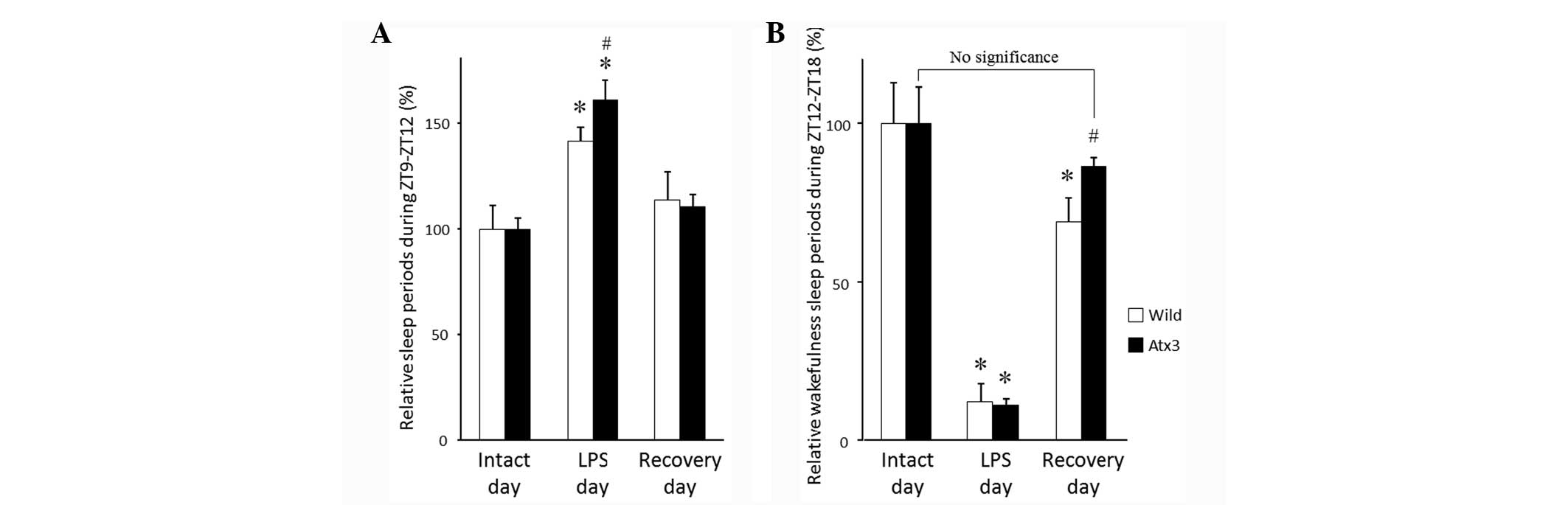
By contrast, non-REM sleep periods (ZT9-ZT12) were significantly increased following LPS injection on the LPS day in ataxin-3 transgenic mice (P<0.01) or matched wild-type littermates (P<0.0005) compared with mice on the intact day (Fig. 1A). Non-REM sleep periods during ZT9-ZT12 of the ataxin-3 transgenic mice were significantly increased following LPS injection on the LPS day compared with that of the matched wild-type littermates (P<0.05) (Fig. 1A), suggesting that the ataxin-3 transgenic mice demonstrate more sleep during sickness behavior. Wakefulness periods during ZT12-ZT18 were significantly decreased following LPS injection on the LPS day in ataxin-3 transgenic mice (P<0.0005) and matched wild-type littermates (P<0.0005) compared with mice on the intact day (Fig. 1B). On the day following LPS injection (recovery day), the significant reduction in the wakefulness period during ZT12-ZT18 was retained in the matched wild-type littermates (P<0.05); however, there was no significant difference between wakefulness periods on the intact day or recovery day in the ataxin-3 transgenic mice compared with mice on the intact day (Fig. 1B).

Figure 1.

Changes in sleep/wakefulness periods following lipopolysaccharide (LPS) injection in ataxin-3 transgenic mice. (A) Relative sleep period during Zeitgeber time 9 (ZT9)-ZT12 standardized by the intact day. (B) Relative wakefulness periods during ZT12-ZT18 standardized by the intact day. *P<0.05, significant differences in each day compared with the intact day. #P<0.05, significant differences in ataxin-3 transgenic mice compared with wild-type littermates. White bars indicate the matched wild-type littermates (n=4) and black bars are ataxin-3 transgenic mice (n=4). Atx3, ataxin-3 transgenic mice; wild, wild-type littermates.

Discussion

Previously, LPS injection was reported to induce increases in non-REM sleep (10). In the present study, increases in the periods of non-REM sleep induced by LPS injection were observed in the matched wild-type littermates. In addition, further increases in sleep according to hypocretin loss in ataxin-3 transgenic mice were demonstrated. The marked reduction of activity was observed as expected following LPS injection in the mouse lines. The marked increase in the quantity of sleep was not observed on the recovery day in either line. The complete recovery of the physical activity was not observed in the matched wild-type littermates; however, it was confirmed that the ataxin-3 transgenic mice recovered their physical activity to the same as the intact day levels.

Hypocretin is known to regulate the sleep arousal process. When there are no hypocretin neurons, it can be hypothesized that the ataxin-3 transgenic mice will show an increase in sleep. Hypocretin is suppressed in wild-type mice by inflammation (1); however, it is believed that hypocretin neurons are not completely inhibited in LPS-induced sickness behavior of wild-type mice. Therefore, differences in sickness behavior between ataxin-3 transgenic mice and matched wild-type littermates on the LPS day in the present study may be explained with/without hypocretin signaling.

Notably, it was suggested that the recovery from sickness in the ataxin-3 transgenic mice was quicker when compared with that in the matched wild-type littermates. As the ataxin-3 transgenic mice get more sleep, it is suggested that their faster recovery is the result of longer rest on the LPS day.

Hypocretin is necessary for healthy people to maintain wakefulness. Hypocretin, however, may be one of the factors preventing recovery during sickness. The evolutionary merit of this system is explained by wild animals, for whom an extended, deep sleep may be dangerous. By contrast, humans are usually completely protected when sick. Therefore, recovery during a cold may be faster if combination therapies involving cold medicine and a hypocretin antagonist (11,12) are administered.

Acknowledgements

The present study was supported by JSPS KAKENHI grant no. 23700458 to S. Tanaka.

References

1 

Grossberg AJ, Zhu X, Leinninger GM, Levasseur PR, Braun TP, Myers MG Jr and Marks DL: Inflammation-induced lethargy is mediated by suppression of orexin neuron activity. J Neurosci. 31:11376–11386. 2011. View Article : Google Scholar : PubMed/NCBI

2 

de Lecea L and Sutcliffe JG: The hypocretins and sleep. FEBS J. 272:5675–5688. 2005. View Article : Google Scholar : PubMed/NCBI

3 

Sakurai T: The neural circuit of orexin (hypocretin): Maintaining sleep and wakefulness. Nat Rev Neurosci. 8:171–181. 2007. View Article : Google Scholar : PubMed/NCBI

4 

Mieda M, Willie JT, Hara J, Sinton CM, Sakurai T and Yanagisawa M: Orexin peptides prevent cataplexy and improve wakefulness in an orexin neuron-ablated model of narcolepsy in mice. Proc Natl Acad Sci USA. 101:4649–4654. 2004. View Article : Google Scholar : PubMed/NCBI

5 

Harris GC and Aston-Jones G: Arousal and reward: A dichotomy in orexin function. Trends Neurosci. 29:571–577. 2006. View Article : Google Scholar : PubMed/NCBI

6 

Hara J, Beuckmann CT, Nambu T, et al: Genetic ablation of orexin neurons in mice results in narcolepsy, hypophagia and obesity. Neuron. 30:345–354. 2001. View Article : Google Scholar : PubMed/NCBI

7 

Peyron C, Faraco J, Rogers W, et al: A mutation in a case of early onset narcolepsy and a generalized absence of hypocretin peptides in human narcoleptic brains. Nat Med. 6:991–997. 2000. View Article : Google Scholar : PubMed/NCBI

8 

Chemelli RM, Willie JT, Sinton CM, et al: Narcolepsy in orexin knockout mice: Molecular genetics of sleep regulation. Cell. 98:437–451. 1999. View Article : Google Scholar : PubMed/NCBI

9 

Radulovacki M, Virus RM, Djuricic-Nedelson M and Green RD: Adenosine analogs and sleep in rats. J Pharmacol Exp Ther. 228:268–274. 1984.PubMed/NCBI

10 

Morrow JD and Opp MR: Diurnal variation of lipopolysaccharide-induced alterations in sleep and body temperature of interleukin-6-deficient mice. Brain Behav Immun. 19:40–51. 2005. View Article : Google Scholar : PubMed/NCBI

11 

Cao M and Guilleminault C: Hypocretin and its emerging role as a target for treatment of sleep disorders. Curr Neurol Neurosci Rep. 11:227–234. 2011. View Article : Google Scholar : PubMed/NCBI

12 

Roecker AJ and Coleman PJ: Orexin receptor antagonists: Medicinal chemistry and therapeutic potential. Curr Top Med Chem. 8:977–987. 2008. View Article : Google Scholar : PubMed/NCBI

Related Articles

  • Abstract
  • View
  • Download
  • Twitter
Copy and paste a formatted citation
Spandidos Publications style
Tanaka S, Toyoda H, Honda Y, Seki Y, Sakurai T, Honda K and Kodama T: Hypocretin/orexin prevents recovery from sickness. Biomed Rep 3: 648-650, 2015.
APA
Tanaka, S., Toyoda, H., Honda, Y., Seki, Y., Sakurai, T., Honda, K., & Kodama, T. (2015). Hypocretin/orexin prevents recovery from sickness. Biomedical Reports, 3, 648-650. https://doi.org/10.3892/br.2015.491
MLA
Tanaka, S., Toyoda, H., Honda, Y., Seki, Y., Sakurai, T., Honda, K., Kodama, T."Hypocretin/orexin prevents recovery from sickness". Biomedical Reports 3.5 (2015): 648-650.
Chicago
Tanaka, S., Toyoda, H., Honda, Y., Seki, Y., Sakurai, T., Honda, K., Kodama, T."Hypocretin/orexin prevents recovery from sickness". Biomedical Reports 3, no. 5 (2015): 648-650. https://doi.org/10.3892/br.2015.491
Copy and paste a formatted citation
x
Spandidos Publications style
Tanaka S, Toyoda H, Honda Y, Seki Y, Sakurai T, Honda K and Kodama T: Hypocretin/orexin prevents recovery from sickness. Biomed Rep 3: 648-650, 2015.
APA
Tanaka, S., Toyoda, H., Honda, Y., Seki, Y., Sakurai, T., Honda, K., & Kodama, T. (2015). Hypocretin/orexin prevents recovery from sickness. Biomedical Reports, 3, 648-650. https://doi.org/10.3892/br.2015.491
MLA
Tanaka, S., Toyoda, H., Honda, Y., Seki, Y., Sakurai, T., Honda, K., Kodama, T."Hypocretin/orexin prevents recovery from sickness". Biomedical Reports 3.5 (2015): 648-650.
Chicago
Tanaka, S., Toyoda, H., Honda, Y., Seki, Y., Sakurai, T., Honda, K., Kodama, T."Hypocretin/orexin prevents recovery from sickness". Biomedical Reports 3, no. 5 (2015): 648-650. https://doi.org/10.3892/br.2015.491
Follow us
  • Twitter
  • LinkedIn
  • Facebook
About
  • Spandidos Publications
  • Careers
  • Cookie Policy
  • Privacy Policy
How can we help?
  • Help
  • Live Chat
  • Contact
  • Email to our Support Team