Spandidos Publications Logo
  • About
    • About Spandidos
    • Aims and Scopes
    • Abstracting and Indexing
    • Editorial Policies
    • Reprints and Permissions
    • Job Opportunities
    • Terms and Conditions
    • Contact
  • Journals
    • All Journals
    • Oncology Letters
      • Oncology Letters
      • Information for Authors
      • Editorial Policies
      • Editorial Board
      • Aims and Scope
      • Abstracting and Indexing
      • Bibliographic Information
      • Archive
    • International Journal of Oncology
      • International Journal of Oncology
      • Information for Authors
      • Editorial Policies
      • Editorial Board
      • Aims and Scope
      • Abstracting and Indexing
      • Bibliographic Information
      • Archive
    • Molecular and Clinical Oncology
      • Molecular and Clinical Oncology
      • Information for Authors
      • Editorial Policies
      • Editorial Board
      • Aims and Scope
      • Abstracting and Indexing
      • Bibliographic Information
      • Archive
    • Experimental and Therapeutic Medicine
      • Experimental and Therapeutic Medicine
      • Information for Authors
      • Editorial Policies
      • Editorial Board
      • Aims and Scope
      • Abstracting and Indexing
      • Bibliographic Information
      • Archive
    • International Journal of Molecular Medicine
      • International Journal of Molecular Medicine
      • Information for Authors
      • Editorial Policies
      • Editorial Board
      • Aims and Scope
      • Abstracting and Indexing
      • Bibliographic Information
      • Archive
    • Biomedical Reports
      • Biomedical Reports
      • Information for Authors
      • Editorial Policies
      • Editorial Board
      • Aims and Scope
      • Abstracting and Indexing
      • Bibliographic Information
      • Archive
    • Oncology Reports
      • Oncology Reports
      • Information for Authors
      • Editorial Policies
      • Editorial Board
      • Aims and Scope
      • Abstracting and Indexing
      • Bibliographic Information
      • Archive
    • Molecular Medicine Reports
      • Molecular Medicine Reports
      • Information for Authors
      • Editorial Policies
      • Editorial Board
      • Aims and Scope
      • Abstracting and Indexing
      • Bibliographic Information
      • Archive
    • World Academy of Sciences Journal
      • World Academy of Sciences Journal
      • Information for Authors
      • Editorial Policies
      • Editorial Board
      • Aims and Scope
      • Abstracting and Indexing
      • Bibliographic Information
      • Archive
    • International Journal of Functional Nutrition
      • International Journal of Functional Nutrition
      • Information for Authors
      • Editorial Policies
      • Editorial Board
      • Aims and Scope
      • Abstracting and Indexing
      • Bibliographic Information
      • Archive
    • International Journal of Epigenetics
      • International Journal of Epigenetics
      • Information for Authors
      • Editorial Policies
      • Editorial Board
      • Aims and Scope
      • Abstracting and Indexing
      • Bibliographic Information
      • Archive
    • Medicine International
      • Medicine International
      • Information for Authors
      • Editorial Policies
      • Editorial Board
      • Aims and Scope
      • Abstracting and Indexing
      • Bibliographic Information
      • Archive
  • Articles
  • Information
    • Information for Authors
    • Information for Reviewers
    • Information for Librarians
    • Information for Advertisers
    • Conferences
  • Language Editing
Spandidos Publications Logo
  • About
    • About Spandidos
    • Aims and Scopes
    • Abstracting and Indexing
    • Editorial Policies
    • Reprints and Permissions
    • Job Opportunities
    • Terms and Conditions
    • Contact
  • Journals
    • All Journals
    • Biomedical Reports
      • Information for Authors
      • Editorial Policies
      • Editorial Board
      • Aims and Scope
      • Abstracting and Indexing
      • Bibliographic Information
      • Archive
    • Experimental and Therapeutic Medicine
      • Information for Authors
      • Editorial Policies
      • Editorial Board
      • Aims and Scope
      • Abstracting and Indexing
      • Bibliographic Information
      • Archive
    • International Journal of Epigenetics
      • Information for Authors
      • Editorial Policies
      • Editorial Board
      • Aims and Scope
      • Abstracting and Indexing
      • Bibliographic Information
      • Archive
    • International Journal of Functional Nutrition
      • Information for Authors
      • Editorial Policies
      • Editorial Board
      • Aims and Scope
      • Abstracting and Indexing
      • Bibliographic Information
      • Archive
    • International Journal of Molecular Medicine
      • Information for Authors
      • Editorial Policies
      • Editorial Board
      • Aims and Scope
      • Abstracting and Indexing
      • Bibliographic Information
      • Archive
    • International Journal of Oncology
      • Information for Authors
      • Editorial Policies
      • Editorial Board
      • Aims and Scope
      • Abstracting and Indexing
      • Bibliographic Information
      • Archive
    • Medicine International
      • Information for Authors
      • Editorial Policies
      • Editorial Board
      • Aims and Scope
      • Abstracting and Indexing
      • Bibliographic Information
      • Archive
    • Molecular and Clinical Oncology
      • Information for Authors
      • Editorial Policies
      • Editorial Board
      • Aims and Scope
      • Abstracting and Indexing
      • Bibliographic Information
      • Archive
    • Molecular Medicine Reports
      • Information for Authors
      • Editorial Policies
      • Editorial Board
      • Aims and Scope
      • Abstracting and Indexing
      • Bibliographic Information
      • Archive
    • Oncology Letters
      • Information for Authors
      • Editorial Policies
      • Editorial Board
      • Aims and Scope
      • Abstracting and Indexing
      • Bibliographic Information
      • Archive
    • Oncology Reports
      • Information for Authors
      • Editorial Policies
      • Editorial Board
      • Aims and Scope
      • Abstracting and Indexing
      • Bibliographic Information
      • Archive
    • World Academy of Sciences Journal
      • Information for Authors
      • Editorial Policies
      • Editorial Board
      • Aims and Scope
      • Abstracting and Indexing
      • Bibliographic Information
      • Archive
  • Articles
  • Information
    • For Authors
    • For Reviewers
    • For Librarians
    • For Advertisers
    • Conferences
  • Language Editing
Login Register Submit
  • This site uses cookies
  • You can change your cookie settings at any time by following the instructions in our Cookie Policy. To find out more, you may read our Privacy Policy.

    I agree
Search articles by DOI, keyword, author or affiliation
Search
Advanced Search
presentation
Biomedical Reports
Join Editorial Board Propose a Special Issue
Print ISSN: 2049-9434 Online ISSN: 2049-9442
Journal Cover
November-2015 Volume 3 Issue 6

Full Size Image

Sign up for eToc alerts
Recommend to Library

Journals

International Journal of Molecular Medicine

International Journal of Molecular Medicine

International Journal of Molecular Medicine is an international journal devoted to molecular mechanisms of human disease.

International Journal of Oncology

International Journal of Oncology

International Journal of Oncology is an international journal devoted to oncology research and cancer treatment.

Molecular Medicine Reports

Molecular Medicine Reports

Covers molecular medicine topics such as pharmacology, pathology, genetics, neuroscience, infectious diseases, molecular cardiology, and molecular surgery.

Oncology Reports

Oncology Reports

Oncology Reports is an international journal devoted to fundamental and applied research in Oncology.

Experimental and Therapeutic Medicine

Experimental and Therapeutic Medicine

Experimental and Therapeutic Medicine is an international journal devoted to laboratory and clinical medicine.

Oncology Letters

Oncology Letters

Oncology Letters is an international journal devoted to Experimental and Clinical Oncology.

Biomedical Reports

Biomedical Reports

Explores a wide range of biological and medical fields, including pharmacology, genetics, microbiology, neuroscience, and molecular cardiology.

Molecular and Clinical Oncology

Molecular and Clinical Oncology

International journal addressing all aspects of oncology research, from tumorigenesis and oncogenes to chemotherapy and metastasis.

World Academy of Sciences Journal

World Academy of Sciences Journal

Multidisciplinary open-access journal spanning biochemistry, genetics, neuroscience, environmental health, and synthetic biology.

International Journal of Functional Nutrition

International Journal of Functional Nutrition

Open-access journal combining biochemistry, pharmacology, immunology, and genetics to advance health through functional nutrition.

International Journal of Epigenetics

International Journal of Epigenetics

Publishes open-access research on using epigenetics to advance understanding and treatment of human disease.

Medicine International

Medicine International

An International Open Access Journal Devoted to General Medicine.

Journal Cover
November-2015 Volume 3 Issue 6

Full Size Image

Sign up for eToc alerts
Recommend to Library

  • Article
  • Citations
    • Cite This Article
    • Download Citation
    • Create Citation Alert
    • Remove Citation Alert
    • Cited By
  • Similar Articles
    • Related Articles (in Spandidos Publications)
    • Similar Articles (Google Scholar)
    • Similar Articles (PubMed)
  • Download PDF
  • Download XML
  • View XML
Article

Assessment of autonomic nervous system function in nursing students using an autonomic reflex orthostatic test by heart rate spectral analysis

  • Authors:
    • Mao Hasegawa
    • Azusa Hayano
    • Atsushi Kawaguchi
    • Ryuya Yamanaka
  • View Affiliations / Copyright

    Affiliations: Department of Medical Science, Graduate School of Nursing for Health Care Science, Kyoto Prefectural University of Medicine, Kyoto 602‑8566, Japan, Department of Biomedical Statistics and Bioinformatics, Graduate School of Medicine, Kyoto University, Kyoto 606‑8501, Japan
  • Pages: 831-834
    |
    Published online on: August 28, 2015
       https://doi.org/10.3892/br.2015.512
  • Expand metrics +
Metrics: Total Views: 0 (Spandidos Publications: | PMC Statistics: )
Metrics: Total PDF Downloads: 0 (Spandidos Publications: | PMC Statistics: )
Cited By (CrossRef): 0 citations Loading Articles...

This article is mentioned in:


Abstract

Nursing students experience academic demands, such as tests, theoretical and practical coursework, research activities, various aspects of professional practice, and contact with health professionals and patients. Consequently, nursing students face numerous types of stress, and increased stress levels contribute to physical and psychological distress in nursing students. The aim of the present study was to investigate the autonomic nervous system function of nursing students by assessing active standing load using the autonomic reflex orthostatic tolerance test, which enables quantitative analysis of dynamic autonomic nervous system function. The autonomic nervous system activity in the resting state was low in fourth‑year students, they had parasympathetic hypotension, and there was a tendency towards higher sympathetic nervous system activity of fourth‑year students compared with first‑, second‑ and third‑year students. In the standing state, there was a trend towards a higher autonomic nervous system activity response of fourth‑year students compared with first‑, second‑ and third‑year students. These results suggest that stress may influence autonomic nervous activity in fourth‑year nursing students. By correcting stress in fourth‑year nursing students, it may be possible to prevent the development of health problems.

Introduction

The autonomic nervous system coordinates bodily functions to ensure homeostasis (cardiovascular and respiratory control, thermal regulation, gastrointestinal motility, urinary and bowel excretory functions, reproduction, and metabolic and endocrine physiology) and adaptive responses to stress (1). Autonomic responses to psychological stress induce activation of sympathetic nerves with inhibition of the parasympathetic nervous system and adrenocortical hormone release to the heart, leading to increased heart rate, cardiac output and blood pressure (2). Psychological factors contribute to physiological processes (such as sweating, cardiovascular and gastrointestinal arousal) via the autonomic nervous system (3). Stress is a major contributor to psychosocial and physical pathological conditions (4).

Nursing students experience academic demands, such as tests, theoretical and practical coursework, research activities, various aspects of professional practice, and contact with health professionals and patients. Consequently, nursing students face numerous types of stress (5). Thus, increased stress levels contribute to physical and psychological distress in nursing students (6–8). There is a concern that the added demands of modern nursing programs place the students under greater pressure due to competing demands (9). Therefore, we hypothesized that high-grade students faced greater stressors, and consequently had abnormal functioning of the autonomic nervous system.

The aim of the present study was to examine the functioning of the autonomic nervous system in nursing students by assessing active standing load using the autonomic reflex orthostatic tolerance test that enables quantitative analysis of dynamic autonomic nervous system function.

Materials and methods

Design and participants

There were 121 nursing students (22 first-, 35 second-, 23 third- and 41 fourth-year students) enrolled at the Kyoto Prefectural University of Medicine (Kyoto, Japan). These data are >70% of stable R-R intervals without noise. There were 3 (2.5%) males and 118 (97.5%) females, and the average age was 20.6±1.8 years (range, 18–33 years). The investigation was carried out between October 1, 2014 and January 31, 2015.

Data collection and analysis

For measurements of the autonomic nervous system functions, a heart rate variability analysis method was used (10). Heart rate and autonomic nervous activity were measured. Electrocardiogram measurements were obtained in a sitting position for 2 min, in a standing position for 2 min and in a resting position for 1 min for autonomic reflex orthostatic tolerance test. Real-time analysis was performed using heart rate variability analysis software by Crosswell Co., Inc., (Yokohama, Japan). The coefficient of variation of R-R intervals (CVRR) obtained from electrocardiograms were divided into high-frequency (HF) and low-frequency (LF) components by power spectrum analysis to evaluate the autonomic nervous activity. The HF component reflects parasympathetic nervous activity, while the LF/HF reflects sympathetic nervous activity. Coefficient of component variance for HF (CCVHF) reflects the parasympathetic nervous index, and CVRR as the variability of overall autonomic nervous system activity. ΔCVRR was used as the response of the autonomic nervous system. ΔLF/HF was used as the sympathetic nervous system function in the standing position. ΔCCVHF was used as the parasympathetic nervous system function in the sitting position. The differences between the groups of each parameter were analyzed using the Wilcoxon/Kruskal-Wallis test. A two-tailed P<0.05 was considered to indicate a statistically significant difference.

Ethics consideration

The study received Ethics approval from the Institutional Review Board of the Kyoto Prefectural University of Medicine (notice no. of determination: ERB-E-76, 2014). The students received an information sheet that explained the purpose of the study and methods, and were provided with assurance that participation was voluntary and that their personal information would be kept confidential during and following the study.

Results

Resting and standing states

The results of every student year for resting state are shown in Table I. The activity of the autonomic nervous system (CVRR) of fourth-year students was lower compared with first-year students (fourth-year students, 5.02±1.37; first-year students, 5.80±1.53; P=0.017). There was a trend of the sympathetic nervous system activity (LF/HF) of fourth-year students to be higher compared with other student years (fourth-year students, 3.69±3.57; third-year students, 2.10±1.97; P=0.08). The parasympathetic nervous system activity (CCVHF) of fourth-year students was lower compared with third-year students (fourth-year students, 2.23±0.85; third-year students, 2.73±0.89; P=0.015). The results for every student years for the standing state are shown in Table II. There was a trend of ΔCVRR of fourth-year students to be higher compared with other student years (fourth-year students, 3.35±2.09; second-year students, 2.38±2.56; P=0.10). There was a trend of the sympathetic nervous system response (ΔLF/HF) of fourth-year students to be lower among the other student years.

Table I.

Autonomic nervous system functions of the resting state in different student nursing years.

Table I.

Autonomic nervous system functions of the resting state in different student nursing years.

VariablesFirst year, n=22Second year, n=35Third year, n=23Fourth year, n=41 Wilcoxon/Kruskal-Wallis testing result
CVRR 5.80±1.53 5.50±1.55 5.68±1.75 5.02±1.37First vs. fourth; P=0.017
LF/HF 2.97±2.34 2.80±2.44 2.10±1.97 3.69±3.57NS
CCVHF 2.46±0.75 2.36±0.77 2.73±0.89 2.23±0.85Third vs. fourth; P=0.015
Heart rate 73.72±9.50 70.82±8.90 72.70±11.42 73.18±8.98NS

[i] Data are average ± standard deviation. NS, not significant; CVRR, coefficient of variation of R-R intervals; LF, low-frequency; HF, high-frequency; CCVHF, coefficient of component variance for HF.

Table II.

Autonomic nervous system functions of the standing state in different student nursing years.

Table II.

Autonomic nervous system functions of the standing state in different student nursing years.

VariablesFirst year, n=22Second year, n=35Third year, n=23Fourth year, n=41 Wilcoxon/Kruskal-Wallis testing result
ΔCVRR 2.57±2.13 2.38±2.56 2.76±1.71 3.35±2.09NS
ΔLF/HF 4.20±7.47 3.94±7.88 3.60±4.39 2.60±3.61NS
ΔCCVHF 0.57±0.41 0.46±0.40 0.48±0.65 0.38±0.71NS
Heart rate 7.55±4.27 7.47±4.43 7.48±3.45 8.03±4.53NS

[i] Data are average ± standard deviation. NS, not significant; CVRR, coefficient of variation of R-R intervals; LF, low-frequency; HF, high-frequency; CCVHF, coefficient of component variance for HF.

Autonomic nervous system functions

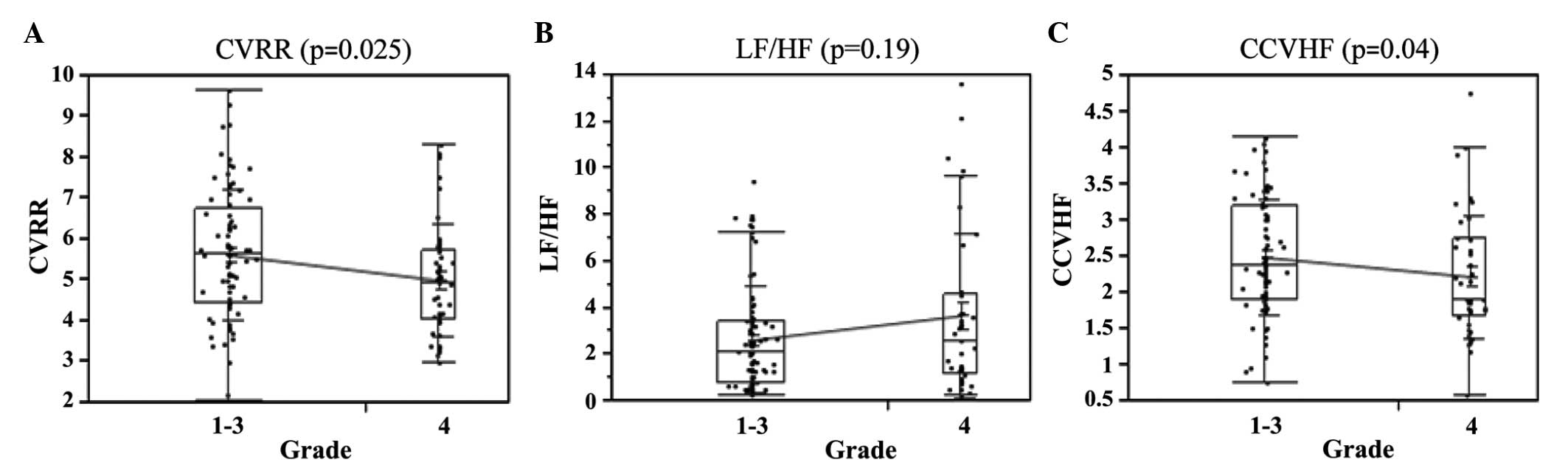
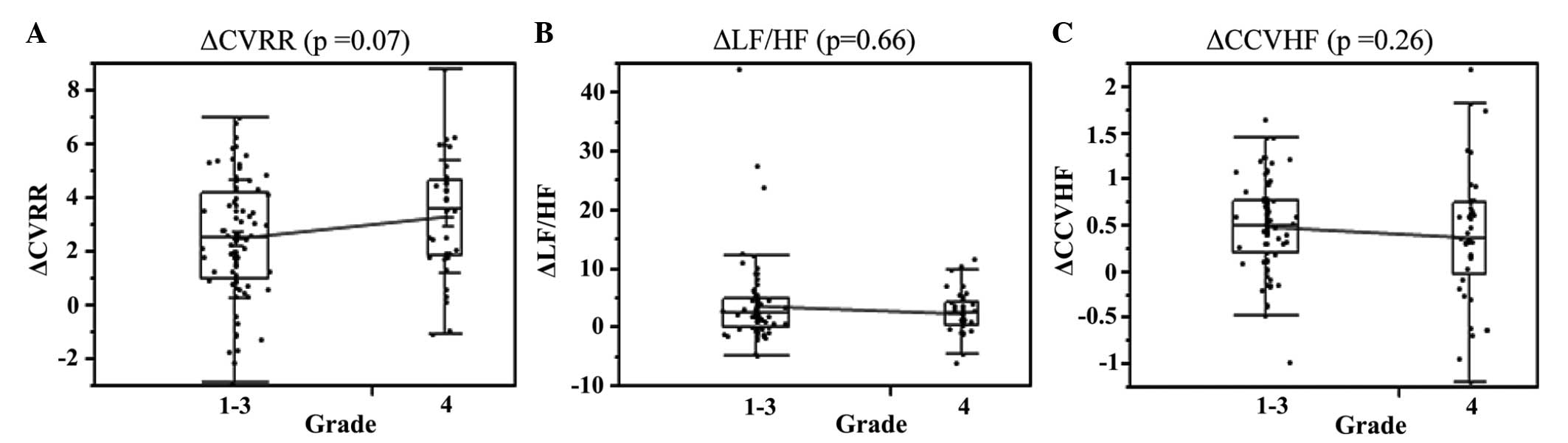
The results of the autonomic nervous system functions of the resting state comparing fourth-year students with first- to third-year students is shown in Fig. 1. The activity of the autonomic nervous system (CVRR) of fourth-year students was lower compared with first- to third-year students (fourth-year students, 5.02±1.37; first- to third-year students, 5.63±1.59; P=0.025). There was a trend of the sympathetic nervous system activity (LF/HF) of fourth-year students to be higher compared with first- to third-year students (fourth-year students, 3.69±3.57; first- to third-year students, 2.65±2.29; P=0.19). The parasympathetic nervous system activity (CCVHF) of fourth-year students was lower compared with first- to third-year students (fourth-year students, 2.23±0.85; first- to third-year students, 2.49±0.81; P=0.04). The results of the autonomic nervous system function in the standing state comparing fourth- to first- to third-year students is shown in Fig. 2. There was a trend of the ΔCVRR of the fourth-year students to be higher compared with first- to third-year students (fourth-year students, 3.35±2.09; first- to third-year students, 2.54±2.20; P=0.07). ΔLF/HF and ΔCCVHF were not significant between fourth- and first- to third-year students.

Figure 1.

Autonomic nervous system functions at the resting state comparing fourth-year nursing students with first- to third-year nursing students. (A) CVRR (P=0.025), (B) LF/HF (P=0.19) and (C) CCVHF (P=0.04). CVRR, coefficient of variation of R-R intervals; LF, low-frequency; HF, high-frequency; CCVHF, coefficient of component variance for HF.

Figure 2.

Autonomic nervous system functions at the standing state comparing fourth-year nursing students with first- to third-year nursing students. (A) ΔCVRR (P=0.07), (B) ΔLF/HF (P=0.66) and (C) ΔCCVHF (P=0.26). CVRR, coefficient of variation of R-R intervals; LF, low-frequency; HF, high-frequency; CCVHF, coefficient of component variance for HF.

Discussion

The present study showed that fourth-year student autonomic nervous system activity in the resting state was low, there was parasympathetic hypotension and there was a trend of the sympathetic nervous system activity of fourth-year students to be higher compared with first- to third-year students. In the standing state, there was a trend of the autonomic nervous system activity response of fourth-year students to be higher compared with first- to third-year students. Autonomic responses to psychological stress induced the activation of sympathetic nerves with inhibition of the parasympathetic nervous system (2). In the standing state, there were several cases in the fatigue state with a higher autonomic nervous system activity response (data not shown). The present results suggest that stress may influence autonomic nervous activity in fourth-year nursing students.

Long sleep hours and a regular diet are considered the backbone of a healthy student lifestyle. Sleep decreases sympathetic nerve activity (2). From our previous study (11) it was revealed that fourth-year nursing students had longer studying hours with less sleeping hours. Therefore, the clinical training and study hours had an effect on the life rhythm of fourth-year nursing students. Additionally, lifestyle is affected by stresses, including clinical nursing practice and studying for a national board examination.

The stress response is mediated by the stress system, which is located in the central nervous system and peripheral organs. The main stress system includes the hypothalamic pituitary axis and the systemic sympathetic adrenomedullary systems (4). Stress is a major contributor to psychosocial and physical pathological conditions (4). Chronic stress can cause physical, behavioral and/or neuropsychiatric manifestations, such as anxiety, depression, executive and/or cognitive dysfunction, and sleep disorders such as insomnia (4). Increased levels of corticotrophin-releasing hormone and/or stress system abnormalities have been reported in behavioral and neuropsychiatric disorders, such as anxiety, depression and eating disorders. Low corticotrophin-releasing hormone activity has also been implicated in depression (4). All these disorders are associated with dysfunction of the stress system (4).

Studying stress among nursing students is important as this condition is associated with academic performance, which can influence the quality of care in their future professional life. It is necessary to design effective prevention and intervention strategies for mental health problems in nursing students through stress management. Determining how stress occurs among nursing students is an essential step in preventing and reducing the progression of health problems to more severe states. There is widespread agreement that preventing health problems is a better strategy compared to treating them after they become apparent (12,13). Interventions aimed at reducing the risk of health problems by treating autonomic nervous system dysfunction may produce better results, although guidance in effective stress management may be essential.

The limitations of the present study were that it included a relatively small number of participants and that the context was confined to a particular geographic location. However, the study offers certain valuable insights into the autonomic nervous system dysfunction among nursing students.

In conclusion, the present study confirmed that the activity of the autonomic nervous system in the resting state in fourth-year nursing students was low, there was parasympathetic hypotension and there was a trend of the sympathetic nervous system activity of fourth-year students to be higher compared with first- to third-year students. In the standing state, there was a trend of the autonomic nervous system activity response of fourth-year students to be higher compared with first- to third-year students. By correcting stress in fourth-year nursing students, it may be possible to prevent the development of health problems.

Acknowledgements

The authors express their sincere gratitude to the participants in the study who generously provided their time and trust. The authors would like to express their gratitude to Ms. Chieko Fujii and Mr. Motoi Nagaya for their technical assistance.

References

1 

Hamill RW, Shapiro RE and Vizzard MA: Peripheral autonomic nervous system. In: Primer on the autonomic nervous system. Robertson D, Biaggioni I, Burnstock G, Low PA and Paton JFR: (3rd). Academic press. (London, UK). 17–26. 2012.

2 

Ziegler MG: Psychological stress and the autonomic nervous system. Primer on the autonomic nervous system. Robertson D, Biaggioni I, Burnstock G, Low PA and Paton JFR: (3rd). Academic press. (London, UK). 291–293. 2012. View Article : Google Scholar

3 

Carter C and Tranel D: Mind-Body interactions. In: Primer on the autonomic nervous system. Robertson D, Biaggioni I, Burnstock G, Low PA and Paton JFR: (3rd). Academic press. (London, UK). 295–299. 2012.

4 

Chrousos GP: Stress and disorders of the stress system. Nat Rev Endocrinol. 5:374–381. 2009. View Article : Google Scholar : PubMed/NCBI

5 

Costa ALS: Stress in nursing students: Construction of determining factors. REME Rev Min Enfem. 11:414–419. 2007.

6 

Masamura K, Iwamoto M, Ichihara K, Fujisawa R, Azuma R, Sugiyama S, Kunitsugu I, Okuda M and Hobara T: Relationships between student nurses stress and daily life when engaged in clinical practice. Yamaguchi-igaku. 52:13–21. 2003.

7 

Hirose K, Minegishi H, Seto M, Shoda M, Sakata S and Furuya T: College student stress during basic clinical nursing practice: Physical and psychological stress response due to time-serial change. Annual Reports of Gunma Prefectural College of Health Sciences. 5:65–75. 1998.

8 

Watson R, Gardiner E, Hogston R, Gibson H, Stimpson A, Wrate R and Deary I: A longitudinal study of stress and psychological distress in nurses and nursing students. J Clin Nurs. 18:270–278. 2009. View Article : Google Scholar : PubMed/NCBI

9 

Timmins F, Corroon AM, Byrne G and Mooney B: The challenge of contemporary nurse education programmes. Perceived stressors of nursing students: Mental health and related lifestyle issues. J Psychiatr Ment Health Nurs. 18:758–766. 2011. View Article : Google Scholar : PubMed/NCBI

10 

Pomeranz B, Macaulay RJ, Caudill MA, Kutz I, Adam D, Gordon D, Kilborn KM, Barger AC, Shannon DC, Cohen RJ, et al: Assessment of autonomic function in humans by heart rate spectral analysis. Am J Physiol. 248:H151–H153. 1985.PubMed/NCBI

11 

Fukumoto R, Hasegawa M, Takishita Y, Iwawaki Y, Kawaguchi A and Yamanaka R: A study of lifestyle and dietary habits in Japanese nursing students. Sch J Arts Humanit Soc Sci. 3(1B): 139–143. 2015.

12 

Garrosa E, Moreno-Jiménez B, Liang Y and González JL: The relationship between socio-demographic variables, job stressors, burnout, and hardy personality in nurses: An exploratory study. Int J Nurs Stud. 45:418–427. 2008. View Article : Google Scholar : PubMed/NCBI

13 

da Silva RM, Goulart CT, Lopes LFD, Serrano PM, Costa ALS and de Azevedo Guido L: Hardy personality and burnout syndrome among nursing students in three Brazilian universities-an analytic study. BMC Nurs. 13:92014. View Article : Google Scholar : PubMed/NCBI

Related Articles

  • Abstract
  • View
  • Download
  • Twitter
Copy and paste a formatted citation
Spandidos Publications style
Hasegawa M, Hayano A, Kawaguchi A and Yamanaka R: Assessment of autonomic nervous system function in nursing students using an autonomic reflex orthostatic test by heart rate spectral analysis. Biomed Rep 3: 831-834, 2015.
APA
Hasegawa, M., Hayano, A., Kawaguchi, A., & Yamanaka, R. (2015). Assessment of autonomic nervous system function in nursing students using an autonomic reflex orthostatic test by heart rate spectral analysis. Biomedical Reports, 3, 831-834. https://doi.org/10.3892/br.2015.512
MLA
Hasegawa, M., Hayano, A., Kawaguchi, A., Yamanaka, R."Assessment of autonomic nervous system function in nursing students using an autonomic reflex orthostatic test by heart rate spectral analysis". Biomedical Reports 3.6 (2015): 831-834.
Chicago
Hasegawa, M., Hayano, A., Kawaguchi, A., Yamanaka, R."Assessment of autonomic nervous system function in nursing students using an autonomic reflex orthostatic test by heart rate spectral analysis". Biomedical Reports 3, no. 6 (2015): 831-834. https://doi.org/10.3892/br.2015.512
Copy and paste a formatted citation
x
Spandidos Publications style
Hasegawa M, Hayano A, Kawaguchi A and Yamanaka R: Assessment of autonomic nervous system function in nursing students using an autonomic reflex orthostatic test by heart rate spectral analysis. Biomed Rep 3: 831-834, 2015.
APA
Hasegawa, M., Hayano, A., Kawaguchi, A., & Yamanaka, R. (2015). Assessment of autonomic nervous system function in nursing students using an autonomic reflex orthostatic test by heart rate spectral analysis. Biomedical Reports, 3, 831-834. https://doi.org/10.3892/br.2015.512
MLA
Hasegawa, M., Hayano, A., Kawaguchi, A., Yamanaka, R."Assessment of autonomic nervous system function in nursing students using an autonomic reflex orthostatic test by heart rate spectral analysis". Biomedical Reports 3.6 (2015): 831-834.
Chicago
Hasegawa, M., Hayano, A., Kawaguchi, A., Yamanaka, R."Assessment of autonomic nervous system function in nursing students using an autonomic reflex orthostatic test by heart rate spectral analysis". Biomedical Reports 3, no. 6 (2015): 831-834. https://doi.org/10.3892/br.2015.512
Follow us
  • Twitter
  • LinkedIn
  • Facebook
About
  • Spandidos Publications
  • Careers
  • Cookie Policy
  • Privacy Policy
How can we help?
  • Help
  • Live Chat
  • Contact
  • Email to our Support Team