Introduction
Gastric cancer is a type of common and fatal
digestive malignant disease, particularly in eastern Asia (1), which has a tendency to occur as
metastasis in the early stage. Despite the progress in earlier
diagnosis and new therapeutic strategies, which improved the
overall prognosis for gastric cancer patients, advanced gastric
cancer remains a rigorous challenge for clinical staff, and the
median overall survival is <1-year, and 5-year survival is ~7%
for metastasis gastric cancer patient (2). Chemotherapy is an extremely important
therapeutic strategy for advanced gastric cancer; however,
chemotherapy resistance is a severe obstacle (3), particularly for patients who make
progression or reoccur subsequent to finishing their first-line
treatment, and these patients are rarely suitable for additional
treatment as tumor cells show a poor response to any cytotoxic
drugs or drug combinations (4).
To overcome the dilemma induced by chemotherapy
resistance, numerous molecular-targeted agents have been designed
and considered as new therapeutic strategies for several malignant
diseases (5,6), such as trastuzumab for Her-2 positive in
breast cancer and gastric cancer (7,8), and a
number of other attractive molecular-targeted agents have also been
merged and have shown promising data in preclinical trials
(9–11).
The phosphoinositide 3-kinase (PI3K)/Akt pathway
dysregulation has been widely reported in different types of
malignant diseases (12,13), such as the PIK3CA gene
amplification or activation mutation, overactivation of the
downstream molecule Akt, and loss of tumor suppressor phosphatase
and tensin homolog (14). In gastric
cancer, the abnormalities of the PI3K/Akt pathway are considered to
have an important role in carcinogenesis, proliferation and
resistance to chemotherapy drugs (15,16).
Additionally, as reported in a previous study, the treatment of
conventional chemotherapy drugs can induce further activation of
the PI3K/Akt pathway in a number of solid cancers (17), which may lead to the occurrence of
acquired drug resistance. Therefore, we hypothesize that Akt
inhibition may increase the efficiency of chemotherapy and reverse
the drug resistance.
MK-2206 is a highly selective oral Akt inhibitor,
which has a higher inhibition effect on Akt1 and Akt2, compared to
Akt3. In vitro, MK-2206 is found to have a synergistic
effect with conventional chemotherapy agents in ovarian cancer and
osteosarcoma (18,19). However, to the best of our knowledge,
there are no previous studies evaluating the combination effect of
cisplatin and MK-2206 in gastric cancer.
Materials and methods
Cell culture
Gastric cancer cell lines AGS, MGC-803 and MKN-45
were purchased from the Cell Bank of China (Shanghai, China), and
all these three cell lines were grown in RPMI-1640 (Thermo Fisher
Scientific, Inc., Waltham, MA, USA) supplemented with 10% fetal
bovine serum (Gemini Scientific, West Sacramento, CA, USA) at 37°C
in a humidified atmosphere with 5% CO2, and the culture
medium was routinely changed every 3 days.
Drug sensitivity assay
Cell were seeded in 96-wells plate with a density of
5,000 cells/well, treated with cisplatin (Sigma-Aldrich, Inc., St.
Louis, MO, USA) for 24 h, followed by the Akt inhibitor, MK-2206
(Selleck Chemicals, Houston, TX, USA), for another 48 h. The
monotherapy control groups were treated with cisplatin for 24 h
followed by dimethyl sulfoxide (DMSO) (Sigma-Aldrich, Inc.) for
another 48 h, or were treated with MK-2206 alone for 72 h, and the
culture medium in each well was discharged and 20 µl
3-(4,5-dimethylthiazol-2-yl)-2,5-diphenyltetrazolium bromide (MTT)
(Sigma-Aldrich, Inc.) was added. The cells were cultured for
another 4 h, MTT in each well was removed and 150 µl DMSO was added
to each well and was cultured for another 5 min to dissolve the
crystal at 37°C. The absorbance was measured by microplate reader
at 490 nm (EXI800; BioTek, WInooski, VT, USA).
Apoptosis assay by flow cytometry
Subsequent to seeding the AGS gastric cancer cells
in 6-well plates with a density of 2×10⁵ cells/well, the
cells were treated with cisplatin for 12 h, followed by MK-2206 for
24 h, and the monotherapy groups were treated with cisplatin for 12
h followed by DMSO for another 24 h or MK-2206 alone for 24 h. The
control group was treated with DMSO alone. Following the harvesting
of cells in each well, staining was performed with the Annexin
V/propidium iodide (PI) kit (Nanjing Keygen Biotechnology, Nanjing,
China) according to the manufacturer's protocol, and PI/fluorescein
isothiocyanate two-dimensional flow cytometric analysis was
performed.
Western blot analysis
The gastric cancer AGS cells were treated with
cisplatin for 12 h, followed by MK-2206 for 24 h, and the cells
were washed by phosphate-buffered saline twice, harvested and lysed
in radioimmunoprecipitation assay buffer (Sigma-Aldrich, Inc.) with
protease inhibitors. Cell lysates containing 50 µg of protein were
resolved in sodium dodecyl sulfate-polyacrylamide gel
electrophoresis (SDS-PAGE), transferred onto a polyvinylidene
fluoride filter, and probed with the antibodies of total Akt
[rabbit monoclonal antibody (mAb); 1:1,000; Cell Signaling
Technology, Danvers, MA, USA), p-Akt (Ser473; rabbit mAb; 1:1,000,
Cell Signaling Technology), cleaved polyadenosine diphosphate
ribose polymerase (PARP) (rabbit mAb; 1:1,000, Cell Signaling
Technology) and glyceraldehyde 3-phosphate dehydrogenase (GAPDH)
(rabbit mAb, 1:4,000; Sanying Biotechnology, Wuhan, China). Primary
antibodies were detected with the secondary antibodies of goat
anti-rabbit, using enhanced chemiluminescence (1:3,000; Beijing
Beyotime Biology, Beijing, China).
Statistical analysis
Results were calculated as mean ± standard
deviation. Two-sided t-test was used to detect statistical
significance, and P<0.05 was considered to indicate a
statistically significant difference.
Results
Gastric cancer cell line with the
higher Akt phosphorylation is more resistant to cisplatin
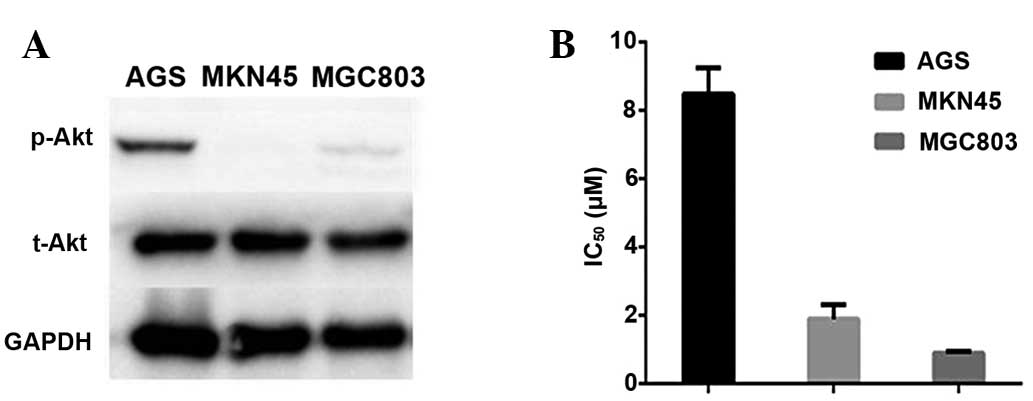
To detect whether Akt phosphorylation has a role in
drug resistance to cisplatin in gastric cancer, western blot
analysis was performed to detect the level of p-Akt (Ser473) in
three gastric cancer cell lines, AGS, MGC-803 and MKN-45. The level
of p-Akt in AGS cells was higher compared to MGC-803 and MKN-45
cells, and the MTT assay was used to determine the effect of
cisplatin in these three cell lines (Fig.
1A). The half maximal inhibitory concentration
(IC50) of cisplatin for each cell line was calculated.
The IC50 of AGS was almost twice as high as for MGC-803
and MKN-45 (Fig. 1B), which may
indicate that Akt phosphorylation can increase the resistance to
cisplatin in gastric cancer cells.
Akt inhibitor MK-2206 increases the
effect of cisplatin with a sequence-dependant manner in gastric
cancer cells
As Akt phosphorylation may have a role in the
resistance to cisplatin, we hypothesized that Akt inhibition may
increase the effect of cisplatin in gastric cancer cells. To
confirm this hypothesis, the Akt inhibitor MK-2206 was used, and in
a previous study, three sequences have been used to detect the
combination effect of MK-2206 and traditional chemotherapy drugs in
cancer: Traditional drugs followed by MK-2206, MK-2206 prior to
traditional drugs, and MK-2206 and traditional drugs
simultaneously, and it has been reported that traditional drugs
followed by MK-2206 showed a good effect, and the effect of other
two sequences were limited (18,19). MK-2206
can increase the effect of cisplatin in high p-Akt activation
gastric cancer AGS cells, but the combination effect was poor in
the other two gastric cancer cells with lower p-Akt (Fig. 2).
MK-2206 can increase the apoptosis
induced by cisplatin in gastric cancer cell line AGS
The combination of MK-2206 and cisplatin lead to a
synthetic cytotoxic effect in the higher Akt phosphorylation
gastric cancer cell line, AGS; however, the combination showed a
slight effect in the other two gastric cancer cell lines, which
have a low level of Akt phosphorylation. To investigate whether
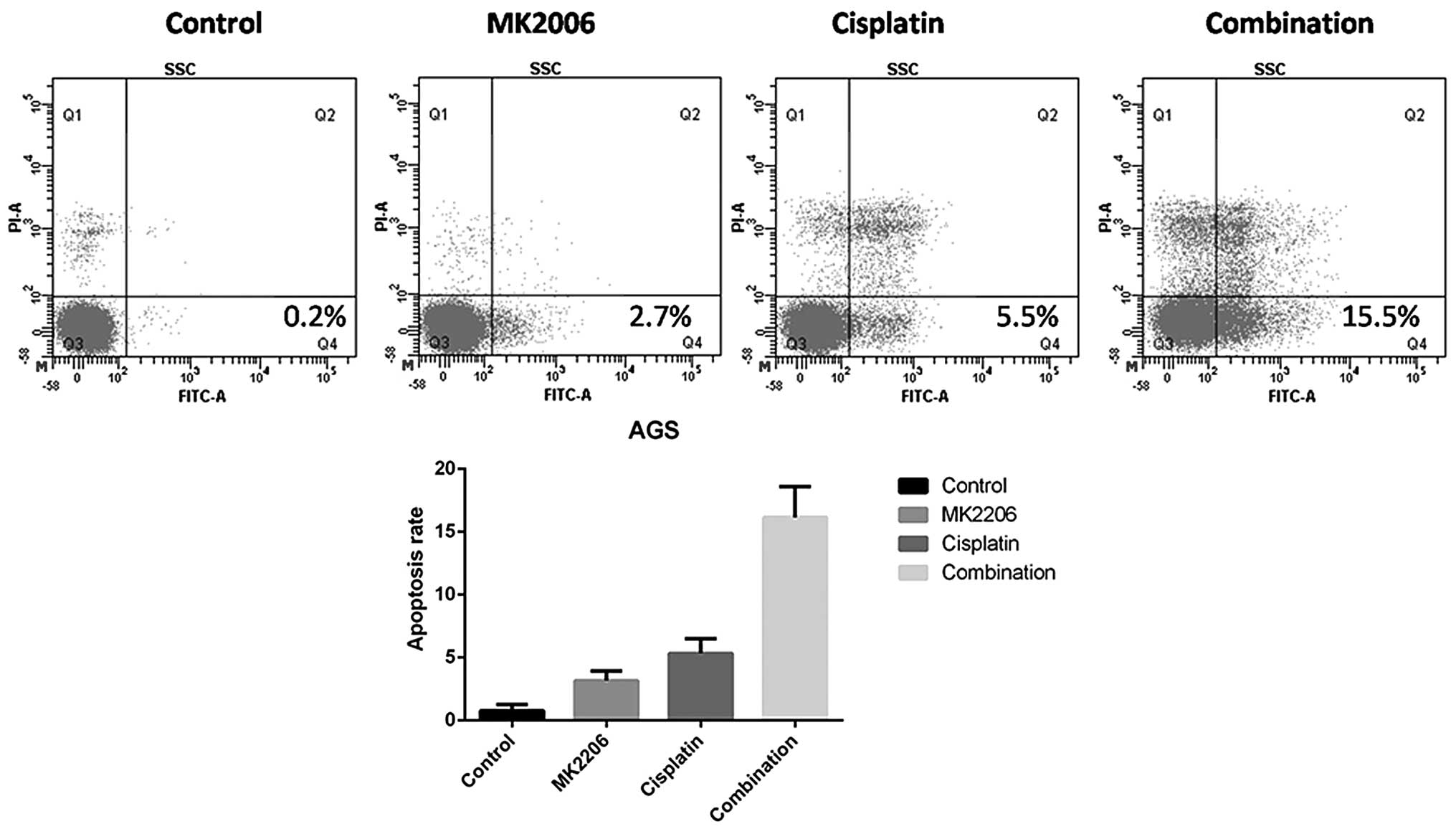
MK-2206 can also increase the apoptosis induced by cisplatin, AGS
cells were treated as aforementioned, and were subjected to Annexin
V/PI staining. Sequential treatment of AGS cells with 10 µM
cisplatin for 12 h followed by 10 µM MK-2206 for a further 24 h
induced more apoptosis compared to the monotherapy groups (16.17%
in the combination group, 3.17% in the MK-2206 group and 5.33% in
the cisplatin group) (Fig. 3).
MK-2206 inhibits the expression of
p-Akt and increases the expression of cleaved PARP in the gastric
cancer AGS cell line
MK-2206, as a potent Akt inhibitor, significantly
decreased the Akt phosphorylation and activation. Subsequently, the
effect of the potential inhibition of the Akt pathway by cisplatin
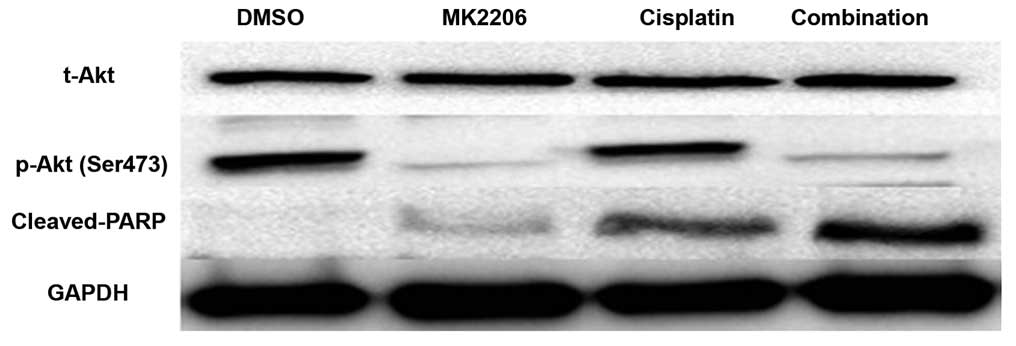
and MK-2206 combination was analyzed. The results of western blot
analysis (Fig. 4) showed that the
combination can markedly decrease the p-Akt (Ser473) in AGS cells,
compared with control and cisplatin monotherapy groups; however,
the total Akt remained stable in all groups. PARP is recognized as
a marker of apoptosis, so therefore the effect of the combination
on the expression of cleaved PARP was examined. In the untreated
group, the expression of cleaved PARP was limited, and the
combination group induced more expression of cleaved PARP in
contrast to the cisplatin or MK-2206 alone groups, and this was in
accordance with the results of the MTT and apoptosis assays.
Discussion
The limited effectiveness of chemotherapy drugs can
be attributed to several reasons, such as checkpoints that arrest
the cell cycle to allow DNA damage repair, or activation of certain
signaling pathways to help the cancer cell escape from the
cytotoxicity induced by numerous drugs (20,21).
Therefore, targeting survival pathways may be logically considered
as a good strategy for increasing the chemotherapeutic effect in
cancer cells (22,23).
The PI3K/Akt pathway has been widely investigated,
and was reported to participate in several biological and
pathological responses in numerous types of cancer, including
gastric cancer. Numerous molecules targeting the PI3K/Akt pathway
have been designed (24), MK-2206 is
one of these agents, although the monotherapy effect of MK-2206 is
limited in a number of cancers, and certain studies have reported
that it showed a good therapeutic effect when combined with other
traditional chemotherapy drugs (25).
The present study evaluated the benefit of the
combination of cisplatin and MK-2206 in gastric cancer cell lines,
and detected the effect of the Akt inhibitor MK-2206 on gastric
cancer cell lines alone and in combination of cisplatin. The
monotherapy effect of MK-2206 was not significant in the three cell
gastric cancer cell lines; however, when treating the AGS cells
with cisplatin followed by MK-2206, an increase in apoptosis and
proliferation inhibition was induced in gastric cancer cells.
Western blot analysis also showed that the expression of p-Akt
(Ser473) was significantly blocked in the combination group, and
consistently, the level of the apoptosis marker, cleaved PARP, was
higher compared to the monotherapy groups.
The present study has certain limitations. The
number of gastric cancer cell lines used in the experiments is
limited, there is no in vivo experiment evaluation and the
mechanisms for the effect remain to be elucidated. However, the
data appear promising, and may be helpful for high Akt
phosphorylation gastric cancer patients.
Acknowledgements
The present study was sponsored by a grant from the
National Nature Science Foundation of China (no. 81172294).
References
|
1
|
Siegel RL, Miller KD and Jemal A: Cancer
statistics, 2015. CA Cancer J Clin. 65:5–29. 2015. View Article : Google Scholar : PubMed/NCBI
|
|
2
|
Power DG, Kelsen DP and Shah MA: Advanced
gastric cancer - slow but steady progress. Cancer Treat Rev.
36:384–392. 2010. View Article : Google Scholar : PubMed/NCBI
|
|
3
|
Marin JJ, Al-Abdulla R, Lozano E, Briz O,
Bujanda L, Banales JM and Macias RI: Mechanisms of resistance to
chemotherapy in gastric cancer. Anticancer Agents Med Chem. Aug
3–2015.(Epub ahead of print). PubMed/NCBI
|
|
4
|
Kim SM and Park SH: Chemotherapy beyond
second-line in advanced gastric cancer. World J Gastroenterol.
21:8811–8816. 2015. View Article : Google Scholar : PubMed/NCBI
|
|
5
|
Covell LL and Ganti AK: Treatment of
advanced thyroid cancer: Role of molecularly targeted therapies.
Target Oncol. 10:311–324. 2015. View Article : Google Scholar : PubMed/NCBI
|
|
6
|
Kito Y and Yamazaki K: Targeted therapies
for metastatic colorectal cancer. Nihon Rinsho. 73:1384–1390.
2015.(In Japanese). PubMed/NCBI
|
|
7
|
Wahler J and Suh N: Targeting HER2
Positive breast cancer with chemopreventive agents. Curr Pharmacol
Rep. 1:324–335. 2015. View Article : Google Scholar : PubMed/NCBI
|
|
8
|
Chua C, Tan IB, Yamada Y, Rha SY, Yong WP,
Ong WS, Tham CK, Ng M, Tai DW, Iwasa S, et al: Phase II study of
trastuzumab in combination with S-1 and cisplatin in the first-line
treatment of human epidermal growth factor receptor HER2-positive
advanced gastric cancer. Cancer Chemother Pharmacol. 76:397–408.
2015. View Article : Google Scholar : PubMed/NCBI
|
|
9
|
Bao Z, Cao C, Geng X, Tian B, Wu Y, Zhang
C, Chen Z, Li W, Shen H and Ying S: Effectiveness and safety of
poly (ADP-ribose) polymerase inhibitors in cancer therapy: A
systematic review and meta-analysis. Oncotarget. Sep 22–2015.(Epub
ahead of print).
|
|
10
|
Abu-Khalaf MM, Baumgart MA, Gettinger SN,
Doddamane I, Tuck DP, Hou S, Chen N, Sullivan C, Lezon-Geyda K,
Zelterman D, et al: Phase 1b study of the mammalian target of
rapamycin inhibitor sirolimus in combination with nanoparticle
albumin-bound paclitaxel in patients with advanced solid tumors.
Cancer. 121:1817–1826. 2015. View Article : Google Scholar : PubMed/NCBI
|
|
11
|
Brana I, Berger R, Golan T, Haluska P,
Edenfield J, Fiorica J, Stephenson J, Martin LP, Westin S, Hanjani
P, et al: A parallel-arm phase I trial of the humanised anti-IGF-1R
antibody dalotuzumab in combination with the AKT inhibitor MK-2206,
the mTOR inhibitor ridaforolimus, or the NOTCH inhibitor MK-0752,
in patients with advanced solid tumours. Br J Cancer.
111:1932–1944. 2014. View Article : Google Scholar : PubMed/NCBI
|
|
12
|
Faes S and Dormond O: PI3K and AKT:
Unfaithful partners in cancer. Int J Mol Sci. 16:21138–21152. 2015.
View Article : Google Scholar : PubMed/NCBI
|
|
13
|
Guo H, German P, Bai S, Barnes S, Guo W,
Qi X, Lou H, Liang J, Jonasch E, Mills GB, et al: The PI3K/AKT
pathway and renal cell carcinoma. J Genet Genomics. 42:343–353.
2015. View Article : Google Scholar : PubMed/NCBI
|
|
14
|
Liu P, Cheng H, Roberts TM and Zhao JJ:
Targeting the phosphoinositide 3-kinase pathway in cancer. Nat Rev
Drug Discov. 8:627–644. 2009. View
Article : Google Scholar : PubMed/NCBI
|
|
15
|
Shi J, Yao D, Liu W, Wang N, Lv H, Zhang
G, Ji M, Xu L, He N, Shi B, et al: Highly frequent PIK3CA
amplification is associated with poor prognosis in gastric cancer.
BMC Cancer. 12:502012. View Article : Google Scholar : PubMed/NCBI
|
|
16
|
Matsuoka T and Yashiro M: The Role of
PI3K/Akt/mTOR Signaling in Gastric Carcinoma. Cancers (Basel).
6:1441–1463. 2014. View Article : Google Scholar : PubMed/NCBI
|
|
17
|
Parsons CM, Muilenburg D, Bowles TL,
Virudachalam S and Bold RJ: The role of Akt activation in the
response to chemotherapy in pancreatic cancer. Anticancer Res.
30:3279–3289. 2010.PubMed/NCBI
|
|
18
|
Lin YH, Chen BY, Lai WT, Wu SF, Guh JH,
Cheng AL and Hsu LC: The Akt inhibitor MK-2206 enhances the
cytotoxicity of paclitaxel (Taxol) and cisplatin in ovarian cancer
cells. Naunyn Schmiedebergs Arch Pharmacol. 388:19–31. 2015.
View Article : Google Scholar : PubMed/NCBI
|
|
19
|
Duan L, Perez RE, Hansen M, Gitelis S and
Maki CG: Increasing cisplatin sensitivity by schedule-dependent
inhibition of AKT and Chk1. Cancer Biol Ther. 15:1600–1612. 2014.
View Article : Google Scholar : PubMed/NCBI
|
|
20
|
Riquelme I, Saavedra K, Espinoza JA, Weber
H, García P, Nervi B, Garrido M, Corvalán AH, Roa JC and Bizama C:
Molecular classification of gastric cancer: Towards a
pathway-driven targeted therapy. Oncotarget. 6:24750–24779. 2015.
View Article : Google Scholar : PubMed/NCBI
|
|
21
|
Benada J and Macurek L: Targeting the
checkpoint to kill cancer cells. Biomolecules. 5:1912–1937. 2015.
View Article : Google Scholar : PubMed/NCBI
|
|
22
|
Nicolini A, Ferrari P, Kotlarova L, Rossi
G and Biava PM: The PI3K-AKt-mTOR pathway and new tools to prevent
acquired hormone resistance in breast cancer. Curr Pharm
Biotechnol. 16:804–815. 2015. View Article : Google Scholar : PubMed/NCBI
|
|
23
|
Pandey R and Kapur R: Targeting
phosphatidylinositol-3-kinase pathway for the treatment of
Philadelphia-negative myeloproliferative neoplasms. Mol Cancer.
14:1182015. View Article : Google Scholar : PubMed/NCBI
|
|
24
|
Zhang L, Wu J, Ling MT, Zhao L and Zhao
KN: The role of the PI3K/Akt/mTOR signalling pathway in human
cancers induced by infection with human papillomaviruses. Mol
Cancer. 14:872015. View Article : Google Scholar : PubMed/NCBI
|
|
25
|
Almhanna K, Cubitt CL, Zhang S, Kazim S,
Husain K, Sullivan D, Sebti S and Malafa M: MK-2206, an Akt
inhibitor, enhances carboplatinum/paclitaxel efficacy in gastric
cancer cell lines. Cancer Biol Ther. 14:932–936. 2013. View Article : Google Scholar : PubMed/NCBI
|