Spandidos Publications Logo
  • About
    • About Spandidos
    • Aims and Scopes
    • Abstracting and Indexing
    • Editorial Policies
    • Reprints and Permissions
    • Job Opportunities
    • Terms and Conditions
    • Contact
  • Journals
    • All Journals
    • Oncology Letters
      • Oncology Letters
      • Information for Authors
      • Editorial Policies
      • Editorial Board
      • Aims and Scope
      • Abstracting and Indexing
      • Bibliographic Information
      • Archive
    • International Journal of Oncology
      • International Journal of Oncology
      • Information for Authors
      • Editorial Policies
      • Editorial Board
      • Aims and Scope
      • Abstracting and Indexing
      • Bibliographic Information
      • Archive
    • Molecular and Clinical Oncology
      • Molecular and Clinical Oncology
      • Information for Authors
      • Editorial Policies
      • Editorial Board
      • Aims and Scope
      • Abstracting and Indexing
      • Bibliographic Information
      • Archive
    • Experimental and Therapeutic Medicine
      • Experimental and Therapeutic Medicine
      • Information for Authors
      • Editorial Policies
      • Editorial Board
      • Aims and Scope
      • Abstracting and Indexing
      • Bibliographic Information
      • Archive
    • International Journal of Molecular Medicine
      • International Journal of Molecular Medicine
      • Information for Authors
      • Editorial Policies
      • Editorial Board
      • Aims and Scope
      • Abstracting and Indexing
      • Bibliographic Information
      • Archive
    • Biomedical Reports
      • Biomedical Reports
      • Information for Authors
      • Editorial Policies
      • Editorial Board
      • Aims and Scope
      • Abstracting and Indexing
      • Bibliographic Information
      • Archive
    • Oncology Reports
      • Oncology Reports
      • Information for Authors
      • Editorial Policies
      • Editorial Board
      • Aims and Scope
      • Abstracting and Indexing
      • Bibliographic Information
      • Archive
    • Molecular Medicine Reports
      • Molecular Medicine Reports
      • Information for Authors
      • Editorial Policies
      • Editorial Board
      • Aims and Scope
      • Abstracting and Indexing
      • Bibliographic Information
      • Archive
    • World Academy of Sciences Journal
      • World Academy of Sciences Journal
      • Information for Authors
      • Editorial Policies
      • Editorial Board
      • Aims and Scope
      • Abstracting and Indexing
      • Bibliographic Information
      • Archive
    • International Journal of Functional Nutrition
      • International Journal of Functional Nutrition
      • Information for Authors
      • Editorial Policies
      • Editorial Board
      • Aims and Scope
      • Abstracting and Indexing
      • Bibliographic Information
      • Archive
    • International Journal of Epigenetics
      • International Journal of Epigenetics
      • Information for Authors
      • Editorial Policies
      • Editorial Board
      • Aims and Scope
      • Abstracting and Indexing
      • Bibliographic Information
      • Archive
    • Medicine International
      • Medicine International
      • Information for Authors
      • Editorial Policies
      • Editorial Board
      • Aims and Scope
      • Abstracting and Indexing
      • Bibliographic Information
      • Archive
  • Articles
  • Information
    • Information for Authors
    • Information for Reviewers
    • Information for Librarians
    • Information for Advertisers
    • Conferences
  • Language Editing
Spandidos Publications Logo
  • About
    • About Spandidos
    • Aims and Scopes
    • Abstracting and Indexing
    • Editorial Policies
    • Reprints and Permissions
    • Job Opportunities
    • Terms and Conditions
    • Contact
  • Journals
    • All Journals
    • Biomedical Reports
      • Information for Authors
      • Editorial Policies
      • Editorial Board
      • Aims and Scope
      • Abstracting and Indexing
      • Bibliographic Information
      • Archive
    • Experimental and Therapeutic Medicine
      • Information for Authors
      • Editorial Policies
      • Editorial Board
      • Aims and Scope
      • Abstracting and Indexing
      • Bibliographic Information
      • Archive
    • International Journal of Epigenetics
      • Information for Authors
      • Editorial Policies
      • Editorial Board
      • Aims and Scope
      • Abstracting and Indexing
      • Bibliographic Information
      • Archive
    • International Journal of Functional Nutrition
      • Information for Authors
      • Editorial Policies
      • Editorial Board
      • Aims and Scope
      • Abstracting and Indexing
      • Bibliographic Information
      • Archive
    • International Journal of Molecular Medicine
      • Information for Authors
      • Editorial Policies
      • Editorial Board
      • Aims and Scope
      • Abstracting and Indexing
      • Bibliographic Information
      • Archive
    • International Journal of Oncology
      • Information for Authors
      • Editorial Policies
      • Editorial Board
      • Aims and Scope
      • Abstracting and Indexing
      • Bibliographic Information
      • Archive
    • Medicine International
      • Information for Authors
      • Editorial Policies
      • Editorial Board
      • Aims and Scope
      • Abstracting and Indexing
      • Bibliographic Information
      • Archive
    • Molecular and Clinical Oncology
      • Information for Authors
      • Editorial Policies
      • Editorial Board
      • Aims and Scope
      • Abstracting and Indexing
      • Bibliographic Information
      • Archive
    • Molecular Medicine Reports
      • Information for Authors
      • Editorial Policies
      • Editorial Board
      • Aims and Scope
      • Abstracting and Indexing
      • Bibliographic Information
      • Archive
    • Oncology Letters
      • Information for Authors
      • Editorial Policies
      • Editorial Board
      • Aims and Scope
      • Abstracting and Indexing
      • Bibliographic Information
      • Archive
    • Oncology Reports
      • Information for Authors
      • Editorial Policies
      • Editorial Board
      • Aims and Scope
      • Abstracting and Indexing
      • Bibliographic Information
      • Archive
    • World Academy of Sciences Journal
      • Information for Authors
      • Editorial Policies
      • Editorial Board
      • Aims and Scope
      • Abstracting and Indexing
      • Bibliographic Information
      • Archive
  • Articles
  • Information
    • For Authors
    • For Reviewers
    • For Librarians
    • For Advertisers
    • Conferences
  • Language Editing
Login Register Submit
  • This site uses cookies
  • You can change your cookie settings at any time by following the instructions in our Cookie Policy. To find out more, you may read our Privacy Policy.

    I agree
Search articles by DOI, keyword, author or affiliation
Search
Advanced Search
presentation
Biomedical Reports
Join Editorial Board Propose a Special Issue
Print ISSN: 2049-9434 Online ISSN: 2049-9442
Journal Cover
July-2016 Volume 5 Issue 1

Full Size Image

Sign up for eToc alerts
Recommend to Library

Journals

International Journal of Molecular Medicine

International Journal of Molecular Medicine

International Journal of Molecular Medicine is an international journal devoted to molecular mechanisms of human disease.

International Journal of Oncology

International Journal of Oncology

International Journal of Oncology is an international journal devoted to oncology research and cancer treatment.

Molecular Medicine Reports

Molecular Medicine Reports

Covers molecular medicine topics such as pharmacology, pathology, genetics, neuroscience, infectious diseases, molecular cardiology, and molecular surgery.

Oncology Reports

Oncology Reports

Oncology Reports is an international journal devoted to fundamental and applied research in Oncology.

Experimental and Therapeutic Medicine

Experimental and Therapeutic Medicine

Experimental and Therapeutic Medicine is an international journal devoted to laboratory and clinical medicine.

Oncology Letters

Oncology Letters

Oncology Letters is an international journal devoted to Experimental and Clinical Oncology.

Biomedical Reports

Biomedical Reports

Explores a wide range of biological and medical fields, including pharmacology, genetics, microbiology, neuroscience, and molecular cardiology.

Molecular and Clinical Oncology

Molecular and Clinical Oncology

International journal addressing all aspects of oncology research, from tumorigenesis and oncogenes to chemotherapy and metastasis.

World Academy of Sciences Journal

World Academy of Sciences Journal

Multidisciplinary open-access journal spanning biochemistry, genetics, neuroscience, environmental health, and synthetic biology.

International Journal of Functional Nutrition

International Journal of Functional Nutrition

Open-access journal combining biochemistry, pharmacology, immunology, and genetics to advance health through functional nutrition.

International Journal of Epigenetics

International Journal of Epigenetics

Publishes open-access research on using epigenetics to advance understanding and treatment of human disease.

Medicine International

Medicine International

An International Open Access Journal Devoted to General Medicine.

Journal Cover
July-2016 Volume 5 Issue 1

Full Size Image

Sign up for eToc alerts
Recommend to Library

  • Article
  • Citations
    • Cite This Article
    • Download Citation
    • Create Citation Alert
    • Remove Citation Alert
    • Cited By
  • Similar Articles
    • Related Articles (in Spandidos Publications)
    • Similar Articles (Google Scholar)
    • Similar Articles (PubMed)
  • Download PDF
  • Download XML
  • View XML
Article

An improved polymerase chain reaction-restriction fragment length polymorphism assay for the detection of a PON2 gene polymorphism

  • Authors:
    • Xiaoran Duan
    • Yongli Yang
    • Tuanwei Wang
    • Xiaolei Feng
    • Wu Yao
    • Zhen Yan
    • Wei Wang
  • View Affiliations / Copyright

    Affiliations: Department of Occupational and Environmental Health, College of Public Health, Zhengzhou University, Zhengzhou, Henan 450001, P.R. China, Department of Epidemiology and Biostatistics, College of Public Health, Zhengzhou University, Zhengzhou, Henan 450001, P.R. China
  • Pages: 133-135
    |
    Published online on: May 13, 2016
       https://doi.org/10.3892/br.2016.676
  • Expand metrics +
Metrics: Total Views: 0 (Spandidos Publications: | PMC Statistics: )
Metrics: Total PDF Downloads: 0 (Spandidos Publications: | PMC Statistics: )
Cited By (CrossRef): 0 citations Loading Articles...

This article is mentioned in:


Abstract

In recent research, it has been shown that there have been variants of rs12026 within the paraoxonase 2 (PON2) gene, which have been associated with cardiovascular disease, cerebrovascular disease, diabetes and other diseases. The isochizomers, such as the BsoFI enzyme, required for the detection of this polymorphism are expensive. Therefore, an improved and less expensive polymerase chain reaction (PCR)-restriction fragment length polymorphism method was established for the detection of the single‑nucleotide polymorphism rs12026 in the exon 5 of chromosome 7 of the human PON2 gene using the method of amplification‑created restriction site. Subsequent to assessing 302 individuals, the genotype frequencies were 68.9% for CC, 29.8% for CG and 1.3% for GG, and the allelic frequencies were 83.8% for C and 16.2% for G. The PCR results were confirmed by DNA sequencing. The χ2 test showed that the genotype and allele frequencies of PON2‑148 do not deviate from Hardy-Weinberg equilibrium, and the sequences of amplified products were consistent with the sequence published in GenBank with the exception of a mismatched base.

Introduction

Paraoxonase 2 (PON2) is a member of the PON gene family located on chromosome 7q21.3, which also includes the homologous genes for PON1 and PON3 (1,2). In contrast to PON1, which is mainly expressed in the liver, PON2 is expressed in a variety of tissues. It is known that PON1 has been shown to have antioxidant properties (3). However, the function of ubiquitously expressed PON2 remains to be elucidated (1).

A G/C single-nucleotide polymorphism (SNP) rs12026 in exon 5 of the PON2 gene introduces the coding variant of alanine/glycine at position 148 (PON2-148). There have been associating variants of rs12026 within the PON2 gene with cardiovascular disease (4–6), cerebrovascular disease (7), diabetes (8,9) and other diseases (10). For this SNP detection, several assays have been suggested, such as the fluorescently labeled probes technique (11), dynamic allele-specific hybridization technique (7), TaqMan assay (5) and polymerase chain reaction-restriction fragment length polymorphism (PCR-RFLP) (6). Among them, PCR-RFLP is the most frequently used technique due to its high sensitivity and reliability. However, the current PCR-RFLP assay is facing practical challenges and is not suitable for high throughput screening. The present study demonstrated an improved PCR-RFLP assay for the detection of a polymorphism of the PON2 gene.

Materials and methods

Primer design

The information regarding the PON2 gene and polymorphism rs12026 was obtained from the National Center for Biotechnology Information (NCBI) website (http://www.ncbi.nlm.nih.gov). The method of the amplification-created restriction site was used to introduce a new enzyme site to recognize the variant.

The sequences of the primer pair were designed by primer premier 5.0 software as follows: Forward, 5′ AGGTCCCGTAGTTATGTCTTGT 3′; and reverse, 5′ TCAGATGCAACAGAGAATTGTCT 3′.

The natural occurring DNA sequences according with positions of primers were: AGGTCCCGTAGTTATGTCTTGT aaattaactctgttctttcaattctttagatgacacagtttatctctttgttgtaaaccaccc agaattcaagaatacagtggaaatttttaaatttgaagaagSAGAAAATTCTCTGTTGCATCTGA. Capital bases A, C, G and T represent the sequences according to the positions of primers, and S represents the position for the polymorphism G/C. The length of the base sequences was 150 base pairs (bp). The natural occurring ‘T’ nucleotide that matches with A (underlined) in the DNA sequences was substituted by a ‘G’ in the reverse primer (underlined) in order to introduce a recognized site for the BsmAI restriction endonuclease.

Genotype of DNA

Genomic DNA was extracted from the peripheral blood leukocytes of 302 Chinese Han individuals followed by standard procedures. The research objects were obtained from one enterprise in Zhengzhou in 2014. The study protocol was approved by the Ethics Committee of the University of Zhengzhou (Zhengzhou, Henan, China). The PCR was performed in a volume of 25 µl containing 100 ng of genomic DNA, 1X PCR Master mix (Tiangen, Beijing, China) and 5 pmol of each primer. The DNA was denatured at 95°C for 3 min, and temperature cycles were set at 95°C for 30 sec, 56°C for 30 sec and 72°C for 30 sec for 30 cycles, followed by a final extension at 72°C for 10 min. PCR products underwent electrophoresis on 3% agarose gels and were stained with ethidium bromide and exposed to ultraviolet illumination.

Enzyme digestion was conducted in a 20 µl final volume using 5 units of BsmAI enzyme (New England Biolabs, Ipswich, MA, USA) and 10 µl of the PCR product. The reaction was conducted at 37°C overnight. The digested products were visualized on 3% agarose gels stained with ethidium bromide.

Statistical analysis

The basic data were analyzed using SPSS 21.0 software (IBM, Corp., Armonk, NY, USA). Methods of representation and examination were based on the distribution of quantitative data. All the statistical tests were two-sided, and P<0.05 was considered to indicate a statistically significant difference.

Results

Polymorphisms of PON2

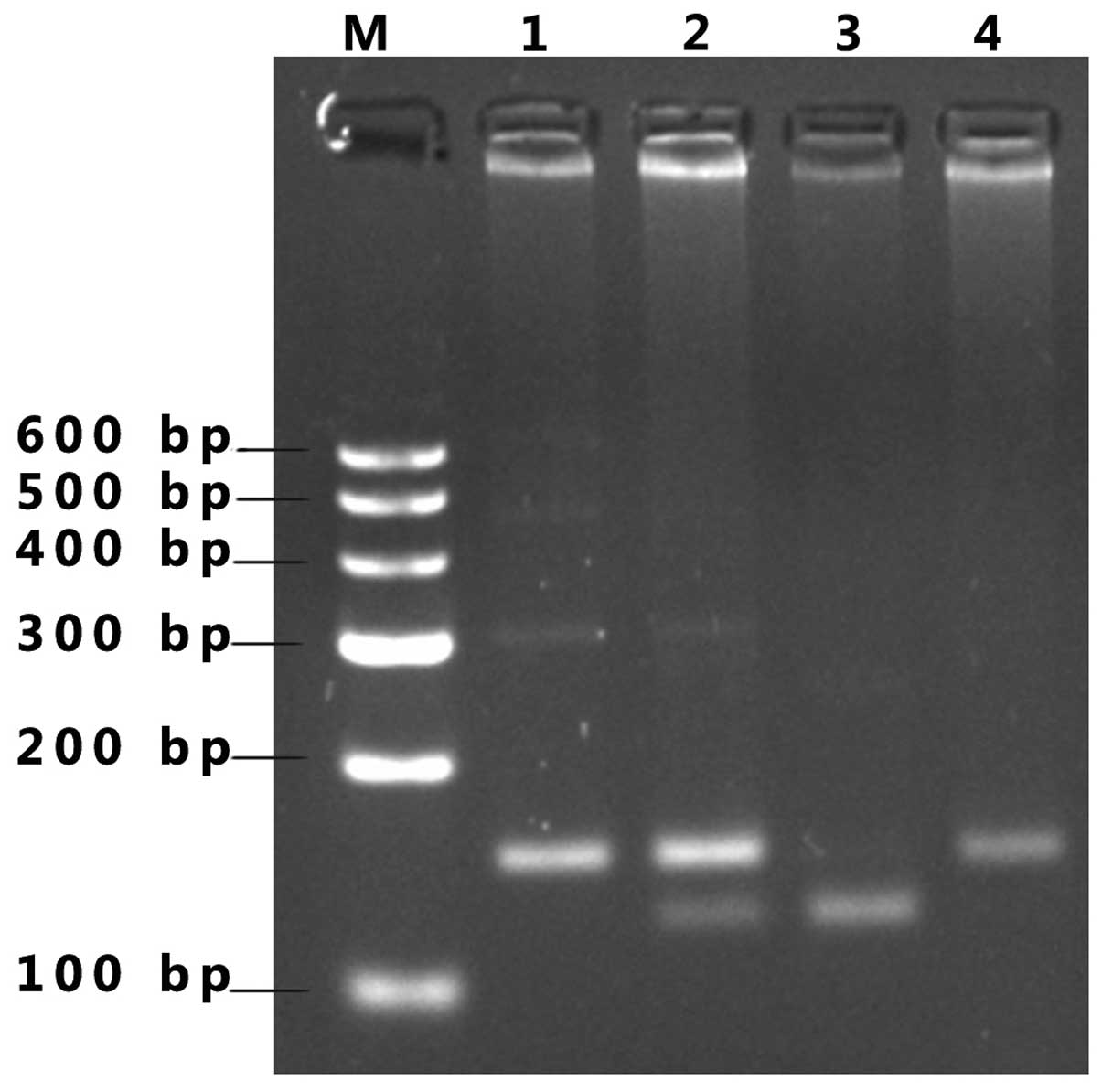
Based on the PCR designed with the mismatched primers, the PON2 polymorphisms could be identified simultaneously. The PCR products that were separated on 3% agarose gel are shown in Fig. 1 (BsmAI PCR-RFLP analysis of the PON2 biallelic polymorphism). From the gel, that the PCR amplification yielded a product of 150 bp. Following incubation with BsmAI, the individual homozygous for the C allele yielded one uncut band (150 bp). The homozygous G allele yielded two bands of 121 and 29 bp.

Figure 1.

BsmAI polymerase chain reaction-restriction fragment length polymorphism analysis of the PON2 biallelic polymorphism, M, DNA ladder; lanes 1 and 4, CC; lane 2, CG; lane 3, GG. PON2, paraoxonase 2; bp, base pair.

Polymorphisms of PON2 were detected in 302 Chinese Han individuals. The genotype frequencies were 68.9% for CC, 29.8% for CG and 1.3% for GG. The allelic frequencies were 83.8% for C and 16.2% for G. The PCR results were confirmed by DNA sequencing. The χ2 test showed that the genotype and allele frequencies of PON2-148 do not deviate from Hardy-Weinberg equilibrium (χ2=2.80, P>0.05).

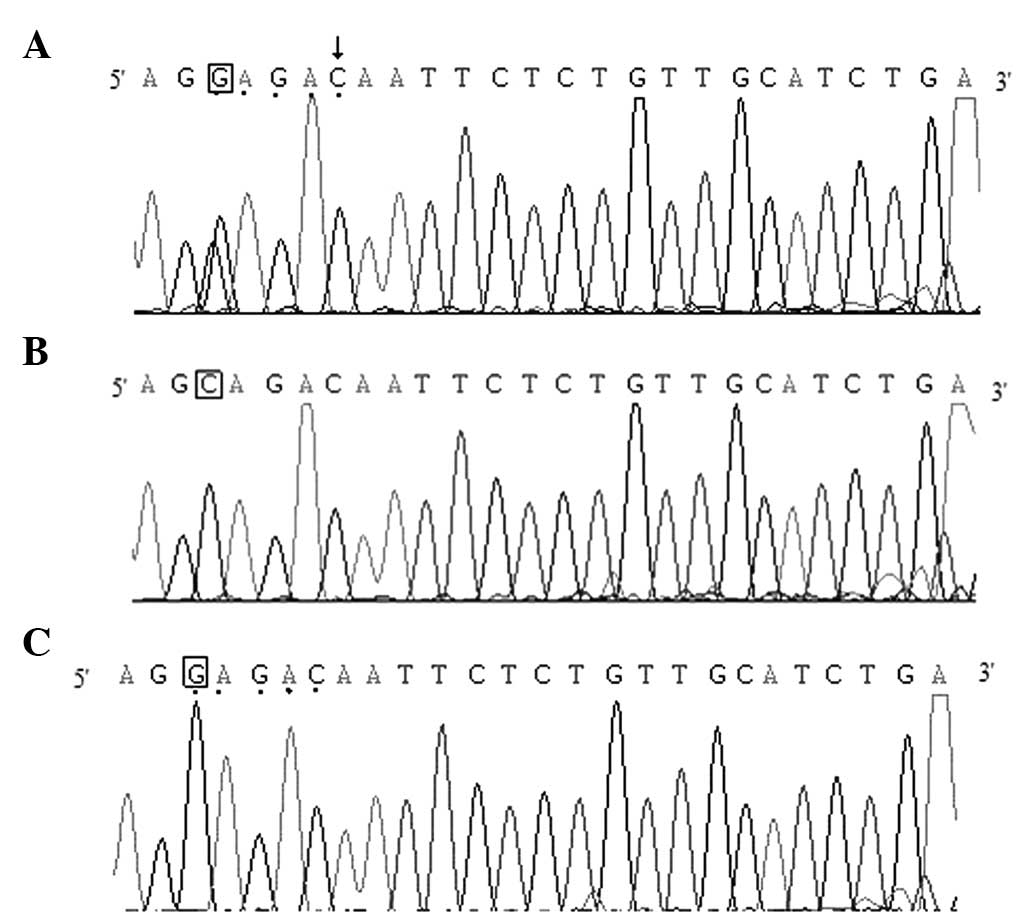
Examples of DNA sequencing of the PCR product of the PON2 gene are shown in Fig. 2. As expected, the sequences of the amplified products were consistent with the one published in Genbank (NM_000446), with the exception of the mismatched base.

Figure 2.

Examples of DNA sequencing of the polymerase chain reaction product of the PON2 gene. (A and C) The BsmAI recognition site (GAGAC) is indicated by a mark symbol, and the vertical arrow corresponds to the mismatched base. Three figures represent the genotype of (A) GC, (B) CC and (C) GG are shown, and the bases (G and C) representing the polymorphism sites are in the squares. PON2, paraoxonase 2.

The BsmAI recognition site (GAGAC) is indicated by a marked symbol in Fig. 2A and C, and the vertical arrow corresponds to the mismatched base. The genotypes of GC, CC and GG are shown in Fig. 2, respectively, and the bases representing the polymorphism sites are denoted in squares.

Discussion

The commonly used detection methods for SNP analysis include DNA sequencing, TaqMan assay, fluorescently labeled probes, molecular beacons and PCR-RFLP. DNA sequencing is an accurate method for genotyping; however, it is labor-intensive and not suitable for high-throughput analysis. The most prominent advantage for the TaqMan probe technique is that it does not require a PCR post-treatment process, such as separation or elution, which improves the detection rate. To ensure accurate classification is difficult, as the probe must be designed and can be expensive (12). Molecular beacons are marked by fluorescent dyes of different colors to achieve the simultaneous detection of multiple SNPs. However, dyes are less for the suitable fluorescent dye-labeled, which significantly limits the detection of flux. In addition, a fluorescent molecular beacon probe must be designed and these are expensive (13). The abovementioned methods do have their own advantages; however, the equipment used is expensive and the experiment methods are complex, therefore, they are difficult to popularize and apply for SNP detection. The PCR-RFLP technique is widely used in the detection of SNP as the detection method is simple, and it has a high sensitivity and reliability. However, certain assays can be employed to detect rs12026 polymorphism of PON2 using common equipment. The PCR-RFLP method has been used since 1997 (14), but the BsoFI enzyme or its isoschizomers required are expensive. In order to overcome this, PCR-RFLP with mismatched primers and the inexpensive HinfI enzyme was developed to detect rs12026 (15). However, the polyacrylamide gel electrophoresis in this developed method was inconvenient compared with the agarose gel electrophoresis. The present study introduced the inexpensive BsmAI enzyme and fast agarose gel electrophoresis to detect PON2 polymorphism rs12026 using the PCR-RFLP method. In conclusion, a simple and economical technique for analysis of the PON2 polymorphism rs12026 was reported. This may be used widely in the future study of the genetics of diseases, including cardiovascular disease, cerebrovascular disease and diabetes.

Acknowledgements

The present study was supported by the National Natural Science Foundation of China (grant nos. NSFC81001239 and 30972457).

References

1 

Mochizuki H, Scherer SW, Xi T, Nickle DC, Majer M, Huizenga JJ, Tsui LC and Prochazka M: Human PON2 gene at 7q21.3: Cloning, multiple mRNA forms, and missense polymorphisms in the coding sequence. Gene. 213:149–157. 1998. View Article : Google Scholar : PubMed/NCBI

2 

Shiner M, Fuhrman B and Aviram M: A biphasic U-shape effect of cellular oxidative stress on the macrophage anti-oxidant paraoxonase 2 (PON2) enzymatic activity. Biochem Biophys Res Commun. 349:1094–1099. 2006. View Article : Google Scholar : PubMed/NCBI

3 

Ng CJ, Wadleigh DJ, Gangopadhyay A, Hama S, Grijalva VR, Navab M, Fogelman AM and Reddy ST: Paraoxonase-2 is a ubiquitously expressed protein with antioxidant properties and is capable of preventing cell-mediated oxidative modification of low density lipoprotein. J Biol Chem. 276:44444–44449. 2001. View Article : Google Scholar : PubMed/NCBI

4 

Saeed M, Perwaiz Iqbal M, Yousuf FA, Perveen S, Shafiq M, Sajid J and Frossard PM: Interactions and associations of paraoxonase gene cluster polymorphisms with myocardial infarction in a Pakistani population. Clin Genet. 71:238–244. 2007. View Article : Google Scholar : PubMed/NCBI

5 

Thameem F, He X, Voruganti VS, Nath SD, Fanti P, Blangero J, Maccluer JW, Comuzzie AG, Arar NH and Abboud HE: Evaluation of polymorphisms in paraoxonase 2 (PON2) gene and their association with cardiovascular-renal disease risk in Mexican Americans. Kidney Blood Press Res. 32:200–204. 2009. View Article : Google Scholar : PubMed/NCBI

6 

Chi DS, Ling WH, Ma J, Xia M, Hou MJ, Wang Q, Zhu HL, Tang ZH and Yu XP: Relationship between paraoxonase 1 55 Met/Leu, paraoxonase 2 148 Ala/Gly genetic polymorphisms and coronary artery disease. Zhonghua Yi Xue Yi Chuan Xue Za Zhi. 23:289–293. 2006.(In Chinese). PubMed/NCBI

7 

Pasdar A, Ross-Adams H, Cumming A, Cheung J, Whalley L, St Clair D and MacLeod MJ: Paraoxonase gene polymorphisms and haplotype analysis in a stroke population. BMC Med Genet. 7:282006. View Article : Google Scholar : PubMed/NCBI

8 

Calle R, McCarthy MI, Banerjee P, Zeggini E, Cull CA, Thorne KI, Wiltshire S, Terra S, Meyer D, Richmond J, et al: Paraoxonase 2 (PON2) polymorphisms and development of renal dysfunction in type 2 diabetes: UKPDS 76. Diabetologia. 49:2892–2899. 2006. View Article : Google Scholar : PubMed/NCBI

9 

Pinizzotto M, Castillo E, Fiaux M, Temler E, Gaillard RC and Ruiz J: Paraoxonase2 polymorphisms are associated with nephropathy in Type II diabetes. Diabetologia. 44:104–107. 2001. View Article : Google Scholar : PubMed/NCBI

10 

Chen D, Hu Y, Chen C, Yang F, Fang Z, Wang L and Li J: Polymorphisms of the paraoxonase gene and risk of preterm delivery. Epidemiology. 15:466–470. 2004. View Article : Google Scholar : PubMed/NCBI

11 

Shin BS: Paraoxonase gene polymorphism in south-western Korean population. J Korean Med Sci. 24:561–566. 2009. View Article : Google Scholar : PubMed/NCBI

12 

de Kok JB, Wiegerinck ET, Giesendorf BA and Swinkels DW: Rapid genotyping of single nucleotide polymorphisms using novel minor groove binding DNA oligonucleotides (MGB probes). Hum Mutat. 19:554–559. 2002. View Article : Google Scholar : PubMed/NCBI

13 

Steemers FJ, Ferguson JA and Walt DR: Screening unlabeled DNA targets with randomly ordered fiber-optic gene arrays. Nat Biotechnol. 18:91–94. 2000. View Article : Google Scholar : PubMed/NCBI

14 

Hegele RA, Connelly PW, Scherer SW, Hanley AJ, Harris SB, Tsui LC and Zinman B: Paraoxonase-2 gene (PON2) G148 variant associated with elevated fasting plasma glucose in noninsulin-dependent diabetes mellitus. J Clin Endocrinol Metab. 82:3373–3377. 1997. View Article : Google Scholar : PubMed/NCBI

15 

Zhang Y, Zheng F, Du H, Krepinsky JC, Segbo JA and Zhou X: Detecting the polymorphisms of paraoxonase (PON) cluster in Chinese Han population based on a rapid method. Clin Chim Acta. 365:98–103. 2006. View Article : Google Scholar : PubMed/NCBI

Related Articles

  • Abstract
  • View
  • Download
  • Twitter
Copy and paste a formatted citation
Spandidos Publications style
Duan X, Yang Y, Wang T, Feng X, Yao W, Yan Z and Wang W: An improved polymerase chain reaction-restriction fragment length polymorphism assay for the detection of a PON2 gene polymorphism. Biomed Rep 5: 133-135, 2016.
APA
Duan, X., Yang, Y., Wang, T., Feng, X., Yao, W., Yan, Z., & Wang, W. (2016). An improved polymerase chain reaction-restriction fragment length polymorphism assay for the detection of a PON2 gene polymorphism. Biomedical Reports, 5, 133-135. https://doi.org/10.3892/br.2016.676
MLA
Duan, X., Yang, Y., Wang, T., Feng, X., Yao, W., Yan, Z., Wang, W."An improved polymerase chain reaction-restriction fragment length polymorphism assay for the detection of a PON2 gene polymorphism". Biomedical Reports 5.1 (2016): 133-135.
Chicago
Duan, X., Yang, Y., Wang, T., Feng, X., Yao, W., Yan, Z., Wang, W."An improved polymerase chain reaction-restriction fragment length polymorphism assay for the detection of a PON2 gene polymorphism". Biomedical Reports 5, no. 1 (2016): 133-135. https://doi.org/10.3892/br.2016.676
Copy and paste a formatted citation
x
Spandidos Publications style
Duan X, Yang Y, Wang T, Feng X, Yao W, Yan Z and Wang W: An improved polymerase chain reaction-restriction fragment length polymorphism assay for the detection of a PON2 gene polymorphism. Biomed Rep 5: 133-135, 2016.
APA
Duan, X., Yang, Y., Wang, T., Feng, X., Yao, W., Yan, Z., & Wang, W. (2016). An improved polymerase chain reaction-restriction fragment length polymorphism assay for the detection of a PON2 gene polymorphism. Biomedical Reports, 5, 133-135. https://doi.org/10.3892/br.2016.676
MLA
Duan, X., Yang, Y., Wang, T., Feng, X., Yao, W., Yan, Z., Wang, W."An improved polymerase chain reaction-restriction fragment length polymorphism assay for the detection of a PON2 gene polymorphism". Biomedical Reports 5.1 (2016): 133-135.
Chicago
Duan, X., Yang, Y., Wang, T., Feng, X., Yao, W., Yan, Z., Wang, W."An improved polymerase chain reaction-restriction fragment length polymorphism assay for the detection of a PON2 gene polymorphism". Biomedical Reports 5, no. 1 (2016): 133-135. https://doi.org/10.3892/br.2016.676
Follow us
  • Twitter
  • LinkedIn
  • Facebook
About
  • Spandidos Publications
  • Careers
  • Cookie Policy
  • Privacy Policy
How can we help?
  • Help
  • Live Chat
  • Contact
  • Email to our Support Team