Spandidos Publications Logo
  • About
    • About Spandidos
    • Aims and Scopes
    • Abstracting and Indexing
    • Editorial Policies
    • Reprints and Permissions
    • Job Opportunities
    • Terms and Conditions
    • Contact
  • Journals
    • All Journals
    • Oncology Letters
      • Oncology Letters
      • Information for Authors
      • Editorial Policies
      • Editorial Board
      • Aims and Scope
      • Abstracting and Indexing
      • Bibliographic Information
      • Archive
    • International Journal of Oncology
      • International Journal of Oncology
      • Information for Authors
      • Editorial Policies
      • Editorial Board
      • Aims and Scope
      • Abstracting and Indexing
      • Bibliographic Information
      • Archive
    • Molecular and Clinical Oncology
      • Molecular and Clinical Oncology
      • Information for Authors
      • Editorial Policies
      • Editorial Board
      • Aims and Scope
      • Abstracting and Indexing
      • Bibliographic Information
      • Archive
    • Experimental and Therapeutic Medicine
      • Experimental and Therapeutic Medicine
      • Information for Authors
      • Editorial Policies
      • Editorial Board
      • Aims and Scope
      • Abstracting and Indexing
      • Bibliographic Information
      • Archive
    • International Journal of Molecular Medicine
      • International Journal of Molecular Medicine
      • Information for Authors
      • Editorial Policies
      • Editorial Board
      • Aims and Scope
      • Abstracting and Indexing
      • Bibliographic Information
      • Archive
    • Biomedical Reports
      • Biomedical Reports
      • Information for Authors
      • Editorial Policies
      • Editorial Board
      • Aims and Scope
      • Abstracting and Indexing
      • Bibliographic Information
      • Archive
    • Oncology Reports
      • Oncology Reports
      • Information for Authors
      • Editorial Policies
      • Editorial Board
      • Aims and Scope
      • Abstracting and Indexing
      • Bibliographic Information
      • Archive
    • Molecular Medicine Reports
      • Molecular Medicine Reports
      • Information for Authors
      • Editorial Policies
      • Editorial Board
      • Aims and Scope
      • Abstracting and Indexing
      • Bibliographic Information
      • Archive
    • World Academy of Sciences Journal
      • World Academy of Sciences Journal
      • Information for Authors
      • Editorial Policies
      • Editorial Board
      • Aims and Scope
      • Abstracting and Indexing
      • Bibliographic Information
      • Archive
    • International Journal of Functional Nutrition
      • International Journal of Functional Nutrition
      • Information for Authors
      • Editorial Policies
      • Editorial Board
      • Aims and Scope
      • Abstracting and Indexing
      • Bibliographic Information
      • Archive
    • International Journal of Epigenetics
      • International Journal of Epigenetics
      • Information for Authors
      • Editorial Policies
      • Editorial Board
      • Aims and Scope
      • Abstracting and Indexing
      • Bibliographic Information
      • Archive
    • Medicine International
      • Medicine International
      • Information for Authors
      • Editorial Policies
      • Editorial Board
      • Aims and Scope
      • Abstracting and Indexing
      • Bibliographic Information
      • Archive
  • Articles
  • Information
    • Information for Authors
    • Information for Reviewers
    • Information for Librarians
    • Information for Advertisers
    • Conferences
  • Language Editing
Spandidos Publications Logo
  • About
    • About Spandidos
    • Aims and Scopes
    • Abstracting and Indexing
    • Editorial Policies
    • Reprints and Permissions
    • Job Opportunities
    • Terms and Conditions
    • Contact
  • Journals
    • All Journals
    • Biomedical Reports
      • Information for Authors
      • Editorial Policies
      • Editorial Board
      • Aims and Scope
      • Abstracting and Indexing
      • Bibliographic Information
      • Archive
    • Experimental and Therapeutic Medicine
      • Information for Authors
      • Editorial Policies
      • Editorial Board
      • Aims and Scope
      • Abstracting and Indexing
      • Bibliographic Information
      • Archive
    • International Journal of Epigenetics
      • Information for Authors
      • Editorial Policies
      • Editorial Board
      • Aims and Scope
      • Abstracting and Indexing
      • Bibliographic Information
      • Archive
    • International Journal of Functional Nutrition
      • Information for Authors
      • Editorial Policies
      • Editorial Board
      • Aims and Scope
      • Abstracting and Indexing
      • Bibliographic Information
      • Archive
    • International Journal of Molecular Medicine
      • Information for Authors
      • Editorial Policies
      • Editorial Board
      • Aims and Scope
      • Abstracting and Indexing
      • Bibliographic Information
      • Archive
    • International Journal of Oncology
      • Information for Authors
      • Editorial Policies
      • Editorial Board
      • Aims and Scope
      • Abstracting and Indexing
      • Bibliographic Information
      • Archive
    • Medicine International
      • Information for Authors
      • Editorial Policies
      • Editorial Board
      • Aims and Scope
      • Abstracting and Indexing
      • Bibliographic Information
      • Archive
    • Molecular and Clinical Oncology
      • Information for Authors
      • Editorial Policies
      • Editorial Board
      • Aims and Scope
      • Abstracting and Indexing
      • Bibliographic Information
      • Archive
    • Molecular Medicine Reports
      • Information for Authors
      • Editorial Policies
      • Editorial Board
      • Aims and Scope
      • Abstracting and Indexing
      • Bibliographic Information
      • Archive
    • Oncology Letters
      • Information for Authors
      • Editorial Policies
      • Editorial Board
      • Aims and Scope
      • Abstracting and Indexing
      • Bibliographic Information
      • Archive
    • Oncology Reports
      • Information for Authors
      • Editorial Policies
      • Editorial Board
      • Aims and Scope
      • Abstracting and Indexing
      • Bibliographic Information
      • Archive
    • World Academy of Sciences Journal
      • Information for Authors
      • Editorial Policies
      • Editorial Board
      • Aims and Scope
      • Abstracting and Indexing
      • Bibliographic Information
      • Archive
  • Articles
  • Information
    • For Authors
    • For Reviewers
    • For Librarians
    • For Advertisers
    • Conferences
  • Language Editing
Login Register Submit
  • This site uses cookies
  • You can change your cookie settings at any time by following the instructions in our Cookie Policy. To find out more, you may read our Privacy Policy.

    I agree
Search articles by DOI, keyword, author or affiliation
Search
Advanced Search
presentation
Biomedical Reports
Join Editorial Board Propose a Special Issue
Print ISSN: 2049-9434 Online ISSN: 2049-9442
Journal Cover
September-2020 Volume 13 Issue 3

Full Size Image

Sign up for eToc alerts
Recommend to Library

Journals

International Journal of Molecular Medicine

International Journal of Molecular Medicine

International Journal of Molecular Medicine is an international journal devoted to molecular mechanisms of human disease.

International Journal of Oncology

International Journal of Oncology

International Journal of Oncology is an international journal devoted to oncology research and cancer treatment.

Molecular Medicine Reports

Molecular Medicine Reports

Covers molecular medicine topics such as pharmacology, pathology, genetics, neuroscience, infectious diseases, molecular cardiology, and molecular surgery.

Oncology Reports

Oncology Reports

Oncology Reports is an international journal devoted to fundamental and applied research in Oncology.

Experimental and Therapeutic Medicine

Experimental and Therapeutic Medicine

Experimental and Therapeutic Medicine is an international journal devoted to laboratory and clinical medicine.

Oncology Letters

Oncology Letters

Oncology Letters is an international journal devoted to Experimental and Clinical Oncology.

Biomedical Reports

Biomedical Reports

Explores a wide range of biological and medical fields, including pharmacology, genetics, microbiology, neuroscience, and molecular cardiology.

Molecular and Clinical Oncology

Molecular and Clinical Oncology

International journal addressing all aspects of oncology research, from tumorigenesis and oncogenes to chemotherapy and metastasis.

World Academy of Sciences Journal

World Academy of Sciences Journal

Multidisciplinary open-access journal spanning biochemistry, genetics, neuroscience, environmental health, and synthetic biology.

International Journal of Functional Nutrition

International Journal of Functional Nutrition

Open-access journal combining biochemistry, pharmacology, immunology, and genetics to advance health through functional nutrition.

International Journal of Epigenetics

International Journal of Epigenetics

Publishes open-access research on using epigenetics to advance understanding and treatment of human disease.

Medicine International

Medicine International

An International Open Access Journal Devoted to General Medicine.

Journal Cover
September-2020 Volume 13 Issue 3

Full Size Image

Sign up for eToc alerts
Recommend to Library

  • Article
  • Citations
    • Cite This Article
    • Download Citation
    • Create Citation Alert
    • Remove Citation Alert
    • Cited By
  • Similar Articles
    • Related Articles (in Spandidos Publications)
    • Similar Articles (Google Scholar)
    • Similar Articles (PubMed)
  • Download PDF
  • Download XML
  • View XML
Article Open Access

Targeting vulnerable atherosclerotic plaque via PET‑tracers aiming at cell‑surface overexpression of somatostatin receptors

  • Authors:
    • Georgios Z. Papadakis
    • George Kochiadakis
    • George Lazopoulos
    • Kostas Marias
    • Nikolaos Klapsinos
    • Fady Hannah‑shmouni
    • Georgia G. Igoumenaki
    • Taxiarchis Konstantinos Nikolouzakis
    • Stelios Kteniadakis
    • Demetrios A. Spandidos
    • Apostolos H. Karantanas
  • View Affiliations / Copyright

    Affiliations: Department of Radiology, Medical School, University of Crete, 71003 Heraklion, Greece, Cardiology Department, University of Crete, 71110 Heraklion, Greece, Department of Cardiothoracic Surgery, University General Hospital of Heraklion, University of Crete, Medical School, 71003 Heraklion, Greece, Foundation for Research and Technology Hellas (FORTH), Computational Biomedicine Laboratory (CBML), 70013 Heraklion, Greece, Internal Medicine‑Endocrinology, Hypertension and Metabolic Genetics, Section on Endocrinology and Genetics, Eunice Kennedy Shriver National Institute of Child Health and Human Development, National Institutes of Health, Bethesda, MD 20892, USA, Laboratory of Anatomy‑Histology‑Embryology, Medical School, University of Crete, 71003 Heraklion, Greece, Emergency Department, Venizeleion General Hospital, 71409 Heraklion, Greece, Laboratory of Clinical Virology, Medical School, University of Crete, 70013 Heraklion, Greece
    Copyright: © Papadakis et al. This is an open access article distributed under the terms of Creative Commons Attribution License.
  • Article Number: 9
    |
    Published online on: June 16, 2020
       https://doi.org/10.3892/br.2020.1316
  • Expand metrics +
Metrics: Total Views: 0 (Spandidos Publications: | PMC Statistics: )
Metrics: Total PDF Downloads: 0 (Spandidos Publications: | PMC Statistics: )
Cited By (CrossRef): 0 citations Loading Articles...

This article is mentioned in:


Abstract

Cardiovascular disease (CD) is the leading cause of death in the developed world, with major atherothrombotic events, being mainly attributed to the rupture of unstable, vulnerable atherosclerotic lesions, leading to blood flow obstruction. Since unstable atherosclerotic plaques frequently do not cause hemodynamically significant blood flow restriction, conventional stress imaging tests cannot depict the vulnerable, high‑risk for rupture atherosclerotic lesions. Therefore, molecular imaging techniques targeting specific pathophysiologic features related to atherosclerotic plaque rupture mechanism, hold promise for precise and individualized treatment strategies of CD. In the current report, we describe in a patient diagnosed with pancreatic neuroendocrine tumor, the selective uptake of 68Ga‑DOATATE by an atherosclerotic lesion in the thoracic aorta. This data indicates that 68Ga‑DOTATATE, which is a positron emitting tomography tracer, targeting the recruitment of macrophages taking place in the vulnerable plaque, could potentially serve as an imaging probe for the detection of high‑risk, prone to rupture plaques.

Introduction

Despite progress in prevention, diagnosis and therapy, cardiovascular disease (CD) stands for the leading cause of morbidity and mortality in the developed world (1). The majority of CD-related deaths are due to acute thrombotic events, following the rupture of atherosclerotic lesions, which are characterized by key pathophysiologic features. The capability of positron emitting tomography (PET) imaging to visualize and quantify these features at the cellular and sub-cellular level provides the ground for the employment of PET-radiopharmaceuticals, which target rupture-related biochemical processes, in order to address the challenge of detecting high-risk vulnerable atherosclerotic lesions.

The pathophysiology of atherosclerosis is quite complex, and is mainly characterized by an inflammatory cascade triggered by the entrance of low-density lipoproteins (LDL) at sites of endothelial injury, and the subsequent recruitment of macrophages which take up the oxidized LDL remnants (2). An extensive description of the atherosclerotic plaque pathophysiology is beyond the scope of the current report. Our main interest is focused on the key role that infiltration by macrophages plays in inflammatory processes encountered in unstable atherosclerotic plaques.

Since the expression of somatostatin receptors (SSTRs) subtype-2, has been detected on macrophages (3,4), these cells can be effectively targeted with somatostatin analogues radio-labelled with isotopes suitable for PET-imaging. Such PET-tracers, which enable whole-body characterization of cell surface SSTRs-expression, have become the imaging standard of reference for the detections of neuroendocrine tumors (NETs) and other SSTRs-positive lesions (5-12). Furthermore, we have previously reported the increased uptake of 68Ga-DOTATATE, which is one of the commercially available PET-tracers targeting cell surface SSTRs-subtype-2-over-expression, at sites of reactive inflammatory alterations (13,14).

Case report

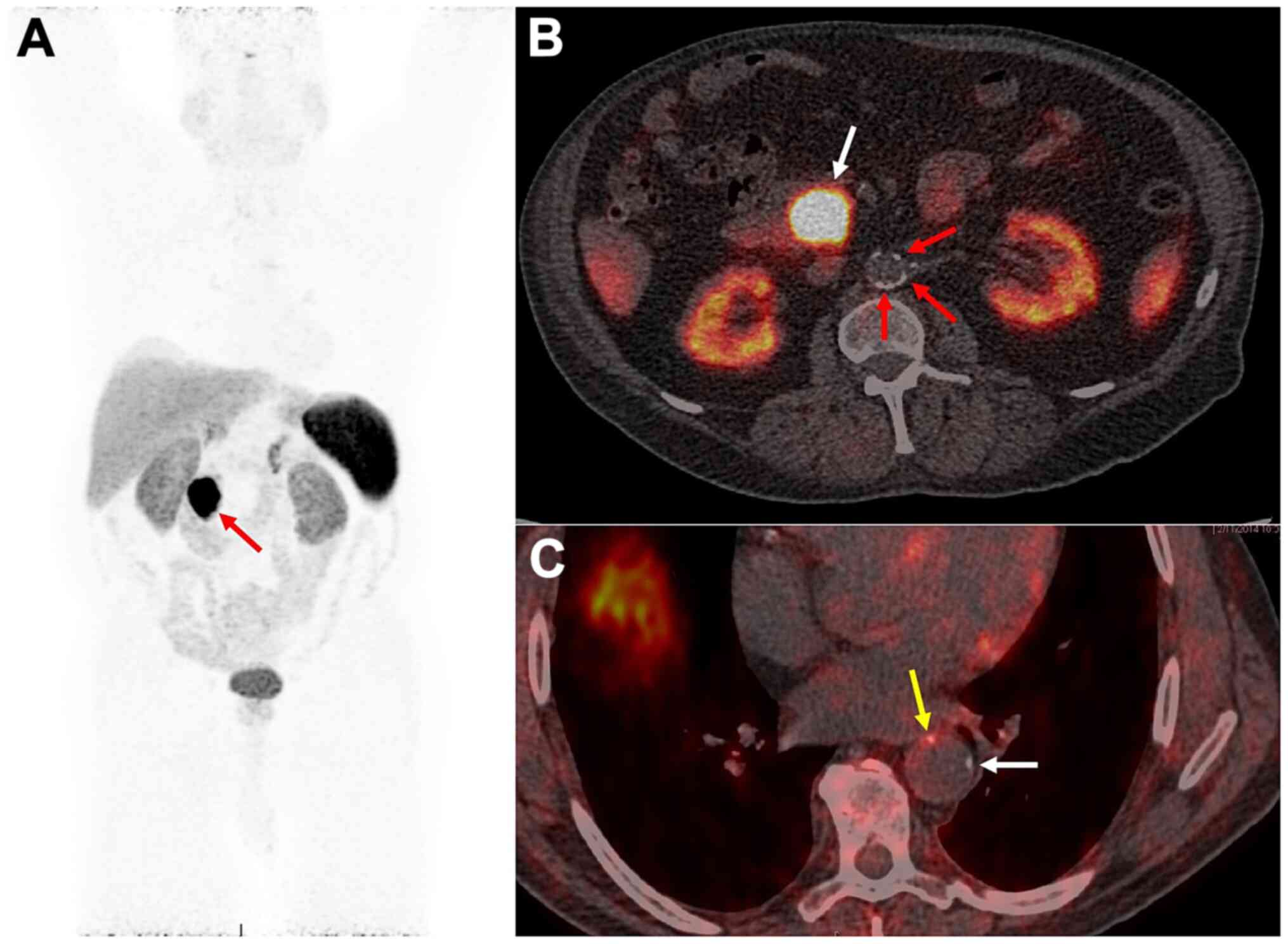
A 82-year-old man presented with a constant epigastric pain. The computed tomography (CT) scan of the abdomen, showed a large (3 cm) pancreatic head mass. Subsequently, endoscopic ultrasound (EUS) and biopsy of the tumor revealed a low-grade NET. Therefore, a whole body 68Ga-DOTATATE PET/CT scan was performed for staging purposes. The PET/CT study showed (Fig. 1A) intense radiotracer uptake (SUVmax: 85) by the pancreatic head tumor and excluded the presence of metastatic disease.

Figure 1

(A) MIP 68Ga-DOTATATE PET image of the of the head and torso showing (red arrow) a large tumor in the head of the pancreas with intensely elevated uptake (SUVmax: 85). (B) Axial fused 68Ga-DOTATATE PET/CT image of the abdomen demonstrating the 68Ga-DOTATATE-avid pancreatic head mass (white arrow) and extensive atherosclerotic lesions in the aorta (red arrows) which are 68Ga-DOTATATE-negative. (C) Axial fused 68Ga-DOTATATE PET/CT image of the thorax showing two aortic atherosclerotic lesions, one of which was 68Ga-DOTATATE-negative (white arrow), while the other one (yellow arrow) exhibiting elevated radiotracer uptake (SUVmax: 5.5) and thus implying infiltration by macrophages. MIP, maximum intensity projection; PET, positron emitting tomography; CT, computed tomography.

Furthermore, there was extensive atherosclerosis seen throughout medium- and large-sized arteries such as in the abdominal aorta, most of which were 68Ga-DOTATATE-negative (Fig. 1B; red arrows). However, in the thoracic aorta a radiotracer-positive plaque (SUVmax: 5.5) was encountered (Fig. 1C; yellow arrow), implying infiltration by macrophages, which are known to be characterized by cell-surface over-expression of SSTRs-subtype-2, leading to increased 68Ga-DOTATATE activity. At the same level of the thoracic aorta, another 68Ga-DOTATATE-negative plaque was detected (Fig. 1C; white arrow), suggesting that not all atherosclerotic lesions take up the administered PET-tracer. Despite its small size, the 68Ga-DOTATATE avidity of the plaque seen on the thoracic aorta, suggests an active inflammatory cascade taking place in that specific lesion, raising suspicion for a high-risk prone to rupture lesion.

Discussion

Early and accurate detection of high-risk, prone to rupture atherosclerotic plaques, is the holy grail of CD research, receiving great interest and extensive research efforts. Molecular imaging of key rupture-related pathophysiological features of the plaques, by means of PET-tracers, holds promise to address this diagnostic challenge. Imaging the recruitment of macrophages at sites of vessel wall inflammation (VWI), via PET-tracers aiming at the cell-surface over-expression of STTRs subtype-2, also seen on macrophages, is a promising molecular imaging strategy for the detection of the unstable plaques.

In a series of 16 patients with NETS, Li X. et al. reported association between coronary artery uptake of 68Ga-DOTATATE with known risk factors of CD (15). Furthermore, Pedersen SF et al, in a cohort of 10 patients who underwent simultaneous PET/MRI scans using 64Cu-DOTATATE, prior to carotid endarterectomy, found increased tracer uptake in symptomatic plaques, while an independent correlation with CD 163 gene expression (surrogate marker of activated macrophages) was revealed (16). In a series of 42 patients with atherosclerosis, Tarkin et al reported that 68Ga-DOTATATE correctly detected culprit arteries in patients with acute coronary syndrome, predicted high-risk coronary CT features and was positively associated with Framingham risk score, implying the employment of the radiotracer as a novel imaging probe for VWI (17). Moreover, 68Ga-DOTATATE is superior to 18F-FDG which is the most widely used PET-tracer, targeting metabolic activity, since the lack of physiologic uptake by the myocardium, enables assessment of the coronary arteries.

In accordance to the existing literature, the current report adds to the data that not all atherosclerotic plaques exhibit elevated 68Ga-DOTATATE activity, suggesting that only lesions harboring active inflammatory processes and therefore are infiltrated by macrophages, take up the tracer. A major limitation of our report is the lack of histologic analysis of the 68Ga-DOTATATE-avid plaque in the thoracic aorta, and the confirmation of macrophages accumulation. However, our work enhances the need for further research efforts being addressed towards employment of this specific molecular imaging strategy for the detection of the vulnerable atherosclerotic plaque.

Acknowledgements

Not applicable.

Funding

Funding

Part of this study was financially supported by the Stavros Niarchos Foundation within the framework of the project ARCHERS (Advancing Young Researchers' Human Capital in Cutting Edge Technologies in the Preservation of Cultural Heritage and the Tackling of Societal Challenges).

Availability of data and materials

All the information relevant to the present study is available from the corresponding author on reasonable request.

Authors' contributions

GZP, AHK, and GK conceived and designed the study. GZP, GL, KM, NK, FHS, GGI, TKN and SK researched the literature, performed interpretation of data and drafted the manuscript. DAS, and AHK critically revised the article for important intellectual content, and assisted in the literature search for this case report. All authors agree to be accountable for all aspects of the work in ensuring that questions related to the accuracy or integrity of any part of the work are appropriately investigated, and finally approved the version of the manuscript to be published.

Ethics approval and consent to participate

The images were provided by esteemed physicians at the NIH, with whom the first and corresponding author of the article collaborates. All study participants at the NIH clinical protocols provided all the extensive consent forms and strict ethical approval documents that the NIH standards require.

Patient consent for publication

Not applicable.

Competing interests

DAS is the Editor-in-Chief for the journal, but had no personal involvement in the reviewing process, or any influence in terms of adjudicating on the final decision, for this article. All the other authors declare that they have no competing interests.

References

1 

Bucerius J, Dijkgraaf I, Mottaghy FM and Schurgers LJ: Target identification for the diagnosis and intervention of vulnerable atherosclerotic plaques beyond 18F-fluorodeoxyglucose positron emission tomography imaging: Promising tracers on the horizon. Eur J Nucl Med Mol Imaging. 46:251–265. 2019.PubMed/NCBI View Article : Google Scholar

2 

Krishnan S, Otaki Y, Doris M, Slipczuk L, Arnson Y, Rubeaux M, Dey D, Slomka P, Berman DS and Tamarappoo B: Molecular imaging of vulnerable coronary plaque: A pathophysiologic perspective. J Nucl Med. 58:359–364. 2017.PubMed/NCBI View Article : Google Scholar

3 

Dalm VA, van Hagen PM, van Koetsveld PM, Achilefu S, Houtsmuller AB, Pols DH, van der Lely AJ, Lamberts SW and Hofland LJ: Expression of somatostatin, cortistatin, and somatostatin receptors in human monocytes, macrophages, and dendritic Cells. Am J Physiol Endocrinol Metab. 285:E344–E353. 2003.PubMed/NCBI View Article : Google Scholar

4 

Armani C, Catalani E, Balbarini A, Bagnoli P and Cervia D: Expression, pharmacology, and functional role of somatostatin receptor subtypes 1 and 2 in human macrophages. J Leukoc Biol. 81:845–855. 2007.PubMed/NCBI View Article : Google Scholar

5 

Hofman MS, Lau WF and Hicks RJ: Somatostatin receptor imaging with 68Ga DOTATATE PET/CT: Clinical utility, normal patterns, pearls, and pitfalls in interpretation. Radiographics. 35:500–516. 2015.PubMed/NCBI View Article : Google Scholar

6 

Tirosh A, Papadakis GZ, Millo C, Hammoud D, Sadowski SM, Herscovitch P, Pacak K, Marx SJ, Yang L, Nockel P, et al: Prognostic utility of total 68Ga-DOTATATE-avid tumor volume in patients with neuroendocrine tumors. Gastroenterology. 154:998–1008.e1. 2018.PubMed/NCBI View Article : Google Scholar

7 

Tirosh A, Papadakis GZ, Millo C, Sadowski SM, Herscovitch P, Pacak K, Marx SJ, Yang L, Nockel P, Shell J, et al: Association between neuroendocrine tumors biomarkers and primary tumor site and disease type based on total 68Ga-DOTATATE-Avid tumor volume measurements. Eur J Endocrinol. 176:575–582. 2017.PubMed/NCBI View Article : Google Scholar

8 

Papadakis GZ, Millo C, Sadowski SM, Bagci U and Patronas NJ: Kidney tumor in a von Hippel-Lindau (VHL) patient with intensely increased activity on 68Ga-DOTA-TATE PET/CT. Clin Nucl Med. 41:970–971. 2016.PubMed/NCBI View Article : Google Scholar

9 

El-Maouche D, Sadowski SM, Papadakis GZ, Guthrie L, Cottle-Delisle C, Merkel R, Millo C, Chen CC, Kebebew E and Collins MT: 68Ga-DOTATATE for tumor localization in tumor-induced osteomalacia. J Clin Endocrinol Metab. 101:3575–3581. 2016.PubMed/NCBI View Article : Google Scholar

10 

Papadakis GZ, Millo C, Sadowski SM, Bagci U and Patronas NJ: Epididymal cystadenomas in von Hippel-Lindau disease showing increased activity on 68Ga-DOTATATE PET/CT. Clin Nucl Med. 41:781–782. 2016.PubMed/NCBI View Article : Google Scholar

11 

Papadakis GZ, Millo C, Sadowski SM, Bagci U and Patronas NJ: Endolymphatic sac tumor showing increased activity on 68Ga-DOTATATE PET/CT. Clin Nucl Med. 41:783–784. 2016.PubMed/NCBI View Article : Google Scholar

12 

Papadakis GZ, Bagci U, Sadowski SM, Patronas NJ and Stratakis CA: Ectopic ACTH and CRH co-secreting tumor localized by 68Ga-DOTA-TATE PET/CT. Clin Nucl Med. 40:576–578. 2015.PubMed/NCBI View Article : Google Scholar

13 

Papadakis GZ, Millo C, Karantanas AH, Bagci U and Patronas NJ: Avascular necrosis of the hips with increased activity on 68Ga-DOTATATE PET/CT. Clin Nucl Med. 42:214–215. 2017.PubMed/NCBI View Article : Google Scholar

14 

Papadakis GZ, Millo C, Bagci U, Sadowski SM and Stratakis CA: Schmorl nodes can cause increased 68Ga-DOTATATE activity on PET/CT, mimicking metastasis in patients with neuroendocrine malignancy. Clin Nucl Med. 41:249–250. 2016.PubMed/NCBI View Article : Google Scholar

15 

Li X, Samnick S, Lapa C, Israel I, Buck AK, Kreissl MC and Bauer W: 68Ga-DOTATATE PET/CT for the detection of inflammation of large arteries: Correlation with 18F-FDG, calcium burden and risk factors. xsEJNMMI Res. 2(52)2012.PubMed/NCBI View Article : Google Scholar

16 

Pedersen SF, Sandholt BV, Keller SH, Hansen AE, Clemmensen AE, Sillesen H, Højgaard L, Ripa RS and Kjær A: 64Cu-DOTATATE PET/MRI for detection of activated macrophages in carotid atherosclerotic plaques: Studies in patients undergoing endarterectomy. Arterioscler Thromb Vasc Biol. 35:1696–1703. 2015.PubMed/NCBI View Article : Google Scholar

17 

Tarkin JM, Joshi FR, Evans NR, Chowdhury MM, Figg NL, Shah AV, Starks LT, Martin-Garrido A, Manavaki R, Yu E, et al: Detection of atherosclerotic inflammation by 68Ga-DOTATATE PET compared to 18F-FDG PET imaging. J Am Coll Cardiol. 69:1774–1791. 2017.PubMed/NCBI View Article : Google Scholar

Related Articles

  • Abstract
  • View
  • Download
  • Twitter
Copy and paste a formatted citation
Spandidos Publications style
Papadakis GZ, Kochiadakis G, Lazopoulos G, Marias K, Klapsinos N, Hannah‑shmouni F, Igoumenaki GG, Nikolouzakis TK, Kteniadakis S, Spandidos DA, Spandidos DA, et al: Targeting vulnerable atherosclerotic plaque via PET‑tracers aiming at cell‑surface overexpression of somatostatin receptors. Biomed Rep 13: 9, 2020.
APA
Papadakis, G.Z., Kochiadakis, G., Lazopoulos, G., Marias, K., Klapsinos, N., Hannah‑shmouni, F. ... Karantanas, A.H. (2020). Targeting vulnerable atherosclerotic plaque via PET‑tracers aiming at cell‑surface overexpression of somatostatin receptors. Biomedical Reports, 13, 9. https://doi.org/10.3892/br.2020.1316
MLA
Papadakis, G. Z., Kochiadakis, G., Lazopoulos, G., Marias, K., Klapsinos, N., Hannah‑shmouni, F., Igoumenaki, G. G., Nikolouzakis, T. K., Kteniadakis, S., Spandidos, D. A., Karantanas, A. H."Targeting vulnerable atherosclerotic plaque via PET‑tracers aiming at cell‑surface overexpression of somatostatin receptors". Biomedical Reports 13.3 (2020): 9.
Chicago
Papadakis, G. Z., Kochiadakis, G., Lazopoulos, G., Marias, K., Klapsinos, N., Hannah‑shmouni, F., Igoumenaki, G. G., Nikolouzakis, T. K., Kteniadakis, S., Spandidos, D. A., Karantanas, A. H."Targeting vulnerable atherosclerotic plaque via PET‑tracers aiming at cell‑surface overexpression of somatostatin receptors". Biomedical Reports 13, no. 3 (2020): 9. https://doi.org/10.3892/br.2020.1316
Copy and paste a formatted citation
x
Spandidos Publications style
Papadakis GZ, Kochiadakis G, Lazopoulos G, Marias K, Klapsinos N, Hannah‑shmouni F, Igoumenaki GG, Nikolouzakis TK, Kteniadakis S, Spandidos DA, Spandidos DA, et al: Targeting vulnerable atherosclerotic plaque via PET‑tracers aiming at cell‑surface overexpression of somatostatin receptors. Biomed Rep 13: 9, 2020.
APA
Papadakis, G.Z., Kochiadakis, G., Lazopoulos, G., Marias, K., Klapsinos, N., Hannah‑shmouni, F. ... Karantanas, A.H. (2020). Targeting vulnerable atherosclerotic plaque via PET‑tracers aiming at cell‑surface overexpression of somatostatin receptors. Biomedical Reports, 13, 9. https://doi.org/10.3892/br.2020.1316
MLA
Papadakis, G. Z., Kochiadakis, G., Lazopoulos, G., Marias, K., Klapsinos, N., Hannah‑shmouni, F., Igoumenaki, G. G., Nikolouzakis, T. K., Kteniadakis, S., Spandidos, D. A., Karantanas, A. H."Targeting vulnerable atherosclerotic plaque via PET‑tracers aiming at cell‑surface overexpression of somatostatin receptors". Biomedical Reports 13.3 (2020): 9.
Chicago
Papadakis, G. Z., Kochiadakis, G., Lazopoulos, G., Marias, K., Klapsinos, N., Hannah‑shmouni, F., Igoumenaki, G. G., Nikolouzakis, T. K., Kteniadakis, S., Spandidos, D. A., Karantanas, A. H."Targeting vulnerable atherosclerotic plaque via PET‑tracers aiming at cell‑surface overexpression of somatostatin receptors". Biomedical Reports 13, no. 3 (2020): 9. https://doi.org/10.3892/br.2020.1316
Follow us
  • Twitter
  • LinkedIn
  • Facebook
About
  • Spandidos Publications
  • Careers
  • Cookie Policy
  • Privacy Policy
How can we help?
  • Help
  • Live Chat
  • Contact
  • Email to our Support Team