Spandidos Publications Logo
  • About
    • About Spandidos
    • Aims and Scopes
    • Abstracting and Indexing
    • Editorial Policies
    • Reprints and Permissions
    • Job Opportunities
    • Terms and Conditions
    • Contact
  • Journals
    • All Journals
    • Oncology Letters
      • Oncology Letters
      • Information for Authors
      • Editorial Policies
      • Editorial Board
      • Aims and Scope
      • Abstracting and Indexing
      • Bibliographic Information
      • Archive
    • International Journal of Oncology
      • International Journal of Oncology
      • Information for Authors
      • Editorial Policies
      • Editorial Board
      • Aims and Scope
      • Abstracting and Indexing
      • Bibliographic Information
      • Archive
    • Molecular and Clinical Oncology
      • Molecular and Clinical Oncology
      • Information for Authors
      • Editorial Policies
      • Editorial Board
      • Aims and Scope
      • Abstracting and Indexing
      • Bibliographic Information
      • Archive
    • Experimental and Therapeutic Medicine
      • Experimental and Therapeutic Medicine
      • Information for Authors
      • Editorial Policies
      • Editorial Board
      • Aims and Scope
      • Abstracting and Indexing
      • Bibliographic Information
      • Archive
    • International Journal of Molecular Medicine
      • International Journal of Molecular Medicine
      • Information for Authors
      • Editorial Policies
      • Editorial Board
      • Aims and Scope
      • Abstracting and Indexing
      • Bibliographic Information
      • Archive
    • Biomedical Reports
      • Biomedical Reports
      • Information for Authors
      • Editorial Policies
      • Editorial Board
      • Aims and Scope
      • Abstracting and Indexing
      • Bibliographic Information
      • Archive
    • Oncology Reports
      • Oncology Reports
      • Information for Authors
      • Editorial Policies
      • Editorial Board
      • Aims and Scope
      • Abstracting and Indexing
      • Bibliographic Information
      • Archive
    • Molecular Medicine Reports
      • Molecular Medicine Reports
      • Information for Authors
      • Editorial Policies
      • Editorial Board
      • Aims and Scope
      • Abstracting and Indexing
      • Bibliographic Information
      • Archive
    • World Academy of Sciences Journal
      • World Academy of Sciences Journal
      • Information for Authors
      • Editorial Policies
      • Editorial Board
      • Aims and Scope
      • Abstracting and Indexing
      • Bibliographic Information
      • Archive
    • International Journal of Functional Nutrition
      • International Journal of Functional Nutrition
      • Information for Authors
      • Editorial Policies
      • Editorial Board
      • Aims and Scope
      • Abstracting and Indexing
      • Bibliographic Information
      • Archive
    • International Journal of Epigenetics
      • International Journal of Epigenetics
      • Information for Authors
      • Editorial Policies
      • Editorial Board
      • Aims and Scope
      • Abstracting and Indexing
      • Bibliographic Information
      • Archive
    • Medicine International
      • Medicine International
      • Information for Authors
      • Editorial Policies
      • Editorial Board
      • Aims and Scope
      • Abstracting and Indexing
      • Bibliographic Information
      • Archive
  • Articles
  • Information
    • Information for Authors
    • Information for Reviewers
    • Information for Librarians
    • Information for Advertisers
    • Conferences
  • Language Editing
Spandidos Publications Logo
  • About
    • About Spandidos
    • Aims and Scopes
    • Abstracting and Indexing
    • Editorial Policies
    • Reprints and Permissions
    • Job Opportunities
    • Terms and Conditions
    • Contact
  • Journals
    • All Journals
    • Biomedical Reports
      • Information for Authors
      • Editorial Policies
      • Editorial Board
      • Aims and Scope
      • Abstracting and Indexing
      • Bibliographic Information
      • Archive
    • Experimental and Therapeutic Medicine
      • Information for Authors
      • Editorial Policies
      • Editorial Board
      • Aims and Scope
      • Abstracting and Indexing
      • Bibliographic Information
      • Archive
    • International Journal of Epigenetics
      • Information for Authors
      • Editorial Policies
      • Editorial Board
      • Aims and Scope
      • Abstracting and Indexing
      • Bibliographic Information
      • Archive
    • International Journal of Functional Nutrition
      • Information for Authors
      • Editorial Policies
      • Editorial Board
      • Aims and Scope
      • Abstracting and Indexing
      • Bibliographic Information
      • Archive
    • International Journal of Molecular Medicine
      • Information for Authors
      • Editorial Policies
      • Editorial Board
      • Aims and Scope
      • Abstracting and Indexing
      • Bibliographic Information
      • Archive
    • International Journal of Oncology
      • Information for Authors
      • Editorial Policies
      • Editorial Board
      • Aims and Scope
      • Abstracting and Indexing
      • Bibliographic Information
      • Archive
    • Medicine International
      • Information for Authors
      • Editorial Policies
      • Editorial Board
      • Aims and Scope
      • Abstracting and Indexing
      • Bibliographic Information
      • Archive
    • Molecular and Clinical Oncology
      • Information for Authors
      • Editorial Policies
      • Editorial Board
      • Aims and Scope
      • Abstracting and Indexing
      • Bibliographic Information
      • Archive
    • Molecular Medicine Reports
      • Information for Authors
      • Editorial Policies
      • Editorial Board
      • Aims and Scope
      • Abstracting and Indexing
      • Bibliographic Information
      • Archive
    • Oncology Letters
      • Information for Authors
      • Editorial Policies
      • Editorial Board
      • Aims and Scope
      • Abstracting and Indexing
      • Bibliographic Information
      • Archive
    • Oncology Reports
      • Information for Authors
      • Editorial Policies
      • Editorial Board
      • Aims and Scope
      • Abstracting and Indexing
      • Bibliographic Information
      • Archive
    • World Academy of Sciences Journal
      • Information for Authors
      • Editorial Policies
      • Editorial Board
      • Aims and Scope
      • Abstracting and Indexing
      • Bibliographic Information
      • Archive
  • Articles
  • Information
    • For Authors
    • For Reviewers
    • For Librarians
    • For Advertisers
    • Conferences
  • Language Editing
Login Register Submit
  • This site uses cookies
  • You can change your cookie settings at any time by following the instructions in our Cookie Policy. To find out more, you may read our Privacy Policy.

    I agree
Search articles by DOI, keyword, author or affiliation
Search
Advanced Search
presentation
Biomedical Reports
Join Editorial Board Propose a Special Issue
Print ISSN: 2049-9434 Online ISSN: 2049-9442
Journal Cover
August-2023 Volume 19 Issue 2

Full Size Image

Sign up for eToc alerts
Recommend to Library

Journals

International Journal of Molecular Medicine

International Journal of Molecular Medicine

International Journal of Molecular Medicine is an international journal devoted to molecular mechanisms of human disease.

International Journal of Oncology

International Journal of Oncology

International Journal of Oncology is an international journal devoted to oncology research and cancer treatment.

Molecular Medicine Reports

Molecular Medicine Reports

Covers molecular medicine topics such as pharmacology, pathology, genetics, neuroscience, infectious diseases, molecular cardiology, and molecular surgery.

Oncology Reports

Oncology Reports

Oncology Reports is an international journal devoted to fundamental and applied research in Oncology.

Experimental and Therapeutic Medicine

Experimental and Therapeutic Medicine

Experimental and Therapeutic Medicine is an international journal devoted to laboratory and clinical medicine.

Oncology Letters

Oncology Letters

Oncology Letters is an international journal devoted to Experimental and Clinical Oncology.

Biomedical Reports

Biomedical Reports

Explores a wide range of biological and medical fields, including pharmacology, genetics, microbiology, neuroscience, and molecular cardiology.

Molecular and Clinical Oncology

Molecular and Clinical Oncology

International journal addressing all aspects of oncology research, from tumorigenesis and oncogenes to chemotherapy and metastasis.

World Academy of Sciences Journal

World Academy of Sciences Journal

Multidisciplinary open-access journal spanning biochemistry, genetics, neuroscience, environmental health, and synthetic biology.

International Journal of Functional Nutrition

International Journal of Functional Nutrition

Open-access journal combining biochemistry, pharmacology, immunology, and genetics to advance health through functional nutrition.

International Journal of Epigenetics

International Journal of Epigenetics

Publishes open-access research on using epigenetics to advance understanding and treatment of human disease.

Medicine International

Medicine International

An International Open Access Journal Devoted to General Medicine.

Journal Cover
August-2023 Volume 19 Issue 2

Full Size Image

Sign up for eToc alerts
Recommend to Library

  • Article
  • Citations
    • Cite This Article
    • Download Citation
    • Create Citation Alert
    • Remove Citation Alert
    • Cited By
  • Similar Articles
    • Related Articles (in Spandidos Publications)
    • Similar Articles (Google Scholar)
    • Similar Articles (PubMed)
  • Download PDF
  • Download XML
  • View XML

  • Supplementary Files
    • Supplementary_Data.pdf
Article Open Access

Herpesvirus entry mediator as a potential biomarker in breast cancer compared with conventional cytotoxic T‑lymphocyte‑associated antigen 4

  • Authors:
    • Alia Aldahlawi
    • Fatemah Basingab
    • Jehan Alrahimi
    • Kawther Zaher
    • Peter Natesan Pushparaj
    • Mohammed A. Hassan
    • Kaltoom Al‑Sakkaf
  • View Affiliations / Copyright

    Affiliations: Department of Biological Sciences, Faculty of Sciences, King Abdulaziz University, Jeddah 21589, Saudi Arabia, Immunology Unit, King Fahad for Medical Research, King Abdulaziz University, Jeddah 21589, Saudi Arabia, Center of Excellence in Genomic Medicine Research, King Fahad for Medical Research, King Abdulaziz University, Jeddah 21589, Saudi Arabia, Department of Medical Basic Sciences, College of Medicine and Health Sciences, Hadhramout University, Mukalla 50511, Republic of Yemen
    Copyright: © Aldahlawi et al. This is an open access article distributed under the terms of Creative Commons Attribution License.
  • Article Number: 56
    |
    Published online on: July 17, 2023
       https://doi.org/10.3892/br.2023.1638
  • Expand metrics +
Metrics: Total Views: 0 (Spandidos Publications: | PMC Statistics: )
Metrics: Total PDF Downloads: 0 (Spandidos Publications: | PMC Statistics: )
Cited By (CrossRef): 0 citations Loading Articles...

This article is mentioned in:


Abstract

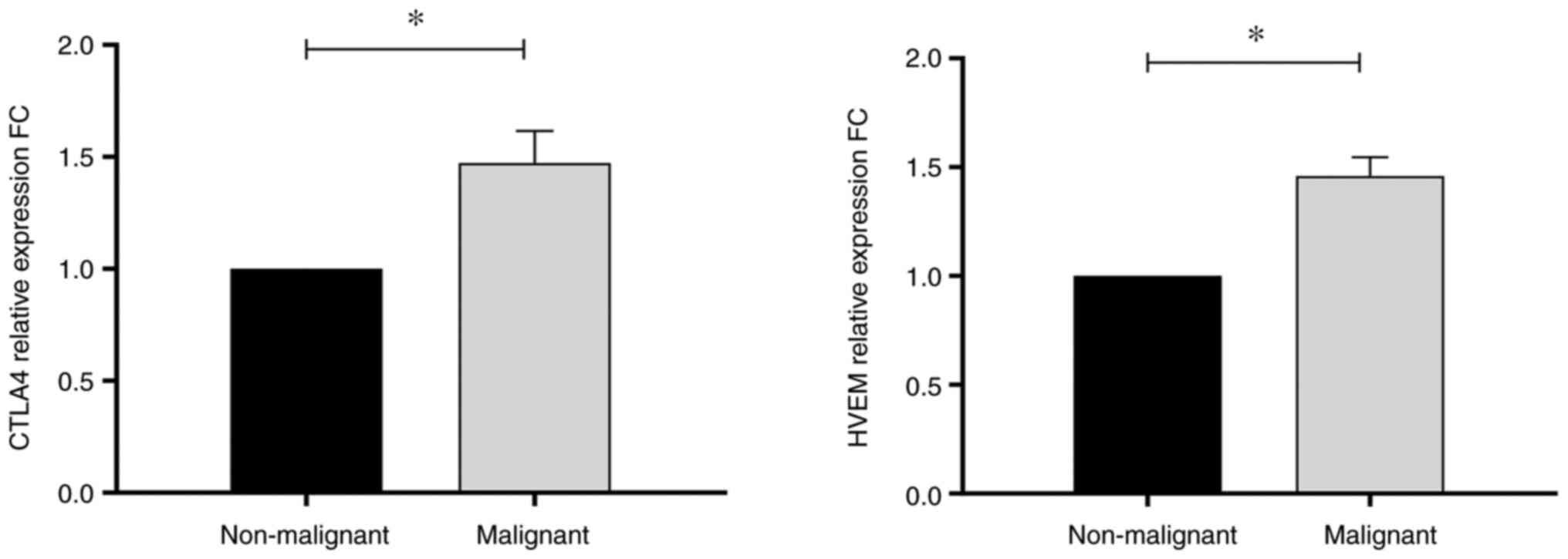
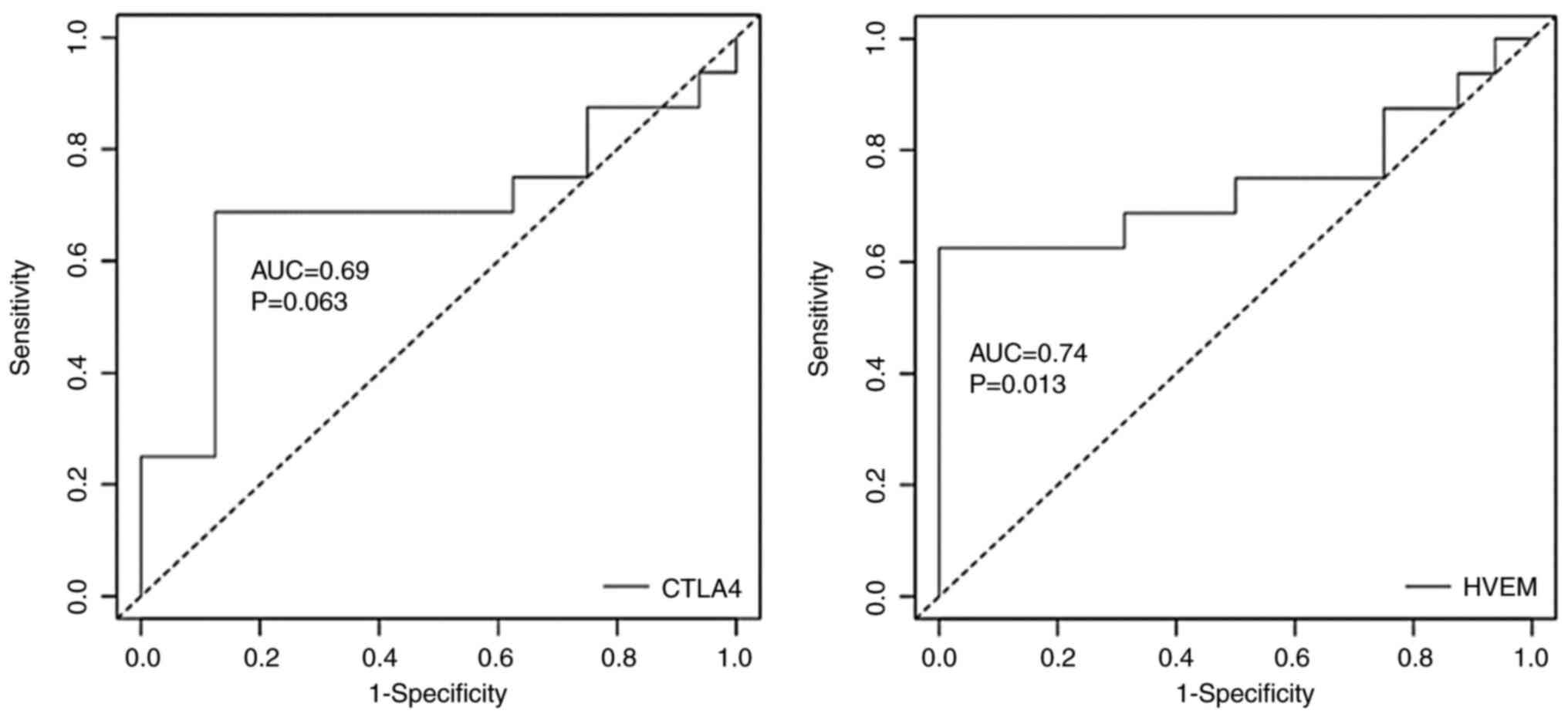
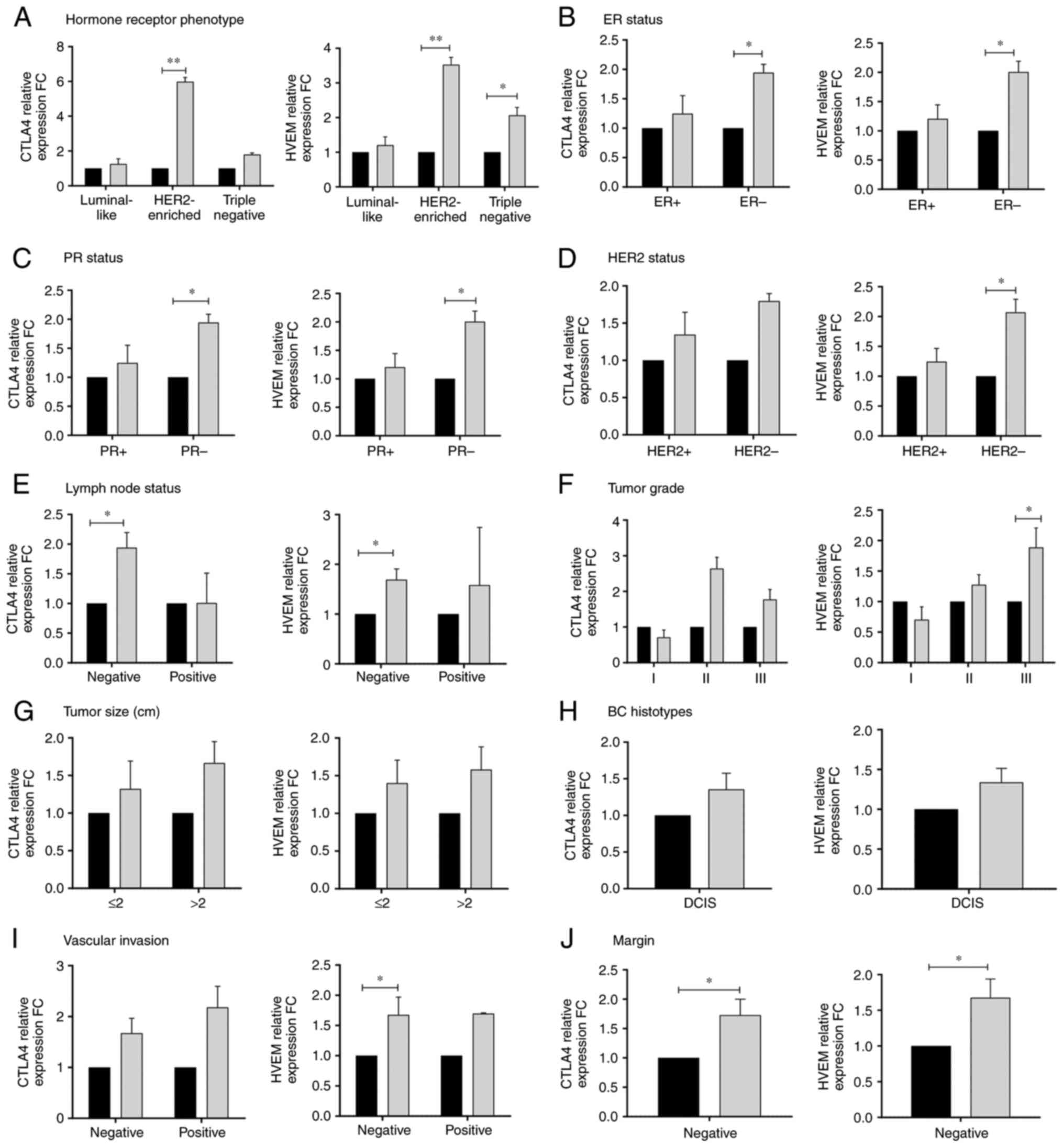
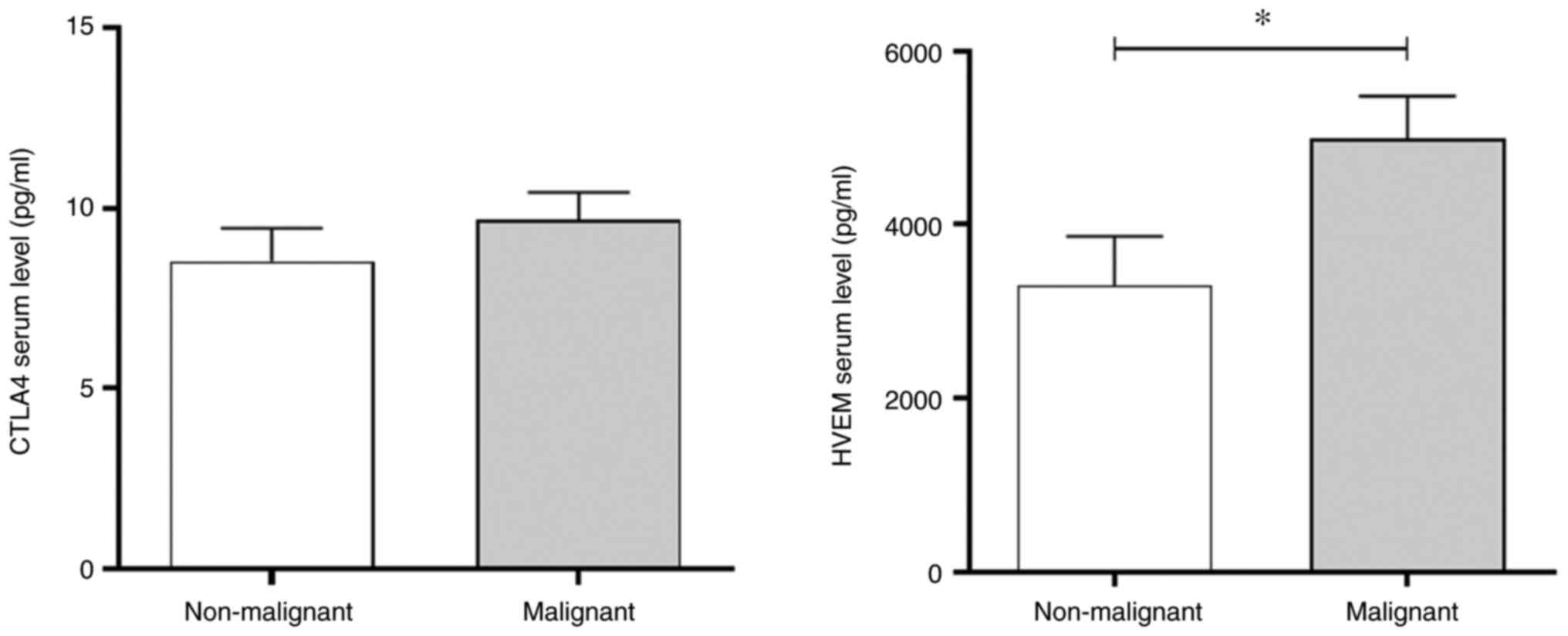
Breast cancer (BC) is the most common cancer in women worldwide, with 2.3 million cases recorded in 2020. Despite improvements in cancer treatment, patients with BC still succumb to the disease, due to regional and distant metastases when diagnosed at later stages. Several immune checkpoint inhibitors have been approved for BC treatment, based on their expression and role in maintaining immunosurveillance against tumors. The present study aimed to evaluate the expression of 12 immune checkpoints in patients with BC, and assess their role as diagnostic and therapeutic markers. Expression levels were measured using reverse transcription‑quantitative polymerase chain reaction. Among the 12 immune markers, herpesvirus entry mediator (HVEM) was found to be significantly upregulated in patients with malignant BC compared to non‑malignant controls, with a relative fold change (FC) of 1.46 and P=0.012. A similar finding was observed for cytotoxic T‑lymphocyte‑associated antigen 4 (CTLA4; FC=1.47 and P=0.035). In addition, receiver operating characteristic curve analysis revealed that HVEM expression allowed significant differentiation between groups, with an area under the curve of 0.74 (P=0.013). Upregulation in both HVEM and CTLA4 was revealed to be significantly associated with the human epidermal growth factor receptor‑2 (HER2)‑enriched phenotype (FC=3.53, P=0.009 and FC=5.98, P=0.002, respectively), while only HVEM was significantly associated with the triple‑negative phenotype (FC=2.07, P=0.016). Furthermore, HVEM was significantly higher in patients with grade III tumors (FC=1.88, P=0.025) and negative vascular invasion (FC=1.67, P=0.046) compared with non‑malignant controls. Serum protein levels were assessed by multiplex immunoassay, and a significant increase in HVEM was detected in patients with malignant BC compared with that in non‑malignant controls (P=0.035). These data indicated that HVEM may serve as a potential biomarker and target for immunotherapy, especially for certain types of BC.
View Figures

Figure 1

Figure 2

Figure 3

Figure 4

Figure 5

View References

1 

Lei S, Zheng R, Zhang S, Wang S, Chen R, Sun K, Zeng H, Zhou J and Wei W: Global patterns of breast cancer incidence and mortality: A population-based cancer registry data analysis from 2000 to 2020. Cancer Commun (Lond). 41:1183–1194. 2021.PubMed/NCBI View Article : Google Scholar

2 

Sharma R: Breast cancer incidence, mortality and mortality-to-incidence ratio (MIR) are associated with human development, 1990-2016: Evidence from Global Burden of Disease Study 2016. Breast Cancer. 26:428–445. 2019.PubMed/NCBI View Article : Google Scholar

3 

Magro G, Salvatorelli L, Puzzo L, Piombino E, Bartoloni G, Broggi G and Vecchio GM: Practical approach to diagnosis of bland-looking spindle cell lesions of the breast. Pathologica. 111:344–360. 2019.PubMed/NCBI View Article : Google Scholar

4 

Broggi G, Filetti V, Ieni A, Rapisarda V, Ledda C, Vitale E, Varricchio S, Russo D, Lombardo C, Tuccari G, et al: MacroH2A1 immunoexpression in breast cancer. Front Oncol. 10(1519)2020.PubMed/NCBI View Article : Google Scholar

5 

Fang J, Chen F, Liu D, Gu F, Chen Z and Wang Y: Prognostic value of immune checkpoint molecules in breast cancer. Biosci Rep. 40(BSR20201054)2020.PubMed/NCBI View Article : Google Scholar

6 

Yi H, Li Y, Tan Y, Fu S, Tang F and Deng X: Immune checkpoint inhibition for Triple-negative breast cancer: Current landscape and future perspectives. Front Oncol. 11(648139)2021.PubMed/NCBI View Article : Google Scholar

7 

Planes-Laine G, Rochigneux P, Bertucci F, Chrétien AS, Viens P, Sabatier R and Gonçalves A: PD-1/PD-L1 targeting in breast cancer: The first clinical evidences are emerging. A literature review. Cancers (Basel). 11(1033)2019.PubMed/NCBI View Article : Google Scholar

8 

Kern R and Panis C: CTLA-4 expression and its clinical significance in breast cancer. Arch Immunol Ther Exp (Warsz). 69(16)2021.PubMed/NCBI View Article : Google Scholar

9 

Watanabe N, Gavrieli M, Sedy JR, Yang J, Fallarino F, Loftin SK, Hurchla MA, Zimmerman N, Sim J, Zang X, et al: BTLA is a lymphocyte inhibitory receptor with similarities to CTLA-4 and PD-1. Nat Immunol. 4:670–679. 2003.PubMed/NCBI View Article : Google Scholar

10 

Dill EA, Dillon PM, Bullock TN and Mills AM: IDO expression in breast cancer: An assessment of 281 primary and metastatic cases with comparison to PD-L1. Mod Pathol. 31:1513–1522. 2018.PubMed/NCBI View Article : Google Scholar

11 

Miselis NR, Linn D, Restaino C, Baral T, Xia J, Ueda R, Sawant A, Baker J, Raghunathan G, Wang X, et al: Abstract 577: Antagonism of the co-inhibitory receptor BTLA enhances efficacy of anti-PD-1 treatment in murine syngeneic tumor models. Cancer Res. 77(577)2017.

12 

Inoue T, Sho M, Yasuda S, Nishiwada S, Nakamura S, Ueda T, Nishigori N, Kawasaki K, Obara S, Nakamoto T, et al: HVEM expression contributes to tumor progression and prognosis in human colorectal cancer. Anticancer Res. 35:1361–1367. 2015.PubMed/NCBI

13 

Hokuto D, Sho M, Yamato I, Yasuda S, Obara S, Nomi T and Nakajima Y: Clinical impact of herpesvirus entry mediator expression in human hepatocellular carcinoma. Eur J Cancer. 51:157–165. 2015.PubMed/NCBI View Article : Google Scholar

14 

Tang M, Cao X, Li Y, Li GQ, He QH, Li SJ, Chen J, Xu GL and Zhang KQ: High expression of herpes virus entry mediator is associated with poor prognosis in clear cell renal cell carcinoma. Am J Cancer Res. 9:975–987. 2019.PubMed/NCBI

15 

Migita K, Sho M, Shimada K, Yasuda S, Yamato I, Takayama T, Matsumoto S, Wakatsuki K, Hotta K, Tanaka T, et al: Significant involvement of herpesvirus entry mediator in human esophageal squamous cell carcinoma. Cancer. 120:808–817. 2014.PubMed/NCBI View Article : Google Scholar

16 

Malissen N, Macagno N, Granjeaud S, Granier C, Moutardier V, Gaudy-Marqueste C, Habel N, Mandavit M, Guillot B, Pasero C, et al: HVEM has a broader expression than PD-L1 and constitutes a negative prognostic marker and potential treatment target for melanoma. Oncoimmunology. 8(e1665976)2019.PubMed/NCBI View Article : Google Scholar

17 

Fourcade J, Sun Z, Pagliano O, Guillaume P, Luescher IF, Sander C, Kirkwood JM, Olive D, Kuchroo V and Zarour HM: CD8(+) T cells specific for tumor antigens can be rendered dysfunctional by the tumor microenvironment through upregulation of the inhibitory receptors BTLA and PD-1. Cancer Res. 72:887–896. 2012.PubMed/NCBI View Article : Google Scholar

18 

Sideras K, Biermann K, Yap K, Mancham S, Boor PPC, Hansen BE, Stoop HJA, Peppelenbosch MP, van Eijck CH, Sleijfer S, et al: Tumor cell expression of immune inhibitory molecules and tumor-infiltrating lymphocyte count predict cancer-specific survival in pancreatic and ampullary cancer. Int J Cancer. 141:572–582. 2017.PubMed/NCBI View Article : Google Scholar

19 

Zhu YD and Lu MY: Increased expression of TNFRSF14 indicates good prognosis and inhibits bladder cancer proliferation by promoting apoptosis. Mol Med Rep. 18:3403–3410. 2018.PubMed/NCBI View Article : Google Scholar

20 

Haymaker CL, Wu RC, Ritthipichai K, Bernatchez C, Forget MA, Chen JQ, Liu H, Wang E, Marincola F, Hwu P and Radvanyi LG: BTLA marks a less-differentiated tumor-infiltrating lymphocyte subset in melanoma with enhanced survival properties. Oncoimmunology. 4(e1014246)2015.PubMed/NCBI View Article : Google Scholar

21 

Kim S, Park S, Cho MS, Lim W, Moon BI and Sung SH: Strong correlation of indoleamine 2,3-dioxygenase 1 expression with basal-like phenotype and increased lymphocytic infiltration in triple-negative breast cancer. J Cancer. 8:124–130. 2017.PubMed/NCBI View Article : Google Scholar

22 

Schaer DA, Murphy JT and Wolchok JD: Modulation of GITR for cancer immunotherapy. Curr Opin Immunol. 24:217–224. 2012.PubMed/NCBI View Article : Google Scholar

23 

Choudhry H, Hassan MA, Al-Malki AL and Al-Sakkaf KA: Suppression of circulating AP001429.1 long non-coding RNA in obese patients with breast cancer. Oncol Lett. 22(508)2021.PubMed/NCBI View Article : Google Scholar

24 

Lan X, Li S, Gao H, Nanding A, Quan L, Yang C, Ding S and Xue Y: Increased BTLA and HVEM in gastric cancer are associated with progression and poor prognosis. Onco Targets Ther. 10:919–926. 2017.PubMed/NCBI View Article : Google Scholar

25 

Pasero C and Olive D: Interfering with coinhibitory molecules: BTLA/HVEM as new targets to enhance anti-tumor immunity. Immunol Lett. 151:71–75. 2013.PubMed/NCBI View Article : Google Scholar

26 

Fu Z and Li D, Jiang W, Wang L, Zhang J, Xu F, Pang D and Li D: Association of BTLA gene polymorphisms with the risk of malignant breast cancer in Chinese women of Heilongjiang Province. Breast Cancer Res Treat. 120:195–202. 2010.PubMed/NCBI View Article : Google Scholar

27 

Khalife E, Khodadadi A, Talaeizadeh A, Rahimian L, Nemati M and Jafarzadeh A: Overexpression of regulatory T Cell-related markers (FOXP3, CTLA-4 and GITR) by peripheral blood mononuclear cells from patients with breast cancer. Asian Pacific J Cancer Prev. 19:3019–3025. 2018.PubMed/NCBI View Article : Google Scholar

28 

Zhou Y, Heitmann JS, Clar KL, Kropp KN, Hinterleitner M, Engler T, Koch A, Hartkopf AD, Zender L, Salih HR, et al: Platelet-expressed immune checkpoint regulator GITRL in breast cancer. Cancer Immunol Immunother. 70:2483–2496. 2021.PubMed/NCBI View Article : Google Scholar

29 

Jaberipour M, Habibagahi M, Hosseini A, Habibabad SR, Talei A and Ghaderi A: Increased CTLA-4 and FOXP3 transcripts in peripheral blood mononuclear cells of patients with breast cancer. Pathol Oncol Res. 16:547–551. 2010.PubMed/NCBI View Article : Google Scholar

30 

Tsang JYS, Chan KW, Ni YB, Hlaing T, Hu J, Chan SK, Cheung SY and Tse GM: Expression and clinical significance of herpes virus entry mediator (HVEM) in breast cancer. Ann Surg Oncol. 24:4042–4050. 2017.PubMed/NCBI View Article : Google Scholar

31 

Wu S, Shi X, Wang J, Wang X, Liu Y, Luo Y, Mao F and Zeng X: Triple-negative breast cancer: Intact mismatch repair and partial Co-expression of PD-L1 and LAG-3. Front Immunol. 12(561793)2021.PubMed/NCBI View Article : Google Scholar

32 

Kitano A, Ono M, Yoshida M, Noguchi E, Shimomura A, Shimoi T, Kodaira M, Yunokawa M, Yonemori K, Shimizu C, et al: Tumour-infiltrating lymphocytes are correlated with higher expression levels of PD-1 and PD-L1 in early breast cancer. ESMO Open. 2(e000150)2017.PubMed/NCBI View Article : Google Scholar

33 

Baptista MZ, Sarian LO, Derchain SF, Pinto GA and Vassallo J: Prognostic significance of PD-L1 and PD-L2 in breast cancer. Hum Pathol. 47:78–84. 2016.PubMed/NCBI View Article : Google Scholar

34 

Yasinska IM, Sakhnevych SS, Pavlova L, Teo Hansen Selnø A, Teuscher Abeleira AM, Benlaouer O, Gonçalves Silva I, Mosimann M, Varani L, Bardelli M, et al: The Tim-3-Galectin-9 pathway and its regulatory mechanisms in human breast cancer. Front Immunol. 10(1594)2019.PubMed/NCBI View Article : Google Scholar

35 

Carvajal-Hausdorf DE, Mani N, Velcheti V, Schalper KA and Rimm DL: Objective measurement and clinical significance of IDO1 protein in hormone receptor-positive breast cancer. J Immunother Cancer. 5(81)2017.PubMed/NCBI View Article : Google Scholar

36 

Livak KJ and Schmittgen TD: Analysis of relative gene expression data using real-time quantitative PCR and the 2(-Delta Delta C(T)) method. Methods. 25:402–408. 2001.PubMed/NCBI View Article : Google Scholar

37 

Pfaffl MW, Horgan GW and Dempfle L: Relative expression software tool (REST) for group-wise comparison and statistical analysis of relative expression results in real-time PCR. Nucleic Acids Res. 30(e36)2002.PubMed/NCBI View Article : Google Scholar

38 

Hamed MH, Pushparaj PN, Rehman S, Al-Karim S, Bazarah S and Qadri I: Deciphering the significance of plasma chemokines as prognostic biomarkers in pegylated IFN-Α-2a/Ribavirin-treated chronic Hepatitis C Genotype 4 patients. Infect Disord Drug Targets. 22:58–62. 2022.PubMed/NCBI View Article : Google Scholar

39 

Huwaikem MAH, Kalamegam G, Alrefaei G, Ahmed F, Kadam R, Qadah T, Sait KHW and Pushparaj PN: Human Wharton's Jelly stem cell secretions inhibit human leukemic cell line K562 in vitro by inducing cell cycle arrest and apoptosis. Front Cell Dev Biol. 9(614988)2021.PubMed/NCBI View Article : Google Scholar

40 

Ledys F, Kalfeist L, Galland L, Limagne E and Ladoire S: Therapeutic associations comprising Anti-PD-1/PD-L1 in breast cancer: Clinical challenges and perspectives. Cancers (Basel). 13(5999)2021.PubMed/NCBI View Article : Google Scholar

41 

Ji Q, Ding J, Hao M, Luo N, Huang J and Zhang W: Immune checkpoint inhibitors combined with chemotherapy compared with chemotherapy alone for triple-negative breast cancer: A systematic review and meta-analysis. Front Oncol. 11(795650)2021.PubMed/NCBI View Article : Google Scholar

42 

Miglietta F, Cona MS, Dieci MV, Guarneri V and La Verde N: An overview of immune checkpoint inhibitors in breast cancer. Explor Target Antitumor Ther. 1:452–472. 2020.PubMed/NCBI View Article : Google Scholar

43 

Manni M and Läubli H: Targeting glyco-immune checkpoints for cancer therapy. Expert Opin Biol Ther. 21:1063–1071. 2021.PubMed/NCBI View Article : Google Scholar

44 

Basingab FS, Ahmadi M and Morgan DJ: IFNγ-dependent interactions between ICAM-1 and LFA-1 counteract prostaglandin E2-mediated inhibition of antitumor CTL responses. Cancer Immunol Res. 4:400–411. 2016.PubMed/NCBI View Article : Google Scholar

45 

Hassan MA, Al-Sakkaf K, Shait Mohammed MR, Dallol A, Al-Maghrabi J, Aldahlawi A, Ashoor S, Maamra M, Ragoussis J, Wu W, et al: Integration of transcriptome and metabolome provides unique insights to pathways associated with obese breast cancer patients. Front Oncol. 10(804)2020.PubMed/NCBI View Article : Google Scholar

Related Articles

  • Abstract
  • View
  • Download
  • Twitter
Copy and paste a formatted citation
Spandidos Publications style
Aldahlawi A, Basingab F, Alrahimi J, Zaher K, Pushparaj PN, Hassan MA and Al‑Sakkaf K: Herpesvirus entry mediator as a potential biomarker in breast cancer compared with conventional cytotoxic T‑lymphocyte‑associated antigen 4. Biomed Rep 19: 56, 2023.
APA
Aldahlawi, A., Basingab, F., Alrahimi, J., Zaher, K., Pushparaj, P.N., Hassan, M.A., & Al‑Sakkaf, K. (2023). Herpesvirus entry mediator as a potential biomarker in breast cancer compared with conventional cytotoxic T‑lymphocyte‑associated antigen 4. Biomedical Reports, 19, 56. https://doi.org/10.3892/br.2023.1638
MLA
Aldahlawi, A., Basingab, F., Alrahimi, J., Zaher, K., Pushparaj, P. N., Hassan, M. A., Al‑Sakkaf, K."Herpesvirus entry mediator as a potential biomarker in breast cancer compared with conventional cytotoxic T‑lymphocyte‑associated antigen 4". Biomedical Reports 19.2 (2023): 56.
Chicago
Aldahlawi, A., Basingab, F., Alrahimi, J., Zaher, K., Pushparaj, P. N., Hassan, M. A., Al‑Sakkaf, K."Herpesvirus entry mediator as a potential biomarker in breast cancer compared with conventional cytotoxic T‑lymphocyte‑associated antigen 4". Biomedical Reports 19, no. 2 (2023): 56. https://doi.org/10.3892/br.2023.1638
Copy and paste a formatted citation
x
Spandidos Publications style
Aldahlawi A, Basingab F, Alrahimi J, Zaher K, Pushparaj PN, Hassan MA and Al‑Sakkaf K: Herpesvirus entry mediator as a potential biomarker in breast cancer compared with conventional cytotoxic T‑lymphocyte‑associated antigen 4. Biomed Rep 19: 56, 2023.
APA
Aldahlawi, A., Basingab, F., Alrahimi, J., Zaher, K., Pushparaj, P.N., Hassan, M.A., & Al‑Sakkaf, K. (2023). Herpesvirus entry mediator as a potential biomarker in breast cancer compared with conventional cytotoxic T‑lymphocyte‑associated antigen 4. Biomedical Reports, 19, 56. https://doi.org/10.3892/br.2023.1638
MLA
Aldahlawi, A., Basingab, F., Alrahimi, J., Zaher, K., Pushparaj, P. N., Hassan, M. A., Al‑Sakkaf, K."Herpesvirus entry mediator as a potential biomarker in breast cancer compared with conventional cytotoxic T‑lymphocyte‑associated antigen 4". Biomedical Reports 19.2 (2023): 56.
Chicago
Aldahlawi, A., Basingab, F., Alrahimi, J., Zaher, K., Pushparaj, P. N., Hassan, M. A., Al‑Sakkaf, K."Herpesvirus entry mediator as a potential biomarker in breast cancer compared with conventional cytotoxic T‑lymphocyte‑associated antigen 4". Biomedical Reports 19, no. 2 (2023): 56. https://doi.org/10.3892/br.2023.1638
Follow us
  • Twitter
  • LinkedIn
  • Facebook
About
  • Spandidos Publications
  • Careers
  • Cookie Policy
  • Privacy Policy
How can we help?
  • Help
  • Live Chat
  • Contact
  • Email to our Support Team