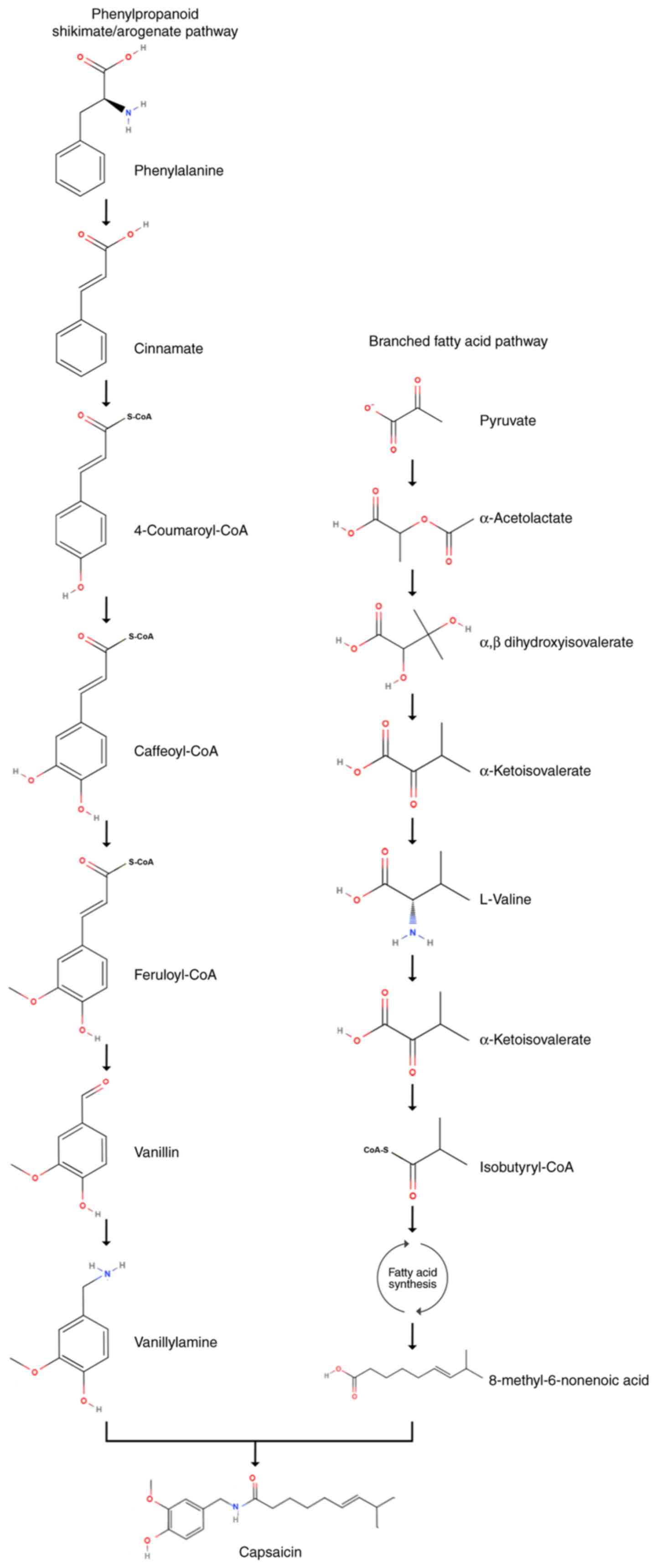
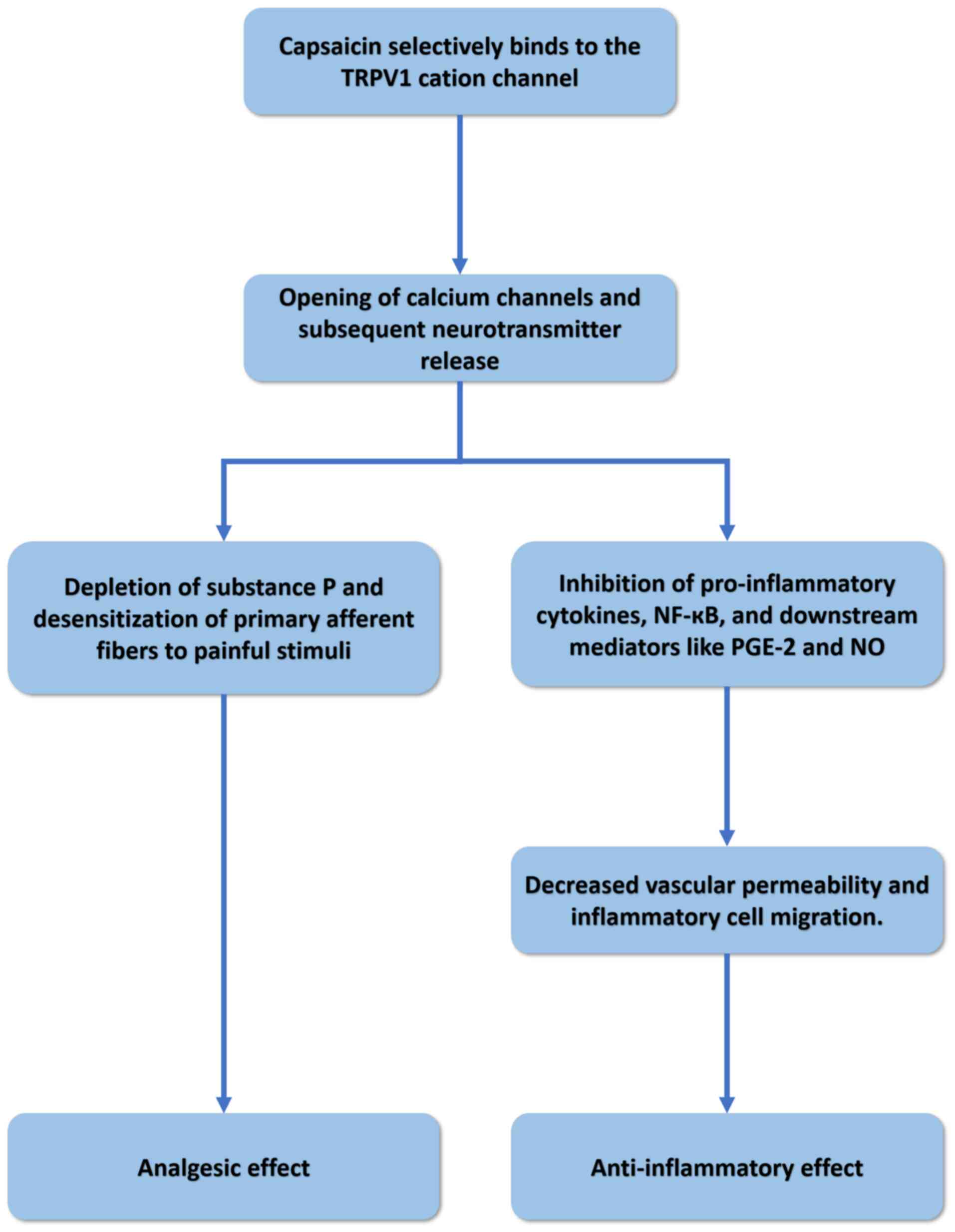
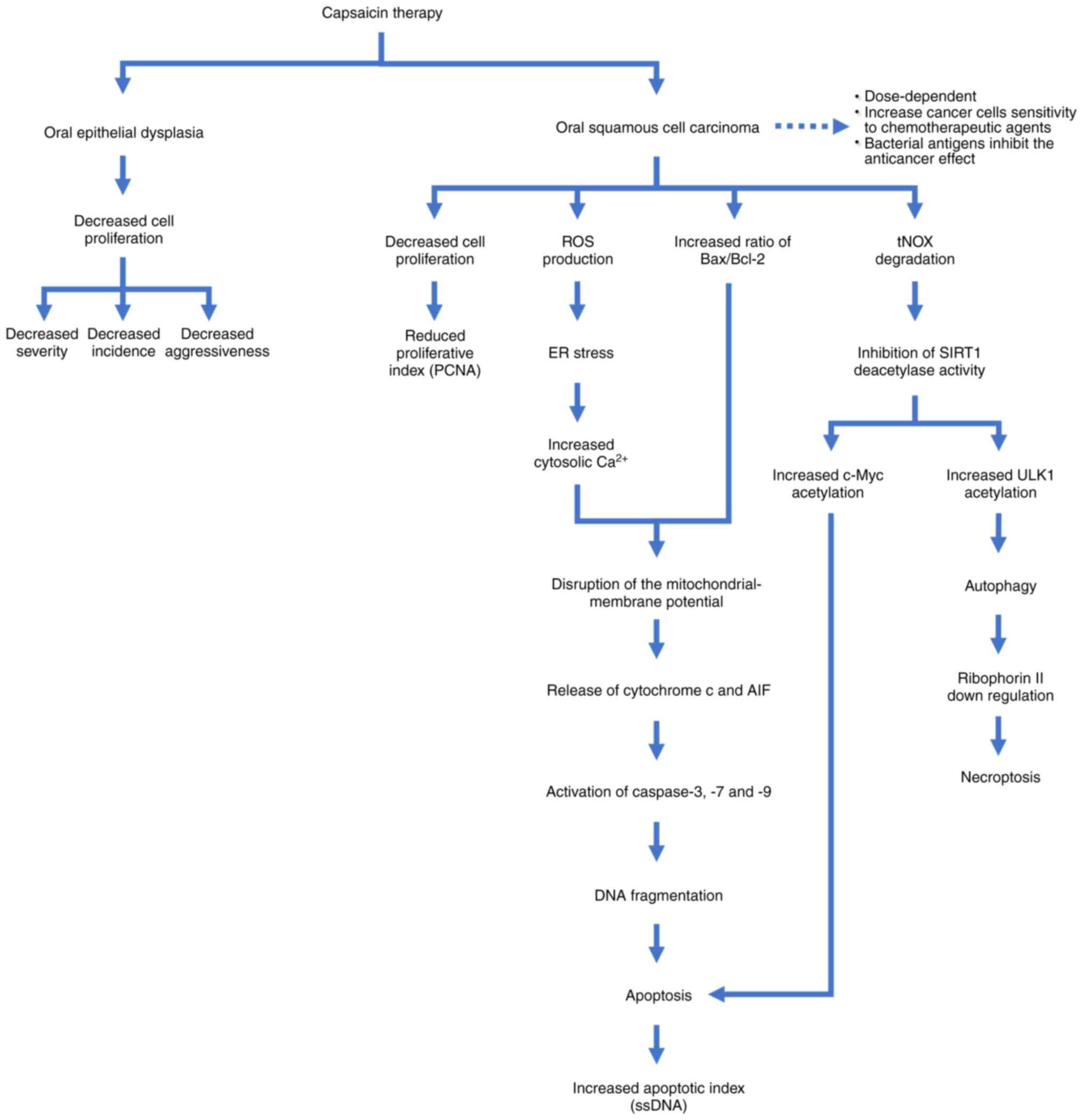
|
1
|
Reyes-Escogido Mde L, Gonzalez-Mondragon
EG and Vazquez-Tzompantzi E: Chemical and pharmacological aspects
of capsaicin. Molecules. 16:1253–1270. 2011.PubMed/NCBI View Article : Google Scholar
|
|
2
|
Adetunji TL, Olawale F, Olisah C, Adetunji
AE and Aremu AO: Capsaicin: A Two-Decade Systematic Review of
Global Research Output and Recent Advances Against Human Cancer.
Front Oncol. 12(908487)2022.PubMed/NCBI View Article : Google Scholar
|
|
3
|
Fattori V, Hohmann MS, Rossaneis AC,
Pinho-Ribeiro FA and Verri WA: Capsaicin: Current Understanding of
Its Mechanisms and Therapy of Pain and Other Pre-Clinical and
Clinical Uses. Molecules. 21(844)2016.PubMed/NCBI View Article : Google Scholar
|
|
4
|
Chapa-Oliver AM and Mejía-Teniente L:
Capsaicin: From Plants to a Cancer-Suppressing Agent. Molecules.
21(931)2016.PubMed/NCBI View Article : Google Scholar
|
|
5
|
Alonso-Villegas R, González-Amaro RM,
Figueroa-Hernández CY and Rodríguez-Buenfil IM: The Genus Capsicum:
A Review of Bioactive Properties of Its Polyphenolic and
Capsaicinoid Composition. Molecules. 28(4239)2023.PubMed/NCBI View Article : Google Scholar
|
|
6
|
Bal S, Sharangi AB, Upadhyay TK, Khan F,
Pandey P, Siddiqui S, Saeed M, Lee HJ and Yadav DK: Biomedical and
Antioxidant Potentialities in Chilli: Perspectives and Way Forward.
Molecules. 27(6380)2022.PubMed/NCBI View Article : Google Scholar
|
|
7
|
Allam AE: Suppression of cytokine
production by newly isolated flavonoids from pepper. Fitoterapia.
151(104903)2021.PubMed/NCBI View Article : Google Scholar
|
|
8
|
Caterina MJ, Schumacher MA, Tominaga M,
Rosen TA, Levine JD and Julius D: The capsaicin receptor: A
heat-activated ion channel in the pain pathway. Nature.
389:816–824. 1997.PubMed/NCBI View
Article : Google Scholar
|
|
9
|
Basith S, Cui M, Hong S and Choi S:
Harnessing the Therapeutic Potential of Capsaicin and Its Analogues
in Pain and Other Diseases. Molecules. 21(966)2016.PubMed/NCBI View Article : Google Scholar
|
|
10
|
Persson MS, Fu Y, Bhattacharya A, Goh SL,
van Middelkoop M, Bierma-Zeinstra SM, Walsh D, Doherty M and Zhang
W: OA Trial Bank Consortium. Relative efficacy of topical
non-steroidal anti-inflammatory drugs and topical capsaicin in
osteoarthritis: Protocol for an individual patient data
meta-analysis. Syst Rev. 5(165)2016.PubMed/NCBI View Article : Google Scholar
|
|
11
|
Srinivasan K: Biological Activities of Red
Pepper (Capsicum annuum) and Its Pungent Principle Capsaicin: A
Review. Crit Rev Food Sci Nutr. 56:1488–1500. 2016.PubMed/NCBI View Article : Google Scholar
|
|
12
|
Marini E, Magi G, Mingoia M, Pugnaloni A
and Facinelli B: Antimicrobial and Anti-Virulence Activity of
Capsaicin Against Erythromycin-Resistant, Cell-Invasive Group A
Streptococci. Front Microbiol. 6(1281)2015.PubMed/NCBI View Article : Google Scholar
|
|
13
|
Zhou Y, Guan X, Zhu W, Liu Z, Wang X, Yu H
and Wang H: Capsaicin inhibits Porphyromonas gingivalis growth,
biofilm formation, gingivomucosal inflammatory cytokine secretion,
and in vitro osteoclastogenesis. Eur J Clin Microbiol Infect Dis.
33:211–219. 2014.PubMed/NCBI View Article : Google Scholar
|
|
14
|
Chatterjee S, Asakura M, Chowdhury N,
Neogi SB, Sugimoto N, Haldar S, Awasthi SP, Hinenoya A, Aoki S and
Yamasaki S: Capsaicin, a potential inhibitor of cholera toxin
production in Vibrio cholerae. FEMS Microbiol Lett. 306:54–60.
2010.PubMed/NCBI View Article : Google Scholar
|
|
15
|
Qiu J, Niu X, Wang J, Xing Y, Leng B, Dong
J, Li H, Luo M, Zhang Y, Dai X, et al: Capsaicin protects mice from
community-associated methicillin-resistant Staphylococcus aureus
pneumonia. PLoS One. 7(e33032)2012.PubMed/NCBI View Article : Google Scholar
|
|
16
|
Kalia NP, Mahajan P, Mehra R, Nargotra A,
Sharma JP, Koul S and Khan IA: Capsaicin, a novel inhibitor of the
NorA efflux pump, reduces the intracellular invasion of
Staphylococcus aureus. J Antimicrob Chemother. 67:2401–2408.
2012.PubMed/NCBI View Article : Google Scholar
|
|
17
|
Zhang S, Wang D, Huang J, Hu Y and Xu Y:
Application of capsaicin as a potential new therapeutic drug in
human cancers. J Clin Pharm Ther. 45:16–28. 2020.PubMed/NCBI View Article : Google Scholar
|
|
18
|
Nie J, Zhao C, Deng LI, Chen J, Yu B, Wu
X, Pang P and Chen X: Efficacy of traditional Chinese medicine in
treating cancer. Biomed Rep. 4:3–14. 2016.PubMed/NCBI View Article : Google Scholar
|
|
19
|
Díaz J, Pomar F, Bernal A and Merino F:
Peroxidases and the metabolism of capsaicin in Capsicum annuum L.
Phytochem Rev. 3:141–157. 2004.
|
|
20
|
Kehie M, Kumaria S, Tandon P and Ramchiary
N: Biotechnological advances on in vitro capsaicinoids biosynthesis
in capsicum: a review. Phytochem Rev. 14:189–201. 2015.
|
|
21
|
Mazourek M, Pujar A, Borovsky Y, Paran I,
Mueller L and Jahn MM: A dynamic interface for capsaicinoid systems
biology. Plant Physiol. 150:1806–1821. 2009.PubMed/NCBI View Article : Google Scholar
|
|
22
|
Suzuki T, Fujiwake H and Iwai K:
Intracellular localization of capsaicin and its analogues,
capsaicinoid, in Capsicum fruit 1. Microscopic investigation of the
structure of the placenta of Capsicum annuum var. annuum cv.
Karayatsubusa. Plant Cell Physiol. 21:839–853. 1980.
|
|
23
|
Sukrasno N and Yeoman MM: Phenylpropanoid
metabolism during growth and development of Capsicum frutescens
fruits. Phytochem. 32:839–844. 1993.
|
|
24
|
Stewart C Jr, Kang BC, Liu K, Mazourek M,
Moore SL, Yoo EY, Kim BD, Paran I and Jahn MM: The Pun1 gene for
pungency in pepper encodes a putative acyltransferase. Plant J.
42:675–688. 2005.PubMed/NCBI View Article : Google Scholar
|
|
25
|
Zhang ZX, Zhao SN, Liu GF, Huang ZM, Cao
ZM, Cheng SH and Lin SS: Discovery of putative capsaicin
biosynthetic genes by RNA-Seq and digital gene expression analysis
of pepper. Sci Rep. 6(34121)2016.PubMed/NCBI View Article : Google Scholar
|
|
26
|
Arce-Rodríguez ML and Ochoa-Alejo N:
Biochemistry and molecular biology of capsaicinoid biosynthesis:
Recent advances and perspectives. Plant Cell Rep. 38:1017–1030.
2019.PubMed/NCBI View Article : Google Scholar
|
|
27
|
Blum E, Mazourek M, O'Connell M, Curry J,
Thorup T, Liu K, Jahn M and Paran I: Molecular mapping of
capsaicinoid biosynthesis genes and quantitative trait loci
analysis for capsaicinoid content in Capsicum. Theor Appl Genet.
108:79–86. 2003.PubMed/NCBI View Article : Google Scholar
|
|
28
|
Clark R and Lee SH: Anticancer Properties
of Capsaicin Against Human Cancer. Anticancer Res. 36:837–843.
2016.PubMed/NCBI
|
|
29
|
Alawi K and Keeble J: The paradoxical role
of the transient receptor potential vanilloid 1 receptor in
inflammation. Pharmacol Ther. 125:181–195. 2010.PubMed/NCBI View Article : Google Scholar
|
|
30
|
Kim CS, Kawada T, Kim BS, Han IS, Choe SY,
Kurata T and Yu R: Capsaicin exhibits anti-inflammatory property by
inhibiting IkB-a degradation in LPS-stimulated peritoneal
macrophages. Cell Signal. 15:299–306. 2003.PubMed/NCBI View Article : Google Scholar
|
|
31
|
Derry S, Lloyd R, Moore RA and McQuay HJ:
Topical capsaicin for chronic neuropathic pain in adults. Cochrane
Database Syst Rev. CD007393, 2009.
|
|
32
|
Epstein JB and Marcoe JH: Topical
application of capsaicin for treatment of oral neuropathic pain and
trigeminal neuralgia. Oral Surg Oral Med Oral Pathol. 77:135–140.
1994.PubMed/NCBI View Article : Google Scholar
|
|
33
|
Ellison N, Loprinzi CL, Kugler J, Hatfield
AK, Miser A, Sloan JA, Wender DB, Rowland KM, Molina R, Cascino TL,
et al: Phase III placebo-controlled trial of capsaicin cream in the
management of surgical neuropathic pain in cancer patients. J Clin
Oncol. 15:2974–2980. 1997.PubMed/NCBI View Article : Google Scholar
|
|
34
|
Fusco BM and Alessandri M: Analgesic
effect of capsaicin in idiopathic trigeminal neuralgia. Anesth
Analg. 74:375–377. 1992.PubMed/NCBI View Article : Google Scholar
|
|
35
|
Padilla M, Clark GT and Merrill RL:
Topical medications for orofacial neuropathic pain: A review. J Am
Dent Assoc. 131:184–195. 2000.PubMed/NCBI View Article : Google Scholar
|
|
36
|
Mason L, Moore RA, Derry S, Edwards JE and
McQuay HJ: Systematic review of topical capsaicin for the treatment
of chronic pain. BMJ. 328(991)2004.PubMed/NCBI View Article : Google Scholar
|
|
37
|
Peppin JF and Pappagallo M: Capsaicinoids
in the treatment of neuropathic pain: A review. Ther Adv Neurol
Disord. 7:22–32. 2014.PubMed/NCBI View Article : Google Scholar
|
|
38
|
Sayanlar J, Guleyupoglu N, Portenoy R and
Ashina S: Trigeminal postherpetic neuralgia responsive to treatment
with capsaicin 8% topical patch: A case report. J Headache Pain.
13:587–589. 2012.PubMed/NCBI View Article : Google Scholar
|
|
39
|
Gaul C and Resch S: Application of the
capsaicin 8% cutaneous patch in neuropathic pain of the head and
face: A case series. Cephalalgia. 35:545–550. 2015.PubMed/NCBI View Article : Google Scholar
|
|
40
|
Martinez MLC, Adan N, Carballude A,
Lamelas L, Villar E and Seoane PR: Capsaicin 8% patch in trigeminal
neuralgia: Case reports. Aust Med J. 12:98–102. 2019.
|
|
41
|
Jääskeläinen SK: Is burning mouth syndrome
A neuropathic pain condition? Pain. 159:610–613. 2018.PubMed/NCBI View Article : Google Scholar
|
|
42
|
Petruzzi M, Lauritano D, De Benedittis M,
Baldoni M and Serpico R: Systemic capsaicin for burning mouth
syndrome: Short-term results of a pilot study. J Oral Pathol Med.
33:111–114. 2004.PubMed/NCBI View Article : Google Scholar
|
|
43
|
Silvestre FJ, Silvestre-Rangil J,
Tamarit-Santafé C and Bautista D: Application of a capsaicin rinse
in the treatment of burning mouth syndrome. Med Oral Patol Oral Cir
Bucal. 17:e1–e4. 2012.PubMed/NCBI View Article : Google Scholar
|
|
44
|
Jørgensen MR and Pedersen AM: Analgesic
effect of topical oral capsaicin gel in burning mouth syndrome.
Acta Odontol Scand. 75:130–136. 2017.PubMed/NCBI View Article : Google Scholar
|
|
45
|
Azzi L, Croveri F, Pasina L, Porrini M,
Vinci R, Manfredini M, Tettamanti L, Tagliabue A, Silvestre Rangil
J and Spadari F: A ‘burning’ therapy for burning mouth syndrome:
Preliminary results with the administration of topical capsaicin. J
Biol Regul Homeost Agents. 31 (2 Suppl 1):89–95. 2017.PubMed/NCBI
|
|
46
|
Mann NS: Capsaicin induced acute erosive
gastritis: Its prevention by antacid, metiamide and cimetidine. J
Ky Med Assoc. 75:71–73. 1977.PubMed/NCBI
|
|
47
|
Satyanarayana MN: Capsaicin and gastric
ulcers. Crit Rev Food Sci Nutr. 46:275–328. 2006.PubMed/NCBI View Article : Google Scholar
|
|
48
|
Berger A, Henderson M, Nadoolman W, Duffy
V, Cooper D, Saberski L and Bartoshuk L: Oral capsaicin provides
temporary relief for oral mucositis pain secondary to
chemotherapy/radiation therapy. J Pain Symptom Manage. 10:243–248.
1995.PubMed/NCBI View Article : Google Scholar
|
|
49
|
Jiang H, Yu X, Fang R, Xiao Z and Jin Y:
3D printed mold-based capsaicin candy for the treatment of oral
ulcer. Int J Pharm. 568(118517)2019.PubMed/NCBI View Article : Google Scholar
|
|
50
|
Diatchenko L, Nackley AG, Slade GD,
Fillingim RB and Maixner W: Idiopathic pain disorders - Pathways of
vulnerability. Pain. 123:226–230. 2006.PubMed/NCBI View Article : Google Scholar
|
|
51
|
Pedullà E, Meli GA, Garufi A, Mandalà ML,
Blandino A and Cascone P: Neuropathic pain in temporomandibular
joint disorders: Case-control analysis by MR imaging. AJNR Am J
Neuroradiol. 30:1414–1418. 2009.PubMed/NCBI View Article : Google Scholar
|
|
52
|
Winocur E, Gavish A, Halachmi M, Eli I and
Gazit E: Topical application of capsaicin for the treatment of
localized pain in the temporomandibular joint area. J Orofac Pain.
14:31–36. 2000.PubMed/NCBI
|
|
53
|
Campbell BK, Fillingim RB, Lee S, Brao R,
Price DD and Neubert JK: Effects of High-Dose Capsaicin on TMD
Subjects:A Randomized Clinical Study. JDR Clin Trans Res. 2:58–65.
2017.PubMed/NCBI View Article : Google Scholar
|
|
54
|
Mosqueda-Solís A, Lafuente-Ibáñez de
Mendoza I, Aguirre-Urizar JM and Mosqueda-Taylor A: Capsaicin
intake and oral carcinogenesis: A systematic review. Med Oral Patol
Oral Cir Bucal. 26:e261–e268. 2021.PubMed/NCBI View Article : Google Scholar
|
|
55
|
Tanaka T, Kohno H, Sakata K, Yamada Y,
Hirose Y, Sugie S and Mori H: Modifying effects of dietary
capsaicin and rotenone on 4-nitroquinoline 1-oxide-induced rat
tongue carcinogenesis. Carcinogenesis. 23:1361–1367.
2002.PubMed/NCBI View Article : Google Scholar
|
|
56
|
Ip SW, Lan SH, Lu HF, Huang AC, Yang JS,
Lin JP, Huang HY, Lien JC, Ho CC, Chiu CF, et al: Capsaicin
mediates apoptosis in human nasopharyngeal carcinoma NPC-TW 039
cells through mitochondrial depolarization and endoplasmic
reticulum stress. Hum Exp Toxicol. 31:539–549. 2012.PubMed/NCBI View Article : Google Scholar
|
|
57
|
Kamaruddin MF, Hossain MZ, Mohamed Alabsi
A and Mohd Bakri M: The Antiproliferative and Apoptotic Effects of
Capsaicin on an Oral Squamous Cancer Cell Line of Asian Origin,
ORL-48. Medicina (Kaunas). 55(322)2019.PubMed/NCBI View Article : Google Scholar
|
|
58
|
Mohamed MA and AlQarni AA: Chemopreventive
effect of capsaicin in experimentally induced hamster buccal pouch
carcinogenesis (Immunohistochemical study Bcl-2). Egypt Dent J.
65:1237–1243. 2019.
|
|
59
|
Chang CF, Islam A, Liu PF, Zhan JH and
Chueh PJ: Capsaicin acts through tNOX (ENOX2) to induce autophagic
apoptosis in p53-mutated HSC-3 cells but autophagy in
p53-functional SAS oral cancer cells. Am J Cancer Res.
10:3230–3247. 2020.PubMed/NCBI
|
|
60
|
Huang YC, Yuan TM, Liu BH, Liu KL, Wung CH
and Chuang SM: Capsaicin Potentiates Anticancer Drug Efficacy
Through Autophagy-Mediated Ribophorin II Downregulation and
Necroptosis in Oral Squamous Cell Carcinoma Cells. Front Pharmacol.
12(676813)2021.PubMed/NCBI View Article : Google Scholar
|
|
61
|
Chakraborty R, Vickery K, Darido C,
Ranganathan S and Hu H: Bacterial Antigens Reduced the Inhibition
Effect of Capsaicin on Cal 27 Oral Cancer Cell Proliferation. Int J
Mol Sci. 22(8686)2021.PubMed/NCBI View Article : Google Scholar
|
|
62
|
Materska M and Perucka I: Antioxidant
activity of the main phenolic compounds isolated from hot pepper
fruit (Capsicum annuum L). J Agric Food Chem. 53:1750–1756.
2005.PubMed/NCBI View Article : Google Scholar
|
|
63
|
Shahidi F, Varatharajan V, Oh WY and Peng
H: Phenolic compounds in agri-food by-products, their
bioavailability and health effects. J Food Bioact. 5:57–119.
2019.
|
|
64
|
Romero-Luna HE, Colina J, Guzmán-Rodríguez
L, Sierra-Carmona CG, Farías-Campomanes ÁM, García-Pinilla S,
González-Tijera MM, Malagón-Alvira KO and Peredo-Lovillo A: C
apsicum fruits as functional ingredients with antimicrobial
activity: An emphasis on mechanisms of action. J Food Sci Technol.
60:1–11. 2022.PubMed/NCBI View Article : Google Scholar
|
|
65
|
Periferakis AT, Periferakis A, Periferakis
K, Caruntu A, Badarau IA, Savulescu-Fiedler I, Scheau C and Caruntu
C: Antimicrobial Properties of Capsaicin: Available Data, Future
Research Perspectives. Nutrients. 15(4097)2023.PubMed/NCBI View Article : Google Scholar
|
|
66
|
Santos MM, Vieira-da-Motta O, Vieira IJ,
Braz-Filho R, Gonçalves PS, Maria EJ, Terra WS, Rodrigues R and
Souza CL: Antibacterial activity of Capsicum annuum extract and
synthetic capsaicinoid derivatives against Streptococcus mutans. J
Nat Med. 66:354–356. 2012.PubMed/NCBI View Article : Google Scholar
|
|
67
|
Gu H, Yang Z, Yu W, Xu K and Fu YF:
Antibacterial Activity of Capsaicin against Sectional Cariogenic
Bacteria. Pak J Zool. 51:681–687. 2019.
|
|
68
|
Doğan K and Tunçer S: Capsaicin Shows
Species and Strain-specific Activity: Investigation of the
Antibacterial Effects on the Oral Pathogen Streptococcus mutans and
the Oral Probiotics Streptococcus salivarius M18 and K12. Hacettepe
Biol Chem. 52:11–19. 2024.
|
|
69
|
Cong X, Zhang Y, Shi L, Yang NY, Ding C,
Li J, Ding QW, Su YC, Xiang RL, Wu LL and Yu GY: Activation of
transient receptor potential vanilloid subtype 1 increases
expression and permeability of tight junction in normal and
hyposecretory submandibular gland. Lab Invest. 92:753–768.
2012.PubMed/NCBI View Article : Google Scholar
|
|
70
|
Nascimento PL, Nascimento TC, Ramos NS,
Silva GR, Gomes JE, Falcão RE, Moreira KA, Porto AL and Silva TM:
Quantification, Antioxidant and Antimicrobial Activity of Phenolics
Isolated from Different Extracts of Capsicum frutescens (Pimenta
Malagueta). Molecules. 19:5434–5447. 2014.PubMed/NCBI View Article : Google Scholar
|
|
71
|
Omolo MA, Wong ZZ, Borh WG, Hedblom GA,
Dev K and Baumler DJ: Comparative analysis of capsaicin in twenty
nine varieties of unexplored Capsicum and its antimicrobial
activity against bacterial and fungal pathogens. J Med Plant Res.
12:544–556. 2018.
|
|
72
|
Behbehani JM, Irshad M, Shreaz S and
Karched M: Anticandidal Activity of Capsaicin and Its Effect on
Ergosterol Biosynthesis and Membrane Integrity of Candida albicans.
Int J Mol Sci. 24(1046)2023.PubMed/NCBI View Article : Google Scholar
|
|
73
|
Hafiz T, Mubaraki M, Dkhil M and
Al-Quraishy S: Antiviral Activities of Capsicum annuum Methanolic
Extract against Herpes Simplex Virus 1 and 2. Pakistan J Zool.
49:251–255. 2017.
|
|
74
|
Tang K, Zhang X and Guo Y: Identification
of the dietary supplement capsaicin as an inhibitor of Lassa virus
entry. Acta Pharm Sin B. 10:789–798. 2020.PubMed/NCBI View Article : Google Scholar
|
|
75
|
Gonzalez-Paz LA, Lossada CA, Moncayo LS,
Romero F, Paz JL, Vera-Villalobos J, Pérez AE, San-Blas E and
Alvarado YJ: Theoretical Molecular Docking Study of the Structural
Disruption of the Viral 3CL-Protease of COVID19 Induced by Binding
of Capsaicin, Piperine and Curcumin Part 1: A Comparative Study
with Chloroquine and Hydrochloroquine Two Antimalaric Drugs.
Preprint: Research Square, 2020. https://doi.org/10.21203/rs.3.rs-21206/v1.
|
|
76
|
Zhang MQ, Jia X, Cheng CQ, Wang YX, Li YY,
Kong LD, Li QQ, Xie F, Yu YL, He YT, et al: Capsaicin functions as
a selective degrader of STAT3 to enhance host resistance to viral
infection. Acta Pharmacol Sin. 44:2253–2264. 2023.PubMed/NCBI View Article : Google Scholar
|