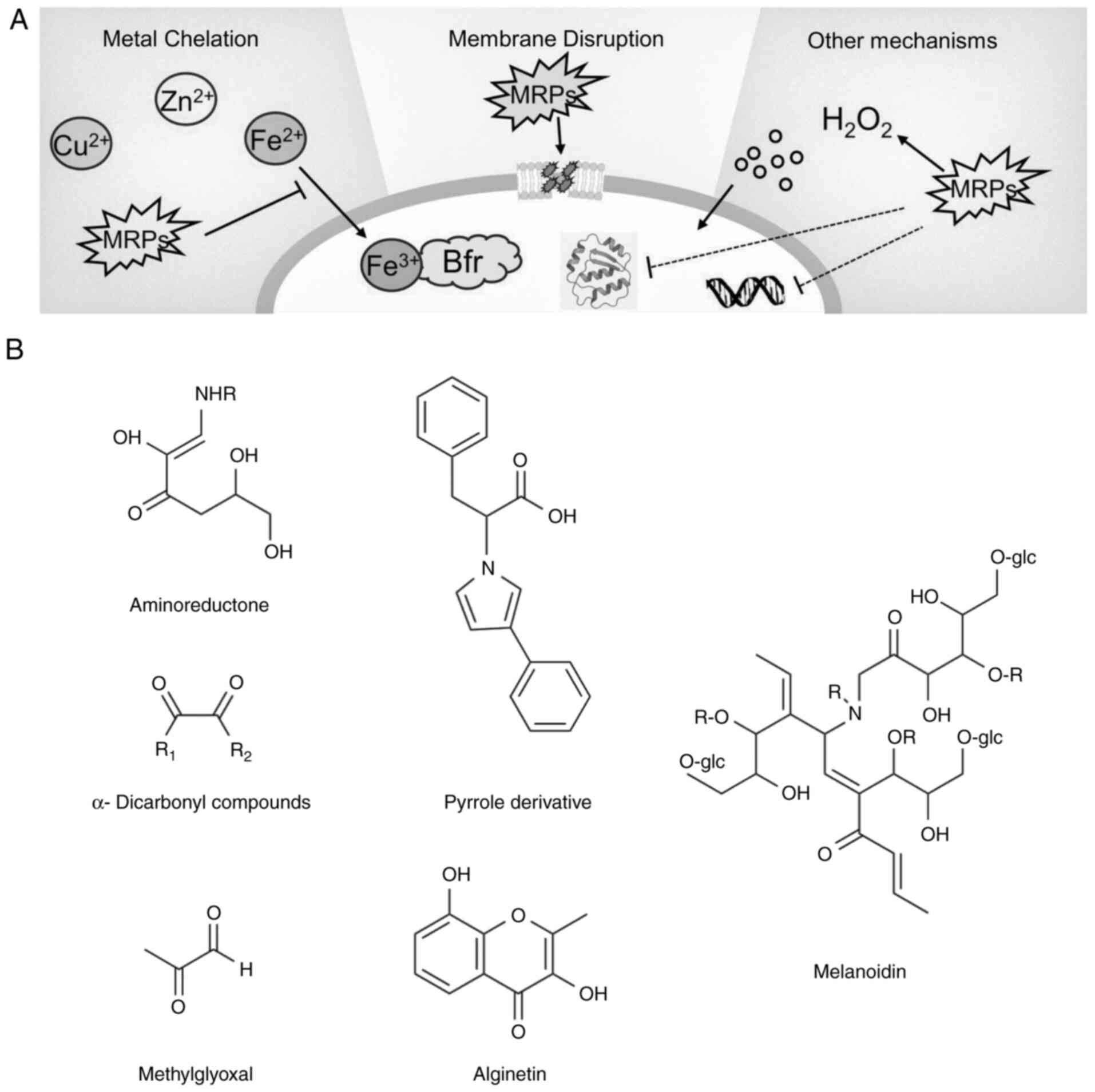
|
1
|
Nooshkam M, Varidi M and Verma DK:
Functional and biological properties of Maillard conjugates and
their potential application in medical and food: A review. Food Res
Int. 131(109003)2020.PubMed/NCBI View Article : Google Scholar
|
|
2
|
Kathuria D, Hamid Gautam S and Thakur A:
Maillard reaction in different food products: Effect on product
quality, human health and mitigation strategies. Food Control.
153(109911)2023.
|
|
3
|
Khalid M, Petroianu G and Adem A: Advanced
glycation end products and diabetes mellitus: Mechanisms and
perspectives. Biomolecules. 12(542)2022.PubMed/NCBI View Article : Google Scholar
|
|
4
|
Ruggeri RM, Vicchio TM, Cristani M, Certo
R, Caccamo D, Alibrandi A, Giovinazzo S, Saija A, Campennì A,
Trimarchi F and Gangemi S: Oxidative stress and advanced glycation
end products in Hashimoto's thyroiditis. Thyroid. 26:504–511.
2016.PubMed/NCBI View Article : Google Scholar
|
|
5
|
Fishman SL, Sonmez H, Basman C, Singh V
and Poretsky L: The role of advanced glycation end-products in the
development of coronary artery disease in patients with and without
diabetes mellitus: A review. Mol Med. 24(59)2018.PubMed/NCBI View Article : Google Scholar
|
|
6
|
Shi A, Ji X, Li W, Dong L, Wu Y, Zhang Y,
Liu X, Zhang Y and Wang S: The interaction between human microbes
and advanced glycation end products: the role of Klebsiella X15 on
advanced glycation end products' degradation. Nutrients.
16(754)2024.PubMed/NCBI View Article : Google Scholar
|
|
7
|
Phuong-Nguyen K, McNeill BA, Aston-Mourney
K and Rivera LR: Advanced glycation end-products and their effects
on gut health. Nutrients. 15(405)2023.PubMed/NCBI View Article : Google Scholar
|
|
8
|
Ke L, Luo S, Rao P, Bradshaw JP, Sa'adedin
F, Rappolt M and Zhou J: An evidence for a novel antiviral
mechanism: modulating effects of Arg-Glc Maillard reaction products
on the phase transition of multilamellar vesicles. Front Cell Dev
Biol. 8(629775)2021.PubMed/NCBI View Article : Google Scholar
|
|
9
|
Helou C, Marier D, Jacolot P,
Abdennebi-Najar L, Niquet-Léridon C, Tessier FJ and Gadonna-Widehem
P: Microorganisms and Maillard reaction products: A review of the
literature and recent findings. Amino Acids. 46:267–277.
2014.PubMed/NCBI View Article : Google Scholar
|
|
10
|
Jiang T, Feng L and Li J: Changes in
microbial and postharvest quality of shiitake mushroom (Lentinus
edodes) treated with chitosan-glucose complex coating under cold
storage. Food Chem. 131:780–786. 2012.
|
|
11
|
Hiramoto S, Itoh K, Shizuuchi S, Kawachi
Y, Morishita Y, Nagase M, Suzuki Y, Nobuta Y, Sudou Y, Nakamura O,
et al: Melanoidin, a food protein-derived advanced maillard
reaction product, suppresses helicobacter pylori in vitro and in
vivo. Helicobacter. 9:429–435. 2004.PubMed/NCBI View Article : Google Scholar
|
|
12
|
Snelson M and Coughlan M: Dietary advanced
glycatione end products: Digestion, metabolism and modulation of
gut microbial ecology. Nutrients. 11(215)2019.PubMed/NCBI View Article : Google Scholar
|
|
13
|
Ni L, Shen R, Luo H, Li X, Zhang X, Huang
L, Deng Y, Liao X, Wu Y, Duan C and Xie X: GlmS plays a key role in
the virulence factor expression and biofilm formation ability of
Staphylococcus aureus promoted by advanced glycation end products.
Virulence. 15(2352476)2024.PubMed/NCBI View Article : Google Scholar
|
|
14
|
Hiramoto K, Sekiguchi K, Aso-O R, Ayuha K,
Ni-Iyama H, Kato T and Kikugawa K: DNA strand breaks induced
through active oxygen radicals by fragrant component
4-hydroxy-2-hydroxymethyl5-methyl-3(2H)-furanone in maillard
reaction of hexose/amino acid. Food Chem Toxicol. 33:803–814.
1995.PubMed/NCBI View Article : Google Scholar
|
|
15
|
Sheikh-Zeinoddin M, Perehinec TM, Hill SE
and Rees CED: Maillard reaction causes suppression of virulence
gene expression in Listeria monocytogenes. Int J Food Microbiol.
61:41–49. 2000.PubMed/NCBI View Article : Google Scholar
|
|
16
|
Kundinger MM, Zabala-Díaz IB, Chalova VI
and Ricke SC: Effects of Maillard reaction products on hilA
expression in salmonella typhimurium. J Food Sci. 73:M32–5.
2008.PubMed/NCBI View Article : Google Scholar
|
|
17
|
Xie X, Liu X, Li Y, Luo L, Yuan W, Chen B,
Liang G, Shen R, Li H, Huang S and Duan C: Advanced glycation end
products enhance biofilm formation by promoting extracellular DNA
release through sigB upregulation in Staphylococcus aureus. Front
Microbiol. 11(1479)2020.PubMed/NCBI View Article : Google Scholar
|
|
18
|
Daglia M, Tarsi R, Papetti A, Grisoli P,
Dacarro C, Pruzzo C and Gazzani G: Antiadhesive effect of green and
roasted coffee on Streptococcus mutans adhesive properties on
saliva-coated hydroxyapatite beads. J Agric Food Chem.
50:1225–1229. 2002.PubMed/NCBI View Article : Google Scholar
|
|
19
|
Lanciotti R, Anese M, Sinigaglia M,
Severini C and Massini R: Effects of heated
glucose-fructose-glutamic acid solutions on the growth of Bacillus
stearothermophilus. LWT. 32:223–230. 1999.
|
|
20
|
Rurián-Henares JA and Morales FJ:
Antimicrobial activity of melanoidins against Escherichia coli is
mediated by a membrane-damage mechanism. J Agric Food Chem.
56:2357–2362. 2008.PubMed/NCBI View Article : Google Scholar
|
|
21
|
Silván JM, van de Lagemaat J, Olano A and
Del Castillo MD: Analysis and biological properties of amino acid
derivates formed by Maillard reaction in foods. J Pharm Biomed
Anal. 41:1543–1551. 2006.PubMed/NCBI View Article : Google Scholar
|
|
22
|
Martins SIFS, Jongen WMF and Van Boekel
MAJS: A review of Maillard reaction in food and implications to
kinetic modelling. Trends Food Sci Technol. 11:364–373. 2000.
|
|
23
|
Wang HY, Qian H and Yao WR: Melanoidins
produced by the Maillard reaction: Structure and biological
activity. Food Chem. 128:573–584. 2011.
|
|
24
|
Kroh LW, Fiedler T and Wagner J: alpha-
Dicarbonyl compounds-key intermediates for the formation of
carbohydrate-based melanoidins. Ann N Y Acad Sci. 1126:210–215.
2008.PubMed/NCBI View Article : Google Scholar
|
|
25
|
Cämmerer B, Jalyschko W and Kroh LW:
Intact carbohydrate structures as part of the melanoidin skeleton.
J Agric Food Chem. 50:2083–2087. 2002.PubMed/NCBI View Article : Google Scholar
|
|
26
|
Miethke M, Pieroni M, Weber T, Brönstrup
M, Hammann P, Halby L, Arimondo PB, Glaser P, Aigle B, Bode HB, et
al: Towards the sustainable discovery and development of new
antibiotics. Nat Rev Chem. 5:726–749. 2021.PubMed/NCBI View Article : Google Scholar
|
|
27
|
Einarsson H, Snygg BG and Eriksson C:
Inhibition of bacterial growth by Maillard reaction products. J
Agric Food Chem. 31:1043–1047. 1983.
|
|
28
|
Bhattacharjee MK, Sugawara K and Ayandeji
OT: Microwave sterilization of growth medium alleviates inhibition
of Aggregatibacter actinomycetemcomitans by Maillard reaction
products. J Microbiol Methods. 78:227–230. 2009.PubMed/NCBI View Article : Google Scholar
|
|
29
|
Rufián-Henares JA and Morales FJ:
Microtiter plate-based assay for screening antimicrobial activity
of melanoidins against E. coli and S. aureus. Food Chem.
111:1069–1074. 2008.
|
|
30
|
Bhattacharjee MK, Mehta BS and Akukwe B:
Maillard reaction products inhibit the periodontal pathogen
Aggregatibacter actinomycetemcomitans by chelating iron. Arch Oral
Biol. 122(104989)2021.PubMed/NCBI View Article : Google Scholar
|
|
31
|
Aonishi K, Miyao S, Yokoi L, Kitaoka N,
Koyama K, Matsuura H and Koseki S: Isolation and identification of
the antibacterial compounds produced by Maillard reaction of xylose
with phenylalanine or proline. J Agric Food Chem. 72:16010–16017.
2024.PubMed/NCBI View Article : Google Scholar
|
|
32
|
Kukuminato S, Koyama K and Koseki S:
Antibacterial properties of melanoidins produced from various
combinations of maillard reaction against pathogenic bacteria.
Microbiol Spectr. 9(e0114221)2021.PubMed/NCBI View Article : Google Scholar
|
|
33
|
Maesaka E, Kukuminato S, Aonishi K, Koyama
K and Koseki S: Antibacterial effect of melanoidins derived from
xylose and phenylalanine against bacillus cereus and clostridium
perfringens. J Food Prot. 86(100140)2023.PubMed/NCBI View Article : Google Scholar
|
|
34
|
Li SL, Lin J and Chen XM: Effect of
chitosan molecular weight on the functional properties of
chitosan-maltose Maillard reaction products and their application
to fresh-cut Typha latifolia L. Carbohydr Polym. 102:682–690.
2014.PubMed/NCBI View Article : Google Scholar
|
|
35
|
Gottardi D, Hong PK, Ndagijimana M and
Betti M: Conjugation of gluten hydrolysates with glucosamine at
mild temperatures enhances antioxidant and antimicrobial
properties. LWT-Food Sci Technol. 57:181–187. 2014.
|
|
36
|
Kraskouski A, Hileuskaya K, Nikalaichuk V,
Ladutska A, Kabanava V, Yao W and You L: Chitosan-based Maillard
self-reaction products: Formation, characterization, antioxidant
and antimicrobial potential. Carbohydr Polym Technol Appl.
4(100257)2022.
|
|
37
|
Song R, Yang P, Wei R and Ruan G:
Antioxidative, antibacterial, and food functional properties of the
half-fin anchovy hydrolysates-glucose conjugates formed via
Maillard reaction. Molecules. 21(795)2016.PubMed/NCBI View Article : Google Scholar
|
|
38
|
Jiang W, Liu Y, Yang X and Hu S:
Antioxidant and antibacterial activities of modified crab shell
bioactive peptides by Maillard reaction. Int J Food Prop.
21:2730–2743. 2018.
|
|
39
|
Kim Y, Kim S, Lee S, Ha J, Lee J, Choi Y,
Oh H, Lee Y, Oh NS, Yoon Y and Lee H: Antimicrobial activity of
fermented Maillard reaction products, novel milk-derived material,
made by whey protein and Lactobacillus rhamnosus and Lactobacillus
gasseri on Clostridium perfringens. Anim Biosci. 34:1525–1531.
2021.PubMed/NCBI View Article : Google Scholar
|
|
40
|
Sun T, Qin Y, Xu H, Xie J, Hu D, Xue B and
Hua X: Antibacterial activities and preservative effect of chitosan
oligosaccharide Maillard reaction products on Penaeus vannamei. Int
J Biol Macromol. 105(Pt 1):764–768. 2017.PubMed/NCBI View Article : Google Scholar
|
|
41
|
Ji L, Zhang Y, Song W, Cai L, Wang Y and
Guo J: Analysis on antibacterial activities and volatile compounds
of Maillard reaction products derived from squid skin. E3S Web
Conf. 145(01028)2020.
|
|
42
|
Wang J, Wei R and Song R: Novel
antibacterial peptides isolated from the Maillard reaction products
of half-fin anchovy (Setipinna taty) Hydrolysates/glucose and their
mode of action in escherichia Coli. Mar Drugs.
17(47)2019.PubMed/NCBI View Article : Google Scholar
|
|
43
|
Goulas V, Nicolaou D, Botsaris G and
Barbouti A: Straw wine melanoidins as potential multifunctional
agents: Insight into antioxidant, antibacterial, and
angiotensin-I-converting enzyme inhibition effects. Biomedicines.
6(83)2018.PubMed/NCBI View Article : Google Scholar
|
|
44
|
Mu K, Wang S and D Kitts DD: Evidence to
indicate that maillard reaction products can provide selective
antimicrobial activity. Integr Food Nutr Metab. 3:330–335.
2016.
|
|
45
|
Maletta AB and Were LM: Effect of coffee
filtrate, methylglyoxal, glyoxal, and caffeine on Salmonella
typhimurium and S. Enteritidis survival in ground chicken breasts.
J Food Sci. 77:M135–41. 2012.PubMed/NCBI View Article : Google Scholar
|
|
46
|
Chen X, Jiang D, Xu P, Geng Z, Xiong G,
Zou Y, Wang D and Xu W: Structural and antimicrobial properties of
Maillard reaction products in chicken liver protein hydrolysate
after sonication. Food Chem. 343(128417)2021.PubMed/NCBI View Article : Google Scholar
|
|
47
|
Trang VT, Takeuchi H, Kudo H, Aoki A,
Katsuno S, Shimamura T, Sugiura T and Ukeda H: Antimicrobial
activity of aminoreductone against Helicobacter pylori. J Agric
Food Chem. 57:11343–11348. 2009.PubMed/NCBI View Article : Google Scholar
|
|
48
|
Trang VT, Son VH, Thanh LX, Sarter S,
Shimamura T, Uked H and Takeuchi H: Functional properties of
Maillard reaction products in food: antimicrobial activity of
aminoreductone against pathogenic bacteria. Food Sci Technol Res.
19:833–841. 2013.
|
|
49
|
Trang VT, Takeuchi H, Kudo H, Katsuno S,
Shimamura T, Kashiwagi T, Son VH, Sugiura T and Ukeda H: In Vitro
Antimicrobial activity of aminoreductone against the pathogenic
bacteria Methicillin-Resistant Staphylococcus aureus (MRSA). J
Agric Food Chem. 59:8953–8960. 2011.PubMed/NCBI View Article : Google Scholar
|
|
50
|
Feng T, Zhou Y, Wang X, Wang X and Xia S:
α-Dicarbonyl compounds related to antimicrobial and antioxidant
activity of maillard reaction products derived from xylose,
cysteine and corn peptide hydrolysate. Food Biosci.
41(100951)2021.
|
|
51
|
Mavric E, Wittmann S, Barth G and Henle T:
Identification and quantification of methylglyoxal as the dominant
antibacterial constituent of Manuka (Leptospermum scoparium) honeys
from New Zealand. Mol Nutr Food Res. 52:483–489. 2008.PubMed/NCBI View Article : Google Scholar
|
|
52
|
Benattouche Z, Benamar K, Belkhodja H,
Bouhadi D, Hariri A and Raho GB: Investigating the antimicrobial
effect of Maillard products on pathogens microorganisms. Ro J
Infect Dis. 27:290–295. 2024.
|
|
53
|
Pischetsrieder M, Schoetter C and Severin
T: Formation of an aminoreductone during the Maillard reaction of
lactose with Nr-acetyllysine or proteins. J Agric Food Chem.
46:928–931. 1998.
|
|
54
|
Nagarajan K, Taleuzzamman M, Kumar V,
Singh S, Singh J, Panda BP and Ghosh LK: Antimicrobial
glycopeptides: Synthesis and antibacterial activity of N-linked and
O-linked smaller chain glycopeptides. Drug Res (Stuttg).
64:186–194. 2013.PubMed/NCBI View Article : Google Scholar
|
|
55
|
Trang VT: Effects of aminoreductone
against the growth of food-borne bacteria in medium and in milk.
Tạp Chí Khoa Học Và Công Nghệ. 53:606–614. 2015.
|
|
56
|
Shimamura T, Kurogi Y, Katsuno S,
Kashiwagi T and Ukeda H: Demonstration of the presence of
aminoreductone formed during the Maillard reaction in milk. Food
Chem. 129:1088–1092. 2011.PubMed/NCBI View Article : Google Scholar
|
|
57
|
Kang HK and Park Y: Glycopeptide
antibiotics: Structure and mechanisms of action. J Bacteriol Virol.
45(67)2015.
|
|
58
|
Hong PK, Gottardi D, Ndagijimana M and
Betti M: Glycation and transglutaminase mediated glycosylation of
fish gelatin peptides with glucosamine enhance bioactivity. Food
Chem. 142:285–293. 2014.PubMed/NCBI View Article : Google Scholar
|
|
59
|
White JS: Misconceptions about
high-fructose corn syrup: Is it uniquely responsible for obesity,
reactive dicarbonyl compounds, and advanced glycation endproducts?
J Nutr. 139:1219S–1227S. 2009.PubMed/NCBI View Article : Google Scholar
|
|
60
|
Shibamoto T: Diacetyl: Occurrence,
analysis, and toxicity. J Agric Food Chem. 62:4048–4053.
2014.PubMed/NCBI View Article : Google Scholar
|
|
61
|
Papetti A, Mascherpa D and Gazzani G: Free
α-dicarbonyl compounds in coffee, barley coffee and soy sauce and
effects of in vitro digestion. Food Chem. 164:259–265.
2014.PubMed/NCBI View Article : Google Scholar
|
|
62
|
Brighina S, Restuccia C, Arena E, Palmeri
R and Fallico B: Antibacterial activity of 1,2-dicarbonyl compounds
and the influence of the in vitro assay system. Food Chem.
311(125905)2020.PubMed/NCBI View Article : Google Scholar
|
|
63
|
Adams CJ, Boult CH, Deadman BJ, Farr JM,
Grainger MN, Manley-Harris M and Snow MJ: Isolation by HPLC and
characterisation of the bioactive fraction of New Zealand manuka
(Leptospermum scoparium) honey. Carbohydr Res. 343:651–659.
2008.PubMed/NCBI View Article : Google Scholar
|
|
64
|
Rabie E, Serem JC, Oberholzer HM, Gaspar
AR and Bester MJ: How methylglyoxal kills bacteria: An
ultrastructural study. Ultrastruct Pathol. 40:107–111.
2016.PubMed/NCBI View Article : Google Scholar
|
|
65
|
Kilty SJ, Duval M, Chan FT, Ferris W and
Slinger R: Methylglyoxal: (active agent of manuka honey) in vitro
activity against bacterial biofilms. Int Forum Allergy Rhinol.
1:348–350. 2011.PubMed/NCBI View Article : Google Scholar
|
|
66
|
Rufián-Henares JA and de la Cueva SP:
Antimicrobial activity of coffee melanoidins-A study of their
metal-chelating properties. J Agric Food Chem. 57:432–438.
2009.PubMed/NCBI View Article : Google Scholar
|
|
67
|
Zhong Y, Liu H, Chen F, He Q, Zhang X, Lan
L and Yang C: Design, synthesis and biological evaluation of
thiazolyl-halogenated pyrroles or pyrazoles as novel antibacterial
and antibiofilm agents. Eur J Med Chem. 268(116221)2024.PubMed/NCBI View Article : Google Scholar
|
|
68
|
Liu Z, Zhang P, Qin Y, Zhang N, Teng Y,
Venter H and Ma S: Design and synthesis of aryl-substituted
pyrrolidone derivatives as quorum sensing inhibitors. Bioorganic
Chem. 105(104376)2020.PubMed/NCBI View Article : Google Scholar
|
|
69
|
Elneairy MAA, Youssef EGN, Ebrahim SAA,
Mohammad NEM, Abd El-Rahman NMS, Elhewaty ASM, Sanad SMH and Mekky
AEM: MRSA inhibitory activity of some new
pyrazolo[1,5-a]pyrimidines linked to arene and/or furan or
thiophene units. Chem Biodivers. 22(e202402031)2025.PubMed/NCBI View Article : Google Scholar
|
|
70
|
Noda K, Kishimoto M, Shimamura Y and
Murata M: Conditions and mechanism of formation of the Maillard
reaction pigment, furpenthiazinate, in a model system and in some
acid hydrolyzates of foods and its biological properties. J Agric
Food Chem. 72:6593–6600. 2024.PubMed/NCBI View Article : Google Scholar
|
|
71
|
Zou T, Liu J, Song H and Liu Y: Discovery
of Amadori-type conjugates in a peptide Maillard reaction and their
corresponding influence on the formation of pyrazines. J Food Sci.
83:1588–1595. 2018.PubMed/NCBI View Article : Google Scholar
|
|
72
|
Bekedam EK, Roos E, Schols HA, Van Boekel
MA and Smit G: Low molecular weight melanoidins in coffee brew. J
Agric Food Chem. 56:4060–4067. 2008.PubMed/NCBI View Article : Google Scholar
|
|
73
|
Mondaca-Navarro BA, Ávila-Villa LA,
González-Córdova AF, López-Cervantes J, Sánchez-Machado DI,
Campas-Baypoli ON and Rodríguez-Ramírez R: Antioxidant and
chelating capacity of Maillard reaction products in amino
acid-sugar model systems: Applications for food processing. J Sci
Food Agric. 97:3522–3529. 2017.PubMed/NCBI View Article : Google Scholar
|
|
74
|
Qiu DH, Huang ZL, Zhou T, Shen C and Hider
RC: In vitro inhibition of bacterial growth by iron chelators. FEMS
Microbiol Lett. 314:107–111. 2011.PubMed/NCBI View Article : Google Scholar
|
|
75
|
Morales F: Iron-binding ability of
melanoidins from food and model systems? Food Chem. 90:821–827.
2005.
|
|
76
|
Lang A, Lan W and Xie J: Preparation and
antimicrobial mechanism of Maillard reaction products derived from
ε-polylysine and chitooligosaccharides. Biochem Biophys Res Commun.
650:30–38. 2023.PubMed/NCBI View Article : Google Scholar
|
|
77
|
Liang C, Yuan F, Liu F, Wang Y and Gao Y:
Structure and antimicrobial mechanism of ɛ-polylysine-chitosan
conjugates through Maillard reaction. Int J Biol Macromol.
70:427–434. 2014.PubMed/NCBI View Article : Google Scholar
|
|
78
|
Hauser C, Müller U, Sauer T, Augner K and
Pischetsrieder M: Maillard reaction products as antimicrobial
components for packaging films. Food Chem. 145:608–613.
2014.PubMed/NCBI View Article : Google Scholar
|
|
79
|
Ugye JT, Uzairu A, Idris SO and Kwanashie
HO: The mechanism of the biochemical activity of
3,5-diphenylamine-1,4 dihydro-2,6-dimethylpyridine dicarboxylate
adduct of formaldehyde and plasma albumin cross link. Int J Chem
Biomed Sci. 3:73–78. 2017.
|
|
80
|
Mueller U, Sauer T, Weigel I, Pichner R
and Pischetsrieder M: Identification of H2O2 as a major
antimicrobial component in coffee. Food Funct. 2:265–272.
2011.PubMed/NCBI View Article : Google Scholar
|
|
81
|
Hofmann T: Studies on the relationship
between molecular weight and the color potency of fractions
obtained by thermal treatment of glucose/amino acid and
glucose/protein solutions by using ultracentrifugation and color
dilution techniques. J Agric Food Chem. 46:3891–3895. 1998.
|
|
82
|
Kim JS and Lee YS: The Influence of pH on
the color development of melanoidins formed from fructose/amino
acid enantiomer model systems. Prev Nutr Food Sci. 13:306–312.
2008.
|
|
83
|
Guan YG, Wang SL, Yu SJ, Yu SM and Zhao
ZG: Changes in the initial stages of a glucose-proline Maillard
reaction model system influences dairy product quality during
thermal processing. J Dairy Sci. 95:590–601. 2012.PubMed/NCBI View Article : Google Scholar
|
|
84
|
Tamanna N and Mahmood N: Food processing
and maillard reaction products: Effect on human health and
nutrition. Int J Food Sci. 2015(526762)2015.PubMed/NCBI View Article : Google Scholar
|
|
85
|
Lund MN and Ray CA: Control of maillard
reactions in foods: Strategies and chemical mechanisms. J Agric
Food Chem. 65:4537–4552. 2017.PubMed/NCBI View Article : Google Scholar
|
|
86
|
Ajandouz EH, Tchiakpe LS, Ore FD, Benajiba
A and Puigserver A: Effects of pH on caramelization and Maillard
reaction kinetics in fructose-lysine model systems. J Food Sci.
66:926–931. 2001.
|
|
87
|
Wijewickreme AN, Kitts DD and Durance TD:
Reaction conditions influence the elementary composition and metal
chelating affinity of nondialyzable model Maillard reaction
products. J Agric Food Chem. 45:4577–4583. 1997.
|
|
88
|
Hrynets Y, Bhattacherjee A, Ndagijimana M,
Hincapie Martinez DJ and Betti M: Iron (Fe2+)-catalyzed
glucosamine browning at 50˚C: Identification and quantification of
major flavor compounds for antibacterial activity. J Agric Food
Chem. 64:3266–3275. 2016.PubMed/NCBI View Article : Google Scholar
|
|
89
|
Yoshimura Y, Iijima T, Watanabe T and
Nakazawa H: Antioxidative effect of Maillard reaction products
using glucose-glycine model system. J Agric Food Chem.
45:4106–4109. 1997.
|
|
90
|
Le AQ, Dang VP, Nguyen ND, Nguyen QH and
Ngo DN: Preparation of chitosan-glucosamine derivatives (Maillard
reaction products) by gamma Co-60 irradiation method and
investigation of antibacterial activity. Nucl Sci Technol (Hanoi).
7:44–50. 2017.
|
|
91
|
Chevalier F, Chobert JM, Genot C and
Haertlé T: Scavenging of free radicals, antimicrobial, and
cytotoxic activities of the maillard reaction products of
beta-lactoglobulin glycated with several sugars. J Agric Food Chem.
49:5031–5038. 2001.PubMed/NCBI View Article : Google Scholar
|
|
92
|
Yu X, Jing Y and Yan F:
Chitooligosaccharide-Lysine Maillard reaction products: Preparation
and potential application on fresh-cut Kiwifruit. Food Bioprocess
Technol. 12:1133–1143. 2019.
|
|
93
|
Hancock RE, Brown KL and Mookherjee N:
Host defence peptides from invertebrates - emerging antimicrobial
strategies. Immunobiology. 211:315–322. 2006.PubMed/NCBI View Article : Google Scholar
|
|
94
|
Su G, Zheng L, Cui C, Yang B, Ren J and
Zhao M: Characterization of antioxidant activity and volatile
compounds of Maillard reaction products derived from different
peptide fractions of peanut hydrolysate. Food Res Int.
44:3250–3258. 2011.
|
|
95
|
Dolashka P, Moshtanska V, Borisova V,
Dolashki A, Stevanovic S, Dimanov T and Voelter W: Antimicrobial
proline-rich peptides from the hemolymph of marine snail Rapana
venosa. Peptides. 32:1477–1483. 2011.PubMed/NCBI View Article : Google Scholar
|
|
96
|
Patrignani M, Rinaldi GJ, Rufián-Henares
JÁ and Lupano CE: Antioxidant capacity of Maillard reaction
products in the digestive tract: An in vitro and in vivo study.
Food Chem. 276:443–450. 2019.PubMed/NCBI View Article : Google Scholar
|
|
97
|
Nagaoka I, Hirota S, Yomogida S, Ohwada A
and Hirata M: Synergistic actions of antibacterial neutrophil
defensins and cathelicidins. Inflamm Res. 49:73–79. 2000.PubMed/NCBI View Article : Google Scholar
|
|
98
|
Yang H, Zhang Y, Zhou F, Guo J, Tang J,
Han Y, Li Z and Fu C: Preparation, bioactivities and applications
in food industry of chitosan-based Maillard products: A review.
Molecules. 26(166)2020.PubMed/NCBI View Article : Google Scholar
|
|
99
|
Kitaura A, Nishinaka T, Hamasaki S,
Hatipoglu OF, Wake H, Nishibori M, Mori S, Nakao S and Takahashi H:
Advanced glycation end-products reduce lipopolysaccharide uptake by
macrophages. PLoS One. 16(e0245957)2021.PubMed/NCBI View Article : Google Scholar
|
|
100
|
Baisier WM and Labuza TP: Maillard
browning kinetics in a liquid model system. J Agric Food Chem.
40:707–713. 1992.
|
|
101
|
Liu X, Xia B, Hu L, Ni Z, Thakur K and Wei
Z: Maillard conjugates and their potential in food and nutritional
industries: A review. Food Front. 1:382–397. 2020.
|
|
102
|
Kim ES and Yaylayan V: Identification of
the Maillard reaction intermediates as divalent iron complexes in
alanine/glucose/FeCl2 model system using ESI/qTOF/MS/MS and isotope
labelling technique. Curr Res Food Sci. 4:287–294. 2021.PubMed/NCBI View Article : Google Scholar
|
|
103
|
Yang N, Yang S and Zheng X: Inhibition of
Maillard reaction during alkaline thermal hydrolysis of sludge. Sci
Total Environ. 814(152497)2022.PubMed/NCBI View Article : Google Scholar
|
|
104
|
Ye X, Zhang M, Gong Z, Jiao W, Li L, Dong
M, Xiang T, Feng N and Wu Q: Inhibition of polyphenols on Maillard
reaction products and their induction of related diseases: A
comprehensive review. Phytomedicine. 128(155589)2024.PubMed/NCBI View Article : Google Scholar
|
|
105
|
Panja S, Rankenberg J, Michel C, Cooksley
G, Glomb MA and Nagaraj RH: Proximal cysteine residues in proteins
promote Nε-carboxyalkylation of lysine residues by α-dicarbonyl
compounds. J Biol Chem. 301(108377)2025.PubMed/NCBI View Article : Google Scholar
|
|
106
|
Ecevit K, Barros AA, Silva JM and Reis RL:
Preventing microbial infections with natural phenolic compounds.
Future Pharmacol. 2:460–498. 2022.
|
|
107
|
Dahlem Junior MA, Nguema Edzang RW, Catto
AL and Raimundo JM: Quinones as an efficient molecular scaffold in
the antibacterial/antifungal or antitumoral arsenal. Int J Mol Sci.
23(14108)2022.PubMed/NCBI View Article : Google Scholar
|
|
108
|
Bork LV, Haase PT, Rohn S and Kanzler C:
Structural characterization of polar melanoidins deriving from
Maillard reaction intermediates-A model approach. Food Chem.
395(133592)2022.PubMed/NCBI View Article : Google Scholar
|
|
109
|
Yang JQ, Chen HJ, Huang CR, Chen CS and
Chen YF: Antibacterial activities of functional groups on the
benzene rings in nucleic acid nanocarriers. Mater Today Chem.
38(102106)2024.
|
|
110
|
Rusu A, Moga IM, Uncu L and Hancu G: The
role of five-membered heterocycles in the molecular structure of
antibacterial drugs used in therapy. Pharmaceutics.
15(2554)2023.PubMed/NCBI View Article : Google Scholar
|
|
111
|
Zhang W, Chen Z, Yang R, Hua X, Zhao W and
Guan S: Application of caseinate modified with maillard reaction
for improving physicochemical properties of high load flaxseed oil
microcapsules. Eur J Lipid Sci Technol. 123(2000172)2021.
|
|
112
|
Khubiev OM, Egorov AR, Kirichuk AA,
Khrustalev VN, Tskhovrebov AG and Kritchenkov AS: Chitosan-based
antibacterial films for biomedical and food applications. Int J Mol
Sci. 24(10738)2023.PubMed/NCBI View Article : Google Scholar
|
|
113
|
Simões D, Miguel SP and Correia IJ:
Biofunctionalization of electrospun poly(caprolactone) fibers with
Maillard reaction products for wound dressing applications. React
Funct Polym. 131:191–202. 2018.
|