Spandidos Publications Logo
  • About
    • About Spandidos
    • Aims and Scopes
    • Abstracting and Indexing
    • Editorial Policies
    • Reprints and Permissions
    • Job Opportunities
    • Terms and Conditions
    • Contact
  • Journals
    • All Journals
    • Oncology Letters
      • Oncology Letters
      • Information for Authors
      • Editorial Policies
      • Editorial Board
      • Aims and Scope
      • Abstracting and Indexing
      • Bibliographic Information
      • Archive
    • International Journal of Oncology
      • International Journal of Oncology
      • Information for Authors
      • Editorial Policies
      • Editorial Board
      • Aims and Scope
      • Abstracting and Indexing
      • Bibliographic Information
      • Archive
    • Molecular and Clinical Oncology
      • Molecular and Clinical Oncology
      • Information for Authors
      • Editorial Policies
      • Editorial Board
      • Aims and Scope
      • Abstracting and Indexing
      • Bibliographic Information
      • Archive
    • Experimental and Therapeutic Medicine
      • Experimental and Therapeutic Medicine
      • Information for Authors
      • Editorial Policies
      • Editorial Board
      • Aims and Scope
      • Abstracting and Indexing
      • Bibliographic Information
      • Archive
    • International Journal of Molecular Medicine
      • International Journal of Molecular Medicine
      • Information for Authors
      • Editorial Policies
      • Editorial Board
      • Aims and Scope
      • Abstracting and Indexing
      • Bibliographic Information
      • Archive
    • Biomedical Reports
      • Biomedical Reports
      • Information for Authors
      • Editorial Policies
      • Editorial Board
      • Aims and Scope
      • Abstracting and Indexing
      • Bibliographic Information
      • Archive
    • Oncology Reports
      • Oncology Reports
      • Information for Authors
      • Editorial Policies
      • Editorial Board
      • Aims and Scope
      • Abstracting and Indexing
      • Bibliographic Information
      • Archive
    • Molecular Medicine Reports
      • Molecular Medicine Reports
      • Information for Authors
      • Editorial Policies
      • Editorial Board
      • Aims and Scope
      • Abstracting and Indexing
      • Bibliographic Information
      • Archive
    • World Academy of Sciences Journal
      • World Academy of Sciences Journal
      • Information for Authors
      • Editorial Policies
      • Editorial Board
      • Aims and Scope
      • Abstracting and Indexing
      • Bibliographic Information
      • Archive
    • International Journal of Functional Nutrition
      • International Journal of Functional Nutrition
      • Information for Authors
      • Editorial Policies
      • Editorial Board
      • Aims and Scope
      • Abstracting and Indexing
      • Bibliographic Information
      • Archive
    • International Journal of Epigenetics
      • International Journal of Epigenetics
      • Information for Authors
      • Editorial Policies
      • Editorial Board
      • Aims and Scope
      • Abstracting and Indexing
      • Bibliographic Information
      • Archive
    • Medicine International
      • Medicine International
      • Information for Authors
      • Editorial Policies
      • Editorial Board
      • Aims and Scope
      • Abstracting and Indexing
      • Bibliographic Information
      • Archive
  • Articles
  • Information
    • Information for Authors
    • Information for Reviewers
    • Information for Librarians
    • Information for Advertisers
    • Conferences
  • Language Editing
Spandidos Publications Logo
  • About
    • About Spandidos
    • Aims and Scopes
    • Abstracting and Indexing
    • Editorial Policies
    • Reprints and Permissions
    • Job Opportunities
    • Terms and Conditions
    • Contact
  • Journals
    • All Journals
    • Biomedical Reports
      • Information for Authors
      • Editorial Policies
      • Editorial Board
      • Aims and Scope
      • Abstracting and Indexing
      • Bibliographic Information
      • Archive
    • Experimental and Therapeutic Medicine
      • Information for Authors
      • Editorial Policies
      • Editorial Board
      • Aims and Scope
      • Abstracting and Indexing
      • Bibliographic Information
      • Archive
    • International Journal of Epigenetics
      • Information for Authors
      • Editorial Policies
      • Editorial Board
      • Aims and Scope
      • Abstracting and Indexing
      • Bibliographic Information
      • Archive
    • International Journal of Functional Nutrition
      • Information for Authors
      • Editorial Policies
      • Editorial Board
      • Aims and Scope
      • Abstracting and Indexing
      • Bibliographic Information
      • Archive
    • International Journal of Molecular Medicine
      • Information for Authors
      • Editorial Policies
      • Editorial Board
      • Aims and Scope
      • Abstracting and Indexing
      • Bibliographic Information
      • Archive
    • International Journal of Oncology
      • Information for Authors
      • Editorial Policies
      • Editorial Board
      • Aims and Scope
      • Abstracting and Indexing
      • Bibliographic Information
      • Archive
    • Medicine International
      • Information for Authors
      • Editorial Policies
      • Editorial Board
      • Aims and Scope
      • Abstracting and Indexing
      • Bibliographic Information
      • Archive
    • Molecular and Clinical Oncology
      • Information for Authors
      • Editorial Policies
      • Editorial Board
      • Aims and Scope
      • Abstracting and Indexing
      • Bibliographic Information
      • Archive
    • Molecular Medicine Reports
      • Information for Authors
      • Editorial Policies
      • Editorial Board
      • Aims and Scope
      • Abstracting and Indexing
      • Bibliographic Information
      • Archive
    • Oncology Letters
      • Information for Authors
      • Editorial Policies
      • Editorial Board
      • Aims and Scope
      • Abstracting and Indexing
      • Bibliographic Information
      • Archive
    • Oncology Reports
      • Information for Authors
      • Editorial Policies
      • Editorial Board
      • Aims and Scope
      • Abstracting and Indexing
      • Bibliographic Information
      • Archive
    • World Academy of Sciences Journal
      • Information for Authors
      • Editorial Policies
      • Editorial Board
      • Aims and Scope
      • Abstracting and Indexing
      • Bibliographic Information
      • Archive
  • Articles
  • Information
    • For Authors
    • For Reviewers
    • For Librarians
    • For Advertisers
    • Conferences
  • Language Editing
Login Register Submit
  • This site uses cookies
  • You can change your cookie settings at any time by following the instructions in our Cookie Policy. To find out more, you may read our Privacy Policy.

    I agree
Search articles by DOI, keyword, author or affiliation
Search
Advanced Search
presentation
Biomedical Reports
Join Editorial Board Propose a Special Issue
Print ISSN: 2049-9434 Online ISSN: 2049-9442
Journal Cover
February-2026 Volume 24 Issue 2

Full Size Image

Sign up for eToc alerts
Recommend to Library

Journals

International Journal of Molecular Medicine

International Journal of Molecular Medicine

International Journal of Molecular Medicine is an international journal devoted to molecular mechanisms of human disease.

International Journal of Oncology

International Journal of Oncology

International Journal of Oncology is an international journal devoted to oncology research and cancer treatment.

Molecular Medicine Reports

Molecular Medicine Reports

Covers molecular medicine topics such as pharmacology, pathology, genetics, neuroscience, infectious diseases, molecular cardiology, and molecular surgery.

Oncology Reports

Oncology Reports

Oncology Reports is an international journal devoted to fundamental and applied research in Oncology.

Experimental and Therapeutic Medicine

Experimental and Therapeutic Medicine

Experimental and Therapeutic Medicine is an international journal devoted to laboratory and clinical medicine.

Oncology Letters

Oncology Letters

Oncology Letters is an international journal devoted to Experimental and Clinical Oncology.

Biomedical Reports

Biomedical Reports

Explores a wide range of biological and medical fields, including pharmacology, genetics, microbiology, neuroscience, and molecular cardiology.

Molecular and Clinical Oncology

Molecular and Clinical Oncology

International journal addressing all aspects of oncology research, from tumorigenesis and oncogenes to chemotherapy and metastasis.

World Academy of Sciences Journal

World Academy of Sciences Journal

Multidisciplinary open-access journal spanning biochemistry, genetics, neuroscience, environmental health, and synthetic biology.

International Journal of Functional Nutrition

International Journal of Functional Nutrition

Open-access journal combining biochemistry, pharmacology, immunology, and genetics to advance health through functional nutrition.

International Journal of Epigenetics

International Journal of Epigenetics

Publishes open-access research on using epigenetics to advance understanding and treatment of human disease.

Medicine International

Medicine International

An International Open Access Journal Devoted to General Medicine.

Journal Cover
February-2026 Volume 24 Issue 2

Full Size Image

Sign up for eToc alerts
Recommend to Library

  • Article
  • Citations
    • Cite This Article
    • Download Citation
    • Create Citation Alert
    • Remove Citation Alert
    • Cited By
  • Similar Articles
    • Related Articles (in Spandidos Publications)
    • Similar Articles (Google Scholar)
    • Similar Articles (PubMed)
  • Download PDF
  • Download XML
  • View XML

  • Supplementary Files
    • Supplementary_Data.pdf
Article Open Access

Polychlorinated biphenyl 153 alters the intestinal epithelial cell transcriptome

  • Authors:
    • Hanna Ham
    • Prakrti Senthil
    • Stephanie C. Tan
    • Robert M. Sargis
    • Gail S. Prins
    • Hua Geng
  • View Affiliations / Copyright

    Affiliations: Department of Pediatrics, College of Medicine, University of Illinois at Chicago, Chicago, IL 60612, USA, Department of Medical Education, Loyola University Chicago Stritch School of Medicine, Maywood, IL 60153, USA, Department of Medicine, Division of Endocrinology, Diabetes and Metabolism, College of Medicine, University of Illinois at Chicago, Chicago, IL 60612, USA, Department of Urology, College of Medicine, University of Illinois at Chicago, Chicago, IL 60612, USA
    Copyright: © Ham et al. This is an open access article distributed under the terms of Creative Commons Attribution License.
  • Article Number: 27
    |
    Published online on: December 22, 2025
       https://doi.org/10.3892/br.2025.2100
  • Expand metrics +
Metrics: Total Views: 0 (Spandidos Publications: | PMC Statistics: )
Metrics: Total PDF Downloads: 0 (Spandidos Publications: | PMC Statistics: )
Cited By (CrossRef): 0 citations Loading Articles...

This article is mentioned in:


Abstract

Polychlorinated biphenyl 153 (PCB153) is one of the most persistent environmental pollutants and abundant PCB congeners detected in human tissues, primarily acquired through dietary exposure. The intestinal epithelium therefore represents a critical initial target for PCB‑related toxicity. However, the molecular mechanisms by which PCB153 disrupts normal intestinal epithelial function remain incompletely understood. The present study investigated the effects of PCB153 exposure on non‑transformed human intestinal epithelial cells (IECs) using transcriptomic profiling. The data revealed that PCB153 induced dose‑dependent alterations in the IEC transcriptome. Key pathways affected by PCB153 included Wnt signaling, ABC transporters, cGMP‑PKG signaling and metallothionein‑mediated metal homeostasis. High‑dose exposure further activated inflammatory and tumorigenic pathways such as TNF and NF‑κB signaling, while suppressing mitochondrial metabolism, oxidative phosphorylation and cellular detoxification processes. To the best of our knowledge, this is the first report that reveals the extensive transcriptomic remodeling in normal human IECs in response to PCB153 exposure, highlighting the disrupted intestinal regeneration, immune response and metabolic regulation. These findings provide novel mechanistic insights into how PCB153 compromises intestinal epithelial health, and establishes a transcriptomic framework for identifying biomarkers and therapeutic targets related to environmental toxicant exposure.
View Figures

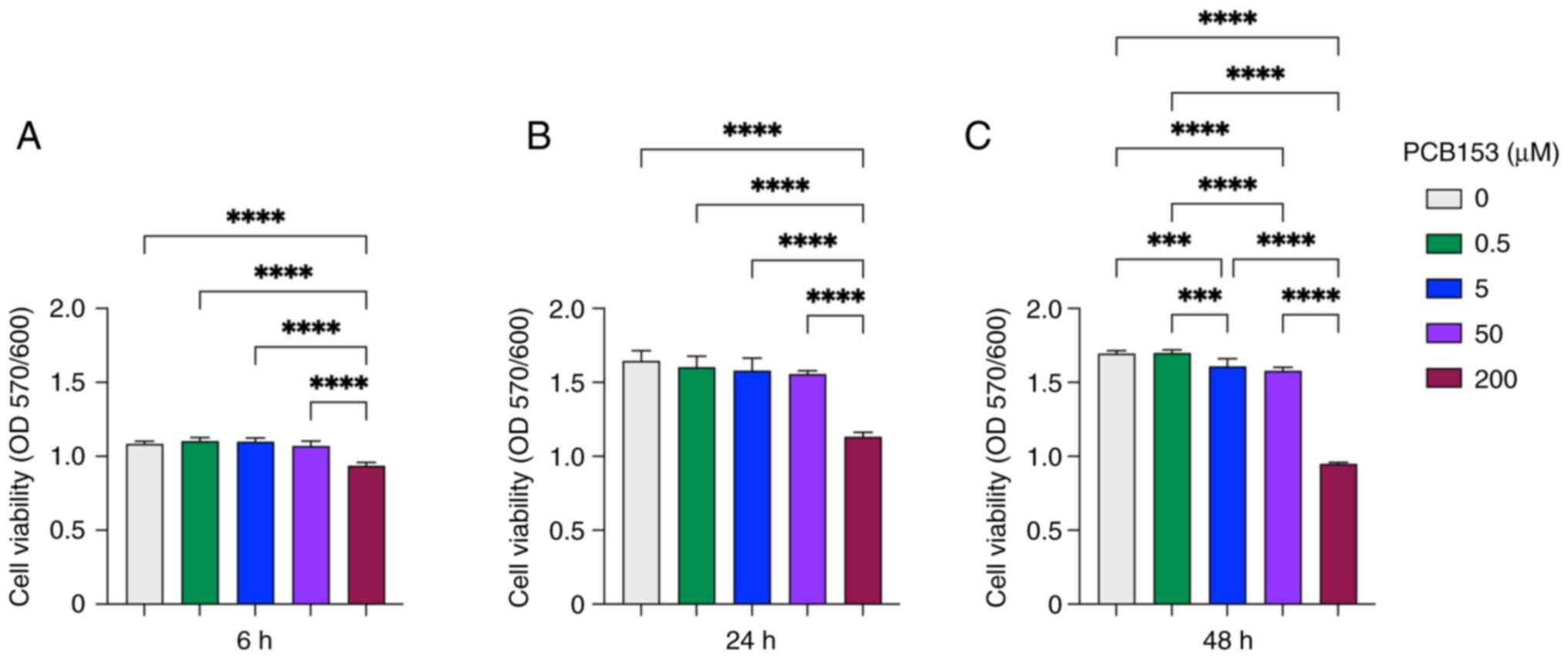
Figure 1

Effects of PCB153 on NCM460D cell
viability. NCM460D cells were treated with a series of
concentrations of PCB153 (0, 0.5, 5, 50 and 200 µM) for (A) 6, (B)
24 and (C) 48 h. Cell viability was determined using the
PrestoBlue™ HS assay. Data are presented as the mean ±
SD from six biological repeats. One-way ANOVA with Tukey's post hoc
test; ***P<0.001, ****P<0.0001. OD,
optical density; PCB153, polychlorinated biphenyl 153.

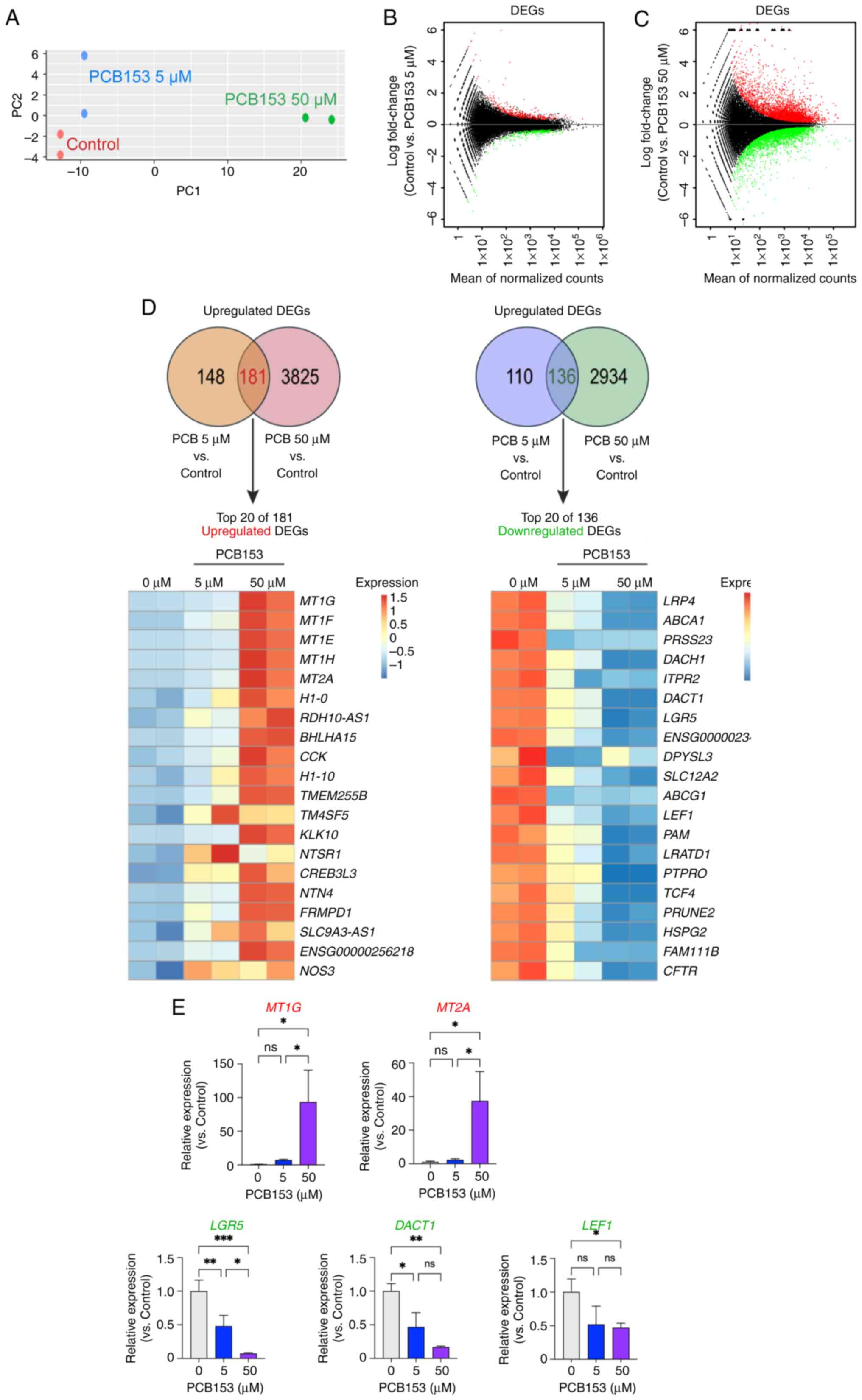
Figure 2

Dose-dependent transcriptomic
alterations in human IECs following PCB153 exposure. (A) PC
analysis of RNA-seq data showing distinct clustering of control and
PCB153-treated IECs, with a clear dose-dependent separation between
the 5 and 50 µM exposure groups. (B) MA plot of DEGs in IECs
treated with 5 µM PCB153 compared with the control group,
highlighting 329 upregulated and 246 downregulated genes (adjusted
P<0.05). (C) MA plot of DEGs in IECs treated with 50 µM PCB153
compared with the control group, showing 4,006 upregulated and
3,070 downregulated genes (adjusted P<0.05). (D) Venn diagram
illustrating the overlap of DEGs between the 5 and 50 µM PCB153
treatment groups, identifying 181 commonly upregulated and 136
commonly downregulated genes, with the top 20 DEGs (ranked by
P-value) visualized in a heatmap. RNA-seq data from two independent
biological experiments, each performed in duplicate are presented.
(E) Reverse transcription-quantitative PCR validation of selected
representative DEGs (MT1G, MT2A, LGR5,
DACT1 and LEF1) confirming induction of
metallothionein genes and suppression of Wnt-related targets,
consistent with RNA-seq results. n=3 for each group. Statistical
significance was determined using one-way ANOVA.
*P<0.05, **P<0.01,
***P<0.001. DEG, differentially expressed gene; IEC,
intestinal epithelial cell; ns, not significant; PC, principal
component; PCB153, polychlorinated biphenyl 153; RNA-seq, RNA
sequencing; MA plot, minus-average plot.

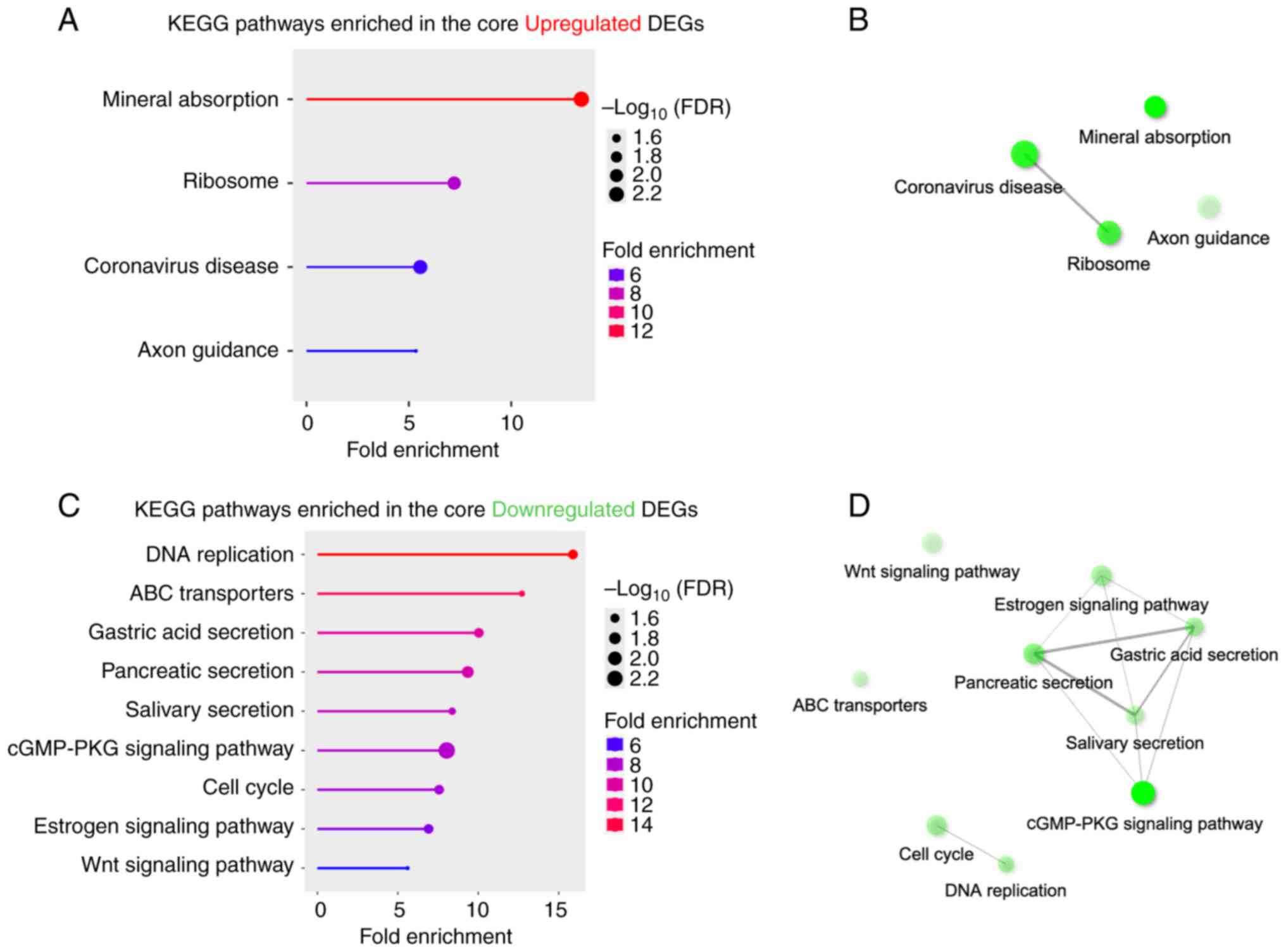
Figure 3

Pathway enrichment analysis of
commonly dysregulated genes in IECs following PCB153 exposure. (A)
KEGG pathway enrichment analysis of 181 commonly upregulated genes
revealed significant enrichment in pathways related to ‘mineral
absorption’, ‘ribosome’, ‘coronavirus disease’ and ‘axon guidance’.
(B) Network analysis of upregulated pathways highlighted potential
interactions between ‘ribosome’ and viral response-related pathways
(‘coronavirus disease’). (C) KEGG pathway enrichment analysis of
136 commonly downregulated genes identified significant suppression
of pathways involved in ‘DNA replication’, ‘ABC transporters’,
digestive secretions (‘gastric acid secretion’, ‘pancreatic
secretion’ and ‘salivary secretion’), ‘cGMP-PKG signaling’, ‘cell
cycle’, ‘estrogen signaling’ and ‘Wnt signaling’. (D) Network
analysis of downregulated pathways showed interconnected
suppression of digestive secretion pathways and the ‘cGMP-PKG
signaling pathway’, indicating impaired intestinal epithelial
physiology. (B and D) Interactive plot shows the relationship
between enriched pathways. Two pathways (nodes) are connected if
they share ≥20% of genes. Darker nodes are more significantly
enriched gene sets. Bigger nodes represent larger gene sets.
Thicker edges represent more overlapped genes. DEG, differentially
expressed gene; FDR, false discovery rate; IEC, intestinal
epithelial cell; KEGG, Kyoto Encyclopedia of Genes and Genomes;
PCB153, polychlorinated biphenyl 153.

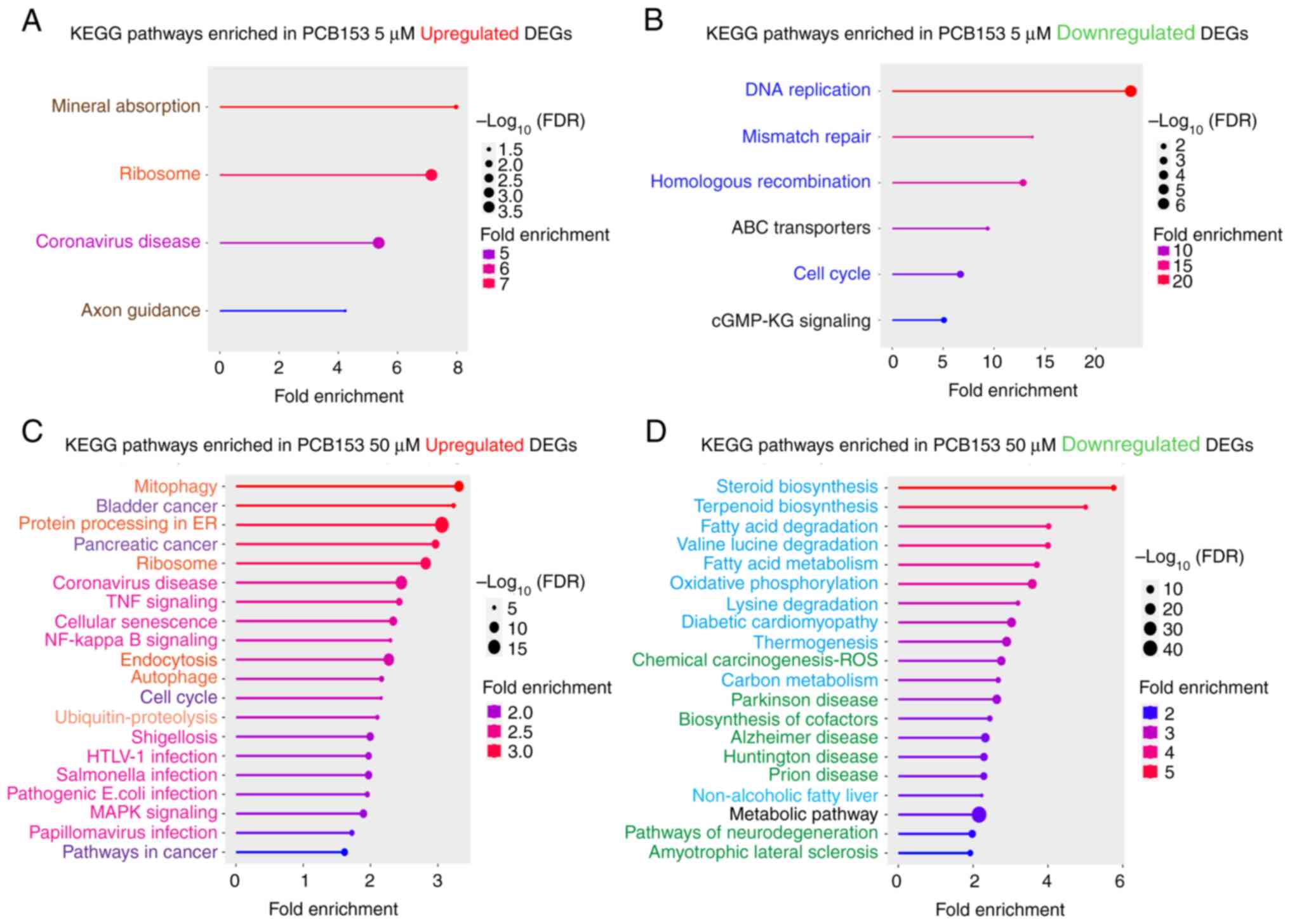
Figure 4

Dose-dependent pathway alterations in
IECs following PCB153 exposure. KEGG pathway enrichment analysis of
(A) upregulated genes and (B) downregulated genes in IECs treated
with 5 µM PCB compared with the control group. (C and D) The top 20
enriched pathways in IECs treated with 50 µM PCB153 were ranked by
fold enrichment and reorganized into functional modules (indicated
by the font color) to improve clarity and interpretability. (A-D)
Upregulated pathways were grouped into ‘Immune & Host-Defense’
(magenta), ‘Proteostasis & Translation’ (orange),
‘Proliferation/Oncogenic’ (violet) and ‘Others’ (brown) categories,
whereas downregulated pathways were grouped into ‘Core Energy &
Lipid Metabolism’ (light blue), ‘Genome Maintenance &
Proliferation’ (dark blue), ‘Neurodegeneration & Proteostasis
Stress’ (green) and ‘Transport/Signaling & Global’ (black)
categories. The significance of pathway enrichment is shown as
-log10(FDR), with higher values indicating stronger
statistical enrichment. DEG, differentially expressed gene; FDR,
false discovery rate; IEC, intestinal epithelial cell; KEGG, Kyoto
Encyclopedia of Genes and Genomes; PCB153, polychlorinated biphenyl
153.
View References

1 

Carpenter DO: Polychlorinated biphenyls (PCBs): Routes of exposure and effects on human health. Rev Environ Health. 21:1–23. 2006.PubMed/NCBI View Article : Google Scholar

2 

McLachlan MS, Undeman E, Zhao F and MacLeod M: Predicting global scale exposure of humans to PCB 153 from historical emissions. Environ Sci Process Impacts. 20:747–756. 2018.PubMed/NCBI View Article : Google Scholar

3 

Wood SA, Armitage JM, Binnington MJ and Wania F: Deterministic modeling of the exposure of individual participants in the National Health and Nutrition Examination Survey (NHANES) to polychlorinated biphenyls. Environ Sci Process Impacts. 18:1157–1168. 2016.PubMed/NCBI View Article : Google Scholar

4 

Desvignes V, Volatier JL, de Bels F, Zeghnoun A, Favrot MC, Marchand P, Le Bizec B, Riviere G, Leblanc JC and Merlo M: Study on polychlorobiphenyl serum levels in French consumers of freshwater fish. Sci Total Environ. 505:623–632. 2015.PubMed/NCBI View Article : Google Scholar

5 

Chelakkot C, Ghim J and Ryu SH: Mechanisms regulating intestinal barrier integrity and its pathological implications. Exp Mol Med. 50:1–9. 2018.PubMed/NCBI View Article : Google Scholar

6 

Peterson LW and Artis D: Intestinal epithelial cells: Regulators of barrier function and immune homeostasis. Nat Rev Immunol. 14:141–153. 2014.PubMed/NCBI View Article : Google Scholar

7 

Choi YJ, Seelbach MJ, Pu H, Eum SY, Chen L, Zhang B, Hennig B and Toborek M: Polychlorinated biphenyls disrupt intestinal integrity via NADPH oxidase-induced alterations of tight junction protein expression. Environ Health Perspect. 118:976–981. 2010.PubMed/NCBI View Article : Google Scholar

8 

Phillips MC, Dheer R, Santaolalla R, Davies JM, Burgueño J, Lang JK, Toborek M and Abreu MT: Intestinal exposure to PCB 153 induces inflammation via the ATM/NEMO pathway. Toxicol Appl Pharmacol. 339:24–33. 2018.PubMed/NCBI View Article : Google Scholar

9 

Moyer MP, Manzano LA, Merriman RL, Stauffer JS and Tanzer LR: NCM460, a normal human colon mucosal epithelial cell line. In Vitro Cell Dev Biol Anim. 32:315–317. 1996.PubMed/NCBI View Article : Google Scholar

10 

Livak KJ and Schmittgen TD: Analysis of relative gene expression data using real-time quantitative PCR and the 2(-Delta Delta C(T)) method. Methods. 25:402–408. 2001.PubMed/NCBI View Article : Google Scholar

11 

Dobin A, Davis CA, Schlesinger F, Drenkow J, Zaleski C, Jha S, Batut P, Chaisson M and Gingeras TR: STAR: Ultrafast universal RNA-seq aligner. Bioinformatics. 29:15–21. 2013.PubMed/NCBI View Article : Google Scholar

12 

Li H, Handsaker B, Wysoker A, Fennell T, Ruan J, Homer N, Marth G, Abecasis G and Durbin R: 1000 Genome Project Data Processing Subgroup. The sequence alignment/Map format and SAMtools. Bioinformatics. 25:2078–2079. 2009.PubMed/NCBI View Article : Google Scholar

13 

Anders S, Pyl PT and Huber W: HTSeq-a Python framework to work with high-throughput sequencing data. Bioinformatics. 31:166–169. 2015.PubMed/NCBI View Article : Google Scholar

14 

Love MI, Huber W and Anders S: Moderated estimation of fold change and dispersion for RNA-seq data with DESeq2. Genome Biol. 15(550)2014.PubMed/NCBI View Article : Google Scholar

15 

Yu G, Wang LG, Han Y and He QY: clusterProfiler: An R package for comparing biological themes among gene clusters. OMICS. 16:284–287. 2012.PubMed/NCBI View Article : Google Scholar

16 

Ge SX, Jung D and Yao R: ShinyGO: A graphical gene-set enrichment tool for animals and plants. Bioinformatics. 36:2628–2629. 2020.PubMed/NCBI View Article : Google Scholar

17 

Socha-Banasiak A, Sputa-Grzegrzółka P, Grzegrzółka J, Pacześ K, Dzięgiel P, Sordyl B, Romanowicz H and Czkwianianc E: Metallothioneins in inflammatory bowel diseases: Importance in pathogenesis and potential therapy target. Can J Gastroenterol Hepatol. 2021(6665697)2021.PubMed/NCBI View Article : Google Scholar

18 

Waeytens A, De Vos M and Laukens D: Evidence for a potential role of metallothioneins in inflammatory bowel diseases. Mediators Inflamm. 2009(729172)2009.PubMed/NCBI View Article : Google Scholar

19 

Nait Slimane S, Marcel V, Fenouil T, Catez F, Saurin JC, Bouvet P, Diaz JJ and Mertani HC: Ribosome biogenesis alterations in colorectal cancer. Cells. 9(2361)2020.PubMed/NCBI View Article : Google Scholar

20 

Silva J, Alkan F, Ramalho S, Snieckute G, Prekovic S, Garcia AK, Hernández-Pérez S, van der Kammen R, Barnum D, Hoekman L, et al: Ribosome impairment regulates intestinal stem cell identity via ZAKa activation. Nat Commun. 13(4492)2022.PubMed/NCBI View Article : Google Scholar

21 

Zhang H, Vreeken D, Leuning DG, Bruikman CS, Junaid A, Stam W, de Bruin RG, Sol WMPJ, Rabelink TJ, van den Berg BM, et al: Netrin-4 expression by human endothelial cells inhibits endothelial inflammation and senescence. Int J Biochem Cell Biol. 134(105960)2021.PubMed/NCBI View Article : Google Scholar

22 

Sensoy I: A review on the food digestion in the digestive tract and the used in vitro models. Curr Res Food Sci. 4:308–319. 2021.PubMed/NCBI View Article : Google Scholar

23 

Fleckenstein JM and Bitoun JP: Changing the locks on intestinal signaling. Cell Host Microbe. 29:1335–1337. 2021.PubMed/NCBI View Article : Google Scholar

24 

Rappaport JA and Waldman SA: The guanylate cyclase C-cGMP signaling axis opposes intestinal epithelial injury and neoplasia. Front Oncol. 8(299)2018.PubMed/NCBI View Article : Google Scholar

25 

Dietrich CG, Geier A and Oude Elferink RPJ: ABC of oral bioavailability: Transporters as gatekeepers in the gut. Gut. 52:1788–1795. 2003.PubMed/NCBI View Article : Google Scholar

26 

Flanagan DJ, Austin CR, Vincan E and Phesse TJ: Wnt signalling in gastrointestinal epithelial stem cells. Genes (Basel). 9(178)2018.PubMed/NCBI View Article : Google Scholar

27 

Mah AT, Yan KS and Kuo CJ: Wnt pathway regulation of intestinal stem cells. J Physiol. 594:4837–4847. 2016.PubMed/NCBI View Article : Google Scholar

28 

Lazarova D and Bordonaro M: Multifactorial causation of early onset colorectal cancer. J Cancer. 12:6825–6834. 2021.PubMed/NCBI View Article : Google Scholar

29 

Li J, Ma X, Chakravarti D, Shalapour S and DePinho RA: Genetic and biological hallmarks of colorectal cancer. Genes Dev. 35:787–820. 2021.PubMed/NCBI View Article : Google Scholar

30 

Ullman TA and Itzkowitz SH: Intestinal inflammation and cancer. Gastroenterology. 140:1807–1816. 2011.PubMed/NCBI View Article : Google Scholar

31 

Stolfi C, Maresca C, Monteleone G and Laudisi F: Implication of intestinal barrier dysfunction in gut dysbiosis and diseases. Biomedicines. 10(289)2022.PubMed/NCBI View Article : Google Scholar

32 

Zong Y, Li H, Liao P, Chen L, Pan Y, Zheng Y, Zhang C, Liu D, Zheng M and Gao J: Mitochondrial dysfunction: Mechanisms and advances in therapy. Signal Transduct Target Ther. 9(124)2024.PubMed/NCBI View Article : Google Scholar

33 

Jacobson A, Yang D, Vella M and Chiu IM: The intestinal neuro-immune axis: Crosstalk between neurons, immune cells, and microbes. Mucosal Immunol. 14:555–565. 2021.PubMed/NCBI View Article : Google Scholar

34 

Treps L, Le Guelte A and Gavard J: Emerging roles of Semaphorins in the regulation of epithelial and endothelial junctions. Tissue Barriers. 1(e23272)2013.PubMed/NCBI View Article : Google Scholar

35 

Agudo A, Goñi F, Etxeandia A, Vives A, Millán E, López R, Amiano P, Ardanaz E, Barricarte A, Chirlaque MD, et al: Polychlorinated biphenyls in Spanish adults: Determinants of serum concentrations. Environ Res. 109:620–628. 2009.PubMed/NCBI View Article : Google Scholar

36 

Cerná M, Malý M, Grabic R, Batáriová A, Smíd J and Benes B: Serum concentrations of indicator PCB congeners in the Czech adult population. Chemosphere. 72:1124–1131. 2008.PubMed/NCBI View Article : Google Scholar

37 

Leong JY, Blachman-Braun R, Patel AS, Patel P and Ramasamy R: Association between polychlorinated biphenyl 153 exposure and serum testosterone levels: Analysis of the national health and nutrition examination survey. Transl Androl Urol. 8:666–672. 2019.PubMed/NCBI View Article : Google Scholar

38 

Longnecker MP, Wolff MS, Gladen BC, Brock JW, Grandjean P, Jacobson JL, Korrick SA, Rogan WJ, Weisglas-Kuperus N, Hertz-Picciotto I, et al: Comparison of polychlorinated biphenyl levels across studies of human neurodevelopment. Environ Health Perspect. 111:65–70. 2003.PubMed/NCBI View Article : Google Scholar

Related Articles

  • Abstract
  • View
  • Download
  • Twitter
Copy and paste a formatted citation
Spandidos Publications style
Ham H, Senthil P, Tan SC, Sargis RM, Prins GS and Geng H: Polychlorinated biphenyl 153 alters the intestinal epithelial cell transcriptome. Biomed Rep 24: 27, 2026.
APA
Ham, H., Senthil, P., Tan, S.C., Sargis, R.M., Prins, G.S., & Geng, H. (2026). Polychlorinated biphenyl 153 alters the intestinal epithelial cell transcriptome. Biomedical Reports, 24, 27. https://doi.org/10.3892/br.2025.2100
MLA
Ham, H., Senthil, P., Tan, S. C., Sargis, R. M., Prins, G. S., Geng, H."Polychlorinated biphenyl 153 alters the intestinal epithelial cell transcriptome". Biomedical Reports 24.2 (2026): 27.
Chicago
Ham, H., Senthil, P., Tan, S. C., Sargis, R. M., Prins, G. S., Geng, H."Polychlorinated biphenyl 153 alters the intestinal epithelial cell transcriptome". Biomedical Reports 24, no. 2 (2026): 27. https://doi.org/10.3892/br.2025.2100
Copy and paste a formatted citation
x
Spandidos Publications style
Ham H, Senthil P, Tan SC, Sargis RM, Prins GS and Geng H: Polychlorinated biphenyl 153 alters the intestinal epithelial cell transcriptome. Biomed Rep 24: 27, 2026.
APA
Ham, H., Senthil, P., Tan, S.C., Sargis, R.M., Prins, G.S., & Geng, H. (2026). Polychlorinated biphenyl 153 alters the intestinal epithelial cell transcriptome. Biomedical Reports, 24, 27. https://doi.org/10.3892/br.2025.2100
MLA
Ham, H., Senthil, P., Tan, S. C., Sargis, R. M., Prins, G. S., Geng, H."Polychlorinated biphenyl 153 alters the intestinal epithelial cell transcriptome". Biomedical Reports 24.2 (2026): 27.
Chicago
Ham, H., Senthil, P., Tan, S. C., Sargis, R. M., Prins, G. S., Geng, H."Polychlorinated biphenyl 153 alters the intestinal epithelial cell transcriptome". Biomedical Reports 24, no. 2 (2026): 27. https://doi.org/10.3892/br.2025.2100
Follow us
  • Twitter
  • LinkedIn
  • Facebook
About
  • Spandidos Publications
  • Careers
  • Cookie Policy
  • Privacy Policy
How can we help?
  • Help
  • Live Chat
  • Contact
  • Email to our Support Team