Introduction
Smoking tobacco is a major global health hazard,
accounting for a large portion of morbidity and mortality rates
accounting for ~7 million deaths in 2020, worldwide (1,2).
Increasing interest has been paid to other tobacco products as a
potential to replace traditional combustible cigarettes (TCCs)
(3-5).
There are thousands of harmful chemicals in TCCs, the majority of
are listed as toxicants and carcinogens by health authorities, such
as the Centers for Disease Control and Prevention and American
Cancer Society (6). These include
formaldehyde, hydrogen cyanide and benzene among others, as well as
radioactive materials. Heating tobacco instead of burning it has
been claimed to be less harmful (7), however new toxicity data mainly in the
pulmonary and cardiovascular systems confirm that heated tobacco
products release fewer toxic chemicals compared with traditional
cigarettes, but still carry health risks due to the presence of
harmful substances (8). A
non-combustible alternative to TCC, including heat not burn (HNB)
devices, such as ‘I Quit Ordinary Smoking (IQOS™), a
tobacco-heating product developed by Philip Morris International
(9) and Glo manufactured by
Lorillard Tobacco Company have become available, However, research
is ongoing to determine the relative health advantages of these
products compared with TCCs (10).
Understanding the potential effects of both
traditional and new HNB devices is key. According to 2023
statistics from the Health Ministry in Jordan, 66% of males and 16%
of females smoke (11), despite the
numerous public health campaigns and restrictions on smoking
(12). However, a 26% of smokers
have switched from using TCCs to non-combustible alternatives as a
healthier replacement (13). IQOS
was the only HNB device available in Jordan for a number of years.
This electrically heated device warms sticks filled with processed
tobacco, producing a nicotine-containing aerosol that contains
fewer harmful chemicals than cigarette smoke, thus rendering IQOS
less harmful for consuming nicotine (13,14).
However, there is ongoing debate in the scientific
community about whether IQOS is healthier than TCCs (15,16).
The results of studies investigating the different effects of these
two modes of smoking are inconclusive (10,11).
Certain studies have shown potential detrimental effects with
long-term use of HNB (10,17), while others have shown decreased
exposure to harmful substances compared to conventional smoking
(9). It has been indicated in
previous studies that reactive carbonyls and superoxide radicals,
two highly toxic substances found in mainstream smoke, but not in
vapor from HNB products such as IQOS, may have potential health
benefits among individuals who wish to quit or cut down on their
cigarette intake due to safety concerns (18-20).
Comparative assessments on health test claims for
safety improvement over risk reduction associated with IQOS. The
aim of the present study was to compare traditional smoking with
IQOS to determine whether the use of IQOS is less harmful health
compared with traditional cigarettes. The findings may provide
useful information for regulatory authorities concerned with global
health care systems and development strategies, as regards the
advantages and disadvantages of HNB cigarettes.
The present study aimed to compare the hematological
and biochemical parameters between non-smokers and TCC and HNB
smokers. These parameters are critical in clarifying the effects of
smoking on health, such as complete blood count (CBC), hemoglobin
(Hb) levels, hematocrit, mean corpuscular volume (MCV). In
addition, the present study examined the levels of alanine
transaminase (ALT), an indicator of liver health, superoxide
dismutase (SOD), a key antioxidant enzyme that protects against
oxidative tissue damage (20), and
fatty acid-binding protein 4 (FABP4), a marker of inflammation and
oxidative stress in numerous types of tissue, including lung
tissue, and their association with cardiovascular risk factors,
including insulin resistance and atherosclerosis (21).
Material and methods
Samples
Of 204 participants (age, 18 to 35 years, the blood
samples was collected at golden hands lab in Amman, Jordan the
study included 65 individuals who used IQOS, 75 who smoked TCC and
64 non-smokers. Blood samples were obtained from participants (148
male and 65 female) between November 2023 and January 2024.
Inclusion criteria were no history of chronic disease, not using
medications that may affect the studied parameters and not using
other forms of nicotine delivery system, such as pipes, hookahs and
vaping. Individuals under the age of 18 or above 35, with chronic
diseases and having medication or mixing other smoking types were
excluded. All participants signed a consent form. Under aseptic
conditions, venous blood samples (5 ml) were collected using plain
and EDTA (Greiner Bio-One) tubes. Tubes were centrifuged for 10 min
at 4400 (rpm) 3,000 x g at 4˚C to obtain serum to perform FABP4,
ALT and SOD assay. Serum aliquots were stored at -20˚C. Ethical
approval was obtained from Al-Ahliyya Amman University (approval
no. AAU/6/11/2023-2024; Amman, Jordan).
CBC
CBC was performed on the Sysmex XP-300 (Sysmex
Corporation). CBC test included white blood cell (WBC) and red
blood cell (RBC) counts, Hb and platelet count. In addition to
measuring MCV, CBC test was performed for after running high, low
and normal controls, and standards on the Sysmex analyzer to ensure
the accuracy.
ALT assay
ALT levels were measured using an assay kit ALT4511
(Shenzhen Mindray Bio-Medical Electronics Co., Ltd.) and
spectrophotometer (colorimetric and turbidity methods) according to
the manufacturer's instructions.
FABP4 assay
FABP4 levels were assessed using a Human
FABP4/A-FABP DuoSet ELISA kit DY3150-05 (Bio-Techne). A total of
100 µl/well samples or standards was covered with an adhesive strip
and incubated for 2 h at room temperature (RT). Liquid was removed
and 100 µl detection Ab/Ag solution was added to each well for
another 2 h at RT. The plate was covered with a new adhesive strip
and incubated for 2 h at RT, followed by the removal of the liquid.
A total of 100 µl working dilution of Streptavidin-HRP was added to
each well for 20 min at RT, followed by removing the liquid and
adding 100 µl substrate solution to each well for 20 min at RT.
Lastly, the reaction was stopped using 50 µl stop solution and the
absorbance was read immediately at 450 nm by the microplate reader
(BioTek Instruments, Inc.). Concentration of FABP4 in each sample
was calculated according to the manufacturer's instructions.
SOD assay
SOD levels were determined using an Activity assay
kit (cat. no. NBP3-24484 (Bio-Techne), according to the
manufacturer's instructions. SOD standard curve was prepared by
serially diluting the SOD standard in triplicate using 1X SOD
buffer, with concentrations ranging from 0.1 to 10.0 units/25 µl.
Similarly, triplicate wells containing 1X SOD buffer were prepared
as activity controls. Serum was diluted in 1X SOD buffer and added
to triplicate wells. A master mix was added to all wells to a total
volume of 175 µl. Reactions were initiated by adding 1X xanthine
solution to all wells, and absorbance readings at 450 nm were taken
every minute for 10 min at RT using a plate reader. The rate of
change in absorbance was determined by calculating the slope of
absorbance curves against time. Finally, the percentage inhibition
of the rate of increase in absorbance at 450 nm was calculated as
follows: % Inhibition=(slope of 1X SOD buffer control-slope of
sample)/slope of 1X SOD buffer control) x100.
Statistical analysis
Categorical variables are presented as frequency and
percentage, whereas numerical variables are presented as mean ± SD
or median (interquartile range) of two independent experiments.
Differences in categorical variable frequencies between groups were
tested using the χ2 or Fisher's exact test depending on
the expected values in each cell of the contingency table. The
differences between numerical variables were tested with unpaired
t-test for independent samples or Wilcoxon rank sum test after
checking the normality of the distribution. One-way ANOVA or
Kruskal-Wallis rank sum test followed by Holm's or Dunn's post hoc
test was used to test the differences between >2 groups after
checking the distribution of the values. Correlation between
numerical variables was measured with Spearman correlation. All
analyses and figures were produced in R version 4.3.3 R Foundation
for Statistical Computing, Vienna, Austria. P<0.05 was
considered to indicate a statistically significant difference.
Results
Participant characteristics
The mean age of the participants was 24.7±4.6 years,
ranging from 18 to 35 years (Table
I). Male participants comprised 72.5% of all the subjects. Most
subjects were aged between 18 and 25 years (65%). The majority of
females (70%) were non-smokers, 21% were IQOS smokers or and 9%
were conventional cigarette smokers. Most males were conventional
cigarette smokers (47%), followed by IQOS smokers (36%). These
differences in the distributions of males and females among the
three groups were significant.
 | Table IDemographic characteristics of the
study groups. |
Table I
Demographic characteristics of the
study groups.
| Characteristic | Non-smoker
(n=64) | Cigarettes
(n=75) | IQOS™
(n=65) | Overall
(n=204) | P-value |
|---|
| Sex (%) | | | | | |
|
Female | 39.0 (70.0) | 5.0 (9.0) | 12.0 (21.0) | 56.0 (27.5) |
<0.0001a |
|
Male | 25.0 (17.0) | 70.0 (47.0) | 53.0 (36.0) | 148.0 (72.5) | |
| Mean age,
years | 23.6±4.7 | 25.3±5.2 | 25.2±3.7 | 24.7±4.6 | 0.0170b |
| Median age (IQR),
years | 22.5
(20.0-25.0) | 24.0
(21.0-30.0) | 25.0
(22.0-27.0) | 24.0
(21.0-27.0) | |
| Age range, years
(%) | | | | | |
|
18-25 | 50 (38.0) | 48 (36.0) | 34 (26.0) | 132 (65.0) | |
|
26-35 | 14 (19.0) | 27 (38.0) | 31 (43.0) | 72 (35.0) | |
A total of 60.9% of the non-smokers were female,
93.3% of the conventional cigarette smokers were male and 81.5% of
the IQOS smokers were male.
In addition, there was a significant difference in
the mean age of subjects in the three groups. The mean age of the
non-smoker group was the youngest (23.6±4.7 years vs. 25.3±5.2
years for the cigarette smokers and 25.2±3.7 for the IQOS
smokers).
For the age group of 18-25 years, the highest
proportions of the subjects were almost equally split between
non-smokers (38%) and cigarette smokers (36%). On the other hand,
the largest proportion (43%) of those aged between 26 and 35 years
were IQOS smokers. The majority (78%) of the non-smoker group
consisted of subjects aged between 18 and 25 years. Cigarette
smokers were also mostly (64%) aged between 18 and 25 years. IQOS
smokers were divided almost equally between the two age groups
(18-25, 52% and 26-35 years, 48%; Table
I). As the study groups significantly differed in their sex
distribution and normal hematological ranges vary by sex, the
hematological parameters were studied for males and females
separately (22).
Hematological parameters
There were no significant differences in Hb
concentration and WBC, RBC or platelet count between the study
groups for males. Mean WBC count was elevated in both traditional
cigarette (8.2±2.1x10⁹/l) and IQOS smokers
(8.2±2.4x10⁹/l) compared with non-smokers
(7.7±2.0x10⁹/l; Table
II).
| Table IIHematological parameters for the
males in the study groups. |
Table II
Hematological parameters for the
males in the study groups.
| Parameter | Non-smoker
(n=25) | Cigarettes
(n=70) | IQOS™ (n=53) | Overall
(n=148) | Normal range | P-value |
|---|
| Mean Hb, g/l | 155.2±10.1 | 158.9±9.4 | 157.5±10.1 | 157.8±9.8 | 140.0- | 0.341a |
| Median Hb (IQR),
g/l | 156.0
(145.0-166) | 159.0
(153.0-162.0) | 155 (150-164) | 157.0
(152.0-163.0) | 180.0 | |
| Mean WBC,
x109/l | 7.7±2.0 | 8.2±2.1 | 8.2±2.4 | 8.1±2.2 | 4.5-11.0 | 0.598b |
| WBC (IQR),
x109/l | 7.9 (6.4-9.1) | 8.0 (6.7-10.0) | 8.3 (6.4-9.7) | 8.1 (6.4-9.8) | 4.7-6.1 | 0.778a |
| Mean RBC,
x106/µl | 5.3±0.5 | 5.3±0.4 | 5.4±0.4 | 5.3±0.4 | | |
| Median RBC (IQR),
x106/µl | 5.4 (4.9-5.6) | 5.4 (5.1-5.6) | 5.4 (5.1-5.6) | 5.4 (5.1-5.6) | | |
| Mean MCV, fl | 84.3±2.5 | 86.8±3.7 | 85.7±5.5 | 85.4±7.6 | 80.0-96.0 | 0.004a |
| Median MCV (IQR),
fl | 85.0
(82.8-85.3) | 86.9
(85.1-88.9) | 86.0
(83.7-89.4) | 86.0
(83.7-88.8) | | |
| Mean platelet
count, cells/µl | 271.8±56.6 | 268.0±67.4 | 264.1±67.6 | 267.3±65.4 | 150.0- | 0.807a |
| Median platelet
count (IQR), cells/µl | 274.0
(218.0-318.0) | 259.0
(223.0-299.0) | 265.0
(205.0-320.0) | 262.0
(214.0-312.0) | 400.0 | |
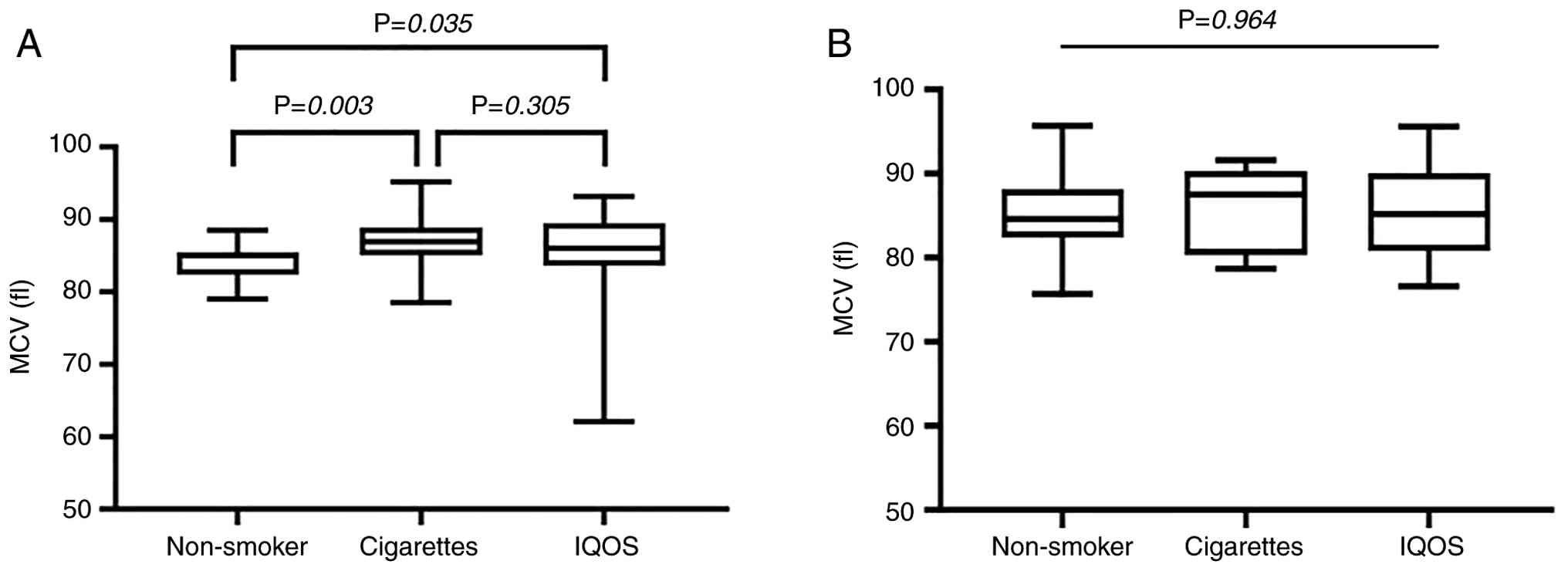
Differences in MCV (mean size of RBC) between the
three groups were significant for males. Male cigarette smokers had
a significantly higher MCV compared with non-smokers (86.8±3.7 vs.
84.3±2.5 fl, respectively). The differences in MCV between the male
cigarette and IQOS smokers were not significant. However, the
difference in MCV between the male IQOS smokers (mean, 84.2±11.7;
median, 85.8 fl) and non-smokers (mean, 84.3±2.5; median, 85 fl)
was significant (Table II;
Fig. 1A).
There were no significant differences in mean Hb
concentration, mean WBC, RBC or platelet count or MCV between the
study groups for females (Fig. 1B).
IQOS group had the highest mean WBC count
(8.6±2.6x10⁹/l) compared with cigarette smokers
(7.7±1.3x10⁹/l) and non-smokers
(8.2±2.1x10⁹/l; Table
III).
| Table IIIHematological parameters for the
females in the study groups. |
Table III
Hematological parameters for the
females in the study groups.
| Parameter | Non-smoker
(n=39) | Cigarettes
(n=5) | IQOS™
(n=12) | Overall (n=56) | Normal range | P-value |
|---|
| Mean Hb, g/l | 133.0±8.7 | 131.4±8.6 | 130.8±12.1 | 132.4±9.4 | 120.0- | 0.987a |
| (IQR), g/l | 132.0
(127-138) | 131.0
(130.0-138.0) | 133.0
(129.0-138.0) | 132.0
(127.0-138.0) | 160.1 | |
| Mean WBC,
x109/l | 8.2±2.1 | 7.7±1.3 | 8.6±2.6 | 8.2±2.1 | 4.5-11.0 | 0.710b |
| Median WBC (IQR),
x109/l | 8.2 (7.0-9.4) | 7.7 (6.9-8.5) | 8.2 (7.3-9.9) | 8.1 (7.1-9.5) | | |
| Mean RBC,
x106/µl | 4.7±0.3 | 4.6±0.2 | 4.7±0.3 | 4.7±0.3 | 4.7-6.1 | 0.848a |
| Median RBC (IQR),
x106/µl | 4.7 (4.5-5.0) | 4.6 (4.5-4.6) | 4.7 (4.5-5.0) | 4.6 (4.5-5.0) | | |
| Mean MCV | 85.3±4.3 | 85.8±5.3 | 85.1±5.8 | 85.3±4.7 | 80.0-96.0 | 0.964b |
| Median MCV (IQR),
fl | 84.6
(82.5-88.0) | 87.5
(82.0-89.0) | 85.2
(81.0-88.9) | 84.9
(82.0-88.4) | | |
| Mean platelet
count, cells/µl | 315.9±67.8 | 302.8±23.8 | 304.3±41.9 | 312.3±60.0 | 150.0- | 0.833a |
| Median platelet
count (IQR), cells/µl | 317.0
(268.0-356.0) | 300.0
(298.0-316.0) | 313.0
(286.0-329.0) | 317.0
(276.0-353.0) | 400.0 | |
A total of ~20% of female non-smokers and cigarette
smokers had Hb values ≥14 g/dl which is the upper limit of normal
range. On the other hand, 25% of female IQOS smokers had Hb levels
≥14. However, the differences between the three groups were not
significant (Table IV). Most male
cigarette smokers had Hb values ≥16 (47%). A total of ~40% of
non-smoker and IQOS smoking males had Hb levels ≥16. The
differences in these frequencies were not significant (Table IV).
| Table IVParticipants with high and low Hb
values. |
Table IV
Participants with high and low Hb
values.
| Group | Non-smoker | Cigarettes |
IQOS™ | P-value |
|---|
| Female (%) | | | | |
|
Hb <14
g/dl | 31(79) | 4(80) | 9(75) | 0.875a |
|
Hb ≥14
g/dl | 8(21) | 1(20) | 3(25) | |
| Male (%) | | | | |
|
Hb <16
g/dl | 15(60) | 37(53) | 31(58) | 0.750b |
|
Hb ≥16
g/dl | 10(40) | 33(47) | 22(42) | |
ALT
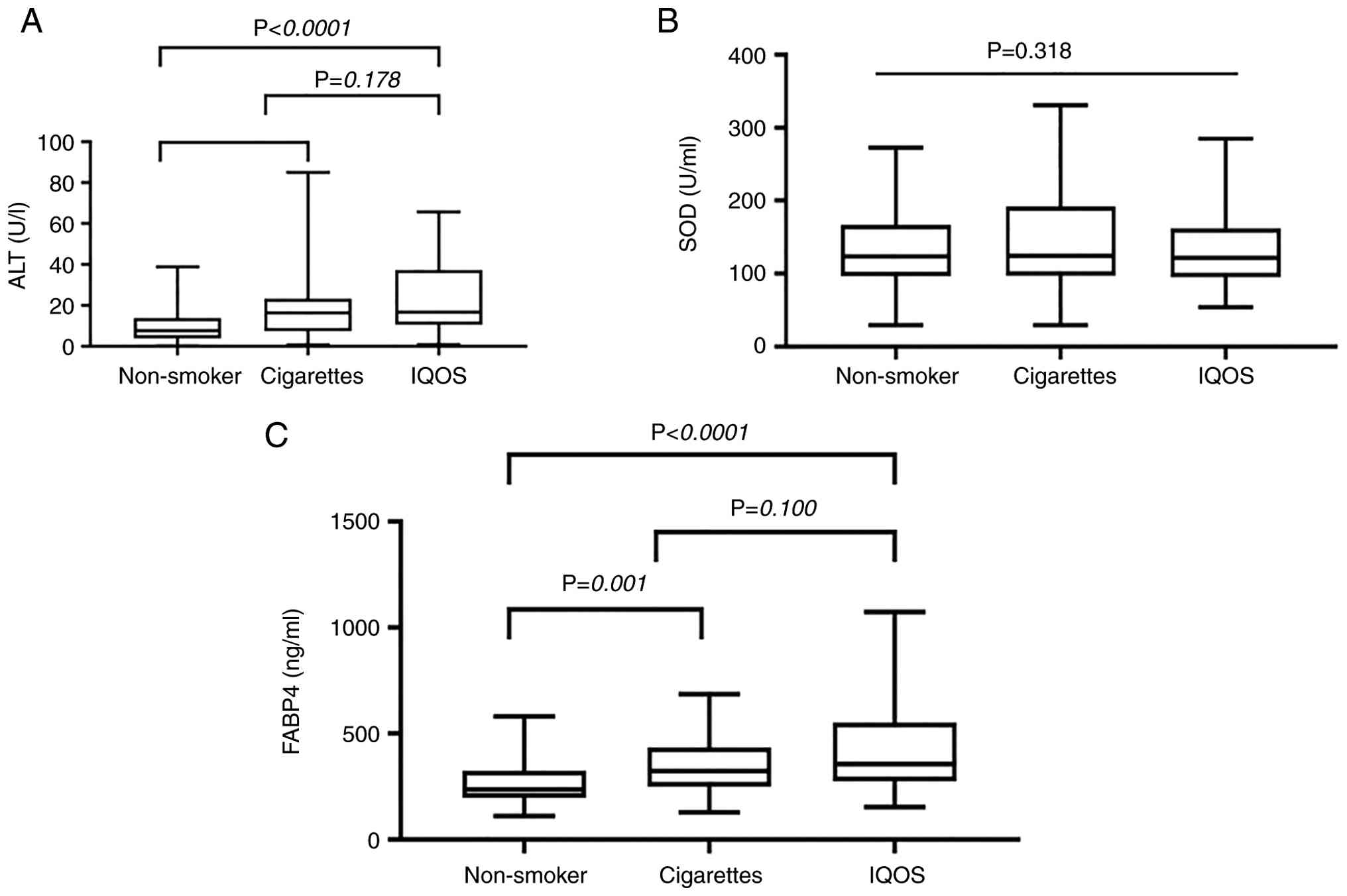
ALT levels were significantly different among the
three study groups regardless of sex. IQOS smokers had the highest
mean (22.6±16.6 U/l) and median ALT levels (16.6 U/l). This was
significantly higher than in the non-smoker group (mean, 10.6±9.1;
median, 7.7 U/l). Moreover, there was a significant difference in
ALT between non-smokers and cigarette smokers (mean, 17.9±13.7;
median, 16.4 U/l). There was no significant difference in ALT
between cigarette and IQOS™ smokers (Table V; Fig.
2A).
| Table VMarker levels. |
Table V
Marker levels.
| Parameter | Non-smoker
(n=25) | Cigarettes
(n=70) | IQOS™
(n=53) | Overall
(n=148) | Normal range |
P-valuea |
|---|
| Median ALT | 10.6±9.1 | 17.9±13.7 | 22.6±16.6 | 17.1±14.3 | <45.0 | <0.0001 |
| (IQR), U/l | 7.7 (4.0-13.7) | 16.4
(7.6-23.2) | 16.6
(10.7-37.0) | 13.2
(6.5-22.8) | | |
| Mean SOD, U/ml | 130.7±49.1 | 149.9±72.5 | 130.1±45.9 | 138.2±59.2 | 110-215 | 0.3180 |
| Median SOD (IQR),
U/ml | 123.0
(97.0-164.0) | 125.0
(101.0-190.0) | 121.0
(96.0-160.0) | 123.0
(96.0-171.0) | | |
| Median | 269.5±119 | 348±135 | 421.8±206.5 | 346.9±167.8 | | <0.0001 |
| FABP4 (IQR),
ng/ml | 234.0
(196.0-322.0) | 321.0
(249.0-435.0) | 356.0
(273.0-547.0) | 313.0
(224.0-442.0) | Not applicable | |
SOD
There was no significant difference between the
three study groups in the levels of SOD. The overall mean SOD value
was 138.2±59.2 U/ml (Table V;
Fig. 2B).
FABP4
The three smoking status groups differed
significantly in the levels of FABP4. The IQOS group had the
highest mean (421.8±356 ng/ml) and median (376 ng/ml) levels. This
was significantly higher than in the non-smoker group (mean,
269.5±119; median, 234 ng/ml). Moreover, cigarette smokers also had
significantly higher levels of FABP4 (mean, 348.0±135.0; median,
321 ng/ml) than non-smokers (Table
V; Fig. 2C).
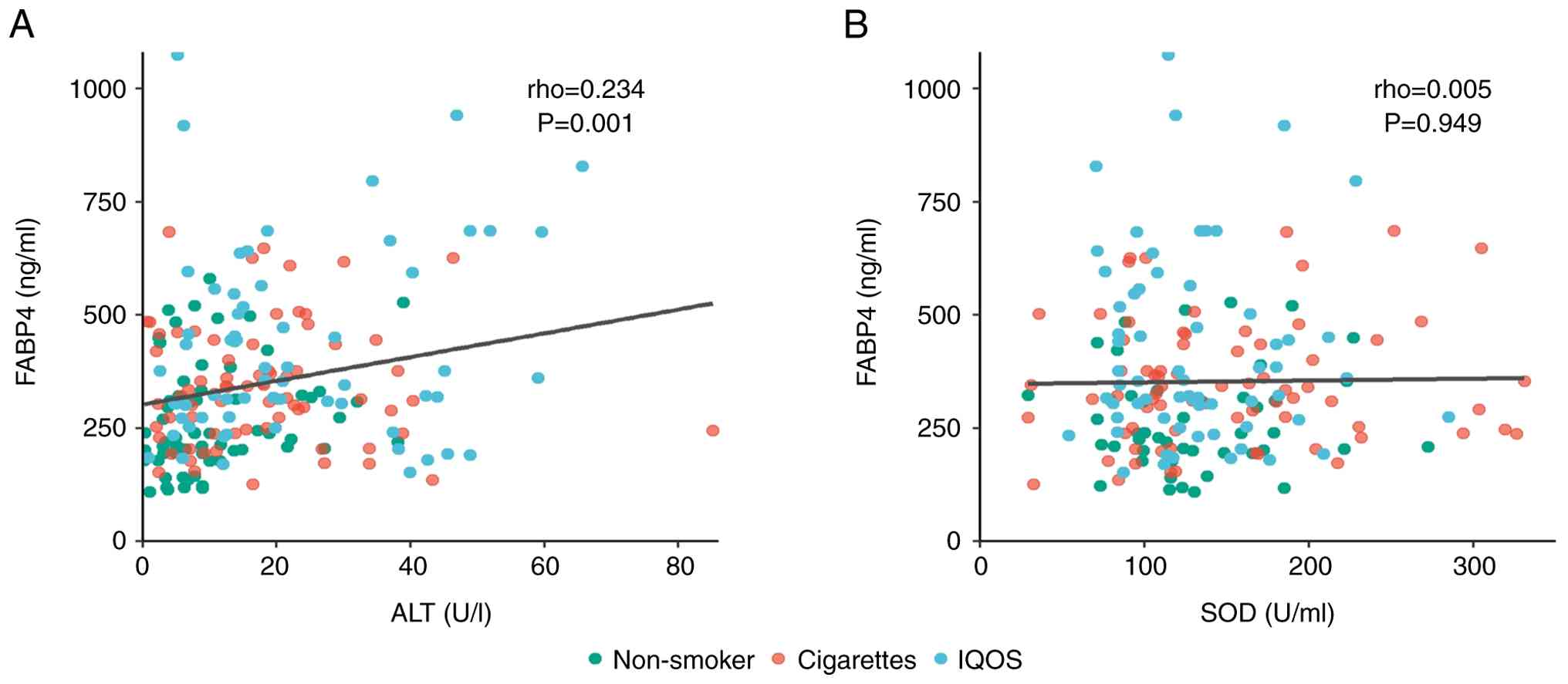
There was a positive association between ALT and
FABP4 for the entire study population. Levels of FABP4 increased
with increasing ALT. The correlation was moderate (ρ=0.234) and
significant (Fig. 3A). There was no
correlation between levels of FABP4 and SOD for the study
population (ρ=0.005; Fig. 3B).
The mean weight in the IQOS smoking group was
77.3±19.0 kg. The members of this group had been smoking on average
for 2.9±1.1 years. The majority of the IQOS smokers (66.2%) smoked
≥1 packs/day. Moreover, 52.3% of the group reported that they
engage in some form of exercise (Table
VI).
| Table VIWeight and smoking habits of the I
Quit Ordinary Smoking group. |
Table VI
Weight and smoking habits of the I
Quit Ordinary Smoking group.
| Variable | Value (n=65) |
|---|
| Mean weight,
kg | |
|
Male | 81.6±17.6 |
|
Female | 58.6±12.7 |
| Mean duration of
smoking, years | 2.9±1.1 |
| Daily consumption,
packs (%) | |
|
<1 | 22.0 (33.8) |
|
≥1 | 35.0 (66.2) |
| Exercise (%) | |
|
Yes | 34.0 (52.3) |
|
No | 31.0 (47.7) |
Hb was positively correlated with the weight of the
male IQOS group (ρ=0.318). FABP4 increased with increasing weight
of the IQOS group (ρ=0.415; Table
VII). On the other hand, SOD was strongly correlated with the
weight of the female IQOS smokers (ρ=0.606; Table VIII).
| Table VIICorrelation between body weight of
male I Quit Ordinary Smoking users with hematological parameters
and markers. |
Table VII
Correlation between body weight of
male I Quit Ordinary Smoking users with hematological parameters
and markers.
| Variable | Correlation
coefficient | P-value |
|---|
| Hb | 0.318 | 0.020 |
| WBC | 0.011 | 0.936 |
| RBC | 0.270 | 0.051 |
| MCV | -0.142 | 0.312 |
| Platelet count | 0.095 | 0.498 |
| ALT | 0.088 | 0.534 |
| SOD | 0.055 | 0.700 |
| FABP4 | 0.415 | 0.002 |
| Table VIIICorrelation between body weight of
female I Quit Ordinary Smoking users with hematological parameters
and markers. |
Table VIII
Correlation between body weight of
female I Quit Ordinary Smoking users with hematological parameters
and markers.
| Variable | Correlation
coefficient | P-value |
|---|
| Hb | 0.228 | 0.475 |
| WBC | 0.368 | 0.239 |
| RBC | -0.116 | 0.719 |
| MCV | 0.481 | 0.114 |
| Platelet count | 0.263 | 0.409 |
| ALT | -0.007 | 0.983 |
| SOD | 0.606 | 0.048 |
| FABP4 | -0.039 | 0.905 |
IQOS smokers with higher daily consumption had been
smoking for longer periods of time. Daily consumption was not
significantly associated with hematological parameters or ALT, SOD
or FABP4 levels (Table IX).
| Table IXHematological parameters and markers
for the I Quit Ordinary Smoking group by daily consumption. |
Table IX
Hematological parameters and markers
for the I Quit Ordinary Smoking group by daily consumption.
| | Daily consumption,
packs | |
|---|
| Variable | <1 (n=22) | ≥1 (n=43) | P-value |
|---|
| Mean duration of
smoking, years | 2.4±1.1 | 3.2±1.0 | 0.005a |
| Mean Hb, g/l | 150.7±18.3 | 153.5±12.6 | 0.527b |
| Mean WBC count,
x109/l | 8.0±2.3 | 8.5±2.5 | 0.432c |
| Mean RBC count,
x106/µl | 5.3±0.4 | 5.3±0.5 | 0.889c |
| Mean MCV, fl | 85.1±4.2 | 85.8±6.1 | 0.292a |
| Mean platelet
count, cells/µl | 261.5±64.0 | 276.6±66 | 0.308a |
| Mean ALT levels,
U/l | 24.0±15.7 | 21.9±17.1 | 0.621a |
| Mean SOD levels,
U/ml | 122.1±43.0 | 133.8±47.2 | 0.392a |
| Mean FABP4 levels,
ng/ml | 349.6±136.6 | 458.7±227.0 | 0.076a |
No significant differences were found between the
IQOS smokers who reported exercising and those who reported no
exercising except for FABP4 (P=0.001). The mean FABP4 levels in the
group who exercise was lower (342.2±148.3 vs. 509.0±227.5 ng/ml)
than in the group who do not exercise (Table X).
| Table XHematological parameters and markers
for the I Quit Ordinary Smoking group by exercise habit. |
Table X
Hematological parameters and markers
for the I Quit Ordinary Smoking group by exercise habit.
| Variable | Exercise
(n=34) | No exercise
(n=31) | P-value |
|---|
| Mean duration of
smoking, years | 2.7±1.1 | 3.1±1.1 | 0.126a |
| Mean Hb, g/l | 152.4±16.2 | 152.7±13.1 | 0.875a |
| Mean WBC count,
x109/l | 8.6±2.8 | 8.0±1.9 | 0.336b |
| Mean RBC count,
x106/µl | 5.3±0.6 | 5.3±0.4 | 0.906c |
| Mean MCV, fl | 85.0±6.6 | 86.2±4.1 | 0.604a |
| Mean platelet
count, cells/µl | 262.7±58.8 | 281.1±71.3 | 0.237a |
| Mean ALT levels,
U/l | 24.2±15.7 | 20.9±17.6 | 0.236a |
| Mean SOD levels,
U/ml | 128.3±42.8 | 132.2±50.0 | 0.918a |
| Mean FABP4 levels,
ng/ml | 342.2±148.3 | 509.0±227.5 | 0.001a |
Discussion
Despite the well-established health hazards
associated with smoking, numerous individuals, particularly young
people, have switched to alternatives, such as IQOS, considering it
to be a safer option as IQOS provides nicotine without the harmful
effects of combustion typically associated with traditional
cigarettes (21,23). However, the safety of IQOS remains a
contentious issue, as increasing research (23,24)
suggests that its use may still be associated with substantial
health risks. To the best of our knowledge, the effects of the use
of IQOS compared with traditional cigarette smoking have not yet
been comprehensively studied. The present study included younger
individuals because they are less likely to have transitioned from
conventional cigarettes to IQOS. Since individuals who mostly
switch from conventional cigarettes to IQOS may experience
persistent effects from long-term traditional smoking, potentially
mask the effects associated with IQOS use. Thus, by selecting
participants at earlier stages of smoking behavior, we aimed to
isolate the specific impact of IQOS on the measured health
indicators (25).
Smoking alters hematological parameters, including
RBC count, Hb, hematocrit, MCV and MCHC (26). Hematocrit levels are typically
elevated in smokers due to increased RBC production in response to
hypoxia, which may increase blood viscosity and cardiovascular
risks (27). In the present study,
while smokers exhibited higher levels of these hematological
markers mainly Hb, no significant differences were found between
cigarette smokers, IQOS users and non-smokers, potentially due to
the young age and short duration of smoking status of the
participants.
MCV tends to be higher in smokers, potentially due
to smoking-related toxins affecting bone marrow function, resulting
in larger red blood cells (28). In
the present study, male smokers exhibited a significantly higher
MCV than non-smokers; however, no significant difference was found
between cigarette smokers and IQOS users. This suggested that while
the effect of smoking on MCV is evident in traditional smokers, the
impact of IQOS on this parameter may be less pronounced; however,
further investigations are required. Female participants exhibited
no significant differences in hematological parameters, which may
be due to small number of participants in the conventional
cigarette group, although there was a notable difference in MCV
between IQOS users and non-smokers.
Smoking triggers systemic inflammation, typically
reflected in elevated WBC counts and changes in leukocyte subtype,
which can indicate generalized infection or inflammation (29). While the present study found an
increased WBC count in smokers, no significant difference was
observed compared with non-smokers, which may be attributed to the
relatively short smoking duration of the participants. Previous
research has demonstrated that smokers with longer duration of
smoking tend to have significantly higher WBC count (30).
The present study demonstrated significant
differences in serum ALT levels among the three groups. IQOS users
exhibited the highest mean serum ALT levels, followed by cigarette
smokers, with non-smokers exhibiting the lowest levels. This
suggested that smoking, including the use of alternative devices,
such as IQOS, may affect liver function. Similar findings have been
reported in previous studies, which emphasize ALT as a valuable
marker for liver damage (31,32).
Although ALT levels alone cannot diagnose liver disease, they offer
high specificity and sensitivity for detecting liver injury,
particularly in the context of smoking (33).
SOD is a key antioxidant enzyme that protect cells
from oxidative damage. While certain studies have reported
significantly elevated SOD levels in smokers due to the adaptive
response of the body to increased levels of oxidative stress
(33,34). The present study did not reveal
significant differences in SOD levels between the smoking and
non-smoking groups. This inconsistency may be due to varying
methods of measurement, smoking duration or the adaptive mechanisms
of the body in response to chronic smoking (35,36).
FABP4 is a key protein involved in lipid metabolism
and inflammation. Elevated levels of FABP4 are associated with
metabolic abnormality, including insulin resistance, obesity and
cardiovascular disease (37,38).
The present study found that both cigarette smokers and IQOS users
had higher levels of FABP4 compared with non-smokers, with a
positive correlation between FABP4 and ALT levels, suggesting a
potential association between increased FABP4 levels and liver
damage. This is supported by research indicating that cigarette
smoke elevates FABP4 levels, which may contribute to tissue
inflammation and damage (39,40).
Further studies are required to assess the role of FABP4 as a
potential biomarker for smoking-associated disease, particularly
liver damage. On the other hand, certain biomarkers, including
carboxyhemoglobin and certain urinary metabolites like
3-hydroxypropyl mercapturic acid and S-phenylmercapturic acid, have
been reported at lower levels in users of heated tobacco products
(HNB) compared with conventional cigarette smokers, suggesting a
relative reduction in exposure to specific toxicants (41,42).
The present study also revealed notable associations
among IQOS smokers. The positive correlation between ALT and FABP4
levels suggested that the use of IQOS may lead to liver damage,
similar to traditional cigarette smoking. Additionally, the daily
consumption of IQOS was positively associated with both weight and
smoking duration, highlighting the cumulative effects of smoking
intensity over time. Of note, a number of IQOS smokers also engaged
in physical activity showed significant decrease in FABP4 levels,
suggesting a potential mitigating factor in decreasing
smoking-associated health risks.
Furthermore, the association between Hb, RBC count
and weight suggests that certain physiological adaptations may
occur in response to smoking, potentially to compensate for the
negative effects of smoking on the cardiovascular system. These
findings underscore the need for a holistic approach when assessing
the health impacts of smoking alternatives, considering both
smoking behavior and lifestyle choices.
While the present study provided insight into the
impact of IQOS and conventional smoking on FABP4 levels, there were
limitations. The study included 204 participants, which may be
suitable for preliminary findings, but still limits the
generalizability of the results to broader populations. Future
studies should use larger and more diverse cohorts to confirm these
findings. Additionally, FABP4 levels are influenced by various
metabolic conditions, which need to be controlled in the study.
Incorporating additional biomarkers such as C reactive protein,
TNF-α, and IL-6 in future studies may offer a more comprehensive
assessment of inflammation and metabolic impact.
The present study highlighted the complex and
multifaceted effects of smoking, including the use of alternatives,
such as IQOS, on health markers. While IQOS may be perceived as a
safer alternative to traditional cigarettes, it may affect liver
function, specifically the positive correlation between ALT and
FABP4 levels, which may indicate its risk to liver health,
hematological parameters and metabolic health. Further research is
warranted to explore the long-term effects of IQOS and other
smoking alternatives on health, particularly among young users, and
to develop strategies for mitigating the health risks associated
with smoking in all forms.
Acknowledgements
Not applicable.
Funding
Funding: The present study was supported by Al-Ahliyya Amman
University (grant no. 202137016.
Availability of data and materials
The data generated in the present study may be
requested from the corresponding author.
Authors' contributions
LEM and MMA confirm the authenticity of all the raw
data. LEM designed the study, analyzed data and wrote the
manuscript. MMA conceived and designed the study, analyzed data and
wrote, reviewed and edited the manuscript. SZ analyzed data and
reviewed and edited the manuscript. BAAM performed the experiments
and reviewed and edited the manuscript. All authors have read and
approved the final manuscript.
Ethics approval and consent to
participate
The present study was approved by Al-Ahliyya Amman
University (approval no. AAU/6/11/2023-2024; Amman, Jordan). All
participants gave written informed consent before
participation.
Patient consent for publication
Not applicable.
Competing interests
The authors declare that they have no competing
interests.
References
|
1
|
Dai X, Gakidou E and Lopez AD: Evolution
of the global smoking epidemic over the past half century:
Strengthening the evidence base for policy action. Tob Control.
31:129–137. 2022.PubMed/NCBI View Article : Google Scholar
|
|
2
|
Al-Othman N, Ghanim M and Alqaraleh M:
Comparison between smoking and nonsmoking palestinian medical
students in the health-promoting behaviors and lifestyle
characteristics. Biomed Res Int. 2021(5536893)2021.PubMed/NCBI View Article : Google Scholar
|
|
3
|
Pluym N, Burkhardt T, Scherer G and
Scherer M: The potential of new nicotine and tobacco products as
tools for people who smoke to quit combustible cigarettes-a
systematic review of common practices and guidance towards a robust
study protocol to measure cessation efficacy. Harm Reduct J.
21(130)2024.PubMed/NCBI View Article : Google Scholar
|
|
4
|
Karelitz JL, He Y, Becker E and Vansickel
A: Switching behavior and changes in smoking behavior by menthol
cigarette preference and menthol heated tobacco product use among
adults in the United States who smoke cigarettes: An actual use
study. Harm Reduct J. 22(19)2025.PubMed/NCBI View Article : Google Scholar
|
|
5
|
Hardie G, Gale N, McEwan M, Oscar SM,
Ziviani L, Proctor CJ and Murphy J: An abuse liability assessment
of the glo tobacco heating product in comparison to combustible
cigarettes and nicotine replacement therapy. Sci Rep.
12(14701)2022.PubMed/NCBI View Article : Google Scholar
|
|
6
|
Talhout R, Schulz T, Florek E, van Benthem
J, Wester P and Opperhuizen A: Hazardous compounds in tobacco
smoke. Int J Environ Res Public Health. 8:613–628. 2011.PubMed/NCBI View Article : Google Scholar
|
|
7
|
Alkouri O, Khader Y and Al-Bashaireh AM:
Prevalence of cigarettes and waterpipe smoking among Jordanians,
refugees, and migrants in Jordan and its associated factors: A
secondary data analysis. Int J Environ Res Public Health.
20(82)2022.PubMed/NCBI View Article : Google Scholar
|
|
8
|
Upadhyay S, Rahman M, Johanson G, Palmberg
L and Ganguly K: Heated tobacco products: Insights into composition
and toxicity. Toxics. 11(667)2023.PubMed/NCBI View Article : Google Scholar
|
|
9
|
Balfour DJK, Benowitz NL, Colby SM,
Hatsukami DK, Lando HA, Leischow SJ, Lerman C, Mermelstein RJ,
Niaura R, Perkins KA, et al: Balancing consideration of the risks
and benefits of E-cigarettes. Am J Public Health. 111:1661–1672.
2021.PubMed/NCBI View Article : Google Scholar
|
|
10
|
Ghazi S, Song MA and El-Hellani A: A
scoping review of the toxicity and health impact of IQOS. Tob Induc
Dis. 22(97)2024.PubMed/NCBI View Article : Google Scholar
|
|
11
|
Mustafa MI: Smoking in Jordan an
‘epidemic’, says Health Ministry official. The Jordan Times, 2024.
https://jordantimes.com.
|
|
12
|
Goicoechea JZ, Boughner A, Lee JJC,
Mahajan A, Yeo K, Sproga M, Russell C, Coughlan M, Selya A, Caci G,
et al: Respiratory symptoms among e-cigarette users without an
established smoking history in the VERITAS cohort. Sci Rep.
14(28549)2024.PubMed/NCBI View Article : Google Scholar
|
|
13
|
Abu-Helalah MA, Alshraideh HA, Al-Serhan
AA, Nesheiwat AI, Da'na M and Al-Nawafleh A: Epidemiology,
attitudes and perceptions toward cigarettes and hookah smoking
amongst adults in Jordan. Environ Health Prev Med. 20:422–433.
2015.PubMed/NCBI View Article : Google Scholar
|
|
14
|
Azeez R: Design and test of wPUM
topography monitor for IQOS. Thesis. Rochester Institute of
Technology, 2024.
|
|
15
|
Al-Sawalha NA, Almomani BA, Mokhemer E,
Al-Shatnawi SF and Bdeir R: E-cigarettes use among university
students in Jordan: Perception and related knowledge. PLoS One.
16(e0262090)2021.PubMed/NCBI View Article : Google Scholar
|
|
16
|
Abdalla MA, Abubaker J, Abu-Farha M,
Al-Khairi I, Cherian P, Qaddoumi MG, Al-Rashed F, Thanaraj TA,
Albatineh AN and Al-Mulla F: Investigating the role of FABP4 in
diabetes and obesity and the influence of age and ethnicity: A
comprehensive analysis of a cohort from the KEDP-study. Int J Mol
Sci. 25(4578)2024.PubMed/NCBI View Article : Google Scholar
|
|
17
|
Saito N, Furuhashi M, Koyama M, Higashiura
Y, Akasaka H, Tanaka M, Moniwa N, Ohnishi H, Saitoh S, Ura N, et
al: Elevated circulating FABP4 concentration predicts
cardiovascular death in a general population: A 12-year prospective
study. Sci Rep. 11(4008)2021.PubMed/NCBI View Article : Google Scholar
|
|
18
|
Znyk M and Kaleta D: The health effects of
heated tobacco product use-a narrative review. Healthcare (Basel).
13(2042)2025.PubMed/NCBI View Article : Google Scholar
|
|
19
|
Bhat TA, Kalathil SG, Leigh NJ, Goniewicz
ML and Thanavala YM: Can switching from cigarettes to heated
tobacco products reduce consequences of pulmonary infection? Respir
Res. 25(381)2024.PubMed/NCBI View Article : Google Scholar
|
|
20
|
Merritt N, Urquhart C and Burcham P: Role
of reactive carbonyls and superoxide radicals in protein damage by
cigarette smoke extracts: Comparison of heat-not-burn e-cigarettes
to conventional cigarettes. Chem Biol Interact.
395(111008)2024.PubMed/NCBI View Article : Google Scholar
|
|
21
|
Malenica M, Prnjavorac B, Bego T, Dujic T,
Semiz S, Skrbo S, Gusic A, Hadzic A and Causevic A: Effect of
cigarette smoking on haematological parameters in healthy
population. Med Arch. 71:132–136. 2017.PubMed/NCBI View Article : Google Scholar
|
|
22
|
Doucoure M, Zeguime A, Niangaly A, Guindo
MA, Doritchamou JYA, Assadou MH, Katile A, Kanoute MB, Perou S,
Ouattara A, et al: Normal clinical laboratory ranges by age and
sex, and impact on study screening outcomes in rural mali. Am J
Trop Med Hyg. 110:1021–1028. 2024.PubMed/NCBI View Article : Google Scholar
|
|
23
|
Duan Z, Le D, Ciceron AC, Dickey-Chasins
R, Wysota CN, Bar-Zeev Y, Levine H, Abroms LC, Romm KF and Berg CJ:
‘It's like if a vape pen and a cigarette had a baby’: A mixed
methods study of perceptions and use of IQOS among US young adults.
Health Educ Res. 37:364–377. 2022.PubMed/NCBI View Article : Google Scholar
|
|
24
|
Tran CT, Bosilkovska M, de La Bourdonnaye
G, Blanc N and Haziza C: Reduced levels of biomarkers of exposure
in smokers switching to the carbon-heated tobacco product 1.0: A
controlled, randomized, open-label 5-day exposure trial. Sci Rep.
10(19227)2020.PubMed/NCBI View Article : Google Scholar
|
|
25
|
Znyk M, Raciborski F and Kaleta D:
Evaluation of morphology and biochemical parameters of young adults
using heated tobacco products in Poland: A case-control study. J
Clin Med. 14(2734)2025.PubMed/NCBI View Article : Google Scholar
|
|
26
|
Joehanes R, Just AC, Marioni RE, Pilling
LC, Reynolds LM, Mandaviya PR, Guan W, Xu T, Elks CE, Aslibekyan S,
et al: Epigenetic signatures of cigarette smoking. Circ Cardiovasc
Genet. 9:436–447. 2016.PubMed/NCBI View Article : Google Scholar
|
|
27
|
Dries SS, Seibert BS, Bastiani MF, Linden
R and Perassolo MS: Evaluation of oxidative stress biomarkers and
liver and renal functional parameters in patients during treatment
a mental health unit to treat alcohol dependence. Drug Chem
Toxicol. 45:861–867. 2022.PubMed/NCBI View Article : Google Scholar
|
|
28
|
Gong Y, Yu Z, Gao Y, Deng L, Wang M, Chen
Y, Li J and Cheng B: FABP4 inhibitors suppress inflammation and
oxidative stress in murine and cell models of acute lung injury.
Biochem Biophys Res Commun. 496:1115–1121. 2018.PubMed/NCBI View Article : Google Scholar
|
|
29
|
Aghaeimeybodi F, Samadzadeh G, Haji Safari
Z, Nouri S, Talebi HR and Shahcheraghi SH: Comparison of chronic
obstructive pulmonary diseases induced by wood smoke and tobacco
smoke. Tanaffos. 20:268–276. 2021.PubMed/NCBI
|
|
30
|
Al-Awaida W, Goh KW, Al-Ameer HJ,
Gushchina YS, Torshin VI, Severin AE, Al Bawareed O, Srour B, Al
Farraj J and Hamad I: Assessing the protective role of
epigallocatechin gallate (EGCG) against water-pipe smoke-induced
toxicity: A comparative study on gene expression and
histopathology. Molecules. 28(7502)2023.PubMed/NCBI View Article : Google Scholar
|
|
31
|
Inal B, Hacıbekiroglu T, Cavus B, Musaoglu
Z, Demir H and Karadag B: Effects of smoking on healthy young men's
hematologic parameters. North Clin Istanb. 1:19–25. 2014.PubMed/NCBI View Article : Google Scholar
|
|
32
|
Breitling LP, Arndt V, Drath C and Brenner
H: Liver enzymes: Interaction analysis of smoking with alcohol
consumption or BMI, comparing AST and ALT to γ-GT. PLoS One.
6(e27951)2011.PubMed/NCBI View Article : Google Scholar
|
|
33
|
Jenifer HD, Bhola S, Kalburgi V, Warad S
and Kokatnur VM: The influence of cigarette smoking on blood and
salivary super oxide dismutase enzyme levels among smokers and
nonsmokers-A cross-sectional study. J Tradit Complement Med.
5:100–5. 2015.PubMed/NCBI View Article : Google Scholar
|
|
34
|
Wang C, Wang S, Chang T, Yao W and Chou P:
Smoking and Alanine Aminotransferase Levels in Hepatitis C Virus
Infection: Implications for Prevention of Hepatitis C Virus
Progression. Arch Intern Med. 162:811–815. 2002.PubMed/NCBI View Article : Google Scholar
|
|
35
|
Wedemeyer H, Hofmann WP, Lueth S, Malinski
P, Thimme R, Tacke F and Wiegand J: ALT screening for chronic liver
diseases: Scrutinizing the evidence. Z Gastroenterol. 48:46–55.
2010.PubMed/NCBI View Article : Google Scholar : (In German).
|
|
36
|
Agnihotri R, Pandurang P, Kamath SU, Goyal
R, Ballal S, Shanbhogue AY, Kamath U, Bhat GS and Bhat KM:
Association of cigarette smoking with superoxide dismutase enzyme
levels in subjects with chronic periodontitis. J Periodontol.
80:657–662. 2009.PubMed/NCBI View Article : Google Scholar
|
|
37
|
Furuhashi M: Fatty acid-binding protein 4
in cardiovascular and metabolic diseases. J Atheroscler Thromb.
26:216–232. 2019.PubMed/NCBI View Article : Google Scholar
|
|
38
|
van der Ark-Vonk EM, Puijk MV, Pasterkamp
G and van der Laan SW: The effects of FABP4 on cardiovascular
disease in the aging population. Curr Atheroscler Rep. 26:163–175.
2024.PubMed/NCBI View Article : Google Scholar
|
|
39
|
Agellon LB: Importance of fatty acid
binding proteins in cellular function and organismal metabolism. J
Cell Mol Med. 28(e17703)2024.PubMed/NCBI View Article : Google Scholar
|
|
40
|
Zhang W, Zhang Y and Zhu Q: Cigarette
smoke extract-mediated FABP4 upregulation suppresses viability and
induces apoptosis, inflammation and oxidative stress of bronchial
epithelial cells by activating p38 MAPK/MK2 signaling pathway. J
Inflamm (Lond). 19(7)2022.PubMed/NCBI View Article : Google Scholar
|
|
41
|
Akiyama Y and Sherwood N: Systematic
review of biomarker findings from clinical studies of electronic
cigarettes and heated tobacco products. Toxicol Rep. 8:282–294.
2021.PubMed/NCBI View Article : Google Scholar
|
|
42
|
Li X, Wang X, Cui P, Liu G, Zhang H, Gao Y
and Kai Z: Comparison of biomarkers of exposure in a controlled
study of smokers switched from conventional cigarettes to heated
tobacco products. Toxics. 11(816)2023.PubMed/NCBI View Article : Google Scholar
|