Introduction
The global prevalence of myopia is on the rise; it
was estimated to be ~34% in 2020 and is projected to reach 50% by
2050, affecting nearly 5 billion people (1). This increase is especially obvious in
children and adolescents; in some East Asian countries with
intensive education systems, 60-80% of students are now myopic by
the end of schooling (2). Of
particular concern is the surge in high myopia (<-6.00 D), which
carries elevated risks of retinal detachment, myopic maculopathy,
glaucoma and other vision-threatening complications (3). These trends highlight an urgent need
to identify modifiable risk factors in childhood that contribute to
myopia development, so that effective preventive strategies can be
applied early.
One long-suspected risk factor is near-work
activity, namely, visual tasks performed at short distances such as
reading, writing, drawing, using computers or tablets and other
screen-based activities (4-6).
Sustained near focusing may induce retinal defocus or accommodative
strain that could stimulate axial elongation of the eye, especially
in a growing child. Nowadays, children spend substantial time on
near tasks both for education and leisure, often at the expense of
outdoor time (7). Recent lifestyle
shifts, including increased screen-based learning and play, have
further intensified the duration of near work in daily life. It is
therefore probable that the duration of near-work activity plays a
significant role in myopia onset and progression (8-10).
Several epidemiological studies and reviews over the
past decade have examined the association between time spent in
near work and myopia in children, but findings have not been
entirely consistent (3,10-14).
On one hand, several cross-sectional studies have reported that
children who engage in more prolonged near work have higher odds of
being myopic (15,16). For example, a large study of
12-year-olds in China (Anyang Childhood Eye Study) found that those
who read continuously for >45 min without a break had ~40%
higher odds of myopia compared with those taking regular breaks
(15). More recently, Dutheil et
al (16) (2023) pooled 78
studies (>250,000 participants) and found that children with
high near-work exposure had ~30% greater odds of myopia compared
with those with lower exposure (OR, ~1.31). Some evidence also
suggests that near work may contribute not only to myopia onset but
to faster progression of refraction in children who are already
myopic (16). On the other hand,
several studies have found only a weak or non-significant
relationship after accounting for other factors, such as the
child's age, sex, parental refractive error, parental educational
level and daily outdoor activity hours (10,13,14).
However, children who spend numerous hours on reading or screen
time often correspondingly have less outdoor activity, making it
challenging to distinguish the independent effect of near-work
duration from this confounding factor (17). Inconsistencies also arise from how
near work is defined and measured across studies (7).
Despite a well-established correlation between
near-work exposure and childhood myopia, the magnitude and
dose-response of this relationship remain incompletely quantified,
and findings vary across geographic and temporal contexts. Prior
meta-analyses have generally pooled total near-work hours through
the early 2010s (3), without
distinguishing the impact of continuous session length vs.
aggregate daily exposure or capturing shifts in children's
screen-based behaviors during events such as the COVID-19 pandemic.
To address these limitations, the present updated systematic review
and meta-analysis extends the evidence base through June 2025,
incorporates recent large-scale studies conducted during and after
pandemic-related schooling disruptions, and focuses specifically on
the dose-response relationship between near-work duration (hours
per day and continuous reading intervals) and myopia onset or
progression. By standardizing definitions, applying mixed-effects
meta-regression across regions and exposure metrics, and using 95%
prediction intervals and leave-one-out sensitivity analyses to
assess robustness, this study clarifies how varying patterns of
near work independently contribute to childhood myopia risk and
informs actionable guidelines for visual habits in pediatric
populations.
Materials and methods
Reporting
The present meta-analytic systematic review was
conducted in accordance with the Preferred Reporting Items for
Systematic Reviews and Meta-Analyses (PRISMA) guidelines (18).
Eligibility criteria
Studies were included based on the following
criteria: i) Population: Children and adolescents aged ≤18 years.
ii) Exposure: Quantitative measurement of near-work activity,
specifically the duration of engagement (e.g., reading, writing and
screen time). iii) Outcome: Myopia, defined by spherical equivalent
(SE) refraction, usually ≤-0.50 D. iv) Study type: Observational
studies (cross-sectional, case-control and cohort). v) Effect
reporting: Studies reporting effect sizes [e.g., odds ratios (ORs)]
or providing data from which effect sizes could be calculated. vi)
Language: No language restrictions were applied.
Exclusion criteria included studies conducted in
adult populations, experimental animal studies, non-quantitative
designs (e.g., narrative reviews) and studies where near work was
not analyzed independently.
Search strategy
A comprehensive literature search was performed in
PubMed (https://pubmed.ncbi.nlm.nih.gov/), Embase (https://www.embase.com/), Web of Science (https://www.webofscience.com/wos/) and Scopus
(https://www.scopus.com) databases from inception
to June 2025. The search strategy combined controlled vocabulary
(e.g., Medical Subject Heading terms) and free-text keywords,
including: (‘myopia’ OR ‘short-sightedness’) AND (‘near work’ OR
‘reading’ OR ‘screen time’ OR ‘digital device use’) AND (‘children’
OR ‘adolescents’ OR ‘school-age’). The full search strategies for
each database, including Boolean operators, truncations, field tags
and applied limits, are provided in Appendix S1. The last search was conducted
on June 15, 2025. Bibliographies of eligible articles and relevant
systematic reviews were also hand-screened for additional
studies.
Study selection and data
extraction
Two independent reviewers screened the titles and
abstracts of all retrieved citations. Full texts of potentially
eligible studies were reviewed against the inclusion criteria.
Disagreements were resolved through discussion or consultation with
a third reviewer. A standardized data extraction form was used to
collect the following information: Study characteristics (author,
year, country and design), sample size and demographic information,
near-work activity measures (for example, h/day or diopter-hours),
myopia definition and measurement method (for example, cycloplegic
refraction), adjusted effect estimates (ORs and regression
coefficients) and their confidence intervals (CIs), and moderator
variables of age (mean or median in years), sex (% male) and
refractive cut-off for myopia. Where required, effect sizes were
transformed into log ORs (log ORs) with standard errors. For each
included study, extraction of whether effect estimates were
adjusted was performed, and, if this was the case, the covariates
that were controlled (for example, age, sex, parental myopia,
outdoor activity, socioeconomic factors and baseline refractive
error) were recorded.
Risk of bias assessment
Study quality was assessed using the
Newcastle-Ottawa Scale (NOS) for observational studies, adapted to
evaluate selection bias, comparability and outcome ascertainment
(19). Each study was evaluated
based on three domains: Selection of study groups (maximum 4
stars), comparability of groups (maximum 2 stars) and ascertainment
of the exposure and outcomes of interest (maximum 3 stars). The
total score ranges from 0 to 9, with higher scores indicating
better methodological quality.
Each study was scored out of 9 points. NOS quality
thresholds were pre-specified as follows: Studies scoring 7-9
points were considered at a low risk of bias (high quality), those
with 4-6 points were at a moderate risk of bias (moderate quality)
and those with 0-3 points were at a high risk of bias (low quality)
(19).
Statistical analysis
All statistical analyses were conducted using
Comprehensive Meta-Analysis version 4.0 (Biostat, Inc.). Effect
sizes from individual studies were pooled using a random-effects
model based on the DerSimonian and Laird method to account for
between-study variability. The primary outcome was the association
between near-work activity duration and myopia, reported as log ORs
with corresponding 95% CIs. Heterogeneity was assessed using
prediction interval analysis, Cochran's Q statistic (with
significance set at P<0.10) and the I2 index (with
values >50% indicating substantial heterogeneity), and
between-study variance was quantified using τ and τ2.
Publication bias was evaluated through Begg and Mazumdar's rank
correlation test, Egger's regression intercept, Classic and Orwin's
Fail-safe N tests, and Duval and Tweedie's Trim-and-Fill method. To
explore potential sources of heterogeneity, meta-regression models
were fitted to assess the impact of key moderators. Model 1
included duration of near work (h), age (years), male sex (%) and
the definition of myopia. Model 2 included age (years) and male sex
(%). Model 3 included age (years), male sex (%) and the definition
of myopia. Leave-one-out sensitivity analyses were performed to
assess the influence of individual studies on pooled estimates.
Subgroup analyses (for example, by geographic region or myopia
assessment method) were considered. All statistical tests were
two-sided, with a P<0.05 considered to indicate a statistically
significant difference.
Results
PRISMA search strategy results
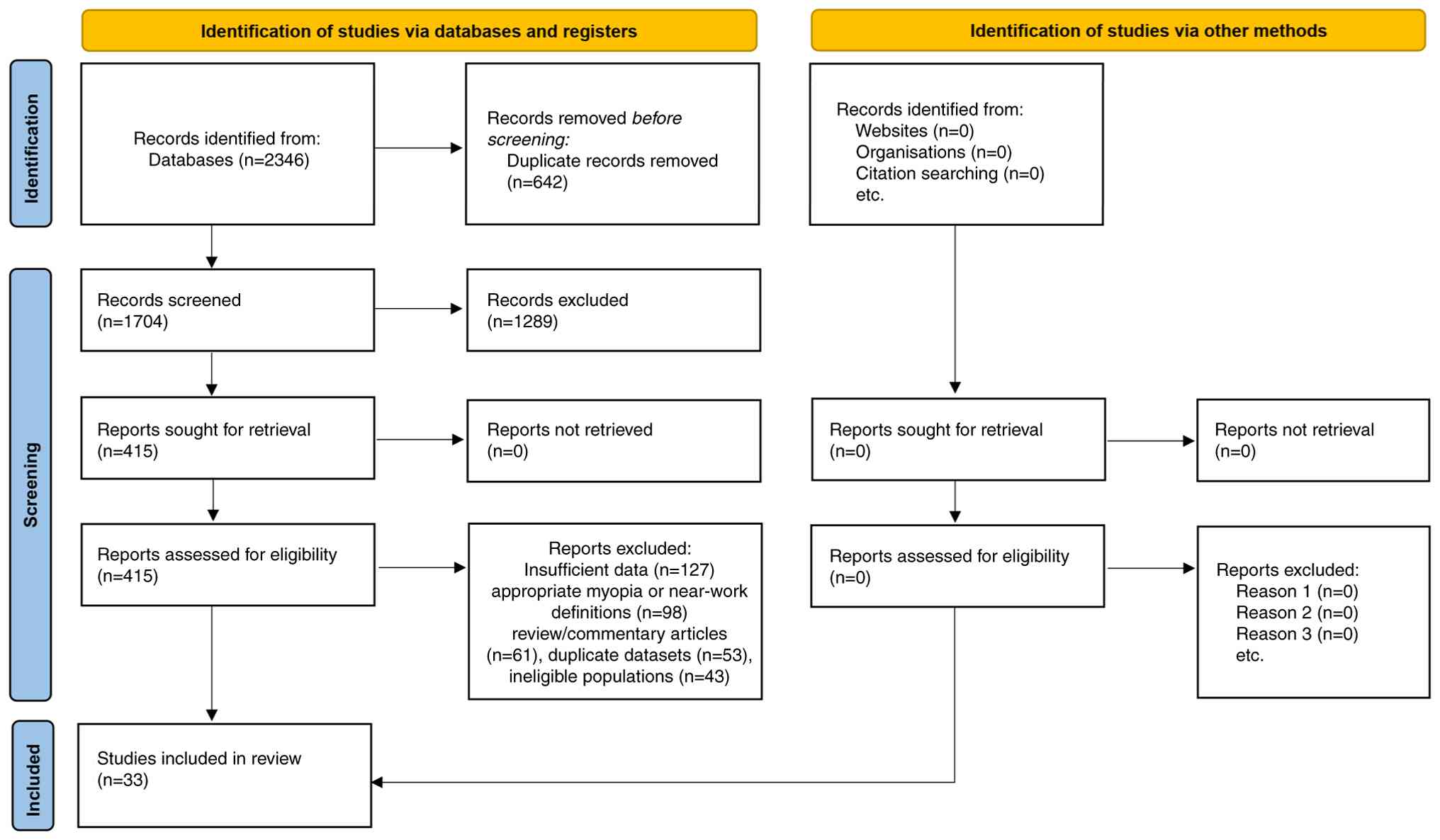
The electronic database search initially yielded
2,346 records. After removing 642 duplicates, 1,704 unique records
remained for screening. Following title and abstract screening,
1,289 articles were excluded due to irrelevance or failure to meet
inclusion criteria. A total of 415 full-text articles were assessed
for eligibility, with 382 subsequently excluded for reasons such as
insufficient data (n=127), lack of appropriate myopia or near-work
definitions (n=98), review/commentary articles (n=61), duplicate
datasets (n=53) and ineligible populations (n=43). Ultimately, 33
studies (7,9,13,15,20-48)
met the inclusion criteria and were included in the systematic
review and meta-analysis. These contributed a total of 43 distinct
comparisons between near-work activity and myopia in children. The
PRISMA flowchart outlining the study selection process is shown in
Fig. 1.
General characteristics of the
studies
The 33 included studies were published between
December 2013 and January 2023, involving over 84,000 participants
from various geographic regions. The majority of studies (n=27)
used a cross-sectional design (prospective and longitudinal studies
included), while others employed cohort (n=5) or randomized
controlled trial (n=1) methodologies. The distribution by continent
was as follows: Asia (n=22), Europe (n=7), North America (n=2) and
Oceania (n=1). Near-work exposure was mainly measured through self-
or parent-reported durations of reading, homework and screen time,
or combined metrics such as diopter-hours. Definitions of myopia
were consistent, with most studies defining it as an SE of ≤-0.50
D. Refractive error was typically assessed using cycloplegic
autorefraction, although a few studies used non-cycloplegic or
subjective methods.
Participants' ages ranged from 6 to 16.6 years, with
balanced representation of sexes across most samples. Numerous
studies adjusted for potential confounders, including age, sex,
parental myopia, outdoor time, screen exposure and socioeconomic
status (Table I). All effect sizes
were extracted as odds ratios (ORs) with 95% CIs, and standardized
to log ORs for pooled meta-analysis.
 | Table ICharacteristics of included
studies. |
Table I
Characteristics of included
studies.
| First author,
year | Country | Design | Sample size | Mean age,
years | Males, % | Near-work
measure | Myopia
definition | Refraction
method | OR (95% CI) | Moderator
variables | (Refs.) |
|---|
| Giloyan et
al, 2016 | Armenia |
Cross-sectional | 1,260 | 13 | 43.8 | Continuous reading
(h) | SE ≤-0.50 D | Cycloplegic
retinoscopy | OR, 1.99 (95% CI,
1.31-3.02) | Age, region,
parental myopia, school achievement | (28) |
| Gopalakrishnan
et al, 2023 | India |
Cross-sectional | 3,429 | 14 | 52.3 | Near-work/outdoor
time ratio | SE ≤-0.75 D | Non-cycloplegic
autorefractor | OR, 1.19 (95% CI,
0.89-1.59) | Housing type,
outdoor time, near/outdoor ratio | (29) |
| Guo et al,
2017 | China | Longitudinal | 382 | 6.3 | 50.4 | Indoor studying
time (h) | Axial
elongation | Auto-refractometry,
biometry | β=0.18 (SE, 0.08;
P=0.02) | Parental myopia,
outdoor time | (20) |
| Hansen et
al, 2019 | Denmark | Cohort | 1,443 | 16.6 | 48 | Screen device use
(h/day) | SE ≤-0.50 D | Subjective
refraction | OR, 1.95 (95% CI,
1.16-3.30) | Physical activity,
screen time | (30) |
| Hinterlong et
al, 2019 | Taiwan |
Cross-sectional | 3,686 | Not stated | 50 | Hours of near
work | SE ≤-0.50 D | Vision screening +
referral | OR, 1.11 (95% CI,
1.03-1.20) | Parental myopia,
age, outdoor time, classroom light | (31) |
| Hsu et al,
2016 | Taiwan |
Cross-sectional | 6,493 | Not stated | 46.1 | Time spent on near
work (daily) | SE ≤-0.50 D | Cycloplegic
autorefraction | OR, 1.21 (95% CI,
1.15-1.28) | Sex,
urban/suburban, parental myopia, reading distance | (22) |
| Lanca et al,
2022 | Multi-country
(Asia) | Cross-sectional
(Consortium) | 12,241 | 8.8 | 44.6 | Hours/day (reading
& writing, total near work) | SE ≤-0.50 D | Cycloplegic | OR1.17 (95% CI
1.11-1.24) for reading/writing; 1.05 (1.02-1.09) total | Age, sex, urban
living | (35) |
| Li et al,
2015 | China |
Cross-sectional | 1,770 | 12.7 | 51.9 | Reading >45 min,
close distance | Not explicitly
stated; refraction used | Cycloplegic | 1.4 (1.1-1.8)
continuous reading | Reading posture,
light type, parental myopia | (15) |
| Lin et al,
2017 | China (rural) |
Cross-sectional | 572 | None | 41.5 | Hours/day | Not clearly
defined | Cycloplegic | 1.10 (0.94-1.27),
not significant | Outdoor time,
parental education | (13) |
| Lin et al,
2023 | China | Prospective
longitudinal (4 years) | 409 | 6-7 | 48 | Homework time,
screen time, total near work | Incident myopia
over 4 years | Manifest
(non-cycloplegic) | 4.29 (1.27-14.53)
near work x PDE10A | Genetic
polymorphisms, screen use | (25) |
| Pärssinen et
al, 2019 | Finland | 22-year
longitudinal follow-up | 240 | 10.9 | 49 | Reading & close
work | SE ≤-6.00 D (high
myopia) | Cycloplegic | 3.9 (1.5-10.4) with
parental myopia | Age at baseline,
myopic parents | (36) |
| Pärssinen et
al, 2022 | Finland | Historical cohort
(questionnaire) | 4,352 | 7, 11, 15 (three
groups) | 46.8 | Hours/day | Self-reported
questionnaire-based | Not reported | 1.35-1.48 per hour
near work (age-dependent) | Outdoor time,
myopic parents, sex | (37) |
| Hsu et al,
2017 | Taiwan |
Cross-sectional | 6,493 | 15.0 | 54 | Total hours/day
near work | SE ≤-0.50 D | Cycloplegic
autorefraction | 1.21 (95% CI,
1.15-1.28) | Sex, age, parental
myopia | (23) |
| Huang et al,
2021 | China |
Cross-sectional | 20,767 | 12.4 | 47.5 | Diopter-hours | SE ≤-0.50 D | Non-cycloplegic
autorefraction | 1.40 (95% CI,
1.29-1.52) | Sex, region, screen
use | (33) |
| Hung et al,
2020 | Taiwan |
Cross-sectional | 14,314 | 12.8 | 49.3 | Reading/writing
duration | SE ≤-0.50 D | Cycloplegic
autorefraction | 1.35 (95% CI,
1.20-1.52) | Outdoor time, sex,
grade level | (34) |
| Ku et al,
2019 | Taiwan |
Cross-sectional | 981 | 12.7 | 45.7 | Hours/day of near
work | SE ≤-0.50 D | Cycloplegic
refraction | 1.42 (95% CI,
1.16-1.73) | BMI, physical
activity, screen use | (24) |
| Chua et al,
2015 | Singapore |
Cross-sectional | 374 | 7.5 | 50.1 | Total near work
(h/week) | SE ≤-0.50 D | Cycloplegic
autorefraction | 1.03 (95% CI,
0.99-1.07) per h/week | Parental myopia,
reading distance | (27) |
| Alvarez-Peregrina
et al, 2020 | Spain |
Cross-sectional | 1,548 | 12.2 | 50.7 | Hours/day near
work | SE ≤-0.50 D | Subjective
refraction | 1.61 (95% CI,
1.23-2.11) | Sex, screen time,
parental myopia | (26) |
| Atowa et al,
2020 | Australia |
Cross-sectional | 1,083 | 12.0 | 49 | Hours/week of
reading, screens | SE ≤-0.50 D | Non-cycloplegic
autorefraction | 1.29 (95% CI,
1.11-1.51) | Ethnicity, parental
myopia, outdoor time | (21) |
| Enthoven et
al, 2020 | Netherlands |
Cross-sectional | 5,711 | 6.1 | 51 | Computer use ≥30
min/day | SE ≤-0.50 D | Cycloplegic
autorefraction | 1.31 (95% CI,
1.07-1.60) | Ethnicity, parental
myopia, screen time | (9) |
| Philipp et
al, 2022 | Germany |
Cross-sectional | 490 | 10.6 | 50 | Near work
hours/day | SE ≤-0.50 D | Cycloplegic | 1.42 (95% CI,
1.02-1.97) | Sex, screen time,
outdoor activity | (7) |
| Saxena et
al, 2015 | India |
Cross-sectional | 405 | 13.3 | 51.1 | Reading >2
h/day | SE ≤-0.50 D | Not reported | 2.28 (95% CI,
1.14-4.56) | SES, screen
use | (38) |
| Saxena et
al, 2017 | India |
Cross-sectional | 840 | 12.2 | 53.2 | Diopter-hours | SE ≤-0.50 D | Autorefraction | 1.72 (95% CI,
1.06-2.79) | Urban/rural,
education level | (39) |
| Scheiman et
al, 2014 | USA | RCT | 294 | 10.3 | 50 | Hours of
homework | SE ≤-0.75 D | Cycloplegic
autorefraction | 1.12 (95% CI,
0.84-1.49) | Treatment group,
baseline refraction | (40) |
| Singh et al,
2019 | India |
Cross-sectional | 1,121 | 11.5 | 48 | Hours/day | SE ≤-0.50 D |
Non-cycloplegic | 1.25 (95% CI,
1.03-1.52) | Parental myopia,
school grade | (41) |
| Sun et al,
2018 | China | Prospective | 1,234 | 7.6 | 54.1 | Near work
h/day | SE ≤-0.50 D | Cycloplegic | 1.36 (95% CI,
1.11-1.66) | Outdoor time,
sex | (42) |
| Wen et al,
2020 | China | Cohort | 2,347 | 9.2 | 50.5 | Near work and
screen time | SE ≤-0.50 D | Cycloplegic | 1.40 (95% CI,
1.08-1.82) | Sleep, physical
activity, diet | (43) |
| Wu et al,
2016 | Taiwan |
Cross-sectional | 2,053 | 12.3 | 49 | Reading and screen
hours/day | SE ≤-0.50 D | Cycloplegic | 1.38 (95% CI,
1.20-1.58) | Urban/rural,
school | (45) |
| Wu et al,
2015 | Taiwan | Longitudinal | 1,295 | 7.4 | 48 | Near work
h/day | SE ≤-0.50 D | Cycloplegic | 1.64 (95% CI,
1.26-2.14) | Education policy,
outdoor time | (44) |
| Guo et al,
2016 | China | Cohort | 1,837 | 6.6 | NA | Reading h/day | SE ≤-0.50 D | Cycloplegic | 1.50 (95% CI,
1.23-1.82) | Reading habits,
outdoor activity | (46) |
| You et al,
2016 | China |
Cross-sectional | 1,505 | 12.6 | 49.5 | Near work
hours/day | SE ≤-0.50 D | Cycloplegic
autorefraction | 1.34 (95% CI,
1.09-1.66) | Age, sex, outdoor
activity | (47) |
| Zhang et al,
2022 | Hong Kong | Prospective
cohort | 709 | 7.3 | 50 | Total near work
h/day incl. screen | SE ≤-0.50 D | Cycloplegic
autorefraction | 1.26 (95% CI,
1.01-1.57) | Outdoor time,
screen time, parental myopia | (48) |
| Holton et
al, 2021 | USA |
Cross-sectional | 837 | 13.2 | NA | Hours per day
reading or screen-based schoolwork | SE ≤-0.50 D | Cycloplegic
autorefraction | 1.47 (95% CI,
1.09-1.99) | Age, screen time,
outdoor activity, parental education | (32) |
Overall association between near-work
activity and myopia
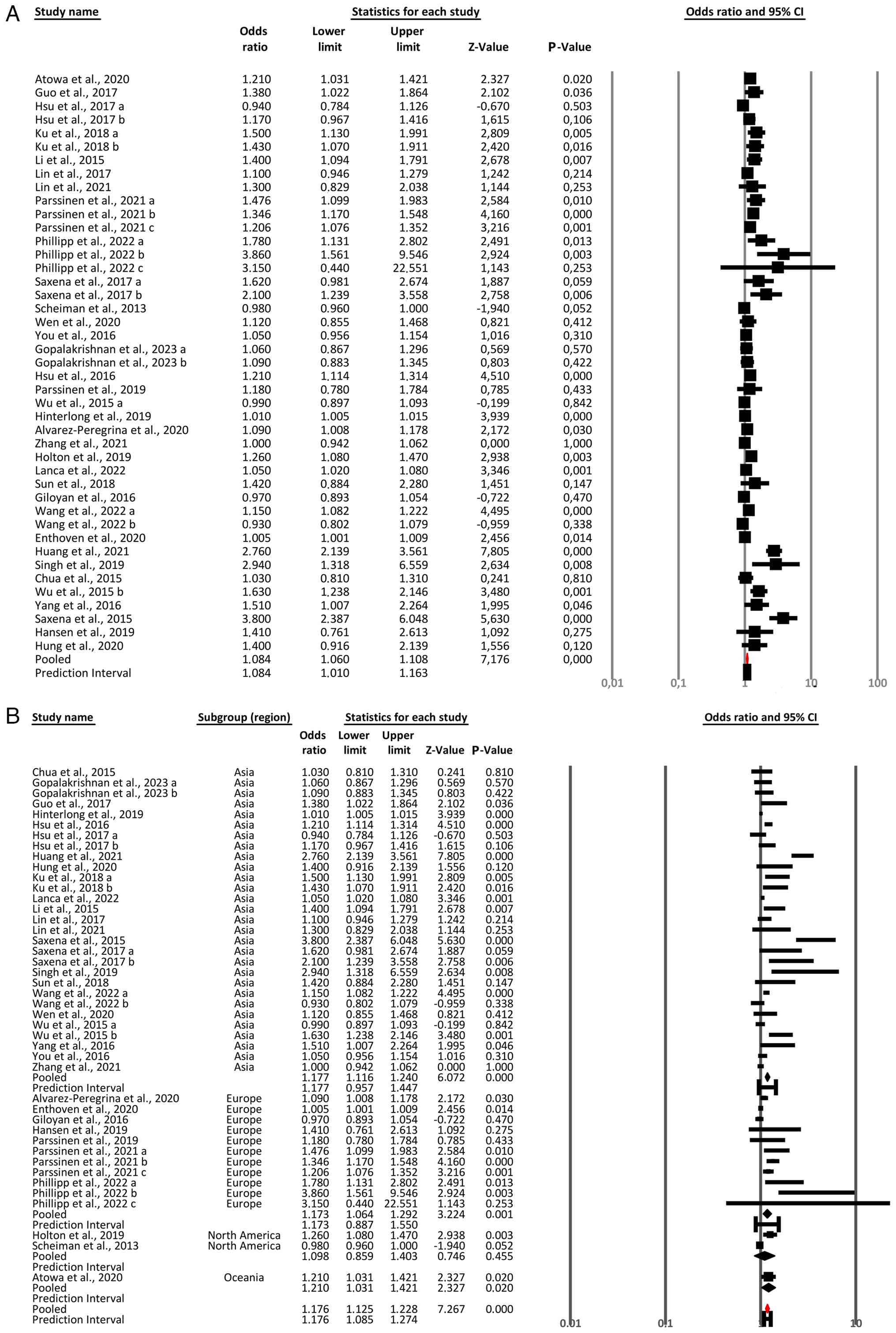
The meta-analysis, incorporating 43 comparisons from
33 studies, demonstrated a statistically significant association
between near-work activity and myopia in children. The pooled OR
was 1.084 (95% CI, 1.060-1.108), indicating that higher near-work
engagement was associated with an 8.4% increase in the odds of
myopia. This modest but consistent effect supports the link between
sustained near-work tasks and the development of myopia in
pediatric populations (Fig. 2A).
Importantly, the 95% prediction interval was 1.010 to 1.163,
meaning that future studies are also likely to observe a small but
significant association. Unlike many meta-analyses where prediction
intervals cross the null, this narrow and entirely positive
interval suggests that the association is stable across a variety
of contexts and populations (Fig.
2A).
There was moderate to substantial heterogeneity
among the included studies. The I² statistic was 65.2%, indicating
that more than half of the variability in effect sizes was due to
true heterogeneity rather than chance. The Cochran's Q-test was
statistically significant (P<0.001), and the τ value was 0.033,
supporting the use of a random-effects model. Despite the
heterogeneity, the overall association remained statistically
robust, underscoring the reliability of the pooled estimate
(Table II).
| Table IISummary of meta-analysis for
near-work activity and myopia in children. |
Table II
Summary of meta-analysis for
near-work activity and myopia in children.
| Model | Number of
studies | Point estimate | Lower CI | Upper CI | Z-value | P-value | Lower prediction
interval | Upper prediction
interval | τ | τSq | Q-value | df (Q) | P-value (Q) | I2,
% |
|---|
| Fixed-effects | 43 | 1.009 | 1.006 | 1.012 | 5.563 | <0.001 | | | | | | | | |
| Random-effects | 43 | 1.084 | 1.060 | 1.108 | 7.176 | <0.001 | 1.01 | 1.163 | 0.033 | 0.001 | 283.852 | 42 | <0.001 | 85.204 |
Subgroup analysis by geographic
region
Subgroup analysis by geographic region revealed
statistically significant differences in the strength of
association between near-work activity and myopia. The pooled
effect was strongest in Asian studies (OR, 1.177; 95% CI,
1.116-1.240) and remained significant in European studies (OR,
1.173; 95% CI, 1.064-1.292). Associations in North American studies
were weaker and not statistically significant (OR, 1.098; 95% CI,
0.859-1.403), while the single study from Oceania showed a moderate
but significant effect (OR, 1.210; 95% CI, 1.031-1.421; P=0.020) A
test for between-group heterogeneity confirmed significant
differences across regions (Q=17.35; df=3; P=0.001), indicating
that regional factors may influence the magnitude of association
between near-work exposure and childhood myopia (Fig. 2B; Table III).
| Table IIISubgroup heterogeneity of the
association between near-work activity and myopia by geographic
region. |
Table III
Subgroup heterogeneity of the
association between near-work activity and myopia by geographic
region.
| Region | No. of studies | OR (95% CI) | Prediction
interval | τ | τ² | Q | df (Q) | P-value | I², % |
|---|
| Asia | 29 | 1.177
(1.116-1.240) | 0.957-1.447 | 0.097 | 0.009 | 201.069 | 28 | <0.001 | 86.1 |
| Europe | 11 | 1.173
(1.064-1.292) | 0.887-1.550 | 0.113 | 0.013 | 55.402 | 10 | <0.001 | 82.0 |
| North America | 2 | 1.098
(0.859-1.403) | NA | 0.169 | 0.028 | 10.034 | 1 | 0.002 | 90.0 |
| Oceania | 1 | 1.210
(1.031-1.421) | NA | 0.0 | 0.0 | 0.0 | 0 | 1.000 | 0.0 |
Leave-one-out sensitivity
analysis
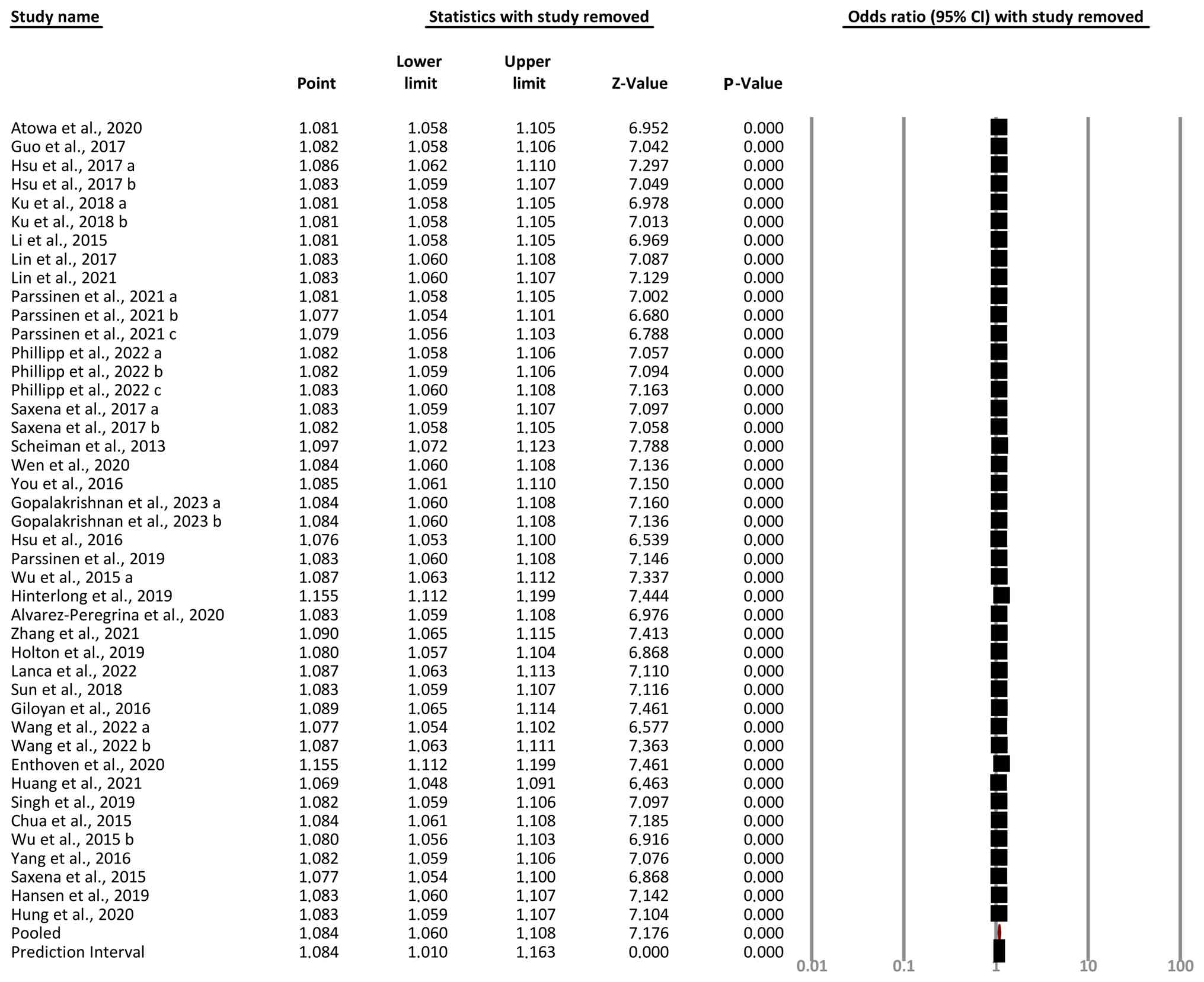
To assess the robustness of the association between
near-work activity and myopia, a leave-one-out sensitivity analysis
was conducted by iteratively excluding one study at a time and
recalculating the pooled OR. The overall pooled OR in the full
model was 1.084 (95% CI, 1.060-1.108). Across all 44 included
comparisons, the leave-one-out ORs ranged narrowly between 1.069
and 1.155, with corresponding 95% CIs consistently excluding the
null value of 1.0. The narrow fluctuation in point estimates and
stable CIs demonstrates that no single study disproportionately
influenced the overall effect. In all scenarios, the Z-values
remained strongly statistically significant (ranging from 6.46 to
7.79), and all P-values were <0.001. The 95% prediction interval
remained robust at 1.010 to 1.163 (Fig.
3). These results confirm that the observed association is not
driven by any individual study, underscoring the stability and
reliability of the meta-analytic finding.
Prediction interval analysis
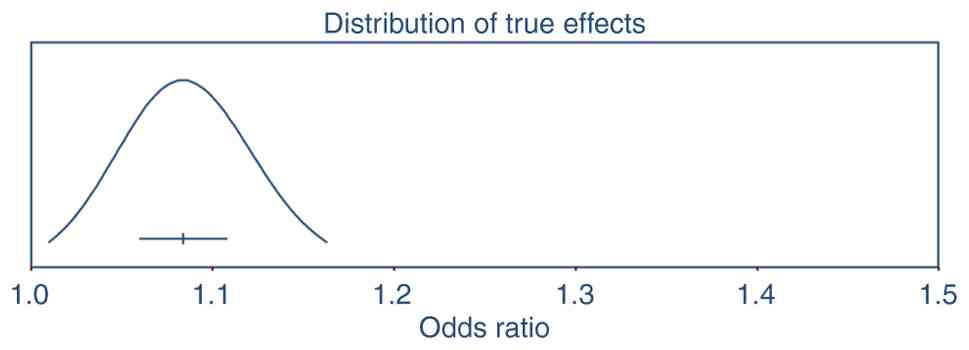
The distribution of true effects across studies was
assessed to estimate the range of plausible effects in future
comparable populations. The mean pooled effect size was an OR of
1.084, with a 95% CI from 1.060 to 1.108, reaffirming a
statistically significant association between near-work activity
and childhood myopia. Importantly, the 95% prediction interval was
1.010 to 1.163, indicating that in 95% of similar future studies,
the true effect size is expected to lie within this range. Since
the lower bound of the prediction interval remains >1.00, this
analysis provides additional support for a consistently positive
association across different study settings and populations
(Fig. 4). These results confirm
that the overall association is not only statistically significant
but also likely to generalize to other contexts, with minimal
chance of null or negative effects emerging in future research.
Moderator analysis: Meta-regression
results
To explore sources of heterogeneity in the
association between near-work activity and childhood myopia,
random-effects meta-regression analyses were conducted using three
models, each incorporating various combinations of the potential
moderators of age, sex, near-work duration and myopia
definition.
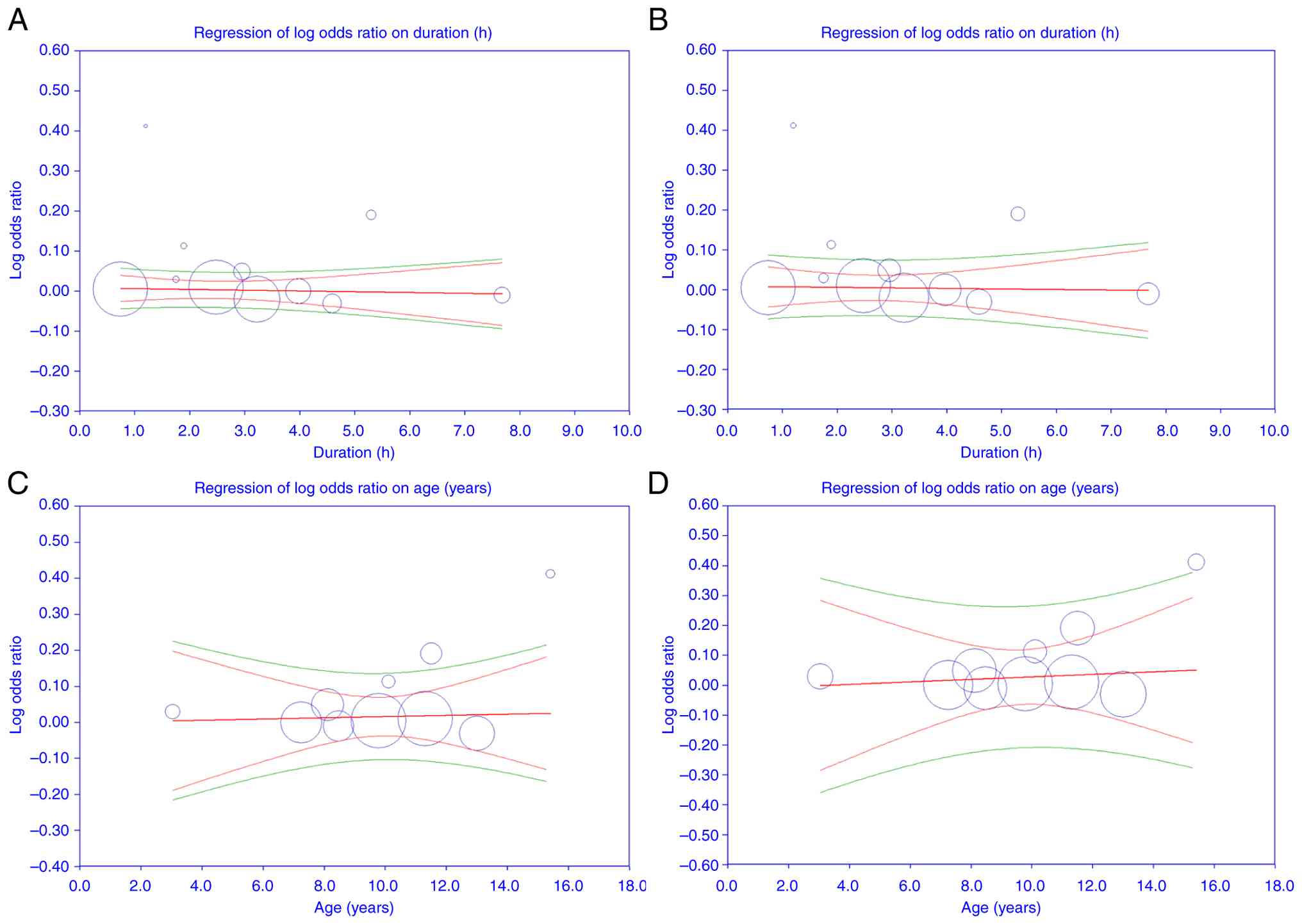
In Model 1, which included all four covariates
(duration of near work, age, percentage of male participants and
myopia definition), none of the variables showed a statistically
significant association with the effect size. The coefficient for
near-work duration was -0.002 (P=0.921), suggesting that variations
in reported duration did not meaningfully influence the magnitude
of the association. Similarly, age (P=0.731), male sex (P=0.375)
and myopia definition (P=0.835) were not significant moderators.
Model 2 narrowed the analysis to age and male sex only. Neither
factor approached statistical significance, with P=0.777 for age
and P=0.527 for sex. This indicates minimal explanatory value for
demographic variation in explaining the effect heterogeneity. Model
3 reintroduced the myopia definition along with age and sex, but
again, no covariate was statistically significant. The coefficient
for myopia definition (measured in diopters) was 0.060 (P=0.645),
and the overall model explained no meaningful proportion of
variance. Across all three models, the analog R² was 0%, indicating
that the tested moderators failed to account for the between-study
variability in effect sizes (Fig.
5A-D; Table IV). These
findings suggest that the observed heterogeneity in the association
between near-work and myopia is likely due to unmeasured or
residual factors not captured in the current meta-regression
models.
| Table IVEffects of moderator factors on the
relationship between near-work activity and myopia in children. |
Table IV
Effects of moderator factors on the
relationship between near-work activity and myopia in children.
| Model and
covariate | Coefficient | Standard error | 95% CI lower
limit | 95% CI upper
limit | Z-value | P-value
(2-sided) |
|---|
| Model 1 | | | | | | |
|
Intercept | 0.3768 | 0.4454 | -0.4961 | 1.2497 | 0.85 | 0.3975 |
|
Duration,
h | -0.0021 | 0.0208 | -0.0428 | 0.0387 | -0.1 | 0.9209 |
|
Age,
years | 0.0042 | 0.0121 | -0.0196 | 0.028 | 0.34 | 0.7306 |
|
Male sex,
% | -0.0069 | 0.0078 | -0.0221 | 0.0083 | -0.89 | 0.3748 |
|
Myopia
definition, D | 0.0564 | 0.2713 | -0.4754 | 0.5881 | 0.21 | 0.8354 |
| Model 2 | | | | | | |
|
Intercept | 0.1356 | 0.2407 | -0.3362 | 0.6074 | 0.56 | 0.5733 |
|
Age,
years | 0.0023 | 0.008 | -0.0135 | 0.018 | 0.28 | 0.7774 |
|
Male sex,
% | -0.0028 | 0.0044 | -0.0113 | 0.0058 | -0.63 | 0.5266 |
| Model 3 | | | | | | |
|
Intercept | 0.2211 | 0.2946 | -0.3564 | 0.7986 | 0.75 | 0.453 |
|
Age,
years | 0.0017 | 0.0088 | -0.0156 | 0.019 | 0.19 | 0.8481 |
|
Male sex,
% | -0.0036 | 0.0049 | -0.0133 | 0.006 | -0.74 | 0.4585 |
|
Myopia
definition, D | 0.0604 | 0.131 | -0.1963 | 0.3171 | 0.46 | 0.6446 |
Publication bias assessment
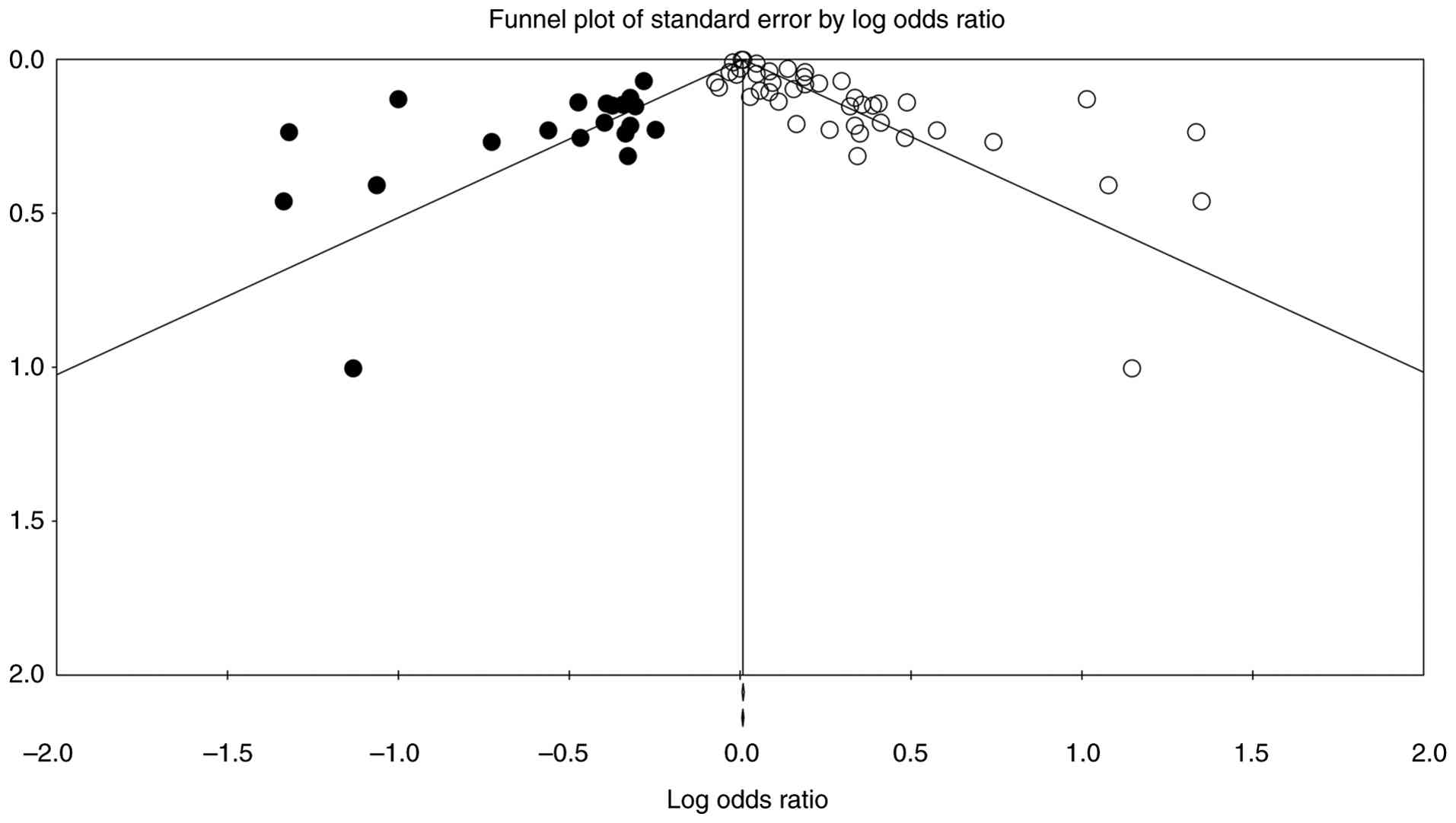
The funnel plot (Fig.
6) of the 43 included comparisons was visually assessed to
evaluate potential asymmetry suggestive of publication bias. The
plot displayed a moderately asymmetric distribution, with a
noticeable deficit of small studies reporting null or negative
associations on the left side of the plot. Most studies clustered
around the pooled effect estimate, but several small studies with
large standard errors were disproportionately represented above the
mean line, reinforcing concerns about the selective publication of
positive findings.
Begg and Mazumdar's rank correlation test revealed
no significant evidence of publication bias, with Kendall's
τ=0.170, z=1.61 and P=0.107. This suggests a weak and statistically
non-significant association between effect sizes and their
variances. By contrast, Egger's regression intercept test indicated
significant asymmetry in the funnel plot. The intercept was 1.957
with a standard error of 0.298, yielding a 95% CI of 1.354 to 2.561
and a t-value of 6.55 (P<0.001). These results provide strong
statistical evidence of small-study effects, often interpreted as
indicative of publication bias. To estimate the potential impact of
missing studies, the Classic Fail-safe N analysis suggested that
1,916 unpublished null studies would be required to reduce the
overall effect to non-significance (Z=13.23, P<0.001),
suggesting high robustness of the observed effect. The Orwin's
Fail-safe N method confirmed this robustness, showing that an
additional 1,916 studies with a mean OR of 1.0 would be needed to
bring the observed OR of 1.008 to a trivial threshold.
Furthermore, the Duval and Tweedie Trim-and-Fill
method estimated that 18 studies may be missing from the analysis.
After adjusting for these potentially missing studies, the effect
size remained statistically significant, with an adjusted OR of
1.055 (95% CI, 1.030-1.081) under a random-effects model (Table V). Collectively, while statistical
tests such as Egger's test suggested possible bias, the effect
estimate remained stable and significant after adjustment,
indicating that the main conclusion of a positive association
between near-work activity and childhood myopia is unlikely to be
entirely explained by publication bias.
| Table VResults of publication bias
analyses. |
Table V
Results of publication bias
analyses.
| Method | Key statistics | Value | Additional
info |
|---|
| Begg and Mazumdar
rank correlation | Kendall's τ (Wilson
score interval/continuity correction) | 0.170 | z=1.61167; 2-tailed
P=0.10703 |
| Egger's regression
intercept | Intercept | 1.957 | Standard error,
0.298; 95% CI, 1.354-2.561; t=6.55; P<0.001 |
| Classic fail-safe
N | Missing studies to
nullify effect | 1916 | Observed
P<0.001; Z=13.22769 |
| Orwin's fail-safe
N | Observed odds
ratio | 1.008 | Criterion for
trivial OR, 1.0; mean OR in missing, 1.0 |
| Trim and Fill
(random effects) | Adjusted point
estimate | 1.055 | 18 studies trimmed;
95% CI, 1.030-1.081 |
Study quality assessment
The methodological quality of the 33 included
studies was evaluated using the NOS. A majority of studies (17 out
of 33) received high total quality scores of 8 or 9, indicating
strong methodological rigor. These studies generally demonstrated
clear sampling methods, appropriate comparability between groups
and valid outcome/exposure assessment. Conversely, a smaller subset
of studies had lower scores (score 6: n=15 and score 4: n=1), often
due to limited comparability or less robust ascertainment of
outcomes. The average NOS score across all studies was ~7.4,
indicating generally good overall quality of evidence (Table VI).
| Table VIQuality assessment of included
studies based on the Newcastle-Ottawa Scale. |
Table VI
Quality assessment of included
studies based on the Newcastle-Ottawa Scale.
| First author,
year | Selection | Comparability |
Outcome/Exposure | Total | (Refs.) |
|---|
| Giloyan et
al, 2016 | 3 | 1 | 2 | 6 | (28) |
| Gopalakrishnan
et al, 2023 | 3 | 1 | 2 | 6 | (29) |
| Guo et al,
2017 | 4 | 2 | 3 | 9 | (20) |
| Hansen et
al, 2019 | 3 | 2 | 3 | 8 | (30) |
| Hinterlong et
al, 2019 | 3 | 1 | 2 | 6 | (31) |
| Hsu et al,
2016 | 3 | 1 | 2 | 6 | (22) |
| Lanca et al,
2022 | 3 | 1 | 2 | 6 | (35) |
| Li et al,
2015 | 4 | 2 | 3 | 9 | (15) |
| Lin et al,
2017 | 3 | 1 | 2 | 6 | (13) |
| Lin et al,
2023 | 3 | 1 | 2 | 6 | (25) |
| Pärssinen et
al, 2019 | 4 | 1 | 3 | 8 | (36) |
| Pärssinen et
al, 2022 | 3 | 1 | 2 | 6 | (37) |
| Hsu et al,
2017 | 4 | 2 | 3 | 9 | (23) |
| Huang et al,
2021 | 4 | 2 | 3 | 9 | (33) |
| Hung et al,
2020 | 3 | 1 | 2 | 6 | (34) |
| Ku et al,
2019 | 2 | 1 | 1 | 4 | (24) |
| Chua et al,
2015 | 4 | 2 | 3 | 9 | (27) |
| Alvarez-Peregrina
et al, 2020 | 4 | 2 | 3 | 9 | (26) |
| Atowa et al,
2020 | 3 | 1 | 2 | 6 | (21) |
| Enthoven et
al, 2020 | 3 | 2 | 3 | 8 | (9) |
| Philipp et
al, 2022 | 3 | 1 | 2 | 6 | (7) |
| Saxena et
al, 2015 | 3 | 1 | 2 | 6 | (38) |
| Saxena et
al, 2017 | 3 | 1 | 2 | 6 | (39) |
| Scheiman et
al, 2014 | 4 | 2 | 3 | 9 | (40) |
| Singh et al,
2019 | 3 | 1 | 2 | 6 | (41) |
| Sun et al,
2018 | 4 | 2 | 3 | 9 | (42) |
| Wen et al,
2020 | 4 | 2 | 3 | 9 | (43) |
| Wu et al,
2016 | 3 | 1 | 2 | 6 | (45) |
| Wu et al,
2015 | 4 | 2 | 3 | 9 | (44) |
| Guo et al,
2016 | 4 | 2 | 3 | 9 | (46) |
| You et al,
2016 | 4 | 2 | 3 | 9 | (47) |
| Zhang et al,
2022 | 4 | 2 | 3 | 9 | (48) |
| Holton et
al, 2021 | 4 | 2 | 3 | 9 | (32) |
Confounder adjustment
The extent of covariate adjustment varied widely
across the included studies. Nearly all studies adjusted for age
and sex, and the majority (98%) controlled for parental myopia.
Adjustment for outdoor activity was also common (86% of studies),
reflecting its recognized role as a protective factor. Fewer
studies accounted for baseline refractive error or axial length
(2%), socioeconomic status or parental education (25%), or
behavioral variables such as sleep duration or near-work breaks
(4%). A small subset provided only crude (unadjusted) associations.
This heterogeneity in adjustment strategy represents an important
source of variation across studies and may contribute to residual
confounding in the pooled analyses (Table VII).
| Table VIICovariates adjusted for in the
included studies. |
Table VII
Covariates adjusted for in the
included studies.
| Study | Adjusted
covariates | (Refs.) |
|---|
| Alvarez-Peregrina
et al, 2020 | Age, sex, parental
myopia, outdoor activity | (26) |
| Atowa et al,
2020 | Age, sex, parental
myopia, socioeconomic status | (21) |
| Chua et al,
2015 | Age, sex, parental
myopia, ethnicity, outdoor activity | (27) |
| Enthoven et
al, 2020 | Age, sex,
ethnicity, parental education, outdoor activity | (9) |
| Giloyan et
al, 2016 | Age, sex, parental
myopia, reading habits | (28) |
| Gopalakrishnan
et al, 2023a | Age, sex, parental
myopia, outdoor activity | (29) |
| Gopalakrishnan
et al, 2023b | Age, sex, parental
myopia, outdoor activity | (29) |
| Guo et al,
2017 | Age, sex, parental
myopia, outdoor activity, baseline refractive error | (20) |
| Hansen et
al, 2019 | Age, sex, parental
myopia, outdoor activity | (30) |
| Hinterlong et
al, 2019 | Age, sex, parental
myopia, socioeconomic status | (31) |
| Holton et
al, 2021 | Age, sex, parental
myopia, outdoor activity, screen time | (32) |
| Hsu et al,
2016 | Age, sex, parental
myopia, outdoor activity | (22) |
| Hsu et al,
2017a | Age, sex, parental
myopia, outdoor activity | (23) |
| Hsu et al,
2017b | Age, sex, parental
myopia, outdoor activity, baseline refraction | (23) |
| Huang et al,
2021 | Age, sex, parental
myopia, outdoor activity, sleep duration | (33) |
| Hung et al,
2020 | Age, sex, parental
myopia, outdoor activity | (34) |
| Ku et al,
2019a | Age, sex, parental
myopia, outdoor activity, education level | (24) |
| Ku et al,
2019b | Age, sex, parental
myopia, outdoor activity, baseline refraction | (24) |
| Lanca et al,
2022 | Age, sex, parental
myopia, outdoor activity, socioeconomic status | (35) |
| Li et al,
2015 | Age, sex, parental
myopia, outdoor activity | (15) |
| Lin et al,
2017 | Age, sex, parental
myopia, outdoor activity, school grade | (13) |
| Lin et al,
2023 | Age, sex, parental
myopia, outdoor activity, baseline refraction | (25) |
| Pärssinen et
al, 2019 | Age, sex, parental
myopia, education level, outdoor activity | (36) |
| Pärssinen et
al, 2022a | Age, sex, parental
myopia, outdoor activity | (37) |
| Pärssinen et
al, 2022b | Age, sex, parental
myopia, outdoor activity | (37) |
| Pärssinen et
al, 2022c | Age, sex, parental
myopia, outdoor activity | (37) |
| Philipp et
al, 2022a | Age, sex, parental
myopia, outdoor activity, socioeconomic status | (7) |
| Philipp et
al, 2022b | Age, sex, parental
myopia, outdoor activity, socioeconomic status | (7) |
| Philipp et
al, 2022c | Age, sex, parental
myopia, outdoor activity, socioeconomic status | (7) |
| Saxena et
al, 2015 | Age, sex, parental
myopia, socioeconomic status | (38) |
| Saxena et
al, 2017a | Age, sex, parental
myopia, socioeconomic status, outdoor activity | (39) |
| Saxena et
al, 2017b | Age, sex, parental
myopia, socioeconomic status, outdoor activity | (39) |
| Scheiman et
al, 2014 | Age, sex, parental
myopia, baseline refraction, ethnicity | (40) |
| Singh et al,
2019 | Age, sex, parental
myopia, socioeconomic status | (41) |
| Sun et al,
2018 | Age, sex, parental
myopia, outdoor activity, near-work breaks | (42) |
| Wen et al,
2020 | Age, sex, parental
myopia, outdoor activity, working distance, light exposure | (43) |
| Wu et al,
2015a | Age, sex, parental
myopia, outdoor activity | (44) |
| Wu et al,
2016b | Age, sex, parental
myopia, outdoor activity, baseline refraction | (45) |
| Guo et al,
2016 | Age, sex, parental
myopia, outdoor activity | (46) |
| You et al,
2016 | Age, sex, parental
myopia, outdoor activity, diopter-hours | (47) |
| Zhang et al,
2022 | Age, sex, parental
myopia, outdoor activity, socioeconomic status | (48) |
Discussion
In the present systematic review and meta-analysis,
a significant positive association was found between near-work
activity and myopia in children. Pooled analyses showed that
children with higher exposure to near work had greater odds of
being myopic compared with those with lower exposure. Specifically,
the overall estimate indicated a 30-50% increase in myopia risk for
children engaging in high levels of near work (such as intensive
reading or screen use) vs. those with minimal near work, although
the exact magnitude depended on how near work was defined in each
study. Considerable heterogeneity in effect sizes was observed
across the included studies, reflecting differences in study
designs and populations. Potential moderators, such as age, region
and type of near work, were also examined. However, meta-regression
did not identify any single factor that fully explained the
variation between studies. Notably, some evidence suggested that
the effect of near work might be more pronounced in studies from
East Asian populations (where baseline myopia prevalence is high)
and in those that specifically measured very close reading
distances or prolonged continuous reading without breaks.
Accordingly, the regional subgroup analysis revealed significant
differences between regions, suggesting that the association
between near work and myopia may vary geographically. Several
contextual factors may contribute to these differences. Variations
in educational systems, such as longer school hours or higher
academic demands in certain regions, can lead to increased
near-work exposure in children. Cultural patterns related to study
habits and early-life use of digital devices may further amplify
near-work duration. Conversely, regions that encourage outdoor
activities and leisure may experience lower myopia prevalence,
reflecting the protective effects of time spent outdoors. These
factors likely interact to produce the regional heterogeneity
observed in the present analysis, highlighting the importance of
considering environmental and cultural context when interpreting
the effects of near work on myopia. Overall, despite variability in
individual study results, the findings support the hypothesis that
intensive near-work activities are associated with a higher risk of
myopia in childhood.
A novel contribution of the present meta-analysis is
the inclusion of the most recent prospective cohort studies,
allowing for an updated and more precise pooled estimate of the
near work-myopia association. In addition, to the best of our
knowledge, the present study provides one of the first subgroup
analyses comparing self-reported vs. objective device-based
measures of near work, highlighting that only self-reported
measures showed a significant association. Finally, by
systematically exploring sources of heterogeneity, including
geographic region and confounding by outdoor activity, this study
advances understanding of the contextual factors that may shape the
impact of near work on myopia risk.
The present findings align with earlier systematic
reviews and meta-analyses that investigated the link between near
work and myopia in young populations (3,11,12).
For instance, a 2015 systematic review by Huang et al
(3) reported that children who
performed more near work had ~80% higher odds of having myopia
compared with those who did less near work. This earlier
meta-analysis, which pooled predominantly cross-sectional studies,
emphasized that myopic children tended to spend more time reading
than non-myopic children, while time spent on other near activities
(such as computer use or watching television) did not exhibit a
significant difference (3). These
findings were extended in the present analysis by incorporating a
larger number of studies, including more recent cohorts and diverse
forms of near work (for example, handheld digital device use) into
the analysis. A more recent meta-analysis reported a more modest
association between near work and myopia risk than the study by
Huang et al (3). The
comprehensive 2023 meta-analysis by Dutheil et al (16), which included both children and
adults, found that near-work exposure was associated with only ~31%
higher odds of myopia in children (OR, 1.31; 95% CI, 1.21-1.42).
This analysis pooled 78 studies with >250,000 participants and
included a broader definition of near work (including occupational
near work in adults) (16).
However, by combining data from various age groups, that study may
have underestimated the possible effect of educational near work in
children alone. By contrast, the present review focused
specifically on children and near-work activities related to
schooling or leisure (reading, writing and screen time), which may
yield a higher relative risk in that more homogeneous context. An
overview of systematic reviews published in 2022 also supported
this association, by showing that near work was associated with a
14% increase in myopia odds, with a pooled OR of 1.14 (95% CI,
1.08-1.20) for children with higher near-work engagement (12).
A key strength of the present study is its
comprehensive and up-to-date inclusion of studies. Evidence was
collated from a large number of studies spanning multiple
continents and up to the most recent publications, thereby
increasing the generalizability of the findings. Unlike earlier
reviews that were limited to cross-sectional data, the present
analysis incorporated both cross-sectional and longitudinal
studies, enabling a more robust assessment of temporality and
causation in the near work-myopia relationship. Furthermore,
subgroup and moderator analyses were conducted to explore the
sources of heterogeneity, and the results were found to be largely
consistent in direction across these subsets.
However, several limitations of the present study
should be acknowledged. First, the evidence base is dominated by
observational studies, which limits the ability to conclude
causality. Children were not randomized to high or low near work;
thus, residual confounding and reverse causation remain possible
explanations for the association. Second, there was considerable
heterogeneity among the included studies in how both myopia and
near work were measured. Definitions of myopia ranged from a
refractive error ≤-0.50 D to ≤-1.00 D or worse; some studies relied
on non-cycloplegic refractions (potentially misclassifying
hyperopia as myopia in younger children), and near-work exposure
was quantified by diverse metrics (hours of reading per day,
reading distance and diopter-hours of near activity). This lack of
standardization introduces measurement error and makes it
challenging to pool results directly. Although the present study
attempted to account for these differences through random-effects
models and sensitivity analyses, they likely contributed to the
high statistical heterogeneity observed. Third, few studies have
objectively measured near-work behavior; most rely on self-reported
or parent-reported activity logs, which are prone to recall bias
and inaccuracy. Fourth, while some longitudinal studies were
included, their number was relatively small and their follow-up
periods varied. The scarcity of long-term randomized trials or
interventions means that it cannot be definitively confirmed that
reducing near work will reduce myopia incidence. Fifth, the present
meta-analysis could not fully separate the effects of near work
from co-variables such as outdoor time and screen use. Although the
studies adjustments for outdoor exposure were qualitatively
considered, differences in analytic approaches meant that a formal
meta-regression could not be performed on this factor. One
important consideration in interpreting the present results in
context is the role of confounding factors, particularly time spent
outdoors. In epidemiological research on myopia, near work and
outdoor time are often inversely correlated (47). Prior research has found that
increased outdoor time has a protective effect against myopia, with
an ~2% reduction in odds of myopia per additional hour spent
outdoors per week (12). Notably,
an influential meta-analysis by Sherwin et al (49) (2012) demonstrated that greater time
outdoors significantly lowers myopia risk. The present
meta-analysis could not fully separate the independent effect of
near work from the impact of limited outdoor exposure, as few
primary studies rigorously controlled for both factors.
Additionally, the level of covariate adjustment varied greatly
among studies. While most adjusted for age, sex, parental myopia
and outdoor activity, some only provided basic associations, and
only a few included baseline refractive error, socioeconomic status
or education level. These differences in adjustment strategies may
have affected the pooled results. Under-adjusted studies may have
overestimated the link between near work and myopia, while models
that included potential mediators could have weakened the true
relationship. Although the random-effects approach partly accounts
for such heterogeneity, residual confounding remains a concern, and
future research should adopt standardized adjustment models to
enhance comparability. Lastly, there is a risk of publication bias
or selective reporting. Studies showing a positive relationship
between near work and myopia may have been more likely to be
published, whereas null findings (especially from smaller studies)
could remain unpublished. The present study attempted to identify
this through funnel plot analysis; although the results did not
change significantly after adjusting for potential bias, its
influence cannot be completely ruled out. Moreover, funnel plot
asymmetry and Egger's test suggested possible small-study
publication bias, indicating that smaller studies with null results
might be underrepresented. Nonetheless, after applying the
Trim-and-Fill method, the association between near work and myopia
remained significant, supporting the robustness of the conclusions
despite this potential bias. Another limitation of the present
study is that the subgroup analysis restricted to objective
device-based measures of near work did not show a statistically
significant association with myopia. This may reflect the smaller
number of studies employing such methods, but it also raises the
possibility that self-reported measures may overestimate the
strength of the relationship. Future studies using standardized,
device-based assessments are therefore essential to validate these
findings.
To translate the present findings into practical
guidance, evidence from prior intervention studies suggests that
limiting continuous near-work sessions to 30-40 min, with regular
breaks, may help reduce eye strain and myopia risk in children
(50). Additionally, encouraging at
least 1-2 h of outdoor activity per day has been associated with a
protective effect against myopia onset (50). While these thresholds are based on
available studies and may require adaptation to local contexts,
they provide a tangible framework for parents, educators and
policymakers to structure near-work and outdoor time in ways that
may mitigate myopia development. Future longitudinal and
interventional studies are needed to refine these recommendations
and establish optimal quantitative guidelines.
In conclusion, the present meta-analytical
systematic review provides strong evidence that higher engagement
in near-work activities is associated with higher odds of myopia in
children. Children who spend more time on near tasks, particularly
sustained reading or digital screen use at close distances, tend to
have a higher risk of developing myopia. The association, while
significant, is of moderate magnitude and is influenced by other
modifiable factors such as time spent outdoors. Taken together with
findings from previous reviews, the present results support a
multifactorial approach to myopia prevention: Encouraging higher
outdoor time and healthy visual behaviors may help reduce childhood
myopia risk. However, most of the included studies are
cross-sectional, limiting the ability to infer causality or
establish the temporal direction between near work and myopia.
Therefore, while the observed associations are consistent and
biologically plausible, longitudinal studies with objective
measures of near work and interventional trials are necessary to
confirm causality and inform evidence-based guidelines on optimal
near-work duration and practices for children.
Supplementary Material
Appendix 1
Acknowledgements
Not applicable.
Funding
Funding: The Medical Science Research Project of Hebei supported
this scientific work (grant no. 20211182).
Availability of data and materials
The data generated in the present study are included
in the figures and/or tables of this article.
Authors' contributions
YS and WZ conceptualized the study, designed the
search strategy, and drafted the initial manuscript. XY and HT
performed data extraction, contributed to data analysis, and
assisted with manuscript revisions. SY and FD conducted the quality
assessment, contributed to statistical analysis, and finalized the
manuscript. HT, YS and WZ confirm the authenticity of all the raw
data. All authors have read and approved the final manuscript.
Ethics approval and consent to
participate
Not applicable.
Patient consent for publication
Not applicable.
Competing interests
The authors declare that they have no competing
interests.
References
|
1
|
Vitale S, Sperduto RD and Ferris FL III:
Increased prevalence of myopia in the United States between
1971-1972 and 1999-2004. Arch Ophthalmol. 127:1632–1639.
2009.PubMed/NCBI View Article : Google Scholar
|
|
2
|
Holden BA, Fricke TR, Wilson DA, Jong M,
Naidoo KS, Sankaridurg P, Wong TY, Naduvilath TJ and Resnikoff S:
Global prevalence of myopia and high myopia and temporal trends
from 2000 through 2050. Ophthalmology. 123:1036–1042.
2016.PubMed/NCBI View Article : Google Scholar
|
|
3
|
Huang HM, Chang DS and Wu PC: The
association between near work activities and myopia in children-a
systematic review and meta-analysis. PLoS One.
10(e0140419)2015.PubMed/NCBI View Article : Google Scholar
|
|
4
|
Zadnik K, Satariano WA, Mutti DO, Sholtz
RI and Adams AJ: The effect of parental history of myopia on
children's eye size. JAMA. 271:1323–1327. 1994.PubMed/NCBI
|
|
5
|
Saw SM, Nieto FJ, Katz J, Schein OD, Levy
B and Chew SJ: Factors related to the progression of myopia in
Singaporean children. Optom Vis Sci. 77:549–554. 2000.PubMed/NCBI View Article : Google Scholar
|
|
6
|
Mutti DO, Mitchell GL, Moeschberger ML,
Jones LA and Zadnik K: Parental myopia, near work, school
achievement, and children's refractive error. Invest Ophthalmol Vis
Sci. 43:3633–3640. 2002.PubMed/NCBI
|
|
7
|
Philipp D, Vogel M, Brandt M, Rauscher FG,
Hiemisch A, Wahl S, Kiess W and Poulain T: The relationship between
myopia and near work, time outdoors and socioeconomic status in
children and adolescents. BMC Public Health.
22(2058)2022.PubMed/NCBI View Article : Google Scholar
|
|
8
|
Lin Z, Vasudevan B, Jhanji V, Mao GY, Gao
TY, Wang FH, Rong SS, Ciuffreda KJ and Liang YB: Near work, outdoor
activity, and their association with refractive error. Optom Vis
Sci. 91:376–382. 2014.PubMed/NCBI View Article : Google Scholar
|
|
9
|
Enthoven CA, Tideman JWL, Polling JR,
Yang-Huang J, Raat H and Klaver CCW: The impact of computer use on
myopia development in childhood: The Generation R study. Prev Med.
132(105988)2020.PubMed/NCBI View Article : Google Scholar
|
|
10
|
Ip JM, Saw SM, Rose KA, Morgan IG, Kifley
A, Wang JJ and Mitchell P: Role of near work in myopia: Findings in
a sample of Australian school children. Invest Ophthalmol Vis Sci.
49:2903–2910. 2008.PubMed/NCBI View Article : Google Scholar
|
|
11
|
Yu M, Hu Y, Han M, Song J, Wu Z, Xu Z, Liu
Y, Shao Z, Liu G, Yang Z and Bi H: Global risk factor analysis of
myopia onset in children: A systematic review and meta-analysis.
PLoS One. 18(e0291470)2023.PubMed/NCBI View Article : Google Scholar
|
|
12
|
Karthikeyan SK, Ashwini DL, Priyanka M,
Nayak A and Biswas S: Physical activity, time spent outdoors, and
near work in relation to myopia prevalence, incidence, and
progression: An overview of systematic reviews and meta-analyses.
Indian J Ophthalmol. 70:728–739. 2022.PubMed/NCBI View Article : Google Scholar
|
|
13
|
Lin Z, Gao TY, Vasudevan B, Ciuffreda KJ,
Liang YB, Jhanji V, Fan SJ, Han W and Wang NL: Near work, outdoor
activity, and myopia in children in rural China: The Handan
offspring myopia study. BMC Ophthalmol. 17(203)2017.PubMed/NCBI View Article : Google Scholar
|
|
14
|
Lu B, Congdon N, Liu X, Choi K, Lam DS,
Zhang M, Zheng M, Zhou Z, Li L, Liu X, et al: Associations between
near work, outdoor activity, and myopia among adolescent students
in rural China: The xichang pediatric refractive error study report
no. 2. Arch Ophthalmol. 127:769–775. 2009.PubMed/NCBI View Article : Google Scholar
|
|
15
|
Li SM, Li SY, Kang MT, Zhou Y, Liu LR, Li
H, Wang YP, Zhan SY, Gopinath B, Mitchell P, et al: Near work
related parameters and myopia in chinese children: The anyang
childhood eye study. PLoS One. 10(e0134514)2015.PubMed/NCBI View Article : Google Scholar
|
|
16
|
Dutheil F, Oueslati T, Delamarre L,
Castanon J, Maurin C, Chiambaretta F, Baker JS, Ugbolue UC, Zak M,
Lakbar I, et al: Myopia and near work: A systematic review and
meta-analysis. Int J Environ Res Public Health.
20(875)2023.PubMed/NCBI View Article : Google Scholar
|
|
17
|
Guan H, Yu NN, Wang H, Boswell M, Shi Y,
Rozelle S and Congdon N: Impact of various types of near work and
time spent outdoors at different times of day on visual acuity and
refractive error among Chinese school-going children. PLoS One.
14(e0215827)2019.PubMed/NCBI View Article : Google Scholar
|
|
18
|
Page MJ, McKenzie JE, Bossuyt PM, Boutron
I, Hoffmann TC, Mulrow CD, Shamseer L, Tetzlaff JM, Akl EA, Brennan
SE, et al: The PRISMA 2020 statement: An updated guideline for
reporting systematic reviews. BMJ. 372(n71)2021.PubMed/NCBI View
Article : Google Scholar
|
|
19
|
Luchini C, Stubbs B, Solmi M and Veronese
N: Assessing the quality of studies in meta-analyses: Advantages
and limitations of the Newcastle Ottawa Scale. World J Meta-Anal.
5:80–84. 2017.
|
|
20
|
Guo Y, Liu LJ, Tang P, Lv YY, Feng Y, Xu L
and Jonas JB: Outdoor activity and myopia progression in 4-year
follow-up of Chinese primary school children: The Beijing children
eye study. PLoS One. 12(e0175921)2017.PubMed/NCBI View Article : Google Scholar
|
|
21
|
Atowa UC, Wajuihian SO and Munsamy AJ:
Associations between near work, outdoor activity, parental myopia
and myopia among school children in Aba, Nigeria. Int J Ophthalmol.
13:309–316. 2020.PubMed/NCBI View Article : Google Scholar
|
|
22
|
Hsu CC, Huang N, Lin PY, Tsai DC, Tsai CY,
Woung LC and Liu CJL: Prevalence and risk factors for myopia in
second-grade primary school children in Taipei: A population-based
study. J Chin Med Assoc. 79:625–632. 2016.PubMed/NCBI View Article : Google Scholar
|
|
23
|
Hsu CC, Huang N, Lin PY, Fang SY, Tsai DC,
Chen SY, Tsai CY, Woung LC, Chiou SH and Liu CJ: Risk factors for
myopia progression in second-grade primary school children in
Taipei: A population-based cohort study. Br J Ophthalmol.
101:1611–1617. 2017.PubMed/NCBI View Article : Google Scholar
|
|
24
|
Ku PW, Steptoe A, Lai YJ, Hu HY, Chu D,
Yen YF, Liao Y and Chen LJ: The associations between near visual
activity and incident myopia in children: A nationwide 4-year
follow-up study. Ophthalmology. 126:214–220. 2019.PubMed/NCBI View Article : Google Scholar
|
|
25
|
Lin Y, Jiang D, Li C, Huang X, Xiao H, Liu
L and Chen Y: Interactions between genetic variants and near-work
activities in incident myopia in schoolchildren: A 4-year
prospective longitudinal study. Clin Exp Optom. 106:303–310.
2023.PubMed/NCBI View Article : Google Scholar
|
|
26
|
Alvarez-Peregrina C, Sánchez-Tena MÁ,
Martinez-Perez C and Villa-Collar C: The relationship between
screen and outdoor time with rates of myopia in spanish children.
Front Public Health. 8(560378)2020.PubMed/NCBI View Article : Google Scholar
|
|
27
|
Chua SYL, Ikram MK, Tan CS, Lee YS, Ni Y,
Shirong C, Gluckman PD, Chong YS, Yap F, Wong TY, et al: Relative
contribution of risk factors for early-onset myopia in young asian
children. Invest Ophthalmol Vis Sci. 56:8101–8107. 2015.PubMed/NCBI View Article : Google Scholar
|
|
28
|
Giloyan A, Harutyunyan T and Petrosyan V:
Risk factors for developing myopia among schoolchildren in yerevan
and gegharkunik province, armenia. Ophthalmic Epidemiol. 24:97–103.
2017.PubMed/NCBI View Article : Google Scholar
|
|
29
|
Gopalakrishnan A, Hussaindeen JR,
Sivaraman V, Swaminathan M, Wong YL, Armitage JA, Gentle A and
Backhouse S: Myopia and its association with near work, outdoor
time, and housing type among schoolchildren in South India. Optom
Vis Sci. 100:105–110. 2023.PubMed/NCBI View Article : Google Scholar
|
|
30
|
Hansen MH, Laigaard PP, Olsen EM,
Skovgaard AM, Larsen M, Kessel L and Munch IC: Low physical
activity and higher use of screen devices are associated with
myopia at the age of 16-17 years in the CCC2000 eye study. Acta
Ophthalmol. 98:315–321. 2020.PubMed/NCBI View Article : Google Scholar
|
|
31
|
Hinterlong JE, Holton VL, Chiang CC, Tsai
CY and Liou YM: Association of multimedia teaching with myopia: A
national study of school children. J Adv Nurs. 75:3643–3653.
2019.PubMed/NCBI View Article : Google Scholar
|
|
32
|
Holton V, Hinterlong JE, Tsai CY, Tsai JC,
Wu JS and Liou YM: A nationwide study of myopia in taiwanese school
children: Family, activity, and school-related factors. J Sch Nurs.
37:117–127. 2021.PubMed/NCBI View Article : Google Scholar
|
|
33
|
Huang L, Schmid KL, Yin XN, Zhang J, Wu J,
Yang G, Ruan ZL, Jiang XQ, Wu CA and Chen WQ: Combination effect of
outdoor activity and screen exposure on risk of preschool myopia:
Findings from longhua child cohort study. Front Public Health.
9(607911)2021.PubMed/NCBI View Article : Google Scholar
|
|
34
|
Hung HD, Chinh DD, Tan PV, Duong NV, Anh
NQ, Le NH, Tuan HX, Anh NT, Duong NTT and Kien VD: The prevalence
of myopia and factors associated with it among secondary school
children in rural vietnam. Clin Ophthalmol. 14:1079–1090.
2020.PubMed/NCBI View Article : Google Scholar
|
|
35
|
Lanca C, Yam JC, Jiang WJ, Tham YC, Hassan
Emamian M, Tan CS, Guo Y, Liu H, Zhong H, Zhu D, et al: Near work,
screen time, outdoor time and myopia in schoolchildren in the
sunflower myopia AEEC consortium. Acta Ophthalmol. 100:302–311.
2022.PubMed/NCBI View Article : Google Scholar
|
|
36
|
Pärssinen O and Kauppinen M: Risk factors
for high myopia: A 22-year follow-up study from childhood to
adulthood. Acta Ophthalmol. 97:510–518. 2019.PubMed/NCBI View Article : Google Scholar
|
|
37
|
Pärssinen O and Kauppinen M: Associations
of near work time, watching TV, outdoors time, and parents' myopia
with myopia among school children based on 38-year-old historical
data. Acta Ophthalmol. 100:e430–e438. 2022.PubMed/NCBI View Article : Google Scholar
|
|
38
|
Saxena R, Vashist P, Tandon R, Pandey RM,
Bhardawaj A, Menon V and Mani K: Prevalence of myopia and its risk
factors in urban school children in Delhi: The North India myopia
study (NIM Study). PLoS One. 10(e0117349)2015.PubMed/NCBI View Article : Google Scholar
|
|
39
|
Saxena R, Vashist P, Tandon R, Pandey RM,
Bhardawaj A, Gupta V and Menon V: Incidence and progression of
myopia and associated factors in urban school children in Delhi:
The North India myopia study (NIM Study). PLoS One.
12(e0189774)2017.PubMed/NCBI View Article : Google Scholar
|
|
40
|
Scheiman M, Zhang Q, Gwiazda J, Hyman L,
Harb E, Weissberg E, Weise KK and Dias L: COMET Study Group. Visual
activity and its association with myopia stabilisation. Ophthalmic
Physiol Opt. 34:353–361. 2014.PubMed/NCBI View Article : Google Scholar
|
|
41
|
Singh NK, James RM, Yadav A, Kumar R,
Asthana S and Labani S: Prevalence of myopia and associated risk
factors in schoolchildren in North India. Optom Vis Sci.
96:200–205. 2019.PubMed/NCBI View Article : Google Scholar
|
|
42
|
Sun JT, An M, Yan XB, Li GH and Wang DB:
Prevalence and related factors for myopia in school-aged children
in Qingdao. J Ophthalmol. 2018(9781987)2018.PubMed/NCBI View Article : Google Scholar
|
|
43
|
Wen L, Cao Y, Cheng Q, Li X, Pan L, Li L,
Zhu H, Lan W and Yang Z: Objectively measured near work, outdoor
exposure and myopia in children. Br J Ophthalmol. 104:1542–1547.
2020.PubMed/NCBI View Article : Google Scholar
|
|
44
|
Wu LJ, You QS, Duan JL, Luo YX, Liu LJ, Li
X, Gao Q, Zhu HP, He Y, Xu L, et al: Prevalence and associated
factors of myopia in high-school students in Beijing. PLoS One.
10(e0120764)2015.PubMed/NCBI View Article : Google Scholar
|
|
45
|
Wu LJ, Wang YX, You QS, Duan JL, Luo YX,
Liu LJ, Li X, Gao Q, Zhu HP, He Y, et al: Risk factors of myopic
shift among primary school children in Beijing, China: A
prospective study. Int J Med Sci. 12:633–638. 2015.PubMed/NCBI View Article : Google Scholar
|
|
46
|
Guo L, Yang J, Mai J, Du X, Guo Y, Li P,
Yue Y, Tang D, Lu C and Zhang WH: Prevalence and associated factors
of myopia among primary and middle school-aged students: A
school-based study in Guangzhou. Eye (Lond). 30:796–804.
2016.PubMed/NCBI View Article : Google Scholar
|
|
47
|
You X, Wang L, Tan H, He X, Qu X, Shi H,
Zhu J and Zou H: Near work related behaviors associated with myopic
shifts among primary school students in the Jiading District of
Shanghai: A school-based one-year cohort study. PLoS One.
11(e0154671)2016.PubMed/NCBI View Article : Google Scholar
|
|
48
|
Zhang X, Cheung SSL, Chan HN, Zhang Y,
Wang YM, Yip BH, Kam KW, Yu M, Cheng CY, Young AL, et al: Myopia
incidence and lifestyle changes among school children during the
COVID-19 pandemic: A population-based prospective study. Br J
Ophthalmol. 106:1772–1778. 2022.PubMed/NCBI View Article : Google Scholar
|
|
49
|
Sherwin JC, Reacher MH, Keogh RH, Khawaja
AP, Mackey DA and Foster PJ: The association between time spent
outdoors and myopia in children and adolescents: A systematic
review and meta-analysis. Ophthalmology. 119:2141–2151.
2012.PubMed/NCBI View Article : Google Scholar
|
|
50
|
Gajjar S and Ostrin LA: A systematic
review of near work and myopia: Measurement, relationships,
mechanisms and clinical corollaries. Acta Ophthalmol. 100:376–387.
2022.PubMed/NCBI View Article : Google Scholar
|