Spandidos Publications Logo
  • About
    • About Spandidos
    • Aims and Scopes
    • Abstracting and Indexing
    • Editorial Policies
    • Reprints and Permissions
    • Job Opportunities
    • Terms and Conditions
    • Contact
  • Journals
    • All Journals
    • Oncology Letters
      • Oncology Letters
      • Information for Authors
      • Editorial Policies
      • Editorial Board
      • Aims and Scope
      • Abstracting and Indexing
      • Bibliographic Information
      • Archive
    • International Journal of Oncology
      • International Journal of Oncology
      • Information for Authors
      • Editorial Policies
      • Editorial Board
      • Aims and Scope
      • Abstracting and Indexing
      • Bibliographic Information
      • Archive
    • Molecular and Clinical Oncology
      • Molecular and Clinical Oncology
      • Information for Authors
      • Editorial Policies
      • Editorial Board
      • Aims and Scope
      • Abstracting and Indexing
      • Bibliographic Information
      • Archive
    • Experimental and Therapeutic Medicine
      • Experimental and Therapeutic Medicine
      • Information for Authors
      • Editorial Policies
      • Editorial Board
      • Aims and Scope
      • Abstracting and Indexing
      • Bibliographic Information
      • Archive
    • International Journal of Molecular Medicine
      • International Journal of Molecular Medicine
      • Information for Authors
      • Editorial Policies
      • Editorial Board
      • Aims and Scope
      • Abstracting and Indexing
      • Bibliographic Information
      • Archive
    • Biomedical Reports
      • Biomedical Reports
      • Information for Authors
      • Editorial Policies
      • Editorial Board
      • Aims and Scope
      • Abstracting and Indexing
      • Bibliographic Information
      • Archive
    • Oncology Reports
      • Oncology Reports
      • Information for Authors
      • Editorial Policies
      • Editorial Board
      • Aims and Scope
      • Abstracting and Indexing
      • Bibliographic Information
      • Archive
    • Molecular Medicine Reports
      • Molecular Medicine Reports
      • Information for Authors
      • Editorial Policies
      • Editorial Board
      • Aims and Scope
      • Abstracting and Indexing
      • Bibliographic Information
      • Archive
    • World Academy of Sciences Journal
      • World Academy of Sciences Journal
      • Information for Authors
      • Editorial Policies
      • Editorial Board
      • Aims and Scope
      • Abstracting and Indexing
      • Bibliographic Information
      • Archive
    • International Journal of Functional Nutrition
      • International Journal of Functional Nutrition
      • Information for Authors
      • Editorial Policies
      • Editorial Board
      • Aims and Scope
      • Abstracting and Indexing
      • Bibliographic Information
      • Archive
    • International Journal of Epigenetics
      • International Journal of Epigenetics
      • Information for Authors
      • Editorial Policies
      • Editorial Board
      • Aims and Scope
      • Abstracting and Indexing
      • Bibliographic Information
      • Archive
    • Medicine International
      • Medicine International
      • Information for Authors
      • Editorial Policies
      • Editorial Board
      • Aims and Scope
      • Abstracting and Indexing
      • Bibliographic Information
      • Archive
  • Articles
  • Information
    • Information for Authors
    • Information for Reviewers
    • Information for Librarians
    • Information for Advertisers
    • Conferences
  • Language Editing
Spandidos Publications Logo
  • About
    • About Spandidos
    • Aims and Scopes
    • Abstracting and Indexing
    • Editorial Policies
    • Reprints and Permissions
    • Job Opportunities
    • Terms and Conditions
    • Contact
  • Journals
    • All Journals
    • Biomedical Reports
      • Information for Authors
      • Editorial Policies
      • Editorial Board
      • Aims and Scope
      • Abstracting and Indexing
      • Bibliographic Information
      • Archive
    • Experimental and Therapeutic Medicine
      • Information for Authors
      • Editorial Policies
      • Editorial Board
      • Aims and Scope
      • Abstracting and Indexing
      • Bibliographic Information
      • Archive
    • International Journal of Epigenetics
      • Information for Authors
      • Editorial Policies
      • Editorial Board
      • Aims and Scope
      • Abstracting and Indexing
      • Bibliographic Information
      • Archive
    • International Journal of Functional Nutrition
      • Information for Authors
      • Editorial Policies
      • Editorial Board
      • Aims and Scope
      • Abstracting and Indexing
      • Bibliographic Information
      • Archive
    • International Journal of Molecular Medicine
      • Information for Authors
      • Editorial Policies
      • Editorial Board
      • Aims and Scope
      • Abstracting and Indexing
      • Bibliographic Information
      • Archive
    • International Journal of Oncology
      • Information for Authors
      • Editorial Policies
      • Editorial Board
      • Aims and Scope
      • Abstracting and Indexing
      • Bibliographic Information
      • Archive
    • Medicine International
      • Information for Authors
      • Editorial Policies
      • Editorial Board
      • Aims and Scope
      • Abstracting and Indexing
      • Bibliographic Information
      • Archive
    • Molecular and Clinical Oncology
      • Information for Authors
      • Editorial Policies
      • Editorial Board
      • Aims and Scope
      • Abstracting and Indexing
      • Bibliographic Information
      • Archive
    • Molecular Medicine Reports
      • Information for Authors
      • Editorial Policies
      • Editorial Board
      • Aims and Scope
      • Abstracting and Indexing
      • Bibliographic Information
      • Archive
    • Oncology Letters
      • Information for Authors
      • Editorial Policies
      • Editorial Board
      • Aims and Scope
      • Abstracting and Indexing
      • Bibliographic Information
      • Archive
    • Oncology Reports
      • Information for Authors
      • Editorial Policies
      • Editorial Board
      • Aims and Scope
      • Abstracting and Indexing
      • Bibliographic Information
      • Archive
    • World Academy of Sciences Journal
      • Information for Authors
      • Editorial Policies
      • Editorial Board
      • Aims and Scope
      • Abstracting and Indexing
      • Bibliographic Information
      • Archive
  • Articles
  • Information
    • For Authors
    • For Reviewers
    • For Librarians
    • For Advertisers
    • Conferences
  • Language Editing
Login Register Submit
  • This site uses cookies
  • You can change your cookie settings at any time by following the instructions in our Cookie Policy. To find out more, you may read our Privacy Policy.

    I agree
Search articles by DOI, keyword, author or affiliation
Search
Advanced Search
presentation
Biomedical Reports
Join Editorial Board Propose a Special Issue
Print ISSN: 2049-9434 Online ISSN: 2049-9442
Journal Cover
June-2026 Volume 24 Issue 6

Full Size Image

Sign up for eToc alerts
Recommend to Library

Journals

International Journal of Molecular Medicine

International Journal of Molecular Medicine

International Journal of Molecular Medicine is an international journal devoted to molecular mechanisms of human disease.

International Journal of Oncology

International Journal of Oncology

International Journal of Oncology is an international journal devoted to oncology research and cancer treatment.

Molecular Medicine Reports

Molecular Medicine Reports

Covers molecular medicine topics such as pharmacology, pathology, genetics, neuroscience, infectious diseases, molecular cardiology, and molecular surgery.

Oncology Reports

Oncology Reports

Oncology Reports is an international journal devoted to fundamental and applied research in Oncology.

Experimental and Therapeutic Medicine

Experimental and Therapeutic Medicine

Experimental and Therapeutic Medicine is an international journal devoted to laboratory and clinical medicine.

Oncology Letters

Oncology Letters

Oncology Letters is an international journal devoted to Experimental and Clinical Oncology.

Biomedical Reports

Biomedical Reports

Explores a wide range of biological and medical fields, including pharmacology, genetics, microbiology, neuroscience, and molecular cardiology.

Molecular and Clinical Oncology

Molecular and Clinical Oncology

International journal addressing all aspects of oncology research, from tumorigenesis and oncogenes to chemotherapy and metastasis.

World Academy of Sciences Journal

World Academy of Sciences Journal

Multidisciplinary open-access journal spanning biochemistry, genetics, neuroscience, environmental health, and synthetic biology.

International Journal of Functional Nutrition

International Journal of Functional Nutrition

Open-access journal combining biochemistry, pharmacology, immunology, and genetics to advance health through functional nutrition.

International Journal of Epigenetics

International Journal of Epigenetics

Publishes open-access research on using epigenetics to advance understanding and treatment of human disease.

Medicine International

Medicine International

An International Open Access Journal Devoted to General Medicine.

Journal Cover
June-2026 Volume 24 Issue 6

Full Size Image

Sign up for eToc alerts
Recommend to Library

  • Article
  • Citations
    • Cite This Article
    • Download Citation
    • Create Citation Alert
    • Remove Citation Alert
    • Cited By
  • Similar Articles
    • Related Articles (in Spandidos Publications)
    • Similar Articles (Google Scholar)
    • Similar Articles (PubMed)
  • Download PDF
  • Download XML
  • View XML
Article Open Access

Neuroprotective effects of Tiliacora triandra (Colebr.) Diels leaf extract against lipopolysaccharide‑induced memory impairment via anti‑neuroinflammation

  • Authors:
    • Napatr Sriraksa
    • Siwaporn Praman
    • Utcharaporn Kamsrijai
    • Arunothai Wanta
    • Shisanupong Anukanon
    • Prachak Inkaew
    • Thaneeya Hawiset
  • View Affiliations / Copyright

    Affiliations: Department of Physiology, School of Medical Sciences, University of Phayao, Phayao 56000, Thailand, Department of Physiology, School of Medicine, Mae Fah Luang University, Chiang Rai 57100, Thailand, Department of Anatomy, School of Medicine, Mae Fah Luang University, Chiang Rai 57100, Thailand, Integrative Natural Therapeutics and Health Innovation Research Unit (INTHI), Mae Fah Luang University, Chiang Rai 57100, Thailand, Department of Chemistry, School of Science, Mae Fah Luang University, Chiang Rai 57100, Thailand
    Copyright: © Sriraksa et al. This is an open access article distributed under the terms of Creative Commons Attribution License.
  • Article Number: 75
    |
    Published online on: April 24, 2026
       https://doi.org/10.3892/br.2026.2148
  • Expand metrics +
Metrics: Total Views: 0 (Spandidos Publications: | PMC Statistics: )
Metrics: Total PDF Downloads: 0 (Spandidos Publications: | PMC Statistics: )
Cited By (CrossRef): 0 citations Loading Articles...

This article is mentioned in:


Abstract

Neurodegenerative diseases are characterized by progressive neuronal loss associated with neuroinflammation. Lipopolysaccharide (LPS) is used as a proinflammatory stimulus in neurodegenerative models, as it induces neuroinflammatory responses and activates microglia and astrocytes, leading to the release of cytokines [such as tumor necrosis factor‑α (TNF‑α), interleukin (IL)‑1β and IL‑6] that exacerbate neuronal damage. Tiliacora triandra, a medicinal plant native to Southeast Asia, has antioxidant and anti‑inflammatory properties. The present study investigated the neuroprotective effects of T. triandra leaf extract (TTE) against LPS‑induced memory impairment and neuroinflammation in rats. Animals were randomly divided into five treatment groups, namely a vehicle‑control, vehicle plus LPS, ibuprofen plus LPS (positive control) and TTE‑treated plus LPS groups receiving 200 or 400 mg/kg body weight (BW) TTE for 14 consecutive days. Starting on day 8, LPS (250 µg/kg BW) was administered intraperitoneally for 7 days to induce neuroinflammation. At the end of the treatment period, animals were sacrificed and hippocampal tissues were collected for histological and biochemical analyses. The results demonstrated that TTE significantly ameliorated LPS‑induced memory deficits and sickness‑like behavior. TTE treatment reduced neuroinflammatory responses, as evidenced by decreased levels of proinflammatory cytokines, such as TNF‑α and IL‑1β, compared with the vehicle plus LPS group. Additionally, compared with the vehicle plus LPS group, TTE treatment resulted in a reduced number of activated microglia and astrocytes, as indicated by a reduced number of positive cells of ionized calcium‑binding adapter molecule 1 and glial fibrillary acidic protein in the hippocampus, respectively. Furthermore, the results of the present study suggested that TTE treatment promoted neuronal survival in hippocampal regions affected by LPS administration. Overall, these findings suggested that TTE mitigated the LPS‑induced neuroinflammation and cognitive impairment, which indicates that it may have potential as a therapeutic agent for neuroinflammatory and memory‑related disorders.
View Figures

Figure 1

Schematic diagram of the present
experimental study. In the present study, animals were orally
administered a distilled water vehicle, 50 mg/kg BW ibuprofen or
TTE at doses of 200 or 400 mg/kg BW once daily for 14 days. Each
group consisted of six animals. From days 8-14, all animals, except
for those in the vehicle-control group (which received daily i.p.
injections of 0.9% sodium chloride), received daily i.p. injections
of 250 µg/kg BW LPS. Behavioral assessments were carried out on day
14 following the final treatment. BW, body weight; TTE, T.
triandra leaf extract; LPS, lipopolysaccharide; NORT, novel
object recognition test; OFT, open field test; YMT, Y-maze test;
i.p., intraperitoneal.

Figure 2

Effect of TTE on BW and locomotive
behavior. (A) Percentage of BW change (analyzed using two-way mixed
ANOVA). Number of times each animal (B) reared or (C) crossed
(analyzed using one-way ANOVA). The data is presented as the mean ±
SEM (n=6). ##P<0.01 and ###P<0.001 vs.
the V-CON group. *P<0.05 and **P<0.01
vs. the V plus LPS group. BW, body weight; TTE, T. triandra
leaf extract; LPS, lipopolysaccharide; V-CON, vehicle-control; V,
vehicle; IBU, ibuprofen.

Figure 3

Effect of TTE on cognitive
performance. (A) Discrimination index (%). (B) Spontaneous
alternation (%). One-way ANOVA was used to analyze the data, and
the data is presented as the mean ± SEM (n=6).
##P<0.01 vs. the V-CON group. *P<0.05
and **P<0.01 vs. the V plus LPS group. TTE, T.
triandra leaf extract; LPS, lipopolysaccharide; V-CON,
vehicle-control; V, vehicle; IBU, ibuprofen.

Figure 4

Effect of TTE on proinflammatory
cytokines. (A) TNF-α. (B) IL-1β. One-way ANOVA was used to analyze
the data, and the data is presented as the mean ± SEM (n=6).
###P<0.001 vs. the V-CON group. *P<0.05
and ***P<0.001 vs. the V plus LPS group. TTE, T.
triandra leaf extract; LPS, lipopolysaccharide; V-CON,
vehicle-control; V, vehicle; IBU, ibuprofen; TNF-α, tumor necrosis
factor-α; IL-1β, interleukin-1β.

Figure 5

Effect of TTE on the number of
surviving neurons in the hippocampus. (A) Nissl-stained section of
the rat hippocampus. Number of surviving neurons in the (B) CA1,
(C) CA3 and (D) DG. Micrographs of the (E) CA1, (F) CA3 and (G) DG
sections of the hippocampus at 20x magnification (scale bar, 20
µm). The red arrowheads indicate the dark, shrunken and damaged
neurons. The black arrows indicate the neurons that were still
alive. One-way ANOVA was used to analyze the data, and the data is
presented as the mean ± SEM (n=6). ###P<0.001 vs. the
V-CON group. *P<0.05, **P<0.01 and
***P<0.001 vs. the V plus LPS group. TTE, T.
triandra leaf extract; LPS, lipopolysaccharide; V-CON,
vehicle-control; V, vehicle; IBU, ibuprofen; CA1/3, cornu ammonis
1/3; DG, dentate gyrus.

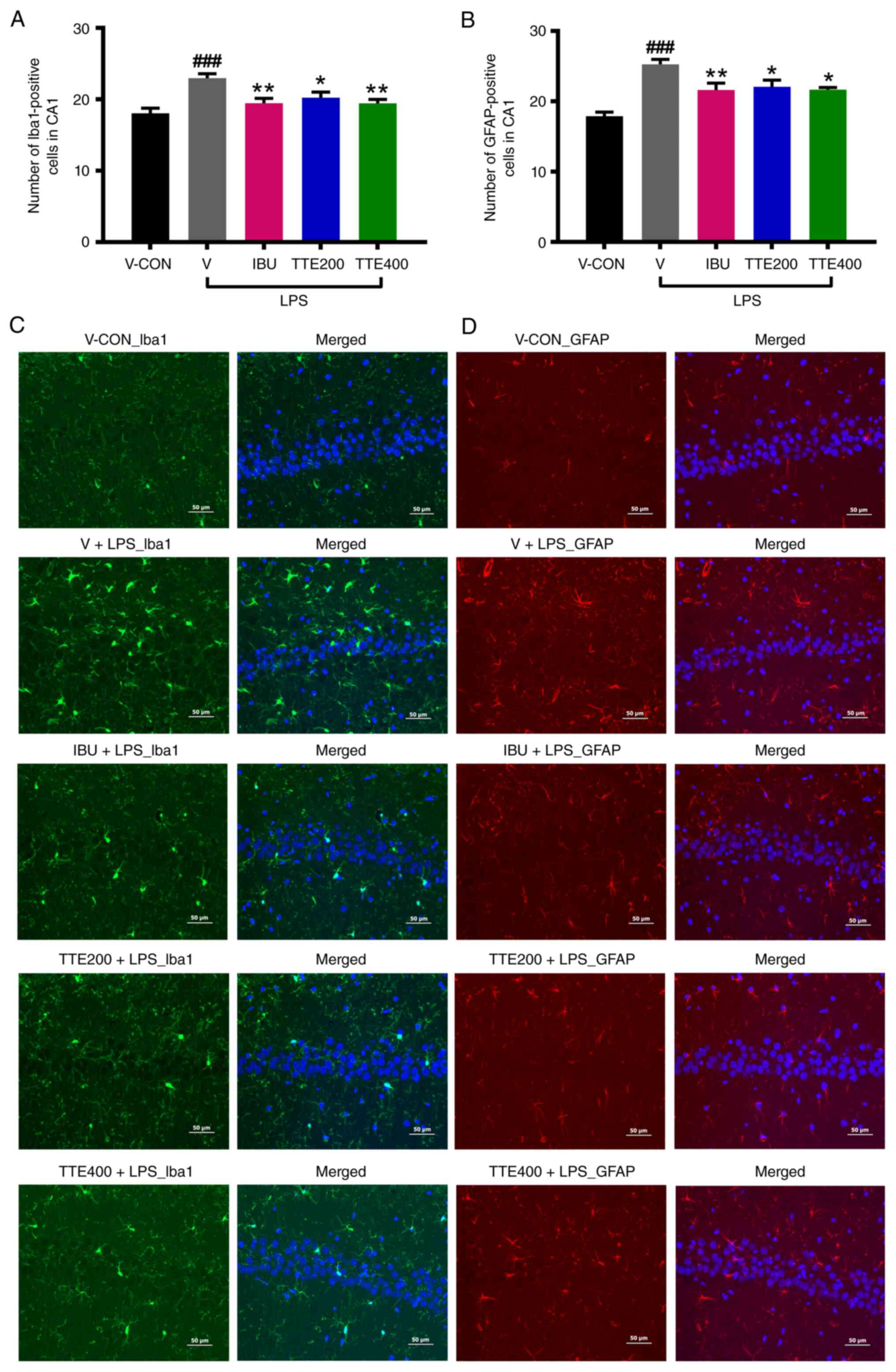
Figure 6

Effect of TTE on the number of Iba1-
and GFAP-positive cells in the CA1. Number of (A) Iba1- and (B)
GFAP-positive cells. The immunofluorescence of (C) Iba1-positive
cells (green) and (D) GFAP-positive cells (red) in the CA1. Hoechst
33258 (blue) labels the nuclei of all cell types, including neurons
and glial cells. Hippocampal neurons are characterized by larger,
diffusely stained nuclei arranged in a dense and organized laminar
pattern. The glial cells (microglia and astrocytes) exhibit
smaller, intensely stained (punctate) nuclei that co-localize with
Iba1 or GFAP immunoreactivity (43,44).
The images were captured at 20x magnification (scale bar, 50 µm).
One-way ANOVA was used to analyze the data, and the data is
presented as the mean ± SEM (n=6). ###P<0.001 vs. the
V-CON group. *P<0.05 and **P<0.01 vs.
the V plus LPS group. TTE, T. triandra leaf extract; LPS,
lipopolysaccharide; V-CON, vehicle-control; V, vehicle; IBU,
ibuprofen; CA1, cornu ammonis 1; Iba1, ionized calcium-binding
adapter molecule 1; GFAP, glial fibrillary acidic protein.

Figure 7

Effect of TTE on the number of Iba1-
and GFAP-positive cells in the CA3. Number of (A) Iba1- and (B)
GFAP-positive cells. The immunofluorescence of (C) Iba1-positive
cells (green) and (D) GFAP-positive cells (red) in the CA3. Hoechst
33258 (blue) labels the nuclei of all cell types, including neurons
and glial cells. Hippocampal neurons are characterized by larger,
diffusely stained nuclei arranged in a dense and organized laminar
pattern. The glial cells (microglia and astrocytes) exhibit
smaller, intensely stained (punctate) nuclei that co-localize with
Iba1 or GFAP immunoreactivity (43,44).
The images were captured at 20x magnification (scale bar, 50 µm).
One-way ANOVA was used to analyze the data, and the data is
presented as the mean ± SEM (n=6). ###P<0.001 vs. the
V-CON group. *P<0.05 and **P<0.01 vs.
the V plus LPS group. TTE, T. triandra leaf extract; LPS,
lipopolysaccharide; V-CON, vehicle-control; V, vehicle; IBU,
ibuprofen; CA3, cornu ammonis 3; Iba1, ionized calcium-binding
adapter molecule 1; GFAP, glial fibrillary acidic protein.

Figure 8

Effect of TTE on the number of Iba1-
and GFAP-positive cells in the DG. Number of (A) Iba1- and (B)
GFAP-positive cells. The immunofluorescence of (C) Iba1-positive
cells (green) and (D) GFAP-positive cells (red) in the DG. Hoechst
33258 (blue) labels the nuclei of all cell types, including neurons
and glial cells. Hippocampal neurons are characterized by larger,
diffusely stained nuclei arranged in a dense and organized laminar
pattern. The glial cells (microglia and astrocytes) exhibit
smaller, intensely stained (punctate) nuclei that co-localize with
Iba1 or GFAP immunoreactivity (43,44).
The images were captured at 20x magnification (scale bar, 50 µm).
One-way ANOVA was used to analyze the data, and the data is
presented as the mean ± SEM (n=6). ###P<0.001 vs. the
V-CON group. *P<0.05, **P<0.01 and
***P<0.001 vs. the V plus LPS group. TTE, T.
triandra leaf extract; LPS, lipopolysaccharide; V-CON,
vehicle-control; V, vehicle; IBU, ibuprofen; DG, dentate gyrus;
Iba1, ionized calcium-binding adapter molecule 1; GFAP, glial
fibrillary acidic protein.

Figure 9

Proposed mechanisms of the possible
neuroprotective actions of TTE against neuroinflammation and
cognitive impairment. TTE may exert neuroprotective effects by
reducing neuroinflammation and supporting neuronal survival. It
lowers the levels of proinflammatory cytokines and suppresses
microglial and astrocyte activation, as evidenced by reduced Iba1-
and GFAP-positive cells in the hippocampus, which reduced
inflammation-induced damage. These effects potentially contribute
to improved cognitive function and reduced sickness-like behavior,
suggesting its therapeutic potential for neuroinflammatory and
memory-related disorders. LPS, lipopolysaccharide; GFAP, glial
fibrillary acidic protein; Iba1, ionized calcium-binding adapter
molecule 1; TNF-α, tumor necrosis factor-α; IL-1β, interleukin-1β;
BBB, blood-brain barrier; YMT, Y-maze test; NORT, novel object
recognition test; OFT, open field test; DI, discrimination index;
i.p., intraperitoneal injection.
View References

1 

Adamu A, Li S, Gao F and Xue G: The role of neuroinflammation in neurodegenerative diseases: Current understanding and future therapeutic targets. Front Aging Neurosci. 16(1347987)2024.PubMed/NCBI View Article : Google Scholar

2 

Kwon HS and Koh SH: Neuroinflammation in neurodegenerative disorders: The roles of microglia and astrocytes. Transl Neurodegener. 9(42)2020.PubMed/NCBI View Article : Google Scholar

3 

Pekny M, Pekna M, Messing A, Steinhäuser C, Lee JM, Parpura V, Hol EM, Sofroniew MV and Verkhratsky A: Astrocytes: A central element in neurological diseases. Acta Neuropathol. 131:323–345. 2016.PubMed/NCBI View Article : Google Scholar

4 

Liddelow SA and Barres BA: Reactive astrocytes: Production, function, and therapeutic potential. Immunity. 46:957–967. 2017.PubMed/NCBI View Article : Google Scholar

5 

Rizzo FR, Musella A, De Vito F, Fresegna D, Bullitta S, Vanni V, Guadalupi L, Stampanoni Bassi M, Buttari F, Mandolesi G, et al: Tumor necrosis factor and interleukin-1β modulate synaptic plasticity during neuroinflammation. Neural Plast. 2018(8430123)2018.PubMed/NCBI View Article : Google Scholar

6 

DiSabato DJ, Quan N and Godbout JP: Neuroinflammation: The devil is in the details. J Neurochem. 139 (Suppl 2):S136–S153. 2016.PubMed/NCBI View Article : Google Scholar

7 

Pekny M and Pekna M: Astrocyte reactivity and reactive astrogliosis: Costs and benefits. Physiol Rev. 94:1077–1098. 2014.PubMed/NCBI View Article : Google Scholar

8 

Lier J, Streit WJ and Bechmann I: Beyond activation: Characterizing microglial functional phenotypes. Cells. 10(2236)2021.PubMed/NCBI View Article : Google Scholar

9 

Wang C, Zong S, Cui X, Wang X, Wu S, Wang L, Liu Y and Lu Z: The effects of microglia-associated neuroinflammation on Alzheimer's disease. Front Immunol. 14(1117172)2023.PubMed/NCBI View Article : Google Scholar

10 

Spangenberg EE and Green KN: Inflammation in Alzheimer's disease: Lessons learned from microglia-depletion models. Brain Behav Immun. 61:1–11. 2017.PubMed/NCBI View Article : Google Scholar

11 

Heneka MT, Carson MJ, El Khoury J, Landreth GE, Brosseron F, Feinstein DL, Jacobs AH, Wyss-Coray T, Vitorica J, Ransohoff RM, et al: Neuroinflammation in Alzheimer's disease. Lancet Neurol. 14:388–405. 2015.PubMed/NCBI View Article : Google Scholar

12 

Winner B and Winkler J: Adult neurogenesis in neurodegenerative diseases. Cold Spring Harb Perspect Biol. 7(a021287)2015.PubMed/NCBI View Article : Google Scholar

13 

Ransohoff RM: How neuroinflammation contributes to neurodegeneration. Science. 353:777–783. 2016.PubMed/NCBI View Article : Google Scholar

14 

Dabi YT, Ajagbe AO and Degechisa ST: Toll-like receptors in pathogenesis of neurodegenerative diseases and their therapeutic potential. Immun Inflamm Dis. 11(e839)2023.PubMed/NCBI View Article : Google Scholar

15 

Muzio L, Viotti A and Martino G: Microglia in neuroinflammation and neurodegeneration: From understanding to therapy. Front Neurosci. 15(742065)2021.PubMed/NCBI View Article : Google Scholar

16 

Zhao J, Bi W, Xiao S, Lan X, Cheng X, Zhang J, Lu D, Wei W, Wang Y, Li H, et al: Neuroinflammation induced by lipopolysaccharide causes cognitive impairment in mice. Sci Rep. 9(5790)2019.PubMed/NCBI View Article : Google Scholar

17 

Choe K, Park JS, Park HY, Tahir M, Park TJ and Kim MO: Lupeol protect against LPS-induced neuroinflammation and amyloid beta in adult mouse hippocampus. Front Nutr. 11(1414696)2024.PubMed/NCBI View Article : Google Scholar

18 

Zhang X, Peng X, Wang C, Olatunji OJ and Famurewa A: Tiliacora triandra attenuates cisplatin triggered hepatorenal and testicular toxicity in rats by modulating oxidative inflammation, apoptosis and endocrine deficit. Front Biosci (Landmark Ed). 27(44)2022.PubMed/NCBI View Article : Google Scholar

19 

Huang Y, Liu C, Song X, An M, Liu M, Yao L, Famurewa AC and Olatunji OJ: Antioxidant and anti-inflammatory properties mediate the neuroprotective effects of hydro-ethanolic extract of Tiliacora triandra against cisplatin-induced neurotoxicity. J Inflamm Res. 14:6735–6748. 2021.PubMed/NCBI View Article : Google Scholar

20 

Weerawatanakorn M, Rojsuntornkitti K, Pan MH and Wongwaiwech D: Some phytochemicals and anti-inflammation effect of juice from Tiliacora triandra leaves. J Food Nutr Res. 6:32–38. 2018.

21 

Pradubyat N, Wunnakup T, Praparatana R, Wongwiwatthananukit S, Jongrungruangchok S, Songsak T, Madaka F and Sudsai T: Evaluation of antioxidant and anti-inflammatory properties, bioactive compound profiling, and molecular mechanisms of a multicomponent Thai herbal formulation. Phytomed Plus. 4(100662)2024.

22 

Hawiset T, Sriraksa N, Kamsrijai U, Praman S and Inkaew P: Neuroprotective effect of Tiliacora triandra (Colebr.) Diels leaf extract on scopolamine-induced memory impairment in rats. Heliyon. 9(e22545)2023.PubMed/NCBI View Article : Google Scholar

23 

Sriraksa N, Hawiset T, Kongsui R, Thongrong S, Promsrisuk T and Boontem P: Tiliacora triandra (Colebr.) Diels leaf extract alleviates motor deficit and protects against MPTP-induced neurodegeneration in mice. J Appl Pharm Sci. 14:230–237. 2024.

24 

Phunchago N, Wattanathorn J and Chaisiwamongkol K: Tiliacora triandra, an anti-intoxication plant, improves memory impairment, neurodegeneration, cholinergic function, and oxidative stress in hippocampus of ethanol dependence rats. Oxid Med Cell Longev. 2015(918426)2015.PubMed/NCBI View Article : Google Scholar

25 

Thong-Asa W and Bullangpoti V: Neuroprotective effects of Tiliacora triandra leaf extract in a mice model of cerebral ischemia reperfusion. Avicenna J Phytomed. 10:202–212. 2020.PubMed/NCBI

26 

Kumar N and Chaiyasut C: Health promotion potential of vegetables cultivated in Northern Thailand: A preliminary screening of tannin and flavonoid contents, 5α-reductase inhibition, astringent activity, and antioxidant activities. J Evid Based Complementary Altern Med. 22:573–579. 2017.PubMed/NCBI View Article : Google Scholar

27 

Faul F, Erdfelder E, Lang AG and Buchner A: . G*Power 3: A flexible statistical power analysis program for the social, behavioral, and biomedical sciences. Behav Res Methods. 39:175–191. 2007.PubMed/NCBI View Article : Google Scholar

28 

Faul F, Erdfelder E, Buchner A and Lang AG: Statistical power analyses using G*Power 3.1: Tests for correlation and regression analyses. Behav Res Methods. 41:1149–1160. 2009.PubMed/NCBI View Article : Google Scholar

29 

University of Arizona: Guidelines for Anesthetic and Analgesic Use in Laboratory Animals. https://www.spandidos-publications.com/var/GuidelinesAnestheticAnalgesicUse.pdf. Accessed January, 2026.

30 

American Veterinary Medical Association: AVMA guidelines for the euthanasia of animals: 2020 edition. AVMA, Schaumburg, IL, 2020.

31 

Lucera GM, Menani JV, Colombari E and Colombari DSA: ANG II and aldosterone acting centrally participate in the enhanced sodium intake in water-deprived renovascular hypertensive rats. Front Pharmacol. 12(679985)2021.PubMed/NCBI View Article : Google Scholar

32 

Sireeratawong S, Lertprasertsuke N, Srisawat U, Thuppia A, Ngamjariyawat A, Suwanlikhid N and Jaijoy K: Acute and subchronic toxicity study of the water extract from Tiliacora triandra (Colebr.) Diels in rats. Songklanakarin J Sci Technol. 30:611–619. 2008.

33 

Nayak A, Raju R, Das P, Das K, Suvitha A, Ranjan Meher B, Alobid S, Almoteer AI, Almadani ME, Alshehri A, et al: Novel ibuprofen prodrug: A possible promising agent for the management of complications of Alzheimer's disease. Saudi Pharm J. 32(101888)2024.PubMed/NCBI View Article : Google Scholar

34 

Thingore C, Kshirsagar V and Juvekar A: Amelioration of oxidative stress and neuroinflammation in lipopolysaccharide-induced memory impairment using Rosmarinic acid in mice. Metab Brain Dis. 36:299–313. 2021.PubMed/NCBI View Article : Google Scholar

35 

Ali W, Choe K, Park JS, Ahmad R, Park HY, Kang MH, Park TJ and Kim MO: Kojic acid reverses LPS-induced neuroinflammation and cognitive impairment by regulating the TLR4/NF-κB signaling pathway. Front Pharmacol. 15(1443552)2024.PubMed/NCBI View Article : Google Scholar

36 

Blossom V, Ullal SD, Rai R, Chakraborthi S, Kumar NA, Pai MM and Vadgaonkar R: Bacterial lipopolysaccharide model of neuroinflammation-associated neurodegeneration in Wistar rats: A comparison between different durations of lipopolysaccharide induction. Vet World. 17:2567–2576. 2024.PubMed/NCBI View Article : Google Scholar

37 

Benmhammed H, Lamtai M, Mesfioui A, Nassiri A, Mouden S, Bikri S and Hessni AEl: Effects of lipopolysaccharide administration at different postnatal periods on behavioral and biochemical assessments in Wistar rats. Neurosci Behav Physiol. 54:357–373. 2024.

38 

Onasanwo SA, Adebimpe-John OE, Olopade FE and Olajide OO: Kolaviron protects rats from cognitive decline induced by lipopolysaccharide in Wistar rat. Niger J Physiol Sci. 36:67–76. 2021.PubMed/NCBI

39 

Azzam SM, Abdel Rahman AAS, Ahmed-Farid OA, Abu El-Wafa WM and Salem GEM: Lipopolysaccharide induced neuroprotective effects of bacterial protease against Alzheimer's disease in male Wistar albino rats. Int J Biol Macromol. 230(123260)2023.PubMed/NCBI View Article : Google Scholar

40 

Hawiset T, Sriraksa N, Anukanon S, Kamsrijai U, Praman S, Teerapattarakan N and Inkaew P: Tacca chantrieri André rhizome extract alleviates scopolamine-induced cognitive impairment and neuroinflammation in rats. Adv Pharmacol Pharm Sci. 2025(7334303)2025.PubMed/NCBI View Article : Google Scholar

41 

Hawiset T, Sriraksa N, Kongsui R, Kamsrijai U, Wanchai K and Inkaew P: Azadirachta indica A. Juss. flower extract attenuated memory deficit-induced by restraint stress in male rats. Physiol Pharmacol. 27:53–63. 2023.

42 

Hawiset T, Sriraksa N, Kamsrijai U, Wanchai K and Inkaew P: Anxiolytic and antidepressant-like activities of aqueous extract of Azadirachta indica A. Juss. flower in the stressed rats. Heliyon. 8(e08881)2022.PubMed/NCBI View Article : Google Scholar

43 

Cerbai F, Lana D, Nosi D, Petkova-Kirova P, Zecchi S, Brothers HM, Wenk GL and Giovannini MG: The neuron-astrocyte-microglia triad in normal brain ageing and in a model of neuroinflammation in the rat hippocampus. PLoS One. 7(e45250)2012.PubMed/NCBI View Article : Google Scholar

44 

García-Cabezas MÁ, John YJ, Barbas H and Zikopoulos B: Distinction of neurons, glia and endothelial cells in the cerebral cortex: An algorithm based on cytological features. Front Neuroanat. 10(107)2016.PubMed/NCBI View Article : Google Scholar

45 

Skrzypczak-Wiercioch A and Sałat K: Lipopolysaccharide-induced model of neuroinflammation: Mechanisms of action, research application and future directions for its use. Molecules. 27(5481)2022.PubMed/NCBI View Article : Google Scholar

46 

Fołta J, Rzepka Z and Wrześniok D: The role of inflammation in neurodegenerative diseases: Parkinson’s disease, Alzheimer’s disease, and multiple sclerosis. Int J Mol Sci. 26(5177)2025.PubMed/NCBI View Article : Google Scholar

47 

Kongsui R, Promsrisuk T, Chanmanee T, Klimaschewski L, Jamsuwan S, Sriraksa N, Jittiwat J and Thongrong S: Biochanin A prevents neurodegeneration and oxidative stress in a kainic acid model of epilepsy by activating the PI3K/Akt/Nrf2 signaling pathway. Sci Rep. 15(39842)2025.PubMed/NCBI View Article : Google Scholar

48 

Zhang L, Li J and Lin A: Assessment of neurodegeneration and neuronal loss in aged 5XFAD mice. STAR Protoc. 2(100915)2021.PubMed/NCBI View Article : Google Scholar

49 

Palachai N, Supawat A, Kongsui R, Klimaschewski L and Jittiwat J: Galangin's neuroprotective role: Targeting oxidative stress, inflammation, and apoptosis in ischemic stroke in a rat model of permanent middle cerebral artery occlusion. Int J Mol Sci. 26(1847)2025.PubMed/NCBI View Article : Google Scholar

50 

Khan MS, Ali T, Kim MW, Jo MH, Jo MG, Badshah H and Kim MO: Anthocyanins protect against LPS-induced oxidative stress-mediated neuroinflammation and neurodegeneration in the adult mouse cortex. Neurochem Int. 100:1–10. 2016.PubMed/NCBI View Article : Google Scholar

51 

Lee JW, Lee YK, Yuk DY, Choi DY, Ban SB, Oh KW and Hong JT: Neuro-inflammation induced by lipopolysaccharide causes cognitive impairment through enhancement of beta-amyloid generation. J Neuroinflammation. 5(37)2008.PubMed/NCBI View Article : Google Scholar

52 

Booranasubkajorn S, Kanlaya H, Huabprasert S, Lumlerdkij N, Akarasereenont P and Tripatara P: The effect of Thai herbal Ha-Rak Formula (HRF) on LPS-induced systemic inflammation in Wistar rats. Siriraj Med J. 69:356–362. 2017.

53 

Das Sinha P, Islam S, Biswas P and Stuehr DJ: Nitric oxide regulates cytochrome P450 2D6 and 3A4 activity via concentration-dependent modulation of heme loading. J Biol Chem. 301(110772)2025.PubMed/NCBI View Article : Google Scholar

54 

Rozhkova IN, Okotrub SV, Brusentsev EY, Uldanova EE, Chuyko EА, Lipina TV, Amstislavskaya TG and Amstislavsky SY: Neuronal density in the brain cortex and hippocampus in Clsnt2-KO mouse strain modeling autistic spectrum disorder. Vavilovskii Zhurnal Genet Selektsii. 26:365–370. 2022.PubMed/NCBI View Article : Google Scholar

55 

Lawrence JM, Schardien K, Wigdahl B and Nonnemacher MR: Roles of neuropathology-associated reactive astrocytes: A systematic review. Acta Neuropathol Commun. 11(42)2023.PubMed/NCBI View Article : Google Scholar

56 

Rainsford KD: Ibuprofen: Pharmacology, efficacy and safety. Inflammopharmacology. 17:275–342. 2009.PubMed/NCBI View Article : Google Scholar

57 

Wachiryah TA and Hathaipat L: Enhancing effect of Tiliacora triandra leaves extract on spatial learning, memory and learning flexibility as well as hippocampal choline acetyltransferase activity in mice. Avicenna J Phytomed. 8:380–388. 2018.PubMed/NCBI

58 

Pasachan T, Duangjai A, Ontawong A, Amornlerdpison D, Jinakote M, Phatsara M, Soodvilai S and Srimaroeng C: Tiliacora triandra (Colebr.) Diels leaf aqueous extract inhibits hepatic glucose production in HepG2 cells and type 2 diabetic rats. Molecules. 26(1239)2021.PubMed/NCBI View Article : Google Scholar

59 

Al-Khayri JM, Sahana GR, Nagella P, Joseph BV, Alessa FM and Al-Mssallem MQ: Flavonoids as potential anti-inflammatory molecules: A review. Molecules. 27(2901)2022.PubMed/NCBI View Article : Google Scholar

60 

Zahra M, Abrahamse H and George BP: Flavonoids: Antioxidant powerhouses and their role in nanomedicine. Antioxidants (Basel). 13(922)2024.PubMed/NCBI View Article : Google Scholar

61 

Navarro-Hoyos M, Bisoyi R, Kc P, Lutz N and Ruxsarash M: Key dietary flavonoids: Insights into their structural characteristics, antioxidant and anti-inflammatory activities, and potential as neuroprotective agents. Molecules. 31(154)2026.PubMed/NCBI View Article : Google Scholar

Related Articles

  • Abstract
  • View
  • Download
  • Twitter
Copy and paste a formatted citation
Spandidos Publications style
Sriraksa N, Praman S, Kamsrijai U, Wanta A, Anukanon S, Inkaew P and Hawiset T: Neuroprotective effects of <em>Tiliacora triandra</em> (Colebr.) Diels leaf extract against lipopolysaccharide‑induced memory impairment via anti‑neuroinflammation. Biomed Rep 24: 75, 2026.
APA
Sriraksa, N., Praman, S., Kamsrijai, U., Wanta, A., Anukanon, S., Inkaew, P., & Hawiset, T. (2026). Neuroprotective effects of <em>Tiliacora triandra</em> (Colebr.) Diels leaf extract against lipopolysaccharide‑induced memory impairment via anti‑neuroinflammation. Biomedical Reports, 24, 75. https://doi.org/10.3892/br.2026.2148
MLA
Sriraksa, N., Praman, S., Kamsrijai, U., Wanta, A., Anukanon, S., Inkaew, P., Hawiset, T."Neuroprotective effects of <em>Tiliacora triandra</em> (Colebr.) Diels leaf extract against lipopolysaccharide‑induced memory impairment via anti‑neuroinflammation". Biomedical Reports 24.6 (2026): 75.
Chicago
Sriraksa, N., Praman, S., Kamsrijai, U., Wanta, A., Anukanon, S., Inkaew, P., Hawiset, T."Neuroprotective effects of <em>Tiliacora triandra</em> (Colebr.) Diels leaf extract against lipopolysaccharide‑induced memory impairment via anti‑neuroinflammation". Biomedical Reports 24, no. 6 (2026): 75. https://doi.org/10.3892/br.2026.2148
Copy and paste a formatted citation
x
Spandidos Publications style
Sriraksa N, Praman S, Kamsrijai U, Wanta A, Anukanon S, Inkaew P and Hawiset T: Neuroprotective effects of <em>Tiliacora triandra</em> (Colebr.) Diels leaf extract against lipopolysaccharide‑induced memory impairment via anti‑neuroinflammation. Biomed Rep 24: 75, 2026.
APA
Sriraksa, N., Praman, S., Kamsrijai, U., Wanta, A., Anukanon, S., Inkaew, P., & Hawiset, T. (2026). Neuroprotective effects of <em>Tiliacora triandra</em> (Colebr.) Diels leaf extract against lipopolysaccharide‑induced memory impairment via anti‑neuroinflammation. Biomedical Reports, 24, 75. https://doi.org/10.3892/br.2026.2148
MLA
Sriraksa, N., Praman, S., Kamsrijai, U., Wanta, A., Anukanon, S., Inkaew, P., Hawiset, T."Neuroprotective effects of <em>Tiliacora triandra</em> (Colebr.) Diels leaf extract against lipopolysaccharide‑induced memory impairment via anti‑neuroinflammation". Biomedical Reports 24.6 (2026): 75.
Chicago
Sriraksa, N., Praman, S., Kamsrijai, U., Wanta, A., Anukanon, S., Inkaew, P., Hawiset, T."Neuroprotective effects of <em>Tiliacora triandra</em> (Colebr.) Diels leaf extract against lipopolysaccharide‑induced memory impairment via anti‑neuroinflammation". Biomedical Reports 24, no. 6 (2026): 75. https://doi.org/10.3892/br.2026.2148
Follow us
  • Twitter
  • LinkedIn
  • Facebook
About
  • Spandidos Publications
  • Careers
  • Cookie Policy
  • Privacy Policy
How can we help?
  • Help
  • Live Chat
  • Contact
  • Email to our Support Team