1. Introduction
Magnolia bark has been utilized in traditional
Chinese and Japanese medicine for a long history to treat
conditions such as gastrointestinal dysfunction, and anxiety. The
active constituents, honokiol (HKL;
5,3'-diallyl-biphenyl-2,4'-diol), a regioisomer of magnolol, was
first isolated in 1972(1), yet its
full pharmacological potential remained underexplored for decades
and systematic reviews consolidating its molecular mechanisms
remain scarce. Previous studies have confirmed that HKL is
favorable for the treatment of a variety of diseases, including
anti-inflammatory, antioxidant, neuroprotective and antitumor
effects, rendering it favorable for the treatment of a wide
spectrum of diseases (2-5).
Recent resurgence of interest, driven by its multitarget
pharmacology and favorable toxicity profile, has positioned HKL as
a lead compound for rational drug design, although clinical
translation remains hampered by formulation challenges (2). Concurrently, advances in structural
modification and drug delivery strategies have begun to address the
inherent limitations of HKL, such as poor aqueous solubility and
suboptimal bioavailability. As a result, the present review
synthesized recent advances in the mechanistic understanding,
pharmacology and translational research of HKL, benchmarks it
against other natural-product derivatives and outlined an
evidence-based developmental pipeline for future
investigations.
2. Method
For the present review, a comprehensive literature
search was conducted across multiple electronic databases,
including PubMed (https://pubmed.ncbi.nlm.nih.gov/) and Scopus
(https://www.scopus.com/). Keywords such as
‘honokiol’, ‘Alzheimer's disease’, ‘cancer’, ‘metabolic disorders’,
‘infectious diseases’, and ‘pharmacology’ were used in the search.
The present review systematically reviewed all relevant in
vitro, in vivo and clinical studies investigating the
therapeutic effects of HKL. The present review synthesized original
research published between 2023 and 2025 to provide an updated
profile of the direct molecular targets, signaling mechanisms, and
nano-enabled delivery strategies of HKL.
3. Structural considerations
HKL possesses two phenolic hydroxyls flanked by
ortho-allyl substituents. This structure is ideal for membrane
permeation but problematic for oral absorption. Recent total
synthesis of HKL utilized a phosphonium ylide-mediated cascade
reaction and natural product isomerization processes, providing a
novel alternative approach to unite Illicium-derived
neolignans under a common precursor, chavicol (6). It has poor water solubility, which
leads to high hepatic first-pass clearance and results in a low
oral bioavailability of only 0.7% in rats, thereby limiting its
clinical application. To address this limitation through structural
modification, the two phenolic hydroxyl groups (C2'-OH and C4-OH)
in the HKL molecule are key sites. Among them, the C2'-OH group is
considered the ‘critical pharmacophore’ for most of its activity,
while chemical modification at the C4-OH position serves as a
potential site for enhancing efficacy and reducing toxicity. For
instance, introducing additional pharmacophores (such as
1,3,4-thiadiazole, metformin) via a linker at C4-OH can increase
antitumor activity by 10 to 100-fold while reducing toxicity to
normal cells (2,7). The ortho-allyl substituent also plays
an important role in its antitumor activity (7).
Several studies have reported more active and
targeted HKL derivatives: Zhong et al (3) conjugated HKL with metformin via a
1,3,5-triazine ring to obtain the derivative HM568. In an
MPTP-induced Parkinson's disease mouse model, HM568 markedly
improved motor performance, attenuated neuroinflammation, restored
the number of tyrosine hydroxylase-positive neurons and reduced
α-synuclein aggregation, while the safety profile was favorable
(LD50 >2,000 mg/kg). Sasia et al (8) reported that a hexafluorinated HKL
derivative (claisened hexafluoro; CH) and the parent HKL (3 µmol/l)
both exhibited antisenescence effects in BV-2 microglia
intermittently stimulated with LPS, and reduced the expression of
senescence-associated markers and inflammatory factors, showing
efficacy comparable to that of the γ-secretase inhibitor DAPT.
Among the 22 HKL-thioether-1,3,4-oxadiazole derivatives synthesized
by Yang et al (9), compound
3k exhibited superior inhibitory activity against HCT116 colon
cancer cells (IC50=6.1 µmol/l) compared with that of
5-fluorouracil. It effectively induced cell cycle arrest and
apoptosis by suppressing Yes-associated protein (YAP) signaling.
Among the 28 mitochondria-targeted HKL derivatives designed by Miao
et al (5), compound 2E-3-F16
induced ROS-mediated mitochondrial dysfunction in NCI-H446 lung
cancer cells in a concentration-dependent manner. It demonstrated
higher tumor selectivity and lower toxicity in Caenorhabditis
elegans than did the parent HKL. In a cerebral
ischemia/reperfusion model study, HH-A, the derivative with
markedly improved water solubility, markedly reduced infarct volume
and cerebral edema by activating the nuclear factor erythroid
2-related factor 2 (Nrf2)/heme oxygenase 1 (HO-1) signaling
pathway, with efficacy surpassing that of edaravone dexborneol
(4).
In conclusion, these studies demonstrate that
rational structural modification of HKL can simultaneously increase
its water solubility, target specificity and therapeutic index
while preserving its multimodal anti-inflammatory and
cytoprotective effects.
4. Molecular targets and systems
pharmacology
Traditional Chinese medicine has attracted intense
research interest in recent years and its therapeutic potential is
now recognized worldwide. Among its bioactive constituents, HKL
stands out as a pleiotropic agent that concurrently modulates
multiple validated targets across several signaling cascades
(Fig. 1).
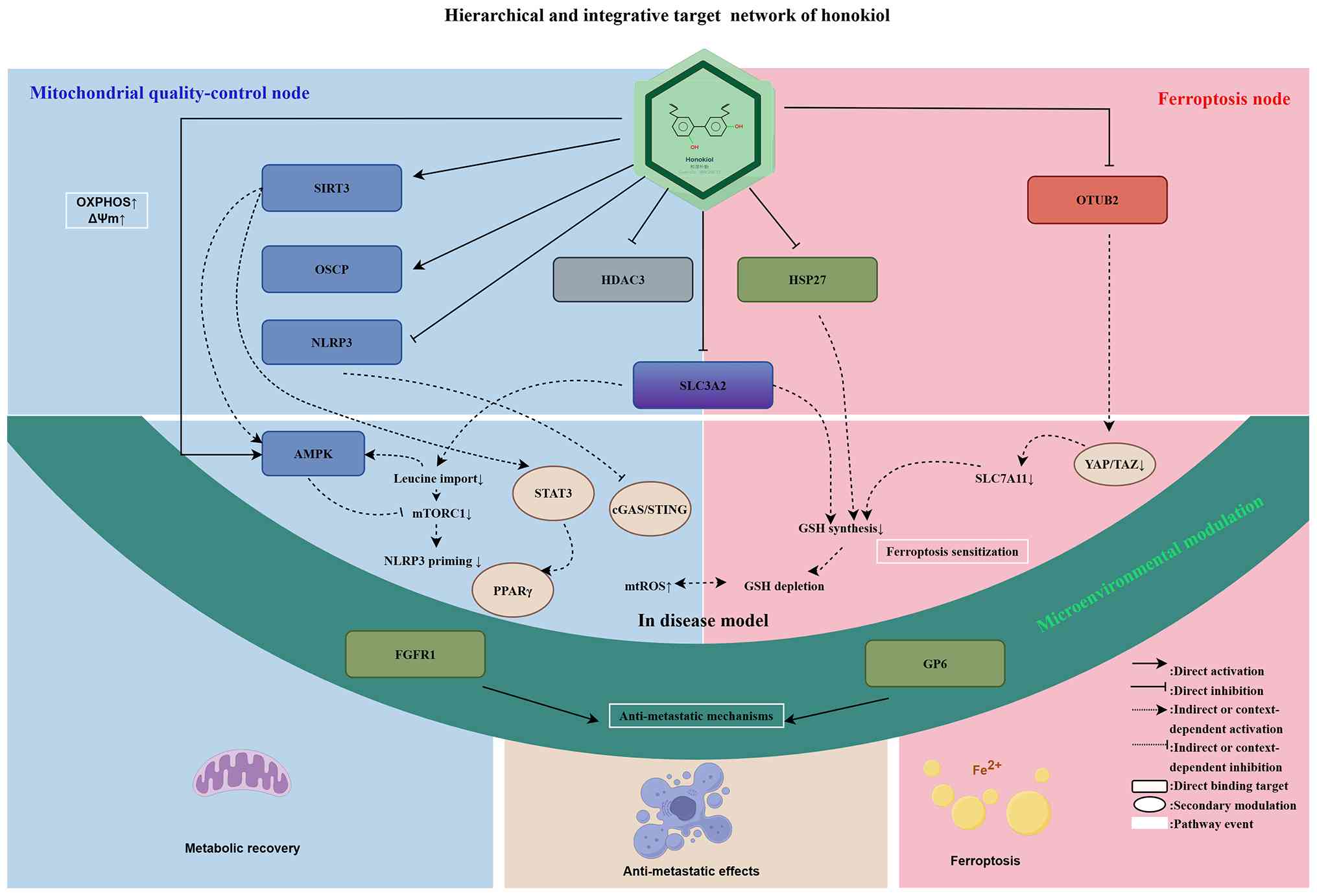 | Figure 1The targets and pathways of honokiol.
Direct binding targets (SIRT3, OTUB2, SLC3A2, OSCP, NLRP3, HDAC3,
HSP27, GP6 and FGFR1) initiate primary pathways associated with
mitochondrial quality control and cystine metabolism. Secondary
modulators (cGAS-STING, YAP/TAZ, STAT3, AMPK and PPARγ) amplify or
suppress these signals in a disease-specific manner. Dashed arrows
indicate indirect action and context dependent crosstalk. SIRT3,
sirtuin 3; OTUB2, OTU domain-containing ubiquitin aldehyde-binding
protein 2; SLC3A2, solute carrier family 3 member 2; OSCP,
oligomycin sensitivity-conferring protein; NLRP3, NOD-like receptor
protein 3; HDAC, histone deacetylase; HSP27, heat shock protein 27;
GP6, platelet glycoprotein VI; FGFR1, fibroblast growth factor
receptor 1; cGAS, cyclic GMP-AMP synthase; STING, stimulator of
interferon genes; YAP, Yes-associated protein; TAZ, transcriptional
coactivator with PDZ-binding motif; STAT3, signal transducer and
activator of transcription 3; AMPK, adenosine
monophosphate-activated protein kinase; PPARγ, peroxisome
proliferator-activated receptor gamma; HSP, heat shock protein. |
HKL exerts pharmacological effects through a
hierarchy of direct binding targets and downstream signaling
cascades. Experimentally validated direct targets, including
sirtuin 3 (SIRT3) (10), OTU
deubiquitinase, ubiquitin aldehyde binding 2 (OTUB2) (11), NOD-like receptor protein 3 (NLRP3)
(12), solute carrier family 3
member 2 (SLC3A2) (13), oligomycin
sensitivity-conferring protein (OSCP) (14), histone deacetylase 3(15), heat shock protein 27 (HSP27)
(16), platelet glycoprotein VI
(GP6) (17), fibroblast growth
factor receptor 1 (FGFR1) (18),
adenosine monophosphate-activated protein kinase (AMPK) (19), initiate primary pathways that
converge on mitochondrial quality control and cystine-dependent
redox homeostasis. Indirectly regulated components, including
YAP/transcriptional coactivator with PDZ-binding motif (TAZ),
signal transducer and activator of transcription 3 (STAT3), and
peroxisome proliferator-activated receptor gamma (PPARγ), may
amplify or dampen these core signals in a disease-specific manner
(Fig. 1).
SIRT3-mitochondrial quality
control
SIRT3 is a highly conserved
NAD+-dependent deacetylase that is predominantly
localized in mitochondria and plays crucial roles in regulating
oxidative stress, metabolism, inflammation, apoptosis and autophagy
(20). HKL alleviates mitochondrial
dysfunction and reduces oxidative stress by binding and activating
SIRT3 (10,20). In Alzheimer's disease (AD) models,
HKL upregulates SIRT3 expression, promotes mitophagy and attenuates
β-amyloid (Aβ) deposits (21). A
similar mechanism was observed in myocardial ischemia-reperfusion
injury (22) and diabetic
nephropathy (23). This
SIRT3-dependent protection was further confirmed in sodium
fluoride-induced mitochondrial damage in porcine oocytes, where HKL
restored superoxide dismutase 2 (SOD2) activity via SIRT3-mediated
deacetylation, alleviating mitochondrial reactive oxygen species
(mtROS) accumulation and improving developmental competence
(24). Similarly, in cigarette
smoke-exposed airway epithelial cells, HKL activated the SIRT3/SOD2
signaling pathway to suppress ROS generation, inflammatory cytokine
release, and apoptosis (25). HKL
was shown to ameliorate diabetes-associated cognitive dysfunction
by upregulating SIRT3, which limited excessive
mitochondria-associated endoplasmic reticulum membrane formation,
and preserved neuronal survival (26). Collectively, these findings
underscore HKL as a potent SIRT3 activator capable of counteracting
mitochondrial oxidative injury across multiple organs and disease
contexts.
NLRP3-cGAS-STING Axis
The NLRP3 inflammasome acts as a central hub driving
numerous inflammatory diseases. HKL suppresses NLRP3 inflammasome
activation through context-dependent mechanisms. In lupus nephritis
models, it binds NLRP3 directly and inhibited its activation,
thereby downregulating the interleukin-33 (IL-33)/interleukin 1
receptor-like 1 (ST2) axis (12).
In sepsis/colitis models, it indirectly blocked NLRP3 assembly and
caspase-1 activation by promoting degradation of SLC3A2, decreasing
L-leucine uptake and suppressing mechanistic target of rapamycin
complex 1 (mTORC1) signaling (13).
In Neisseria gonorrhoeae-infected macrophages, dual-action HKL
inhibited NLRP3/caspase-1 pyroptosis while exerting direct
bactericidal effects (27). HKL
also mitigated cGAS-STING activation through mitochondrial
homeostasis. It promoted SIRT3-mediated SOD2 deacetylation and
attenuated mtDNA damage (28). In
hepatic fibrosis, HKL interrupted the NLRP3-pyroptosis-cGAS-STING
feedback loop, reducing liver damage and collagen deposition
(29). In models of acute
peritonitis and lupus nephritis, HKL not only inhibited the
NLRP3/IL-1β axis but also activated the Sirt1-autophagy pathway or
suppressed IL-33/ST2 signaling, markedly decreasing TNF-α and IL-6
levels and alleviating organ injury (30,12).
In lung injury, it inhibited silica-induced cGAS-STING signaling
and macrophage pyroptosis (31). In
summary, HKL provides a broad-spectrum and safe intervention for
NLRP3-driven infections, metabolic disorders and autoimmune
inflammation.
YAP/TAZ transcriptional hub
YAP and TAZ are key transcriptional coactivators of
the Hippo pathway and play important roles in controlling organ
size and tissue malignant transformation (32). In CNE1 nasopharyngeal carcinoma
cells, HKL arrested cells in G0/G1 phase and
promoted apoptosis by decreasing the mitochondrial membrane
potential and inducing YAP phosphorylation via the Hippo pathway;
these effects could be reversed by an MST1/2 inhibitor (XMU-MP-1)
(33). In ovarian cancer, HKL
antagonized OTUB2 to destabilize YAP, suppressed SLC7A11, triggered
lipid ROS-mediated ferroptosis and reduced Ki67 expression
(11). Concurrently, it suppressed
proliferation and invasion, downregulated YAP/TAZ signaling,
triggered apoptosis and restrained tumor growth in vivo
(34).
FGFR
PEAQ-ITC data show that HKL binds the FGFR1 kinase
domain ATP-binding pocket, blocking downstream signaling. In
FGFR1-expressing cancer cells, HKL abolished FGF1-mediated
protection against the microtubule poison taltobulin, restoring
cytotoxicity. While prolonged taltobulin exposure selected for
dual-resistant clones with upregulated FGFR1 and cyclin D
expression, cotreatment with HKL or a ligand trap prevented this
resistance (18). Thus, targeting
the FGF1/FGFR1 axis with HKL overcomes intrinsic taltobulin
resistance and suppresses acquired resistance, suggesting a
strategy to enhance the efficacy of microtubule-directed
chemotherapy.
STAT3
Across independent disease models, HKL converges on
a single druggable node, STAT3 Tyr705 phosphorylation, to reprogram
pathological gene expression. In reserpine-induced fibromyalgia,
oral HKL (8 mg/kg) downregulated Janus kinases (JAK)/STAT3
transcription in spinal tissue, inhibiting calcitonin
gene-related-peptide expression and alleviating mechanical
allodynia (35). In addition, HKL
upregulated the endogenous STAT3 inhibitor protein inhibitor of
activated stat protein 3, selectively suppressed STAT3 Tyr705
phosphorylation, downregulated Bcl-2 and drove caspase-3-mediated
apoptosis both in vitro and in xenografts (36). HKL activated SIRT3 to deacetylate
STAT3, thereby suppressing STAT3/retinoic acid receptor-related
orphan receptor γ t signaling, curbing Th17 differentiation and
IL-17/IL-21 production and consequently ameliorating colitis in
both DSS-induced and IL-10-deficient mouse models (37). Similarly, during chronic cerebral
hypoperfusion, HKL increased SIRT3 activity, blocked STAT3 nuclear
translocation and prevented astrocyte A1 polarization, preserving
hippocampal neurons and memory (38). Thus, whether the pathology is
chronic pain, cancer, colitis or vascular dementia, HKL acts as a
context-specific STAT3 gatekeeper, representing a pleiotropic yet
mechanistically unified therapeutic agent.
AMPK
HKL is a direct AMPK activator that docks onto the
AMPKγ1 subunit, bypassing classical upstream kinases and robustly
switching on the AMPK signaling axis (19). In metabolic, hypertensive, renal and
fatty-liver disorders, this interaction restored energy
homeostasis: it blocked atrial fibrosis and lipid accumulation in
atrial tissue (39), suppressed the
expression of profibrotic α-smooth muscle actin and collagen IV in
the kidney (40), inhibited
Ang-II-induced cardiac hypertrophy via Nur77-liver kinase b1
(LKB1)-AMPK (41) and mitigated
oxidative stress in aged laying hens (42). HKL (5 mg/kg, 4 weeks) attenuated
adenine-induced chronic kidney disease in rats by curbing
Bcl-2-interacting protein 3 (BNIP3)/BNIP3-like (NIX)- and FUN14
domain-containing 1 (FUNDC1)-driven excessive mitophagy and
reversing AMPK activation, thereby improving renal function and
limiting fibrosis and apoptosis (40). Thus, targeting AMPKγ1 with HKL
offers a unified, nontoxic strategy against metabolic syndrome and
related end-organ damage.
PPARγ
HKL activates the PPARγ signaling pathway, resulting
in increased uncoupling protein 1 expression, increased heat
production in adipose tissue and anti-obesity effects. Magnolol or
HKL alleviated nonalcoholic fatty liver disease (NAFLD), promoted
adipose-tissue browning and counteracted obesity through dual
activation of PPARα/γ (43).
Hierarchical and integrative
regulation
It is hypothesized that the pharmacological effects
of HKL may be conceptualized through two principal functional
modules, mitochondrial quality control and ferroptotic regulation,
with additional microenvironmental modulation, whose relative
dominance depends on cellular context and disease-specific
vulnerabilities.
Mitochondrial quality-control node. Direct
binding of SIRT3 and OSCP promotes oxidative phosphorylation and
restores membrane potential. Direct NLRP3 binding provides parallel
inflammasome suppression. Concurrent SLC3A2 inhibition restricts
leucine import, attenuating mTORC1 activation and suppressing NLRP3
inflammasome priming. These inputs position this node as the
dominant effector in metabolic and neurodegenerative diseases,
where bioenergetic restoration is the primary therapeutic
objective.
Ferroptosis node. Direct OTUB2 antagonism
accelerates YAP proteasomal degradation, leading to the
transcriptional suppression of SLC7A11. This is compounded by
direct SLC3A2 inhibition, resulting in a dual-hit disruption of
cystine uptake. The resulting depletion of glutathione sensitizes
cells to ferroptosis, particularly in YAP-hyperactive malignancies.
HSP27 inhibition may further impair oxidative stress defenses,
although this requires additional validation.
In disease models, cross-nodal amplification is
mediated by shared secondary effectors mtROS from OXPHOS
perturbation and amplifies ferroptotic sensitivity when glutathione
defense is simultaneously compromised. AMPK activation reinforces
mTORC1 suppression, establishing a self-reinforcing metabolic
brake. PPARγ and STAT3 modulation provides additional contextual
tuning.
Microenvironmental effects. FGFR1 inhibition
attenuates growth factor-driven signaling, whereas GP6 antagonism
may disrupt platelet-tumor interactions. These effects are less
well characterized but suggest complementary antimetastatic
mechanisms.
This proposed architecture may help explain the
broad preclinical spectrum of HKL: metabolic recovery appears to
predominate in nonmalignant disease models, sensitivity to
ferroptosis may prevail in cancers with high YAP/SLC7A11
vulnerability, and microenvironmental effects could contribute to
its antimetastatic activity.
5. Disease-focused pharmacodynamics
Cancer
HKL exerts multiple anticancer effects by inducing
apoptosis, cell cycle arrest and autophagy in cancer cells. Its
mechanisms have been extensively studied because of its ability to
target multiple pathological pathways (Fig. 2).
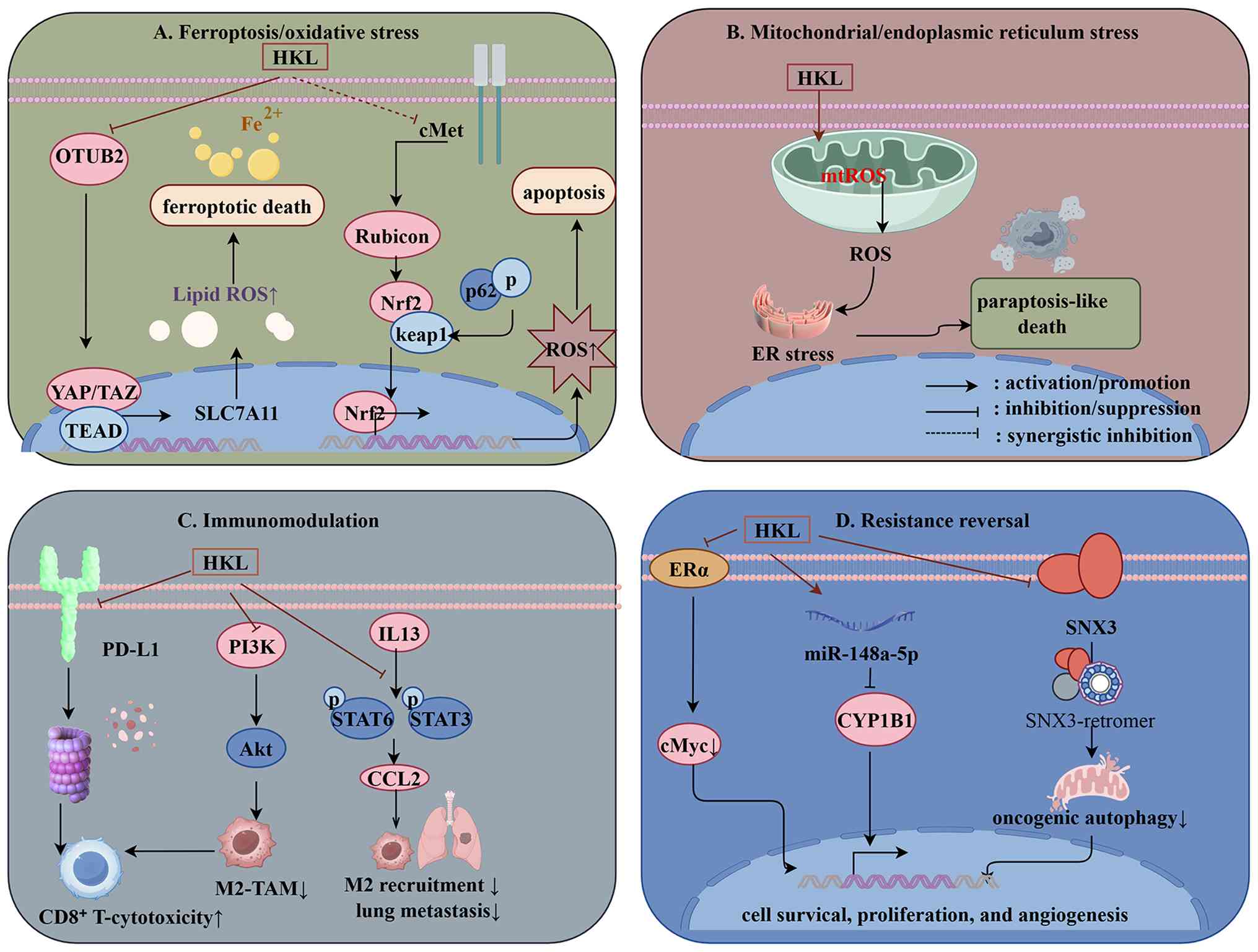 | Figure 2Functional classification of honokiol
anticancer mechanisms. HKL modulates four molecular hubs: (A)
Ferroptosis/oxidative stress: (OTUB2-YAP/TAZ axis,
c-Met-Rubicon-p62-Nrf2 axis) (B) Mitochondrial/endoplasmic
reticulum stress: (paraptosis-like death) (C) Immunomodulation:
(PD-L1, gasdermin E, PI3K, IL-13) (D) Resistance reversal: (ERα,
miR-148a-5p, SNX3). HKL, honokiol; OSCP, oligomycin
sensitivity-conferring protein; YAP, Yes-associated protein; TAZ,
transcriptional coactivator with PDZ-binding motif; Nrf2, nuclear
factor erythroid 2-related factor 2; PD-L1, programmed death-ligand
1; PI3K, phosphatidylinositol 3-kinase; IL, interleukin; ERα,
estrogen receptor alpha; miR, microRNA; SNX3, sorting nexin 3. |
Ovarian cancer. HKL physically occupies the
deubiquitinase OTUB2, silencing YAP/TAZ signaling and inducing a
lipid-ROS burst, Fe²+ overload and classical ferroptotic
death (11). ROS-cleavable micelles
(RC-PH-Ms) loaded with both HKL and paclitaxel, switched
tumor-associated macrophages from the M2 phenotype to the M1
phenotype and inhibited metastatic cells from using the vascular
supply (44). Glutathione-sensitive
HKL polyprodrug nanoparticles (A/P-PHK NP40) bearing EpCAM aptamers
achieved 15% drug loading and tumor-specific release, outperformed
free HKL in cell and xenograft models, and demonstrated greater
inhibitory effects on the growth of ovarian cancer cells (45).
Hepatocellular carcinoma. An amphiphilic
Angelica-polysaccharide-berberine conjugate, ASP-BBR-PM@HKL,
exhibited a high rate of cell inhibition and an excellent antiHCC
effect in subsequent in vivo experiments (46). HKL-generated mtROS accumulate and
diffuse to the endoplasmic reticulum, initiating endoplasmic
reticulum stress and culminating in the paraptosis-like death of
Hep3B cells, an alternative death route bypassing classical
apoptosis resistance (47).
Breast cancer. Du et al (48) developed CD44-targeting MPDA
nanoparticles loaded with HKL and surface-coated with hyaluronic
acid and then combined them with low-dose metformin and
near-infrared photothermal therapy. The nanosystem showed high
stability, biocompatibility, potent in vitro cytotoxicity
and significant in vivo tumor suppression via activation of
cleaved caspase-3/poly ADP ribose polymerase-mediated apoptosis,
offering a promising nanomedicine platform for breast cancer
therapy. By binding to and downregulating estrogen receptor alpha
(ERα), HKL restored trastuzumab sensitivity in
HER2+/ERα+ trastuzumab-resistant HCC1954
cells (49). HKL transcriptionally
upregulated tumor-suppressive miR-148a-5p, downregulated cytochrome
p450 1B1 and potentiated paclitaxel-induced apoptosis in MDA-MB-231
cells (50). HKL blocked
IL-13/signal transducer and activator of transcription 6 (STAT6)
signaling, reduced chemokine (C-C motif) ligand-2 (CCL2) secretion
and thereby decreased the ratio of M2/M1 macrophages in
triple-negative breast tumors, markedly reducing pulmonary
metastasis in vivo (51).
Colorectal cancer. A triple combination of
HKL + magnolol + baicalin triggered GSDME-dependent pyroptosis,
converted ‘cold’ tumors to ‘hot’ tumors and outperformed FOLFIRI
when partnered with antiprogrammed cell death 1 (PD-1) therapy
(52). HKL disrupted the sorting
nexin 3 (SNX3)-retromer complex, impaired oncogenic autophagy and
macropinocytosis and sensitized KRAS(G13D)-mutant colorectal cancer
to cetuximab (53).
Lung cancer. Liposomal HKL suppressed
phosphatidylinositol 3-kinase/Akt signaling, decreased M2-TAM and
MDSC infiltration and increased CD8+ T-cell activity in
lung cancer, indicating superior antiPD-1 efficacy (54). HNK interrupted the IL-1β-triggered
nuclear factor kappa-B (NF-κB)-vascular endothelial growth factor
forward loop and suppressed human umbilical vein endothelial cell
tube formation and tumor angiogenesis in vitro and in
vivo (55). Direct physical
engagement of HKL with PD-L1 accelerated its degradation,
reinvigorated T-cell cytotoxicity and suppressed tumor growth in
C57BL/6 mice (56).
Other malignancies. In nasopharyngeal
carcinoma, the HKL derivative 1g downregulated HIF-1α, MMP-2 and
Bcl-2 expression and suppressed CNE-2Z cell invasion and xenograft
expansion (57). In anaplastic
thyroid cancer, ROS-dependent EMT blockade underlies the
HKL-mediated inhibition of KMH-2 and ASH-3 cell proliferation and
migration (58). HKL combined with
cabozantinib inhibited the c-Met-Rubicon-p62-Nrf2 antioxidant axis,
elevated ROS and triggered renal cell carcinoma (RCC) death
(59).
Together, the capacity of HKL to engage oxidative,
apoptotic, immunologic and resistance-related hubs endows it with a
unique polypharmacologic signature. Coupling these mechanistic
insights with rationally engineered nanocarriers or combination
regimens paves the way toward precision, low-toxicity cancer
therapeutics.
Neurodegeneration
AD is characterized by β-amyloid (Aβ)
overproduction, τ hyperphosphorylation, neuroinflammation and
mitochondrial collapse. HKL crosses the blood-brain barrier and
affects these underlying factors through a coordinated, multilevel
mechanism.
Aβ generation and aggregation. In
streptozotocin-icv rats, HKL reduced the number of hippocampal
Aβ1-42 plaques and neurofibrillary tangles while
restoring memory function in the Morris-water and elevated-plus
mazes. HKL downregulated NF-κB (p65) and reduced AchE and
neuro-inflammatory markers (IL-1β and IL-6), indicating that HKL
interrupted the NF-κB pathway to curb amyloidogenic processing
(60). In silico docking and
cell-free assays revealed that HKL is a nanomolar-to-micromolar
dual inhibitor of β-site amyloid precursor protein cleaving enzyme
1, AChE, glutaminyl cyclase and glycogen synthase kinase-3β. These
results indicate that HKL suppresses Aβ generation, aggregation and
pyro-Glu modification, establishing HKL as a multienzyme blocker
for AD intervention (61).
SIRT3-centered mitochondrial quality control HKL (20
mg/kg) elevated SIRT3 expression in the hippocampi and livers of
APP/PS1 mice. This was associated with increased levels of
insulin-degrading enzyme and SOD2, whereas hepatic LDL
receptor-related protein 1 expression decreased, collectively
reducing Aβ deposition, decreasing aspartate
aminotransferase/alanine aminotransferase ALT levels and restoring
albumin levels. These findings suggest that reinforcement of the
hepatic ‘Aβ-sink’ contributes to central clearance (62). In a hippocampal neuronal AD model,
HKL triggered mitochondrial autophagy, reduced ROS levels and
mitochondrial membrane depolarization and protected against
Aβ-oligomer-induced apoptosis; all these benefits were abolished by
the selective SIRT3 inhibitor 3-TYP or by cyclosporine-A (21).
Neuro-inflammation. Chronic cerebral
hypoperfusion (CCH) rats treated with 1 mg/kg HKL for 21 days
presented restored SIRT3 activity and inhibited STAT3 nuclear
translocation and A1 polarization in the hippocampi. Moreover, the
neuronal and synaptic loss were prevented and spatial memory was
recovered, indicating that HKL ameliorated CCH-induced neurological
damage, at least in part, by modulating the SIRT3-STAT3 axis
(38). Conjugation of HKL to the
mitochondria-targeting peptide XJB produced conjugates that are
less toxic than the parent compound and provide protection on
neuronal injury in vitro and in vivo. These
beneficial effects coincide with elevated SIRT3 activity,
upregulation of the mitochondrial fusion protein mitofusin-1
(Mfn-1), and induction of autophagy. Thus, mitochondria-directed
delivery amplifies the SIRT3-dependent bioactivity of HKL and
offers a promising avenue for the drug development of drugs for AD
(63). Similarly, supplementation
with HKL promotes the survival and growth of iPSC-derived neurons
from a sporadic-AD patient, supporting its potential to promote
neuronal viability in a human disease genotype (64).
From enzyme inhibition to SIRT3-mediated
mitochondrial autophagy and glial modulation, HKL offers a
contiguous, low-toxicity chain of actions that restrains Aβ
genesis, promotes clearance and alleviates neuroinflammation.
Parkinson's disease (PD). HKL affects PD
mainly at three checkpoints. First, HKL-butyrate and related
short-chain-fatty-acyl esters reversibly decrease the abundance of
Enterococcus faecalis, the gut bacterium that converts oral
levodopa to dopamine, thereby increasing central dopamine
bioavailability (65). Second, the
mitochondria-targeted derivative Mito-ortho-HNK amplifies this
microbial brake by suppressing Enterococcus faecalis
proliferation, thereby reducing gut levodopa metabolism and
enhancing brain dopamine levels in levodopa-d3-treated mice
(66). Third, the hybrid analog
HM568 suppresses microglial M1 polarization; downregulates NF-κB
pathway markers; lowers the levels of IL-1β, IL-6 and TNF-α;
protects tyrosine-hydroxylase-positive neurons and reverses motor
deficits in MPTP-PD mice (3). Thus,
HKL and its pro-drugs act as gut-brain axis modulators that
simultaneously suppress peripheral levodopa metabolism, alleviate
neuroinflammation and preserve nigrostriatal function.
Metabolic disorders. Nonalcoholic
steatohepatitis (NASH)
HKL alleviates NAFLD through multiple mechanisms. It
docks onto AMPKγ1, switching on AMPK signaling to suppress
lipogenesis and fibrogenesis in hepatocytes (19). HNK alleviates oxidative stress and
inflammation in metabolic dysfunction-associated fatty liver
disease (MAFLD) by activating the Nrf2 pathway. Nrf2 signaling and
receptor interacting protein kinase 3 (RIPK3)-mediated necroptosis
form a negative feedback axis, playing a key role in MAFLD
progression (67). HKL also
restructures the gut-liver axis, increasing the abundance of
Ruminococcaceae, Caulobacteraceae and Brevundimona,
normalizing serum bile acid and lipid levels, thereby attenuating
steatohepatitis in methionine-choline-deficient C57BL/6 mice
(68). HKL (40 mg/kg) attenuated
liver injury, decreased the activity of the cholesterol-induced
NLRP3-cGAS-STING feed-forward loop and alleviated hepatic fibrosis
(29).
Diabetes syndrome. Obesity is a chronic
metabolic disorder characterized by excessive accretion of adipose
mass that results from the complex interplay of genetic
susceptibility and environmental cues. HKL exerts anti-obesogenic
effects through a polypharmacologic mode of action that
simultaneously engages multiple validated molecular targets and
intersecting signaling pathways, thereby attenuating adiposity and
its downstream complications. HKL alleviated diabetic nephropathy
in high fat diet (HFD)-fed streptozotocin (STZ)-treated rats by
suppressing endoplasmic reticulum-stress signaling
(glucose-regulated protein 78, C/EBP homologous protein, activating
transcription factor 4 and tribbles homolog 3) and Rho-kinase 1/2,
which subsequently reduced oxidative stress and albuminuria and
restored creatinine clearance (69). In diabetic mice, HKL recapitulated
the cardioprotective effects of semaglutide by restoring Raf kinase
inhibitor protein (RKIP) through a SIRT3-dependent mechanism, which
suppressed TANK-binding kinase 1-NF-κB signaling, thereby reducing
cardiac inflammation in an RKIP-dependent manner (70). Retinal microvascular injury was
blocked when HKL promoted SIRT3-mediated mitochondrial fusion and
decreased ROS levels and endothelial apoptosis in db/db mice
(71). Periodontal ligament stem
cells rescued by HKL induced SIRT3-driven deacetylation of leucine
rich pentatricopeptide repeat-containing (LRPPRC), restoring
oxidative phosphorylation and alveolar bone regeneration under high
glucose conditions (72). Cognitive
decline was reversed as HKL disassembled the pathological voltage
dependent anion channel 1-glucose regulated protein 75-inositol
1,4,5-trisphosphate receptor complex and reduced
mitochondria-endoplasmic reticulum contacts in the diabetic mouse
hippocampus via SIRT3(26), whereas
network pharmacology of HKL revealed additional retinoid X receptor
alpha/vitamin D receptor heterodimer activation that restored
autophagy and alleviated depression-like behavior in HFD-fed
diabetic mice (73). Testicular
oxidative stress and polyol-pathway hyperactivity were normalized
by oral HKL (25 mg/kg-¹) in HFD-fed STZ-treated rats,
with no change in testicular weight and a decrease in serum
estradiol (74). In diabetic
cardiorenal co-injury, transcriptomic mining revealed hemoglobin
subunits (hemoglobin subunit α 1/2, hemoglobin subunit β) and
proliferation and apoptosis adaptor protein as shared diabetic
signatures; HKL was predicted to modulate hemoglobin subunits via
molecular docking, pending experimental validation (75). In Dahl salt-sensitive rats,
intraperitoneal administration of HKL at 5 mg/kg/day for 12 weeks
improved the ejection fraction and fractional shortening without
altering blood pressure, heart rate, or body weight; this effect
required SIRT3 and was accompanied by reduced acetylation of MPC1
and increased mitochondrial pyruvate oxidation (76).
Infectious and inflammatory
diseases
HKL has been increasingly recognized for its
broad-spectrum anti-inflammatory activities. Recent studies have
shown that HKL exerts its anti-inflammatory effects through
multiple molecular pathways, including inhibition of the NLRP3
inflammasome, suppression of NF-κB signaling, and modulation of
SIRT3-dependent mitochondrial function. For instance, Hua et
al (27) demonstrated that HKL
markedly inhibited NLRP3 inflammasome activation in Neisseria
gonorrhoeae-infected macrophages, reducing IL-1β secretion and
caspase-1 activity, while preserving mitochondrial integrity and
suppressing ROS production. Similarly, Zhou et al (28) reported that HKL attenuated
silica-induced lung fibrosis by inhibiting macrophage pyroptosis
via the cGAS-STING pathway, highlighting its potential in treating
chronic inflammatory diseases (31). Moreover, Zhou et al (28) reported that HKL activates SIRT3, a
mitochondrial deacetylase that regulates the activity of
anti-oxidant enzymes such as SOD2, thereby reducing mtROS levels
and preventing inflammasome activation. This SIRT3-mediated
mechanism is also involved in the protective effects of HKL against
endothelial dysfunction and fibrosis in models of pulmonary and
renal inflammation. Additionally, Niu et al (77) demonstrated that HKL inhibits
transient receptor potential vanilloid 4 (TRPV4) channels by
targeting the ankyrin repeat domain, contributing to its
anti-inflammatory profile by modulating calcium signaling and
endothelial permeability in inflammatory bowel disease.
HKL has emerged as a broad-spectrum, anti-infective
natural product. Sun et al (78) reported potent synergistic
bactericidal activity against methicillin-resistant
Staphylococcus aureus (MRSA) and E. faecium (VRE)
when combined with β-lactam antibiotics; mechanistic work revealed
that HKL disrupted FtsZ GTPase activity while enhancing its
polymerization, blocked septum formation and ultimately caused cell
death, whereas Galleria mellonella larvae infected with
S. aureus showed markedly improved survival with minimal
systemic toxicity. Ren et al (79) demonstrated that HKL decreased
Streptococcus mutans survival at 30 µg/ml minimum inhibitory
concentration, yet at 15 µg/ml suppressed EPS synthesis,
lactic-acid production and biofilm biomass and downregulated the
expression of the virulence genes gtfB/C/D, comD/E
and ldh without harming human gingival fibroblasts,
indicating its potential as an anticaries agent. Sophorolipid
micelles encapsulating HKL (HKL-SL Ms) developed by Lin et
al (80) disrupted S.
aureus biofilms in vitro by destroying extracellular
polysaccharides, proteins and DNA; reducing planktonic counts by
6.42 log10 CFU/ml; and preventing early biofilm
reformation. In a murine pneumonia model, these micelles decreased
pulmonary bacterial load and inflammation, suggesting that they are
promising formulations for refractory lung infections. Zheng et
al (81) reported that the
combination of HKL with resveratrol exerted synergistic antibiofilm
effects against Porphyromonas gingivalis and
Fusobacterium nucleatum, reducing the levels of matrix
polysaccharides and DNA while downregulating the expression of
biofilm formation genes.
In viral infections, HKL showed promising antiviral
activity against both RNA and DNA viruses. Zhao et al
(82) identified HKL as a key
antiviral component in Zhengqi tablets, a traditional Chinese
medicine formulation, by targeting the 3CL/M Pro of
SARS-CoV-2, thereby inhibiting viral replication. Furthermore, Yang
et al (83) evaluated the
antiviral efficacy of HKL against Micropterus salmoides
rhabdovirus, a pathogen that affects aquaculture. The authors
reported that HKL markedly reduced viral load and cytopathic
effects in infected cells and improved survival rates in infected
fish, suggesting its potential as a natural antiviral agent in
veterinary medicine. HKL protected Vero E6 and human
A549-ACE2/TMPRSS2 cells from SARS-CoV-2-induced cytopathic effects,
reducing viral RNA and infectious titers by up to ~1,000-fold. It
acted at the post-entry step, inhibited multiple SARS-CoV-2
variants including Omicron and blocked the replication of MERS-CoV
and SARS-CoV, demonstrating broad-spectrum anticoronavirus activity
combined with anti-inflammatory properties, warranting further
animal and clinical evaluation (84).
In summary, HKL exerts anti-inflammatory effects and
protects mitochondria by inhibiting the NLRP3, cGAS-STING and NF-κB
pathways and activating SIRT3; it kills drug-resistant bacteria
such as MRSA by blocking FtsZ and disrupting biofilms;
additionally, it targets 3CLpro, which inhibits COVID-19 and its
variants, resulting in broad-spectrum anti-infective activity with
low toxicity.
6. Pharmacokinetics and delivery
innovation
The clinical promise of HKL is hampered by low
aqueous solubility and poor oral bioavailability. To overcome this,
a succession of nano- and chemical strategies has been developed
(Table I).
 | Table ISome delivery systems for the
increasing of the Honokiol bioavailability. |
Table I
Some delivery systems for the
increasing of the Honokiol bioavailability.
| First author/s,
year | Category | Delivery
system | Targeting
mechanism | Key advantage | Major
limitation | (Refs.) |
|---|
| Sampieri-Morán
et al, 2025 |
Nano-formulation | SNEDDS | Lymphatic
transport; bypass first-pass | High oral
bioavailability | High surfactant
content; GI irritation | (85) |
| Liu et al,
2025 |
Nano-formulation | Pt/HKL-NMs | Passive EPR | Synergistic
antitumor potential | Complex
preparation; batch variability | (86) |
| Thakur et
al, 2024 |
Nano-formulation | Flunarizine-HKL
NPs | Dual-drug
co-delivery | Synergistic
vascular targeting | Complex
optimization; scale-up difficulty | (87) |
| He et al,
2024 |
Stimuli-responsive | CD-MOF | GSH-triggered
disulfide cleavage | High loading;
homologous targeting | pH-dependent
stability; complex coating | (88) |
| Liao et al,
2025 |
Stimuli-responsive | Polycyclopho
sphazene Nano-HKL | GSH-responsive
covalent bond cleavage | High plasma
stability; precise release | Potential
degradation toxicity | (89) |
| Wang et al,
2025 |
Stimuli-responsive | ASP-SS-BBR/HKL | GSH-responsive;
dual-delivery | Berberine-HKL
synergy | Unclear metabolic
pathway | (46) |
| Miao et al,
2024 | Mitochondrial | TPP-HKL | ΔΨm-driven
accumulation | Potent
mitochondrial toxicity | Hemolysis risk;
platelet toxicity | (5) |
| Liu et al,
2025 | Mitochondrial | XJB-HKL | mitochondrial inner
membrane affinity | Low cytotoxicity;
SIRT3 activation | Peptide enzymatic
degradation | (63) |
Nanoformulations
Lipophilic active compounds can be dissolved in the
oil core of nanoemulsions (NEs) and be passively transported into
the cells that absorb the NEs. Building on this concept,
Sampieri-Morán et al (85)
prepared both high-energy NE and low-energy self-nanoemulsifying
drug delivery systems (SNEDDS) to orally deliver Magnolia bark
extract; the formulations increased HKL bioavailability 3.47- and
3.98-fold, respectively, with the SNEDDS ((21.7±0.65 nm) and NEs
(119.7±0.47 nm) both showing good stability. Liu et al
(86) co-assembled HKL and
Pt4+ into nanomicelles (Pt/HKL-NMs; 70% encapsulated)
that simultaneously scavenged radicals, suppressed inflammation,
killed bacteria and reduced drug toxicity. Thakur et al
(87) used a QbD-CCD approach to
engineer flunarizine-HKL coloaded cross-linked hybrid nanoparticles
(>75% encapsulation) embedded in a thermoresponsive gel that
released both drugs steadily for at least one month; combined
administration protected zebrafish lateral-line neuromasts from
cisplatin-induced hair-cell loss, outperforming either drug alone
or the approved rescue agent sodium thiosulfate, and offered a new
intratympanic strategy to prevent cisplatin ototoxicity.
Stimuli-responsive carriers
Various drug delivery systems have been developed to
overcome the limitations of platinum-based chemotherapy. Among
them, stimuli-responsive nanocarrier systems, recognized as one of
the most promising strategies, have attracted increasing attention.
For instance, a glutathione-responsive cyclodextrin metal-organic
framework (CD-MOF) loaded with HKL and indocyanine green achieved
94.08% breast tumor suppression in transplanted tumor-bearing mice
under synergistic photochemotherapy (88). In addition, Liao et al
(89) developed ~160 nm
GSH-responsive polyphosphazene Nano-HKL particles by covalently
linking HKL to hexachlorocyclotriphosphazene via a
disulfide-containing linker. The construct remained stable in
plasma and gradually released HKL in the glutathione-rich tumor
microenvironment through disulfide bond reduction. Its
redox-mediated delivery markedly suppresses A375 melanoma xenograft
tumor growth, outperforming free HKL through inducing
G2/M cell cycle arrest and apoptosis and showing no
observable systemic toxicity in major organs. The
polysaccharide-berberine amphiphilic polymer (ASP-SS-BBR) loaded
with HKL can achieve effective glutathione-responsive release.
In vitro and in vivo evidence have both shown that
this polymer can effectively target and inhibit the activity of
hepatocellular carcinoma cells (46). Together, these studies demonstrate
that pH- or GSH-gated HKL nanosystems can safely amplify
therapeutic indices across kingdoms, from soil-borne bacteria to
malignant melanoma.
Mitochondrial targeting
Mitochondrial targeting has emerged as a powerful
strategy to amplify both the anticancer and neuroprotective actions
of HKL. Miao et al (5)
synthesized triphenylphosphonium-HKL conjugates (TPP-HKL) that
accumulated 10-fold in isolated mitochondria and decreased the
IC50 in cisplatin-resistant A549/DDP cells, while
simultaneously reducing systemic hemolysis. In addition, Liu et
al (63) coupled HKL to the
mitochondria-directed XJB peptide; the resulting nanocojugate
retained SIRT3-activating capacity, increased autophagy and
upregulated the expression of the fusion protein Mfn-1, thereby
conferring superior protection against neuronal injury in
vitro and in zebrafish models of Alzheimer's disease at
markedly lower concentrations than those of native HKL. Together,
these studies demonstrate that mitochondrial targeting, whether via
TPP+ or XJB peptide, converts HKL into a more potent,
selective and safer therapeutic for both cancer and
neurodegeneration.
The evolution of HKL delivery systems reflects a
trajectory from basic solubilization to sophisticated targeting.
Nanoformulations (SNEDDS, Pt/HKL-NMs) primarily address the
physicochemical limitations of HKL, enhancing bioavailability but
lacking active targeting. CD-MOF, polyphosphazene, ASP-SS-BBR)
introduce tumor microenvironment-triggered release, improving the
therapeutic index but lacking widespread efficacy.
Mitochondrial-targeted systems represent the current frontier:
TPP-HKL achieves the greatest mitochondrial accumulation but is
associated with hemolysis and platelet dysfunction, whereas XJB-HKL
offers a safer alternative with peptide-mediated targeting;
however, its efficacy is currently validated only in
neurodegenerative models and its peptide stability in vivo
remains to be optimized. No singular system currently offers a
panacea across all the metrics; rational selection depends on the
specific disease context, acceptable toxicity profile, and
administration route.
7. Potential clinical applications
HKL is a low-molecular-weight biphenolic compound
that readily crosses the blood-brain barrier (BBB) and exhibits
pleiotropic bioactivities, conferring translational potential in
several therapeutic areas. It has demonstrated antitumor effects
against lung cancer, breast cancer, prostate cancer and
glioblastoma. Its BBB permeability makes it a particularly
promising candidate for brain malignancies. HKL also has
neuroprotective effects that are relevant to neurodegenerative
diseases, is beneficial for cardiovascular and metabolic disorders,
and possesses anti-inflammatory and analgesic effects that are
applicable to arthritis and periodontitis treatment and nonopioid
pain management.
Several features favor clinical translation. HKL is
derived from a medicinal and edible plant (Magnolia
officinalis), with a relatively favorable toxicity profile.
Advances in nanoformulations, including liposomes, polymeric
micelles and nanoparticles, have substantially improved its
bioavailability despite poor aqueous solubility. Additionally, HKL
acts as a chemosensitizer alongside cisplatin and doxorubicin and
can reverse multidrug resistance. Preliminary evidence from humans
supports some of effects: a randomized, double-blind,
placebo-controlled trial demonstrated that Relora®, a
standardized proprietary extract combining HKL-containing M.
officinalis bark extract with Phellodendron amurense,
markedly reduced salivary cortisol exposure and anxiety symptoms in
moderately stressed adults over a four-week intervention period
(90), Furthermore, early-phase
clinical investigation has progressed beyond preclinical stages in
China, where a Phase I trial (CTR20170822) has been conducted to
evaluate the efficacy of HKL in cancer patients and an additional
registered trial (CTR20240113) is being conducted to examine its
application in a broader therapeutic context, collectively
representing the most advanced clinical development of HKL as an
investigational agent to date.
However, challenges remain. Its short plasma
half-life, rapid metabolism, and poor water solubility create
difficulties in its formulation, particularly for intravenous
administration. Large-scale good laboratory practice
(GLP)-compliant toxicological data are also lacking. A zebrafish
study revealed that 0.6 mg/l HKL caused gill bleaching, liver
hemorrhage and 46% mortality, whereas 0.2 mg/l was largely
nontoxic. High-dose HKL upregulated the expression of
apoptosis-related genes (Bax, caspase-3, caspase-9 and
P53), elevated hepatic TNF-α and ROS levels, and increased
the activity of antioxidant enzymes (catalase), leading to
oxidative stress and tissue necrosis. Low doses, by contrast,
triggered adaptive antioxidant responses with increased
mitochondrial membrane potential. These findings confirm
dose-dependent toxicity and highlight the need for rigorous safety
evaluation (91). Stringent purity
and quality control standards for large-scale manufacturing must
also be established.
Despite encouraging preclinical findings, a
substantial translational gap remains. Typically, in murine
studies, 20-200 mg/kg HKL is administered via intraperitoneal or
intravenous routes, achieving plasma concentrations that may not be
readily attainable in humans at tolerable doses. Much of the
mechanistic evidence has been derived from murine studies. The
transition from DMSO-solubilized preparations to GMP-grade
nanoformulations introduces bioequivalence uncertainties yet to be
characterized in humans. The classification of HKL as a
nutraceutical may complicate investigational new drug filing
strategies, potentially slowing formal clinical development. These
factors may contribute to the limited human pharmacokinetic data,
validated biomarkers, and target engagement evidence currently
available from immortalized cell lines or xenograft models, which
may not fully recapitulate human disease complexity.
Currently, most HKL research remains preclinical and
registered human clinical trials are limited. A systematic search
of ClinicalTrials.gov and the Chinese
Clinical Trial Registry (accessed April 2026) revealed five trials.
These trials cover oncology, neurology, psychiatry and oral health,
yet they all share fundamental limitations that preclude the
establishment of HKL-specific efficacy. Among trials registered on
ClinicalTrials.gov, NCT06566443 (registered 2024,
not yet recruiting) was conducted to evaluate a HKL-containing
dietary supplement in early-stage non-small cell lung cancer
patients with an open-label, preoperative design and safety and
quality-of-life endpoints; its dietary-supplement framing and
confounding constituents preclude the attribution of any efficacy
signal to HKL alone. NCT06672965 (completed 2024) was performed to
investigate an oral HKL formulation for anxiety in a randomized,
double-blind, placebo-controlled trial; however, it was positioned
as an antistress dietary supplement rather than a pharmaceutical
intervention, with HKL doses likely below pharmacologically active
thresholds. NCT00966953 (completed 2008, unpublished) was conducted
to examine an oral health HKL formulation for gingival conditions
in a randomized parallel-group design; this trial assessed local,
topical action rather than systemic absorption, providing no
pharmacokinetic or efficacy data relevant to internal
indications.
In China, a phase I trial (CTR20170822; registered
2017) of liposomal HKL in advanced solid tumors completed initial
enrollment. Full results from this cohort have not appeared in
peer-reviewed literature. Efficacy claims in subsequent papers rely
on indirect citations, making independent verification impossible.
Notably, the indication shifted from broad solid tumors in this
early trial towards recurrent glioblastoma in a subsequently
registered phase II trial (CTR20240113, 2024), suggesting a
strategic pivot toward central nervous system malignancies where
the blood-brain barrier permeability of HKL confers a mechanistic
advantage rather than robust efficacy signals in systemic
cancers.
Collectively, these trials reflect the
multi-indication exploratory potential of HKL but underscore the
absence of large-scale phase III evidence, the predominance of
nutraceutical-framed development and the lack of dose-optimization
studies achieving pharmacologically relevant systemic exposure. No
phase III randomized controlled trial evaluating HKL as a primary
oncologic or neuroprotective intervention has been conducted.
Approval as a standalone prescription drug therefore remains a
distant prospect under current evidence standards. Near-term
applications are likely restricted to premium nutraceuticals with
validated bioavailability enhancement, adjunctive therapeutics in
combination with established chemotherapeutic agents and
nanodelivery-based formulations for CNS indications where
blood-brain barrier permeability provides a distinct,
mechanistically grounded advantage.
Advancing HKL toward clinical validation requires a
phased evidence-building approach (92). Priorities include rigorous human
pharmacokinetic characterization of GMP-grade formulations to
address dose translatability uncertainties, identification of
clinically feasible biomarkers for patient enrichment and
mechanistic early-phase trials with paired biomarker assessments to
confirm target engagement. Only upon completion of these steps
would comparative effectiveness studies against standard-of-care
regimens be informative and cost-effective.
8. Limitations and evidence gaps
Publication bias and selective
reporting
The narrative synthesized in the present review is
predominantly derived from studies reporting positive
pharmacological outcomes, reflecting a well-documented publication
bias in natural product research (93). This bias is not merely theoretical:
Direct evidence exists that HKL inhibited bend3 hemangioma growth
in vitro but failed to affect proliferation in nude mice,
with the authors explicitly noting this negative result as
unpublished data (94). Such
selective publication of positive in vitro findings while
omitting negative in vivo outcomes artificially inflates the
perceived translational potential.
Dose-dependent toxicity and narrow
therapeutic window
Although HKL has favorable safety profiles at
therapeutic doses, converging evidence from in vitro, in
vivo and limited clinical data suggests that its therapeutic
window is critically narrow, raising important concerns for
translational and clinical applications.
In vitro cytotoxicity thresholds vary
considerably across cell lines, complicating the establishment of a
universal safe concentration range. Yang et al (95) demonstrated that liposomal HKL (LH)
did not induce cytotoxicity in hepatocellular carcinoma cell lines
(HepG2, SK-HEP1, and SMCC7721) or normal liver cells (LO2) at
concentrations <40 µmol/l, whereas it did induce cytotoxicity
>60 µmol/l after 24 h of exposure. By contrast, Salgado-Benvindo
et al (84) reported
substantial cytotoxicity in HuH-7 cells at much lower
concentrations, with a 50% reduction in viability (CC50)
at ~20 µmol/l. The two- to threefold variation in these thresholds
reflects inherent cell line differences. It also complicates any
direct translation of in vitro data to in vivo or
clinical settings.
In vivo data add further constraints. A rat
developmental toxicity study reported a NOAEL of 600 µg/kg/day and
embryo-fetal toxicity at 2,000 µg/kg/day, yielding a 3.3-fold
margin (96). In a separate chronic
study, mice given Magnolia officinalis extract equivalent to
2 mg/day HKL for three months showed HKL accumulation in serum,
urine and kidneys, with elevated serum creatinine and blood urea
nitrogen levels and ultrastructural renal damage (97; and
references therein). Notably, similar nephrotoxicity was not
reported in 21- or 90-day subchronic studies (97). Whether this reflects
duration-dependent toxicity, species differences, or formulation
effects remains to be clarified.
Intravenous HKL has been administered to cancer
patients at doses ≤50 mg/kg (98).
In beagle dogs, lethality was reported at 66.7-100.0 mg/kg
(99); in pregnant rats,
developmental toxicity appeared at 2,000 µg/kg/day (96). These values are not normalized for
species differences in metabolism or body surface area. Direct
comparison is therefore not supported by available pharmacokinetic
data.
Oral Magnolia bark extract containing
combined magnolol and HKL at 1-10 mg has been studied in volunteers
over periods ranging from single doses to one year, with no
reported adverse effects attributed to the neolignans (97). The route, formulation, and
indication differ markedly from those in the intravenous
oncological setting.
Safety appears to depend on dose, duration, route
and population. Cumulative nephrotoxicity in rodents emerged only
after three months of exposure (97). Formal dose-escalation trials in
humans are lacking. The maximum tolerated dose remains
undefined.
9. Conclusions
The 2023-2025 research corpus positions HKL as a
prototypical multitarget nutraceutical transitioning toward
pharmaceutical credibility. Mechanistically, HKL can directly bind
to targets such as NLPR3, FGFR1, the AMPK1 subunit, ERα and PD-L1
and exerts its pharmacological effects at the nexus of
mitochondrial homeostasis, inflammasome restraint, and oncogenic
signaling, offering broad-spectrum utility. Contemporary
nanotechnology and medicinal-chemistry efforts have rectified
historical PK liabilities, enabling first-in-human trials. A
coordinated precision-medicine framework that integrates predictive
biomarkers and AI-assisted drug design, will be pivotal for the
success of HKL in modern therapeutics.
Acknowledgements
Not applicable.
Funding
Funding: The present study was supported by Innovation
Agglomeration Zone for Chinese Medicine Industry Project, grant no.
L2024-QCY-ZYYJJQ-X146 and the Key Research Project of the Shaanxi
Provincial Department of Education, grant no. 22JS011.
Availability of data and materials
Not applicable.
Authors' contributions
WJ conceived and designed the review structure;
performed the literature search and data extraction; drafted the
original manuscript; prepared the figures and tables and reviewed
and edited the final version. Data authentication is not
applicable. The author read and approved the final manuscript.
Ethics approval and consent to
participate
Not applicable.
Patient consent for publication
Not applicable.
Competing interests
The author declares that they have no competing
interests.
References
|
1
|
Fujita M, Itokawa H and Sashida Y:
Honokiol, a new phenolic compound isolated from the bark of
Magnolia obovata THUNB. Chem Pharm Bull. 20:212–213. 1972.
|
|
2
|
Li X, Yuan Z, Wang Y, Wang W and Shi J:
Recent advances of honokiol: Pharmacological activities, manmade
derivatives and structure-activity relationship. Eur J Med Chem.
272(116471)2024.PubMed/NCBI View Article : Google Scholar
|
|
3
|
Zhong C, Wang C, Li W, Li W, Chen X, Guo
J, Feng Y and Wu X: A derivative of honokiol HM568 has an
anti-neuroinflammatory effect in Parkinson's disease. Chem Biol
Interact. 403(111212)2024.PubMed/NCBI View Article : Google Scholar
|
|
4
|
Zhang Y, Zhang P, Zhang X and Liu Y: HH-A,
a modified honokiol, protects against cerebral ischemia/reperfusion
induced brain injury in rodent via Nrf2/HO-1 signaling pathways.
Naunyn Schmiedebergs Arch Pharmacol. 397:3389–3402. 2024.PubMed/NCBI View Article : Google Scholar
|
|
5
|
Miao H, Cui W, Zhang T, Zhang Y, Zhang J,
Lou H and Fan P: Mitochondrial targeting derivatives of honokiol
enhanced selective antitumor activity in NCI-H446 cells and
decreased in vivo toxicity in Caenorhabditis elegans. Eur J Med
Chem. 264(115996)2024.PubMed/NCBI View Article : Google Scholar
|
|
6
|
Arnold RE, Saska J, Mesquita-Ribeiro R,
Dajas-Bailador F, Taylor L, Lewis W, Argent S, Shao H, Houk KN and
Denton RM: Total synthesis, biological evaluation and biosynthetic
re-evaluation of Illicium-derived neolignans. Chem Sci.
15:11783–11793. 2024.PubMed/NCBI View Article : Google Scholar
|
|
7
|
Dai SY, Qin WX, Yu S, Li C, Yang YH and
Pei YH: Honokiol and magnolol: A review of structure-activity
relationships of their derivatives. Phytochemistry.
223(114132)2024.PubMed/NCBI View Article : Google Scholar
|
|
8
|
Sasia C, Borgonetti V, Mancini C, Lori G,
Arbiser JL, Taddei ML and Galeotti N: The neolignan honokiol and
its synthetic derivative honokiol hexafluoro reduce
neuroinflammation and cellular senescence in microglia cells.
Cells. 13(1652)2024.PubMed/NCBI View Article : Google Scholar
|
|
9
|
Yang R, Fu X, Fan J, Wang T, Song J, Xu T,
Guo Y and Zhang SY: Semisynthesis and biological evaluation of
novel honokiol thioethers against colon cancer cells HCT116 via
inhibiting the transcription and expression of YAP protein. Bioorg
Med Chem. 107(117762)2024.PubMed/NCBI View Article : Google Scholar
|
|
10
|
Pillai VB, Samant S, Sundaresan NR,
Raghuraman H, Kim G, Bonner MY, Arbiser JL, Walker DI, Jones DP,
Gius D and Gupta MP: Honokiol blocks and reverses cardiac
hypertrophy in mice by activating mitochondrial Sirt3. Nat Commun.
14(6656)2015.PubMed/NCBI View Article : Google Scholar
|
|
11
|
Liu F, Zhang Y, Xia X, Han J and Cao L:
Honokiol induces ferroptosis in ovarian cancer cells through the
regulation of YAP by OTUB2. J Obstet Gynaecol Res. 50:864–872.
2024.PubMed/NCBI View Article : Google Scholar
|
|
12
|
Ma Q, Xu M, Jing X, Qiu J, Huang S, Yan H,
Yin L, Lou J, Zhao L, Fan Y and Qiu P: Honokiol suppresses the
aberrant interactions between renal resident macrophages and
tubular epithelial cells in lupus nephritis through the
NLRP3/IL-33/ST2 axis. Cell Death Dis. 14(174)2023.PubMed/NCBI View Article : Google Scholar
|
|
13
|
Cai X, Jiang X, Zhao M, Su K, Tang MH,
Hong F, Ye N, Zhang R, Li N, Wang L, et al: Identification of the
target protein and molecular mechanism of honokiol in
anti-inflammatory action. Phytomedicine. 109(154617)2023.PubMed/NCBI View Article : Google Scholar
|
|
14
|
Grandi M, Boldrin F, Risato G, Grillini S,
Tiso N, Argenton F, Leonardi E, Tosatto S, Solaini G, Baracca A and
Giorgio V: Honokiol blocks tumor development and metastasis through
mitochondrion-targeted effects. Cell Death Dis.
17(186)2026.PubMed/NCBI View Article : Google Scholar
|
|
15
|
Wu SM, Jan YJ, Tsai SC, Pan HC, Shen CC,
Yang CN, Lee SH, Liu SH, Shen LW, Chiu CS, et al: Targeting histone
deacetylase-3 blocked epithelial-mesenchymal plasticity and
metastatic dissemination in gastric cancer. Cell Biol Toxicol.
39:1873–1896. 2023.PubMed/NCBI View Article : Google Scholar
|
|
16
|
Kim Y, Jang HD, An DH, Lee HS, Kim HG and
Choi SE: Honokiol inhibits colorectal cancer cell growth:
Involvement of Hsp27 as a molecular target. Curr Issues Mol Biol.
47(921)2025.PubMed/NCBI View Article : Google Scholar
|
|
17
|
Lee TY, Chang CC, Lu WJ, Yen TL, Lin KH,
Geraldine P, Li JY and Sheu JR: Honokiol as a specific collagen
receptor glycoprotein VI antagonist on human platelets: Functional
ex vivo and in vivo studies. Sci Rep. 7(40002)2017.PubMed/NCBI View Article : Google Scholar
|
|
18
|
Szymczyk J, Sochacka M, Biadun M,
Sluzalska KD, Witkowska D and Zakrzewska M: . Overcoming drug
resistance of cancer cells by targeting the FGF1/FGFR1 axis with
honokiol or FGF ligand trap. Front Pharmacol.
15(1459820)2024.PubMed/NCBI View Article : Google Scholar
|
|
19
|
Tian R, Yang J, Wang X, Liu S, Dong R,
Wang Z, Yang Z, Zhang Y, Cai Z, Yang H, et al: Honokiol acts as an
AMPK complex agonist therapeutic in non-alcoholic fatty liver
disease and metabolic syndrome. Chin Med. 18(30)2023.PubMed/NCBI View Article : Google Scholar
|
|
20
|
Xiang F, Zhang Z, Li Y, Xia B, Liao Y,
Yang C, He Z, Lin L and Xie J: Honokiol targeting SIRT3: From
molecular mechanisms to therapeutic opportunities. FASEB J.
39(e70798)2025.PubMed/NCBI View Article : Google Scholar
|
|
21
|
Li H, Sun J, Wu Y, Yang Y, Zhang W and
Tian Y: Honokiol relieves hippocampal neuronal damage in
Alzheimer's disease by activating the SIRT3-mediated mitochondrial
autophagy. CNS Neurosci Ther. 30(e14878)2024.PubMed/NCBI View Article : Google Scholar
|
|
22
|
Liao Y, Ke B, Long X, Xu J and Wu Y:
Abnormalities in the SIRT1-SIRT3 axis promote myocardial
ischemia-reperfusion injury through ferroptosis caused by silencing
the PINK1/Parkin signaling pathway. BMC Cardiovasc Disord.
23(582)2023.PubMed/NCBI View Article : Google Scholar
|
|
23
|
Kim JE, Jo MJ, Bae SY, Ahn SY, Ko GJ and
Kwon YJ: Mitochondrial SIRT3 as a protective factor against
cyclosporine A-induced nephrotoxicity. Sci Rep.
14(10143)2024.PubMed/NCBI View Article : Google Scholar
|
|
24
|
Qi XY, Yuan JD, Liu ZY, Jiang XQ, Zhang Q,
Zhang SL, Zhao L, Ke LY, Zhang CY, Li Y, et al: Sirtuin 3-mediated
deacetylation of superoxide dismutase 2 ameliorates sodium
fluoride-induced mitochondrial dysfunction in porcine oocytes. Sci
Total Environ. 908(168306)2024.PubMed/NCBI View Article : Google Scholar
|
|
25
|
Li F, Ye C and Wang X, Li X and Wang X:
Honokiol ameliorates cigarette smoke-induced damage of airway
epithelial cells via the SIRT3/SOD2 signalling pathway. J Cell Mol
Med. 27:4009–4020. 2023.PubMed/NCBI View Article : Google Scholar
|
|
26
|
Chang Y, Wang C, Zhu J, Zheng S, Sun S, Wu
Y, Jiang X, Li L, Ma R and Li G: SIRT3 ameliorates
diabetes-associated cognitive dysfunction via regulating
mitochondria-associated ER membranes. J Transl Med.
21(494)2023.PubMed/NCBI View Article : Google Scholar
|
|
27
|
Hua KF, Hsu HT, Huang MS, Chiu HW, Wong
WT, Peng CH, Lin YB, Chen A, Wang CC, Hsu CH, et al: Honokiol
exhibits anti-NLRP3 inflammasome and antimicrobial properties in
neisseria gonorrhoeae-infected macrophages. J Inflamm Res.
17:3499–3513. 2024.PubMed/NCBI View Article : Google Scholar
|
|
28
|
Zhou Q, Yi G, Chang M, Li N, Bai Y, Li H
and Yao S: Activation of Sirtuin3 by honokiol ameliorates alveolar
epithelial cell senescence in experimental silicosis via the
cGAS-STING pathway. Redox Biol. 74(103224)2024.PubMed/NCBI View Article : Google Scholar
|
|
29
|
Wang Z, Liu J, Mou Y, Zhou X, Liao W, Li Y
and Tang J: Disruption of cholesterol homeostasis triggers
NLRP3-cGAS-STING axis-dependent hepatic fibrosis and honokiol
intervention effects. Phytomedicine. 143(156904)2025.PubMed/NCBI View Article : Google Scholar
|
|
30
|
Pan X, Hua Z, Fan G and Feng Q:
Inflammatory suppression and immunity regulation benefits of
honokiol in a rat model of acute peritonitis via the regulation of
NLRP3 inflammasome and Sirt1/autophagy axis. Histol Histopathol.
39:921–934. 2024.PubMed/NCBI View Article : Google Scholar
|
|
31
|
Zhou Q, Chang M, Guo S, Zhang Y, Qu Q,
Zhou Q, Li Z and Yao S: Honokiol ameliorates silica-induced lung
fibrosis by inhibiting macrophage pyroptosis via modulating
cGAS/STING signaling. Int Immunopharmacol.
146(113812)2025.PubMed/NCBI View Article : Google Scholar
|
|
32
|
Wei Y, Hui VLZ, Chen Y, Han R, Han X and
Guo Y: YAP/TAZ: Molecular pathway and disease therapy. MedComm
(2020). 4(e340)2023.PubMed/NCBI View Article : Google Scholar
|
|
33
|
Wu KY, Liu L, Wu ZH, Huang Q, Xie RJ, Zhou
L and Wang M: Hinokiol regulates the cell cycle and apoptosis of
nasopharyngeal carcinoma CNE1 cells via Hippo-YAP signaling
pathway. Zhonghua Er Bi Yan Hou Tou Jing Wai Ke Za Zhi. 59:621–629.
2024.PubMed/NCBI View Article : Google Scholar : (In Chinese).
|
|
34
|
Liu F, Zhang Y, Xia X, Han J and Cao L:
Honokiol regulates ovarian cancer cell malignant behavior through
YAP/TAZ pathway modulation. J Obstet Gynaecol Res. 50:1010–1019.
2024.PubMed/NCBI View Article : Google Scholar
|
|
35
|
Khodir SA, Sweed EM, El-Haroun H,
Abd-Elhamid TH, El Derbaly SA, Mahmoud AR and Motawea SM: Honokiol
ameliorates reserpine-induced fibromyalgia through antioxidant,
anti-inflammatory, neurotrophic, and anti-apoptotic mechanisms. Sci
Rep. 15(25983)2025.PubMed/NCBI View Article : Google Scholar
|
|
36
|
Fei Y, Zhang X, Wang X, Sun Y, He J, Liu
X, Song Z, Li L, Qiu L, Qian Z, et al: Upregulation of tumor
suppressor PIAS3 by Honokiol promotes tumor cell apoptosis via
selective inhibition of STAT3 tyrosine 705 phosphorylation. J Nat
Med. 78:285–295. 2024.PubMed/NCBI View Article : Google Scholar
|
|
37
|
Chen X, Zhang M, Zhou F, Gu Z, Li Y, Yu T,
Peng C, Zhou L, Li X, Zhu D, et al: SIRT3 activator honokiol
inhibits Th17 cell differentiation and alleviates colitis. Inflamm
Bowel Dis. 29:1929–1940. 2023.PubMed/NCBI View Article : Google Scholar
|
|
38
|
Hu Y, Zhang M, Liu B, Tang Y, Wang Z, Wang
T, Zheng J and Zhang J: Honokiol prevents chronic cerebral
hypoperfusion induced astrocyte A1 polarization to alleviate
neurotoxicity by targeting SIRT3-STAT3 axis. Free Radic Biol Med.
202:62–75. 2023.PubMed/NCBI View Article : Google Scholar
|
|
39
|
Wang XH, Ning ZH, Xie Z, Ou Y, Yang JY,
Liu YX, Huang H, Tang HF, Jiang ZS, Hu HJ, et al: SIRT3/AMPK
signaling pathway regulates lipid metabolism and improves
vulnerability to atrial fibrillation in dahl salt-sensitive rats.
Am J Hypertens. 37:901–908. 2024.PubMed/NCBI View Article : Google Scholar
|
|
40
|
Wei X, Wang Y, Lao Y, Weng J, Deng R, Li
S, Lu J, Yang S and Liu X: Effects of honokiol protects against
chronic kidney disease via BNIP3/NIX and FUNDC1-mediated mitophagy
and AMPK pathways. Mol Biol Rep. 50:6557–6568. 2023.PubMed/NCBI View Article : Google Scholar
|
|
41
|
Lin X, Zhang H, Chu Y, Zhang Y, Xu C, Xie
H, Ruan Q, Lin J, Huang CK and Chai D: Honokiol ameliorates
angiotensin II-induced cardiac hypertrophy by promoting
dissociation of the Nur77-LKB1 complex and activating the AMPK
pathway. J Cell Mol Med. 28(e18028)2024.PubMed/NCBI View Article : Google Scholar
|
|
42
|
Chen Y, Yang Z, Bai J, Wang X, Yuan Q, Mi
Y and Zhang C: Bioactive lignan honokiol alleviates ovarian
oxidative stress in aging laying chickens by regulating SIRT3/AMPK
pathway. Antioxidants (Basel). 13(377)2024.PubMed/NCBI View Article : Google Scholar
|
|
43
|
Chu Y, Gui S, Zheng Y, Zhao J, Zhao Y, Li
Y and Chen X: The natural compounds, Magnolol or Honokiol, promote
adipose tissue browning and resist obesity through modulating
PPARα/γ activity. Eur J Pharmacol. 969(176438)2024.PubMed/NCBI View Article : Google Scholar
|
|
44
|
Zhang L, Guo R, Chen M, Liu M, Liu Y, Yu
Y, Zang J, Kong L and Li X: Inhibition of ovarian cancer growth,
metastasis and reverse the tumor microenvironment by dual
drug-loaded polymer micelle targeting tumor microenvironment. Int J
Nanomedicine. 20:2969–2990. 2025.PubMed/NCBI View Article : Google Scholar
|
|
45
|
Guo C, Cheng X, Yang Y, Wang L, Wang W and
Shao L: Aptamer-modified GSH-degradable honokiol polyprodrug
nanoparticles for ovarian cancer-specific targeting therapy. Bioorg
Med Chem Lett. 123(130215)2025.PubMed/NCBI View Article : Google Scholar
|
|
46
|
Wang B, Lv B, Li H, Zhang J, Ding Y, Zhou
J, Bu M, Fan L and Han C: Design of self-assembled micelles based
on natural dual-targeting strategies and evaluation of their
anti-liver cancer effects as drug delivery systems. NPJ Precis
Oncol. 9(82)2025.PubMed/NCBI View Article : Google Scholar
|
|
47
|
Kim SY and Choi YH: Honokiol induces
paraptosis-like cell death through mitochondrial ROS-dependent
endoplasmic reticulum stress in hepatocellular carcinoma Hep3B
cells. Toxicol Res. 4:385–396. 2025.PubMed/NCBI View Article : Google Scholar
|
|
48
|
Du Q, Zhang Q, Li J, Wang X, Gao X, Tan G,
Feng Q, Li J, Meng Y and Yu Y: Enhanced integrated therapy for
breast cancer employing Honokiol-loaded mesoporous polydopamine
nanoparticles in conjunction with photothermal effects and low-dose
metformin. APL Bioeng. 9(016115)2025.PubMed/NCBI View Article : Google Scholar
|
|
49
|
Putra IMR, Lestari IA, Fatimah N, Hanif N,
Ujiantari NSO, Putri DDP and Hermawan A: Bioinformatics and in
vitro study reveal ERα as the potential target gene of honokiol to
enhance trastuzumab sensitivity in HER2+ trastuzumab-resistant
breast cancer cells. Comput Biol Chem. 111(108084)2024.PubMed/NCBI View Article : Google Scholar
|
|
50
|
Han X, Cheng Y, Jiang Z, Alu A and Ma X:
Honokiol exhibits anti-tumor effects in breast cancer by modulating
the miR-148a-5p-CYP1B1 axis. Am J Chin Med. 52:1843–1861.
2024.PubMed/NCBI View Article : Google Scholar
|
|
51
|
Mei M, Tang L, Zhou H, Xue N and Li M:
Honokiol prevents lung metastasis of triple-negative breast cancer
by regulating polarization and recruitment of macrophages. Eur J
Pharmacol. 959(176076)2023.PubMed/NCBI View Article : Google Scholar
|
|
52
|
Gao Q, Sheng Q, Yang Z, Zhu Z, Li L, Xu L,
Xia J, Qiao Y, Gu J, Zhu X, et al: Honokiol-Magnolol-Baicalin
possesses synergistic anticancer potential and enhances the
efficacy of Anti-PD-1 immunotherapy in colorectal cancer by
triggering GSDME-dependent pyroptosis. Adv Sci (Weinh).
12(e2417022)2025.PubMed/NCBI View Article : Google Scholar
|
|
53
|
Zhu Q, Zhang R, Gu X, Zhao Z, Gao Q, Chen
M, Wu Q, Xie T and Sui X: Honokiol enhances the sensitivity of
cetuximab in KRASG13D mutant colorectal cancer through destroying
SNX3-retromer complex. Theranostics. 14:5443–5460. 2024.PubMed/NCBI View Article : Google Scholar
|
|
54
|
Cheng Y, Han X, Lai X and Wei X: Liposomal
honokiol inhibits non-small cell lung cancer progression and
enhances PD-1 blockade via suppressing M2 macrophages polarization.
Phytomedicine. 135(156093)2024.PubMed/NCBI View Article : Google Scholar
|
|
55
|
Cheng X, Wang F, Qiao Y, Chen T, Fan L,
Shen X, Yu D, Huang Y and Wei M: Honokiol inhibits
interleukin-induced angiogenesis in the NSCLC microenvironment
through the NF-κB signaling pathway. Chem Biol Interact.
370(110295)2023.PubMed/NCBI View Article : Google Scholar
|
|
56
|
Luo L, Wu T, Ji M, Xiang J, Zou Y and Liao
Y: Honokiol suppress the PD-L1 expression to improve anti-tumor
immunity in lung cancer. Int Immunopharmacol.
133(112098)2024.PubMed/NCBI View Article : Google Scholar
|
|
57
|
Li BH, Ma H, Zhu J, Chen J, Dai YQ, Zhang
XJ, Li HM and Wu CZ: Semisynthesis and anti-cancer properties of
novel honokiol derivatives in human nasopharyngeal carcinoma CNE-2Z
cells. J Enzyme Inhib Med Chem. 38(2244694)2023.PubMed/NCBI View Article : Google Scholar
|
|
58
|
Liao KS, Lee YR, Chao WY, Huang YJ, Chung
HC, Chen SH, Li YZ, Zhao PW and Chang HY: Honokiol suppresses cell
proliferation and tumor migration through ROS in human anaplastic
thyroid cancer cells. Endocr Metab Immune Disord Drug Targets: Apr
24, 2024 (Epub ahead of print).
|
|
59
|
Rawat L, Balan M, Sasamoto Y, Sabarwal A
and Pal S: A novel combination therapy with Cabozantinib and
Honokiol effectively inhibits c-Met-Nrf2-induced renal tumor growth
through increased oxidative stress. Redox Biol.
68(102945)2023.PubMed/NCBI View Article : Google Scholar
|
|
60
|
Singh L and Singh S: Neuroprotective
potential of Honokiol in ICV-STZ induced neuroinflammation, Aβ
(1-42) and NF-kB expression in experimental model of rats. Neurosci
Lett. 799(137090)2023.PubMed/NCBI View Article : Google Scholar
|
|
61
|
Youn K and Jun M: Determination of
potential lead compound from magnolia officinalis for Alzheimer's
disease through pharmacokinetic prediction, molecular docking,
dynamic simulation, and experimental validation. Int J Mol Sci.
25(10507)2024.PubMed/NCBI View Article : Google Scholar
|
|
62
|
Wang H, Liu J, Tian YR, Zhu F and Li H:
The effects of Honokiol on the liver of Alzheimer's disease mice by
upregulating SIRT3. J Alzheimers Dis. 107:641–652. 2025.PubMed/NCBI View Article : Google Scholar
|
|
63
|
Liu G, Zhang T, Qian S, Zhang X, Lou H and
Fan P: Conjugation with the XJB peptide enhanced neuroprotective
effect of honokiol via SIRT3 modulation. Eur J Med Chem.
289(117460)2025.PubMed/NCBI View Article : Google Scholar
|
|
64
|
Le DTT, Vu CM, Ly TTB, Nguyen NT, Nguyen
PTM and Chu HH: Effect of Honokiol on culture time and survival of
Alzheimer's disease iPSC-derived neurons. Bioimpacts.
14(27652)2024.PubMed/NCBI View Article : Google Scholar
|
|
65
|
Cheng G, Hardy M, Feix JB and Kalyanaraman
B: Inhibition of levodopa metabolism to dopamine by honokiol
short-chain fatty acid derivatives may enhance therapeutic efficacy
in Parkinson's disease. Sci Rep. 15(20004)2025.PubMed/NCBI View Article : Google Scholar
|
|
66
|
Cheng G, Hardy M, Hillard CJ, Feix JB and
Kalyanaraman B: Mitigating gut microbial degradation of levodopa
and enhancing brain dopamine: Implications in Parkinson's disease.
Commun Biol. 7(668)2024.PubMed/NCBI View Article : Google Scholar
|
|
67
|
Cao W, Chen Z, Lin C, Lin X, Chen Y and
Zhang J: Honokiol mitigates metabolic-associated fatty liver
disease by regulating Nrf2 and RIPK3 signaling pathways. Turk J
Gastroenterol. 35:551–559. 2024.PubMed/NCBI View Article : Google Scholar
|
|
68
|
Zhai T, Wang J and Chen Y: Honokiol
affects the composition of gut microbiota and the metabolism of
lipid and bile acid in methionine-choline deficiency diet-induced
NASH mice. Sci Rep. 13(15203)2023.PubMed/NCBI View Article : Google Scholar
|
|
69
|
Rather IA, Khan N, Kushwah AS, Surampalli
G and Kumar M: Nephroprotective effects of honokiol in a high-fat
diet-streptozotocin rat model of diabetic nephropathy. Life Sci.
320(121543)2023.PubMed/NCBI View Article : Google Scholar
|
|
70
|
Lin K, Wang A, Zhai C, Zhao Y, Hu H, Huang
D, Zhai Q, Yan Y and Ge J: Semaglutide protects against
diabetes-associated cardiac inflammation via Sirt3-dependent RKIP
pathway. Br J Pharmacol. 182:1561–1581. 2025.PubMed/NCBI View Article : Google Scholar
|
|
71
|
Shi J, Liu M, Zhao J, Tan Y and Jiang C:
Honokiol protects against diabetic retinal microvascular injury via
sirtuin 3-mediated mitochondrial fusion. Front Pharmacol.
15(1485831)2024.PubMed/NCBI View Article : Google Scholar
|
|
72
|
Tang H, Zhou Y, Ma L, Ye Y, Xiao QX, Tang
JQ and Xu Y: SIRT3 alleviates mitochondrial dysfunction and
senescence in diabetes-associated periodontitis by deacetylating
LRPPRC. Free Radic Biol Med. 227:407–419. 2025.PubMed/NCBI View Article : Google Scholar
|
|
73
|
Sun H, Liu Y, Wang X and Shu L: A network
pharmacology-based method to explore the therapeutic effect of
honokiol on diabetes with comorbid depression in mice. Eur J
Pharmacol. 975(176642)2024.PubMed/NCBI View Article : Google Scholar
|
|
74
|
Szałabska-Rąpała K, Zych M, Borymska W,
Londzin P, Dudek S and Kaczmarczyk-Żebrowska I: Beneficial effect
of honokiol and magnolol on polyol pathway and oxidative stress
parameters in the testes of diabetic rats. Biomed Pharmacother.
172(116265)2024.PubMed/NCBI View Article : Google Scholar
|
|
75
|
Liu Y, Chen M, Zhu C and Guo D:
Transcriptome analysis of serum biomarker, shared gene signature
and pharmacological targets between diabetic cardiomyopathy and
nephropathy. Biochem Biophys Rep. 43(102194)2025.PubMed/NCBI View Article : Google Scholar
|
|
76
|
Zhao Y, Lu Z, Zhang H, Wang L, Sun F, Li
Q, Cao T, Wang B, Ma H, You M, et al: Sodium-glucose exchanger 2
inhibitor canagliflozin promotes mitochondrial metabolism and
alleviates salt-induced cardiac hypertrophy via preserving SIRT3
expression. J Adv Res. 70:255–269. 2025.PubMed/NCBI View Article : Google Scholar
|
|
77
|
Niu L, Wang S, Xu Y, Zu X, You X, Zhang Q,
Zhuang P, Jiang M, Gao J, Hou X, et al: Honokiol targeting ankyrin
repeat domain of TRPV4 ameliorates endothelial permeability in mice
inflammatory bowel disease induced by DSS. J Ethnopharmacol.
325(117825)2024.PubMed/NCBI View Article : Google Scholar
|
|
78
|
Sun N, Zhi Z, Xiao T, Deng X, He T, Dong
W, Feng S, Chen S, Wong WL and Yuan W: The study of honokiol as a
natural product-based antimicrobial agent and its potential
interaction with FtsZ protein. Front Microbiol.
15(1361508)2024.PubMed/NCBI View Article : Google Scholar
|
|
79
|
Ren S, Yang Y, Xia M, Deng Y, Zuo Y, Lei L
and Hu T: A Chinese herb preparation, honokiol, inhibits
Streptococcus mutans biofilm formation. Arch Oral Biol.
147(105610)2023.PubMed/NCBI View Article : Google Scholar
|
|
80
|
Lin S, Li X, Zhang W, Shu G,
Tolker-Nielsen T, Li H, Xu F, Lin J, Peng G, Zhang L and Fu H:
Enhanced penetration and biofilm eradication by sophorolipid
micelles encapsulating Honokiol: A comprehensive solution for
biofilm-associated lung infections. J Nanobiotechnology.
23(76)2025.PubMed/NCBI View Article : Google Scholar
|
|
81
|
Zheng S, Deng R, Huang G, Ou Z and Shen Z:
Effects of honokiol combined with resveratrol on bacteria
responsible for oral malodor and their biofilm. J Oral Microbiol.
16(2361402)2024.PubMed/NCBI View Article : Google Scholar
|
|
82
|
Zhao Y, Yu S, Ye W, Lin G, Gao D and Zhang
J: Mechanistic insights into the dual anti-COVID-19 and
anti-inflammatory actions of Zhengqi tablets. J Ethnopharmacol.
352(120249)2025.PubMed/NCBI View Article : Google Scholar
|
|
83
|
Yang F, Yang B, Song K, Jin Y, Wang G, Li
P, Yu Q and Ling F: Natural product honokiol exhibits antiviral
effects against Micropterus salmoides rhabdovirus (MSRV) both in
vitro and in vivo. J Fish Dis. 47(e13915)2024.PubMed/NCBI View Article : Google Scholar
|
|
84
|
Salgado-Benvindo C, Leijs AA, Thaler M,
Tas A, Arbiser JL, Snijder EJ and van Hemert MJ: Honokiol inhibits
SARS-CoV-2 replication in cell culture at a post-entry step.
Microbiol Spectr. 11(e0327322)2023.PubMed/NCBI View Article : Google Scholar
|
|
85
|
Sampieri-Morán JM, Bravo-Alfaro DA,
Uribe-Lam E, Luna-Barcenas G, Montiel-Sánchez M, Velasco-Rodríguez
LDC, Acosta-Osorio AA, Ferrer M and García HS: Delivery of Magnolia
bark extract in nanoemulsions formed by high and low energy methods
improves the bioavailability of Honokiol and Magnolol. Eur J Pharm
Biopharm. 208(114627)2025.PubMed/NCBI View Article : Google Scholar
|
|
86
|
Liu C, Cao Z, Li L, Li Q, Zhang C, Wang Y,
Li L and Fu P: Self-Assembled Pt/Honokiol nanomicelles for the
treatment of sepsis-associated acute kidney injury. ACS Biomater
Sci Eng. 11:383–401. 2025.PubMed/NCBI View Article : Google Scholar
|
|
87
|
Thakur NS, Rus I, Herbert A, Zallocchi M,
Chakrabarty B, Joshi AD, Lomeo J and Agrahari V: Crosslinked-hybrid
nanoparticle embedded in thermogel for sustained co-delivery to
inner ear. J Nanobiotechnology. 22(482)2024.PubMed/NCBI View Article : Google Scholar
|
|
88
|
He Y, Guo J, Ding H, Lin M, Wu Y, He Z,
Wang Z, Xia Q, Zhu C, Zhang Y and Feng N: Glutathione-responsive
CD-MOFs co-loading honokiol and indocyanine green biomimetic active
targeting to enhance photochemotherapy for breast cancer. Int J
Pharm. 660(124310)2024.PubMed/NCBI View Article : Google Scholar
|
|
89
|
Liao D, Yang Y, Xiong S, Feng J, Zou C,
Peng H, Yang X, Zhang SL, Wang ZP, He Y and Huang C: Self-assembled
GSH-responsive polycyclophosphazene loaded honokiol nano-drug for
enhanced cancer therapy. Colloids Surf B Biointerfaces.
255(114876)2025.PubMed/NCBI View Article : Google Scholar
|
|
90
|
Talbott SM, Talbott JA and Pugh M: Effect
of Magnolia officinalis and Phellodendron amurense (Relora®) on
cortisol and psychological mood state in moderately stressed
subjects. J Int Soc Sports Nutr. 10(37)2013.PubMed/NCBI View Article : Google Scholar
|
|
91
|
Lin J, Liu H, Huang X and Deng Y:
Toxicological effects of Honokiol on zebrafish and its underlying
mechanism. J Biochem Mol Toxicol. 38(e23789)2024.PubMed/NCBI View Article : Google Scholar
|
|
92
|
Sorkin BC, Kuszak AJ, Bloss G, Fukagawa
NK, Hoffman FA, Jafari M, Barrett B, Brown PN, Bushman FD, Casper
SJ, et al: Improving natural product research translation: From
source to clinical trial. FASEB J. 34:41–65. 2020.PubMed/NCBI View Article : Google Scholar
|
|
93
|
Fanelli D, Costas R and Ioannidis JP:
Meta-assessment of bias in science. Proc Natl Acad Sci USA.
114:3714–3719. 2017.PubMed/NCBI View Article : Google Scholar
|
|
94
|
Fried LE and Arbiser JL: Honokiol, a
multifunctional antiangiogenic and antitumor agent. Antioxid Redox
Signal. 11:1139–1148. 2009.PubMed/NCBI View Article : Google Scholar
|
|
95
|
Yang J, Pei H, Luo H, Fu A, Yang H, Hu J,
Zhao C, Chai L, Chen X, Shao X, et al: Non-toxic dose of liposomal
honokiol suppresses metastasis of hepatocellular carcinoma through
destabilizing EGFR and inhibiting the downstream pathways.
Oncotarget. 8:915–932. 2017.PubMed/NCBI View Article : Google Scholar
|
|
96
|
Zhang Q, Ye X, Wang L, Peng B, Zhang Y,
Bao J, Li W, Wei J, Wang A, Jin H and Chen S: Embryo-fetal
development toxicity of honokiol microemulsion intravenously
administered to pregnant rats. Regul Toxicol Pharmacol. 74:117–122.
2016.PubMed/NCBI View Article : Google Scholar
|
|
97
|
Sarrica A, Kirika N, Romeo M, Salmona M
and Diomede L: Safety and toxicology of magnolol and honokiol.
Planta Med. 84:1151–1164. 2018.PubMed/NCBI View Article : Google Scholar
|
|
98
|
Eliaz I and Weil E: Intravenous honokiol
in drug-resistant cancer: two case reports. Integr Cancer Ther.
19(1534735420922615)2020.PubMed/NCBI View Article : Google Scholar
|
|
99
|
Qin X, Yin J, Zhang W, Li J, Wen J and
Chen S: Acute and subchronic toxicities in dogs and genotoxicity of
honokiol microemulsion. Regul Toxicol Pharmacol. 95:362–370.
2018.PubMed/NCBI View Article : Google Scholar
|

















