Introduction
Renal tumors, which consist of renal cell carcinoma
(RCC; 80-85%) and upper tract urothelial carcinoma (UTUC; 5-10%),
represent the second most common type of urological cancer
(1). Although both originate in the
kidney, these malignancies develop from distinct anatomical sites
and require different treatment approaches. RCC is typically
managed with partial nephrectomy for small tumors (preferred
treatment for tumors sized ≤4 cm in maximal dimension, optional
treatment for tumor sized >4 to ≤10 cm in maximal dimension), or
radical nephrectomy for larger tumors (preferred treatment for
tumor sized >10 cm in maximal dimension) or more advanced
disease (tumor extension beyond kidney boundary). By contrast, the
gold standard for UTUC is radical nephroureterectomy with bladder
cuff excision, while kidney-sparing surgery and endoscopic
management may be considered for selected low-risk UTUC to minimize
morbidity and preserve renal function (2-5).
Current diagnostic approaches for differentiating RCC from UTUC
include urine cytology, contrast-enhanced imaging of the upper
urinary tract and more invasive procedures, such as
ureterorenoscopy (URS) or flexible URS, with or without biopsy
(6,7). Therefore, accurate preoperative
diagnosis of RCC and UTUC is essential for appropriate treatment
planning and improving patient outcomes.
At present, preoperative hematological markers, such
as neutrophil-to-lymphocyte ratio (NLR), platelet-to-lymphocyte
ratio (PLR) and white blood cell (WBC) count, are increasingly
recognized as important biomarkers in the diagnosis and prognosis
of several cancers, such as gastric (8), breast (9) and prostate cancer (10). These markers reflect the balance
between systemic inflammation and immune response, which play
crucial roles in cancer development and progression. NLR, PLR and
WBC count are simple and low-cost indicators that can be obtained
from routine blood tests. Elevated levels of NLR and PLR have been
associated with the presence of various cancers as well as with
poorer clinical outcomes, such as reduced survival rates and
increased risk of metastasis (11,12).
Because these preoperative parameters are easily accessible and
affordable, they have notable potential to support cancer diagnosis
and guide clinical decision-making in patients with cancer.
Currently, machine learning (ML) techniques play an
important role in healthcare, especially in cancer (13). ML can be used to improve the
accuracy of cancer diagnosis (14)
and to predict recurrence (15) and
mortality (16). Our previous
studies demonstrated that integrative bioinformatics and ML
approaches can effectively identify potential biomarkers for clear
cell RCC (ccRCC). Insulin-like growth factor-binding protein 3 and
galectin 1 were identified as promising secreted biomarkers for
ccRCC diagnosis (17). In addition,
NADH dehydrogenase (ubiquinone) 1 alpha subcomplex 4-like 2,
dopamine transporter 1 and fatty acid binding protein 7 were
demonstrated as potential biomarkers for distinguishing ccRCC and
non-ccRCC (18,19). However, the application of
hematological markers, such as NLR, PLR and WBC count, in
differentiating RCC from UTUC remains unclear.
Therefore, the present study aimed to develop and
evaluate a ML model using preoperative hematological markers and
clinical data to differentiate RCC from UTUC. A panel of ML
algorithms, combined with feature selection, was used to explore
the diagnostic potential of blood-derived biomarkers as a
non-invasive, low-cost adjunct to current diagnostic methods, to
support preoperative decision-making in clinical practice for
patients with renal cancer.
Materials and methods
Samples from patients with RCC and
UTUC
The current retrospective study analyzed data from
the electronic medical records of patients with RCC and UTUC who
visited Srinagarind Hospital, Faculty of Medicine, Khon Kaen
University (Khon Kaen, Thailand) from January 2013 to December
2024. Inclusion criteria were patients with histopathologically
confirmed RCC or UTUC who underwent surgical treatment at the same
hospital during the study period. Exclusion criteria included
patients who did not undergo surgery at the study hospital, those
with missing preoperative hematological data and those with
incomplete clinical data before or after treatment. The collected
data included age and sex (presented in the results section),
pathological diagnosis (RCC or UTUC) and hematological parameters
obtained from preoperative blood tests. The parameters used in the
present study, including age, NLR, PLR, platelet (PLT) count, WBC
count, neutrophil percentage (NE %), lymphocyte percentage (LY %)
and diagnosis, are shown in Table
I.
 | Table IClinical and hematological features
used for machine learning model development. |
Table I
Clinical and hematological features
used for machine learning model development.
| Variable | Role | Units |
|---|
| Agea | Feature | Years |
| NLR | Feature | N/A |
| PLR | Feature | N/A |
| WBC count | Feature |
x103/µl |
| PLT count | Feature |
x103/µl |
| NE % | Feature | % |
| LY % | Feature | % |
|
Diagnosisb | Classification | N/A |
The present study was conducted in accordance with
The Declaration of Helsinki and the International Council for
Harmonization Good Clinical Practice guidelines (20). All patient information was
confidential and presented in a format that prevents individual
identification. The study protocol was approved by the Ethics
Committee for Human Research of Khon Kaen University (approval no.
HE671739). As this was a retrospective study using only
de-identified clinical data, with no prospective data collection or
patient contact, the requirement for informed consent was waived by
the Ethics Committee.
Python library
All analyses were performed in Python (version
3.11.5; https://www.python.org). ML models were
implemented using scikit-learn (version 1.4.1), class imbalance was
addressed with the imbalanced-learn library (version 0.12.2) and
gradient-boosted tree models were implemented with XGBoost (version
2.0.3). Data handling and numerical computations were performed
using pandas (version 2.1.4), NumPy (version 1.24.3) and SciPy
(version 1.11.1). Figures were generated with matplotlib (version
3.10.0) and seaborn (version 0.12.2).
Feature selection
Feature selection is a critical step in the
development of ML models, as it helps reduce model complexity and
improve predictive performance. In the current study, feature
selection was performed using Recursive Feature Elimination with
Cross-Validation (RFECV) based on a Random Forest classifier. RFECV
was applied to the complete set of available features, ranking them
according to the impurity-based feature importance estimated by the
Random Forest model. The algorithm then iteratively removed the
least important feature at each step. After each elimination, the
reduced feature subset was evaluated using 10-fold stratified
cross-validation, and the subset yielding the highest mean
cross-validation accuracy was selected as the optimal feature set.
To avoid data leakage, RFECV was fitted on the training data
only.
ML model construction
A total of 23 supervised ML algorithms, including
linear models (logistic regression, ridge classifier, ridge
classifier with built-in cross-validation, stochastic gradient
descent, perceptron and passive-aggressive), support vector
machines [support vector classifier (SVC), Nu-SVC and linear SVC],
nearest-neighbor (k-nearest neighbors), decision trees (decision
tree and extra tree), ensemble methods (random forest, extra trees,
gradient boosting, AdaBoost, bagging and XGBoost), naïve Bayes
(Gaussian and Bernoulli), discriminant analysis (linear and
quadratic) and CalibratedClassifierCV, were used to classify RCC
and UTUC based on preoperative hematological parameters. The model
was constructed using a dataset comprising 115 patients with RCC
and 57 patients with UTUC. To address the class imbalance between
RCC and UTUC, feature standardization and the Synthetic Minority
Oversampling Technique (SMOTE; sampling strategy=0.8,
k_neighbors=5) were combined into a single pipeline fitted to the
training data with cross-validation. These steps were fitted on the
training data of each fold and were not applied to the testing
data. The dataset was divided into a training set (70%) and a
testing set (30%) using stratified sampling (stratified by
diagnosis) with a fixed random seed (random_state=42) to preserve
class proportions and ensure reproducibility. Model comparison and
hyperparameter tuning were performed on the training set using
grid-search with 10-fold stratified cross-validation, and the
best-performing models were evaluated on the held-out test set
using accuracy, balanced accuracy, precision, recall, F1 score and
the area under the receiver operating characteristic curve
(AUC).
Statistical analysis
Statistical analysis was conducted using Python
libraries, including NumPy, SciPy, pandas and statsmodels (version
0.14.0), as aforementioned. The Shapiro-Wilk test was employed to
evaluate the normality of data distribution. Data are presented as
frequencies or mean ± SD, minimum and maximum values. For
comparison of group means, independent Student's t-tests were
applied to normally distributed data, while Mann-Whitney U tests
were used for non-normally distributed data. P<0.05 was
considered to indicate a statistically significant difference.
Results
Demographic characteristics of the
study population
A total of 172 patients with renal cancer were
included in the present study. This total comprised 115 cases
(66.9%) of RCC and 57 cases (33.1%) of UTUC. The study population
consisted of 109 men (63.4%) and 63 women (36.6%). The mean age of
all patients was 61.2±12.4 years (range 20-87 years). Patients with
RCC were significantly younger than patients with UTUC
(P<0.001). The mean age of male patients with RCC was 58.6±10.8
years compared with 68.1±10.0 years for male patients with UTUC.
Similarly, female patients with RCC had a mean age of 56.4±14.3
years, while female patients with UTUC had a mean age of 68.2±9.3
years.
The mean preoperative hematological parameters for
all patients were as follows: NLR of 5.61±6.10; PLR of
213.26±132.48; WBC count of 8,918.37 cells/µl; PLT count of
286,982.56 cells/µl; NE % of 68.34%; and LY % of 21.75%.
Statistical analysis using the Mann-Whitney U test showed no
significant differences between the RCC and UTUC groups in the
hematological parameters (NLR, PLR, WBC, PLT, NE % and LY %;
Table II). The feature selection
process was performed using RFECV based on a Random Forest
classifier. Hyperparameter tuning was performed using grid search
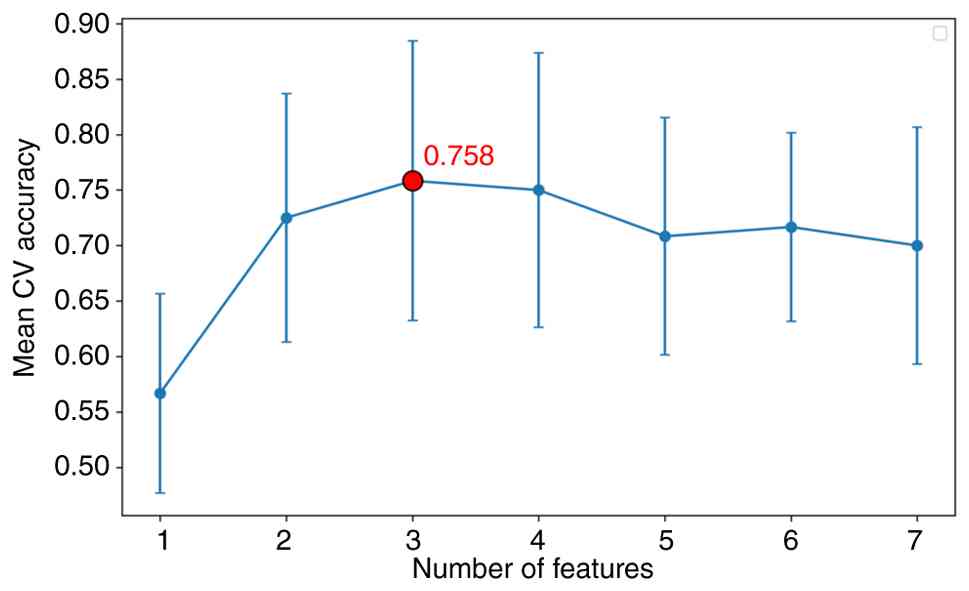
with cross-validation. As shown in Fig.
1, three features, including age, WBC count and PLR, were
determined to be the most important features for an effective
model. This optimal feature set from RFECV achieved a test-set
accuracy of 73.08%, with a precision of 0.76 for RCC and 0.64 for
UTUC, a recall of 0.89 for RCC and 0.41 for UTUC, and F1 scores of
0.82 for RCC and 0.50 for UTUC.
| Table IIComparison of preoperative
hematological parameters between patients with RCC and UTUC. |
Table II
Comparison of preoperative
hematological parameters between patients with RCC and UTUC.
| | | P-value |
|---|
| Variable | RCC group | UTUC group | Shapiro-Wilk test
(RCC) | Shapiro-Wilk test
(UTUC) | Mann-Whitney U
test |
|---|
| NLR | 5.389±5.819 | 6.047±6.659 | <0.001 | <0.001 | 0.578 |
| PLR | 208.604±122.427 | 222.647±151.494 | <0.001 | <0.001 | 0.745 |
| WBC count
x103/µl | 8.890±3.789 | 8.976±4.279 | <0.001 | <0.001 | 0.607 |
| PLT count
x103/µl |
291.539±106.013 |
277.789±109.631 | <0.001 | <0.010 | 0.313 |
| NE % | 67.918±15.356 | 69.195±13.989 | <0.050 | 0.212 | 0.693 |
| LY % | 22.019±11.718 | 21.204±12.003 | <0.001 | <0.050 | 0.563 |
To further explore the distribution and
relationships between the selected features, a pair plot of all
features (age, NLR, PLR, WBC count, PLT count, NE % and LY %)
categorized by diagnosis (RCC vs. UTUC) was generated (Fig. 2). Among these features, RFECV
retained age, PLR and WBC count as the optimal subset for
classification. Age showed the clearest separation between groups,
with the density plots indicating that patients with UTUC were
typically older than patients with RCC. Inflammatory markers showed
only modest, non-significant differences between groups (Table II). In the density plots, patients
with UTUC tended to have higher PLR values and NE % than patients
with RCC, even though a few individual patients with RCC had the
highest values shown in the scatter plots, likely because the RCC
group was larger. For WBC count, the distributions of the two
groups largely overlapped, with comparable dispersion, although a
small number of patients with RCC had the highest values.
Similarly, the density curves for PLT count were similar in shape
and range for both groups, indicating substantial overlap between
RCC and UTUC.
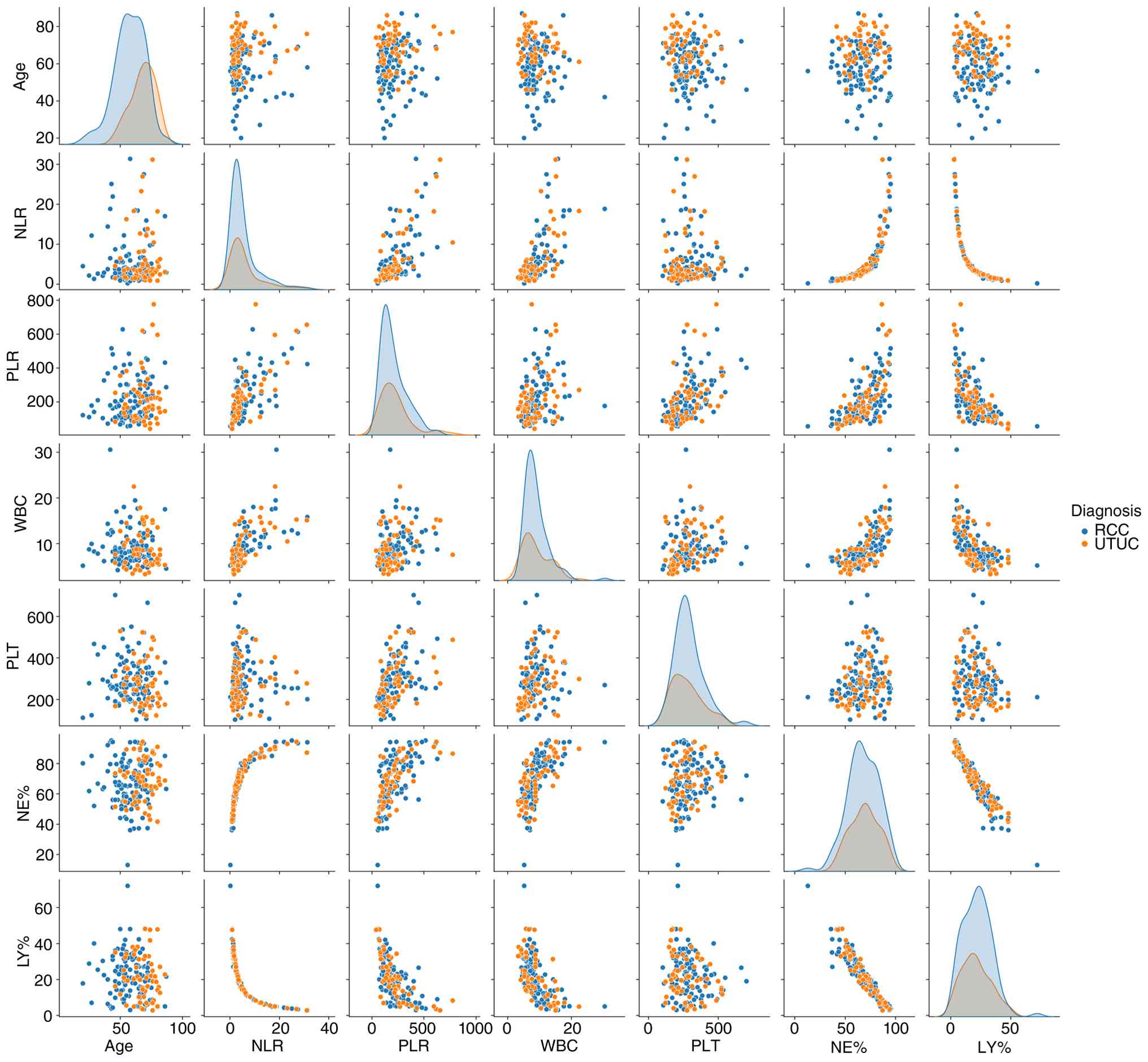 | Figure 2Pair plot of all features. The
diagonal shows the distribution of individual features, while the
scatter plots in the off-diagonal display show pairwise
relationships between variables, color-coded by diagnosis (RCC in
blue, UTUC in orange). NLR, neutrophil-to-lymphocyte ratio; PLR,
platelet-to-lymphocyte ratio; WBC, white blood cell; PLT, platelet;
NE, neutrophil; LY, lymphocyte; RCC, renal cell carcinoma; UTUC,
upper tract urothelial carcinoma. |
Classification model for differential
diagnosis of RCC and UTUC
To address the class imbalance between RCC and UTUC,
SMOTE was applied to the training data within a cross-validation
pipeline to prevent data leakage. A total of 23 supervised ML
algorithms were screened to develop classification models to
differentiate RCC from UTUC. The performance of all 23 candidate
models was first screened using accuracy, balanced accuracy,
precision, recall, F1 score and AUC values from 10-fold
cross-validation on the training set (Fig. 3); the top six models were then tuned
and evaluated on the held-out test set (Table III and Fig. 4). Among the algorithms evaluated,
the Extra Trees classifier showed the most favorable overall
performance on the test set, with an accuracy of 75.0%, a balanced
accuracy of 0.71 and an AUC value of 0.755. The confusion matrix
for the Extra Trees model (Fig. 4A)
showed that of the 35 patients with RCC in the test set, 29 were
correctly classified as RCC, and of the 17 patients with UTUC, 10
were correctly classified as UTUC. Several other models achieved
broadly comparable discrimination, with AUC values clustered
0.71-0.72 (Fig. 4B), whereas the
remaining algorithms performed less consistently. To assess the
robustness of these estimates, the Extra Trees model was further
evaluated using out-of-bag bootstrap resampling (1,000 iterations).
The bootstrap results were consistent with the test performance,
with a mean accuracy of 0.73 (95% CI, 0.64-0.82), a balanced
accuracy of 0.66 (95% CI, 0.56-0.76) and an AUC value of 0.71 (95%
CI, 0.59-0.83).
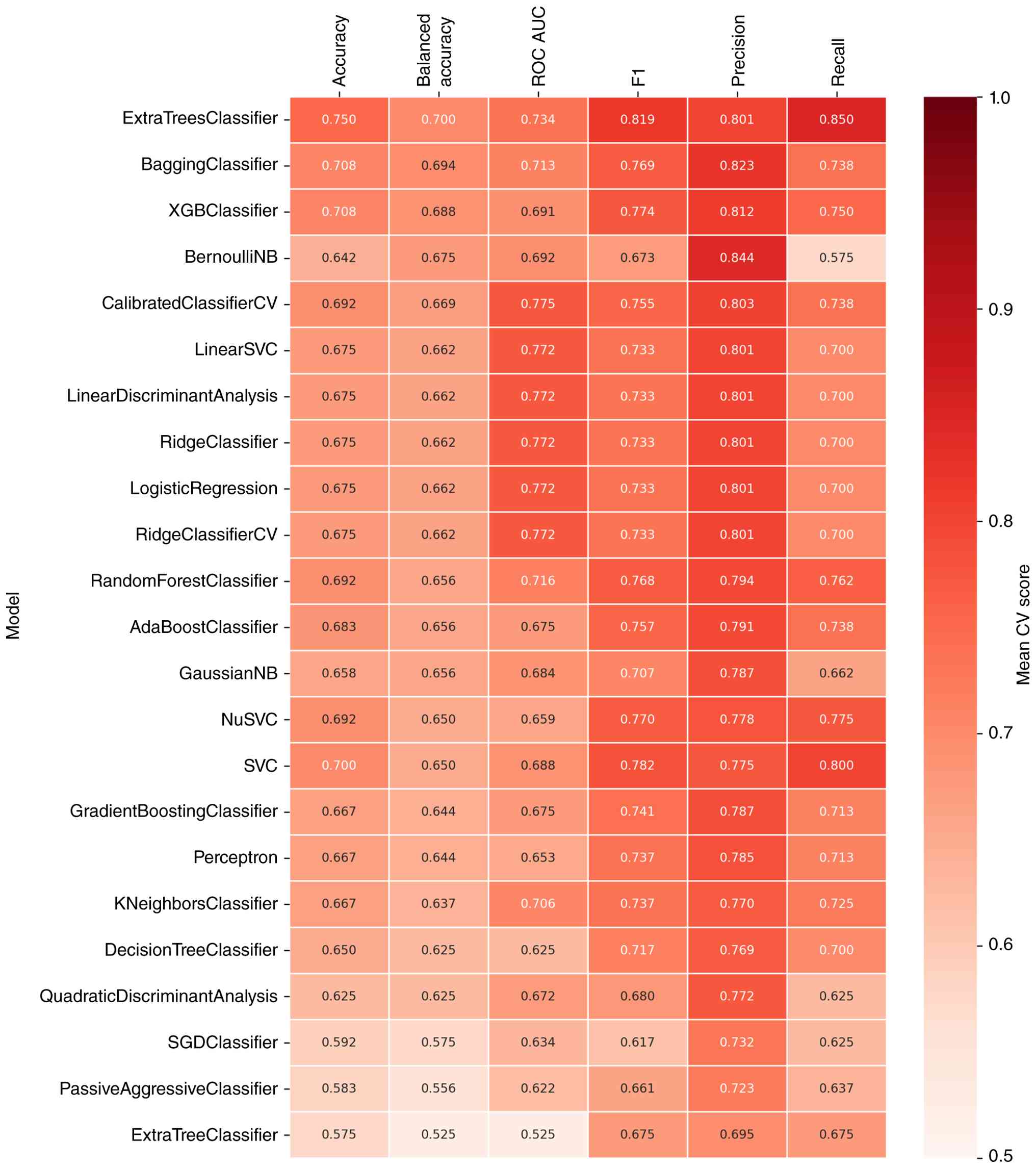 | Figure 3Performance comparison of machine
learning classifiers for differentiating renal cell carcinoma from
upper tract urothelial carcinoma. Each row represents a classifier
and each column a performance metric, including accuracy, balanced
accuracy, ROC AUC, F1 score, precision and recall. Values represent
the mean scores obtained from stratified 10-fold cross-validation
on the training set. Cell colors are scaled according to the mean
cross-validation score. ROC AUC, receiver operating characteristic
area under the curve; CV, cross-validation; SVC, support vector
classifier; NB, naïve Bayes; XGB, extreme gradient boosting; SGD,
stochastic gradient descent. |
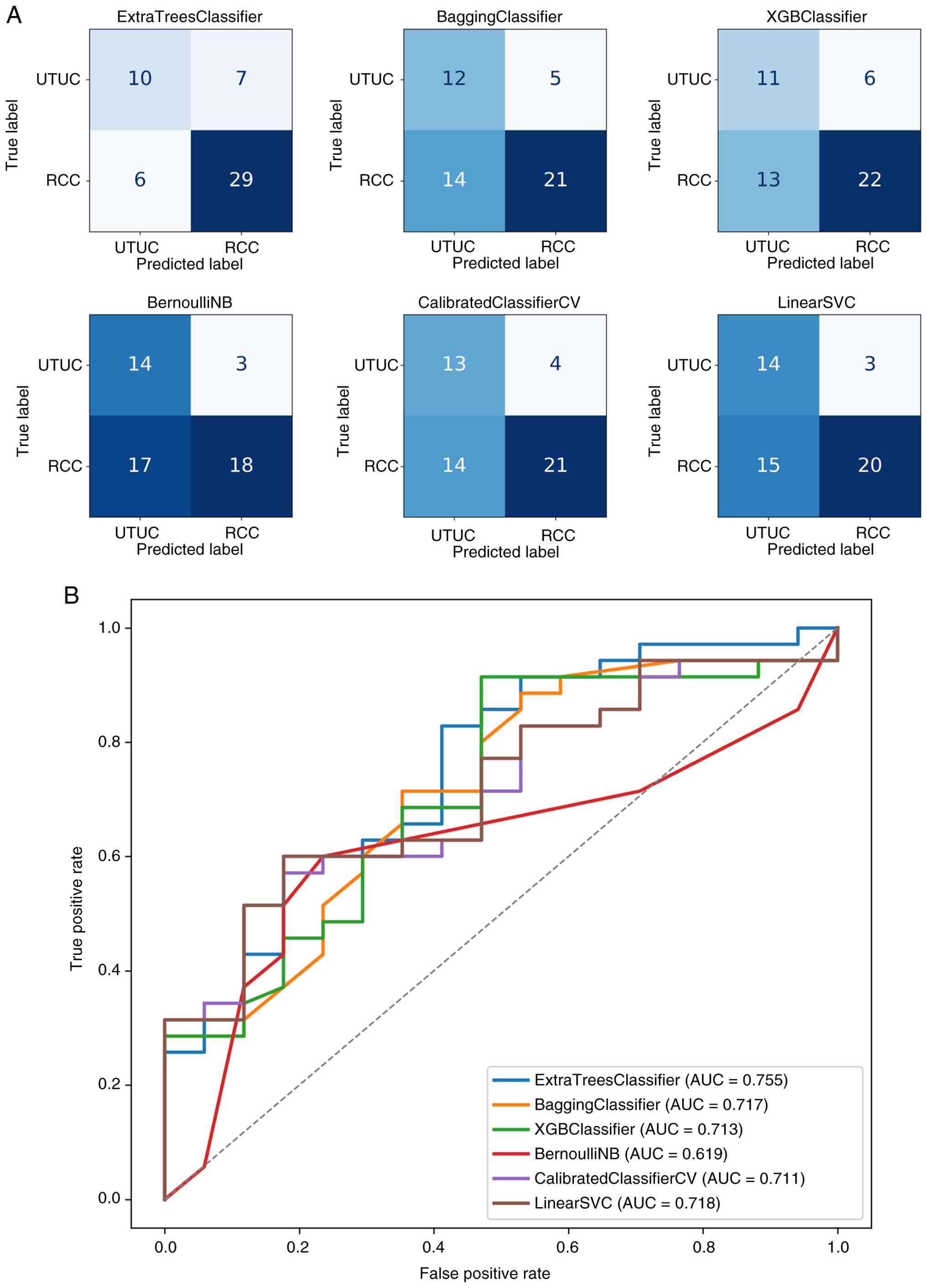 | Figure 4Performance of six supervised machine
learning models for the differential diagnosis of RCC and UTUC. (A)
Confusion matrices for the top six supervised ML algorithms,
including ExtraTreesClassifier, BaggingClassifier, XGBClassifier,
BernoulliNB, CalibratedClassifierCV and LinearSVC. Rows represent
the actual diagnosis, and columns represent the predicted
diagnosis. (B) ROC curves and AUC scores of six ML algorithms for
the differential diagnosis of RCC and UTUC based on clinical and
preoperative hematological data. ROC, receiver operating
characteristic; AUC, area under the ROC curve; ML, machine
learning; RCC, renal cell carcinoma; UTUC, upper tract urothelial
carcinoma; CV, cross-validation; SVC, support vector classifier;
NB, naïve Bayes; XGB, extreme gradient boosting. |
| Table IIIPerformance comparison of top six
supervised machine learning algorithms for differentiating between
RCC and UTUC using preoperative hematological and clinical
data. |
Table III
Performance comparison of top six
supervised machine learning algorithms for differentiating between
RCC and UTUC using preoperative hematological and clinical
data.
| | | Precision | Recall | F1 score |
|---|
| Model | Accuracy, % | Balanced accuracy,
% | AUC | RCC | UTUC | RCC | UTUC | RCC | UTUC |
|---|
| ETC | 75.00 | 70.8 | 0.755 | 0.806 | 0.625 | 0.829 | 0.588 | 0.817 | 0.606 |
| BC | 63.46 | 65.3 | 0.717 | 0.808 | 0.462 | 0.600 | 0.706 | 0.689 | 0.558 |
| XGB | 63.46 | 63.8 | 0.713 | 0.786 | 0.458 | 0.629 | 0.647 | 0.698 | 0.537 |
| BNB | 61.54 | 66.9 | 0.619 | 0.857 | 0.452 | 0.514 | 0.824 | 0.643 | 0.583 |
| CCCV | 65.38 | 68.2 | 0.711 | 0.840 | 0.481 | 0.600 | 0.765 | 0.700 | 0.591 |
| LSVC | 65.38 | 69.7 | 0.718 | 0.870 | 0.483 | 0.571 | 0.824 | 0.690 | 0.609 |
Discussion
The development of a non-invasive and low-cost tool
for differentiating RCC from UTUC has notable clinical implications
because RCC and UTUC require distinct treatment approaches. RCC is
typically managed with partial or radical nephrectomy, whereas UTUC
requires radical nephroureterectomy with bladder cuff excision
(5,21). In unresectable or metastatic cases,
UTUC may be managed with palliative chemotherapy and radiotherapy.
By contrast, RCC is relatively resistant to conventional
chemotherapy and radiotherapy. Systemic treatments, such as
targeted therapy or immunotherapy, are therefore often considered
for RCC treatment (6,7). Misdiagnosis may lead to inappropriate
treatment and, consequently, poorer outcomes for these patients.
However, to the best of our knowledge, no preoperative blood-based
biomarker panel has been widely accepted for distinguishing RCC
from UTUC in clinical practice.
Both RCC and UTUC are associated with alterations in
systemic inflammatory markers with different underlying mechanisms.
In RCC, an elevated NLR is considered to result from dysregulation
of the hypoxia-inducible factor pathway. This dysregulation leads
to increased production of pro-inflammatory cytokines, such as
IL-6, IL-8, TNF-α and granulocyte-macrophage colony-stimulating
factor, that promote neutrophilia and may suppress lymphocyte
counts and function (22). An
elevated NLR has been associated with advanced tumor stages, higher
nuclear grades and poorer survival outcomes in patients with RCC
(23-25).
Similarly, an elevated PLR has emerged as an important prognostic
factor in RCC. Multiple studies have consistently shown that higher
PLR is associated with decreased overall survival, cancer-specific
survival and progression-free survival (26,27).
In UTUC, alterations in NLR, PLR and WBC count are influenced by
tumor-associated inflammation, changes in the immune
microenvironment (T-cell-depleted tumor immune contexture and
altered programmed death-ligand 1 expression) and genomic
alterations (fibroblast growth factor receptor 3 mutations, TP53
mutations and DNA mismatch repair deficiency/microsatellite
instability) (28,29). The distinct mechanisms underlying
alterations in hematological parameters in RCC and UTUC suggest
that these markers may be useful for differentiating between the
two tumor types.
However, the present study revealed no statistically
significant differences in individual hematological parameters
between patients with RCC and UTUC. This finding suggests that
single hematological parameters alone may be insufficient to
differentiate RCC from UTUC. More advanced analytical approaches,
such as ML, may therefore be required to identify the complex,
multivariable patterns across these markers that could improve
diagnostic accuracy.
The integration of routine preoperative
hematological markers with ML algorithms for cancer diagnosis and
prognosis has been reported in several types of cancer, such as
oral squamous cell carcinoma (30),
colorectal cancer (31) and
cervical cancer (32). However, to
the best of our knowledge, no previous study has used preoperative
hematological markers together with ML to distinguish RCC from
UTUC. In the present study, ML models based on preoperative
hematological markers and clinical data were used to differentiate
between RCC and UTUC. After feature selection, age and the
hematological markers PLR and WBC count were retained as the most
informative predictors. The Extra Trees model demonstrated the best
overall performance, with an accuracy of 75.0% and an AUC value of
0.755. This level of performance does not exceed that of
established imaging techniques. Contrast-enhanced CT has been
reported to achieve a sensitivity of 85-95% and a specificity of
75-85% for RCC detection (33,34),
while offering 80-90% sensitivity and 70-80% specificity for UTUC.
Rather than replacing gold-standard diagnostic methods, a ML model
based on routinely available blood parameters may serve as a
simple, non-invasive and low-cost tool. A ML model could provide
additional information to support preoperative assessment and
complement conventional diagnostic workflows.
Certain limitations should be acknowledged. The
present study was retrospective and conducted at a single center
with a relatively small sample size. The findings require external
validation on larger, multicenter datasets to confirm the model's
robustness. Moreover, the models were trained on a class-imbalanced
dataset in which UTUC cases were underrepresented. In addition, a
further limitation concerns SMOTE. In the training set of 120
patients (80 patients with RCC, 40 patients with UTUC), a sampling
strategy of 0.80 generated 24 synthetic UTUC samples. Because SMOTE
interpolates between neighboring minority cases, the resulting
values may not preserve the interdependence of hematological
variables. This may not fully reflect real biological relationships
among variables and may affect model generalizability. For these
reasons, the present work should be regarded as a proof-of-concept
study rather than a clinically applicable diagnostic classifier.
Further evaluation using data from multicenter studies will be
needed to assess clinical utility before implementation. In
addition, combining these blood-based markers with imaging or other
clinical features may further improve model performance in future
work.
In the present proof-of-concept study, ML models
based on preoperative hematological markers and clinical data were
developed to differentiate RCC from UTUC. Among the algorithms
evaluated, the Extra Trees model showed the most favorable
performance with an accuracy of 75.0%, a balanced accuracy of 0.71
and an AUC value of 0.755. These preliminary findings suggest that
ML approaches using readily available blood parameters may serve as
supportive information to complement conventional imaging and
histopathological evaluation in differentiating RCC from UTUC.
However, multicenter studies with larger and more balanced cohorts,
together with external validation, are needed before the clinical
applicability of the proposed ML models can be established.
Acknowledgements
Not applicable.
Funding
Funding: The present study was supported by a grant from the
Fundamental Fund of Khon Kaen University, under the National
Science, Research and Innovation Fund, Thailand (grant no.
161843).
Availability of data and materials
The data generated in the present study may be
requested from the corresponding author.
Authors' contributions
KN participated in conceptualization, data curation,
reviewing and editing the manuscript and study supervision. CP was
involved in acquisition of data and data curation. KS was involved
in methodology, data curation, data analysis, interpretation of
data and writing the original draft. SS participated in
conceptualization, methodology, writing the original draft, study
supervision and funding acquisition. WS was involved in
conceptualization, methodology, data curation, data analysis,
interpretation of data, writing the original draft, reviewing and
editing the manuscript and study supervision. KN and KS confirm the
authenticity of all the raw data. All authors read and approved the
final manuscript.
Ethics approval and consent to
participate
The present study was approved by the Ethics
Committee for Human Research of Khon Kaen University (approval no.
HE671739). The requirement for informed consent was waived by the
Ethics Committee due to the retrospective nature of the study.
Patient consent for publication
Not applicable.
Competing interests
The authors declare that they have no competing
interests.
Use of artificial intelligence tools
During the preparation of this work, artificial
intelligence tools (ChatGPT; OpenAI) were used to improve the
readability and language of the manuscript, and subsequently, the
authors revised and edited the content produced by the artificial
intelligence tools as necessary, taking full responsibility for the
ultimate content of the present manuscript.
References
|
1
|
Siegel RL, Miller KD, Wagle NS and Jemal
A: Cancer statistics, 2023. CA Cancer J Clin. 73:17–48.
2023.PubMed/NCBI View Article : Google Scholar
|
|
2
|
Qi N, Chen Y, Gong K and Li H: Concurrent
renal cell carcinoma and urothelial carcinoma: Long-term follow-up
study of 27 cases. World J Surg Oncol. 16(16)2018.PubMed/NCBI View Article : Google Scholar
|
|
3
|
Upfill-Brown A, Lenis AT, Faiena I,
Salmasi AH, Johnson DC, Pooli A, Drakaki A, Gollapudi K, Blumberg
J, Pantuck AJ and Chamie K: Treatment utilization and overall
survival in patients receiving radical nephroureterectomy versus
endoscopic management for upper tract urothelial carcinoma:
Evaluation of updated treatment guidelines. World J Urol.
37:1157–1164. 2019.PubMed/NCBI View Article : Google Scholar
|
|
4
|
Rouprêt M, Babjuk M, Burger M, Capoun O,
Cohen D, Compérat EM, Cowan NC, Dominguez-Escrig JL, Gontero P,
Hugh Mostafid A, et al: European association of urology guidelines
on upper urinary tract urothelial carcinoma: 2020 update. Eur Urol.
79:62–79. 2021.PubMed/NCBI View Article : Google Scholar
|
|
5
|
Doehn C, Grunwald V, Steiner T, Follmann
M, Rexer H and Krege S: The diagnosis, treatment, and follow-up of
renal cell carcinoma. Dtsch Arztebl Int. 113:590–596.
2016.PubMed/NCBI View Article : Google Scholar
|
|
6
|
Bex A, Ghanem YA, Albiges L, Bonn S, Campi
R, Capitanio U, Dabestani S, Hora M, Klatte T, Kuusk T, et al:
European association of urology guidelines on renal cell carcinoma:
The 2025 update. Eur Urol. 87:683–696. 2025.PubMed/NCBI View Article : Google Scholar
|
|
7
|
Masson-Lecomte A, Birtle A, Pradere B,
Capoun O, Compérat E, Domínguez-Escrig JL, Liedberg F, Makaroff L,
Mariappan P, Moschini M, et al: European association of urology
guidelines on upper urinary tract urothelial carcinoma: Summary of
the 2025 update. Eur Urol. 87:697–716. 2025.PubMed/NCBI View Article : Google Scholar
|
|
8
|
Nguyen MLT, Pham C, Le QV, Nham PLT, Tran
DH, Le TS, Hoang VT, Can VM, Nguyen LT and Bui KC: The diagnostic
and prognostic value of neutrophil-to-lymphocyte ratio and
platelet-to-lymphocyte ratio on gastric cancer patients. Medicine
(Baltimore). 102(e34357)2023.PubMed/NCBI View Article : Google Scholar
|
|
9
|
Yang DL, Wang HY, Aisimutula D, Zhao J,
Zhu QM, Li J, Li HF and Gao XL: Diagnostic role of the
neutrophil-to-lymphocyte ratio and the platelet-to-lymphocyte ratio
in breast cancer: A systematic review and meta-analysis. Oncol
Lett. 29(41)2024.PubMed/NCBI View Article : Google Scholar
|
|
10
|
Huszno J, Kolosza Z, Mrochem-Kwarciak J,
Telka E, Jochymek B and Miszczyk L: Role of neutrophil-lymphocyte
ratio, platelet-lymphocyte ratio, lymphocyte-monocyte ratio and
platelets in prognosis of patients with prostate cancer. Oncol
Lett. 24(305)2022.PubMed/NCBI View Article : Google Scholar
|
|
11
|
Gao Y, Wang WJ, Zhi Q, Shen M, Jiang M,
Bian X, Gong FR, Zhou C, Lian L, Wu MY, et al:
Neutrophil/lymphocyte ratio is a more sensitive systemic
inflammatory response biomarker than platelet/lymphocyte ratio in
the prognosis evaluation of unresectable pancreatic cancer.
Oncotarget. 8:88835–88844. 2017.PubMed/NCBI View Article : Google Scholar
|
|
12
|
Jia W, Yuan L, Ni H, Xu B and Zhao P:
Prognostic value of platelet-to-lymphocyte ratio,
neutrophil-to-lymphocyte ratio, and lymphocyte-to-white blood cell
ratio in colorectal cancer patients who received neoadjuvant
chemotherapy. Technol Cancer Res Treat.
20(15330338211034291)2021.PubMed/NCBI View Article : Google Scholar
|
|
13
|
Kourou K, Exarchos KP, Papaloukas C,
Sakaloglou P, Exarchos T and Fotiadis DI: Applied machine learning
in cancer research: A systematic review for patient diagnosis,
classification and prognosis. Comput Struct Biotechnol J.
19:5546–5555. 2021.PubMed/NCBI View Article : Google Scholar
|
|
14
|
Zhu SL, Dong J, Zhang C, Huang YB and Pan
W: Application of machine learning in the diagnosis of gastric
cancer based on noninvasive characteristics. PLoS One.
15(e0244869)2020.PubMed/NCBI View Article : Google Scholar
|
|
15
|
Zhou L, Hong H, Chu F, Chen X and Wang C:
Predicting the recurrence of ovarian cancer based on machine
learning. Cancer Manag Res. 16:1375–1387. 2024.PubMed/NCBI View Article : Google Scholar
|
|
16
|
Li X, Zhou Z, Zhang X, Cheng X, Xing C and
Wu Y: Predicting 3-year all-cause mortality in rectal cancer
patients based on body composition and machine learning. Front
Nutr. 12(1473952)2025.PubMed/NCBI View Article : Google Scholar
|
|
17
|
Seubwai W, Sangkhamanon S and Zhang X:
Identification of IGFBP3 and LGALS1 as potential secreted
biomarkers for clear cell renal cell carcinoma based on
bioinformatics analysis and machine learning. Adv Clin Exp Med.
34:1649–1659. 2025.PubMed/NCBI View Article : Google Scholar
|
|
18
|
Panwoon C, Seubwai W, Thanee M and
Sangkhamanon S: Identification of novel biomarkers to distinguish
clear cell and non-clear cell renal cell carcinoma using
bioinformatics and machine learning. PLoS One.
19(e0305252)2024.PubMed/NCBI View Article : Google Scholar
|
|
19
|
Panwoon C, Seubwai W, Thanee M and
Sangkhamanon S: FABP7: A potential diagnostic and prognostic
biomarker for clear cell renal cell carcinoma. In Vivo.
38:2912–2920. 2024.PubMed/NCBI View Article : Google Scholar
|
|
20
|
World Medical Association. World medical
association declaration of Helsinki: Ethical principles for medical
research involving human participants. JAMA. 333:71–74.
2025.PubMed/NCBI View Article : Google Scholar
|
|
21
|
Leow JJ, Liu Z, Tan TW, Lee YM, Yeo EK and
Chong YL: Optimal management of upper tract urothelial carcinoma:
Current perspectives. Onco Targets Ther. 13:1–15. 2020.PubMed/NCBI View Article : Google Scholar
|
|
22
|
Thompson AAR, Binham J, Plant T, Whyte MKB
and Walmsley SR: Hypoxia, the HIF pathway and neutrophilic
inflammatory responses. Biol Chem. 394:471–477. 2013.PubMed/NCBI View Article : Google Scholar
|
|
23
|
Widz D, Mitura P, Buraczynski P, Plaza P,
Bar M, Cabanek M, Nowak G, Ostrowska A and Bar K: Preoperative
neutrophil-lymphocyte ratio as a predictor of overall survival in
patients with localized renal cell carcinoma. Urol J. 17:30–35.
2020.PubMed/NCBI View Article : Google Scholar
|
|
24
|
Hu K, Lou L, Ye J and Zhang S: Prognostic
role of the neutrophil-lymphocyte ratio in renal cell carcinoma: A
meta-analysis. BMJ Open. 5(e006404)2015.PubMed/NCBI View Article : Google Scholar
|
|
25
|
Pedersen MM, Donskov F, Pedersen L, Zhang
ZF and Norgaard M: Elevated neutrophil-lymphocyte ratio combined
with hyponatremia indicate poor prognosis in renal cell carcinoma.
Acta Oncol. 59:13–19. 2020.PubMed/NCBI View Article : Google Scholar
|
|
26
|
Zhou X and Luo G: A meta-analysis of the
platelet-lymphocyte ratio: A notable prognostic factor in renal
cell carcinoma. Int J Biol Markers. 37:123–133. 2022.PubMed/NCBI View Article : Google Scholar
|
|
27
|
Wang X, Su S and Guo Y: The clinical use
of the platelet to lymphocyte ratio and lymphocyte to monocyte
ratio as prognostic factors in renal cell carcinoma: A systematic
review and meta-analysis. Oncotarget. 8:84506–84514.
2017.PubMed/NCBI View Article : Google Scholar
|
|
28
|
Inman B and Tay KJ: Inflammation: A
significant contributor to upper-tract urothelial carcinoma
prognosis? Eur Urol Focus. 1:64–65. 2015.PubMed/NCBI View Article : Google Scholar
|
|
29
|
Evmorfopoulos K, Mitrakas L, Karathanasis
A, Zachos I, Tzortzis V and Vlachostergios PJ: Upper tract
urothelial carcinoma: A rare malignancy with distinct
immuno-genomic features in the era of precision-based therapies.
Biomedicines. 11(1775)2023.PubMed/NCBI View Article : Google Scholar
|
|
30
|
Wu X, Yao Y, Dai Y, Diao P, Zhang Y, Zhang
P, Li S, Jiang H and Cheng J: Identification of diagnostic and
prognostic signatures derived from preoperative blood parameters
for oral squamous cell carcinoma. Ann Transl Med.
9(1220)2021.PubMed/NCBI View Article : Google Scholar
|
|
31
|
Xu R, Chi H, Zhang Q, Li X and Hong Z:
Enhancing the diagnostic accuracy of colorectal cancer through the
integration of serum tumor markers and hematological indicators
with machine learning algorithms. Clin Transl Oncol. 27:299–308.
2025.PubMed/NCBI View Article : Google Scholar
|
|
32
|
Zhao H, Wang Y, Sun Y, Wang Y, Shi B, Liu
J and Zhang S: Hematological indicator-based machine learning
models for preoperative prediction of lymph node metastasis in
cervical cancer. Front Oncol. 14(1400109)2024.PubMed/NCBI View Article : Google Scholar
|
|
33
|
Shen J and Zou Y: Diagnostic value of
contrast-enhanced CT in clear cell renal cell carcinoma: A
systematic review and meta-analysis. BMC Urol.
24(189)2024.PubMed/NCBI View Article : Google Scholar
|
|
34
|
Akram F, Mazhar A, Javed H, Fayyaz M, Khan
A and Ahmad K: Diagnostic accuracy of contrast enhanced Ct for
detection of renal cell carcinoma taking histopathology as gold
standard. J Ayub Med Coll Abbottabad. 35:84–87. 2023.PubMed/NCBI View Article : Google Scholar
|