Introduction
Immunomodulators encompass elements that can
influence the immune response and are derived from both exogenous
sources and endogenous production (1,2).
Within the field of immunology, the mode of action of the agent is
essential for its classification and can be distinctly classified
into immunostimulants, immunoadjuvants or immunosuppressants.
Research indicates that immunostimulants have the potential to
enhance the protective functions of the immune system against
pathogenic microorganisms, typically operating through mechanisms
that demonstrate notable efficacy. When the innate and adaptive
immune systems commence their activities, these agents may yield
enhanced outcomes (3). The
biological framework of humans is made up of two primary parts that
bolster their defense systems: Innate immunity and adaptive
immunity. Furthermore, both innate and adaptive immune systems can
be categorized into cellular and humoral immune responses (4). Acute renal failure is marked by a
rapid deterioration of kidney function, evidenced through a
decrease in the glomerular filtration rate (GFR) (5).
Cytokines are small, secreted proteins with a
molecular weight of <40 kDa that are produced by a diverse
spectrum of cells to regulate and modulate the immunological
response (6). The release of
pro-inflammatory cytokines initiates the activation of immune cells
and subsequently stimulates the production and secretion of
additional cytokines (7,8). However, a previous investigation has
indicated that the simultaneous release of both pro-inflammatory
and anti-inflammatory cytokines is crucial for any cellular and
humoral immune response (9). The
pleiotropic cytokine interleukin-6 (IL-6) plays a notable
regulatory role in hematopoietic homeostasis and immunological
signaling cascades, metabolic pathways and organogenesis. The
significance of IL-6 in a variety of renal pathologies, including
lupus nephritis, IgA nephropathy, diabetic nephropathy, acute
kidney injury (AKI) and chronic kidney disease (CKD), is
increasingly recognized (10).
Specifically, IL-6 is integral to the pathophysiology of renal
impairment and it possesses significant prognostic implications
regarding the extent of such an impairment (11). The human IL-6 gene is located on
chromosome 7p21 and consists of five exons with four introns in
between. Several single nucleotide polymorphisms (SNPs) in its
promoter region, including -174 G>C, -634 C>G, -572 G>C
and -597 G>A, have been linked to the control of IL-6
transcriptional activity (12).
Amongst the identified variants, the -174 G>C SNP within the
promoter region has garnered the greatest research focus, owing to
its documented impact on modulating IL-6 gene expression (13,14).
Antinuclear antibodies (ANAs) comprise a diverse
array of autoantibodies that exhibit reactivity towards structural
components of the cell nucleus. The ANA assay serves as a
preliminary diagnostic tool for the identification of autoimmune
disorders (15). ANAs have also
been detected in cases of acute and chronic infections,
malignancies, adverse reactions to pharmacological agents and even
among individuals with no discernible health issues (16). ANAs can directly target self-derived
proteins, leading to disruptions in DNA synthesis and protein
biosynthesis, which may result in immune dysregulation, metabolic
dysfunctions of organs and further complications. Thus, under
certain conditions, elevated levels of ANAs may represent a threat
to the physiological integrity of the organism (17).
The kidneys are essential in regulating glucose
homeostasis via mechanisms of glucose filtration, reabsorption,
utilization and endogenous synthesis. The development of
hyperphosphatemia and hypocalcemia in patients with CKD will cause
an alteration in the negative feedback systems responsible for
modulating parathyroid hormone production, thereby inducing
secondary hyperparathyroidism. Thus, the presence of
hyperparathyroidism is a notable marker of mineral dysregulation in
patients who are affected by CKD (18).
Tumor necrosis factor-α (TNF-α) is a cytokine that
exhibits pleiotropic effects across diverse cell types; it has been
recognized as a principal modulator of inflammatory responses and
participates in the pathogenesis of certain inflammatory and
autoimmune disorders. This cytokine is produced by activated
macrophages, natural killer cells and T lymphocytes and serves as
an initiator for a variety of inflammatory mediators, including
additional cytokines and chemokines (19-21).
Albumin represents the predominant protein found within human
plasma, constituting ~50% of the overall protein composition of
serum; it serves as a frequently employed clinical biomarker
(22).
While a considerable amount of research has explored
the effects of IL-6 gene polymorphisms in relation to CKD, the
results have illustrated variability, particularly regarding the
relationships between the rs1800795 and rs1800797 variants and the
concentrations of circulating IL-6 in individuals with end-stage
renal disease (ESRD) receiving hemodialysis. Furthermore, a
significant deficiency in current research is apparent, which
integrates genetic, immunological and biochemical dimensions
through a unified analytical perspective, concentrating on
populations originating from the Middle East, particularly those
with Kurdish ethnic identities. The effects of sexual disparities
associated with these gender distinctions persist to demand
comprehensive scrutiny in the scholarly discourse. As a result, the
present study aims to resolve this research gap by conducting a
detailed investigation into the genetic polymorphisms of IL-6 and
their associations with different biomarkers in patients with
CKD.
Materials and methods
Patients
A wide-ranging analysis was executed with a cohort
of 51 individuals (22 male and 29 female). The individuals were
40-60 years old and all were diagnosed with ESRD (stage V),
receiving hemodialysis 3 times a week. In the present study,
individuals diagnosed with ESRD were stratified as exhibiting stage
V renal failure in accordance with the Kidney Disease: Improving
Global Outcomes (KDIGO) guidelines (23). A GFR <15 ml/min/1.73
m2 characterizes ESRD, leading to the requirement for
initiating dialysis. Anyone outside the outlined age group, as well
as children and teenagers and those with early disease
manifestation were excluded from the present study. Samples were
collected from dialysis centers located in the Sulaymaniyah
Governorate, Kurdistan Region of Iraq in the municipalities of
Rania and Qaladeze (Rania Dialysis Center and Qaladeze Dialysis
Center), from September 2024 to January 2025.
Controls
In total, 51 unrelated healthy volunteers (20 men
and 31 women, age range: 25-60 years) were used for the molecular
genetic analysis. These healthy individuals were used only as
controls for comparing IL-6 genotype and allele frequencies, they
were not included in the clinical or biochemical analyses. Healthy
volunteers with a history of chronic kidney disease or other major
chronic illnesses were excluded from the present study.
Sample analysis
Specimens were obtained under standard conditions
and then separated into two aliquots. The first aliquot was
designated for the assessment of biochemical markers and
inflammatory cytokines, whereas the second aliquot was reserved for
molecular investigations. Serum extraction from whole blood was
executed through centrifugation at 1,000 x g for 30 min at room
temperature. Prior to the initiation of any analytical procedures,
aliquots of the samples were meticulously prepared and stored at
-20˚C. The enzyme-linked immunosorbent assay (ELISA) methodology
was employed to quantify the concentrations of human IL-6, TNF-α
and ANAs. The investigation was performed in accordance with the
defined principles, methodologies and result analyses as outlined
in the kits used. The determination of serum levels of IL-6, TNF-α
and ANA was performed with the human IL-6 ELISA (cat. no.
QT-EH0201; Wuhan Fine Biotech Co., Ltd.), human TNF-α ELISA (cat.
no. QT-EH0302; Wuhan Fine Biotech Co., Ltd.) and ANA (ORGENTEC
Diagnostika GmbH; product no. ORG 200; 24 Alegria) kits. All
samples were evaluated thrice and the conclusive concentrations
were defined through standard calibration curves established using
successive dilutions of the indicated standards.
The biochemical parameters (urea, creatinine,
albumin, calcium, phosphate and glucose) were systematically
analyzed employing the Cobas 6000 analytical system. This system
uses enzymatic reaction methods to analyze urea (urease GLDH
method), creatinine (enzymatic conversion in conjunction with
colorimetric detection) and glucose (hexokinase approach),
culminating in marked optical variations through substrate
conversion. Colorimetric assessment was also used to ascertain
albumin concentration utilizing bromocresol green dye-binding.
Calcium concentrations were quantified through the formation of
arsenazo III complexes and phosphate levels were assessed via
molybdate ultraviolet complex formation. The apparatus incorporates
autonomous calibration with stringent quality management systems,
ensuring analytical exactness and consistency.
Genomic DNA isolation and
genotyping
After obtaining informed consent,
EDTA-anticoagulated peripheral whole blood was drawn from each
patient. The extraction of genomic DNA was carried out utilizing
the AddPrep Genomic DNA Extraction Kit (AddBio, Inc.; cat. no.
10023). PCR amplification was performed using Add Taq Master Mix,
2X concentration (AddBio, Inc.) in accordance with the
manufacturer's guidelines. Genotyping of IL-6 polymorphisms was
performed using the PCR-restriction fragment length polymorphism
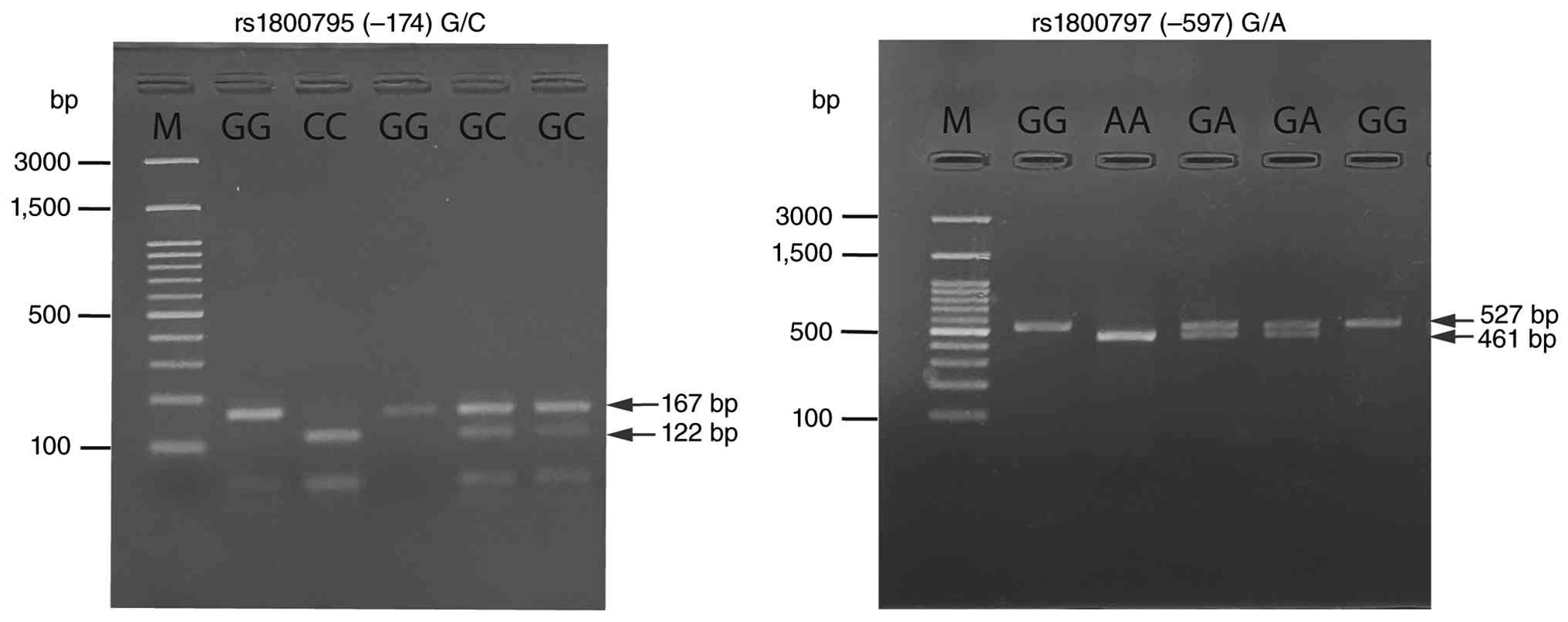
(RFLP) method (Table I). In total,
two independent PCR assays were carried out to detect distinct
polymorphic loci within the IL-6 gene: Hin1III (rs1800795,
G>C) and FokI (rs1800797, G>A). Appropriate primers
were used to amplify the corresponding gene regions from the
subjects via PCR and the reaction products were digested using the
appropriate restriction enzymes (Table
I). The digested products were analyzed on 2% agarose gels,
stained with Safe Gel Stain Dye and examined under UV
transillumination (Fig. 1). Each
gel was examined by two observers unaware of the status of the
subject. If there was any conflict, the analysis was repeated.
 | Table IPCR and restriction fragment length
polymorphism procedures and products of the IL-6 gene variants
(rs1800795 and rs1800797). |
Table I
PCR and restriction fragment length
polymorphism procedures and products of the IL-6 gene variants
(rs1800795 and rs1800797).
| Gene variant | Primers
(5'-3') | Thermocycler
conditions | PCR product
(bp) | Restriction
enzyme | Restriction
products (bp) |
|---|
| rs1800795
(-174C/G) | F:
TGACTTCAGCTTTACTCTTTGT | 95˚C 4 min, (95˚C
30 sec; 58˚C 35 sec; | 198 | Hin1II | C allele: 122, 45
and 31; |
| | R:
CTGATTGGAAACCTTATTAAG | 72˚C 60 sec) x 35,
72˚C 5 min | | | G allele: 167 and
31 |
| rs1800797
(-597G/A) | F:
GGAGTCACACACTCCACCT | 95˚C 4 min, (95˚C
30 sec; 57˚C 30 sec; | 527 | FokI | G allele: 527; A
allele: 461 and 66 |
| | R:
CTGATTGGAAACCTTATTAAG | 72˚C 30 sec) x 35,
72˚C 5 min | | | |
Ethical considerations
The research protocol was approved by the Biology
Department, the Scientific Committee and the Directorate of the
Research Center at the University of Raparin (Rania, Sulaymaniyah,
Iraq; approval no. 71; reference no. 2866; May 28, 2023). Written
informed consent to participate was obtained from all participants
before enrolment and sample collection.
Statistical analysis
The biostatistical evaluation was conducted
employing the SPSS software suite (version 22; IBM Corp.). A
one-way analysis of variance was utilized to assess the data
(immunological and biochemical parameters). Sex-based comparisons
between male and female patients with ESRD were performed using
one-way ANOVA. Since only two groups were compared, no post hoc
test was required. Pearson's correlation test was used to assess
associations among inflammatory, demographic and biochemical
parameters. Genotype frequencies in patients and controls were
evaluated using the Hardy-Weinberg equilibrium (HWE) test by χ2
test of each SNP. To analyze IL6 SNP genetic models, the SNPStats
tool (https://www.snpstats.net/) was used
(24). Genotype frequencies,
proportions, odds ratios (ORs) and 95% confidence intervals (CIs)
are used to summarize logistic regression analysis. The
Kruskal-Wallis test was used to analyze serum IL-6 concentrations
across rs1800795 and rs1800797 genotypes in patients with CKD.
P<0.05 was considered to indicate a statistically significant
difference.
Results
Demographic characteristics of the
investigated cohort
The cohort included 22 male (43.1%) and 29 female
(56.9%) patients; this distribution was descriptive, and no
statistical comparison of sex proportions was performed. Among the
examined demographic, biochemical and inflammatory variables, body
weight was significantly higher in male than female patients
(P=0.007; Tables II and III), whereas age and the other measured
parameters did not differ significantly between sexes. However, the
greater number of female participants in this convenience sample
should not be interpreted as evidence of a sex difference in CKD
prevalence or incidence.
| Table IISex-based comparison of biochemical
and inflammatory parameters. |
Table II
Sex-based comparison of biochemical
and inflammatory parameters.
| Biochemical
parameters | Mean ± standard
deviation | Standard error of
the mean |
|---|
| Weight (kg) | | |
|
Male |
74.0909±10.46950 | 2.23210 |
|
Female |
63.2759±15.51013 | 2.88016 |
| Creatinine
(mg/dl) | | |
|
Male | 8.3436±2.30019 | 0.49040 |
|
Female |
8.9566±12.26722 | 2.27797 |
| Urea (mg/dl) | | |
|
Male |
135.8773±27.14893 | 5.78817 |
|
Female |
124.6421±40.35681 | 7.49407 |
| Albumin (g/dl) | | |
|
Male | 3.5823±0.64323 | 0.13714 |
|
Female | 3.7803±0.36188 | 0.06720 |
| Calcium
(mg/dl) | | |
|
Male | 8.8855±2.19645 | 0.46828 |
|
Female | 8.9748±1.21011 | 0.22471 |
| Phosphate
(mg/dl) | | |
|
Male | 5.3368±1.92865 | 0.41119 |
|
Female | 5.1762±1.60423 | 0.29790 |
| ANA (IU/dl) | | |
|
Male | 0.7682±0.65928 | 0.14056 |
|
Female | 0.7586±0.60975 | 0.11323 |
| Glucose
(mg/dl) | | |
|
Male |
125.0727±41.18986 | 8.78171 |
|
Female |
146.1862±79.55239 | 14.77251 |
| IL6 (pg/ml) | | |
|
Male |
1.518182±1.945602 | 0.414804 |
|
Female |
6.703448±15.494849 | 2.877321 |
| TNF-α (pg/ml) | | |
|
Male |
7.677273±11.384071 | 2.427092 |
|
Female |
32.282759±107.180396 | 19.902900 |
| Table IIIStatistical differences in patients:
Implications for clinical monitoring. |
Table III
Statistical differences in patients:
Implications for clinical monitoring.
| Biochemical
parameters | F-value |
P-valuea | Mean
difference |
|---|
| Weight (kg) | 6.396 | 0.007 | 10.81505 |
| Creatinine
(mg/dl) | 1.155 | 0.818 | -0.61292 |
| Urea (mg/dl) | 2.108 | 0.266 | 11.23520 |
| Albumin (g/dl) | 5.032 | 0.169 | -0.19807 |
| Calcium
(mg/dl) | 1.524 | 0.854 | -0.08937 |
| Phosphate
(mg/dl) | 0.615 | 0.747 | 0.16061 |
| ANA (IU/dl) | 0.030 | 0.958 | 0.00956 |
| Glucose
(mg/dl) | 5.103 | 0.263 | -21.11348 |
| IL6 concentration
(pg/ml) | 8.866 | 0.126 | -5.185266 |
| TNF-α (pg./ml) | 3.200 | 0.290 | -24.605486 |
Age showed small, non-significant correlations with
IL-6 (r=0.166), TNF-α (r=0.217), creatinine (r=-0.185), urea
(r=-0.062), albumin (r=-0.081), calcium (r=0.021), phosphate
(r=-0.265), ANA (r=0.110) and glucose (r=0.153) (Table IV). These findings indicate that
age was not significantly correlated with the measured inflammatory
or biochemical variables in this cohort. Furthermore, creatinine,
urea, albumin, calcium, phosphate, TNF-α, ANA and glucose did not
differ significantly between male and female patients (P>0.05;
Table III).
| Table IVPearson correlation coefficients
among the inflammatory, demographic and biochemical parameters. |
Table IV
Pearson correlation coefficients
among the inflammatory, demographic and biochemical parameters.
| Variable | IL-6 (pg/ml) | TNF-α (pg/ml) | Age (years) | Weight (kg) | Creatinine
(mg/dl) | Urea (mg/dl) | Albumin (g/dl) | Calcium
(mg/dl) | Phosphate
(mg/dl) | ANA (IU/dl) | Glucose
(mg/dl) |
|---|
| IL-6 (pg/ml) | 1 | -0.025 | 0.166 | -0.055 | -0.024 | -0.009 | 0.048 | 0.173 | 0.032 | -0.075 | 0.029 |
| TNF (pg/ml) | -0.025 | 1 | 0.217 | -0.162 | -0.054 | -0.302a | -0.222 | -0.041 | -0.104 | 0.191 | 0.011 |
| Age (years) | 0.166 | 0.217 | 1 | -0.086 | -0.185 | -0.062 | -0.081 | 0.021 | -0.265 | 0.11 | 0.153 |
| Weight (kg) | -0.055 | -0.162 | -0.086 | 1 | 0.132 | 0.042 | -0.116 | -0.136 | -0.124 | -0.151 | -0.036 |
| Creatinine
(mg/dl) | -0.024 | -0.054 | -0.185 | 0.132 | 1 | 0.047 | -0.016 | -0.165 | 0.248 | 0.07 | 0.005 |
| Urea (mg/dl) | -0.009 | -0.302a | -0.062 | 0.042 | 0.047 | 1 | 0.224 | 0.019 | 0.305a | 0.001 | 0.212 |
| Albumin (g/dl) | 0.048 | -0.222 | -0.081 | -0.116 | -0.016 | 0.224 | 1 | 0.509b | 0.086 | 0.033 | -0.065 |
| Calcium
(mg/dl) | 0.173 | -0.041 | 0.021 | -0.136 | -0.165 | 0.019 | 0.509b | 1 | 0.164 | -0.066 | 0.023 |
| Phosphate
(mg/dl) | 0.032 | -0.104 | -0.265 | -0.124 | 0.248 | 0.305a | 0.086 | 0.164 | 1 | 0.171 | 0.161 |
| ANA (IU/dl) | -0.075 | 0.191 | 0.11 | -0.151 | 0.07 | 0.001 | 0.033 | -0.066 | 0.171 | 1 | 0.258 |
| Glucose
(mg/dl) | 0.029 | 0.011 | 0.153 | -0.036 | 0.005 | 0.212 | -0.065 | 0.023 | 0.161 | 0.258 | 1 |
Most inflammatory, demographic and biochemical
variables did not show statistically significant correlations.
However, significant correlations were observed between albumin and
calcium (r=0.509, P<0.01), urea and phosphate (r=0.305,
P<0.05) and TNF-α and urea (r=-0.302, P<0.05) (Table IV).
Distributions of IL-6 gene
polymorphisms between groups
Table V presents the
genotype distributions for the IL-6 promoter variants rs1800795 and
rs1800797, together with the HWE statistics for cases and controls
(controls were included only for molecular studies for the
comparison of genotype and allele frequencies). For rs1800795,
51.0% of patients and 78.4% of controls carried the GG genotype,
43.1 and 19.6% carried the GC genotype and 5.9 and 2.0% carried the
CC genotype, respectively. HWE testing showed that rs1800795
genotype frequencies were in equilibrium in both patients
(χ2=0.35, P=0.55) and controls (χ2=0.16,
P=0.69).
| Table VDistribution of genotype data for
rs1800795 and rs1800797 for the cases (n=51) and controls
(n=51). |
Table V
Distribution of genotype data for
rs1800795 and rs1800797 for the cases (n=51) and controls
(n=51).
| SNP | Case, n (%) | χ² | P-value | Controls, n
(%) | χ² | P-value |
|---|
| rs1800795 | | 0.35 | 0.55 | | 0.16 | 0.69 |
| GG | 26 (51.0) | | | 40 (78.4) | | |
| GC | 22 (43.1) | | | 10 (19.6) | | |
| CC | 3 (5.9) | | | 1 (2.0) | | |
| rs1800797 | | 0.50 | 0.47 | | 0.17 | 0.67 |
| GG | 30 (58.8) | | | 35 (68.6) | | |
| GA | 17 (33.3) | | | 15 (29.4) | | |
| AA | 4 (7.8) | | | 1 (2.0) | | |
For rs1800797, 58.8% of patients and 68.6% of
controls had the GG genotype, 33.3 and 29.4% the GA genotype, and
7.8 and 2.0% the AA genotype, respectively. Genotype distributions
for rs1800797 were also consistent with HWE in both groups
(patients: χ2=0.50, P=0.47; controls:
χ2=0.17, P=0.67).
Association of rs1800795 and rs1800797
with CKD in different genetic models
The association between genetic models of the IL-6
rs1800795 and rs1800797 genotypes and susceptibility to CKD was
performed using SNPStats software (Table VI). For IL6 rs1800795, a
statistically significant association with CKD was found under the
codominant model (P=0.013), with higher frequencies of the GC and
CC genotypes observed in patients with CKD compared with the
control group. Significant associations were also detected using
the dominant model (GC+CC vs. GG, P=0.0034) and the overdominant
model (GC vs. GG+CC, P=0.0098). However, the recessive model did
not show significant results (P=0.30), which may be due to the
lower frequency of CC homozygotes. Although the odds ratios for
rs1800795 were <1 across several models, this is likely a result
of the reference coding utilized in SNPStats. The GC and CC
genotypes were more frequent among patients with CKD than in the
control group, indicating an increased susceptibility to the
disease for carriers of the C allele.
| Table VIGenetic model analysis of IL6
rs1800795 and rs1800797 in cases (n=51) and controls (n=51). |
Table VI
Genetic model analysis of IL6
rs1800795 and rs1800797 in cases (n=51) and controls (n=51).
| A, rs1800795 |
|---|
| Model | Genotype | Cases, n (%) | Controls, n
(%) | ORa (95% CI) | P-value |
|---|
| Codominant | G/G | 26 (51%) | 40 (78.4%) | 1.00 | 0.0013 |
| | G/C | 22 (43.1%) | 10 (19.6%) | 0.30
(0.12-0.72) | |
| | C/C | 3 (5.9%) | 1 (2%) | 0.22
(0.02-2.20) | |
| Dominant | G/G | 26 (51%) | 40 (78.4%) | 1.00 | 0.003 |
| | G/C-C/C | 25 (49%) | 11 (21.6%) | 0.29
(0.12-0.68) | |
| Recessive | G/G-G/C | 49 (94.1%) | 50 (98 %) | 1.00 | 0.3 |
| | C/C | 3 (5.9%) | 1 (2.0%) | 0.32
(0.03-3.18) | |
| Overdominant | G/G-C/C | 29 (56.9%) | 41 (80.4%) | 1.00 | 0.0098 |
| | G/C | 22 (43.1%) | 10 (19.6%) | 0.32
(0.13-0.78) | |
| B, rs1800797 |
| Model | Genotype | Cases, n (%) | Controls, n
(%) | ORa (95% CI) | P-value |
| Codominant | G/G | 30 (58.8%) | 35 (68.6%) | 1.00 | 0.3 |
| | G/A | 17 (33.3%) | 15 (29.4%) | 0.76
(0.32-1.77) | |
| | A/A | 4 (7.8%) | 1 (2.0%) | 0.21
(0.02-2.02) | |
| Dominant | G/G | 30 (58.8%) | 35 (68.6%) | 1.00 | 0.3 |
| | G/A-A/A | 21 (41.2%) | 16 (31.4%) | 0.65
(0.29-1.47) | |
| Recessive | G/G-G/A | 47 (92.2%) | 50 (98%) | 1.00 | 0.16 |
| | A/A | 4 (7.8%) | 1 (2.0%) | 0.24
(0.03-2.18) | |
| Overdominant | G/G-A/A | 34 (66.7%) | 36 (70.6%) | 1.00 | 0.67 |
| | G/A | 17 (33.3%) | 15 (29.4%) | 0.83
(0.36-1.93) | |
By contrast, IL6 rs1800797 (FokI) showed no
significant association with CKD under the codominant, dominant,
recessive and overdominant models (all P>0.05). Genotype and
allele distributions were comparable between patients with CKD and
the controls across all inheritance models.
Serum IL-6 concentrations across
rs1800795 and rs1800797 genotypes in patients with CKD
Serum IL-6 levels in patients with CKD were measured
using ELISA. The IL-6 levels did not differ significantly among the
rs1800795 genotypes (Kruskal-Wallis test, P=0.069). The median
(min-max) IL-6 concentrations were 1.10 (0.0-53.2), 0.65 (0.0-49.9)
and 0.80 (0.7-1.7) pg/ml for the GG, GC and CC genotypes,
respectively. Similarly, analysis of the rs1800797 genotypes showed
no significant differences in IL-6 levels in patients with CKD
(Kruskal-Wallis test P=0.66). The median (min-max) IL-6
concentrations were 0.80 (0.0-53.2), 0.80 (0.0-7.7) and 0.75
(0.2-0.8) pg/ml for the GG, GA and AA genotypes, respectively.
These results are summarized in Table
VII.
| Table VIISerum IL-6 concentrations across
rs1800795 and rs1800797 genotypes in patients with chronic kidney
disease. |
Table VII
Serum IL-6 concentrations across
rs1800795 and rs1800797 genotypes in patients with chronic kidney
disease.
| SNP and
genotype | Median IL-6, pg/ml
(min-max) |
P-valuea |
|---|
| rs1800795 | | 0.069 |
|
GG | 1.10
(0.0-53.2) | |
|
GC | 0.65
(0.0-49.9) | |
|
CC | 0.80 (0.7-1.7) | |
| rs1800797 | | |
|
GG | 0.80
(0.0-53.2) | 0.66 |
|
GA | 0.80 (0.0-7.7) | |
|
AA | 0.75 (0.2-0.8) | |
Discussion
Recent findings indicate that biological sex affects
the metabolic response to lifestyle interventions. In particular,
men and women respond differently to changes in diet and to
physical activity, which leads to variations in metabolic outcomes
(25). Sex inequities notably
impact the global prevalence of CKD and the availability of
healthcare services, thereby highlighting the necessity for
sex-sensitive healthcare approaches. In addition, it has also been
demonstrated that the differences between the sexes are evident in
the management of CKD and hypertension, demanding customized
therapeutic plans for each sex due to their biological variations
and health risk disparities (26,27).
Additionally, it has been asserted that women appear to have a
lower risk of developing acute kidney injuries that happen within
healthcare facilities, indicating that estrogen has a clear effect
in diminishing the related threats (26,27).
The interplay of pro-inflammatory vs.
anti-inflammatory cytokine gene alterations is pivotal in
understanding CKD emergence; it provides a cross-sectional analysis
that scrutinizes the extent to which genetic variations in cytokine
genes may affect individual susceptibility to CKD. The present
study revealed the importance of genetic traits in modulating
inflammation among those with CKD, arguing that variations in
cytokine genes linked to both inflammation types might have a role
in how the disease develops (28).
The KDIGO clinical practice guidelines provide a framework for the
classification and management of kidney disease, emphasizing early
detection, monitoring of renal function and management of
underlying causes. In patients receiving hemodialysis, fluid status
is managed through dialysis prescription and clinical monitoring
(23). The KDIGO guidelines are
systematically applied to establish uniform criteria to ensure
consistency in the management of patients suffering from AKI and to
enhance clinical methodologies within the discipline of nephrology
(23,29).
Empirical research reveals that, due to the
protective characteristics of estrogen, women are less susceptible
to AKI and recover more swiftly, while men are more likely to
suffer from intensified damage related to androgens (30-34).
In alignment with the expected anthropometric variations associated
with biological sex, in the present study, male participants
exhibited a markedly increased body mass compared with female
participants. However, no notable differences were identified
between the sexes concerning biochemical or renal metrics,
suggesting that their metabolic profiles were similar. This finding
corresponds with the characteristics of the intended population,
which comprised individuals in stage V renal failure receiving
hemodialysis three times a week. Overall, the results underscore
the necessity for a nuanced understanding of sex-related
differences in anthropometry while acknowledging the metabolic
congruence among the studied groups. The phenomenon of increased
body mass, commonly referred to as obesity, has been empirically
linked to renal impairment. Obesity exerts a direct deleterious
effect on renal function by elevating glomerular pressure and
facilitating the accumulation of adipose tissue in the perirenal
region, which in turn leads to the generation of oxidative stress
and inflammatory responses (35,36).
Moreover, excess body weight is often correlated with the onset of
diabetes mellitus and hypertension, both of which are recognized as
conditions that exacerbate the progression of CKD (37,38).
Research indicates that individuals presenting with a body mass
index (BMI) of ≥30 are at an augmented risk for the development of
CKD, while individuals classified as moderately overweight (with a
BMI ranging from 25 to 29.9) may experience a gradual decline in
renal function over time (25,39-41).
In the present study, most biochemical and
demographic factors did not exhibit significant relationships,
according to the correlation analysis. Notably, albumin showed a
moderate correlation with calcium and urea had a positive
correlation with phosphate. There were no other noteworthy
relationships found. These results implied that urea-phosphate and
albumin-calcium correlations might represent underlying renal and
metabolic linkages, even if most parameters vary independently.
Higher urea removal efficiency is linked to higher phosphate
removal efficiency, according to a study that demonstrated a
positive correlation between urea and phosphate reduction ratios
during hemodialysis (23,41). The results of the present study
demonstrate the usefulness of albumin-adjusted calcium in clinical
settings, as demonstrated by its reasonable correlation with
ionized calcium levels (42). In a
cohort of patients receiving maintenance hemodialysis in an
intensive care unit, albumin-corrected calcium levels were found to
be highly associated with 28-day in-hospital mortality,
highlighting the clinical relevance of this correlation (43).
Environmental factors and genetics promote the
advancement of numerous diseases, including cancer, diabetes and
inflammatory diseases, particularly CKD (44,45).
Notably, genetic variation is a basic cause of a number of
disorders that have been studied across different populations
(46). Given the inflammatory
characteristics of CKD, the association with the IL-6 gene seems to
exert a considerable influence within the etiopathological context
of this condition (47). In terms
of CKD, an abundance of studies has yielded inconsistent findings
across different demographic groups. Some investigations support
the results of the present study, whereas others offer conflicting
interpretations. The variability in research outcomes highlights
the complexity of the relationship between IL-6 and CKD. The
present study investigated the association of IL-6-174 G/C
(rs1800795) and IL-6-597 G/A (rs1800797) with CKD. The genotype
distributions of both SNPs were in HWE for cases and controls. The
findings indicated that the GC and CC genotypes were more frequent
among patients with CKD compared with healthy controls (49 vs.
21.6%). The dominant model showed the strongest statistical
significance. This suggests that the presence of the C allele may
be associated with CKD in the present cohort. Similar results were
reported in South Indian patients with CKD and Sudanese
hemodialysis cohorts, where the C allele was associated with
advanced kidney disease (48,49) By
contrast, studies in Iraqi and European dialysis populations
reported no significant differences in genotype distribution
(50-53).
Ethnic diversity, geographic variation and the multifactorial
nature of the disease may influence these differences, and
gene-environment interactions such as diet or lifestyle may modify
genetic susceptibility (29,50-53).
In the present study, analysis of inheritance patterns further
supported the association of rs1800795 with CKD. Significant
associations were observed under codominant, dominant and
over-dominant models. By contrast, the recessive model did not show
any significant correlation, most likely due to the low frequency
of the CC homozygous genotype, a common limitation in genetic
studies of dialysis patients (14,49).
Conversely, rs1800797 showed no association with CKD across any
inheritance model, consistent with prior reports indicating minimal
impact on disease susceptibility (48).
In the present study, although rs1800795 showed an
association with CKD risk, the genotypes of this SNP did not show
significant relationships with serum IL-6 levels. This finding
aligns with various dialysis studies where IL-6 promoter variants
were linked with clinical features, including cardiovascular
complications, hypertension and erythropoietin responsiveness,
rather than to the baseline serum IL-6 concentration (53,54).
In hemodialysis patients, serum levels of IL-6 are influenced by
reduced renal clearance, oxidative stress and inflammatory stimuli
associated with the dialysis procedure. These pathological factors
may mask small genotype-specific differences in IL-6 gene
production (55). Likewise, the
rs1800797 genotype did not show a correlation with the circulating
IL-6 level. Although some studies in other inflammatory conditions
have suggested that rs1800797 may influence IL-6 production,
evidence of a stable or predictable role in CKD or in patients
undergoing dialysis remains limited (49,55).
Overall, the findings of the present study suggested that the
rs1800795IL-6 gene variant, unlike rs1800797, is associated with
CKD susceptibility in patients on hemodialysis. However, neither
variant showed a clear influence on the levels of IL-6 found in the
blood. This dissociation between genetic risk and measured cytokine
levels suggests that these IL-6 variants might contribute to
disease susceptibility through biological pathways that are not
adequately reflected by a single IL-6 measurement in dialysis
patients.
Regardless of the common understanding that IL-6
serves as a significant mediator in the inflammatory pathways of
CKD, the present study did find any notable sex differences in IL-6
concentrations or relevant links between circulating IL-6 levels
and the biochemical markers explored. This noticeable disjunction
emphasizes a vital methodological and biological factor:
Circulating IL-6 concentrations among patients with ESRD during
hemodialysis might not consistently represent the underlying
inflammatory processes or genetic susceptibility at a singular
measurement time. Variables such as decreased kidney capability,
inflammation initiated by dialysis and marked discrepancies among
individuals are likely to add complexity to subtle links. As a
result, references to IL-6-associated inflammatory pathways within
this discourse aim to elucidate the biological significance of IL-6
in the pathophysiology of CKD, rather than to propose statistically
significant correlations observed within the present cohort.
The unavailability of a control group for
immunological and biochemical tests acts as a notable hurdle in the
present evaluation, complicating efforts to establish meaningful
comparisons between those with renal issues and their healthy
counterparts. The presence of a control group would have supported
a more extensive evaluation of biomarkers in individuals
experiencing CKD and furthered the comprehension of the impact of
sex on the differences in these biomarkers. The sample population
was characterized by an opportunistic approach, wherein subjects
were listed based on their accessibility and clinical diagnosis of
ESRD within the predetermined age bracket of 40 to 60 years
In conclusion, the observations of the present study
show that, in conjunction with body weight, the primary biochemical
and immunological parameters displayed no statistically significant
alterations associated with sex among individuals diagnosed with
ESRD who were undergoing hemodialysis. Significant correlations
were identified between albumin and calcium, along with
associations between urea and phosphate, elucidating the complex
metabolic issues typically linked to CKD. The IL-6 rs1800795
polymorphism exhibited a statistically significant correlation with
the predisposition to CKD, with the C allele present at a higher
frequency among affected individuals, while rs1800797 did not
demonstrate any such correlation. Additionally, neither type of
polymorphism was linked with the levels of IL-6 circulating in the
blood, suggesting that the genetic risk could act through pathways
not directly identified by standalone serum cytokine assessments
(47). These conclusions clarify
the diverse attributes of CKD and accentuate the fundamental need
for the combination of genetic components with biochemical and
immunological studies to enrich our knowledge of the illness and
evaluate associated risks.
Acknowledgements
Not applicable.
Funding
Funding: No funding was received.
Availability of data and materials
The data generated in the present study may be
requested from the corresponding author.
Authors' contributions
AFS, KSMI, ASA and AAMA confirm the authenticity of
all the raw data. AFS contributed to the investigation by
conducting experiments, collecting data and analyzing the results,
and contributed to methodology, supervision, original draft
preparation and reviewing and editing the manuscript. KSMI
contributed to the statistical analysis using SNPStats software
analysis, molecular analysis, data visualization and reviewing and
editing the manuscript. ASA contributed to formal analysis,
interpretation of results and reviewing and editing the manuscript.
AAMA contributed to the acquisition, organization and curation of
biochemical data and assisted in analysis/interpretation of the
data. All authors read and approved the final version of the
manuscript.
Ethics approval and consent to
participate
The research protocol was approved by the Biology
Department, the Scientific Committee and the Directorate of the
Research Center at the University of Raparin (Rania, Sulaymaniyah,
Iraq; approval no. 71; reference no. 2866; May 28, 2023). Written
informed consent to participate was obtained from all participants
before enrolment and sample collection.
Patient consent for publication
Not applicable.
Competing interests
The authors declare that they have no competing
interests.
References
|
1
|
Shallal AF: Immunomodulatory pathways of
some biomarkers in individuals with renal failure. ARO (Koya).
13:326–333. 2025.
|
|
2
|
Shallal AF: Modulation of immune pathway
and biomarkers: Impacts of lifestyle, nutrition, and therapeutic
interventions. World J Pharma Res. 14:419–430. 2025.PubMed/NCBI View Article : Google Scholar
|
|
3
|
Shallal AF, Razaq CH and Owaid MN:
Immunomodulatory effects of ganoderma lucidum on NK Cells: From
traditional use to modern immunotherapy. J Macrofungi. 1:14–29.
2025.
|
|
4
|
Shallal AF, Ali DS and Eyüpoğlu V:
Ameliorative role of diet in some immunological and metabolic
indicators. JUAPS. 17:22–28. 2023.
|
|
5
|
Nazar CM, Bashir F, Izhar S and Anderson
J: Overview of management of acute renal failure and its
evaluation; a case analysis. J Nephropharmacol. 4:17–22.
2015.PubMed/NCBI
|
|
6
|
Seong SY and Matzinger P: Hydrophobicity:
An ancient damage-associated molecular pattern that initiates
innate immune responses. Nat Rev Immunol. 4:469–478.
2004.PubMed/NCBI View
Article : Google Scholar
|
|
7
|
Kany S, Vollrath JT and Relja B: Cytokines
in inflammatory disease. Int J Mol Sci. 20(6008)2019.
|
|
8
|
Schaper F and Rose-John S: Interleukin-6:
Biology, signaling and strategies of blockade. Cytokine Growth
Factor Rev. 26:475–487. 2015.PubMed/NCBI View Article : Google Scholar
|
|
9
|
Geginat J, Larghi P, Paroni M, Nizzoli G,
Penatti A, Pagani M, Gagliani N, Meroni P, Abrignani S and Flavell
RA: The light and the dark sides of Interleukin-10 in
immune-mediated diseases and cancer. Cytokine Growth Factor Rev.
30:87–93. 2016.PubMed/NCBI View Article : Google Scholar
|
|
10
|
Su H, Lei CT and Zhang C: Interleukin-6
signaling pathway and its role in kidney disease: An update. Front
Immunol. 8(405)2017.PubMed/NCBI View Article : Google Scholar
|
|
11
|
González-Lafuente L, Mercado-García E,
Vázquez-Sánchez S, González-Moreno D, Boscá L, Fernández-Velasco M,
Segura J, Kuro-O M, Ruilope LM, Liaño F and Ruiz-Hurtado G:
Interleukin-6 as a prognostic marker in acute kidney injury and its
klotho-dependent regulation. Nefrología (Engl Ed). 44:818–829.
2024.PubMed/NCBI View Article : Google Scholar
|
|
12
|
Rao M, Wong C, Kanetsky P, Girndt M,
Stenvinkel P, Reilly M and Raj DS: Cytokine gene polymorphism and
progression of renal and cardiovascular diseases. Kidney Int.
72:549–556. 2007.PubMed/NCBI View Article : Google Scholar
|
|
13
|
Buraczynska M, Jozwiak L, Ksiazek P,
Borowicz E and Mierzicki P: Interleukin-6 gene polymorphism and
faster progression to end-stage renal failure in chronic
glomerulonephritis. Transl Res. 150:101–105. 2007.PubMed/NCBI View Article : Google Scholar
|
|
14
|
Muzasti RA, Hariman H and Daulay ER: The
influence of− 174 G/C interleukin 6 promoter gene polymorphism to
interleukin 6 concentration in the end stage renal disease patients
with dialysis: A single-center experience in Indonesia. Open Access
Maced J Med Sci. 8:563–566. 2020.
|
|
15
|
Ge Q, Gu X, Yu W, Zhang G, Liang W, Li M,
Zhai G and Yan M: Antinuclear antibodies in healthy population:
Positive association with abnormal tissue metabolism, inflammation
and immune dysfunction. Int Immunopharmacol.
113(109292)2022.PubMed/NCBI View Article : Google Scholar
|
|
16
|
Sur LM, Floca E, Sur DG, Colceriu MC,
Samasca G and Sur G: Antinuclear antibodies: marker of diagnosis
and evolution in autoimmune diseases. Lab Med. 49:e62–e73.
2018.PubMed/NCBI View Article : Google Scholar
|
|
17
|
Solow EB, Vongpatanasin W, Skaug B, Karp
DR, Ayers C and de Lemos JA: Antinuclear antibodies in the general
population: Positive association with inflammatory and vascular
biomarkers but not traditional cardiovascular risk factors. Clin
Exp Rheumatol. 36:1031–1037. 2018.PubMed/NCBI
|
|
18
|
Abass NM, Yousef AM, Sabet EA, Kamal YM
and El-Rashidy MH: Study of serum calcium and phosphorus levels in
chronic kidney disease patients with acute coronary syndrome. Egypt
J Intern Med. 36(59)2024.
|
|
19
|
Jang DI, Lee AH, Shin HY, Song HR, Park
JH, Kang TB, Lee SR and Yang SH: The role of tumor necrosis factor
alpha (TNF-α) in autoimmune disease and current TNF-α inhibitors in
therapeutics. Int J Mol Sci. 22(2719)2021.PubMed/NCBI View Article : Google Scholar
|
|
20
|
Brierly G, Celentano A, Breik O,
Moslemivayeghan E, Patini R, McCullough M and Yap T: Tumour
necrosis factor alpha (TNF-α) and oral squamous cell carcinoma.
Cancers (Basel). 15(1841)2023.PubMed/NCBI View Article : Google Scholar
|
|
21
|
Samimi Z, Kardideh B, Chalabi M, Zafari P
and Taghadosi M: The plasma Tumor Necrosis Factor-α (TNF-α) does
not have any correlation with disease activity in rheumatoid
arthritis patients treated with disease modifying anti-rheumatic
drugs (DMARDs). Braz J Pharm Sci. 56(e18551)2020.
|
|
22
|
Cheng T, Wang X, Han Y, Hao J, Hu H and
Hao L: The level of serum albumin is associated with renal
prognosis and renal function decline in patients with chronic
kidney disease. BMC Nephrol. 24(57)2023.PubMed/NCBI View Article : Google Scholar
|
|
23
|
Levin A, Stevens PE, Bilous RW, Coresh J,
De Francisco ALM, De Jong PE, Griffith KE, Hemmelgarn BR, Iseki K,
Lamb EJ, et al: Kidney disease: Improving global outcomes (KDIGO)
CKD work group. KDIGO 2012 clinical practice guideline for the
evaluation and management of chronic kidney disease. Kidney Int
Suppl. 3:1–150. 2013.PubMed/NCBI View Article : Google Scholar
|
|
24
|
Solé X, Guinó E, Valls J, Iniesta R and
Moreno V: SNPStats: A web tool for the analysis of association
studies. Bioinformatics. 22:1928–1929. 2006.PubMed/NCBI View Article : Google Scholar
|
|
25
|
Gorini S, Camajani E, Feraco A, Armani A,
Karav S, Filardi T, Aulisa G, Cava E, Strollo R, Padua E, et al:
Exploring gender differences in the effects of diet and physical
activity on metabolic parameters. Nutrients. 17(354)2025.PubMed/NCBI View Article : Google Scholar
|
|
26
|
García GG, Iyengar A, Kaze F, Kierans C,
Padilla-Altamira C and Luyckx VA: Sex and gender differences in
chronic kidney disease and access to care around the globe. Semin
Nephrol. 42:101–113. 2022.PubMed/NCBI View Article : Google Scholar
|
|
27
|
Mayne KJ, Sullivan MK and Lees JS: Sex and
gender differences in the management of chronic kidney disease and
hypertension. J Hum Hypertens. 37:649–653. 2023.PubMed/NCBI View Article : Google Scholar
|
|
28
|
Neugarten J and Golestaneh L: Female sex
reduces the risk of hospital-associated acute kidney injury: A
meta-analysis. BMC Nephrol. 19(314)2018.PubMed/NCBI View Article : Google Scholar
|
|
29
|
Okada R, Wakai K, Naito M, Morita E, Kawai
S, Hamajima N, Hara M, Takashima N, Suzuki S, Takezaki T, et al:
Pro-/anti-inflammatory cytokine gene polymorphisms and chronic
kidney disease: A cross-sectional study. BMC Nephrol.
13(2)2012.PubMed/NCBI View Article : Google Scholar
|
|
30
|
Ciarambino T, Crispino P and Giordano M:
Gender and renal insufficiency: Opportunities for their therapeutic
management? Cells. 11(3820)2022.PubMed/NCBI View Article : Google Scholar
|
|
31
|
Neugarten J, Golestaneh L and Kolhe NV:
Sex differences in acute kidney injury requiring dialysis. BMC
Nephrol. 19(131)2018.PubMed/NCBI View Article : Google Scholar
|
|
32
|
Hosszu A, Fekete A and Szabo AJ: Sex
differences in renal ischemia-reperfusion injury. Am J Physiol
Renal Physiol. 319:F149–F154. 2020.PubMed/NCBI View Article : Google Scholar
|
|
33
|
Buse M, Moeller MJ and Stamellou E: What
we have learned so far from single cell sequencing in acute kidney
injury. Front Physiol. 13(933677)2022.PubMed/NCBI View Article : Google Scholar
|
|
34
|
Ciarambino T, Para O and Giordano M:
Gender in acute kidney disease: A narrative review. Clin Nephrol.
95:123–126. 2021.PubMed/NCBI View
Article : Google Scholar
|
|
35
|
Kovesdy CP, Furth S and Zoccali C: World
Kidney Day Steering Committee. Obesity and kidney disease: Hidden
consequences of the epidemic. Physiol Int. 104:1–4. 2017.PubMed/NCBI View Article : Google Scholar
|
|
36
|
Hall ME, do Carmo JM, da Silva AA, Juncos
LA, Wang Z and Hall JE: Obesity, hypertension, and chronic kidney
disease. Int J Nephrol Renovasc Dis. 7:75–88. 2014.PubMed/NCBI View Article : Google Scholar
|
|
37
|
Hall JE, do Carmo JM, da Silva AA, Wang Z
and Hall ME: . Obesity-induced hypertension: Interaction of
neurohumoral and renal mechanisms. Circ Res. 116:991–1006.
2015.PubMed/NCBI View Article : Google Scholar
|
|
38
|
Ku E, Lee BJ, Wei J and Weir MR:
Hypertension in CKD: Core curriculum 2019. Am J Kidney Dis.
74:120–131. 2019.PubMed/NCBI View Article : Google Scholar
|
|
39
|
Bosman A, Koek WNH, Campos-Obando N, van
der Eerden BCJ, Ikram MA, Uitterlinden AG, van Leeuwen JPTM and
Zillikens MC: Sexual dimorphisms in serum calcium and phosphate
concentrations in the Rotterdam Study. Sci Rep.
13(8310)2023.PubMed/NCBI View Article : Google Scholar
|
|
40
|
Xu R, Zhang LX, Zhang PH, Wang F, Zuo L
and Wang HY: Gender differences in age-related decline in
glomerular filtration rates in healthy people and chronic kidney
disease patients. BMC Nephrol. 11(20)2010.PubMed/NCBI View Article : Google Scholar
|
|
41
|
Giandalia A, Giuffrida AE, Gembillo G,
Cucinotta D, Squadrito G, Santoro D and Russo GT: Gender
differences in diabetic kidney disease: Focus on hormonal, genetic
and clinical factors. Int J Mol Sci. 22(5808)2021.PubMed/NCBI View Article : Google Scholar
|
|
42
|
Begum M and Arshad AR: Correlation between
urea and phosphate reduction ratios during hemodialysis. Pak Armed
Forces Med J. 75:450–453. 2025.
|
|
43
|
Desgagnés N, King JA, Kline GA,
Seiden-Long I and Leung AA: Use of albumin-adjusted calcium
measurements in clinical practice. JAMA Network Open.
8(e2455251)2025.PubMed/NCBI View Article : Google Scholar
|
|
44
|
Zhao S, Zhao Q, Xu Y, Zheng S, Dai H, Rui
H and Liu B: The association between albumin corrected calcium
levels and mortality in ICU patients undergoing maintenance
hemodialysis. Sci Rep. 15(12086)2025.PubMed/NCBI View Article : Google Scholar
|
|
45
|
Haghi M, Ranjbar M, Karari K,
Samadi-Miandoab S, Eftekhari A and Hosseinpour-Feizi MA: Certain
haplotypes of the 3'-UTR region of the HLA-G gene are linked to
breast cancer. Br J Biomed Sci. 78:87–91. 2021.PubMed/NCBI View Article : Google Scholar
|
|
46
|
Dosseva-Panova V, Mlachkova A, Popova C
and Kicheva M: Evaluation of Interleukin-6, lymphotoxin-α and TNF-α
gene polymorphisms in chronic periodontitis. Journal of IMAB–Annual
Proceeding Scientific Papers. 21:864–867. 2015.
|
|
47
|
Ali YBM, Moussa SG, Shahen SM, Dewir MA
and El-Sayed IH: Association between interleukin-6 gene
polymorphism and iron regulation in hemodialysis patients infected
with HCV. J Bras Nefrol. 42:437–447. 2020.PubMed/NCBI View Article : Google Scholar
|
|
48
|
Mohamad KS: Association between 5'-UTR and
3'-UTR polymorphisms of the TYMS Gene and breast cancer in kurdish
women of Iraq. Asian Pac J Cancer Prev. 22:1557–1560.
2021.PubMed/NCBI View Article : Google Scholar
|
|
49
|
Abdelrhman NA and Ali EW: The association
of interleukin-6 (-174 G/C) polymorphism with risk of chronic
kidney disease and erythropoietin hyporesponsiveness. Journal of
Nephropathology: Nov 19, 2022 (Epub ahead of print).
|
|
50
|
Sevak V, Chinniah R, Pandi S, Sampathkumar
K, Dinakaran T and Karuppiah B: Association of IL-4 (-590 C/T) and
IL-6 (-174 G/C) gene polymorphism in South Indian CKD patients.
Egyptian Journal of Medical Human Genetics. 25(17)2024.2024.
doi:10.1186/s43042-024-00476-8.
|
|
51
|
Al-Radeef MY: Association between allelic
variations of-174G/C polymorphism of interleukin-6 gene and chronic
kidney disease-mineral and bone disorder in iraqi patients. Baghdad
Science Journal. 17(2)2020.
|
|
52
|
Chiș AF, Cătană A, Sorițău O, Chiș BA,
Cutaș A and Pop CM: Interleukin-6 serum level and-597 A/G gene
polymorphism in moderate and severe chronic obstructive pulmonary
disease. European Journal of Inflammation: Oct 19, 2020 (Epub ahead
of print).
|
|
53
|
Almukainzi M, Alotaibi L, Abdulwahab A,
Albukhary N and El Mahdy AM: Quality and safety investigation of
commonly used topical cosmetic preparations. Sci Rep.
12(18299)2022.PubMed/NCBI View Article : Google Scholar
|
|
54
|
Losito A, Kalidas K, Santoni S and Jeffery
S: Association of interleukin-6-174G/C promoter polymorphism with
hypertension and left ventricular hypertrophy in dialysis patients.
Kidney Int. 64:616–622. 2003.PubMed/NCBI View Article : Google Scholar
|
|
55
|
Sánchez-Valencia PE, Díaz-García JD,
Leyva-Leyva M, Sánchez-Aguillón F, González-Arenas NR,
Mendoza-García JG, Tenorio-Aguirre EK, de León-Bautista MP,
Ibarra-Arce A, Maravilla P and Olivo-Díaz A: Frequency of tumor
necrosis factor-α, interleukin-6, and interleukin-10 gene
polymorphisms in mexican patients with diabetic retinopathy and
diabetic kidney disease. Pathophysiology. 32(14)2025.PubMed/NCBI View Article : Google Scholar
|