Spandidos Publications Logo
  • About
    • About Spandidos
    • Aims and Scopes
    • Abstracting and Indexing
    • Editorial Policies
    • Reprints and Permissions
    • Job Opportunities
    • Terms and Conditions
    • Contact
  • Journals
    • All Journals
    • Oncology Letters
      • Oncology Letters
      • Information for Authors
      • Editorial Policies
      • Editorial Board
      • Aims and Scope
      • Abstracting and Indexing
      • Bibliographic Information
      • Archive
    • International Journal of Oncology
      • International Journal of Oncology
      • Information for Authors
      • Editorial Policies
      • Editorial Board
      • Aims and Scope
      • Abstracting and Indexing
      • Bibliographic Information
      • Archive
    • Molecular and Clinical Oncology
      • Molecular and Clinical Oncology
      • Information for Authors
      • Editorial Policies
      • Editorial Board
      • Aims and Scope
      • Abstracting and Indexing
      • Bibliographic Information
      • Archive
    • Experimental and Therapeutic Medicine
      • Experimental and Therapeutic Medicine
      • Information for Authors
      • Editorial Policies
      • Editorial Board
      • Aims and Scope
      • Abstracting and Indexing
      • Bibliographic Information
      • Archive
    • International Journal of Molecular Medicine
      • International Journal of Molecular Medicine
      • Information for Authors
      • Editorial Policies
      • Editorial Board
      • Aims and Scope
      • Abstracting and Indexing
      • Bibliographic Information
      • Archive
    • Biomedical Reports
      • Biomedical Reports
      • Information for Authors
      • Editorial Policies
      • Editorial Board
      • Aims and Scope
      • Abstracting and Indexing
      • Bibliographic Information
      • Archive
    • Oncology Reports
      • Oncology Reports
      • Information for Authors
      • Editorial Policies
      • Editorial Board
      • Aims and Scope
      • Abstracting and Indexing
      • Bibliographic Information
      • Archive
    • Molecular Medicine Reports
      • Molecular Medicine Reports
      • Information for Authors
      • Editorial Policies
      • Editorial Board
      • Aims and Scope
      • Abstracting and Indexing
      • Bibliographic Information
      • Archive
    • World Academy of Sciences Journal
      • World Academy of Sciences Journal
      • Information for Authors
      • Editorial Policies
      • Editorial Board
      • Aims and Scope
      • Abstracting and Indexing
      • Bibliographic Information
      • Archive
    • International Journal of Functional Nutrition
      • International Journal of Functional Nutrition
      • Information for Authors
      • Editorial Policies
      • Editorial Board
      • Aims and Scope
      • Abstracting and Indexing
      • Bibliographic Information
      • Archive
    • International Journal of Epigenetics
      • International Journal of Epigenetics
      • Information for Authors
      • Editorial Policies
      • Editorial Board
      • Aims and Scope
      • Abstracting and Indexing
      • Bibliographic Information
      • Archive
    • Medicine International
      • Medicine International
      • Information for Authors
      • Editorial Policies
      • Editorial Board
      • Aims and Scope
      • Abstracting and Indexing
      • Bibliographic Information
      • Archive
  • Articles
  • Information
    • Information for Authors
    • Information for Reviewers
    • Information for Librarians
    • Information for Advertisers
    • Conferences
  • Language Editing
Spandidos Publications Logo
  • About
    • About Spandidos
    • Aims and Scopes
    • Abstracting and Indexing
    • Editorial Policies
    • Reprints and Permissions
    • Job Opportunities
    • Terms and Conditions
    • Contact
  • Journals
    • All Journals
    • Biomedical Reports
      • Information for Authors
      • Editorial Policies
      • Editorial Board
      • Aims and Scope
      • Abstracting and Indexing
      • Bibliographic Information
      • Archive
    • Experimental and Therapeutic Medicine
      • Information for Authors
      • Editorial Policies
      • Editorial Board
      • Aims and Scope
      • Abstracting and Indexing
      • Bibliographic Information
      • Archive
    • International Journal of Epigenetics
      • Information for Authors
      • Editorial Policies
      • Editorial Board
      • Aims and Scope
      • Abstracting and Indexing
      • Bibliographic Information
      • Archive
    • International Journal of Functional Nutrition
      • Information for Authors
      • Editorial Policies
      • Editorial Board
      • Aims and Scope
      • Abstracting and Indexing
      • Bibliographic Information
      • Archive
    • International Journal of Molecular Medicine
      • Information for Authors
      • Editorial Policies
      • Editorial Board
      • Aims and Scope
      • Abstracting and Indexing
      • Bibliographic Information
      • Archive
    • International Journal of Oncology
      • Information for Authors
      • Editorial Policies
      • Editorial Board
      • Aims and Scope
      • Abstracting and Indexing
      • Bibliographic Information
      • Archive
    • Medicine International
      • Information for Authors
      • Editorial Policies
      • Editorial Board
      • Aims and Scope
      • Abstracting and Indexing
      • Bibliographic Information
      • Archive
    • Molecular and Clinical Oncology
      • Information for Authors
      • Editorial Policies
      • Editorial Board
      • Aims and Scope
      • Abstracting and Indexing
      • Bibliographic Information
      • Archive
    • Molecular Medicine Reports
      • Information for Authors
      • Editorial Policies
      • Editorial Board
      • Aims and Scope
      • Abstracting and Indexing
      • Bibliographic Information
      • Archive
    • Oncology Letters
      • Information for Authors
      • Editorial Policies
      • Editorial Board
      • Aims and Scope
      • Abstracting and Indexing
      • Bibliographic Information
      • Archive
    • Oncology Reports
      • Information for Authors
      • Editorial Policies
      • Editorial Board
      • Aims and Scope
      • Abstracting and Indexing
      • Bibliographic Information
      • Archive
    • World Academy of Sciences Journal
      • Information for Authors
      • Editorial Policies
      • Editorial Board
      • Aims and Scope
      • Abstracting and Indexing
      • Bibliographic Information
      • Archive
  • Articles
  • Information
    • For Authors
    • For Reviewers
    • For Librarians
    • For Advertisers
    • Conferences
  • Language Editing
Login Register Submit
  • This site uses cookies
  • You can change your cookie settings at any time by following the instructions in our Cookie Policy. To find out more, you may read our Privacy Policy.

    I agree
Search articles by DOI, keyword, author or affiliation
Search
Advanced Search
presentation
Experimental and Therapeutic Medicine
Join Editorial Board Propose a Special Issue
Print ISSN: 1792-0981 Online ISSN: 1792-1015
Journal Cover
November-December 2010 Volume 1 Issue 6

Full Size Image

Sign up for eToc alerts
Recommend to Library

Journals

International Journal of Molecular Medicine

International Journal of Molecular Medicine

International Journal of Molecular Medicine is an international journal devoted to molecular mechanisms of human disease.

International Journal of Oncology

International Journal of Oncology

International Journal of Oncology is an international journal devoted to oncology research and cancer treatment.

Molecular Medicine Reports

Molecular Medicine Reports

Covers molecular medicine topics such as pharmacology, pathology, genetics, neuroscience, infectious diseases, molecular cardiology, and molecular surgery.

Oncology Reports

Oncology Reports

Oncology Reports is an international journal devoted to fundamental and applied research in Oncology.

Experimental and Therapeutic Medicine

Experimental and Therapeutic Medicine

Experimental and Therapeutic Medicine is an international journal devoted to laboratory and clinical medicine.

Oncology Letters

Oncology Letters

Oncology Letters is an international journal devoted to Experimental and Clinical Oncology.

Biomedical Reports

Biomedical Reports

Explores a wide range of biological and medical fields, including pharmacology, genetics, microbiology, neuroscience, and molecular cardiology.

Molecular and Clinical Oncology

Molecular and Clinical Oncology

International journal addressing all aspects of oncology research, from tumorigenesis and oncogenes to chemotherapy and metastasis.

World Academy of Sciences Journal

World Academy of Sciences Journal

Multidisciplinary open-access journal spanning biochemistry, genetics, neuroscience, environmental health, and synthetic biology.

International Journal of Functional Nutrition

International Journal of Functional Nutrition

Open-access journal combining biochemistry, pharmacology, immunology, and genetics to advance health through functional nutrition.

International Journal of Epigenetics

International Journal of Epigenetics

Publishes open-access research on using epigenetics to advance understanding and treatment of human disease.

Medicine International

Medicine International

An International Open Access Journal Devoted to General Medicine.

Journal Cover
November-December 2010 Volume 1 Issue 6

Full Size Image

Sign up for eToc alerts
Recommend to Library

  • Article
  • Citations
    • Cite This Article
    • Download Citation
    • Create Citation Alert
    • Remove Citation Alert
    • Cited By
  • Similar Articles
    • Related Articles (in Spandidos Publications)
    • Similar Articles (Google Scholar)
    • Similar Articles (PubMed)
  • Download PDF
  • Download XML
  • View XML
Case Report

Hepatic arterial infusion chemotherapy for post-operative liver metastases from pancreatic cancer in a patient with leukocytopenia: A case report

  • Authors:
    • Hidehiro Tajima
    • Tetsuo Ohta
    • Hirohisa Kitagawa
    • Seisho Sakai
    • Isamu Makino
    • Hironori  Hayashi
    • Hisatoshi Nakagawara
    • Ichiro Onishi
    • Hiroyuki Takamura
    • Itasu  Ninomiya
    • Sachio Fushida
    • Takashi Tani
    • Takashi Fujimura
    • Masato Kayahara
    • Wataru Koda
    • Tetsuya Minami
    • Yasuharu Ryu
    • Junichiro Sanada
    • Osamu Matsui
  • View Affiliations / Copyright

    Affiliations: Department of Gastroenterologic Surgery, Graduate School of Medicine Science, Kanazawa University, Kanazawa 920-8641, Japan, Radiology Division of Cancer Medicine, Graduate School of Medicine Science, Kanazawa University, Kanazawa 920-8641, Japan
  • Pages: 987-990
    |
    Published online on: September 29, 2010
       https://doi.org/10.3892/etm.2010.160
  • Expand metrics +
Metrics: Total Views: 0 (Spandidos Publications: | PMC Statistics: )
Metrics: Total PDF Downloads: 0 (Spandidos Publications: | PMC Statistics: )
Cited By (CrossRef): 0 citations Loading Articles...

This article is mentioned in:


Abstract

Here, we present a case of post-operative liver metastases from pancreatic head cancer in a patient with leukocytopenia, who was safely treated by hepatic arterial infusion (HAI) chemotherapy consisting of gemcitabine and 5-FU. The patient was a 61-year-old woman who underwent pancreatico-duodenectomy for pancreatic head cancer, but was found to be an unsuitable candidate for adjuvant systemic chemotherapy due to the presence of leukocytopenia. Five months after surgery, a follow-up CT revealed two liver metastases. Intravenous systemic chemotherapy was also contraindicated due to the leukocytopenia. In the apparent absence of recurrence, excepting the liver metastases, we decided to administer HAI chemotherapy, which had already been administered following the curative surgery. HAI chemotherapy has been shown to be associated with a lower incidence of systemic side effects. Gemcitabine at a dose of 400 mg was administered via a bedside pump and infused over 30 min. After gemcitabine infusion, 250 mg of 5-FU was infused continuously over 24 h from days 1 to 5. This comprised 1 cycle of therapy. The treatment cycles were continued biweekly. After 10 cycles without severe side effects, it was found that though the size of the metastatic tumors was not reduced, tumor vascularity was. However, after the 13th treatment cycle, local recurrence and lymph node metastases were detected. By this time, the patient had recovered from the leukocytopenia, and could thus be administered systemic chemotherapy. In conclusion, HAI chemotherapy is useful and safe for the treatment of malignancies confined to the liver, even in cases where the patient is in a reduced physical condition.

Introduction

Pancreatic carcinoma causes more than 20,000 deaths every year in Japan, with an overall 5-year survival rate of less than 5% (1,2). For patients with localized disease, radical surgery may afford long-term benefits. However, even in patients who undergo resection, the reported 5-year survival rate remains in the range of 7–24%, and in most series the median survival is only approximately 1 year, indicating that surgery alone is usually inadequate. Even after curative resection, patients with pancreatic cancer face a 50–80% local recurrence rate and a 25–50% chance of developing distant metastases (3).

Gemcitabine, a deoxycytidine analogue that competes for incorporation into DNA, thereby inhibiting its synthesis, is the key drug for the treatment of pancreatic cancer. Compared to resection alone, adjuvant chemotherapy with gemcitabine improves, although to a limited degree, survival in patients with resectable pancreatic adenocarcinoma (4). However, a major drawback of adjuvant therapy for pancreatic cancer is the impossibility of administering the designated therapy to 20–30% of patients as a result of post-operative complications, delayed surgical recovery or early disease recurrence (5,6).

Hepatic arterial infusion (HAI) of chemotherapeutic agents is a treatment option for patients with primary or metastatic hepatic malignancies confined to the liver. The use of HAI chemotherapy is based on sound physiology and pharmacology. First, liver metastases that grow beyond 2–3 mm depend on the hepatic artery for vascularization, whereas normal liver tissues are perfused by the portal vein (7,8). Second, HAI therapy allows drug delivery to hepatic metastases not achievable by systemic administration, especially drugs with a high systemic clearance (9). Third, first-pass hepatic extraction of certain drugs results in lower systemic concentrations, and hence less systemic toxicities (10). Phase I studies of HAI chemotherapy with gemcitabine in patients with liver malignancies were recently reported (11–13).

Herein, we report a case of a patient with pancreatic head cancer and post-operative liver metastases, determined to be an unsuitable candidate for systemic chemotherapy due to leukocytopenia. The patient was treated safely by HAI consisting of gemcitabine and 5-FU.

Case report

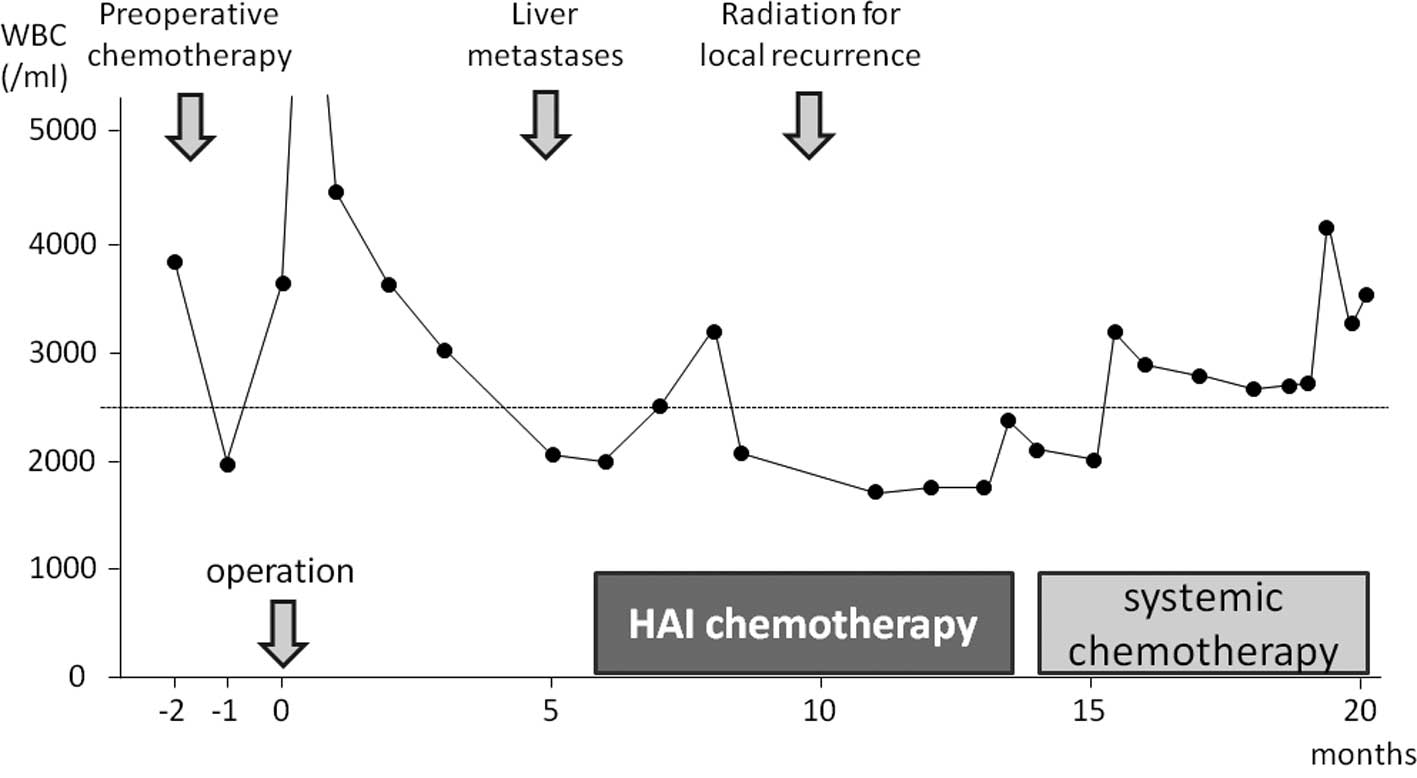
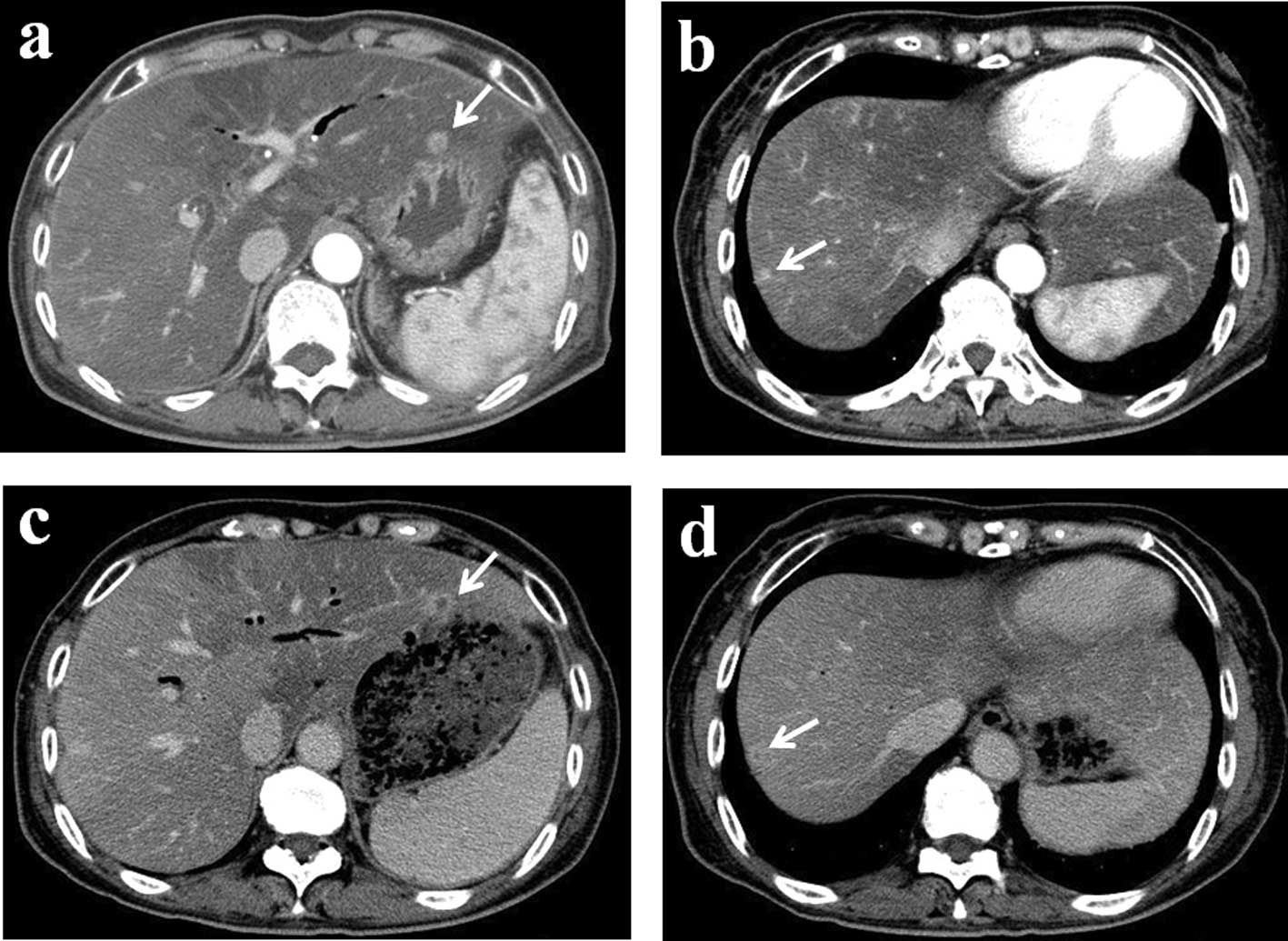
In May 2008, a 61-year-old woman underwent pancreaticoduodenectomy for pancreatic head cancer. Pathological examination revealed invasive ductal carcinoma of the pancreas head with three metastatic regional lymph nodes. Tumor stage was found to be T1,-N1b,-M0, stage III according to the International Union Against Cancer (UICC) classification. The patient received pre-operative chemotherapy with gemcitabine and oral S-1. Although two cycles of chemotherapy were originally planned, the second cycle was not administered because the patient developed leukocytopenia. The leukocyte count returned to within the normal range pre-operatively, and the post-operative course was uneventful. However, adjuvant systemic chemotherapy could not be administered as the patient again developed leukocytopenia (Fig. 1). Five months after surgery, a follow-up computed tomography (CT) scan revealed two liver metastases (Fig. 2a and b). Due to the leukocytopenia, intravenous systemic chemotherapy was contraindicated. In the apparent absence of recurrence, excepting the liver metastases, we decided to administer HAI chemotherapy, which had already been administered following the curative surgery and has been shown to be associated with a lower incidence of systemic side effects. Written informed consent was obtained from the patient, and the treatment was undertaken with the approval of the Medical Ethics Committee of Kanazawa University Hospital.

Figure 1.

Clinical course and changes in white blood cell (WBC) count. At the time of presentation of liver metastases, systemic chemotherapy could not be administered due to the patient’s leukocytopenia. After 13 cycles of the treatment, the HAI catheter and subcutaneous implantable port system were removed due to tube trouble. However, by this time the patient had recovered from the leukocytopenia and was treated with systemic chemotherapy.

Figure 2.

Abdominal computed tomography (CT). Two regions of liver metastases were detected in a follow up CT 5 months after surgery (a and b, arrows). After 10 cycles of HAI chemotherapy, the vascularity of the tumors was reduced (c and d, arrows).

An intrahepatic arterial catheter was percutaneously implanted after hepatic arteriography performed by right femoral puncture. The catheter was then connected to a subcutaneous implantable port system, located in the lower right abdominal area. Gemcitabine (400 mg) was dissolved in 50 ml of saline for administration by bedside pump over 30 min. After gemcitabine infusion, 250 mg of 5-FU dissolved in 50 ml of saline was infused continuously over 24 h from days 1 to 5. This comprised 1 cycle of therapy. Each treatment cycle was continued biweekly from hospital days 1 to 6.

After 10 cycles, a follow-up contrast-enhanced CT revealed no decrease in the size of the metastatic tumors [stable disease according to the Response Evaluation Criteria in Solid Tumors (RECIST) guidelines]; however, tumor vascularity was reduced (Fig. 2c and d). HAI treatment was continued up to the 13th cycle without any severe side effects. However, after the 10th treatment cycle (5 months from the start of HAI chemotherapy), local recurrence was detected. Moreover, due to partial thrombosis of the hepatic artery, it was necessary to remove the HAI catheter and subcutaneous implantable port system after the 13th cycle. At this time, the leukocyte count had returned to within the normal range, and the patient was administered systemic chemotherapy (Fig. 1). Systemic chemotherapy was continued at an outpatient clinic for 22 months after the institution of HAI treatment.

Discussion

Pancreatic cancer is a fatal disease, with a 5-year survival rate of less than 5%. Surgery remains the only curative option. Therefore, in order to improve the prognosis for patients with carcinoma of the pancreatic head, we usually perform radical pancreatic resection, including wide lymph node dissection and complete removal of the extra pancreatic nerve plexus of the superior mesenteric artery or celiac axis (14–16). Compared to resection alone, adjuvant chemotherapy improves, although to a limited degree, survival in patients with resectable pancreatic adenocarcinoma (4). However, a major drawback of adjuvant therapy for pancreatic cancer is the impossibility of administering the designated therapy to 20–30% of patients as a result of post-operative complications, delayed surgical recovery or early disease recurrence (5,6). Theoretically, these issues may be addressed by the use of neoadjuvant therapy, in order to ensure that more patients are able to receive potentially beneficial adjuvant treatment. Recently, several clinical studies of neoadjuvant chemo-(radio)-therapy in pancreatic cancer have been reported (20–24). In this case, we attempted two pre-operative cycles of chemotherapy with gemcitabine and oral S-1. However, only 1 cycle of chemotherapy was administered due to the development of leukocytopenia.

HAI chemotherapy has been studied most extensively in patients with liver metastases from colorectal cancer treated using fluorodeoxyuridine or 5-FU. Despite the significantly higher response rates to HAI than to intravenous infusion, most of these studies did not report a significant prolongation of survival; nonetheless, meta-analyses were performed (25,26). Arterial infusion chemotherapy with gemcitabine and 5-FU has previously been reported for locally advanced pancreatic cancer and liver metastases from pancreatic cancer (10,27,28). Moreover, in certain Phase I studies, HAI chemotherapy with gemcitabine was well tolerated when administered at doses of up to 1,000 mg/m2 infused over 400 min (8,9). Super-selective HAI delivers high doses of chemotherapeutic agents into the tumor vessels, producing increased regional levels with greater effectiveness and a lower incidence/severity of systemic side effects. Thus, as in the presented case, HAI chemotherapy may be indicated for liver-directed treatment.

According to the pharmacokinetics of gemcitabine, when 1,000 mg/m2 of gemcitabine is injected by intravenous infusion over 30 min, the average maximum plasma concentrations is 21,865±4,165 ng/ml by 15 min. It is reported that the flow volume of the proper hepatic artery is approximately 330 ml/ min (25). When 400 mg of gemcitabine is infused into the proper hepatic artery over 30 min, the local plasma concentration in the liver is approximately 40,000 ng/ml by 30 min. On the other hand, the plasma concentration of 250 mg of 5-FU infused into the proper hepatic artery over 24 h has been shown to be 0.5 μg/ml. This concentration is equal to the concentration obtained following administration of 30 mg/kg (1,350 mg for this patient) of 5-FU over 24 h (26). Vogl et al reported that the maximum tolerated dose of hepatic intraarterial chemotherapy with gemcitabine was 1,400 mg/m2 (8). Maruyama et al reported that when 1,000–1,500 mg of 5-FU was infused into the hepatic artery over 5 h, the maximum plasma concentration was 0.48 μg/ml, on average, and no grade 3 adverse effects were noted. In this case, gemcitabine was infused at 400 mg due to the presense of leukocytopenia (27).

At the time of presentation of liver metastases, systemic chemotherapy could not be administered to our patient due to the presence of leukocytopenia. After the 13th treatment cycle, the HAI catheter and subcutaneous implantable port system were removed due totube trouble. However, the leukocyte count had been restored to normal range by this time, and the patient was administered systemic chemotherapy.

In conclusion, HAI chemotherapy is useful and safe for the treatment of malignant tumors confined to the liver, even in patients in a poor general condition. A Phase I study of HAI chemotherapy with gemcitabine and 5-FU is underway in patients with pancreatic cancer with post-operative metastases confined to the liver.

References

1. 

Ministry of Health, Labor and Welfare: The Dynamic Statistics of the Population in 2005. http://www.mhlw.go.jp/toukei/saikin/hw/jinkou/kakutei05/hyo7/htmluri.

2. 

Ishii H, Furuse J, Boku N, et al: Phase II study of gemcitabine chemotherapy alone for locally advanced pancreatic carcinoma: JCOG0506. Jpn J Clin Oncol. 40:573–579. 2010. View Article : Google Scholar : PubMed/NCBI

3. 

Evans DB, Abbruzzese JL and Willett CG: Cancer of the pancreas. Cancer: Priciples and Practice of Oncology. De Vita VT Jr, Hellman S and Rosenberg SA: 6th edition. Lippincott, Williams and Wilkins; Philadelphia: pp. 1126–1161. 2001

4. 

Oettle H, Post S, Neuhaus P, et al: Adjuvant chemotherapy with gemcitabine vs. observation in patients undergo curative-intent resection of pancreatic cancer: a randomized controlled trial. JAMA. 297:267–277. 2007. View Article : Google Scholar

5. 

Aloia TE, Lee JE, Vauthey JN, et al: Delayed recovery after pancreaticoduodenectomy: a major factor impairing the delivery of adjuvant chemotherapy? J Am Coll Surg. 204:347–355. 2007. View Article : Google Scholar : PubMed/NCBI

6. 

Sandy H, Bruckner H, Cooperman A, et al: Survival advantage of combined chemoradiotherapy compared with resection as the initial treatment of patients with regional pancreatic carcinoma. An outcomes trial. Cancer. 89:314–327. 2000. View Article : Google Scholar

7. 

Ensminger WD, Rosowsky A and Raso V: A clinical pharmacological evaluation of hepatic arterial infusions of 5-fluoro-2-deoxyuridine and 5-fluoroufacil. Cancer Res. 38:3789–3792. 1978.PubMed/NCBI

8. 

Vogl TJ, Schwarz W, Eichler K, et al: Hepatic intraarterial chemotherapy with gemcitabine in patients with unresectable cholangiocarcinoma and liver metastases of pancreatic cancer: a clinical study on maximum tolerable dose and treatment efficacy. J Cancer Res Clin Oncol. 132:745–755. 2006. View Article : Google Scholar

9. 

Tse AN, Wu N, Patel D, et al: A phase I study of gemcitabine given via intrahepatic pump for primary or metastatic hepatic malignancies. Cancer Chemother Pharmacol. 64:935–944. 2009. View Article : Google Scholar : PubMed/NCBI

10. 

Van Riel JM, Peters GJ, Mammatas LH, et al: A phase I and pharmacokinetic study of gemcitabine given by 24-h hepatic arterial infusion. Euro J Cancer. 45:2519–2527. 2009.PubMed/NCBI

11. 

Nagakawa T, Nagamori M, Futakami F, et al: Result of extensive surgery for pancreatic carcinoma. Cancer. 77:640–645. 1996. View Article : Google Scholar : PubMed/NCBI

12. 

Noto M, Miwa K, Kitagawa H, et al: Pancreas head carcinoma. Frequency of invasion to soft tissue adherent to the superior mesenteric artery. Am J Surg Pathol. 29:1056–1061. 2005.PubMed/NCBI

13. 

Traverso LW: Pancreatic cancer: surgery alone is not sufficient. Surg Endosc. 20(Suppl 2): 446–449. 2006. View Article : Google Scholar

14. 

Spitz FR, Abbruzzese JL, Lee JE, et al: Preoperative and postoperative chemoradiation strategies in patients treated with pancreaticoduodenectomy for adenocarcinoma of the pancreas. J Clin Oncol. 15:928–937. 1997.PubMed/NCBI

15. 

Hoffman JP, Lipsitz S, Pisansky T, et al: Phase II trial of preoperative radiation therapy and chemotherapy for patients with localized, resectable adenocarcinoma of the pancreas: an Eastern Cooperative Oncology Group Study. J Clin Oncol. 16:317–323. 1998.

16. 

Palmer DH, Stocken DD, Hewitt H, et al: A randomized phase 2 trial of neoadjuvant chemotherapy in resectable pancreatic cancer: gemicitabine alone versus gemcitabine combined with cisplatin. Ann Surg Oncol. 14:2088–2096. 2007. View Article : Google Scholar

17. 

Golcher H, Brunner T, Grabenbauer G, et al: Preoperative chemoradiation in adenocarcinoma of the pancreas. A single centre experience advocating a new treatment strategy. EJSO. 34:756–764. 2008. View Article : Google Scholar : PubMed/NCBI

18. 

Turrini O, Viret F, Zabotto LM, et al: Neoadjuvant 5 fluorouracilcisplatin chemoradiation effect on survival in patients with resectable pancreatic head adenocarcinoma: a ten-year single institution experience. Oncology. 76:413–419. 2009.PubMed/NCBI

19. 

Takai S, Satoi S, Yanagimoto H, et al: Neoadjuvant chemoradiation in patients with potentially resectable pancreatic cancer. Pancreas. 36:26–32. 2008. View Article : Google Scholar : PubMed/NCBI

20. 

Satoi S, Yanaagimoto H, Toyokawa H, et al: Surgical results after prepoerative chemoradiation therapy for patienes with pancreatic cancer. Pancreas. 38:282–288. 2009. View Article : Google Scholar : PubMed/NCBI

21. 

Cohen AD and Kemeny NE: An update on hepatic arterial infusion chemotherapy for colorectal cancer. Oncologist. 8:553–566. 2003. View Article : Google Scholar : PubMed/NCBI

22. 

Mocellin S, Pilati P, Lise M, et al: Meta-analysis of hepatic arterial infusion for unresectable liver metastases from colorectal cancer: the end of an era? J Clin Oncol. 25:5649–5654. 2007. View Article : Google Scholar : PubMed/NCBI

23. 

Homma H, Akiyama T, Mezawa S, et al: Advanced pancreatic carcinoma showing a complete response to arterial infusion chemotherapy. Int J Clin Oncol. 9:197–201. 2004. View Article : Google Scholar : PubMed/NCBI

24. 

Miyanishi K, Ishiwatari H and Hayashi T: A phase I trial lf arterial infusion chemotherapy with gemcitabine and 5-fluorouracil for unresectable advanced pancreatic cancer after vascular supply distribution via superselective embolization. Jpn J Clin Oncol. 38:268–274. 2008. View Article : Google Scholar

25. 

Mogami K, Ichihara T, Sato T, et al: A case of the papilla lf vater accompanied witn a stricture of the celiac artery by the median arcuate ligament. Jpn J Gastroenterol Surg. 41:1588–1593. 2008. View Article : Google Scholar

26. 

Kikuchi K and Kanno H: Comparison for blood levels and clinical effects between tablet and other dosage forms of 5-fluorouracil (5-FU). Gan To Kagaku Ryouho. 6:559–565. 1979.

27. 

Maruyama S, Ando M and Watayo T: Concentration of 5-FU after hepatic artery infusion chemotherapy for liver metastases of colorectal cancer. Gan To Kagaku Ryouho. 30:1635–1638. 2003.PubMed/NCBI

Related Articles

  • Abstract
  • View
  • Download
  • Twitter
Copy and paste a formatted citation
Spandidos Publications style
Tajima H, Ohta T, Kitagawa H, Sakai S, Makino I, Hayashi H, Nakagawara H, Onishi I, Takamura H, Ninomiya I, Ninomiya I, et al: Hepatic arterial infusion chemotherapy for post-operative liver metastases from pancreatic cancer in a patient with leukocytopenia: A case report. Exp Ther Med 1: 987-990, 2010.
APA
Tajima, H., Ohta, T., Kitagawa, H., Sakai, S., Makino, I., Hayashi, H. ... Matsui, O. (2010). Hepatic arterial infusion chemotherapy for post-operative liver metastases from pancreatic cancer in a patient with leukocytopenia: A case report. Experimental and Therapeutic Medicine, 1, 987-990. https://doi.org/10.3892/etm.2010.160
MLA
Tajima, H., Ohta, T., Kitagawa, H., Sakai, S., Makino, I., Hayashi, H., Nakagawara, H., Onishi, I., Takamura, H., Ninomiya, I., Fushida, S., Tani, T., Fujimura, T., Kayahara, M., Koda, W., Minami, T., Ryu, Y., Sanada, J., Matsui, O."Hepatic arterial infusion chemotherapy for post-operative liver metastases from pancreatic cancer in a patient with leukocytopenia: A case report". Experimental and Therapeutic Medicine 1.6 (2010): 987-990.
Chicago
Tajima, H., Ohta, T., Kitagawa, H., Sakai, S., Makino, I., Hayashi, H., Nakagawara, H., Onishi, I., Takamura, H., Ninomiya, I., Fushida, S., Tani, T., Fujimura, T., Kayahara, M., Koda, W., Minami, T., Ryu, Y., Sanada, J., Matsui, O."Hepatic arterial infusion chemotherapy for post-operative liver metastases from pancreatic cancer in a patient with leukocytopenia: A case report". Experimental and Therapeutic Medicine 1, no. 6 (2010): 987-990. https://doi.org/10.3892/etm.2010.160
Copy and paste a formatted citation
x
Spandidos Publications style
Tajima H, Ohta T, Kitagawa H, Sakai S, Makino I, Hayashi H, Nakagawara H, Onishi I, Takamura H, Ninomiya I, Ninomiya I, et al: Hepatic arterial infusion chemotherapy for post-operative liver metastases from pancreatic cancer in a patient with leukocytopenia: A case report. Exp Ther Med 1: 987-990, 2010.
APA
Tajima, H., Ohta, T., Kitagawa, H., Sakai, S., Makino, I., Hayashi, H. ... Matsui, O. (2010). Hepatic arterial infusion chemotherapy for post-operative liver metastases from pancreatic cancer in a patient with leukocytopenia: A case report. Experimental and Therapeutic Medicine, 1, 987-990. https://doi.org/10.3892/etm.2010.160
MLA
Tajima, H., Ohta, T., Kitagawa, H., Sakai, S., Makino, I., Hayashi, H., Nakagawara, H., Onishi, I., Takamura, H., Ninomiya, I., Fushida, S., Tani, T., Fujimura, T., Kayahara, M., Koda, W., Minami, T., Ryu, Y., Sanada, J., Matsui, O."Hepatic arterial infusion chemotherapy for post-operative liver metastases from pancreatic cancer in a patient with leukocytopenia: A case report". Experimental and Therapeutic Medicine 1.6 (2010): 987-990.
Chicago
Tajima, H., Ohta, T., Kitagawa, H., Sakai, S., Makino, I., Hayashi, H., Nakagawara, H., Onishi, I., Takamura, H., Ninomiya, I., Fushida, S., Tani, T., Fujimura, T., Kayahara, M., Koda, W., Minami, T., Ryu, Y., Sanada, J., Matsui, O."Hepatic arterial infusion chemotherapy for post-operative liver metastases from pancreatic cancer in a patient with leukocytopenia: A case report". Experimental and Therapeutic Medicine 1, no. 6 (2010): 987-990. https://doi.org/10.3892/etm.2010.160
Follow us
  • Twitter
  • LinkedIn
  • Facebook
About
  • Spandidos Publications
  • Careers
  • Cookie Policy
  • Privacy Policy
How can we help?
  • Help
  • Live Chat
  • Contact
  • Email to our Support Team