Spandidos Publications Logo
  • About
    • About Spandidos
    • Aims and Scopes
    • Abstracting and Indexing
    • Editorial Policies
    • Reprints and Permissions
    • Job Opportunities
    • Terms and Conditions
    • Contact
  • Journals
    • All Journals
    • Oncology Letters
      • Oncology Letters
      • Information for Authors
      • Editorial Policies
      • Editorial Board
      • Aims and Scope
      • Abstracting and Indexing
      • Bibliographic Information
      • Archive
    • International Journal of Oncology
      • International Journal of Oncology
      • Information for Authors
      • Editorial Policies
      • Editorial Board
      • Aims and Scope
      • Abstracting and Indexing
      • Bibliographic Information
      • Archive
    • Molecular and Clinical Oncology
      • Molecular and Clinical Oncology
      • Information for Authors
      • Editorial Policies
      • Editorial Board
      • Aims and Scope
      • Abstracting and Indexing
      • Bibliographic Information
      • Archive
    • Experimental and Therapeutic Medicine
      • Experimental and Therapeutic Medicine
      • Information for Authors
      • Editorial Policies
      • Editorial Board
      • Aims and Scope
      • Abstracting and Indexing
      • Bibliographic Information
      • Archive
    • International Journal of Molecular Medicine
      • International Journal of Molecular Medicine
      • Information for Authors
      • Editorial Policies
      • Editorial Board
      • Aims and Scope
      • Abstracting and Indexing
      • Bibliographic Information
      • Archive
    • Biomedical Reports
      • Biomedical Reports
      • Information for Authors
      • Editorial Policies
      • Editorial Board
      • Aims and Scope
      • Abstracting and Indexing
      • Bibliographic Information
      • Archive
    • Oncology Reports
      • Oncology Reports
      • Information for Authors
      • Editorial Policies
      • Editorial Board
      • Aims and Scope
      • Abstracting and Indexing
      • Bibliographic Information
      • Archive
    • Molecular Medicine Reports
      • Molecular Medicine Reports
      • Information for Authors
      • Editorial Policies
      • Editorial Board
      • Aims and Scope
      • Abstracting and Indexing
      • Bibliographic Information
      • Archive
    • World Academy of Sciences Journal
      • World Academy of Sciences Journal
      • Information for Authors
      • Editorial Policies
      • Editorial Board
      • Aims and Scope
      • Abstracting and Indexing
      • Bibliographic Information
      • Archive
    • International Journal of Functional Nutrition
      • International Journal of Functional Nutrition
      • Information for Authors
      • Editorial Policies
      • Editorial Board
      • Aims and Scope
      • Abstracting and Indexing
      • Bibliographic Information
      • Archive
    • International Journal of Epigenetics
      • International Journal of Epigenetics
      • Information for Authors
      • Editorial Policies
      • Editorial Board
      • Aims and Scope
      • Abstracting and Indexing
      • Bibliographic Information
      • Archive
    • Medicine International
      • Medicine International
      • Information for Authors
      • Editorial Policies
      • Editorial Board
      • Aims and Scope
      • Abstracting and Indexing
      • Bibliographic Information
      • Archive
  • Articles
  • Information
    • Information for Authors
    • Information for Reviewers
    • Information for Librarians
    • Information for Advertisers
    • Conferences
  • Language Editing
Spandidos Publications Logo
  • About
    • About Spandidos
    • Aims and Scopes
    • Abstracting and Indexing
    • Editorial Policies
    • Reprints and Permissions
    • Job Opportunities
    • Terms and Conditions
    • Contact
  • Journals
    • All Journals
    • Biomedical Reports
      • Information for Authors
      • Editorial Policies
      • Editorial Board
      • Aims and Scope
      • Abstracting and Indexing
      • Bibliographic Information
      • Archive
    • Experimental and Therapeutic Medicine
      • Information for Authors
      • Editorial Policies
      • Editorial Board
      • Aims and Scope
      • Abstracting and Indexing
      • Bibliographic Information
      • Archive
    • International Journal of Epigenetics
      • Information for Authors
      • Editorial Policies
      • Editorial Board
      • Aims and Scope
      • Abstracting and Indexing
      • Bibliographic Information
      • Archive
    • International Journal of Functional Nutrition
      • Information for Authors
      • Editorial Policies
      • Editorial Board
      • Aims and Scope
      • Abstracting and Indexing
      • Bibliographic Information
      • Archive
    • International Journal of Molecular Medicine
      • Information for Authors
      • Editorial Policies
      • Editorial Board
      • Aims and Scope
      • Abstracting and Indexing
      • Bibliographic Information
      • Archive
    • International Journal of Oncology
      • Information for Authors
      • Editorial Policies
      • Editorial Board
      • Aims and Scope
      • Abstracting and Indexing
      • Bibliographic Information
      • Archive
    • Medicine International
      • Information for Authors
      • Editorial Policies
      • Editorial Board
      • Aims and Scope
      • Abstracting and Indexing
      • Bibliographic Information
      • Archive
    • Molecular and Clinical Oncology
      • Information for Authors
      • Editorial Policies
      • Editorial Board
      • Aims and Scope
      • Abstracting and Indexing
      • Bibliographic Information
      • Archive
    • Molecular Medicine Reports
      • Information for Authors
      • Editorial Policies
      • Editorial Board
      • Aims and Scope
      • Abstracting and Indexing
      • Bibliographic Information
      • Archive
    • Oncology Letters
      • Information for Authors
      • Editorial Policies
      • Editorial Board
      • Aims and Scope
      • Abstracting and Indexing
      • Bibliographic Information
      • Archive
    • Oncology Reports
      • Information for Authors
      • Editorial Policies
      • Editorial Board
      • Aims and Scope
      • Abstracting and Indexing
      • Bibliographic Information
      • Archive
    • World Academy of Sciences Journal
      • Information for Authors
      • Editorial Policies
      • Editorial Board
      • Aims and Scope
      • Abstracting and Indexing
      • Bibliographic Information
      • Archive
  • Articles
  • Information
    • For Authors
    • For Reviewers
    • For Librarians
    • For Advertisers
    • Conferences
  • Language Editing
Login Register Submit
  • This site uses cookies
  • You can change your cookie settings at any time by following the instructions in our Cookie Policy. To find out more, you may read our Privacy Policy.

    I agree
Search articles by DOI, keyword, author or affiliation
Search
Advanced Search
presentation
Experimental and Therapeutic Medicine
Join Editorial Board Propose a Special Issue
Print ISSN: 1792-0981 Online ISSN: 1792-1015
Journal Cover
July-August 2011 Volume 2 Issue 4

Full Size Image

Sign up for eToc alerts
Recommend to Library

Journals

International Journal of Molecular Medicine

International Journal of Molecular Medicine

International Journal of Molecular Medicine is an international journal devoted to molecular mechanisms of human disease.

International Journal of Oncology

International Journal of Oncology

International Journal of Oncology is an international journal devoted to oncology research and cancer treatment.

Molecular Medicine Reports

Molecular Medicine Reports

Covers molecular medicine topics such as pharmacology, pathology, genetics, neuroscience, infectious diseases, molecular cardiology, and molecular surgery.

Oncology Reports

Oncology Reports

Oncology Reports is an international journal devoted to fundamental and applied research in Oncology.

Experimental and Therapeutic Medicine

Experimental and Therapeutic Medicine

Experimental and Therapeutic Medicine is an international journal devoted to laboratory and clinical medicine.

Oncology Letters

Oncology Letters

Oncology Letters is an international journal devoted to Experimental and Clinical Oncology.

Biomedical Reports

Biomedical Reports

Explores a wide range of biological and medical fields, including pharmacology, genetics, microbiology, neuroscience, and molecular cardiology.

Molecular and Clinical Oncology

Molecular and Clinical Oncology

International journal addressing all aspects of oncology research, from tumorigenesis and oncogenes to chemotherapy and metastasis.

World Academy of Sciences Journal

World Academy of Sciences Journal

Multidisciplinary open-access journal spanning biochemistry, genetics, neuroscience, environmental health, and synthetic biology.

International Journal of Functional Nutrition

International Journal of Functional Nutrition

Open-access journal combining biochemistry, pharmacology, immunology, and genetics to advance health through functional nutrition.

International Journal of Epigenetics

International Journal of Epigenetics

Publishes open-access research on using epigenetics to advance understanding and treatment of human disease.

Medicine International

Medicine International

An International Open Access Journal Devoted to General Medicine.

Journal Cover
July-August 2011 Volume 2 Issue 4

Full Size Image

Sign up for eToc alerts
Recommend to Library

  • Article
  • Citations
    • Cite This Article
    • Download Citation
    • Create Citation Alert
    • Remove Citation Alert
    • Cited By
  • Similar Articles
    • Related Articles (in Spandidos Publications)
    • Similar Articles (Google Scholar)
    • Similar Articles (PubMed)
  • Download PDF
  • Download XML
  • View XML
Article

Interleukin-28B polymorphisms are associated with an early viral response in patients receiving hepatitis C therapy

  • Authors:
    • Rie Osaki
    • Takashi Nishimura
    • Takayuki Takeuchi
    • Hirotsugu Imaeda
    • Yoshiaki Okumura
    • Makoto Shioya
    • Tamio Nakahara
    • Shigeki Bamba
    • Shinobu Nakajo
    • Yoshihide Fujiyama
    • Akira Andoh
  • View Affiliations / Copyright

    Affiliations: Department of Medicine, Graduate School, Shiga University of Medical Science, Seta Tsukinowa, Otsu 520-2192, Japan, Department of Medicine, Notogawa Hospital, Higashioumi, Japan, Department of Medicine, Social Insurance Shiga Hospital, Fujimidai, Otsu, Japan, Division of Mucosal Immunology, Graduate School, Shiga University of Medical Science, Seta Tsukinowa, Otsu 520-2192, Japan
  • Pages: 715-718
    |
    Published online on: April 7, 2011
       https://doi.org/10.3892/etm.2011.250
  • Expand metrics +
Metrics: Total Views: 0 (Spandidos Publications: | PMC Statistics: )
Metrics: Total PDF Downloads: 0 (Spandidos Publications: | PMC Statistics: )
Cited By (CrossRef): 0 citations Loading Articles...

This article is mentioned in:


Abstract

Prediction of the efficacy of pegylated interferon (PEG-IFN) plus ribavirin (RBV) therapy against hepatitis C (HCV) infection is valuable for determining its applications. This study investigated the relationship between the early response of HCV to PEG-IFN/RBV therapy and the interleukin (IL)-28B genetic polymorphism in patients with HCV infection. The genotypes of IL-28B rs8099917 T>G single nucleotide polymorphism were determined in 144 patients with HCV infection. Among them, 59 were treated with PEG-IFN/RBV. The frequency of IL-28B TT homozygosity was 75.2% in patients with HCV serotype 1 and 84.6% in patients with serotype 2. Multivariate analysis showed that IL-28B TT homozygosity (P=0.014) and the platelets number (P=0.030) was associated with the early suppression of HCV-RNA at 12 weeks after the start of PEG-IFN/RBV therapy. The IL-28B polymorphism was a significant pre-treatment predictor of the response to PEG-IFN/RBV therapy in patients with HCV infection.

Introduction

Hepatitis C virus (HCV) is the leading cause of chronic liver disease. It accounts for 70% of all chronic hepatitis cases, 40% of all cases of liver cirrhosis and 60% of hepatocellular carcinomas (HCC) (1,2). Since the successful eradication of HCV is associated with a reduced risk of liver cirrhosis and HCC (3,4), antiviral therapy plays a crucial role in the management of HCV-infected patients. Currently, pegylated interferon (PEG-IFN) plus ribavirin (RBV) is considered to be the most effective standard of care for chronic hepatitis C (5–7), but the rate of sustained virological response (SVR; HCV RNA-negative for 24 weeks after the cessation of therapy) is approximately 50% in patients with HCV genotype 1, the most common genotype in many countries (5,6). Furthermore, 20–30% of HCV genotype 1 patients are non-responders to PEG-IFN/RBV therapy (3).

Prediction of the efficacy of PEG-IFN/RBV therapy is important for determining its applications, since PEG-IFN/RBV carries potential serious side effects and is costly when used over a long period of time to achieve SVR. The outcome of interferon therapy has been reported to be associated with both viral and host factors. Representative viral factors are the HCV genotype, high HCV RNA titers (8), amino acid substitutions in the NS5A (9) and core region (10). The host factors include age, body mass index, insulin resistance and stage of liver fibrosis (4,11). Furthermore, it has recently been reported that a single nucleotide polymorphism (SNP) of the host gene interleukin (IL)-28B is significantly associated with the response to PEG-IFN/RBV therapy (12,13). A genome-wide association study of the genetic determinants of a therapeutic response in HCV-1 patients treated with PEG-IFN/RBV identified a SNP upstream of the IL-28B gene on chromosome 19, which was associated with an approximately 2-fold difference in SVR rates in patients of European, African-American or Hispanic ancestry (13). Non-responders were required to have been more than 80% compliant to both PEG-IFN/RBV dosing, and the ethnicity was defined by their genetic ancestry (13).

This study investigated the relationship between the early response of HCV to PEG-IFN/RBV therapy and the IL-28B genetic polymorphism in Japanese patients with HCV infection.

Patients and methods

Study populations

A total of 144 patients with chronic HCV infection (HCV serotype 1, n=105 and serotype 2, n=39), who were treated at the Hospital of the Shiga University of Medical Science, the Notogawa Hospital and the Social Insurance Shiga Hospital, were included in the study. Table I lists the demographic features of the subjects. Among these patients, 59 were treated with PEG-IFN/RBV therapy. The patients received weekly injections of PEG-IFN at 1.5 μg/kg body weight, and the oral administration of ribavirin for 48 weeks. The amount of ribavirin was adjusted based on the patient’s body weight (600 mg for <60 kg, 800 mg for 60–80 kg and 1,000 mg for >80 kg). Only patients with >75% compliance with the prescribed doses of PEG-IFN/RBV were included in this study. Informed consent was obtained from all patients. The ethics committee of each participating medical center approved this study.

Table I.

Patient baseline characteristics.

Table I.

Patient baseline characteristics.

Gender (male/female)88/67
Age (years)59.8±11.2(28–92)
ALT (IU/l)83.3±115.4(17–1,199)
γ-GTP (IU/l)56.6±68.8(7.8–638)
Platelet (106/μl)15.6±5.40(3.5–9.0)
HCV-RNA level (log10/ml)6.1±0.64(3.5–9.0)
HCV serotype 1/2105/39

[i] Data are presented as the means ± SD (range).

Serotyping

Serotyping was performed by an enzyme immunoassay-based Murex assay (Murex Diagnostics Inc., Norcross, GA, USA).

Genotyping

The samples were genotyped for IL-28B rs8099917 using the TaqMan® SNP Assay (Applied Biosystems Inc., Foster City, CA, USA) as previously described (14). Homozygosity (GG) or heterozygosity (TG) of the minor sequence was defined as having the IL-28B minor allele, whereas homozygosity for the major sequence (TT) was defined as having the IL-28B major allele. The HCV RNA levels were analyzed using the TaqMan RT-PCR test. The measurement ranges of these assays were 1.2–7.8 log IU.

Statistical analysis

Hardy-Weinberg equilibrium (HWE) analysis was performed in these subjects by comparing the detected distribution of allele frequencies with the theoretical distribution estimated from the SNP allelic frequencies. P>0.05 (Chi-square statistics) was considered to indicate equilibrium. The categorical variables were presented as frequencies and percentages when required. The continuous variables were reported as the means ± SD (range). The viral kinetics were assessed using the Chi-square test. Multivariate logistic regression analysis with stepwise forward selection was performed with a criterion of P<0.05 for the inclusion or removal of variables. All statistical analyses used the Ekuseru-toukei 2008 (Social Survey Research Information Co., Ltd., Tokyo, Japan) software with P<0.05 considered to be statistically significant.

Results

The genotype frequencies of the IL-28B polymorphisms in patients with HCV serotypes 1 and 2 are shown in Table II. The frequency of the IL-28B major allele, defined as homozygosity for the major sequence (TT), in HCV serotype 1 patients (75.2%) was lower than that in serotype 2 patients (84.6%) (not significant). The frequency of the rs8099917 T allele was 87.1% in patients with serotype 1, and 92.3% in patients with serotype 2. These data corroborate those of a recent report of the Japanese population described by Ochi et al (5).

Table II.

Genotype distribution of IL-28B SNP rs8099917.

Table II.

Genotype distribution of IL-28B SNP rs8099917.

rs8099917
TTTGGGT (%)G (%)
HCV serotype 1 (n)79251
(75.2%)(23.8%)(0.95%)87.112.9
HCV serotype 2 (n)3360
(84.6%)(15.4%)(0.0%)92.37.7
Total (n)112311
(77.8%)(21.5%)(0.69%)89.710.3

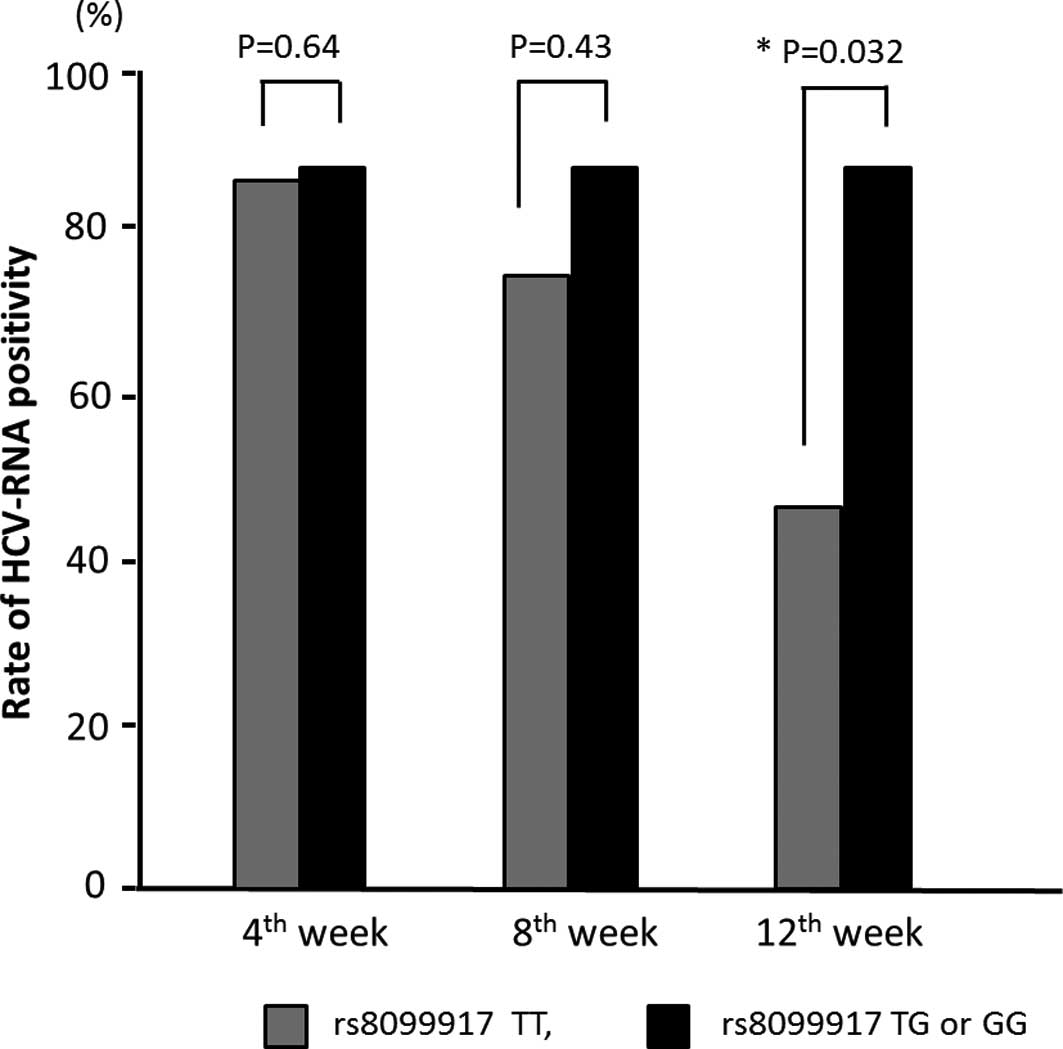
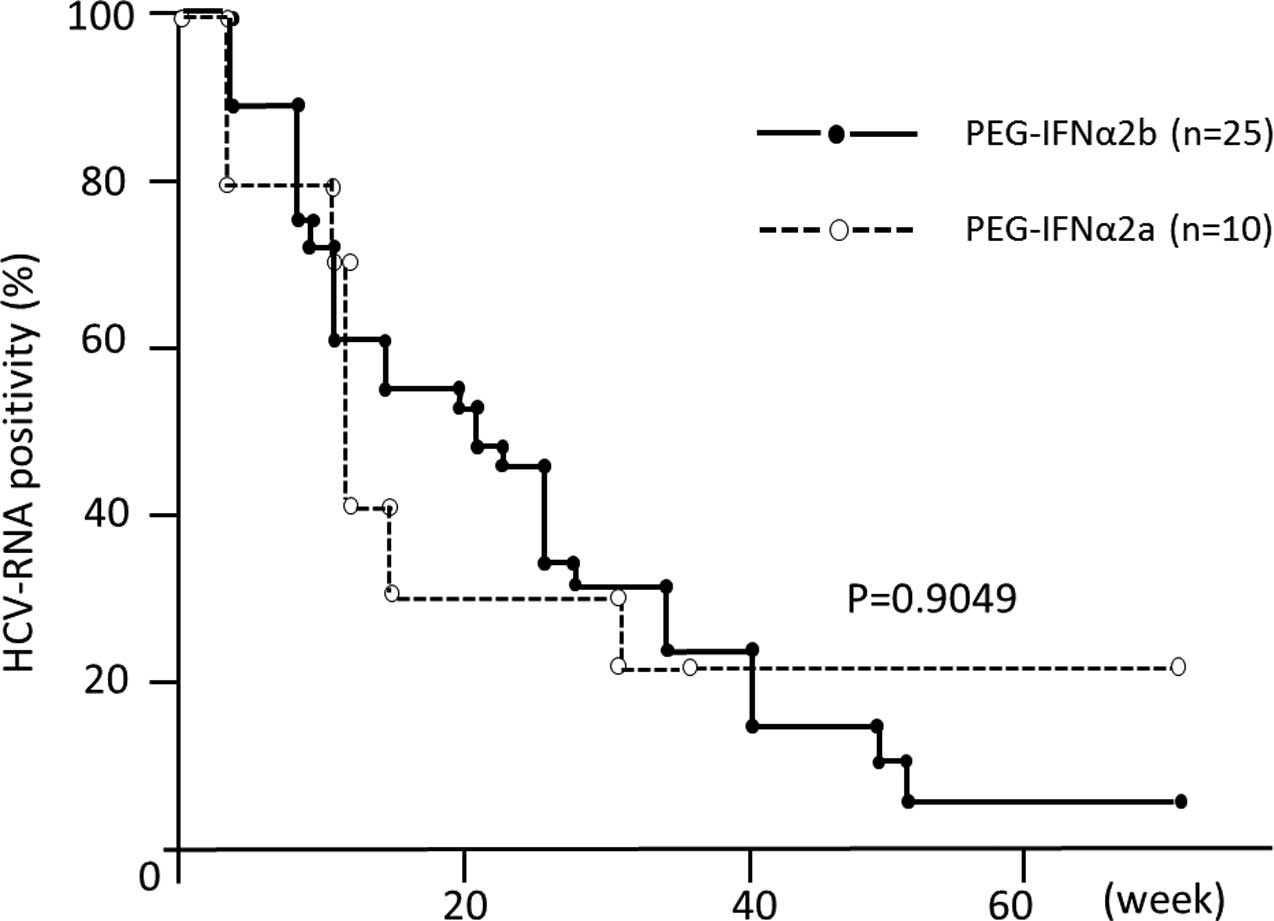
The patients with HCV genotype 1 were stratified according to their IL-28B allele type, and the early responses of HCV-RNA at 4, 8 and 12 weeks after the start of PEG-IFN/RBV therapy were analyzed (Fig. 1). The rate of HCV-RNA positivity was significantly lower at 12 weeks in patients with the IL-28B major allele than in patients with the IL-28B minor allele. This finding suggests that IL-28B has a great impact on the early virological response to therapy. Using multivariate analysis, the major allele of IL-28B (P=0.014) and the number of platelets (P=0.030) were associated with negative HCV-RNA at 12 weeks (Table III). No significant difference was detected between the effects of PEG-IFNα-2a and 2b (Fig. 2).

Figure 1.

Early viral response of the HCV genotype 1 to pegylated interferon (PEG-IFN) plus ribavirin (RBV). Patients of HCV genotype 1 were stratified according to their IL28B allele type, and the early responses of HCV-RNA at 4, 8 and 12 weeks after the start of PEG-IFN/RBV therapy were assessed.

Figure 2.

Comparison of the effects of PEG-INFα-2a and 2b on HCV positivity. Data were analyzed by the Kaplan-Meier method. There were no significant differences between the effects of the two PEG-IFNα formulations.

Table III.

Multivariate analyses of factors associated with HCV-RNA-negativity at week 12.

Table III.

Multivariate analyses of factors associated with HCV-RNA-negativity at week 12.

Odds ratio95% CIP-value
rs8099917 TT66.22.320-999.90.014a
Gender0.360.043–3.210.220
Age1.070.990–1.180.220
BMI0.720.430–1.210.210
γ-GTP1.000.970–1.030.910
Platelets1.331.030–2.120.030a

{ label (or @symbol) needed for fn[@id='tfn2-etm-02-04-0715'] } CI, confidence interval. BMI, body mass index.

a Significant difference.

Discussion

Twenty to thirty percent of patients infected with HCV genotype 1 are non-responders to PEG-IFN/RBV therapy. Furthermore, PEG-IFN/RBV therapy may be associated with considerable toxicity. Therefore, a pre-treatment prediction of the patient response to therapy is clinically valuable. However, there have been no reliable baseline predictors for the response to anti-viral therapy. This study demonstrated that the IL-28B polymorphism was an overwhelming predictor of an early viral response to PEG-IFN/RBV therapy. IL-28B encodes a protein known as IFNλ 3, which is thought to suppress the replication of various viruses, including HCV (15). The results of the present study may provide a rationale for developing diagnostic testing and a therapeutic approach for targeting IL-28B in chronic hepatitis C in the future.

A polymorphism upstream of the IL-28B gene has been reported to be strongly associated with a favorable response in HCV-1 patients (13). In this study, we confirmed the clinical relevance of this genetic discovery. The polymorphism was significantly associated with early viral clearance at week 12. The key marker for an improved treatment response was the IL-28B major allele (TT type). The major allele type was associated with improved early viral suppression, such that by week 12, the reduction in viral positivity was doubled in patients with the TT allele as compared to the non-TT IL-28B type HCV-1 patients. Genotyping of IL-28B prior to PEG-IFN/RBV therapy will aid clinicians and patients in PEG-IFN/RBV therapy management. Those patients who have the major allele (TT type) IL-28B have a greater likelihood of achieving early viral reduction, and should be considered ideal candidates. By contrast, patients with the minor allele (TG or GG type) are unlikely to achieve an early response to therapy, and need excellent compliance to the doses of PEG-IFN/RBV.

It has been reported that 20% of individuals infected with HCV are obese, and that the obesity in these individuals is associated with steatosis and the progression of fibrosis (4,11,16). These factors are shown to be associated with a non-response to treatment with PEG-IFN/RBV (16). However, we did not identify the BMI as one of the significant factors for a poor early viral response. On the other hand, we detected a significant association of platelet number. Since platelet number decreases in accordance with the progression of liver fibrosis (11), this suggests that PEG-IFN/RBV is more effective for patients with better histological changes of the liver.

Recent direct comparative trials, retrospective and meta-analysis studies have demonstrated that treatment with PEG-IFNα-2a is a significant and independent contributor to SVR in patients infected with genotype 1 (17), as compared to treatment with PEG-IFNα-2b, although the largest head-to-head trial (IDEAL study) failed to detect a significant difference in SVR rates between these two peg-IFNα formulations (18). Our observations also demonstrated that there are no differences in the early viral response between these two PEG-IFNα subtypes.

In conclusion, an IL-28B genotype is the strongest baseline predictor of an early viral response to PEG-IFN/RBV therapy in HCV-1 patients. It is likely that IL-28B SNP genotyping may become part of the clinical assessment before standard antiviral therapy in individuals chronically infected with HCV-1.

Acknowledgements

This study was supported, in part, by MSD K.K. (Tokyo, Japan).

References

1. 

Alavian SM, Tabatabaei SV, Keshvari M, et al: Peginterferon alpha-2a and ribavirin treatment of patients with haemophilia and hepatitis C virus infection: a single-centre study of 367 cases. Liver Int. 30:1173–1180. 2010. View Article : Google Scholar : PubMed/NCBI

2. 

Welzel TM, Morgan TR, Bonkovsky HL, et al: Variants in interferon-alpha pathway genes and response to pegylated interferon-alpha2a plus ribavirin for treatment of chronic hepatitis C virus infection in the hepatitis C antiviral long-term treatment against cirrhosis trial. Hepatology. 49:1847–1858. 2009. View Article : Google Scholar

3. 

Kurosaki M, Tanaka Y, Nishida N, et al: Pre-treatment prediction of response to pegylated-interferon plus ribavirin for chronic hepatitis C using genetic polymorphism in IL28B and viral factors. J Hepatol. 54:439–448. 2011. View Article : Google Scholar

4. 

Yasui K, Harano Y, Mitsuyoshi H, et al: Steatosis and hepatic expression of genes regulating lipid metabolism in Japanese patients infected with hepatitis C virus. J Gastroenterol. 45:95–104. 2010. View Article : Google Scholar : PubMed/NCBI

5. 

Ochi H, Maekawa T, Abe H, et al: IL-28B predicts response to chronic hepatitis C therapy-fine-mapping and replication study in Asian populations. J Gen Virol. Jan. 12–2011, (E-pub ahead of print).

6. 

Hadziyannis SJ and Koskinas JS: Differences in epidemiology, liver disease and treatment response among HCV genotypes. Hepatol Res. 29:129–135. 2004. View Article : Google Scholar : PubMed/NCBI

7. 

Hadziyannis SJ, Sette H Jr, Morgan TR, et al: Peginterferon-alpha2a and ribavirin combination therapy in chronic hepatitis C: a randomized study of treatment duration and ribavirin dose. Ann Intern Med. 140:346–355. 2004. View Article : Google Scholar : PubMed/NCBI

8. 

Iino S, Ichida F, Sakuma A and Suzuki H: A randomized clinical trial with natural interferon-alpha monotherapy for 24 or 48 weeks in patients with chronic hepatitis C having genotype 1b infection in high viral titers. Hepatol Res. 24:338–345. 2002. View Article : Google Scholar

9. 

Enomoto N, Sakuma I, Asahina Y, et al: Mutations in the nonstructural protein 5A gene and response to interferon in patients with chronic hepatitis C virus 1b infection. N Engl J Med. 334:77–81. 1996. View Article : Google Scholar : PubMed/NCBI

10. 

Akuta N, Suzuki F, Kawamura Y, et al: Predictors of viral kinetics to peginterferon plus ribavirin combination therapy in Japanese patients infected with hepatitis C virus genotype 1b. J Med Virol. 79:1686–1695. 2007. View Article : Google Scholar : PubMed/NCBI

11. 

Izumi N, Asahina Y and Kurosaki M: Predictors of virological response to a combination therapy with pegylated interferon plus ribavirin including virus and host factors. Hepat Res Treat. 2010:7036022010.PubMed/NCBI

12. 

Tanaka Y, Nishida N, Sugiyama M, et al: Genome-wide association of IL28B with response to pegylated interferon-alpha and ribavirin therapy for chronic hepatitis C. Nat Genet. 41:1105–1109. 2009. View Article : Google Scholar : PubMed/NCBI

13. 

Ge D, Fellay J, Thompson AJ, et al: Genetic variation in IL28B predicts hepatitis C treatment-induced viral clearance. Nature. 461:399–401. 2009. View Article : Google Scholar : PubMed/NCBI

14. 

Livak KJ: Allelic discrimination using fluorogenic probes and the 5′ nuclease assay. Genet Anal. 14:143–149. 1999.

15. 

Marcello T, Grakoui A, Barba-Spaeth G, et al: Interferons alpha and lambda inhibit hepatitis C virus replication with distinct signal transduction and gene regulation kinetics. Gastroenterology. 131:1887–1898. 2006. View Article : Google Scholar : PubMed/NCBI

16. 

Charlton MR, Pockros PJ and Harrison SA: Impact of obesity on treatment of chronic hepatitis C. Hepatology. 43:1177–1186. 2006. View Article : Google Scholar : PubMed/NCBI

17. 

Tsubota A, Fujise K, Namiki Y and Tada N: Peginterferon and ribavirin treatment for hepatitis C virus infection. World J Gastroenterol. 17:419–432. 2011. View Article : Google Scholar : PubMed/NCBI

18. 

McHutchison JG, Lawitz EJ, Shiffman ML, et al: Peginterferon alpha-2b or alpha-2a with ribavirin for treatment of hepatitis C infection. N Engl J Med. 361:580–593. 2009. View Article : Google Scholar : PubMed/NCBI

Related Articles

  • Abstract
  • View
  • Download
  • Twitter
Copy and paste a formatted citation
Spandidos Publications style
Osaki R, Nishimura T, Takeuchi T, Imaeda H, Okumura Y, Shioya M, Nakahara T, Bamba S, Nakajo S, Fujiyama Y, Fujiyama Y, et al: Interleukin-28B polymorphisms are associated with an early viral response in patients receiving hepatitis C therapy. Exp Ther Med 2: 715-718, 2011.
APA
Osaki, R., Nishimura, T., Takeuchi, T., Imaeda, H., Okumura, Y., Shioya, M. ... Andoh, A. (2011). Interleukin-28B polymorphisms are associated with an early viral response in patients receiving hepatitis C therapy. Experimental and Therapeutic Medicine, 2, 715-718. https://doi.org/10.3892/etm.2011.250
MLA
Osaki, R., Nishimura, T., Takeuchi, T., Imaeda, H., Okumura, Y., Shioya, M., Nakahara, T., Bamba, S., Nakajo, S., Fujiyama, Y., Andoh, A."Interleukin-28B polymorphisms are associated with an early viral response in patients receiving hepatitis C therapy". Experimental and Therapeutic Medicine 2.4 (2011): 715-718.
Chicago
Osaki, R., Nishimura, T., Takeuchi, T., Imaeda, H., Okumura, Y., Shioya, M., Nakahara, T., Bamba, S., Nakajo, S., Fujiyama, Y., Andoh, A."Interleukin-28B polymorphisms are associated with an early viral response in patients receiving hepatitis C therapy". Experimental and Therapeutic Medicine 2, no. 4 (2011): 715-718. https://doi.org/10.3892/etm.2011.250
Copy and paste a formatted citation
x
Spandidos Publications style
Osaki R, Nishimura T, Takeuchi T, Imaeda H, Okumura Y, Shioya M, Nakahara T, Bamba S, Nakajo S, Fujiyama Y, Fujiyama Y, et al: Interleukin-28B polymorphisms are associated with an early viral response in patients receiving hepatitis C therapy. Exp Ther Med 2: 715-718, 2011.
APA
Osaki, R., Nishimura, T., Takeuchi, T., Imaeda, H., Okumura, Y., Shioya, M. ... Andoh, A. (2011). Interleukin-28B polymorphisms are associated with an early viral response in patients receiving hepatitis C therapy. Experimental and Therapeutic Medicine, 2, 715-718. https://doi.org/10.3892/etm.2011.250
MLA
Osaki, R., Nishimura, T., Takeuchi, T., Imaeda, H., Okumura, Y., Shioya, M., Nakahara, T., Bamba, S., Nakajo, S., Fujiyama, Y., Andoh, A."Interleukin-28B polymorphisms are associated with an early viral response in patients receiving hepatitis C therapy". Experimental and Therapeutic Medicine 2.4 (2011): 715-718.
Chicago
Osaki, R., Nishimura, T., Takeuchi, T., Imaeda, H., Okumura, Y., Shioya, M., Nakahara, T., Bamba, S., Nakajo, S., Fujiyama, Y., Andoh, A."Interleukin-28B polymorphisms are associated with an early viral response in patients receiving hepatitis C therapy". Experimental and Therapeutic Medicine 2, no. 4 (2011): 715-718. https://doi.org/10.3892/etm.2011.250
Follow us
  • Twitter
  • LinkedIn
  • Facebook
About
  • Spandidos Publications
  • Careers
  • Cookie Policy
  • Privacy Policy
How can we help?
  • Help
  • Live Chat
  • Contact
  • Email to our Support Team