Introduction
Head and neck mucosal melanoma (HNMM) is a rare
malignant tumor worldwide, but is relatively common in Japan,
comprising 6% of all melanomas (1). Resection with a clear margin is
emphasized as the most important factor for good local control and
better prognosis. However, radical surgery is not possible in
certain cases as many important organs may be located near the
tumor. In addition, effective chemotherapy has not yet been
established, and a common therapeutic strategy has not been
clarified excluding curative surgical resection.
This study was performed to analyze 13 cases of MMHN
treated at the Yokohama City University School of Medicine from
June 1992 to November 2010.
Patients and methods
The medical records of 13 MMHN patients treated at
the Yokohama City University School of Medicine from June 1992 to
November 2010 were retrospectively reviewed. Collected data
included gender, age, primary site, extent of the lesion, nodal
involvement at presentation, metastasis at presentation, treatment
contents, positive or negative surgical margins and treatment
outcome.
Patients consisted of 3 males and 10 females. Median
age was 60.8 years (range 39–78). Common symptoms were epistaxes
(38.5%) and nasal obstruction (30.8%). In terms of the primary
site, tumors in 5 cases were in the paranasal cavities (maxillary
sinus in 2 cases, ethmoid sinus in 2 cases, sphenoid sinus in 1
case) and 8 cases in the nasal cavity. Staging according to the
Ballantyne's staging system was applied (1). Stage I: 11 cases showed lesional type
tumors. Stage II: 1 case had cervical nodal metastasis only. Stage
III: 1 case had distant metastases. Furthermore, Stage I was
classified into two types. Tumors in 5 cases in Stage Ia were
limited to one anatomical lesion, and those in 6 cases in Stage Ib
extended to the adjacent lesion.
The median follow-up period was 48 months (range
10–115). Survival rates were expressed using the Kaplan-Meyer
method and the Wilcoxon test was used to evaluate the difference
between each group (Table I).
 | Table I.Characteristics of 13 patients with
mucosal melanoma of the head and neck. |
Table I.
Characteristics of 13 patients with
mucosal melanoma of the head and neck.
| Characteristics | No. |
|---|
| Age (years) | 39–78 (average
61) |
| Gender | |
| Male | 3 |
| Female | 10 |
| Sites | |
| Nasal cavity | 8 |
| Sinonasal
cavity | 5 |
| Maxillary
sinus | 2 |
| Ethmoidal
sinus | 2 |
| Sphenoidal
sinus | 1 |
| Tumor stage | |
| Stage Ia | 5 |
| Stage Ib | 6 |
| Stage II | 1 |
| Stage III | 1 |
Surgical resection
Ten out of 13 patients underwent definitive surgery
as initial treatment. Three patients did not undergo surgical
operation due to 1 case each of liver metastases, orbital and skull
base invasion, and skull base invasion.
Chemotherapy and radiotherapy
In addition to surgery, chemotherapy and/or
immunotherapy were carried out in the initial treatment course
(Table II). Chemotherapy was based
on the so-called DAV therapy: Dimethyltriazeno-imidazole
carboxamide (DTIC; 80–140 mg/m2), amino methyl
pyrimidinyl methyl chlorethyl nitrorosourea hydrochloride (ACNU;
50–80 mg/m2) and vincristine (VCR; 0.5–0.8
mg/m2). Cisplatin with DAV was administered for 3
patients and interferon-α with DAV was applied in 5 cases (Table III).
| Table II.Characteristics and outcomes of each
patient. |
Table II.
Characteristics and outcomes of each
patient.
| Pt. no. | Age | Gender | Major complaint | Site | Stage | Primary
treatment | Surgical margin | Adjunct LAK cell
therapy (no. of times) | Outcome (follow-up
period, months) |
|---|
| 1 | 45 | F | Cheek pain | MS | Ib | C→O→R | − | − | Death (13) |
| 2 | 67 | M | Epistaxis | N | Ia | C→O→I | − | − | Death (38) |
| 3 | 54 | M | Epistaxis | ES | Ia | C→I | | − | Death (35) |
| 4 | 74 | F | Nasal
obstruction | N | Ia | O→I | + | + (32) | Death (64) |
| 5 | 54 | F | Nasal
obstruction | N | Ia | O→I | − | + (6) | Death (42) |
| 6 | 68 | F | Nasal
obstruction | N | Ia | C→O→I | − | + (13) | Death (115) |
| 7 | 40 | F | Epistaxis | N | Ib | C→O→I | + | + (15) | Death (35) |
| 8 | 56 | M | Epistaxis | N | Ib | O→I | + | + (23) | Death (89) |
| 9 | 74 | F | Nasal
obstruction | N | Ib | O→C→I | − | − | Alive (65) |
| 10 | 40 | F | Asymptomatic | SS | III | R→C→I | | + (22) | Alive (62) |
| 11 | 72 | F | Exophthalmos | MS | Ib | C→I | | − | Alive (31) |
| 12 | 69 | F | Neck tumor | MS | II | C→O→I | − | − | Alive (31) |
| 13 | 78 | F | Epistaxis | N | Ib | C→O→I | − | + (6) | Alive (10) |
| Table III.Chemotherapy regimens. |
Table III.
Chemotherapy regimens.
| DAV + CDDP | 3 |
| DAV | 2 |
| DAV-feron | 5 |
Radiotherapy during initial treatment was carried
out in 2 cases. Postoperative radiotherapy (50 Gy) was carried out
for 1 case and heavy particulate radiotherapy was carried out for 1
inoperative case.
Immunotherapy
As for immunotherapy, lymphokine-activated killer
(LAK) cell transfer therapy (2,3) was
carried out for 7 patients as adjunctive treatment after initial
treatment. LAK cell therapy populates the self-activated
lymphocytes intravenously with interleukin-2 (IL-2). Grimm et
al (4) and Rosenberg et
al (5) demonstrated an
increasing trend in the survival rate when IL-2 was administered
with LAK cells in patients with advanced cancer. Blood (40–50 ml)
was collected from the patients. Approximately 109
lymphocytes were prepared after culture with the anti-CD3 antibody
and IL-2, and subsequently CD-8-positive killer (LAK) cells were
induced and proliferated. The average number of adjunctive LAK cell
treatments was 16 (range 6–32). Many patients received the therapy
once a week or once every 2 weeks. The number of cells injected
each time was 5×10⁸ to 5×10⁹.
Results
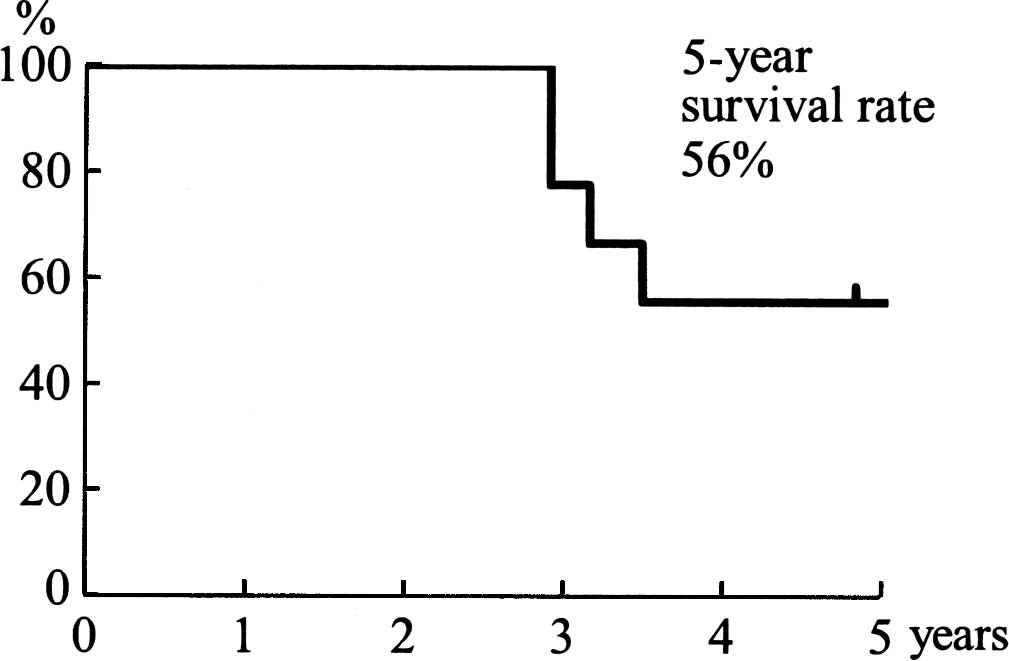
The overall 5-year, cause-specific survival rate was
56% (Fig. 1). Each rate showed a
better outcome than those of other reports (6,7). As
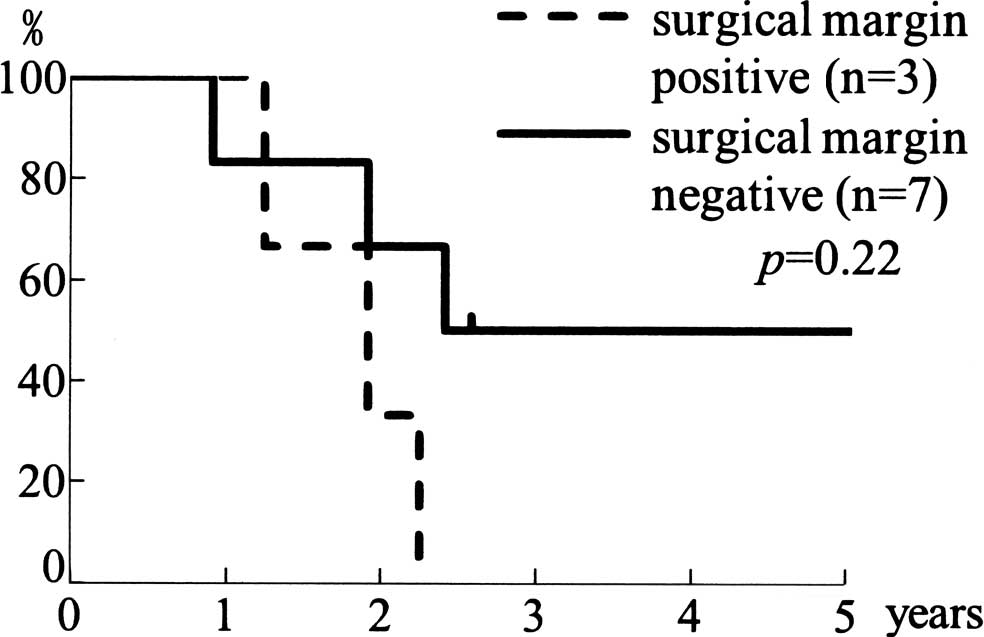
for the operative therapy, the 5-year disease-free survival rate in
margin-positive surgery (n=3) was 0%, whereas it was 50% in
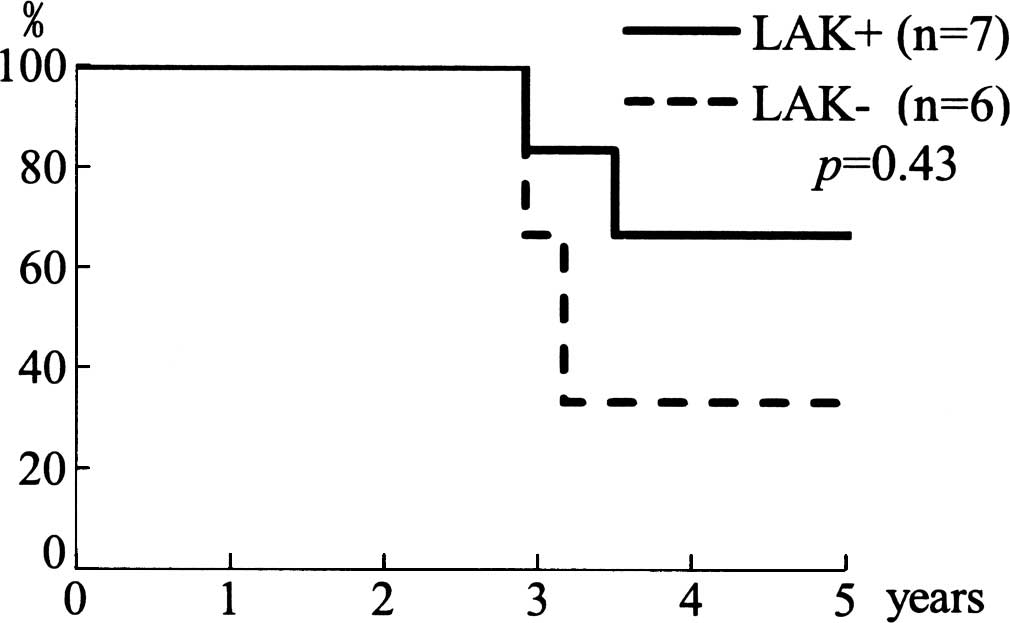
margin-negative surgery (n=7) (p=0.21) (Fig. 2). In 7 cases receiving adjunctive
LAK cell therapy, the 5-year cause-specific survival rate was 66%,
while that in 6 cases without adjunctive LAK therapy was 33%
(p=0.43) (Fig. 3). Although a
statistical significance was not recognized, LAK therapy is
suggested to improve prognosis of MMHN.
Discussion
The incidence of malignant melanoma in Japan is low
compared to Western countries. However, regarding the incidence of
MMHN, in Western countries it accounts for only 1.7% of all cases
of melanoma, whereas it accounts for 23.3% in Japan (8,10).
MMHN arises from aberrant melanocytes during fetal life. On the
other hand, a difference in sensitivity to ultraviolet rays is
assumed to cause skin melanoma. Therefore, racial difference is
considered to be associated with a high incidence of melanoma of
the skin in Western countries.
With regard to gender and MMHN, certain reports have
shown a male-to-female ratio of 1:1 to 2:1 (8,10).
In this study, the ratio was 3:10. Regarding the primary site of
MMHN, various studies have reported a rate of occurrence of 50% in
the oral cavity and 35% in the sinonasal cavity (10), or a high occurrence in the
sinonasal cavity (11). In this
study, 8 cases (61%) originated from the nasal cavity and 5 cases
(39%) from the paranasal cavities.
A treatment modality for MMHN has yet to be
established. For resectable lesions, complete removal with surgical
margins, such as a basilar operation, is generally the most optimal
course. Regarding chemotherapy for MMHN, a DTIC-based combination
regimen is often applied (12).
Penel et al reported that positive surgical margins were a
risk factor in univariate analysis, and they suggested that clear
margins appeared to predict a more favorable outcome (13). Other reports also revealed that the
quality of the margins was linked to a better overall survival rate
(10,14). Thus, operative therapy is the first
choice for curative treatment. In our study, the 5-year
disease-free survival rate in margin-positive surgery (n=3) was 0%,
whereas it was 50% in margin-negative surgery (n=7) (p=0.21)
(Fig. 2).
On the other hand, recent reports have shown almost
the same effectiveness in terms of local control by high-dose
fractionated radiotherapy in comparison to curative surgery
(7,15). Wada et al reported that
high-dose per fractionated radiotherapy doses (≥3 Gy) were
associated with better prognosis for both local control and
survival (9). The effect of
postoperative radiotherapy has also been the focus of research
(14). Temam et al
demonstrated that patients with early T-classification tumors who
received postoperative radiotherapy had a better local disease-free
survival compared to patients with late T-classification tumors who
did not receive postoperative radiotherapy (16). Thus, the role of radiotherapy, such
as high-dose fractionated radiotherapy and carbon ion radiotherapy,
is expected to be considerably more important for functionally and
cosmetically operable cases (9,17,18).
However, radiotherapy treats the local tumor, but does not inhibit
distant metastasis (14,16). A combination treatment with
systemic therapies, such as chemotherapy and immunotherapy, is
indispensable for the improvement of the outcome of MMHN (14,16).
As for immunotherapy, LAK cells were administered
intravenously with IL-2 to retain its activity in attacking cancer
cells. Grimm et al (4) and
Rosenberg et al (5) found
an increased trend in the survival rate when IL-2 was administered
with LAK cells in patients with melanoma. Seven patients received
LAK cell therapy as adjunctive therapy after initial treatment. The
5-year cause-specific survival rate of this group was 67%, while
that of 6 cases without LAK cell therapy was 33% (p=0.43). Due to
the small population, a statistical significance could not be
obtained. However, based on the results, LAK cell therapy is
suggested to improve prognosis of MMHN (Fig. 3).
Because of the small size of most reported series
and their retrospective nature, the effect of various treatment
strategies for MMHN has been difficult to evaluate.
Surgical treatment has been the primary treatment
modality. However, as wide surgical resection in the head and neck
region is often difficult, radiotherapy has been recently reported
as a beneficial management modality. The high rate of distant
metastasis also suggests that a systemic treatment is required.
Currently, there is no role for adjuvant systemic therapy for
patients who have been successfully resected. Further evaluation of
the role of chemotherapy and immunotherapy is required to decrease
the rates of distant metastasis and improve survival (19).
There are few reports on immunotherapy for MMHN.
Based on dermatological research, malignant melanoma is targeted
using immunotherapies, such as cytokines, cancer vaccines, adoptive
cell transfer and cancer gene therapies, and these immunotherapies
have been actively investigated (20–22).
For example, Atkins et al reported that 12 responding
patients out of 270 patients with metastatic melanoma treated with
high-dose recombinant IL-2 therapy remained continually
disease-free or progression-free from >70 to >150 months
following initiation of therapy (20).
In the present study, LAK cell therapy as initial or
adjunctive therapy for patients with MMHN was applied. A tendency
for an improved survival rate of patients with MMHN by LAK cell
therapy was recognized. Further investigation using an accumulation
of cases is warranted.
Abbreviations:
|
MMHN
|
mucosal melanoma of the head and
neck
|
|
LAK
|
lymphokine-activated killer
|
References
|
1.
|
Ballantyne AJ: Malignant melanoma of the
skin of the head and neck. An analysis of 405 cases. Am J Surg.
120:425–431. 1970. View Article : Google Scholar : PubMed/NCBI
|
|
2.
|
Tsukuda M, Mochimatsu I, Sakumoto M, et
al: The synergistic effects of interleukin 2 and interleukin 7 on
the proliferation and autologous tumor cell lysis of
tumor-associated lymphocytes. Biotherapy. 6:167–174. 1993.
View Article : Google Scholar : PubMed/NCBI
|
|
3.
|
Tsukuda M, Mochimatsu I, Sakumoto M, et
al: Autologous tumor cell killing activity of tumor-associated
lymphocytes in patients with head and neck carcinomas. Biotherapy.
6:155–161. 1993. View Article : Google Scholar : PubMed/NCBI
|
|
4.
|
Grimm EA, Mazumder A, Zhang HZ, et al:
Lymphokine-activated killer cell phenomenon. Lysis of natural
killer-resistant fresh solid tumor cells by interleukin 2-activated
autologous human peripheral blood lymphocytes. J Exp Med.
155:1823–1841. 1982. View Article : Google Scholar
|
|
5.
|
Rosenberg SA, Lotze MT, Yang JC, et al:
Prospective randomized trial of high-dose interleukin-2 alone or in
conjunction with lymphokine-activated killer cells for the
treatment of patients with advanced cancer. J Natl Cancer Inst.
85:622–632. 1993. View Article : Google Scholar
|
|
6.
|
Manolidis S and Donald PJ: Malignant
mucosal melanoma of the head and neck: review of the literature and
report of 14 patients. Cancer. 80:1373–1386. 1997. View Article : Google Scholar : PubMed/NCBI
|
|
7.
|
Douglas CM, Malik T, Swindell R, et al:
Mucosal melanoma of the head and neck: radiotherapy or surgery? J
Otolaryngol Head Neck Surg. 39:385–392. 2010.
|
|
8.
|
Omura K, Takemiya S, Shimada F, et al:
Malignant mucosal melanomas of the head and neck – collective
review from six cancer hospitals. Gan No Rinsho. 32:1511–1518.
1986.
|
|
9.
|
Wada H, Nemoto K, Ogawa Y, et al: A
multi-institutional retrospective analysis of external radiotherapy
for mucosal melanoma of the head and neck in Northern Japan. Int J
Radiat Oncol Biol Phys. 59:495–500. 2004. View Article : Google Scholar : PubMed/NCBI
|
|
10.
|
Conley JJ: Melanomas of the mucous
membrane of the head and neck. Laryngoscope. 99:1248–1254. 1989.
View Article : Google Scholar : PubMed/NCBI
|
|
11.
|
Saito H, Hozawa J and Yamagami M:
Statistical analysis of malignant melanoma of nasal cavity and
paranasal sinuses in Japan. Nippon Jibiinkoka Gakkai Kaiho.
86:139–143. 1983. View Article : Google Scholar : PubMed/NCBI
|
|
12.
|
Ishihara K, Yamazaki N and Asano K:
Chemotherapy of malignant melanoma. Gan To Kagaku Ryoho.
20:1287–1292. 1993.
|
|
13.
|
Penel N, Mallet Y, Mirabel X, et al:
Primary mucosal melanoma of head and neck: prognostic value of
clear margins. Laryngoscope. 116:993–995. 2006. View Article : Google Scholar : PubMed/NCBI
|
|
14.
|
Moreno MA, Roberts DB, Kupferman ME, et
al: Mucosal melanoma of the nose and paranasal sinuses, a
contemporary experience from the M. D. Anderson Cancer Center.
Cancer. 116:2215–2223. 2010.PubMed/NCBI
|
|
15.
|
Mizoe JE, Tsujii H, Kamada T, et al: Dose
escalation study of carbon ion radiotherapy for locally advanced
head-and-neck cancer. Int J Radiat Oncol Biol Phys. 60:358–364.
2004. View Article : Google Scholar : PubMed/NCBI
|
|
16.
|
Temam S, Mamelle G, Marandas P, et al:
Postoperative radiotherapy for primary mucosal melanoma of the head
and neck. Cancer. 103:313–319. 2005. View Article : Google Scholar
|
|
17.
|
Zenda S, Kawashima M, Nishio T, et al:
Proton beam therapy as a nonsurgical approach to mucosal melanoma
of the head and neck: a pilot study. Int J Radiat Oncol Biol Phys.
Oct 13–2010.(E-pub ahead of print).
|
|
18.
|
Trotti A and Peters LJ: Role of
radiotherapy in the primary management of mucosal melanoma of the
head and neck. Semin Surg Oncol. 9:246–250. 1993.PubMed/NCBI
|
|
19.
|
Gavriel H, McArthur G, Sizeland A and
Henderson M: Review: mucosal melanoma of the head and neck.
Melanoma Res. April 30–2011.(E-pub ahead of print).
|
|
20.
|
Atkins MB, Kunkel L, Sznol M, et al:
High-dose recombinant interleukin-2 therapy in patients with
metastatic melanoma: long-term survival update. Cancer J Sci Am.
6(Suppl 1): 11–14. 2000.PubMed/NCBI
|
|
21.
|
Baba T, Sato-Matsushita M, Kanamoto A, et
al: Phase I clinical trial of the vaccination for the patients with
metastatic melanoma using gp100-derived epitope peptide restricted
to HLA-A*2402. J Transl Med. 8:842010.PubMed/NCBI
|
|
22.
|
Rosenberg SA, Restifo NP, Yang JC, et al:
Adoptive cell transfer: a clinical path to effective cancer
immunotherapy. Nat Rev Cancer. 8:299–308. 2008. View Article : Google Scholar : PubMed/NCBI
|