Introduction
As the most abundant cells in tumor stroma,
tumor-associated fibroblasts or carcinoma-associated stromal
fibroblasts (CAFs) have distinctly different morphological and
biological characteristics compared with normal fibroblasts (NFs).
CAFs may promote the malignant transformation of epithelial cells
by secreting a variety of growth factors, cytokines,
chemoattractants and enzymes. Scatter factor/hepatocyte growth
factor, insulin growth factor, matrix metalloproteinases and
fibroblast activation protein have been confirmed to play an
important role in tumor-host crosstalk (1–3).
Accumulating evidence suggests that CAFs play an important role in
cancer initiation and progression (4). Co-culture system or three-dimensional
(3D) culture system has been used to study the interaction between
CAFs and cancer cells in recent years. However, the study of cells
in 3D cultures has been hampered by the lack of simple methods to
analyze them. Current techniques are time-consuming, require
expensive equipment such as confocal microscopy for optimal
results, and are poorly adapted for study (5,6).
Moreover, these tumor-promoting properties of CAFs appear to be
partially independent of the presence of tumor cells and are
maintained in vitro even in the absence of epithelial cells
(1,7). Therefore, it is feasible to isolate
fibroblasts from carcinoma specimen and to culture in vitro
for understanding the role of CAFs in the tumor microenvironment.
Since the concept of the secretome (ensemble of proteins secreted
and/or shed from cells) was proposed (8), it has become an attractive and
challenging proteomic technology in recent years. However,
secretome analysis still faces some difficulties mainly related to
sample collection and preparation. In the present study, we
explored one method of sample preparation, and we conducted
secretome analysis of CAFs and NFs to evaluate the expression
patterns of secreted proteins from fibroblasts in NPC
carcinogenesis. The experimental results will provide a basis for
the further understanding of the regulatory mechanisms of CAFs in
the NPC microenvironment.
Materials and methods
Nasopharyngeal mucosal samples
All experimental procedures in this study were
approved by the Ethics Committee of the Central South University
School of Medicine. In total, 8 nasopharyngeal mucosal samples from
patients with poorly differentiated nasopharyngeal squamous cell
carcinoma and 8 from patients with sinusitis were obtained with
informed consent at the Second Xiangya Hospital of Central South
University. Diagnoses were pathologically confirmed, and none of
the patients had received prior chemotherapy or radiation
therapy.
Fibroblast culture
CAFs and NFs were obtained by tissue culture as
described in detail elsewhere (9).
Nasopharyngeal mucosa tissue was washed extensively with sterile
PBS to remove contaminating debris and red blood cells, and cut
into small pieces. Then cells were dissociated by 0.25% trypsin
(Sigma, St. Louis, MO, USA) and purified using a curettage method
combined with trypsinization. The outgrowing fibroblasts were
cultivated with RPMI-1640 medium (Gibco, Life Technologies Inc,
Grand Island, NY, USA) supplemented with 10% fetal bovine serum
(FBS) and 1% penicillin/streptomycin (Sigma) in an incubator set at
37°C and 5% CO2. Cells were transferred and plated into
T-75 flasks. While cells were grown to 70% confluence, the culture
medium was removed and cells were washed more than 3 times with
Hank’s solution (Sigma), and then serum-free RPMI-1640 medium
supplemented with 5 μg/ml transferrin and 5 μg/ml
insulin were added to the culture for 72 h. For all experiments,
cells used were passaged no more than three times.
Preparation of secreted protein
samples
Culture medium was collected and centrifuged for 10
min at 1,000 × g, 10 min at 3,000 × g at 4°C to remove cell debris
or dead cells. The supernatant was harvested and filtered through a
membrane filter (nominal pore size 0.22 μm), and then
secreted proteins were enriched and concentrated by ultrafiltration
centrifugation (Millipore, Bedford, MA, USA). Finally,
approximately 250 μl of the supernatant containing secreted
proteins was obtained every time according to the CentriPlus
Centrifugal Filter Device User Guide. Protein lysis buffer (2 mol/l
thiourea, 7 mol/l urea, 40 mmol/l Tris, 4% CHAPS, 65 mol/l DTT) was
added to the concentrated supernatant. The mixture was centrifuged
for 30 min at 15,000 × g at 4°C and the final supernatant (ie.
secreted proteins) was obtained. The protein concentration was
measured using a 2D Quantitative kit (Amersham Biosciences,
Piscataway, NJ, USA).
2-D PAGE
Aliquots containing approximately 600 μg of
secreted protein extract were diluted in rehydration buffer for
separation by isoelectrical focusing followed by SDS-PAGE (4–15%
gradient gels) exactly in the same manner as previously described
elsewhere (10). After SDS-PAGE,
the gels were then stained with Coomassie blue staining solution
overnight followed by destaining with 18% methanol and 5% acetic
acid, Triplicate gels were made for each group.
Image analysis
2-D PAGE images were digitized with an Image scanner
(Amersham Biosciences, Piscataway, NJ, USA) and image analysis was
conducted using the PDQuest software (Bio-Rad, V7.1) as previously
described in detail elsewhere (10).
Identification of proteins by MALDI-TOF
MS
Protein spots showing temporal changes in expression
in each group were excised and digested in-gel with
sequencing-grade modified trypsin (Promega, Madison, WI, USA).
Tryptic peptides were separated and analyzed using MALDI-TOF MS.
The differentially expressed proteins were identified by peptide
mass fingerprint (PMF), SWISS-PROT and NCBI protein databases
searching using Mascot Distiller software exactly in the same
manner as previously described (10).
Galectin-1 ELISA assay
CAF and NF culture media were collected,
respectively, and applied to ELISA assay of galectin-1 in the
supernatant.
Results
2-D PAGE
A reliable method for extracting secreted protein
from conditioned medium was established. We isolated CAFs from
cancer specimens and cultivated ex vivo for up to 3
passages. Secreted proteins were enriched from the culture
supernatant by ultrafiltration centrifugation, and approximately
250 μl of the supernatant containing secreted proteins was
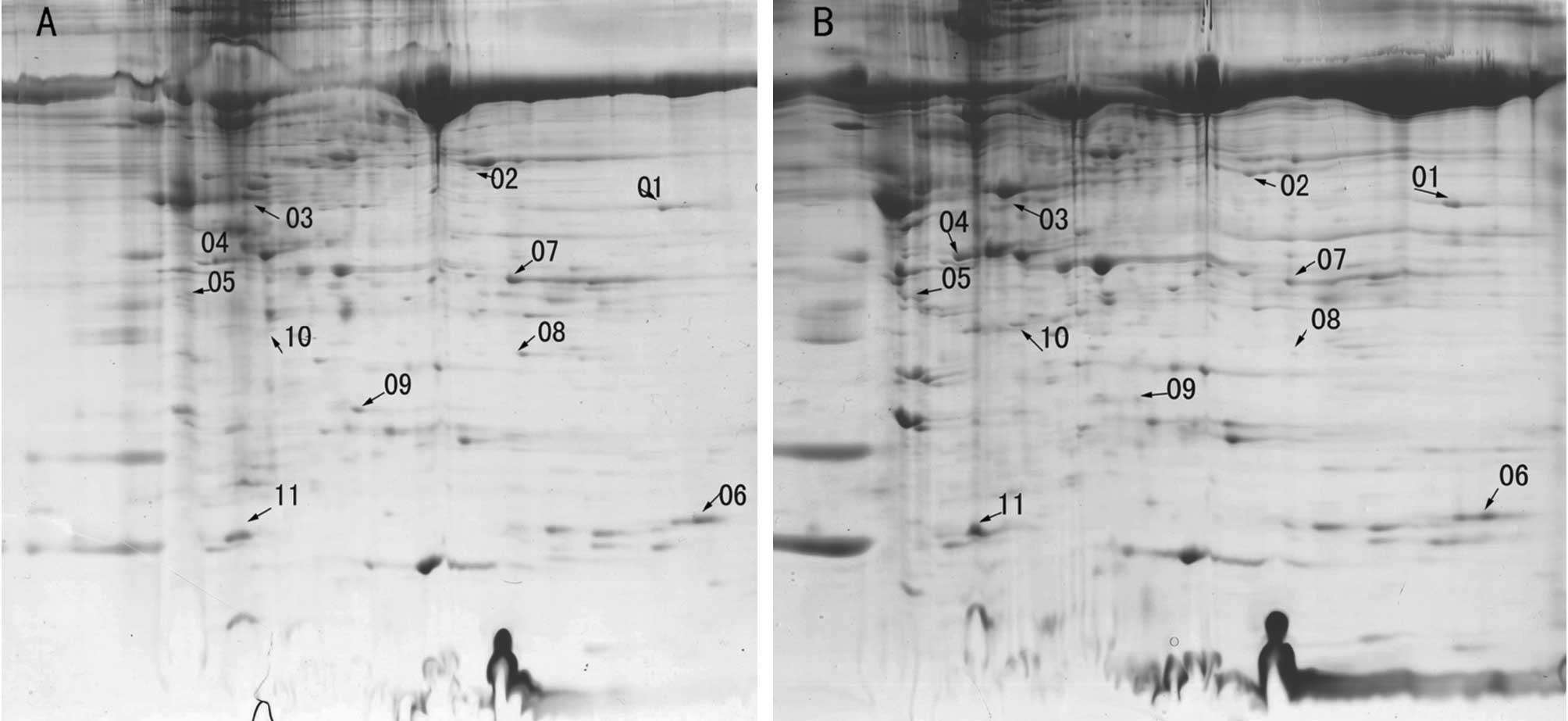
finally obtained. The 2-D PAGE reference map of the secreted
proteins from the fibroblasts was constructed. The differentially
expressed proteins were selected and numbered by PDQuestTM
(Fig. 1).
Protein identification
Eleven significant spots were identified through
MALDI-TOF MS and SWISS-PROT databases (Table I). These secreted protein were
consistently expressed in both the CAF and NF supernatants, while 8
were differentially up-regulated in the CAF supernatant when
compared with the NF supernatant. The other proteins were
down-regulated including cystatin C, complement component C1s
precursor and heterogeneous nuclear ribonucleoprotein A1. The
concentration of galectin-1 in the supernatant was determined by
ELISA. We detected a marked difference between the two groups
indicating that CAFs may secrete more galectin-1 than NFs.
 | Table I.Eleven spots obtained from 2-D PAGE
identified via MALDI-TOF MS. |
Table I.
Eleven spots obtained from 2-D PAGE
identified via MALDI-TOF MS.
| No. | Accession no. | Protein name | Relative molecular
weight (kDa) | Isoelectric point
(pI) | Variable
multiplesa |
|---|
| 1 | P04075 | Fructose bisphosphate
aldolase A | 24.7 | 8.47 | 3.10 |
| 2 | P05121 | Plasminogen activator
inhibitor 1 | 42.75 | 6.98 | 3.60 |
| 3 | P07711 | Cathepsin L | 37.9 | 5.32 | 2.50 |
| 4 | P08758 | Membrane annexin
A5 | 35.3 | 5.15 | 2.90 |
| 5 | P31947 | 14-3-3σ protein | 27.7 | 4.69 | 3.20 |
| 6 | P01034 | Cystatin C | 12.9 | 7.85 | 0.47 |
| 7 | P16035 | Complement component
C1s precursor | 78.16 | 4.87 | 0.23 |
| 8 | P08294 | Cu/Zn-SOD | 16.2 | 5.85 | 5.20 |
| 9 | P09651 | Heterogeneous nuclear
ribonucleoprotein A1 | 21.0 | 6.78 | 0.22 |
| 10 | P52565 | Rho-GDP dissociation
inhibitor 1 | 2.2 | 6.74 | 3.90 |
| 11 | P09382 | Galectin 1 | 14.89 | 5.32 | 3.10 |
Discussion
As it is well known that secreted proteins play a
key role in cell signaling, communication and migration, the
investigation of secreted proteins has received increased attention
in recent years. Secreted proteins are responsible for the
crosstalk among cells and understanding this language can largely
increase our knowledge concerning the molecular mechanisms of
neoplasia. Significant technological advances in the field of
proteomics during the last few years have provided shortcuts for
the research of secreted proteins, and the concept of the secretome
was correspondingly proposed. The secretome has facilitated the
study of cell secreted proteins, and it may be a viable strategy
for identifying candidate diagnostic and prognostic markers,
potential drug and therapeutic targets (11,12).
In the present experiment, we explored a set of methods with
reference to other studies (13).
At first, fibroblast cells were washed repeatedly more than 3 times
to eliminate interference of bovine serum albumin, and then
serum-free RPMI-1640 medium supplemented with transferrin and
insulin as necessary nourishments was added to continue culture.
Secondly, the culture medium was harvested and filtered through a
0.22-μm membrane filter. Thirdly, the culture medium was
concentrated and desalinated by ultrafiltration centrifugation. The
final step consisted of the lysis and denaturation of the
concentrated secreted proteins using a solution composed of 2 mol/l
thiourea, 7 mol/l urea, 4% CHAPS, 40 mmol/l Tris and 65 mol/l
DTT.
Although we achieved success in the sample
preparation approaches, many problems remain to be solved. The
major defect of the method used in this experiment involved the
complex operation used to enrich the secreted proteins and the
large amount of cell medium required; 50 ml of culture medium was
needed for approximately 250 μl of the supernatant
containing the secreted proteins. In order to enrich the secreted
proteins, the supernatant containing the secreted proteins was
collected repeatedly and the mixture was repeatedly put through
ultrafiltration centrifugation. Obviously, it is extremely
important to develop simpler and more efficient approaches such as
the nanozeolite-driven approach for enrichment of secretory
proteins (14). This technique not
only simplifies the operation order, but also saves time. Non-gel
electrophoresis technology may also have important application
value in secretome analysis such as nanoproteomics (15), capillary ultrafiltration and
multidimensional liquid chromatographic separation in combination
with mass spectrometry(16).
However, 2-D PAGE which is rapidly being modified plays an
irreplaceable role in proteomic analysis and is still the classical
and most widely used proteomics method.
Secreted proteins from CAFs may influence the NPC
pathological process in different ways. Among these secreted
proteins, Cu/Zn-SOD and fructose bisphosphate aldolase A are
associated with cellular oxidative reaction and play an important
role in protecting cells against reactive oxygen species injury.
Cathepsin L, cystatin C, plasminogen activator inhibitor-1,
heterogeneous ribonucleoprotein A1, Rho-GDP dissociation
inhibitor-1, 14-3-3σ protein and annexin A5 are associated with
signal transduction involved in NPC invasion and metastasis
(17–19). As a result, CAFs are involved in
the regulation of the NPC microenvironment through these secreted
proteins by different processes including protein degradation, cell
proliferation, invasion and metastasis. Galectin 1 is one member of
the family of β-galactoside-binding proteins implicated in
modulating cell-cell and cell-matrix interactions. Galectin 1 may
participate in the regulation of the nasopharyngeal carcinoma
microenvironment and its regulating mechanism remains unclear and
is yet to be further clarified (20).
In conclusion, CAFs may influence the biological
behavior of adjacent normal epithelial cells and cancer cells
through secreted proteins in an autocrine or paracrine manner to
maintain tumor microenvironment balance. Therefore, the fibroblast
cell is not a silent character in carcinogenesis, and it plays an
important role in this complex process, particularly in the
regulation of the tumor microenvironment. Although the 3D culture
system is too complex for operation, its application and
investigation warrant future efforts since it may have broad
application prospects in the field of secretome analysis of
CAFs.
Acknowledgements
This study was financially supported
by the National Natural Science Foundation of China (grant nos.
30700940 and 81100360).
References
|
1.
|
Orimo A, Gupta PB, Sgroi DC,
Arenzana-Seisdedos F, Delaunay T, Naeem R, Carey VJ, Richardson AL
and Weinberg RA: Stromal fibroblasts present in invasive human
breast carcinomas promote tumor growth and angiogenesis through
elevated SDF-1/CXCL12 secretion. Cell. 121:335–348. 2005.
View Article : Google Scholar
|
|
2.
|
Yang F, Tuxhorn JA, Ressler SJ, McAlhany
SJ, Dang TD and Rowley DR: Stromal expression of connective tissue
growth factor promotes angiogenesis and prostate cancer
tumorigenesis. Cancer Res. 65:8887–8895. 2005. View Article : Google Scholar : PubMed/NCBI
|
|
3.
|
Maeda T, Desouky J and Friedl A:
Syndecan-1 expression by stromal fibroblasts promotes breast
carcinoma growth in vivo and stimulates tumor angiogenesis.
Oncogene. 25:1408–1412. 2006. View Article : Google Scholar : PubMed/NCBI
|
|
4.
|
Bhowmick NA, Neilson EG and Moses HL:
Stromal fibroblasts in cancer initiation and progression. Nature.
432:332–337. 2004. View Article : Google Scholar : PubMed/NCBI
|
|
5.
|
Yamada KM and Cukierman E: Modeling tissue
morphogenesis and cancer in 3D. Cell. 130:601–610. 2007. View Article : Google Scholar : PubMed/NCBI
|
|
6.
|
Debnath J and Brugge JS: Modelling
glandular epithelial cancers in three-dimensional cultures. Nat Rev
Cancer. 5:675–688. 2005. View
Article : Google Scholar : PubMed/NCBI
|
|
7.
|
Hu M, Yao J, Cai L, Bachman KE, van den
Brûle F, Velculescu V and Polyak K: Distinct epigenetic changes in
the stromal cells of breast cancers. Nat Genet. 37:899–905. 2005.
View Article : Google Scholar : PubMed/NCBI
|
|
8.
|
Tjalsma H, Bolhuis A, Jongbloed JD, Bron S
and van Dijl JM: Signal peptide-dependent protein transport in
Bacillus subtilis: a genome-based survey of the secretome.
Microbiol Mol Biol Rev. 64:515–547. 2000. View Article : Google Scholar : PubMed/NCBI
|
|
9.
|
Sonnenberg M, van der Kuip H, Haubeis S,
Fritz P, Schroth W, Friedel G, Simon W, Mürdter TE and Aulitzky WE:
Highly variable response to cytotoxic chemotherapy in
carcinoma-associated fibroblasts (CAFs) from lung and breast. BMC
Cancer. 8:3642008. View Article : Google Scholar : PubMed/NCBI
|
|
10.
|
Feng XP, Yi H, Li MY, Li XH, Yi B, Zhang
PF, Li C, Peng F, Tang CE, Li JL, Chen ZC and Xiao ZQ:
Identification of biomarkers for predicting nasopharyngeal
carcinoma response to radiotherapy by proteomics. Cancer Res.
70:3450–3562. 2010. View Article : Google Scholar : PubMed/NCBI
|
|
11.
|
May M: From cells, secrets of the
secretome leak out. Nat Med. 15:8282009. View Article : Google Scholar : PubMed/NCBI
|
|
12.
|
Pavlou MP and Diamandis EP: The cancer
cell secretome: a good source for discovering biomarkers? J
Proteomics. 73:1896–1906. 2010.PubMed/NCBI
|
|
13.
|
Boraldi F, Bini L, Liberatori S, Armini A,
Pallini V, Tiozzo R, Ronchetti IP and Quaglino D: Normal human
dermal fibroblasts: proteomic analysis of cell layer and culture
medium. Electrophoresis. 24:1292–1310. 2003. View Article : Google Scholar : PubMed/NCBI
|
|
14.
|
Cao J, Hu Y, Shen C, Yao J, Wei L, Yang F,
Nie A, Wang H, Shen H, Liu Y, Zhang Y, Tang Y and Yang P:
Nanozeolite-driven approach for enrichment of secretory proteins in
human hepatocellular carcinoma cells. Proteomics. 9:4881–4888.
2009. View Article : Google Scholar : PubMed/NCBI
|
|
15.
|
Archakov AI, Ivanov YD, Lisitsa AV and
Zgoda VG: AFM fishing nanotechnology is the way to reverse the
Avogadro number in proteomics. Proteomics. 7:4–9. 2007. View Article : Google Scholar : PubMed/NCBI
|
|
16.
|
Huang CM, Wang CC, Barnes S and Elmets CA:
In vivo detection of secreted proteins from wounded skin using
capillary ultrafiltration probes and mass spectrometric proteomics.
Proteomics. 6:5805–5814. 2006. View Article : Google Scholar : PubMed/NCBI
|
|
17.
|
Xu X, Yuan G, Liu W, Zhang Y and Chen W:
Expression of cathepsin L in nasopharyngeal carcinoma and its
clinical significance. Exp Oncol. 31:102–105. 2009.PubMed/NCBI
|
|
18.
|
Tang CE, Guan YJ, Yi B, Li XH, Liang K,
Zou HY, Yi H, Li MY, Zhang PF, Li C, Peng F, Chen ZC, Yao KT and
Xiao ZQ: Identification of the amyloid β-protein precursor and
cystatin C as novel epidermal growth factor receptor regulated
secretory proteins in nasopharyngeal carcinoma by proteomics. J
Proteome Res. 9:6101–6111. 2010.
|
|
19.
|
Yi B, Tan SX, Tang CE, Huang WG, Cheng AL,
Li C, Zhang PF, Li MY, Li JL, Yi H, Peng F, Chen ZC and Xiao ZQ:
Inactivation of 14-3-3 sigma by promoter methylation correlates
with metastasis in nasopharyngeal carcinoma. J Cell Biochem.
106:858–866. 2009. View Article : Google Scholar : PubMed/NCBI
|
|
20.
|
Tang CE, Tan T, Li C, Chen ZC, Ruan L,
Wang HH, Su T, Zhang PF and Xiao ZQ: Identification of galectin-1
as a novel biomarker in nasopharyngeal carcinoma by proteomic
analysis. Oncol Rep. 24:495–500. 2010.PubMed/NCBI
|