Introduction
Pleomorphic adenoma is one of the most common
salivary gland tumors, which mainly occurs in the parotid gland and
the submandibular gland. Although most of the pleomorphic adenomas
are benign tumors, they have a tendency to be transformed into
malignant tumors in their natural course (1). Adenolymphoma, also known as Warthin’s
tumor, is the second most common benign tumor of the salivary
glands. The development of adenolymphoma is related to the
epithelial cells of the heterotopic salivary gland in the
intraparotid lymph nodes (2).
Elucidation of the factors related to the pathogenesis of
pleomorphic adenoma and adenolymphoma may be favorable to the
understanding and management of such human illnesses.
Chemokines are a superfamily of low-molecular-weight
chemotactic cytokines, which are best known for inducing leukocyte
trafficking during inflammation and were recently found to be
involved in the migration of tumor cells (3). The role played by chemokines in tumor
development is complex as some chemokines favor tumor progression,
while others may facilitate the generation of effective antitumor
immunity (4).
The chemokine CCL28 (also named mucosa-associated
epithelial chemokine, MEC) belongs to the C-C chemokine subfamily
and is a CCR10/CCR3 ligand commonly produced by epithelial cells in
different mucosal tissues such as the mammary gland, salivary
gland, intestine and colon (5–8).
CCL28 is consititutively expressed by these mucosal epithelial
cells and is considered to chemoattract subpopulations of CD4/CD8 T
cells in mucosal immunity. For example, CCL28 is markedly increased
in inflamed colon epithelium, and its production is also
upregulated by proinflammatory stimuli, suggesting the role of
CCL28 in counter-regulating colonic inflammation (9). A more recent study on CCL28
expression in human colon and rectum cancers revealed that there
was a notable suppression of CCL28 protein in colon tumors while no
significant difference was noted between rectum tumors and adjacent
normal tissue (8). The authors
claimed to do further investigations to clarify the role of CCL28
in colorectal carcinogenesis, nevertheless this study presented
information concerning the regulation of CCL28 expression in
cancer.
In salivary glands, CCL28 has been shown to have
dual functions in mucosal immunity as a chemokine attracting T
cells and also as a potent antimicrobial factor against pathogens
(7). However, little is known
regarding the role of CCL28 in the pathogenesis of salivary gland
tumors. Here, we investigated the expression of CCL28 in
pleomorphic adenoma and adenolymphoma from a relatively large
number of corresponding patient samples and to assess its potential
impact on oral carcinogenesis.
Materials and methods
Patients and tissue preparation
The protocol for this paper was evaluated and
approved by the Ethics Committee of the Stomatology Hospital of
Shandong University. All patients and volunteers signed an informed
consent form regarding the collection of the samples. The parotid
gland tissues were obtained from patients with pleomorphic adenoma
(40 patients) or adenolymphoma (32 patients) during surgical
resection. The diagnoses were carried out at the Department of Oral
and Maxillofacial Surgery, Qilu Hospital of Shandong University
between 2008 and 2009. All tumorous tissues and normal adjacent
salivary tissues (approximately 1 cm away from the tumor) were
removed from each patient, and all tissues were frozen immediately
at −70°C until their use.
Saliva collection and preparation
Whole saliva samples were collected from 45 healthy
volunteers, 40 pleomorphic adenoma patients and 32 adenolymphoma
patients without any stimulation to preserve their natural
composition. In order to minimize temporal fluctuations, all
samples were collected between 09:00 and 10:00 h at least 60 min
after food or liquid ingestion. Whole unstimulated saliva samples
in sterilized centrifuge tubes were centrifuged at 10,000 x g for
20 min at 4°C. The supernatants were collected and stored in small
aliquot tubes at −70°C until required for use.
Immunohistochemistry
The tissue specimens were fixed in 4%
paraformaldehyde, dehydrated conventionally and embedded in
paraffin. Sections (5 μm) were deparaffinized, rehydrated, and
treated with 0.3% H2O2 in PBS for 10 min at
room temperature to block endogenous peroxidase activity, and block
non-specific binding sites with rabbit serum in PBS for 20 min. The
sections were incubated overnight at 4°C with the CC chemokine
(CCL28) chicken anti-human polyclonal antibody (Abcam, Cambridge,
MA; Lifespan Biosciences, Seattle, WA) diluted 1:100, then
incubated with biotin-labeled rabbit anti-chicken IgY (1:100
dilution; Abcam; Lifespan Biosciences) for 30 min. After incubation
with HRP, the sections were stained with 3,3-diaminobenzidine.
Finally, all the sections were counterstained with hematoxylin.
Real-time PCR
Total-RNA was extracted from 50 mg of freshly
isolated tissues using an acid guanidinium-phenol-chloroform method
following the manufacturer’s instructions (TRIzol reagent;
Gibco-BRL; Life Technologies, Grand Island, NY). Reverse
transcription was performed following RevertAid™ First Strand cDNA
Synthesis kit (MBI Fermentas, Burlington, ON, Canada). Real-time
PCR was carried out using an ABI PRISM 7000 Sequence Detection
System (PE Applied Biosystems, Foster City, CA) in conjunction with
the SYBR-Green PCR kit (Takara, Kyoto, Japan). PCR primers for
CCL28 were as follows: 5′-CAG AGA GGA CTC GCC ATC GT-3′ (sense) and
5′-TGT GAA ACC TCC GTG CAA CA-3′ (anti-sense), yielding a 101-bp
product. The housekeeping β-actin gene was used as an internal
control for the examination of human gene expression, and the
primer sequences were 5′-GAC TAC CTC ATG AAG ATC CTC ACC-3′ (sense)
and 5′-TCT CCT TAA TGT CAC GCA CGA TT-3′ (antisense), yielding a
85-bp product. Fold changes in CCL28 mRNA expression were
determined as 2–ΔΔCt, where –ΔΔCt = –
[(CtCCL28unknown-Ctβ-actin unknown) -
(CtCCL28 control -Ctβ-actin control)]. The
results are expressed as means ± SD.
Protein preparation
Frozen tumorous tissues and normal adjacent tissues
were thawed and homogenized in ice-cold RIPA lysis buffer (pH 7.4,
50 mM Tris-HCl, 150 mM NaCl, 1% Nonidet P-40, 0.5% sodium
deoxycholate, 0.1% sodium dodecyl sulphate (SDS), 1 mM sodium
orthovanadate, 1 μg/ml leupeptin, 1 mM EDTA) and 100 μg/ml
phenylmethylsulphonyl fluoride (PMSF). The lysates were placed on
ice for 30 min and then centrifuged at 13,000 x g for 10 min, and
the supernatant fluids were stored at −20°C until required for use.
The protein content of the supernatant fluid was determined for
each sample using the Bradford protein assay.
ELISA
CCL28 concentration was evaluated in tissues and
saliva using an established commercial enzyme-linked immunosorbent
(ELISA) kit (R&D Systems Europe, UK) and following the
procedures suggested by the manufacturer. The saliva CCL28 protein
concentrations from patients and control subjects were expressed as
nanograms per milliliter (ng/ml), and the CCL28 protein levels of
the tumor and paired normal tissues were expressed as picograms per
milligram (pg/mg). They were calculated from a standard curve of
known values. All assays were carried out in triplicate and mean
values were used for statistical calculations. Data are expressed
as mean ± SD.
Statistical analysis
Data for the comparison of differences in CCL28
expression between normal and tumorous tissues were processed using
SPSS (Statistical Package for the Social Sciences) version 10.0 for
Windows (SPSS Inc., Chicago, IL). Differences in CCL28 levels in
saliva between patients and healthy volunteers were examined by the
Mann-Whitney U test, and differences in CCL28 expression between
tumor and normal paired tissues were examined by the Wilcoxon’s
signed rank test. P-values <0.05 were considered statistically
significant.
Results
Immunohistochemical staining for
CCL28
Immunohistochemistry was used to detect the
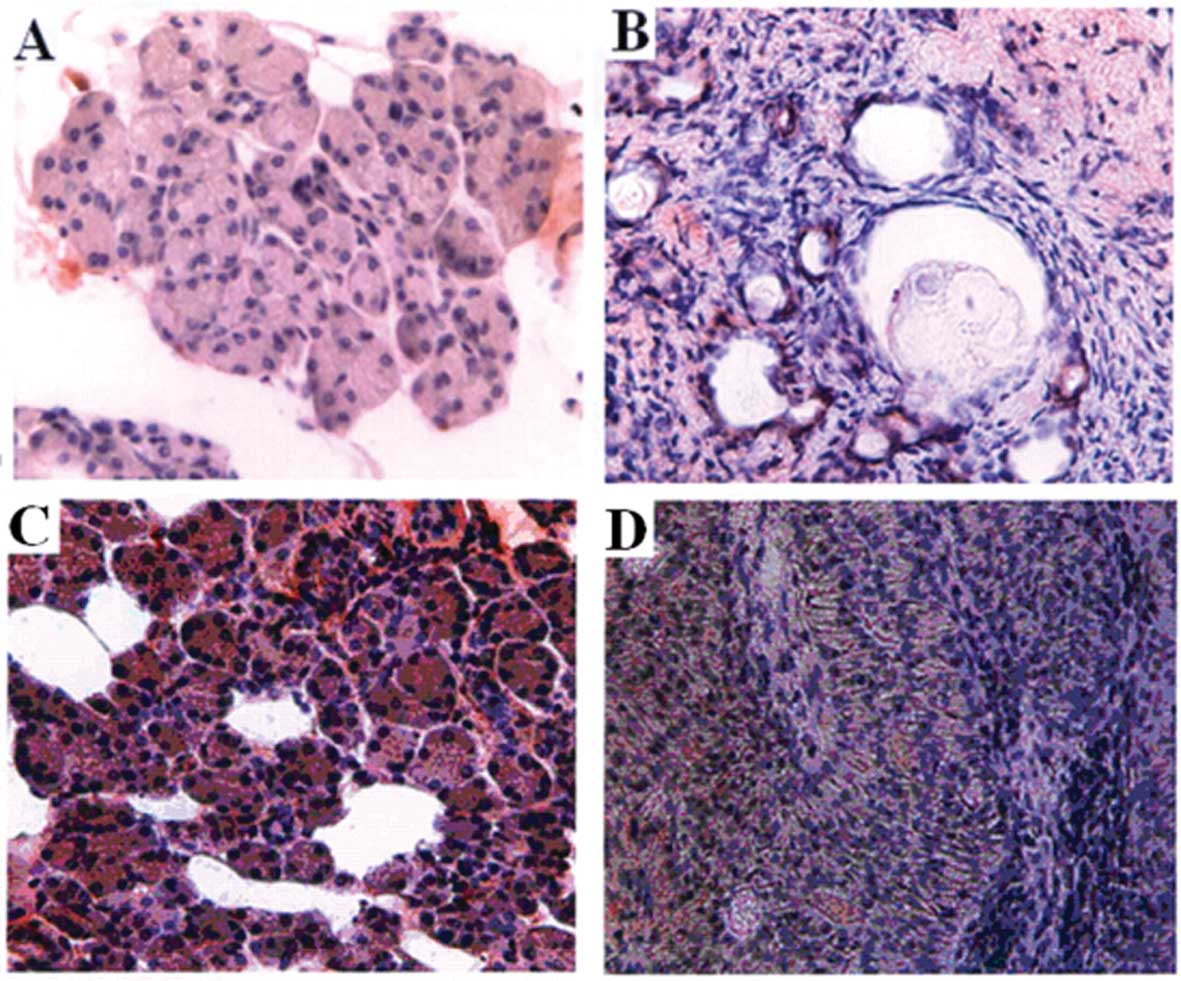
localization of CCL28 expression in the sampled tissues. Fig. 1 shows immunohistochemical staining
of CCL28 protein. Immunohistochemical reactivity for CCL28 was
observed in the cytoplasm of acinar epithelial cells of the
salivary glands. A heterogeneous staining of CCL28 protein was
detected in the tumorous and the normal adjacent tissues. A strong
intensity of immunostaining was observed in the normal adjacent
salivary gland tissues (Fig. 1A and
C), whereas pleomorphic adenoma and adenolymphoma tissues
showed weak immunoactivity (Fig. 1B
and D).
Regulated CCL28 mRNA expression in
salivary gland tumors
We first used real-time PCR to examine the
expression level of CCL28 by epithelium in the pleomorphic adenoma
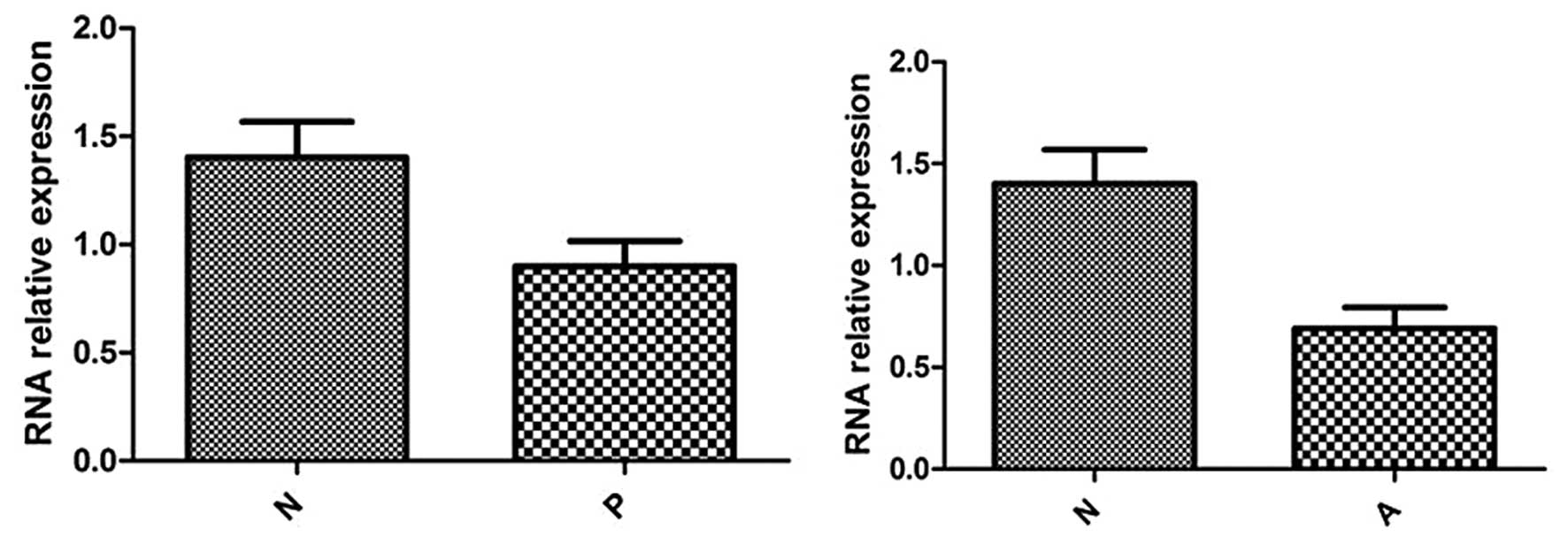
and adenolymphoma of human salivary glands. There was a significant
difference between the levels of CCL28 mRNA in tumorous tissues and
paired normal adjacent tissues. Among the 40 pleomorphic adenoma
tissue pairs studied, 28 (70%) tumors showed low expression of
CCL28. A statistically significant difference was noted
(P<0.05). It was also noted that 26 (81%) adenolymphoma tissues
exhibited low CCL28 mRNA expression (P<0.05). As a result of
quantitative analysis, the relative expression of CCL28 in
pleomorphic adenomas was 0.64 (0.90/1.40)-fold lower than the
normal adjacent tissues, while expression in adenolymphomas was
0.49 (0.69/1.40)-fold (Fig.
2).
Protein levels of CCL28 in salivary gland
tumors
It is known that expression of cytokine and
chemokine mRNA is not always well correlated with protein
expression (10). Therefore, the
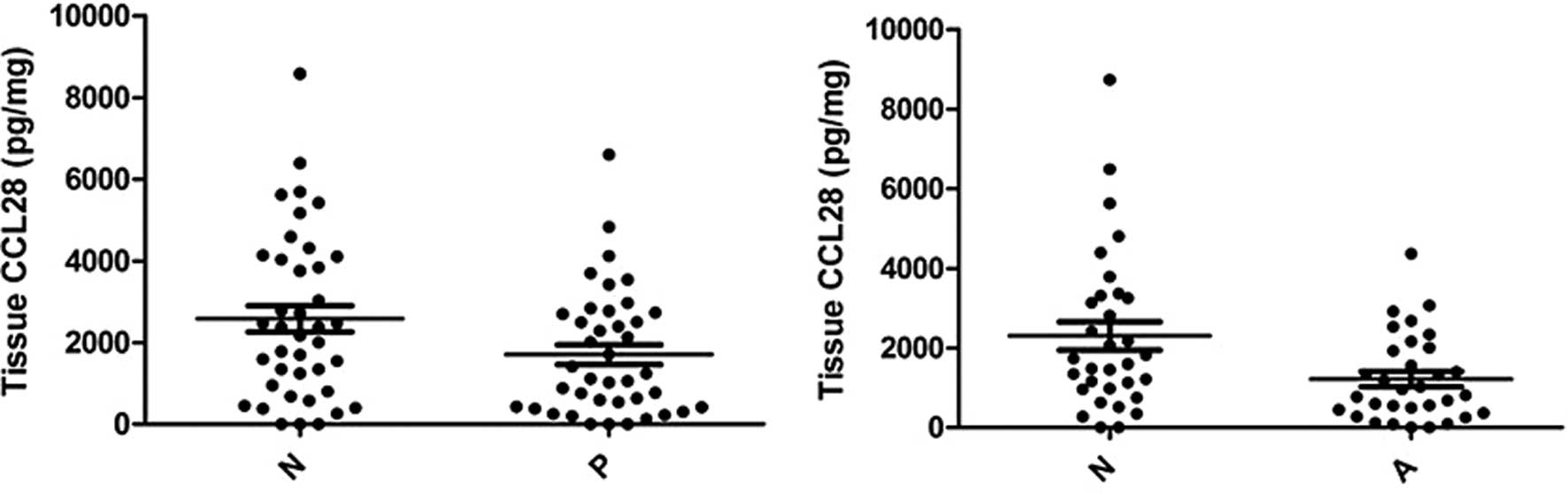
CCL28 protein expression level was further determined by ELISA
using proteinlysates of salivary gland tissues and matched normal
tissues (Fig. 3). We found a
significant difference (P=0.0027) in the levels of CCL28 protein in
pleomorphic adenomas (median, 1672 pg/mg) in comparison with paired
normal tissue (median, 2576 pg/mg). The levels of CCL28 protein in
adenolymphoma (median, 1213 pg/mg) were significantly lower
(P=0.0003) than those in the paired normal tissue (median, 2386
pg/mg).
Protein levels of CCL28 in saliva
Salivary levels of CCL28 were measured by ELISA in
45 healthy volunteers, 40 pleomorphic adenoma and 32 adenolymphoma
patients. The mean saliva value for the healthy volunteers (n=45)
was 70.69 ng/ml with a standard deviation of 31.85 ng/ml; the mean
saliva CCL28 value of the pleomorphic adenoma patient was 36.91
ng/ml with a standard deviation of 26.05 ng/ml; the mean saliva
CCL28 level of the 32 adenolymphoma patients was 34.23 ng/ml with a
standard deviation of 22.85 ng/ml (Table I). After statistical analysis, the
level of saliva CCL28 protein in pleomorphic adenoma and
adenolymphoma patients was significantly lower than that in the
healthy volunteers (P<0.01).
 | Table I.Saliva CCL28 levels. |
Table I.
Saliva CCL28 levels.
| CCL28 concentration
(C; ng/ml) | Healthy volunteers
(n=45) | Pleomorphic adenoma
patients (n=40) | Adenolymphoma
patients (n=32) |
|---|
| C≤20 | 3 (6.7) | 10 (25.0) | 8 (25.0) |
| 20<C≤40 | 4 (8.9) | 15 (37.5) | 15 (46.9) |
| 40<C≤60 | 8 (17.8) | 8 (20.0) | 5 (15.6) |
| 60<C≤80 | 12 (26.7) | 4 (10.0) | 3 (9.4) |
| 80<C≤100 | 8 (17.8) | 1 (2.5) | 1 (3.1) |
| 100<C≤120 | 7 (15.6) | 2 (5.0) | 0 |
| C>120 | 3 (6.7) | 9 | 0 |
Discussion
Chemokines are a large family of structurally
related proteins, which possess multiple functions by interacting
with their specific receptors to regulate the trafficking of
leukocytes (11–13). CCL28 has been regarded as one of
the major CC chemokines expressed in the epithelial cells of
various mucosal tissues (6). Some
previous studies suggest that alterations in CCL28 expression play
a role in tumor pathogenesis. For example, CCL28 expression was
found to be highly reduced or eliminated in breast tumors (14). In colon tumors, CCL28 is also
significantly reduced compared with normal tissues (8). These data suggest that the reduction
in the chemokine may be favorable to tumor growth. Contradictorily,
research (15) has revealed that
CCL28 plays a role in immune escape due to its recruitment of Treg.
We conducted this study to clarify whether the chemokine CCL28 is
involved in tumors of the salivary glands.
The results of the present study revealed that CCL28
mRNA in pleomorphic adenoma and adenolymphoma was significantly
reduced compared with normal tissues. The results may be due to
altered expression of related transcription factors in the
generation of CCL28 mRNA synthesis. According to the ELISA results,
the CCL28 protein level was significantly lower in tumor tissues in
comparison with the paired normal tissues. We noted that the level
of CCL28 was lower in pleomorphic adenoma compared with paired
normal tissue (P= 0.0047), and was significantly lower in
adenolymphoma (P=0.0012). Meanwhile, the results of
immunohistochemistry indicated that CCL28 was expressed in both
tumors with weak staining compared to the strong immunoreactivity
in normal salivary gland tissues.
The decreased expression of CCL28 in pleomorphic
adenoma and adenolymphoma, shown in this study, may result in
reduced populations of CCR10/CCR3 immune cells, most of which
possess anti-tumor features, recruited to the salivary glands, thus
enabling tumors to escape from immune surveillance. Based on our
findings, we speculate that although CCL28 may recruit Treg cells
bearing CCR10/CCR3, in the case of salivary glands the chemokine is
perhaps mainly involved in recruiting immune competitive cells
rather than regulatory cells. In this manner, increased CCL28
expression may terminate or reverse the occurrence and development
of tumors in the salivary glands. Thus extended research is
essential to confirm the types of immune cells responsible for the
influence of CCL28 on tumor pathogenesis in salivary glands. This
would facilitate further understanding of the underlying mechanisms
of salivary gland carcinogenesis.
Acknowledgements
This study was supported by funding
from the National Natural Science Foundation of China (30171010,
30371323) and the Natural Science Foundation of Shandong Province
(Y2006c124).
References
|
1
|
Demasi AP, Furuse C, Soares AB, Altemani A
and Araújo VC: Peroxiredoxin I, platelet-derived growth factor A,
and platelet-derived growth factor receptor alpha are overexpressed
in carcinoma ex pleomorphic adenoma: association with malignant
transformation. Hum Pathol. 40:390–397. 2009. View Article : Google Scholar
|
|
2
|
Faur A, Lazar E, Cornianu M, Dema A,
Vidita CG and Galuscan A: Warthin tumor: a curious entity - case
reports and review of literature. Rom J Morphol Embryol.
50:269–273. 2009.PubMed/NCBI
|
|
3
|
Zlotnik A: Chemokines and cancer. Int J
Cancer. 119:2026–2029. 2006. View Article : Google Scholar : PubMed/NCBI
|
|
4
|
Vandercappellen J, Van Damme J and Struyf
S: The role of CXC chemokines and their receptors in cancer. Cancer
Lett. 267:226–244. 2008. View Article : Google Scholar : PubMed/NCBI
|
|
5
|
Pan J, Kunkel EJ, Gosslar U, Lazarus N,
Langdon P, Broadwell K, Vierra MA, Genovese MC, Butcher EC and
Soler D: A novel chemokine ligand for CCR10 and CCR3 expressed by
epithelial cells in mucosal tissues. J Immunol. 165:2943–2949.
2000. View Article : Google Scholar : PubMed/NCBI
|
|
6
|
Wang W, Soto H, Oldham ER, Buchanan ME,
Homey B, Catron D, Jenkins N, Copeland NG, Gilbert DJ, Nguyen N, et
al: Identification of a novel chemokine (CCL28), which binds CCR10
(GPR2). J Biol Chem. 275:22313–22323. 2000. View Article : Google Scholar : PubMed/NCBI
|
|
7
|
Hieshima K, Ohtani H, Shibano M, Izawa D,
Nakayama T, Kawasaki Y, Shiba F, Shiota M, Katou F, Saito T and
Yoshie O: CCL28 has dual roles in mucosal immunity as a chemokine
with broad-spectrum antimicrobial activity. J Immunol.
170:1452–1461. 2003. View Article : Google Scholar : PubMed/NCBI
|
|
8
|
Dimberg J, Hugander A and Wagsater D:
Protein expression of the chemokine, CCL28, in human colorectal
cancer. Int J Oncol. 28:315–319. 2006.PubMed/NCBI
|
|
9
|
Ogawa H, Iimura M, Eckmann L and Kagnoff
MF: Regulated production of the chemokine CCL28 in human colon
epithelium. Am J Physiol Gastrointest Liver Physiol.
287:G1062–G1069. 2004. View Article : Google Scholar : PubMed/NCBI
|
|
10
|
O’Gorman MT, Jatoi NA, Lane SJ and Mahon
BP: IL-1beta and TNF-alpha induce increased expression of CCL28 by
airway epithelial cells via an NFkappaB-dependent pathway. Cell
Immunol. 238:87–96. 2005.PubMed/NCBI
|
|
11
|
Zlotnik A and Yoshie O: Chemokines: a new
classification system and their role in immunity. Immunity.
12:121–127. 2000. View Article : Google Scholar : PubMed/NCBI
|
|
12
|
Cheroutre H: IELs: enforcing law and order
in the court of the intestinal epithelium. Immunol Rev.
206:114–131. 2005. View Article : Google Scholar : PubMed/NCBI
|
|
13
|
Ebert LA, Schaerli P and Moser B:
Chemokine-mediated control of T cell traffic in lymphoid and
peripheral tissues. Mol Immunol. 42:799–809. 2005. View Article : Google Scholar : PubMed/NCBI
|
|
14
|
Mickanin CS, Bhatia U and Labow M:
Identification of a novel beta-chemokine, MEC, down-regulated in
primary breast tumors. Int J Oncol. 18:939–944. 2001.PubMed/NCBI
|
|
15
|
Facciabene A, Peng X, Hagemann IS, Balint
K, Barchetti A, Wang LP, Gimotty PA, Gilks CB, Lal P, Zhang L and
Coukos G: Tumour hypoxia promotes tolerance and angiogenesis via
CCL28 and T(reg) cells. Nature. 475:226–230. 2011. View Article : Google Scholar : PubMed/NCBI
|