Introduction
Obesity is an increasing global health problem, and
has been associated with metabolic syndrome (MetS), diabetes,
cardiovascular disease, hypertension and cancer (1). The increasing incidence of obesity
suggests that this epidemic is likely to worsen in the future
(2). Animal models are useful
tools for evaluating the potential efficacy of compounds for the
prevention and treatment of obesity. It has been demonstrated that
rodents fed a high-fat diet are good models of obesity, in which
the dietary environment is a major contributor (3).
It has been previously shown that certain foods are
beneficial for the suppression or prevention of MetS, including tea
(4). Green tea is already a
popular beverage, and may be easily incorporated as part of a diet
designed to attenuate or prevent the symptoms of MetS (4). Catechins, in particular, are one of
the major polyphenolic compounds in tea and are beneficial for the
treatment of the main MetS conditions, including obesity and type-2
diabetes, as well as cardiovascular risk factors (5). Another potentially beneficial food is
onion. Onion has the capacity to regulate lipid metabolism and
suppress hyperglycemia and diabetes (6). Previous studies have attributed the
anti-obesity effects of onion to quercetin, one of the flavonoids
present in onion peel (7–9). Tea extracted from onion peel (onion
peel tea; OPT) may thus be expected to exert beneficial effects in
MetS.
In the present study, the anti-obesity effects of
OPT were evaluated in mice that had been fed a high-fat diet.
Furthermore, the effects of OPT on blood parameters in these mice
were examined.
Materials and methods
OPT
The present study used freeze-dried OPT, containing
1.15 mg/g quercetin. The OPT (Sarratto tamacha) was acquired from
Finarl Co., Ltd. (Tottori, Japan).
Animals and diets
Twenty BALB/c mice (male, 4 weeks old) were
purchased from CLEA Japan, Inc. (Osaka, Japan). The animals were
maintained under standard conditions. The use of these animals and
the procedures they were subjected to were approved by the Animal
Research Committee of Tottori University (Tottori, Japan).
Throughout the experimental period, the mice had unrestricted
access to food and water.
Study design
The mice were randomized into the control and OPT
groups (n=10 mice per group). Following habituation, all mice were
fed a high-fat diet (HFD: High Fat Diet-32; CLEA Japan, Inc.) from
day −21 to day 0. The control group was then fed a normal powdered
diet (CE-2; CLEA Japan, Inc.) from day 0 to day 28, while the OPT
group was fed a normal powdered diet supplemented with 5% (w/w)
OPT. The mice were weighed once every seven days from day −21 to
day 28.
Blood and epididymal fat tissue were harvested from
the mice on days 14 and 28 (n=5 at each time-point). Blood was
collected via cardiac puncture under isoflurane inhalation
anesthesia. After allowing to stand for 1 h at room temperature,
the serum was recovered by centrifugation of the blood at 1,000 × g
for 10 min at 4°C. The serum samples were then stored at −80°C
prior to analysis. Following blood collection, the animals were
immediately sacrificed by cervical dislocation, and their
epididymal fat tissue was harvested and weighed.
Blood chemical analysis
Blood chemicals were measured using a blood chemical
auto analyzer (Dry-Chem 7000; Fujifilm Inc., Tokyo, Japan). Serum
triglyceride (TG), total-cholesterol (T-cho), glucose (Glu),
alanine transaminase (ALT), aspartate aminotransferase (AST),
alkaline phosphatase (ALP), geranylgeranyltransferase (GGT) and
albumin (Alb) levels were measured.
Measurement of serum leptin
concentration
A sandwich enzyme-linked immunosorbent assay kit
(Morinaga Institute of Biological Science, Inc., Yokohama, Japan)
was used to measure the leptin concentration, in accordance with
the manufacturer’s instructions.
Statistical analysis
Statistical analyses were performed using the
Student’s t-test or one-way analysis of variance (ANOVA) and the
Tukey-Kramer test. The data are presented as the mean ± standard
deviation. P<0.05 was considered to indicate a statistically
significant difference.
Results
Effects of dietary OPT on body weight and
epididymal fat tissue
In the OPT group, the intake of quercetin during the
experimental period was calculated to be 5–6 mg/kg/day. During the
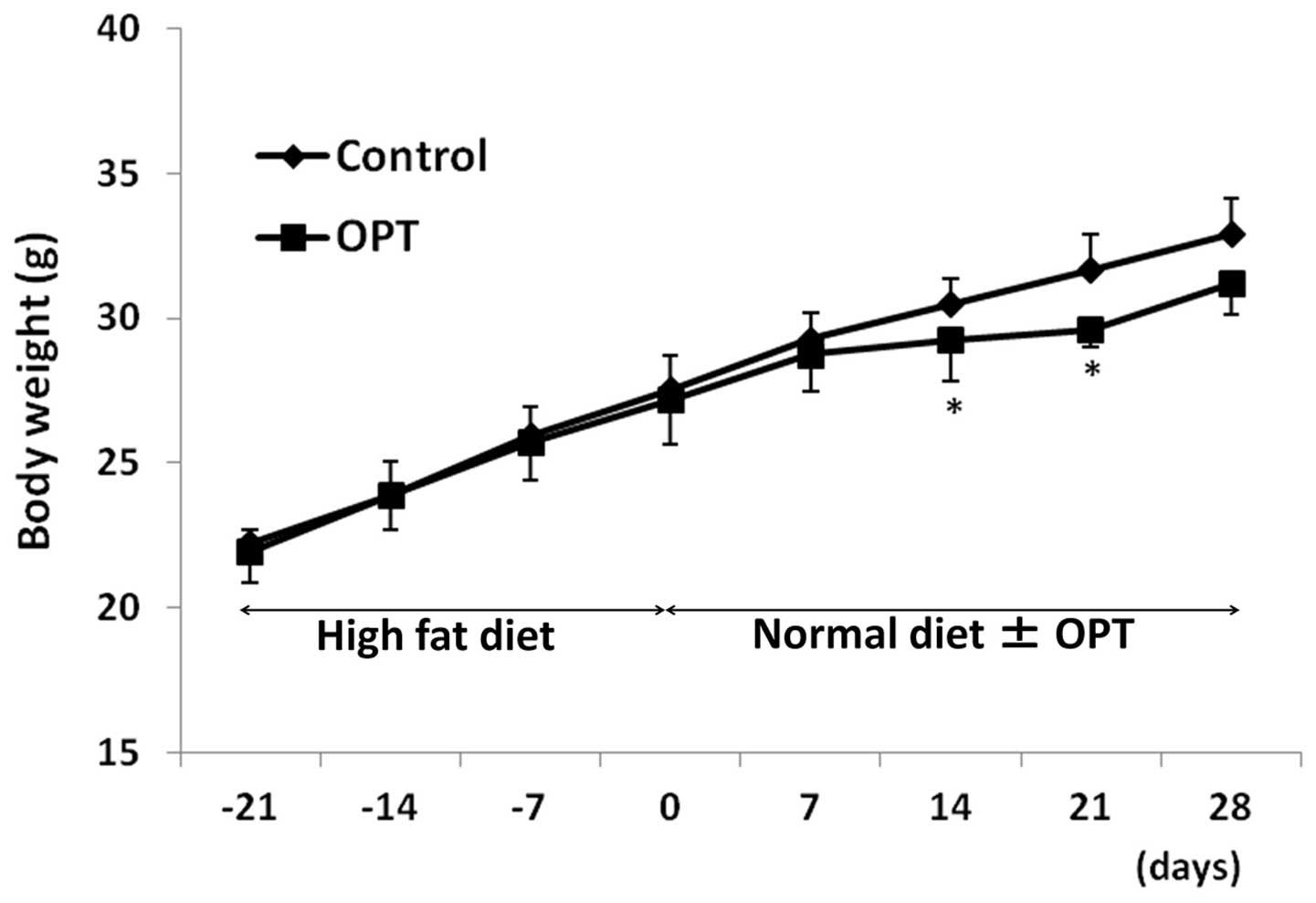
experimental period, the body weights of the mice were observed to
increase in the control and OPT groups (Fig. 1). However, in the OPT group, the
gain in body weight was attenuated compared with that of the
control group. On days 14 and 21, in particular, the body weights
in the OPT group were significantly lower than those of the control
group (P<0.05).
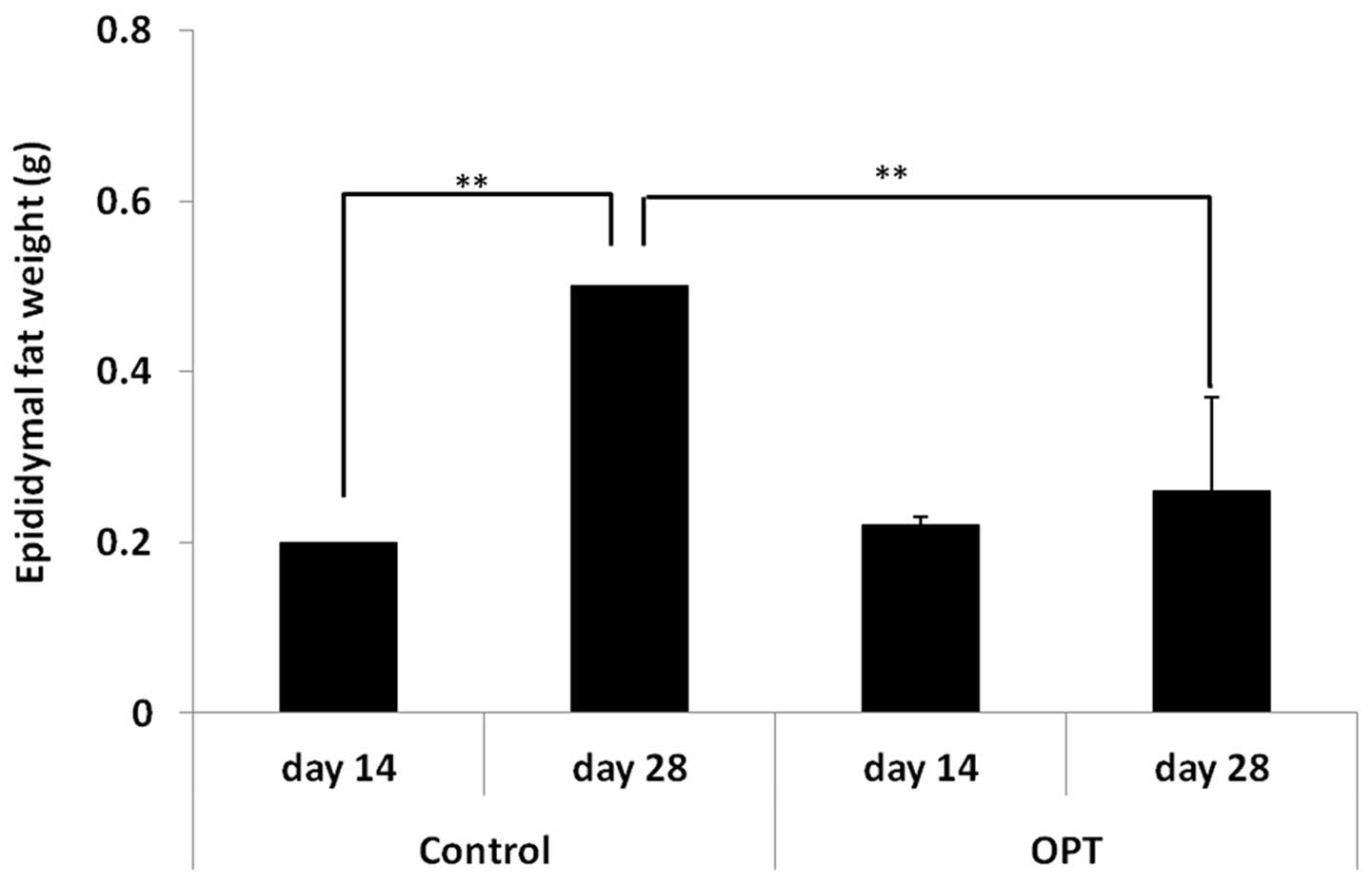
The mean epididymal fat tissue weights are shown in
Fig. 2. On day 14, no significant
difference was identified between the epididymal fat tissue weights
in the control group (0.2±0.0 g) and the OPT group (0.2±0.1 g).
However, on day 28, the mean epididymal fat tissue weight of the
OPT group (0.3±0.1 g) was significantly lower than that of the
control group (0.5±0.0 g) (P<0.01).
Effects of OPT on blood chemical
parameters
The blood chemical analysis results are shown in
Table I. On day 28, the mean serum
Glu concentration in the OPT group was significantly lower than
that of the control group (P<0.01). On day 14, however, there
was no significant difference in serum Glu concentration between
the groups. On day 14, the mean serum concentration of T-cho in the
OPT group was significantly lower than that of the control group
(P<0.05). On day 28, however, there was no significant
difference in mean serum T-cho concentration between the groups. On
day 28, the mean serum ALP concentration in the OPT group was
significantly higher than that of the control group (P<0.01),
although there was no difference on day 14. In the OPT group, the
mean serum TG concentrations were lower than those of the control
group on days 14 and 28, although these differences were not
statistically significant. No statistically significant differences
were identified between the groups with regard to the serum
concentrations of ALT, AST, GGT or Alb on days 14 or 28.
 | Table IEffects of OPT on blood chemical
parameters in a high-fat-diet-induced model of obesity. |
Table I
Effects of OPT on blood chemical
parameters in a high-fat-diet-induced model of obesity.
| Control | OPT |
|---|
|
|
|
|---|
| Parameter | Day 14 | Day 28 | Day 14 | Day 28 |
|---|
| Glu (mg/dl) | 172.6±17.4 | 304.2±19.6 | 185.6±15.2 | 242.4±28.0a |
| T-cho (mg/dl) | 87.4±10.5 | 97.0±11.1 | 73.4±5.6b | 99.0±13.0 |
| TG (mg/dl) | 116.0±30.2 | 186.8±8.1 | 79.8±9.5 | 134.4±45.0 |
| ALT (IU/l) | 34.0±4.3 | 35.4±9.9 | 36.0±6.6 | 35.6±13.1 |
| AST (IU/l) | 100.8±58.6 | 54.6±13.8 | 73.6±15.9 | 50.4±11.0 |
| ALP (IU/l) | 385.2±44.4 | 366.8±12.0 | 412.0±99.3 | 422.6±11.0a |
| GGT (IU/l) | 6.6±2.2 | 4.4±0.5 | 5.4±0.5 | 4.4±0.5 |
| Alb (g/dl) | 2.1±0.1 | 2.3±0.1 | 2.1±0.1 | 2.2±0.1 |
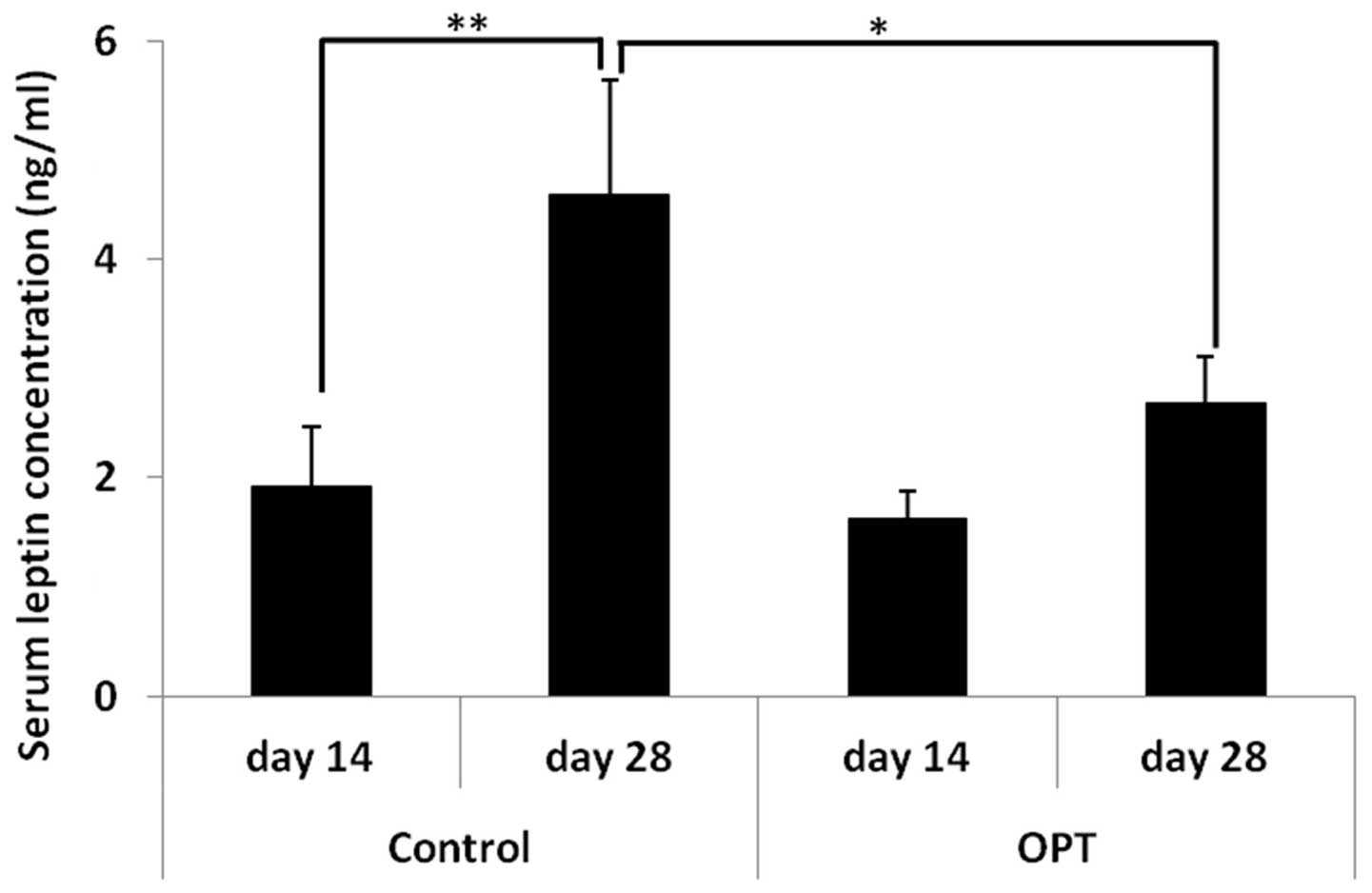
The serum leptin levels of the mice are shown in
Fig. 3. On day 14, no significant
difference was observed in the leptin level between the control
group (1.9±0.5 ng/ml) and the OPT group (1.6±0.2 ng/ml). The mean
serum leptin concentration in the control group was significantly
higher on day 28 than that on day 14 (P<0.01). Furthermore, on
day 28, the mean serum leptin concentration in the OPT group
(2.7±0.4 ng/ml) was significantly lower than that of the control
group (4.9±1.0 ng/ml) (P<0.05).
Discussion
In this study, dietary OPT was shown to suppress the
increases in body weight and level of epididymal fat tissue in an
experimental mouse model. It has been revealed that, in rodents, a
high-fat diet is a major contributor to obesity (3). The results of the present study
indicated that dietary OPT was capable of reducing body weight in
an experimental high-fat-diet-induced model of obesity.
It has previously been suggested that dietary
supplementation with onion may be beneficial for improving lipid
metabolism in humans; Lee et al(10,11)
demonstrated that onion peel extract (OPE) was rich in quercetin
and was capable of altering the expression of genes involved in
cholesterol metabolism. It has also been demonstrated that OPE is
able to lower blood low-density lipoprotein cholesterol and
increase high-density lipoprotein cholesterol levels by increasing
the expression of low-density lipoprotein receptor mRNA and mRNA
encoding ATP-binding cassette transporter A1 genes (12). Moreover, a review by Sudathip et
al(4) reported that green tea
extract decreased blood Glu, TG and T-cho levels in diet-induced
models of obesity (4). The results
of the present study indicated that OPT also suppressed increases
in blood Glu, TG and T-cho in a diet-induced model of obesity.
Marques et al(13)
demonstrated that the blood ALP levels were increased in a
diet-induced mouse model of obesity. To the best of our knowledge,
the correlation between obesity and an increase in blood ALP has
not been completely elucidated. Further studies are required in
this respect.
It has previously been indicated that the adipocytes
in adipose tissue secrete a variety of proteins, known as
adipocytokines, including tumor necrosis factor-α, interleukin-6,
resistin, leptin and adiponectin (14). Plasma leptin concentrations are
positively correlated with adiposity (excessive body fat) and body
weight changes in humans and rodents (15). Adiponectin contributes to insulin
sensitivity and fatty acid oxidation, and circulating
concentrations of adiponectin are inversely correlated with body
mass (16,17). The results of the present study
indicated that OPT suppressed the secretion of leptin from
adipocytes. The suppression of leptin secretion may have
contributed to the reduction in body weight and the weight of
epididymal fat tissue observed in the mice in the OPT group.
A high intake of plant foods (i.e. vegetables,
legumes and fruits), which contain flavonoids and polyphenolic
compounds, has been directly correlated with the management and
prevention of obesity, type-2 diabetes mellitus and other
cardiovascular disease risk factors; among these plant foods,
onions (Allium cepa) are one of the richest sources of
flavonoids in the human diet (18–20).
Quercetin is a major flavonol that is abundant in plant products,
particularly in onions, and it has been demonstrated to possess
antioxidative, anti-inflammatory and lipid-regulating properties
(18,21–24).
Numerous studies involving human clinical investigations, animal
trials and in vitro experiments have demonstrated that
phenolic substances, including quercetin, have important
anti-inflammatory and anti-obesity properties (23,25,26).
OPT is rich in quercetin (1.15 mg/g). One possible mechanism by
which OPT exerts anti-obesity effects may be via the action of
quercetin. In the previous studies, the experimental animals were
fed more quercetin than was taken in by the animals in the present
study (9,12). The results of the present study
suggest that there may be another mechanism underlying the action
of OPT. To enhance the understanding of any such additional
mechanisms, an analysis of all of the components of OPT may be
required.
In conclusion, OPT suppressed the increases in body
weight and epididymal fat tissue weight normally observed with a
high-fat-diet-induced model of obesity. It also significantly
reduced the serum levels of T-cho and Glu. Furthermore, in the OPT
group, the level of serum leptin on day 28 was significantly
reduced compared with that of the control group. In combination,
the results of the present study indicate that OPT may be a potent
functional food for the treatment, management or prevention of
obesity.
References
|
1
|
Vucenik I and Stains JP: Obesity and
cancer risk: evidence, mechanisms, and recommendations. Ann N Y
Acad Sci. 1271:37–43. 2012. View Article : Google Scholar : PubMed/NCBI
|
|
2
|
Haslam DW and James WP: Obesity. Lancet.
366:1197–1209. 2005. View Article : Google Scholar : PubMed/NCBI
|
|
3
|
Bulló M, Casas-Agustench P, Amigó-Correig
P, Aranceta J and Salas-Salvadó J: Inflammation, obesity and
comorbidities: the role of diet. Public Health Nutr. 10:1164–1172.
2007.
|
|
4
|
Sudathip S, Grove KA and Lambert JD:
Weight control and prevention of metabolic syndrome by green tea.
Pharmacol Res. 64:146–154. 2011. View Article : Google Scholar : PubMed/NCBI
|
|
5
|
Thielecke F and Boschmann M: The potential
role of green tea catechins in the prevention of the metabolic
syndrome - a review. Phytochemistry. 70:11–24. 2009. View Article : Google Scholar : PubMed/NCBI
|
|
6
|
Corzo-Martinez M, Corzo N and Villamiel M:
Biological properties of onions and garlic. Trends Food Sci
Technol. 18:609–625. 2007. View Article : Google Scholar
|
|
7
|
Ahn J, Lee H, Kim S, Park J and Ha T: The
anti-obesity effect of quercetin is mediated by the AMPK and MAPK
signaling pathways. Biochem Biophys Res Commun. 373:545–549. 2008.
View Article : Google Scholar : PubMed/NCBI
|
|
8
|
Seiva FR, Chuffa LG, Braga CP, Amorim JP
and Fernandes AA: Quercetin ameliorates glucose and lipid
metabolism and improves antioxidant status in postnatally
monosodium glutamate-induced metabolic alterations. Food Chem
Toxicol. 50:3556–3561. 2012. View Article : Google Scholar
|
|
9
|
Kim OY, Lee SM, Do H, Moon J, Lee KH, Cha
YJ and Shin MJ: Influence of quercetin-rich onion peel extracts on
adipokine expression in the visceral adipose tissue of rats.
Phytother Res. 26:432–437. 2012.PubMed/NCBI
|
|
10
|
Lee KH, Kim YH, Park EJ and Cho SR: Study
on dietary habit and effect of onion powder supplementation on
serum lipid levels in early diagnosed hyperlipidemic patients. J
Korean Soc Food Sci Nutr. 37:561–570. 2008. View Article : Google Scholar
|
|
11
|
Lee KH, Park E, Lee HJ, et al: Effects of
daily quercetin-rich supplementation on cardiometabolic risks in
male smokers. Nutr Res Pract. 5:28–33. 2011. View Article : Google Scholar : PubMed/NCBI
|
|
12
|
Lee SM, Moon J, Do HJ, Chung JH, Lee KH,
Cha YJ and Shin MJ: Onion peel extract increases hepatic
low-density lipoprotein receptor and ATP-binding cassette
transporter A1 messenger RNA expressions in Sprague-Dawley rats fed
a high-fat diet. Nutr Res. 32:210–217. 2012. View Article : Google Scholar : PubMed/NCBI
|
|
13
|
Marques CM, Motta VF, Torres TS, Aguila MB
and Mandarim-de-Lacerda CA: Beneficial effects of exercise training
(treadmill) on insulin resistance and nonalcoholic fatty liver
disease in high-fat fed C57BL/6 mice. Braz J Med Biol Res.
43:467–475. 2010. View Article : Google Scholar : PubMed/NCBI
|
|
14
|
Fasshauer M and Paschke R: Regulation of
adipocytokines and insulin resistance. Diabetologia. 46:1594–1603.
2003. View Article : Google Scholar
|
|
15
|
Gnacińska M, Małgorzewicz S, Stojek M,
Łysiak-Szydłowska W and Sworczak K: Role of adipokines in
complications related to obesity: a review. Adv Med Sci.
54:150–157. 2009.PubMed/NCBI
|
|
16
|
Rosen ED and Spiegelman BM: Adipocytes as
regulators of energy balance and glucose homeostasis. Nature.
444:847–853. 2006. View Article : Google Scholar : PubMed/NCBI
|
|
17
|
Arita Y, Kihara S, Ouchi N, et al:
Paradoxical decrease of an adipose-specific protein, adiponectin,
in obesity. Biochem Biophys Res Commun. 257:79–83. 1999. View Article : Google Scholar : PubMed/NCBI
|
|
18
|
Hertog MGL, Feskens EJM, Hollman PC, Katan
MB and Kromhout D: Dietary antioxidant flavonoids and risk of
coronary heart disease: the Zutphen elderly study. Lancet.
342:1007–1011. 1993. View Article : Google Scholar : PubMed/NCBI
|
|
19
|
Knekt P, Kumpulainen J, Järvinen R, et al:
Flavonoid intake and risk of chronic diseases. Am J Clin Nutr.
76:560–568. 2002.PubMed/NCBI
|
|
20
|
Mink PJ, Scrafford CG, Barraj LM, Harnack
L, Hong CP, Nettleton JA and Jacobs DR Jr: Flavonoid intake and
cardiovascular disease mortality: a prospective study in
postmenopausal women. Am J Clin Nutr. 85:895–909. 2007.PubMed/NCBI
|
|
21
|
Zern TL, Wood RJ, Greene C, et al: Grape
polyphenols exert a cardioprotective effect in pre- and
postmenopausal women by lowering plasma lipids and reducing
oxidative stress. J Nutr. 135:1911–1917. 2005.
|
|
22
|
Lee KH, Kim Y, Park E and Hwang HJ: Effect
of onion powder supplementation on lipid metabolism in high
fat-cholesterol fed SD rats. J Food Sci Nutr. 13:1371–1376.
2008.
|
|
23
|
Rivera L, Morón R, Sánchez M, Zarzuelo A
and Galisteo M: Quercetin ameliorates metabolic syndrome and
improves the inflammatory status in obese Zucker rats. Obesity
(Silver Spring). 16:2081–2087. 2008. View Article : Google Scholar : PubMed/NCBI
|
|
24
|
Stewart LK, Soileau JL, Ribnicky D, et al:
Quercetin transiently increases energy expenditure but persistently
decreases circulating markers of inflammation in C57BL/6J mice fed
a high-fat diet. Metabolism. 57:S39–46. 2008. View Article : Google Scholar : PubMed/NCBI
|
|
25
|
Hsu CL and Yen GC: Effects of flavonoids
and phenolic acids on the inhibition of adipogenesis in 3T3-L1
adipocytes. J Agric Food Chem. 55:8404–8410. 2007. View Article : Google Scholar : PubMed/NCBI
|
|
26
|
Yen GC, Chen YC, Chang YT and Hsu CL:
Effects of polyphenolic compounds on tumor necrosis factor-α
(TNF-α)-induced changes of adipokines and oxidative stress in
3T3-L1 adipocytes. J Agric Food Chem. 59:546–551. 2011.
|