Introduction
Radix Angelicae Sinensis (AS), otherwise known as
Danggui, has been used in traditional Chinese medicine for
thousands of years and was first mentioned in Shenlong Bencao Jing
(200–300 A.D., Han Dynasty) (1).
AS is known for its clinical efficacy in the therapy of
gynecological disease and has been named ‘female ginseng’ (1,2).
Moreover, AS has been widely used for treating constipation,
hepatic fibrosis, anemia and cardiovascular disease (3). In previous studies, AS has been shown
to have numerous roles, including regulating the immune system and
as an anticancer, anti-inflammatory and antioxidant agent (4–7).
Over 70 compounds have been identified in AS and the components
have been classified into two groups, including essential oils and
water-soluble ingredients. Ferulic acid (FA) is one of the most
abundant water-soluble ingredients and has been identified as the
active component of AS (8).
Medicinal formulae containing AS are usually
administered for benefiting vital energy, nourishing blood and
regulating menstruation. Two examples are the formulae
Danggui-Buxue-Tang (DBT) and Danggui-Sini-Tang (DST). One of the
simplest formulae is DBT, which was first described in Neiwaishang
Bianhuo Lun in 1247 A.D (9). As
described, the DBT formula contained Radix Astragali and AS. DBT is
usually administered to females for the treatment of menopausal
symptoms. The formula regulates their health by invigorating vital
energy and enriching the blood (10). DST, a traditional medicinal
formula, was first recorded in Shanghan Lun (11) and is used to treat a variety of
conditions, including poor extremity circulation, heart failure,
shock and severe watery diarrhea. In particular, the formula is
used for the therapy of infectious diseases that are complicated
with hemodynamic instability (12,13).
FA was cited as the main index of components in AS,
as described in the Pharmacopoeia of the People’s Republic of China
2010 (14). FA may be used to
clear free radicals, reduce blood fat, regulate the immune system
and decrease oxidative stress (15,16).
FA is one of the most effective and active components of AS, DBT
and DST.
In the present study, the FA content of AS, DBT and
DST was determined by ultra performance liquid chromatography
(UPLC) with the aim of investigating whether the FA content
differed significantly between the formulae. Furthermore, the study
investigated whether the FA content increased or decreased in
decoctions that contained AS, compared with the FA level in AS
alone.
Materials and methods
Reagents and materials
The DST formula contains seven traditional Chinese
medicinal components: Radix Angelicae Sinensis (origin, Gansu;
batch no. 2013010401), Radix Paeoniae Alba (origin, Zhejiang; batch
no. 2013010402), Rumulus Cinnamomi (origin, Guangxi; batch no.
2013010403), Asari Radiix Etrhizoma (origin, Liaoning; batch no.
2013010404), Radix Glycyrrizae (origin, Neimeng; batch no.
2013010405), Medulla Tetrapanacis (origin, Shanxi; batch no.
2013010406 ) and Fructus Jujubae (origin, Xinjiang; batch no.
2013010407) in a weight ratio of 4:3:3:1:2:2:1. The DBT formula
contains Radix Angelicae Sinensis (origin, Gansu; batch no.
2013010401) and Radix Astragali Mongolici (origin, Neimeng; batch
no. 2013010408) in a weight ratio of 1:5. The herbs were purchased
from the Xiangya Hospital Pharmacy (Changsha, China) and identified
by director pharmacist Lei-Peng.
The FA standards (purity, >98%) were purchased
from Chengdu Must Bio-Technology Co., Ltd. (Chengdu, China). The
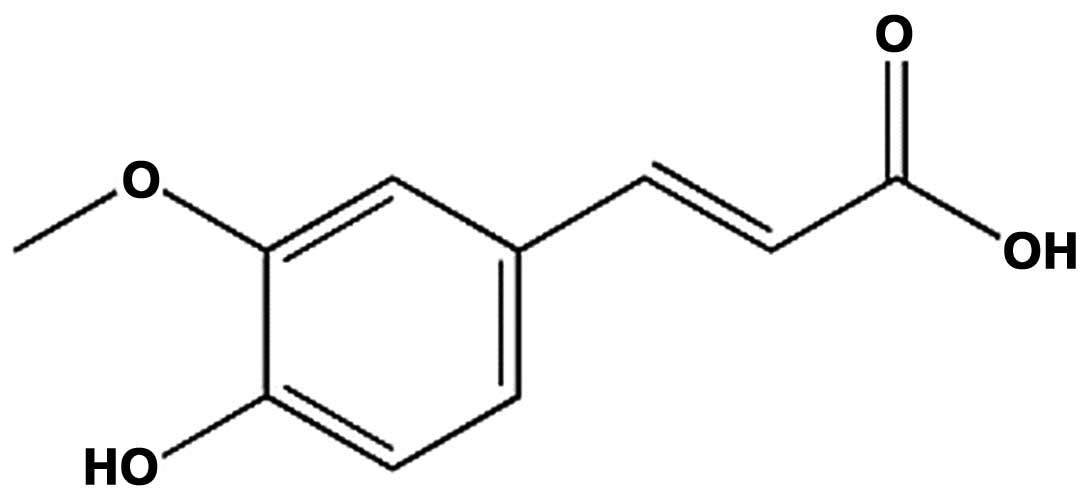
chemical structure of FA is shown in Fig 1. HPLC grade methanol and
acetonitrile were purchased from Tedia Company, Inc. (Fairfield,
OH, USA). Analytical grade acetic acid was obtained from Sinopharm
Chemical Reagent Co. Ltd. (Shanghai, China). All other reagents
were also analytical grade. Purified water was obtained using a
Milli-Q purification system (Millipore Corporation, Billerica, MA,
USA) and was used to prepare the mobile phases and sample
solutions.
Instruments
Chromatography was performed using a Waters Acquity
UPLC system, with an automatic sample handling system (2695), diode
array detector (2996), Empower 2.0 data processing software and
Acquity BEH C18 column (100×2.1 mm internal diameter; 1.7 μm) (all
from Waters Corporation, Milford, MA, USA).
Chromatographic system
The mobile phases were solvent A (methanol) and
solvent B (0.5% acetic acid). The gradient flow was as follows: 0
min, (A)/(B) = 0/100; 1 min, (A)/(B) = 18/82; 3 min, (A)/(B) =
28/72; and 4 min, (A)/(B) = 38/62. The column temperature was
maintained at 40°C and the room temperature was 25°C. The volume of
each injection was 6 μl.
Preparation of standard solutions and
calibration curves
The stock standard solution of FA was prepared by
dissolving FA in methanol to obtain a 320 ng/μl solution. Next,
seven concentrations of the standard solution were obtained by
dilution of the stock solution. Working solutions and the stock
solution were stored at 4°C. The standard curve was prepared using
Empower software from the peak area of the seven concentrations
determined by UPLC. The calibration curve ranged between 0.33 and
21.32 ng/μl. Further dilution of the lowest concentration working
solution was performed to obtain a series of standard solutions to
evaluate the limit of detection (LOD) and the limit of quantity
(LOQ) of FA.
Preparation of sample solutions
AS (20 g), DST (20 g AS, 15 g Radix Paeoniae Alba,
15 g Rumulus Cinnamomi, 5 g Asari Radiix Etrhizoma, 10 g Radix
Glycyrrizae, 10 g Medulla Tetrapanacis and 5 g Fructus Jujubae) and
DBT (20 g AS and 100 g Radix Astragali Mongolici) were immersed in
distilled water (1:10; w/v) for 30 min and then boiled for 30 min.
The boiling procedure was repeated twice. Each decoction was
filtered and mixed together. Next, the solutions were lyophilized
to acquire powdered DBT and DST. The powder was stored at 4°C. For
UPLC analysis, the powders were dissolved in distilled water to
provide solutions with final concentrations of 95 mg/ml AS, 300
mg/ml DBT and 164 mg/ml DST. A 100-μl sample of each solution was
extracted with 900 μl methanol for 30 min by ultrasonic extraction.
The extracted solution was centrifuged at 13,201 × g for 5 min. The
supernatant was collected and filtered through a 0.22 μM filter and
the final filtrate was analyzed by UPLC. A volume of 6 μl of each
solution was injected into the column.
Recovery test
Recovery tests are used to evaluate the accuracy of
an analytical method. By spiking the standard solution and knowing
the exact concentrations of the DBT and DST samples prior to
abstraction, the recovery of FA was investigated. The following
formula was used to calculate the percentage of recovery: Recovery
(%) = (total content following spiking − original content in
sample)/spiked content × 100.
Results and Discussion
Optimization of the chromatographic
conditions
In order to obtain an absolute peak and elute the
target earlier, the selection of a chromatographic column, mobile
phase and flow rate was important. In the study, various
combinations of columns, mobile phases and flow rates were tested.
By comparing the Acquity UPLC BEH shield RP18 column (2.1×100 mm;
1.7 μm) with the Acquity UPLC BEH C18 column (2.1×100 mm; 1.7 μm),
the latter was selected for this study. Mobile phases consisting of
methanol with water, methanol with 0.5% acetic acid, acetonitrile
with water and acetonitrile with 0.5% acetic acid were applied
under various gradient elution modes and flow rates. Following a
number of trials, the Acquity UPLC BEH C18 column, a mobile phase
of methanol with 0.5% acetic acid, a flow rate of 0.3 ml/min and
gradient elution modes were selected as the suitable chromatogram
conditions. Under these conditions, the desired separation was
achieved within 5 min, the peak shape was improved and peak tailing
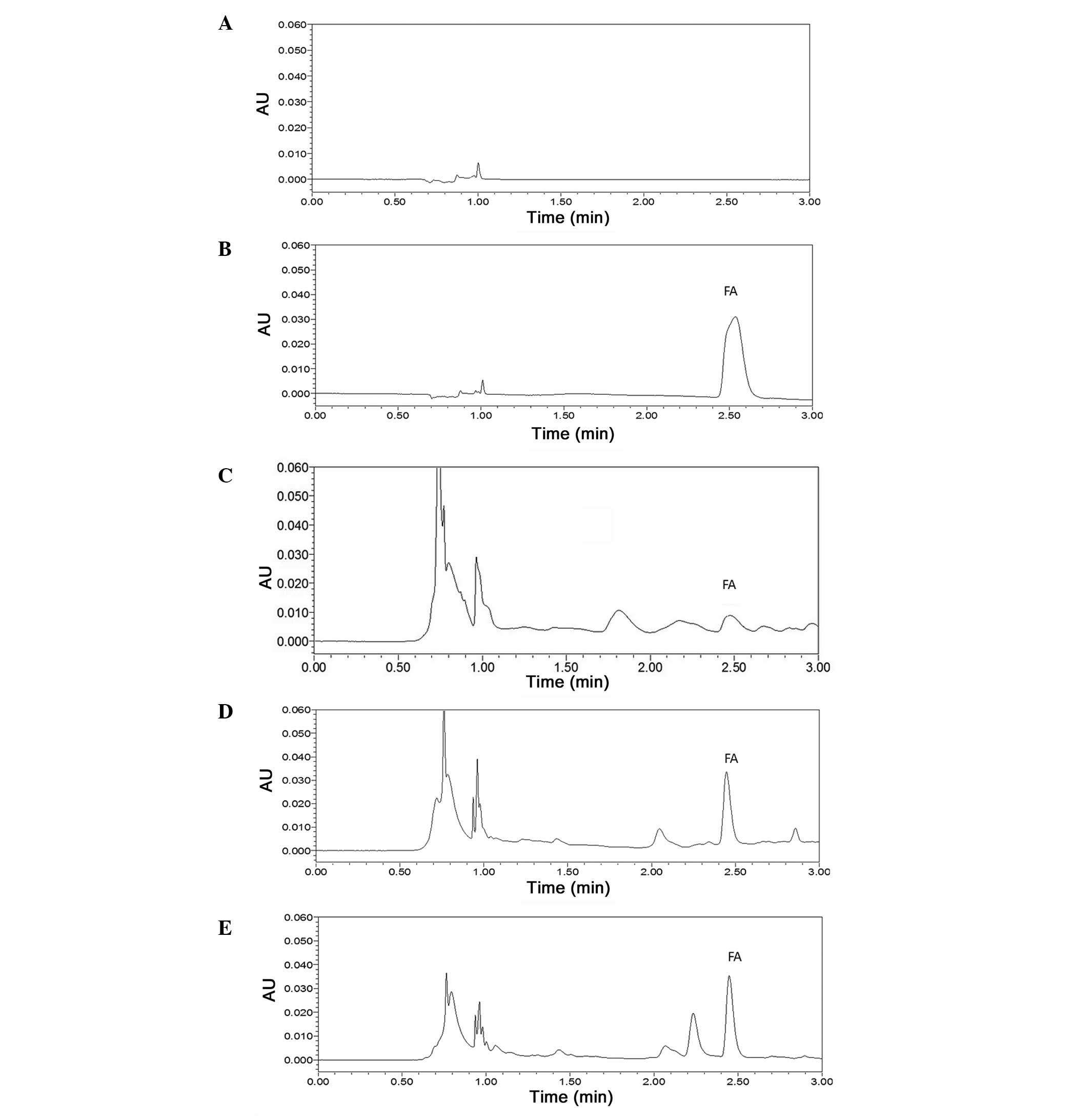
was inhibited. The wavelength of the PAD detector was selected
according to the maximum UV absorption wavelength of FA which was
320 nm. Typical chromatograms of the blank solvent (20% formic acid
and methanol), standard solution, AS, DBT and DST are shown in
Fig 2.
Optimization of the extraction
conditions
Protein precipitation was the main method used to
extract the objective from the decoction and the selection of the
solvent used for precipitation was important. In the study, the
solvents tested were methanol, 5% formic acid with methanol, 10%
formic acid with methanol, 20% formic acid with methanol, 5%
NaHCO3 with methanol, 10% NaHCO3 with
methanol and 20% NaHCO3 with methanol. It was identified
that 10% formic acid and methanol were the most effective solvents
for the extraction of FA from AS, DBT and DST. The FA content of
RAS, DBT and DST was determined using the same method, and five
solutions of every sample were determined at the same time. The
results are shown in Table I.
 | Table IFA content in 95 mg/ml AS, 300 mg/ml
DBT and 164 mg/ml DST. |
Table I
FA content in 95 mg/ml AS, 300 mg/ml
DBT and 164 mg/ml DST.
| FA content,
ng/μl | |
|---|
|
| |
|---|
| Source | Group 1 | Group 2 | Group 3 | Group 4 | Group 5 | Mean | RSD, % |
|---|
| AS | 1.23 | 1.28 | 1.25 | 1.36 | 1.29 | 1.28 | 4.00 |
| DBT | 2.06 | 2.04 | 2.06 | 2.07 | 1.95 | 2.04 | 2.42 |
| DST | 2.24 | 2.20 | 2.09 | 2.09 | 2.22 | 2.17 | 3.36 |
Calibration curve
A calibration curve was prepared with the data from
seven concentrations of the standard solution of FA. The
calibration curve had the following equation: y = 2E − 05x +
0.1263. The calibration data exhibited a good linear regression
(R2=0.9997), ranging between 0.33 and 21.32 ng/μl. The
LOD [signal to noise ratio (S/N), 3) and LOQ (S/N, 10) values were
calculated to be 0.04 and 0.128 ng/μl, respectively.
Precision and accuracy
Method precision was assessed by intra- and
inter-day assays. Intra- and inter-day precisions were determined
by testing three concentrations of the standard solution five times
in one day and once a day on three consecutive days. Relative
standard deviation (RSD) values were considered to indicate the
measurement precision. As shown in Table II, the RSD values for the
evaluation of intra- and inter-day precision ranged between 0.27
and 3.03%.
| Table IIMeasurement precision of the UPLC
method for the detection of FA. |
Table II
Measurement precision of the UPLC
method for the detection of FA.
| Precision |
|---|
|
|
|---|
| Intra-day, n=5 | Inter-day, n=5 |
|---|
|
|
|
|---|
| Nominal
concentration, ng/μl | Mean ± SD, ng/μl | RSD, % | Mean ± SD, ng/μl | RSD, % |
|---|
| 10.66 | 10.66±0.03 | 0.27 | 10.35±0.28 | 2.67 |
| 2.67 | 2.75±0.02 | 0.89 | 2.52±0.08 | 3.03 |
| 0.67 | 0.71±0.01 | 1.18 | 0.62±0.02 | 2.43 |
Stability
Stability analysis was performed by evaluating the
sample solutions at 4°C at various time points (0, 4, 10, 16 and 24
h). The RSD values of FA concentration were ≤1.63%, as shown in
Table III. The results indicate
that FA was stable for 24 h at 4°C.
| Table IIIStability of FA at 4°C (n=5). |
Table III
Stability of FA at 4°C (n=5).
| FA content,
ng/μl | |
|---|
|
| |
|---|
| Source | 0 h | 4 h | 10 h | 16 h | 24 h | RSD, % |
|---|
| AS | 1.28 | 1.27 | 1.27 | 1.24 | 1.30 | 1.63 |
| DBT | 2.04 | 2.05 | 2.08 | 2.05 | 2.10 | 1.23 |
| DST | 2.17 | 2.15 | 2.16 | 2.12 | 2.13 | 0.94 |
Repeatability and recovery
Extraction of samples and analyses were repeated
using the same method and chromatography system. The peak area of
FA was obtained and the RSD values of repeatability ranged between
1.15 and 3.74%, as shown in Table
IV. As the data indicates, the present method for testing the
content of FA was reproducible. The accuracy tests were
accomplished by a recovery test. In the study, the average
recoveries of FA ranged between 98.44 and 101.64%, with RSD values
≤4.73% (Table V). The results
indicate that the method was reliable and accurate for measuring
the content of FA.
| Table IVRepeatability of the method. |
Table IV
Repeatability of the method.
| FA content,
ng/μl | |
|---|
|
| |
|---|
| Source | Test 1 | Test 2 | Test 3 | Test 4 | Test 5 | Mean | RSD, % |
|---|
| AS | 1.25 | 1.29 | 1.24 | 1.30 | 1.28 | 1.28 | 2.04 |
| DBT | 2.08 | 2.09 | 2.08 | 2.03 | 2.07 | 2.07 | 1.15 |
| DST | 2.07 | 2.09 | 2.12 | 2.27 | 2.17 | 2.14 | 3.74 |
| Table VRecovery of FA. |
Table V
Recovery of FA.
| Source | Original content
(ng/μl) | Spiked content
(ng/μl) | Total content
(ng/μl) | Recovery, % | RSD, % |
|---|
| AS | 32.0 | 21.32 | 53.67 | 101.64 | 4.73 |
| DBT | 81.6 | 85.28 | 165.55 | 98.44 | 2.92 |
| DT | 86.8 | 85.28 | 171.37 | 99.17 | 2.18 |
Conclusion
In conclusion, using a simple and reliable UPLC
method, the FA content of AS, DBT and DST was accurately
determined. As is commonly understood, differences in active
compounds exist between traditional medicines used singly and in
formulations, resulting in varying clinical effects. From the
present study, a comparison of the FA content of AS with that of
the combination of herbs in the DBT and DST formulae shows an
increased FA content in the combinations.
Acknowledgements
The study was supported by grants from the Hunan
Provincial Subjects (no. 2012-594), the Youth Foundation of
National Natural Science Foundation of China (no.81202807) and the
Freedom Explore Program of Central South University (no.
2012QNZT121).
References
|
1
|
Yi L, Liang Y, Wu H and Yuan D: The
analysis of Radix Angelicae Sinensis (Danggui). J Chromatogr A.
1216:1991–2001. 2009. View Article : Google Scholar
|
|
2
|
Upton R: Dang Gui Root Angelica
sinensis (Oliv) Diels. American Herbal Pharmacopoeia; Scotts
Valley, CA: 2003
|
|
3
|
Hou YZ, Zhao GR, Yuan YJ, et al:
Inhibition of rat vascular smooth muscle cell proliferation by
extract of Ligusticum chuanxiong and Angelica
sinensis. J Ethnopharmacol. 100:140–144. 2005. View Article : Google Scholar : PubMed/NCBI
|
|
4
|
Zhao KJ, Dong TT, Tu PF, et al: Molecular
genetic and chemical assessment of radix Angelica (Danggui)
in China. J Agric Food Chem. 51:2576–2583. 2003. View Article : Google Scholar : PubMed/NCBI
|
|
5
|
Yang X, Zhao Y, Wang H and Mei Q:
Macrophage activation by an acidic polysaccharide isolated from
Angelica sinensis (Oliv.) Diels. J Biochem Mol Biol.
40:636–643. 2007. View Article : Google Scholar : PubMed/NCBI
|
|
6
|
Kuang X, Yao Y, Du JR, et al:
Neuroprotective role of Z-ligustilide against forebrain ischemic
injury in ICR mice. Brain Res. 1102:145–153. 2006. View Article : Google Scholar : PubMed/NCBI
|
|
7
|
Cheng YL, Chang WL, Lee SC, et al: Acetone
extract of Angelica sinensis inhibits proliferation of human
cancer cells via inducing cell cycle arrest and apoptosis. Life
Sci. 75:1579–1594. 2004.
|
|
8
|
Lu GH, Chan K, Chan CL, et al:
Quantification of ligustilides in the roots of Angelica
sinensis and related umbelliferous medicinal plants by
high-performance liquid chromatography and liquid
chromatography-mass spectrometry. J Chromatogr A. 1046:101–107.
2004.PubMed/NCBI
|
|
9
|
Li DY: Neiwaishang Bianhuo Lun. People’s
Medical Publishing House; Beijing: 2007, (In Chinese).
|
|
10
|
Zhang WL, Zheng KY, Zhu KY, et al:
Chemical and biological assessment of Angelica herbal
decoction: comparison of different preparations during historical
applications. Phytomedicine. 19:1042–1048. 2012.PubMed/NCBI
|
|
11
|
Zhang ZJ: Shanghan Lun. Yueyuan Publishing
House; Beijing: 2007, (In Chinese).
|
|
12
|
Gao YQ, Zhao GP and Jiang RW:
Determination of ferulic acid serum concentration in Danggui Sini
Decoction by HPLC and its pharmacokinetics in rats. Chin Trad
Patent Med. 33:419–422. 2011.(In Chinese).
|
|
13
|
Chen HC, Chen WC, Lin KH, et al:
Simultaneous use of traditional Chinese medicine (Si-Ni-Tang) to
treat septic shock patients: study protocol for a randomized
controlled trial. Trials. 12:1992011. View Article : Google Scholar : PubMed/NCBI
|
|
14
|
Chinese Pharmacopoeia Commission, . The
Pharmacopoeia of the People’s Republic of China 2010. Chinese
Medical Science and Technology Press; Beijing: 2010, (In
Chinese).
|
|
15
|
Lee SC, Tsai CC, Yao CH, et al: Ferulic
acid enhances peripheral nerve regeneration across long gaps. Evid
Based Complement Alternat Med. 2013:8763272013.PubMed/NCBI
|
|
16
|
Huang WH and Song CQ: Research progresses
in the chemistry and pharmacology of Angelica sinensis (Oliv.)
Diel. Zhongguo Zhong Yao Za Xhi. 26:147–151. 2001.(In Chinese).
|