Spandidos Publications Logo
  • About
    • About Spandidos
    • Aims and Scopes
    • Abstracting and Indexing
    • Editorial Policies
    • Reprints and Permissions
    • Job Opportunities
    • Terms and Conditions
    • Contact
  • Journals
    • All Journals
    • Oncology Letters
      • Oncology Letters
      • Information for Authors
      • Editorial Policies
      • Editorial Board
      • Aims and Scope
      • Abstracting and Indexing
      • Bibliographic Information
      • Archive
    • International Journal of Oncology
      • International Journal of Oncology
      • Information for Authors
      • Editorial Policies
      • Editorial Board
      • Aims and Scope
      • Abstracting and Indexing
      • Bibliographic Information
      • Archive
    • Molecular and Clinical Oncology
      • Molecular and Clinical Oncology
      • Information for Authors
      • Editorial Policies
      • Editorial Board
      • Aims and Scope
      • Abstracting and Indexing
      • Bibliographic Information
      • Archive
    • Experimental and Therapeutic Medicine
      • Experimental and Therapeutic Medicine
      • Information for Authors
      • Editorial Policies
      • Editorial Board
      • Aims and Scope
      • Abstracting and Indexing
      • Bibliographic Information
      • Archive
    • International Journal of Molecular Medicine
      • International Journal of Molecular Medicine
      • Information for Authors
      • Editorial Policies
      • Editorial Board
      • Aims and Scope
      • Abstracting and Indexing
      • Bibliographic Information
      • Archive
    • Biomedical Reports
      • Biomedical Reports
      • Information for Authors
      • Editorial Policies
      • Editorial Board
      • Aims and Scope
      • Abstracting and Indexing
      • Bibliographic Information
      • Archive
    • Oncology Reports
      • Oncology Reports
      • Information for Authors
      • Editorial Policies
      • Editorial Board
      • Aims and Scope
      • Abstracting and Indexing
      • Bibliographic Information
      • Archive
    • Molecular Medicine Reports
      • Molecular Medicine Reports
      • Information for Authors
      • Editorial Policies
      • Editorial Board
      • Aims and Scope
      • Abstracting and Indexing
      • Bibliographic Information
      • Archive
    • World Academy of Sciences Journal
      • World Academy of Sciences Journal
      • Information for Authors
      • Editorial Policies
      • Editorial Board
      • Aims and Scope
      • Abstracting and Indexing
      • Bibliographic Information
      • Archive
    • International Journal of Functional Nutrition
      • International Journal of Functional Nutrition
      • Information for Authors
      • Editorial Policies
      • Editorial Board
      • Aims and Scope
      • Abstracting and Indexing
      • Bibliographic Information
      • Archive
    • International Journal of Epigenetics
      • International Journal of Epigenetics
      • Information for Authors
      • Editorial Policies
      • Editorial Board
      • Aims and Scope
      • Abstracting and Indexing
      • Bibliographic Information
      • Archive
    • Medicine International
      • Medicine International
      • Information for Authors
      • Editorial Policies
      • Editorial Board
      • Aims and Scope
      • Abstracting and Indexing
      • Bibliographic Information
      • Archive
  • Articles
  • Information
    • Information for Authors
    • Information for Reviewers
    • Information for Librarians
    • Information for Advertisers
    • Conferences
  • Language Editing
Spandidos Publications Logo
  • About
    • About Spandidos
    • Aims and Scopes
    • Abstracting and Indexing
    • Editorial Policies
    • Reprints and Permissions
    • Job Opportunities
    • Terms and Conditions
    • Contact
  • Journals
    • All Journals
    • Biomedical Reports
      • Information for Authors
      • Editorial Policies
      • Editorial Board
      • Aims and Scope
      • Abstracting and Indexing
      • Bibliographic Information
      • Archive
    • Experimental and Therapeutic Medicine
      • Information for Authors
      • Editorial Policies
      • Editorial Board
      • Aims and Scope
      • Abstracting and Indexing
      • Bibliographic Information
      • Archive
    • International Journal of Epigenetics
      • Information for Authors
      • Editorial Policies
      • Editorial Board
      • Aims and Scope
      • Abstracting and Indexing
      • Bibliographic Information
      • Archive
    • International Journal of Functional Nutrition
      • Information for Authors
      • Editorial Policies
      • Editorial Board
      • Aims and Scope
      • Abstracting and Indexing
      • Bibliographic Information
      • Archive
    • International Journal of Molecular Medicine
      • Information for Authors
      • Editorial Policies
      • Editorial Board
      • Aims and Scope
      • Abstracting and Indexing
      • Bibliographic Information
      • Archive
    • International Journal of Oncology
      • Information for Authors
      • Editorial Policies
      • Editorial Board
      • Aims and Scope
      • Abstracting and Indexing
      • Bibliographic Information
      • Archive
    • Medicine International
      • Information for Authors
      • Editorial Policies
      • Editorial Board
      • Aims and Scope
      • Abstracting and Indexing
      • Bibliographic Information
      • Archive
    • Molecular and Clinical Oncology
      • Information for Authors
      • Editorial Policies
      • Editorial Board
      • Aims and Scope
      • Abstracting and Indexing
      • Bibliographic Information
      • Archive
    • Molecular Medicine Reports
      • Information for Authors
      • Editorial Policies
      • Editorial Board
      • Aims and Scope
      • Abstracting and Indexing
      • Bibliographic Information
      • Archive
    • Oncology Letters
      • Information for Authors
      • Editorial Policies
      • Editorial Board
      • Aims and Scope
      • Abstracting and Indexing
      • Bibliographic Information
      • Archive
    • Oncology Reports
      • Information for Authors
      • Editorial Policies
      • Editorial Board
      • Aims and Scope
      • Abstracting and Indexing
      • Bibliographic Information
      • Archive
    • World Academy of Sciences Journal
      • Information for Authors
      • Editorial Policies
      • Editorial Board
      • Aims and Scope
      • Abstracting and Indexing
      • Bibliographic Information
      • Archive
  • Articles
  • Information
    • For Authors
    • For Reviewers
    • For Librarians
    • For Advertisers
    • Conferences
  • Language Editing
Login Register Submit
  • This site uses cookies
  • You can change your cookie settings at any time by following the instructions in our Cookie Policy. To find out more, you may read our Privacy Policy.

    I agree
Search articles by DOI, keyword, author or affiliation
Search
Advanced Search
presentation
Experimental and Therapeutic Medicine
Join Editorial Board Propose a Special Issue
Print ISSN: 1792-0981 Online ISSN: 1792-1015
Journal Cover
August-2014 Volume 8 Issue 2

Full Size Image

Sign up for eToc alerts
Recommend to Library

Journals

International Journal of Molecular Medicine

International Journal of Molecular Medicine

International Journal of Molecular Medicine is an international journal devoted to molecular mechanisms of human disease.

International Journal of Oncology

International Journal of Oncology

International Journal of Oncology is an international journal devoted to oncology research and cancer treatment.

Molecular Medicine Reports

Molecular Medicine Reports

Covers molecular medicine topics such as pharmacology, pathology, genetics, neuroscience, infectious diseases, molecular cardiology, and molecular surgery.

Oncology Reports

Oncology Reports

Oncology Reports is an international journal devoted to fundamental and applied research in Oncology.

Experimental and Therapeutic Medicine

Experimental and Therapeutic Medicine

Experimental and Therapeutic Medicine is an international journal devoted to laboratory and clinical medicine.

Oncology Letters

Oncology Letters

Oncology Letters is an international journal devoted to Experimental and Clinical Oncology.

Biomedical Reports

Biomedical Reports

Explores a wide range of biological and medical fields, including pharmacology, genetics, microbiology, neuroscience, and molecular cardiology.

Molecular and Clinical Oncology

Molecular and Clinical Oncology

International journal addressing all aspects of oncology research, from tumorigenesis and oncogenes to chemotherapy and metastasis.

World Academy of Sciences Journal

World Academy of Sciences Journal

Multidisciplinary open-access journal spanning biochemistry, genetics, neuroscience, environmental health, and synthetic biology.

International Journal of Functional Nutrition

International Journal of Functional Nutrition

Open-access journal combining biochemistry, pharmacology, immunology, and genetics to advance health through functional nutrition.

International Journal of Epigenetics

International Journal of Epigenetics

Publishes open-access research on using epigenetics to advance understanding and treatment of human disease.

Medicine International

Medicine International

An International Open Access Journal Devoted to General Medicine.

Journal Cover
August-2014 Volume 8 Issue 2

Full Size Image

Sign up for eToc alerts
Recommend to Library

  • Article
  • Citations
    • Cite This Article
    • Download Citation
    • Create Citation Alert
    • Remove Citation Alert
    • Cited By
  • Similar Articles
    • Related Articles (in Spandidos Publications)
    • Similar Articles (Google Scholar)
    • Similar Articles (PubMed)
  • Download PDF
  • Download XML
  • View XML
Case Report

ALK-positive diffuse large B-cell lymphoma of the duodenum: A case report and review of the literature

  • Authors:
    • Xiaoming Xing
    • Dongliang Lin
    • Wenwen Ran
    • Huamin Liu
  • View Affiliations / Copyright

    Affiliations: Department of Pathology, The Affiliated Hospital of Qingdao University Medical College, Qingdao, Shandong 266003, P.R. China, Department of Oncology, The Affiliated Hospital of Qingdao University Medical College, Qingdao, Shandong 266003, P.R. China
  • Pages: 409-412
    |
    Published online on: June 16, 2014
       https://doi.org/10.3892/etm.2014.1786
  • Expand metrics +
Metrics: Total Views: 0 (Spandidos Publications: | PMC Statistics: )
Metrics: Total PDF Downloads: 0 (Spandidos Publications: | PMC Statistics: )
Cited By (CrossRef): 0 citations Loading Articles...

This article is mentioned in:


Abstract

Anaplastic lymphoma kinase (ALK)‑positive diffuse large B‑cell lymphoma (ALK+ DLBCL) is characterized by the presence of immunoblastic or plasmablastic cells with a strong ALK protein expression that is frequently associated with t(2;17)(p23;q23). The present study reports a case of ALK+ DLBCL in a 26‑year‑old male with a duodenal mass. Histologically, the neoplastic cells demonstrated prominent plasmablastic differentiation with abundant amphophilic cytoplasma and central nucleoli. Paraffin immunohistochemistry revealed: an exclusively cytoplasmic granular expression of ALK; CD138, immunoglobulin A (IgA) and CD79α positivity; and focal expression of multiple myeloma oncogene 1 (Mum‑1), CD30 and epithelial membrane antigen (EMA). However, the immunohistochemical staining was negative for CD3, CD38 and CD20. Fluorescence in situ hybridization (FISH) analysis using an ALK break‑apart probe revealed the presence of ALK gene rearrangements in the patient. To the best of our knowledge, the current case represents the first example of primary extranodal ALK+ DLBCL presenting as a duodenal mass.

Introduction

Anaplastic lymphoma kinase (ALK)-positive diffuse large B-cell lymphoma (ALK+ DLBCL) is a rare novel subtype of DLBCL that was recognized as a separate entity in the 2008 World Health Organization (WHO) classification of lymphoid neoplasms (1). Since it was first described in 1997 (2), to the best of our knowledge, ~60 cases have been reported to date. Morphologically, the lymphoma is composed of immunoblastic or plasmablastic cells and exhibits a sinusoidal growth pattern. Immunohistochemical staining of the tumor cells reveals a distinct profile, including a lack of B-lineage (CD20 and CD79α) and T-lineage (CD3) markers and CD30, but the expression of CD138 and CD38 (plasmacytic markers), variable expression levels of CD4 and CD57, and single light-chain cytoplasmic immunoglobulin A (IgA). Notably, a previous study demonstrated that lymphoma cells were strongly positive for ALK in a cytoplasmic granular staining pattern, which was different to the cytoplasmic and/or nuclear pattern characteristics of the T/null anaplastic large cell lymphoma (ALCL) (3).

Initially, an ALK gene rearrangement was not detected in ALK+ DLBCL and the full-length ALK protein was considered to be the pathogenesis of the lymphoma (2). However in 2003, Gascoyne et al (4) and De Paepe et al (5) described six and three cases, respectively, of ALK+ DLBCL. They were characterized by t(2;17)(p23;q23), which results in the fusion of the ALK gene at chromosome band 2p23 and the clathrin gene (CLTC) at 17q2. Subsequent studies revealed chromosome translocation at t(2;5)(p23;q35), which was frequently associated with ALCL, and a cryptic insertion of the ALK gene into chromosome 4 at band 4q22-24 fusion in certain cases of ALK+ DLBCL (6–8).

Although extranodal sites, including the nasopharynx and stomach, may be involved (7,9,10), it is the lymph nodes that are consistently primarily involved in cases of ALK+ DLBCL. The present study reports, to the best of our knowledge, the first case of primary extranodal ALK+ DLBCL presenting as a duodenal mass.

Case report

Case summary

A 26-year-old male presented with a principal complaint of abdominal distension and vomiting for almost three weeks. Computed tomography (CT) scans revealed an irregular mass in the lower part of the duodenum, abdominal and retroperitoneal lymphadenopathy, and multiple low-density foci in the spleen. However, there was no evidence of disease elsewhere. The endoscopic biopsy was reported as lymphoma, although a definitive diagnosis was not reached. A subsequent palliative pancreaticoduodenectomy was performed.

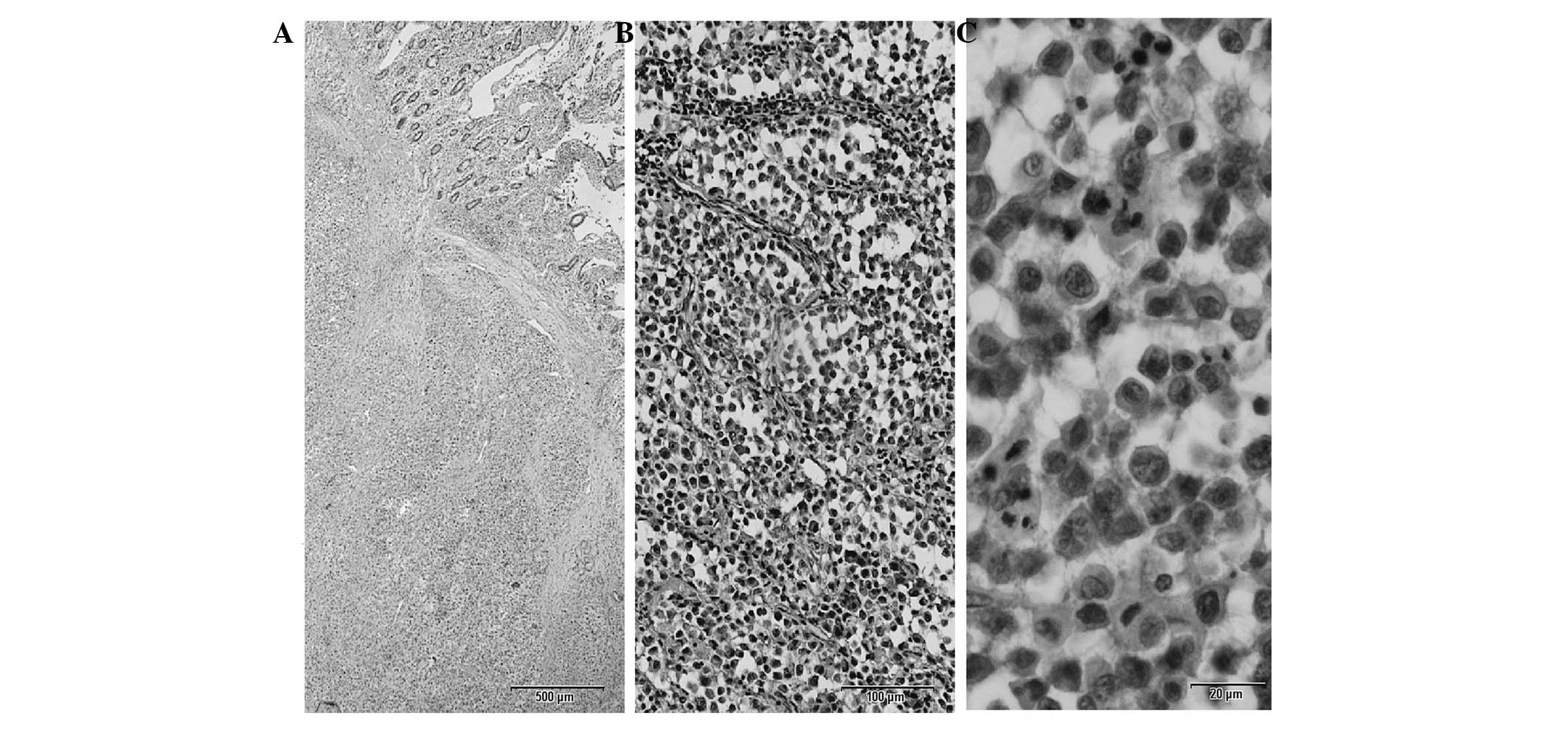
Histological examination of the tumor revealed a diffuse infiltration of tumor cells from the mucosa to the serosa. The neoplastic cells were large, with centrally or eccentrically located round nuclei, prominent single nucleoli and moderately eosinophilic cytoplasm (Fig. 1). Regional lymph nodes were also invaded. Bone marrow biopsy revealed no evidence of infiltrations by the lymphoma. The patient was assessed as being at stage IIa according to the Ann Arbor staging system.

Figure 1

Cytologic features of the anaplastic lymphoma kinase-positive diffuse large B-cell lymphoma (ALK+ DLBCL). (A) Diffuse infiltration of tumor cells (HE stain; magnification, HE ×20). (B) Sinusoidal infiltration pattern (HE stain. magnification, HE ×100). (C) Tumor cells with round, regular nuclei; single, central, eosinophilic nucleoli and moderate amounts of eosinophilic cytoplasm (HE stain; magnification, HE ×400). HE, hematoxylin and eosin.

Eight cycles of cyclophosphamide, doxorubicin, vincristine, prednisone and etoposide (CHOPE) were administered to the patient over nine months. The patient responded to the therapy and the disease was partially regressed, although without the achievement of tumor-free status.

The use of human tissue samples for this study was approved by the Institutional Review Board of the Affiliated Hospital of Qingdao University Medical College (Qingdao, China). The patient provided written informed consent for their participation in the study.

Immunohistochemistry

Immunohistochemical staining was performed on paraffin-embedded tissue sections (5 μm) with the EnVision method. The analyses were conducted with a large panel of monoclonal antibodies, including antibodies against CD20, CD79α (both from ZSGB-BIO, Beijng, China), CD3 (BD Biosciences, Heidelberg, Germany), CD138, CD38, CD56, epithelial membrane antigen (EMA), AE1/AE3, CD30, multiple myeloma oncogene 1 (Mum-1), CD10 (all from ZSGB-BIO), B-cell lymphoma 6 (Bcl-6; BD Biosciences), immunoglobulin A (IgA; DAKO, Glostrup, Denmark) and Ki67 (ZSGB-BIO), following antigen retrieval. For detection of the ALK (BD Biosciences) protein, the monoclonal antibody anti-ALK was used.

In situ hybridization

In situ hybridization was performed, according to standard methods (11), on 4-μm paraffin-embedded tissue sections with specific digoxigenin-labeled probes (ZSGB-BIO) that were complementary to Epstein-Barr virus (EBV)-encoded RNA nuclear transcripts.

Fluorescence in situ hybridization (FISH)

FISH was performed on 4 μm paraffin-embedded tissue sections following deparaffinization and digestion. The slides were washed in saline-sodium citrate (SSC) buffer, fixed in 10%-buffered formalin for 5 min, dehydrated in graded alcohol and allowed to air dry. Hybridization was performed using a dual-color break-apart rearrangement probe (ZSGB-BIO) for the ALK gene on chromosome 2. The probes were denatured by incubation at 78°C for 5 min in a humidified box, after which they were hybridized overnight at 42°C.

Immunohistochemistry and in situ hybridization results

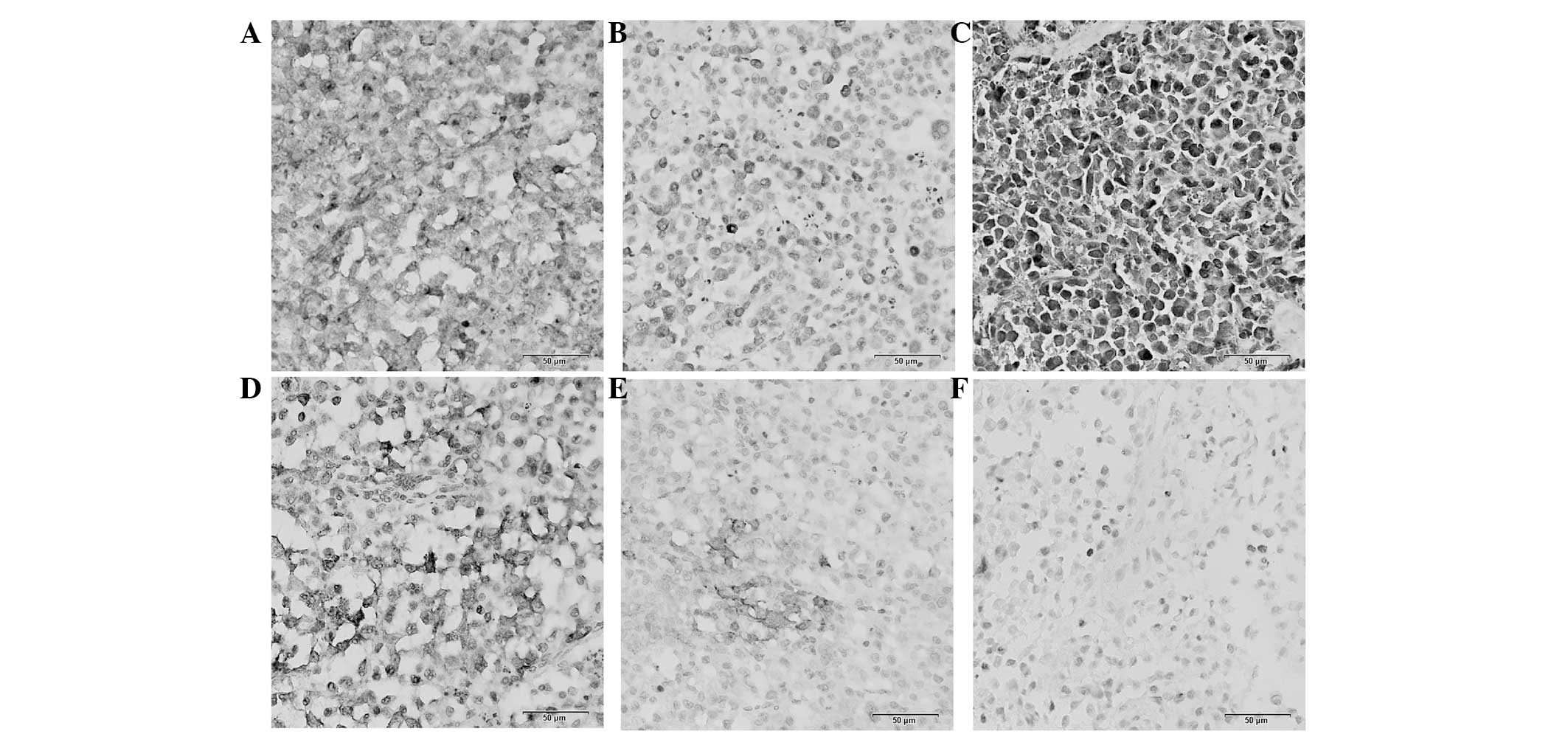
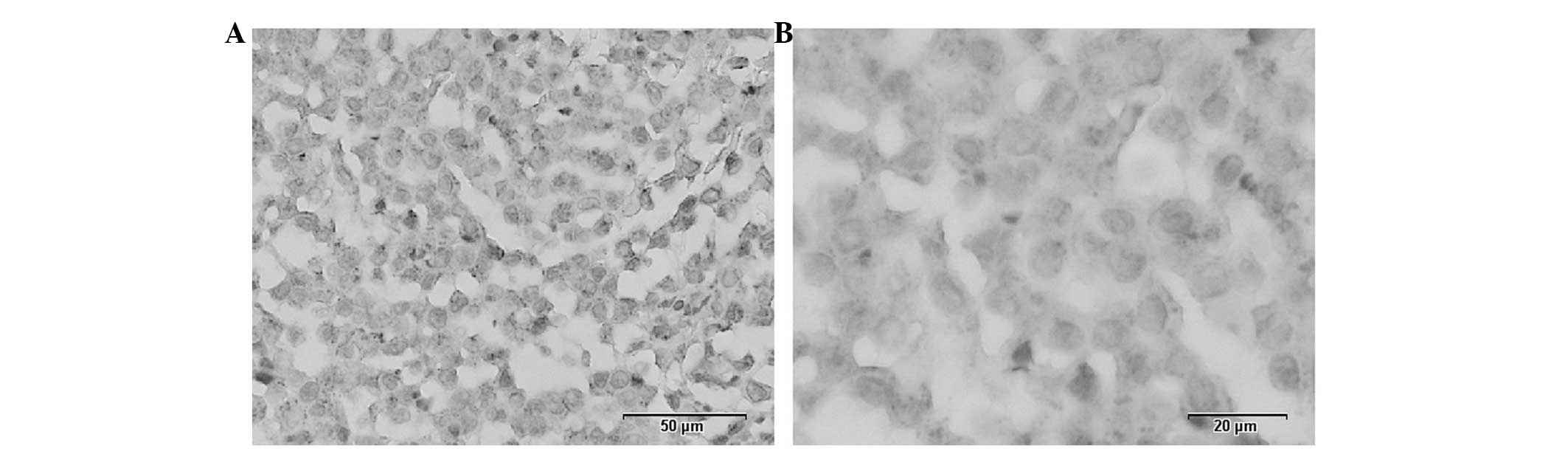
Immunohistochemistry demonstrated that the tumor cells were positive for CD138, IgA and CD79α (Fig. 2), but negative for CD3, CD38, CD20, CD10, Bcl-6, CD56 and cytokeratin. Mum-1, CD30 and EMA revealed a patchy reactivity (Fig. 2). Furthermore, immunohistochemistry with the monoclonal antibody anti-ALK1, revealed a granular cytoplasmic expression of the ALK protein by neoplastic cells (Fig. 3). The EBV in situ hybridization staining was negative.

Figure 2

Typical immunohistochemical staining of the anaplastic lymphoma kinase-positive diffuse large B-cell lymphoma (ALK+ DLBCL). The tissue was positive for (A) CD138; (B) CD79α and (C) immunoglobulin A (IgA) and focally positive for (D) epithelial membrane antigen (EMA), (E) CD30 and (F) multiple myeloma oncogene 1 (Mum-1). Magnification, ×200 by the Envision method.

Figure 3

Granular cytoplasmic staining of the anaplastic lymphoma kinase (ALK). Magnification of (A) and (B) is ×200 and ×400, respectively by the Envision method.

FISH results indicate ALK gene rearrangements

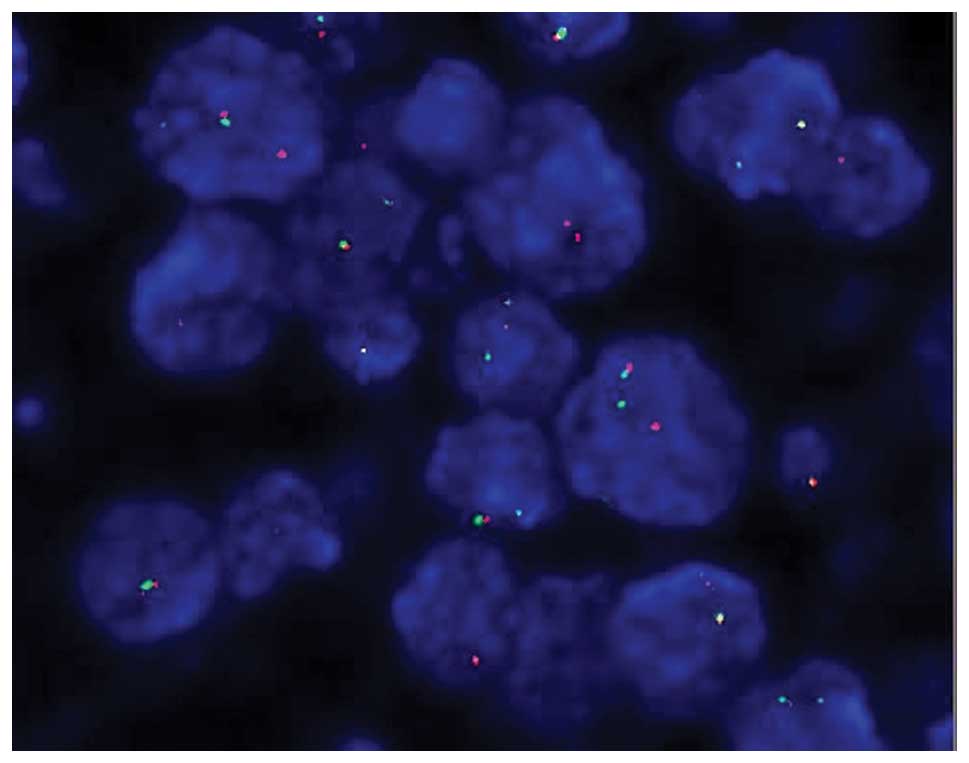
FISH analysis demonstrated that gene rearrangement of ALK were present in the patient. Fig. 4 shows clearly separated green and red signals indicating the translocation of the ALK gene. The normal ALK gene signal is shown as a fused yellow signal or joined green and red signals.

Figure 4

Fluorescence in situ hybridization of the anaplastic lymphoma kinase (ALK) gene using a break-apart probe. The clearly separated green and red signals indicate a translocation of the ALK gene.

Discussion

ALK+ DLBCL was originally described by Delsol et al (2) in 1997, based on a series of seven cases. It spans all age groups (9–72 years), with a median of 38 years, and occurs with a male predominance (male:female ratio, 3:1). ALK+ DLBCL frequently presents with an aggressive clinical course, a poor response to therapy and a short survival time (12). Histologically, the tumor cells exhibit an immunoblastic and/or plasmablastic morphology with a sinusoidal growth pattern. Immunohistochemically, ALK+ DLBCL does not express B-lineage markers (CD20 and CD79α), T-lineage markers (CD3), cytotoxic granular proteins (granzyme B and TIA-1) or CD30. However, plasmacytic markers, including CD138, CD38 and EMA, are characteristically expressed, which demonstrates the terminally differentiated B-lineage origin of the tumor cells (13). In the majority of reported cases of ALK+ DLBCL, monotypic IgA λ was expressed, and EBV was not detected by in situ hybridization (3,5,6,9,10,13,14). In concordance with the results of these studies, the present case tested positive for the expression of CD138 and IgA.

Although a unique immunophenotypic profile has been established for ALK+ DLBCL, there remains a certain immunophenotypic heterogeneity. For example, CD79α is not usually expressed in tumor cells; however, in certain cases, including the case reported in the present study, the tumor cells were positive for CD79α (10,14). Similarly, although usually negative, the current case and one case described in the study by De Paepe et al (5) were focally positive for CD30.

Lymph nodes are consistently primarily involved in ALK+ DLBCL; however, cases of extranodal involvement, including in the stomach, nasal cavity, ovary and brain, have been described (7,9,10,14). While the gastrointestinal tract (GI) is the most common site of extranodal lymphoma, only one case of an extranodal lymphoma in the stomach has been reported, which was in the study by McManus et al (9). The study described a gastric ALK+ DLBCL without the involvement of bone marrow or adjacent organs in a patient aged 21 years (9). To the best of our knowledge, the current study describes the first case of ALK+ DLBCL in the duodenum, which represents the second reported occurrence of ALK+ DLBCL in the GI tract.

ALK+ DLBCL exhibits a distinct staining pattern for the ALK protein according to the underlying gene rearrangement. The majority of reported cases with clathrin heavy-chain (CLTC)-ALK gene translocation exhibit granular cytoplasmic staining (2,3,7,13,14), while a number of cases with nucleophosmin (NPM1)-ALK translocation exhibit cytoplasmic and nuclear staining (6,7). Furthermore, certain other staining patterns have been observed. Lee et al (13) observed a case demonstrating a unique nuclear membrane-staining pattern for the ALK protein, which indicated a novel ALK gene rearrangement involving another translocation partner gene. A cryptic 3′-ALK gene insertion into chromosome 4 was identified by Stachurski et al (8), which represented a novel cytogenetic alteration of ALK+ DLBCL. The current case demonstrated a typical cytoplasmic and granular ALK staining pattern and the corresponding rearrangement of the ALK gene.

Clinically, ALK+ DLBCL is more aggressive and reveals a worse response rate to standard chemotherapy compared with typical DLBCL. Laurent et al (14) reviewed a large cohort of 38 cases of ALK+ DLBCL and observed that the majority of patients experienced an aggressive clinical course, with a 5-year survival rate of 25% following treatment with the CHOPE regimen. Since tests for CD20 are negative in the majority of cases of ALK+ DLBCL, rituximab plays no therapeutic role. Therefore, it is important to develop novel and effective alternative treatments for ALK+ DLBCL, including front-line intensification with or without autologous stem-cell transplantation, and the application of new biological agents such as anti-CD138 monoclonal antibodies and ALK inhibitors (14,15).

References

1 

Delsol G, Campo E and Gascoyne RD: ALK-positive large B-cell lymphoma. WHO Classification of Tumours of Haematopoietic and Lymphoid Tissues. Swerdlow S, Campo E, Harris N, et al: Lyon: International Agency for Research on Cancer; pp. 254–255. 2008

2 

Delsol G, Lamant L, Mariamé B, et al: A new subtype of large B-cell lymphoma expressing the ALK kinase and lacking the 2;5 translocation. Blood. 89:1483–1490. 1997.PubMed/NCBI

3 

Morris SW, Kirstein MN, Valentine MB, Dittmer K, Shapiro DN, Look AT and Saltman DL: Fusion of a kinase gene, ALK, to a nucleolar protein gene, NPM, in non-Hodgkin’s lymphoma. Science. 267:316–317. 1995.

4 

Gascoyne RD, Lamant L, Martin-Subero JI, et al: ALK-positive diffuse large B-cell lymphoma is associated with Clathrin-ALK rearrangements: report of 6 cases. Blood. 102:2568–2573. 2003. View Article : Google Scholar : PubMed/NCBI

5 

De Paepe P, Baens M, van Krieken H, et al: ALK activation by the CLTC-ALK fusion is a recurrent event in large B-cell lymphoma. Blood. 102:2638–2641. 2003.PubMed/NCBI

6 

Adam P, Katzenberger T, Seeberger H, et al: A case of a diffuse large B-cell lymphoma of plasmablastic type associated with the t(2;5)(p23;q35) chromosome translocation. Am J Surg Pathol. 27:1473–1476. 2003. View Article : Google Scholar : PubMed/NCBI

7 

Onciu M, Behm FG, Downing JR, et al: ALK-positive plasmablastic B-cell lymphoma with expression of the NPM-ALK fusion transcript: report of 2 cases. Blood. 102:2642–2644. 2003. View Article : Google Scholar : PubMed/NCBI

8 

Stachurski D, Miron PM, Al-Homsi S, Hutchinson L, Harris NL, Woda B and Wang SA: Anaplastic lymphoma kinase-positive diffuse large B-cell lymphoma with a complex karyotype and cryptic 3’ ALK gene insertion to chromosome 4 q22-24. Hum Pathol. 38:940–945. 2007.PubMed/NCBI

9 

McManus DT, Catherwood MA, Carey PD, Cuthbert RJ and Alexander HD: ALK-positive diffuse large B-cell lymphoma of the stomach associated with a clathrin-ALK rearrangement. Hum Pathol. 35:1285–1288. 2004. View Article : Google Scholar : PubMed/NCBI

10 

Reichard KK, McKenna RW and Kroft SH: ALK-positive diffuse large B-cell lymphoma: report of four cases and review of the literature. Mod Pathol. 20:310–319. 2007. View Article : Google Scholar : PubMed/NCBI

11 

Luo B, Wang Y, Wang XF, Liang H, Yan LP, Huang BH and Zhao P: Expression of Epstein-Barr virus genes in EBV-associated gastric carcinomas. World J Gastroenterol. 11:629–633. 2005. View Article : Google Scholar : PubMed/NCBI

12 

Beltran B, Castillo J, Salas R, et al: ALK-positive diffuse large B-cell lymphoma: report of four cases and review of the literature. J Hematol Oncol. 2:112009. View Article : Google Scholar : PubMed/NCBI

13 

Lee HW, Kim K, Kim W and Ko YH: ALK-positive diffuse large B-cell lymphoma: report of three cases. Hematol Oncol. 26:108–113. 2008. View Article : Google Scholar : PubMed/NCBI

14 

Laurent C, Do C, Gascoyne RD, et al: Anaplastic lymphoma kinase-positive diffuse large B-cell lymphoma: a rare clinicopathologic entity with poor prognosis. J Clin Oncol. 27:4211–4216. 2009. View Article : Google Scholar : PubMed/NCBI

15 

Tassone P, Goldmacher VS, Neri P, et al: Cytotoxic activity of the maytansinoid immunoconjugate B-B4-DM1 against CD138+ multiple myeloma cells. Blood. 104:3688–3696. 2004.PubMed/NCBI

Related Articles

  • Abstract
  • View
  • Download
  • Twitter
Copy and paste a formatted citation
Spandidos Publications style
Xing X, Lin D, Ran W and Liu H: ALK-positive diffuse large B-cell lymphoma of the duodenum: A case report and review of the literature. Exp Ther Med 8: 409-412, 2014.
APA
Xing, X., Lin, D., Ran, W., & Liu, H. (2014). ALK-positive diffuse large B-cell lymphoma of the duodenum: A case report and review of the literature. Experimental and Therapeutic Medicine, 8, 409-412. https://doi.org/10.3892/etm.2014.1786
MLA
Xing, X., Lin, D., Ran, W., Liu, H."ALK-positive diffuse large B-cell lymphoma of the duodenum: A case report and review of the literature". Experimental and Therapeutic Medicine 8.2 (2014): 409-412.
Chicago
Xing, X., Lin, D., Ran, W., Liu, H."ALK-positive diffuse large B-cell lymphoma of the duodenum: A case report and review of the literature". Experimental and Therapeutic Medicine 8, no. 2 (2014): 409-412. https://doi.org/10.3892/etm.2014.1786
Copy and paste a formatted citation
x
Spandidos Publications style
Xing X, Lin D, Ran W and Liu H: ALK-positive diffuse large B-cell lymphoma of the duodenum: A case report and review of the literature. Exp Ther Med 8: 409-412, 2014.
APA
Xing, X., Lin, D., Ran, W., & Liu, H. (2014). ALK-positive diffuse large B-cell lymphoma of the duodenum: A case report and review of the literature. Experimental and Therapeutic Medicine, 8, 409-412. https://doi.org/10.3892/etm.2014.1786
MLA
Xing, X., Lin, D., Ran, W., Liu, H."ALK-positive diffuse large B-cell lymphoma of the duodenum: A case report and review of the literature". Experimental and Therapeutic Medicine 8.2 (2014): 409-412.
Chicago
Xing, X., Lin, D., Ran, W., Liu, H."ALK-positive diffuse large B-cell lymphoma of the duodenum: A case report and review of the literature". Experimental and Therapeutic Medicine 8, no. 2 (2014): 409-412. https://doi.org/10.3892/etm.2014.1786
Follow us
  • Twitter
  • LinkedIn
  • Facebook
About
  • Spandidos Publications
  • Careers
  • Cookie Policy
  • Privacy Policy
How can we help?
  • Help
  • Live Chat
  • Contact
  • Email to our Support Team