Spandidos Publications Logo
  • About
    • About Spandidos
    • Aims and Scopes
    • Abstracting and Indexing
    • Editorial Policies
    • Reprints and Permissions
    • Job Opportunities
    • Terms and Conditions
    • Contact
  • Journals
    • All Journals
    • Oncology Letters
      • Oncology Letters
      • Information for Authors
      • Editorial Policies
      • Editorial Board
      • Aims and Scope
      • Abstracting and Indexing
      • Bibliographic Information
      • Archive
    • International Journal of Oncology
      • International Journal of Oncology
      • Information for Authors
      • Editorial Policies
      • Editorial Board
      • Aims and Scope
      • Abstracting and Indexing
      • Bibliographic Information
      • Archive
    • Molecular and Clinical Oncology
      • Molecular and Clinical Oncology
      • Information for Authors
      • Editorial Policies
      • Editorial Board
      • Aims and Scope
      • Abstracting and Indexing
      • Bibliographic Information
      • Archive
    • Experimental and Therapeutic Medicine
      • Experimental and Therapeutic Medicine
      • Information for Authors
      • Editorial Policies
      • Editorial Board
      • Aims and Scope
      • Abstracting and Indexing
      • Bibliographic Information
      • Archive
    • International Journal of Molecular Medicine
      • International Journal of Molecular Medicine
      • Information for Authors
      • Editorial Policies
      • Editorial Board
      • Aims and Scope
      • Abstracting and Indexing
      • Bibliographic Information
      • Archive
    • Biomedical Reports
      • Biomedical Reports
      • Information for Authors
      • Editorial Policies
      • Editorial Board
      • Aims and Scope
      • Abstracting and Indexing
      • Bibliographic Information
      • Archive
    • Oncology Reports
      • Oncology Reports
      • Information for Authors
      • Editorial Policies
      • Editorial Board
      • Aims and Scope
      • Abstracting and Indexing
      • Bibliographic Information
      • Archive
    • Molecular Medicine Reports
      • Molecular Medicine Reports
      • Information for Authors
      • Editorial Policies
      • Editorial Board
      • Aims and Scope
      • Abstracting and Indexing
      • Bibliographic Information
      • Archive
    • World Academy of Sciences Journal
      • World Academy of Sciences Journal
      • Information for Authors
      • Editorial Policies
      • Editorial Board
      • Aims and Scope
      • Abstracting and Indexing
      • Bibliographic Information
      • Archive
    • International Journal of Functional Nutrition
      • International Journal of Functional Nutrition
      • Information for Authors
      • Editorial Policies
      • Editorial Board
      • Aims and Scope
      • Abstracting and Indexing
      • Bibliographic Information
      • Archive
    • International Journal of Epigenetics
      • International Journal of Epigenetics
      • Information for Authors
      • Editorial Policies
      • Editorial Board
      • Aims and Scope
      • Abstracting and Indexing
      • Bibliographic Information
      • Archive
    • Medicine International
      • Medicine International
      • Information for Authors
      • Editorial Policies
      • Editorial Board
      • Aims and Scope
      • Abstracting and Indexing
      • Bibliographic Information
      • Archive
  • Articles
  • Information
    • Information for Authors
    • Information for Reviewers
    • Information for Librarians
    • Information for Advertisers
    • Conferences
  • Language Editing
Spandidos Publications Logo
  • About
    • About Spandidos
    • Aims and Scopes
    • Abstracting and Indexing
    • Editorial Policies
    • Reprints and Permissions
    • Job Opportunities
    • Terms and Conditions
    • Contact
  • Journals
    • All Journals
    • Biomedical Reports
      • Information for Authors
      • Editorial Policies
      • Editorial Board
      • Aims and Scope
      • Abstracting and Indexing
      • Bibliographic Information
      • Archive
    • Experimental and Therapeutic Medicine
      • Information for Authors
      • Editorial Policies
      • Editorial Board
      • Aims and Scope
      • Abstracting and Indexing
      • Bibliographic Information
      • Archive
    • International Journal of Epigenetics
      • Information for Authors
      • Editorial Policies
      • Editorial Board
      • Aims and Scope
      • Abstracting and Indexing
      • Bibliographic Information
      • Archive
    • International Journal of Functional Nutrition
      • Information for Authors
      • Editorial Policies
      • Editorial Board
      • Aims and Scope
      • Abstracting and Indexing
      • Bibliographic Information
      • Archive
    • International Journal of Molecular Medicine
      • Information for Authors
      • Editorial Policies
      • Editorial Board
      • Aims and Scope
      • Abstracting and Indexing
      • Bibliographic Information
      • Archive
    • International Journal of Oncology
      • Information for Authors
      • Editorial Policies
      • Editorial Board
      • Aims and Scope
      • Abstracting and Indexing
      • Bibliographic Information
      • Archive
    • Medicine International
      • Information for Authors
      • Editorial Policies
      • Editorial Board
      • Aims and Scope
      • Abstracting and Indexing
      • Bibliographic Information
      • Archive
    • Molecular and Clinical Oncology
      • Information for Authors
      • Editorial Policies
      • Editorial Board
      • Aims and Scope
      • Abstracting and Indexing
      • Bibliographic Information
      • Archive
    • Molecular Medicine Reports
      • Information for Authors
      • Editorial Policies
      • Editorial Board
      • Aims and Scope
      • Abstracting and Indexing
      • Bibliographic Information
      • Archive
    • Oncology Letters
      • Information for Authors
      • Editorial Policies
      • Editorial Board
      • Aims and Scope
      • Abstracting and Indexing
      • Bibliographic Information
      • Archive
    • Oncology Reports
      • Information for Authors
      • Editorial Policies
      • Editorial Board
      • Aims and Scope
      • Abstracting and Indexing
      • Bibliographic Information
      • Archive
    • World Academy of Sciences Journal
      • Information for Authors
      • Editorial Policies
      • Editorial Board
      • Aims and Scope
      • Abstracting and Indexing
      • Bibliographic Information
      • Archive
  • Articles
  • Information
    • For Authors
    • For Reviewers
    • For Librarians
    • For Advertisers
    • Conferences
  • Language Editing
Login Register Submit
  • This site uses cookies
  • You can change your cookie settings at any time by following the instructions in our Cookie Policy. To find out more, you may read our Privacy Policy.

    I agree
Search articles by DOI, keyword, author or affiliation
Search
Advanced Search
presentation
Experimental and Therapeutic Medicine
Join Editorial Board Propose a Special Issue
Print ISSN: 1792-0981 Online ISSN: 1792-1015
Journal Cover
January-2015 Volume 9 Issue 1

Full Size Image

Sign up for eToc alerts
Recommend to Library

Journals

International Journal of Molecular Medicine

International Journal of Molecular Medicine

International Journal of Molecular Medicine is an international journal devoted to molecular mechanisms of human disease.

International Journal of Oncology

International Journal of Oncology

International Journal of Oncology is an international journal devoted to oncology research and cancer treatment.

Molecular Medicine Reports

Molecular Medicine Reports

Covers molecular medicine topics such as pharmacology, pathology, genetics, neuroscience, infectious diseases, molecular cardiology, and molecular surgery.

Oncology Reports

Oncology Reports

Oncology Reports is an international journal devoted to fundamental and applied research in Oncology.

Experimental and Therapeutic Medicine

Experimental and Therapeutic Medicine

Experimental and Therapeutic Medicine is an international journal devoted to laboratory and clinical medicine.

Oncology Letters

Oncology Letters

Oncology Letters is an international journal devoted to Experimental and Clinical Oncology.

Biomedical Reports

Biomedical Reports

Explores a wide range of biological and medical fields, including pharmacology, genetics, microbiology, neuroscience, and molecular cardiology.

Molecular and Clinical Oncology

Molecular and Clinical Oncology

International journal addressing all aspects of oncology research, from tumorigenesis and oncogenes to chemotherapy and metastasis.

World Academy of Sciences Journal

World Academy of Sciences Journal

Multidisciplinary open-access journal spanning biochemistry, genetics, neuroscience, environmental health, and synthetic biology.

International Journal of Functional Nutrition

International Journal of Functional Nutrition

Open-access journal combining biochemistry, pharmacology, immunology, and genetics to advance health through functional nutrition.

International Journal of Epigenetics

International Journal of Epigenetics

Publishes open-access research on using epigenetics to advance understanding and treatment of human disease.

Medicine International

Medicine International

An International Open Access Journal Devoted to General Medicine.

Journal Cover
January-2015 Volume 9 Issue 1

Full Size Image

Sign up for eToc alerts
Recommend to Library

  • Article
  • Citations
    • Cite This Article
    • Download Citation
    • Create Citation Alert
    • Remove Citation Alert
    • Cited By
  • Similar Articles
    • Related Articles (in Spandidos Publications)
    • Similar Articles (Google Scholar)
    • Similar Articles (PubMed)
  • Download PDF
  • Download XML
  • View XML
Case Report

Pulmonary tuberculosis with false-positive 18F-fluorodeoxyglucose positron emission tomography mimicking recurrent lung cancer: A case report

  • Authors:
    • Cheng Chen
    • Ye‑Han Zhu
    • Hong‑Ying Qian
    • Jian‑An Huang
  • View Affiliations / Copyright

    Affiliations: Respiratory Department, The First Affiliated Hospital of Soochow University, Suzhou, Jiangsu 215006, P.R. China
  • Pages: 159-161
    |
    Published online on: November 7, 2014
       https://doi.org/10.3892/etm.2014.2054
  • Expand metrics +
Metrics: Total Views: 0 (Spandidos Publications: | PMC Statistics: )
Metrics: Total PDF Downloads: 0 (Spandidos Publications: | PMC Statistics: )
Cited By (CrossRef): 0 citations Loading Articles...

This article is mentioned in:


Abstract

Recurrent lung cancer is a common clinical condition. 18F‑fluorodeoxyglucose positron emission tomography (FDG‑PET) is currently the predominant non‑invasive imaging technique used for the detection of tumor recurrence. In the present study, the case of a 67‑year‑old male suspected to have postoperative recurrence of primary lung cancer was examined. Chest computed tomography (CT) scans identified a subpleural nodule grown within a short time period, along with the occurrence of multiple patchy shadows on the right lung. PET‑CT scans revealed an increased FDG uptake in the surgical site, which exhibited features of a malignant disease. However, a video‑assisted thoracoscopic biopsy provided the diagnosis of tuberculosis and guided further appropriate treatment. In conclusion, further evaluation is required in all patients with suspected metastatic and recurrent carcinoma.

Introduction

Treatment of lung cancer usually involves surgery in the early stages and radiotherapy or chemoradiotherapy in more advanced stages of the disease (1). Cancer recurrence may occur in multiple sites following primary treatment. Although recurrent and metastatic disease is usually not curable, surgical treatment may be beneficial in cases where locoregional recurrence is detected early. Performing 18F-fluorodeoxyglucose positron emission tomography-computed tomography (18F-FDG PET-CT) is important in the diagnosis of clinically suspicious recurrent lung cancer (2). However, the diagnostic efficiency of PET-CT remains controversial (3,4). A previous study demonstrated that delayed PET-CT scans enhanced the variation of FDG uptake between a number of lesions (5). In addition, delayed maximum standardized uptake values (SUVmax) of >5.5 were shown to improve the differentiation of hypermetabolic lesions compared with earlier scans. However, careful interpretation and management are still required for correct diagnosis. In the present study, a case of pulmonary tuberculosis, suspected as recurrent lung cancer following PET-CT scans, was examined.

Case report

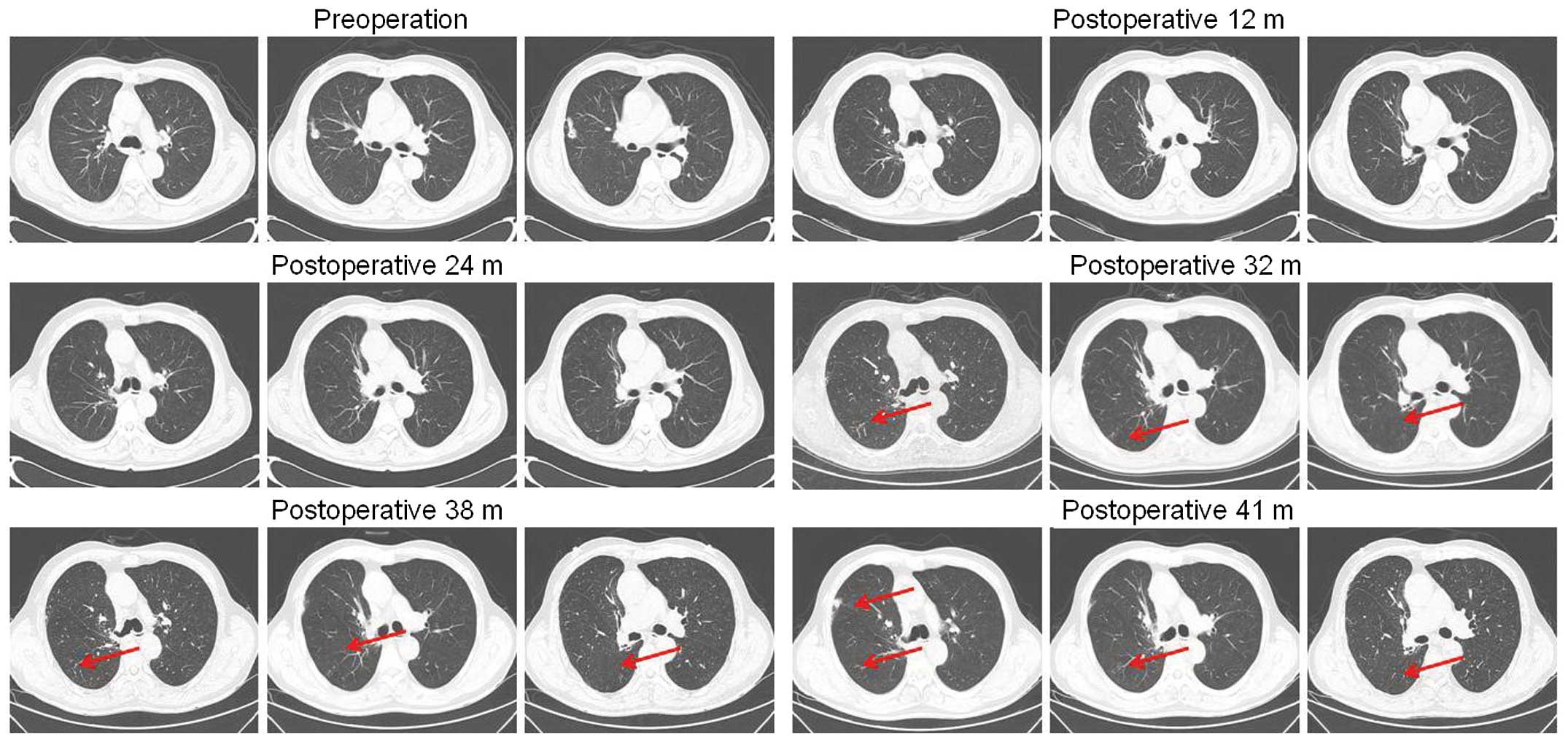
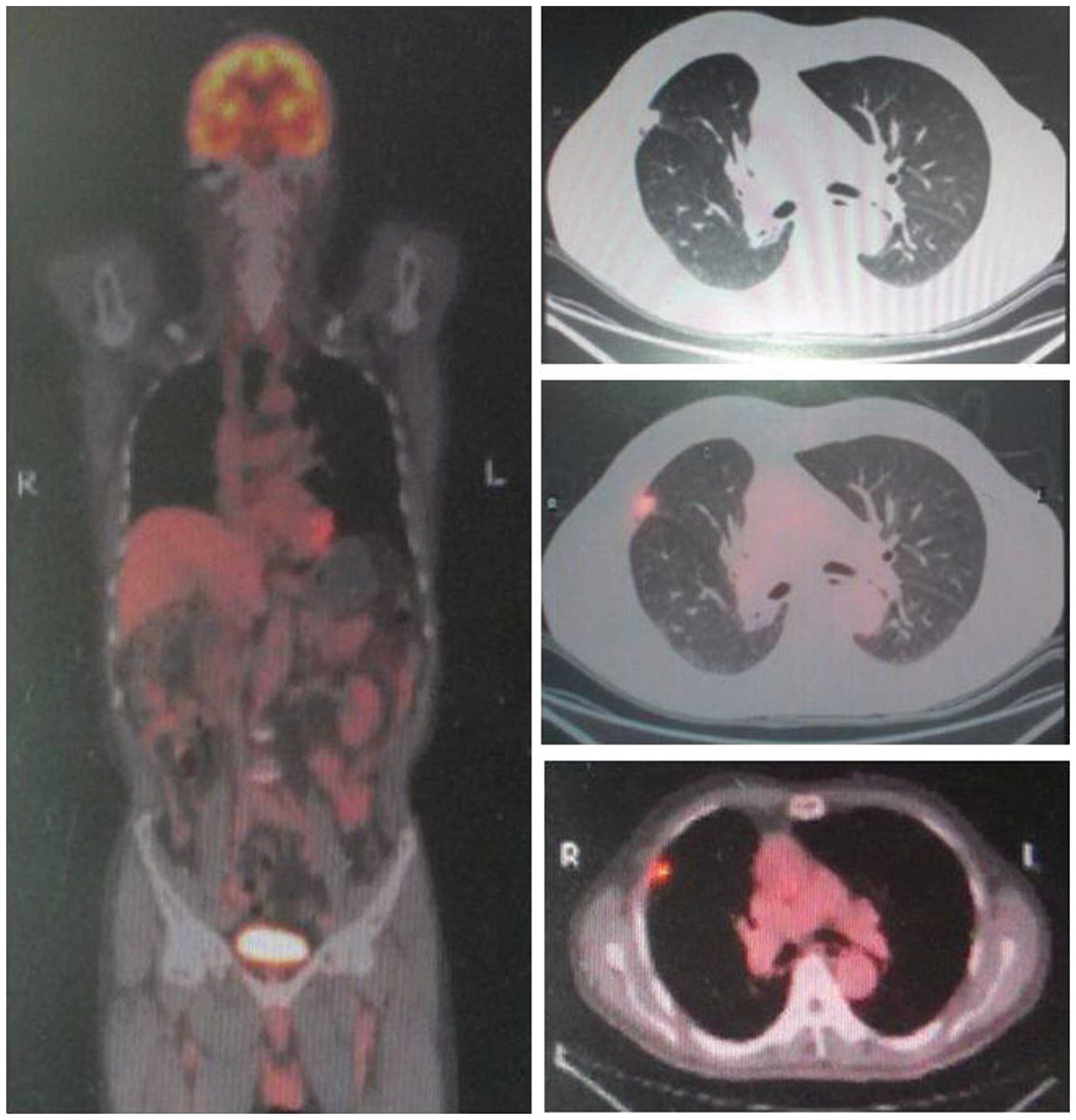
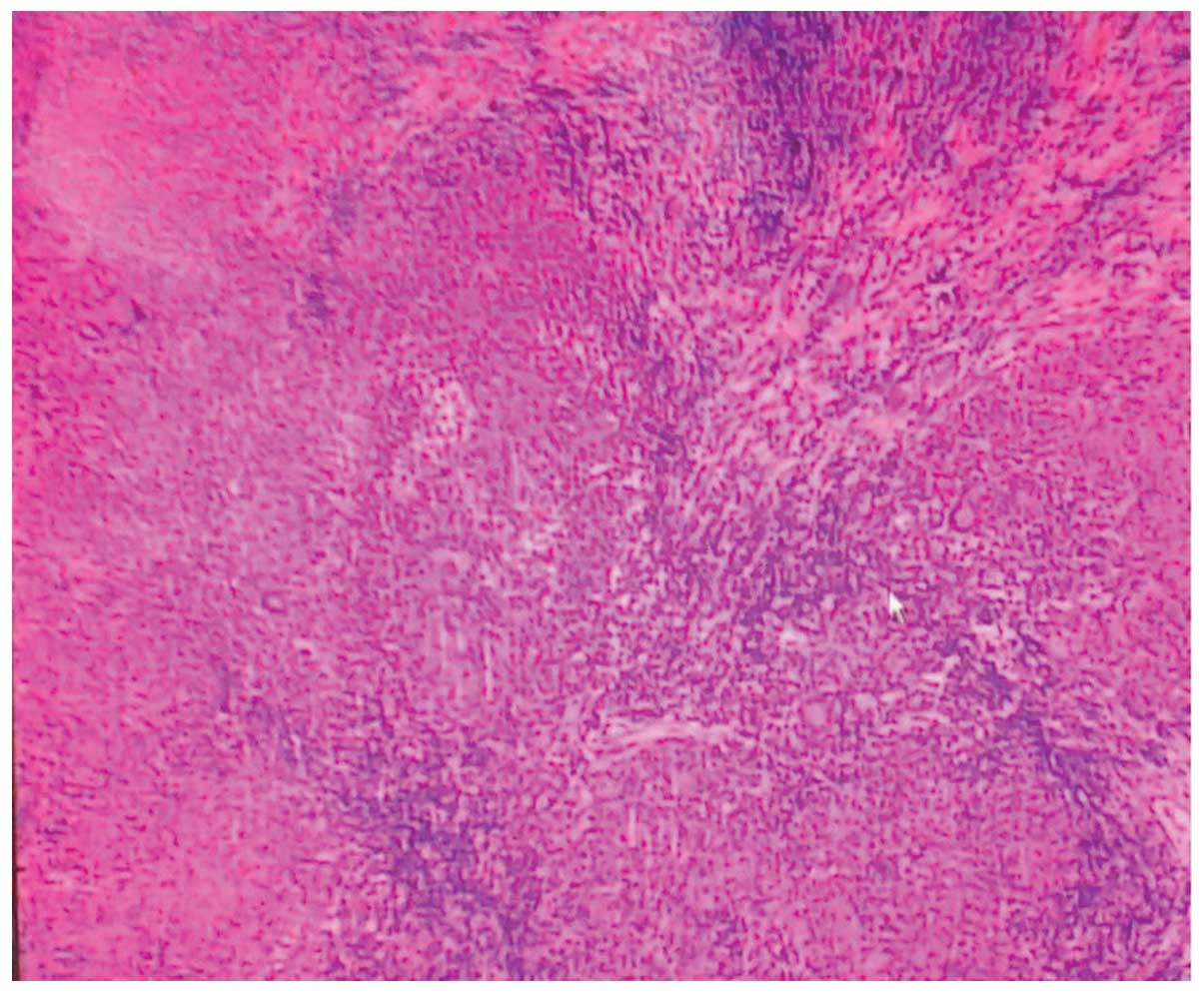
A 67-year-old male was admitted to the Surgical Outpatients Department of The First Affiliated Hospital of Soochow University (Suzhou, China), with a mass lesion (2×2 cm) on the right lung (Fig. 1). The lesion was detected during a routine medical examination. A video-assisted thoracoscopic lobectomy was performed to remove the mass, and histopathological examination revealed a lung adenocarcinoma with visceral pleural invasion. The patient underwent four courses of adjuvant chemotherapy (75 mg/m2 cisplatin and 100 mg/m2 gemcitabine) and was clinically diagnosed as disease free. However, the appearance of multiple patchy shadows on the right lung was observed in CT scans at 32 months following the surgery (6). The patient did not present any evident changes in the chest radiographs and serum tumor marker tests during the subsequent nine-month follow-up period. After the nine-month period, chest CT scans revealed a subpleural nodule (0.5×0.5 cm) and a slight enlargement of the patchy shadow on the right lung (Fig. 2). PET-CT scans revealed that the FDG uptake of the nodule had a SUVmax of 6.1. A that indicated malignant disease. A video-assisted thoracoscopic biopsy indicated that the patient suffered from tuberculosis (Fig. 3). Written informed consent was obtained from the patient.

Figure 1

Computed tomography (CT) scans of the patient. No evident changes were observed in the chest radiographs until 32 months following surgery, when multiple patchy shadows were observed on the right lung. After a further nine months, chest CT scans revealed a subpleural nodule (0.5×0.5 cm) and a slight enlargement of the patchy shadow. m, months.

Figure 2

Positron emission tomography-computed tomography scans showing an abnormality with increased 18F-fluorodeoxyglucose uptake at the surgical site.

Figure 3

Hematoxylin and eosin staining of the tissue, showing the presence of a granuloma and caseous necrosis (magnification, ×200).

Discussion

Adenocarcinoma is the predominant histological subtype of lung carcinoma (7); however, smear pulmonary tuberculosis appearing on the surgical site as the recurrence of lung cancer is extremely rare, particularly during the postoperative follow-up period.

Postoperative recurrence of lung cancer is commonly diagnosed by CT or PET-CT scans and clinical features, instead of a rebiopsy. PET-CT is the most sensitive non-invasive imaging method for the detection of tumor metastases and recurrence, since these scans enable more accurate assessment of the tumor morphology, composition, location and extent (8). However, the diagnostic efficiency of PET-CT remains controversial, since a number of benign lesions may exhibit increased metabolic activity, leading to a false positive result. Failure to differentiate between recurrent tumors and benign lesions may result in inappropriate treatment. Therefore, previous studies have attempted to evaluate the accuracy of PET-CT as a diagnostic method, and the characteristics of false negatives and false positives, to improve specificity and sensitivity (5,9). Razak et al demonstrated that early whole body PET-CT may efficiently detect extrapulmonary tuberculosis lesions, while dual time point imaging may not be able to determine the lesion type (9).

The present study reports the case of a 67-year-old male with pulmonary tuberculosis, whose PET-CT images mimicked recurrent lung cancer. Due to the slow progress of the multiple patchy shadows on the right lung, along with the increased FDG uptake in a short-term growing subpleural nodule, the patient was suspected to suffer from recurrent lung cancer. However, the slow progress of the multiple patchy shadows and the normality of the serum tumor markers prompted a video-assisted thoracoscopic rebiopsy to be performed. Pathological examination confirmed the inference that the subpleural nodule was due to tuberculosis instead of recurrent lung cancer. Therefore, further evaluation is required in all patients with a suspected metastatic and recurrent carcinoma, and rebiopsy is a valuable method for certain patients, since other conditions may exist, including a benign disease.

Acknowledgements

The study was supported by grants from the Jiangsu Provincial Special Program of Medical Science (no. BL2012023), the Department of Public Health of Jiangsu Province Project (no. H201208), the Natural Science Foundation of Jiangsu Province University (no. 13KJB320021) and the National Key Clinical Specialist Construction Programs of China and Ministry of Health for Public Projects (no. 201402024).

References

1 

Spiro SG, Gould MK and Colice GL; American College of Chest Physicians. Initial evaluation of the patient with lung cancer: symptoms, signs, laboratory tests, and paraneoplastic syndromes: ACCP evidenced-based clinical practice guidelines (2nd edition). Chest. 132(3 Suppl): 149S–160S. 2007. View Article : Google Scholar : PubMed/NCBI

2 

Liao S, Penney BC, Wroblewski K, et al: Prognostic value of metabolic tumor burden on 18F-FDG PET in nonsurgical patients with non-small cell lung cancer. Eur J Nucl Med Mol Imaging. 39:27–38. 2012. View Article : Google Scholar

3 

Burdick MJ, Stephans KL, Reddy CA, Djemil T, Srinivas SM and Videtic GM: Maximum standardized uptake value from staging FDG-PET/CT does not predict treatment outcome for early-stage non-small-cell lung cancer treated with stereotactic body radiotherapy. Int J Radiat Oncol Biol Phys. 78:1033–1039. 2010. View Article : Google Scholar : PubMed/NCBI

4 

Li S, Zheng Q, Ma Y, Wang Y, Feng Y, Zhao B and Yang Y: Implications of false negative and false positive diagnosis in lymph node staging of NSCLC by means of 18F-FDG PET/CT. PLoS One. 8:e785522013. View Article : Google Scholar

5 

Suga K, Kawakami Y, Hiyama A, Sugi K, Okabe K, Matsumoto T, Ueda K, Tanaka N and Matsunaga N: Dual-time point 18F-FDG PET/CT scan for differentiation between 18F-FDG-avid non-small cell lung cancer and benign lesions. Ann Nucl Med. 23:427–435. 2009. View Article : Google Scholar : PubMed/NCBI

6 

Fisher MD and D’Orazio A: Phase II and III trials: comparison of four chemotherapy regimens in advanced non small-cell lung cancer (ECOG 1594). Clin Lung Cancer. 2:21–22. 2000. View Article : Google Scholar

7 

Tse LA, Mang OW, Yu IT, Wu F, Au JS and Law SC: Cigarette smoking and changing trends of lung cancer incidence by histological subtype among Chinese male population. Lung Cancer. 66:22–27. 2009. View Article : Google Scholar : PubMed/NCBI

8 

Ozgül MA, Kirkil G, Seyhan EC, Cetinkaya E, Ozgül G and Yüksel M: The maximum standardized FDG uptake on PET-CT in patients with non-small cell lung cancer. Multidiscip Respir Med. 8:692013. View Article : Google Scholar : PubMed/NCBI

9 

Razak HR, Geso M, Abdul Rahim N and Nordin AJ: Imaging characteristics of extrapulmonary tuberculosis lesions on dual time point imaging (DTPI) of FDG PET/CT. J Med Imaging Radiat Oncol. 55:556–562. 2011. View Article : Google Scholar : PubMed/NCBI

Related Articles

  • Abstract
  • View
  • Download
  • Twitter
Copy and paste a formatted citation
Spandidos Publications style
Chen C, Zhu YH, Qian HY and Huang JA: Pulmonary tuberculosis with false-positive 18F-fluorodeoxyglucose positron emission tomography mimicking recurrent lung cancer: A case report. Exp Ther Med 9: 159-161, 2015.
APA
Chen, C., Zhu, Y., Qian, H., & Huang, J. (2015). Pulmonary tuberculosis with false-positive 18F-fluorodeoxyglucose positron emission tomography mimicking recurrent lung cancer: A case report. Experimental and Therapeutic Medicine, 9, 159-161. https://doi.org/10.3892/etm.2014.2054
MLA
Chen, C., Zhu, Y., Qian, H., Huang, J."Pulmonary tuberculosis with false-positive 18F-fluorodeoxyglucose positron emission tomography mimicking recurrent lung cancer: A case report". Experimental and Therapeutic Medicine 9.1 (2015): 159-161.
Chicago
Chen, C., Zhu, Y., Qian, H., Huang, J."Pulmonary tuberculosis with false-positive 18F-fluorodeoxyglucose positron emission tomography mimicking recurrent lung cancer: A case report". Experimental and Therapeutic Medicine 9, no. 1 (2015): 159-161. https://doi.org/10.3892/etm.2014.2054
Copy and paste a formatted citation
x
Spandidos Publications style
Chen C, Zhu YH, Qian HY and Huang JA: Pulmonary tuberculosis with false-positive 18F-fluorodeoxyglucose positron emission tomography mimicking recurrent lung cancer: A case report. Exp Ther Med 9: 159-161, 2015.
APA
Chen, C., Zhu, Y., Qian, H., & Huang, J. (2015). Pulmonary tuberculosis with false-positive 18F-fluorodeoxyglucose positron emission tomography mimicking recurrent lung cancer: A case report. Experimental and Therapeutic Medicine, 9, 159-161. https://doi.org/10.3892/etm.2014.2054
MLA
Chen, C., Zhu, Y., Qian, H., Huang, J."Pulmonary tuberculosis with false-positive 18F-fluorodeoxyglucose positron emission tomography mimicking recurrent lung cancer: A case report". Experimental and Therapeutic Medicine 9.1 (2015): 159-161.
Chicago
Chen, C., Zhu, Y., Qian, H., Huang, J."Pulmonary tuberculosis with false-positive 18F-fluorodeoxyglucose positron emission tomography mimicking recurrent lung cancer: A case report". Experimental and Therapeutic Medicine 9, no. 1 (2015): 159-161. https://doi.org/10.3892/etm.2014.2054
Follow us
  • Twitter
  • LinkedIn
  • Facebook
About
  • Spandidos Publications
  • Careers
  • Cookie Policy
  • Privacy Policy
How can we help?
  • Help
  • Live Chat
  • Contact
  • Email to our Support Team