Spandidos Publications Logo
  • About
    • About Spandidos
    • Aims and Scopes
    • Abstracting and Indexing
    • Editorial Policies
    • Reprints and Permissions
    • Job Opportunities
    • Terms and Conditions
    • Contact
  • Journals
    • All Journals
    • Oncology Letters
      • Oncology Letters
      • Information for Authors
      • Editorial Policies
      • Editorial Board
      • Aims and Scope
      • Abstracting and Indexing
      • Bibliographic Information
      • Archive
    • International Journal of Oncology
      • International Journal of Oncology
      • Information for Authors
      • Editorial Policies
      • Editorial Board
      • Aims and Scope
      • Abstracting and Indexing
      • Bibliographic Information
      • Archive
    • Molecular and Clinical Oncology
      • Molecular and Clinical Oncology
      • Information for Authors
      • Editorial Policies
      • Editorial Board
      • Aims and Scope
      • Abstracting and Indexing
      • Bibliographic Information
      • Archive
    • Experimental and Therapeutic Medicine
      • Experimental and Therapeutic Medicine
      • Information for Authors
      • Editorial Policies
      • Editorial Board
      • Aims and Scope
      • Abstracting and Indexing
      • Bibliographic Information
      • Archive
    • International Journal of Molecular Medicine
      • International Journal of Molecular Medicine
      • Information for Authors
      • Editorial Policies
      • Editorial Board
      • Aims and Scope
      • Abstracting and Indexing
      • Bibliographic Information
      • Archive
    • Biomedical Reports
      • Biomedical Reports
      • Information for Authors
      • Editorial Policies
      • Editorial Board
      • Aims and Scope
      • Abstracting and Indexing
      • Bibliographic Information
      • Archive
    • Oncology Reports
      • Oncology Reports
      • Information for Authors
      • Editorial Policies
      • Editorial Board
      • Aims and Scope
      • Abstracting and Indexing
      • Bibliographic Information
      • Archive
    • Molecular Medicine Reports
      • Molecular Medicine Reports
      • Information for Authors
      • Editorial Policies
      • Editorial Board
      • Aims and Scope
      • Abstracting and Indexing
      • Bibliographic Information
      • Archive
    • World Academy of Sciences Journal
      • World Academy of Sciences Journal
      • Information for Authors
      • Editorial Policies
      • Editorial Board
      • Aims and Scope
      • Abstracting and Indexing
      • Bibliographic Information
      • Archive
    • International Journal of Functional Nutrition
      • International Journal of Functional Nutrition
      • Information for Authors
      • Editorial Policies
      • Editorial Board
      • Aims and Scope
      • Abstracting and Indexing
      • Bibliographic Information
      • Archive
    • International Journal of Epigenetics
      • International Journal of Epigenetics
      • Information for Authors
      • Editorial Policies
      • Editorial Board
      • Aims and Scope
      • Abstracting and Indexing
      • Bibliographic Information
      • Archive
    • Medicine International
      • Medicine International
      • Information for Authors
      • Editorial Policies
      • Editorial Board
      • Aims and Scope
      • Abstracting and Indexing
      • Bibliographic Information
      • Archive
  • Articles
  • Information
    • Information for Authors
    • Information for Reviewers
    • Information for Librarians
    • Information for Advertisers
    • Conferences
  • Language Editing
Spandidos Publications Logo
  • About
    • About Spandidos
    • Aims and Scopes
    • Abstracting and Indexing
    • Editorial Policies
    • Reprints and Permissions
    • Job Opportunities
    • Terms and Conditions
    • Contact
  • Journals
    • All Journals
    • Biomedical Reports
      • Information for Authors
      • Editorial Policies
      • Editorial Board
      • Aims and Scope
      • Abstracting and Indexing
      • Bibliographic Information
      • Archive
    • Experimental and Therapeutic Medicine
      • Information for Authors
      • Editorial Policies
      • Editorial Board
      • Aims and Scope
      • Abstracting and Indexing
      • Bibliographic Information
      • Archive
    • International Journal of Epigenetics
      • Information for Authors
      • Editorial Policies
      • Editorial Board
      • Aims and Scope
      • Abstracting and Indexing
      • Bibliographic Information
      • Archive
    • International Journal of Functional Nutrition
      • Information for Authors
      • Editorial Policies
      • Editorial Board
      • Aims and Scope
      • Abstracting and Indexing
      • Bibliographic Information
      • Archive
    • International Journal of Molecular Medicine
      • Information for Authors
      • Editorial Policies
      • Editorial Board
      • Aims and Scope
      • Abstracting and Indexing
      • Bibliographic Information
      • Archive
    • International Journal of Oncology
      • Information for Authors
      • Editorial Policies
      • Editorial Board
      • Aims and Scope
      • Abstracting and Indexing
      • Bibliographic Information
      • Archive
    • Medicine International
      • Information for Authors
      • Editorial Policies
      • Editorial Board
      • Aims and Scope
      • Abstracting and Indexing
      • Bibliographic Information
      • Archive
    • Molecular and Clinical Oncology
      • Information for Authors
      • Editorial Policies
      • Editorial Board
      • Aims and Scope
      • Abstracting and Indexing
      • Bibliographic Information
      • Archive
    • Molecular Medicine Reports
      • Information for Authors
      • Editorial Policies
      • Editorial Board
      • Aims and Scope
      • Abstracting and Indexing
      • Bibliographic Information
      • Archive
    • Oncology Letters
      • Information for Authors
      • Editorial Policies
      • Editorial Board
      • Aims and Scope
      • Abstracting and Indexing
      • Bibliographic Information
      • Archive
    • Oncology Reports
      • Information for Authors
      • Editorial Policies
      • Editorial Board
      • Aims and Scope
      • Abstracting and Indexing
      • Bibliographic Information
      • Archive
    • World Academy of Sciences Journal
      • Information for Authors
      • Editorial Policies
      • Editorial Board
      • Aims and Scope
      • Abstracting and Indexing
      • Bibliographic Information
      • Archive
  • Articles
  • Information
    • For Authors
    • For Reviewers
    • For Librarians
    • For Advertisers
    • Conferences
  • Language Editing
Login Register Submit
  • This site uses cookies
  • You can change your cookie settings at any time by following the instructions in our Cookie Policy. To find out more, you may read our Privacy Policy.

    I agree
Search articles by DOI, keyword, author or affiliation
Search
Advanced Search
presentation
Experimental and Therapeutic Medicine
Join Editorial Board Propose a Special Issue
Print ISSN: 1792-0981 Online ISSN: 1792-1015
Journal Cover
April-2015 Volume 9 Issue 4

Full Size Image

Sign up for eToc alerts
Recommend to Library

Journals

International Journal of Molecular Medicine

International Journal of Molecular Medicine

International Journal of Molecular Medicine is an international journal devoted to molecular mechanisms of human disease.

International Journal of Oncology

International Journal of Oncology

International Journal of Oncology is an international journal devoted to oncology research and cancer treatment.

Molecular Medicine Reports

Molecular Medicine Reports

Covers molecular medicine topics such as pharmacology, pathology, genetics, neuroscience, infectious diseases, molecular cardiology, and molecular surgery.

Oncology Reports

Oncology Reports

Oncology Reports is an international journal devoted to fundamental and applied research in Oncology.

Experimental and Therapeutic Medicine

Experimental and Therapeutic Medicine

Experimental and Therapeutic Medicine is an international journal devoted to laboratory and clinical medicine.

Oncology Letters

Oncology Letters

Oncology Letters is an international journal devoted to Experimental and Clinical Oncology.

Biomedical Reports

Biomedical Reports

Explores a wide range of biological and medical fields, including pharmacology, genetics, microbiology, neuroscience, and molecular cardiology.

Molecular and Clinical Oncology

Molecular and Clinical Oncology

International journal addressing all aspects of oncology research, from tumorigenesis and oncogenes to chemotherapy and metastasis.

World Academy of Sciences Journal

World Academy of Sciences Journal

Multidisciplinary open-access journal spanning biochemistry, genetics, neuroscience, environmental health, and synthetic biology.

International Journal of Functional Nutrition

International Journal of Functional Nutrition

Open-access journal combining biochemistry, pharmacology, immunology, and genetics to advance health through functional nutrition.

International Journal of Epigenetics

International Journal of Epigenetics

Publishes open-access research on using epigenetics to advance understanding and treatment of human disease.

Medicine International

Medicine International

An International Open Access Journal Devoted to General Medicine.

Journal Cover
April-2015 Volume 9 Issue 4

Full Size Image

Sign up for eToc alerts
Recommend to Library

  • Article
  • Citations
    • Cite This Article
    • Download Citation
    • Create Citation Alert
    • Remove Citation Alert
    • Cited By
  • Similar Articles
    • Related Articles (in Spandidos Publications)
    • Similar Articles (Google Scholar)
    • Similar Articles (PubMed)
  • Download PDF
  • Download XML
  • View XML
Case Report

Marchiafava-Bignami disease with rare etiology: A case report

  • Authors:
    • Yongjian Cui
    • Lei Zheng
    • Xiaoli Wang
    • Weiwen Zhang
    • Dongcai Yuan
    • Yan Wei
  • View Affiliations / Copyright

    Affiliations: The Second Department of Neurology, Harrison International Peace Hospital, Hengshui, Hebei 053000, P.R. China, Central Laboratory, Harrison International Peace Hospital, Hengshui, Hebei 053000, P.R. China
  • Pages: 1515-1517
    |
    Published online on: February 5, 2015
       https://doi.org/10.3892/etm.2015.2263
  • Expand metrics +
Metrics: Total Views: 0 (Spandidos Publications: | PMC Statistics: )
Metrics: Total PDF Downloads: 0 (Spandidos Publications: | PMC Statistics: )
Cited By (CrossRef): 0 citations Loading Articles...

This article is mentioned in:


Abstract

A male, 62‑year‑old patient was admitted to hospital due to dizziness and gait disturbance for 10 days. The patient had fallen a few times due to the gait instability, which was associated with stiffness and memory loss. The patient had undergone cardiac carcinoma surgery three years previously and had no drinking history. Physical examination revealed that the patient was lucid when conscious but exhibited slurred speech, apathy and cognitive impairment. The finger‑to‑nose and rapid alternating movement tests showed the patient to be slightly clumsy. Magnetic resonance imaging revealed symmetric abnormal signals in the splenium of the corpus callosum, and the diagnosis was Marchiafava-Bignami disease (MBD). The patient recovered following the administration of vitamin B and other treatments. The patient had long‑term appetite loss. A brain myelin metabolism disorder caused by long‑term malnutrition and leading to demyelinating changes in the brain may have been the cause of the MBD of this patient. Clinicians should increase awareness of this disease and should not ignore the diagnosis of it, even when the patient lacks a drinking history. Early diagnosis and treatment can improve the prognosis of the patient.

Introduction

Marchiafava-Bignami disease (MBD) is a rare neurological disease often associated with chronic, heavy alcohol consumption and malnutrition, and is characterized by callosal lesions consisting of necrosis and demyelination (1–4). Over the past few years, magnetic resonance imaging (MRI) findings of the callosal and cortical lesions, which are critical for the diagnosis of MBD, have been investigated (5). To date, the etiology of MBD is incompletely understood. In excess of 90% of patients with MBD exhibit a poor prognosis (6); however, with adequate therapy, these patients can recover completely, with the disappearance of the callosal lesions on serial MRI (7–8).

It is well known that MBD is widely observed and can be caused by any alcoholic beverage. It appears that, with alcoholism, the prognosis is worse; however, MBD can occur in patients who have no history of alcohol abuse (9–11). The main hypothesis for the pathogenesis of MBD is that the condition is associated with malnutrition or vitamin B deficiency (9), although there are reports describing cases of MBD caused by existing cyanide, CO poisoning and sepsis, as well as sickle cell disease and Plasmodium infection (3). The treatment of MBD in those patients remains controversial; however, the administration of nutritional factors, such as high-dose group B vitamins and folic acid, is believed to be beneficial, and numerous patients have shown improvements following the administration of vitamin B therapy (9,12).

The present study describes a case of MBD in a non-drinker, who had previously undergone cardiac carcinoma surgery. The study was conducted in accordance with the Declaration of Helsinki and with approval from the Ethics Committee of the Harrison International Peace Hospital (Hengshui, China). Written informed consent was obtained from participant.

Case report

Patient history

The patient, a 62-year-old male, came from Hengshui Wuyi county and was referred to our department due to dizziness and gait instability that had persisted for >10 days. The patient staggered from side to side, fell several times due to the gait instability, did not dare to stand and exhibited continuously worsening symptoms. The patient also had a dull expression and hypomnesia. Three years previously, the patient had undergone cardiac carcinoma surgery and was prescribed long-term oral ranitidine and furazolidone. The family members of the patient complained that his food intake had decreased significantly and that he had recently suffered from delusions, following which his appetite had reduced further. The patient had no history of poison contact or drinking or drug abuse.

Physical, biochemical and imaging examinations

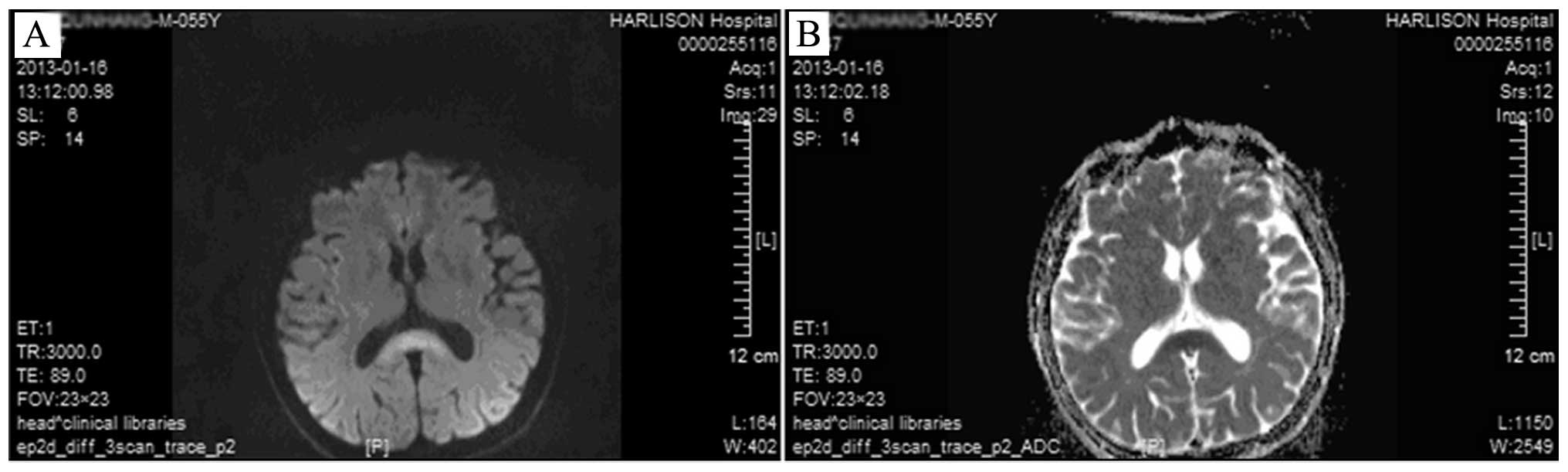
Physical examination of the patient revealed that he was lucid when conscious, but exhibited slurred speech, apathy, cognitive impairment and poor calculation and memory. The bilateral pupils of the patient were round and equal, his light reflex and eyeball motion were normal, and the patient did not exhibit nystagmus. His bilateral frontalis and nasolabial groove were approximately symmetrical, and his tongue was in the center. The muscle strength of the patient’s extremities was grade 5, with normal muscle tone. The patient had no sensory disturbance, and his physiological reflexes were present without pathological reflex. The finger-to-nose and fast alternating movement tests showed the patient to be slightly clumsy, and MRI showed symmetric abnormal signals in the splenium of the corpus callosum (Fig. 1). Blood lipid tests revealed a total cholesterol level of 6.29 mmol/l and a low-density lipoprotein level of 3.96 mmol/l. Routine blood, urine, liver and kidney function and blood coagulation tests showed no obvious abnormalities, and no abnormalities were found with thoracic and abdominal computed tomography. The diagnosis was MBD. The patient was told to consume a diet rich in vitamins to improve the brain blood and oxygen supply, and was prescribed vitamins B1 and B6, methylcobalamin, and folic acid treatments. Two weeks after admission, the slow responses and delusions of the patient had improved markedly. Following discharge, the patient was followed-up for two months. He could walk freely and live on his own.

Figure 1

Magnetic resonance imaging showed symmetric abnormal signals in the splenium of the corpus callosum. (A) Diffusion-weighted imaging sequences showed a high signal in the splenium of the corpus callosum. (B) Apparent diffusion coefficient sequences showed a low signal in the splenium of the corpus callosum.

Discussion

To date, the etiology of MBD is incompletely understood, as it is one of the rare complications of chronic alcoholism (1–2). It is believed that MBD may be closely associated with chronic alcoholism and/or malnutrition caused by long-term alcohol abuse; however, MBD can also occur in patients who have no history of alcohol abuse (9–11). The main hypothesis for MBD pathogenesis is that the condition may be associated with malnutrition or vitamin B deficiency (9), although it is believed that MBD may have other etiologies. There are reports on MBD caused by existing cyanide, CO poisoning and sepsis, as well as sickle cell disease and Plasmodium infection (3).

The present study describes a patient who had undergone cardiac carcinoma surgery three years previously, and who had received chemotherapy three times; the last chemotherapy session was one-and-a-half years prior to admission. The etiology of the patient’s condition may have been similar to that described in a previous study, in which a metabolic disorder of the myelin in the brain of a patient with no long-term alcohol abuse, which was caused by long-term malnutrition involving protein, folic acid and particularly thiamine deficiency, led to demyelinating changes and MBD (9). The corpus callosum, which is the largest commissural fiber system within the hemisphere, has a relatively high myelin content, and may often cause the degeneration and necrosis of nerve cells in such patients. The treatment of MBD in these patients remains controversial, although it is believed that nutritional factors, such as high-dose group B vitamins and folic acid, may be beneficial.

Over the past few years, MRI findings of the callosal and cortical lesions, which are critical for the diagnosis of MBD, have been investigated (5). An improvement in the neurological disorder occurring concurrently with a change in the MRI findings following therapy should therefore enhance the understanding of the disease, which may be beneficial for the definitive diagnosis and monitoring of MBD in patients with no long-term alcohol abuse. Specific MRI changes have been approved as the main basis for the diagnosis of the condition, including a slightly low or hypointense signal on the T1WI, and a hyperintense signal on the T2WI, fluid-attenuated inversion recovery and diffusion-weighted imaging sequences. The MR images of the patient in the present case were consistent with those expected for MBD (Fig. 1A and B).

For the patient in the present report, a number of diseases and conditions had to be excluded prior to a diagnosis of MBD being reached. The first condition was paraneoplastic syndrome (PNS), which is characterized by symptoms including cerebellar degeneration and limbic encephalitis. Patients with PNS also exhibit cerebrospinal fluid (CSF) pleocytosis and elevated protein and immunoglobulin G levels. The routine CSF and biochemical tests of the present patient were normal, and the brain MRI results were not consistent with PNS. Furthermore, the condition of the patient improved following vitamin treatment; none of these observations supported a diagnosis of PNS. Secondly, multiple sclerosis (MS) had to be excluded. MS lesions are relatively small, and the condition predominantly manifests as multiple lesions of the periventricular white matter. The lesions rarely develop initially or appear only in the corpus callosum. In the majority of cases of MS, the condition exhibits remission and relapse. In the present case, the condition of the patient, the CSF tests and the MRI findings were not in accordance with MS. A third possible condition was Wernicke’s encephalopathy (WE). In patients with WE, the bilateral thalamus and brainstem often show symmetrical lesions, and the typical MRI findings are abnormal signals in the mammillary body, aqueduct and around the third ventricle, which can be combined with MBD. The MRI of this patient revealed a solitary lesion in the corpus callosum, which was not consistent with WE. A fourth condition to be excluded was corpus callosum infarction, which is rarely seen in the clinic. The anterior and posterior cerebral arteries supply blood to the anterior and posterior corpus callosum, respectively, and most lesions are unilateral. A fifth possible condition was progressive multifocal leukoencephalopathy (PML), which is a type of progressive demyelinating disease caused by papovavirus infection. In addition to the corpus callosum, this disease involves the subcortical white matter, and the lesions show a non-symmetrical distribution. Furthermore, as time progresses, the lesions may exhibit an integration trend. PML is dangerous, progressive and has a poor prognosis, but the observations in the present case did not support a PML diagnosis. Finally, a poison-induced disease had to be excluded. Since the mechanisms underlying brain damage in poisoning diseases, such as CO, organophosphorus, lead or mercury poisoning, are different, the lesions in the cerebral white matter are different, and the MRI features, which involve the basal ganglia, brainstem, cerebellum and cortex, are not specific. Furthermore, the patient may have a clear history of poisoning.

MBD may be a reversible brain disease. Clinicians should enhance the awareness of the disease and emphasize that the disease cannot be ignored in patients without a drinking history, particularly in malnourished patients. An improvement in the neurological disorder occurring concurrently with a change in the corpus callosum degeneration following therapy should enhance the understanding of the disease, which may be beneficial for the definitive diagnosis and early treatment of MBD.

References

1 

Suzuki Y, Oishi M, Ogawa K and Kamei S: A patient with Marchiafava-Bigami disease as a complication of diabetes mellitus treated effectively with corticosteroid. J Clin Neurosci. 19:761–762. 2012. View Article : Google Scholar : PubMed/NCBI

2 

Tung CS, Wu SL, Tsou JC, Hsu SP, Kuo HC and Tsui HW: Marchiafava-Bignami disease with widespread lesions and complete recovery. AJNR Am J Neuroradiol. 31:1506–1507. 2010. View Article : Google Scholar

3 

Boutboul D, Lidove O, Aguilar C, Klein I and Papo T: Marchiafava-Bignami disease complicating SC hemoglobin disease and Plasmodium falciparum infection. Presse Med. 39:990–993. 2010. View Article : Google Scholar : PubMed/NCBI

4 

Tuntiyatorn L and Laothamatas J: Acute Marchiafava-Bignami disease with callosal, cortical and white matter involvement. Emerg Radiol. 15:137–140. 2008. View Article : Google Scholar

5 

Wenz H, Eisele P, Artemis D, Förster A and Brockmann MA: Acute Marchiafava-Bignami disease with extensive diffusion restriction and early recovery: case report and review of the literature. J Neuroimaging. 24:421–424. 2012. View Article : Google Scholar : PubMed/NCBI

6 

Namekawa M, Nakamura Y and Nakano I: Cortical involvement in Marchiafava-Bignami disease can be a predictor of a poor prognosis: a case report and review of the literature. Intern Med. 52:811–813. 2013. View Article : Google Scholar : PubMed/NCBI

7 

Kinno R, Yamamoto M, Yamazaki T, Owan Y, Fukui T and Kinugasa E: Cerebral microhemorrhage in Marchiafava-Bignami disease detected by susceptibility-weighted imaging. Neurol Sci. 34:545–548. 2013. View Article : Google Scholar

8 

Yoshizaki T, Hashimoto T, Fujimoto K and Oguchi K: Evolution of callosal and cortical lesions on MRI in Marchiafava-Bignami disease. Case Rep Neurol. 2:19–23. 2010. View Article : Google Scholar : PubMed/NCBI

9 

Carrilho PE, Santos MB, Piasecki L and Jorge AC: Marchiafava-Bignami disease: a rare entity with a poor outcome. Rev Bras Ter Intensiva. 25:68–72. 2013. View Article : Google Scholar : PubMed/NCBI

10 

Celik Y, Temizoz O, Genchellac H, Cakir B and Asil T: A non-alcoholic patient with acute Marchiafava-Bignami disease associated with gynecologic malignancy: paraneoplastic Marchiafava-Bignami disease? Clin Neurol Neurosurg. 109:505–508. 2007. View Article : Google Scholar : PubMed/NCBI

11 

Rusche-Skolarus LE, Lucey BP, Vo KD and Snider BJ: Transient encephalopathy in a postoperative non-alcoholic female with Marchiafava-Bignami disease. Clin Neurol Neurosurg. 109:713–715. 2007. View Article : Google Scholar : PubMed/NCBI

12 

Hoshino Y, Ueno Y, Shimura H, Miyamoto N, Watanabe M, Hattori N and Urabe T: Marchiafava-Bignami disease mimics motor neuron disease: case report. BMC Neurol. 13:2082013. View Article : Google Scholar : PubMed/NCBI

Related Articles

  • Abstract
  • View
  • Download
  • Twitter
Copy and paste a formatted citation
Spandidos Publications style
Cui Y, Zheng L, Wang X, Zhang W, Yuan D and Wei Y: Marchiafava-Bignami disease with rare etiology: A case report. Exp Ther Med 9: 1515-1517, 2015.
APA
Cui, Y., Zheng, L., Wang, X., Zhang, W., Yuan, D., & Wei, Y. (2015). Marchiafava-Bignami disease with rare etiology: A case report. Experimental and Therapeutic Medicine, 9, 1515-1517. https://doi.org/10.3892/etm.2015.2263
MLA
Cui, Y., Zheng, L., Wang, X., Zhang, W., Yuan, D., Wei, Y."Marchiafava-Bignami disease with rare etiology: A case report". Experimental and Therapeutic Medicine 9.4 (2015): 1515-1517.
Chicago
Cui, Y., Zheng, L., Wang, X., Zhang, W., Yuan, D., Wei, Y."Marchiafava-Bignami disease with rare etiology: A case report". Experimental and Therapeutic Medicine 9, no. 4 (2015): 1515-1517. https://doi.org/10.3892/etm.2015.2263
Copy and paste a formatted citation
x
Spandidos Publications style
Cui Y, Zheng L, Wang X, Zhang W, Yuan D and Wei Y: Marchiafava-Bignami disease with rare etiology: A case report. Exp Ther Med 9: 1515-1517, 2015.
APA
Cui, Y., Zheng, L., Wang, X., Zhang, W., Yuan, D., & Wei, Y. (2015). Marchiafava-Bignami disease with rare etiology: A case report. Experimental and Therapeutic Medicine, 9, 1515-1517. https://doi.org/10.3892/etm.2015.2263
MLA
Cui, Y., Zheng, L., Wang, X., Zhang, W., Yuan, D., Wei, Y."Marchiafava-Bignami disease with rare etiology: A case report". Experimental and Therapeutic Medicine 9.4 (2015): 1515-1517.
Chicago
Cui, Y., Zheng, L., Wang, X., Zhang, W., Yuan, D., Wei, Y."Marchiafava-Bignami disease with rare etiology: A case report". Experimental and Therapeutic Medicine 9, no. 4 (2015): 1515-1517. https://doi.org/10.3892/etm.2015.2263
Follow us
  • Twitter
  • LinkedIn
  • Facebook
About
  • Spandidos Publications
  • Careers
  • Cookie Policy
  • Privacy Policy
How can we help?
  • Help
  • Live Chat
  • Contact
  • Email to our Support Team