Spandidos Publications Logo
  • About
    • About Spandidos
    • Aims and Scopes
    • Abstracting and Indexing
    • Editorial Policies
    • Reprints and Permissions
    • Job Opportunities
    • Terms and Conditions
    • Contact
  • Journals
    • All Journals
    • Oncology Letters
      • Oncology Letters
      • Information for Authors
      • Editorial Policies
      • Editorial Board
      • Aims and Scope
      • Abstracting and Indexing
      • Bibliographic Information
      • Archive
    • International Journal of Oncology
      • International Journal of Oncology
      • Information for Authors
      • Editorial Policies
      • Editorial Board
      • Aims and Scope
      • Abstracting and Indexing
      • Bibliographic Information
      • Archive
    • Molecular and Clinical Oncology
      • Molecular and Clinical Oncology
      • Information for Authors
      • Editorial Policies
      • Editorial Board
      • Aims and Scope
      • Abstracting and Indexing
      • Bibliographic Information
      • Archive
    • Experimental and Therapeutic Medicine
      • Experimental and Therapeutic Medicine
      • Information for Authors
      • Editorial Policies
      • Editorial Board
      • Aims and Scope
      • Abstracting and Indexing
      • Bibliographic Information
      • Archive
    • International Journal of Molecular Medicine
      • International Journal of Molecular Medicine
      • Information for Authors
      • Editorial Policies
      • Editorial Board
      • Aims and Scope
      • Abstracting and Indexing
      • Bibliographic Information
      • Archive
    • Biomedical Reports
      • Biomedical Reports
      • Information for Authors
      • Editorial Policies
      • Editorial Board
      • Aims and Scope
      • Abstracting and Indexing
      • Bibliographic Information
      • Archive
    • Oncology Reports
      • Oncology Reports
      • Information for Authors
      • Editorial Policies
      • Editorial Board
      • Aims and Scope
      • Abstracting and Indexing
      • Bibliographic Information
      • Archive
    • Molecular Medicine Reports
      • Molecular Medicine Reports
      • Information for Authors
      • Editorial Policies
      • Editorial Board
      • Aims and Scope
      • Abstracting and Indexing
      • Bibliographic Information
      • Archive
    • World Academy of Sciences Journal
      • World Academy of Sciences Journal
      • Information for Authors
      • Editorial Policies
      • Editorial Board
      • Aims and Scope
      • Abstracting and Indexing
      • Bibliographic Information
      • Archive
    • International Journal of Functional Nutrition
      • International Journal of Functional Nutrition
      • Information for Authors
      • Editorial Policies
      • Editorial Board
      • Aims and Scope
      • Abstracting and Indexing
      • Bibliographic Information
      • Archive
    • International Journal of Epigenetics
      • International Journal of Epigenetics
      • Information for Authors
      • Editorial Policies
      • Editorial Board
      • Aims and Scope
      • Abstracting and Indexing
      • Bibliographic Information
      • Archive
    • Medicine International
      • Medicine International
      • Information for Authors
      • Editorial Policies
      • Editorial Board
      • Aims and Scope
      • Abstracting and Indexing
      • Bibliographic Information
      • Archive
  • Articles
  • Information
    • Information for Authors
    • Information for Reviewers
    • Information for Librarians
    • Information for Advertisers
    • Conferences
  • Language Editing
Spandidos Publications Logo
  • About
    • About Spandidos
    • Aims and Scopes
    • Abstracting and Indexing
    • Editorial Policies
    • Reprints and Permissions
    • Job Opportunities
    • Terms and Conditions
    • Contact
  • Journals
    • All Journals
    • Biomedical Reports
      • Information for Authors
      • Editorial Policies
      • Editorial Board
      • Aims and Scope
      • Abstracting and Indexing
      • Bibliographic Information
      • Archive
    • Experimental and Therapeutic Medicine
      • Information for Authors
      • Editorial Policies
      • Editorial Board
      • Aims and Scope
      • Abstracting and Indexing
      • Bibliographic Information
      • Archive
    • International Journal of Epigenetics
      • Information for Authors
      • Editorial Policies
      • Editorial Board
      • Aims and Scope
      • Abstracting and Indexing
      • Bibliographic Information
      • Archive
    • International Journal of Functional Nutrition
      • Information for Authors
      • Editorial Policies
      • Editorial Board
      • Aims and Scope
      • Abstracting and Indexing
      • Bibliographic Information
      • Archive
    • International Journal of Molecular Medicine
      • Information for Authors
      • Editorial Policies
      • Editorial Board
      • Aims and Scope
      • Abstracting and Indexing
      • Bibliographic Information
      • Archive
    • International Journal of Oncology
      • Information for Authors
      • Editorial Policies
      • Editorial Board
      • Aims and Scope
      • Abstracting and Indexing
      • Bibliographic Information
      • Archive
    • Medicine International
      • Information for Authors
      • Editorial Policies
      • Editorial Board
      • Aims and Scope
      • Abstracting and Indexing
      • Bibliographic Information
      • Archive
    • Molecular and Clinical Oncology
      • Information for Authors
      • Editorial Policies
      • Editorial Board
      • Aims and Scope
      • Abstracting and Indexing
      • Bibliographic Information
      • Archive
    • Molecular Medicine Reports
      • Information for Authors
      • Editorial Policies
      • Editorial Board
      • Aims and Scope
      • Abstracting and Indexing
      • Bibliographic Information
      • Archive
    • Oncology Letters
      • Information for Authors
      • Editorial Policies
      • Editorial Board
      • Aims and Scope
      • Abstracting and Indexing
      • Bibliographic Information
      • Archive
    • Oncology Reports
      • Information for Authors
      • Editorial Policies
      • Editorial Board
      • Aims and Scope
      • Abstracting and Indexing
      • Bibliographic Information
      • Archive
    • World Academy of Sciences Journal
      • Information for Authors
      • Editorial Policies
      • Editorial Board
      • Aims and Scope
      • Abstracting and Indexing
      • Bibliographic Information
      • Archive
  • Articles
  • Information
    • For Authors
    • For Reviewers
    • For Librarians
    • For Advertisers
    • Conferences
  • Language Editing
Login Register Submit
  • This site uses cookies
  • You can change your cookie settings at any time by following the instructions in our Cookie Policy. To find out more, you may read our Privacy Policy.

    I agree
Search articles by DOI, keyword, author or affiliation
Search
Advanced Search
presentation
Experimental and Therapeutic Medicine
Join Editorial Board Propose a Special Issue
Print ISSN: 1792-0981 Online ISSN: 1792-1015
Journal Cover
October-2015 Volume 10 Issue 4

Full Size Image

Sign up for eToc alerts
Recommend to Library

Journals

International Journal of Molecular Medicine

International Journal of Molecular Medicine

International Journal of Molecular Medicine is an international journal devoted to molecular mechanisms of human disease.

International Journal of Oncology

International Journal of Oncology

International Journal of Oncology is an international journal devoted to oncology research and cancer treatment.

Molecular Medicine Reports

Molecular Medicine Reports

Covers molecular medicine topics such as pharmacology, pathology, genetics, neuroscience, infectious diseases, molecular cardiology, and molecular surgery.

Oncology Reports

Oncology Reports

Oncology Reports is an international journal devoted to fundamental and applied research in Oncology.

Experimental and Therapeutic Medicine

Experimental and Therapeutic Medicine

Experimental and Therapeutic Medicine is an international journal devoted to laboratory and clinical medicine.

Oncology Letters

Oncology Letters

Oncology Letters is an international journal devoted to Experimental and Clinical Oncology.

Biomedical Reports

Biomedical Reports

Explores a wide range of biological and medical fields, including pharmacology, genetics, microbiology, neuroscience, and molecular cardiology.

Molecular and Clinical Oncology

Molecular and Clinical Oncology

International journal addressing all aspects of oncology research, from tumorigenesis and oncogenes to chemotherapy and metastasis.

World Academy of Sciences Journal

World Academy of Sciences Journal

Multidisciplinary open-access journal spanning biochemistry, genetics, neuroscience, environmental health, and synthetic biology.

International Journal of Functional Nutrition

International Journal of Functional Nutrition

Open-access journal combining biochemistry, pharmacology, immunology, and genetics to advance health through functional nutrition.

International Journal of Epigenetics

International Journal of Epigenetics

Publishes open-access research on using epigenetics to advance understanding and treatment of human disease.

Medicine International

Medicine International

An International Open Access Journal Devoted to General Medicine.

Journal Cover
October-2015 Volume 10 Issue 4

Full Size Image

Sign up for eToc alerts
Recommend to Library

  • Article
  • Citations
    • Cite This Article
    • Download Citation
    • Create Citation Alert
    • Remove Citation Alert
    • Cited By
  • Similar Articles
    • Related Articles (in Spandidos Publications)
    • Similar Articles (Google Scholar)
    • Similar Articles (PubMed)
  • Download PDF
  • Download XML
  • View XML
Case Report

Extra-articular tenosynovial chondromatosis of the left ring finger in a 23-year-old man: A case report and literature review

  • Authors:
    • Yu‑Xian Chen
    • Yun‑Xiang Lu
    • Ze Zhuang
    • Zhi‑Yong Li
  • View Affiliations / Copyright

    Affiliations: Department of Joint Surgery and Orthopedic Trauma, The Third Affiliated Hospital, Sun Yat‑Sen University, Guangzhou, Guangdong 510630, P.R. China
  • Pages: 1581-1583
    |
    Published online on: August 18, 2015
       https://doi.org/10.3892/etm.2015.2687
  • Expand metrics +
Metrics: Total Views: 0 (Spandidos Publications: | PMC Statistics: )
Metrics: Total PDF Downloads: 0 (Spandidos Publications: | PMC Statistics: )
Cited By (CrossRef): 0 citations Loading Articles...

This article is mentioned in:


Abstract

Tenosynovial chondromatosis is an extra-articular version of articular synovial chondromatosis and a relatively rare condition that can affect the tendon sheath, bursa, or joint synovial tissue. Tenosynovial chondromatosis is rarely reported in the literature and is often misdiagnosed. In the present study, a case of extra‑articular tenosynovial chondromatosis of the left ring finger in a 23‑year‑old man is reported. Three different‑sized nodules were identified upon surgery and all were removed via synovectomy. The patient was symptom free 6 months postoperatively, and there were no signs of recurrence after 1.5 years of follow-up. The literature describing tenosynovial chondromatosis in the fingers is also reviewed.

Introduction

Primary synovial chondromatosis is a rare, benign, proliferative cartilaginous lesion that can arise from the tendon sheath, bursa or joint synovial tissue (1,2). Tenosynovial chondromatosis is an extra-articular version of articular synovial chondromatosis, and it is most commonly observed in the fingers and feet. Tenosynovial chondromatosis has rarely been reported in the publicly available literature and is often erroneously classified as a cartilage or soft tissue tumor. In addition, numerous patients with tenosynovial chondromatosis are asymptomatic, and the histological diagnosis can be challenging (3). The present study describes a case of tenosynovial chondromatosis in the finger tendon sheath of a 23-year-old male patient. The literature associated with tenosynovial chondromatosis affecting the fingers is also reviewed.

Case report

A 23-year-old male patient was admitted to the Third Affiliated Hospital of Sun Yat-Sen University (Guangzhou, China) with a history of pain and progressive swelling at the proximal interphalangeal joint of the left ring finger for the past 2 years. The symptoms and decreased range of motion of the metacarpophalangeal joint were greatly affecting the patient's daily life in the weeks leading up to his admission. The patient recalled no history of trauma or overuse of the left hand. A physical examination of the finger revealed an ~3×2 cm irregular mass at the volar aspect of the ring finger. The mass had a hard texture, clear boundary and mild tenderness with pressure. The left ring finger metacarpophalangeal joint had a decreased range of motion of 60°. Blood biochemistry for the patient was unremarkable. Preoperative ultrasonography of the left ring finger revealed multiple nodules with well-defined boundaries in the tendon sheath. Since chondromatosis rarely occurs extra-articularly, the nodules were initially and preliminarily diagnosed as a chondroma of the soft tissue parts.

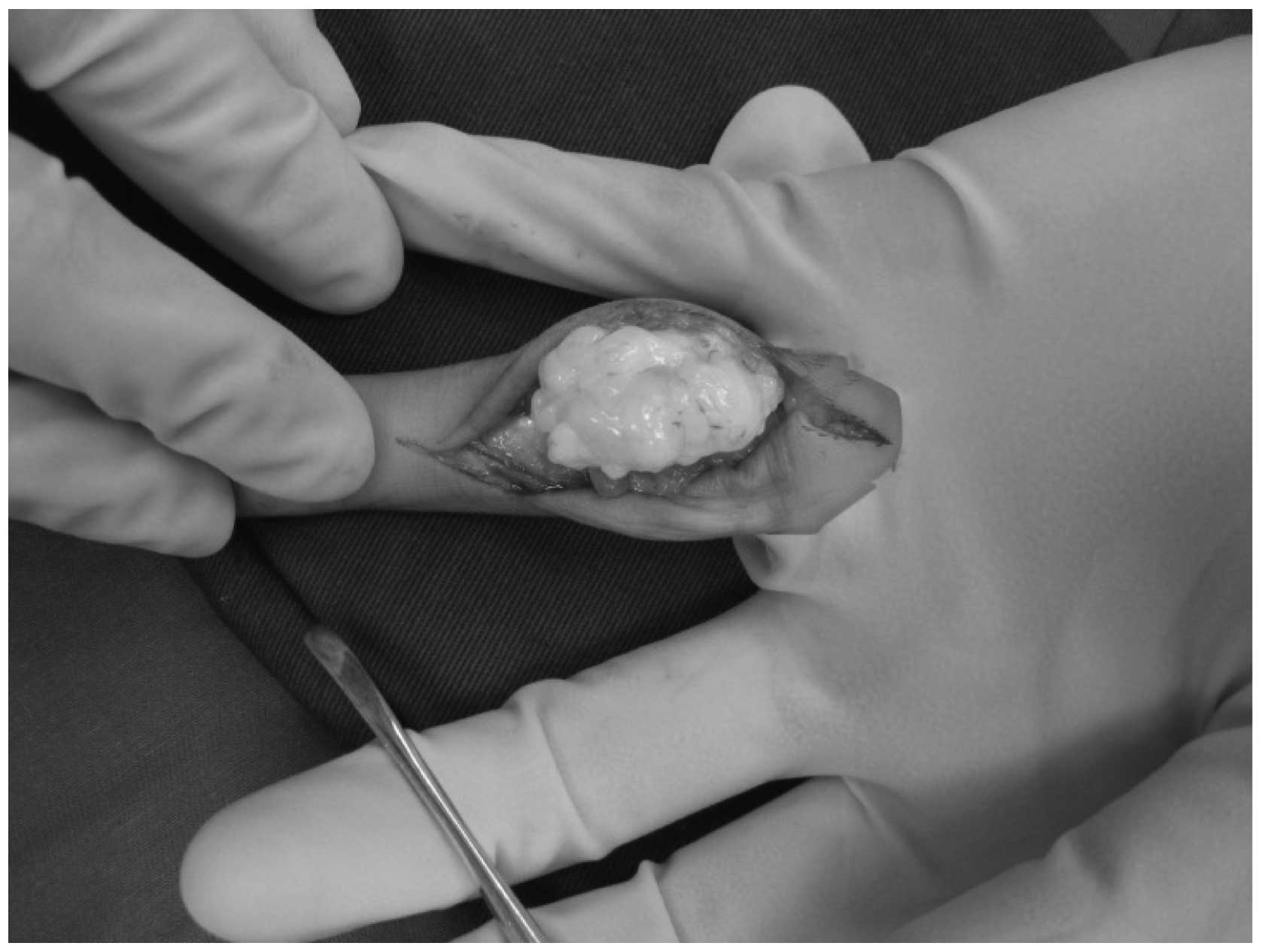
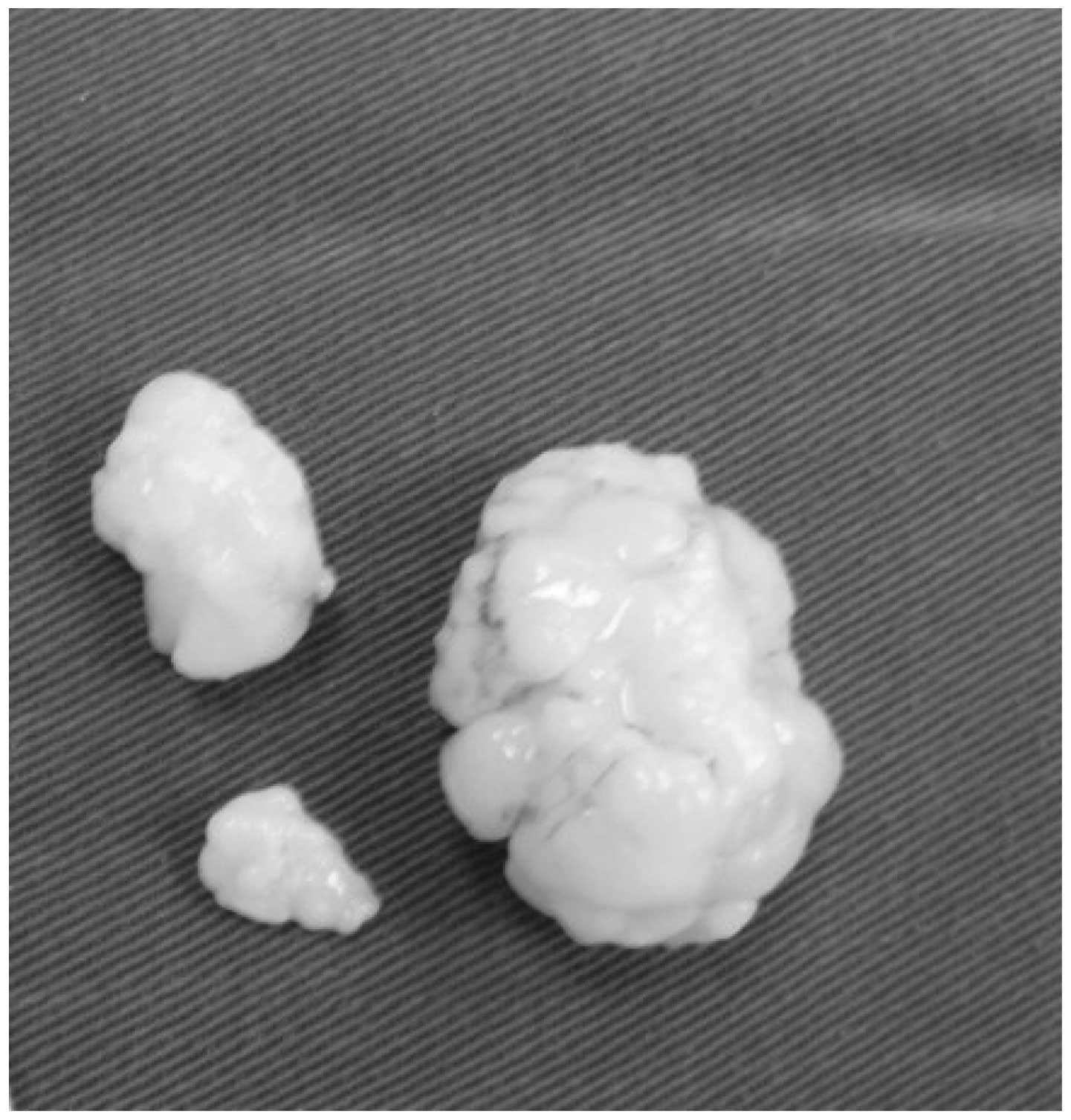
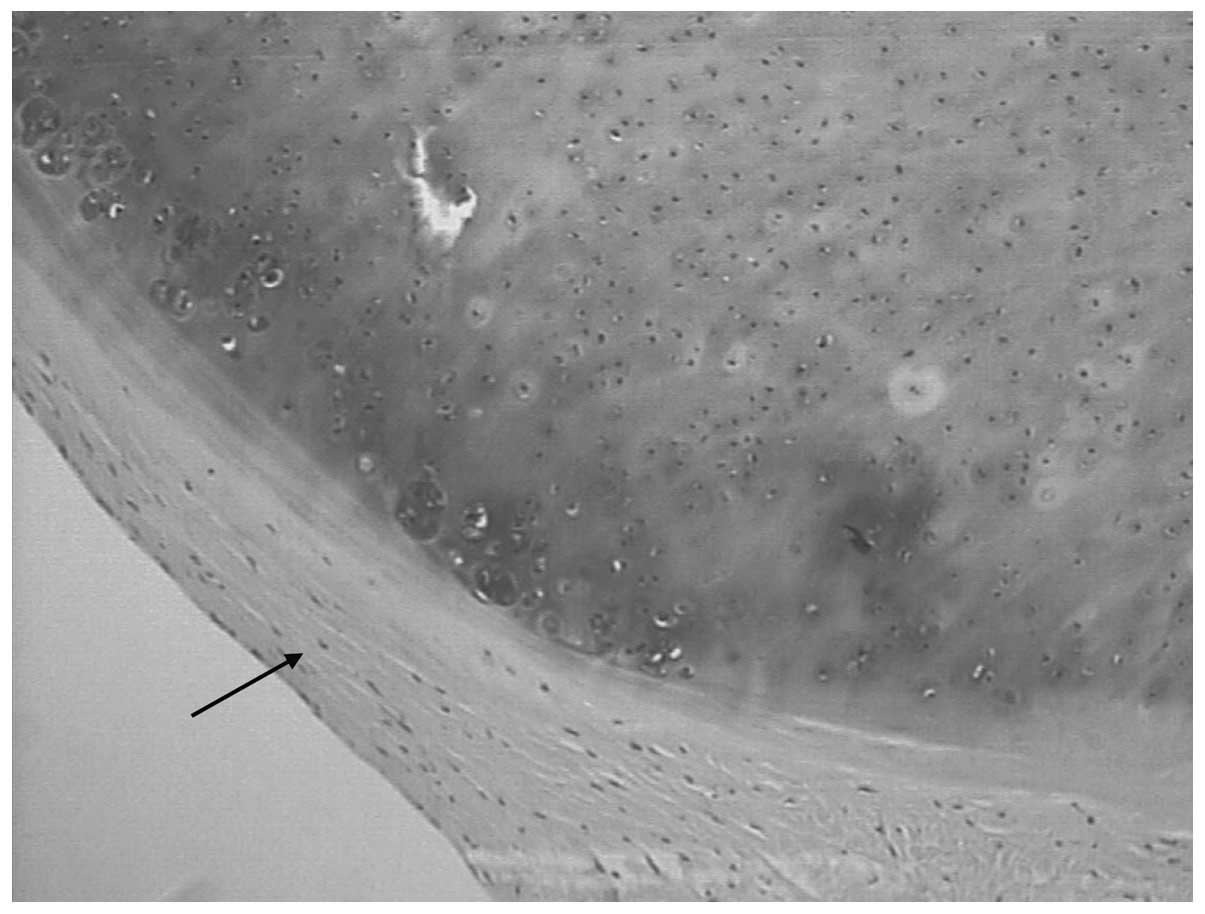
Surgical resection of the nodules was performed. Under brachial plexus anesthesia, a ‘Z’-shaped incision was made at the volar aspect of the left ring finger proximal phalanx to expose the subcutaneous tumor. Three different-sized nodules were excised (2.0×1.5, 1.2×0.6 and 0.7×0.3 cm) during surgery. The nodules were encapsulated loose white bodies in the flexor tendon sheath, with a hard texture and smooth surface (Figs. 1 and 2). Histopathological examination of the nodules revealed increased chondrocyte cellularity and a fibrous capsule, consistent with a diagnosis of tenosynovial chondromatosis (Fig. 3). The patient was symptom free 6 months postoperatively. At a follow-up 1 year after that, there were no signs of recurrence.

Figure 1.

Intraoperative view of the white cartilage-like loose nodule resulting from tenosynovial chondromatosis in the left ring finger.

Figure 2.

Three white cartilage-like loose bodies were removed from the left ring finger.

Figure 3.

Histopathologic examination of tenosynovial chondromatosis revealed chondrocyte proliferation. Hematoxylin and eosin staining showed that the nodule was covered by a fibrous capsule (black arrow; magnification: x100).

Discussion

Synovial chondromatosis is a rare condition characterized by the formation of multiple cartilaginous nodules in the synovial membrane. Synovial cells are similar to mesenchymal stem cells and are capable of giving rise to cartilage or bone tissue under specific conditions (4). Synovial chondromatosis can involve the joints (articular synovial chondromatosis) and the tendon sheath (tenosynovial chondromatosis). While both intra-articular and extra-articular synovial chondromatosis are histologically very similar, they are distinct entities with regard to surgical strategies and recurrence rate (5).

Various names have been given to the nodules found in the tendon sheath, including synovial chondromatosis, synovial cartilage metaplasia, tenosynovial osteochondroma, cartilage and soft tissue benign tumors, and soft tissue tumors. A previous study proposed that all these diagnoses were essentially tenosynovial chondromatosis (6). The proper diagnosis of tenosynovial chondromatosis is clinically challenging due to its rarity, particularly when no calcification or ossification is present in the tumor (2,3). Secondary synovial chondromatosis is caused by degenerative or traumatic lesions, which lead to the formation of intra-articular cartilage.

In 1977, Milgram described synovial chondromatosis as occurring in the following three distinct phases: i) active intrasynovial disease with no free loose bodies; ii) transitional lesions with osteochondral nodules in the synovial membrane and osteochondral bodies lying free within the joint cavity; and iii) multiple free osteochondral bodies with quiescent intrasynovial disease (5,7).

Tenosynovial chondromatosis most frequently affects the hands and feet (8). A total of 26 cases of tenosynovial chondromatosis in the fingers, including the present case, have been documented in the literature (1–4,6,8,9). These cases include 14 males and 13 females, ranging from 30 to 60 years of age. The right hand (16 cases) was more frequently affected than the left hand (8 cases). In the two remaining cases, there was one incidence of bilateral disease, and 1 case where the affected hand was not specified. There have been 5 cases of tenosynovial chondromatosis in the thumb, 3 cases affecting the index finger, 9 cases affecting the middle finger, and 5 cases affecting the ring or pinky finger. The flexor tendon was involved in all of the reported cases, but the extensor tendon was never involved. Patients with tenosynovial chondromatosis usually present with no history of trauma. The two most common symptoms are painless swelling that can occur over several months to several years and mild tenderness when pressure is applied. Many patients are asymptomatic, while others develop a trigger finger deformity or carpal tunnel syndrome. Due to the atypical clinical manifestations and the slow disease process, clinical treatment for tenosynovial chondromatosis is often delayed (3,4,9).

Plain radiography of tenosynovial chondromatosis may show extra-articular soft tissue swelling with multiple small calcifications or ossifications. A large calcified body with clusters may suggest a lobular mass (3,5,7). Synovial swelling may lead to bone corrosion, though a periosteal reaction is rarely observed. In patients with a long history of tenosynovial chondromatosis, round, oval or elongated mineralizations can be seen within the tendon sheath, although the adjacent joint is usually not affected.

Computed tomography (CT) of tenosynovial chondromatosis can clearly identify the calcified nodules and their exact locations as well as cortical erosion (10). Detection of tenosynovial chondromatosis with magnetic resonance imaging (MRI) depends on the degree to which the nodules have mineralized. In the majority of cases, the nodules display a muscle-like signal intensity on T1-weighted images and exhibit high signal intensity on T2-weighted images (11). In the present case, preoperative ultrasonography revealed multiple nodules with well-defined boundaries in the tendon sheath. Thus, ultrasonography represents a convenient and cost-effective alternative to CT or MRI for the detection of tenosynovial chondromatosis.

Gross examination of the excised tumor often shows multiple, white, transparent, lobular cartilage nodules, which are easily isolated from the synovial tendon sheath. There can be thousands of nodules of various shapes, ranging in size from a few millimeters to several centimeters, located in the synovial membrane or synovial tendon sheath. In the majority of cases of tenosynovial chondromatosis, closely packed smaller cartilage nodules in the tendon sheath merge into larger nodules (1,5,6). Histopathologic examination may show hyaline cartilage nodules surrounded by synovial membrane. Chondrocytes show mild or moderate atypia. Certain cases show a mucinous change, calcification or ossification, with nodules surrounded by giant cells. As the histologic appearance of tenosynovial chondromatosis is atypical, an erroneous diagnosis of chondrosarcoma can easily be made. However, chondrosarcoma rarely occurs in the hands or feet, a fact that can aid in the differential diagnosis (1,3,5).

Tenosynovial chondromatosis should be differentiated from several other lesions that give rise to bone cartilage formation. Soft tissue tumors should be considered first, as they occur more frequently than synovial chondromatosis and have a much lower recurrence rate. Soft tissue tumors are usually solitary, well-encapsulated, and generally occur in a younger patient population, ranging from 10 to 39 years of age. This disease has rarely been reported to have malignant transformation (3,5,12). Chondrosarcoma should also be considered due to a small risk for malignant transformation. Evidence of aggressive behaviors through imaging, such as cortical erosion or periosteal reaction, is indicative of chondrosarcoma with malignancy. A definitive diagnosis of chondrosarcoma results from histologic findings, as chondrosarcoma predominantly originates from the bone (5). Secondary synovial chondromatosis is usually caused by osteochondral fracture or joint surface exfoliation. Periosteal chondroma mainly occurs in children and young adults and predominantly affects the proximal humerus (6). Other differential diagnoses that can be ruled out by a histologic examination include tenosynovial giant cell tumor, calcifying aponeurotic fibroma, tumoral calcinosis, hydroxy-apatite deposition disease, a foreign body, and inflammatory arthritis.

Tenosynovial chondromatosis is characterized by a slow progression that can last for decades. There are also reports that the nodules can spontaneously be resorbed (12). Malignant chondrosarcoma has been documented in 5% of 53 cases of synovial chondromatosis (13). By contrast, to the best of our knowledge, no malignant cases of tenosynovial chondromatosis have been reported. Although the association between complete synovial excision and the low relapse rate is not yet clear, most doctors recommend complete removal the loose bodies. Therefore, delicate surgical dissection around the nodules and satellite nodules and a synovectomy are necessary (3,12). In the present case, the patient underwent successful surgical removal of the loose bodies and the surrounding synovial membrane and was followed up for 1.5-years without recurrence.

The reported recurrence rates for tenosynovial chondromatosis vary considerably. In some studies with relatively small sample sizes, no recurrence or a very low recurrence rate was reported. However, one study reported a high recurrence rate of 88% in a larger cohort of 37 cases of tenosynovial chondromatosis in the hands and feet (6). The recurrence of synovial chondromatosis or tenosynovial chondromatosis can take several months to several years (4–6,9).

The literature reviewed in this study indicate that no available methods are able to apply to the total nature of synovial chondromatosis preoperatively. However, ultrasonography may represent a convenient and cost-effective alternative to CT or MRI imaging for early diagnosis. As for treatment, resection is the preferred method for synovial chondromatosis.

Acknowledgements

This study was supported by the Science and Technology Program of Guangzhou (No. 2011Y1-00033-4)

References

1 

Khadilakar MS, Patil AA, Shah NS, Deshmukh SD and Anand M: Extra-osseous tenosynovial chondromatosis of the middle finger: A case report. J Orthop Surg (Hong Kong). 20:406–408. 2012.PubMed/NCBI

2 

Gil Albarova, Morales-Andaluz J, Castiella T and Seral F: Tenosynovial chondromatosis of the third finger. Arch Orthop Trauma Surg. 120:239–240. 2000. View Article : Google Scholar : PubMed/NCBI

3 

Ueo T, Kashima K, Daa T, Kashima N, Tsuji K, Hisaoka M and Yokoyama S: A case of tenosynovial chondromatosis with tophus-like deposits. APMIS. 112:624–628. 2004. View Article : Google Scholar : PubMed/NCBI

4 

Chan WL, Hung LK, Griffith JF, Louis TC and Ho PC: Tenosynovial osteochondromatosis of both flexor and extensor tendons. Hand Surg. 9:89–95. 2004. View Article : Google Scholar : PubMed/NCBI

5 

Milgram JW: Synovial osteochondromatosis: A histopathological study of thirty cases. J Bone Joint Surg Am. 59:792–801. 1977.PubMed/NCBI

6 

Fetsch JF, Vinh TN, Remotti F, Walker EA, Murphey MD and Sweet DE: Tenosynovial (extraarticular) chondromatosis: An analysis of 37 cases of an underrecognized clinicopathologic entity with a strong predilection for the hands and feet and a high local recurrence rate. Am J Surg Pathol. 27:1260–1268. 2003. View Article : Google Scholar : PubMed/NCBI

7 

Cebesoy O, Isik M, Subasi M, Karsli B and Pamukcu U: Extra-articular tenosynovial chondromatosis mimicking a neoplastic disease in the first web space of the hand. Oman Med J. 27:316–318. 2012. View Article : Google Scholar : PubMed/NCBI

8 

De Benedetti MJ and Schwinn CP: Tenosynovial chondromatosis in the hand. J Bone Joint Surg Am. 61:898–903. 1979.PubMed/NCBI

9 

Bui Mansfield, Rohini D and Bagg M: Tenosynovial chondromatosis of the ring finger. AJR Am J Roentgenol. 184:1223–1224. 2005. View Article : Google Scholar : PubMed/NCBI

10 

Ho YY and Choueka J: Synovial chondromatosis of the upper extremity. J Hand Surg Am. 38:804–810. 2013. View Article : Google Scholar : PubMed/NCBI

11 

Murphey MD, Vidal JA, Fanburg-Smith JC and Gajewski DA: Imaging of synovial chondromatosis with radiologic-pathologic correlation. Radiographics. 27:1465–1488. 2007. View Article : Google Scholar : PubMed/NCBI

12 

Christoforou D, Strauss EJ, Abramovici L and Posner MA: Benign extraosseous cartilage tumours of the hand and wrist. J Hand Surg Eur Vol. 37:8–13. 2012. View Article : Google Scholar : PubMed/NCBI

13 

Apte SS and Athanasou NA: An immunohistological study of cartilage and synovium in primary synovial chondromatosis. J Pathol. 166:277–281. 1992. View Article : Google Scholar : PubMed/NCBI

Related Articles

  • Abstract
  • View
  • Download
  • Twitter
Copy and paste a formatted citation
Spandidos Publications style
Chen YX, Lu YX, Zhuang Z and Li ZY: Extra-articular tenosynovial chondromatosis of the left ring finger in a 23-year-old man: A case report and literature review. Exp Ther Med 10: 1581-1583, 2015.
APA
Chen, Y., Lu, Y., Zhuang, Z., & Li, Z. (2015). Extra-articular tenosynovial chondromatosis of the left ring finger in a 23-year-old man: A case report and literature review. Experimental and Therapeutic Medicine, 10, 1581-1583. https://doi.org/10.3892/etm.2015.2687
MLA
Chen, Y., Lu, Y., Zhuang, Z., Li, Z."Extra-articular tenosynovial chondromatosis of the left ring finger in a 23-year-old man: A case report and literature review". Experimental and Therapeutic Medicine 10.4 (2015): 1581-1583.
Chicago
Chen, Y., Lu, Y., Zhuang, Z., Li, Z."Extra-articular tenosynovial chondromatosis of the left ring finger in a 23-year-old man: A case report and literature review". Experimental and Therapeutic Medicine 10, no. 4 (2015): 1581-1583. https://doi.org/10.3892/etm.2015.2687
Copy and paste a formatted citation
x
Spandidos Publications style
Chen YX, Lu YX, Zhuang Z and Li ZY: Extra-articular tenosynovial chondromatosis of the left ring finger in a 23-year-old man: A case report and literature review. Exp Ther Med 10: 1581-1583, 2015.
APA
Chen, Y., Lu, Y., Zhuang, Z., & Li, Z. (2015). Extra-articular tenosynovial chondromatosis of the left ring finger in a 23-year-old man: A case report and literature review. Experimental and Therapeutic Medicine, 10, 1581-1583. https://doi.org/10.3892/etm.2015.2687
MLA
Chen, Y., Lu, Y., Zhuang, Z., Li, Z."Extra-articular tenosynovial chondromatosis of the left ring finger in a 23-year-old man: A case report and literature review". Experimental and Therapeutic Medicine 10.4 (2015): 1581-1583.
Chicago
Chen, Y., Lu, Y., Zhuang, Z., Li, Z."Extra-articular tenosynovial chondromatosis of the left ring finger in a 23-year-old man: A case report and literature review". Experimental and Therapeutic Medicine 10, no. 4 (2015): 1581-1583. https://doi.org/10.3892/etm.2015.2687
Follow us
  • Twitter
  • LinkedIn
  • Facebook
About
  • Spandidos Publications
  • Careers
  • Cookie Policy
  • Privacy Policy
How can we help?
  • Help
  • Live Chat
  • Contact
  • Email to our Support Team