Spandidos Publications Logo
  • About
    • About Spandidos
    • Aims and Scopes
    • Abstracting and Indexing
    • Editorial Policies
    • Reprints and Permissions
    • Job Opportunities
    • Terms and Conditions
    • Contact
  • Journals
    • All Journals
    • Oncology Letters
      • Oncology Letters
      • Information for Authors
      • Editorial Policies
      • Editorial Board
      • Aims and Scope
      • Abstracting and Indexing
      • Bibliographic Information
      • Archive
    • International Journal of Oncology
      • International Journal of Oncology
      • Information for Authors
      • Editorial Policies
      • Editorial Board
      • Aims and Scope
      • Abstracting and Indexing
      • Bibliographic Information
      • Archive
    • Molecular and Clinical Oncology
      • Molecular and Clinical Oncology
      • Information for Authors
      • Editorial Policies
      • Editorial Board
      • Aims and Scope
      • Abstracting and Indexing
      • Bibliographic Information
      • Archive
    • Experimental and Therapeutic Medicine
      • Experimental and Therapeutic Medicine
      • Information for Authors
      • Editorial Policies
      • Editorial Board
      • Aims and Scope
      • Abstracting and Indexing
      • Bibliographic Information
      • Archive
    • International Journal of Molecular Medicine
      • International Journal of Molecular Medicine
      • Information for Authors
      • Editorial Policies
      • Editorial Board
      • Aims and Scope
      • Abstracting and Indexing
      • Bibliographic Information
      • Archive
    • Biomedical Reports
      • Biomedical Reports
      • Information for Authors
      • Editorial Policies
      • Editorial Board
      • Aims and Scope
      • Abstracting and Indexing
      • Bibliographic Information
      • Archive
    • Oncology Reports
      • Oncology Reports
      • Information for Authors
      • Editorial Policies
      • Editorial Board
      • Aims and Scope
      • Abstracting and Indexing
      • Bibliographic Information
      • Archive
    • Molecular Medicine Reports
      • Molecular Medicine Reports
      • Information for Authors
      • Editorial Policies
      • Editorial Board
      • Aims and Scope
      • Abstracting and Indexing
      • Bibliographic Information
      • Archive
    • World Academy of Sciences Journal
      • World Academy of Sciences Journal
      • Information for Authors
      • Editorial Policies
      • Editorial Board
      • Aims and Scope
      • Abstracting and Indexing
      • Bibliographic Information
      • Archive
    • International Journal of Functional Nutrition
      • International Journal of Functional Nutrition
      • Information for Authors
      • Editorial Policies
      • Editorial Board
      • Aims and Scope
      • Abstracting and Indexing
      • Bibliographic Information
      • Archive
    • International Journal of Epigenetics
      • International Journal of Epigenetics
      • Information for Authors
      • Editorial Policies
      • Editorial Board
      • Aims and Scope
      • Abstracting and Indexing
      • Bibliographic Information
      • Archive
    • Medicine International
      • Medicine International
      • Information for Authors
      • Editorial Policies
      • Editorial Board
      • Aims and Scope
      • Abstracting and Indexing
      • Bibliographic Information
      • Archive
  • Articles
  • Information
    • Information for Authors
    • Information for Reviewers
    • Information for Librarians
    • Information for Advertisers
    • Conferences
  • Language Editing
Spandidos Publications Logo
  • About
    • About Spandidos
    • Aims and Scopes
    • Abstracting and Indexing
    • Editorial Policies
    • Reprints and Permissions
    • Job Opportunities
    • Terms and Conditions
    • Contact
  • Journals
    • All Journals
    • Biomedical Reports
      • Information for Authors
      • Editorial Policies
      • Editorial Board
      • Aims and Scope
      • Abstracting and Indexing
      • Bibliographic Information
      • Archive
    • Experimental and Therapeutic Medicine
      • Information for Authors
      • Editorial Policies
      • Editorial Board
      • Aims and Scope
      • Abstracting and Indexing
      • Bibliographic Information
      • Archive
    • International Journal of Epigenetics
      • Information for Authors
      • Editorial Policies
      • Editorial Board
      • Aims and Scope
      • Abstracting and Indexing
      • Bibliographic Information
      • Archive
    • International Journal of Functional Nutrition
      • Information for Authors
      • Editorial Policies
      • Editorial Board
      • Aims and Scope
      • Abstracting and Indexing
      • Bibliographic Information
      • Archive
    • International Journal of Molecular Medicine
      • Information for Authors
      • Editorial Policies
      • Editorial Board
      • Aims and Scope
      • Abstracting and Indexing
      • Bibliographic Information
      • Archive
    • International Journal of Oncology
      • Information for Authors
      • Editorial Policies
      • Editorial Board
      • Aims and Scope
      • Abstracting and Indexing
      • Bibliographic Information
      • Archive
    • Medicine International
      • Information for Authors
      • Editorial Policies
      • Editorial Board
      • Aims and Scope
      • Abstracting and Indexing
      • Bibliographic Information
      • Archive
    • Molecular and Clinical Oncology
      • Information for Authors
      • Editorial Policies
      • Editorial Board
      • Aims and Scope
      • Abstracting and Indexing
      • Bibliographic Information
      • Archive
    • Molecular Medicine Reports
      • Information for Authors
      • Editorial Policies
      • Editorial Board
      • Aims and Scope
      • Abstracting and Indexing
      • Bibliographic Information
      • Archive
    • Oncology Letters
      • Information for Authors
      • Editorial Policies
      • Editorial Board
      • Aims and Scope
      • Abstracting and Indexing
      • Bibliographic Information
      • Archive
    • Oncology Reports
      • Information for Authors
      • Editorial Policies
      • Editorial Board
      • Aims and Scope
      • Abstracting and Indexing
      • Bibliographic Information
      • Archive
    • World Academy of Sciences Journal
      • Information for Authors
      • Editorial Policies
      • Editorial Board
      • Aims and Scope
      • Abstracting and Indexing
      • Bibliographic Information
      • Archive
  • Articles
  • Information
    • For Authors
    • For Reviewers
    • For Librarians
    • For Advertisers
    • Conferences
  • Language Editing
Login Register Submit
  • This site uses cookies
  • You can change your cookie settings at any time by following the instructions in our Cookie Policy. To find out more, you may read our Privacy Policy.

    I agree
Search articles by DOI, keyword, author or affiliation
Search
Advanced Search
presentation
Experimental and Therapeutic Medicine
Join Editorial Board Propose a Special Issue
Print ISSN: 1792-0981 Online ISSN: 1792-1015
Journal Cover
December-2015 Volume 10 Issue 6

Full Size Image

Sign up for eToc alerts
Recommend to Library

Journals

International Journal of Molecular Medicine

International Journal of Molecular Medicine

International Journal of Molecular Medicine is an international journal devoted to molecular mechanisms of human disease.

International Journal of Oncology

International Journal of Oncology

International Journal of Oncology is an international journal devoted to oncology research and cancer treatment.

Molecular Medicine Reports

Molecular Medicine Reports

Covers molecular medicine topics such as pharmacology, pathology, genetics, neuroscience, infectious diseases, molecular cardiology, and molecular surgery.

Oncology Reports

Oncology Reports

Oncology Reports is an international journal devoted to fundamental and applied research in Oncology.

Experimental and Therapeutic Medicine

Experimental and Therapeutic Medicine

Experimental and Therapeutic Medicine is an international journal devoted to laboratory and clinical medicine.

Oncology Letters

Oncology Letters

Oncology Letters is an international journal devoted to Experimental and Clinical Oncology.

Biomedical Reports

Biomedical Reports

Explores a wide range of biological and medical fields, including pharmacology, genetics, microbiology, neuroscience, and molecular cardiology.

Molecular and Clinical Oncology

Molecular and Clinical Oncology

International journal addressing all aspects of oncology research, from tumorigenesis and oncogenes to chemotherapy and metastasis.

World Academy of Sciences Journal

World Academy of Sciences Journal

Multidisciplinary open-access journal spanning biochemistry, genetics, neuroscience, environmental health, and synthetic biology.

International Journal of Functional Nutrition

International Journal of Functional Nutrition

Open-access journal combining biochemistry, pharmacology, immunology, and genetics to advance health through functional nutrition.

International Journal of Epigenetics

International Journal of Epigenetics

Publishes open-access research on using epigenetics to advance understanding and treatment of human disease.

Medicine International

Medicine International

An International Open Access Journal Devoted to General Medicine.

Journal Cover
December-2015 Volume 10 Issue 6

Full Size Image

Sign up for eToc alerts
Recommend to Library

  • Article
  • Citations
    • Cite This Article
    • Download Citation
    • Create Citation Alert
    • Remove Citation Alert
    • Cited By
  • Similar Articles
    • Related Articles (in Spandidos Publications)
    • Similar Articles (Google Scholar)
    • Similar Articles (PubMed)
  • Download PDF
  • Download XML
  • View XML
Case Report

Adult cervicomedullary pilocytic astrocytoma: A case report

  • Authors:
    • Yaodong Zhao
    • Lijin Feng
    • Qing Wei
    • Liang Gao
  • View Affiliations / Copyright

    Affiliations: Department of Neurosurgery, Shanghai 10th People's Hospital, Tongji University, School of Medicine, Shanghai 200072, P.R. China, Department of Pathology, Shanghai 10th People's Hospital, Tongji University, School of Medicine, Shanghai 200072, P.R. China
  • Pages: 2221-2223
    |
    Published online on: October 23, 2015
       https://doi.org/10.3892/etm.2015.2828
  • Expand metrics +
Metrics: Total Views: 0 (Spandidos Publications: | PMC Statistics: )
Metrics: Total PDF Downloads: 0 (Spandidos Publications: | PMC Statistics: )
Cited By (CrossRef): 0 citations Loading Articles...

This article is mentioned in:


Abstract

Pilocytic astrocytoma (PA) is a rare glioma, which generally occurs in children and young adults. In adult patients, the majority of PA tumors are supratentorial. Due to the low morbidity rate of the disease in adults, PA is frequently misdiagnosed and mistreated. In the present study, this rare disease was successfully treated. The study reported the case of a 48‑year‑old patient with a cervicomedullary occupying lesion, who complained of numbness and pain of the right limbs that persisted for >10 years, with aggravation for 1 month. A magnetic resonance imaging scan showed a sharp cervicomedullary mass extending from the lower medulla to the cervical vertebra C3 level. Intraoperatively, the medulla and upper cervical cord were found to be well‑stacked. Immediately after ingression into the spinal cord along the dorsal median sulcus, the tumor mass was detected and had a gray fish‑like appearance, moderate blood supply and clear boundary. After intratumoral decompression, total excision was achieved. Postoperative pathological examination confirmed that the tumor was a PA. Following discharge, the patient did not suffer from any symptoms of the lower cranial nerves and was able to walk with limited assistance.

Introduction

Pilocytic astrocytoma (PA) is a rare, slow-growing glioma, which is classified as grade I by the World Health Organization and typically occurs in children and young adults (1). PA is the most common glial neoplasm in children. Only one-third of PA patients are >18 years of age and only 17% are >30 years of age, with 50% of tumors being supratentorial in adults (2). The most common occurrence sites include the region around the third ventricle and the cerebellum. However, the entire neuraxis can be affected, with prevalence in the hypothalamus, thalamus, optical chiasma and nerve, brainstem, cerebellum, cerebral hemispheres and basal ganglia (3–5). Cervicomedullary PA has been rarely reported, and the disease is frequently misdiagnosed due to its rarity. There are no clinical features that are unique to PA. Signs and symptoms usually persist for a number of months, and may differ depending on the size, location and presence of associated hydrocephalus. Patients with PA typically exhibit an extremely high survival rate of >90% at 10 years of age (6). The present study reported the case of a 48-year-old patient with cervicomedullary PA that was successfully treated. The study aims to share our clinical experience on this disease. In addition, this patient may be the eldest PA case ever reported.

Case report

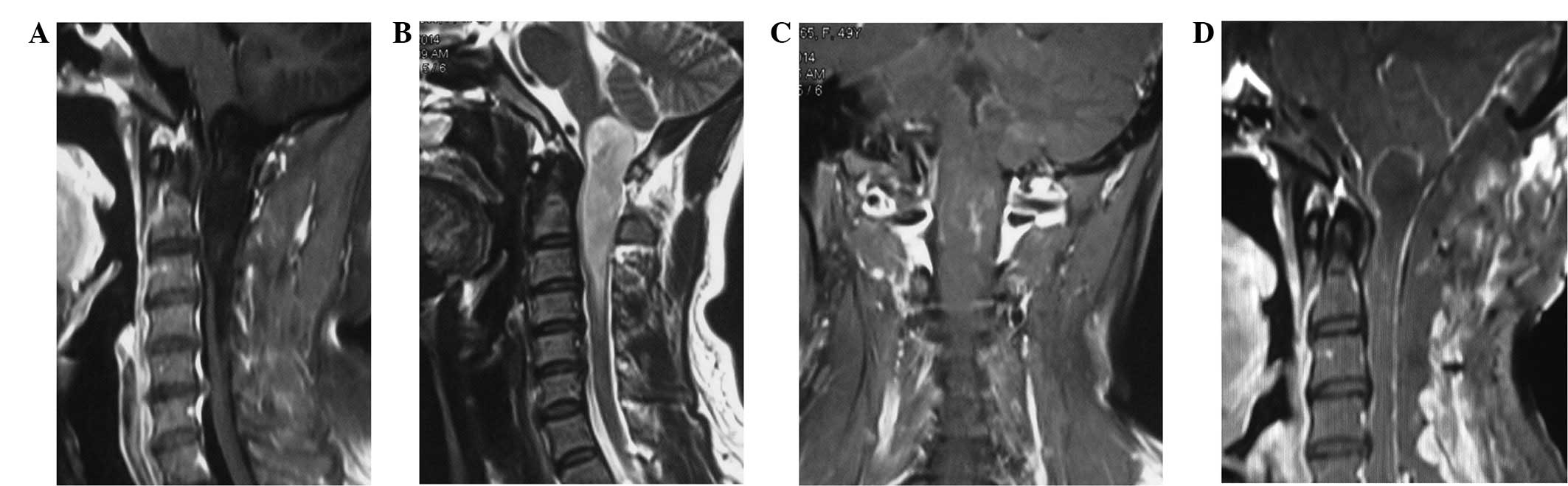
A 48-year-old woman was admitted to the Shanghai 10th People's Hospital (Shanghai, China) in May 2014, complaining of numbness and pain of the right limbs that persisted for >10 years and was aggravated for 1 month. No significant medical history was reported, such as any head traumas, and the patient's family history was unremarkable. Physical examination demonstrated that the myodynamia of the right limbs was approximately of grade 5 according to the Lovett Standard (7). A magnetic resonance imaging (MRI) examination showed a sharp cervicomedullary mass extending from the lower medulla to the cervical vertebra C3 level. The mass was hypointense on T1-weighted images (Fig. 1A), compared with the grey or white matter, and hyperintense on T2-weighted images (Fig. 1B). In addition, the mass was enhanced heterogeneously subsequent to contrast agent administration (Fig. 1C). All laboratory tests performed, including blood, urine and coagulation analyses, along with biochemical serum analyses (electrolytes, protein levels, urea, creatinine, glucose, cholesterol and liver enzymes), were found to be normal. In addition, a chest X-ray scan appeared to be normal. Written informed consent was obtained from the patients family.

Figure 1.

MRI examination revealing a sharp cervicomedullary mass that extended from the lower medulla to the cervical vertebra 3 level. (A) T1-weighted MRI scan showing a hypo-intense lesion and (B) T2-weighted MRI scan showing a hyper-intense lesion. (C) Contrast enhanced MRI scan showing a heterointense lesion. (D) Postoperative MRI scan of the patient showing almost complete excision of the tumor. MRI, magnetic resonance imaging.

The evident clinical symptoms and a definite mass lesion in the cervicomedulla, with a primary diagnosis being glioma of low grade, indicated that surgical excision was required. Following sufficient preoperative preparation, the patient underwent a surgical treatment. Intraoperatively, the medulla and upper cervical cord (between cervical vertebra C1 and C3) were found to be well-stacked. Immediately after ingression into the spinal cord along the dorsal median sulcus, the tumor mass was detected. The mass had a gray fish-like appearance, moderate blood supply and a clear boundary. After intratumoral decompression, total excision was achieved (Fig. 1D).

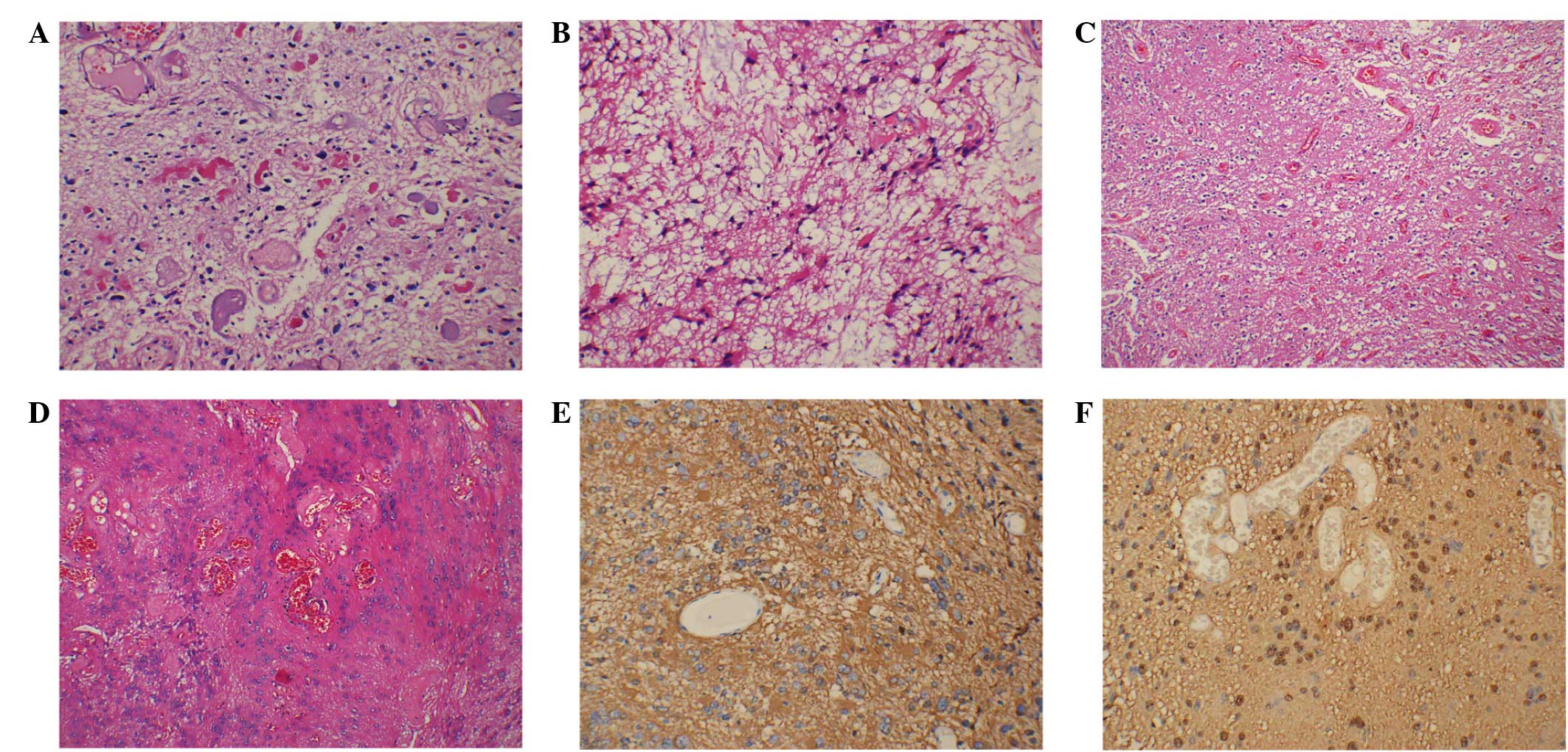
Following histopathological examination, the tumor was confirmed to be PA. At high magnification, typical histology characteristics, including Rosenthal fibers, a loose area, an oligodendroglioma-like honeycomb cell area and braid-like vessels, were evident (8). Immunohistochemical staining was performed and the tumor cells were found to be positive for glial fibrillary acidic protein and S-100 protein (Fig. 2).

Figure 2.

Pathological examination and immunohistochemical staining (hematoxylin and eosin staining; magnification, ×200), showing the following features: (A) Rosenthal fibers; (B) loose area; (C) oligodendroglioma-like honeycomb cell area; and (D) braid-like vessels. The tumor cells exhibited positive expression of (E) glial fibrillary acidic protein and (F) S-100 protein.

Postoperatively, the vital signs of the patient were closely monitored, particularly the patient's breathing. The tracheal intubation was removed only after the breathing was confirmed to be stable and vigorous, and the cough reflex was nearly normal (~24 h after surgery). Following discharge, the patient did not suffer from any symptoms at the lower cranial nerves. As PA is a benign type of lesion, no postoperative radiotherapy or chemotherapy was required. At 3 months after the operation (August 2014), the myodynamia of the right limbs was comparable to that prior to the operation.

Discussion

A lesion located in the cervicomedullary junction affects the brainstem, the cervical cord or both regions, depending on its extent and pathology. Involvement of the brainstem is manifested as cranial nerve palsies, decreased respiratory drive and long tract signs, which may result in the tumor being unresectable (8). However, the pathological nature of a cervicomedullary tumor has a great influence on the disease prognosis. For instance, in the case of a PA tumor, complete resection is often curative. Therefore, careful study of preoperative MRI scans is required. In general, the cystic part of PA lesions displays hypointensity on T1-weighted images and hyperintensity in T2-weighted MRI images. In the solid part of PA, MRI scans reveal a T1-weighted isointense or slightly hypointense signal, with or without contrast enhancement; by contrast, on T2-weighted scans, the lesions exhibit slight hyperintensity or mixed signals (9). Absence of peritumoral edema is one of the characteristics of PA. Combining these radiological characteristics and the slow onset of the disease, a diagnosis of PA may be considered. Surgical resection remains the first choice of treatment against PA.

In the present case, the tumor mass was carefully removed intraoperatively under a microscope through intratumoral depression, with the least disturbance of the surrounding nerve tissue. During surgery, PA patients are at a high risk of developing bradycardia, and thus monitoring of cardiovascular and respiratory parameters is advocated to detect changes in brainstem function that may result from surgical handling (10). The nucleus tractus solitarius (NTS) and the reticular formation situated in the caudal dorsal medulla are responsible for the cardiac rhythm unsteadiness (11). Even light stimulation of these structures by bipolar forceps during surgery can result in acute hypotension and bradycardia. The middle and caudal regions of the NTS have been reported to represent the sites where afferent nerves mediating cardiovascular and respiratory reflexes make their primary synapse (12). All these regions should be monitored and treated with care during surgery. For patients with a residual tumor, additional management approaches are required, including observation and a combination of surgery, chemotherapy and radiotherapy.

Acknowledgements

The current research was supported by a grant from the National Natural Science Foundation of China (no. 81101909).

References

1 

Tibbetts KM, Emnett RJ, Gao F, Perry A, Gutmann DH and Leonard JR: Histopathologic predictors of pilocytic astrocytoma event-free survival. Acta Neuropathol. 117:657–665. 2009. View Article : Google Scholar : PubMed/NCBI

2 

Burkhard C, Di Patre PL, Schüler D, Schüler G, Yaşargil MG, Yonekawa Y, Lütolf UM, Kleihues P and Ohgaki H: A population-based study of the incidence and survival rates in patients with pilocytic astrocytoma. J Neurosurg. 98:1170–1174. 2003. View Article : Google Scholar : PubMed/NCBI

3 

Forsyth PA, Shaw EG, Scheithauer BW, OFallon JR, Layton DD Jr and Katzmann JA: Supratentorial pilocytic astrocytomas: A clinicopathologic, prognostic, flow cytometric study of 51 patients. Cancer. 72:1335–1342. 1993. View Article : Google Scholar : PubMed/NCBI

4 

Katsetos CD and Krishna L: Lobar pilocytic astrocytomas of the cerebral hemispheres: I. Diagnosis and nosology. Clin Neuropathol. 13:295–305. 1994.PubMed/NCBI

5 

Brat DJ and Burger PC: Cerebral pilocytic astrocytoma: Distinction from infiltrating fibrillary astrocytomas. Pathol Case Rev. 3:290–295. 1998. View Article : Google Scholar

6 

Cyrine S, Sonia Z, Mounir T, Badderedine S, Kalthoum T, Hedi K and Moncef M: Pilocytic astrocytoma: A retrospective study of 32 cases. Clin Neurol Neurosurg. 115:1220–1225. 2012. View Article : Google Scholar : PubMed/NCBI

7 

Dyck PJ, Boes CJ, Mulder D, Millikan C, Windebank AJ, Dyck PJ and Espinosa R: History of standard scoring, notation, and summation of neuromuscular signs. A current survey and recommendation. J Peripher Nerv Syst. 10:158–173. 2005. View Article : Google Scholar : PubMed/NCBI

8 

Nair AP, Mehrotra A, Das KK, Srivastava AK, Sahu RN and Kumar R: Clinico-radiological profile and nuances in the management of cervicomedullary junction intramedullary tumors. Asian J Neurosurg. 9:21–28. 2014. View Article : Google Scholar : PubMed/NCBI

9 

Chourmouzi D, Papadopoulou E, Konstantinidis M, Syrris V, Kouskouras K, Haritani A, Karkavelas G and Dresvelegas A: Manifestations of pilocytic astrocytoma: A pictorial review. Insights Imaging. 5:387–402. 2014. View Article : Google Scholar : PubMed/NCBI

10 

Endo T, Sato K, Takahashi T and Kato M: Acute hypotension and bradycardia by medulla oblongata compression in spinal surgery. J Neurosurg Anesthesiol. 13:310–313. 2001. View Article : Google Scholar : PubMed/NCBI

11 

Lawrence AJ and Jarrott B: Neurochemical modulation of cardiovascular control in the nucleus tractus solitarius. Prog Neurobiol. 48:21–53. 1996. View Article : Google Scholar : PubMed/NCBI

12 

Horiuchi J, Potts PD, Polson JW and Dampney RA: Distribution of neurons projecting to the rostral ventrolateral medullary pressor region that are activated by sustained hypotension. Neuroscience. 89:1319–1329. 1999. View Article : Google Scholar : PubMed/NCBI

Related Articles

  • Abstract
  • View
  • Download
  • Twitter
Copy and paste a formatted citation
Spandidos Publications style
Zhao Y, Feng L, Wei Q and Gao L: Adult cervicomedullary pilocytic astrocytoma: A case report. Exp Ther Med 10: 2221-2223, 2015.
APA
Zhao, Y., Feng, L., Wei, Q., & Gao, L. (2015). Adult cervicomedullary pilocytic astrocytoma: A case report. Experimental and Therapeutic Medicine, 10, 2221-2223. https://doi.org/10.3892/etm.2015.2828
MLA
Zhao, Y., Feng, L., Wei, Q., Gao, L."Adult cervicomedullary pilocytic astrocytoma: A case report". Experimental and Therapeutic Medicine 10.6 (2015): 2221-2223.
Chicago
Zhao, Y., Feng, L., Wei, Q., Gao, L."Adult cervicomedullary pilocytic astrocytoma: A case report". Experimental and Therapeutic Medicine 10, no. 6 (2015): 2221-2223. https://doi.org/10.3892/etm.2015.2828
Copy and paste a formatted citation
x
Spandidos Publications style
Zhao Y, Feng L, Wei Q and Gao L: Adult cervicomedullary pilocytic astrocytoma: A case report. Exp Ther Med 10: 2221-2223, 2015.
APA
Zhao, Y., Feng, L., Wei, Q., & Gao, L. (2015). Adult cervicomedullary pilocytic astrocytoma: A case report. Experimental and Therapeutic Medicine, 10, 2221-2223. https://doi.org/10.3892/etm.2015.2828
MLA
Zhao, Y., Feng, L., Wei, Q., Gao, L."Adult cervicomedullary pilocytic astrocytoma: A case report". Experimental and Therapeutic Medicine 10.6 (2015): 2221-2223.
Chicago
Zhao, Y., Feng, L., Wei, Q., Gao, L."Adult cervicomedullary pilocytic astrocytoma: A case report". Experimental and Therapeutic Medicine 10, no. 6 (2015): 2221-2223. https://doi.org/10.3892/etm.2015.2828
Follow us
  • Twitter
  • LinkedIn
  • Facebook
About
  • Spandidos Publications
  • Careers
  • Cookie Policy
  • Privacy Policy
How can we help?
  • Help
  • Live Chat
  • Contact
  • Email to our Support Team