Introduction
Gastric cancer is the second leading cause of
cancer-associated mortality worldwide (1). As one of the most frequently occurring
cancer types (2–3% of all cases of cancer) (2), and with a low survival rate (29% at 5
years) (3), gastric cancer is mainly
treated with surgery and combination chemotherapy regimens, which
have improved the overall survival rates (4). However, poor prognosis caused by
multiple drug resistance remains the major problem in cancer
treatment. Improved or novel combination chemotherapy strategies
must be developed in order to overcome drug resistance and improve
the prognosis of gastric cancer patients.
Flavonoids, which are mainly extracted from plants
or fruit, have multiple biological activities and have been widely
studied in cancer therapy (5,6).
Naringenin is a flavonoid that is extracted from citrus fruit and
possesses antimutagenic and anticarcinogenic activities (7,8). Recent
studies have shown that naringenin is able to induce cancer growth
inhibition, migration or cell cycle arrest in various cancer cells,
including epidermoid carcinoma, human hepatocellular carcinoma,
bladder cancer and breast cancer cells (8–11).
However, to the best of our knowledge, the anticancer activity of
naringenin in gastric cancer cells has not been studied.
Overexpression of the anti-apoptotic protein, B-cell
lymphoma (Bcl)-2, has been commonly observed in various cancer
cells and is associated with drug resistance and poor prognosis
(12). ABT-737, a small molecule
mimicking BH3-only protein, is an inhibitor of Bcl-2 and its
anticancer activity has been studied in lung cancer (13), acute myeloid leukemia (14), multiple myeloma (15) and lymphoma (16). However, the effect of ABT-737 on
gastric cancer cells has not been extensively investigated
(17).
In the present study, the combinative effect of
naringenin and ABT-737 on gastric cancer cells was investigated.
Cancer cell growth and colony formation were examined in the
gastric cancer cell line, SGC7901. In addition, the potential
underlying mechanism of action of naringenin and ABT-737 was
analyzed.
Materials and methods
Cell culture and reagents
The SGC7901 human gastric cancer cell line (American
Type Culture Collection, Manassas, VA, USA) was maintained in
RPMI-1640 medium (Invitrogen; Thermo Fisher Scientific, Inc.,
Waltham, MA, USA), supplemented with 10% fetal bovine serum,
glutamine and penicillin and streptomycin antibiotics (Invitrogen;
Thermo Fisher Scientific, Inc.) at 37°C in 5% CO2.
Naringenin and ABT-737 were obtained from Sigma-Aldrich (St. Louis,
MO, USA) and Selleck Chemicals (Houston, TX, USA),
respectively.
Antibodies and reagents
Mouse anti-human poly ADP-ribose polymerase (PARP)
polyclonal antibody (pAb; 1:1,000; 9542), rabbit anti-human protein
kinase B (Akt) pAb (1:1,000; 9272), and rabbit anti-human
phospho-Akt (p-Akt) pAb (1:1,000; 9271) were purchased from Cell
Signaling Technology, Inc. (Danvers, MA, USA). Rabbit anti-human
caspase-3 pAb (1:1,000; AC030), mouse anti-human p53 monoclonal
antibody (mAb; 1:1,000; AP062) and mouse anti-human
glyceraldehyde-3-phosphate dehydrogenase (GAPDH) mAb (1:800;
AG019), as well as horseradish peroxidase (HRP)-conjugated goat
anti-rabbit (1:1,000; A0239) and goat anti-mouse (1:1,000; A0216)
IgG secondary antibodies, were purchased from Beyotime Institute of
Biotechnology (Shanghai, China).
Cell viability assay
The effect of naringenin or ABT-737 on SGC7901 cell
growth was measured using the cell counting kit-8 assay (CCK-8;
Beyotime Institute of Biotechnology). Briefly, 2,000 SGC7901 cells
cultured in a 96-well plate were treated with naringenin (20, 40,
80, or 160 µM), ABT-737 (1, 5, 10, or 15 µM) or a combination of
the two (40 µM naringenin and 5 µM ABT-737) for 48 h. Subsequent to
the treatment, 10 µl WST-8 solution (Beyotime Institute of
Biotechnology) was added and the cells were incubated for a further
2 h. The number of viable cells was measured with a microplate
reader (Bio-Rad Laboratories, Inc., Hercules, CA, USA) at a test
wavelength of 450 nm. Cell viability was normalized against control
cells treated with vehicle (dimethyl sulfoxide) and GraphPad Prism
5 software (GraphPad Software, Inc., La Jolla, CA, USA) was used to
produce histograms and analyze the data. All cell viability assays
were performed in triplicate and repeated in three independent
experiments.
Colony formation assay
For the colony formation assay, 500 SGC7901 cells
were seeded in a 6-well plate and incubated with 40 µM naringenin,
5 µM ABT-737 or a combination of the two for 6 days. The cell
colonies were fixed with methanol for 15 min at room temperature
and then stained with crystal violet staining solution (Beyotime
Institute of Biotechnology) for 30 min. Colonies with a diameter
>0.2 mm were counted and the results were presented as a
histogram. Colony formation experiments were performed in
triplicate and repeated in three independent experiments.
Western blot analysis
SGC7901 cells were treated with 40 µM naringenin
and/or 5 µM ABT-737 for 48 h, after which the cells were suspended
in cell lysis buffer (Beyotime Institute of Biotechnology)
supplemented with a protease inhibitor cocktail, in order to
extract whole cell lysates. The lysates were resolved by 12.5%
sodium dodecyl sulfate-polyacrylamide gel electrophoresis and then
transferred to polyvinylidene difluoride membranes (Beyotime
Institute of Biotechnology). Subsequently, the membranes were
blocked with 5% non-fat milk. Next, they were incubated with the
appropriate primary antibody subsequent to washing with
phosphate-buffered saline containing 1% Tween 20, followed by
exposure to the HRP-conjugated anti-rabbit IgG secondary antibody.
The bands were visualized by the addition of an enhanced
chemiluminescence reagent (Beyotime Institute of Biotechnology) to
the membranes. Images were captured using X-ray films (Kodak,
Rochester, NY, USA) in a dark room.
Statistical analysis
Statistically significant differences between the
treatment groups were determined using the Student's t-test or
one-way analysis of variance, and were indicated by P<0.05.
Standard deviations in the data are demonstrated by a bar in the
histogram.
Results
Naringenin and ABT-737 inhibit SGC7901
cell viability
Since naringenin and ABT-737 have anticancer
activities (7,8,13), the
present study evaluated their effect on SGC7901 cell growth using
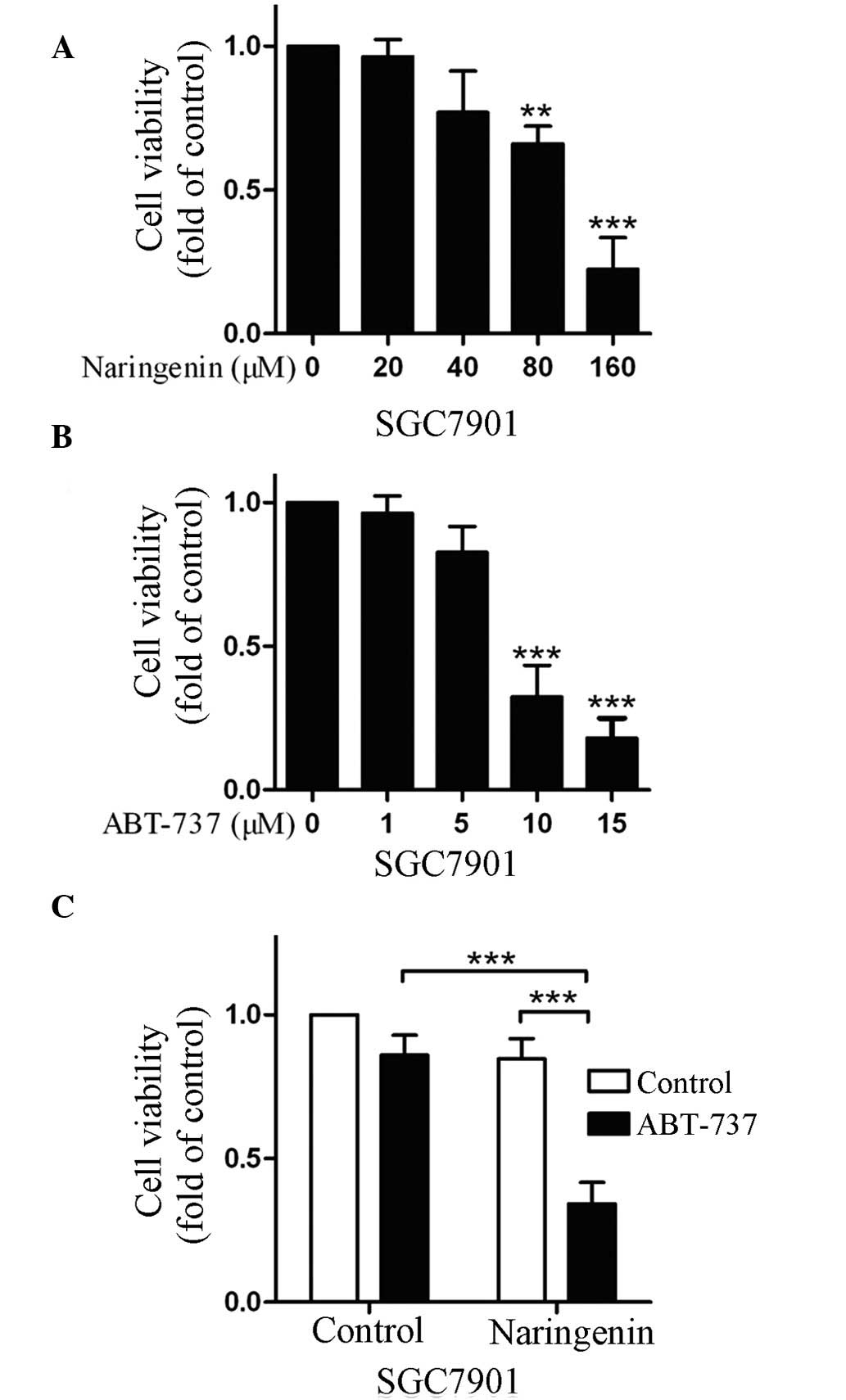
the CCK-8 assay. Treatment with naringenin or ABT-737 was found to
inhibit SGC7901 cell growth in a dose-dependent manner (Fig. 1A and B). Subsequently, the combined
effects of naringenin and ABT-737 on cell growth were determined;
cell viability was significantly decreased upon treatment of the
SGC7901 cells with the two drugs, as compared with that observed
with either drug alone (P<0.001; Fig.
1C). These results indicated that naringenin was able to
inhibit gastric cancer cell growth, and that the inhibition induced
by naringenin was enhanced upon addition of ABT-737.
Naringenin and ABT-737 inhibit SGC7901
cell colony formation
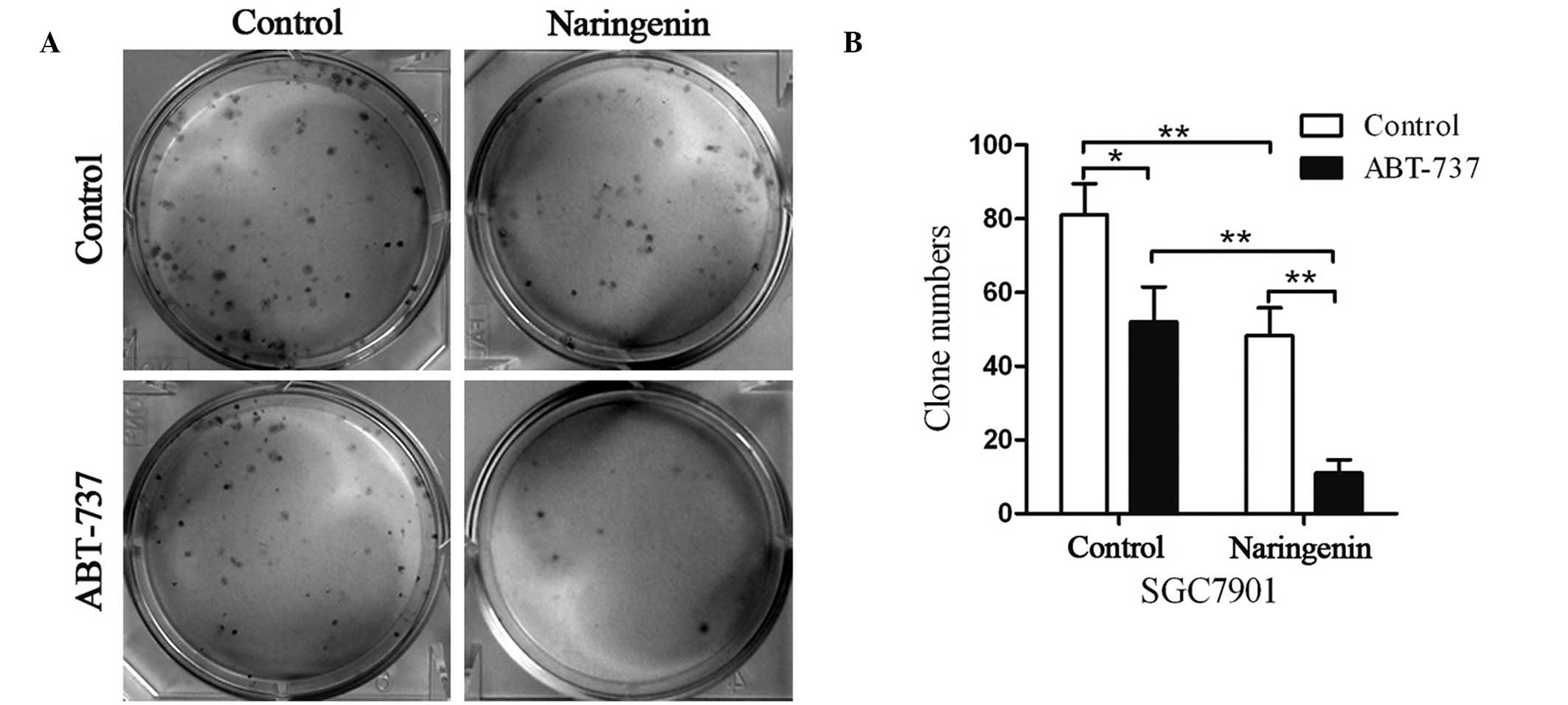
Naringenin and ABT-737 were found to inhibit SGC7901
cell growth; thus, this inhibition was investigated using a colony
formation assay. A low density of SGC7901 cells were seeded and
treated with naringenin and/or ABT-737 for 6 days (Fig. 2A). Treatment with naringenin or
ABT-737 alone decreased the clone numbers by ~40%, while a
combination of the two drugs induced a 90% decrease in cell
colonies, as compared with the control group (Fig. 2B). Therefore, SGC7901 cell colony
formation was inhibited by naringenin, ABT-737 or a combination of
the two.
Naringenin and ABT-737 induce more
cleaved caspase-3 and PARP
Naringenin and ABT-737 have been shown to induce
apoptosis in numerous types of cancer cells (18–21);
therefore, the apoptotic effects of these two drugs on SGC7901
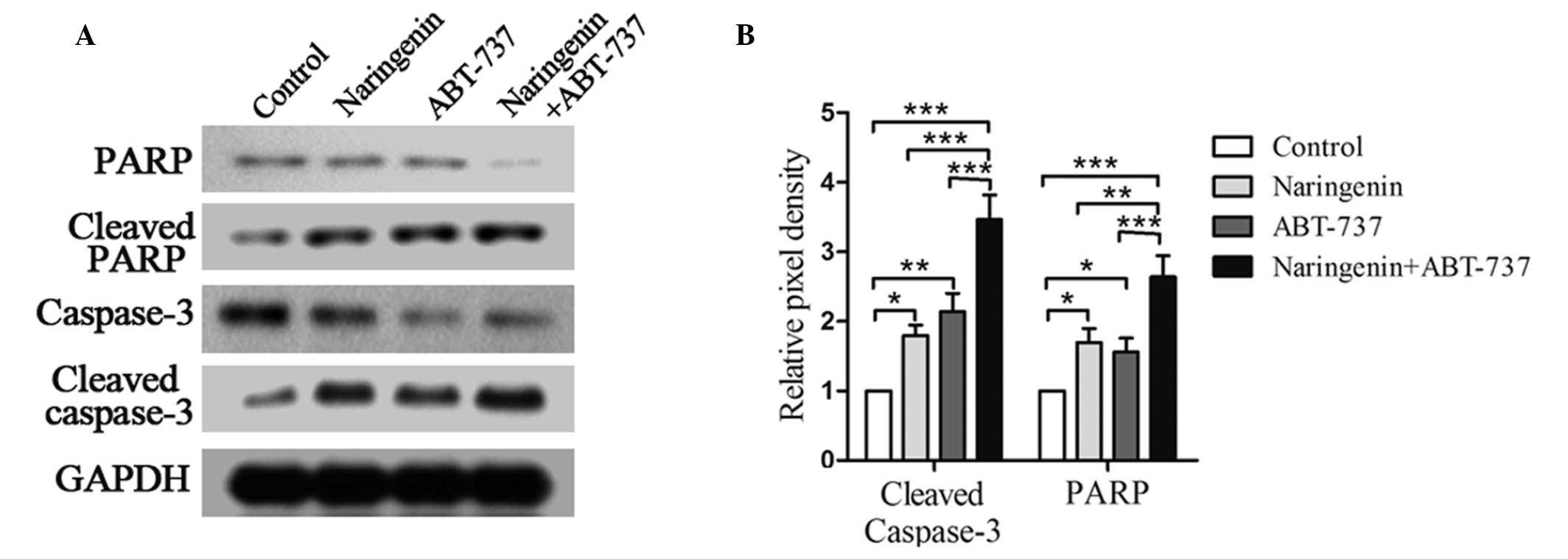
cells was investigated. The expression levels of the
apoptosis-associated proteins caspase-3 and PARP were detected in
SGC7901 cells using western blot analysis (Fig. 3). Treatment with naringenin or
ABT-737 alone significantly increased the expression levels of
cleaved caspase-3 and PARP (P<0.05; Fig. 3A and B), as compared with the control
cells. However, the expression levels of cleaved caspase-3 and PARP
were more significantly increased following the combination
treatment (P<0.01; Fig. 3A and
B); as compared with either treatment alone. These results
suggested an enhancement in the apoptosis of SGC7901 cells
following treatment with naringenin and ABT737.
Naringenin and ABT-737 increase p53
expression and reduce Akt activation
Naringenin is able to induce cell apoptosis via
multiple pathways (9,22,23). In
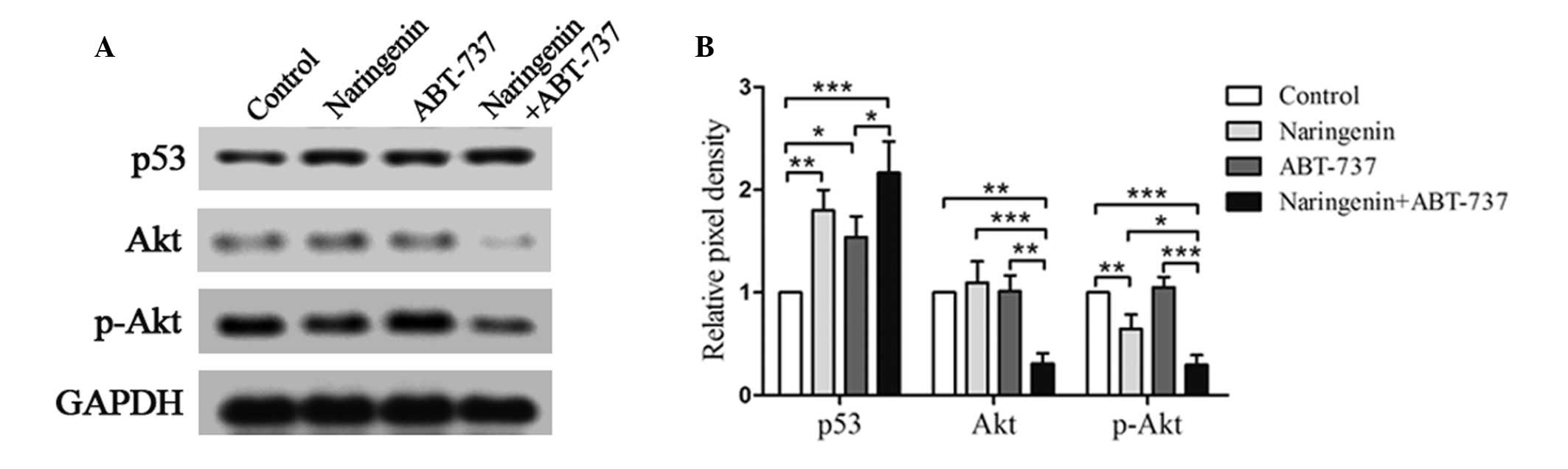
the present study, the pathways involved in naringenin and
ABT-737-induced cell apoptosis, including the p53 and Akt pathways
that are important in cell apoptosis and survival (24,25),
were investigated (Fig. 4). The
results indicated that naringenin inhibited the phosphorylation of
Akt, whereas ABT-737 did not have the same effect. The expression
levels and rate of phosphorylation of Akt in SGC7901 cells were
significantly reduced upon treatment with a combination of
naringenin and ABT-737 (P<0.05). Furthermore, naringenin and/or
ABT-737 increased the expression levels of p53 protein. These
results suggested that the p53 and Akt pathways are involved in the
cell apoptosis induced by the combination of naringenin and ABT-737
treatment of SGC7901 cells.
Discussion
The present study demonstrated anticancer activities
for naringenin and ABT-737, and that naringenin, in combination
with ABT-737, was able to inhibit gastric cancer cell growth and
colony formation. In addition, naringenin and ABT-737 induced the
cleavage of caspase-3 and PARP, which resulted in apoptosis.
Furthermore, the p53 and Akt pathways were confirmed to be involved
in the anticancer effects induced by the combination of these two
drugs.
Naringenin is extracted from citrus fruit and
previous studies have demonstrated its antimutagenic and
anticarcinogenic activities in various cancer types (26,27).
Ekambaram et al (7,28) reported the modulatory and anticancer
effects of naringenin on gastric carcinogenesis induced by
N-methyl-N′-nitro-N-nitrosoguanidine and saturated sodium chloride
in rats. However, the biological activity of naringenin on human
gastric cancer cells has not been previously investigated. The
results of the present study demonstrated that naringenin was able
to induce the inhibition of gastric cancer cell growth and colony
formation. This inhibitory effect may be caused by
naringenin-induced apoptosis through the activation of caspase-3.
Naringenin also increased the expression levels of p53 and
downregulated Akt activation in the SGC7901 cells. Previous studies
have shown that naringenin induced apoptosis in acute myeloid
leukemia cells through the downregulation of Akt and caspase-3
activation (19). A recent study
also demonstrated that naringenin was able to inhibit bladder
cancer cell migration through the downregulation of the Akt and
matrix metalloproteinase-2 pathways (8). These observations are consistent with
the findings of the present study.
Drug resistance is a feature of gastric cancer that
is associated with poor prognosis. The anti-apoptotic protein Bcl-2
is overexpressed in various types of cancer cells and is associated
with drug resistance (12). Novel
drugs targeting Bcl-2, including ABT-737, have been developed to
overcome the drug resistance and induce the apoptosis of cancer
cells. In the present study, the inhibitory effects of ABT-737 on
cell growth and colony formation were confirmed in gastric cancer
cells. Similar to the results of the present study, a previous
study also reported the pro-apoptotic role of ABT-737 in gastric
cancer cells (17). In addition,
ABT-737 in combination with naringenin was found to further inhibit
SGC7901 cell growth and colony formation in the current study. Our
results also showed that naringenin and ABT-737 were able to
further increase cleavage of caspse-3 and PARP, leading to the
inhibition of cell growth and survival. Furthermore, these two
drugs increased p53 expression, which has a positive role in cell
apoptosis. The Akt pathway, which is a pro-survival pathway, was
inhibited by naringenin alone or in combination with ABT-737.
In conclusion, naringenin and ABT-737 were found to
exhibit an anticancer activity in gastric cancer cells. Naringenin
alone or in combination with ABT-737 was able to induce the
inhibition of gastric cancer cell growth and colony formation. In
addition, naringenin and ABT-737 induced the activation of
caspase-3 and cleavage of PARP, leading to cell apoptosis. Finally,
the Akt and p53 pathways were found to be involved in the
combination effect of naringenin and ABT-737 in gastric cancer
cells.
References
|
1
|
Li Y, Yan PW, Huang XE and Li CG: MDR1
gene C3435T polymorphism is associated with clinical outcomes in
gastric cancer patients treated with postoperative adjuvant
chemotherapy. Asian Pac J Cancer Prev. 12:2405–2409.
2011.PubMed/NCBI
|
|
2
|
Ferro A, Peleteiro B, Malvezzi M, Bosetti
C, Bertuccio P, Levi F and Negri E: LaV ecchia C and Lunet N:
Worldwide trends in gastric cancer mortality (1980-2011), with
predictions to 2015, and incidence by subtype. Eur J Cancer.
50:1330–1344. 2014. View Article : Google Scholar : PubMed/NCBI
|
|
3
|
American Cancer Society Survival rates for
stomach cancer by stage. https://www.cancer.org/cancer/stomach-cancer/detection-diagnosis-staging/survival-rates.htmlAccessed.
June 24–2014
|
|
4
|
Shan YS, Hsu HP, Lai MD, Yen MC, Luo YP
and Chen YL: Increased expression of argininosuccinate synthetase
protein predicts poor prognosis in human gastric cancer. Oncology
Rep. 33:49–57. 2015.
|
|
5
|
Yuan J, Li W, Tian Y and Wang X:
Anti-proliferative effect of Flos Albiziae flavonoids on the human
gastric cancer SGC-7901 cell line. Exp Ther Med. 5:51–56.
2013.PubMed/NCBI
|
|
6
|
Romagnolo DF and Selmin OI: Flavonoids and
cancer prevention: A review of the evidence. J Nutr Gerontol
Geriatr. 31:206–238. 2012. View Article : Google Scholar : PubMed/NCBI
|
|
7
|
Ekambaram G, Rajendran P, Magesh V and
Sakthisekaran D: Naringenin reduces tumor size and weight lost in
N-methyl-N'-nitro-N-nitrosoguanidine-induced gastric carcinogenesis
in rats. Nutr Res. 28:106–112. 2008. View Article : Google Scholar : PubMed/NCBI
|
|
8
|
Liao AC, Kuo CC, Huang YC, Yeh CW, Hseu
YC, Liu JY and Hsu LS: Naringenin inhibits migration of bladder
cancer cells through downregulation of AKT and MMP2. Mol Med Rep.
10:1531–1536. 2014.PubMed/NCBI
|
|
9
|
Hatkevich T, Ramos J, Santos-Sanchez I and
Patel YM: A naringenin-tamoxifen combination impairs cell
proliferation and survival of MCF-7 breast cancer cells. Exp Cell
Res. 327:331–339. 2014. View Article : Google Scholar : PubMed/NCBI
|
|
10
|
Ahamad MS, Siddiqui S, Jafri A, Ahmad S,
Afzal M and Arshad M: Induction of apoptosis and antiproliferative
activity of naringenin in human epidermoid carcinoma cell through
ROS generation and cell cycle arrest. PloS one. 9:e1100032014.
View Article : Google Scholar : PubMed/NCBI
|
|
11
|
Arul D and Subramanian P: Naringenin
(citrus flavonone) induces growth inhibition cell cycle arrest and
apoptosis in human hepatocellular carcinoma cells. Pathol Oncol
Res. 19:763–770. 2013. View Article : Google Scholar : PubMed/NCBI
|
|
12
|
Kang MH and Reynolds CP: Bcl-2 inhibitors:
Targeting mitochondrial apoptotic pathways in cancer therapy. Clin
Cancer Res. 15:1126–1132. 2009. View Article : Google Scholar : PubMed/NCBI
|
|
13
|
Tahir SK, Yang X, Anderson MG,
Morgan-Lappe SE, Sarthy AV, Chen J, Warner RB, Ng SC, Fesik SW,
Elmore SW, et al: Influence of Bcl-2 family members on the cellular
response of small-cell lung cancer cell lines to ABT-737. Cancer
Res. 67:1176–1183. 2007. View Article : Google Scholar : PubMed/NCBI
|
|
14
|
Konopleva M, Contractor R, Tsao T, Samudio
I, Ruvolo PP, Kitada S, Deng X, Zhai D, Shi YX, Sneed T, et al:
Mechanisms of apoptosis sensitivity and resistance to the BH3
mimetic ABT-737 in acute myeloid leukemia. Cancer Cell. 10:375–388.
2006. View Article : Google Scholar : PubMed/NCBI
|
|
15
|
Bodet L, Gomez-Bougie P, Touzeau C,
Dousset C, Descamps G, Maïga S, Avet-Loiseau H, Bataille R, Moreau
P, Le Gouill S, et al: ABT-737 is highly effective against
molecular subgroups of multiple myeloma. Blood. 118:3901–3910.
2011. View Article : Google Scholar : PubMed/NCBI
|
|
16
|
van Delft MF, Wei AH, Mason KD, Vandenberg
CJ, Chen L, Czabotar PE, Willis SN, Scott CL, Day CL, Cory S, et
al: The BH3 mimetic ABT-737 targets selective Bcl-2 proteins and
efficiently induces apoptosis via Bak/Bax if Mcl-1 is neutralized.
Cancer cell. 10:389–399. 2006. View Article : Google Scholar : PubMed/NCBI
|
|
17
|
Sun XP, Zhang X, He C, Qiao H, Jiang X,
Jiang H and Sun X: ABT-737 synergizes with arsenic trioxide to
induce apoptosis of gastric carcinoma cells in vitro and in vivo. J
Int Med Res. 40:1251–1264. 2012. View Article : Google Scholar : PubMed/NCBI
|
|
18
|
Li RF, Feng YQ, Chen JH, Ge LT, Xiao SY
and Zuo XL: Naringenin suppresses K562 human leukemia cell
proliferation and ameliorates Adriamycin-induced oxidative damage
in polymorphonuclear leukocytes. Exp Ther Med. 9:697–706.
2015.PubMed/NCBI
|
|
19
|
Park JH, Jin CY, Lee BK, Kim GY, Choi YH
and Jeong YK: Naringenin induces apoptosis through downregulation
of Akt and caspase-3 activation in human leukemia THP-1 cells. Food
Chem Toxicol. 46:3684–3690. 2008. View Article : Google Scholar : PubMed/NCBI
|
|
20
|
Parrondo R: deL as Pozas A, Reiner T and
Perez-Stable C: ABT-737, a small molecule Bcl-2/Bcl-xL antagonist,
increases antimitotic-mediated apoptosis in human prostate cancer
cells. PeerJ. 1:e1442013. View Article : Google Scholar : PubMed/NCBI
|
|
21
|
Cristofanon S and Fulda S: ABT-737
promotes tBid mitochondrial accumulation to enhance TRAIL-induced
apoptosis in glioblastoma cells. Cell Death Dis. 3:e4322012.
View Article : Google Scholar : PubMed/NCBI
|
|
22
|
Yu DH, Ma CH, Yue ZQ, Yao X and Mao CM:
Protective effect of naringenin against lipopolysaccharide-induced
injury in normal human bronchial epithelium via suppression of MAPK
signaling. Inflammation. 38:195–204. 2015. View Article : Google Scholar : PubMed/NCBI
|
|
23
|
Kapoor R, Rizvi F and Kakkar P: Naringenin
prevents high glucose-induced mitochondria-mediated apoptosis
involving AIF, Endo-G and caspases. Apoptosis. 18:9–27. 2013.
View Article : Google Scholar : PubMed/NCBI
|
|
24
|
Kruiswijk F, Labuschagne CF and Vousden
KH: p53 in survival, death and metabolic health, A lifeguard with a
licence to kill. Nat Rev Mol Cell Biol. 16:393–405. 2015.
View Article : Google Scholar : PubMed/NCBI
|
|
25
|
Warfel NA and Kraft AS: PIM kinase (and
Akt) biology and signaling in tumors. Pharmacol Ther. 151:41–49.
2015. View Article : Google Scholar : PubMed/NCBI
|
|
26
|
Alam MA, Subhan N, Rahman MM, Uddin SJ,
Reza HM and Sarker SD: Effect of citrus flavonoids, naringin and
naringenin, on metabolic syndrome and their mechanisms of action.
Adv Nutr. 5:404–417. 2014. View Article : Google Scholar : PubMed/NCBI
|
|
27
|
Sabarinathan D, Mahalakshmi P and Vanisree
AJ: Naringenin promote apoptosis in cerebrally implanted C6 glioma
cells. Mol Cell Biochem. 345:215–222. 2010. View Article : Google Scholar : PubMed/NCBI
|
|
28
|
Ekambaram G, Rajendran P, Devaraja R,
Muthuvel R and Sakthisekaran D: Impact of naringenin on
glycoprotein levels in N-methyl-N'-nitro-N-nitrosoguanidine-induced
gastric carcinogenesis in rats. Anticancer Drugs. 19:885–890. 2008.
View Article : Google Scholar : PubMed/NCBI
|