Spandidos Publications Logo
  • About
    • About Spandidos
    • Aims and Scopes
    • Abstracting and Indexing
    • Editorial Policies
    • Reprints and Permissions
    • Job Opportunities
    • Terms and Conditions
    • Contact
  • Journals
    • All Journals
    • Oncology Letters
      • Oncology Letters
      • Information for Authors
      • Editorial Policies
      • Editorial Board
      • Aims and Scope
      • Abstracting and Indexing
      • Bibliographic Information
      • Archive
    • International Journal of Oncology
      • International Journal of Oncology
      • Information for Authors
      • Editorial Policies
      • Editorial Board
      • Aims and Scope
      • Abstracting and Indexing
      • Bibliographic Information
      • Archive
    • Molecular and Clinical Oncology
      • Molecular and Clinical Oncology
      • Information for Authors
      • Editorial Policies
      • Editorial Board
      • Aims and Scope
      • Abstracting and Indexing
      • Bibliographic Information
      • Archive
    • Experimental and Therapeutic Medicine
      • Experimental and Therapeutic Medicine
      • Information for Authors
      • Editorial Policies
      • Editorial Board
      • Aims and Scope
      • Abstracting and Indexing
      • Bibliographic Information
      • Archive
    • International Journal of Molecular Medicine
      • International Journal of Molecular Medicine
      • Information for Authors
      • Editorial Policies
      • Editorial Board
      • Aims and Scope
      • Abstracting and Indexing
      • Bibliographic Information
      • Archive
    • Biomedical Reports
      • Biomedical Reports
      • Information for Authors
      • Editorial Policies
      • Editorial Board
      • Aims and Scope
      • Abstracting and Indexing
      • Bibliographic Information
      • Archive
    • Oncology Reports
      • Oncology Reports
      • Information for Authors
      • Editorial Policies
      • Editorial Board
      • Aims and Scope
      • Abstracting and Indexing
      • Bibliographic Information
      • Archive
    • Molecular Medicine Reports
      • Molecular Medicine Reports
      • Information for Authors
      • Editorial Policies
      • Editorial Board
      • Aims and Scope
      • Abstracting and Indexing
      • Bibliographic Information
      • Archive
    • World Academy of Sciences Journal
      • World Academy of Sciences Journal
      • Information for Authors
      • Editorial Policies
      • Editorial Board
      • Aims and Scope
      • Abstracting and Indexing
      • Bibliographic Information
      • Archive
    • International Journal of Functional Nutrition
      • International Journal of Functional Nutrition
      • Information for Authors
      • Editorial Policies
      • Editorial Board
      • Aims and Scope
      • Abstracting and Indexing
      • Bibliographic Information
      • Archive
    • International Journal of Epigenetics
      • International Journal of Epigenetics
      • Information for Authors
      • Editorial Policies
      • Editorial Board
      • Aims and Scope
      • Abstracting and Indexing
      • Bibliographic Information
      • Archive
    • Medicine International
      • Medicine International
      • Information for Authors
      • Editorial Policies
      • Editorial Board
      • Aims and Scope
      • Abstracting and Indexing
      • Bibliographic Information
      • Archive
  • Articles
  • Information
    • Information for Authors
    • Information for Reviewers
    • Information for Librarians
    • Information for Advertisers
    • Conferences
  • Language Editing
Spandidos Publications Logo
  • About
    • About Spandidos
    • Aims and Scopes
    • Abstracting and Indexing
    • Editorial Policies
    • Reprints and Permissions
    • Job Opportunities
    • Terms and Conditions
    • Contact
  • Journals
    • All Journals
    • Biomedical Reports
      • Information for Authors
      • Editorial Policies
      • Editorial Board
      • Aims and Scope
      • Abstracting and Indexing
      • Bibliographic Information
      • Archive
    • Experimental and Therapeutic Medicine
      • Information for Authors
      • Editorial Policies
      • Editorial Board
      • Aims and Scope
      • Abstracting and Indexing
      • Bibliographic Information
      • Archive
    • International Journal of Epigenetics
      • Information for Authors
      • Editorial Policies
      • Editorial Board
      • Aims and Scope
      • Abstracting and Indexing
      • Bibliographic Information
      • Archive
    • International Journal of Functional Nutrition
      • Information for Authors
      • Editorial Policies
      • Editorial Board
      • Aims and Scope
      • Abstracting and Indexing
      • Bibliographic Information
      • Archive
    • International Journal of Molecular Medicine
      • Information for Authors
      • Editorial Policies
      • Editorial Board
      • Aims and Scope
      • Abstracting and Indexing
      • Bibliographic Information
      • Archive
    • International Journal of Oncology
      • Information for Authors
      • Editorial Policies
      • Editorial Board
      • Aims and Scope
      • Abstracting and Indexing
      • Bibliographic Information
      • Archive
    • Medicine International
      • Information for Authors
      • Editorial Policies
      • Editorial Board
      • Aims and Scope
      • Abstracting and Indexing
      • Bibliographic Information
      • Archive
    • Molecular and Clinical Oncology
      • Information for Authors
      • Editorial Policies
      • Editorial Board
      • Aims and Scope
      • Abstracting and Indexing
      • Bibliographic Information
      • Archive
    • Molecular Medicine Reports
      • Information for Authors
      • Editorial Policies
      • Editorial Board
      • Aims and Scope
      • Abstracting and Indexing
      • Bibliographic Information
      • Archive
    • Oncology Letters
      • Information for Authors
      • Editorial Policies
      • Editorial Board
      • Aims and Scope
      • Abstracting and Indexing
      • Bibliographic Information
      • Archive
    • Oncology Reports
      • Information for Authors
      • Editorial Policies
      • Editorial Board
      • Aims and Scope
      • Abstracting and Indexing
      • Bibliographic Information
      • Archive
    • World Academy of Sciences Journal
      • Information for Authors
      • Editorial Policies
      • Editorial Board
      • Aims and Scope
      • Abstracting and Indexing
      • Bibliographic Information
      • Archive
  • Articles
  • Information
    • For Authors
    • For Reviewers
    • For Librarians
    • For Advertisers
    • Conferences
  • Language Editing
Login Register Submit
  • This site uses cookies
  • You can change your cookie settings at any time by following the instructions in our Cookie Policy. To find out more, you may read our Privacy Policy.

    I agree
Search articles by DOI, keyword, author or affiliation
Search
Advanced Search
presentation
Experimental and Therapeutic Medicine
Join Editorial Board Propose a Special Issue
Print ISSN: 1792-0981 Online ISSN: 1792-1015
Journal Cover
November-2016 Volume 12 Issue 5

Full Size Image

Sign up for eToc alerts
Recommend to Library

Journals

International Journal of Molecular Medicine

International Journal of Molecular Medicine

International Journal of Molecular Medicine is an international journal devoted to molecular mechanisms of human disease.

International Journal of Oncology

International Journal of Oncology

International Journal of Oncology is an international journal devoted to oncology research and cancer treatment.

Molecular Medicine Reports

Molecular Medicine Reports

Covers molecular medicine topics such as pharmacology, pathology, genetics, neuroscience, infectious diseases, molecular cardiology, and molecular surgery.

Oncology Reports

Oncology Reports

Oncology Reports is an international journal devoted to fundamental and applied research in Oncology.

Experimental and Therapeutic Medicine

Experimental and Therapeutic Medicine

Experimental and Therapeutic Medicine is an international journal devoted to laboratory and clinical medicine.

Oncology Letters

Oncology Letters

Oncology Letters is an international journal devoted to Experimental and Clinical Oncology.

Biomedical Reports

Biomedical Reports

Explores a wide range of biological and medical fields, including pharmacology, genetics, microbiology, neuroscience, and molecular cardiology.

Molecular and Clinical Oncology

Molecular and Clinical Oncology

International journal addressing all aspects of oncology research, from tumorigenesis and oncogenes to chemotherapy and metastasis.

World Academy of Sciences Journal

World Academy of Sciences Journal

Multidisciplinary open-access journal spanning biochemistry, genetics, neuroscience, environmental health, and synthetic biology.

International Journal of Functional Nutrition

International Journal of Functional Nutrition

Open-access journal combining biochemistry, pharmacology, immunology, and genetics to advance health through functional nutrition.

International Journal of Epigenetics

International Journal of Epigenetics

Publishes open-access research on using epigenetics to advance understanding and treatment of human disease.

Medicine International

Medicine International

An International Open Access Journal Devoted to General Medicine.

Journal Cover
November-2016 Volume 12 Issue 5

Full Size Image

Sign up for eToc alerts
Recommend to Library

  • Article
  • Citations
    • Cite This Article
    • Download Citation
    • Create Citation Alert
    • Remove Citation Alert
    • Cited By
  • Similar Articles
    • Related Articles (in Spandidos Publications)
    • Similar Articles (Google Scholar)
    • Similar Articles (PubMed)
  • Download PDF
  • Download XML
  • View XML
Case Report

Monozygotic twins with infantile neuroaxonal dystrophy: A case report and literature review

  • Authors:
    • Haifeng Li
    • Yan Zou
    • Xinhua Bao
    • Hui Wang
    • Jiangping Wang
    • Huiying Jin
    • Yuping Che
    • Xiaoyan Tang
  • View Affiliations / Copyright

    Affiliations: Rehabilitation Department, The Children's Hospital, Zhejiang University School of Medicine, Hangzhou, Zhejiang 310051, P.R. China, Nutrition and Food Safety Department, Zhejiang Provincial Center for Disease Control and Prevention, Hangzhou, Zhejiang 310051, P.R. China, Pediatric Department, Peking University First Hospital, Beijing 100034, P.R. China, Clinical Laboratory of Zhongke, Beijing 100034, P.R. China
  • Pages: 3387-3389
    |
    Published online on: September 30, 2016
       https://doi.org/10.3892/etm.2016.3761
  • Expand metrics +
Metrics: Total Views: 0 (Spandidos Publications: | PMC Statistics: )
Metrics: Total PDF Downloads: 0 (Spandidos Publications: | PMC Statistics: )
Cited By (CrossRef): 0 citations Loading Articles...

This article is mentioned in:


Abstract

Infantile neuroaxonal dystrophy (INAD) is a rare neurodegenerative disease with early onset. PLA2G6 gene mutations have been identified in the majority individuals with INAD. In future, molecular diagnosis of INAD will replace the invasive biopsies used previously. In the present report, monozygotic male twins with INAD were referred The Children's Hospital (Zhejiang University School of Medicine, Zhejiang, China) at fifteen months old for delayed development. The older brother was found to have developmental stagnation when he was 6 months old. The patient could not stand securely without support, and had poor eye tracking and listening ability. Magnetic resonance imaging (MRI) of the patient's brain revealed cerebellar atrophy and electromyography identified signs of peripheral neuropathy. The younger brother displayed similar clinical features and findings. Two different phospholipase A2 group VI (PLA2G6; 22q13.1) gene mutations were detected in the twins by DNA sequencing. The results of the present study indicate that neurogenetic disease should be considered when child patients present with idiopathic developmental stagnation, particularly when similar cases have appeared in the same family. In addition, INAD should be considered as a possible diagnosis when the patient has developmental delay of the central and peripheral nerves. In the future, molecular genetic testing will be the primary method of INAD diagnosis, enabling better prevention of this genetic disease.

Introduction

Infantile neuroaxonal dystrophy (INAD) is a rare autosomal recessive neurodegenerative disorder, characterized by an early symptomatic onset with rapid progression of psychomotor regression and hypotonia, evolving into spasticity. This results in total neurological degeneration and mortality by the age of 10. There is no effective treatment for INAD at present and since it is a rare disorder, involving axons in the central and peripheral nervous system, there is little literature on the disease. Therefore, it is important to provide accurate genetic counseling for families with INAD.

INAD sufferers exhibit spheroid bodies in the central nervous system and pathological swelling of axons (1). In addition, T2-weighted magnetic resonance imaging (MRI) of patients with INAD typically reveals cerebellar atrophy, however, MRI is not used as the primary method of INAD diagnosis (2,3). Prior to molecular testing for phospholipase A2 group VI (PLA2G6; 22q13.1) mutations, which have been identified in the majority of INAD sufferers, an INAD diagnosis could be only be confirmed through electron microscopy identification of axon dystrophy in a tissue biopsy of conjunctiva, skin, muscle or sural nerves (4). Molecular diagnosis of INAD eliminates the need for invasive biopsies, enables the detection of carriers of INAD-associated mutations and allows for prenatal diagnosis. The present study reports the case twins with INAD caused by PLA2G6 mutations inherited from the mother and father, which highlights the importance of genetic testing in the diagnosis and prevention of INAD.

Case report

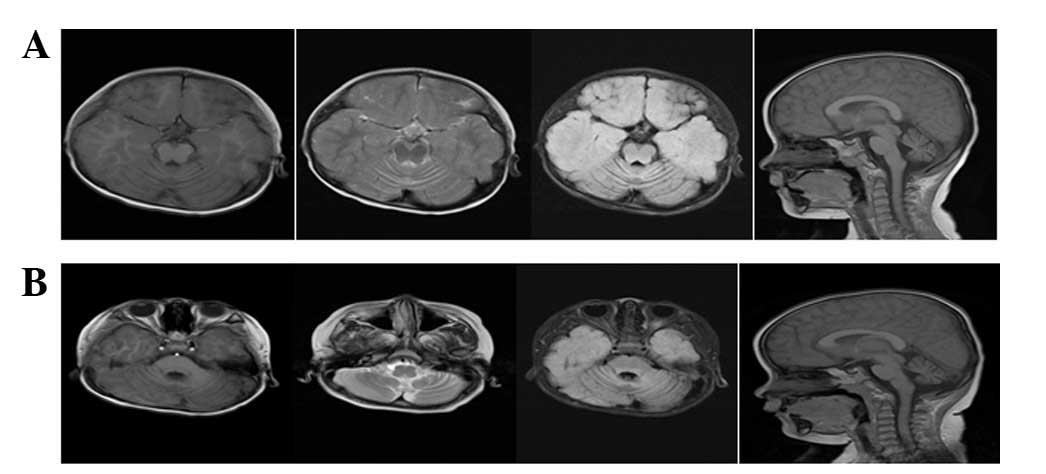
The current report presents monozygotic male twins with INAD referred to The Children's Hospital (Zhejiang University School of Medicine, Zhejiang, China) in December 2013 at 15 months old with delayed development. Written informed consent for participation in the current study was obtained from the guardians. The parents were a non-consanguineous healthy Chinese couple, with no significant family history and an older child (female, 8 years old) that was healthy. The twins were born at term, following an uneventful pregnancy, by cesarean section. The patients were asymptomatic at birth and achieved normal developmental milestones, including looking up, standing up and sitting independently, until they were 6 months old. Disease onset occurred when the patients were between 7 and 15 months old, where they could not stand securely without support, and exhibited poor eye tracking and listening ability. Clinical examination revealed slow reactions, a limb muscle strength of grade IV and a muscle tension level of 1. Electromyography identified signs of peripheral neuropathy. Electroencephalogram showed slow background activity. MRI imaging of the brain revealed cerebellar atrophy (Fig. 1).

Figure 1.

Sagittal T2-weighted MRI showed vermis and hemisphere atrophy of the cerebellums of (A) the older twin and (B) the younger twin.

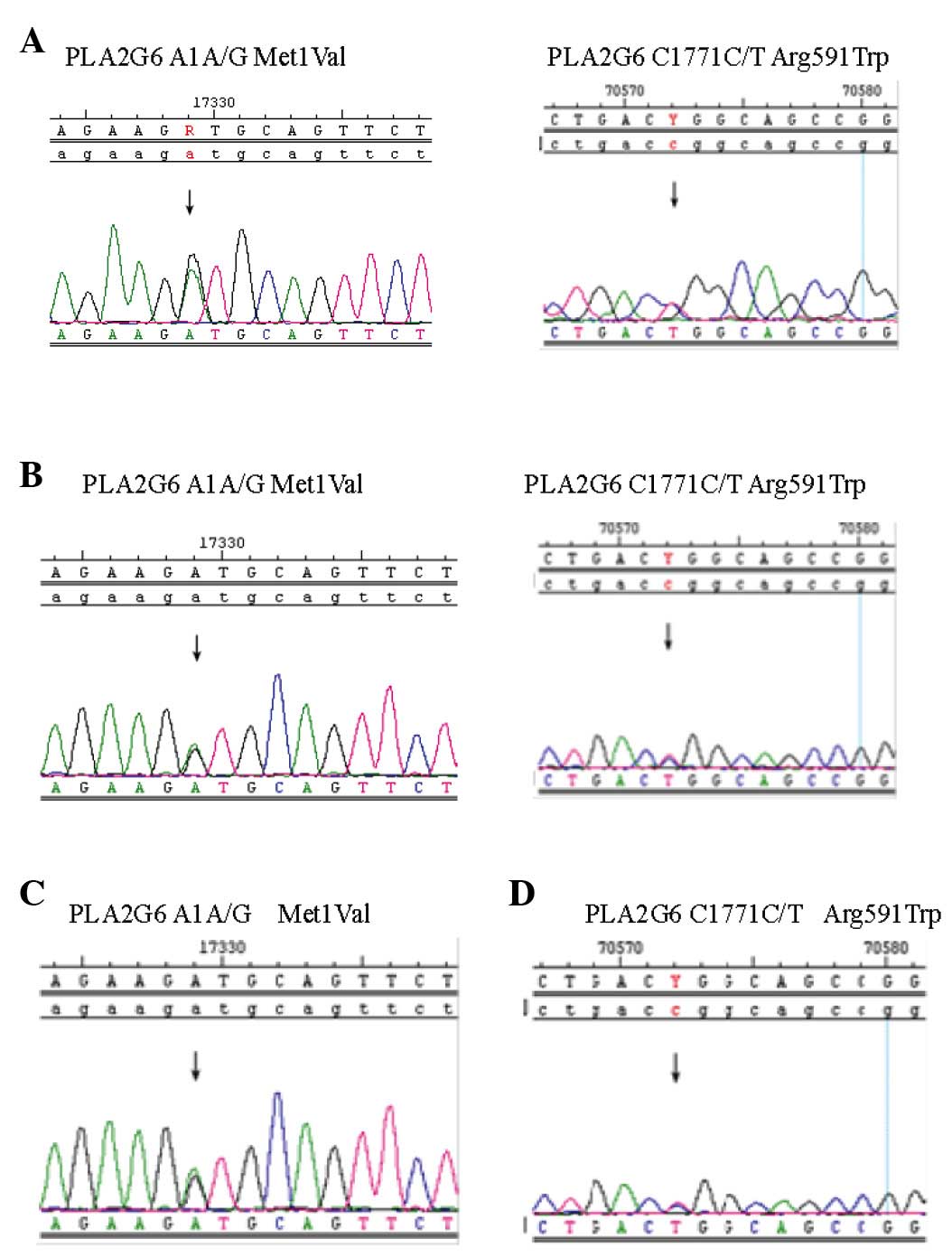
Polymerase chain reaction (PCR) amplification was performed to screen for PLA2G6 mutation. The Whole Blood Genome DNA Isolation kit (cat. no. 2013-1400049; Beijing ComWin Biotech Co., Ltd., Beijing, China) was used to obtain DNA from the patients, according to the manufacturer's instructions. PCR was performed using the PCR Amplification Kit (cat. no. R011) and Ex Taq DNA polymerase (both Takara Biotechnology Co., Ltd., Dalian, China). The PCR reaction included 10X Ex Taq buffer (3 µl), 2.5 mM dNTPs (2.4 µl), Primer F (10 µM; 0.6 µl), Primer R (10 µM; 0.6 µl), template DNA (1 µl), Ex Taq (5 U/µl; 0.15 µl), and water (22.25 µl). The thermal cycling conditions were as follows: 94°C for 3 min, 94°C for 30 sec, 55°C for 30s, 36 cycles of 55°C for 1 min, and totally 36 cycles, and 72°C for 5 min. DNA sequencing was performed using the ABI PRISM BigDye Terminator v3.1 Cycle Sequencing kit (cat. no. 4337455; Applied Biosystems; Thermo Fisher Scientific, Inc., Waltham, MA, USA), according to the manufacturer's instructions, and an Applied Biosystems 3100 Genetic Analyzer (Thermo Fisher Scientific, Inc.) to detect the following mutations: Exon 2 A1 (A/G), exon 2 G87 (G/A) and exon 13 C1771 (C/T). Interestingly, two different PLA2G6 mutations were detected in the twins, exon 2 A1 A/G and exon 13 C1771 C/T (Fig. 2A and B). The Met1Val of A1 A/G was from the father (Fig. 2C) and the Arg591Trp of C1771 C/T was from mother (Fig. 2D).

Figure 2.

DNA sequencing analysis of the PLA2G6 mutations in the (A) older twin, (B) younger twin, (C) father of the twins and (D) mother of the twins.

Discussion

INAD is a severe early onset neurodegenerative disease. Clinical and neurophysiological findings alone may be insufficient for early diagnosis of INAD. MRI examination (T2-weighted) of patients with INAD typically reveals marked cerebellar atrophy and a signal hyperintensity of the cerebellar cortex. Nardocci et al (1) proposed clinical diagnostic criteria for INAD. However, developments in molecular diagnosis have showed that the majority of INAD cases are associated with mutations in the PLA2G6 gene (4). PLA2G6, which encodes the Ca2+-independent phospholipase A2β, iPLA2β, has been identified as a causative gene of INAD (5). The enzyme iPLA2β serves a key role in membrane composition, via hydrolysis of peroxidized fatty acid, and in signal transduction. The determination that PLA2G6 mutations are the cause of INAD has revolutionized the ability to diagnosis this disorder (6). Khateeb et al (7) demonstrated the role of phospholipase mutation in neurodegenerative disorders. Malik et al (8) indicated that loss of iPLA2β function triggers age-dependent impairment of protein degradation signaling pathways and homeostasis of the axonal membranes, resulting in age-related neurological impairment. Polster et al (9) suggested that PLA2G6 serves a role in neuronal proliferation in the developing brain, neurons, cortical plate and hindbrain. PLA2G6 expression is widespread in neuronal tissues, however, the expression pattern changes dynamically over time, which suggests that INAD pathogenesis begins prenatally. Mutations in the gene encoding iPLA2β are found in ~85% of patients with INAD and Strokin et al (10) suggests that altered Ca2+ signaling is the key mechanism in the development of INAD. In addition, Biancheri et al (11) reported that a 2-year-old boy presenting with hypotonia and psychomotor regression, whose MRI showed cerebellar atrophy with normal cerebellar cortex signal intensity, had a homozygous 5′ splice site PLA2G6 mutation (12). This indicates that the absence of cerebellar cortex signal hyperintensity does not rule out an INAD diagnosis (13).

Previous studies containing the phrase ‘INAD and PLA2G6’ were identified in PubMed (http://www.ncbi.nlm.nih.gov/pubmed), resulting in 61 papers from 2006 to 2015. Since 2006, just 11 genetic studies of patients with INAD have been published (2,6,12–17). In China, only 2 studies reported PLA2G6-associated neurodegeneration. The first study discussed 10 patients with INAD, who had been diagnosed through neuropathology, that were analyzed for PLA2G6 mutations (17). The second was a follow-up study of 25 Chinese children with PLA2G6-associated neurodegeneration that found 27 different mutations, of which 13 were novel (18).

In conclusion, the results of present study highlight that in children who present with early, rapid cognitive and motor regression, and axial hypotonia, INAD is an important differential diagnosis. In this regard, neurogenetic disease should be considered in children with developmental stagnation of an unknown cause, particularly when similar cases have appeared within their family. Furthermore, INAD should be considered when children have delayed central and peripheral nerve development. In future, genetic testing will be the primary method used for INAD diagnosis. In addition, this testing could be used for carrier detection and prenatal diagnosis in affected families, in order to facilitate a more precise assessment of the recurrence risks, to guide prenatal care and to prevent genetic diseases.

Acknowledgements

The present study was supported by Zhejiang Province Science and Technology Fund (grant no. 2015C33178).

References

1 

Nardocci N, Zorzi G, Farina L, Binelli S, Scaioli W, Ciano C, Verga L, Angelini L, Savoiardo M and Bugiani O: Infantile neuroaxonal dystrophy: Clinical spectrum and diagnostic criteria. Neurology. 52:1472–1478. 1999. View Article : Google Scholar : PubMed/NCBI

2 

Kurian MA, Morgan NV, MacPherson L, Foster K, Peake D, Gupta R, Philip SG, Hendriksz C, Morton JE, Kingston HM, et al: Phenotypic spectrum of neurodegeneration associated with mutations in the PLA2G6 gene (PLAN). Neurology. 70:1623–1629. 2008. View Article : Google Scholar : PubMed/NCBI

3 

Farina L, Nardocci N, Bruzzone MG, D'Incerti L, Zorzi G, Verga L, Morbin M and Savoiardo M: Infantile neuroaxonal dystrophy: Neuroradiological studies in 11 patients. Neuroradiology. 41:376–380. 1999. View Article : Google Scholar : PubMed/NCBI

4 

Gregory A, Westaway SK, Holm IE, Kotzbauer PT, Hogarth P, Sonek S, Coryell JC, Nguyen TM, Nardocci N, Zorzi G, et al: Neurodegeneration associated with genetic defects in phospholipase A(2). Neurology. 71:1402–1409. 2008. View Article : Google Scholar : PubMed/NCBI

5 

Wada H, Kojo S and Seino K: Mouse models of human INAD by Pla2g6 deficiency. Histol Histopathol. 28:965–969. 2013.PubMed/NCBI

6 

Morgan NV, Westaway SK, Morton JE, Gregory A, Gissen P, Sonek S, Cangul H, Coryell J, Canham N, Nardocci N, et al: PLA2G6, encoding a phospholipase A2, is mutated in neurodegenerative disorders with high brain iron. Nat Genet. 38:752–754. 2006. View Article : Google Scholar : PubMed/NCBI

7 

Khateeb S, Flusser H, Ofir R, Shelef I, Narkis G, Vardi G, Shorer Z, Levy R, Galil A, Elbedour K and Birk OS: PLA2G6 mutation underlies infantile neuroaxonal dystrophy. Am J Hum Genet. 79:942–948. 2006. View Article : Google Scholar : PubMed/NCBI

8 

Malik I, Turk J, Mancuso DJ, Montier L, Wohltmann M, Wozniak DF, Schmidt RE, Gross RW and Kotzbauer PT: Disrupted membrane homeostasis and accumulation of ubiquitinated proteins in a mouse model of infantile neuroaxonal dystrophy caused by PLA2G6 mutations. Am J Pathol. 172:406–416. 2008. View Article : Google Scholar : PubMed/NCBI

9 

Polster B, Crosier M, Lindsay S and Hayflick S: Expression of PLA2G6 in human fetal development: Implications for infantile neuroaxonal dystrophy. Brain Res Bull. 83:374–379. 2010. View Article : Google Scholar : PubMed/NCBI

10 

Strokin M, Seburn KL, Cox GA, Martens KA and Reiser G: Severe disturbance in the Ca2+ signaling in astrocytes from mouse models of human infantile neuroaxonal dystrophy with mutated Pla2g6. Hum Mol Genet. 21:2807–2814. 2012. View Article : Google Scholar : PubMed/NCBI

11 

Biancheri R, Rossi A, Alpigiani G, Filocamo M, Gandolfo C, Lorini R and Minetti C: Cerebellar atrophy without cerebellar cortex hyperintensity in infantile neuroaxonal dystrophy (INAD) due to PLA2G6 mutation. Eur J Paediatr Neurol. 11:175–177. 2007. View Article : Google Scholar : PubMed/NCBI

12 

Frattini D, Nardocci N, Pascarella R, Panteghini C, Garavaglia B and Fusco C: Downbeat nystagmus as the presenting symptom of infantile neuroaxonal dystrophy: A case report. Brain Dev. 37:270–272. 2015. View Article : Google Scholar : PubMed/NCBI

13 

Solomons J, Ridgway O, Hardy C, Kurian MA, Jayawant S, Hughes S, Pretorius P and Németh AH: Infantile neuroaxonal dystrophy caused by uniparental disomy. Dev Med Child Neurol. 56:386–389. 2014. View Article : Google Scholar : PubMed/NCBI

14 

Riku Y, Ikeuchi T, Yoshino H, Mimuro M, Mano K, Goto Y, Hattori N, Sobue G and Yoshida M: Extensive aggregation of α-synuclein and tau in juvenile-onset neuroaxonal dystrophy: An autopsied individual with a novel mutation in the PLA2G6 gene-splicing site. Acta Neuropathol Commun. 1:122013. View Article : Google Scholar : PubMed/NCBI

15 

Tonelli A, Romaniello R, Grasso R, Cavallini A, Righini A, Bresolin N, Borgatti R and Bassi MT: Novel splice-site mutations and a large intragenic deletion in PLA2G6 associated with a severe and rapidly progressive form of infantile neuroaxonal dystrophy. Clin Genet. 78:432–440. 2010. View Article : Google Scholar : PubMed/NCBI

16 

Carrilho I, Santos M, Guimarães A, Teixeira J, Chorão R, Martins M, Dias C, Gregory A, Westaway S, Nguyen T, et al: Infantile neuroaxonal dystrophy: What's most important for the diagnosis? Eur J Paediatr Neurol. 12:491–500. 2008. View Article : Google Scholar : PubMed/NCBI

17 

Wu Y, Jiang Y, Gao Z, Wang J, Yuan Y, Xiong H, Chang X, Bao X, Zhang Y, Xiao J and Wu X: Clinical study and PLA2G6 mutation screening analysis in Chinese patients with infantile neuroaxonal dystrophy. Eur J Neurol. 16:240–245. 2009. View Article : Google Scholar : PubMed/NCBI

18 

Zhang P, Gao Z, Jiang Y, Wang J, Zhang F, Wang S, Yang Y, Xiong H, Zhang Y, Bao X, et al: Follow-up study of 25 Chinese children with PLA2G6-associated neurodegeneration. Eur J Neurol. 20:322–330. 2013. View Article : Google Scholar : PubMed/NCBI

Related Articles

  • Abstract
  • View
  • Download
  • Twitter
Copy and paste a formatted citation
Spandidos Publications style
Li H, Zou Y, Bao X, Wang H, Wang J, Jin H, Che Y and Tang X: Monozygotic twins with infantile neuroaxonal dystrophy: A case report and literature review. Exp Ther Med 12: 3387-3389, 2016.
APA
Li, H., Zou, Y., Bao, X., Wang, H., Wang, J., Jin, H. ... Tang, X. (2016). Monozygotic twins with infantile neuroaxonal dystrophy: A case report and literature review. Experimental and Therapeutic Medicine, 12, 3387-3389. https://doi.org/10.3892/etm.2016.3761
MLA
Li, H., Zou, Y., Bao, X., Wang, H., Wang, J., Jin, H., Che, Y., Tang, X."Monozygotic twins with infantile neuroaxonal dystrophy: A case report and literature review". Experimental and Therapeutic Medicine 12.5 (2016): 3387-3389.
Chicago
Li, H., Zou, Y., Bao, X., Wang, H., Wang, J., Jin, H., Che, Y., Tang, X."Monozygotic twins with infantile neuroaxonal dystrophy: A case report and literature review". Experimental and Therapeutic Medicine 12, no. 5 (2016): 3387-3389. https://doi.org/10.3892/etm.2016.3761
Copy and paste a formatted citation
x
Spandidos Publications style
Li H, Zou Y, Bao X, Wang H, Wang J, Jin H, Che Y and Tang X: Monozygotic twins with infantile neuroaxonal dystrophy: A case report and literature review. Exp Ther Med 12: 3387-3389, 2016.
APA
Li, H., Zou, Y., Bao, X., Wang, H., Wang, J., Jin, H. ... Tang, X. (2016). Monozygotic twins with infantile neuroaxonal dystrophy: A case report and literature review. Experimental and Therapeutic Medicine, 12, 3387-3389. https://doi.org/10.3892/etm.2016.3761
MLA
Li, H., Zou, Y., Bao, X., Wang, H., Wang, J., Jin, H., Che, Y., Tang, X."Monozygotic twins with infantile neuroaxonal dystrophy: A case report and literature review". Experimental and Therapeutic Medicine 12.5 (2016): 3387-3389.
Chicago
Li, H., Zou, Y., Bao, X., Wang, H., Wang, J., Jin, H., Che, Y., Tang, X."Monozygotic twins with infantile neuroaxonal dystrophy: A case report and literature review". Experimental and Therapeutic Medicine 12, no. 5 (2016): 3387-3389. https://doi.org/10.3892/etm.2016.3761
Follow us
  • Twitter
  • LinkedIn
  • Facebook
About
  • Spandidos Publications
  • Careers
  • Cookie Policy
  • Privacy Policy
How can we help?
  • Help
  • Live Chat
  • Contact
  • Email to our Support Team