Spandidos Publications Logo
  • About
    • About Spandidos
    • Aims and Scopes
    • Abstracting and Indexing
    • Editorial Policies
    • Reprints and Permissions
    • Job Opportunities
    • Terms and Conditions
    • Contact
  • Journals
    • All Journals
    • Oncology Letters
      • Oncology Letters
      • Information for Authors
      • Editorial Policies
      • Editorial Board
      • Aims and Scope
      • Abstracting and Indexing
      • Bibliographic Information
      • Archive
    • International Journal of Oncology
      • International Journal of Oncology
      • Information for Authors
      • Editorial Policies
      • Editorial Board
      • Aims and Scope
      • Abstracting and Indexing
      • Bibliographic Information
      • Archive
    • Molecular and Clinical Oncology
      • Molecular and Clinical Oncology
      • Information for Authors
      • Editorial Policies
      • Editorial Board
      • Aims and Scope
      • Abstracting and Indexing
      • Bibliographic Information
      • Archive
    • Experimental and Therapeutic Medicine
      • Experimental and Therapeutic Medicine
      • Information for Authors
      • Editorial Policies
      • Editorial Board
      • Aims and Scope
      • Abstracting and Indexing
      • Bibliographic Information
      • Archive
    • International Journal of Molecular Medicine
      • International Journal of Molecular Medicine
      • Information for Authors
      • Editorial Policies
      • Editorial Board
      • Aims and Scope
      • Abstracting and Indexing
      • Bibliographic Information
      • Archive
    • Biomedical Reports
      • Biomedical Reports
      • Information for Authors
      • Editorial Policies
      • Editorial Board
      • Aims and Scope
      • Abstracting and Indexing
      • Bibliographic Information
      • Archive
    • Oncology Reports
      • Oncology Reports
      • Information for Authors
      • Editorial Policies
      • Editorial Board
      • Aims and Scope
      • Abstracting and Indexing
      • Bibliographic Information
      • Archive
    • Molecular Medicine Reports
      • Molecular Medicine Reports
      • Information for Authors
      • Editorial Policies
      • Editorial Board
      • Aims and Scope
      • Abstracting and Indexing
      • Bibliographic Information
      • Archive
    • World Academy of Sciences Journal
      • World Academy of Sciences Journal
      • Information for Authors
      • Editorial Policies
      • Editorial Board
      • Aims and Scope
      • Abstracting and Indexing
      • Bibliographic Information
      • Archive
    • International Journal of Functional Nutrition
      • International Journal of Functional Nutrition
      • Information for Authors
      • Editorial Policies
      • Editorial Board
      • Aims and Scope
      • Abstracting and Indexing
      • Bibliographic Information
      • Archive
    • International Journal of Epigenetics
      • International Journal of Epigenetics
      • Information for Authors
      • Editorial Policies
      • Editorial Board
      • Aims and Scope
      • Abstracting and Indexing
      • Bibliographic Information
      • Archive
    • Medicine International
      • Medicine International
      • Information for Authors
      • Editorial Policies
      • Editorial Board
      • Aims and Scope
      • Abstracting and Indexing
      • Bibliographic Information
      • Archive
  • Articles
  • Information
    • Information for Authors
    • Information for Reviewers
    • Information for Librarians
    • Information for Advertisers
    • Conferences
  • Language Editing
Spandidos Publications Logo
  • About
    • About Spandidos
    • Aims and Scopes
    • Abstracting and Indexing
    • Editorial Policies
    • Reprints and Permissions
    • Job Opportunities
    • Terms and Conditions
    • Contact
  • Journals
    • All Journals
    • Biomedical Reports
      • Information for Authors
      • Editorial Policies
      • Editorial Board
      • Aims and Scope
      • Abstracting and Indexing
      • Bibliographic Information
      • Archive
    • Experimental and Therapeutic Medicine
      • Information for Authors
      • Editorial Policies
      • Editorial Board
      • Aims and Scope
      • Abstracting and Indexing
      • Bibliographic Information
      • Archive
    • International Journal of Epigenetics
      • Information for Authors
      • Editorial Policies
      • Editorial Board
      • Aims and Scope
      • Abstracting and Indexing
      • Bibliographic Information
      • Archive
    • International Journal of Functional Nutrition
      • Information for Authors
      • Editorial Policies
      • Editorial Board
      • Aims and Scope
      • Abstracting and Indexing
      • Bibliographic Information
      • Archive
    • International Journal of Molecular Medicine
      • Information for Authors
      • Editorial Policies
      • Editorial Board
      • Aims and Scope
      • Abstracting and Indexing
      • Bibliographic Information
      • Archive
    • International Journal of Oncology
      • Information for Authors
      • Editorial Policies
      • Editorial Board
      • Aims and Scope
      • Abstracting and Indexing
      • Bibliographic Information
      • Archive
    • Medicine International
      • Information for Authors
      • Editorial Policies
      • Editorial Board
      • Aims and Scope
      • Abstracting and Indexing
      • Bibliographic Information
      • Archive
    • Molecular and Clinical Oncology
      • Information for Authors
      • Editorial Policies
      • Editorial Board
      • Aims and Scope
      • Abstracting and Indexing
      • Bibliographic Information
      • Archive
    • Molecular Medicine Reports
      • Information for Authors
      • Editorial Policies
      • Editorial Board
      • Aims and Scope
      • Abstracting and Indexing
      • Bibliographic Information
      • Archive
    • Oncology Letters
      • Information for Authors
      • Editorial Policies
      • Editorial Board
      • Aims and Scope
      • Abstracting and Indexing
      • Bibliographic Information
      • Archive
    • Oncology Reports
      • Information for Authors
      • Editorial Policies
      • Editorial Board
      • Aims and Scope
      • Abstracting and Indexing
      • Bibliographic Information
      • Archive
    • World Academy of Sciences Journal
      • Information for Authors
      • Editorial Policies
      • Editorial Board
      • Aims and Scope
      • Abstracting and Indexing
      • Bibliographic Information
      • Archive
  • Articles
  • Information
    • For Authors
    • For Reviewers
    • For Librarians
    • For Advertisers
    • Conferences
  • Language Editing
Login Register Submit
  • This site uses cookies
  • You can change your cookie settings at any time by following the instructions in our Cookie Policy. To find out more, you may read our Privacy Policy.

    I agree
Search articles by DOI, keyword, author or affiliation
Search
Advanced Search
presentation
Experimental and Therapeutic Medicine
Join Editorial Board Propose a Special Issue
Print ISSN: 1792-0981 Online ISSN: 1792-1015
Journal Cover
April-2017 Volume 13 Issue 4

Full Size Image

Sign up for eToc alerts
Recommend to Library

Journals

International Journal of Molecular Medicine

International Journal of Molecular Medicine

International Journal of Molecular Medicine is an international journal devoted to molecular mechanisms of human disease.

International Journal of Oncology

International Journal of Oncology

International Journal of Oncology is an international journal devoted to oncology research and cancer treatment.

Molecular Medicine Reports

Molecular Medicine Reports

Covers molecular medicine topics such as pharmacology, pathology, genetics, neuroscience, infectious diseases, molecular cardiology, and molecular surgery.

Oncology Reports

Oncology Reports

Oncology Reports is an international journal devoted to fundamental and applied research in Oncology.

Experimental and Therapeutic Medicine

Experimental and Therapeutic Medicine

Experimental and Therapeutic Medicine is an international journal devoted to laboratory and clinical medicine.

Oncology Letters

Oncology Letters

Oncology Letters is an international journal devoted to Experimental and Clinical Oncology.

Biomedical Reports

Biomedical Reports

Explores a wide range of biological and medical fields, including pharmacology, genetics, microbiology, neuroscience, and molecular cardiology.

Molecular and Clinical Oncology

Molecular and Clinical Oncology

International journal addressing all aspects of oncology research, from tumorigenesis and oncogenes to chemotherapy and metastasis.

World Academy of Sciences Journal

World Academy of Sciences Journal

Multidisciplinary open-access journal spanning biochemistry, genetics, neuroscience, environmental health, and synthetic biology.

International Journal of Functional Nutrition

International Journal of Functional Nutrition

Open-access journal combining biochemistry, pharmacology, immunology, and genetics to advance health through functional nutrition.

International Journal of Epigenetics

International Journal of Epigenetics

Publishes open-access research on using epigenetics to advance understanding and treatment of human disease.

Medicine International

Medicine International

An International Open Access Journal Devoted to General Medicine.

Journal Cover
April-2017 Volume 13 Issue 4

Full Size Image

Sign up for eToc alerts
Recommend to Library

  • Article
  • Citations
    • Cite This Article
    • Download Citation
    • Create Citation Alert
    • Remove Citation Alert
    • Cited By
  • Similar Articles
    • Related Articles (in Spandidos Publications)
    • Similar Articles (Google Scholar)
    • Similar Articles (PubMed)
  • Download PDF
  • Download XML
  • View XML
Article

Application of dead space fraction to titrate optimal positive end-expiratory pressure in an ARDS swine model

  • Authors:
    • Weishuai Bian
    • Wei Chen
    • Yangong Chao
    • Lan Wang
    • Liming Li
    • Jian Guan
    • Xuefeng Zang
    • Jie Zhen
    • Bo Sheng
    • Xi Zhu
  • View Affiliations / Copyright

    Affiliations: Department of Critical Care Medicine, Beijing Shijitan Hospital, Capital Medical University, Beijing 100038, P.R. China, Department of Critical Care Medicine, The First Affiliated Hospital, Tsing Hua University, Beijing 100016, P.R. China, Department of Critical Care Medicine, Dongzhimen Chinese Medical Hospital, Beijing Chinese‑Medical University, Beijing 100700, P.R. China, Department of Critical Care Medicine, Third Hospital, Peking University, Beijing 100083, P.R. China
  • Pages: 1572-1577
    |
    Published online on: February 10, 2017
       https://doi.org/10.3892/etm.2017.4117
  • Expand metrics +
Metrics: Total Views: 0 (Spandidos Publications: | PMC Statistics: )
Metrics: Total PDF Downloads: 0 (Spandidos Publications: | PMC Statistics: )
Cited By (CrossRef): 0 citations Loading Articles...

This article is mentioned in:


Abstract

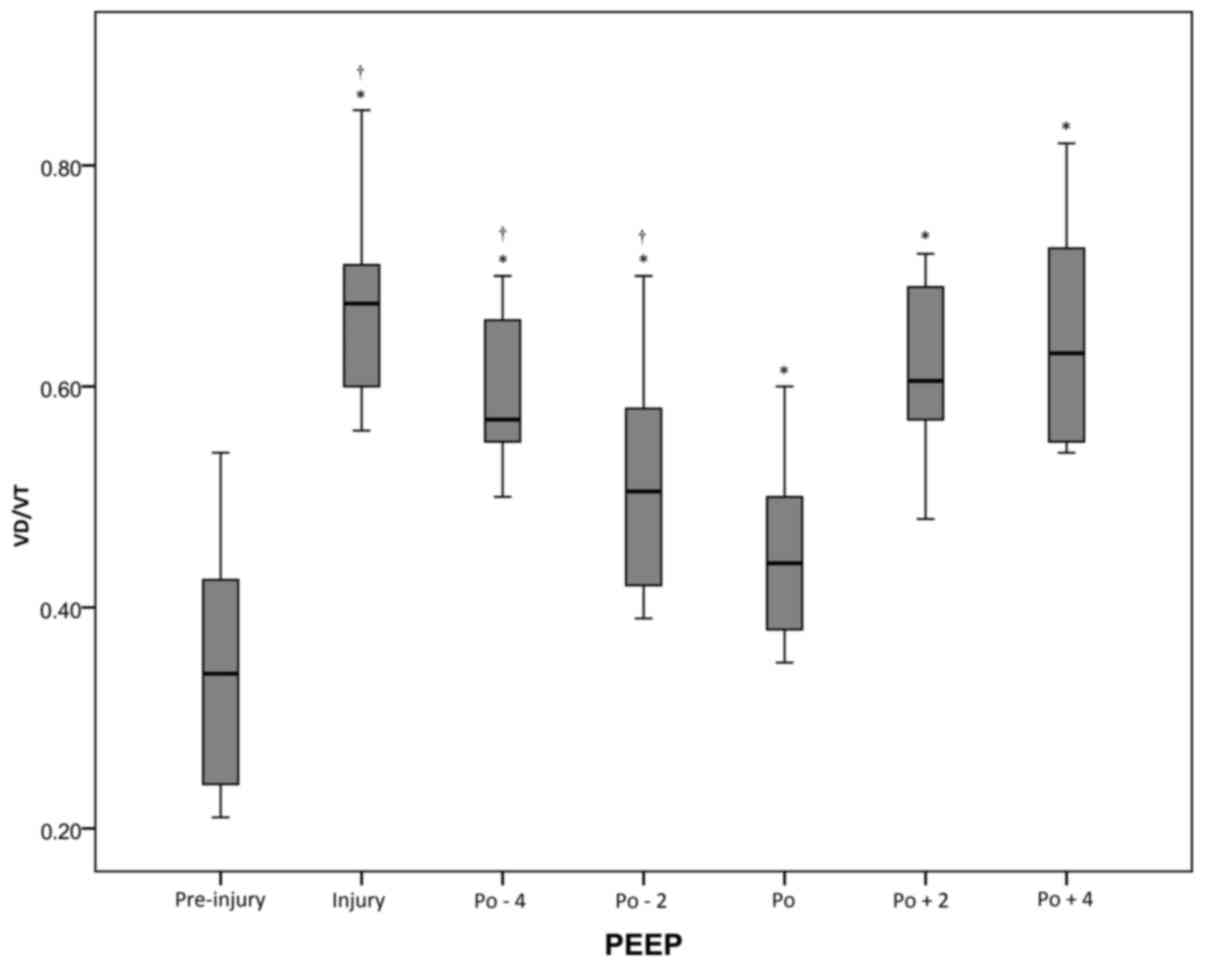
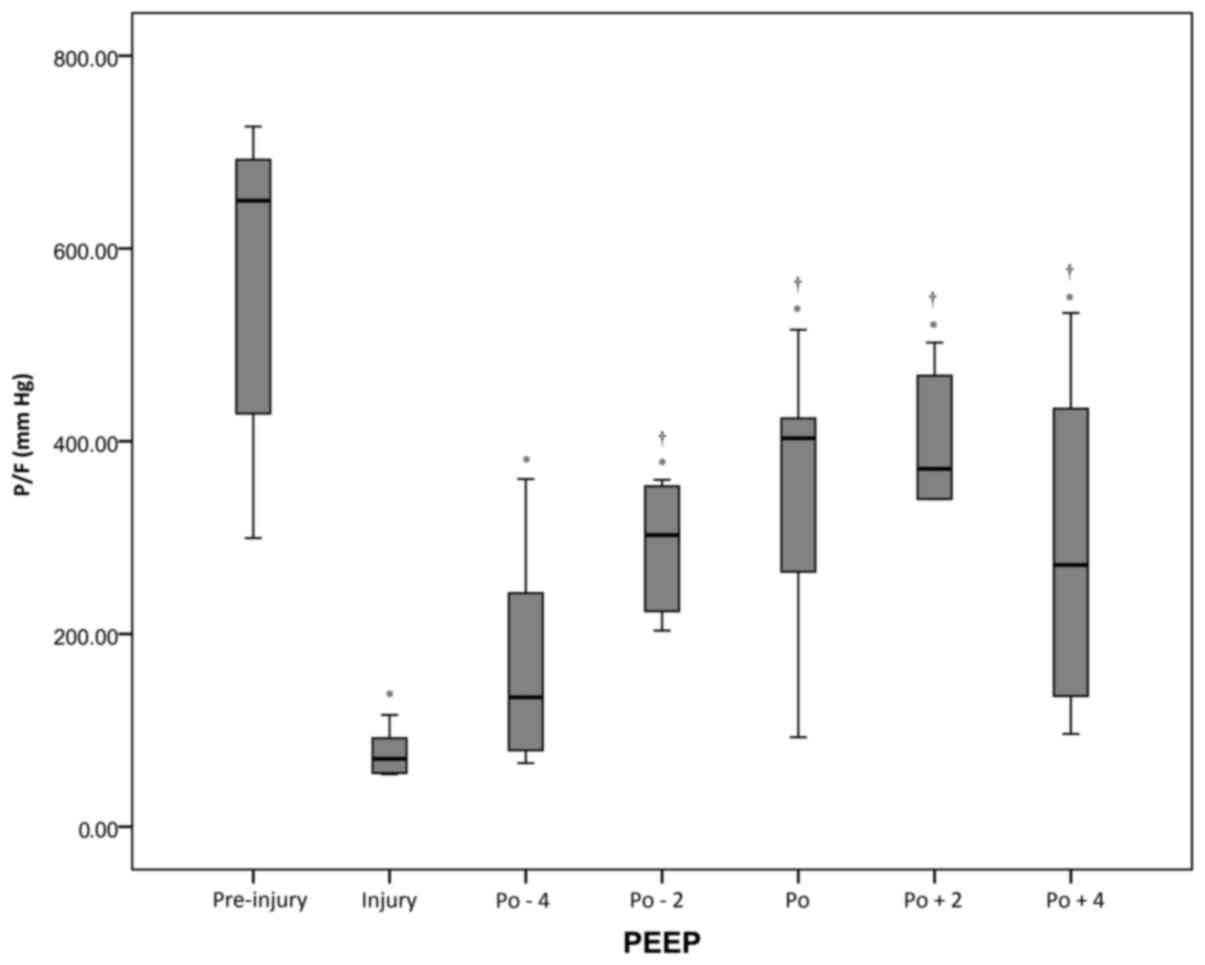
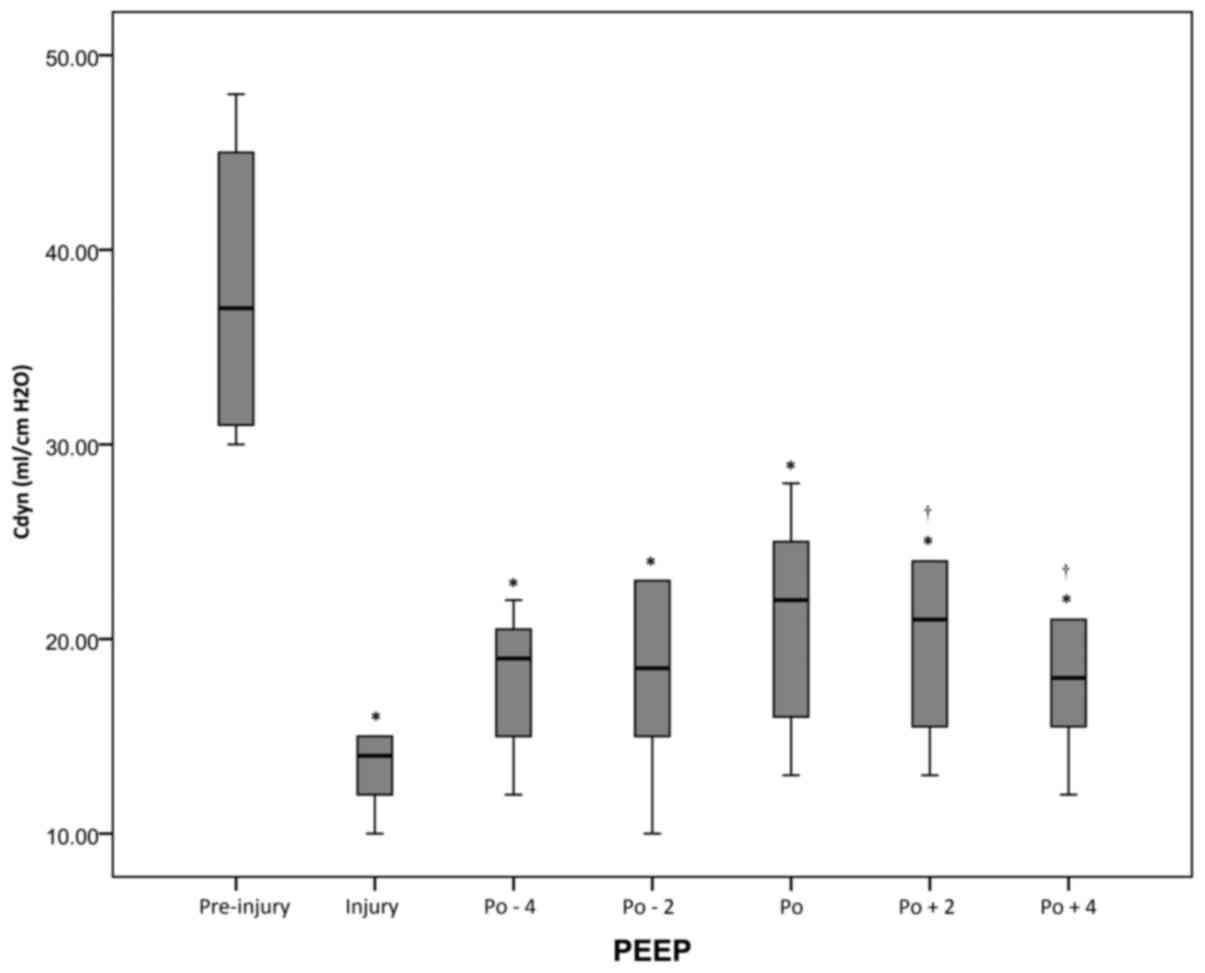
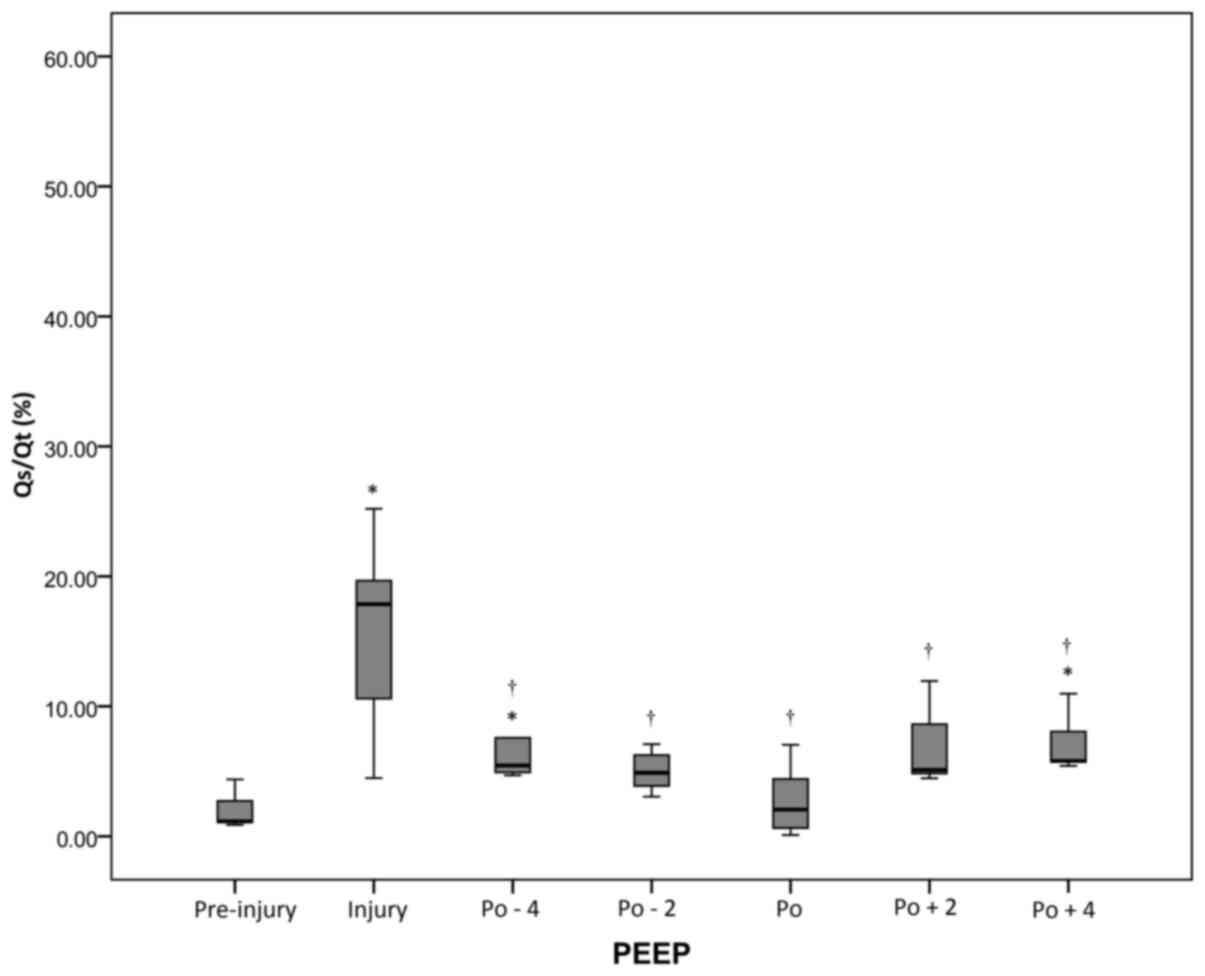
This study aimed to apply the dead space fraction [ratio of dead space to tidal volume (VD/VT)] to titrate the optimal positive end-expiratory pressure (PEEP) in a swine model of acute respiratory distress syndrome (ARDS). Twelve swine models of ARDS were constructed. A lung recruitment maneuver was then conducted and the PEEP was set at 20 cm H2O. The PEEP was reduced by 2 cm H2O every 10 min until 0 cm H2O was reached, and VD/VT was measured after each decrement step. VD/VT was measured using single‑breath analysis of CO2, and calculated from arterial CO2 partial pressure (PaCO2) and mixed expired CO2 (PeCO2) using the following formula: VD/VT = (PaCO2 ‑ PeCO2)/PaCO2. The optimal PEEP was identified by the lowest VD/VT method. Respiration and hemodynamic parameters were recorded during the periods of pre‑injury and injury, and at 4 and 2 cm H2O below and above the optimal PEEP (Po). The optimal PEEP in this study was found to be 13.25±1.36 cm H2O. During the Po period, VD/VT decreased to a lower value (0.44±0.08) compared with that during the injury period (0.68±0.10) (P<0.05), while the intrapulmonary shunt fraction reached its lowest value. In addition, a significant change of dynamic tidal respiratory compliance and oxygenation index was induced by PEEP titration. These results indicate that minimal VD/VT can be used for PEEP titration in ARDS.
View Figures

Figure 1

Figure 2

Figure 3

Figure 4

View References

1 

Phua J, Badia JR, Adhikari NK, Friedrich JO, Fowler RA, Singh JM, Scales DC, Stather DR, Li A, Jones A, et al: Has mortality from acute respiratory distress syndrome decreased over time? A systematic review. Am J Respir Crit Care Med. 179:220–227. 2009. View Article : Google Scholar : PubMed/NCBI

2 

Petty TL: Acute respiratory distress syndrome (ARDS). Dis Mon. 36:1–58. 1990.PubMed/NCBI

3 

Villar J, Blanco J, Añón JM, Santos-Bouza A, Blanch L, Ambrós A, Gandía F, Carriedo D, Mosteiro F, Basaldúa S, et al: The ALIEN study: Incidence and outcome of acute respiratory distress syndrome in the era of lung protective ventilation. Intensive Care Med. 37:1932–1941. 2011. View Article : Google Scholar : PubMed/NCBI

4 

Bull TM, Clark B, McFann K and Moss M: National Institutes of Health/National Heart, Lung, and Blood Institute ARDS Network: Pulmonary vascular dysfunction is associated with poor outcomes in patients with acute lung injury. Am J Respir Crit Care Med. 182:1123–1128. 2010. View Article : Google Scholar : PubMed/NCBI

5 

Lachmann B: Open up the lung and keep the lung open. Intensive Care Med. 18:319–321. 1992. View Article : Google Scholar : PubMed/NCBI

6 

Amato MB, Barbas CS, Medeiros DM, Magaldi RB, Schettino GP, Lorenzi-Filho G, Kairalla RA, Deheinzelin D, Munoz C, Oliveira R, et al: Effect of a protective-ventilation strategy on mortality in the acute respiratory distress syndrome. N Engl J Med. 338:347–354. 1998. View Article : Google Scholar : PubMed/NCBI

7 

Levy MM: PEEP in ARDS-how much is enough? N Engl J Med. 351:389–391. 2004. View Article : Google Scholar : PubMed/NCBI

8 

Sakuramoto H, Shimojo N, Jesmin S, Unoki T, Kamiyama J, Oki M, Miya K, Kawano S and Mizutani T: Repeated open endotracheal suctioning causes gradual desaturation but does not exacerbate lung injury compared to closed endotracheal suctioning in a rabbit model of ARDS. BMC Anesthesiol. 13:472013. View Article : Google Scholar : PubMed/NCBI

9 

Charron C, Repesse X, Bouferrache K, Bodson L, Castro S, Page B, Jardin F and Vieillard-Baron A: PaCO2 and alveolar dead space are more relevant than PaO2/FiO2 ratio in monitoring the respiratory response to prone position in ARDS patients: A physiological study. Crit Care. 15:R1752011. View Article : Google Scholar : PubMed/NCBI

10 

Fengmei G, Jin C, Songqiao L, Congshan Y and Yi Y: Dead space fraction changes during PEEP titration following lung recruitment in patients with ARDS. Respir Care. 57:1578–1585. 2012. View Article : Google Scholar : PubMed/NCBI

11 

Gattinoni L, Caironi P, Cressoni M, Chiumello D, Ranieri VM, Quintel M, Russo S, Patroniti N, Cornejo R and Bugedo G: Lung recruitment in patients with the acute respiratory distress syndrome. N Engl J Med. 354:1775–1786. 2006. View Article : Google Scholar : PubMed/NCBI

12 

Tusman G, Suarez-Sipmann F, Böhm SH, Pech T, Reissmann H, Meschino G, Scandurra A and Hedenstierna G: Monitoring dead space during recruitment and PEEP titration in an experimental model. Intensive Care Med. 32:1863–1871. 2006. View Article : Google Scholar : PubMed/NCBI

13 

Uttman L, Bitzén U, De Robertis E, Enoksson J, Johansson L and Jonson B: Protective ventilation in experimental acute respiratory distress syndrome after ventilator-induced lung injury: A randomized controlled trial. Br J Anaesth. 109:584–594. 2012. View Article : Google Scholar : PubMed/NCBI

14 

Beydon L, Uttman L, Rawal R and Jonson B: Effects of positive end-expiratory pressure on dead space and its partitions in acute lung injury. Intensive Care Med. 28:1239–1245. 2002. View Article : Google Scholar : PubMed/NCBI

15 

Blanch L, Lucangelo U, Lopez-Aguilar J, Fernandez R and Romero P: Volumetric capnography in patients with acute lung injury: Effects of positive end-expiratory pressure. Eur Respir J. 13:1048–1054. 1999. View Article : Google Scholar : PubMed/NCBI

16 

Higgs Z, Macafee D, Braithwaite B and Maxwell-Armstrong C: The Seldinger technique: 50 years on. Lancet. 366:1407–1409. 2005. View Article : Google Scholar : PubMed/NCBI

17 

Marshall W: Arterial blood gas analysis. Ann Clin Biochem. 47:283. 2010. View Article : Google Scholar

18 

Fletcher R, Jonson B, Cumming G and Brew J: The concept of deadspace with special reference to the single breath test for carbon dioxide. Br J Anaesth. 53:77–88. 1981. View Article : Google Scholar : PubMed/NCBI

19 

Fowler WS: Lung function studies; The respiratory dead space. Am J Physiol. 154:405–416. 1948.PubMed/NCBI

20 

Hofer CK, Furrer L, Matter-Ensner S, Maloigne M, Klaghofer R, Genoni M and Zollinger A: Volumetric preload measurement by thermodilution: A comparison with transoesophageal echocardiography. Br J Anaesth. 94:748–755. 2005. View Article : Google Scholar : PubMed/NCBI

21 

Quintel M, Pelosi P, Caironi P, Meinhardt JP, Luecke T, Herrmann P, Taccone P, Rylander C, Valenza F, Carlesso E and Gattinoni L: An increase of abdominal pressure increases pulmonary edema in oleic acid-induced lung injury. Am J Respir Crit Care Med. 169:534–541. 2004. View Article : Google Scholar : PubMed/NCBI

22 

Caramez MP, Kacmarek RM, Helmy M, Miyoshi E, Malhotra A, Amato MB and Harris RS: A comparison of methods to identify open-lung PEEP. Intensive Care Med. 35:740–747. 2009. View Article : Google Scholar : PubMed/NCBI

23 

Borges JB, Okamoto VN, Matos GF, Caramez MP, Arantes PR, Barros F, Souza CE, Victorino JA, Kacmarek RM, Barbas CS, et al: Reversibility of lung collapse and hypoxemia in early acute respiratory distress syndrome. Am J Respir Crit Care Med. 174:268–278. 2006. View Article : Google Scholar : PubMed/NCBI

24 

Ashbaugh DG, Bigelow DB, Petty TL and Levine BE: Acute respiratory distress in adults. Lancet. 2:319–323. 1967. View Article : Google Scholar : PubMed/NCBI

25 

Greene R, Zapol WM, Snider MT, Reid L, Snow R, O'Connell RS and Novelline RA: Early bedside detection of pulmonary vascular occlusion during acute respiratory failure. Am Rev Respir Dis. 124:593–601. 1981.PubMed/NCBI

26 

Dantzker DR, Brook CJ, Dehart P, Lynch JP and Weg JG: Ventilation-perfusion distributions in the adult respiratory distress syndrome. Am Rev Respir Dis. 120:1039–1052. 1979.PubMed/NCBI

27 

Idell S, Mazar AP, Bitterman P, Mohla S and Harabin AL: Fibrin turnover in lung inflammation and neoplasia. Am J Respir Crit Care Med. 163:578–584. 2001. View Article : Google Scholar : PubMed/NCBI

28 

Tomashefski JF Jr, Davies P, Boggis C, Greene R, Zapol WM and Reid LM: The pulmonary vascular lesions of the adult respiratory distress syndrome. Am J Pathol. 112:112–126. 1983.PubMed/NCBI

29 

Nuckton TJ, Alonso JA, Kallet RH, Daniel BM, Pittet JF, Eisner MD and Matthay MA: Pulmonary dead-space fraction as a risk factor for death in the acute respiratory distress syndrome. N Engl J Med. 346:1281–1286. 2002. View Article : Google Scholar : PubMed/NCBI

30 

Lucangelo U, Bernabè F, Vatua S, Degrassi G, Villagrà A, Fernandez R, Romero PV, Saura P, Borelli M and Blanch L: Prognostic value of different dead space indices in mechanically ventilated patients with acute lung injury and ARDS. Chest. 133:62–71. 2008. View Article : Google Scholar : PubMed/NCBI

31 

Maisch S, Reissmann H, Fuellekrug B, Weismann D, Rutkowski T, Tusman G and Bohm SH: Compliance and dead space fraction indicate an optimal level of positive end-expiratory pressure after recruitment in anesthetized patients. Anaesth Analg. 106:175–181. 2008. View Article : Google Scholar

32 

Coffey RL, Albert RK and Robertson HT: Mechanisms of physiological dead space response to PEEP after acute oleic acid lung injury. J Appl Physiol Respir Environ Exerc Physiol. 55:1550–1557. 1983.PubMed/NCBI

33 

Breen PH and Mazumdar B: How does positive end-expiratory pressure decrease CO2 elimination from the lung? Respir Physiol. 103:233–242. 1996. View Article : Google Scholar : PubMed/NCBI

34 

Anderson CT and Breen PH: Carbon dioxide kinetics and capnography during critical care. Crit Care. 4:207–215. 2000. View Article : Google Scholar : PubMed/NCBI

35 

Tang R, Huang Y, Chen Q, Hui X, Li Y, Yu Q, Zhao H, Yang Y and Qiu H: The effect of alveolar dead space on the measurement of end-expiratory lung volume by modified nitrogen wash-out/wash-in in lavage-induced lung injury. Respir Care. 57:2074–2081. 2012.PubMed/NCBI

36 

Suwa K, Hedley-Whyte J and Bendixen HH: Circulation and physiologic dead space changes on controlling the ventilation of dogs. J Appl Physiol. 21:1855–1859. 1966.PubMed/NCBI

Related Articles

  • Abstract
  • View
  • Download
  • Twitter
Copy and paste a formatted citation
Spandidos Publications style
Bian W, Chen W, Chao Y, Wang L, Li L, Guan J, Zang X, Zhen J, Sheng B, Zhu X, Zhu X, et al: Application of dead space fraction to titrate optimal positive end-expiratory pressure in an ARDS swine model. Exp Ther Med 13: 1572-1577, 2017.
APA
Bian, W., Chen, W., Chao, Y., Wang, L., Li, L., Guan, J. ... Zhu, X. (2017). Application of dead space fraction to titrate optimal positive end-expiratory pressure in an ARDS swine model. Experimental and Therapeutic Medicine, 13, 1572-1577. https://doi.org/10.3892/etm.2017.4117
MLA
Bian, W., Chen, W., Chao, Y., Wang, L., Li, L., Guan, J., Zang, X., Zhen, J., Sheng, B., Zhu, X."Application of dead space fraction to titrate optimal positive end-expiratory pressure in an ARDS swine model". Experimental and Therapeutic Medicine 13.4 (2017): 1572-1577.
Chicago
Bian, W., Chen, W., Chao, Y., Wang, L., Li, L., Guan, J., Zang, X., Zhen, J., Sheng, B., Zhu, X."Application of dead space fraction to titrate optimal positive end-expiratory pressure in an ARDS swine model". Experimental and Therapeutic Medicine 13, no. 4 (2017): 1572-1577. https://doi.org/10.3892/etm.2017.4117
Copy and paste a formatted citation
x
Spandidos Publications style
Bian W, Chen W, Chao Y, Wang L, Li L, Guan J, Zang X, Zhen J, Sheng B, Zhu X, Zhu X, et al: Application of dead space fraction to titrate optimal positive end-expiratory pressure in an ARDS swine model. Exp Ther Med 13: 1572-1577, 2017.
APA
Bian, W., Chen, W., Chao, Y., Wang, L., Li, L., Guan, J. ... Zhu, X. (2017). Application of dead space fraction to titrate optimal positive end-expiratory pressure in an ARDS swine model. Experimental and Therapeutic Medicine, 13, 1572-1577. https://doi.org/10.3892/etm.2017.4117
MLA
Bian, W., Chen, W., Chao, Y., Wang, L., Li, L., Guan, J., Zang, X., Zhen, J., Sheng, B., Zhu, X."Application of dead space fraction to titrate optimal positive end-expiratory pressure in an ARDS swine model". Experimental and Therapeutic Medicine 13.4 (2017): 1572-1577.
Chicago
Bian, W., Chen, W., Chao, Y., Wang, L., Li, L., Guan, J., Zang, X., Zhen, J., Sheng, B., Zhu, X."Application of dead space fraction to titrate optimal positive end-expiratory pressure in an ARDS swine model". Experimental and Therapeutic Medicine 13, no. 4 (2017): 1572-1577. https://doi.org/10.3892/etm.2017.4117
Follow us
  • Twitter
  • LinkedIn
  • Facebook
About
  • Spandidos Publications
  • Careers
  • Cookie Policy
  • Privacy Policy
How can we help?
  • Help
  • Live Chat
  • Contact
  • Email to our Support Team