Introduction
Traditional Chinese medicine (TCM) injections are
prepared from active substances extracted from TCMs and other
natural medicines to establish novel scientific and technological
methods, based on TCM hypotheses and experiences (1). The injections consist of various
sterile preparations for which the indications are described by TCM
terminology or TCM terminology combined with associated Western
medicine terminology (2). TCM
injections are Chinese characteristic modernized TCM preparations,
that are cost-effective, efficient, reliable and of high
bioavailability. Thus, these injections are widely used in the
clinic and are considered indispensable. In comparison with Western
medicines, TCM injections are usually composed of various TCM
components, and enter directly into the patient's bloodstream
(3,4). Thus, the risk of TCM injections is
higher than that of oral medication and adverse reactions including
allergy to TCM injections, or even death events due to severe
adverse reactions have been recently reported (5). The skin test of TCM injections prior to
use is considered a feasible method in the exclusion of the most
susceptible patients and to ensure the safety of these patients.
Numerous commercially available allergy skin test detectors,
however, have a simple structure and limited applications. Thus,
they are unable to be used in the allergy test of TCM injections
(6). Therefore, technology is
required to provide a fast allergy skin test detector for TCM
injections whereby a patient would be able to determine his/her
allergy to TCM injections through a skin test.
In the present study, a device was designed to
provide a fast allergy skin test detector for TCM injections that
could be applied to drugs of a single component or complex
components. Consequently, the patient would be able to determine
his/her allergy to TCM injections via a skin test, and avoid the
occurrence of adverse reactions to TCM injections.
Materials and methods
System design and working
principles
The fast allergy skin test detector for TCM
injections consists of the mainframe of the detector, skin test
electrode, and the percutaneous penetration device for drug
solution (7).
The mainframe of the detector
Key points of the structure
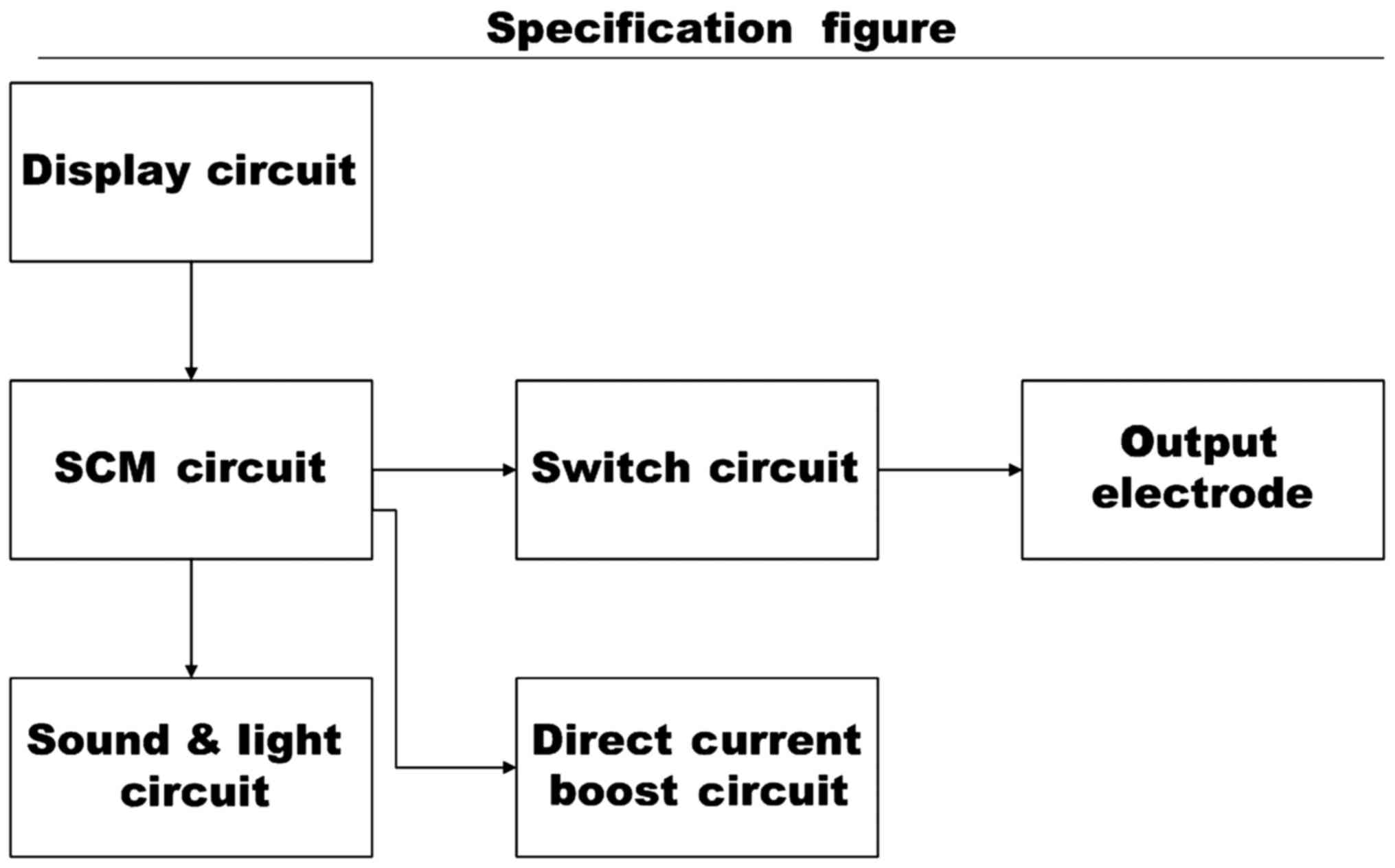
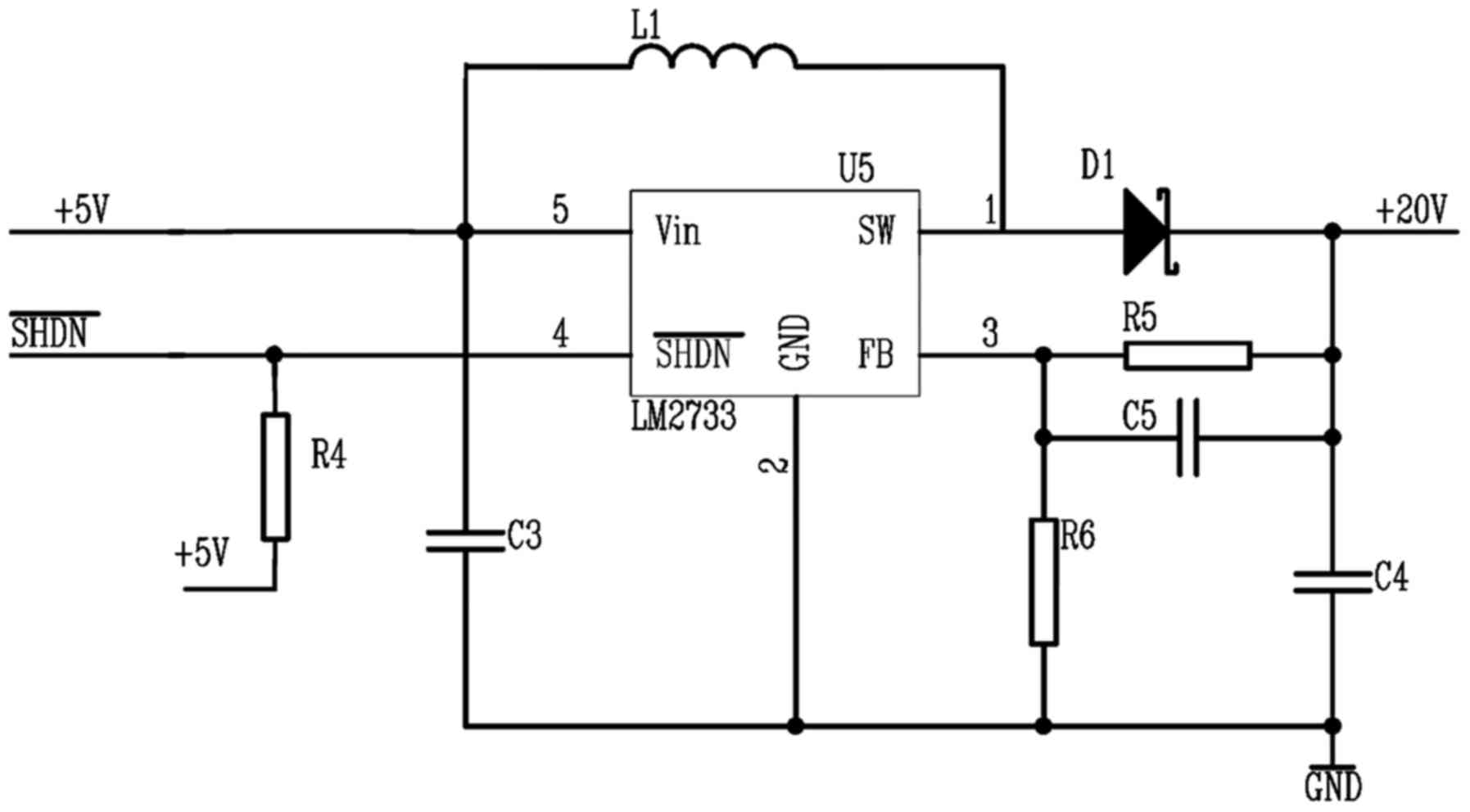
The fast allergy skin test detector for TCM
injections consisted of a single chip microcontroller (SCM)
circuit, display circuit, sound and light alarm circuit, switch
circuit, output electrode, and direct-current boost circuit
(Figs. 1–3). The SCM circuit was bidirectionally
connected to the switch circuit and the two output terminals of the
SCM circuit were connected to the display circuit and the sound and
light alarm circuit, respectively, while the other terminal of the
SCM circuit was connected to the corresponding input terminal of
the direct-current boost circuit. The output terminal of the switch
circuit was connected to the output electrode, and the output
terminal of the direct-current boost circuit was connected to the
corresponding power supply terminal of the switch circuit.
Working principles
Direct-constant power supply (+5 V) was superposed
to a high-amplitude pulse. If the drug was composed of a single
component, the pulse on the output electrode was a high-amplitude
pulse. By contrast, if the drug was composed of complex components,
the pulse on the output electrode was the superposition of a
high-amplitude pulse and +5 V.
Workflow of the fast allergy skin test detector
for TCM injections (
8)
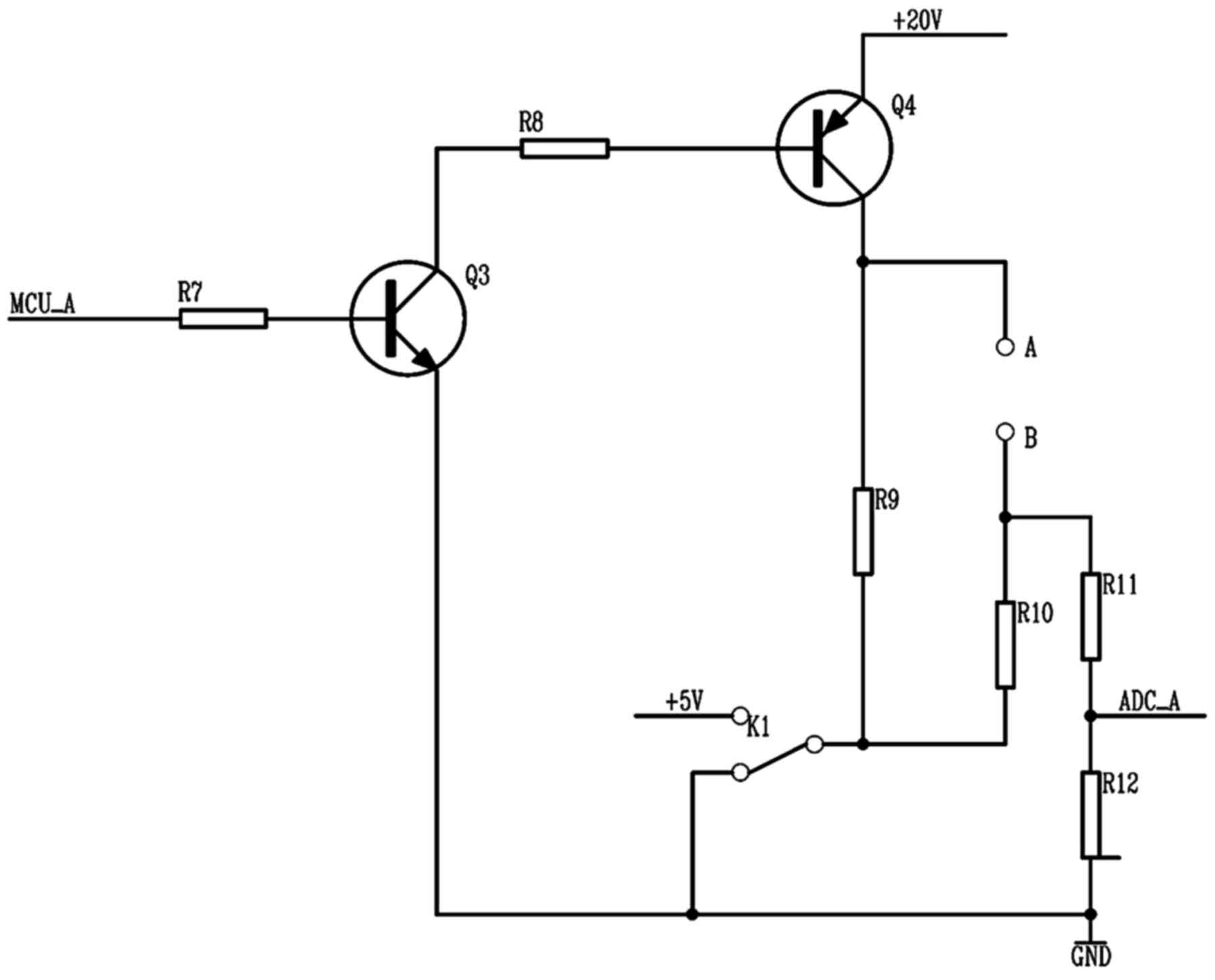
As shown in Fig. 4, a
high SCM U1 output led to a low-level output through MCU_A to
control the switch of Q3. The switch of Q4, which was controlled by
the switch of Q3, produced a pulse of 20 V, which acted on the skin
and accelerated the skin adsorption of the drug. The feedback
voltage produced in R12 was within the identifiable range of SCM
U1. If the contact between output electrode A or B and the skin was
poor (the feedback voltage was <0.1 V), SCM U1 detected this
voltage through ADC_A and gave an alarm through the sound and light
alarm circuit.
If switch K1 was in ground connection, and a single
pulse of 20-V amplitude was detected at output electrodes A and B,
it could be used to detect the allergy reactions of the drug of a
single component. If the switch K1 was connected to +5 V, and the
superposition of a pulse of 20-V amplitude and +5 V on output
electrodes A and B, it could be used to detect the allergy
reactions of drugs of complex components.
When the test began, SCM U1 began to time. SCM U1
monitored the sound and light alarm circuit to give an alarm when
the predefined time was reached, the digital tube showed ‘END’, and
the buzzer FM buzzed to notify the medical staff to check the
allergy. Digital tubes U2-U4 were used to display time, current
working status, or error alarm.
If SCM U1 detected a poor contact between the output
electrode and the skin, it would control the sound and light alarm
circuit to sound an alarm, and the digital tube showed ‘EEE’.
Skin test electrode (
9)
According to the application characteristics of the
TCM injections, the device incorporated four detection electrode
and corresponding percutaneous penetration devices for drug
solution, and increased the compatibility of control types for TCM
injections, i.e., 10% (or 5%) glucose injection and normal saline
injection were used as the solution and blank control,
respectively, in the skin test.
The device used the skin test electrodes with
different shapes according to the width of the patient's arm. A
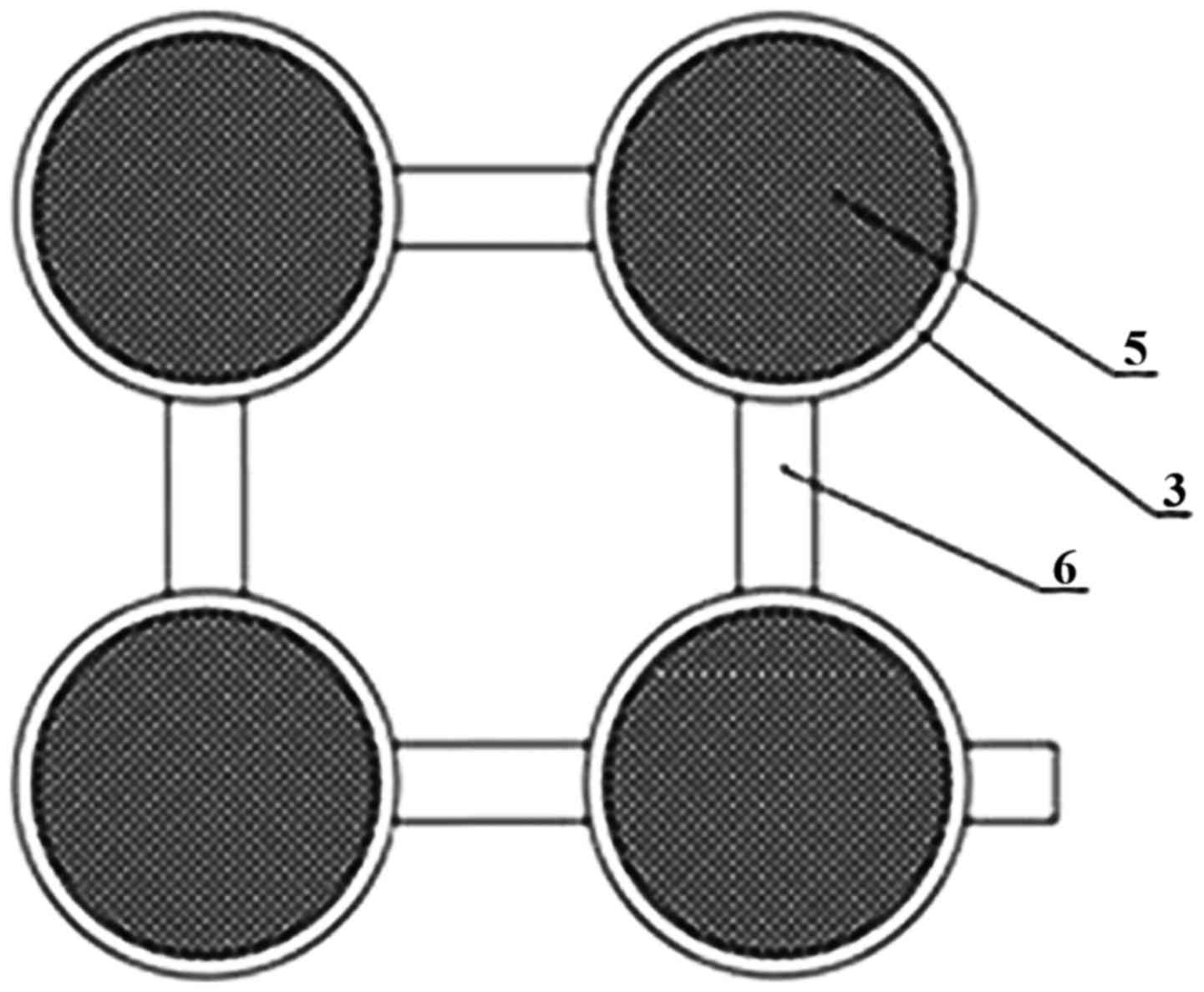
4-electrode ring was set in a square, whereas a 4-electrode ring
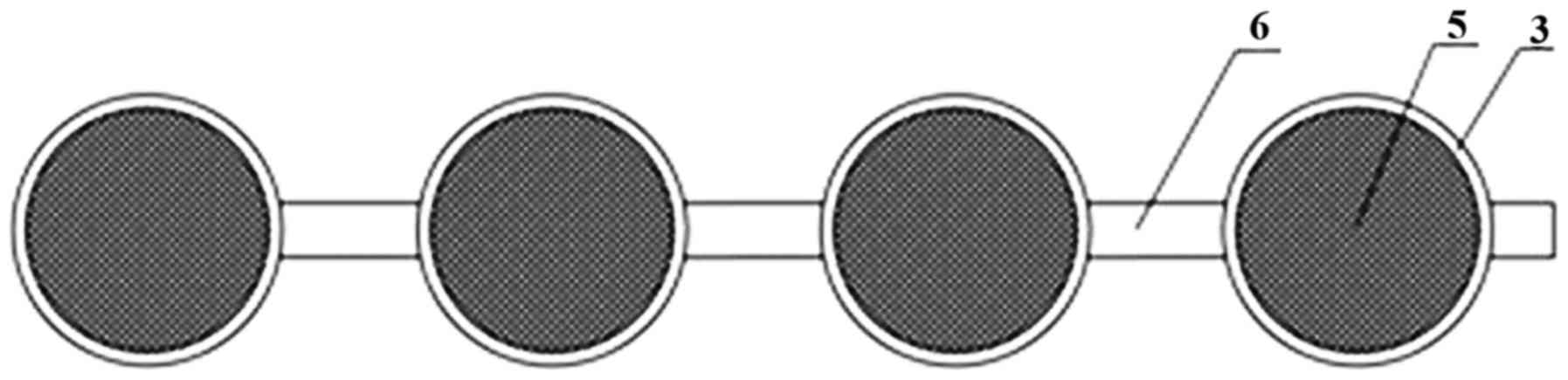
was set in a single line, to perform a test and control
analysis.
Percutaneous penetration device for drug solution
(
10)
The percutaneous penetration device for the drug
solution used a nano-sponge patch as the material that adsorbed the
skin test solution. Based on the physical adsorption, which was
dependent on the nano-capillary pore structure in the sponge, this
device spontaneously and completely adsorbed the components in the
TCM injection, and released the adsorbed components after slight
pressure.
The percutaneous penetration device for the drug
solution was covered by flexible liposome on the nano-sponge patch,
and the liposome improved the permeation of drugs by the skin. As
TCM injections were characteristic of many complex components,
which had a different skin permeation rate, this utility model
adsorbed various components, and enabled these components to
permeate completely into the skin tissue. Liposome coverage
membrane had a significant pro-permeation effect as the carrier of
percutaneous administration, especially for the macromolecular
drugs, such as polypeptides and proteins. Flexible liposome had
good deformability on pressure, as it could permeate intact skin,
and achieve effective drug concentration even with a low dose of
the drug. Consequently, the skin was able to completely adsorb the
tested TCM injections.
The permeation device was used for the drug solution
with different shapes and skin test electrodes, and was adjusted to
the different arm width of the test subjects.
A nano-sponge patch was used as the material that
adsorbed the skin test solution, thus it completely adsorbed and
released all the adsorbed TCM injection components.
Flexible liposome coverage was utilized, which
achieved an effective drug concentration even with a low dose of
the drug. Thus, the skin was able to completely adsorb the tested
TCM injections.
Detailed description of the fast allergy skin
test detector for TCM injections (
11)
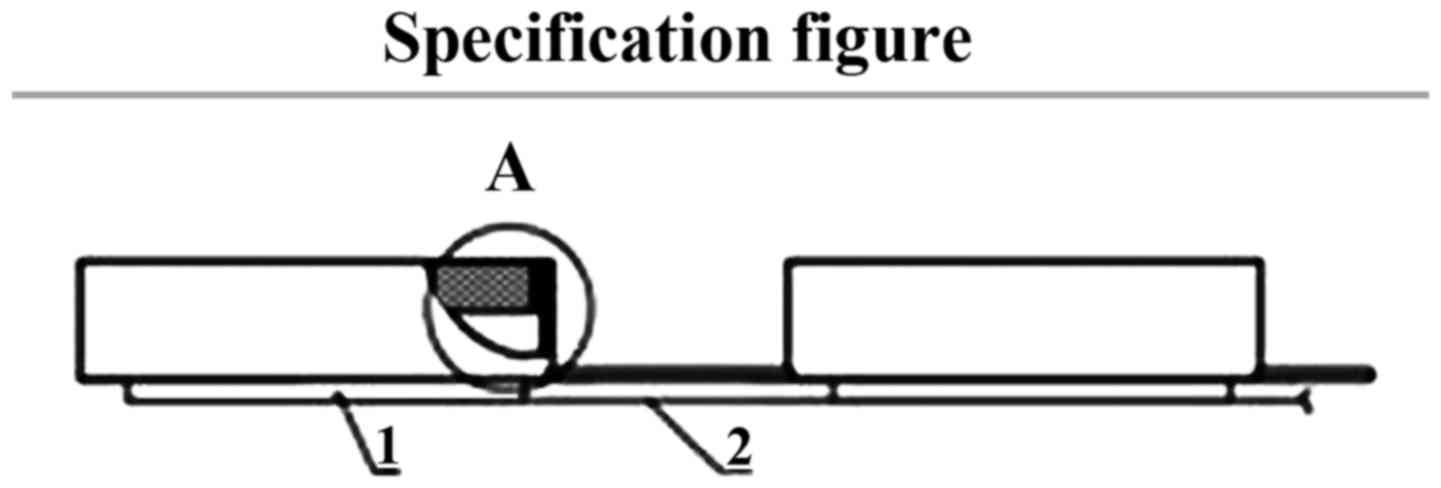
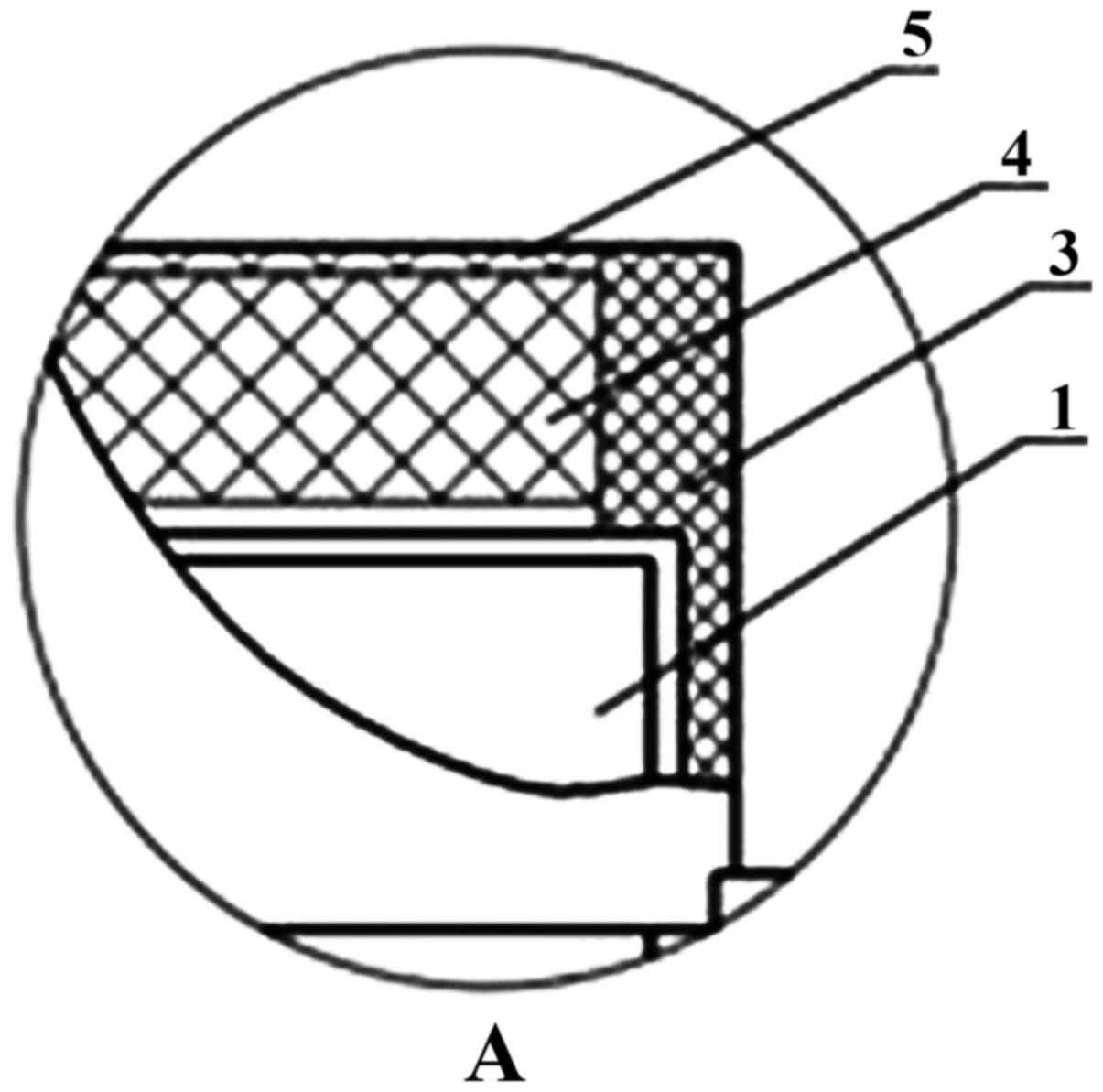
The percutaneous permeation device consisted of an
electrode 1 that was connected to the electronic pulse-transmitting
device through a connection wire 2 and the drug solution permeation
device that was mounted on electrode 1 (Figs. 5 and 6). The electronic pulse transmitter device
was either a direct constant electronic pulse transmitter device or
an ultrasonic-transmitting device. The drug solution permeation
device consisted of electrode collar 3 and connection band 6, which
fixed electrode collar 3 (Fig. 7).
Nano-sponge patch 4 was mounted on electrode collar 3, and liposome
membrane 5 was covered by nano-sponge patch 4. The outer surface of
nano-sponge patch 4 was inundated in liquid liposome to form
liposome membrane 5. An embodiment of this device is shown in
Fig. 7, with four electrode collars
arranged in the form of a square. Another embodiment of this device
is shown in Fig. 8, with four
electrode collars arranged in a line. The fixed electrode collar of
this device had a diameter of 0.8–1.2 mm and a height of 4.5–5.5
mm. The thickness of the nano-sponge patch 4 was 2.0–3.5 mm and
that of the liposome membrane 5 was 0.1–0.5 mm. According to the
characteristics of TCM injections, this device used >3 (usually
4) detection electrodes and corresponding drug solution permeation
devices, which increased the compatibility of the control types for
TCM injections, i.e., the skin test used 10% (or 5%) glucose
solution and normal saline as the solution and blank control
solution, respectively.
Drug solution permeation devices with different
shapes and compatible with the skin test electrode based on the
patient's arm width were employed.
Nano-sponge patch 4 was used as the material that
adsorbed the skin test solution. Based on the physical adsorption,
this device spontaneously and completely adsorbed the components in
the TCM injection, and released the adsorbed components after
slight pressure.
The permeation device used flexible liposome
membrane 5. Liposome formulation improved the drug permeability of
the skin. TCM injections were characterized by multiple components,
which were complex and had different permeability, thus each
component was adsorbed and permeated into the skin tissues. As the
percutaneous administration carrier, liposome membrane 5 had a
significant pro-permeation effect, especially for macromolecular
drugs such as peptides and proteins. Flexible liposome had a strong
compressional deformation ability, as it permeated the whole skin,
and achieved effective drug concentration even with
low-administration dose of the drug. Thus, the tested TCM
injections was completely adsorbed by the skin.
The nano-sponge was used as the material that
adsorbed the skin test solution. The nano-sponge completely
adsorbed and released the adsorbed TCM injection components.
Flexible liposome membrane 5 was used, and achieved
effective drug concentration even with a low administration dose of
the drug. Thus, the skin absorbed the tested TCM injections
completely. The electronic pulse-transmitting and
ultrasonic-transmitting devices used constituted the clinically
used pro-permeation electronic device. Prior to using this device,
the test site should be cleaned with sterile water for injection,
and the drug solution placed on the liposome membrane 5 on each
electrode collar 3. Electrode collar 3 should then be mounted on
the electrode 1. Liposome membrane 5 should then be adhered onto
test site closely, and the liposome membrane 5 should be fixed on
the interior arm (disinfected, the injection site of the skin
test). Electrode 1 should also be in direct contact with the skin.
Following activation of the electronic pulse-transmitting device
for 5 min, the buzzer could automatically record the time, at which
point, electrode 1 should be removed to observe the negative and
positive reactions.
Results
The functional characteristics of the fast allergy
skin test detector for TCM injections are simple structure,
convenient operation, wide application range, and its use for the
determination of multicomponent drugs (11). Based on the characteristics of the
TCM injections, the fast allergy skin test detector for TCM
injections used >3 (usually 4) detection electrodes and
corresponding drug solution permeation devices. It also increased
the compatibility of control types for TCM injections, that is, the
skin test used 10% (or 5%) glucose solution and normal saline as
the solution and blank control solution, respectively.
The fast allergy skin test detector for TCM
injections used the skin test electrodes with different shapes
according to the width of the patient's arm.
The fast allergy skin test detector for TCM
injections used the nano-sponge patch as the material that adsorbed
the skin test solution. Based on the physical adsorption, which was
dependent on the nano-capillary pore structure in the sponge, this
device spontaneously and completely adsorbed the components in the
TCM injection, and released the adsorbed components after slight
pressure.
The fast allergy skin test detector for TCM
injections used a flexible liposome membrane on the nano-sponge
patch. Liposome formulation improved the drug permeability of the
skin. TCM injections were characterized by multiple components,
which were complex and had different permeability. Thus, each
component was adsorbed and permeated into the skin tissues. As the
percutaneous administration carrier, the liposome membrane had a
significant pro-permeation effect, especially for the
macromolecular drugs such as peptides and proteins. Flexible
liposome had a strong compressional deformation ability, as it
permeated the whole skin, and achieved effective drug concentration
even with a low administration dose of the drug. Thus, the tested
TCM injections were completely adsorbed by the skin.
Discussion
As a novel TCM formulation, the TCM injection was
introduced in the 1970s-1980s and was extensively used clinically
(12). However, as TCM injections
had multiple TCM components, and entered the patient's blood
directly through an intravenous drip, the risk of clinical use of
TCM injections was much greater than that of oral TCM (13). Several adverse reactions due to
allergy to TCM injections have been reported in recent years, or
even mortality due to severe adverse reactions. However, many
investigators did not favor refusal or discontinuation of TCM
injections due to adverse reactions, including allergy (14). Allergy occurred in a certain
population with special physique (15), and some TCM injections had
irreplaceable characteristics in comparison with Western medicine,
such as cheapness, wide application range, efficiency, reliability
and of high bioavailability. Most medical experts in China
suggested that a skin test should be performed, regardless of any
TCM injection, and required a skin test in the drug instructions.
Subsequently, TCM injections were not administrated to subjects
with allergy.
Use of the skin test detector to perform skin test
is considered a common practice. Currently, there are a number of
commercially available skin test detectors for drug allergy, such
as YLM-II type Quick Allergy Skin Test Instrument (16), and QY-1A type High-speed Allergy Test
instrument. However, these detectors were limited to the use of
penicillins, cephalosporins, streptomycin, refined tetanus
antimycin and procaine, and could only be used in allergy tests for
the drugs of single component rather than drugs of complex
components (17). Therefore, they
could not be used in the allergy test of TCM injections (18). The fast allergy skin test detector
for TCM injections has become impoprtant in clinical practice to
allow the patient to determine any allergy to TCM injections
through a skin test.
We developed the novel fast allergy skin test
detector for TCM injections, combining the direct constant
technology based on the high-amplitude pulse, the permeation device
for drug solution with different shapes that is compatible with
skin test electrodes, nano-sponge patch adsorption, and flexible
liposome coverage. This device was characterized by a simple
structure, convenient operation, low-drug dose for a skin test,
human safety, and no irritation and low-false positive rate. Thus,
it could meet clinical requirements for clinical applications. We
have obtained five patents thus far and considered the clinical use
of this device in the prevention of allergy to TCM injections as
promising.
References
|
1
|
Li Y and Zhang J: Improvement and
enhancement of traditional Chinese medicine injections. Chin J Chin
Materia Med. 36:1905–1909. 2011.(In Chinese).
|
|
2
|
Cheng F and Liu Z: Safety evaluation of
traditional Chinese medicine injections and study of related key
technology. Chin J Chin Materia Med. 34:1052–1054. 2009.(In
Chinese).
|
|
3
|
Luo XY, Zhang FR and He RM: Efficacy of
shenfu injection as adjuvant therapy in treating patients of
ischemic cardiomyopathy with heart insufficiency. Chin J
Integrative Med. 29:685–687. 2009.
|
|
4
|
Zhu J, Kang L, Ye Q, Fan G, Liang Y, Yan C
and Orgah J: Effects of Shenfu injection and its main components on
the contraction of isolated rat thoracic aortic rings. PLoS One.
8:e780262013. View Article : Google Scholar : PubMed/NCBI
|
|
5
|
Wang HN and Tang JY: Discussion on
allergic reactions of traditional Chinese medicine injections and
its related research. Chin J Clin Pharmacol. 95:7052008.
|
|
6
|
Li S, Huang Y and Wang X: Clinical
observation of the effect of QY-1 fast skin test detector for
penicillin. Proc Navy Gen Hosp. 9:182–183. 2008.
|
|
7
|
State Intellectual Property Office of
People's Republic of China: Fast allergy skin test detector for TCM
injections. Patent ZL 2011 1 0039784.5.
|
|
8
|
State Intellectual Property Office of
People's Republic of China: Fast allergy skin test instrument for
TCM injections. Patent ZL 2011 2 0040746.7.
|
|
9
|
State Intellectual Property Office of
People's Republic of China: Fast allergy skin test detector for TCM
injections. Patent ZL 2011 2 0040745.2.
|
|
10
|
State Intellectual Property Office of
People's Republic of China: Allergy detector. Patent ZL 2011 2
0040742.9.
|
|
11
|
State Intellectual Property Office of
People's Republic of China: Fast allergy skin test instrument for
TCM injections. Patent ZL 2011 2 0040744.8.
|
|
12
|
Jiang JJ and Xie YM: Discussion on
establishment of quality control system for intensive hospital
monitoring on traditional Chinese medicine injections. Chin J Chin
Materia Med. 37:2689–2691. 2012.(In Chinese).
|
|
13
|
Guo XE, Zhao YB, Xie YM, Zhao LC, Li YF
and Hao Z: Establishment of model of traditional Chinese medicine
injections post-marketing safety monitoring. Chin J Chin Materia
Med. 38:2974–2978. 2013.(In Chinese).
|
|
14
|
Wang HN, Chen W, Fu Z, Du WM and He J:
Necesity of applying pharmacovigilance in post-marketing safety
monitoring of traditional Chinese medicine injections. Chin J Chin
Materia Med. 33:612–614. 2008.(In Chinese).
|
|
15
|
Li H, Deng J, Yue Z, Zhang YX and Sun H:
Detecting drug - herbal interaction using a spontaneous reporting
system database: an example with benzylpenicillin and qingkailing
injection. Eur J Clin Pharmacol. 71:1139–1145. 2015. View Article : Google Scholar : PubMed/NCBI
|
|
16
|
Yang WM: YLM-II type quick allergy skin
test instrument of the clinical effect observation. Med Inf.
26:1402013.(In Chinese).
|
|
17
|
Zhou W, Yang J, You J and Xu C: Parallel
and Self-control observation on Skin Test of High-speed Allergy
Test instrument. J Nurs (China). 17:58–59. 2010.
|
|
18
|
Huang W and Zhang H: Clinical observation
of skin test detector in the skin tests of sodium penicillin,
cefazolin sodium and tetanus antitoxin. Chin J Mod Nurs.
16:175–176. 2010.
|