Introduction
The prognosis of small cell lung cancer (SCLC)
remains poor, although modest improvements in survival have been
achieved. The proportion of SCLC among all histological types of
lung cancer decreased from 17.26% in 1986 to 12.95% in 2002
(1). Although SCLC is sensitive to
first-line chemotherapy and radiotherapy, the majority of patients
experience relapse within 2 years and succumb to systemic
metastasis. The 5-year survival rate of limited stage SCLC is 15%
or less and the 2-year survival of extensive stage SCLC is
5.2–19.5% (1,2). Temozolomide, a chemotherapeutic drug,
is a suitable option for relapsed SCLC, particularly when brain
metastases are present (3,4), and it has been recommended for
second-line treatment of SCLC in the National Comprehensive Cancer
Network guidelines (5). In a phase
II study of the efficacy of temozolomide in the treatment of SCLC,
Pietanza et al (3)
established the methylation status of the
O6-methyl-guanine-DNA methyltransferase (MGMT) promoter
in 27 patients, and found that the overall promoter methylation
rate in those patients was 48%. A significantly greater proportion
of cases with methylated MGMT exhibited a response to temozolomide
compared with those with unmethylated MGMT (38 vs. 7%; P=0.08).
These results suggest that the response to temozolomide treatment
may be associated with the MGMT methylation status in SCLC
(3). Temozolomide administered at a
dose of 200 mg/m2/day for 5 days in 28-day cycles is
tolerable and active in patients with relapsed SCLC (4). The incidence of mutations in the
epidermal growth factor receptor in non-small cell lung cancer is
higher in China than in the United States and European countries
(6,7). The difference in MGMT methylation rates
among China, the United States and European countries remains
unknown and, to the best of our knowledge, there are currently no
reports on the status of MGMT promoter methylation for SCLC in
China.
Mutations of isocitrate dehydrogenase (IDH)1 and
IDH2 are the most frequent genomic alterations detected in gliomas,
affecting 40% of these tumors, and are some of the earliest
aberrations occurring in gliomagenesis (8). IDH mutations have been found to be
independent prognostic factors of a good outcome for glioma, and
IDH mutation appears to be a significant marker of chemosensitivity
in secondary glioblastoma (8). A
study of secondary glioblastomas indicated that the combined use of
the IDH status and MGMT promoter status may be deserving and
appropriate for examination as a stratification factor in clinical
trials involving the use of temozolomide for the treatment of
patients with secondary glioblastoma (9). However, prognostic and predictive
values of IDH1/2 mutation for chemosensitivity in SCLC are unknown
and further studies are required for clarification. Therefore, it
would be valuable to elucidate the status of MGMT methylation and
IDH1/2 mutation in SCLC patients treated with temozolomide.
In the present study, MGMT promoter methylation in
resected SCLC specimens was detected by the use of polymerase chain
reaction (PCR) amplification and Sanger sequencing. The IDH1/IDH2
mutation was identified by methylation-specific PCR (MSP) and
high-resolution melting (HRM) analysis.
Materials and methods
Patient characteristics
A total of 33 SCLC specimens were retrospectively
collected in Zhejiang Cancer Hospital (Hangzhou, China) between
April 2008 and June 2014. All specimens were obtained from SCLC
patients who underwent surgery. A total of 3 patients received
pneumonectomy with lymph node dissection, 1 patient received wedge
resection with lymph node dissection, and 29 patients received
lobectomy with lymph node dissection. All patients were diagnosed
with conventional SCLC, the pathological diagnosis of which was
based on the standard criteria defined by WHO classification
(10). The stage was classified
according to seventh edition of the TNM classification for lung
cancer as follows: IA, 9 cases; IB, 5 cases; IIA, 4 cases; IIB, 3
cases; IIIA, 11 cases; and IIIB, 1 case. The 33 specimens were
obtained from 6 female and 27 male patients (age range, 38 to 77
years; median age, 58 years; body weight range, 44 to 80 kilograms;
median body weight, 66 kilograms). There were 6 non-smokers, 2
light smokers (≤10 pack-years), 5 moderate smokers (10–20
pack-years) and 20 heavy smokers (≥20 pack-years). The median
pack-years of smoking history was 30 (Table I). The present study was approved by
the Ethics Committee of Zhejiang Cancer Hospital. The patient
specimens were retrospectively collected and, as a number of
patients were deceased, exempt written informed consent was also
approved by the Ethics Committee of Zhejiang Cancer Hospital. A
total of 21 patients signed the written informed consent prior to
surgery to preserve their specimens in Biological Sample Bank of
Zhejiang Cancer Hospital to be used for research.
 | Table I.Clinical characteristics of the
patients with small cell lung cancer. |
Table I.
Clinical characteristics of the
patients with small cell lung cancer.
| Characteristics | Cases (n) |
|---|
| Sex |
|
| Male | 27 |
|
Female | 6 |
| Location |
|
| Right
lung | 16 |
| Left
lung | 17 |
| Smoking |
|
|
Non-smoker | 6 |
| Light
smoker (≤10 pack-years) | 2 |
| Moderate
smoker (≤10 pack-years) | 5 |
| Heavy
smoker smokers (≥20 pack-years) | 20 |
| Stage |
|
| IA | 9 |
| IB | 5 |
| IIA | 4 |
| IIB | 3 |
| IIIA | 11 |
| IIIB | 1 |
MSP and HRM analysis
DNA methylation pattern in the CpG island of the
MGMT gene was determined by nested MSP of bisulphite-converted DNA.
DNA bisulfite conversion was conducted using an EZ DNA methylation
kit (Zymo Research Corporation, Irvine, CA, USA) following the
manufacturer's protocol. DNA was treated with sodium bisulfite, to
convert all unmethylated cytosine residues to uracil, whereas
methylated cytosine remained unchanged. Bisulfite-converted DNA was
stored at −70°C until use. The primer sequences used for nested
MSP, methylated and unmethylated PCR are listed in Table II. For the first round of PCR
amplification, 2 µl bisulfite-modified DNA was used in a final
volume of 30 µl reaction mixture containing the template DNA
(>50 ng), forward and reverse MGMT-outside primers and (0.5 pM),
2X SYBR premix (Bioer Technology Co., Ltd., Hangzhou, China).
Amplification was completed in a Mx3000P Thermal Cycler
(Stratagene; Agilent Technologies, Inc., Santa Clara, CA, USA)
under the following conditions: initial denaturation at 95°C for 3
min, 35 cycles each comprising denaturation at 94°C for 30 sec,
annealing at 59°C for 30 sec and extension at 72°C for 30 sec,
followed by a final extension at 72°C for 5 min. The resulting PCR
products of MGMT served as a template for the second MSP. The PCR
product from the first step was subjected to the second round of
PCR with MGMT forward and reverse primers specific for methylated
(MGMT-M) and unmethylated (MGMT-U) sequences of MGMT promoter
(Table II). Amplification was
completed under the following conditions: Initial denaturation at
95°C for 3 min, 40 cycles of denaturation each at 95°C for 30 sec,
annealing at 59°C for 30 sec and extension at 72°C for 30 sec
followed by final extension at 72°C for 4 min. The PCR products
were subjected to HRM analysis using a Light Cycler Nano (Roche
Diagnostics GmbH, Mannheim, Germany) according to its high
resolution melting software in one cycle of 97°C for 1 min and a
melting range temperature of 70–95°C, rising by 0.2°C per
second.
| Table II.Sequences of primers for MGMT
detection. |
Table II.
Sequences of primers for MGMT
detection.
| Primer | Direction | Sequence of
primers |
|---|
| MGMT-O | Forward |
GYGTTTYGGATATGTTGGGATAGTT |
| MGMT-O | Reverse |
AAACTCCRCACTCTTCCRAAAAC |
| MGMT-M | Forward |
TTTCGACGTTCGTAGGTTTTCGC |
| MGMT-M | Reverse |
GCACTCTTCCGAAAACGAAACG |
| MGMT-U | Forward |
TTTGTGTTTTGATGTTTGTAGGTTTTTGT |
| MGMT-U | Reverse |
AACTCCACACTCTTCCAAAAACAAAACA |
IDH1 and IDH2 mutation detection
Mutational analyses of IDH1 (R132) and IDH2 (R172)
were performed using PCR amplification and Sanger sequencing. The
genomic DNA was extracted from paraffin-embedded tumor tissue using
an EASYspin FFPE DNA isolation kit (Aidlab Biotechnologies Co.,
Ltd., Beijing, China) according to the protocol of the manufacture.
The primer sequences used for PCR are provided in Table III. PCR amplification was performed
using a Mx3000P Thermal Cycler (Stratagene; Agilent Technologies,
Inc., Santa Clara, CA, USA) under the following conditions: 95°C
for 2 min, then 40 cycles of 94°C for 30 sec, 57°C for 30 sec and
72°C for 30 sec. The final elongation step was at 72°C for 5 min.
The PCR products were sequenced using an Applied Biosystems 3500
sequencer using IDH1/2 forward primer (Table III).
| Table III.Sequences of primers for IDH1/2
detection. |
Table III.
Sequences of primers for IDH1/2
detection.
| Primer | Direction | Sequence of
primers |
|---|
| IDH1 | Forward |
CTCCTGATGAGAAGAGGGTTG |
| IDH1 | Reverse |
TGGAAATTTCTGGGCCATG |
| IDH2 | Forward |
TGGAACTATCCGGAACATCC |
| IDH2 | Reverse |
AGTCTGTGGCCTTGTACTGC |
Statistical analysis
SPSS 15.0 software (SPSS, Inc., Chicago, IL, USA)
was used for the Chi-square analysis. P<0.05 was considered to
indicate a statistically significant difference.
Results and Discussion
MGMT promoter methylation was detected in 17
patients and the MGMT promoter methylation rate in SCLC was 51.5%
in the present cohort. No significant difference was observed
between patients with MGMT methylation and without MGMT methylation
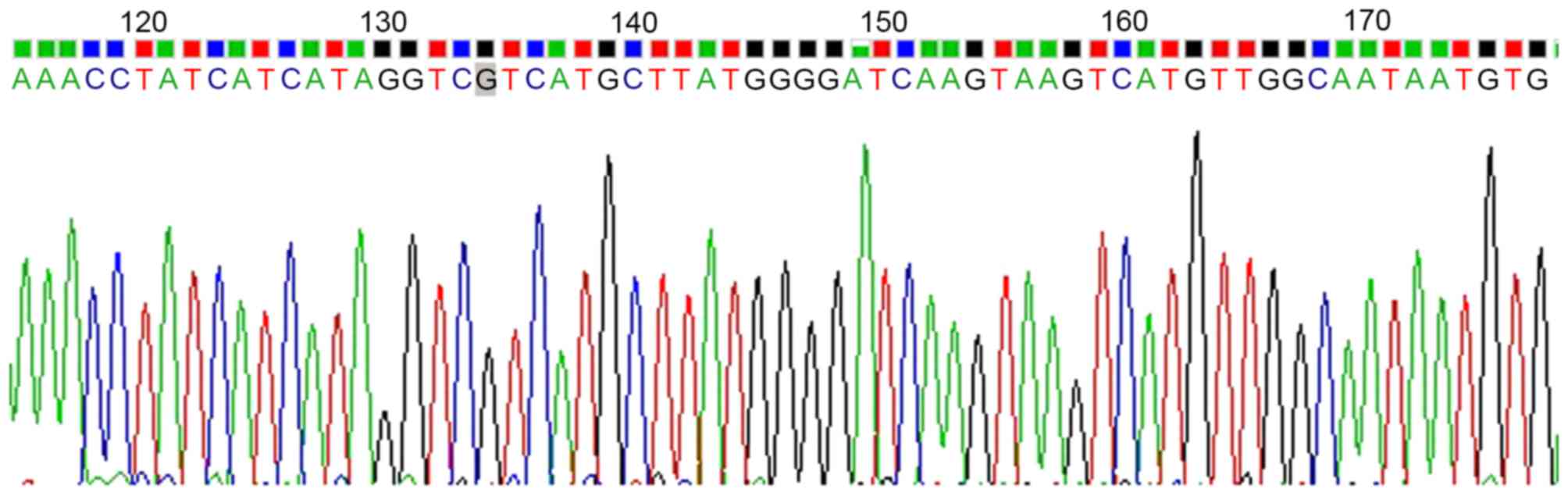
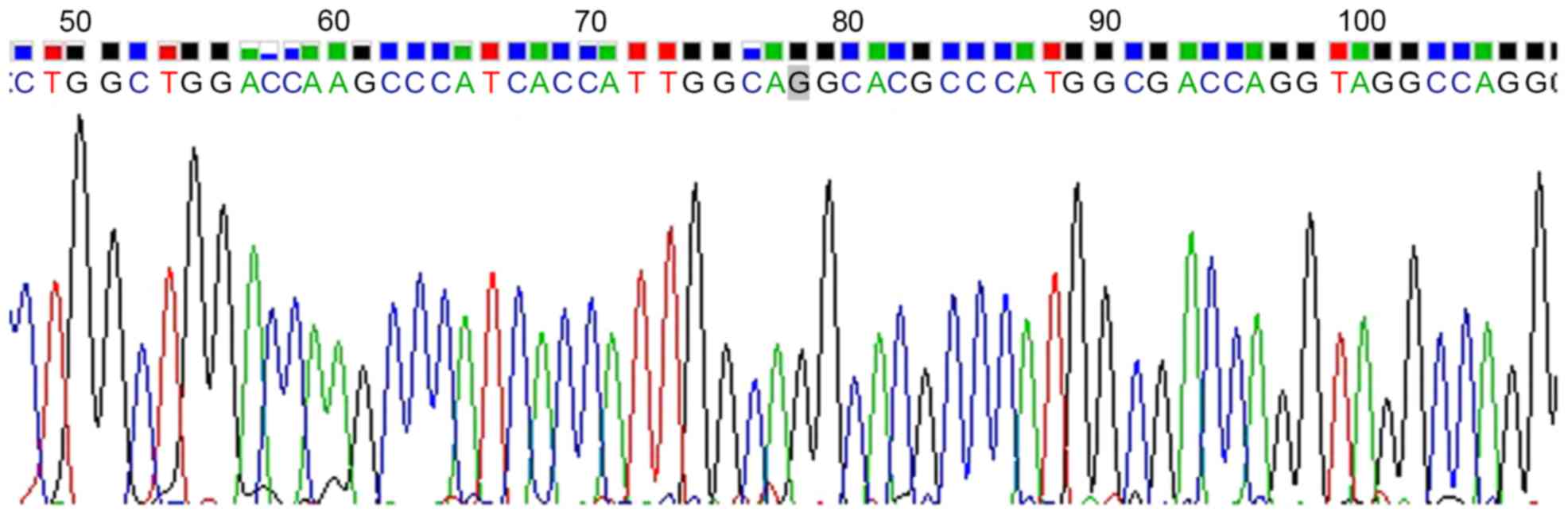
in terms of age, sex and smoking history (Table IV). Furthermore, no IDH1/2 mutation
was detected in the 33 examined SCLC specimens (Figs. 1 and 2).
| Table IV.Clinical features of 33 patients with
small cell lung cancer with and without
O6-methyl-guanine-DNA methyltransferase methylation. |
Table IV.
Clinical features of 33 patients with
small cell lung cancer with and without
O6-methyl-guanine-DNA methyltransferase methylation.
| Clinical
features | Methylation | Without
methylation | P-value |
|---|
| Patients | 17 | 16 | – |
| Median age
(years) | 55 | 60 | 0.58 |
| Sex
(female/male) | 4/13 | 3/13 | 0.935 |
| Smoking history
(median pack-years) | 23 | 40 | 0.29 |
Temozolomide is an alkylating agent that is widely
used in the chemotherapy of cancer (11,12). The
enzyme MGMT, via its dealkylating effect, repairs potentially
tumorigenic DNA mismatches caused by environmentally induced
alkylation, but also acts against the effects of alkylating
molecules that are administered in the chemotherapy of different
types of cancer (13). MGMT is the
primary mediator of the alkylator resistance of glioma cells.
Epigenetic silencing of the MGMT gene in glioma cells by promoter
methylation compromises the DNA repair mechanism and thus increases
chemosensitivity to alkylating drugs. Therefore, MGMT promoter
methylation is a strong prognostic biomarker in pediatric and adult
patients with glioblastoma that are treated with temozolomide
(14). There have been few
investigations on MGMT in SCLC, despite the use of temozolomide in
relapsed SCLC. The response of SCLC to temozolomide may be
associated with MGMT methylation (3). The rate of MGMT promoter methylation
was 51.5% in the present study, which was close to that reported by
Pietanza et al (48%) (3) and
Miglio et al (35.2%) (15).
In the study conducted by Miglio et al (15), results from methylation analysis were
obtained in 54 samples (54/56) and failed in two bronchial washes.
The MGMT promoter was methylated in 35.2% of the cases without any
significant difference between histological and cytological samples
(37.9 vs. 32%) (15). All specimens
in the current study were collected from surgery, and they may
better reflect the respective pathological characteristics.
However, it is very difficult to obtain tissues from surgery
because only ~5% of SCLC patients with a TNM stage of T1-2N0M0 are
suitable for surgery. In MGMT promoter methylation detection,
cytological samples may be a substitution for histological samples.
These results indicate that the rate of MGMT promoter methylation
in patients with SCLC from China may be higher than that in those
from the USA and European countries. This difference may be
attributable to different ethnicities, specimen sources and limited
sample quantity. Elucidation of the predictive prognostic value of
MGMT promoter methylation in patients with relapsed SCLC treated
with temozolomide in China is required.
IDH occurs in three isoforms: IDH1, located in the
cytoplasm; IDH2, located in the mitochondria; and IDH3, which
functions as part of the tricarboxylic acid cycle. IDH catalyzes
the conversion of isocitrate to α-ketoglutarate (α-KG). Mutations
in the active site of IDH1 at position R132 and an analogous
mutation in the IDH2 gene at position R172 have been identified
(16). IDH1 catalyzes the oxidative
decarboxylation of isocitrate to α-KG and in parallel converts
nicotinamide adenine dinucleotide phosphate (NADP+) to
NADPH. The mutant IDH1 acquires novel enzyme activity, converting
α-KG to D-2-hydroxyglutarate, an action that is competitive and
inhibitory to that of α-KG. As a result, the activity of
α-KG-dependent enzyme is reduced (17). IDH2 is a mitochondrial NADP-dependent
isocitrate dehydrogenase identified to be a tumor suppressor in
different types of tumors (18). The
prognosis of Grade II and III glioma was improved in patients with
an IDH mutation, compared with those without the mutation (19,20). The
IDH mutation was associated with a higher response rate to
temozolomide therapy (21). The IDH1
mutation caused cell cycle arrest at the G1 stage and a reduction
of proliferation and invasion ability, while raising sensitivity to
chemotherapy (22). No IDH1/2
mutations in SCLC were detected in the current study, which may be
due to the limited sample quantity, as all samples were acquired
from surgical specimens and only ~5% of SCLC patients with a TNM
stage of T1-2N0M0 were suitable for surgery. The IDH1/2 mutation
may not be an ideal marker in SCLC patients treated with
temozolomide.
In conclusion, findings from the present study
suggest that the rate of MGMT promoter methylation in patients with
SCLC from China may be higher than those from the USA and European
countries. Future studies on the predictive and prognostic value of
MGMT promoter methylation are urgently required to aid in the
treatment for relapsed patients with SCLC that have been treated
with temozolomide.
Acknowledgements
The present study was supported by Zhejiang Province
Medical Science Fund Project of China (grant no. 2015ZHA006) and
the 1022 Talent Training Program of Zhejiang Cancer Hospital.
Glossary
Abbreviations
Abbreviations:
|
SCLC
|
small cell lung cancer
|
|
MGMT
|
O6-methyl-guanine-DNA
methyltransferase
|
|
IDH
|
isocitrate dehydrogenase
|
|
PCR
|
polymerase chain reaction
|
|
HRM
|
high-resolution melting
|
|
MSP
|
methylation-specific polymerase chain
reaction
|
|
α-KG
|
α-ketoglutarate
|
|
NADP
|
nicotinamide adenine dinucleotide
phosphate
|
References
|
1
|
Govindan R, Page N, Morgensztern D, Read
W, Tierney R, Vlahiotis A, Spitznagel EL and Piccirillo J: Changing
epidemiology of small-cell lung cancer in the United States over
the last 30 years: Analysis of the surveillance, epidemiologic, and
end results database. J Clin Oncol. 24:4539–4544. 2006. View Article : Google Scholar : PubMed/NCBI
|
|
2
|
Chen J, Jiang R, Garces YI, Jatoi A,
Stoddard SM, Sun Z, Marks RS, Liu Y and Yang P: Prognostic factors
for limited-stage small cell lung cancer: A study of 284 patients.
Lung Cancer. 67:221–226. 2010. View Article : Google Scholar : PubMed/NCBI
|
|
3
|
Pietanza MC, Kadota K, Huberman K, Sima
CS, Fiore JJ, Sumner DK, Travis WD, Heguy A, Ginsberg MS, Holodny
AI, et al: Phase II trial of temozolomide in patients with relapsed
sensitive or refractory small cell lung cancer, with assessment of
methylguanine-DNA methyltransferase as a potential biomarker. Clin
Cancer Res. 18:1138–1145. 2012. View Article : Google Scholar : PubMed/NCBI
|
|
4
|
Zauderer MG, Drilon A, Kadota K, Huberman
K, Sima CS, Bergagnini I, Sumner DK, Travis WD, Heguy A, Ginsberg
MS, et al: Trial of a 5-day dosing regimen of temozolomide in
patients with relapsed small cell lung cancers with assessment of
methylguanine-DNA methyltransferase. Lung Cancer. 86:237–240. 2014.
View Article : Google Scholar : PubMed/NCBI
|
|
5
|
National Comprehensive Cancer Network, .
NCCN Clinical Practice Guidelines in OncologySmall Cell Lung Cancer
version 2.2017. Fort Washington; PA: 2016
|
|
6
|
Wu YL, Zhong WZ, Li LY, Zhang XT, Zhang L,
Zhou CC, Liu W, Jiang B, Mu XL, Lin JY, et al: Epidermal growth
factor receptor mutations and their correlation with gefitinib
therapy in patients with non-small cell lung cancer: A
meta-analysis based on updated individual patient data from six
medical centers in mainland China. J Thorac Oncol. 2:430–439. 2007.
View Article : Google Scholar : PubMed/NCBI
|
|
7
|
Shigematsu H, Lin L, Takahashi T, Nomura
M, Suzuki M, Wistuba II, Fong KM, Lee H, Toyooka S, Shimizu N, et
al: Clinical and biological features associated with epidermal
growth factor receptor gene mutations in lung cancers. J Natl
Cancer Inst. 97:339–346. 2005. View Article : Google Scholar : PubMed/NCBI
|
|
8
|
Wang XW, Ciccarino P, Rossetto M,
Boisselier B, Marie Y, Desestret V, Gleize V, Mokhtari K, Sanson M
and Labussière M: IDH mutations: genotype-phenotype correlation and
prognostic impact. Biomed Res Int. 2014:5402362014.PubMed/NCBI
|
|
9
|
SongTao Q, Lei Y, Si G, YanQing D, HuiXia
H, XueLin Z, LanXiao W and Fei Y: IDH mutations predict longer
survival and response to temozolomide in secondary glioblastoma.
Cancer Sci. 103:269–273. 2012. View Article : Google Scholar : PubMed/NCBI
|
|
10
|
Travis WD, Brambilla E, Burke AP, Marx A
and Nicholson AG: Introduction to The 2015 World Health
Organization Classification of Tumors of the Lung, Pleura, Thymus,
and Heart. J Thorac Oncol. 10:1240–1242. 2015. View Article : Google Scholar : PubMed/NCBI
|
|
11
|
Taylor JW and Schiff D: Treatment
considerations for MGMT-unmethylated glioblastoma. Curr Neurol
Neurosci Rep. 15:5072015. View Article : Google Scholar : PubMed/NCBI
|
|
12
|
Wang Y, Chen X, Zhang Z, Li S, Chen B, Wu
C, Wang L, Zhang X, Wang J, Chen L and Jiang T: Comparison of the
clinical efficacy of temozolomide (TMZ) versus nimustine
(ACNU)-based chemotherapy in newly diagnosed glioblastoma.
Neurosurg Rev. 37:73–78. 2014. View Article : Google Scholar : PubMed/NCBI
|
|
13
|
Cabrini G, Fabbri E, Lo Nigro C, Dechecchi
MC and Gambari R: Regulation of expression of O6-methylguanine-DNA
methyltransferase and the treatment of glioblastoma (Review). Int J
Oncol. 47:417–428. 2015.PubMed/NCBI
|
|
14
|
Wick W, Weller M, van den Bent M, Sanson
M, Weiler M, von Deimling A, Plass C, Hegi M, Platten M and
Reifenberger G: MGMT testing-the challenges for biomarker-based
glioma treatment. Nat Rev Neurol. 10:372–385. 2014. View Article : Google Scholar : PubMed/NCBI
|
|
15
|
Miglio U, Mezzapelle R, Paganotti A,
Veggiani C, Mercalli F, Mancuso G, Gaudino E, Rena O, Buosi R and
Boldorini R: Frequency of O6-methylguanine-DNA methyltransferase
promoter methylation in cytological samples from small cell lung
cancer. Diagn Cytopathol. 43:947–952. 2015. View Article : Google Scholar : PubMed/NCBI
|
|
16
|
Ohka F, Ito M, Ranjit M, Senga T, Motomura
A, Motomura K, Saito K, Kato K, Kato Y, Wakabayashi T, et al:
Quantitative metabolome analysis profiles activation of
glutaminolysis in glioma with IDH1 mutation. Tumour Biol.
35:5911–5920. 2014. View Article : Google Scholar : PubMed/NCBI
|
|
17
|
Stein EM: IDH2 inhibition in AML: Finally
progress? Best Pract Res Clin Haematol. 28:112–115. 2015.
View Article : Google Scholar : PubMed/NCBI
|
|
18
|
Tian GY, Zang SF, Wang L, Luo Y, Shi JP
and Lou GQ: Isocitrate Dehydrogenase 2 Suppresses the Invasion of
Hepatocellular Carcinoma Cells via Matrix Metalloproteinase 9. Cell
Physiol Biochem. 37:2405–2414. 2015. View Article : Google Scholar : PubMed/NCBI
|
|
19
|
Wang J, Zhao YY, Li JF, Guo CC, Chen FR,
Su HK, Zhao HF, Long YK, Shao JY, To SS and Chen ZP: IDH1 mutation
detection by droplet digital PCR in glioma. Oncotarget.
6:39651–39660. 2015.PubMed/NCBI
|
|
20
|
Xia L, Wu B, Fu Z, Feng F, Qiao E, Li Q,
Sun C and Ge M: Prognostic role of IDH mutations in gliomas: A
meta-analysis of 55 observational studies. Oncotarget.
6:17354–17365. 2015. View Article : Google Scholar : PubMed/NCBI
|
|
21
|
Houillier C, Wang X, Kaloshi G, Mokhtari
K, Guillevin R, Laffaire J, Paris S, Boisselier B, Idbaih A,
Laigle-Donadey F, et al: IDH1 or IDH2 mutations predict longer
survival and response to temozolomide in low-grade gliomas.
Neurology. 75:1560–1566. 2010. View Article : Google Scholar : PubMed/NCBI
|
|
22
|
Wang JB, Dong DF, Wang MD and Gao K: IDH1
overexpression induced chemotherapy resistance and IDH1 mutation
enhanced chemotherapy sensitivity in Glioma cells in vitro and in
vivo. Asian Pac J Cancer Prev. 15:427–432. 2014. View Article : Google Scholar : PubMed/NCBI
|