Spandidos Publications Logo
  • About
    • About Spandidos
    • Aims and Scopes
    • Abstracting and Indexing
    • Editorial Policies
    • Reprints and Permissions
    • Job Opportunities
    • Terms and Conditions
    • Contact
  • Journals
    • All Journals
    • Oncology Letters
      • Oncology Letters
      • Information for Authors
      • Editorial Policies
      • Editorial Board
      • Aims and Scope
      • Abstracting and Indexing
      • Bibliographic Information
      • Archive
    • International Journal of Oncology
      • International Journal of Oncology
      • Information for Authors
      • Editorial Policies
      • Editorial Board
      • Aims and Scope
      • Abstracting and Indexing
      • Bibliographic Information
      • Archive
    • Molecular and Clinical Oncology
      • Molecular and Clinical Oncology
      • Information for Authors
      • Editorial Policies
      • Editorial Board
      • Aims and Scope
      • Abstracting and Indexing
      • Bibliographic Information
      • Archive
    • Experimental and Therapeutic Medicine
      • Experimental and Therapeutic Medicine
      • Information for Authors
      • Editorial Policies
      • Editorial Board
      • Aims and Scope
      • Abstracting and Indexing
      • Bibliographic Information
      • Archive
    • International Journal of Molecular Medicine
      • International Journal of Molecular Medicine
      • Information for Authors
      • Editorial Policies
      • Editorial Board
      • Aims and Scope
      • Abstracting and Indexing
      • Bibliographic Information
      • Archive
    • Biomedical Reports
      • Biomedical Reports
      • Information for Authors
      • Editorial Policies
      • Editorial Board
      • Aims and Scope
      • Abstracting and Indexing
      • Bibliographic Information
      • Archive
    • Oncology Reports
      • Oncology Reports
      • Information for Authors
      • Editorial Policies
      • Editorial Board
      • Aims and Scope
      • Abstracting and Indexing
      • Bibliographic Information
      • Archive
    • Molecular Medicine Reports
      • Molecular Medicine Reports
      • Information for Authors
      • Editorial Policies
      • Editorial Board
      • Aims and Scope
      • Abstracting and Indexing
      • Bibliographic Information
      • Archive
    • World Academy of Sciences Journal
      • World Academy of Sciences Journal
      • Information for Authors
      • Editorial Policies
      • Editorial Board
      • Aims and Scope
      • Abstracting and Indexing
      • Bibliographic Information
      • Archive
    • International Journal of Functional Nutrition
      • International Journal of Functional Nutrition
      • Information for Authors
      • Editorial Policies
      • Editorial Board
      • Aims and Scope
      • Abstracting and Indexing
      • Bibliographic Information
      • Archive
    • International Journal of Epigenetics
      • International Journal of Epigenetics
      • Information for Authors
      • Editorial Policies
      • Editorial Board
      • Aims and Scope
      • Abstracting and Indexing
      • Bibliographic Information
      • Archive
    • Medicine International
      • Medicine International
      • Information for Authors
      • Editorial Policies
      • Editorial Board
      • Aims and Scope
      • Abstracting and Indexing
      • Bibliographic Information
      • Archive
  • Articles
  • Information
    • Information for Authors
    • Information for Reviewers
    • Information for Librarians
    • Information for Advertisers
    • Conferences
  • Language Editing
Spandidos Publications Logo
  • About
    • About Spandidos
    • Aims and Scopes
    • Abstracting and Indexing
    • Editorial Policies
    • Reprints and Permissions
    • Job Opportunities
    • Terms and Conditions
    • Contact
  • Journals
    • All Journals
    • Biomedical Reports
      • Information for Authors
      • Editorial Policies
      • Editorial Board
      • Aims and Scope
      • Abstracting and Indexing
      • Bibliographic Information
      • Archive
    • Experimental and Therapeutic Medicine
      • Information for Authors
      • Editorial Policies
      • Editorial Board
      • Aims and Scope
      • Abstracting and Indexing
      • Bibliographic Information
      • Archive
    • International Journal of Epigenetics
      • Information for Authors
      • Editorial Policies
      • Editorial Board
      • Aims and Scope
      • Abstracting and Indexing
      • Bibliographic Information
      • Archive
    • International Journal of Functional Nutrition
      • Information for Authors
      • Editorial Policies
      • Editorial Board
      • Aims and Scope
      • Abstracting and Indexing
      • Bibliographic Information
      • Archive
    • International Journal of Molecular Medicine
      • Information for Authors
      • Editorial Policies
      • Editorial Board
      • Aims and Scope
      • Abstracting and Indexing
      • Bibliographic Information
      • Archive
    • International Journal of Oncology
      • Information for Authors
      • Editorial Policies
      • Editorial Board
      • Aims and Scope
      • Abstracting and Indexing
      • Bibliographic Information
      • Archive
    • Medicine International
      • Information for Authors
      • Editorial Policies
      • Editorial Board
      • Aims and Scope
      • Abstracting and Indexing
      • Bibliographic Information
      • Archive
    • Molecular and Clinical Oncology
      • Information for Authors
      • Editorial Policies
      • Editorial Board
      • Aims and Scope
      • Abstracting and Indexing
      • Bibliographic Information
      • Archive
    • Molecular Medicine Reports
      • Information for Authors
      • Editorial Policies
      • Editorial Board
      • Aims and Scope
      • Abstracting and Indexing
      • Bibliographic Information
      • Archive
    • Oncology Letters
      • Information for Authors
      • Editorial Policies
      • Editorial Board
      • Aims and Scope
      • Abstracting and Indexing
      • Bibliographic Information
      • Archive
    • Oncology Reports
      • Information for Authors
      • Editorial Policies
      • Editorial Board
      • Aims and Scope
      • Abstracting and Indexing
      • Bibliographic Information
      • Archive
    • World Academy of Sciences Journal
      • Information for Authors
      • Editorial Policies
      • Editorial Board
      • Aims and Scope
      • Abstracting and Indexing
      • Bibliographic Information
      • Archive
  • Articles
  • Information
    • For Authors
    • For Reviewers
    • For Librarians
    • For Advertisers
    • Conferences
  • Language Editing
Login Register Submit
  • This site uses cookies
  • You can change your cookie settings at any time by following the instructions in our Cookie Policy. To find out more, you may read our Privacy Policy.

    I agree
Search articles by DOI, keyword, author or affiliation
Search
Advanced Search
presentation
Experimental and Therapeutic Medicine
Join Editorial Board Propose a Special Issue
Print ISSN: 1792-0981 Online ISSN: 1792-1015
Journal Cover
June-2018 Volume 15 Issue 6

Full Size Image

Sign up for eToc alerts
Recommend to Library

Journals

International Journal of Molecular Medicine

International Journal of Molecular Medicine

International Journal of Molecular Medicine is an international journal devoted to molecular mechanisms of human disease.

International Journal of Oncology

International Journal of Oncology

International Journal of Oncology is an international journal devoted to oncology research and cancer treatment.

Molecular Medicine Reports

Molecular Medicine Reports

Covers molecular medicine topics such as pharmacology, pathology, genetics, neuroscience, infectious diseases, molecular cardiology, and molecular surgery.

Oncology Reports

Oncology Reports

Oncology Reports is an international journal devoted to fundamental and applied research in Oncology.

Experimental and Therapeutic Medicine

Experimental and Therapeutic Medicine

Experimental and Therapeutic Medicine is an international journal devoted to laboratory and clinical medicine.

Oncology Letters

Oncology Letters

Oncology Letters is an international journal devoted to Experimental and Clinical Oncology.

Biomedical Reports

Biomedical Reports

Explores a wide range of biological and medical fields, including pharmacology, genetics, microbiology, neuroscience, and molecular cardiology.

Molecular and Clinical Oncology

Molecular and Clinical Oncology

International journal addressing all aspects of oncology research, from tumorigenesis and oncogenes to chemotherapy and metastasis.

World Academy of Sciences Journal

World Academy of Sciences Journal

Multidisciplinary open-access journal spanning biochemistry, genetics, neuroscience, environmental health, and synthetic biology.

International Journal of Functional Nutrition

International Journal of Functional Nutrition

Open-access journal combining biochemistry, pharmacology, immunology, and genetics to advance health through functional nutrition.

International Journal of Epigenetics

International Journal of Epigenetics

Publishes open-access research on using epigenetics to advance understanding and treatment of human disease.

Medicine International

Medicine International

An International Open Access Journal Devoted to General Medicine.

Journal Cover
June-2018 Volume 15 Issue 6

Full Size Image

Sign up for eToc alerts
Recommend to Library

  • Article
  • Citations
    • Cite This Article
    • Download Citation
    • Create Citation Alert
    • Remove Citation Alert
    • Cited By
  • Similar Articles
    • Related Articles (in Spandidos Publications)
    • Similar Articles (Google Scholar)
    • Similar Articles (PubMed)
  • Download PDF
  • Download XML
  • View XML
Article

Transfer of multiple loci of donor's genes to induce recipient tolerance in organ transplantation

  • Authors:
    • Tong Li
    • Wenqian Zhang
    • Qing Xu
    • Shentao Li
    • Xuehong Tong
    • Jie Ding
    • Hui Li
    • Shengcai Hou
    • Zhidong Xu
    • David M. Jablons
    • Liang You
  • View Affiliations / Copyright

    Affiliations: Thoracic Surgery Department, Beijing Chao‑Yang Hospital, Capital Medical University, Beijing 100020, P.R. China, Medical Experiment and Test Center, Capital Medical University, Beijing 100054, P.R. China, Department of Molecular Biology, Capital Medical University, Beijing 100054, P.R. China, Experimental Center, Beijing Chao‑Yang Hospital, Capital Medical University, Beijing 100020, P.R. China, Thoracic Oncology Laboratory, Department of Surgery, Helen Diller Family Comprehensive Cancer Center, University of California San Francisco, San Francisco, CA 94143‑1724, USA
  • Pages: 4961-4971
    |
    Published online on: April 13, 2018
       https://doi.org/10.3892/etm.2018.6058
  • Expand metrics +
Metrics: Total Views: 0 (Spandidos Publications: | PMC Statistics: )
Metrics: Total PDF Downloads: 0 (Spandidos Publications: | PMC Statistics: )
Cited By (CrossRef): 0 citations Loading Articles...

This article is mentioned in:


Abstract

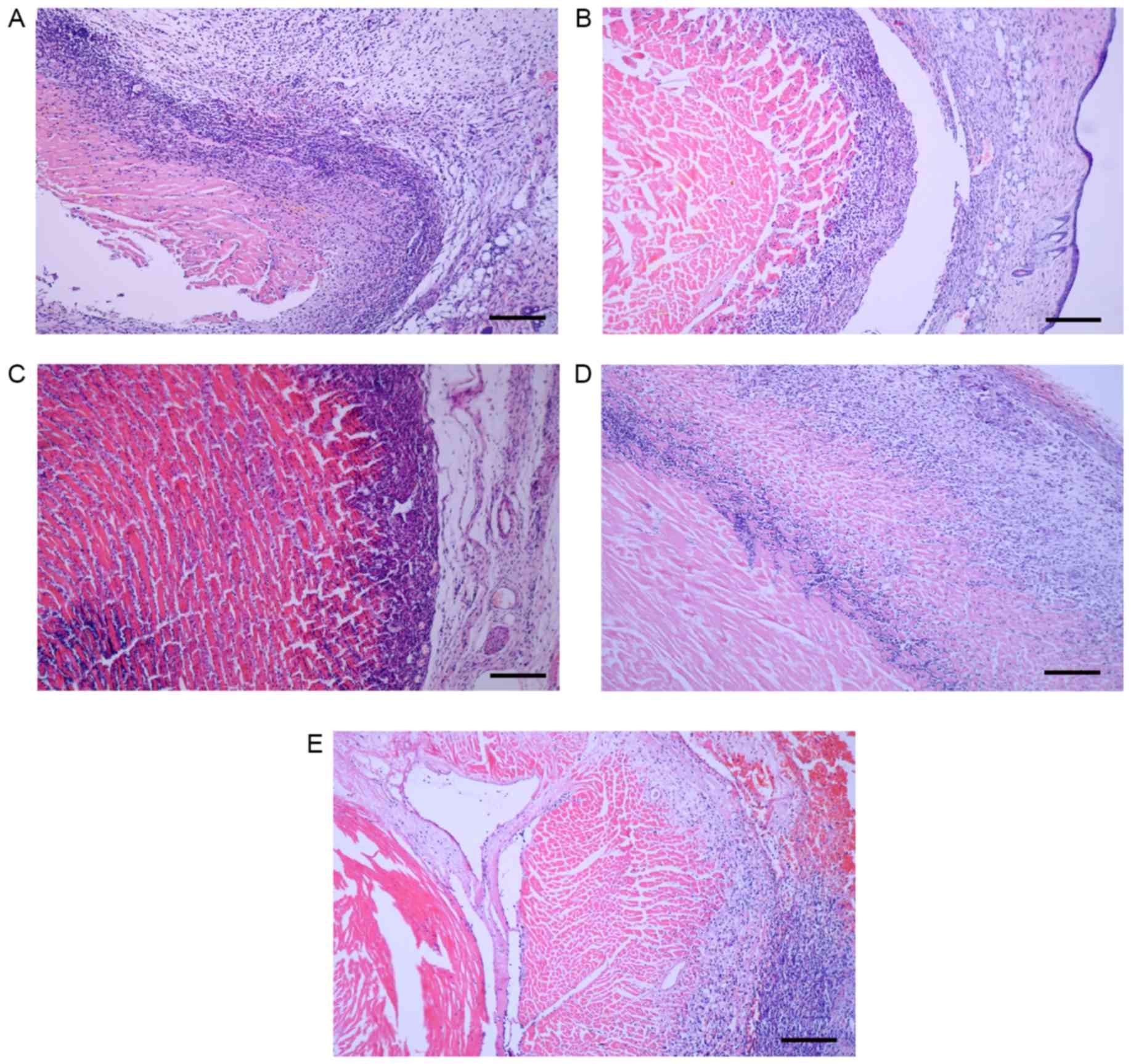
Donor organ rejection remains a significant problem. The present study aimed to assess whether transferring a donor's major histocompatibility complex (MHC) genes to the recipient could mitigate rejection in organ transplantation. Seven loci of MHC genes from donor mice were amplified and ligated into vectors; the vectors either contained one K locus, seven loci or were empty (control). The vectors were subsequently injected into the thymus of recipients (in heterotransplants, recipient rats received the vector containing one K locus), following which donor mouse hearts were transplanted. Following the transplantation of allograft and heterograft, electrocardiosignals were viable for a significantly longer duration in recipient mice and rats receiving the donor histocompatibility‑2 complex (H‑2)d genes compared with those in controls, and in mice that received seven vectors compared with those receiving one vector. Mixed lymphocyte cultures containing cells from these recipients proliferated significantly less compared with mixed lymphocyte cultures containing controls. Also, hearts from H‑2d genes‑treated recipients demonstrated less lymphocyte infiltration and necrosis compared with the control recipient. The present study concluded that allograft and heterograft rejection may be mitigated by introducing the donor's MHC into the recipient; transferring seven loci has been demonstrated to be more effective than transferring one locus.
View Figures

Figure 1

Figure 2

Figure 3

Figure 4

Figure 5

View References

1 

Bharat A, Kuo E, Steward N, Aloush A, Hachem R, Trulock EP, Patterson GA, Meyers BF and Mohanakumar T: Immunological link between primary graft dysfunction and chronic lung allograft rejection. Ann Thorac Surg. 86:189–195. 2008. View Article : Google Scholar : PubMed/NCBI

2 

Corris PA and Christie JD: Update in transplantation 2007. Am J Respir Crit Care Med. 177:1062–1067. 2008. View Article : Google Scholar : PubMed/NCBI

3 

Pham VV, Stichtenoth DO and Borlak J: Graft rejection: Pharmacogenetic analysis or drug anamnesis? Br J Clin Pharmacol. 65:959–960. 2008. View Article : Google Scholar : PubMed/NCBI

4 

Peeters P, Van Laecke S and Vanholder R: Acute kidney injury in solid organ transplant recipients. Acta Clin Belg. 62 Suppl 2:S389–S392. 2007. View Article : Google Scholar

5 

Lechler RI, Sykes M, Thomson AW and Turka LA: Organ transplantation-how much of the promise has been realized? Nat Med. 11:605–613. 2005. View Article : Google Scholar : PubMed/NCBI

6 

Kim JI, Sonawane SB, Lee MK, Lee SH, Duff PE, Moore DJ, O'Connor MR, Lian MM, Deng S, Choi Y, et al: Blockade of GITR-GITRL interaction maintains Treg function to prolong allograft survival. Eur J Immunol. 40:1369–1374. 2010. View Article : Google Scholar : PubMed/NCBI

7 

Peugh WN, Superina RA, Wood KJ and Morris PJ: The role of H-2 and non-H-2 antigens and genes in the rejection of murine cardiac allografts. Immunogenetics. 23:30–37. 1986. View Article : Google Scholar : PubMed/NCBI

8 

Wood KJ: Principles of transplantation immunologyOxford Textbook of Medicine. Oxford University Press; Oxford: pp. 1082003

9 

Beck S and Trowsdale J: The human major histocompatability complex: Lessons from the DNA sequence. Annu Rev Genomics Hum Genet. 1:117–137. 2000. View Article : Google Scholar : PubMed/NCBI

10 

Yu CL: Major histocompatibility complex (introduction)Modern Medical Immunology. Shanghai Medical University Publishing House; Shanghai: pp. 168–169. 1998

11 

Parmar S, Del Lima M, Zou Y, Patah PA, Liu P, Cano P, Rondon G, Pesoa S, de Padua Silva L, Qazilbash MH, et al: Donor-recipient mismatches in MHC class I chain-related gene A in unrelated donor transplantation lead to increased incidence of acute graft-versus-host disease. Blood. 114:2884–2887. 2009. View Article : Google Scholar : PubMed/NCBI

12 

Fang M and Shen GX: The differentiation of T cellMedical Immunology. Gong FL: Science Publishing House; Beijing: pp. 151–153. 2000

13 

Maurice D, Hooper J, Lang G and Weston K: c-Myb regulates lineage choice in developing thymocytes via its target gene Gata3. EMBO J. 26:3629–3640. 2007. View Article : Google Scholar : PubMed/NCBI

14 

Goldrath AW and Bevan MJ: Selecting and maintaining a diverse T-cell repertoire. Nature. 402:255–262. 1999. View Article : Google Scholar : PubMed/NCBI

15 

Kishimoto H and Sprent J: The thymus and central tolerance. Clin Immunol. 95:S3–S7. 2000. View Article : Google Scholar : PubMed/NCBI

16 

Kruskall MS: The major histocompatibility complex: The value of extended haplotypes in the analysis of associated immune diseases and disorders. Yale J Biol Med. 63:477–486. 1990.PubMed/NCBI

17 

Li T, Yan J, Tan JL, Lv YP, Hou SC, Li ST, Xu Q, Tong XH, Ding J, Zhang Zt and Li H: Donor MHC gene to mitigate rejection of transplantation in recipient mice. Chin Med J (Engl). 124:4279–4285. 2011.PubMed/NCBI

18 

Judd KP and Trentin JJ: Cardiac transplantation in mice. Transplantation. 11:298–308. 1971.PubMed/NCBI

19 

Babang G, Morris RE, Babang I and Kates RE: Evaluation of the in vivo dose-response relationship of immunosuppressive drugs using a mouse heart transplant model: Application to cyclosporine. J Pharmacol Exp Ther. 244:259–262. 1988.PubMed/NCBI

20 

Fiedor P, Jin MX, Hardy MA and Oluwole SF: Dependence of acquired systemic tolerance to rat islet allografts induced by intrathymic soluble alloantigens on host responsiveness, MHC differences, and transient immunosuppression in the high responder recipient. Transplantation. 63:279–283. 1997. View Article : Google Scholar : PubMed/NCBI

21 

Oluwole SF, Jin MX, Chowdhury NC, Engelstad K, Ohajekwe OA and James T: Induction of peripheral tolerance by intrathymic inoculation of soluble alloantigens: Evidence for the role of host antigen-presenting cells and suppressor cell mechanism. Cell Immunol. 162:33–41. 1995. View Article : Google Scholar : PubMed/NCBI

22 

Otomo N, Motovama K, Yu S, Shimizu Y, Margenthaler JA, Tu F and Flye MW: Intrathymic alloantigen-mediated tolerant, completely MHC-mismatched mouse hearts are specifically rejected by adoptively transferred in vitro-sensitized anti-class I L(d+)-specific 2C cells. Transplant Proc. 33:159–160. 2001. View Article : Google Scholar : PubMed/NCBI

23 

Strober S: Protective conditioning against GVHD and graft rejection after combined organ and hematopoietic cell transplantation. Blood Cell Mol Dis. 40:48–54. 2008. View Article : Google Scholar

24 

Arima T, Lehmann M and Flye MW: Induction of donor specific transplantation tolerance to cardiac allografts following treatment with nondepleting (RIB 5/2) or depleting (OX-38) anti-CD4 mAb plus intrathymic or intravenous donor alloantigen. Transplantation. 63:284–292. 1997. View Article : Google Scholar : PubMed/NCBI

25 

Gopinathan R, DePaz HA, Oluwole OO, Ali AO, Garrovillo M, Engelstad K, Hardy MA and Oluwole SF: Role of reentry of in vivo alloMHC peptide-activated T cells into the adult thymus in acquired systemic tolerance. Transplantation. 72:1533–1541. 2001. View Article : Google Scholar : PubMed/NCBI

26 

Hillebrands JL, Raué HP, Klatter FA, Hylkema MN, Platteel I, Hardonk-Wubbena A, Nieuwenhuis P and Rozing J: Intrathymic immune modulation prevents acute rejection but not the development of graft arteriosclerosis (chronic rejection). Transplantation. 71:914–924. 2001. View Article : Google Scholar : PubMed/NCBI

27 

Kobayashi E, Kamada N, Delriviere L, Lord R, Goto S, Walker NI, Enosawa S and Miyata M: Migration of donor cells into the thymus is not essential for induction and maintenance of systemic tolerance after liver transplantation in the rat. Immunology. 84:333–336. 1995.PubMed/NCBI

28 

Trani J, Moore DJ, Jarrett BP, Markmann JW, Lee MK, Singer A, Lian MM, Tran B, Caton AJ and Markmann JF: CD25+ immunoregulatory CD4 T cells mediate acquired central transplantation tolerance. J Immunol. 170:279–286. 2003. View Article : Google Scholar : PubMed/NCBI

29 

Chowdhury NC, Murphy B, Sayegh MH, Hardy MA and Oluwole SF: Induction of transplant tolerance by intrathymic inoculation of synthetic MHC class I allopeptides. Transplant Proc. 29:11361997. View Article : Google Scholar : PubMed/NCBI

30 

Sonntag KC, Emery DW, Yasumoto A, Haller G, Germana S, Sablinski T, Shimizu A, Yamada K, Shimada H, Arn S, et al: Tolerance to solid organ transplants through transfer of MHC class II genes. J Clin Invest. 107:65–71. 2001. View Article : Google Scholar : PubMed/NCBI

31 

Spriewald BM, Ensminger SM, Jenkins S, Morris PJ and Wood KJ: Intrathymic delivery of plasmid-encoding endoplasmic reticulum signal-sequence-deleted MHC class I alloantigen can induce long-term allograft survival. Transpl Int. 17:458–462. 2004. View Article : Google Scholar : PubMed/NCBI

32 

Ando Y, Beck Y, Ichikawa N, Meigata K, Nomura Y, Nishimura Y, Tomikawa S and Takiguchi M: Induction of long-term heart graft survival in HLA class I transgenic mice by intrathymic injection of HLA class I peptides. Transplant Proc. 30:3890–3891. 1998. View Article : Google Scholar : PubMed/NCBI

33 

del Rio ML, Pabst O, Ramirez P, Penuelas-Rivas G, Förster R and Rodriguez-Barbosa JI: The thymus is required for the ability of FTY720 to prolong skin allograft survival across different histocompatibility MHC barriers. Transpl Int. 20:895–903. 2007. View Article : Google Scholar : PubMed/NCBI

34 

Siemionow M, Izycki D, Ozer K, Ozmen S and Klimczak A: Role of thymus in operational tolerance induction in limb allograft transplant model. Transplantation. 81:1568–1576. 2006. View Article : Google Scholar : PubMed/NCBI

35 

Yamamoto S, Teranishi K, Kamano C, Samelson-Jones E, Arakawa H, Nobori S, Okumi M, Houser S, Shimizu A, Sachs DH and Yamada K: Role of the thymus in transplantation tolerance in miniature swine: V. Deficiency of the graft-to-thymus pathway of tolerance induction in recipients of cardiac transplants. Transplantation. 81:607–613. 2006. View Article : Google Scholar : PubMed/NCBI

36 

Yamada K, Vagefi PA, Utsugi R, Kitamura H, Barth RN, LaMattina JC and Sachs DH: Thymic transplantation in miniature swine: III. Induction of tolerance by transplantation of composite thymokidneys across fully major histocompatibility complex-mismatched barriers. Transplantation. 76:530–536. 2003. View Article : Google Scholar : PubMed/NCBI

37 

Nobori S, Samelson-Jones E, Shimizu A, Hisashi Y, Yamamoto S, Kamano C, Teranishi K, Vagefi PA, Nuhn M, Okumi M, et al: Long-term acceptance of fully allogeneic cardiac grafts by cotransplantation of vascularized thymus in miniature swine. Transplantation. 81:26–35. 2006. View Article : Google Scholar : PubMed/NCBI

38 

Viret C, Sant'Angelo DB, He X, Ramaswamy H and Janeway CA Jr: A Role for accessibility to self-peptide-self-MHC complexes in intrathymic negative selection. J Immunol. 166:4429–4437. 2001. View Article : Google Scholar : PubMed/NCBI

39 

Pullen JK, Horton RM, Cai ZL and Pease LR: Structural diversity of the classical H-2 genes: K, D, and L. J Immunol. 148:953–967. 1992.PubMed/NCBI

40 

Chowdhury NC, Jin MX, Hardy MA and Oluwole SF: Donor-specific unresponsiveness to murine cardiac allografts induced by intrathymic-soluble alloantigens is dependent on alternate pathway of antigen presentation. J Surg Res. 59:91–96. 1995. View Article : Google Scholar : PubMed/NCBI

41 

Knechtle SJ, Wang J, Graeb C, Zhai Y, Hong X, Fechner JH Jr and Geissler EK: Direct MHC class I complementary DNA transfer to thymus induces donor-specific unresponsiveness, which involves multiple immunologic mechanisms. J Immunol. 159:152–158. 1997.PubMed/NCBI

42 

Geissler EK, Scherer MN and Graeb C: Soluble donor MHC class I gene transfer to thymus promotes allograft survival in a high-responder heart transplant model. Transpl Int. 13 Suppl 1:S452–S455. 2000. View Article : Google Scholar : PubMed/NCBI

Related Articles

  • Abstract
  • View
  • Download
  • Twitter
Copy and paste a formatted citation
Spandidos Publications style
Li T, Zhang W, Xu Q, Li S, Tong X, Ding J, Li H, Hou S, Xu Z, Jablons DM, Jablons DM, et al: Transfer of multiple loci of donor's genes to induce recipient tolerance in organ transplantation. Exp Ther Med 15: 4961-4971, 2018.
APA
Li, T., Zhang, W., Xu, Q., Li, S., Tong, X., Ding, J. ... You, L. (2018). Transfer of multiple loci of donor's genes to induce recipient tolerance in organ transplantation. Experimental and Therapeutic Medicine, 15, 4961-4971. https://doi.org/10.3892/etm.2018.6058
MLA
Li, T., Zhang, W., Xu, Q., Li, S., Tong, X., Ding, J., Li, H., Hou, S., Xu, Z., Jablons, D. M., You, L."Transfer of multiple loci of donor's genes to induce recipient tolerance in organ transplantation". Experimental and Therapeutic Medicine 15.6 (2018): 4961-4971.
Chicago
Li, T., Zhang, W., Xu, Q., Li, S., Tong, X., Ding, J., Li, H., Hou, S., Xu, Z., Jablons, D. M., You, L."Transfer of multiple loci of donor's genes to induce recipient tolerance in organ transplantation". Experimental and Therapeutic Medicine 15, no. 6 (2018): 4961-4971. https://doi.org/10.3892/etm.2018.6058
Copy and paste a formatted citation
x
Spandidos Publications style
Li T, Zhang W, Xu Q, Li S, Tong X, Ding J, Li H, Hou S, Xu Z, Jablons DM, Jablons DM, et al: Transfer of multiple loci of donor's genes to induce recipient tolerance in organ transplantation. Exp Ther Med 15: 4961-4971, 2018.
APA
Li, T., Zhang, W., Xu, Q., Li, S., Tong, X., Ding, J. ... You, L. (2018). Transfer of multiple loci of donor's genes to induce recipient tolerance in organ transplantation. Experimental and Therapeutic Medicine, 15, 4961-4971. https://doi.org/10.3892/etm.2018.6058
MLA
Li, T., Zhang, W., Xu, Q., Li, S., Tong, X., Ding, J., Li, H., Hou, S., Xu, Z., Jablons, D. M., You, L."Transfer of multiple loci of donor's genes to induce recipient tolerance in organ transplantation". Experimental and Therapeutic Medicine 15.6 (2018): 4961-4971.
Chicago
Li, T., Zhang, W., Xu, Q., Li, S., Tong, X., Ding, J., Li, H., Hou, S., Xu, Z., Jablons, D. M., You, L."Transfer of multiple loci of donor's genes to induce recipient tolerance in organ transplantation". Experimental and Therapeutic Medicine 15, no. 6 (2018): 4961-4971. https://doi.org/10.3892/etm.2018.6058
Follow us
  • Twitter
  • LinkedIn
  • Facebook
About
  • Spandidos Publications
  • Careers
  • Cookie Policy
  • Privacy Policy
How can we help?
  • Help
  • Live Chat
  • Contact
  • Email to our Support Team