Introduction
One of the most common complications of pregnancy is
hypertensive disorder complicating pregnancy (HDCP), and relevant
data showed that the incidence rate of it is as high as ~10%, which
seriously affects the perinatal survival rate of mothers and
children, albeit its pathogenesis remains to be determined
(1). Generally, HDCP can be
diagnosed by clinical manifestations, urinary protein examination,
liver and kidney function examination, and fundus examination; in
severe cases, retinal edema, exudation, and hemorrhage, may
manifest in the fundus of patients with HDCP (2). Levels of nitric oxide (NO) and
inflammatory cytokines represented by C-reactive protein (CRP),
tumor necrosis factor-α (TNF-α) and interleukin-6 (IL-6) in
peripheral blood of patients play important roles in the causes of
the disease, which promote the occurrence and development of HDCP
(3,4). In patients with HDCP, the most
representative laboratory examination is the urine protein
examination, which shows urinary tract smooth muscle cell
dysfunction, enlarged renal pelvis volume and increased
hydronephrosis (5). The excessive
activation of inflammatory or other systems lead to immune system
disorders and the deposition of an overdose of immune complexes in
the kidney, which increase vascular permeability to a certain
degree and impair the kidney function, thus leading to the
occurrence of proteinuria (6). At
the same time, urine proteins are related to the level of blood
pressure, so determining the levels of inflammatory factor and NO
in peripheral blood is of important significance for the conditions
of urine proteins, renal function, and blood pressure, in patients
with HDCP (7).
Patients and methods
Patients
A total of 60 patients diagnosed with HDCP in the
Obstetrics Department of Wuhan Children's Hospital (Wuhan, China)
from May 2016 to April 2017 were selected, and were divided into
the gestational hypertension (n=20), mild pre-eclampsia (n=20) and
severe pre-eclampsia (n=20) groups. In addition, 20 healthy
pregnant women were selected as the control group. All the included
patients were aged 24–33 years, with an average age of 28.72±5.9
years; the gestational age was 34–40 weeks, with an average
gestational age of 36.38±4.2 weeks. The diagnostic criteria for the
included patients with HDCP were based on the ‘Chinese Expert
Consensus Document on Blood Pressure Management of HDCP’ (8), and the staging was specifically
conducted according to the level of blood pressure, urine proteins
and renal function in patients. All the included patients signed
the written informed consent. Inclusion criteria for the study
were: patients with high compliance with doctor's advice who
co-operated with examinations; patients who were confirmed cases of
HDCP; patients aged less than or equal to 36 years; and patients
whose fetuses had no obvious defects or diseases. Exclusion
criteria were: patients with a history of chronic hypertension
disease; patients with a history of cardiovascular system disease;
patients with endocrine disease, such as thyroid disease and liver
and kidney disease; patients with malignant tumors; patients with
severe infection; and patients whose clinical data were incomplete.
The study was approved by the Ethics Committee of Wuhan Children's
Hospital.
Methods
The clinical data of all patients were
retrospectively analyzed, including age, sex, weight, height,
delivery times, and gestational age, and the systolic and diastolic
blood pressures of all the patients were recorded. Determination of
levels of inflammatory cytokines and NO in peripheral blood of
patients: After the solid and liquid fasting for 10 h overnight, 10
ml peripheral blood was extracted, the upper-layer serum was taken,
and inflammatory cytokines, CRP, TNF-α and IL-6, were detected
using immunoturbidimetry (reagents and instruments provided by
Shandong Biological Instrument Co., Ltd., Sandong, China).
Determination of 24 h urine proteins: 24 h urine was collected and
detected using a UniCel Dxl 800 automatic analyzer (Beckman
Coulter, Inc., Atlanta, GA, USA). Determination of renal function:
10 ml fasting peripheral venous blood of patients in the morning
was extracted, and homocysteine (Hcy), cystatin-C (Cys-C), serum
creatinine (SCr), urea and β2 microglobulin were also
detected using a Beckman Coulter UniCel Dxl 800 automatic
analyzer.
Statistical analysis
Statistical Product and Service Solutions (SPSS)
19.0 statistical software was used to process data, and the
collected data were expressed as means ± SD. The χ2 test
was used to compare the count data. The Pearson correlation
analysis was conducted for two factors, and the logistic analysis
was performed for related risk factors. P<0.05 indicated that
the difference was statistically significant.
Results
Comparisons of general data between
the HDCP and control groups
There were no statistically significant differences
in age, body mass index (BMI) and delivery times between the HDCP
and control groups (P>0.05). The systolic and diastolic blood
pressures in the HDCP group were significantly higher than those in
the control group, but the gestational age of the former was
significantly smaller than that of the latter (P<0.05) (Table I).
 | Table I.Comparisons of general data between
the HDCP group and the control group. |
Table I.
Comparisons of general data between
the HDCP group and the control group.
| Group | n | Age (years old) | BMI
(kg/m2) | Delivery times
(time) | Systolic blood
pressure (mmHg) | Diastolic blood
pressure (mmHg) | Gestational age
(week) |
|---|
| HDCP group | 60 | 30.53±4.8 | 29.35±4.2 | 1.6±0.7 | 169.3±18.5 | 104.7±9.9 | 35.1±3.7 |
| Control group | 20 | 28.79±5.1 | 28.76±3.9 | 1.4±0.9 | 136.7±14.8 | 88.3±8.7 | 37.9±3.1 |
| P-value |
| 0.351 | 0.096 | 0.812 | 0.001 | 0.001 | 0.023 |
Comparisons of levels of inflammatory
cytokines in peripheral blood between the HDCP and control
groups
Levels of CRP, TNF-α and IL-6 in the HDCP group were
significantly higher than those in the control group. Levels of
CRP, TNF-α and IL-6 in the pre-eclampsia groups were higher than
those in the gestational hypertension group, and those in the
severe pre-eclampsia group were significantly higher than those in
the mild pre-eclampsia group. Differences were statistically
significant (P<0.05) (Table
II).
| Table II.Comparisons of levels of inflammatory
cytokines between the HDCP group and the control group. |
Table II.
Comparisons of levels of inflammatory
cytokines between the HDCP group and the control group.
| Group | n | TNF-α (pg/ml) | IL-6 (ng/l) | CRP (mg/l) |
|---|
| HDCP group | 60 | 14.38±4.21 | 17.58±2.23 | 8.93±1.45 |
| Gestational
hypertension group | 20 | 12.73±3.93 | 15.95±1.12 | 6.40±0.81 |
| Mild preeclampsia
group | 20 | 14.26±5.01 | 16.88±2.84 | 7.51±0.89 |
| Severe preeclampsia
group | 20 | 15.67±4.42 | 19.06±2.57 | 10.96±1.88 |
| Control group | 20 | 9.53±2.38 | 8.59±1.18 | 2.82±1.73 |
| P-value |
| 0.001 | 0.001 | <0.001 |
Comparison of the NO level in
peripheral blood between the HDCP and control group
The NO level in peripheral blood in the HDCP group
was significantly lower than that in the control group; levels of
NO in the pre-eclampsia groups were lower than that in the
gestational hypertension group, and that in the severe
pre-eclampsia group was significantly lower than that in the mild
pre-eclampsia group (P<0.05) (Table
III).
| Table III.Comparison of the NO level between the
HDCP group and the control group. |
Table III.
Comparison of the NO level between the
HDCP group and the control group.
| Group | n | NO (µmmol/l) |
|---|
| HDCP group | 60 | 29.02±5.08 |
| Gestational
hypertension group | 20 | 31.39±4.54 |
| Mild preeclampsia
group | 20 | 28.82±4.03 |
| Severe preeclampsia
group | 20 | 23.92±2.18 |
| Control group | 20 | 45.21±5.15 |
| P-value |
| <0.001 |
Comparisons of levels of 24 h urine
proteins and rental function between the HDCP and control
groups
Levels of 24 h urine proteins, Hcy, Cys-C, SCr, urea
and β2 microglobulin in the HDCP group were
significantly higher than those in the control group; those in the
pre-eclampsia groups were higher than those in the gestational
hypertension group, and those in the severe pre-eclampsia group
were significantly higher than those in the mild pre-eclampsia
group. Differences were statistically significant (P<0.05)
(Table IV).
| Table IV.Comparisons of levels of 24 h urine
proteins and rental function between the HDCP group and the control
group. |
Table IV.
Comparisons of levels of 24 h urine
proteins and rental function between the HDCP group and the control
group.
| Group | n | 24 h urine protein
(g/24 h) | Hcy (µmmol/l) | Cys-C (µmmol/l) | SCr (µmmol/l) | Urea (mmmol/l) | β2
microglobulin (mg/l) |
|---|
| HDCP group | 60 | 1.07±0.66 | 16.53±2.26 | 1.37±0.29 | 49±12 | 4.4±0.8 | 3.5±1.4 |
| Gestational
hypertension group | 20 | 0.63±0.19 | 14.77±2.21 | 1.15±0.44 | 46±12 | 4.1±0.6 | 3.3±0.9 |
| Mild preeclampsia
group | 20 | 0.94±0.28 | 17.59±3.30 | 1.49±0.36 | 52±10 | 4.6±0.8 | 3.5±1.3 |
| Severe preeclampsia
group | 20 | 2.63±0.57 | 21.38±3.38 | 3.03±0.58 | 68±13 | 5.8±0.9 | 4.4±0.5 |
| Control group | 20 | 0.10±0.09 | 8.96±2.27 | 0.97±0.18 | 39±5 | 3.0±0.6 | 2.8±0.2 |
| P-value |
| 0.001 | 0.001 | <0.001 | 0.001 | 0.001 | <0.001 |
Correlation analyses of CRP with 24 h
urine proteins and systolic blood pressure, of 24 h urine proteins
with systolic blood pressure, and of NO with 24 h urine
proteins
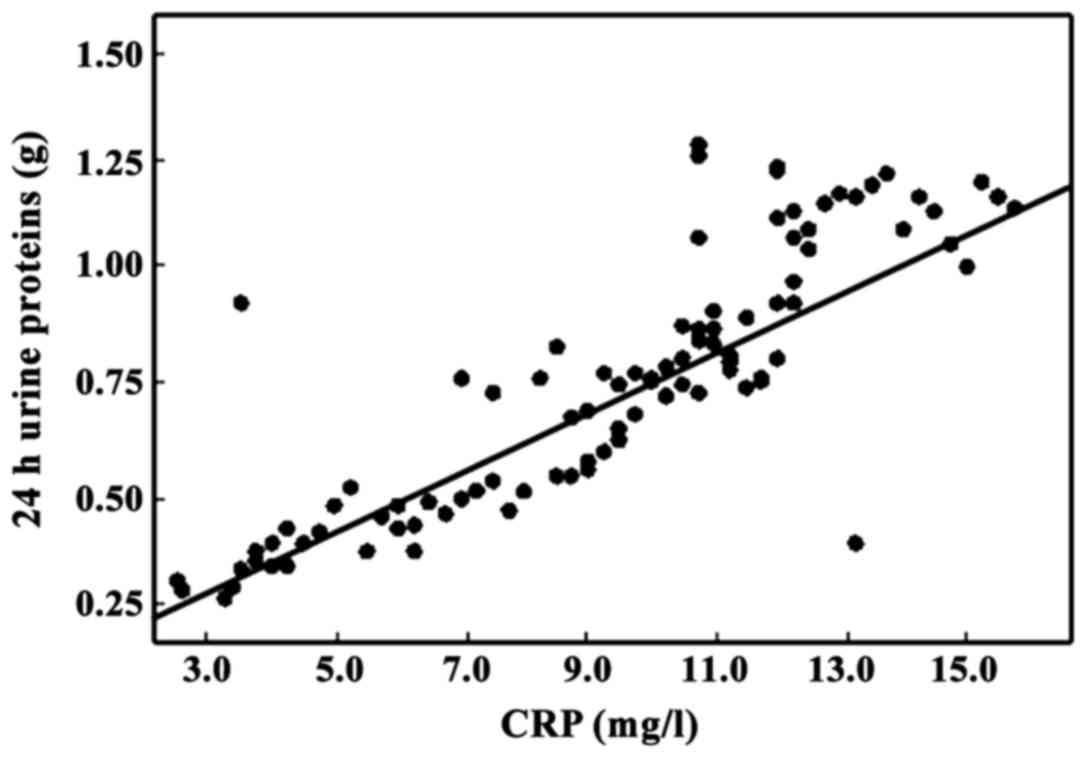
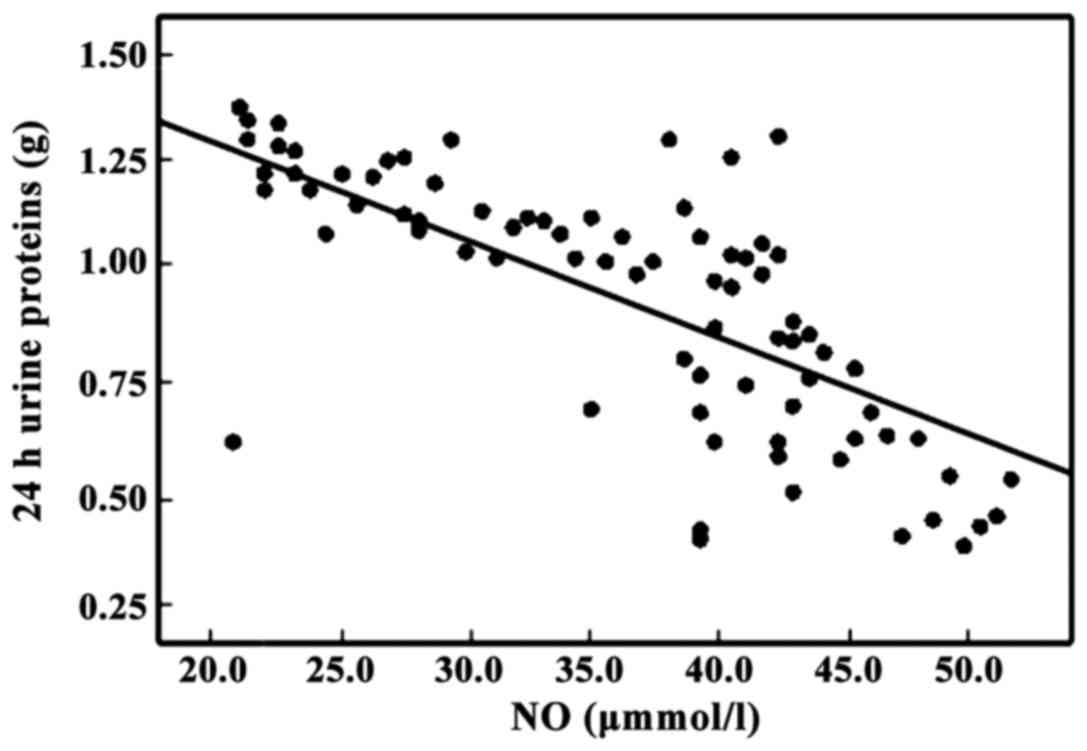
In peripheral blood of the included patients, the
level of CRP was positively associated with 24-h urine proteins
(r=0.792, P<0.001) and the systolic blood pressure (r=0.996,
P<0.001), and 24-h urine proteins were positively correlated
with the systolic blood pressure (r=0.795, P<0.001), but the
level of NO in peripheral blood was negatively related to 24 h
urine proteins (r=−0.722, P<0.001) (Figs. 1–4).
Logistic analysis of the prediction of
risk factors for the occurrence of HDCP in women during the
gestation period
The level of basic blood pressure (systolic blood
pressure, P=0.016; diastolic blood pressure, P=0.005), gestational
age (P=0.001) and the levels of inflammatory cytokines (TNF-α,
P=0.039; IL-6, P=0.025; CRP, P=0.022; NO, P=0.024), 24 h urinary
proteins (0.001) and renal function (Hcy, P=0.032; Cys-C, P=0.029;
SCr, P=0.018; Urea, P=0.013; β2 microglobulin, P=0.036)
had independent predictive values for the occurrence of HDCP
(P<0.05) (Table V).
| Table V.Logistic analysis of the prediction
of risk factors for the occurrence of HDCP in women during the
gestation period. |
Table V.
Logistic analysis of the prediction
of risk factors for the occurrence of HDCP in women during the
gestation period.
| Factor | P-value | Odds ratio (OR)
value | 95% confidence
interval (95% CI) |
|---|
| Age | 0.108 | 1.094 | 0.988–1.157 |
| BMI | 0.847 | 0.910 | 0.102–6.826 |
| Delivery times | 0.526 | 1.448 | 0.465–4.987 |
| Systolic blood
pressure | 0.016 | 7.955 | 1.918–26.165 |
| Diastolic blood
pressure | 0.005 | 7.347 | 1.919–22.159 |
| Gestational
age | 0.044 | 1.029 | 0.955–1.118 |
| TNF-α | 0.039 | 1.001 | 0.927–1.019 |
| IL-6 | 0.025 | 1.432 | 0.576–3.572 |
| CRP | 0.022 | 2.654 | 0.964–7.117 |
| NO | 0.024 | 1.047 | 0.996–1.312 |
| 24 h urine
protein | 0.001 | 1.005 | 0.997–1.033 |
| Hcy | 0.032 | 1.065 | 0.959–1.115 |
| Cys-C | 0.029 | 1.054 | 0.984–1.065 |
| SCr | 0.018 | 1.006 | 0.974–1.082 |
| Urea | 0.013 | 7.543 | 1.918–18.747 |
| β2
microglobulin | 0.036 | 1.017 | 0.954–1.119 |
Discussion
Concerning the health risks of perinatal pregnant
women and fetuses, HDCP exerts serious impacts on their health, but
there is no unified conclusion on the pathogenesis of HDCP
(9). There is an increasing number
of studies on HDCP, which aim to identify optimal early prevention
or treatment methods (10). It is
generally believed in clinical practice that HDCP is caused by the
combined actions of immune system dysfunction, shallow placental
implantation, smooth muscle, and cell dysfunction (11), and the most representative laboratory
examinations are the examinations of 24 h urine protein in urine
and renal function in peripheral blood (12). NO plays a very important role in the
injury and recovery processes of vascular endothelial cells. NO is
capable of dilating blood vessels (13), and the reduced NO content in the body
represents severe vascular endothelial damages. Sufficient NO can
be synthesized and released within the body of normal healthy
pregnant women during the gestation period to maintain placental
blood circulation and repair vascular endothelial injury (14,15). If
the content of NO is decreased, the vascular pressure is increased
due to vasoconstriction, vascular endothelial damage and other
factors (16), which is consistent
with the conclusion of this study, i.e., that the level of NO in
peripheral blood of patients in the HDCP group was significantly
decreased compared with that in the control group.
Inflammatory cytokines also promote the occurrence
and development of HDCP. Normal endometrium and placenta contain a
certain amount of macrophages that are important cells for the
synthesis and secretion of TNF-α (17). TNF-α can maintain normal pregnancy
and resist the occurrence of various types of cancer including
prostate cancer, ovarian cancer and infections to a certain degree
(18–20). However, if the content of the
synthesized and secreted TNF-α in vivo is too high, vascular
endothelial cells are injured through, for example, the oxidation
of free radicals, and arteries excessively contract, thus leading
to HDSP or exacerbating the disease (21). Many kinds of tissue cells in the
human body can produce IL-6, which has many functions, such as
regulating the immune system. Abnormal secretion can lead to
excessive accumulation of platelets in blood vessels and form
endothelial cell dysfunction (22).
In addition, the level of CRP in the normal human body is very low,
but under infection, inflammatory reactions, the level of CRP will
be rapidly increased; thus, CRP is a sensitive indicator of
inflammatory response (23). The
level of CRP in peripheral blood of women with HDCP is higher than
that in healthy pregnant women, because the overaction of the
inflammatory system damages the vascular endothelium and increases
the blood pressure (24). The
findings of this study showed that, levels of inflammatory
cytokines in peripheral blood of patients in the HDCP group were
significantly higher than those in the control group, and the
differences were statistically significant (P<0.05).
Furthermore, inflammatory cytokines were positively correlated with
urine proteins and systolic blood pressure, indicating that
inflammatory cytokines can reflect the severity of the disease to a
certain degree.
Generally, renal function is represented by levels
of Hcy, Cys-C, SCr, urea and β2 microglobulin, which are
also used to reflect the severity of kidney dysfunction. In
patients with HDCP, the expressions of renal function indexes are
different at different stages of the disease, that is, the
expression level is increased with the development of the disease
(22). In this study, levels of 24 h
urine protein, Hcy, Cys-C, SCr, urea and β2
microglobulin in the HDCP group were significantly higher than
those in the control group, those in the pre-eclampsia groups were
higher than those in the gestational hypertension group, and those
in the severe pre-eclampsia group were significantly higher than
those in the mild pre-eclampsia group, which were consistent with
the results of many current studies, as previously indicated.
Therefore, 24-h urine proteins and renal function in patients with
HDCP change with the disease, and at the same time, levels of
inflammatory cytokines and NO in peripheral blood of patients are
closely correlated with the occurrence and development of the
disease. Timely detection of the above indexes provides more
valuable references for the treatment of patients with HDCP.
Acknowledgements
Not applicable.
Funding
No funding was received.
Availability of data and materials
The datasets used and/or analyzed during the current
study are available from the corresponding author on reasonable
request.
Authors contributions
JYZ and XXC were responsible for inflammatory
cytokines and renal function analysis. HXW and HYZ collected and
analyzed the general data of patients. All authors read and
approved the final manuscript.
Ethics approval and consent to
participate
The study was approved by the Ethics Committee of
Wuhan Children's Hospital (Wuhan, China). All the included patients
signed the written informed consent
Patient consent for publication
Not applicable.
Competing interests
The authors declare that they have no competing
interests.
References
|
1
|
Reilly MP, Rohatgi A, McMahon K, Wolfe ML,
Pinto SC, Rhodes T, Girman C and Rader DJ: Plasma cytokines,
metabolic syndrome, and atherosclerosis in humans. J Investig Med.
55:26–35. 2007. View Article : Google Scholar : PubMed/NCBI
|
|
2
|
Magyar MT, Bereczki D, Csípo I, Gyimesi E,
Csiba L, Valikovics A, Balla J and Sipka S: Elevated white blood
cell count, CRP and fibrinogen levels are not associated with
increased anti-endothelial and anti-ox-LDL antibody, MCP-1, and
RANTES levels in early onset occlusive carotid artery disease.
Cytokine. 37:44–50. 2007. View Article : Google Scholar : PubMed/NCBI
|
|
3
|
Thomas GN, Critchley JAJH, Tomlinson B,
Cockram CS and Chan JC: Peripheral vascular disease in Type 2
diabetic Chinese patients: Associations with metabolic indices,
concomitant vascular disease and genetic factors. Diabet Med.
20:988–995. 2003. View Article : Google Scholar : PubMed/NCBI
|
|
4
|
Paul MR, Meir JS and Nader R: Study on the
correlation between renal hemodynamics and endothelial function in
hypertensive patients. JAMA. 285:2481–2485. 2001.PubMed/NCBI
|
|
5
|
Thakore AH, Guo CY, Larson MG, Corey D,
Wang TJ, Vasan RS, D'Agostino RB Sr, Lipinska I, Keaney JF Jr,
Benjamin EJ, et al: Association of multiple inflammatory markers
with carotid intimal medial thickness and stenosis (from the
Framingham Heart Study). Am J Cardiol. 99:1598–1602. 2007.
View Article : Google Scholar : PubMed/NCBI
|
|
6
|
Isidro ML and Ruano B: Bone disease in
diabetes. Curr Diabetes Rev. 6:144–155. 2010. View Article : Google Scholar : PubMed/NCBI
|
|
7
|
Kanazawa I, Yamaguchi T, Hayashi K, Takase
H, Shimizu T and Sugimoto T: Effects of treatment with risedronate
and alfacalcidol on progression of atherosclerosis in
postmenopausal women with type 2 diabetes mellitus accompanied with
osteoporosis. Am J Med Sci. 339:519–524. 2010. View Article : Google Scholar : PubMed/NCBI
|
|
8
|
Niu V, Xu Y, Hao J, Van S, Huang K, Pan W,
Ge X, Liu G, Huang S and Tao F: Prepregnancy body mass index,
gestational weight gain and hypertensive disorder complicating
pregnancy: A prospective cohort study in Ma'anshan City. Wei Sheng
Yan Jiu. 45:205–210. 2016.(In Chinese). PubMed/NCBI
|
|
9
|
Wada S, Kamiya S and Fukawa T: The
relationship between proteinuria and inflammatory factors in
patients with severe pre-eclampsia. Clin Calcium. 18:600–605.
2008.PubMed/NCBI
|
|
10
|
Siddappa R, Mulder W, Steeghs I, van de
Klundert C, Fernandes H, Liu J, Arends R, van Blitterswijk C and de
Boer J: cAMP/PKA signaling inhibits osteogenic differentiation and
bone formation in rodent models. Tissue Eng Part A. 15:2135–2143.
2009. View Article : Google Scholar : PubMed/NCBI
|
|
11
|
Wan SM, Yu YH, Huang YY and Su GD:
Morbidity regularity of severe complications of hypertensive
disorder complicating pregnancy in clinics. Zhonghua Fu Chan Ke Za
Zhi. 42:510–514. 2007.(In Chinese). PubMed/NCBI
|
|
12
|
Pittas AG, Lau J and Hu FB: The clinical
significance of urine protein and urine creatinine ratio detection.
Clin Endocrinol Metab. 92:3017–3026. 2007.
|
|
13
|
Takagi M, Kasayama S, Yamamoto T, Motomura
T, Hashimoto K, Yamamoto H, Sato B, Okada S and Kishimoto T:
Advanced glycation endproducts stimulate interleukin-6 production
by human bone-derived cells. J Bone Miner Res. 12:439–446. 1997.
View Article : Google Scholar : PubMed/NCBI
|
|
14
|
Liu E, Meigs JB, Pittas AG, Economos CD,
McKeown NM, Booth SL and Jacques PF: Predicted 25-hydroxyvitamin D
score and incident type 2 diabetes in the Framingham Offspring
Study. Am J Clin Nutr. 91:1627–1633. 2010. View Article : Google Scholar : PubMed/NCBI
|
|
15
|
Asanuma Y, Chung CP, Oeser A, Solus JF,
Avalos I, Gebretsadik T, Shintani A, Raggi P, Sokka T, Pincus T, et
al: Serum osteoprotegerin is increased and independently associated
with coronary-artery atherosclerosis in patients with rheumatoid
arthritis. Atherosclerosis. 195:e135–e141. 2007. View Article : Google Scholar : PubMed/NCBI
|
|
16
|
Hofbauer LC, Khosla S, Dunstan CR, Lacey
DL, Boyle WJ and Riggs BL: The roles of osteoprotegerin and
osteoprotegerin ligand in the paracrine regulation of bone
resorption. J Bone Miner Res. 15:2–12. 2000. View Article : Google Scholar : PubMed/NCBI
|
|
17
|
Haas M, Leko-Mohr Z, Roschger P, Kletzmayr
J, Schwarz C, Domenig C, Zsontsich T, Klaushofer K, Delling G and
Oberbauer R: Osteoprotegerin and parathyroid hormone as markers of
high-turnover osteodystrophy and decreased bone mineralization in
hemodialysis patients. Am J Kidney Dis. 39:580–586. 2002.
View Article : Google Scholar : PubMed/NCBI
|
|
18
|
Carpentier PA, Dingman AL and Palmer TD:
Placental TNF-α signaling in illness-induced complications of
pregnancy. Am J Pathol. 178:2802–2810. 2011. View Article : Google Scholar : PubMed/NCBI
|
|
19
|
Charles KA, Kulbe H, Soper R,
Escorcio-Correia M, Lawrence T, Schultheis A, Chakravarty P,
Thompson RG, Kollias G, Smyth JF, et al: The tumor-promoting
actions of TNF-alpha involve TNFR1 and IL-17 in ovarian cancer in
mice and humans. J Clin Invest. 119:3011–3023. 2009. View Article : Google Scholar : PubMed/NCBI
|
|
20
|
Pirtskhalaishvili G, Shurin GV, Esche C,
Trump DL and Shurin MR: TNF-alpha protects dendritic cells from
prostate cancer-induced apoptosis. Prostate Cancer Prostatic Dis.
4:221–227. 2001. View Article : Google Scholar : PubMed/NCBI
|
|
21
|
Malyszko J, Malyszko JS, Wolczynski S and
Mysliwiec M: Osteoprotegerin and its correlations with new markers
of bone formation and bone resorption in kidney transplant
recipients. Transplant Proc. 35:2227–2229. 2003. View Article : Google Scholar : PubMed/NCBI
|
|
22
|
KeDy DJ, Wilkinson Berka JL and Ricardo
SD: Management of Chinese consensus for pregnant hypertension
patients. Nephrol Dial Transplant. 17:985–991. 2002.PubMed/NCBI
|
|
23
|
Hullinger TG, Pan Q, Viswanathan HL and
Somerman MJ: TGFbeta and BMP-2 activation of the OPN promoter:
Roles of smad- and hox-binding elements. Exp Cell Res. 262:69–74.
2001. View Article : Google Scholar : PubMed/NCBI
|
|
24
|
Yuan T, Zhang T and Han Z: Placental
vascularization alterations in hypertensive disorders complicating
pregnancy (HDCP) and small for gestational age with HDCP using
three-dimensional power doppler in a prospective case control
study. BMC Pregnancy Childbirth. 15:2402015. View Article : Google Scholar : PubMed/NCBI
|