Introduction
Very low birth weight premature infants (VLBWPIs)
are cared for in the neonatal intensive care unit (NICU), which
must meet the requirements of a restful and a stress-free
environment (1). It has been
reported that during the first 2 weeks following birth, touch,
sound and light stimulation in the NICU are positively associated
with median diastolic blood pressure, mean arterial pressure and
infant movement (2,3).
Growth hormones directly promote bone growth and
increase height (1). Insulin-like
growth factor 1 (IGF-1) is a single-stranded polypeptide that is
regulated by growth hormones. Thus, circulating IGF-1 levels may
indicate the activity of growth hormones and the progress of
maturation in VLBWPIs (1,4). Previous studies have revealed that
IGF-1 is essential for postnatal growth and development in humans
(5), and that low levels of IGF-1
may be involved in the prolonged growth restriction of VLBWPIs
(6).
It is logical to assume that stressful environmental
features may affect the maturation of VLBWPIs and will thus affect
their IGF-1 levels (3,4). However, the specific environmental
features that affect circulating IGF-1 levels of VLBWPIs remains
unclear. The current study hypothesized that if stimuli in the NICU
are reduced and benign circadian rules are established, then IGF-1
levels will increase and VLBWPIs will adapt more easily to the
environment outside the womb, increasing their physiological
wellbeing.
The present study assessed associations between the
environmental characteristics of the NICU and VLBWPI plasma IGF-1
levels and growth indices.
Materials and methods
Subjects
Subjects were recruited between June 2012 and June
2013 at Shunde Women's and Children's Hospital (Shunde, China). A
total of 60 VLBWPIs were consecutively enrolled and apportioned to
either an experimental or control group (each, n=30). All the
VLBWPIs conformed to the following criteria: Birth weight <1,500
g; gestational age <37 weeks; and hospitalization ≥14 days. The
following potential subjects were excluded: Patients with a history
of asphyxia at birth with congenital malformations or genetic
metabolic diseases; and cases of mortality. The experimental group
comprised 18 males and 12 females, with a gestational age of
30.62±2.22 weeks, a body mass of 1.18±0.19 kg, a crown-to-heel
length of 39.87±2.07 cm and a head circumference of 27.96±0.96 cm
(Table I). The control group
consisted of 16 males and 14 females, with a gestational age of
30.54±2.58 weeks, a body mass of 1.21±0.19 kg, a crown-to-heel
length of 39.02±2.13 cm and a head circumference 27.22±0.95 cm.
Differences in sex ratio, gestational age, body mass, crown-to-heel
length and head circumference between the groups were not
statistically significant at birth.
 | Table I.Development indices on day 7 and 14
following birth in the experimental and control groups. |
Table I.
Development indices on day 7 and 14
following birth in the experimental and control groups.
|
| Experimental | Control | t-value | P-value |
|---|
|
|
|
|
|
|
|---|
| Gender ratio
(M/F) | 18/12 | 16/14 | 1.15 | 0.216 |
|---|
| At birth |
| GA
(weeks) | 30.62±2.22 | 30.54±2.58 | 0.48 | 0.531 |
| BW
(kg) | 1.18±0.19 | 1.21±0.19 | 0.95 | 0.268 |
| C-H
(cm) | 39.87±2.07 | 39.02±2.13 | 0.58 | 0.425 |
| HC
(cm) | 27.96±0.96 | 27.22±0.95 | 0.65 | 0.403 |
| 7 days after
birth |
| BW
(kg) | 1.47±0.15 | 1.23±0.14 | 2.74 | 0.039 |
| C-H
(cm) | 41.58±2.55 | 39.15±2.35 | 2.66 | 0.045 |
| HC
(cm) | 28.83±1.05 | 27.61±0.98 | 2.67 | 0.078 |
| 14 days after
birth |
| BW
(kg) | 1.68±0.17 | 1.37±0.17 | 3.08 | 0.028 |
| C-H
(cm) | 42.84±2.73 | 39.61±2.57 | 2.69 | 0.042 |
| HC
(cm) | 29.84±1.13 | 28.62±1.07 | 1.51 | 0.079 |
Standard nursing care of VLBWPIs
Patients in the control group received routine
standard nursing care for VLBWPIs. Patients in the experimental
group also received routine standard nursing care for VLBWPIs,
however they were placed in a separate room under the following
conditions: A quiet period of 3 h every 8 h was maintained, in
which patients were not touched unless there was a need for
treatment. Light stimulation was reduced by drawing the curtains,
using brunet cloth covers over warmers, dimming the indoor lights
and using a dim bedside lamp at night. Noise was reduced by
enabling phone flash caller ids on all phones, reducing the volume
of all instrument alarms and sounds made by the medical staff to
<50 dBA, and limiting impulse noise from the heart rate,
breathing and blood pressure monitors to <55 dBA (7). Simultaneously, regular visits were
conducted by the nurses to ensure timely responses to instrument
alarms. Patients in the experimental and control groups, as well as
all instruments were positioned within the field of vision of the
nurses station for easy observation and to prevent accidents. This
prospective, double-blinded, sequential-period, exploratory study
was approved by the Ethics Committee of Shunde Women's and
Children's Hospital (Shunde, China). All parents or guardians of
the children enrolled in the present study provided written
informed consent prior to enrollment.
Laboratory assays
VLBWPI plasma IGF-1 levels were measured. Venous
blood samples (2 ml) were collected and plasma IGF-1 concentrations
were measured using a fully automated chemical luminescence
immunity analyzer (Siemens Healthineers, Erlangen, Germany; Model,
IMMULITE 2000).
Statistical analysis
Data are presented as the mean ± standard deviation.
Statistical analyses were performed using SPSS statistical software
(version 17.0; SPSS, Inc., Chicago, IL, USA). Figures were
generated using GraphPad software (version 4.0; GraphPad Software,
Inc., La Jolla, CA, USA). Continuous variables were tested using an
independent sample t-test. P<0.05 was considered to indicate a
statistically significant difference.
Results
Effects of reduced environmental
stimulation on plasma IGF-1 levels
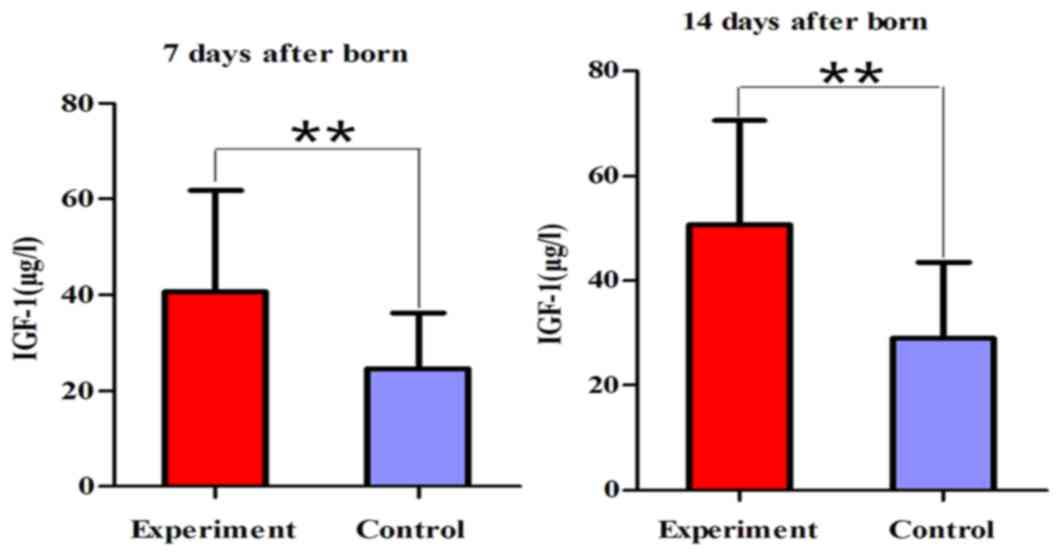
The plasma IGF-1 levels of the VLBWPIs in the
experimental group at day 7 (40.71±21.04 µg/l) and day 14
(50.63±19.79 µg/l) were significantly higher than that of the
control group (day 7, 24.7±11.62 µg/l; day 14, 28.88±14.50 µg/l)
following birth (t=3.65 and 4.86, respectively; P<0.01; Fig. 1).
Effects of reduced environmental
stimulation on body weight, crown-to-heel length and head
circumference
On day 7 and 14 following birth, VLBWPIs in the
experimental group exhibited significantly increased body weight
and crown-to-heel length compared with the VLBWPIs in the control
group (P<0.05; Table I). In
addition, VLBWPIs in the experimental group exhibited increased
head circumference compared with the VLBWPIs of the control group,
however there was no significant difference observed (P>0.05;
Table I).
Discussion
The present study assessed whether reducing the
stress of touch, sound and light in the NICU promotes plasma IGF-1
levels and the physical growth of VLBWPIs. A total of 60 VLBWPIs
were treated with routine nursing care in the NICU, but 30 of these
infants (the experimental group) were placed in a separate room
with reduced stimulations from touch, sound and light. The results
revealed that on day 7 and 14 following birth, the experimental
group exhibited significantly increased levels of plasma IGF-1,
body weight and crown-to-heel lengths compared with the control
group.
IGF-1 is a single-stranded polypeptide regulated by
growth hormones that indicates the activity of growth hormones that
directly promotes bone growth and height (1,8). Plasma
IGF-1 concentrations are considered to be an index of nutritional
status in the fetus and preterm infants (9). There is a high risk of low birth weight
when fetal plasma IGF-1 concentrations are continuously low and the
rate of growth hormone conversion to IGF-1 will significantly
influence stature throughout childhood (5,9–11).
In the present study, the difference in plasma IGF-1
concentrations between the experimental and control group on day 7
and 14 following birth were statistically significant, as were the
indices of development. Vatten et al (12) demonstrated that levels of IGF-I
contributed positively to birth weight and length, and high levels
of IGF-I were associated with low birth weight and reduced length,
which is consistent with the results of the present study. Compared
with full term infants, VLBWPIs are less able to adjust to external
stimuli. VLBWPIs are often disturbed and awakened by sounds in the
NICU, which results in sleeping disorders, a higher consumption of
energy and reduced body growth (1).
Most noises in the NICU are due to activities of the medical staff,
instruments and alarms (1,2,4).
In the present study, plasma IGF-1 levels of VLBWPIs
on day 7 and 14 following birth were significantly higher in the
experimental group than in the control group, and the body weight
and crown-to-heel length were also significantly higher in the
experimental group. The results of the present study indicate that
circulating IGF-1 in VLBWPIs is negatively associated with
stimulations in their environment. Specifically, the beneficial
effects of IGF-1 may be promoted by reducing exposure to
unnecessary light, limiting continuous noise to <50 dBA, impulse
noise to <55 dBA and providing care that allows for an
undisturbed sleep (4).
In summary, interventions in living conditions
should be implemented as soon as possible following birth, to allow
VLBWPIs to adapt more easily to the environment outside the womb.
This includes establishing benign circadian rules that enable
infants to stimulate the secretion of IGF-1, which in turn promotes
the growth of bones and body mass (1,8,13). A previous study has corroborated that
noise from the NICU can lead to negative physiological effects for
VLBWPIs, including a lower breathing rate, heart rate and blood
oxygen saturation, all of which may threaten the survival of
infants (14). Thus, reducing
environmental stress due to touch, light and sound in the NICU may
promote plasma IGF-1 levels and the physical growth of VLBWPIs.
Acknowledgements
Not applicable.
Funding
The present study was supported by grants from the
Bureau of Science and Technology of Foshan City in China (grant no.
201208255).
Availability of data and materials
All datasets used and/or analyzed during the present
study are available from the corresponding author on reasonable
request.
Authors' contributions
YC and CL contributed to the conception and design
of the study. ML, YL and YY performed the experiments. JZ and YL
analyzed the data. YC and CL prepared the manuscript. All authors
read and approved the final manuscript.
Ethics approval and consent to
participate
The study was approved by the Ethics Committee of
Shunde Women's and Children's Hospital (Shunde, China).
Patient consent for publication
All parents or guardians of the children enrolled in
this study provided written informed consent for publication.
Competing interests
The authors declare that they have no competing
interests.
References
|
1
|
Beardsall K, Vanhaesebrouck S, Frystyk J,
Ogilvy-Stuart AL, Vanhole C, van Weissenbruch M, Midgley P, Thio M,
Cornette L, Gill B, et al: Relationship between insulin-like growth
factor I levels, early insulin treatment, and clinical outcomes of
very low birth weight infants. J Pediatr. 164:1038–1044.e1. 2014.
View Article : Google Scholar : PubMed/NCBI
|
|
2
|
Chang YJ, Lin CH and Lin LH: Noise and
related events in a neonatal intensive care unit. Acta Paediatr
Taiwan. 42:212–217. 2001.PubMed/NCBI
|
|
3
|
Slevin M, Farrington N, Duffy G, Daly L
and Murphy JF: Altering the NICU and measuring infants' responses.
Acta Paediatr. 89:577–581. 2000. View Article : Google Scholar : PubMed/NCBI
|
|
4
|
Kawai N, Kanzaki S, Takano-Watou S, Tada
C, Yamanaka Y, Miyata T, Oka M and Seino Y: Serum free insulin-like
growth factor I (IGF-I), total IGF-I, and IGF-binding protein-3
concentrations in normal children and children with growth hormone
deficiency. J Clin Endocrinol Metab. 84:82–89. 1999. View Article : Google Scholar : PubMed/NCBI
|
|
5
|
Walenkamp MJ, Losekoot M and Wit JM:
Molecular IGF-1 and IGF-1 receptor defects: From genetics to
clinical management. Endocr Dev. 24:128–137. 2013. View Article : Google Scholar : PubMed/NCBI
|
|
6
|
Kwinta P, Klimek M, Wójcik M, Grudzień A,
Drozdz D and Pietrzyk JJ: Insulin-like growth factor-1 (IGF-1)
serum concentration among 7-year-old extremely low birth weight
children-an indicator of growth problems. J Pediatr Endocrinol
Metab. 24:651–657. 2011. View Article : Google Scholar : PubMed/NCBI
|
|
7
|
Committeeto Establish Recommended
Standards for Newborn ICU Design Recommend Standards for Newborn
ICU Design Report of the Fitthconsensus Conferenceon Newborn ICU
Design 1, 2002.
|
|
8
|
Radetti G, Bozzola M, Paganini C,
Valentini R, Gentili L, Tettoni K and Tatò L: Growth hormone
bioactivity and levels of growth hormone, growth hormone-binding
protein, insulinlike growth factor I, and insulinlike growth
factor-binding proteins in premature and full-term newborns during
the first month of life. Arch Pediatr Adolesc Med. 151:170–175.
1997. View Article : Google Scholar : PubMed/NCBI
|
|
9
|
Hawkes CP and Grimberg A: Insulin-like
growth factor-I is a marker for the nutritional state. Pediatr
Endocrinol Rev. 13:499–511. 2015.PubMed/NCBI
|
|
10
|
Hellström A, Ley D, Hansen-Pupp I,
Hallberg B, Löfqvist C, van Marter L, van Weissenbruch M, Ramenghi
LA, Beardsall K, Dunger D, et al: Insulin-like growth factor 1 has
multisystem effects on foetal and preterm infant development. Acta
Paediatr. 105:576–586. 2016. View Article : Google Scholar : PubMed/NCBI
|
|
11
|
Hellström A, Engström E, Hård AL,
Albertsson-Wikland K, Carlsson B, Niklasson A, Löfqvist C, Svensson
E, Holm S, Ewald U, et al: Postnatal serum insulin-like growth
factor I deficiency is associated with retinopathy of prematurity
and other complications of premature birth. Pediatrics.
112:1016–1020. 2003. View Article : Google Scholar : PubMed/NCBI
|
|
12
|
Vatten LJ, Nilsen ST, Odegård RA,
Romundstad PR and Austgulen R: Insulin-like growth factor I and
leptin in umbilical cord plasma and infant birth size at term.
Pediatrics. 109:1131–1135. 2002. View Article : Google Scholar : PubMed/NCBI
|
|
13
|
Engström E, Niklasson A, Wikland KA, Ewald
U and Hellström A: The role of maternal factors, postnatal
nutrition, weight gain, and gender in regulation of serum IGF-I
among preterm infants. Pediatr Res. 57:605–610. 2005. View Article : Google Scholar : PubMed/NCBI
|
|
14
|
Tessier R, Cristo M, Velez S, Giron M, de
Calume ZF, Ruiz-Palaez JG, Charpak Y and Charpak N: Kangaroo mother
care and the bonding hypothesis. Pediatrics. 102:e171998.
View Article : Google Scholar : PubMed/NCBI
|