The ‘2015 Paediatric Virology
proposal’ (1), which was presented
during the ‘1st workshop on Paediatric Virology’ on October, 2015,
resulted in a very interesting and constructive debate on the
potential role of the scientific field of neonatal and paediatric
viral infections as a new paediatric subspecialty candidate. To
date, the proposal, which described in detail the new subspecialty
areas, including both clinical and laboratory sections, has
attracted the interest of several world leading experts (2–12), who
have evaluated it in detail and highlighted the value of Paediatric
Virology subspecialists in the future (Table I). The value of the scientific field
of Paediatric Virology is also examined in the recent third
supplement issue of the Experimental and Therapeutic
Medicine (13–19), which is dedicated to Paediatric
Virology and is edited in the context of the ‘5th workshop on
Paediatric Virology’, which will be held in Sparta, Greece on
October 12, 2019.
 | Table I.Pros and cons of the ‘2015 Paediatric
Virology proposal’, which presented Paediatric Virology as a new
separate paediatric subspecialty candidate. |
Table I.
Pros and cons of the ‘2015 Paediatric
Virology proposal’, which presented Paediatric Virology as a new
separate paediatric subspecialty candidate.
| Pros |
|---|
| New and
old viruses as causative agents of emerging epidemics |
| New
vaccines under investigation |
| New
anti-viral agents in the paediatric clinical practice |
|
Complexity of the special
group of patients |
| New
technology methods in neonatal and paediatric care |
| Increased
clinical, research and educational needs |
|
| Cons |
|
|
Subspecialty or special
interest? |
| Jobs
limitations |
| Clinical
or basic sciences research orientation? |
|
Subspecialty of Paediatrics or
Microbiology or Internal Medicine? |
|
Subspecialisation educational
problems of the past |
However, specific points of scepticism have been
raised (2). Amongst these, two have
been considered to be as the most critical. The first one is the
limited number of paediatric virologists required in each country.
This can be addressed by Paediatric Virology being kept as a
special interest (4) and not
scheduled as a separate paediatric subspecialty (5). The Paediatric Virology subspecialty
training should be offered by international centres of excellence,
which would offer trainees the opportunity to be exposed to the
highest case mix, while supervised by internationally renowned
educationalists and researchers. A balance between
subspecialisation and general knowledge should always be sustained
(7).
The second issue is the scientific background of
paediatric virologists; should their medical core specialization be
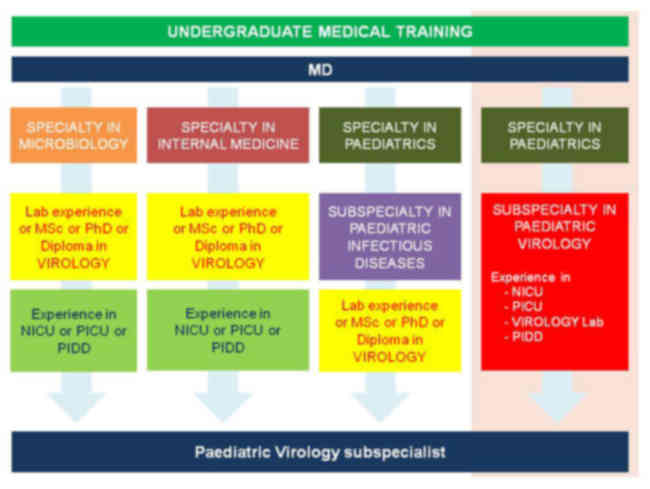
Microbiology, Internal Medicine or Paediatrics? Fig. 1 presents these different pathways.
The supporters of the first two options are based on the current
practice, where Microbiology or Internal Medicine consultants
develop a special interest in Virology. We suggest that this
subspecialisation should be included in Paediatrics (20). Currently, the paediatric orientated
clinical training in Paediatric Virology can be undertaken by
entering subspecialty training in paediatric infectious diseases
(PID) or being a general paediatrician and undertaking a special
interest (SPIN) module in infectious diseases or a higher degree,
e.g., Master of Sciences (MSc), Doctor of Philosophy (PhD), Master
of Research (MRes), or a Postgraduate Diploma in PID (3,4,15). In the future, to optimize care for
children requires state-of-the-art educated neonatologists and
paediatricians on viral infections and paediatric virologists, who
will be skilled in highly demanded diagnostic and therapeutic
decisions for neonates and children with possible viral infections
(20). We believe that the
implementation of the ‘2015 Paediatric Virology proposal’ into
medical education and clinical practice will be a step forward in
this direction.
Acknowledgements
This article is published in the third supplement
issue of the Experimental and Therapeutic Medicine, which is
dedicated to Paediatric Virology. This edition is performed in the
context of the ‘5th workshop on Paediatric Virology’ (Sparta,
Greece, October 12, 2019) organized by the Paediatric Virology
Study Group (PVSG) and supported by the Department of Clinical
Virology of the University of Crete School of Medicine and the
First Department of Paediatrics of the University of Athens School
of Medicine. We would like to thank all the members of the PVSG for
their valuable comments and corrections.
References
|
1
|
Mammas IN, Greenough A, Theodoridou M and
Spandidos DA: Paediatric Virology: A new paediatric subspecialty? A
proposal at the Workshop on Paediatric Virology, Athens, October
10, 2015. Exp Ther Med. 11:3–5. 2016. View Article : Google Scholar : PubMed/NCBI
|
|
2
|
Mammas IN and Spandidos DA: The
subspecialty of Paediatric Virology: A ‘mosaic tile’ in future
Paediatrics. Exp Ther Med. 12:539–540. 2016. View Article : Google Scholar : PubMed/NCBI
|
|
3
|
Mammas IN and Spandidos DA: The
educational challenge of Paediatric Virology: An interview with
Professor of Neonatology Anne Greenough. Exp Ther Med.
14:3332–3334. 2017. View Article : Google Scholar : PubMed/NCBI
|
|
4
|
Mammas IN and Spandidos DA: The future of
medical education in neonatology, paediatrics and paediatric
virology: An interview with Professor Alan Michael Weindling,
Professor of Perinatal Medicine at the University of Liverpool. Exp
Ther Med. 16:2805–2808. 2018.PubMed/NCBI
|
|
5
|
Mammas IN and Spandidos DA: Paediatric
Virology as a new educational initiative: An interview with
Nobelist Professor of Virology Harald zur Hausen. Exp Ther Med.
14:3329–3331. 2017. View Article : Google Scholar : PubMed/NCBI
|
|
6
|
Mammas IN and Spandidos DA: The proposal
of Paediatric Virology and its perspectives: An interview with
Professor of Paediatrics Maria Theodoridou. Exp Ther Med.
14:3338–3340. 2017. View Article : Google Scholar : PubMed/NCBI
|
|
7
|
Mammas IN and Spandidos DA: The innovation
of the subspecialty of Paediatric Virology: An interview with
Research Professor of Molecular Virology Anna Kramvis. Exp Ther
Med. 14:3335–3337. 2017. View Article : Google Scholar : PubMed/NCBI
|
|
8
|
Mammas IN and Spandidos DA: Paediatric
virology as a candidate of paediatric subspecialisation: An
interview with Assistant Professor of Molecular
Microbiology-Virology Angeliki Melidou. Exp Ther Med. 16:2795–2798.
2018.PubMed/NCBI
|
|
9
|
Mammas IN and Spandidos DA: The philosophy
of paediatric teaching: An interview with Dr Nikolaos
Myriokefalitakis, former Clinical Director of the ‘Penteli’
Children's Hospital in Athens (Greece). Exp Ther Med. 16:2799–2802.
2018.PubMed/NCBI
|
|
10
|
Mammas IN and Spandidos DA: Neonatology,
paediatrics and paediatric virology on a British island: An
interview with neonatologist Dr Prakash Thiagarajan (Isle of Man).
Exp Ther Med. 16:2790–2794. 2018.PubMed/NCBI
|
|
11
|
Mammas IN and Spandidos DA: Evaluating the
proposal of paediatric virology: An interview with Professor Tina
Dalianis, Professor of Tumour Virology at Karolinska Institutet.
Exp Ther Med. 16:2785–2789. 2018.PubMed/NCBI
|
|
12
|
Mammas IN and Spandidos DA: Spinal
muscular atrophy type I and the dual role of viruses: An interview
with Professor Basil T. Darras, Professor of Neurology (Pediatrics)
at Harvard Medical School. Exp Ther Med. 15:3673–3679.
2018.PubMed/NCBI
|
|
13
|
Mammas IN, Theodoridou M and Spandidos DA:
The wisdom and eudaimonia of Paediatrics: An interview with
Professor George P. Chrousos, Professor of Paediatrics at the
University of Athens, Greece. Exp Ther Med. 18:3217–3220. 2019.
|
|
14
|
Mammas IN: Clinical Virology research and
medical education in Greece: An interview with Professor Demetrios
A. Spandidos, Professor of Clinical Virology at the University of
Crete in Greece. Exp Ther Med. 18:3221–3225. 2019.
|
|
15
|
Mammas IN and Spandidos DA: Paediatric
Virology and respiratory syncytial virus: An interview with
Honorary Senior Lecturer in Paediatric Infectious Diseases Dr Simon
B. Drysdale (St. George's, University of London, UK). Exp Ther Med.
18:3226–3230. 2019.
|
|
16
|
Mammas IN and Spandidos DA: Advancing
challenges in Paediatric Virology: An interview with Professor
Barbara A. Rath, Co-founder and Chair of the Vienna Vaccine Safety
Initiative. Exp Ther Med. 18:3231–3237. 2019.
|
|
17
|
Mammas IN and Spandidos DA: The
perspectives and the challenges of Paediatric Radiology: An
interview with Dr Georgia Papaioannou, Head of the Paediatric
Radiology Department at the ‘Mitera’ Children's Hospital in Athens,
Greece. Exp Ther Med. 18:3238–3242. 2019.
|
|
18
|
Spandidos DA: Paediatric Virology and
innovation in medical education: An interview with Dr Ioannis N.
Mammas, Consultant Paediatrician on the island of Euboea (Greece)
and Coordinator of the Paediatric Virology Study Group. Exp Ther
Med. 18:3243–3247. 2019.
|
|
19
|
Mammas IN, Koutsaftiki C,
Papatheodoropoulou A and Spandidos DA: Mache Papanicolaou
(1890–1982), the dedicated companion of the great benefactor: An
interview with Dr Julie Kokkori, one of the only living relatives
of Dr George N. Papanicolaou. Exp Ther Med. 18:3248–3251. 2019.
|
|
20
|
Mammas IN, Greenough A, Theodoridou M and
Spandidos DA: Does Europe need paediatric virologists? Exp Ther
Med. 16:2783–2784. 2018.PubMed/NCBI
|