Introduction
Intrauterine adhesions (IUA), also known as
Asherman's syndrome, were first described in 1948 by Joseph G.
Asherman (1). The causes of IUA
include dilatation/curettage, postpartum hemorrhage,
hysteromyomectomy, hysteroscopic operation and genital tuberculosis
(2-4).
The main clinical manifestations of IUAs are hypomenorrhea,
recurrent abortion, amenorrhea, periodic hypogastralgia,
infertility and altered placental implantation, which are
conditions that can cause harm to patient health (5). Currently, the treatment for IUA is
hysteroscopic adhesiolysis; however, there is still a high
recurrence rate after this treatment method (6). A previous study reported re-adhesion
rates of up to 62.5% after hysteroscopic adhesiolysis (6). Therefore, the prevention of IUA after
intrauterine operations is particularly important.
Hyaluronic acid is a highly polymerized chain of
disaccharides and a mucopolysaccharide that has important
physiological functions in the body, including lubrication of the
joints, adjusting the permeability of blood vessel walls,
regulating the spread and transport of proteins and electrolytes
and promoting wound healing (7).
Hyaluronic acid can bind with a large number of water molecules and
improve tissue hydration, enhance cell resistance to mechanical
injury and reduce post-traumatic granulation tissue and fibrous
tissue formation (8,9). Due to its unique biocompatibility and
enzymatic biodegradation, hyaluronic acid is often used to prevent
postoperative tissue adhesion (8,9). At
present, hyaluronic acid gel is widely used after intrauterine
operation to prevent IUAs, and this therapy has achieved some
beneficial effects (10); however,
the rates of adhesion and pregnancy after an intrauterine operation
are still unclear. The current paper reports a meta-analysis on the
existing literature of clinical randomized controlled trials on the
use of hyaluronic acid gel following intrauterine operations.
Materials and methods
Literature search
The Cochrane Library (https://www.cochranelibrary.com/), Embase (https://www.embase.com/) and PubMed (https://www.ncbi.nlm.nih.gov/pubmed/)
databases were searched for articles published before July 31 2018,
using the terms ‘hyaluronic acid’, ‘intrauterine adhesions’,
‘Asherman's syndrome’, ‘IUA’, ‘dilatation and curettage’,
‘abortion’ and ‘hysteroscopic’. No language limit was set on the
original publication.
Study inclusion and exclusion
criteria
The present study included randomized controlled
clinical studies that used hyaluronic acid gel following an
intrauterine operation. The subjects were selected if the women
were considered to be of reproductive age (18-40 years), had
undergone an intrauterine operation and if there were at least two
treatment groups in the trial (with or without the use of
hyaluronic acid gel) regardless of other assistive interventions,
including the administration of estrogen or the use of oral
contraceptives.
Studies were excluded if they were case reports,
articles without specific data or studies with clear defects in
experimental design.
Evaluation index
The efficacy of hyaluronic acid gel interventions
was evaluated using two outcome measures. The first was the
incidence rate of IUAs, according to the grading method as
described by the American Fertility Society in 1988(11) and the second was pregnancy rate. The
outcome measures were assessed according to the following equation:
Number of cases (IUA of pregnancy)/total number of cases.
Study quality evaluation and
statistical analysis
The literature screening, bias risk assessment and
data extraction were conducted systematically by two independent
evaluators. Risk assessments were performed using the clinical
randomized controlled trial evaluation method as described by the
Cochrane reviewer's handbook version 5.1(12). All data were analyzed using the
RevMan 5.3 software (Cochrane).
The statistical heterogeneity of each study result
was analyzed using the χ2 test and the statistical
significance was set at a cut-off value of P=0.1. P<0.01
indicated statistical heterogeneity of the study. I2 was
used to evaluate the heterogeneity of the results. An I2
score of <25% suggested that the heterogeneity may not be
important; however, it indicated significant heterogeneity when it
was >50%. If the I2 was >75%, a high degree of
heterogeneity was indicated. When the I2 was >50%, a
random-effects model was adopted followed by a subgroup and
sensitivity analyses. When the I2 was <50%, a
fixed-effects model was adopted.
All subjects were included in the analysis and were
divided into the treatment group, which received hyaluronic acid
gel treatment after an intrauterine operation, or the control
group, which did not receive treatment with hyaluronic acid gel
after intrauterine operation. A dichotomous variable was expressed
as the relative risk (RR) and 95% confidence interval (CI), while a
continuous variable was expressed as the mean difference (MD).
Results
Baseline characteristics
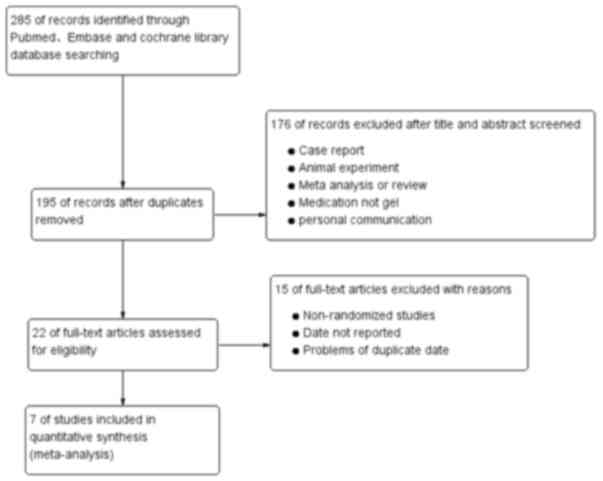
A total of 285 studies were initially selected. A
total of seven were included in the final analysis after screening
(Fig. 1) (10,13-18).
All 7 studies compared the efficacies of using hyaluronic acid gel
as an adjuvant therapy (treatment group) against a control group
(without the use of hyaluronic acid gel) after an intrauterine
operation. A total of 952 women of reproductive age who underwent
intrauterine operations were included. From these patients, 455 had
been treated with hyaluronic acid gel postoperatively and 497 were
controls. Among the 7 studies, 3 used common abortive procedures
such as intrauterine operations (14,15,17) and
4 were performed using hysteroscopy (10,13,16,18). A
total of six studies were performed using direct injection with the
gel (10,16,18) and
one used a temporary adhesion barrier, which hydrated into a gel
within 24-48 h of administration into the patient (17). There were no statistically
significant differences in baseline parameters between the
treatment and control groups, as presented in Table I (10,13-18).
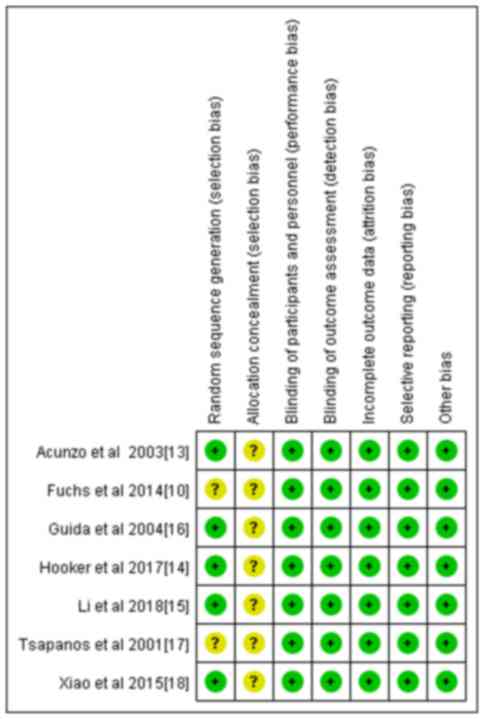
The results of the quality assessment of the included studies are
presented in Fig. 2. Allocation
concealment methods for all the studies were not included.
 | Table ICharacteristics of randomized
controlled trials. |
Table I
Characteristics of randomized
controlled trials.
| First Author,
year | Sample size (n) | Disease | Intervention | Gel(Type and
dose) | Outcomes | (Refs.) |
|---|
| Fuchs et al,
2014 | 52 | Retained Products of
Conception | Gel and Hysteroscopy
vs. Hysteroscopy | Oxiplex gel, 10
ml | IUAs, pregnancy | (10) |
| Acunzo et al,
2003 | 84 | IUAs | Gel, oral antibiotics
and hysteroscopic adhesiolysis vs. oral antibiotics and
hysteroscopic adhesiolysis | Auto-crosslinked
hyaluronic acid, 10 ml | IUAs | (13) |
| Hooker et al,
2017 | 149 | Miscarriage of <14
weeks with at least one previous D&C | Gel and D&Cs vs.
D&C | Auto-crosslinked
hyaluronic acid, 10 ml | IUAs | (14) |
| Li et al,
2019 | 274 | Delayed miscarriage
without previous history of D&C | Gel and D&Cs vs.
D&C | Auto-crosslinked
hyaluronic acid, 3 ml | IUAs | (15) |
| Guida et al,
2004 | 132 | Myomas, polyps, and
uterine septa | Gel and hysteroscopic
vs. hysteroscopic | Auto-crosslinked
hyaluronic acid, 10 ml | IUAs | (16) |
| Tsapanos et
al, 2002 | 150 | Patients with
incomplete, missed, or recurrent abortion scheduled for suction
evacuation and curettage | Gel and D&C vs.
D&C |
Seprafilm™/12.7x15,2 cm | IUAs,
pregnancy | (17) |
| Xiao et al,
2015 | 111 | Moderate to severe
IUA | Gel, Foley's
catheter balloon and hysteroscopic adhesiolysis vs. Foley's
catheter balloon and hysteroscopic adhesiolysis | Auto-crosslinked
hyaluronic acid, 2 ml | IUAs | (18) |
Meta-analysis results
All seven studies reported the incidence rate of
IUAs; however, only 4 reported the IUA score after the intrauterine
operation (14-16,18).
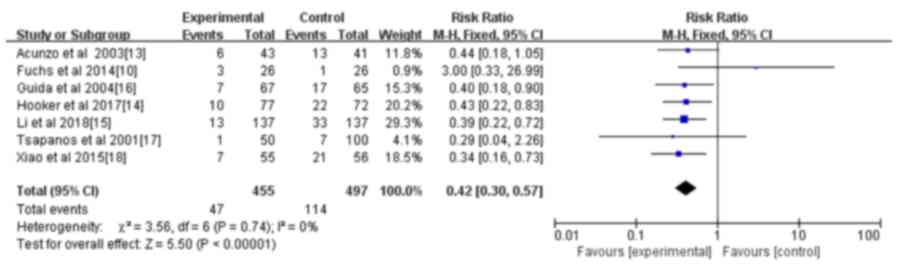
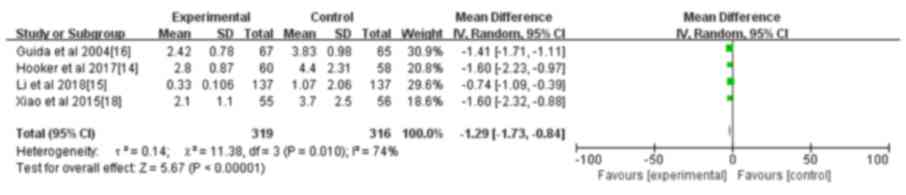
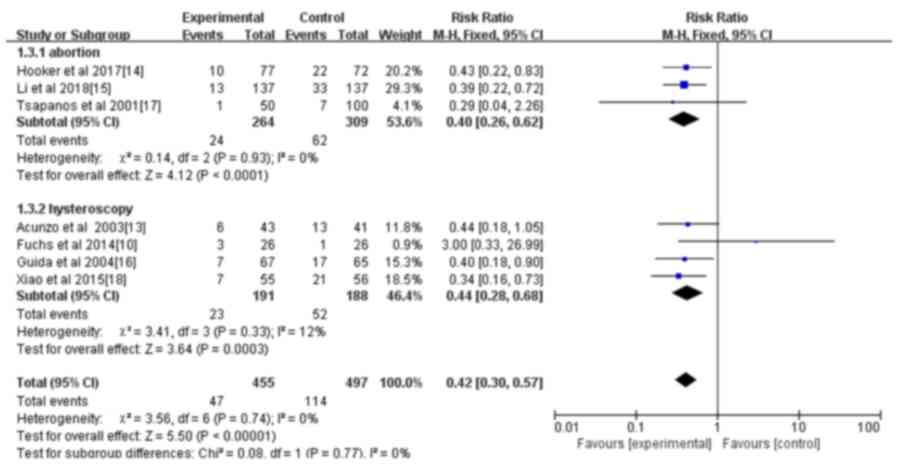
As indicated in Figs. 3 and 4, the hyaluronic acid gel reduced the
incidence of IUA after an intrauterine operation (RR=0.42; 95%
CI=0.30-0.57; P<0.001) and the IUA score after an intrauterine
operation (MD=-1.29, 95% CI=-1.73 to -0.84, P<0.001). A subgroup
analysis revealed that the preventive effect of hyaluronic acid gel
on IUAs was not affected by the type of intrauterine operation, as
presented in Fig. 5. Abortions had
an RR of 0.40 with a 95% CI of 0.26-0.62 (P<0.001) and
hysteroscopy had an RR of 0.44 with a 95% CI of 0.28-0.68
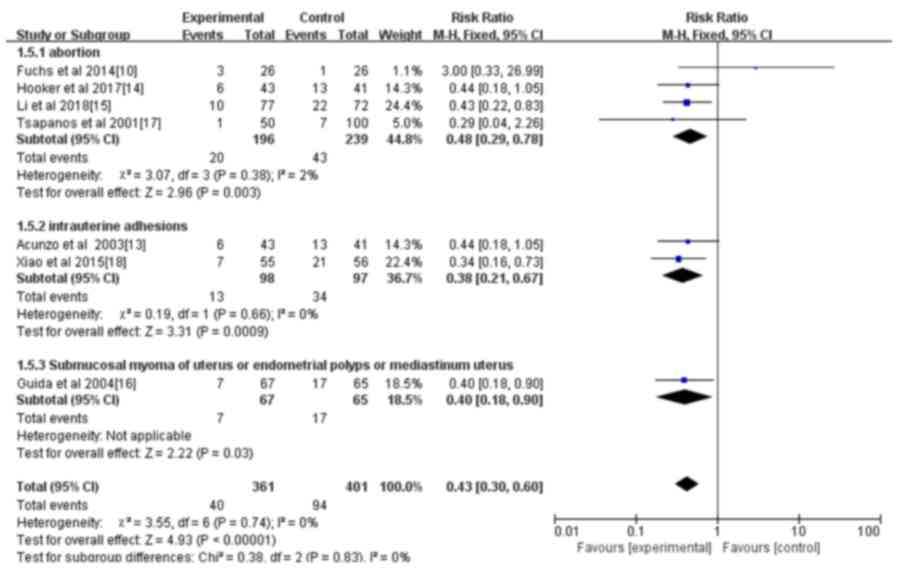
(P<0.001). The analysis also indicated that the preventive
effect of hyaluronic acid gel on IUA was not significantly affected
by primary diseases, namely abortion (RR=0.48; 95% CI=0.29-0.78;
P=0.003), IUAs (RR=0.38; 95% CI=0.21-0.67; P<0.001), and
submucosal myoma of uterus or endometrial polyps or mediastinum
uterus (RR=0.40; 95% CI=0.18-0.90; P=0.03), as presented in
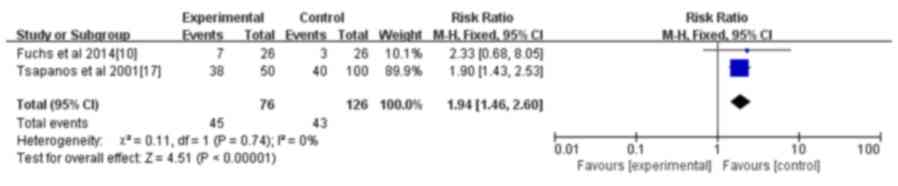
Fig. 6. A total of two studies
(10,17) reported the effect of the treatment on
pregnancy rates and the results demonstrated that the hyaluronic
acid gel could improve pregnancy rates after intrauterine
operations (RR=1.94; 95% CI=1.46-2.6; P<0.001), as presented in
Fig. 7.
Discussion
A total of seven studies were included in the
present meta-analysis; all reported the incidence of IUA after
intrauterine operation (10,13-18),
but only four reported the IUA score (14-16,18).
The results of the current study demonstrated that hyaluronic acid
gel reduced IUA incidence and its score following an intrauterine
operation. This reduction was not affected by the type of
intrauterine operation or the presence of primary diseases. The
effect of treatment on pregnancy rates was reported in two studies,
and the results indicated that hyaluronic acid gel could improve
pregnancy rates following an intrauterine operation (10,17).
However, neither of these studies reported additional details such
as the use of contraceptives or the number of live births after
treatment. These aforementioned studies also did not provide
sufficient follow-up data. In the present study, it was not
possible to evaluate the effect of hyaluronic acid gel on
postoperative pregnancy and live birth rates. None of the seven
studies reported gel-related or surgical-related complications,
including hemorrhage, perforation or cervical laceration.
Hyaluronic acid is a highly polymerized chain of
disaccharides and is a mucopolysaccharide. Due to its irregular
coiled state, physical and chemical properties (19), it has important physiological
functions in the body, such as lubricating the joints, adjusting
the permeability of blood vessel walls, regulating the spread and
transport of proteins and electrolytes and promoting wound healing
(7). Due to its unique
biocompatibility and enzymatic biodegradation, hyaluronic acid is
often used to prevent postoperative tissue adhesion (8,9).
However, its limited half-life causes it to degrade easily in the
body, limiting its effectiveness (20). Hyaluronic acid has also been combined
with other biopolymers, such as proteins or peptides, through
esterification, cross-linking and other chemical modifications of
hyaluronic acids (20). This has led
to the production of related compounds, such as hyaluronic
acid-carboxymethylcellulose gels, which are widely used to prevent
tissue adhesion after surgery (20).
In recent years, the preventive effect of hyaluronic acid gel on
IUA has attracted wide attention. Hooker et al (14) randomly assigned 152 women to the
auxiliary auto-crosslinked hyaluronic acid gel group (intervention
group) and the non-assisted auto-crosslinked hyaluronic acid gel
group (control group) following dilatation and curettage (D&C).
A follow-up diagnostic hysteroscopy was conducted 8 to 12 weeks
after the D&C; the results showed that the application of gel
after D&C significantly reduced the incidence of postoperative
IUAs. A further study using animal models supported these findings.
Huberlant et al (21)
performed bilateral uterine curettage in 20 New Zealand white
rabbits where one uterine tube in each rabbit was its own control.
The rabbits were randomized into two groups where the second
uterine tube was treated with either hyaluronic acid or isotonic
saline. The results suggested that the use of hyaluronic acid gel
in animal models improved fertility and reduced the incidence of
IUA.
Previous studies have indicated that hormones,
intrauterine balloons and intrauterine devices (IUD), achieved some
curative effect in preventing IUAs, but there were no clear
indicators as to the improvement of clinical symptoms and pregnancy
rates of the patients (22-26).
Abu Rafea et al (27)
demonstrated that postoperative intrauterine placement of a Foley's
catheter balloon exhibited no significant effect on childbirth and
pregnancy (27). However, Gupta
et al (28) revealed that a
postoperative Foley's catheter balloon placement seemed to prevent
IUA; however, this is yet to be validated in a study with a larger
cohort. Although this method has had some success, the secondary
tissue damage and secondary uplink infection caused by a Foley's
balloon extraction remains to be determined. Krajčovičová et
al (29) indicated that
following hysteroscopic adhesiolysis, the probability of using a
hyaluronic acid gel and an IUD to restore a normal menstrual cycle
was 60.0 and 55.5% respectively, compared with the probability of
the control group of 36.3%. The pregnancy rate of patients treated
with the hyaluronic acid gel was 77.7%, significantly higher
compared with patients treated with an IUD (60.0%). It can be
inferred that the application of the hyaluronic acid gel is better
than an IUD or balloon at improving the pregnancy rate after IUA
separation. It was also demonstrated that hyaluronic acid can
regulate inflammatory factors, promote the normal epithelialization
and regeneration of wound tissues, effectively isolate adjacent
healing tissues and prevent the formation of adhesions (30).
In conclusion, the current study indicated that
hyaluronic acid gels can significantly reduce IUA incidences after
an intrauterine operation. Their efficacy does not appear to be
affected by the type of intrauterine operation or the presence of
primary diseases. The results of the current study also
demonstrated that hyaluronic acid gels can significantly improve
pregnancy rates following intrauterine operation. The seven studies
included in the present analysis were similar in experimental
design with no heterogeneity. In addition, the sample sizes were
small and the follow-up times were short. These limitations may
have affected the overall analysis. Therefore, a larger sample size
with longer follow-up and appropriately designed randomized,
controlled clinical studies are necessary to fully assess the
efficacy of hyaluronic acid gel-assisted prevention of IUA
following intrauterine operation. The results of the present study
provide novel insight that may be used for the prevention of
IUA.
Acknowledgements
The authors would like to thank Dr Zhu Bin and Dr Wu
Zhengqiang in the Department of Obstetrics and Gynecology, Yiwu
Maternity and Children Health Care Hospital (Jinhua, China) for
their assistance in this study.
Funding
No funding was received.
Availability of data and materials
The datasets used and/or analyzed during the present
study are available from the corresponding author on reasonable
request.
Authors' contributions
FZ and XX contributed equally to this work by
designing the study, reviewing literature, interpreting the
analyses and writing the manuscript. FH and JL contributed to the
literature review, data collection and analysis, and writing the
manuscript. YC contributed to designing the study, data analysis,
and writing the manuscript.
Ethics approval and consent to
participate
Not applicable.
Patient consent for publication
Not applicable.
Competing interests
The authors declare that they have no competing
interests.
References
|
1
|
Vancaillie TG and Garad R: Asherman's
syndrome. Aust Nurs J. 20:34–36. 2013.PubMed/NCBI
|
|
2
|
Yamamoto N, Takeuchi R, Izuchi D, Yuge N,
Miyazaki M, Yasunaga M, Egashira K, Ueoka Y and Inoue Y:
Hysteroscopic adhesiolysis for patients with Asherman's syndrome:
Menstrual and fertility outcomes. Reprod Med Biol. 12:159–166.
2013.PubMed/NCBI View Article : Google Scholar
|
|
3
|
Salazar CA, Isaacson K and Morris S: A
comprehensive review of Ashermanʼs syndrome. Curr Opin Obstet
Gynecol. 29:249–256. 2017.PubMed/NCBI View Article : Google Scholar
|
|
4
|
Mehedintu C, Ionescu O, Rotaru AM,
Antonovici M, Plotogea M, Berceanu C, Vladareanu S and Bratila E:
Asherman's syndrome after an uncomplicated cesarian section.
Gineco. 12:166–168. 2016.
|
|
5
|
Friedman A, DeFazio J and DeCherney A:
Severe obstetric complicantions after aggressive treatment of
asherman syndrome. Obstet Gynecol. 67:864–867. 1986.PubMed/NCBI View Article : Google Scholar
|
|
6
|
Bosteels J, Weyers S, D'Hooghe TM,
Torrance H, Broekmans FJ, Chua SJ and Mol BWJ: Anti-adhesion
therapy following operative hysteroscopy for treatment of female
subfertility. Cochrane Database Syst Rev.
11(CD011110)2017.PubMed/NCBI View Article : Google Scholar
|
|
7
|
Itano N: Simple primary structure, complex
turnover regulation and multiple roles of hyaluronan. J Biochem.
144:131–137. 2008.PubMed/NCBI View Article : Google Scholar
|
|
8
|
Salwowska NM, Bebenek KA, Żądło DA and
Wcisło-Dziadecka DL: Physiochemical properties and application of
hyaluronic acid: A systematic review. J Cosmet Dermatol.
15:520–526. 2016.PubMed/NCBI View Article : Google Scholar
|
|
9
|
Hong MK and Ding DC: Seprafilm®
application method in laparoscopic surgery. JSLS.
21(e2016.00097)2017.PubMed/NCBI View Article : Google Scholar
|
|
10
|
Fuchs N, Smorgick N, Ben Ami I, Vaknin Z,
Tovbin Y, Halperin R and Pansky M: Intercoat (Oxiplex/AP Gel) for
preventing intrauterine adhesions after operative hysteroscopy for
suspected retained products of conception: Double-blind,
prospective, randomized pilot study. J Minim Invasive Gynecol.
21:126–130. 2014.PubMed/NCBI View Article : Google Scholar
|
|
11
|
The American Fertility Society
classifications of adnexal adhesions distal tubal occlusion tubal
occlusion secondary to tubal ligation tubal pregnancies Mullerian
anomalies and intrauterine adhesions. Fertil Steril. 49:944–955.
1988.
|
|
12
|
Higgins JP and Green S: Cochrane handbook
for systematic reviews of interventions. Cochrane Book Series,
2008.
|
|
13
|
Acunzo G, Guida M, Pellicano M, Tommaselli
GA, Di Spiezio Sardo A, Bifulco G, Cirillo D, Taylor A and Nappi C:
Effectiveness of auto-cross-linked hyaluronic acid gel in the
prevention of intrauterine adhesions after hysteroscopic
adhesiolysis: A prospective, randomized, controlled study. Hum
Reprod. 18:1918–1921. 2003.PubMed/NCBI View Article : Google Scholar
|
|
14
|
Hooker AB, de Leeuw R, van de Ven PM,
Bakkum EA, Thurkow AL, Vogel NEA, van Vliet HAAM, Bongers MY,
Emanuel MH, Verdonkschot AEM, et al: Prevalence of intrauterine
adhesions after the application of hyaluronic acid gel after
dilatation and curettage in women with at least one previous
curettage: Short-term outcomes of a multicenter, prospective
randomized controlled trial. Fertil Steril. 107:1223–1231.e3.
2017.PubMed/NCBI View Article : Google Scholar
|
|
15
|
Li X, Wu L, Zhou Y, Fan X, Huang J, Wu J,
Yu R, Lou J, Yang M, Yao Z and Xue M: New crosslinked hyaluronan
gel for the prevention of intrauterine adhesions after dilation and
curettage in patients with delayed miscarriage: A prospective,
multicenter, randomized, controlled trial. J Minim Invasive
Gynecol. 26:94–99. 2019.PubMed/NCBI View Article : Google Scholar
|
|
16
|
Guida M, Acunzo G, Di Spiezio Sardo A,
Bifulco G, Piccoli R, Pellicano M, Cerrota G, Cirillo D and Nappi
C: Effectiveness of auto-crosslinked hyaluronic acid gel in the
prevention of intrauterine adhesions after hysteroscopic surgery: A
prospective, randomized, controlled study. Hum Reprod.
19:1461–1464. 2004.PubMed/NCBI View Article : Google Scholar
|
|
17
|
Tsapanos VS, Stathopoulou LP,
Papathanassopoulou VS and Tzingounis VA: The role of Seprafilm
bioresorbable membrane in the prevention and therapy of endometrial
synechiae. J Biomed Mater Res. 63:10–14. 2002.PubMed/NCBI View Article : Google Scholar
|
|
18
|
Xiao S, Wan Y, Zou F, Ye M, Deng H, Ma J,
Wei Y, Tan C and Xue M: Prevention of intrauterine adhesion with
auto-crosslinked hyaluronic acid gel: A prospective, randomized,
controlled clinical study. Zhonghua Fu Chan Ke Za Zhi. 50:32–36.
2015.(In Chinese). PubMed/NCBI
|
|
19
|
Wang M, Liu C and Xiao W: Intra-articular
injection of hyaluronic acid for the reduction in joint adhesion
formation in a rabbit model of knee injury. Knee Surg Sports
Traumatol Arthrosc. 22:1536–1540. 2013.PubMed/NCBI View Article : Google Scholar
|
|
20
|
Knopf-Marques H, Pravda M, Wolfova L,
Velebny V, Schaaf P, Vrana NE and Lavalle P: Hyaluronic acid and
its derivatives in coating and delivery systems: Applications in
tissue engineering, regenerative medicine and immunomodulation. Adv
Healthc Mater. 5:2841–2855. 2016.PubMed/NCBI View Article : Google Scholar
|
|
21
|
Huberlant S, Fernandez H, Vieille P,
Khrouf M, Ulrich D, deTayrac R and Letouzey V: Application of a
hyaluronic acid gel after intrauterine surgery may improve
spontaneous fertility: A randomized controlled trial in New Zealand
white rabbits. PLoS One. 10(e0125610)2015.PubMed/NCBI View Article : Google Scholar
|
|
22
|
Khan Z and Goldberg JM: Hysteroscopic
management of Asherman's syndrome. J Minim Invasive Gynecol.
25:218–228. 2018.PubMed/NCBI View Article : Google Scholar
|
|
23
|
Zhou Q, Wu X, Dai X, Yuan R and Qi H: The
different dosages of estrogen affect endometrial fibrosis and
receptivity, but not SDF-1/CXCR4 axis in the treatment of
intrauterine adhesions. Gynecol Endocrinol. 34:49–55. 2017.
View Article : Google Scholar
|
|
24
|
Xu W, Zhang Y, Yang Y, Zhang S and Lin X:
Effect of early second-look hysteroscopy on reproductive outcomes
after hysteroscopic adhesiolysis in patients with intrauterine
adhesion, a retrospective study in China. Int J Surg. 50:49–54.
2018.PubMed/NCBI View Article : Google Scholar
|
|
25
|
Cai H, Qiao L, Song K and He Y: Oxidized,
regenerated cellulose adhesion barrier plus intrauterine device
prevents recurrence after adhesiolysis for moderate to Severe
intrauterine adhesions. J Minim Invasive Gynecol. 24:80–88.
2017.PubMed/NCBI View Article : Google Scholar
|
|
26
|
Wei ML, Lin XN, Zhou F, Huang D, Kuang L
and Zhang SY: Evaluation of safety and patient acceptance of
uterine balloon stents in preventing intrauterine adhesions. Natl
Med J China. 94:3095–3097. 2014.PubMed/NCBI View Article : Google Scholar
|
|
27
|
Abu Rafea BF, Vilos GA, Oraif AM, Power
SG, Cains JH and Vilos AG: Fertility and pregnancy outcomes
following resectoscopic septum division with and without
intrauterine balloon stenting: A randomized pilot study. Ann Saudi
Med. 33:34–39. 2013.PubMed/NCBI View Article : Google Scholar
|
|
28
|
Gupta S, Talaulikar VS, Onwude J and
Manyonda I: A pilot study of Foley's catheter balloon for
prevention of intrauterine adhesions following breach of uterine
cavity in complex myoma surgery. Arch Gynecol Obstet. 288:829–832.
2013.PubMed/NCBI View Article : Google Scholar
|
|
29
|
Krajčovičová R, Hudečk R, Ventruba P and
Surgentová K: The role of hyaluronan in Asherman's syndrome
therapy. J Gynecol Surg. 31:250–254. 2015. View Article : Google Scholar
|
|
30
|
Back JH, Cho WJ, Kim JH, Park IK and Kwon
SW: Application of hyaluronic acid/sodium alginate-based
microparticles to prevent tissue adhesion in a rabbit model. Surg
Today. 46:501–508. 2015.PubMed/NCBI View Article : Google Scholar
|