Medical terminology is a significant tool in medical
education, as the meaning of words has great value in medicine.
Scientific terms should be precise and consistent, and should not
cause confusion. For this reason, the selection of the most
appropriate term to describe a new virus, syndrome, procedure or
medical specialty should be performed carefully. According to
Epicurus, the ancient Greek philosopher, who was born on the island
of Samos during the 3rd century B.C. and founded one of the most
influential schools of philosophy in the ancient world, the meaning
of each word is a fundamentally necessary concept and should be
clear without causing misunderstanding or requiring explanation
(1).
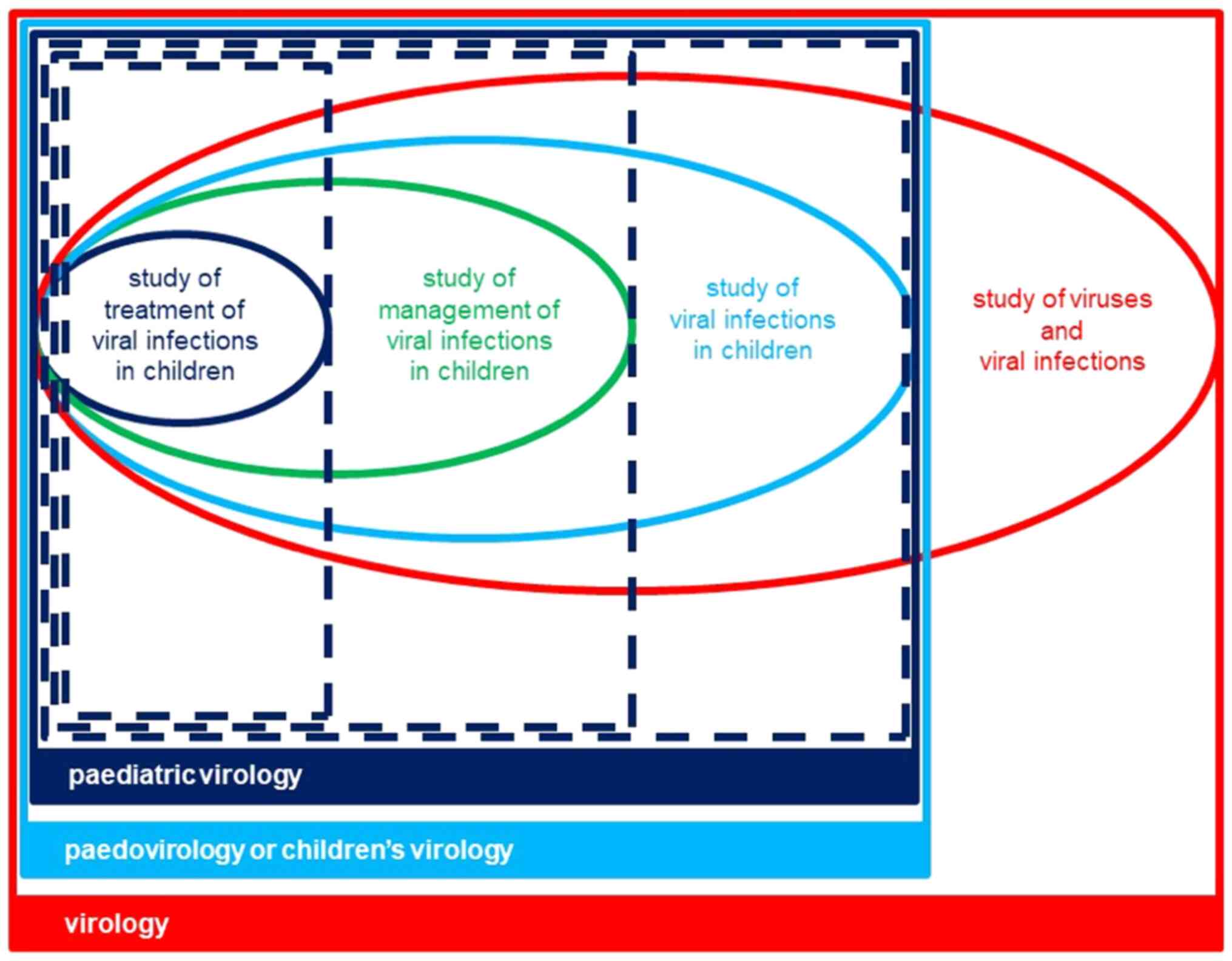
‘Paediatric virology’ is a medical term from the
middle of the 20th century, which derived from three ancient Greek
words [‘paed’<παῖς (pais = child), ‘iatric’<ἰάομαι/ἰῶμαι
(iaome/iome = to be treated) and ‘logy’<λόγος (logos = study)],
and one Latin word [‘viro’<virus]; the term ‘paediatric
virology’ refers to the scientific field of virology, within the
specialty of paediatrics. It encompasses the study of the basic
science of viruses, the epidemiology of viral infections in
children, and the diagnosis and management of children with viral
infections or at risk of developing viral infections (2-4).
The presence of four words in this term is accurate, meaningful and
helpful to describe the characteristics of this new subspecialty,
which:
a) deals with children of all ages <18 years old,
including neonates; b) focuses on treatment (if we want to be
etymologically precise) or management (if we use the general
medical meaning for the term ‘iatric’) of viral infections, a
required aim which should be further developed in the future in
this field (4); c) its subject are
viruses and viral infections; and d) as a scientific field is based
on studying and knowledge (Fig.
1).
This term is in accordance with the respective terms
used in the English language for other medical subspecialties, such
as ‘paediatric gastroenterology’ or ‘paediatric radiology’ or
‘paediatric neurology’; all these terms are used to describe
subspecialties of medicine that are involved in paediatric clinical
practice. Subsequently, ‘paediatric virologist’ is the paediatric
health professional, who is trained in paediatric viral infections
and is an expert in paediatric virology.
An alternative term that could be used for
‘paediatric virology’ is ‘children's virology’, which refers to the
study of viral infections occurring in children. The term
‘children's virology’ derives from three (‘children’, ‘viro’,
‘logy’) instead of four words and its meaning is accurate and
highly descriptive despite the absence of the word ‘iatric’, which
is present in ‘paediatric virology’. This absence does not change
the descriptive accuracy of the required meaning of this term since
the word ‘logos’, used extensively to describe the study of a
branch of science, includes the meaning of ‘iatric’. Similarly, the
term ‘children's hospital’ is alternatively used to describe a
‘paediatric hospital’, where the meaning of the words ‘iatric’ and
‘hospital’ is also repeated.
An alternative new medical term for ‘children's
virology’ could be ‘paedovirology’, where the ancient Greek word
‘paedo’ replaces the word ‘children’. This term expresses
accurately the same meaning as ‘children's virology’ and it does
not contain words with repeated meaning. The main advantages of
‘paedovirology’ are that a) it is a one-word term; b) it fulfills
the principle of the linguistic economy; and c) it is easily
pronounced. Subsequently, the scientist who studies viral
infections occurring in children could be called
‘paedovirologist’.
In the Greek language, where the ancient Greek word
‘ιός’ (ios) is used instead of the Latin word ‘virus’ (5), the term ‘παιδοϊολογία’ (paedoiologia)
could alternatively be used instead of the translated current term
‘παιδιατρική ιολογία’ (paediatriki iologia). Moreover, the Greek
term ‘παιδιατρικός ιολόγος’ (paediatrikos iologos), which is
inappropriately translated by the English term ‘paediatric
virologist’, should be replaced by the term ‘παιδοϊολόγος’
(paedoiologos). Similarly, the English term ‘paediatric
gastroenterology’ is translated to the Greek language to
‘παιδιατρική γαστρεντερολογία’ (paediatriki gastrenterologia) as
well as ‘παιδογαστρεντερολογία’ (paedogastrenterologia), but the
term ‘paediatric gastrenterologist’ is translated into
‘παιδογαστρεντερολόγος’ (paedogastrenterologos) instead of
‘παιδιατρικός γαστρεντερολόγος’ (paediatrikos
gastrenterologos).
According to Professor George Babiniotis, Professor
of Linguistics and former Rector at the University of Athens, the
correct Greek terms for ‘παιδοϊολογία’ (paedoiologia) and
‘παιδοϊολόγος’ (paedoiologos) should be ‘παιδιολογία’ (paediologia)
and ‘παιδιολόγος’ (paediologos) due to the fact that the first
letter in the word ‘ιολογία’ is vowel, so the letter ‘ο’ of ‘παιδο’
(paedo) in the words ‘παιδοϊολογία’ (paedoiologos) and
‘παιδοϊολόγος’ (paedoiologos) should be deleted (Babiniotis G:
personal communication). Similarly, following the same linguistic
rule, in the Greek language, it is said ‘παιδίατρος’ (paediatros),
‘πένταθλο’ (pentathlon), ‘μεγαλέμπορος’ (megalemporos) and not
‘παιδοΐατρος’ (paedoiatros), ‘πεντέαθλο’ ‘penteathlo’,
‘μεγαλοέμπορος’ (megaloemporos). However, in this case, due to the
absence of the letter ‘o’, ‘παιδιo’ (paedio) would mean ‘child’ and
not ‘child+virus’ - in the ancient Greek language the word
‘παιδίον’ (paedion) means the ‘small child’, while the same word
during the Byzantine times replaced the ancient Greek word ‘παῖς’
(paes). Due to this misunderstanding in the meaning of the words
‘παιδιολογία’ (paediologia) and ‘παιδιολόγος’ (paediologos), the
new Greek medical terms ‘παιδοϊολογία’ (paedoiologia) and
‘παιδοϊολόγος’ (paedoiologos) are preferable.
Nevertheless, the terms ‘paediatric virology’ and
‘paediatric virologist’ are highly informative medical terms, which
emphasize the medical focus of this scientific field, which
definitely should be further developed in the forthcoming years.
Despite their linguistic weakness, ‘paediatric virology’ and
‘paediatric virologists’ will probably continue to be preferred and
used in the English language due to their accordance with current
international medical terminology. The terms ‘children's virology’
and ‘children's virologist’ are linguistically correct, accurate,
and highly descriptive, easily pronounced terms, which do not
contain words with repeated meaning. Additionally, the new terms
‘paedovirology’ and ‘paedovirologist’ are one-word terms, which
fulfill the fundamental principles of creating medical terminology
preferably with one-word rather than multiple-words terms and use
words with different and not the same or equivalent meaning. In the
Greek language, the new terms ‘παιδοϊολόγος’ (paedoiologos) and
‘παιδοϊολογία’ (paedoiologia) could be introduced and also used
along with the current term ‘παιδιατρική ιολογία’ (paediatriki
iologia).
Acknowledgements
This article is published in the context of the
foundation of the Institute of Paediatric Virology (IPV; https://paediatricvirology.org) based on the
island of Euboea (Greece), under the auspices of the World Academy
of Sciences (WAS) and the support of the Department of Clinical
Virology of the University of Crete School of Medicine and the
First Department of Paediatrics of the University of Athens School
of Medicine. We would like to thank all the members of the IPV for
their valuable comments and corrections.
Funding
No funding was received.
Availability of data and materials
Not applicable.
Authors' contributions
All authors (INM, SBD, MT, AG and DAS) contributed
to the conception and design of this manuscript, wrote the original
draft, edited and critically revised the manuscript, read and
approved the final manuscript.
Ethics approval and consent to
participate
Not applicable.
Patient consent for publication
Not applicable.
Competing interests
INM, DAS and MT are Co-founders of the Institute of
Paediatric Virology (IPV). SBD is Member of the Advisory Academic
Board (AAB) of the IPV. AG is Chair of the Advisory Academic Board
(AAB) of the IPV. DAS is the Editor-in-Chief for the journal, but
had no personal involvement in the reviewing process, or any
influence in terms of adjudicating on the final decision, for this
article.
References
|
1
|
Epicurus Apanta. Kaktos Editions, Athens,
1994 (In Greek).
|
|
2
|
Mammas IN, Greenough A, Theodoridou M and
Spandidos DA: Paediatric Virology: A new paediatric subspecialty? A
proposal at the Workshop on Paediatric Virology, Athens, October
10, 2015. Exp Ther Med. 11:3–5. 2016.PubMed/NCBI View Article : Google Scholar
|
|
3
|
Mammas IN, Greenough A, Theodoridou M and
Spandidos DA: Educational pathways in Paediatric Virology: Pros and
cons. Exp Ther Med. 18:3260–3262. 2019.PubMed/NCBI View Article : Google Scholar
|
|
4
|
Mammas IN, Greenough A, Theodoridou M and
Spandidos DA: Does Europe need paediatric virologists? Exp Ther Med
16: 2783-2784.
|
|
5
|
Babiniotis G: Dictionary of modern Greek
language. Kentro Lexikologias Editions, Athens, 2019 (In
Greek).
|