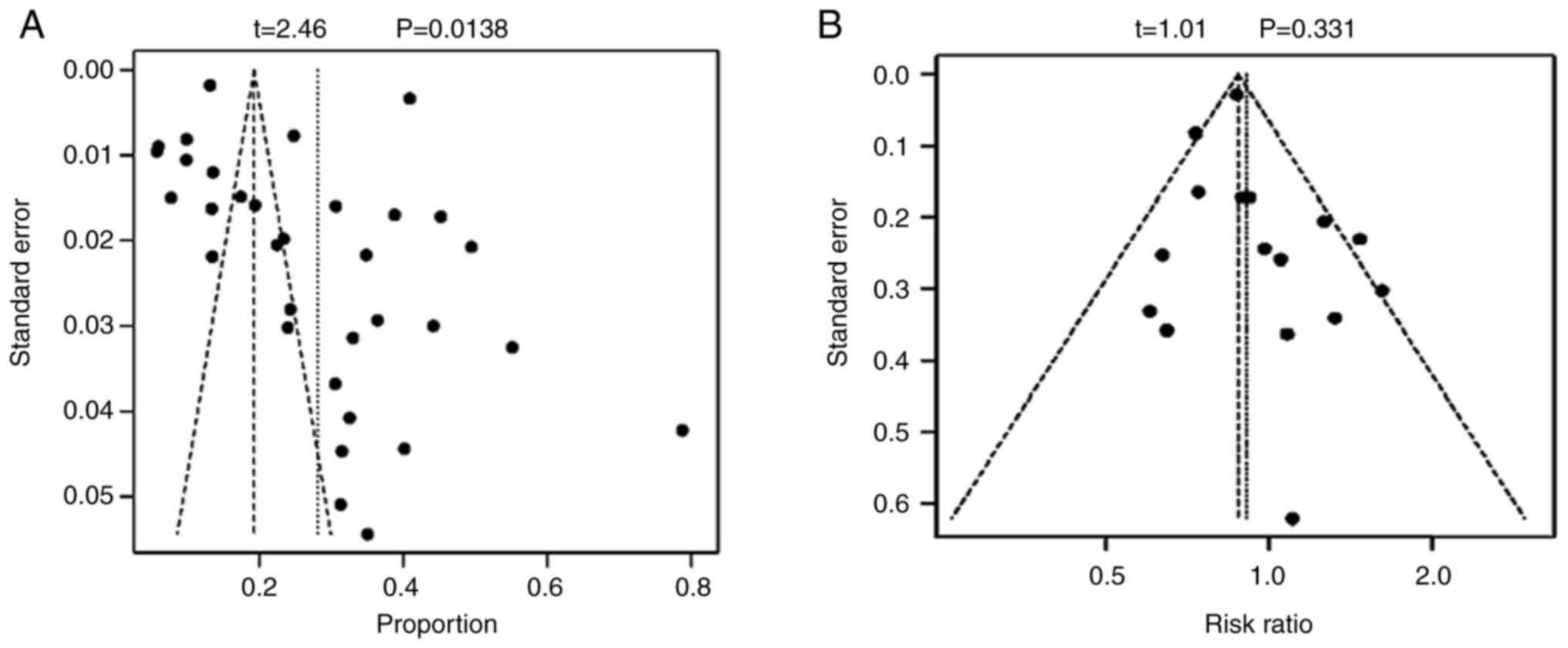
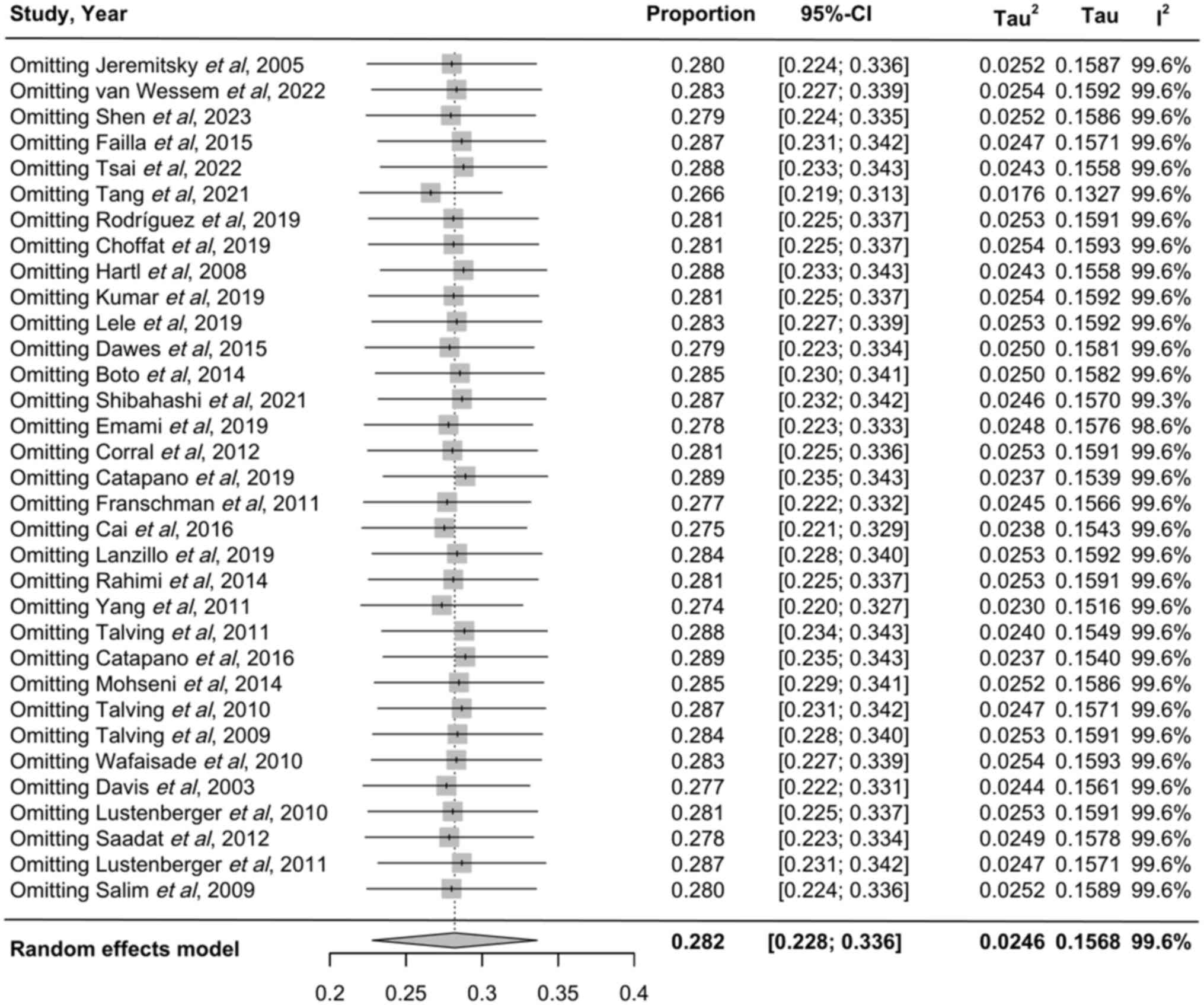
|
1
|
Khellaf A, Khan DZ and Helmy A: Recent
advances in traumatic brain injury. J Neurol. 266:2878–2889.
2019.PubMed/NCBI View Article : Google Scholar
|
|
2
|
Robinson CP: Moderate and severe traumatic
brain injury. Continuum (Minneap Minn). 27:1278–1300.
2021.PubMed/NCBI View Article : Google Scholar
|
|
3
|
Bazarian JJ, McClung J, Cheng YT, Flesher
W and Schneider SM: Emergency department management of mild
traumatic brain injury in the USA. Emerg Med J. 22:473–477.
2005.PubMed/NCBI View Article : Google Scholar
|
|
4
|
Capizzi A, Woo J and Verduzco-Gutierrez M:
Traumatic brain injury: An overview of epidemiology,
pathophysiology, and medical management. Med Clin North Am.
104:213–238. 2020.PubMed/NCBI View Article : Google Scholar
|
|
5
|
Traumatic Brain Injury and Spinal Cord
Injury Collaborators. Global, regional, and national burden of
traumatic brain injury and spinal cord injury, 1990-2016: A
systematic analysis for the Global Burden of Disease Study 2016 GBD
2016. Lancet Neurol. 18:56–87. 2019.PubMed/NCBI View Article : Google Scholar
|
|
6
|
Gao G, Wu X, Feng J, Hui J, Mao Q, Lecky
F, Lingsma H, Maas AIR and Jiang J: China CENTER-TBI Registry
Participants. Clinical characteristics and outcomes in patients
with traumatic brain injury in China: A prospective, multicentre,
longitudinal, observational study. Lancet Neurol. 19:670–677.
2020.PubMed/NCBI View Article : Google Scholar
|
|
7
|
Guan B, Anderson DB, Chen L, Feng S and
Zhou H: Global, regional and national burden of traumatic brain
injury and spinal cord injury, 1990-2019: A systematic analysis for
the Global Burden of Disease Study 2019. BMJ Open.
13(e075049)2023.PubMed/NCBI View Article : Google Scholar
|
|
8
|
Juengst SB, Perrin PB, Klyce DW,
O'Neil-Pirozzi TM, Herrera S, Wright B, Lengenfelder J, Lercher K,
Callender L and Arango-Lasprilla JC: Caregiver Characteristics of
Adults with Acute Traumatic Brain Injury in the United States and
Latin America. Int J Environ Res Public Health.
19(5717)2022.PubMed/NCBI View Article : Google Scholar
|
|
9
|
Pundlik J, Perna R and Arenivas A: Mild
TBI in interdisciplinary neurorehabilitation: Treatment challenges
and insights. NeuroRehabilitation. 46:227–241. 2020.PubMed/NCBI View Article : Google Scholar
|
|
10
|
Wang KK, Yang Z, Zhu T, Shi Y, Rubenstein
R, Tyndall JA and Manley GT: An update on diagnostic and prognostic
biomarkers for traumatic brain injury. Expert Rev Mol Diagn.
18:165–180. 2018.PubMed/NCBI View Article : Google Scholar
|
|
11
|
Dang B, Chen W, He W and Chen G:
Rehabilitation treatment and progress of traumatic brain injury
dysfunction. Neural Plast. 2017(1582182)2017.PubMed/NCBI View Article : Google Scholar
|
|
12
|
Dijkland SA, Foks KA, Polinder S, Dippel
DWJ, Maas AIR, Lingsma HF and Steyerberg EW: Prognosisin moderate
and severe traumatic brain injury: A systematic review of
contemporary models and validation studies. J Neurotrauma. 37:1–13.
2020.PubMed/NCBI View Article : Google Scholar
|
|
13
|
Kamabu LK, Bbosa GS, Lekuya HM, Cho EJ,
Kyaruzi VM, Nyalundja AD, Deng D, Sekabunga JN, Kataka LM, Obiga
DOD, et al: Burden, riskfactors, neurosurgical evacuation outcomes,
and predictors of mortality among traumatic brain injury patients
with expansive intracranial hematomas in Uganda: A mixed methods
study design. BMC Surg. 23(326)2023.PubMed/NCBI View Article : Google Scholar
|
|
14
|
Tunthanathip T, Phuenpathom N, Saehaeng S,
Oearsakul T, Sakarunchai I and Kaewborisutsakul A: Traumatic
cerebrovascular injury: Prevalence and risk factors. Am J Emerg
Med. 38:182–186. 2020.PubMed/NCBI View Article : Google Scholar
|
|
15
|
Kolakowsky-Hayner SA, Bellon K and Yang Y:
Unintentional injuries after TBI: Potential risk factors, impacts,
and prevention. NeuroRehabilitation. 39:363–370. 2016.PubMed/NCBI View Article : Google Scholar
|
|
16
|
Page MJ, McKenzie JE, Bossuyt PM, Boutron
I, Hoffmann TC, Mulrow CD, Shamseer L, Tetzlaff JM, Akl EA, Brennan
SE, et al: The PRISMA 2020 statement: An updated guideline for
reporting systematic reviews. BMJ. 372(n71)2021.PubMed/NCBI View Article : Google Scholar
|
|
17
|
Brooke BS, Schwartz TA and Pawlik TM:
MOOSE reporting guidelines for Meta-analyses of Observational
studies. JAMA Surg. 156:787–788. 2021.PubMed/NCBI View Article : Google Scholar
|
|
18
|
Amir-Behghadami M and Janati A:
Population, intervention, comparison, outcomes and Study (PICOS)
design as a framework to formulate eligibility criteria in
systematic reviews. Emerg Med J. 37(387)2020.PubMed/NCBI View Article : Google Scholar
|
|
19
|
Silver JM, McAllister TW and Yudofsky SC:
Textbook of traumatic brain injury. 293. 2005.
|
|
20
|
Lo CK, Mertz D and Loeb M:
Newcastle-Ottawa Scale: Comparing reviewers' to authors'
assessments. BMC Med Res Methodol. 14(45)2014.PubMed/NCBI View Article : Google Scholar
|
|
21
|
Balduzzi S, Rücker G and Schwarzer G: How
to perform a meta-analysis with R: A practical tutorial. Evid Based
Ment Health. 22:153–160. 2019.PubMed/NCBI View Article : Google Scholar
|
|
22
|
Hancock M and Kent P: Interpretation of
dichotomous outcomes: Risk, odds, risk ratios, odds ratios and
number needed to treat. J Physiother. 62:172–174. 2016.PubMed/NCBI View Article : Google Scholar
|
|
23
|
Alavi M, Hunt GE, Visentin DC, Watson R,
Thapa DK and Cleary M: Using risk and odds ratios to assess effect
size for meta-analysis outcome measures. J Adv Nurs. 76:3231–3234.
2020.PubMed/NCBI View Article : Google Scholar
|
|
24
|
DerSimonian R and Laird N: Meta-analysis
in clinical trials. Control Clin Trials. 7:177–188. 1986.PubMed/NCBI View Article : Google Scholar
|
|
25
|
Cumpston M, Li T, Page MJ, Chandler J,
Welch VA, Higgins JP and Thomas J: Updated guidance for trusted
systematic reviews: A new edition of the Cochrane Handbook for
Systematic Reviews of Interventions. Cochrane Database Syst Rev.
10(ED000142)2019.PubMed/NCBI View Article : Google Scholar
|
|
26
|
Ancona N, Maestri R, Marinazzo D, Nitti L,
Pellicoro M, Pinna GD and Stramaglia S: Leave-one-out prediction
error of systolic arterial pressure time series under paced
breathing. Physiol Meas. 26:363–372. 2005.PubMed/NCBI View Article : Google Scholar
|
|
27
|
Burgess S and Thompson SG: Interpreting
findings from Mendelian randomization using the MR-egger method.
Eur J Epidemiol. 32:377–389. 2017.PubMed/NCBI View Article : Google Scholar
|
|
28
|
Mavridis D and Salanti G: How to assess
publication bias: Funnel plot, trim-and-fill method and selection
models. Evid Based Ment Health. 17(30)2014.PubMed/NCBI View Article : Google Scholar
|
|
29
|
Jeremitsky E, Omert LA, Dunham CM,
Wilberger J and Rodriguez A: The impact of hyperglycemia on
patients with severe brain injury. J Trauma. 58:47–50.
2005.PubMed/NCBI View Article : Google Scholar
|
|
30
|
van Wessem KJP, Jochems D and Leenen LPH:
The effect of prehospital tranexamic acid on outcome in polytrauma
patients with associated severe brain injury. Eur J Trauma Emerg
Surg. 48:1589–1599. 2022.PubMed/NCBI View Article : Google Scholar
|
|
31
|
Shen H, Liu H, He J, Wei L and Wang S:
Risk factors of prognosis in older patients with severe brain
injury after surgical intervention. Eur J Med Res.
28(479)2023.PubMed/NCBI View Article : Google Scholar
|
|
32
|
Failla MD, Kumar RG, Peitzman AB, Conley
YP, Ferrell RE and Wagner AK: Variation in the BDNF gene interacts
with age to predict mortality in a prospective, longitudinal cohort
with severe TBI. Neurorehabil Neural Repair. 29:234–246.
2015.PubMed/NCBI View Article : Google Scholar
|
|
33
|
Tsai CH, Rau CS, Chou SE, Su WT, Hsu SY
and Hsieh CH: Delta de Ritis ratio is associated with worse
mortality outcomes in adult trauma patients with moderate-to-severe
traumatic brain injuries. Diagnostics (Basel).
12(3004)2022.PubMed/NCBI View Article : Google Scholar
|
|
34
|
Tang Z, Yang R, Zhang J, Huang Q, Zhou X,
Wei W and Jiang Q: Outcomes of traumatic brain-injured patients
with Glasgow coma scale <5 and bilateral dilated pupils
undergoing decompressive craniectomy. Front Neurol.
12(656369)2021.PubMed/NCBI View Article : Google Scholar
|
|
35
|
Rodríguez-Triviño CY, Torres Castro I and
Dueñas Z: Hypochloremia in patients with severe traumatic brain
injury: A possible risk factor for increased mortality. World
Neurosurg. 124:e783–e788. 2019.PubMed/NCBI View Article : Google Scholar
|
|
36
|
Choffat C, Delhumeau C, Fournier N and
Schoettker P: Effect of Pre-hospital intubation in patients with
severe traumatic brain injury on outcome: A prospective cohort
study. J Clin Med. 8(470)2019.PubMed/NCBI View Article : Google Scholar
|
|
37
|
Härtl R, Gerber LM, Ni Q and Ghajar J:
Effect of early nutrition on deaths due to severe traumatic brain
injury. J Neurosurg. 109:50–56. 2008.PubMed/NCBI View Article : Google Scholar
|
|
38
|
Kumar RG, DiSanto D, Awan N, Vaughan LE,
Levochkina MS, Weppner JL, Wright DW, Berga SL, Conley YP, Brooks
MM and Wagner AK: Temporal acute serum estradiol and tumor necrosis
factor-α associations and risk of death after severe traumatic
brain injury. J Neurotrauma. 37:2198–2210. 2020.PubMed/NCBI View Article : Google Scholar
|
|
39
|
Lele A, Kannan N, Vavilala MS, Sharma D,
Mossa-Basha M, Agyem K, Mock C, Pandey RM, Dash HH, Mahapatra A and
Gupta D: Patients who benefit from intracranial pressure monitoring
without cerebrospinal fluid drainage after severe traumatic brain
injury. Neurosurgery. 85:231–239. 2019.PubMed/NCBI View Article : Google Scholar
|
|
40
|
Dawes AJ, Sacks GD, Cryer HG, Gruen JP,
Preston C, Gorospe D, Cohen M, McArthur DL, Russell MM,
Maggard-Gibbons M and Ko CY: Intracranial pressure monitoring and
inpatient mortality in severe traumatic brain injury: A propensity
score-matched analysis. J Trauma Acute Care Surg. 78:492–501.
2015.PubMed/NCBI View Article : Google Scholar
|
|
41
|
Boto GR, Gómez PA, De La Cruz J and Lobato
RD: Severe head injury and the risk of early death. J Neurol
Neurosurg Psychiatry. 77:1054–1059. 2006.PubMed/NCBI View Article : Google Scholar
|
|
42
|
Shibahashi K, Hoda H, Okura Y and Hamabe
Y: Acceptable blood pressure levels in the prehospital setting for
patients with traumatic brain injury: A multicenter observational
study. World Neurosurg. 149:e504–e511. 2021.PubMed/NCBI View Article : Google Scholar
|
|
43
|
Emami P, Czorlich P, Fritzsche FS,
Westphal M, Rueger JM, Lefering R and Hoffmann M: Observed versus
expected mortality in pediatric patients intubated in the field
with Glasgow Coma Scale scores <9. Eur J Trauma Emerg Surg.
45:769–776. 2019.PubMed/NCBI View Article : Google Scholar
|
|
44
|
Corral L, Javierre CF, Ventura JL, Marcos
P, Herrero JI and Mañez R: Impact of non-neurological complications
in severe traumatic brain injury outcome. Crit Care.
16(R44)2012.PubMed/NCBI View Article : Google Scholar
|
|
45
|
Catapano JS, Chapman AJ, Dull M,
Abbatematteo JM, Horner LP, Godzik J, Brigeman S, Morgan CD,
Whiting AC, Lu M, et al: Association of Angiotensin-converting
enzyme inhibitors with increased mortality among patients with
isolated severe traumatic brain injury. Neurocrit Care. 31:507–513.
2019.PubMed/NCBI View Article : Google Scholar
|
|
46
|
Franschman G, Peerdeman SM, Andriessen TM,
Greuters S, Toor AE, Vos PE, Bakker FC, Loer SA and Boer C: Effect
of secondary prehospital risk factors on outcome in severe
traumatic brain injury in the context of fast access to trauma
care. J Trauma. 71:826–832. 2011.PubMed/NCBI View Article : Google Scholar
|
|
47
|
Cai SS, Bonds BW, Hu PF and Stein DM: The
role of cardiac troponin I in prognostication of patients with
isolated severe traumatic brain injury. J Trauma Acute Care Surg.
80:477–483. 2016.PubMed/NCBI View Article : Google Scholar
|
|
48
|
Lanzillo B, Piscosquito G, Marcuccio L,
Lanzillo A and Vitale DF: Prognosis of severe acquired brain
injury: Short and long-term outcome determinants and their
potential clinical relevance after rehabilitation. A comprehensive
approach to analyze cohort studies. PLoS One.
14(e0216507)2019.PubMed/NCBI View Article : Google Scholar
|
|
49
|
Rahimi S, Bidabadi E, Mashouf M, Seyed
Saadat SM and Rahimi S: Prognostic value of arterial blood gas
disturbances for in-hospital mortality in pediatric patients with
severe traumatic brain injury. Acta Neurochir (Wien). 156:187–192.
2014.PubMed/NCBI View Article : Google Scholar
|
|
50
|
Yang CJ, Hsiao KY, Su IC and Chen IC: The
association between anemia and the mortality of severe traumatic
brain injury in emergency department. J Trauma. 71:E132–E135.
2011.PubMed/NCBI View Article : Google Scholar
|
|
51
|
Talving P, Lustenberger T, Lam L, Inaba K,
Mohseni S, Plurad D, Green DJ and Demetriades D: Coagulopathy after
isolated severe traumatic brain injury in children. J Trauma.
71:1205–1210. 2011.PubMed/NCBI View Article : Google Scholar
|
|
52
|
Catapano JS, Chapman AJ, Horner LP, Lu M,
Fraser DR and Fildes JJ: Pre-injury polypharmacy predicts mortality
in isolated severe traumatic brain injury patients. Am J Surg.
213:1104–1108. 2017.PubMed/NCBI View Article : Google Scholar
|
|
53
|
Mohseni S, Talving P, Wallin G, Ljungqvist
O and Riddez L: Preinjury β-blockade is protective in isolated
severe traumatic brain injury. J Trauma Acute Care Surg.
76:804–808. 2014.PubMed/NCBI View Article : Google Scholar
|
|
54
|
Talving P, Plurad D, Barmparas G, Dubose
J, Inaba K, Lam L, Chan L and Demetriades D: Isolated severe
traumatic brain injuries: Association of blood alcohol levels with
the severity of injuries and outcomes. J Trauma. 68:357–362.
2010.PubMed/NCBI View Article : Google Scholar
|
|
55
|
Talving P, Benfield R, Hadjizacharia P,
Inaba K, Chan LS and Demetriades D: Coagulopathy in severe
traumatic brain injury: A prospective study. J Trauma. 66:55–61.
2009.PubMed/NCBI View Article : Google Scholar
|
|
56
|
Wafaisade A, Lefering R, Tjardes T,
Wutzler S, Simanski C, Paffrath T, Fischer P, Bouillon B and
Maegele M: Acute coagulopathy in isolated blunt traumatic brain
injury. Neurocrit Care. 12:211–219. 2010.PubMed/NCBI View Article : Google Scholar
|
|
57
|
Davis DP, Hoyt DB, Ochs M, Fortlage D,
Holbrook T, Marshall LK and Rosen P: The effect of paramedic rapid
sequence intubation on outcome in patients with severe traumatic
brain injury. J Trauma. 54:444–453. 2003.PubMed/NCBI View Article : Google Scholar
|
|
58
|
Lustenberger T, Talving P, Kobayashi L,
Barmparas G, Inaba K, Lam L, Branco BC and Demetriades D: Early
coagulopathy after isolated severe traumatic brain injury:
Relationship with hypoperfusion challenged. J Trauma. 69:1410–1414.
2010.PubMed/NCBI View Article : Google Scholar
|
|
59
|
Seyed Saadat SM, Bidabadi E, Seyed Saadat
SN, Mashouf M, Salamat F and Yousefzadeh S: Association of
persistent hyperglycemia with outcome of severe traumatic brain
injury in pediatric population. Childs Nerv Syst. 28:1773–1777.
2012.PubMed/NCBI View Article : Google Scholar
|
|
60
|
Lustenberger T, Inaba K, Barmparas G,
Talving P, Plurad D, Lam L, Konstantinidis A and Demetriades D:
Ethanol intoxication is associated with a lower incidence of
admission coagulopathy in severe traumatic brain injury patients. J
Neurotrauma. 28:1699–1706. 2011.PubMed/NCBI View Article : Google Scholar
|
|
61
|
Salim A, Teixeira P, Ley EJ, DuBose J,
Inaba K and Margulies DR: Serum ethanol levels: Predictor of
survival after severe traumatic brain injury. J Trauma. 67:697–703.
2009.PubMed/NCBI View Article : Google Scholar
|
|
62
|
van Wessem KJP, Niemeyer MJS and Leenen
LPH: Polytrauma patients with severe cervical spine injuries are
different than with severe TBI despite similar AIS scores. Sci Rep.
12(21538)2022.PubMed/NCBI View Article : Google Scholar
|
|
63
|
Pavlovic D, Pekic S, Stojanovic M and
Popovic V: Traumatic brain injury: Neuropathological,
neurocognitive and neurobehavioral sequelae. Pituitary. 22:270–282.
2019.PubMed/NCBI View Article : Google Scholar
|
|
64
|
Marin JR, Weaver MD and Mannix RC: Burden
of USA hospital charges for traumatic brain injury. Brain Inj.
31:24–31. 2017.PubMed/NCBI View Article : Google Scholar
|
|
65
|
Thurman DJ, Alverson C, Dunn KA, Guerrero
J and Sniezek JE: Traumatic brain injury in the United States: A
public health perspective. J Head Trauma Rehabil. 14:602–615.
1999.PubMed/NCBI View Article : Google Scholar
|
|
66
|
Lee E, Jayasinghe N, Swenson C and
Dams-O'Connor K: Dispositional optimism and cognitive functioning
following traumatic brain injury. Brain Inj. 33:985–990.
2019.PubMed/NCBI View Article : Google Scholar
|
|
67
|
Ansari A, Zoghi S, Tavanaei R, Payman AA,
Lu VM, Niakan A, Taheri R and Khalili H: Characteristics and
recovery trends of severe TBI patients with a favorable functional
outcome at 6-month follow-up. Neurosurg Rev. 48(41)2025.PubMed/NCBI View Article : Google Scholar
|
|
68
|
Maegele M, Lefering R, Sakowitz O, Kopp
MA, Schwab JM, Steudel WI, Unterberg A, Hoffmann R, Uhl E and Marzi
I: The incidence and management of moderate to severe head injury.
Dtsch Arztebl Int. 116:167–173. 2019.PubMed/NCBI View Article : Google Scholar
|
|
69
|
Chang HYM, Flahive J, Bose A, Goostrey K,
Osgood M, Carandang R, Hall W and Muehlschlegel S: Predicting
mortality in moderate-severe TBI patients without early withdrawal
of life-sustaining treatments including ICU complications: The
MYSTIC-score. J Crit Care. 72(154147)2022.PubMed/NCBI View Article : Google Scholar
|
|
70
|
O'Reilly GM, Afroz A, Curtis K, Mitra B,
Kim Y, Solly E, Ryder C, Hunter K, Hendrie DV, Rushworth N, et al:
The determinants for death in hospital following moderate to severe
traumatic brain injury in Australia. Emerg Med Australas.
37(e14562)2025.PubMed/NCBI View Article : Google Scholar
|
|
71
|
Strnad M, Borovnik Lesjak V, Vujanović V
and Križmarić M: Predictors of mortality in patients with isolated
severe traumatic brain injury. Wien Klin Wochenschr. 129:110–114.
2017.PubMed/NCBI View Article : Google Scholar
|
|
72
|
Arango JI, George L, Griswold DP, Johnson
ED, Suarez MN, Caquimbo LD, Molano M, Echeverri RA, Rubiano AM and
Adelson PD: Severe pediatric TBI management in a Middle-income
country and a high-income country: A comparative assessment of two
centers. Front Surg. 8(670546)2021.PubMed/NCBI View Article : Google Scholar
|
|
73
|
Teasell R, Flores-Sandoval C, Janzen S,
MacKenzie HM, Mehrabi S, Sequeira K, Bayley M and Bateman EA:
Comparing randomized controlled trials of moderate to severe
traumatic brain injury in lower to middle income countries versus
high income countries. J Neurotrauma. 41:1271–1281. 2024.PubMed/NCBI View Article : Google Scholar
|
|
74
|
Rivera-Lara L, Videtta W, Calvillo E,
Mejia-Mantilla J, March K, Ortega-Gutierrez S, Obrego GC, Paranhos
JE and Suarez JI: Reducing the incidence and mortality of traumatic
brain injury in Latin America. Eur J Trauma Emerg Surg.
49:2381–2388. 2023.PubMed/NCBI View Article : Google Scholar
|
|
75
|
Tropeano MP, Spaggiari R, Ileyassoff H,
Park KB, Kolias AG, Hutchinson PJ and Servadei F: A comparison of
publication to TBI burden ratio of low- and middle-income countries
versus high-income countries: How can we improve worldwide care of
TBI? Neurosurg Focus. 47(E5)2019.PubMed/NCBI View Article : Google Scholar
|
|
76
|
Naik A, Bederson MM, Detchou D,
Dharnipragada R, Hassaneen W, Arnold PM and Germano IM: Traumatic
brain injury mortality and correlates in low- and middle-income
countries: A meta-epidemiological study. Neurosurgery. 93:736–744.
2023.PubMed/NCBI View Article : Google Scholar
|
|
77
|
Shakir M, Altaf A, Irshad HA, Hussain N,
Pirzada S, Tariq M, Trillo-Ordonez Y and Enam SA: Factors delaying
the continuum of care for the management of traumatic brain injury
in low- and Middle-income countries: A systematic review. World
Neurosurg. 180:169–193. 2023.PubMed/NCBI View Article : Google Scholar
|
|
78
|
Wooldridge G, Hansmann A, Aziz O and
O'Brien N: Survey of resources available to implement severe
pediatric traumatic brain injury management guidelines in low and
middle-income countries. Childs Nerv Syst. 36:2647–2655.
2020.PubMed/NCBI View Article : Google Scholar
|
|
79
|
Pantelatos RI, Rahim S, Vik A, Rao V,
Müller TB, Nilsen TIL and Skandsen T: The epidemiology of moderate
and severe traumatic brain injury in central norway.
Neuroepidemiology. 57:185–196. 2023.PubMed/NCBI View Article : Google Scholar
|
|
80
|
Rahim S, Laugsand EA, Fyllingen EH, Rao V,
Pantelatos RI, Müller TB, Vik A and Skandsen T: Moderate and severe
traumatic brain injury in general hospitals: A ten-year
population-based retrospective cohort study in central Norway.
Scand J Trauma Resusc Emerg Med. 30(68)2022.PubMed/NCBI View Article : Google Scholar
|
|
81
|
Guindo-Martínez M, Amela R, Bonàs-Guarch
S, Puiggròs M, Salvoro C, Miguel-Escalada I, Carey CE, Cole JB,
Rüeger S, Atkinson E, et al: The impact of non-additive genetic
associations on age-related complex diseases. Nat Commun.
12(2436)2021.PubMed/NCBI View Article : Google Scholar
|
|
82
|
Diaz J, Rooney A, Calvo RY, Benham DA,
Carr M, Badiee J, Sise CB, Sise MJ, Bansal V and Martin MJ:
Isolated intracranial hemorrhage in elderly patients with
pre-injury anticoagulation: Is full trauma team activation
necessary? J Surg Res. 268:491–497. 2021.PubMed/NCBI View Article : Google Scholar
|
|
83
|
Toida C, Muguruma T, Gakumazawa M,
Shinohara M, Abe T, Takeuchi I and Morimura N: Age- and
severity-related in-hospital mortality trends and risks of severe
traumatic brain injury in Japan: A nationwide 10-year retrospective
study. J Clin Med. 10(1072)2021.PubMed/NCBI View Article : Google Scholar
|
|
84
|
Wågberg S, Stålnacke BM and Magnusson BM:
Gender and age differences in outcomes after mild traumatic brain
injury. J Clin Med. 12(4883)2023.PubMed/NCBI View Article : Google Scholar
|
|
85
|
Desjardins P, Turgeon AF, Tremblay MH,
Lauzier F, Zarychanski R, Boutin A, Moore L, McIntyre LA, English
SW, Rigamonti A, et al: Hemoglobin levels and transfusions in
neurocritically ill patients: A systematic review of comparative
studies. Crit Care. 16(R54)2012.PubMed/NCBI View Article : Google Scholar
|
|
86
|
Vanhala H, Junttila E, Kataja A, Huhtala
H, Luostarinen T and Luoto T: Incidence and associated factors of
anemiain patients with acute moderate and severe traumatic brain
injury. Neurocrit Care. 37:629–637. 2022.PubMed/NCBI View Article : Google Scholar
|
|
87
|
Hare GM, Mazer CD, Hutchison JS, McLaren
AT, Liu E, Rassouli A, Ai J, Shaye RE, Lockwood JA, Hawkins CE, et
al: Severe hemodilutional anemia increases cerebral tissue injury
following acute neurotrauma. J Appl Physiol (1985). 103:1021–1029.
2007.PubMed/NCBI View Article : Google Scholar
|
|
88
|
Acker SN, Partrick DA, Ross JT, Nadlonek
NA, Bronsert M and Bensard DD: Head injury and unclear mechanism of
injury: Initial hematocrit less than 30 is predictive of abusive
head trauma in young children. J Pediatr Surg. 49:338–340.
2014.PubMed/NCBI View Article : Google Scholar
|
|
89
|
Komurcu O, Dost B, Ozdemir E, Aras M and
Ulger F: Red blood cell transfusion and hemoglobin level on
neurological outcome in the first 24 hours of traumatic brain
injury. Am J Emerg Med. 59:74–78. 2022.PubMed/NCBI View Article : Google Scholar
|
|
90
|
Gul HF, Dolanbay T, Simsek AT and Aras M:
Evaluation of blood urea, creatinine, and glucose levels as
biochemical indicators of the type and severity of traumatic brain
injury. Turk Neurosurg. 31:333–338. 2021.PubMed/NCBI View Article : Google Scholar
|
|
91
|
Hajikarimloo B, Jabbaripour S, Tohidinia
AM, Valinejad Qanati A, Fahim F, Javadpour P and Ghasemi R: Insulin
potential in preventing brain damage after traumatic brain injury:
What we know. J Neuroendocrinol. 37(e13458)2025.PubMed/NCBI View Article : Google Scholar
|
|
92
|
Lozano A, Franchi F, Seastres RJ, Oddo M,
Lheureux O, Badenes R, Scolletta S, Vincent JL, Creteur J and
Taccone FS: Glucose and lactate concentrations in cerebrospinal
fluid after traumatic brain injury. J Neurosurg Anesthesiol.
32:162–169. 2020.PubMed/NCBI View Article : Google Scholar
|
|
93
|
Tregub P, Malinovskaya N, Hilazheva E,
Morgun A and Kulikov V: Permissive hypercapnia and hypercapnic
hypoxia inhibit signaling pathways of neuronal apoptosis in
ischemic/hypoxic rats. Mol Biol Rep. 50:2317–2333. 2023.PubMed/NCBI View Article : Google Scholar
|
|
94
|
Gribnau A, van Zuylen ML, Coles JP,
Plummer MP, Hermanns H and Hermanides J: Cerebral glucose
metabolism following TBI: Changes in plasma glucose, glucose
transport and alternative pathways of Glycolysis-A translational
narrative review. Int J Mol Sci. 25(2513)2024.PubMed/NCBI View Article : Google Scholar
|
|
95
|
Zhu C, Chen J, Pan J, Qiu Z and Xu T:
Therapeutic effect of intensive glycemic control therapy in
patients with traumatic brain injury: A systematic review and
meta-analysis of randomized controlled trials. Medicine
(Baltimore). 97(e11671)2018.PubMed/NCBI View Article : Google Scholar
|
|
96
|
Hanna M, Balintescu A, Glassford N,
Lipcsey M, Eastwood G, Oldner A, Bellomo R and Mårtensson J:
Glycemic lability index and mortality in critically ill patients-A
multicenter cohort study. Acta Anaesthesiol Scand. 65:1267–1275.
2021.PubMed/NCBI View Article : Google Scholar
|
|
97
|
Kurtz P and Rocha EEM: Nutrition therapy,
glucose control, and brain metabolism in traumatic brain injury: A
multimodal monitoring approach. Front Neurosci.
14(190)2020.PubMed/NCBI View Article : Google Scholar
|
|
98
|
Xue B, Ruan S, Xie P, Yan K, Gu Z, Meng N,
Zhang J, Liu H, Lu J, Zuo S and Zhang H: Prospective analysis of
glycemic variability in patients with severe traumatic brain
injury: Modified Leuven's adjustment process versus conventional
adjustment process. J Int Med Res. 46:1505–1516. 2018.PubMed/NCBI View Article : Google Scholar
|
|
99
|
Böhm JK, Schaeben V, Schäfer N, Güting H,
Lefering R, Thorn S, Schöchl H, Zipperle J, Grottke O, Rossaint R,
et al: Extended coagulation profiling in isolated traumatic brain
injury: A CENTER-TBI Analysis. Neurocrit Care. 36:927–941.
2022.PubMed/NCBI View Article : Google Scholar
|
|
100
|
Dong JF, Zhang F and Zhang J: Detecting
traumatic brain injury-induced coagulopathy: What we are testing
and what we are not. J Trauma Acute Care Surg. 94 (Suppl
1):S50–S55. 2023.PubMed/NCBI View Article : Google Scholar
|
|
101
|
Nakae R, Fujiki Y, Takayama Y, Kanaya T,
Igarashi Y, Suzuki G, Naoe Y and Yokobori S: Time course of
coagulation and fibrinolytic parameters in pediatric traumatic
brain injury. J Neurosurg Pediatr. 28:526–532. 2021.PubMed/NCBI View Article : Google Scholar
|
|
102
|
Maegele M, Aversa J, Marsee MK, McCauley
R, Chitta SH, Vyakaranam S and Walsh M: Changes in coagulation
following brain injury. Semin Thromb Hemost. 46:155–166.
2020.PubMed/NCBI View Article : Google Scholar
|
|
103
|
Zhang LM, Li R, Sun WB, Wang XP, Qi MM,
Bai Y, Bai J and Zheng WC: Low-dose, early fresh frozen plasma
transfusion therapy after severe trauma brain injury: A clinical,
prospective, randomized, controlled study. World Neurosurg.
132:e21–e27. 2019.PubMed/NCBI View Article : Google Scholar
|
|
104
|
Chesnut RM, Marshall LF, Klauber MR, Blunt
BA, Baldwin N, Eisenberg HM, Jane JA, Marmarou A and Foulkes MA:
The role of secondary brain injury in determining outcome from
severe head injury. J Trauma. 34:216–222. 1993.PubMed/NCBI View Article : Google Scholar
|
|
105
|
Jeremitsky E, Omert L, Dunham CM, Protetch
J and Rodriguez A: Harbingers of poor outcome the day after severe
brain injury: Hypothermia, hypoxia, and hypoperfusion. J Trauma.
54:312–319. 2003.PubMed/NCBI View Article : Google Scholar
|
|
106
|
Vella MA, Crandall ML and Patel MB: Acute
management of traumatic brain injury. Surg Clin North Am.
97:1015–1030. 2017.PubMed/NCBI View Article : Google Scholar
|
|
107
|
Rice AD, Hu C, Spaite DW, Barnhart BJ,
Chikani V, Gaither JB, Denninghoff KR, Bradley GH, Howard JT, Keim
SM and Bobrow BJ: Correlation between prehospital and in-hospital
hypotension and outcomes after traumatic brain injury. Am J Emerg
Med. 65:95–103. 2023.PubMed/NCBI View Article : Google Scholar
|
|
108
|
Rahaman P and Del Bigio MR: Histology of
brain trauma and Hypoxia-ischemia. Acad Forensic Pathol. 8:539–554.
2018.PubMed/NCBI View Article : Google Scholar
|
|
109
|
Reddy P, Izzetoglu K, Shewokis PA,
Sangobowale M and Diaz-Arrastia R: Differences in time-frequency
characteristics between healthy controls and TBI patients during
hypercapnia assessed via fNIRS. Neuroimage Clin.
40(103504)2023.PubMed/NCBI View Article : Google Scholar
|
|
110
|
Hazwani T, Khalifa AM, Azzubi M, Alhammad
A, Aloboudi A, Jorya A, Alkhuraiji A, Alhelabi S and Shaheen N:
Diffuse axonal injury on magnetic resonance imaging and its
relation to neurological outcomes in pediatric traumatic brain
injury. Clin Neurol Neurosurg. 237(108166)2024.PubMed/NCBI View Article : Google Scholar
|
|
111
|
Johnson VE, Stewart W and Smith DH: Axonal
pathology in traumatic brain injury. Exp Neurol. 246:35–43.
2013.PubMed/NCBI View Article : Google Scholar
|
|
112
|
Zhang S, Wang S, Wan X, Liu S, Shu K and
Lei T: Clinical evaluation of post-operative cerebral infarction in
traumatic epidural haematoma. Brain Inj. 31:215–220.
2017.PubMed/NCBI View Article : Google Scholar
|
|
113
|
Behzadnia MJ, Anbarlouei M, Hosseini SM
and Boroumand AB: Prognostic factors in traumatic brain injuries in
emergency department. J Res Med Sci. 27(83)2022.PubMed/NCBI View Article : Google Scholar
|
|
114
|
Gutowski P, Meier U, Rohde V, Lemcke J and
von der Brelie C: Clinical outcome of epidural hematoma treated
surgically in the era of modern resuscitation and trauma care.
World Neurosurg. 118:e166–e174. 2018.PubMed/NCBI View Article : Google Scholar
|
|
115
|
Karnjanasavitree W, Phuenpathom N and
Tunthanathip T: The optimal operative timing of traumatic
intracranial acute subdural hematoma correlated with outcome. Asian
J Neurosurg. 13:1158–1164. 2018.PubMed/NCBI View Article : Google Scholar
|
|
116
|
Aromatario M, Torsello A, D'Errico S,
Bertozzi G, Sessa F, Cipolloni L and Baldari B: Traumatic epidural
and subdural hematoma: Epidemiology, outcome, and dating. Medicina
(Kaunas). 57(125)2021.PubMed/NCBI View Article : Google Scholar
|
|
117
|
Chen L, Xia S, Lin Y, Chen Y, Xian L, Yang
Y, Qiu X, Xu L, Xingshu Z, Chen D, et al: The role of coagulopathy
and subdural hematoma thickness at admission in predicting the
prognoses of patients with severe traumatic brain injury: A
multicenter retrospective cohort study from China. Int J Surg.
110:5545–5562. 2024.PubMed/NCBI View Article : Google Scholar
|
|
118
|
Folkerson LE, Sloan D, Cotton BA, Holcomb
JB, Tomasek JS and Wade CE: Predicting progressive hemorrhagic
injury from isolated traumatic brain injury and coagulation.
Surgery. 158:655–661. 2015.PubMed/NCBI View Article : Google Scholar
|
|
119
|
Chen T, Chen S, Wu Y, Chen Y, Wang L and
Liu J: A predictive model for postoperative progressive
haemorrhagic injury in traumatic brain injuries. BMC Neurol.
22(16)2022.PubMed/NCBI View Article : Google Scholar
|
|
120
|
Stein SC, Young GS, Talucci RC, Greenbaum
BH and Ross SE: Delayed brain injury after head trauma:
Significance of coagulopathy. Neurosurgery. 30:160–165.
1992.PubMed/NCBI View Article : Google Scholar
|
|
121
|
Powers AY, Pinto MB, Aldridge AM, Tang OY,
Chen JS, Berube RL, Doberstein C, Fox JM, Carnevale JA and Asaad
WF: Factors associated with the progression of conservatively
managed acute traumatic subdural hemorrhage. J Crit Care.
48:243–250. 2018.PubMed/NCBI View Article : Google Scholar
|
|
122
|
Di G and Liu H, Jiang X, Dai Y, Chen S,
Wang Z and Liu H: Clinical predictors of progressive hemorrhagic
injury in children with mild traumatic brain injury. Front Neurol.
8(560)2017.PubMed/NCBI View Article : Google Scholar
|
|
123
|
Dumont TM, Visioni AJ, Rughani AI, Tranmer
BI and Crookes B: Inappropriate prehospital ventilation in severe
traumatic brain injury increases in-hospital mortality. J
Neurotrauma. 27:1233–1241. 2010.PubMed/NCBI View Article : Google Scholar
|
|
124
|
Haltmeier T, Benjamin E, Siboni S,
Dilektasli E, Inaba K and Demetriades D: Prehospital intubationfor
isolated severe blunt traumatic brain injury: Worse outcomes and
higher mortality. Eur J Trauma Emerg Surg. 43:731–739.
2017.PubMed/NCBI View Article : Google Scholar
|
|
125
|
Bossers SM, Schwarte LA, Loer SA, Twisk
JW, Boer C and Schober P: Experience in prehospital endotracheal
intubation significantly influences mortality of patients with
severe traumatic brain injury: A systematic review and
Meta-analysis. PLoS One. 10(e0141034)2015.PubMed/NCBI View Article : Google Scholar
|
|
126
|
Anderson J, Ebeid A and Stallwood-Hall C:
Pre-hospital tracheal intubation in severe traumatic brain injury:
A systematic review and meta-analysis. Br J Anaesth. 129:977–984.
2022.PubMed/NCBI View Article : Google Scholar
|
|
127
|
Eichelberger MR, Gotschall CS, Sacco WJ,
Bowman LM, Mangubat EA and Lowenstein AD: A comparison of the
trauma score, the revised trauma score, and the pediatric trauma
score. Ann Emerg Med. 18:1053–1058. 1989.PubMed/NCBI View Article : Google Scholar
|
|
128
|
Ambesi V, Miller C, Fitzgerald MC and
Mitra B: The GCS-Pupils (GCS-P) score to assess outcomes after
traumatic brain injury: A retrospective study. Br J Neurosurg.
23:1–4. 2024.PubMed/NCBI View Article : Google Scholar
|
|
129
|
Anand KV, Shahid PT and Shameel KK:
Evaluating GCS and FOUR score in predicting mortality of traumatic
brain injury patients (TBI): A prospective study in a tertiary
hospital of south malabar. J Pharm Bioallied Sci. 16 (Suppl
1):S598–S600. 2024.PubMed/NCBI View Article : Google Scholar
|
|
130
|
Anand KV, Shahid PT and Shameel KK:
Assessment of GCS and FOUR score as prognostic indicators for
hospital stay and morbidity in traumatic brain injury patients: An
observational study. J Pharm Bioallied Sci. 16 (Suppl 1):S601–S604.
2024.PubMed/NCBI View Article : Google Scholar
|
|
131
|
Ahmadi S, Sarveazad A, Babahajian A,
Ahmadzadeh K and Yousefifard M: Comparison of Glasgow Coma Scale
and Full Outline of UnResponsiveness score for prediction of
in-hospital mortality in traumatic brain injury patients: A
systematic review and meta-analysis. Eur J Trauma Emerg Surg.
49:1693–1706. 2023.PubMed/NCBI View Article : Google Scholar
|
|
132
|
Shestopalov AE, Yakovleva AV, Yadgarov MY,
Sergeev IV and Kuzovlev AN: Prevalence and impact of malnutrition
risk on outcomes in critically Ill patients with traumatic brain
injury and stroke: A retrospective cohort study using electronic
health records. Nutrients. 16(2396)2024.PubMed/NCBI View Article : Google Scholar
|
|
133
|
Pastor IS, Para I, Vesa ȘC and Florian IȘ:
Identifying predictive factors for mortality in patients with TBI
at a neurosurgery department. J Med Life. 16:554–558.
2023.PubMed/NCBI View Article : Google Scholar
|
|
134
|
Khormali M, Payandemehr P, Zafarmandi S,
Baigi V, Zafarghandi M and Sharif-Alhoseini M: Predictive utility
of the glasgow coma scale and the head abbreviated injury scale in
traumatic brain injury: Results from the national trauma registry
of iran. Arch Iran Med. 25:496–501. 2022.PubMed/NCBI View Article : Google Scholar
|
|
135
|
Jeong TS, Choi DH and Kim WK: The
relationship between trauma scoring systems and outcomes in
patients with severe traumatic brain injury. Korean J Neurotrauma.
18:169–177. 2022.PubMed/NCBI View Article : Google Scholar
|
|
136
|
Humble SS, Wilson LD, Wang L, Long DA,
Smith MA, Siktberg JC, Mirhoseini MF, Bhatia A, Pruthi S, Day MA,
et al: Prognosis of diffuse axonal injury with traumatic brain
injury. J Trauma Acute Care Surg. 85:155–159. 2018.PubMed/NCBI View Article : Google Scholar
|
|
137
|
Kulesza B, Mazurek M, Nogalski A and Rola
R: Factors with the strongest prognostic value associated with
in-hospital mortality rate among patients operated for acute
subdural and epidural hematoma. Eur J Trauma Emerg Surg.
47:1517–1525. 2021.PubMed/NCBI View Article : Google Scholar
|
|
138
|
Turkstra LS, Mutlu B, Ryan CW, Despins
Stafslien EH, Richmond EK, Hosokawa E and Duff MC: Sex and gender
differences in emotion recognition and theory of mind after TBI: A
narrative review and directions for future research. Front Neurol.
11(59)2020.PubMed/NCBI View Article : Google Scholar
|
|
139
|
Sandhu MRS, Schonwald A, Boyko M, Jafar
TD, Freedman IG, Woeste J, Kurup A, Funaro MC, Zlotnik A, Gruenbaum
SE, et al: The association between female sex and depression
following traumatic brain injury: A systematic review and
meta-analysis. Neurosci Biobehav Rev. 168(105952)2025.PubMed/NCBI View Article : Google Scholar
|
|
140
|
Cogan AM, McCaughey VK and Scholten J:
Gender differences in outcomes after traumatic brain injury among
service members and veterans. PM R. 12:301–314. 2020.PubMed/NCBI View Article : Google Scholar
|
|
141
|
Oliverio R, Karelina K and Weil ZM: Sex,
Drugs, and TBI: The role of sex in substance abuse related to
traumatic brain injuries. Front Neurol. 11(546775)2020.PubMed/NCBI View Article : Google Scholar
|
|
142
|
Mollayeva T, Mollayeva S and Colantonio A:
Traumatic brain injury: Sex, genderand intersecting
vulnerabilities. Nat Rev Neurol. 14:711–722. 2018.PubMed/NCBI View Article : Google Scholar
|
|
143
|
Giordano KR, Rojas-Valencia LM, Bhargava V
and Lifshitz J: Beyond binary: Influence of sex and gender on
outcome after traumatic brain injury. J Neurotrauma. 37:2454–2459.
2020.PubMed/NCBI View Article : Google Scholar
|
|
144
|
Hanscom M, Loane DJ and Shea-Donohue T:
Brain-gut axis dysfunction in the pathogenesis of traumatic brain
injury. J Clin Invest. 131(e143777)2021.PubMed/NCBI View Article : Google Scholar
|
|
145
|
Weaver JL: The brain-gut axis: A prime
therapeutic target in traumatic brain injury. Brain Res.
1753(147225)2021.PubMed/NCBI View Article : Google Scholar
|
|
146
|
Zhou Y, Lu W and Tang W: Gastrointestinal
failure score in children with traumatic brain injury. BMC Pediatr.
21(219)2021.PubMed/NCBI View Article : Google Scholar
|
|
147
|
Stulce C, Reisner A, Kane JM, Shin HS,
McCracken C, Williamson J, Walson K and Paden M: Fluid overload in
pediatric severe traumatic brain injury. Pediatr Crit Care Med.
21:164–169. 2020.PubMed/NCBI View Article : Google Scholar
|
|
148
|
Jha RM, Kochanek PM and Simard JM:
Pathophysiology and treatment of cerebral edema in traumatic brain
injury. Neuropharmacology. 145:230–246. 2019.PubMed/NCBI View Article : Google Scholar
|
|
149
|
Mekkodathil A, El-Menyar A, Hakim S, Al
Jogol H, Parchani A, Peralta R, Rizoli S and Al-Thani H: Initial
serum levels of magnesium and calcium as predictors of mortality in
traumatic brain injury patients: A retrospective study. Diagnostics
(Basel). 13(1172)2023.PubMed/NCBI View Article : Google Scholar
|
|
150
|
Wang GH, Yan Y, Shen HP and Chu Z: The
clinical characteristics of electrolyte disturbance in patients
with moderate and severe traumatic brain injury who underwent
craniotomy and its influence on prognosis. J Korean Neurosurg Soc.
66:332–339. 2023.PubMed/NCBI View Article : Google Scholar
|
|
151
|
Laing J, Gabbe B, Chen Z, Perucca P, Kwan
P and O'Brien TJ: Risk factors and prognosis of early posttraumatic
seizures in moderate to severe traumatic brain injury. JAMA Neurol.
79:334–341. 2022.PubMed/NCBI View Article : Google Scholar
|
|
152
|
Forssten SP, Ahl Hulme R, Forssten MP,
Ribeiro MAF Jr, Sarani B and Mohseni S: Predictors of outcomes in
geriatric patients with moderate traumatic brain injury after
ground level falls. Front Med (Lausanne).
10(1290201)2023.PubMed/NCBI View Article : Google Scholar
|
|
153
|
Al-Salihi MM, Ayyad A, Al-Jebur MS and
Rahman MM: The ‘Talk and Die’ phenomenon in traumatic brain injury:
A meta-analysis. Clin Neurol Neurosurg. 218(107262)2022.PubMed/NCBI View Article : Google Scholar
|
|
154
|
Couret M, Gendre G, Magnusson L,
Schoettker P and Ribordy V: Out-of-hospital tracheal intubation and
alternatives in the prehospital setting. Rev Med Suisse.
16:325–330. 2020.PubMed/NCBI
|
|
155
|
Sun G, Shi L, Pan T, Li X and Zhang S:
Technique of ICP monitored stepwise intracranial decompression
effectively reduces postoperative complications of severe bifrontal
contusion. Front Neurol. 7(56)2016.PubMed/NCBI View Article : Google Scholar
|
|
156
|
McHugh DC, Fiore SM, Strong N and Egnor
MR: Bifrontal biparietal cruciate decompressive craniectomy in
pediatric traumatic brain injury. Pediatr Neurosurg. 54:6–11.
2019.PubMed/NCBI View Article : Google Scholar
|
|
157
|
Ma J, Zhang K, Wang Z and Chen G: Progress
of research on diffuse axonal injury after traumatic brain injuryy.
Neural Plast. 9746313:2016.PubMed/NCBI View Article : Google Scholar
|
|
158
|
Kennedy L, Nuno M, Gurkoff GG, Nosova K
and Zwienenberg M: Moderate and severe TBI in children and
adolescents: The effects of age, sex, and injury severity on
patient outcome 6 months after injury. Front Neurol.
13(741717)2022.PubMed/NCBI View Article : Google Scholar
|