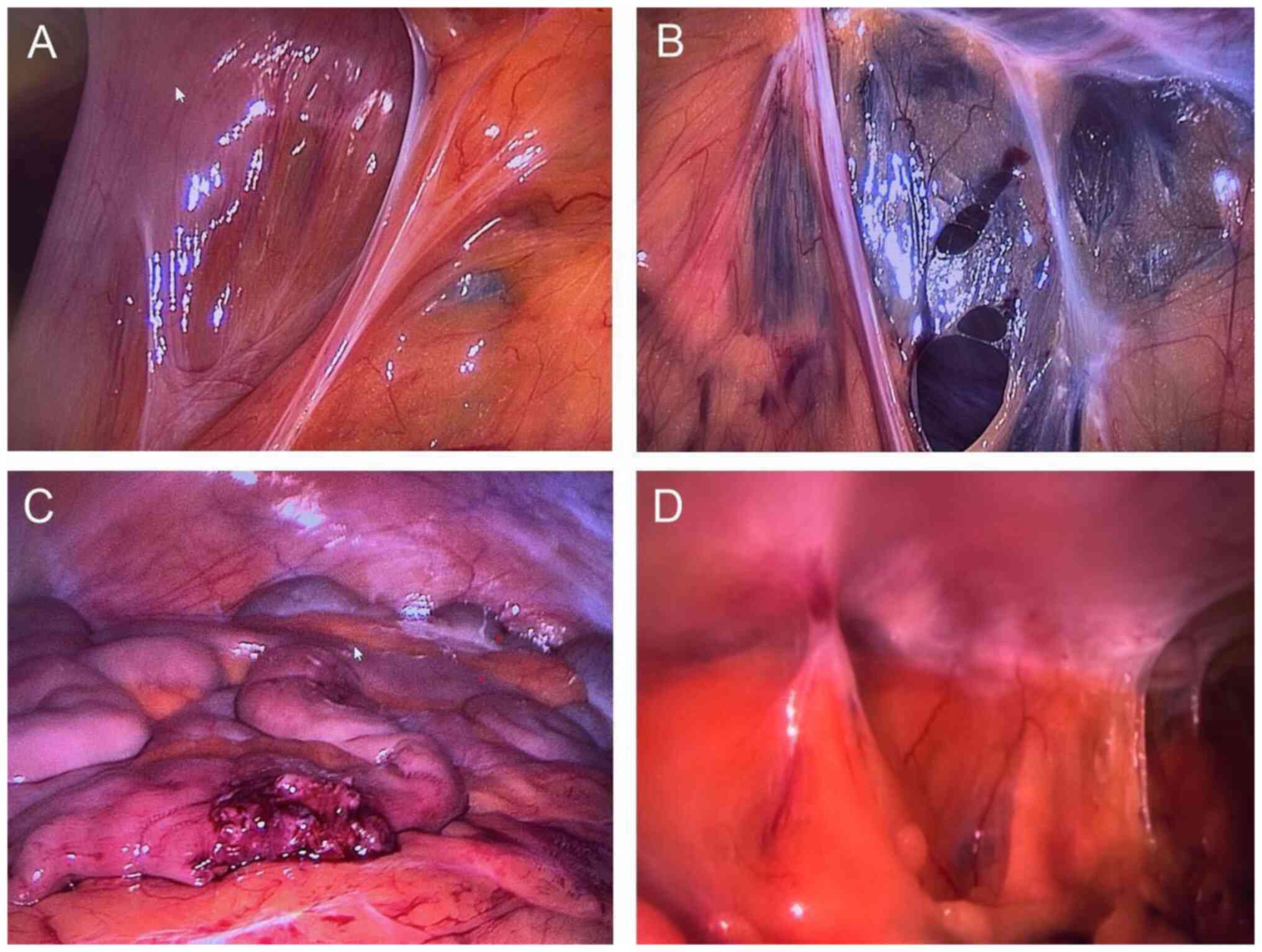
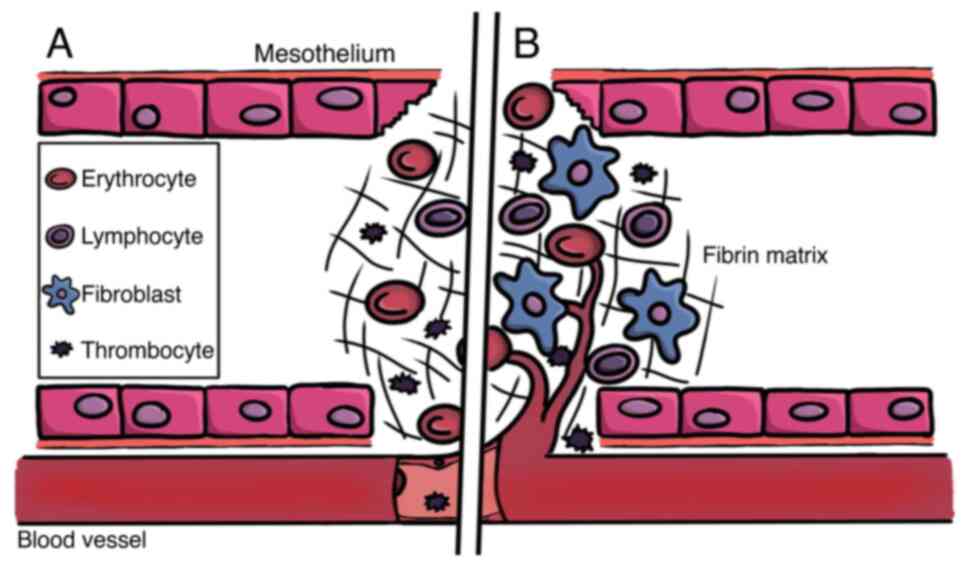
|
1
|
diZerega GS: Contemporary adhesion
prevention. Fertil Steril. 61:219–235. 1994.PubMed/NCBI View Article : Google Scholar
|
|
2
|
Brüggmann D, Tchartchian G, Wallwiener M,
Münstedt K, Tinneberg HR and Hackethal A: Intra-abdominal
adhesions: Definition, origin, significance in surgical practice,
and treatment options. Dtsch Arztebl Int. 107:769–775.
2010.PubMed/NCBI View Article : Google Scholar
|
|
3
|
Sikirica V, Bapat B, Candrilli SD, Davis
KL, Wilson M and Johns A: The inpatient burden of abdominal and
gynecological adhesiolysis in the US. BMC Surg.
11(13)2011.PubMed/NCBI View Article : Google Scholar
|
|
4
|
Cheong Y, Sadek K, Watson A, Metwally M
and Li TC: Adhesion reduction agents in gynaecological procedures:
can NHS aff ord it? An economic cost efficiency analysis. J Obstet
Gynaecol. 31:631–635. 2011.PubMed/NCBI View Article : Google Scholar
|
|
5
|
Davey AK and Maher PJ: Surgical adhesions:
A timely update, a great challenge for the future. J Minim Invasive
Gynecol. 14:15–22. 2007.PubMed/NCBI View Article : Google Scholar
|
|
6
|
Capmas P, Payen F, Lemaire A and Fernandez
H: Adhesions in abdomino-pelvic surgeries: A real economic impact?
PLoS One. 17(e0276810)2022.PubMed/NCBI View Article : Google Scholar
|
|
7
|
Garoufalia Z, Gefen R, Emile SH, Zhou P,
Silva-Alvarenga E and Wexner SD: Financial and inpatient burden of
adhesion-related small bowel obstruction: A systematic review of
the literature. Am Surg. 89:2693–2700. 2023.PubMed/NCBI View Article : Google Scholar
|
|
8
|
Yang KH, Lee TB, Lee SH, Kim SH, Cho YH
and Kim HY: Congenital adhesion band causing small bowel
obstruction: What's the difference in various age groups, pediatric
and adult patients? BMC Surg. 16(79)2016.PubMed/NCBI View Article : Google Scholar
|
|
9
|
Weibel MA and Majno G: Peritoneal
adhesions and their relation to abdominal surgery. A postmortem
study. Am J Surg. 126:345–353. 1973.PubMed/NCBI View Article : Google Scholar
|
|
10
|
Tabibian N, Swehli E, Boyd A, Umbreen A
and Tabibian JH: Abdominal adhesions: A practical review of an
often overlooked entity. Ann Med Surg (Lond). 15:9–13.
2017.PubMed/NCBI View Article : Google Scholar
|
|
11
|
Leung TT, Dixon E, Gill M, Mador BD,
Moulton KM, Kaplan GG and MacLean AR: Bowel obstruction following
appendectomy: What is the true incidence? Ann Surg. 250:51–53.
2009.PubMed/NCBI View Article : Google Scholar
|
|
12
|
Nunobe S, Hiki N, Fukunaga T, Tokunaga M,
Ohyama S, Seto Y and Yamaguchi T: Previous laparotomy is not a
contraindication to laparoscopy-assisted gastrectomy for early
gastric cancer. World J Surg. 32:1466–1472. 2008.PubMed/NCBI View Article : Google Scholar
|
|
13
|
Robb WB and Mariette C: Strategies in the
prevention of the formation of postoperative adhesions in digestive
surgery; a systematic review of the literature. Dis Colon Rectum.
57:1228–1240. 2014.PubMed/NCBI View Article : Google Scholar
|
|
14
|
Buhmann-Kirchhoff S, Lang R, Kirchhoff C,
Steitz HO, Jauch KW, Reiser M and Lienemann A: Functional cine MR
imaging for the detection and mapping of intraabdominal adhesions:
Method and surgical correlation. Eur Radiol. 18:1215–1223.
2008.PubMed/NCBI View Article : Google Scholar
|
|
15
|
Pittaway DE, Daniell JF and Maxson WS:
Ovarian surgery in an infertility patient as an indication for a
short-interval second-look laparoscopy: A preliminary study. Fertil
Steril. 44:611–614. 1985.PubMed/NCBI View Article : Google Scholar
|
|
16
|
Diamond MP, Pellicer A, Boyers SP and
DeCherney AH: The effect of periovarian adhesions on follicular
development in patients undergoing ovarian stimulation for in vitro
fertilization-embryo transfer. Fertil Steril. 49:100–103.
1988.PubMed/NCBI View Article : Google Scholar
|
|
17
|
Blackburn SC and Stanton MP: Anatomy and
physiology of the peritoneum. Semin Pediatr Surg. 23:326–330.
2014.PubMed/NCBI View Article : Google Scholar
|
|
18
|
Sompayrac SW, Mindelzun RE, Silverman PM
and Sze R: The greater omentum. AJR Am J Roentgenol. 168:683–687.
1997.PubMed/NCBI View Article : Google Scholar
|
|
19
|
Kastelein AW, Vos LMC, de Jong KH, van
Baal JOAM, Nieuwland R, van Noorden CJF, Roovers JWR and Lok CAR:
Embryology, anatomy, physiology and pathophysiology of the
peritoneum and the peritoneal vasculature. Semin Cell Dev Biol.
92:27–36. 2019.PubMed/NCBI View Article : Google Scholar
|
|
20
|
Pfister F, Büttner-Herold M, Kitsche B,
Bulian DR, Kielstein JT, Wanninger R, Eden G, Alscher D, Nebel M,
Schwenger V and Amann K: Standardized histomorphological processing
of peritoneal biopsies as part of the German Peritoneal Biopsy
Registry (GRIP, German registry in PD). Pathologe. 41:634–642.
2020.PubMed/NCBI View Article : Google Scholar : (In German).
|
|
21
|
Rudralingam V, Footitt C and Layton B:
Ascites matters. Ultrasound. 25:69–79. 2017.PubMed/NCBI View Article : Google Scholar
|
|
22
|
Doherty NS, Griffiths RJ, Hakkinen JP,
Scampoli DN and Milici AJ: Post-capillary venules in the ‘milky
spots’ of the greater omentum are the major site of plasma protein
and leukocyte extravasation in rodent models of peritonitis.
Inflamm Res. 44:169–177. 1995.PubMed/NCBI View Article : Google Scholar
|
|
23
|
Jackson-Jones LH and Bénézech C: FALC
stromal cells define a unique immunological niche for the
surveillance of serous cavities. Curr Opin Immunol. 64:42–49.
2020.PubMed/NCBI View Article : Google Scholar
|
|
24
|
Jackson-Jones LH, Smith P, Portman JR,
Magalhaes MS, Mylonas KJ, Vermeren MM, Nixon M, Henderson BEP,
Dobie R, Vermeren S, et al: Stromal cells covering omental
fat-associated lymphoid clusters trigger formation of neutrophil
aggregates to capture peritoneal contaminants. Immunity.
52:700–715.e6. 2020.PubMed/NCBI View Article : Google Scholar
|
|
25
|
Cruz-Migoni S and Caamaño J:
Fat-associated lymphoid clusters in inflammation and immunity.
Front Immunol. 7(612)2016.PubMed/NCBI View Article : Google Scholar
|
|
26
|
Brochhausen C, Schmitt VH, Planck CN,
Rajab TK, Hollemann D, Tapprich C, Krämer B, Wallwiener C,
Hierlemann H, Zehbe R, et al: Current strategies and future
perspectives for intraperitoneal adhesion prevention. J
Gastrointest Surg. 16:1256–1274. 2012.PubMed/NCBI View Article : Google Scholar
|
|
27
|
Sen CK and Roy S: Redox signals in wound
healing. Biochim Biophys Acta. 1780:1348–1361. 2008.PubMed/NCBI View Article : Google Scholar
|
|
28
|
Koninckx PR, Gomel V, Ussia A and Adamyan
L: Role of the peritoneal cavity in the prevention of postoperative
adhesions, pain, and fatigue. Fertil Steril. 106:998–1010.
2016.PubMed/NCBI View Article : Google Scholar
|
|
29
|
Buţureanu SA and Buţureanu TA:
Pathophysiology of adhesions. Chirurgia (Bucur). 109:293–298.
2014.
|
|
30
|
Capella-Monsonís H, Kearns S, Kelly J and
Zeugolis DI: Battling adhesions: From understanding to prevention.
BMC Biomed Eng. 1(5)2019.PubMed/NCBI View Article : Google Scholar
|
|
31
|
Maciver AH, McCall M and James Shapiro AM:
Intra-abdominal adhesions: Cellular mechanisms and strategies for
prevention. Int J Surg. 9:589–594. 2011.PubMed/NCBI View Article : Google Scholar
|
|
32
|
Smith SA, Travers RJ and Morrissey JH: How
it all starts: Initiation of the clotting cascade. Crit Rev Biochem
Mol Biol. 50:326–336. 2015.PubMed/NCBI View Article : Google Scholar
|
|
33
|
Mutsaers SE, Prêle CMA, Pengelly S and
Herrick SE: Mesothelial cells and peritoneal homeostasis. Fertil
Steril. 106:1018–1024. 2016.PubMed/NCBI View Article : Google Scholar
|
|
34
|
Li Y, Wang J and Asahina K: Mesothelial
cells give rise to hepatic stellate cells and myofibroblasts via
mesothelial-mesenchymal transition in liver injury. Proc Natl Acad
Sci USA. 110:2324–2329. 2013.PubMed/NCBI View Article : Google Scholar
|
|
35
|
Yang AH, Chen JY and Lin JK:
Myofibroblastic conversion of mesothelial cells. Kidney Int.
63:1530–1539. 2003.PubMed/NCBI View Article : Google Scholar
|
|
36
|
Arung W, Meurisse M and Detry O:
Pathophysiology and prevention of postoperative peritoneal
adhesions. World J Gastroenterol. 17:4545–4553. 2011.PubMed/NCBI View Article : Google Scholar
|
|
37
|
Amadeu TP and Costa AM: Nitric oxide
synthesis inhibition alters rat cutaneous wound healing. J Cutan
Pathol. 33:465–473. 2006.PubMed/NCBI View Article : Google Scholar
|
|
38
|
Zhou Q, Liu LZ, Fu B, Hu X, Shi X, Fang J
and Jiang BH: Reactive oxygen species regulate insulin-induced VEGF
and HIF-1alpha expression through the activation of p70S6K1 in
human prostate cancer cells. Carcinogenesis. 28:28–37.
2007.PubMed/NCBI View Article : Google Scholar
|
|
39
|
De Oliveira-Marques V, Cyrne L, Marinho HS
and Antunes F: A quantitative study of NF-kappaB activation by
H2O2: Relevance in inflammation and synergy with TNF-alpha. J
Immunol. 178:3893–3902. 2007.PubMed/NCBI View Article : Google Scholar
|
|
40
|
Kang JI and Park KM: Advances in
gelatin-based hydrogels for wound management. J Mater Chem B.
9:1503–1520. 2021.PubMed/NCBI View Article : Google Scholar
|
|
41
|
Ou Q, Zhang S, Fu C, Yu L, Xin P, Gu Z,
Cao Z, Wu J and Wang Y: More natural more better: triple natural
anti-oxidant puerarin/ferulic acid/polydopamine incorporated
hydrogel for wound healing. J Nanobiotechnology.
19(237)2021.PubMed/NCBI View Article : Google Scholar
|
|
42
|
Thi PL, Lee Y, Tran DL, Thi TTH, Kang JI,
Park KM and Park KD: In situ forming and reactive oxygen
species-scavenging gelatin hydrogels for enhancing wound healing
efficacy. Acta Biomater. 103:142–152. 2020.PubMed/NCBI View Article : Google Scholar
|
|
43
|
Kim B, Kim Y, Lee Y, Oh J, Jung Y, Koh WG
and Chung JJ: Reactive oxygen species suppressive kraft
lignin-gelatin antioxidant hydrogels for chronic wound repair.
Macromol Biosci. 22(e2200234)2022.PubMed/NCBI View Article : Google Scholar
|
|
44
|
Chen K, Qiu P, Yuan Y, Zheng L, He J, Wang
C, Guo Q, Kenny J, Liu Q, Zhao J, et al: Pseurotin A inhibits
osteoclastogenesis and prevents ovariectomized-induced bone loss by
suppressing reactive oxygen species. Theranostics. 9:1634–1650.
2019.PubMed/NCBI View Article : Google Scholar
|
|
45
|
Brochhausen C, Schmitt VH, Rajab TK,
Planck CN, Krämer B, Wallwiener M, Hierlemann H and Kirkpatrick CJ:
Intraperitoneal adhesions-an ongoing challenge between biomedical
engineering and the life sciences. J Biomed Mater Res A.
98:143–156. 2011.PubMed/NCBI View Article : Google Scholar
|
|
46
|
Cheong YC, Laird SM, Shelton JB, Ledger
WL, Li TC and Cooke ID: The correlation of adhesions and peritoneal
fluid cytokine concentrations: A pilot study. Hum Reprod.
17:1039–1045. 2002.PubMed/NCBI View Article : Google Scholar
|
|
47
|
Cahill RA and Redmond HP: Cytokine
orchestration in post-operative peritoneal adhesion formation.
World J Gastroenterol. 14:4861–4866. 2008.PubMed/NCBI View Article : Google Scholar
|
|
48
|
Scappaticci FA, Fehrenbacher L, Cartwright
T, Hainsworth JD, Heim W, Berlin J, Kabbinavar F, Novotny W, Sarkar
S and Hurwitz H: Surgical wound healing complications in metastatic
colorectal cancer patients treated with bevacizumab. J Surg Oncol.
91:173–180. 2005.PubMed/NCBI View Article : Google Scholar
|
|
49
|
Holmdahl L, Eriksson E, Al-Jabreen M and
Risberg B: Fibrinolysis in human peritoneum during operation.
Surgery. 119:701–705. 1996.PubMed/NCBI View Article : Google Scholar
|
|
50
|
Andreasen PA, Georg B, Lund LR, Riccio A
and Stacey SN: Plasminogen activator inhibitors: Hormonally
regulated serpins. Mol Cell Endocrinol. 68:1–19. 1990.PubMed/NCBI View Article : Google Scholar
|
|
51
|
Ivarsson ML, Bergström M, Eriksson E,
Risberg B and Holmdahl L: Tissue markers as predictors of
postoperative adhesions. Br J Surg. 85:1549–1554. 1998.PubMed/NCBI View Article : Google Scholar
|
|
52
|
Bourboulia D and Stetler-Stevenson WG:
Matrix metalloproteinases (MMPs) and tissue inhibitors of
metalloproteinases (TIMPs): Positive and negative regulators in
tumor cell adhesion. Semin Cancer Biol. 20:161–168. 2010.PubMed/NCBI View Article : Google Scholar
|
|
53
|
Cohen PA, Gower AC, Stucchi AF, Leeman SE,
Becker JM and Reed KL: A neurokinin-1 receptor antagonist that
reduces intraabdominal adhesion formation increases peritoneal
matrix metalloproteinase activity. Wound Repair Regen. 15:800–808.
2007.PubMed/NCBI View Article : Google Scholar
|
|
54
|
Diamond MP, Wexner SD, diZereg GS, Korell
M, Zmora O, Van Goor H and Kamar M: Adhesion prevention and
reduction: current status and future recommendations of a
multinational interdisciplinary consensus conference. Surg Innov.
17:183–188. 2010.PubMed/NCBI View Article : Google Scholar
|
|
55
|
Buunen M, Gholghesaei M, Veldkamp R,
Meijer DW, Bonjer HJ and Bouvy ND: Stress response to laparoscopic
surgery: A review. Surg Endosc. 18:1022–1028. 2004.PubMed/NCBI View Article : Google Scholar
|
|
56
|
Tazeoğlu D, Benli S, Tikici D, Esmer AC
and Dirlik MM: Can minimally invasive surgical techniques reduce
the incidence of postoperative adhesions? Pol Przegl Chir.
94:23–30. 2022.PubMed/NCBI View Article : Google Scholar
|
|
57
|
Molinas CR, Campo R, Elkelani OA, Binda
MM, Carmeliet P and Koninckx PR: Role of hypoxia inducible factors
1alpha and 2alpha in basal adhesion formation and in carbon dioxide
pneumoperitoneum-enhanced adhesion formation after laparoscopic
surgery in transgenic mice. Fertil Steril. 80 (Suppl 2):S795–S802.
2003.PubMed/NCBI View Article : Google Scholar
|
|
58
|
Elkelani OA, Binda MM, Molinas CR and
Koninckx PR: Effect of adding more than 3% oxygen to carbon dioxide
pneumoperitoneum on adhesion formation in a laparoscopic mouse
model. Fertil Steril. 82:1616–1622. 2004.PubMed/NCBI View Article : Google Scholar
|
|
59
|
Yesildaglar N and Koninckx PR: Adhesion
formation in intubated rabbits increases with high insufflation
pressure during endoscopic surgery. Hum Reprod. 15:687–691.
2000.PubMed/NCBI View Article : Google Scholar
|
|
60
|
Otani K, Ishihara S, Nozawa H, Kawai K,
Hata K, Kiyomatsu T, Tanaka T, Nishikawa T, Yasuda K, Sasaki K, et
al: A retrospective study of laparoscopic surgery for small bowel
obstruction. Ann Med Surg (Lond). 16:34–39. 2017.PubMed/NCBI View Article : Google Scholar
|
|
61
|
Hellebrekers BW, Trimbos-Kemper TC,
Trimbos JB, Emeis JJ and Kooistra T: Use of fibrinolytic agents in
the prevention of postoperative adhesion formation. Fertil Steril.
74:203–212. 2000.PubMed/NCBI View Article : Google Scholar
|
|
62
|
Sulaiman H, Dawson L, Laurent GJ,
Bellingan GJ and Herrick SE: Role of plasminogen activators in
peritoneal adhesion formation. Biochem Soc Trans. 30:126–131.
2002.PubMed/NCBI
|
|
63
|
Menzies D and Ellis H: Intra-abdominal
adhesions and their prevention by topical tissue plasminogen
activator. J R Soc Med. 82:534–535. 1989.PubMed/NCBI View Article : Google Scholar
|
|
64
|
Meier H, Dietl KH and Willital GH: First
clinical results of intraoperative application of
streptokinase-streptodornase in children. Langenbecks Arch Chiv.
366:191–193. 1985.
|
|
65
|
De Wilde RL, Devassy R, Ten Broek RPGT,
Miller CE, Adlan A, Aquino P, Becker S, Darmawan F, Gergolet M,
Habana MAE, et al: The future of adhesion prophylaxis trials in
abdominal surgery: An expert global consensus. J Clin Med.
11(1476)2022.PubMed/NCBI View Article : Google Scholar
|
|
66
|
Brown CB, Luciano AA, Martin D, Peers E,
Scrimgeour A and diZerega GS: Adept Adhesion Reduction Study Group.
Adept (icodextrin 4% solution) reduces adhesions after laparoscopic
surgery for adhesiolysis: A double-blind, randomized, controlled
study. Fertil Steril. 88:1413–1426. 2007.PubMed/NCBI View Article : Google Scholar
|
|
67
|
Hosie K, Gilbert JA, Kerr D, Brown CB and
Peers EM: Fluid dynamics in man of an intraperitoneal drug delivery
solution: 4% icodextrin. Drug Deliv. 8:9–12. 2001.PubMed/NCBI View Article : Google Scholar
|
|
68
|
Wiseman DM, Trout JR and Diamond MP: The
rates of adhesion development and the effects of crystalloid
solutions on adhesion development in pelvic surgery. Fertil Steril.
70:702–711. 1998.PubMed/NCBI View Article : Google Scholar
|
|
69
|
Ahmad M and Crescenti F: Significant
adhesion reduction with 4DryField PH after release of adhesive
small bowel obstruction. Surg J (N Y). 5:e28–e34. 2019.PubMed/NCBI View Article : Google Scholar
|
|
70
|
Blumhardt G, Haas M and Polte S: Effect of
4DryField® PH, a novel adhesion barrier, on recurrence of
intestinal adhesions after extensive visceral adhesiolysis. Case
Rep Surg. 2018(9628742)2018.PubMed/NCBI View Article : Google Scholar
|
|
71
|
Khalaf AT, Abdalla AN, Ren K and Liu X:
Cold atmospheric plasma (CAP): A revolutionary approach in
dermatology and skincare. Eur J Med Res. 29(487)2024.PubMed/NCBI View Article : Google Scholar
|
|
72
|
Abazid A, Babak A, Huschitt N, Badendieck
S and Stope MB: Application of non-invasive physical plasma in an
in vitro tissue model of fibroblasts and epithelial cells: enhanced
cell adhesion in mesh implants. Wehrmed Monatsschr. 69:6–12.
2025.
|
|
73
|
Nakagawa H, Matsumoto Y, Matsumoto Y, Miwa
Y and Nagasaki Y: Design of high-performance anti-adhesion agent
using injectable gel with an anti-oxidative stress function.
Biomaterials. 69:165–173. 2015.PubMed/NCBI View Article : Google Scholar
|
|
74
|
Förster S, Niu Y, Eggers B, Nokhbehsaim M,
Kramer FJ, Bekeschus S, Mustea A and Stope MB: Modulation of the
tumor-associated immuno-environment by non-invasive physical
plasma. Cancers (Basel). 15(1073)2023.PubMed/NCBI View Article : Google Scholar
|
|
75
|
Freund E, Moritz J, Stope M, Seebauer C,
Schmidt A and Bekeschus S: Plasma-derived reactive species shape a
differentiation profile in human monocytes. Appl Sci.
9(2530)2019.
|
|
76
|
Niu Y, Förster S, Badendieck S,
Nokhbehsaim M, Abazid A and Stope MB: Non-invasive physical plasma
modulates macrophage polarization: A potential strategy for tumor
microenvironment remodeling. Anticancer Res. 44:2437–2444.
2024.PubMed/NCBI View Article : Google Scholar
|
|
77
|
Holl M, Rasch ML, Becker L, Keller AL,
Schultze-Rhonhof L, Ruoff F, Templin M, Keller S, Neis F, Keßler F,
et al: Cell type-specific anti-adhesion properties of peritoneal
cell treatment with plasma-activated media (PAM). Biomedicines.
10(927)2022.PubMed/NCBI View Article : Google Scholar
|
|
78
|
Kang SU, Kim YS, Kim YE, Park JK, Lee YS,
Kang HY, Jang JW, Ryeo JB, Lee Y, Shin YS and Kim CH: Opposite
effects of non-thermal plasma on cell migration and collagen
production in keloid and normal fibroblasts. PLoS One.
12(e0187978)2017.PubMed/NCBI View Article : Google Scholar
|
|
79
|
Koensgen D, Besic I, Gümbel D, Kaul A,
Weiss M, Diesing K, Kramer A, Bekeschus S, Mustea A and Stope MB:
Cold atmospheric plasma (CAP) and CAP-stimulated cell culture media
suppress ovarian cancer cell growth-a putative treatment option in
ovarian cancer therapy. Anticancer Res. 37:6739–6744.
2017.PubMed/NCBI View Article : Google Scholar
|
|
80
|
Nitsch A, Sander C, Eggers B, Weiss M,
Egger E, Kramer FJ, Erb HHH, Mustea A and Stope MB: Pleiotropic
devitalization of renal cancer cells by non-invasive physical
plasma: Characterization of molecular and cellular efficacy.
Cancers (Basel). 15(481)2023.PubMed/NCBI View Article : Google Scholar
|
|
81
|
Bateman BG, Nunley WC Jr and Kitchin JD
III: Prevention of postoperative peritoneal adhesions with
ibuprofen. Fertil Steril. 38:107–108. 1982.PubMed/NCBI View Article : Google Scholar
|
|
82
|
Puchalski A: The influence of cumulative
dexamethasone, promethazine and dextran 70 used as protection
against intraperitoneal adhesions on selected parameters of humoral
immunity in women operated on for infertility. Ann Acad Med Stetin.
44:115–136. 1998.PubMed/NCBI(In Polish).
|
|
83
|
Jansen RP: Failure of peritoneal
irrigation with heparin during pelvic operations upon young women
to reduce adhesions. Surg Gynecol Obstet. 166:154–160.
1988.PubMed/NCBI
|
|
84
|
Kelly KN, Iannuzzi JC, Rickles AS,
Garimella V, Monson JRT and Fleming FJ: Laparotomy for small-bowel
obstruction: First choice or last resort for adhesiolysis? A
laparoscopic approach for small-bowel obstruction reduces 30-day
complications. Surg Endosc. 28:65–73. 2014.PubMed/NCBI View Article : Google Scholar
|
|
85
|
Sajid MS, Khawaja AH, Sains P, Singh KK
and Baig MK: A systematic review comparing laparoscopic vs open
adhesiolysis in patients with adhesional small bowel obstruction.
Am J Surg. 212:138–150. 2016.PubMed/NCBI View Article : Google Scholar
|
|
86
|
Swank DJ, Swank-Bordewijk SC, Hop WC, Van
Erp WF, Janssen IM, Bonjer HJ and Jeekel J: Laparoscopic
adhesiolysis in patients with chronic abdominal pain: A blinded
randomised controlled multi-centre trial. Lancet. 361:1247–1251.
2003.PubMed/NCBI View Article : Google Scholar
|
|
87
|
Van den Beukel BA, de Ree R, van Leuven S,
Bakkum EA, Strik C, van Goor H and ten Broek RPG: Surgical
treatment of adhesion-related chronic abdominal and pelvic pain
after gynaecological and general surgery: A systematic review and
meta-analysis. Hum Reprod Update. 23:276–288. 2017.PubMed/NCBI View Article : Google Scholar
|
|
88
|
Elgergawi A, Dawood AS, Salem HA and
Alhalwagy A: Outcome of laparoscopic adhesiolysis in infertile
patients with pelvic adhesions following cesarean delivery: A
randomized clinical trial. Fertil Steril. 112(e36)2019.
|
|
89
|
Wang PY, Lee YC, Liu WM and Chen CH:
Surgical outcome of benign cases with pelvic adhesions undergoing
robotic total hysterectomy. J Chin Med Assoc. 85:853–858.
2022.PubMed/NCBI View Article : Google Scholar
|
|
90
|
Chiu LH, Chen CH, Tu PC, Chang CW, Yen YK
and Liu WM: Comparison of robotic surgery and laparoscopy to
perform total hysterectomy with pelvic adhesions or large uterus. J
Minim Access Surg. 11:87–93. 2015.PubMed/NCBI View Article : Google Scholar
|
|
91
|
Milone M, Manigrasso M, Anoldo P, D'Amore
A, Elmore U, Giglio MC, Rompianesi G, Vertaldi S, Troisi RI,
Francis NK and De Palma GD: The role of robotic visceral surgery in
patients with adhesions: a systematic review and meta-analysis. J
Pers Med. 12(307)2022.PubMed/NCBI View Article : Google Scholar
|
|
92
|
Van Goor H: Consequences and complications
of peritoneal adhesions. Colorectal Dis. 9 (Suppl 2):S25–S34.
2007.PubMed/NCBI View Article : Google Scholar
|
|
93
|
Aguayo P, Fraser JD, Ilyas S, St Peter SD,
Holcomb GW III and Ostlie DJ: Laparoscopic management of small
bowel obstruction in children. J Laparoendosc Adv Surg Tech A.
21:85–88. 2011.PubMed/NCBI View Article : Google Scholar
|
|
94
|
Poves I, Sebastián Valverde E, Puig
Companyó S, Dorcaratto D, Membrilla E, Pons MJ and Grande L:
Results of a laparoscopic approach for the treatment of acute small
bowel obstruction due to adhesions and internal hernias. Cir Esp.
92:336–340. 2014.PubMed/NCBI View Article : Google Scholar
|