Introduction
Central lesioning (i.e., the neuromodulation of
functional targets in the central nervous system) has been proven
to be effective for chronic pain treatment, especially for patients
with cancer (1). However, several
reports have indicated that these techniques may also offer
benefits for non-cancer patients (2,3).
More specifically, through modulating anxiety caused by chronic
pain, cingulotomy was found to have an additional effect when the
pain had a suffering component (4). A recent review that investigated
anterior cingulotomy procedures conducted for cancer pain found
meaningful pain relief varying between 32 and 83%, with a good
safety profile (5). The review
concluded that cingulotomy is a valid option for patients with
cancer pain with diffuse pain syndromes, head and neck
malignancies, and marked emotional distress. The identified
possible adverse events included a decline in focus, plus apathy
and hypoactivity; however, these effects were frequently limited to
the early postoperative period and serious side effects were
generally evaluated as rare (5).
While cingulotomy (creating a lesion at the anterior cingulate
cortex) and capsulotomy (creating a lesion at the anterior limb of
the internal capsule) are well-described techniques (6-8),
available reports on their application for refractory trigeminal
neuralgia are scarce (3,9). In the present case, these techniques
were chosen due to their previously identified associations with
pain syndromes (10-12).
The present study reports the case of a patient who achieved good
pain control after stereotactic radiofrequency (RF) cingulotomy and
GammaKnife capsulotomy (GKC). To the best of our knowledge, this is
the first report regarding the combined use of cingulotomy and
capsulotomy for trigeminal neuropathic pain.
Case report
A 39-year-old female patient presented to the
outpatient clinic of Department of Neurosurgery, Ankara University
School of Medicine (Ankara, Türkiye) in October 2022 with severe
left-sided facial non-paroxysmal continuous pain that had started
12 months previously. The pain was categorized as neuropathic
and/or of atypical origin. Medications, such as analgesics,
gabapentin, carbamazepine and antidepressants, at various doses
were ineffective to relieve the pain. The patient had not undergone
any prior invasive interventions. At the initial presentation, the
pain was rated as 9/10 according to the Numeric Rating Scale (NRS)
(13) and was located in the
distribution of the left trigeminal V2 and V3 areas, involving the
ear and retro-auricular region. Left V3 hypoalgesia was also
observed upon examination. Cranial magnetic resonance imaging (MRI)
scans revealed no abnormality. After psychiatric assessment, only a
coexisting anxiety disorder was diagnosed. There were no signs of
pain somatisation or additional psychiatric disorder. No
contraindication was identified against a psychosurgical procedure
(specifically, cingulotomy) for pain relief. Pain levels were
monitored using the NRS, treatment response was evaluated using the
Barrow Neurological Institute (BNI) pain intensity score (14) and neurological assessment was
conducted using standard detailed neurological examination
protocols, which included evaluations of cranial nerve function,
motor and sensory systems, reflexes and coordination. Written
informed consent was obtained from the patient. A bilateral
stereotactic RF cingulotomy was performed under local anaesthesia,
as described in the literature (15). The cingulate bundle was targeted
using computed tomography-MRI fusion images. With a 1.6-mm thick
electrode (uninsulated tip, 7 mm), three lesions (-2 mm, target and
+2 mm) were produced at 85˚C for 90 sec. A detailed description of
the target was previously defined in cadavers and published
(16). At 1-month post-procedure,
the pain NRS was reduced to 1/10. The patient reported high patient
satisfaction and did not show any signs of neurological or
cognitive deficits. The pain-free condition lasted for the
subsequent 3 months. Afterwards, the patient described pain
recurrence scoring 4-5/10 according to the NRS; analgesic and
anti-depressant treatments were administered under the control of
the Department of Psychiatry. Medical treatment was ineffective,
and at the end of the 12th month post-treatment, the patient had
complete pain recurrence scoring 9/10 according to the NRS. Since
the initial result after cingulotomy was satisfactory until the
relapse, a radio-surgical bilateral capsulotomy was
recommended.
The patient was referred to the GammaKnife Unit,
Department of Neurosurgery, Gazi University Faculty of Medicine
(Ankara, Türkiye) for GKC, 1.5 years after the initial cingulotomy.
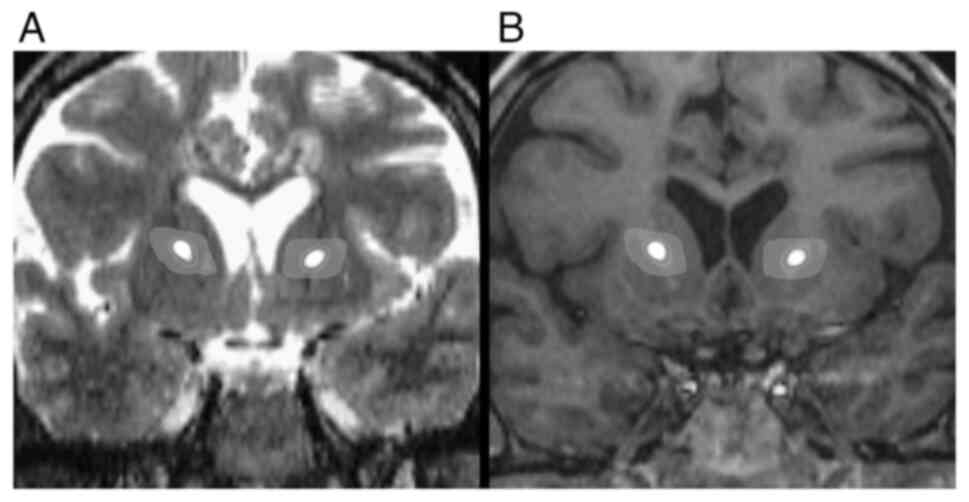
The bilateral anterior limbs of the internal capsules were targeted
with 150 Gy at the 100% prescription isodose in two separate
matrices as described in the previous literature (8). Two shots ~5 mm apart from each other
were used for each target. Following this, the targets were
identified by planning MRI as 20 mm lateral to the midline, 5 mm
behind the tip of the frontal horns of the lateral ventricles at
the level of the inter-commissural plane. The targets were then
manually refined to cover the anterior third of the anterior limb
of the internal capsule within the 50% isodose line, between the
lentiform nucleus and the head of the caudate nucleus, above the
nucleus accumbens. A GammaKnife® Icon (Elekta Instrument
AB) device was used for treatment. Total beam-on-time lasted 184
min. Fig. 1, constructed using the
Slicer 5.0.3(17) software and the
SlicerRT (18) add-on, shows the
radiosurgery targeting and dose distribution.
During the follow-up, the patient reported gradual
improvement of neuropathic pain. At 12 months post-capsulotomy and
24 months post-cingulotomy, the patient had marked pain reduction
to a score of 2-3/10. Neurological and psychiatric examination
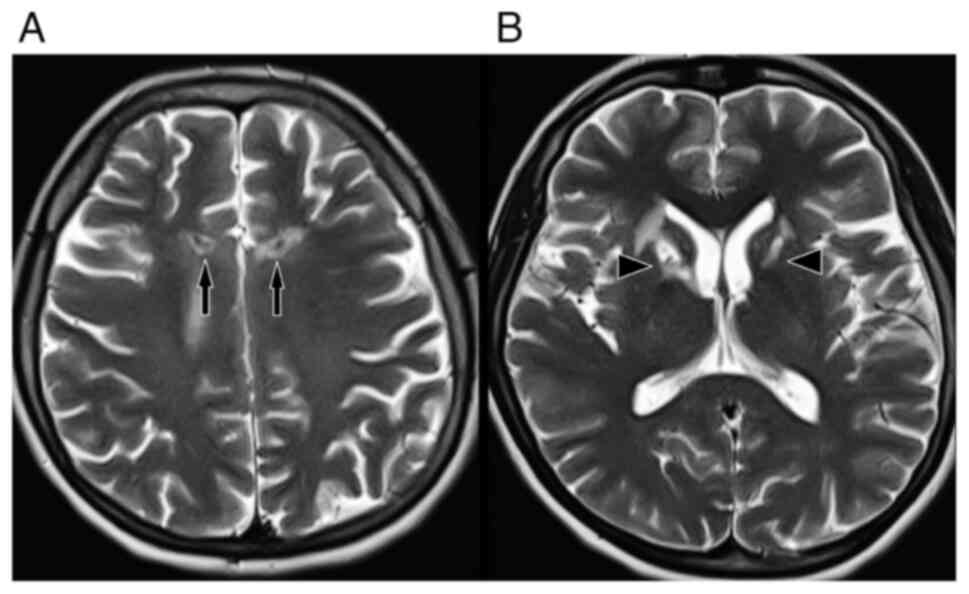
showed neither neurological complication nor cognitive decline. A
control MRI scan confirmed the presence of the capsulotomy lesions
in addition to the previous cingulotomy lesions (Fig. 2). In the end, the patient was
reduced to BNI grade III at the latest follow-up from BNI grade V
at the initial presentation.
Discussion
Classical interventional treatment options for
trigeminal neuralgia in cases when medical therapy proves
ineffective involve the following three techniques: i)
Microvascular decompression; ii) percutaneous rhizotomy; or iii)
stereotactic radiosurgery to the affected trigeminal nerve
(19). Trigeminal tractotomy
(20) or deep brain stimulation
(DBS) of various targets (21) has
been used in more complex cases. These modalities are mainly
considered and investigated for nociceptive pain that is frequently
associated with the classical type of trigeminal neuralgia.
Neuropathic pain is a more difficult concept to understand,
particularly in the complex setting of trigeminal neuralgia. The
method described in the present report can provide additional
benefits in the presence of coexisting psychiatric conditions, thus
giving the treatment an edge over traditional modalities used for
trigeminal neuralgia. Although there are no specific reports, the
present case suggest that the modulation of central pain may be
beneficial for patients with pain refractory to well-established
treatments such as microvascular decompression or percutaneous
rhizotomy. Notably, disadvantages include complication risks
associated with deep intra-axial interventions, along with various
possible unforeseen side effects due to the novelty of the
approach. Yet, while these methods may be novel for trigeminal
neuralgia, they are widely used for other pain conditions and
psychiatric disorders, and have been reported to have minimal known
side effects (6,7).
After numerous ablative interventions, if adequate
pain control is not achieved, classical neuralgic pain may
transform, thus developing a neuropathic component associated with
deafferentation (22), which is
the pain perceived due to the loss of sensory nerve fibres.
Alternatively, as observed in the current case, the initial
presentation can be atypical neuropathic pain. Intractable pain
causes a massive reduction in quality of life for these patients.
In laboratory studies, trigeminal neuropathy was demonstrated to
cause disruptions in the anterior cingulate cortex (23). Taking into account the recent
evidence on the use of cingulotomy for non-cancer pain, in the
current case, the techniques usually reserved for chronic cancer
pain were considered. However, at present, reported instances of
using cingulotomy for facial pain are extremely rare. For instance,
one study that reported on seven non-cancer pain patients, only
included one trigeminal neuralgia patient who had successful pain
reduction (9). There were also two
older case series involving one atypical facial pain case each (in
addition to a few post-herpetic cases); however, the outcomes of
those patients were not reported individually. Overall, to the best
of our knowledge, there are no dedicated studies on using
cingulotomy for facial pain. In a previous study, DBS of the
anterior cingular cortex showed promising long-term results for
chronic neuropathic pain (24).
Although it was considered to exhibit potential, there have been no
reports of anterior cingular cortex DBS for chronic trigeminal
neuropathy in the literature (25).
Changes in pain perception after capsulotomy
(10) and an application of
capsulotomy for somatic symptom disorder (11) have been reported in the literature.
DBS of the anterior limb of the internal capsule has also been
shown to provide relief for post-stroke pain (26). However, none of these studies
focused on trigeminal pain.
Regarding combining central targets, only one report
combined capsulotomy and cingulotomy in the treatment of a single
patient (12). The main indication
for that patient was schizoaffective disorder with heavy suicidal
thoughts; however, it was also reported that the patient had an
altered sensation of temperature and a change in the perception of
temperature-associated pain after the treatments (12). In addition, there was one case
series that combined bilateral cingulotomy with contralateral
mesencephalotomy. Not all patients underwent the combined approach
and, in the whole series, only one patient with facial nociceptive
pain underwent combined lesioning. While individual results for
that patient were not reported, it was noted that all patients with
nociceptive pain had excellent pain relief (27).
Unlike microvascular decompression (MVD) and
percutaneous rhizotomy, which primarily target peripheral pain
transmission through direct neural interventions, cingulotomy and
capsulotomy modulate the central processing of pain (8). This approach may be particularly
beneficial for patients with coexisting psychiatric conditions, as
both procedures have established effects on anxiety and mood
regulation (6,7). While traditional methods such as MVD
and rhizotomy may provide immediate pain relief in classical
trigeminal neuralgia, they are less effective in cases with
atypical or neuropathic pain components. Additionally, repeated
rhizotomy procedures carry a risk of anaesthesia dolorosa, a severe
and often intractable complication (28), whereas the central lesioning
approach described in the present report does not share this
specific risk. However, the major disadvantages of central
lesioning include the potential for cognitive or emotional side
effects, which, although generally minimal, require further study
in the context of trigeminal neuropathic pain.
In the present case, while the initial cingulotomy
provided good pain relief, the achieved effect diminished over
time. At this point, a repeat cingulotomy would usually be
considered. Repeat cingulotomies were previously reported to be
beneficial, especially when the first treatment provided
short-lasting pain control (3).
However, considering the patient's additional conditions and the
previously documented capsulotomy success for various psychiatric
conditions (29), a decision was
made to proceed with a capsulotomy in the present case. At the end
of the first year after the capsulotomy treatment, the patient had
>60% pain reduction and still did not have a relapse. The
single-case nature of the present report prevents generalizing this
outcome, although the proposed approach may be considered for
select patients with similar conditions. Current evidence does not
support replacing classical treatment methods due to the lack of a
control group and randomization. However, future trials may
investigate the efficacy of this method and compare the outcomes
with those afforded by classical treatment modalities. Until then,
the approach described in the present report may only be considered
for select patients with psychiatric comorbidities. We duly
acknowledge the experimental nature of the proposed method.
In conclusion, the current study presents the unique
case of a trigeminal neuralgia patient with atypical neuropathic
pain who underwent combined RF cingulotomy and GKC. The patient
experienced >60% pain reduction after capsulotomy, which was
performed 1 year after cingulotomy. The results suggest that
cingulotomy and capsulotomy are beneficial for refractory
trigeminal neuropathic pain and could be offered, independently or
in combination, to patients requiring advanced tier treatments.
Cingulotomy may be recommended as an initial neurosurgical
treatment for select cases with intractable severe non-malignant
pain; if needed, capsulotomy may be recommended as a sequential
treatment occurring at least 1 year after the initial treatment.
Although this approach may only be suggested for select cases,
future studies may investigate various potential advantages and
pitfalls associated with this approach.
Acknowledgements
Not applicable.
Funding
Funding: No funding was received.
Availability of data and materials
The data generated in the present study may be
requested from the corresponding author.
Authors' contributions
ASa, HE and HDO conceptualised and designed the
paper. ASa and MEY confirm the authenticity of all the raw data.
ASa, HE and HDO advised on patient treatment. Cingulotomy was
performed by ASa and EG, Capsulotomy was performed by MEY, AK and
ASo. Medical images were obtained by EG and ASa, and edited by ASo.
The first draft of the manuscript was written by ASo and critically
revised by MEY, HE, AK, EG, HDO and ASa. All authors read and
approved the final version of the manuscript.
Ethics approval and consent to
participate
Ethical approval was not required for this case
report in accordance with local and national guidelines. This study
fully complies with the 1964 Helsinki Declaration and its later
amendments. The patient consented to the presented medical
treatment and provided written informed consent.
Patient consent for publication
The patient provided written informed consent for
the publication of this case report and accompanying images.
Competing interests
The authors declare that they have no competing
interests.
References
|
1
|
Farrell SM, Pereira EAC, Brown MRD, Green
AL and Aziz TZ: Neuroablative surgical treatments for pain due to
cancer. Neurochirurgie. 67:176–188. 2021.PubMed/NCBI View Article : Google Scholar
|
|
2
|
Deng Z, Pan Y, Li D, Zhang C, Jin H, Wang
T, Zhan S and Sun B: Effect of bilateral anterior cingulotomy on
chronic neuropathic pain with severe depression. World Neurosurg.
121:196–200. 2019.PubMed/NCBI View Article : Google Scholar
|
|
3
|
Sharim J and Pouratian N: Anterior
cingulotomy for the treatment of chronic intractable pain: A
systematic review. Pain Physician. 19:537–550. 2016.PubMed/NCBI
|
|
4
|
Allam AK, Larkin Michael MB, Shofty B and
Viswanathan A: Ablation procedures. Neurosurg Clin N Am.
33:339–344. 2022.PubMed/NCBI View Article : Google Scholar
|
|
5
|
Viswanathan A, Harsh V, Pereira EAC and
Aziz TZ: Cingulotomy for medically refractory cancer pain.
Neurosurg Focus. 35(E1)2013.PubMed/NCBI View Article : Google Scholar
|
|
6
|
Kollenburg L, Kurt E, Arnts H and Vinke S:
Cingulotomy: The last man standing in the battle against medically
refractory poststroke pain. Pain Rep. 9(e1149)2024.PubMed/NCBI View Article : Google Scholar
|
|
7
|
Doshi PK: Anterior capsulotomy for
refractory OCD: First case as per the core group guidelines. Indian
J Psychiatry. 53:270–273. 2011.PubMed/NCBI View Article : Google Scholar
|
|
8
|
Lozano AM, Gildenberg PL and Tasker RR:
Textbook of Stereotactic and Functional Neurosurgery. In: Medicine,
Reference Module Medicine. 2nd edition. Springer, Heidelberg,
2009.
|
|
9
|
Yen CP, Kung SS, Su YF, Lin WC, Howng SL
and Kwan AL: Stereotactic bilateral anterior cingulotomy for
intractable pain. J Clin Neurosci. 12:886–890. 2005.PubMed/NCBI View Article : Google Scholar
|
|
10
|
Talbot JD, Villemure JG, Bushnell MC and
Duncan GH: Evaluation of pain perception after anterior
capsulotomy: A case report. Somatosens Mot Res. 12:115–126.
1995.PubMed/NCBI View Article : Google Scholar
|
|
11
|
He W, Shao L, Wang H, Huang H, Zhang S, Li
C, Zhang C and Yi W: Bilateral anterior capsulotomy for the
treatment of refractory somatic symptom disorder: A case report.
Front Integr Neurosci. 15(721833)2022.PubMed/NCBI View Article : Google Scholar
|
|
12
|
Davis KD, Hutchison WD, Lozano AM and
Dostrovsky JO: Altered pain and temperature perception following
cingulotomy and capsulotomy in a patient with schizoaffective
disorder. Pain. 59:189–199. 1994.PubMed/NCBI View Article : Google Scholar
|
|
13
|
Breivik H, Borchgrevink PC, Allen SM,
Rosseland LA, Romundstad L, Hals EK, Kvarstein G and Stubhaug A:
Assessment of pain. Br J Anaesth. 101:17–24. 2008.PubMed/NCBI View Article : Google Scholar
|
|
14
|
Rogers CL, Shetter AG, Fiedler JA, Smith
KA, Han PP and Speiser BL: Gamma knife radiosurgery for trigeminal
neuralgia: The initial experience of the Barrow Neurological
Institute. Int J Radiat Oncol Biol Phys. 47:1013–1019.
2000.PubMed/NCBI View Article : Google Scholar
|
|
15
|
Hassenbusch SJ, Pillay PK and Barnett GH:
Radiofrequency cingulotomy for intractable cancer pain using
stereotaxis guided by magnetic resonance imaging. Neurosurgery.
27:220–223. 1990.PubMed/NCBI View Article : Google Scholar
|
|
16
|
Guner YE, Comert A, Sayaci EY, Korkmaz AC,
Gungor Y, Morali Guler T, Kahilogullari G and Savas A:
Microsurgical anatomy of the anterior cerebral artery and the
arterial supply of the cingulate gyrus. Surg Radiol Anat.
45:351–358. 2023.PubMed/NCBI View Article : Google Scholar
|
|
17
|
Fedorov A, Beichel R, Kalpathy-Cramer J,
Finet J, Fillion-Robin JC, Pujol S, Bauer C, Jennings D, Fennessy
F, Sonka M, et al: 3D Slicer as an image computing platform for the
quantitative imaging network. Magn Reson Imaging. 30:1323–1341.
2012.PubMed/NCBI View Article : Google Scholar
|
|
18
|
Pinter C, Lasso A, Wang A, Jaffray D and
Fichtinger G: SlicerRT: Radiation therapy research toolkit for 3D
Slicer. Med Phys. 39:6332–6338. 2012.PubMed/NCBI View Article : Google Scholar
|
|
19
|
Araya EI, Claudino RF, Piovesan EJ and
Chichorro JG: Trigeminal neuralgia: Basic and clinical aspects.
Curr Neuropharmacol. 18:109–119. 2020.PubMed/NCBI View Article : Google Scholar
|
|
20
|
Kanpolat Y, Kahilogullari G, Ugur HC and
Elhan AH: Computed tomography-guided percutaneous trigeminal
tractotomy-nucleotomy. Neurosurgery. 63 (Suppl 1):ONS147–ONS155.
2008.PubMed/NCBI View Article : Google Scholar
|
|
21
|
Singleton WGB, Ashida R and Patel NK: Deep
Brain Stimulation for Facial Pain. In: Neuromodulation for facial
pain. Slavin KV (ed). Progress in Neurological Surgery, pp141-161,
2020.
|
|
22
|
Burchiel KJ: A new classification for
facial pain. Neurosurgery. 53:1164–1167. 2003.PubMed/NCBI View Article : Google Scholar
|
|
23
|
Murugappan SK, Hasan M, Lei Z, Iqbal Z,
Ramkrishnan AS, Wong HY and Li Y: Trigeminal neuropathy causes
hypomyelination in the anterior cingulate cortex, disrupts the
synchrony of neural circuitry, and impairs decision-making in male
rats. J Neurosci Res. 99:2721–2742. 2021.PubMed/NCBI View Article : Google Scholar
|
|
24
|
Boccard SGJ, Prangnell SJ, Pycroft L,
Cheeran B, Moir L, Pereira EAC, Fitzgerald JJ, Green AL and Aziz
TZ: Long-term results of deep brain stimulation of the anterior
cingulate cortex for neuropathic pain. World Neurosurg.
106:625–637. 2017.PubMed/NCBI View Article : Google Scholar
|
|
25
|
Chung M and Huh R: Neuromodulation for
trigeminal neuralgia. J Korean Neurosurg Soc. 65:640–651.
2022.PubMed/NCBI View Article : Google Scholar
|
|
26
|
Lempka SF, Malone DA Jr, Hu B, Baker KB,
Wyant A, Ozinga JG IV, Plow EB, Pandya M, Kubu CS, Ford PJ and
Machado AG: Randomized clinical trial of deep brain stimulation for
poststroke pain. Ann Neurol. 81:653–663. 2017.PubMed/NCBI View Article : Google Scholar
|
|
27
|
Marques RAS, Alencar HS, Bannach MA and
Vilela-Filho O: Semidirect targeting-based stereotactic
mesencephalotomy for the treatment of refractory pain: a case
series. J Neurosurg. 136:1128–1138. 2021.PubMed/NCBI View Article : Google Scholar
|
|
28
|
Burchiel KJ, Steege TD, Howe JF and Loeser
JD: Comparison of percutaneous radiofrequency gangliolysis and
microvascular decompression for the surgical management of tic
douloureux. Neurosurgery. 9:111–119. 1981.PubMed/NCBI View Article : Google Scholar
|
|
29
|
Sadashiva N, Tripathi M and De Salles A:
Contemporary role of stereotactic radiosurgery for psychiatric
disorders. Neurol India. 71 (Suppl 1):S31–S38. 2023.PubMed/NCBI View Article : Google Scholar
|