1. Introduction
N6-methyladenosine (m6A) is the most
abundant internal modification in eukaryotic mRNA, with over
440,000 high-confidence m6A sites identified across
human and animal transcriptomes (1). m6A is dynamically
regulated by ‘writers’ such as methyltransferase-like (METTL)3 and
METTL14, ‘erasers’ such as fat mass and obesity-associated protein
(FTO) and alkB homolog 5 (ALKBH5) and ‘readers’ such as YTH domain
proteins, and is enriched near stop codons and in 3' untranslated
regions (2,3). Functionally, m6A
modification influences multiple aspects of RNA metabolism,
including alternative splicing, nuclear export, mRNA stability and
decay and translation efficiency (4). For example, m6A-marked
transcripts are often recognized by N6-methyladenosine RNA binding
protein (YTHDF)2, which accelerates their degradation, whereas
m6A can also promote translation by recruiting YTHDF1 or
eukaryotic translation initiation factor 4 γ 2(5). In circular (circ)RNAs, m6A
controls both their biogenesis and translation potential through
regulators such as METTL3 and YTH domain-containing protein 1
(YTHDC1) (5). Quantitative studies
have shown that m6A is present on 0.1-0.4% of adenosines
in mRNA, and transcriptome-wide mapping has revealed that
m6A sites are notably conserved among vertebrates
(6). The reversibility and
metabolic sensitivity of m6A allow cells to rapidly
adjust gene expression in response to environmental stress,
nutrient status and disease-associated stimuli (7). Thus, m6A acts as a
flexible post-transcriptional regulatory layer rather than a static
RNA mark.
Pulmonary fibrosis (PF), particularly idiopathic PF
(IPF), imposes a substantial global disease burden, with incidence
rates in Europe and North America estimated at 3-9 cases per
100,000 per year and rising over time (8). Patients experience marked symptom
burden, impaired health-related quality of life and a median
survival of only 2.7-3.0 years after diagnosis (9). The economic impact is also notable,
with annual per capita healthcare costs for patients with IPF in
North America reaching ~$20,000, which is 2.5-3.5 times higher than
average national healthcare expenditures (10). Beyond direct medical costs,
progressive fibrosing interstitial lung diseases also lead to
indirect costs such as job loss, psychological stress and caregiver
burden (11). Although
antifibrotic drugs such as pirfenidone and nintedanib can slow
disease progression, they do not cure PF, reverse established
scarring or sufficiently improve symptoms and quality of life
(12). Clinical research is
further challenged by disease heterogeneity, incomplete
understanding of fibrotic mechanisms, lack of sensitive biomarkers
and difficulty in demonstrating additional therapeutic benefits in
the era of approved antifibrotic therapies (13). Notably, research priorities
identified by patients, caregivers and clinicians include reversing
lung scarring, improving lung function, relieving symptoms,
preventing disease progression and enabling earlier diagnosis
(14). Therefore, mechanistic
research in PF should be connected to patient-centered goals,
including early diagnosis, prognostic stratification,
symptom-relevant outcomes and development of disease-modifying
therapies.
Emerging studies have revealed a close association
between m6A RNA methylation and PF. The expression
patterns of key m6A regulators are model- and
context-dependent: METTL3 is upregulated in fibrotic lung tissue,
whereas METTL14 is downregulated in aging-related IPF; FTO is
suppressed in silica-induced PF, and ALKBH5 is downregulated or
destabilized in PM2.5-, silica- and 1-nitropyrene-associated models
(15-25).
These alterations may contribute to PF through cell-type- and
stimulus-specific mechanisms. For example, METTL3-dependent
m6A modification promotes lung
fibroblast-to-myofibroblast transition by modulating potassium
voltage-gated channel subfamily H member 6 (KCNH6) mRNA
translation (18), whereas
METTL14-mediated regulation of DNA damage inducible transcript 4
(DDIT4) mRNA stability has been implicated in aging-related
IPF (16). ALKBH5 dysregulation
contributes to environmental exposure-related PF through mechanisms
involving autophagy dysfunction, inflammatory responses and
epithelial senescence (17,19-22).
FTO suppression is associated with increased m6A RNA
methylation and silica-induced pulmonary inflammation and fibrosis
(23). m6A modification
also regulates non-coding RNAs such as circRNAs and micro (mi)RNAs,
thereby influencing fibrotic signaling pathways (24,25).
However, the available evidence also shows that m6A
regulators may exert different effects depending on cell type,
environmental stimulus, disease stage and target transcript.
Therefore, m6A should not be described as a simple
universal driver of PF.
Several issues in the current literature require
careful clarification. First, although oxidative stress can
regulate m6A machinery, the relationship between
reactive oxygen species (ROS) and m6A should not be
generalized as a universal feedback loop without cell-specific
evidence. Second, regulators such as METTL14 and ALKBH5 have
context-dependent roles and may not be uniformly pro-fibrotic or
anti-fibrotic. Third, the translational relevance of m6A
regulators needs to be discussed in relation to patient-centered
needs, including early diagnosis, prognosis, treatment response and
therapeutic safety. Finally, existing reviews have discussed
m6A in fibrosis or non-coding RNA regulation; therefore,
the novelty of the present review should be defined more cautiously
as a PF-focused synthesis emphasizing cell-type specificity,
validated mechanisms and translational implications rather than as
the first systematic classification of this field (26-29).
To minimize overinterpretation, representative
m6A-related mechanisms were appraised using an
author-defined framework that considered four dimensions: i) The
source of evidence, including human specimens, animal models and/or
cultured cells; ii) causal perturbation of the m6A
regulator or target transcript; iii) direct validation of the
regulator-m6A-target RNA-phenotype axis; and iv)
replication across experimental settings. Evidence was classified
as strong when human evidence was supported by both in vivo
and in vitro causal validation, moderate when evidence from
at least two experimental settings and partial mechanistic
validation was available, limited when findings were derived from a
single model or were predominantly associative, and indirect when
the proposed mechanism was extrapolated mainly from non-PF systems.
Cell type, fibrotic stimulus and disease setting were recorded
separately as model-context variables (Table I). This framework was developed for
the present review and was not adapted from a previously published
evidence-grading system.
 | Table IEvidence-based classification of
representative m6A-related mechanisms in PF. |
Table I
Evidence-based classification of
representative m6A-related mechanisms in PF.
| Mechanism | Main evidence in
the present manuscript | Evidence
strength | Revised
interpretation |
|---|
| METTL3-YTHDF1-KCNH6
axis in fibroblast-to-myofibroblast transition | Human PF tissue,
in vivo PF models and in vitro causal experiments
(18) | Strong | A well-supported
PF-specific mechanism of fibroblast-to-myofibroblast
transition. |
| METTL3-YTHDF2-TSC1
axis in EMT-associated epithelial remodeling | PF-related animal
and cellular experiments with mechanistic validation (36) | Moderate | Supports a
pro-fibrotic role for METTL3 in epithelial remodeling. |
| METTL14–DDIT4 axis
in aging-related IPF | Human IPF samples,
transcriptome-wide analyses and experimental validation in animal
and senescent-cell models (16) | Strong | A well-supported
aging-related mechanism that should not be generalized to all PF
contexts. |
| ALKBH5–FBXW7 axis
in 1-nitropyrene-induced epithelial senescence | In vivo and
in vitro toxicant-induced PF models with causal mechanistic
validation (17) | Moderate | Supports a
protective role for epithelial ALKBH5 in this exposure-specific
model. |
| FTO suppression in
silica-induced PF | Silicosis models,
single-cell transcriptomic data and global m6A
measurements without validated transcript-specific causal targets
(23) | Limited | Associated with
inflammatory and fibrotic remodeling, but causality requires
further validation. |
|
m6A-dependent regulation of
macrophage polarization | Predominantly
inflammatory, metabolic and cancer models outside PF (66,68-73) | Indirect | Mechanistic
background requiring direct PF-specific validation. |
|
m6A-mediated ECM
remodeling | Predominantly
multi-organ fibrosis and non-PF studies (28,80-83) | Indirect | Biologically
plausible, but PF-specific transcript targets remain insufficiently
validated. |
| Pharmacological
inhibition of METTL3 by STM2457 in experimental PF | A single
preclinical mouse study reporting pharmacological intervention in
experimental IPF (88) | Limited | Provides
preliminary pharmacological proof of concept requiring independent
validation. |
| Other
m6A-targeted compounds and delivery systems | Predominantly
cancer and neurological models, with little or no direct validation
in PF (84-87,89-95) | Indirect | Should be regarded
as non-PF preclinical tools rather than established PF
therapies. |
2. m6A modification system in
PF
m6A belongs to a dynamic regulatory
system that can be subdivided into writers, erasers and readers,
which are notable mediators of PF pathogenesis (30). Previous studies have demonstrated
that m6A contributes to PF development by modulating
mRNA stability and degradation, translational regulation,
fibroblast activation, epithelial-mesenchymal transition,
macrophage-associated inflammation, oxidative stress responses and
aging-related epithelial senescence (31,32).
In this framework, the role of each m6A regulator is
interpreted according to experimental context, cell type and target
transcript, rather than being classified simply as pro-fibrotic or
anti-fibrotic. The principal components of the m6A
regulatory system and their proposed roles in PF are summarized in
Fig. 1.
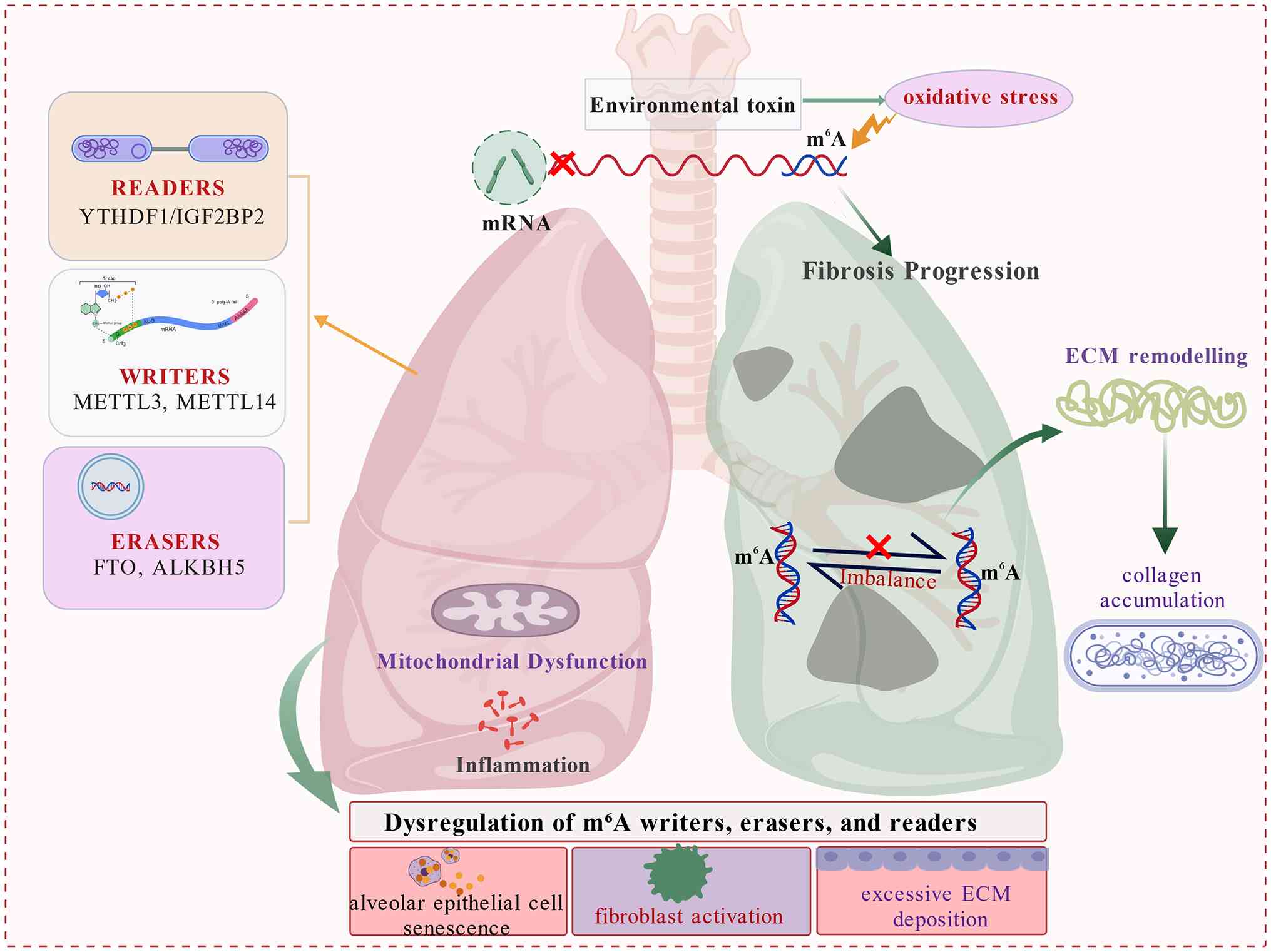 | Figure 1Overview of the m6A
regulatory system in pulmonary fibrosis. The m6A
machinery comprises writers, including METTL3 and METTL14; erasers,
including FTO and ALKBH5; and readers, including YTHDF1/2/3 and
IGF2BP1/2/3. In PF-related models, dysregulation of these
regulators is associated with alveolar epithelial injury and
senescence, fibroblast activation, inflammatory remodeling and
excessive ECM deposition. Environmental toxicants and aging-related
stressors may alter m6A regulation in a cell- and
stimulus-dependent manner. The figure was created using BioGDP
(Biological Graphics Design Platform, version 2.0) (106). ALKBH5, alkB homolog 5; ECM,
extracellular matrix; FTO, fat mass and obesity-associated protein;
IGF2BP, insulin-like growth factor 2 mRNA-binding protein; METTL,
methyltransferase-like; m6A, N6-methyladenosine; PF,
pulmonary fibrosis; YTHDF, YTH N6-methyladenosine RNA-binding
protein. |
Expression characteristics of the
m6A modification system in lung tissue
METTL3 is a core component of the m6A
methyltransferase complex and serves as the main catalytic subunit
responsible for transferring a methyl group to the N6 position of
adenosine residues in RNA, thereby regulating RNA stability,
splicing, translation and degradation (33). Structurally, METTL3 contains a
methyltransferase domain that binds the methyl donor
S-adenosylmethionine and directly catalyzes m6A
modification (30). Although it
contains a methyltransferase-like domain, METTL14 primarily
functions as an RNA-binding platform that enhances substrate
recognition and complex stability (31). METTL14 forms a stable heterodimer
with METTL3, and this complex is essential for efficient and
specific m6A modification in eukaryotic RNAs (32). Previous studies also suggest that
METTL14 may have additional roles in chromatin regulation and gene
expression independent of its RNA methyltransferase activity
(34,35). METTL14 expression is notably
decreased in lung tissue from patients with IPF compared with
normal lung tissue (16).
High-throughput sequencing and experimental validation indicate
that METTL14 downregulation reduces m6A methylation of
DDIT4 mRNA, increases DDIT4 mRNA stability and
protein expression and promotes alveolar epithelial cell senescence
and fibrosis progression (16).
This finding provides a mechanistic link between m6A
remodeling and aging-related epithelial vulnerability in IPF;
however, METTL14 should not be described as universally
pro-fibrotic. In this model, reduced METTL14 expression promotes
senescence by stabilizing DDIT4, whereas the role of METTL14 may
differ in other cell types, disease stages or injury contexts.
METTL3 is notably upregulated in fibrotic lung tissue compared with
normal lung tissue (36). In mouse
models and in vitro experiments, increased METTL3 expression
leads to elevated m6A methylation of (TSC complex
subunit 1) TSC1 mRNA. Through YTHDF2-mediated degradation of
TSC1 mRNA, METTL3 reduces TSC1 protein levels and activates
the AKT/mTOR pathway, thereby driving epithelial-mesenchymal
transition (EMT) and fibrosis progression (36). Knockdown of METTL3 markedly impedes
EMT, indicating its role in promoting fibrosis (36). In addition, METTL3-mediated
m6A modification also promotes lung
fibroblast-to-myofibroblast transition through KCNH6 mRNA
translational regulation in a YTHDF1-dependent manner (18). Together, these data support a
relatively consistent pro-fibrotic role for METTL3 in fibroblast
activation and epithelial remodeling, although its therapeutic
targeting still requires cell-specific safety evaluation.
FTO and ALKBH5 are the two major RNA demethylases
that remove m6A modifications from RNA and dynamically
regulate gene expression. FTO catalyzes oxidative demethylation of
m6A, primarily producing N6-hydroxymethyladenosine as an
intermediate, whereas ALKBH5 directly converts m6A to
adenosine with rapid formaldehyde release, reflecting distinct
biochemical mechanisms and cellular functions (37,38).
Both enzymes influence RNA splicing, export, stability and
translation and participate in biological processes such as
differentiation, stress responses and tumor progression (39,40).
ALKBH5 plays a tissue- and cell-type-specific regulatory role in
PF. In PM2.5- and silica-induced PF models, ALKBH5 expression is
downregulated in lung epithelial cells and macrophages, leading to
increased m6A modification of target mRNAs such as
autophagy related 13 and SLAM family member 7 (SLAMF7),
thereby promoting autophagy dysfunction, inflammation and
extracellular matrix (ECM) deposition (19,20).
Proteasome-dependent degradation of ALKBH5 aggravates PF by
enhancing autophagy-related dysfunction and activating YAP1
signaling in epithelial cells (21). In alveolar epithelial cells exposed
to 1-nitropyrene, ALKBH5 undergoes SUMOylation, a reversible
post-translational modification in which a small ubiquitin-like
modifier protein is covalently attached to lysine residues on a
substrate protein. In this model, ALKBH5 SUMOylation promotes its
proteasomal degradation, thereby increasing m6A
modification of FBXW7 mRNA, enhancing FBXW7 expression and
promoting TRF2 degradation, telomere damage, cellular senescence
and fibrosis (17). Moreover,
ALKBH5 in macrophages regulates m6A modification of
SLAMF7 and affects autophagy and inflammatory responses during
silica-induced lung injury (22).
These findings support a context-dependent role of ALKBH5. In
toxicant-induced epithelial injury, ALKBH5 loss promotes senescence
and fibrosis, suggesting a protective role of ALKBH5 in epithelial
cells. However, ALKBH5-related pathways may differ in macrophages,
fibroblasts and other environmental exposure models. Therefore,
ALKBH5 should be described as a context-dependent regulator rather
than a uniformly anti-fibrotic or pro-fibrotic factor.
FTO is notably downregulated in lung tissues during
PF, specifically in a mouse model of silicosis (23). This suppression leads to increased
global m6A RNA methylation in fibrotic lungs.
Single-cell sequencing further revealed that FTO expression is
reduced in epithelial cells, endothelial cells, fibroblasts and
monocytes, all of which are involved in fibrosis (23). By contrast, ALKBH5 and other
m6A regulators such as METTL3 and METTL14 did not show
notable changes between normal and fibrotic lung tissues in that
specific dataset (23). These
findings suggest that FTO may act as a cell-type-sensitive
regulator in silica-induced pulmonary inflammation and fibrosis.
Nevertheless, whether FTO downregulation is an initiating event, a
secondary response to injury or an amplifier of fibrotic
inflammation remains to be clarified by cell-specific gain- and
loss-of-function studies. YTHDF1, YTHDF2, YTHDF3 and insulin-like
growth factor 2 mRNA-binding protein (IGF2BP)1-3 are key
m6A reader proteins that recognize m6A
modifications and regulate mRNA fate. YTHDF1 primarily promotes the
translation of selected m6A-modified transcripts,
whereas YTHDF2 generally facilitates their degradation. YTHDF3 has
been reported to act as a co-reader that enhances YTHDF1-associated
translation of certain m6A-marked transcripts and
facilitates YTHDF2-associated decay of others. Therefore, the
function of YTHDF3 depends on the bound transcript and cellular
context rather than representing a uniform translational or
degradative effect (41-43).
By contrast, IGF2BP1-3 recognize m6A-containing
transcripts through their K homology domains and recruit
RNA-stabilizing proteins, thereby protecting the bound RNAs from
degradation, prolonging their half-lives and, in some contexts,
increasing protein translation (44,45).
These proteins participate in cell proliferation, differentiation,
stress responses and disease progression. During PF progression,
the expression of m6A readers such as YTHDF1, YTHDF3 and
IGF2BP2 undergoes dynamic changes. In arsenite-related IPF, YTHDF1
recognizes m6A-modified neuronal regeneration-related
protein (NREP) mRNA and enhances NREP translation,
increasing TGF-β1 secretion from alveolar epithelial cells and
promoting fibroblast-to-myofibroblast transition. The resulting
myofibroblasts release extracellular lactate; therefore, lactate is
a metabolic product of activated myofibroblasts rather than a
direct product of NREP. After uptake into alveolar epithelial cells
through monocarboxylate transporter 1, lactate increases H3K18
lactylation, which promotes YTHDF1 transcription and reinforces the
YTHDF1/m6A/NREP/TGF-β1 fibrotic circuit (25). This mechanism illustrates crosstalk
between metabolic remodeling, histone lactylation and
m6A-mediated translational control. However, the term
‘positive feedback loop’ should be used only for this
experimentally supported axis and should not be generalized to all
oxidative stress-m6A interactions. In
hypoxia/reoxygenation injury models, YTHDF3 and IGF2BP2 knockdown
protects bronchial epithelial cells by reducing apoptosis and
inflammation and inhibiting p38 MAPK, AKT, ERK1/2 and NF-κB
pathways (46). Direct evidence
for dynamic changes in YTHDF2 and IGF2BP1/3 in PF remains limited,
and these readers should be presented as potential rather than
fully validated PF regulators. m6A modification
regulates the degradation of fibrosis-related mRNAs through
writers, erasers and readers. Deadenylation is the progressive
shortening of the 3' poly(A) tail of an mRNA, which reduces
transcript stability and commonly precedes decapping and
exonucleolytic degradation. YTHDF2 binds m6A-modified
transcripts and recruits the CCR4/NOT deadenylase complex to
initiate poly(A)-tail shortening and RNA decay. Alternatively,
YTHDF2 can engage the HRSP12-RNase P/MRP endoribonuclease complex
to promote endonucleolytic cleavage (47,48).
Although these are general m6A-dependent RNA-decay
mechanisms, they are directly relevant to PF, as METTL3-dependent
methylation enables YTHDF2-mediated degradation of TSC1 mRNA. The
resulting reduction in TSC1 protein activates AKT/mTOR signaling
and promotes alveolar epithelial remodeling and fibrotic
progression (36).
Beyond mRNAs, m6A also regulates
non-coding RNAs, including miRNAs, long non-coding RNAs and
circRNAs, which modulate fibrosis-related genes and signaling
pathways (26). Dynamic changes in
m6A modification affect the stability of fibrotic mRNAs
involved in TGF-β signaling, collagen production, fibroblast
activation, apoptosis and inflammation (27,49).
However, because much of the evidence for m6A-mediated
ECM regulation comes from multiple-organ fibrosis rather than
PF-specific systems, PF-specific transcript targets should be
distinguished from extrapolated mechanisms (28). The reported expression or
functional alterations of major m6A writers, erasers and
readers in PF-related mechanisms are summarized in Table II.
| Table IISummary of m6A regulator
alterations in pulmonary fibrosis-related mechanisms. |
Table II
Summary of m6A regulator
alterations in pulmonary fibrosis-related mechanisms.
| Regulator | Category | Expression or
functional change | Main cell
type/model | Target/pathway | Biological
effect | (Refs.) |
|---|
| METTL3 | Writer | Upregulated in
fibrotic contexts | Fibroblasts;
epithelial cells; IPF/PF models | KCNH6/YTHDF1;
TSC1/YTHDF2; | Promotes FMT and
EMT-like remodeling AKT/mTOR | (18,36) |
| METTL14 | Writer | Downregulated in
aging-related IPF | Alveolar epithelial
cells | DDIT4 mRNA
stability | Promotes epithelial
senescence when reduced | (16) |
| FTO | Eraser | Downregulated in
silica-induced PF | Epithelial cells,
endothelial cells, fibroblasts, monocytes | Global
m6A increase; inflammatory remodeling | Associated with
inflammation and fibrosis | (23) |
| ALKBH5 | Eraser | Downregulated or
degraded depending on exposure | Epithelial cells,
macrophages | FBXW7; Atg13;
Slamf7 | Regulates
senescence, autophagy and inflammation | (17,19-21) |
| YTHDF1 | Reader | Increased in
arsenite-related IPF | Alveolar epithelial
cells; fibroblast crosstalk | NREP/TGF-β1; KCNH6
translation | Promotes FMT and
fibrotic signaling | (18,25) |
| YTHDF2 | Reader | Functionally
involved in mRNA decay | Epithelial
remodeling models | TSC1 mRNA
degradation | Activates AKT/mTOR
pathway through TSC1 reduction | (36,47,48) |
| YTHDF3 | Reader | Functionally
implicated in a hypoxia/reoxygenation injury model | Bronchial
epithelial cells | p38 MAPK, AKT,
ERK1/2, NF-κB | Regulates apoptosis
and inflammation | (46) |
| IGF2BP2 | Reader | Differentially
expressed in lung injury model | Bronchial
epithelial cells | Inflammatory and
survival | Regulates injury
responses pathways | (46) |
| circRNA-associated
m6A | Non-coding RNA
regulation | Altered in
silica-induced PF | Fibroblasts | circRNA
methylation/eIF4A3-related | Promotes fibroblast
activation and migration regulation | (24) |
m6A-mediated
epitranscriptomic remodeling and cell fate determination
Fibroblast-to-myofibroblast transition is a central
event in the development and progression of PF. Myofibroblasts
arise from activated fibroblasts and are major effector cells
responsible for excessive ECM production, tissue contraction and
structural remodeling in the fibrotic lung (50). This transition is driven by
TGF-β/Smad signaling, mechanical cues from stiffened ECM and
mechanosensitive ion channels such as TRPV4 and BK channels
(51). The process is marked by
increased α-SMA expression, cytoskeletal reorganization and
enhanced collagen synthesis (52).
Inhibiting fibroblast-to-myofibroblast transition reduces collagen
deposition and improves lung function in animal models, supporting
its potential as a therapeutic target (53). m6A RNA modification
plays a notable role in the translational regulation underlying
fibroblast activation. Elevated m6A levels mediated by
methyltransferases such as METTL3 enhance translation of specific
mRNAs required for fibroblast-to-myofibroblast transition. For
example, m6A modification promotes KCNH6 mRNA
translation in a YTHDF1-dependent manner, facilitating fibroblast
activation and fibrotic progression (18). Silencing METTL3 reduces
m6A levels and inhibits this transition in vitro
and in vivo (18). This
pathway represents one of the stronger causal examples linking
m6A modification to PF because it is supported by
patient tissue, animal models and cellular experiments. In
addition, m6A reader proteins such as IGF2BP1 and YTHDF1
can bind to m6A-modified mRNAs and enhance stability or
translation in related biological contexts (54,55).
In a non-PF myogenic model, IGF2BP1 bound m6A-modified
FGFR1 mRNA, increased its stability and translation, and activated
downstream ERK signaling, thereby promoting myogenic
differentiation (55). This
finding illustrates how an m6A reader can stabilize a
receptor transcript; however, it is included only as supportive
mechanistic background and should not be interpreted as direct
evidence for fibroblast activation in PF.
EMT is a process in which epithelial cells lose
polarity and cell-cell adhesion and acquire mesenchymal
characteristics, thereby contributing to epithelial dysfunction,
migratory capacity and ECM-associated signaling (56,57),
and EMT has been implicated in PF. In IPF, EMT-like changes and
abnormal epithelial-fibroblast crosstalk can activate local
fibroblasts, increase collagen deposition and impair lung function
(58,59). However, whether complete EMT
directly contributes substantially to the myofibroblast pool in
vivo remains debated. Therefore, the present review uses
‘epithelial plasticity’ and ‘EMT-like remodeling’ where
appropriate, rather than overstating full EMT as a dominant source
of myofibroblasts. During EMT, m6A RNA methylation
undergoes dynamic changes. METTL3 expression and global
m6A levels are often upregulated during TGF-β-induced
EMT in lung and other epithelial cells (60,61).
Increased m6A promotes translation or stability of
EMT-related transcription factors such as Snail, JUN, JUNB and zinc
finger MYM-type containing 1 (ZMYM1), thereby enhancing mesenchymal
marker expression and repressing epithelial markers such as
E-cadherin (62,63). Mechanistically, m6A
modifications on specific mRNAs facilitate recognition by readers
such as YTHDF1 and human antigen R, which promote translation or
stability of EMT drivers (64). In
a breast cancer model, METTL3-dependent m6A modification
increased MALAT1 stability. MALAT1 subsequently acted as a
competing endogenous RNA for miR-26b, thereby relieving
miR-26b-mediated repression of HMGA2. The resulting increase in
HMGA2 was accompanied by decreased CDH1/E-cadherin expression and
increased CDH2/N-cadherin and VIM/vimentin expression, thereby
promoting EMT, migration and invasion (65). As this evidence was obtained
outside PF, it is presented as a mechanistic example rather than
PF-specific proof.
Macrophage activation states contribute to the
temporal evolution of PF, although they are more appropriately
viewed as a continuum than as a strict M1/M2 dichotomy (66,67).
Pro-inflammatory macrophage programs may aggravate epithelial
injury during the early stages of disease, whereas persistent
M2-like or pro-fibrotic macrophages release TGF-β1 and other
pro-fibrotic mediators, thereby promoting epithelial plasticity,
fibroblast activation, myofibroblast differentiation and ECM
deposition. m6A modification may regulate these
macrophage states by altering the stability, translation and decay
of transcripts involved in inflammatory and metabolic programs.
METTL3 is upregulated during M1-like polarization and modifies
transcripts such as STAT1 and HDGF, thereby promoting inflammatory
responses (68,69). Conversely, ALKBH5-mediated
demethylation of CPT1A mRNA enhances fatty-acid metabolism and
supports M2-like polarization in a colorectal cancer model
(70). As most of these mechanisms
were identified outside PF, they should be interpreted as
mechanistic background requiring direct validation in lung
macrophage-specific PF models. Multi-omics studies reveal dynamic
m6A and 5-hydroxymethylcytosine changes during
macrophage differentiation and polarization (71,72).
For example, in rheumatoid arthritis macrophages, circ_0066715 acts
as a competing endogenous RNA for miR-486-5p, thereby relieving
miR-486-5p-mediated repression of ETS1 and altering
macrophage-polarization programs (73). This axis is cited as an
inflammatory-disease example and has not yet been validated in PF.
However, most macrophage-polarization mechanisms cited here are not
PF-specific. Therefore, these mechanisms are interpreted as
mechanistic background, and PF-specific macrophage m6A
regulation still requires direct validation using lung
macrophage-specific models, single-cell analysis and
lineage-resolved functional studies. Collectively, these findings
indicate that m6A-dependent regulation may influence
pulmonary cell fate through fibroblast activation, epithelial
plasticity and macrophage-associated responses, although the
strength and PF specificity of the evidence differ among these
cellular processes, as summarized in Fig. 2.
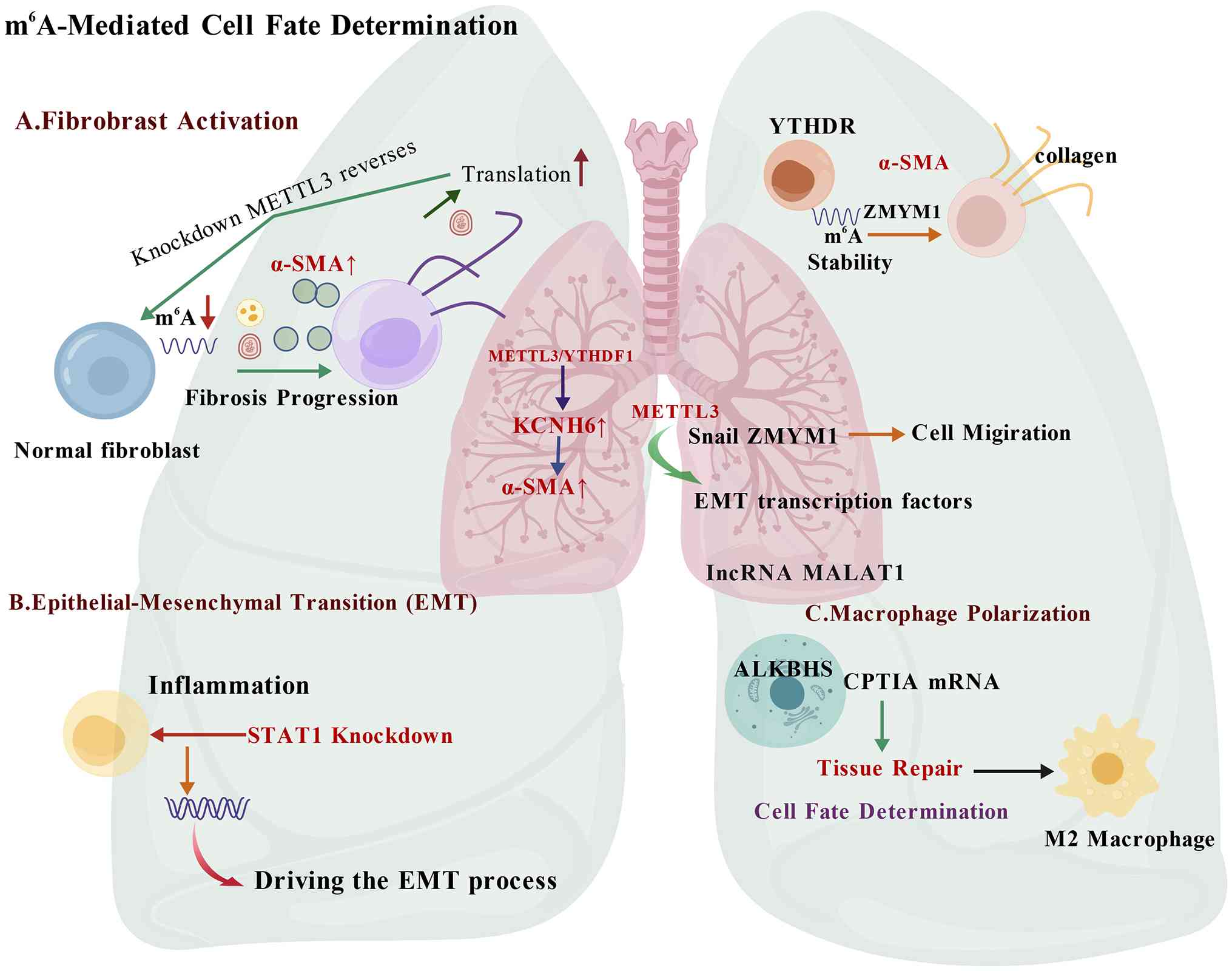 | Figure 2m6A-mediated cell fate
determination in pulmonary fibrosis. (A) Fibroblast activation.
METTL3-mediated m6A modification of KCNH6 mRNA is
recognized by YTHDF1, which enhances KCNH6 translation and promotes
fibroblast-to-myofibroblast transition. METTL3 silencing suppresses
this response in PF models. (B) EMT-associated epithelial
plasticity. In lung and other epithelial models, METTL3-dependent
m6A regulation increases the expression or stability of
EMT-associated factors, including SNAI1, JUN, JUNB and ZMYM1, as
well as the lncRNA MALAT1. These alterations reduce
epithelial-marker expression, increase mesenchymal-marker
expression and enhance cell migration. Mechanisms derived from
non-PF systems are presented as supportive mechanistic background.
(C) Macrophage polarization. METTL3-dependent m6A
modification of STAT1 supports pro-inflammatory macrophage
activation, whereas ALKBH5-mediated demethylation of CPT1A supports
fatty-acid metabolism and M2-like polarization in a non-PF cancer
model. Direct PF-specific validation of these macrophage mechanisms
remains limited. The figure was created using BioGDP (Biological
Graphics Design Platform, version 2.0) (106). ALKBH5, alkB homolog 5; CPT1A,
carnitine palmitoyltransferase 1A; EMT, epithelial-mesenchymal
transition; KCNH6, potassium voltage-gated channel subfamily H
member 6; lncRNA, long non-coding RNA; MALAT1,
metastasis-associated lung adenocarcinoma transcript 1; METTL3,
methyltransferase-like 3; m6A, N6-methyladenosine; PF,
pulmonary fibrosis; STAT1, signal transducer and activator of
transcription 1; YTHDF1, YTH N6-methyladenosine RNA-binding protein
1; ZMYM1, zinc finger MYM-type containing 1. |
Aberrant m6A modification
in PF pathogenesis
Oxidative stress is a major contributor to PF
pathogenesis because it promotes epithelial injury, mitochondrial
dysfunction, DNA damage, inflammatory signaling, cellular
senescence and fibrotic remodeling (12,17,23).
Oxidative stress and m6A modification may interact
through specific regulatory axes, but current evidence does not
justify a universal ROS-m6A feedback model across all PF
contexts. Exposure to 1-nitropyrene leads to excessive
mitochondrial ROS production in alveolar epithelial cells, which
triggers SUMOylation and proteasomal degradation of ALKBH5(17). Consequently, loss of ALKBH5
increases m6A modification of FBXW7 mRNA,
enhances FBXW7 expression and promotes telomeric repeat binding
factor 2 (TRF2) degradation, telomere damage and cellular
senescence, thereby accelerating PF (17). Antioxidant treatment can reverse
some of these effects, highlighting the notable effect of oxidative
stress-induced m6A dysregulation in this specific model
(17). Similarly, in
silica-induced PF, oxidative stress suppresses FTO and increases
global m6A abundance across epithelial cells,
endothelial cells, fibroblasts and monocytes (23). However, the cited study did not
identify or functionally validate individual FTO-dependent
methylated transcripts. Therefore, this finding should be
interpreted as a cell-type-resolved global methylation change
rather than evidence for specific methylated genes.
Aging is a marked risk factor for PF, particularly
IPF, which predominantly affects older adults (74,75).
Aging-related mechanisms include genomic instability, telomere
shortening, epigenetic alterations, mitochondrial dysfunction,
cellular senescence, impaired tissue repair and chronic
inflammation (76-79).
In IPF, methylated RNA immunoprecipitation-sequencing and
RNA-sequencing analyses have revealed widespread remodeling of
m6A methylation patterns, with thousands of
m6A peaks altered compared with healthy controls
(16). METTL14 is notably
downregulated in IPF, leading to reduced m6A
modification of DDIT4 mRNA, increased DDIT4 stability and
higher DDIT4 protein expression, which promotes alveolar epithelial
cell senescence (16). These
findings were validated in animal and senescent cell models
(16). These findings indicate
that METTL14-DDIT4 represents a notable m6A-dependent
aging-senescence axis in IPF, but aging-related PF remains
multifactorial and cannot be attributed to m6A
dysregulation alone.
m6A methylation also participates in ECM
remodeling. Disruption of m6A regulation can alter the
expression and deposition of ECM components such as collagen,
elastin and fibrosis-associated genes in multiple organs (28,80).
For example, METTL3-mediated m6A regulation contributes
to cardiac fibroblast activation and ECM deposition after
myocardial infarction (81). In
hypertrophic-scar fibroblasts, ALKBH5 directly regulates the
m6A status of COL1A1, COL3A1 and ELN transcripts. Loss
of ALKBH5 increases their m6A modification and
expression, leading to excessive collagen I, collagen III and
elastin deposition, whereas ALKBH5 overexpression reduces
pathological ECM accumulation (82). As this evidence is derived from
cutaneous fibrosis, its applicability to PF remains to be
established. FTO also regulates ECM-related genes such as ADAM
metallopeptidase with thrombospondin type 1, collagen type XII
alpha 1 chain and thrombospondin-2 in pancreatic cancer cell
migration and invasion (83).
Although these studies support the broader concept that
m6A can regulate ECM homeostasis, direct PF-specific
evidence for individual ECM transcripts remains limited.
Collectively, current evidence links m6A dysregulation
to toxicant-induced oxidative injury, aging-related epithelial
senescence and abnormal ECM remodeling in PF; however, these
mechanisms remain stimulus-, cell-type- and model-dependent, as
summarized in Fig. 3.
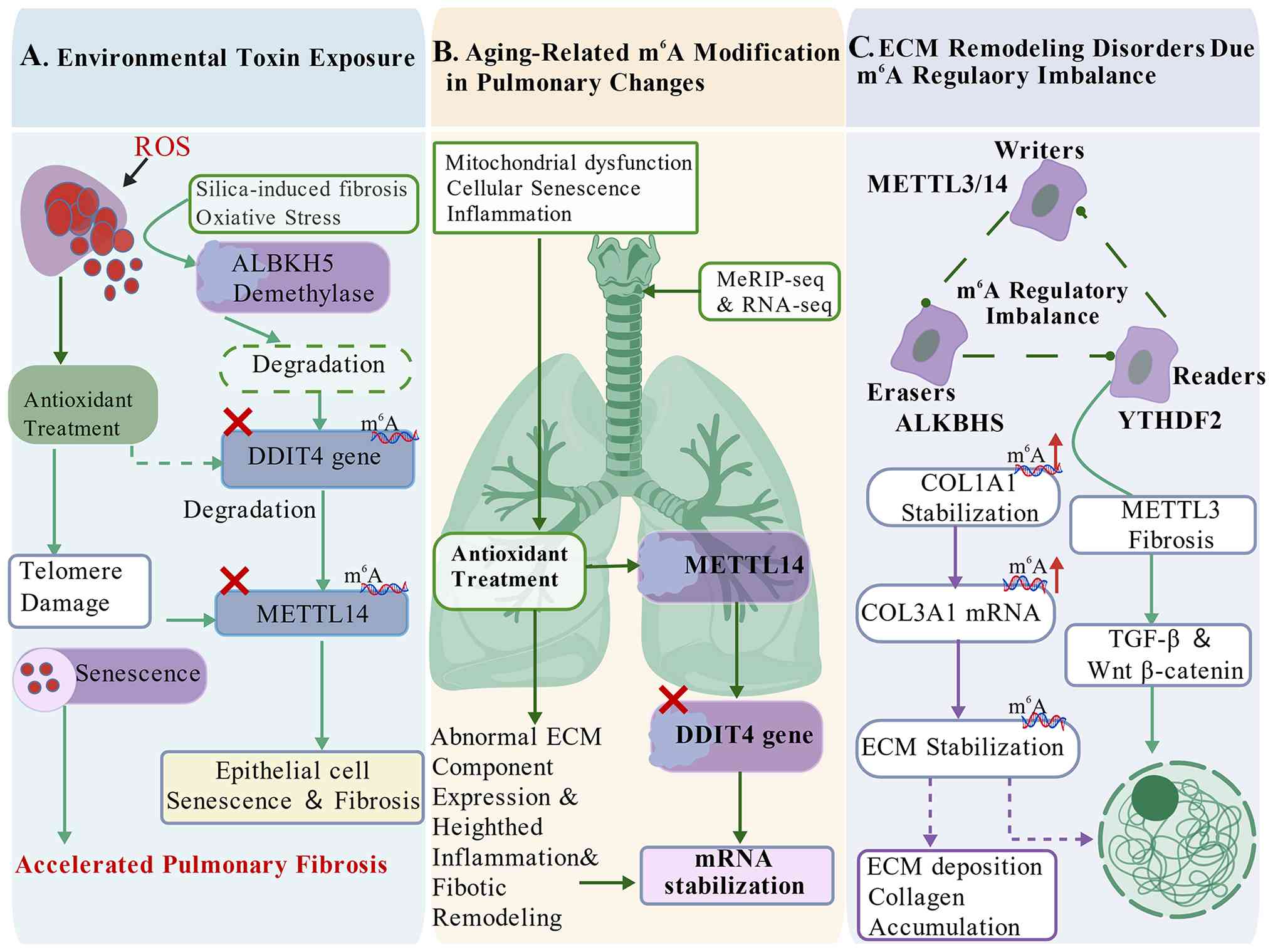 | Figure 3Oxidative stress, aging and ECM
remodeling in m6A-associated pulmonary fibrosis. (A)
Environmental toxin exposure. In a 1-nitropyrene-associated model,
mitochondrial ROS promotes ALKBH5 SUMOylation and proteasomal
degradation, thereby increasing m6A modification of
FBXW7 mRNA and promoting TRF2 loss, telomere damage and alveolar
epithelial cell senescence. In silica-induced PF, FTO suppression
is associated with increased global m6A abundance and
inflammatory and fibrotic remodeling. (B) Aging-related
m6A remodeling. Integrated MeRIP-seq and RNA-seq
analyses were used to identify transcripts showing concurrent
alterations in m6A enrichment and gene expression in
IPF. This approach identified the METTL14-DDIT4 axis, in which
reduced METTL14 expression decreases m6A modification of
DDIT4 mRNA, increases DDIT4 stability and promotes alveolar
epithelial cell senescence. (C) ECM remodeling. Dysregulated
m6A machinery may alter ECM-related transcripts and
pro-fibrotic signaling pathways, resulting in abnormal collagen and
elastin deposition. Because much of the transcript-specific
evidence is derived from non-PF fibrotic systems, these mechanisms
are presented as supportive background rather than as validated
PF-specific pathways. The figure was created using BioGDP
(Biological Graphics Design Platform, version 2.0) (106). ALKBH5, alkB homolog 5; DDIT4, DNA
damage-inducible transcript 4; ECM, extracellular matrix; FBXW7,
F-box and WD repeat domain-containing 7; FTO, fat mass and
obesity-associated protein; IPF, idiopathic pulmonary fibrosis;
MeRIP-seq, methylated RNA immunoprecipitation sequencing; METTL14,
methyltransferase-like 14; m6A, N6-methyladenosine; PF,
pulmonary fibrosis; RNA-seq, RNA sequencing; ROS, reactive oxygen
species; TRF2, telomeric repeat-binding factor 2. |
Therapeutic strategies targeting
m6A modification
The development of small-molecule m6A
modulators has progressed in several disease fields. FTO
inhibitors, including Compound 2 and Compound 3, have been
evaluated in neurological models (84), whereas the YTH-family inhibitor N-7
broadly interferes with m6A recognition by YTH-domain
proteins (85). In cancer models,
the METTL3 inhibitor STM2457 and FTO inhibitors, including FB23,
FB23-2, CS1 and CS2, have shown antitumor activity (86). Quercetin and rutin have also been
reported to influence m6A-related pathways, although
their pleiotropic effects preclude their classification as
selective m6A modulators (87). Among these compounds, STM2457 has
been evaluated directly in an experimental IPF model in C57BL/6
mice. Intraperitoneal administration of STM2457 reduced fibroblast
activation, collagen deposition and pathological and functional
lung abnormalities, reportedly through inhibition of the
METTL3/CTGF signaling axis (88).
By contrast, Compound 2, Compound 3, N-7, FB23, FB23-2, CS1 and CS2
have not been tested in PF models. Accordingly, these agents should
be presented as non-PF tool compounds, whereas STM2457 represents
preliminary preclinical evidence rather than an established
anti-fibrotic therapy. Therefore, they are presented as tool
compounds or preclinical candidates rather than established
anti-fibrotic therapies. Gene editing technologies, especially
CRISPR/dCas13 or dCasRx fused with m6A
methyltransferases or demethylases, have enabled
transcript-specific regulation of m6A modification
(89-91).
These tools allow targeted installation or removal of
m6A marks on selected transcripts and may help determine
the causal roles of specific m6A sites. For PF research,
such technologies could be used to validate disease-relevant
targets such as KCNH6, DDIT4, FBXW7, NREP and ECM-associated
transcripts. However, clinical application remains limited by
delivery efficiency, off-target effects, immunogenicity, long-term
safety and the complexity of fibrotic lung tissue. Tissue-specific
delivery systems have also advanced through nanocarriers,
biomembrane modification and molecular targeting strategies.
Examples include PLGA nanoparticles loaded with METTL3 inhibitors,
engineered small extracellular vesicles delivering YTHDF1 small
interfering (si)RNA, mesenchymal stem cell-derived exosomes
co-delivering YTHDF1 siRNA and chemotherapeutic agents and
exosome-liposome hybrid nanoparticles delivering ALKBH5 mRNA in
tumor models (92-95).
These systems demonstrate the feasibility of cell- or
tissue-targeted m6A modulation, but most data are
derived from cancer models. For PF, future studies should focus on
lung-targeted delivery, epithelial- or fibroblast-specific uptake,
inhalable formulations and safety in chronically injured lung
tissue. From a patient-centered perspective,
m6A-targeted therapy should be evaluated according to
clinically meaningful outcomes, including slowing lung function
decline, reducing symptom burden, preventing acute exacerbation,
improving exercise capacity and enhancing quality of life.
Preclinical target validation in PF also includes METTL3 silencing
in KCNH6-dependent fibroblast activation (18), modulation of the METTL14/DDIT4 axis
in aging-related epithelial senescence (16), and manipulation of the ALKBH5/FBXW7
and YTHDF1/NREP axes in toxicant-induced PF (17,25).
These studies establish mechanistic target validity, whereas
STM2457 currently provides direct small-molecule evidence among the
compounds discussed in the present review.
Research prospects and emerging
technologies
Studies have revealed that m6A
modification may interact with other epigenetic and
post-translational mechanisms in PF. For example, m6A
interacts with histone lactylation, particularly H3K18 lactylation,
in alveolar epithelial cells. Extracellular lactate from
myofibroblasts increases H3K18 lactylation, which promotes YTHDF1
transcription, enhances NREP translation and increases TGF-β1
secretion, thereby facilitating fibroblast-to-myofibroblast
transition (25). m6A
modification is also linked to protein SUMOylation and
ubiquitination; SUMOylation of ALKBH5 leads to its degradation,
increases m6A modification of FBXW7 mRNA and
promotes TRF2 degradation, alveolar epithelial senescence and
fibrosis (17). m6A
also acts in concert with circRNA methylation in silica-induced PF.
Specifically, METTL3-dependent m6A modification of
hsa_circ_0000672 and hsa_circ_0005654 promotes pulmonary fibroblast
activation and migration. Both circRNAs converge on eIF4A3,
producing a synergistic pro-fibrotic effect (24). These examples suggest that
m6A should be understood as part of a multilayer
regulatory network involving RNA methylation, histone modification,
non-coding RNA regulation and post-translational modification.
Single-cell m6A profiling technologies provide new
opportunities for understanding PF heterogeneity. Techniques such
as single cell DART-sequencing and single
nucleus-m6A-CUT&Tag enable mapping of m6A
RNA modifications at single-cell or single-nucleus resolution
(96,97). These technologies may help identify
cell-type-specific m6A landscapes in alveolar epithelial
cells, fibroblast subpopulations, macrophages, endothelial cells
and immune-cell subsets. In IPF, single-cell transcriptomic
analysis has already revealed disease-associated epithelial,
stromal and immune-cell states (98). Future integration of single-cell
transcriptomics, spatial transcriptomics and m6A
profiling may clarify whether m6A dysregulation occurs
early in disease initiation, during fibrotic progression or as a
secondary response to tissue remodeling. From a translational
medicine perspective, m6A-related biomarkers have been
investigated in several cancers. Examples include
m6A-related lncRNA signatures associated with prognosis
and immune-response patterns in lung adenocarcinoma, as well as
m6A-based signatures linked to drug resistance, cancer
stemness and immunotherapy response in other malignancies (99-103).
In PF, m6A regulators may help classify patients
according to dominant pathological processes, such as epithelial
senescence (16), fibroblast
activation (104), inflammatory
remodeling (105) or
environmental exposure-associated injury (23). However, direct evidence for
m6A-related prognostic biomarkers in PF remains limited.
Large independent cohorts, standardized detection methods and
comparison with established indicators such as HRCT features,
pulmonary function decline, MMP7, KL-6 and surfactant proteins are
required before clinical translation.
Unique contributions and framework of
the present review
Previous reviews have discussed m6A in
non-coding RNAs, fibrotic diseases and collagen-related disorders
(26-29).
The contribution of the present review is more precise, as it
provides a PF-focused synthesis of m6A regulatory
mechanisms, emphasizing pulmonary cell-type specificity, validated
transcript targets, context-dependent regulator function,
multilayer epigenetic crosstalk and patient-centered translational
implications. The translational research perspective, the review
integrates evidence showing how m6A regulators
participate in fibroblast activation, epithelial plasticity,
macrophage-associated inflammation, oxidative stress, aging-related
epithelial senescence and ECM remodeling. These mechanisms involve
writers such as METTL3 and METTL14, erasers such as FTO and ALKBH5
and readers such as YTHDF1, YTHDF3 and IGF2BP2 across epithelial
cells, fibroblasts and macrophages (16-25,36).
In addition, for the patient-centered care perspective, the present
review connects m6A biology with patient-prioritized
needs, including early diagnosis, risk stratification, prevention
of progression and development of therapies that may eventually
affect lung scarring, lung function and quality of life (14). The discussion of biomarkers
therefore avoids overclaiming clinical readiness and emphasizes the
need for validation in large patient cohorts. From the perspective
of novel advances in interstitial lung disease, the present review
highlights multilayer crosstalk between m6A and H3K18
lactylation, SUMOylation, ubiquitination and circRNA methylation
(17,24,25).
These mechanisms are not presented as universal pathways, but as
specific examples showing how m6A machinery can be
integrated into broader epigenetic and post-translational
regulatory networks in PF. Overall, the present review does not
claim that m6A is the sole or dominant driver of PF.
Instead, it positions m6A as a dynamic regulatory hub
that connects RNA metabolism with pulmonary cell fate, fibrotic
signaling and potential translational strategies.
3. Conclusion
m6A RNA methylation has emerged as a
notable epitranscriptomic mechanism in PF. It regulates
disease-associated processes including fibroblast activation,
epithelial plasticity, epithelial senescence, macrophage-associated
inflammation, oxidative stress responses and ECM remodeling. The
present review emphasizes that m6A regulation in PF is
context-dependent. For example, METTL3 generally shows pro-fibrotic
activity in fibroblast activation and epithelial remodeling,
whereas METTL14, FTO and ALKBH5 may exert distinct effects
depending on disease stage, cell type, environmental exposure and
target transcript. Therefore, m6A should not be
interpreted as a single directional driver of fibrosis. Current
evidence supports several mechanistically informative axes,
including METTL3/YTHDF1/KCNH6-mediated fibroblast-to-myofibroblast
transition, METTL3/YTHDF2/TSC1-mediated epithelial remodeling,
METTL14/DDIT4-mediated aging-related epithelial senescence,
ALKBH5/FBXW7-mediated toxicant-induced epithelial senescence and
H3K18 lactylation/YTHDF1/NREP-mediated fibrotic signaling. However,
numerous proposed mechanisms, especially those related to
macrophage polarization, ECM remodeling and therapeutic targeting,
still require PF-specific validation. Future studies should move
beyond expression profiling and focus on cell-type-specific,
transcript-specific and temporally resolved m6A
mechanisms. Single-cell m6A profiling, spatial
transcriptomics, RNA epitranscriptomic editing, disease-relevant
animal models and clinically annotated patient cohorts will be
essential for determining whether m6A regulators can
serve as reliable biomarkers or therapeutic targets. A more precise
understanding of the m6A regulatory network may
ultimately support earlier diagnosis, improved risk stratification
and development of safer patient-centered therapeutic strategies
for PF.
Acknowledgements
Not applicable.
Funding
Funding: The present review was funded by Innovation Talent Team
Construction Project of Zunyi Bureau of Industry and Science and
Technology [grant No. Zun KCTD (2025) 59], provided by Guoqi Zhou;
Scientific Research Team Construction Project of Zunyi Medical
College (grant No. HZ202422), provided by Guoqi Zhou; and
Scientific Research Team Construction Project of Zunyi Medical
College (grant No. HZ202418), provided by Xiaofeng Lu.
Availability of data and materials
Not applicable.
Authors' contributions
LLM, DKZ and GQZ contributed to the conception and
design of the review. Material preparation was performed by XFL,
DKZ and LLM. The first draft of the manuscript was written by XFL.
DKZ, LLM and GQZ critically revised the manuscript. All authors
commented on previous versions of the manuscript. All authors have
read and approved the final manuscript. Data authentication is not
applicable.
Ethics approval and consent to
participate
Not applicable.
Patient consent for publication
Not applicable.
Competing interests
The authors declare that they have no competing
interests.
References
|
1
|
Tang Y, Chen K, Song B, Ma J, Wu X, Xu Q,
Wei Z, Su J, Liu G, Rong R, et al: m6A-Atlas: A comprehensive
knowledgebase for unraveling the N6-methyladenosine (m6A)
epitranscriptome. Nucleic Acids Res. 49:D134–D143. 2021.PubMed/NCBI View Article : Google Scholar
|
|
2
|
Yang Y, Hsu PJ, Chen YS and Yang YG:
Dynamic transcriptomic m6A decoration: Writers, erasers,
readers and functions in RNA metabolism. Cell Res. 28:616–624.
2018.PubMed/NCBI View Article : Google Scholar
|
|
3
|
Sendinc E and Shi Y: RNA m6A methylation
across the transcriptome. Mol Cell. 83:428–441. 2023.PubMed/NCBI View Article : Google Scholar
|
|
4
|
He PC and He C: m6A RNA methylation: From
mechanisms to therapeutic potential. EMBO J.
40(e105977)2021.PubMed/NCBI View Article : Google Scholar
|
|
5
|
Di Timoteo G, Dattilo D, Centrón-Broco A,
Colantoni A, Guarnacci M, Rossi F, Incarnato D, Oliviero S, Fatica
A, Morlando M and Bozzoni I: Modulation of circRNA metabolism by
m6A modification. Cell Rep. 31(107641)2020.PubMed/NCBI View Article : Google Scholar
|
|
6
|
Zhang Z, Chen LQ, Zhao YL, Yang CG,
Roundtree IA, Zhang Z, Ren J, Xie W, He C and Luo GZ: Single-base
mapping of m6A by an antibody-independent method. Sci
Adv. 5(eaax0250)2019.PubMed/NCBI View Article : Google Scholar
|
|
7
|
Kim J and Lee G: Metabolic control of
m6A RNA modification. Metabolites. 11(80)2021.PubMed/NCBI View Article : Google Scholar
|
|
8
|
Strongman H, Kausar I and Maher TM:
Incidence, prevalence, and survival of patients with idiopathic
pulmonary fibrosis in the UK. Adv Ther. 35:724–736. 2018.PubMed/NCBI View Article : Google Scholar
|
|
9
|
Delameillieure A, Somogyi V, Schenk S,
Toreyin N, Stenzel N, Van Bulck L, Breuls S, Kreuter M, Wuyts WA,
Mogulkoc N, et al: Identifying outcome domains to establish a core
outcome set for progressive pulmonary fibrosis: A scoping review.
Eur Respir Rev. 34(240133)2025.PubMed/NCBI View Article : Google Scholar
|
|
10
|
Diamantopoulos A, Wright E, Vlahopoulou K,
Cornic L, Schoof N and Maher TM: The burden of illness of
idiopathic pulmonary fibrosis: A comprehensive evidence review.
Pharmacoeconomics. 36:779–807. 2018.PubMed/NCBI View Article : Google Scholar
|
|
11
|
Cottin V, Teague R, Nicholson L, Langham S
and Baldwin M: The burden of progressive-fibrosing interstitial
lung diseases. Front Med (Lausanne). 9(799912)2022.PubMed/NCBI View Article : Google Scholar
|
|
12
|
Spagnolo P, Kropski JA, Jones MG, Lee JS,
Rossi G, Karampitsakos T, Maher TM, Tzouvelekis A and Ryerson CJ:
Idiopathic pulmonary fibrosis: Disease mechanisms and drug
development. Pharmacol Ther. 222(107798)2021.PubMed/NCBI View Article : Google Scholar
|
|
13
|
White ES, Thomas M, Stowasser S and
Tetzlaff K: Challenges for clinical drug development in pulmonary
fibrosis. Front Pharmacol. 13(823085)2022.PubMed/NCBI View Article : Google Scholar
|
|
14
|
Tikellis G, Tong A, Lee JYT, Corte TJ,
Hey-Cunningham AJ, Bartlett M, Crawford T, Glaspole I, Price J,
Maloney J and Holland AE: Top 10 research priorities for people
living with pulmonary fibrosis, their caregivers, healthcare
professionals and researchers. Thorax. 76:575–581. 2021.PubMed/NCBI View Article : Google Scholar
|
|
15
|
Huang G, Huang S and Cui H: Effect of M6A
regulators on diagnosis, subtype classification, prognosis and
novel therapeutic target development of idiopathic pulmonary
fibrosis. Front Pharmacol. 13(993567)2022.PubMed/NCBI View Article : Google Scholar
|
|
16
|
Li D, Qian L, Du Y, Liu L, Sun Z, Han Y,
Guo X, Shen C, Zhang Z and Liu X: METTL14-mediated m6A
modification of DDIT4 promotes its mRNA stability in aging-related
idiopathic pulmonary fibrosis. Epigenetics.
20(2462898)2025.PubMed/NCBI View Article : Google Scholar
|
|
17
|
Li SR, Kang NN, Wang RR, Li MD, Chen LH,
Zhou P, Xu DX, Zhao H and Fu L: ALKBH5 SUMOylation-mediated FBXW7
m6A modification regulates alveolar cells senescence during
1-nitropyrene-induced pulmonary fibrosis. J Hazard Mater.
468(133704)2024.PubMed/NCBI View Article : Google Scholar
|
|
18
|
Zhang JX, Huang PJ, Wang DP, Yang WY, Lu
J, Zhu Y, Meng XX, Wu X, Lin QH, Lv H, et al: m6A
modification regulates lung fibroblast-to-myofibroblast transition
through modulating KCNH6 mRNA translation. Mol Ther. 29:3436–3448.
2021.PubMed/NCBI View Article : Google Scholar
|
|
19
|
Ning J, Pei Z, Wang M, Hu H, Chen M, Liu
Q, Wu M, Yang P, Geng Z, Zheng J, et al: Site-specific Atg13
methylation-mediated autophagy regulates epithelial inflammation in
PM2.5-induced pulmonary fibrosis. J Hazard Mater.
457(131791)2023.PubMed/NCBI View Article : Google Scholar
|
|
20
|
Yin H, Gu P, Xie Y, You X, Zhang Y, Yao Y,
Yang S, Wang D, Chen W and Ma J: ALKBH5 mediates silica
particles-induced pulmonary inflammation through increased
m6A modification of Slamf7 and autophagy dysfunction. J
Hazard Mater. 462(132736)2024.PubMed/NCBI View Article : Google Scholar
|
|
21
|
Zhang Y, Liu Q, Ning J, Jiang T, Kang A,
Li L, Pang Y, Zhang B, Huang X, Wang Q, et al: The
proteasome-dependent degradation of ALKBH5 regulates ECM deposition
in PM2.5 exposure-induced pulmonary fibrosis of mice. J
Hazard Mater. 432(128655)2022.PubMed/NCBI View Article : Google Scholar
|
|
22
|
Liao Z, Wang J, Xu M, Li X and Xu H: The
role of RNA m6A demethylase ALKBH5 in the mechanisms of fibrosis.
Front Cell Dev Biol. 12(1447135)2024.PubMed/NCBI View Article : Google Scholar
|
|
23
|
Xu Y, Wang L, Qian R, Zhao M, Chen X, Sun
D, Wang Y, Cheng W, Chen Y, He Q, et al: Increased m6A-RNA
methylation and demethylase FTO suppression is associated with
silica-induced pulmonary inflammation and fibrosis. Toxicology.
500(153673)2023.PubMed/NCBI View Article : Google Scholar
|
|
24
|
Wang S, Luo W, Huang J, Chen M, Ding J,
Cheng Y, Zhang W, Fang S, Wang J and Chao J: The combined effects
of circular RNA methylation promote pulmonary fibrosis. Am J Respir
Cell Mol Biol. 66:510–523. 2022.PubMed/NCBI View Article : Google Scholar
|
|
25
|
Wang P, Xie D, Xiao T, Cheng C, Wang D,
Sun J, Wu M, Yang Y, Zhang A and Liu Q: H3K18 lactylation promotes
the progression of arsenite-related idiopathic pulmonary fibrosis
via YTHDF1/m6A/NREP. J Hazard Mater. 461(132582)2024.PubMed/NCBI View Article : Google Scholar
|
|
26
|
Zhou Y, Jian N, Jiang C and Wang J:
m6A modification in non-coding RNAs: Mechanisms and
potential therapeutic implications in fibrosis. Biomed
Pharmacother. 179(117331)2024.PubMed/NCBI View Article : Google Scholar
|
|
27
|
Huang X, Yu Z, Tian J, Chen T, Wei A, Mei
C, Chen S and Li Y: m6A RNA modification pathway: Orchestrating
fibrotic mechanisms across multiple organs. Brief Funct Genomics.
24(elae051)2025.PubMed/NCBI View Article : Google Scholar
|
|
28
|
He X, Tang B, Zou P, Song Z, Liu J, Pi Z,
Xiao Y and Xiao R: m6A RNA methylation: The latent string-puller in
fibrosis. Life Sc. 346(122644)2024.PubMed/NCBI View Article : Google Scholar
|
|
29
|
Tan M, Liu S and Liu L: N6-methyladenosine
(m6A) RNA modification in fibrosis and collagen-related diseases.
Clin Epigenetics. 16(127)2024.PubMed/NCBI View Article : Google Scholar
|
|
30
|
Wang P, Doxtader KA and Nam Y: Structural
basis for cooperative function of Mettl3 and Mettl14
methyltransferases. Mol Cell. 63:306–317. 2016.PubMed/NCBI View Article : Google Scholar
|
|
31
|
Liu J, Yue Y, Han D, Wang X, Fu Y, Zhang
L, Jia G, Yu M, Lu Z, Deng X, et al: A METTL3-METTL14 complex
mediates mammalian nuclear RNA N6-adenosine methylation. Nat Chem
Biol. 10:93–95. 2014.PubMed/NCBI View Article : Google Scholar
|
|
32
|
Xu Y, Zhang Y, Luo Y, Qiu G, Lu J, He M
and Wang Y: Novel insights into the METTL3-METTL14 complex in
musculoskeletal diseases. Cell Death Discov. 9(170)2023.PubMed/NCBI View Article : Google Scholar
|
|
33
|
Zeng C, Huang W, Li Y and Weng H: Roles of
METTL3 in cancer: Mechanisms and therapeutic targeting. J Hematol
Oncol. 13(117)2020.PubMed/NCBI View Article : Google Scholar
|
|
34
|
Dou X, Huang L, Xiao Y, Liu C, Li Y, Zhang
X, Yu L, Zhao R, Yang L, Chen C, et al: METTL14 is a chromatin
regulator independent of its RNA N6-methyladenosine
methyltransferase activity. Protein Cell. 14:683–697.
2023.PubMed/NCBI View Article : Google Scholar
|
|
35
|
Liu P, Li F, Lin J, Fukumoto T, Nacarelli
T, Hao X, Kossenkov AV, Simon MC and Zhang R:
m6A-independent genome-wide METTL3 and METTL14
redistribution drives the senescence-associated secretory
phenotype. Nat Cell Biol. 23:355–365. 2021.PubMed/NCBI View Article : Google Scholar
|
|
36
|
Liu M, Sheng Y, Li M, Pan T, Jiang W,
Zhang Y, Pan X, Huang C, Li J and Wang Y: METTL3-dependent YTHDF2
mediates TSC1 expression to regulate alveolar epithelial
mesenchymal transition and promote idiopathic pulmonary fibrosis. J
Cell Physiol. 240(e31473)2025.PubMed/NCBI View Article : Google Scholar
|
|
37
|
Toh JDW, Crossley SWM, Bruemmer KJ, Ge EJ,
He D, Iovan DA and Chang CJ: Distinct RNA N-demethylation pathways
catalyzed by nonheme iron ALKBH5 and FTO enzymes enable regulation
of formaldehyde release rates. Proc Natl Acad Sci USA.
117:25284–25292. 2020.PubMed/NCBI View Article : Google Scholar
|
|
38
|
Shen D, Wang B, Gao Y, Zhao L, Bi Y, Zhang
J, Wang N, Kang H, Pang J, Liu Y, et al: Detailed resume of RNA
m6A demethylases. Acta Pharm Sin B. 12:2193–2205.
2022.PubMed/NCBI View Article : Google Scholar
|
|
39
|
You Y, Fu Y, Huang M, Shen D, Zhao B, Liu
H, Zheng Y and Huang L: Recent advances of m6A demethylases
inhibitors and their biological functions in human diseases. Int J
Mol Sci. 23(5815)2022.PubMed/NCBI View Article : Google Scholar
|
|
40
|
Adjibade P, Di-Marco S, Gallouzi IE and
Mazroui R: The RNA demethylases ALKBH5 and FTO regulate the
translation of ATF4 mRNA in sorafenib-treated hepatocarcinoma
cells. Biomolecules. 14(932)2024.PubMed/NCBI View Article : Google Scholar
|
|
41
|
Jiang X, Liu B, Nie Z, Duan L, Xiong Q,
Jin Z, Yang C and Chen Y: The role of m6A modification in the
biological functions and diseases. Signal Transduct Target Ther.
6(74)2021.PubMed/NCBI View Article : Google Scholar
|
|
42
|
Shi H, Wang X, Lu Z, Zhao BS, Ma H, Hsu
PJ, Liu C and He C: YTHDF3 facilitates translation and decay of
N6-methyladenosine-modified RNA. Cell Res. 27:315–328.
2017.PubMed/NCBI View Article : Google Scholar
|
|
43
|
Zhong L, Liao D, Zhang M, Zeng C, Li X,
Zhang R, Ma H and Kang T: YTHDF2 suppresses cell proliferation and
growth via destabilizing the EGFR mRNA in hepatocellular carcinoma.
Cancer Lett. 442:252–261. 2019.PubMed/NCBI View Article : Google Scholar
|
|
44
|
Zhang L, Wan Y, Zhang Z, Jiang Y, Gu Z, Ma
X, Nie S, Yang J, Lang J, Cheng W and Zhu L: IGF2BP1 overexpression
stabilizes PEG10 mRNA in an m6A-dependent manner and promotes
endometrial cancer progression. Theranostics. 11:1100–1114.
2021.PubMed/NCBI View Article : Google Scholar
|
|
45
|
Huang X, Zhang H, Guo X, Zhu Z, Cai H and
Kong X: Insulin-like growth factor 2 mRNA-binding protein 1
(IGF2BP1) in cancer. J Hematol Oncol. 11(88)2018.PubMed/NCBI View Article : Google Scholar
|
|
46
|
Xiao K, Liu P, Yan P, Liu Y, Song L, Liu Y
and Xie L: N6-methyladenosine reader YTH N6-methyladenosine RNA
binding protein 3 or insulin like growth factor 2 mRNA binding
protein 2 knockdown protects human bronchial epithelial cells from
hypoxia/reoxygenation injury by inactivating p38 MAPK, AKT, ERK1/2,
and NF-κB pathways. Bioengineered. 13:11973–11986. 2022.PubMed/NCBI View Article : Google Scholar
|
|
47
|
Lee Y, Choe J, Park OH and Kim YK:
Molecular mechanisms driving mRNA degradation by m6A
modification. Trends Genet. 36:177–188. 2020.PubMed/NCBI View Article : Google Scholar
|
|
48
|
Boo SH, Ha H and Kim YK: m1A
and m6A modifications function cooperatively to
facilitate rapid mRNA degradation. Cell Rep.
40(111317)2022.PubMed/NCBI View Article : Google Scholar
|
|
49
|
Ye W, Lv X, Gao S, Li Y, Luan J and Wang
S: Emerging role of m6A modification in fibrotic diseases and its
potential therapeutic effect. Biochem Pharmacol.
218(115873)2023.PubMed/NCBI View Article : Google Scholar
|
|
50
|
Southern BD, Li H, Mao H, Crish JF, Grove
LM, Scheraga RG, Mansoor S, Reinhardt A, Abraham S, Deshpande G, et
al: A novel mechanoeffector role of fibroblast S100A4 in
myofibroblast transdifferentiation and fibrosis. J Biol Chem.
300(105530)2024.PubMed/NCBI View Article : Google Scholar
|
|
51
|
Scheraga RG and Olman MA: A focus on ‘eye
on’ channels in pulmonary fibrosis. Am J Respir Cell Mol Biol.
62:132–133. 2020.PubMed/NCBI View Article : Google Scholar
|
|
52
|
Grove LM, Mohan ML, Abraham S, Scheraga
RG, Southern BD, Crish JF, Naga Prasad SV and Olman MA:
Translocation of TRPV4-PI3Kγ complexes to the plasma membrane
drives myofibroblast transdifferentiation. Sci Signal.
12(eaau1533)2019.PubMed/NCBI View Article : Google Scholar
|
|
53
|
Hu B, Zhang X, Fan H, Jin X, Qi Y, Liu R,
Li X, Duan M, Zhang C, Li S, et al: FOXF1 reverses lung fibroblasts
transdifferentiation via inhibiting TGF-β/SMAD2/3 pathway in
silica-induced pulmonary fibrosis. Int Immunopharmacol.
133(112067)2024.PubMed/NCBI View Article : Google Scholar
|
|
54
|
Shan T, Liu F, Wen M, Chen Z, Li S, Wang
Y, Cheng H and Zhou Y: m6A modification negatively
regulates translation by switching mRNA from polysome to P-body via
IGF2BP3. Mol Cell. 83:4494–4508.e6. 2023.PubMed/NCBI View Article : Google Scholar
|
|
55
|
Liu Z, Deng K, Su Y, Zhang Z, Shi C, Wang
J, Fan Y, Zhang G and Wang F: IGF2BP1-mediated the stability and
protein translation of FGFR1 mRNA regulates myogenesis through the
ERK signaling pathway. Int J Biol Macromol. 280(Pt
3)(135989)2024.PubMed/NCBI View Article : Google Scholar : (Epub ahead of
print).
|
|
56
|
Mottais A, Riberi L, Falco A, Soccal S,
Gohy S and De Rose V: Epithelial-mesenchymal transition mechanisms
in chronic airway diseases: A common process to target? Int J Mol
Sci. 24(12412)2023.PubMed/NCBI View Article : Google Scholar
|
|
57
|
Hill C, Jones MG, Davies DE and Wang Y:
Epithelial-mesenchymal transition contributes to pulmonary fibrosis
via aberrant epithelial/fibroblastic cross-talk. J Lung Health Dis.
3:31–35. 2019.PubMed/NCBI
|
|
58
|
Salton F, Volpe MC and Confalonieri M:
Epithelial-mesenchymal transition in the pathogenesis of idiopathic
pulmonary fibrosis. Medicina (Kaunas). 55(83)2019.PubMed/NCBI View Article : Google Scholar
|
|
59
|
Zhang LB, Zhao N and Nong QY: Research
progress of anti-fibrotic drugs that inhibit epithelial-mesenchymal
transition in pulmonary fibrosis. Zhonghua Lao Dong Wei Sheng Zhi
Ye Bing Za Zhi. 41:72–77. 2023.PubMed/NCBI View Article : Google Scholar : (In Chinese).
|
|
60
|
Wanna-Udom S, Terashima M, Lyu H, Ishimura
A, Takino T, Sakari M, Tsukahara T and Suzuki T: The m6A
methyltransferase METTL3 contributes to transforming growth
factor-beta-induced epithelial-mesenchymal transition of lung
cancer cells through the regulation of JUNB. Biochem Biophys Res
Commun. 524:150–155. 2020.PubMed/NCBI View Article : Google Scholar
|
|
61
|
Suphakhong K, Terashima M, Wanna-Udom S,
Takatsuka R, Ishimura A, Takino T and Suzuki T: m6A RNA methylation
regulates the transcription factors JUN and JUNB in TGF-β-induced
epithelial-mesenchymal transition of lung cancer cells. J Biol
Chem. 298(102554)2022.PubMed/NCBI View Article : Google Scholar
|
|
62
|
Lin X, Chai G, Wu Y, Li J, Chen F, Liu J,
Luo G, Tauler J, Du J, Lin S, et al: RNA m6A methylation
regulates the epithelial mesenchymal transition of cancer cells and
translation of Snail. Nat Commun. 10(2065)2019.PubMed/NCBI View Article : Google Scholar
|
|
63
|
Yue B, Song C, Yang L, Cui R, Cheng X,
Zhang Z and Zhao G: METTL3-mediated N6-methyladenosine modification
is critical for epithelial-mesenchymal transition and metastasis of
gastric cancer. Mol Cancer. 18(142)2019.PubMed/NCBI View Article : Google Scholar
|
|
64
|
Li X, Zhao X, Yin R, Yuan M, Zhang Y and
Li X: TGF-β2-induced alterations of m6A methylation in hTERT RPE-1
cells. Exp Eye Res. 241(109839)2024.PubMed/NCBI View Article : Google Scholar
|
|
65
|
Zhao C, Ling X, Xia Y, Yan B and Guan Q:
The m6A methyltransferase METTL3 controls epithelial-mesenchymal
transition, migration and invasion of breast cancer through the
MALAT1/miR-26b/HMGA2 axis. Cancer Cell Int. 21(441)2021.PubMed/NCBI View Article : Google Scholar
|
|
66
|
Wu J, Pan J, Zhou W, Ji G and Dang Y: The
role of N6-methyladenosine in macrophage polarization: A novel
treatment strategy for non-alcoholic steatohepatitis. Biomed
Pharmacother. 171(116145)2024.PubMed/NCBI View Article : Google Scholar
|
|
67
|
Zhu L, Fu X, Chen X, Han X and Dong P: M2
macrophages induce EMT through the TGF-β/Smad2 signaling pathway.
Cell Biol Int. 41:960–968. 2017.PubMed/NCBI View Article : Google Scholar
|
|
68
|
Liu Y, Liu Z, Tang H, Shen Y, Gong Z, Xie
N, Zhang X, Wang W, Kong W, Zhou Y and Fu Y: The
N6-methyladenosine (m6A)-forming enzyme
METTL3 facilitates M1 macrophage polarization through the
methylation of STAT1 mRNA. Am J Physiol Cell Physiol. 317:762–775.
2019.PubMed/NCBI View Article : Google Scholar
|
|
69
|
Zheng L, Chen X, Yin Q, Gu J, Chen J, Chen
M, Zhang Y, Dong M, Jiang H, Yin N, et al: RNA-m6A modification of
HDGF mediated by Mettl3 aggravates the progression of
atherosclerosis by regulating macrophages polarization via energy
metabolism reprogramming. Biochem Biophys Res Commun. 635:120–127.
2022.PubMed/NCBI View Article : Google Scholar
|
|
70
|
Sun M, Yue Y, Wang X, Feng H, Qin Y, Chen
M, Wang Y and Yan S: ALKBH5-mediated upregulation of CPT1A promotes
macrophage fatty acid metabolism and M2 macrophage polarization,
facilitating malignant progression of colorectal cancer. Exp Cell
Res. 437(113994)2024.PubMed/NCBI View Article : Google Scholar
|
|
71
|
Pinello N, Song R, Lee Q, Calonne E,
Larance M, Fuks F and Wong JJL: A multiomics dataset for the study
of RNA modifications in human macrophage differentiation and
polarisation. Sci Data. 11(252)2024.PubMed/NCBI View Article : Google Scholar
|
|
72
|
Pinello N, Song R, Lee Q, Calonne E, Duan
KL, Wong E, Tieng J, Mehravar M, Rong B, Lan F, et al: Dynamic
changes in RNA m6A and 5 hmC influence gene expression
programs during macrophage differentiation and polarisation. Cell
Mol Life Sci. 81(229)2024.PubMed/NCBI View Article : Google Scholar
|
|
73
|
Wan L, Liu J, Huang C, Zhu Z, Li F, Sun G,
Wang K, Li S, Ma X, Chen X and Yuan W: Role of m6A modification and
novel circ_0066715/miR-486-5p/ ETS1 axis in rheumatoid arthritis
macrophage polarization progression. Aging (Albany NY).
14:10009–10026. 2022.PubMed/NCBI View Article : Google Scholar
|
|
74
|
Cho SJ and Stout-Delgado HW: Aging and
lung disease. Annu Rev Physiol. 82:433–459. 2020.PubMed/NCBI View Article : Google Scholar
|
|
75
|
Murtha LA, Morten M, Schuliga MJ,
Mabotuwana NS, Hardy SA, Waters DW, Burgess JK, Ngo DT, Sverdlov
AL, Knight DA and Boyle AJ: The role of pathological aging in
cardiac and pulmonary fibrosis. Aging Dis. 10:419–428.
2019.PubMed/NCBI View Article : Google Scholar
|
|
76
|
Chanda D, Otoupalova E, Smith SR,
Volckaert T, De Langhe SP and Thannickal VJ: Developmental pathways
in the pathogenesis of lung fibrosis. Mol Aspects Med. 65:56–69.
2019.PubMed/NCBI View Article : Google Scholar
|
|
77
|
Torres-Machorro AL, García-Vicente Á,
Espina-Ordoñez M, Luis-García E, Negreros M, Herrera I, Becerril C,
Toscano F, Cisneros J and Maldonado M: Update of aging hallmarks in
idiopathic pulmonary fibrosis. Cells. 14(222)2025.PubMed/NCBI View Article : Google Scholar
|
|
78
|
Stout-Delgado HW, Cho SJ, Chu SG, Mitzel
DN, Villalba J, El-Chemaly S, Ryter SW, Choi AMK and Rosas IO:
Age-dependent susceptibility to pulmonary fibrosis is associated
with NLRP3 inflammasome activation. Am J Respir Cell Mol Biol.
55:252–263. 2016.PubMed/NCBI View Article : Google Scholar
|
|
79
|
Luppi F, Kalluri M, Faverio P, Kreuter M
and Ferrara G: Idiopathic pulmonary fibrosis beyond the lung:
Understanding disease mechanisms to improve diagnosis and
management. Respir Res. 22(109)2021.PubMed/NCBI View Article : Google Scholar
|
|
80
|
Dai X, Cheng Y, Luo W, Wang J, Wang C,
Zhang X, Zhang W and Chao J: m6A ribonucleic acid methylation in
fibrotic diseases of visceral organs. Small Sci.
5(2400308)2024.PubMed/NCBI View Article : Google Scholar
|
|
81
|
Rabolli CP and Accornero F: m6A
RNA methylation: A dynamic regulator of cardiac muscle and
extracellular matrix. Curr Opin Physiol. 28(100561)2022.PubMed/NCBI View Article : Google Scholar
|
|
82
|
Xu R, Yang E, Liang H, Luo S, Liu Y,
Khoong Y, Li H, Huang X, Zhao Y and Zan T: ALKBH5-mediated
m6A demethylation ameliorates extracellular matrix
deposition in cutaneous pathological fibrosis. Clin Transl Med.
14(e70016)2024.PubMed/NCBI View Article : Google Scholar
|
|
83
|
Wang W, He Y, Wu L, Zhai LL, Chen LJ, Yao
LC, Yu KH and Tang ZG: N6-methyladenosine RNA
demethylase FTO regulates extracellular matrix-related genes and
promotes pancreatic cancer cell migration and invasion. Cancer Med.
12:3731–3743. 2023.PubMed/NCBI View Article : Google Scholar
|
|
84
|
Selberg S, Yu LY, Bondarenko O, Kankuri E,
Seli N, Kovaleva V, Herodes K, Saarma M and Karelson M:
Small-molecule inhibitors of the RNA M6A demethylases FTO potently
support the survival of dopamine neurons. Int J Mol Sci.
22(4537)2021.PubMed/NCBI View Article : Google Scholar
|
|
85
|
Gu J, Xu J, You Q and Guo X: Recent
developments of small molecules targeting RNA m6A
modulators. Eur J Med Chem. 196(112325)2020.PubMed/NCBI View Article : Google Scholar
|
|
86
|
Harrahill NJ and Hadden MK: Small
molecules that regulate the N6-methyladenosine RNA
modification as potential anti-cancer agents. Eur J Med Chem.
274(116526)2024.PubMed/NCBI View Article : Google Scholar
|
|
87
|
Gao R, Ye M, Liu B, Wei M, Ma D and Dong
K: m6A modification: A double-edged sword in tumor development.
Front Oncol. 11(679367)2021.PubMed/NCBI View Article : Google Scholar
|
|
88
|
Sun X and He J: STM2457 is therapeutic for
idiopathic pulmonary fibrosis by inhibiting the METTL3-CTGF
signaling axis. Mol Biol. 59:763–771. 2025.
|
|
89
|
Yu L, Alariqi M, Li B, Hussain A, Zhou H,
Wang Q, Wang F, Wang G, Zhu X, Hui F, et al: CRISPR/dCas13(Rx)
derived RNA N6-methyladenosine (m6A) dynamic
modification in plant. Adv Sci (Weinh). 11(e2401118)2024.PubMed/NCBI View Article : Google Scholar
|
|
90
|
Pilala KM, Panoutsopoulou K, Papadimitriou
MA, Soureas K, Scorilas A and Avgeris M: Exploring the
methyl-verse: Dynamic interplay of epigenome and m6A
epitranscriptome. Mol Ther. 33:447–464. 2025.PubMed/NCBI View Article : Google Scholar
|
|
91
|
Xia Z, Tang M, Ma J, Zhang H, Gimple RC,
Prager BC, Tang H, Sun C, Liu F, Lin P, et al: Epitranscriptomic
editing of the RNA N6-methyladenosine modification by dCasRx
conjugated methyltransferase and demethylase. Nucleic Acids Res.
49:7361–7374. 2021.PubMed/NCBI View Article : Google Scholar
|
|
92
|
Li Z, Zhang X, Liu C, Wu Y, Wen Y, Zheng
R, Xu C, Tian J, Peng Q, Zheng X, et al: Engineering a nano-drug
delivery system to regulate m6A modification and enhance
immunotherapy in gastric cancer. Acta Biomater. 191:412–427.
2025.PubMed/NCBI View Article : Google Scholar
|
|
93
|
You Q, Wang F, Du R, Pi J, Wang H, Huo Y,
Liu J, Wang C, Yu J, Yang Y and Zhu L: m6A reader
YTHDF1-targeting engineered small extracellular vesicles for
gastric cancer therapy via epigenetic and immune regulation. Adv
Mater. 35(e2204910)2023.PubMed/NCBI View Article : Google Scholar
|
|
94
|
Du R, You Q, Liu J, Wang C, Zhu L and Yang
Y: Dual-functional extracellular vesicles enable synergistic
treatment via m6A reader YTHDF1-targeting epigenetic
regulation and chemotherapy. Nano Res. 16:13309–13321. 2023.
|
|
95
|
Wu S, Yun J, Tang W, Familiari G,
Relucenti M, Wu J, Li X, Chen H and Chen R: Therapeutic
m6A eraser ALKBH5 mRNA-loaded exosome-liposome hybrid
nanoparticles inhibit progression of colorectal cancer in
preclinical tumor models. ACS Nano. 17:11838–11854. 2023.PubMed/NCBI View Article : Google Scholar
|
|
96
|
Yao H, Yang Y and Yang YG: scDART-seq:
Mapping m6A at the single-cell level. Mol Cell.
82:713–715. 2022.PubMed/NCBI View Article : Google Scholar
|
|
97
|
Hamashima K, Wong KW, Sam TW, Teo JHJ,
Taneja R, Le MTN, Li QJ, Hanna JH, Li H and Loh YH: Single-nucleus
multiomic mapping of m6A methylomes and transcriptomes
in native populations of cells with sn-m6A-CT. Mol Cell.
(S1097-2765(23)00649-4)2023.PubMed/NCBI View Article : Google Scholar : (Epub ahead of
print).
|
|
98
|
Reyfman PA, Walter JM, Joshi N, Anekalla
KR, McQuattie-Pimentel AC, Chiu S, Fernandez R, Akbarpour M, Chen
CI, Ren Z, et al: Single-cell transcriptomic analysis of human lung
provides insights into the pathobiology of pulmonary fibrosis. Am J
Respir Crit Care Med. 199:1517–1536. 2019.PubMed/NCBI View Article : Google Scholar
|
|
99
|
Gu C, Shi X, Dai C, Shen F, Rocco G, Chen
J, Huang Z and Chen C, He C, Huang T and Chen C: RNA m6A
modification in cancers: Molecular mechanisms and potential
clinical applications. Innovation (Camb). 1(100066)2020.PubMed/NCBI View Article : Google Scholar
|
|
100
|
Li B, Jiang J, Assaraf YG, Xiao H, Chen ZS
and Huang C: Surmounting cancer drug resistance: New insights from
the perspective of N6-methyladenosine RNA modification.
Drug Resist Updat. 53(100720)2020.PubMed/NCBI View Article : Google Scholar
|
|
101
|
Zhang Z, Zhang C, Luo Y, Zhang G, Wu P,
Sun N and He J: RNA N6-methyladenosine modification in
the lethal teamwork of cancer stem cells and the tumor immune
microenvironment: Current landscape and therapeutic potential. Clin
Transl Med. 11(e525)2021.PubMed/NCBI View Article : Google Scholar
|
|
102
|
Pan J, Huang T, Deng Z and Zou C: Roles
and therapeutic implications of m6A modification in cancer
immunotherapy. Front Immunol. 14(1132601)2023.PubMed/NCBI View Article : Google Scholar
|
|
103
|
Xu F, Huang X, Li Y, Chen Y and Lin L:
m6A-related lncRNAs are potential biomarkers for
predicting prognoses and immune responses in patients with LUAD.
Mol Ther Nucleic Acids. 24:780–791. 2021.PubMed/NCBI View Article : Google Scholar
|
|
104
|
Tang R, Qin S, Xu Q, Lin W, Zhang S, Peng
Y, Feng J, Xing S, Gao Y, Mei S and He Z:
Lipopolysaccharide-induced histone lactylation mediates m6A RNA
modification causing mitochondrial dysfunction and pulmonary
fibroblasts activation to exacerbate sepsis-associated pulmonary
fibrosis. Respir Res. 26(347)2025.PubMed/NCBI View Article : Google Scholar
|
|
105
|
Yin H, Yang S, Xie Y, You X, Yao Y, Shang
B, Liu H, Fan X, Lin X and Ma J: m6A-mediated DEC1
upregulation facilitates silica-induced pulmonary fibrosis via
PI3K/Akt signaling pathway. J Transl Med. 24(120)2025.PubMed/NCBI View Article : Google Scholar
|
|
106
|
Jiang S, Li H, Zhang L, Mu W, Zhang Y,
Chen T, Wu J, Tang H, Zheng S, Liu Y, et al: Generic diagramming
platform (GDP): A comprehensive database of high-quality biomedical
graphics. Nucleic Acids Res. 53 (D1):D1670–D1676. 2025.PubMed/NCBI View Article : Google Scholar
|

















