Introduction
The development of EGFR tyrosine kinase inhibitors
(EGFR-TKIs) has significantly transformed the treatment paradigm
for non-small cell lung cancer (NSCLC), particularly for patients
with activating EGFR mutations, providing new avenues for targeted
and effective therapy (1). While
the development of multiple generations of EGFR-TKIs has provided
increasingly effective treatment options (2), optimizing treatment for patients with
non-classical EGFR mutations is a major clinical challenge
(3). These non-classical variants
represent ~10-18% of all EGFR mutations (4) and show unique biological
characteristics and distinct treatment response patterns compared
to classical mutations (5). Their
complexity stems from structural diversity, which contributes to
variable responses across different generations of EGFR-TKIs
(6). The G719X mutation family,
which is associated mainly with S768I, poses unique challenges in
the selection of treatment strategies (7). These mutations affect the ATP-binding
pocket of the EGFR kinase domain in ways that differ from classical
mutations (8), potentially
altering drug-binding characteristics and treatment outcomes
(9). Although these mutations have
significant clinical importance, their low frequency has led to
limited representation in major clinical trials (10). Non-classical EGFR mutations remain
poorly managed, with a knowledge gap in clinical guidelines that
generally rely on small studies or case series (11). However, recent advances in
computational methods, including protein structure prediction and
molecular dynamics simulations, have expanded the knowledge of EGFR
mutants (12). Molecular modeling
and artificial intelligence improve the prediction of drug-target
interactions and support clinical evidence (13). This study fills this void by
combining data from molecular simulations with clinical data to
guide evidence-based approaches to clinically informed selection
and sequencing of therapy (14).
The findings revealed the mechanisms of response and resistance,
providing insights into the development of personalized and more
efficacious therapeutic strategies (15).
Materials and methods
Methods of data collection and
determination for EGFR mutation
This retrospective study included 31 patients with
advanced/metastatic, recurrent or post-resection NSCLC harboring
non-classical EGFR mutations, including G719X/G719A, L861Q, S768I
and compound mutation patterns. Patients were selected from the
institutional lung cancer cohort if they had a documented
non-classical EGFR mutation, received EGFR-TKI-based systemic
therapy and had evaluable clinical follow-up data. All patients
were treated at the Chinese Academy of Medical Sciences (CAMS)
Cancer Hospital (Beijing, China) between January 2013 and December
2020 and received EGFR-TKI-based systemic therapy. Progression-free
survival (PFS) during first-line and second-line treatment was
evaluated as PFS1 and PFS2, respectively. Progression patterns
after first-line therapy were classified into three categories
based on clinical and radiographic assessment: Slow progression
(SP), defined as gradual asymptomatic multi-site progression; local
progression (LP), defined as oligoprogression limited to one or a
few sites; and clinical progression (CP), defined as rapid
symptomatic systemic progression (16,17).
Follow-up data were last updated on June 30, 2024.
EGFR mutation status was determined as part of
routine clinical molecular diagnostics in certified clinical
molecular pathology laboratories. Molecular testing was performed
using formalin-fixed paraffin-embedded tumor tissue and/or cytology
specimens obtained at diagnosis or recurrence. According to
specimen availability and institutional clinical practice during
the study period, clinically validated targeted next-generation
sequencing (NGS) and/or amplification refractory mutation system
polymerase chain reaction (ARMS-PCR) assays were used. For
NGS-based testing, commercially available targeted panels were
employed, including GeneseeqPrime™ (425-gene panel; Geneseeq
Technology Inc.), OncoScreen Plus (520-gene panel; Burning Rock
Biotech Ltd.) and Genecast Comprehensive (769-gene panel with
MinerVa® bioinformatics platform; Genecast Biotechnology
Co., Ltd.), as well as an institution-validated in-house 56-gene
targeted panel (CAMS Cancer Hospital) (a laboratory-developed test
validated and accredited for routine clinical use within the
certified molecular pathology laboratory of the institution; as an
in-house clinical assay, no separate peer-reviewed methodological
publication is available); all NGS libraries were sequenced on the
Illumina NovaSeq platform (Illumina, Inc.). For ARMS-PCR-based
testing, the Human EGFR Gene Mutations Detection Kit (Super-ARMS;
cat no. AD-00007; Amoy Diagnostics Co., Ltd.) was used. All
commercial assays were performed in certified clinical molecular
pathology laboratories according to the manufacturers' instructions
and institutional standard operating procedures. Mutation subtype
classification and related molecular findings were retrospectively
extracted from the final clinical molecular pathology reports.
No de novo PCR or sequencing experiments were
performed by the investigators for this study. Raw sequencing files
(FASTQ, BAM and VCF formats), PCR primer sequences, polymerase
specifications and laboratory-specific proprietary assay parameters
were not generated by the investigators and are retained by the
respective certified clinical molecular pathology laboratories
under institutional data governance policies, consistent with the
retrospective design of this study. Accordingly, read alignment
parameters, genome assembly procedures and raw sequencing accession
numbers are not applicable to the present retrospective analysis.
The data reported in this paper have been deposited in the OMIX,
China National Center for Bioinformation/Beijing Institute of
Genomics, Chinese Academy of Sciences (https://ngdc.cncb.ac.cn/omix; accession no.
OMIX017364); de-identified patient-level clinical data are
additionally provided in Tables
SI, SII and SIII; the corresponding molecular
simulation metrics are presented in Table IV.
 | Table IVAssociations between the binding
affinity of EGFR-tyrosine kinase inhibitors and the clinical
outcomes of patients with various non-classical EGFR mutations. |
Table IV
Associations between the binding
affinity of EGFR-tyrosine kinase inhibitors and the clinical
outcomes of patients with various non-classical EGFR mutations.
| Ligand | PFS, months | Docking score | MM-GBSA ΔG_bind,
kcal/mol | Gene mutation
type |
|---|
| Icotinib | 11.6 | -8.279 | -89.68 | G719A |
| Dacomitinib | 8.7 | -6.715 | -78.54 | G719A |
| Erlotinib | 7.7 | -9.532 | -63.91 | G719A |
| Gefitinib | 4.3 | -5.261 | -49.24 | G719A |
| Osimertinib | 4 | -5.138 | -48.01 | G719A |
| Furmonertinib | - | -9.1 | -47.97 | G719A |
| Afatinib | 1.2 | -4.375 | -42.69 | G719A |
| Afatinib | 17.1 | -7.594 | -72.18 | G719A+S768I |
| Gefitinib | 8.8 | -6.548 | -61.77 | G719A+S768I |
| Dacomitinib | 6.1 | -5.946 | -55.12 | G719A+S768I |
| Icotinib | 6.1 | -5.529 | -51.87 | G719A+S768I |
| Furmonertinib | - | -7.962 | -50.76 | G719A+S768I |
| Osimertinib | - | -6.314 | -49.64 | G719A+S768I |
| Erlotinib | - | -5.128 | -46.71 | G719A+S768I |
| Dacomitinib | 15.9 | -8.517 | -92.35 | G719C+S768I |
| Furmonertinib | - | -8.07 | -85.63 | G719C+S768I |
| Gefitinib | 8.8 | -7.803 | -83.49 | G719C+S768I |
| Erlotinib | - | -8.676 | -82.14 | G719C+S768I |
| Afatinib | - | -7.832 | -78.24 | G719C+S768I |
| Icotinib | - | -4.642 | -65.72 | G719C+S768I |
| Osimertinib | - | -5.967 | -64.47 | G719C+S768I |
| Dacomitinib | 30.2 | -9.851 | -95.73 | G719S+S768I |
| Afatinib | 11.3 | -7.991 | -85.02 | G719S+S768I |
| Osimertinib | - | -5.551 | -69.57 | G719S+S768I |
| Erlotinib | - | -5.561 | -65.67 | G719S+S768I |
| Gefitinib | 12.5 | -6.953 | -65.29 | G719S+S768I |
| Icotinib | 5.8 | -6.107 | -57.55 | G719S+S768I |
| Furmonertinib | - | -4.285 | -56.44 | G719S+S768I |
| Dacomitinib | 24.9 | -8.926 | -88.41 | L861Q |
| Afatinib | 15.7 | -7.382 | -70.96 | L861Q |
| Icotinib | - | -7.634 | -57.33 | L861Q |
| Furmonertinib | - | -5.61 | -53.46 | L861Q |
| Gefitinib | - | -7.559 | -50 | L861Q |
| Osimertinib | - | -7.719 | -45.64 | L861Q |
| Erlotinib | - | -6.267 | -39.92 | L861Q |
| Erlotinib | - | -8.34 | -85.64 | V769L+S768I |
| Furmonertinib | - | -8.328 | -79.24 | V769L+S768I |
| Gefitinib | - | -8.164 | -75.23 | V769L+S768I |
| Icotinib | - | -7.336 | -74.57 | V769L+S768I |
| Dacomitinib | - | -5.979 | -74.46 | V769L+S768I |
| Osimertinib | - | -8.333 | -63.52 | V769L+S768I |
| Afatinib | 6.5 | -6.287 | -58.36 | V769L+S768I |
Structural modeling of non-classical
EGFR mutations
To examine the influence of uncommon EGFR mutations
on protein conformation and drug responsiveness, six EGFR variants
were selected: G719A, G719A+S768I, G719C+S768I, G719S+S768I, L861Q
and V769L+S768I. These variants were selected because they
represented the principal single or compound non-classical EGFR
mutations observed in the clinical cohort and had sufficient
corresponding treatment-event data for exploratory
molecular-clinical comparison. The investigation focused on the
domain targeted by EGFR small-molecule inhibitors (residues
G696-G1022). The three-dimensional structures of these mutants were
predicted using the AlphaFold 3 algorithm (Google DeepMind;
AlphaFold Server; https://alphafoldserver.com) (18). For each mutant, the corresponding
amino acid sequence was compiled and formatted based on the input
requirements of AlphaFold 3. Subsequently, computational prediction
was performed to obtain the structures of the six mutant proteins.
The resulting protein structures were imported into Maestro 13.9
software (Schrodinger, LLC) for visualization. The ‘Protein
Preparation Workflow’ module in Maestro 13.9 was used to preprocess
the protein structures, including adding missing hydrogen atoms,
completing missing side chains, removing free water molecules and
optimizing hydrogen bonds.
Molecular docking and Molecular
Mechanics Generalized Born Surface Area (MM-GBSA) calculations
The three-dimensional structure files of the drugs
selected for this study, including furmonertinib, icotinib,
dacomitinib, erlotinib, gefitinib, osimertinib and afatinib, were
retrieved and downloaded from the PubChem database (National Center
for Biotechnology Information; https://pubchem.ncbi.nlm.nih.gov/). Using the LePro
module in LeDock Win32 (http://www.lephar.com/software.htm), the protein PDB
files were converted into a format compatible with LeDock, and
corresponding dock files were generated within the input directory.
Molecular docking simulations between small molecules and proteins
were then conducted using LeDock Win32 to determine the binding
affinity scores of the protein-compound complexes. Following
docking, the Prime MM-GBSA module in Maestro 13.9 (Schrodinger,
LLC) was employed to compute the MM-GBSA binding free energies
(ΔG_bind) for the ligand-protein binding conformations.
Additionally, the ‘Ligand Interaction Diagram’ tool in Maestro 13.9
was utilized to construct two-dimensional representations of
ligand-receptor interactions, visually illustrating the molecular
binding features.
Evidence-based molecular simulation
analysis of clinical outcomes
Spearman rank correlation analysis was carried out
to explore possible relationships between PFS and molecular binding
metrics (LeDock docking scores or MM-GBSA ΔG_bind as appropriate)
from the results of in silico docking methods. Due to the
small cohort, heterogeneous treatment regimens and expected high
correlation between docking scores and MM-GBSA ΔG_bind, no
multivariate linear regression model was used for inferring
independent predictive effects; an ordinary least-squares
multivariable linear regression was conducted solely as a
collinearity diagnostic and confirmed high variance inflation
factors (VIF=21.637), supporting the decision to restrict primary
inference to individual Spearman correlations (19). The analysis was performed at the
drug-mutation treatment event level for generating mechanistic
hypotheses, rather than a validated patient-level predictive model.
A two-sided P<0.05 was considered nominally significant and all
results were interpreted as exploratory.
Results
Clinical outcomes of patients with
non-classical EGFR-mutant NSCLC receiving EGFR-TKI treatment
The median PFS for patients carrying the G719A
mutation was 7.4 months for first-line therapy and 10.3 months for
second-line therapy. For individual first-line treatments, the
median PFS values were as follows: Icotinib, 11.6 months;
dacomitinib, 8.7 months; erlotinib, 7.7 months; gefitinib, 4.3
months; osimertinib, 4.0 months; and afatinib, 1.2 months (Table SI). The cohort comprised 23 female
and 8 male patients (female:male ratio, 2.9:1); the median age was
63 years (range, 41-78 years), as summarized from the patient-level
data in Tables SI, SII and SIII.
The median PFS for patients with L861Q mutation was
as follows: Median PFS for first-line therapy: 19.6 months; median
PFS for second-line therapy: 9.1 months; median PFS for each
first-line therapy: Dacomitinib: 24.9 months; afatinib: 15.7 months
(Table SII).
The median PFS for patients with S768I compound
mutation was as follows: Median PFS for first-line therapy: 11.3
months; median PFS for second-line therapy: 7.6 months. The median
PFS for each first-line therapy was as follows: Dacomitinib: 23.1
months; afatinib-based therapy: 15.4 months; chemotherapy: 12.5
months; gefitinib: 8.8 months; and icotinib: 5.8 months (Tables SIII and I).
| Table IMedian first-line and second-line PFS
(PFS1/PFS2) by S768I subtype mutation. |
Table I
Median first-line and second-line PFS
(PFS1/PFS2) by S768I subtype mutation.
| Gene mutation
type | Median first-line
PFS, months | Median second-line
PFS, months |
|---|
| G719A+S768I | 6.1 (3.2-17.1) | 6.1 (5.4-23.9) |
| G719C+S768I | 15.9 (8.8-20.6) | 2.9 (1.0-12.2) |
| G719S+S768I | 8.6 (4.4-30.2) | 7.8 (7.6-12.5) |
| G719X+S768I | 20.6 (5.3-44.4) | 8.7 (3.0-10.7) |
| V769L+S768I | 6.5 | 4.7 |
To analyze the first-line treatment efficacy for
patients with specific EGFR mutations (G719A, S768I compound and
L861Q), the median PFS and the number of patients who achieved a
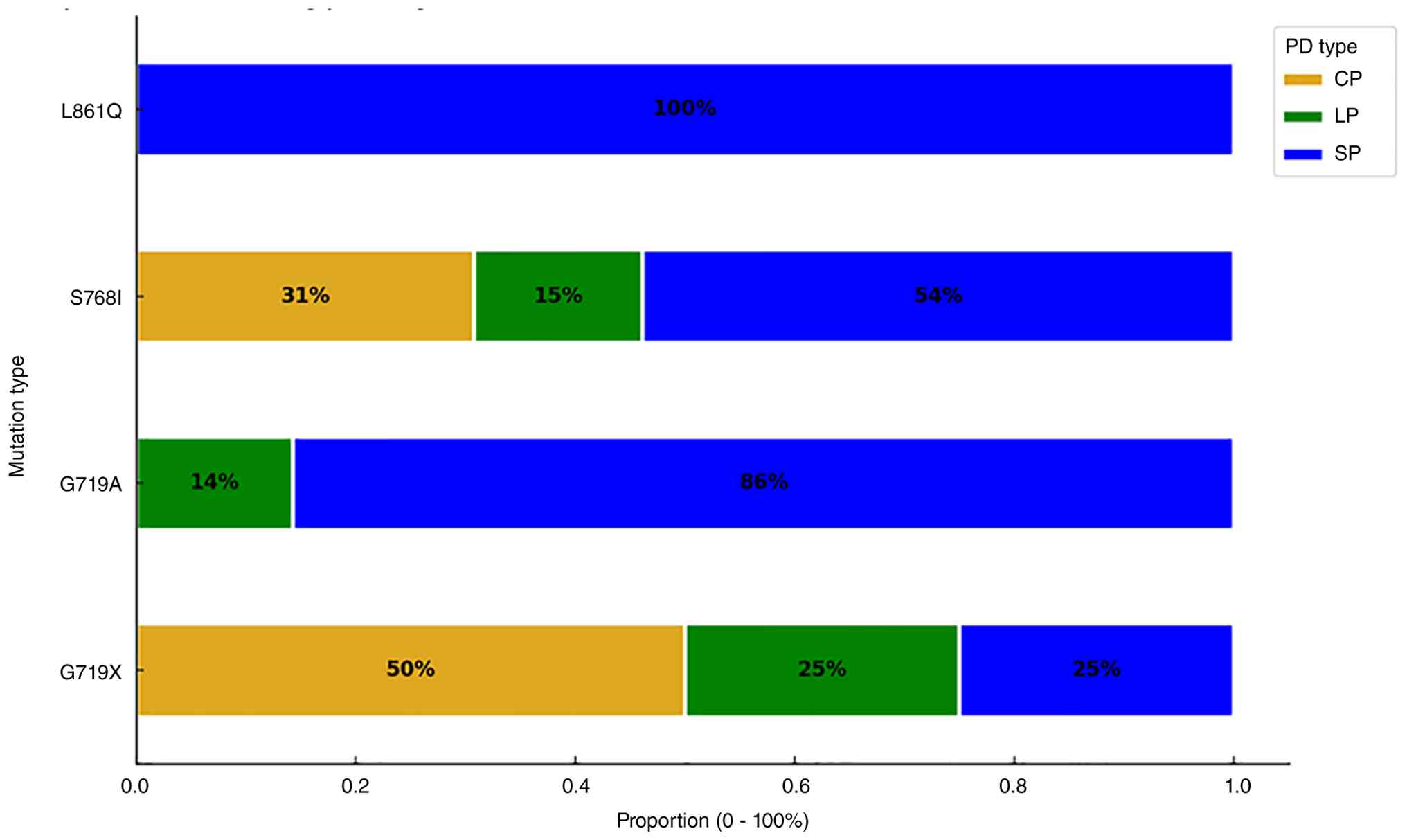
PFS exceeding 30 months were documented (Table II). The distribution of
progressive disease types across different mutation subtypes is
illustrated in Fig. 1. L861Q
showed the longest median first-line PFS (19.6 months), while
long-term PFS >30 months occurred in 1/8 G719A, 2/15 S768I
compound and 1/8 L861Q cases. PD patterns were predominantly SP,
occurring in 6/8 G719A, 5/8 L861Q and 7/15 S768I compound cases; LP
occurred in 1/8 G719A and 2/15 S768I compound cases and CP occurred
in 4/15 S768I compound cases.
| Table IIInformation on long-term
survivors. |
Table II
Information on long-term
survivors.
| Mutation | Median first-line
PFS, months | Patients with PFS
>30 months/total |
|---|
| G719A | 7.4 (1.2-38.7) | 1/8 |
| S768I compound | 11.3 (3.2-44.4) | 2/15 |
| L861Q | 19.6 (9.3-41.8) | 1/8 |
Structural effect of non-classical
EGFR mutations
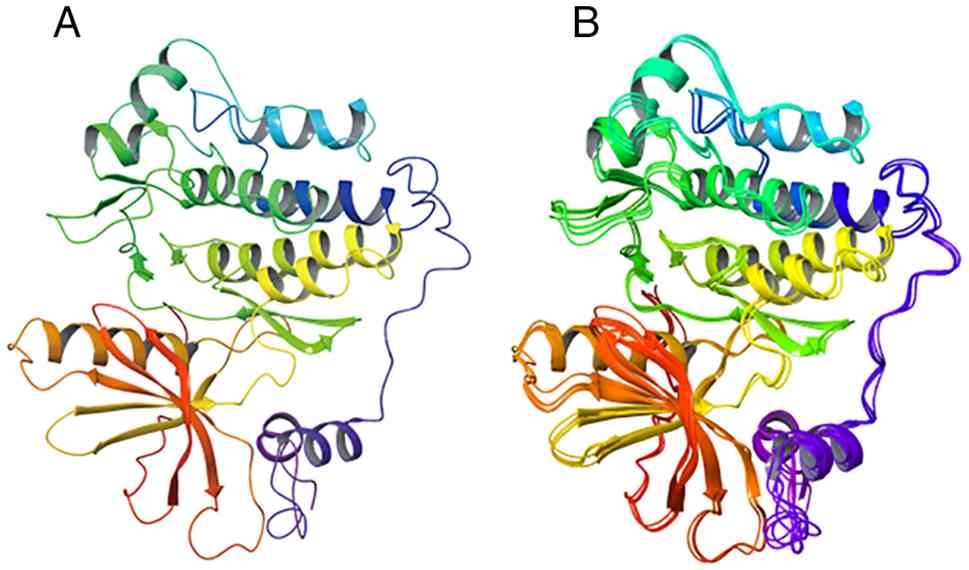
The alignment scores and root-mean-square deviation
(RMSD) values for various non-classical EGFR mutations relative to
the wild-type (WT) EGFR reference structure are presented in
Table III. Alignment scores were
generated using the multiple sequence viewer, where a lower score
signifies better sequence alignment. The RMSD values [in angstroms
(Å)] indicate the structural deviations of the mutated EGFR
proteins from the WT protein. The mutations analyzed included
single mutations (G719A, L861Q) and compound mutations involving
S768I (G719A+S768I, G719C+S768I, G719S+S768I and V769L+S768I),
highlighting the effect of these alterations on protein structure
and drug-binding affinity. Structural superimposition of these
mutant proteins with the WT EGFR is illustrated in Fig. 2. Overall, the single mutations
G719A and L861Q showed smaller structural deviations from WT-EGFR
(RMSD, 1.023 and 0.902 A, respectively) than most S768I compound
mutations, among which G719S+S768I had the highest RMSD (1.264 A),
suggesting greater conformational disruption in compound
mutants.
| Table IIISequence alignment scores and
structural deviations of non-classical EGFR mutations compared to
those of WT-EGFR. |
Table III
Sequence alignment scores and
structural deviations of non-classical EGFR mutations compared to
those of WT-EGFR.
| Gene mutation
type | Alignment
score | RMSD (Å) |
|---|
| G719A | 0.042 | 1.023 |
| L861Q | 0.033 | 0.902 |
| G719A+S768I | 0.063 | 1.254 |
| G719C+S768I | 0.058 | 1.202 |
| G719S+S768I | 0.064 | 1.264 |
| V769L+S768I | 0.05 | 1.121 |
Binding affinity of EGFR-TKIs for
non-classical EGFR mutants
The relationships between different EGFR-TKIs, their
binding affinities, as indicated by docking scores and MM-GBSA
binding free energies (ΔG_bind) and the PFS of patients with
specific non-classical EGFR mutations, are presented in Table IV. Lower docking scores and more
negative MM-GBSA ΔG_bind values indicate stronger binding
affinities between ligands and their corresponding EGFR mutant
proteins. The table summarizes both single and compound mutations,
illustrating the performance of different EGFR-TKIs under various
genetic conditions.
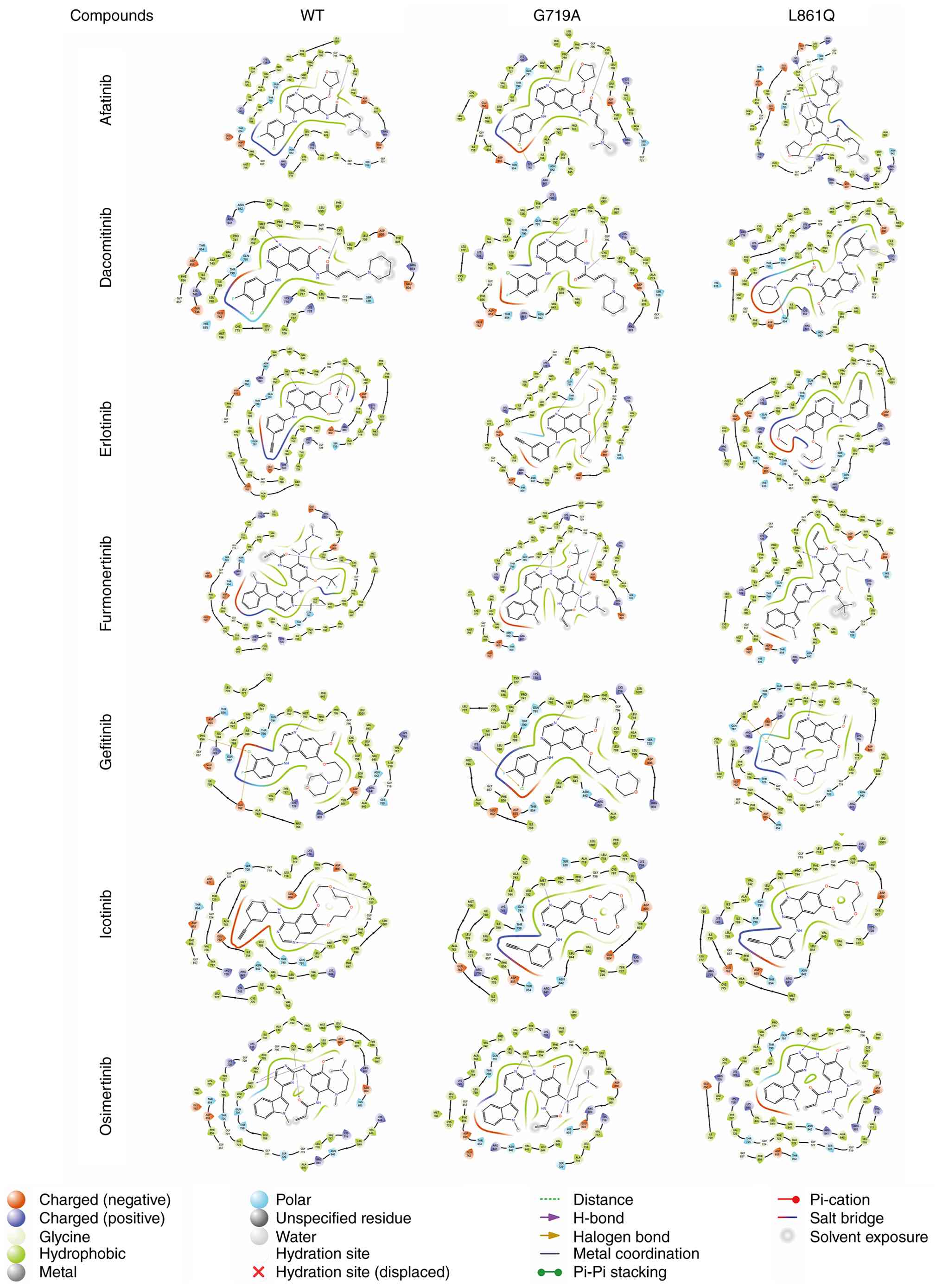
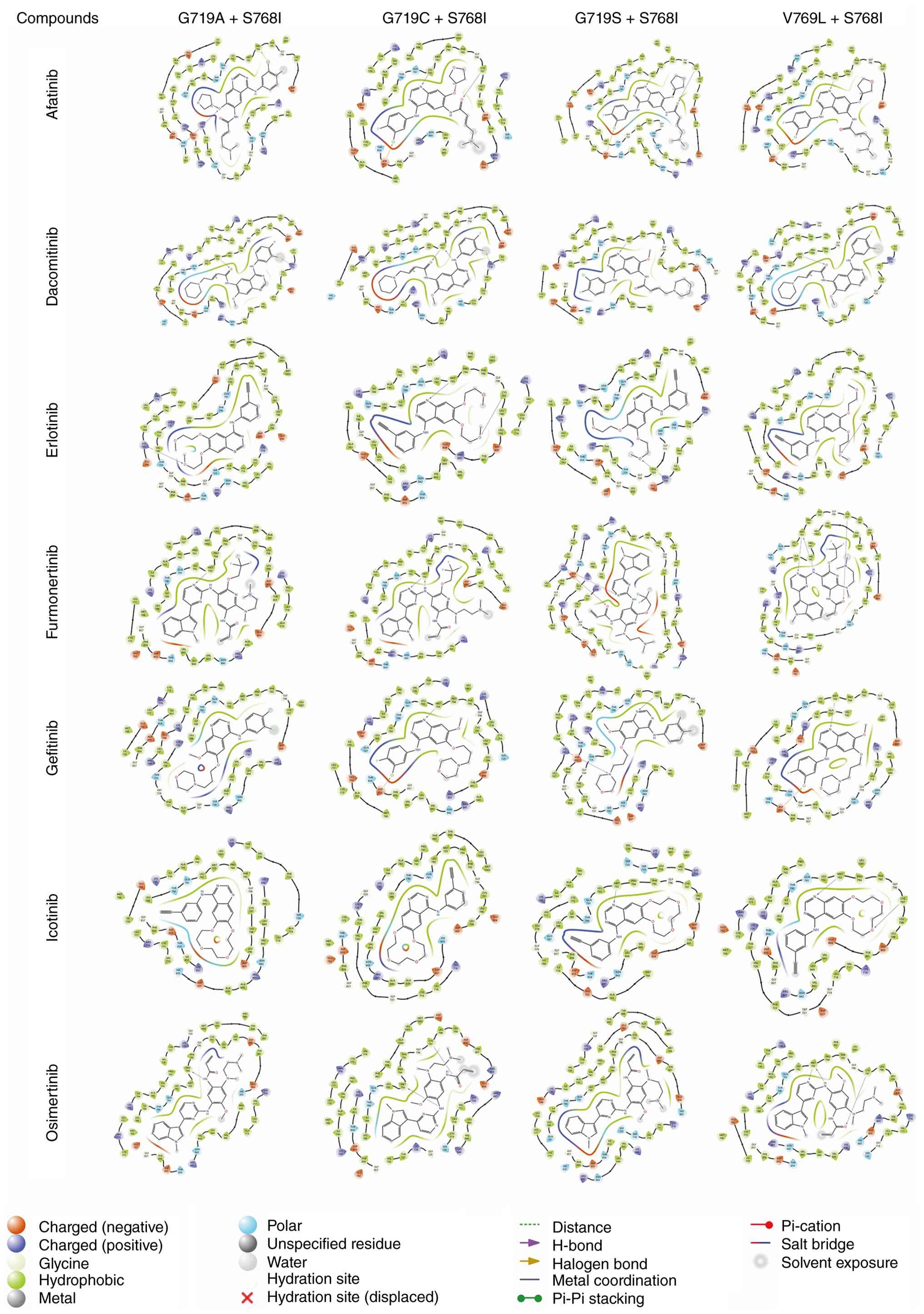
To clarify the variations in binding interactions
between EGFR-TKIs and WT or non-classical EGFR mutants,
two-dimensional binding interaction diagrams shown in Figs. 3 and 4 were analyzed. Fig. 3 depicts the binding modes of
several EGFR-TKIs with WT EGFR and two single-point mutants (G719A
and L861Q). These single-site mutations lead to notable
conformational rearrangements within the ATP-binding pocket,
altering hydrogen bonding and hydrophobic interaction patterns
relative to those in the WT protein. Such structural alterations
are likely to influence both the binding affinity and inhibitory
potency of EGFR-TKIs.
A total of four compound EGFR mutants: G719A+S768I,
G719C+S768I, G719S+S768I and V769L+S768I, are presented in Fig. 4. The addition of S768I modifies the
EGFR-TKI binding landscape, inducing significant conformational
shifts in the ATP-binding domain. These shifts enhance or alter
interactions, including additional hydrogen bonds and hydrophobic
contacts, potentially explaining the different clinical responses
observed in patients with these mutations, as shown by the binding
affinities and outcomes in Table
IV. Quantitatively, dacomitinib showed favorable binding and
clinical outcome signals in L861Q (docking score, -8.926; MM-GBSA
ΔG_bind, -88.41 kcal/mol; PFS, 24.9 months) and G719S+S768I
(docking score, -9.851; MM-GBSA ΔG_bind, -95.73 kcal/mol; PFS, 30.2
months), whereas afatinib in G719A+S768I showed a PFS of 17.1
months with an MM-GBSA ΔG_bind of -72.18 kcal/mol.
The binding interaction analyses depicted in
Figs. 3 and 4 provide comprehensive insights into how
specific non-classical EGFR mutations influence the molecular
binding of EGFR-TKIs. Understanding this mechanism is crucial for
optimizing the selection of EGFR-TKIs and developing personalized
treatment strategies for patients with NSCLC with non-classical
EGFR mutations.
Exploratory correlation between
molecular simulation results and clinical outcomes
The results of the Spearman correlation analysis are
presented in Table V, based on the
drug-mutation treatment events (first-line TKI, PFS, docking score
and MM-GBSA ΔG_bind) presented in Table IV. Results of the collinearity
diagnostic multivariate regression are provided in Table VI. PFS was negatively correlated
with the docking score (r=-0.835, P<0.0001). Furthermore, PFS
showed a strong negative correlation with MM-GBSA ΔG_bind
(r=-0.894, P<0.0001), indicating that more negative values of
MM-GBSA were correlated with better clinical outcomes. Furthermore,
the docking score was strongly positively correlated with MM-GBSA
ΔG_bind (r=0.876, P<0.0001), suggesting that both molecular
simulation metrics were highly dependent on each other in this
study. Thus, the molecular-clinical associations may represent
exploratory and hypothesis-generating findings rather than
definitive evidence of independent predictive effects. In Table VI, the constant represents the
regression intercept rather than a biological predictor; docking
score and MM-GBSA ΔG_bind were not independent predictors in this
diagnostic model (P=0.222 and P=0.849, respectively), consistent
with substantial collinearity (VIF=21.637).
| Table VSpearman correlation analysis between
PFS, the docking score and MM-GBSA ΔG_bind. |
Table V
Spearman correlation analysis between
PFS, the docking score and MM-GBSA ΔG_bind.
| Parameter | PFS, months | Docking score | MM-GBSA ΔG_bind,
kcal/mol |
|---|
| PFS, months | 1 | -0.835
(P<0.0001) | -0.894
(P<0.0001) |
| Docking score | -0.835
(P<0.0001) | 1 | 0.876
(P<0.0001) |
| MM-GBSA ΔG_bind,
kcal/mol | -0.894
(P<0.0001) | 0.876
(P<0.0001) | 1 |
| Table VIMultivariable linear regression
analysis of progression-free survival. |
Table VI
Multivariable linear regression
analysis of progression-free survival.
| Variable | Unstandardized
coefficient (B) | Standard error | Standardized
coefficient (beta) | t | P-value | VIF |
|---|
| Constant | -15.840 | 5.703 | - | -2.778 | 0.013 | - |
| Docking score | -4.369 | 3.442 | -0.919 | -1.269 | 0.222 | 21.637 |
| MM-GBSA ΔG_bind,
kcal/mol | 0.061 | 0.318 | 0.140 | 0.194 | 0.849 | 21.637 |
Discussion
A comprehensive analysis of non-classical EGFR
mutations may provide useful information for optimizing treatment
strategies in a clinically challenging and underrepresented patient
population. In the present study, integrating molecular simulation
data with retrospective clinical outcomes provided a
hypothesis-generating framework for EGFR-TKI selection for this
patient subgroup, for which prospective trial evidence remains
limited.
The present study revealed that dacomitinib
exhibited stronger binding affinity to mutant proteins with the
L861Q mutation compared to other EGFR-TKIs. Clinical data confirmed
that first-line treatment with dacomitinib resulted in notably
longer PFS, surpassing the PFS reported in previous studies with
afatinib and osimertinib for L861Q mutations (20,21).
The present research indicated that afatinib displayed favorable
molecular binding parameters in patients with compound mutations,
such as G719A+S768I, aligning with clinical observations of a PFS
of 17.1 months, which is considerably longer than the treatment
outcomes reported in other studies (21,22).
Similarly, for compound mutations such as G719C+S768I or
G719S+S768I, dacomitinib bound to mutant proteins with high
efficacy. This finding was consistent with the clinical data. The
present results highlighted the significant therapeutic variability
among different structurally targeted drugs for atypical EGFR
mutations (23-25).
As these mutations are rare, pharmaceutical sponsors are often
hesitant to invest in targeted clinical trials owing to an
unfavorable cost-benefit ratio. As a result, clinical decisions
typically rely on individual experiences of physicians,
complicating the ability to offer patients the most accurate
treatment options. The therapeutic efficacy of rare EGFR mutations
has been predominantly assessed through retrospective analyses.
While these studies support the present findings, including the
therapeutic advantage of dacomitinib in managing uncommon compound
mutations (20,26), retrospective designs are inherently
limited by their lack of timeliness. In clinical practice, a
prospective analytical framework is urgently required to generate
reliable treatment guidance for the broad spectrum of uncommon EGFR
mutations encountered in real time. The current study addresses
this need by providing an evidence-based and practical approach for
selecting targeted therapies for rare EGFR mutations. This strategy
helps bridge existing gaps in clinical research and facilitates the
development of more precise and personalized treatment options for
patients with atypical mutations. Patients with EGFR mutations
typically exhibit LP or SP following targeted therapy, often
retaining the original EGFR mutation (16). The clinical data of the present
study confirmed the persistence of primary mutations during disease
progression and validated drug sensitivity predictions for atypical
mutations using molecular simulations. These predictions closely
matched the clinical outcomes of second-line treatments,
demonstrating the robustness of the model for both first-line and
subsequent-line therapies. By accurately capturing drug-mutation
interactions, the model provided a rational framework for selecting
optimal treatments in cases with limited clinical data. The
alignment between the predicted sensitivities and outcomes
highlighted its ability to enhance precision medicine and improve
PFS across multiple lines of therapy.
Owing to the heterogeneous and low-frequency
occurrence of uncommon EGFR mutations (17,27,28),
this study had several limitations. The retrospective nature of the
study and the relatively small sample size of 31 patients may have
limited the generalizability of the findings. As this was a
single-center study, selection bias may have been unintentionally
introduced and the diversity of the patient population may have
been limited. The absence of a control group and the variability in
treatment regimens further contributed to confounding factors,
which may have influenced the results.
Another limitation relates to the retrospective
ascertainment of EGFR mutation status. Molecular results were
extracted from routine clinical pathology reports rather than
generated de novo for this study. Consequently, raw
sequencing files, PCR primer sequences and laboratory-specific
proprietary assay parameters for NGS panels were not uniformly
available to the investigators, although the ARMS-PCR kit catalogue
number was retrievable from archived pathology records. In
addition, the strong correlation between docking scores and MM-GBSA
ΔG_bind indicates that these molecular metrics are not independent
(19), and in high-correlation
settings such collinearity may produce spurious predictor-outcome
associations in regression models. For this reason, the
molecular-clinical analysis was restricted to exploratory Spearman
correlations and no multivariable regression was performed to infer
independent predictive effects. Future prospective studies with
standardized molecular testing, centrally reviewed raw genomic data
and larger sample sizes are required to validate the proposed
simulation-guided framework.
This is a valuable but limited strategy in light of
unique therapeutic differences associated with non-classical EGFR
mutations, such as exon 20 insertions, and other EGFR alterations,
such as the overexpression of MET, which may affect the clinical
outcomes of patients with NSCLC receiving EGFR-TKIs (21). As larger and prospective studies
confirm these results, incorporating more biomarkers and
combination therapies may help further personalize the approach to
these patients. As machine learning and molecular dynamics
simulation methods improve, predictions of drug-agent interactions
can help researchers make better clinical decisions (12,15).
Furthermore, investigating the tumor microenvironment and
patient-specific factors, including comorbidities, will be
pertinent. Translating these discoveries into clinical practice
requires the close interaction of computational biologists and
clinicians.
This study highlighted the power of molecular
simulations in selecting EGFR-TKIs for treating NSCLC more
effectively than traditional clinical analyses. The present
findings may help improve patient stratification and therapeutic
outcomes by tying molecular binding affinities to clinical
endpoints. This approach can help address the existing knowledge
gap and emphasize the necessity of personalized treatment
strategies based on non-classical EGFR mutations.
In conclusion, these findings provide a
proof-of-concept for mining molecular simulation data alongside
retrospective clinical outcomes to guide the selection of EGFR-TKIs
in patients harboring non-classical mutations. This study is
exploratory in nature, but the heterogeneous treatment response
observed suggests that mutation- and drug-specific molecular
interpretations could be of potential value.
Despite being retrospective, single-center in scope
and limited in sample size, differences in activity with EGFR-TKIs
seen across non-classical mutation categories provide a rationale
for further investigation. Larger multicenter datasets,
standardized molecular diagnostics and prospective validation are
necessary before molecular simulation-guided treatment
recommendations can realistically be used in daily clinical
practice.
Supplementary Material
Basic information on patients with the
G719A mutation.
Basic information on patients with the
L861Q mutation.
Basic information on patients with the
S768I mutation.
Acknowledgements
Not applicable.
Funding
Funding: This work was supported by Shenzhen Science and
Technology Program (grant no. JCYJ20220530153612028), the National
Cancer Center/National Clinical Research Center for Cancer/Cancer
Hospital & Shenzhen Hospital, CAMS & Peking Union Medical
College (grant no. E010222007) and the Sanming Project of Medicine
in Shenzhen (grant no. SZSM202211012).
Availability of data and materials
The sequencing data generated in the present study
may be found in the OMIX database (China National Center for
Bioinformation/Beijing Institute of Genomics, Chinese Academy of
Sciences) under accession number OMIX017364 or at the following
URL: https://ngdc.cncb.ac.cn/omix/release/OMIX017364. The
other data generated in the present study may be requested from the
corresponding author.
Authors' contributions
FW, NN and YW conceived and designed the study. FW,
NN, CL, GG, NL and YW collected, analyzed and interpreted the data.
FW and NN wrote the manuscript; NN, NL and YW provided critical
revisions important for the intellectual content. NN and YW confirm
the authenticity of all the raw data. All authors have read and
approved the final version of the manuscript.
Ethics approval and consent to
participate
This study was conducted in accordance with the
Declaration of Helsinki and was approved by the Ethics Committee of
the National Cancer Center/National Clinical Research Center for
Cancer/Cancer Hospital, CAMS and Peking Union Medical College
(approval no. 25/229-5175). Because of the retrospective nature of
the study and the use of de-identified clinical data, the
requirement for written informed consent was waived by the ethics
committee.
Patient consent for publication
Not applicable.
Competing interests
All authors declare that they have no competing
interests.
References
|
1
|
Cooper AJ, Sequist LV and Lin JJ:
Third-generation EGFR and ALK inhibitors: Mechanisms of resistance
and management. Nat Rev Clin Oncol. 19:499–514. 2022.PubMed/NCBI View Article : Google Scholar
|
|
2
|
Ramalingam SS, Vansteenkiste J, Planchard
D, Cho BC, Gray JE, Ohe Y, Zhou C, Reungwetwattana T, Cheng Y,
Chewaskulyong B, et al: Overall survival with osimertinib in
untreated, EGFR-Mutated advanced NSCLC. N Engl J Med. 382:41–50.
2020.PubMed/NCBI View Article : Google Scholar
|
|
3
|
Robichaux JP, Le X, Vijayan RSK, Hicks JK,
Heeke S, Elamin YY, Lin HY, Udagawa H, Skoulidis F, Tran H, et al:
Structure-based classification predicts drug response in
EGFR-mutant NSCLC. Nature. 597:732–737. 2021.PubMed/NCBI View Article : Google Scholar
|
|
4
|
O'Kane GM, Bradbury PA, Feld R, Leighl NB,
Liu G, Pisters KM, Kamel-Reid S, Tsao MS and Shepherd FA: Uncommon
EGFR mutations in advanced non-small cell lung cancer. Lung Cancer.
109:137–144. 2017.PubMed/NCBI View Article : Google Scholar
|
|
5
|
Frankell AM, Dietzen M, Al Bakir M, Lim
EL, Karasaki T, Ward S, Veeriah S, Colliver E, Huebner A, Bunkum A,
et al: The evolution of lung cancer and impact of subclonal
selection in TRACERx. Nature. 616:525–533. 2023.PubMed/NCBI View Article : Google Scholar
|
|
6
|
Yamaguchi O, Kasahara N, Soda H, Imai H,
Naruse I, Yamaguchi H, Itai M, Taguchi K, Uchida M, Sunaga N, et
al: Predictive significance of circulating tumor DNA against
patients with T790M-positive EGFR-mutant NSCLC receiving
osimertinib. Sci Rep. 13(20848)2023.PubMed/NCBI View Article : Google Scholar
|
|
7
|
Borgeaud M, Parikh K, Banna GL, Kim F,
Olivier T, Le X and Addeo A: Unveiling the landscape of uncommon
EGFR mutations in NSCLC-A systematic review. J Thorac Oncol.
19:973–983. 2024.PubMed/NCBI View Article : Google Scholar
|
|
8
|
Jiang Y, Fang X, Xiang Y, Fang T, Liu J
and Lu K: Afatinib for the treatment of NSCLC with uncommon EGFR
mutations: A narrative review. Curr Oncol. 30:5337–5349.
2023.PubMed/NCBI View Article : Google Scholar
|
|
9
|
Pizzutilo EG, Agostara AG, Oresti S,
Signorelli D, Stabile S, Lauricella C, Motta V, Amatu A, Ruggieri
L, Brambilla M, et al: Activity of osimeRTInib in non-small-cell
lung Cancer with UNcommon epidermal growth factor receptor
mutations: Retrospective Observational multicenter study
(ARTICUNO). ESMO Open. 9(103592)2024.PubMed/NCBI View Article : Google Scholar
|
|
10
|
Wang P, Fabre E, Martin A, Chouahnia K,
Benabadji A, Matton L and Duchemann B: Successful sequential
tyrosine kinase inhibitors to overcome a rare compound of EGFR exon
18-18 and EGFR amplification: A case report. Front Oncol.
12(918855)2022.PubMed/NCBI View Article : Google Scholar
|
|
11
|
Ullas B, Shrinidhi N, Mansi S, Narayan S,
Parveen J, Surender D, Joslia JT and Anurag M: All EGFR mutations
are (not) created equal: focus on uncommon EGFR mutations. J Cancer
Res Clin Oncol. 149:1541–1549. 2023.PubMed/NCBI View Article : Google Scholar
|
|
12
|
Zou B, Lee VHF and Yan H: Prediction of
sensitivity to gefitinib/erlotinib for EGFR mutations in NSCLC
based on structural interaction fingerprints and multilinear
principal component analysis. BMC Bioinformatics.
19(88)2018.PubMed/NCBI View Article : Google Scholar
|
|
13
|
Lococo F, Ghaly G, Chiappetta M, Flamini
S, Evangelista J, Bria E, Stefani A, Vita E, Martino A, Boldrini L,
et al: Implementation of artificial intelligence in personalized
prognostic assessment of lung cancer: A narrative review. Cancers
(Basel). 16(1832)2024.PubMed/NCBI View Article : Google Scholar
|
|
14
|
He B, Dong D, She Y, Zhou C, Fang M, Zhu
Y, Zhang H, Huang Z, Jiang T, Tian J and Chen C: Predicting
response to immunotherapy in advanced non-small-cell lung cancer
using tumor mutational burden radiomic biomarker. J Immunother
Cancer. 8(e000550)2020.PubMed/NCBI View Article : Google Scholar
|
|
15
|
Qureshi R, Basit SA, Shamsi JA, Fan X,
Nawaz M, Yan H and Alam T: Machine learning based personalized drug
response prediction for lung cancer patients. Sci Rep.
12(18935)2022.PubMed/NCBI View Article : Google Scholar
|
|
16
|
Harada D and Takigawa N: Oligoprogression
in non-small cell lung cancer. Cancers (Basel).
13(5823)2021.PubMed/NCBI View Article : Google Scholar
|
|
17
|
Jackman D, Pao W, Riely GJ, Engelman JA,
Kris MG, Jänne PA, Lynch T, Johnson BE and Miller VA: Clinical
definition of acquired resistance to epidermal growth factor
receptor tyrosine kinase inhibitors in non-small-cell lung cancer.
J Clin Oncol. 28:357–360. 2010.PubMed/NCBI View Article : Google Scholar
|
|
18
|
Abramson J, Adler J, Dunger J, Evans R,
Green T, Pritzel A, Ronneberger O, Willmore L, Ballard AJ, Bambrick
J, et al: Accurate structure prediction of biomolecular
interactions with AlphaFold 3. Nature. 630:493–500. 2024.PubMed/NCBI View Article : Google Scholar
|
|
19
|
Leeuwenberg AM, van Smeden M, Langendijk
JA, van der Schaaf A, Mauer ME, Moons KGM, Reitsma JB and Schuit E:
Performance of binary prediction models in high-correlation
low-dimensional settings: A comparison of methods. Diagn Progn Res.
6(1)2022.PubMed/NCBI View Article : Google Scholar
|
|
20
|
Yang JC, Schuler M, Popat S, Miura S,
Heeke S, Park K, Märten A and Kim ES: Afatinib for the treatment of
NSCLC harboring uncommon EGFR mutations: A database of 693 cases. J
Thorac Oncol. 15:803–815. 2020.PubMed/NCBI View Article : Google Scholar
|
|
21
|
Wang C, Zhao K, Hu S, Dong W, Gong Y, Li M
and Xie C: Clinical outcomes of gefitinib and erlotinib in patients
with NSCLC harboring uncommon EGFR mutations: A pooled analysis of
438 patients. Lung Cancer. 172:86–93. 2022.PubMed/NCBI View Article : Google Scholar
|
|
22
|
Wu YL, Cheng Y, Zhou X, Lee KH, Nakagawa
K, Niho S, Tsuji F, Linke R, Rosell R, Corral J, et al: Dacomitinib
versus gefitinib as first-line treatment for patients with
EGFR-mutation-positive non-small-cell lung cancer (ARCHER 1050): A
randomised, open-label, phase 3 trial. Lancet Oncol. 18:1454–1466.
2017.PubMed/NCBI View Article : Google Scholar
|
|
23
|
Wu YL, Zhou C, Hu CP, Feng J, Lu S, Huang
Y, Li W, Hou M, Shi JH, Lee KY, et al: Afatinib versus cisplatin
plus gemcitabine for first-line treatment of Asian patients with
advanced non-small-cell lung cancer harbouring EGFR mutations
(LUX-Lung 6): An open-label, randomised phase 3 trial. Lancet
Oncol. 15:213–222. 2014.PubMed/NCBI View Article : Google Scholar
|
|
24
|
Oxnard GR, Lo PC, Nishino M, Dahlberg SE,
Lindeman NI, Butaney M, Jackman DM, Johnson BE and Jänne PA:
Natural history and molecular characteristics of lung cancers
harboring EGFR exon 20 insertions. J Thorac Oncol. 8:179–184.
2013.PubMed/NCBI View Article : Google Scholar
|
|
25
|
Arcila ME, Chaft JE, Nafa K, Roy-Chowdhuri
S, Lau C, Zaidinski M, Paik PK, Zakowski MF, Kris MG and Ladanyi M:
Prevalence, clinicopathologic associations, and molecular spectrum
of ERBB2 (HER2) tyrosine kinase mutations in lung adenocarcinomas.
Clin Cancer Res. 18:4910–4918. 2012.PubMed/NCBI View Article : Google Scholar
|
|
26
|
Li HS, Yang GJ, Cai Y, Li JL, Xu HY, Zhang
T, Zhou LQ, Wang YY, Wang JL, Hu XS, et al: Dacomitinib for
advanced non-small cell lung cancer patients harboring major
uncommon EGFR alterations: A dual-center, single-arm, ambispective
cohort study in China. Front Pharmacol. 13(919652)2022.PubMed/NCBI View Article : Google Scholar
|
|
27
|
Attili I, Passaro A, Pisapia P, Malapelle
U and de Marinis F: Uncommon EGFR compound mutations in non-small
cell lung cancer (NSCLC): A systematic review of available
evidence. Curr Oncol. 29:255–266. 2022.PubMed/NCBI View Article : Google Scholar
|
|
28
|
Russo A, Franchina T, Ricciardi G,
Battaglia A, Picciotto M and Adamo V: Heterogeneous responses to
epidermal growth factor receptor (EGFR) tyrosine kinase inhibitors
(TKIs) in patients with uncommon EGFR mutations: New insights and
future perspectives in this complex clinical scenario. Int J Mol
Sci. 20(1431)2019.PubMed/NCBI View Article : Google Scholar
|