1. Introduction
Radiation-induced lung injury (RILI) is a general
term for any pulmonary toxicity caused by radiotherapy and
represents a continuous pathophysiological process. The acute phase
manifests as radiation pneumonitis (RP), whereas the chronic phase
manifests as radiation-induced pulmonary fibrosis (RIPF). RP
typically develops within several weeks to several months after
radiotherapy, whereas RIPF typically occurs several months to
several years later (1). RILI
causes symptoms such as fever, cough and dyspnea; moreover, in
severe cases, it can lead to respiratory failure, substantially
affecting the quality of life and prognosis of patients (2). Despite continuous advances in
radiotherapy techniques, RILI remains an important clinical concern
in patients receiving thoracic radiotherapy. Currently,
glucocorticoids remain the first-line drugs for treating acute RP.
However, their efficacy is limited due to the lack of specificity
and minimal effects on the chronic fibrotic stage. Furthermore,
long-term use of glucocorticoids may also be associated with
adverse effects such as infections, osteoporosis and elevated blood
sugar levels (3). As RILI is not a
single pathological process and involves dynamic pathological
changes over time, the development of effective pharmacological
interventions remains challenging. The major research gaps in
pharmacological treatment of RILI are the lack of effective
stage-specific treatment strategies and drugs supported by
sufficient clinical evidence. Advances in understanding the
molecular mechanisms of RILI have revealed that the injury process
progresses through three sequential phases: i) Immediate/early
oxidative stress injury; ii) intermediate acute inflammatory
response; and iii) late pro-fibrotic remodeling (4,5). The
present review primarily follows this temporal pattern of RILI,
systematically outlining the core mechanisms of each phase and the
corresponding drugs (including those already available in the
market, those currently in clinical trials and those undergoing
preclinical research), with an aim to provide guidance for clinical
practice and future research directions.
2. Review methodology
Literature searches were conducted for different
topics covered in the present review, including drug prevention of
RILI, corticosteroid therapy, antifibrotic drug therapy, targeted
and immune-related therapy, and novel drug delivery systems. PubMed
(https://pubmed.ncbi.nlm.nih.gov/),
Embase (https://www.embase.com/) and Web of
Science (https://www.webofscience.com/) databases were searched
from inception to May 2026. The search terms included
‘radiation-induced lung injury’, ‘radiation pneumonitis’,
‘radiation-induced pulmonary fibrosis’, ‘drug prevention’,
‘treatment’ and their synonyms, supplemented with representative
drug names [such as amifostine, N-acetylcysteine, pirfenidone (PFD)
and nintedanib].
The inclusion criteria were as follows: i) Studies
investigating pharmacological prevention or treatment of RP and
pulmonary fibrosis; ii) full-text availability; and iii)
publication in English. The exclusion criteria were as follows: i)
Duplicate publications; ii) conference abstracts, comments,
letters, news, editorials and case reports; iii) studies not
relevant to the topic or with incomplete data; and iv) studies with
substantial methodological limitations or insufficient reporting of
relevant data. Although no temporal restriction was applied, recent
literature (published within the last 3 years) was prioritized to
ensure currency and clinical relevance. Following systematic
deduplication, title/abstract screening and full-text assessment, a
total of 68 eligible articles were included.
3. Phase of oxidative stress
Core mechanism of oxidative stress
induced by ionizing radiation
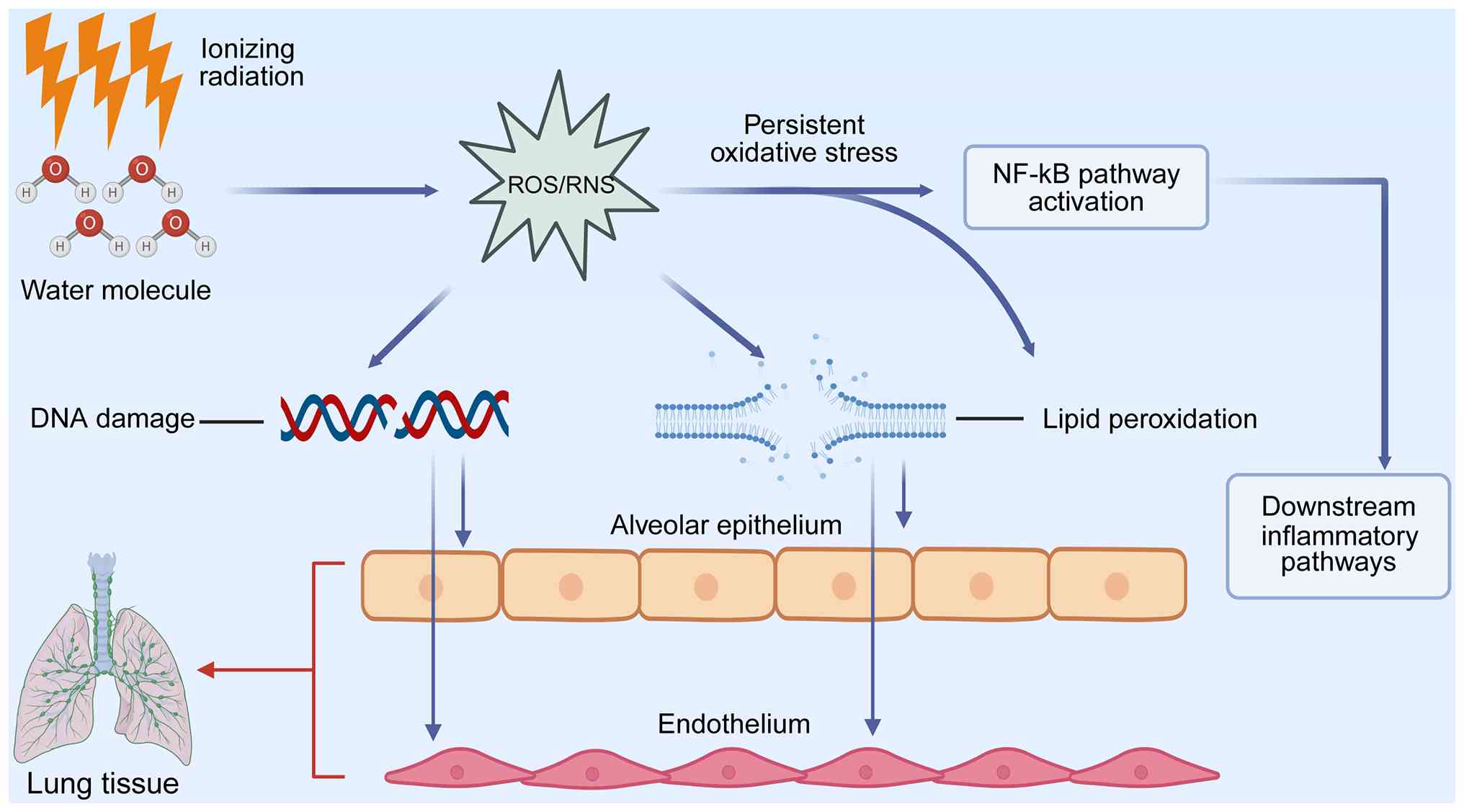
When ionizing radiation acts on lung tissues, it
directly excites and ionizes water molecules, leading to their
decomposition and the generation of abundant reactive oxygen
species (ROS)/nitrogen species. This early burst of oxidative
stress represents the initiating step of RILI, which directly
causes DNA double-strand breaks, lipid peroxidation and cell
membrane damage in alveolar epithelial cells and vascular
endothelial cells (6). Persistent
oxidative stress further aggravates DNA damage and activates
inflammatory signaling pathways, particularly NF-κB, while the
nuclear factor erythroid 2-related factor 2 (Nrf2) pathway is
activated as an endogenous antioxidant response to counteract
excessive ROS accumulation. When oxidative stress persists,
insufficient Nrf2-mediated antioxidant protection may allow
NF-κB-dependent inflammatory signaling to become sustained. The
resulting inflammatory mediators, including IL-6 and other
cytokines, can further activate JAK/STAT signaling and amplify the
inflammatory response. Persistent inflammation subsequently
promotes TGF-β production and activation of the TGF-β/Smad pathway,
thereby linking the early oxidative stress phase to the later
fibrotic phase (7). Consequently,
this early phase constitutes a critical window for therapeutic
intervention. The core mechanism of this phase is shown in Fig. 1.
Amifostine: A classical
radioprotective agent
Given that ROS-mediated oxidative stress is the
primary trigger of RILI, strategically enhancing the antioxidant
capacity of normal tissues immediately before and after irradiation
is a reasonable therapeutic approach. Among the numerous agents
studied, amifostine is currently the only broad-spectrum
cytoprotective agent approved by the U.S. Food and Drug
Administration. Its mechanism of action involves hydrolysis by
alkaline phosphatase to the active metabolite WR-1065, which
directly scavenges radiation-induced ROS through its free thiol
group and acts as a hydrogen donor to repair DNA damage, thereby
providing radioprotection at the cellular level (8). A phase III randomized controlled
trial by Antonadou et al (9) (146 patients with advanced lung cancer
receiving thoracic radiotherapy) demonstrated that the amifostine
group (340 mg/m2, intravenous injection 15 min before
radiotherapy) exhibited a significantly lower incidence of grade ≥2
RP than the control group (16 vs. 49%; P<0.001) and a lower
incidence of RIPF at 6 months (28 vs. 53%; P<0.05), with
comparable antitumor efficacy between the two groups. A further
study explored the possibility of individualized protection; the
results showed that patients with high mutagenic sensitivity were
more susceptible to developing grade ≥3 RIPF, and amifostine
markedly reduced its incidence (10). However, the clinical application of
amifostine is limited by adverse effects such as hypotension,
nausea and vomiting. Consequently, alternative administration
routes have been investigated. A previous study indicated that
subcutaneous injection shows improved toleration compared with
intravenous administration during concurrent chemoradiotherapy,
with comparable efficacy (11).
Additionally, rat experiments have demonstrated that inhalation
administration provides superior protection against RILI compared
with intraperitoneal administration (12). With further advances in research,
the clinical application of amifostine is expected to reach a
broader platform.
Other antioxidants
Apart from amifostine, various other antioxidants
have also demonstrated the potential to prevent and treat RILI.
Among these, N-acetylcysteine, a precursor of glutathione, enhances
intracellular antioxidant defense capacity and effectively
alleviates endothelial dysfunction, inflammation and fibrosis
(13). A further study showed that
it mitigates radiation-induced oxidative stress and preserves lung
function (14). Unlike
conventional antioxidants, omeprazole alleviates RILI through a
dual mechanism, whereby it reduces protein carbonylation to
counteract oxidative stress and downregulates caspase-3 to inhibit
apoptosis. Notably, short-term administration of a low dose (10
mg/kg) of omeprazole markedly improves pathological damage and
shows a favorable safety profile (15). More promisingly, pretreatment with
thrombopoietin mimetics 24 h before irradiation provides long-term
protection against RILI, whereby it reduces tissue pathological
damage and inflammation in the short term (2 weeks), while
long-term follow-up (7 months) shows that it can reduce collagen
deposition, improve lung function and increase survival rates
(16).
Natural antioxidants have also received considerable
attention due to their safety advantages. Among dietary
polyphenols, curcumin and resveratrol effectively mitigate RILI
through the Nrf2/GSH pathway (17,18),
whereas dihydroartemisinin regulates the Nrf2/HO-1 pathway to
prevent ferroptosis and thereby reduce the incidence of RILI
(19). Regarding the complexity of
the mechanism of action, PM014 is a notable molecule as it inhibits
inflammation by blocking NF-κB nuclear translocation and
downregulates the TGF-β1/NADPH oxidase 4 pathway to prevent
epithelial-mesenchymal transition (EMT) and collagen deposition,
with therapeutic effects exceeding those of amifostine (20). Tanshinone IIA also maintains
mitochondrial function and inhibits M1 polarization of alveolar
macrophages through the PARP-1/NF-κB pathway, thereby reducing the
release of pro-inflammatory mediators (21). However, the widespread application
of natural products is limited by their low bioavailability and
challenges associated with their clinical translation. In this
context, nanomaterials, possessing lung-targeting accumulation
properties, offer a promising solution. For instance, inhalable
chitosan-modified poly(lactic-co-glycolic acid) nanoparticles
(ASX@P@CS) effectively overcome the poor water solubility issue of
astaxanthin and significantly inhibit the progression of RILI in
mice (22). Selenium nanoparticles
also exert substantial protective effects during the early and
intermediate post-irradiation phases by scavenging ROS (23). Therefore, the development of
intelligent nanotargeted drug delivery systems currently represents
a key strategy to achieve efficient, low-toxicity and early
intervention of RILI.
4. Phase of inflammation response and immune
regulation
Core mechanisms of the inflammatory
cascade reaction
Although antioxidant therapy can alleviate the
initial damage, it cannot completely halt disease progression. This
limitation is partly attributable to the release of
damage-associated molecular patterns (DAMPs), which activate innate
immune responses following radiation-induced tissue injury. DAMPs
activate macrophages and inflammatory pathways, including NF-κB and
JAK/STAT, promoting the release of TNF-α, IL-1β and IL-6(24). These mediators further recruit
neutrophils, disrupt the alveolar-capillary barrier, and increase
vascular permeability, leading to pulmonary edema and inflammatory
exudation (24). Persistent
inflammation and oxidative stress may promote fibrotic remodeling
(25). The core mechanisms of this
inflammatory and immune-regulatory phase are illustrated in
Fig. 2. Therefore, suppressing
this excessive inflammatory cascade constitutes a core strategy to
prevent the transformation to fibrosis.
Cornerstone drugs:
Glucocorticoids
Glucocorticoids are an important treatment option
for acute RILI (26,27). A retrospective study of 385
patients with lung cancer demonstrated that initiating treatment
with prednisone at 30-40 mg/day stabilized the condition of most
patients; those exhibiting fever, dyspnea or rapid radiological
progression after radiotherapy required more aggressive hormonal
therapy and had a poor prognosis (26). Another study revealed that the
median overall survival period was notably longer in patients who
successfully tapered off glucocorticoids compared with those who
failed to taper (43.4 vs. 22.2 months), suggesting that the
tapering regimen influences survival outcomes (27).
Although glucocorticoids are the first choice for
treating moderate-to-severe RP, the dosing and treatment duration
remain empirical, with no standardized guidelines (28). The 2025 French Association for
Supportive Care in Oncology-French Society of Radiation Oncology
guidelines recommend the following symptom severity-based
management approach: i) Grade 1 (asymptomatic), whereby only
follow-up is required; ii) grade 2 (cough, dyspnea and chest pain),
whereby treatment with oral prednisone at 0.5-1 mg/kg/day for 2
weeks, followed by a stepwise taper over 4 weeks (immunotherapy can
be continued) is recommended; and iii) grade ≥3 (hypoxia, acute
respiratory distress syndrome and other life-threatening
manifestations), whereby initial treatment with intravenous
methylprednisolone at 2-4 mg/kg/day for 1 week and subsequent
transition to oral administration based on the condition of the
patient is recommended (29).
However, glucocorticoid treatment is associated with a high
recurrence rate after discontinuation, and long-term use of
glucocorticoids may increase the risk of infection, hyperglycemia,
osteoporosis and muscle atrophy, with limited efficacy against RIPF
(30). These limitations have
prompted the development of more targeted and safer alternative or
combination strategies.
Other anti-inflammatory and
immunomodulatory strategies
With progression of the understanding of the immune
microenvironment in RILI, novel regulatory strategies continue to
emerge. Basic research has confirmed that dihydroartemisinin, in
addition to its antioxidant effects, can also alleviate lung
inflammation by downregulating TNF-α and TGF-β expression (19). Further exploration of the
underlying mechanism revealed that two TNF-related
apoptosis-inducing ligand pathway agonists not only ameliorate
acute RP by inhibiting macrophage-derived C-C motif chemokine
ligand 22, but also significantly suppress fibrotic progression
within 22 weeks (31). At the
clinical translation level, a prospective randomized study
demonstrated that combining glucocorticoids with recombinant human
endostatin can reduce the recurrence rate of RP from 45 to 15%,
with median overall survival of 16.0 months compared with 7.7
months in the control group, and show a favorable safety profile
(32). At the cellular level,
regulatory dendritic cells, by interacting with regulatory B and T
cells, and inducing the production of immunosuppressive molecules,
constitute a key hub for controlling inflammation (33). These advancements signify a
paradigm shift in RILI treatment from empirical anti-inflammatory
approaches to precise immune mechanism-based interventions.
5. Phase of fibrogenesis
Core mechanism: TGF-β/Smad signaling
axis and myofibroblast activation
RIPF represents the chronic and irreversible stage
of RILI, in which activation of the TGF-β/Smad2/3 pathway plays a
central role. TGF-β signaling promotes fibroblast-to-myofibroblast
transformation, excessive extracellular matrix (ECM) production and
impaired matrix degradation, thereby driving progressive fibrotic
remodeling (34). Persistent
activation of NF-κB and JAK/STAT during the preceding inflammatory
phase may promote TGF-β activity, thereby facilitating the
transition from inflammation to fibrosis. Thus, the progression
from inflammation to fibrosis reflects the interaction between
persistent profibrotic signaling and endogenous protective
mechanisms. The core mechanism of this fibrotic phase is shown in
Fig. 3. Consequently, targeting
this axis to delay, block or potentially reverse fibrosis has
become a pivotal strategy in drug development. Notably, these
fibrotic mechanisms are not unique to RIPF, but overlap with those
observed in other progressive fibrotic lung diseases, particularly
idiopathic pulmonary fibrosis (IPF) and connective tissue
disease-associated interstitial lung disease. As summarized in
Table I, TGF-β signaling,
inflammatory and immune dysregulation and ECM remodeling represent
shared pathological mechanisms across these diseases (24,34,35-37).
These common pathways provide a mechanistic rationale for exploring
whether established antifibrotic therapies used in other fibrotic
lung diseases may also be applicable to RIPF.
 | Table IOverlapping mechanisms between RIPF
and other fibrotic lung diseases. |
Table I
Overlapping mechanisms between RIPF
and other fibrotic lung diseases.
| Shared
mechanism | Mechanism of
RIPF | Mechanism of
IPF | Mechanism of
CTD-ILD |
|---|
| TGF-β signaling and
fibroblast activation | TGF-β activation
promotes fibroblast activation and ECM deposition (34). | TGF-β signaling
promotes fibroblast activation and myofibroblast differentiation
(35). | TGF-β-related
signaling contributes to fibroblast activation and fibrotic
remodeling (36). |
| Inflammation and
immune dysregulation | Persistent
inflammation and immune-cell activation promote fibrotic
progression (24). | Abnormal epithelial
injury and inflammatory responses contribute to fibrosis (37). | Autoimmune
abnormalities and chronic inflammation contribute to pulmonary
fibrosis (37). |
| ECM remodeling | Increased ECM
production and impaired degradation lead to collagen accumulation
(34). | Abnormal ECM
production and degradation promote progressive fibrosis (37). | Inflammatory
responses and fibroblast activation promote ECM deposition
(37). |
Application of anti-pulmonary fibrosis
drugs in RILI
Nintedanib is a multitarget tyrosine kinase
inhibitor that suppresses pathways regulating fibroblast
proliferation, migration and activation, for example,
platelet-derived growth factor receptor, fibroblast growth factor
receptor and vascular endothelial growth factor receptor. A
preclinical study has shown that nintedanib can regulate the
TGF-β/Smad and PI3K/AKT/mTOR pathways in a mouse model of RIPF,
thereby suppressing epithelial inflammation and preventing
fibroblast-to-myofibroblast transformation (34). A phase II clinical trial (trial no.
NCT02517861) confirmed that combining nintedanib with a reduced
dose of prednisone markedly lowers the risk of acute pulmonary
exacerbation in patients with grade ≥2 RP (38). This dual action (simultaneously
suppressing acute inflammation and blocking the progression of
fibrosis) renders nintedanib a highly promising therapeutic agent
for treating RILI. However, it delays rather than reverses the
established fibrosis. As it targets the downstream fibroblast
pathways, the optimal intervention window may be restricted to the
fibrosis progression phase rather than the acute inflammation
phase. Therefore, further studies are urgently required to define
the optimal treatment timing.
PFD is an oral drug approved for treating IPF; this
drug reduces M2 macrophage infiltration and inhibits TGF-β1/Smad3
pathway activation (39). Given
the shared core mechanism of aberrant TGF-β signaling pathway
activation between RIPF and IPF, PFD has been repurposed for
treating RILI (40). A prospective
phase II clinical trial by Hou et al (40) demonstrated that PFD combined with
corticosteroid therapy improved the carbon monoxide diffusion
capacity and forced vital capacity percentages. This study
addressed the gap in antifibrotic treatment during the
‘post-hormone era’ of RILI. Another study also confirmed that
patients with non-small cell lung cancer (NSCLC) complicated with
RILI derived clinical benefits and exhibited good tolerance when
treated with PFD combined with standard therapy (41). Based on the positive results of the
aforementioned phase II trials, larger phase III clinical trials
are anticipated to further validate its therapeutic value. A
summary of relevant research on the treatment of RIPF with
antifibrotic agents is presented in Table II (34,38-44).
| Table IISummary of studies on nintedanib and
PFD for treating RIPF. |
Table II
Summary of studies on nintedanib and
PFD for treating RIPF.
| First author,
year | Research
design | Sample | Grouping and
experimental scheme | Research
indicators | Results | (Refs.) |
|---|
| De Ruysscher et
al, 2017 | Animal experiments
(mouse models) | 266 | Grouping: 0, 4, 8,
12, 16 and 20 Gy local right lung irradiation. Starting 1 week
after irradiation, oral nintedanib (0, 30 and 60 mg/kg) or placebo
was administered daily for 39 weeks. | Monthly CT scan for
lung density. Pathological score after 39 weeks. | Lung density on CT
increased with the dose, but nintedanib did not affect the CT
value; pathological examination showed that nintedanib alleviated
microscopic fibrosis and inflammation. | (42) |
| Rimner et
al, 2023 | Phase II
double-blind, placebo-controlled, randomized clinical trial | 30 | Group A: 18
individuals [nintedanib (150 mg twice per day) + prednisone
tapering]; group B: 12 individuals (placebo + prednisone tapering);
total duration of 8 weeks. | The primary
endpoint was the rate of no acute exacerbation of the lung within 1
year; the secondary endpoints included PFTs, PROs and AEs. | 1-Year rate of no
acute exacerbation: 72% in the nintedanib group vs. 40% in the
placebo group (P=0.037). PFTs and PROs: No marked differences were
observed between the two groups. Grade ≥2 AEs: 16 in the nintedanib
group and 5 in the placebo group. The most common were diarrhea and
dyspnea. | (38) |
| Tu et al,
2024 | Preclinical
research (mouse + cell experiments) | 120 | Grouping: Control
group, single drug group, radiotherapy group (16 Gy), prevention
group (drug administration 2 days before radiotherapy), early
treatment group (drug administration 4 weeks after radiotherapy)
and late treatment group (drug administration 12 weeks after
radiotherapy). Nintedanib dose: 30 mg/kg/day. Cell experiments: To
detect the effect of nintedanib on the signaling pathways of
irradiated epithelial cells and fibroblasts. | Survival rate, body
weight, CT, histo-pathological analysis and in vitro
mechanism exploration. | Prevention and
early treatment can alleviate lung pathological damage and collagen
deposition in mice and improve survival. Mechanism: Inhibiting the
epithelial PI3K/AKT/MAPK, fibroblast TGF-β/Smad and PI3K/AKT/mTOR
pathways. | (34) |
| Zhang et al,
2025 | Animal experiments
(mouse models) | 80 | Grouping: Control
group, radiotherapy group (18 Gy), low-dose nintedanib +
radiotherapy group (40 mg/kg) and high-dose nintedanib +
radiotherapy group (80 mg/kg). 18 Gy whole lung irradiation.
Protocol: Daily intragastric administration. Animals were
sacrificed and evaluated at 14 days (acute phase) and 3 months
(chronic phase) after radiotherapy, respectively. | General condition,
pathology, serum inflammatory factors and TGF-β1/Smad2 pathway
proteins. | i) Nintedanib
improved the general condition of mice and alleviated the
pathological damage of lung tissues; ii) it reduced the levels of
serum IL-6, TNF-α and TGF-β1; and iii) it dose-dependently
inhibited the expression of Smad2 and α-SMA in lung tissues. | (43) |
| Qin et al,
2018 | Animal experiments
(mouse models) | 120 | Grouping: Normal
control, PFD alone (300 mg/kg/day for 4 weeks), simple RT (single
16 Gy to the whole thorax), RT + PFD (same dose of PFD).
Observation until 20 weeks. | Survival period,
RT-induced lung density (micro-CT), collagen deposition, fibrosis
Ashcroft score and mechanism. | i) The median
survival period of the RT group was 73 days, while that of the RT +
PFD group was extended to >140 days (P<0.01); ii) PFD reduced
RT-induced lung density (micro-CT), collagen deposition and
Ashcroft score of fibrosis; and iii) PFD inhibited TGF-β1
expression and Smad3 phosphorylation. | (44) |
| Ying et al,
2021 | Animal experiments
(mouse models + cell experiments) | 40 | Grouping: Normal
control, PFD alone (300 mg/kg/day by gavage), simple RT (single
whole thorax irradiation of 50 Gy) and RT + PFD. Observation was
conducted until 150 days after irradiation. | Macrophage
polarization (M1/M2), TGF-β1/Smad3 pathway and lung tissue
pathology. | PFD alleviates
fibrosis and inflammation, promotes the polarization of
macro-phages to the M2 type and inhibits the TGF-β1/Smad3
pathway. | (39) |
| Hou et al,
2025 | A multicenter,
open-label, randomized controlled phase II trial | 134 | Experimental group
(combined treatment): Oral administration of PFD three times per
day. A stepwise dose escalation was adopted: 200 mg in the first
week, 300 mg in the second week and maintained at 400 mg from the
third to the 24th week. Initiated glucocorticoid dose equivalent to
40 mg of prednisone/day, divided into two oral doses, and
maintained for 2 weeks; then reduced by 10 mg every 2 weeks over 6
to 8 weeks. Control group (standard treatment): Received only the
same glucocorticoid treatment course as aforementioned. | Primary endpoint:
DLCO%; secondary endpoints: FVC%, FEV1% and APEFS; AEs. | i) DLCO%: The
experimental group improved by 8.0%, while the control group
decreased by 2.4%; ii) FVC%: The experimental group improved by
6.1%, while the control group decreased by 2.8%; iii) FEV1%: The
experimental group improved by 2.4%, while the control group
deteriorated by 4.3%; iv) APEFS: The experimental group reached as
high as 81.7%, while the control group was only 61.9%; and v)
incidence of grade ≥3 pneumonia: 6% in the experimental group and
12% in the control group. | (40) |
| Liu et al,
2025 | A single-center
retrospective preliminary study | 33 | All patients
received PFD (gradually increased to 400 mg three times per day)
combined with standard treatment (methylprednisolone 20-40 mg/day
for 5 days, then gradually reduced and discontinued). There was no
control group. | Symptom
improvement, imaging changes and AEs. | i) In the PFD
group, both symptoms and imaging showed improvement, with an
overall imaging response rate of 78.8% (26/33), including 6 cases
(18.2%) of complete response and 20 cases (60.6%) of partial
response; and ii) no PFD-related adverse events of grade ≥3 were
observed. | (41) |
Drugs targeting other targets or
mechanisms
Regarding the TGF-β pathway, anlotinib showed marked
improvement in lung fibrosis in mice, representing a novel
promising therapeutic strategy for clinical application (45). Beyond the TGF-β pathway, cellular
senescence and the senescence-associated secretory phenotype are
key mechanisms in RIPF (46,47).
Senolytic drugs, such as dasatinib + quercetin, can selectively
eliminate senescent cells and have shown potential to reverse
fibrosis in various fibrosis models, including RILI, thereby
emerging as a novel therapeutic direction (48). Opaganib reduces radiation-induced
lung inflammation and fibrosis by regulating sphingolipid
metabolism. As shown previously, opaganib notably increased the
long-term (180-day) survival rate of irradiated mice from 10 to 60%
(49). A 2024 study identified
spleen tyrosine kinase as a key driver target of RILI. Its
inhibitor, fostamatinib, attenuates RP and RIPF in mice by
downregulating fibrotic factors, providing preclinical evidence for
spleen tyrosine kinase-targeted therapies (50).
In recent years, bifunctional immune fusion proteins
targeting both PD-L1 and TGF-β have emerged as a potential strategy
for simultaneously modulating immune suppression and fibrotic
signaling. M7824 (bintrafusp alfa) combines programmed death-ligand
1 (PD-L1) blockade with a TGF-β trap, thereby targeting two
pathways that contribute to immune evasion and tissue fibrosis. One
preclinical study suggested that this dual blockade may enhance the
antitumor effects of radiotherapy while reducing radiation-induced
tissue injury (51). Although its
development for tumor therapy was discontinued, this approach
validated the feasibility of co-blocking PD-L1 and TGF-β for the
management of RILI (52). SHR-1701
is another bifunctional fusion protein targeting PD-L1 and TGF-β
signaling. An early study evaluated the efficacy and safety of
SHR-1701 combined with XELOX + bevacizumab as a first-line regimen
for the treatment of unresectable metastatic colorectal cancer. The
results showed that the objective response rate was 59.7%, the
disease control rate was 83.9%, the median progression-free
survival was 10.3 months and the safety was controllable (53). However, this study focused on
cancer treatment rather than RILI-specific outcomes. Nevertheless,
these agents provide a rationale for simultaneously targeting
inflammatory/immune and pro-fibrotic pathways, suggesting that
multi-target strategies may represent a promising direction for
future RILI treatment.
6. Exploration of frontier and innovative
therapeutic strategies
Targeted drug delivery systems based
on nanotechnology
Owing to the complex pathology of RILI,
nanomedicine-based delivery systems have become a research hotspot
due to their advantages in targeted delivery and controlled release
(5). Specifically, by engineering
modification of carriers, these systems have successfully overcome
the instability of conventional anti-inflammatory and antifibrotic
drugs in circulation, enabling effective drug accumulation in the
injured lung tissue (54). At the
application level, inhalable nano-curcumin formulations have
markedly enhanced the pharmaceutical properties of the drug
(55), while the novel
X-ray-responsive nanocomposite
Au@mSiO2@Mn(CO)55Br, consisting of gold
nanorods coated with mesoporous silica and functionalized with
Mn(CO)5Br, enables X-ray-triggered local release of
carbon monoxide and manganese ions, thereby modulating the ROS
microenvironment and alleviating RILI (56). Therefore, the development of
intelligent nanoplatforms that integrate multiple therapeutic
mechanisms represents a critical trend toward achieving precise
interventions for RILI.
Cell therapy: Mesenchymal stem cells
(MSCs) and their derivatives
MSCs exert therapeutic effects primarily through
paracrine mechanisms. Upon homing to the injured lung tissue, MSCs
release exosomes, microvesicles and trophic factors that
collectively mediate immunomodulatory, anti-inflammatory,
antifibrotic and tissue repair effects (57). A comparative study of MSC sources
indicated that umbilical cord-derived MSCs exhibit superior
therapeutic efficacy (58).
Furthermore, innovative constructs such as the MSC-Lipo-OPC
complex, in which MSCs are combined with liposomes and oligomeric
procyanidin, have been developed to enhance cellular antioxidant
capacity and improve enrichment efficiency at pulmonary lesions,
markedly ameliorating RILI in murine models (59).
Given that the therapeutic efficacy of MSCs is
predominantly mediated by their secreted extracellular vesicles,
‘cell-free therapy’ has emerged as a promising alternative.
Specifically, MSC-derived exosomes attenuate inflammatory
responses, suppress ECM accumulation and inhibit EMT by blocking
the Akt/NF-κB signaling pathway, effectively reversing fibrotic
progression in rat models of RIPF (60). This cell-free strategy mitigates
risks associated with live cell transplantation, such as
tumorigenicity and embolism, while preserving core therapeutic
functionalities, positioning it as a novel strategy with high
potential for clinical translation.
Application of organ chips and
organoids in drug screening
Lung organ chips and organoids are revolutionizing
the development of drugs for RILI. Traditional two-dimensional
cultures fail to simulate the three-dimensional architecture and
dynamic mechanical microenvironment of lung tissues. By contrast,
alveolar chips can precisely reconstruct the alveolar-capillary
interface by integrating the gas exchange barrier, fluid shear
stress and respiratory-like mechanical strain. Dasgupta et
al (61) developed a human
alveolar chip that, following exposure to 16 Gy of γ-rays,
reproduced the core features of acute RILI within 6 h, including
DNA double-strand breaks, cellular hypertrophy, upregulation of
inflammatory mediators and loss of barrier function. After 7 days,
the TNF-α/NF-κB, IL-6/JAK-STAT3 and IFN-γ pathways were markedly
activated, closely mirroring the clinical time window for RP onset
(61). This model provides a
highly physiologically relevant in vitro platform for
elucidating the molecular mechanisms of acute RILI and evaluating
novel radioprotective countermeasures.
Comparison of emerging therapeutic
strategies
These emerging strategies have distinct advantages
and limitations. Nanotechnology-based drug delivery systems improve
drug stability and lung targeting but face challenges in safety,
manufacturing and clinical validation (54-56).
MSC-based therapies provide broad anti-inflammatory and
antifibrotic effects, but their efficacy varies with cell source
and preparation, and concerns regarding tumorigenicity and
pulmonary embolism remain (57,58).
MSC-derived extracellular vesicles may reduce these risks, although
their optimal dosage, delivery route and long-term safety remain
unclear (60). Organ chips and
organoids provide physiologically relevant platforms for drug
screening and mechanism-based evaluation, but cannot fully
reproduce the systemic immune and vascular environment (61). Thus, nanomedicine and cell-based
therapies may have greater potential for future therapeutic
application, whereas organ chips and organoids are more suitable as
translational platforms for drug development and optimization.
7. Identification and management of special
types of RILI
Radiation recall pneumonitis
(RRP)
RRP is defined as acute pneumonia occurring months
to years after thoracic radiotherapy, triggered by specific drugs
and confined to the original irradiation field. Common triggers
include chemotherapeutic agents such as paclitaxel and gemcitabine,
as well as immune checkpoint inhibitors (ICIs) (62). Chest computed tomography is crucial
for diagnosis, with typical findings of ground-glass opacities or
consolidation within the irradiation field. The differential
diagnosis for RRP should include tumor recurrence, infectious
pneumonia, typical RP and drug-induced pneumonitis (63). The underlying mechanism involves
drug-induced immune activation. Therefore, the treatment is focused
on immediate discontinuation of the suspected agent and initiation
of glucocorticoid therapy. Most patients respond favorably to
moderate-dose corticosteroids, with resolution of symptoms and
radiographic abnormalities typically occurring within several
weeks.
Radiation immunotherapy-related
pneumonitis
The combination of ICIs and thoracic radiotherapy
has emerged as standard care for locally advanced NSCLC. However,
this synergy substantially increases the pneumonitis risk.
Real-world data indicated a pneumonitis incidence of 26.9% in the
combination group, which was markedly higher than that (6.7%)
observed for ICI monotherapy (64). The timing of ICI administration
profoundly influences pneumonitis risk, with the incidence of grade
≥2 RP increasing to 45.3% when ICIs preceded chemoradiotherapy,
compared with 25.3% when administered afterward and 24.3% in
concurrent regimens. Notably, shorter intervals between modalities
correlate with a greater risk (65). Proposed mechanisms include
disruption of self-tolerance, cross-reactive immunity between tumor
and normal tissues, release of inflammatory mediators, the abscopal
effect and microbiome alterations, potentially modulated by genetic
and environmental factors (66).
Management should follow the principles of graded, individualized
intervention.
RP complicated by infection
Patients with RP face a substantially elevated risk
of secondary infections, a phenomenon termed ‘superimposed
infection’ involving bacterial, viral or fungal pathogens, which
was first described as early as 1988(67). A large-scale analysis of 1,746
patients with severe RP revealed a notably high secondary infection
rate of 44.5%. The predominant pathogens were Acinetobacter
baumannii (27%), Klebsiella pneumoniae (26.2%) and
Pseudomonas aeruginosa (13.6%), which frequently exhibited
multidrug resistance (68).
Therapeutically, a careful balance must be maintained between RP
management and effective antimicrobial therapy. Empirical treatment
with cefoperazone-sulbactam is a rational initial choice, and
initiating empirical antifungal therapy for a duration of ≥9 days
may improve outcomes (68).
Corticosteroid administration should be strictly contingent upon
adequate antimicrobial coverage, and critically ill patients
require prompt transfer to the Intensive Care Unit with
consideration of mechanical ventilation support (29).
8. Conclusions and perspectives
To address the key limitation restricting the
therapeutic efficacy of thoracic tumor radiotherapy, the drug
prevention and treatment for RILI is evolving from single-modality
symptomatic management toward a multimodal, full-cycle intervention
model. The present review comprehensively summarized advances from
classical radioprotectants and anti-inflammatory drugs to novel
antifibrotic drugs and cutting-edge exploratory therapies based on
the molecular mechanisms and key targets operative at distinct
phases of RILI pathogenesis. However, most candidate drugs remain
in the preclinical stage, and clinical evidence is currently
limited to a small number of agents, such as amifostine, nintedanib
and PFD. The translation of promising preclinical therapies is
further challenged by differences between experimental models and
clinical RILI, uncertainty regarding the optimal timing and
duration of treatment, limited prospective clinical evidence, and
the need to balance lung protection with antitumor efficacy. Future
efforts should prioritize accelerating clinical translation,
engineering intelligent drug delivery systems with high efficacy
and low toxicity, and implementing an individualized patient
stratification approach based on multi-omics profiling to enable
precision prevention and treatment, ultimately establishing a safe
and effective RILI management system that spans the entire disease
course.
Acknowledgements
Not applicable.
Funding
Funding: The present study was supported by the S&T Program
of Hebei (grant no. 246Z7722G).
Availability of data and materials
Not applicable.
Authors' contributions
SL, WB and ZZ conceived the present review,
conducted the literature review and wrote the manuscript. MM, CZ
and YZ assisted with the literature review and manuscript revision.
YS and QA contributed to manuscript writing and interpretation. WB
and ZZ provided critical feedback and helped with manuscript
revision. Data authentication is not applicable. All authors have
read and approved the final version of the manuscript.
Ethics approval and consent to
participate
Not applicable.
Patient consent for publication
Not applicable.
Competing interests
The authors declare that they have no competing
interests.
References
|
1
|
Hanania AN, Mainwaring W, Ghebre YT,
Hanania NA and Ludwig M: Radiation-induced lung injury: Assessment
and management. Chest. 156:150–162. 2019.PubMed/NCBI View Article : Google Scholar
|
|
2
|
Wang Y, Zhang J and Shao C: Cytological
changes in radiation-induced lung injury. Life Sci.
358(123188)2024.PubMed/NCBI View Article : Google Scholar
|
|
3
|
Ruysscher D, Wauters E, Jendrossek V,
Filippi AR, Revel MP, Faivre-Finn C, Naidoo J, Ramella S,
Guckenberger M, Ricardi U, et al: Diagnosis and treatment of
radiation induced pneumonitis in patients with lung cancer: An
ESTRO clinical practice guideline. Radiother Oncol.
207(110837)2025.PubMed/NCBI View Article : Google Scholar
|
|
4
|
Jackson IL and Doyle-Eisele M: Animal
model considerations for medical countermeasure development for
radiation and sulfur mustard exposures: Animal models for radiation
and HD exposures. Disaster Med Public Health Prep.
18(e81)2023.PubMed/NCBI View Article : Google Scholar
|
|
5
|
Zhang X, Zhang Z, Huang M, Jin Y, Huang Y,
Ji P and Ma Z: Pathological mechanisms of radiation-induced lung
injury and novel nano-drug delivery therapeutic strategies. Int J
Nanomedicine. 20:12431–12465. 2025.PubMed/NCBI View Article : Google Scholar
|
|
6
|
Thamer ZA, Muhammed RS and Sharrad AA:
Effects of radiation ionizer on vital molecules: Chemical
mechanisms and omics (Ombus) techniques for detection and analysis.
J Med Phys. 50:781–789. 2025.PubMed/NCBI View Article : Google Scholar
|
|
7
|
Chen YY, Wang M, Zuo CY, Mao MX, Peng XC
and Cai J: Nrf-2 as a novel target in radiation induced lung
injury. Heliyon. 10(e29492)2024.PubMed/NCBI View Article : Google Scholar
|
|
8
|
Piraino LR, Chen CY, Mereness JA, Dunman
PM, Ovitt CE, Benoit DSW and DeLouise LA: Salivary gland tissue
chip screening identifies candidate radioprotective drugs. Commun
Med (Lond). 5(420)2025.PubMed/NCBI View Article : Google Scholar
|
|
9
|
Antonadou D, Coliarakis N, Synodinou M,
Athanassiou H, Kouveli A, Verigos C, Georgakopoulos G, Panoussaki
K, Karageorgis P and Throuvalas N: Clinical Radiation Oncololgy
Hellenic Group. Randomized phase III trial of radiation treatment
+/- amifostine in patients with advanced-stage lung cancer. Int J
Radiat Oncol Biol Phys. 51:915–922. 2001.PubMed/NCBI View Article : Google Scholar
|
|
10
|
Komaki R, Chang JY, Wu X, Allen PK, Milas
L, Liao Z, Fossella FV, Travis E and Spitz MR: Mutagen sensitivity
may predict lung protection by amifostine for patients with locally
advanced non-small cell lung cancer treated by chemoradiotherapy.
Semin Oncol. 32 (Suppl 3):S92–S98. 2005.PubMed/NCBI View Article : Google Scholar
|
|
11
|
Mehta V: Open label multicenter trial of
subcutaneous amifostine (Ethyol) in the prevention of radiation
induced esophagitis and pneumonitis in patients with measurable,
unresectable non-small cell lung cancer. Semin Oncol. 31 (Suppl
18):S42–S46. 2004.PubMed/NCBI View Article : Google Scholar
|
|
12
|
Chen T, Zhuang B, Huang Y, Wang W and Jin
Y: Inhaled amifostine for the prevention of radiation-induced lung
injury. Radiat Med Prot. 3:72–80. 2022.
|
|
13
|
Maghsadi Z, Azadmehr A, Moghadamnia AA,
Feizi F and Hamidi N: N-Acetylcysteine attenuated pulmonary
fibrosis induced by bleomycin via immunomodulation responses. Res
Pharm Sci. 18:177–184. 2023.PubMed/NCBI View Article : Google Scholar
|
|
14
|
Han DW, Ji W, Lee JC, Song SY and Choi CM:
Efficacy of nebulized acetylcysteine for relieving symptoms and
reducing usage of expectorants in patients with radiation
pneumonitis. Thorac Cancer. 10:243–248. 2019.PubMed/NCBI View Article : Google Scholar
|
|
15
|
Talebpour Amiri F, Asghari M and
Hosseinimehr SJ: Omeprazole attenuates irradiation-induced lung
injury through the suppression of apoptosis and oxidative stress in
mice. Med Oncol. 42(172)2025.PubMed/NCBI View Article : Google Scholar
|
|
16
|
English J, Dhanikonda S, Tanaka KE, Koba
W, Eichenbaum G, Yang WL and Guha C: Thrombopoietin mimetic reduces
mouse lung inflammation and fibrosis after radiation by attenuating
activated endothelial phenotypes. JCI insight.
9(e181330)2024.PubMed/NCBI View Article : Google Scholar
|
|
17
|
Baralić K, Živanović J, Božović P,
Kržanović N, Šćepanović N, Petrović J and Đukić-Ćosić D: Protective
effects of curcumin and sulforaphane against ionising
radiation-induced oxidative stress and inflammatory responses in
rat lung tissue. Antioxidants (Basel). 15(255)2026.PubMed/NCBI View Article : Google Scholar
|
|
18
|
Seyedpour N, Motevaseli E, Taeb S,
Nowrouzi A, Mirzaei F, Bahri M, Dehghan-Manshadi HR, Zhaleh M,
Rashidi K, Azmoonfar R, et al: Protective effects of alpha-lipoic
acid, resveratrol, and apigenin against oxidative damages,
histopathological changes, and mortality induced by lung
irradiation in rats. Curr Radiopharm. 17:99–110. 2024.PubMed/NCBI View Article : Google Scholar
|
|
19
|
Ning X, Zhao W, Wu Q, Wang C and Liang S:
Therapeutic potential of dihydroartemisinin in mitigating
radiation-induced lung injury: Inhibition of ferroptosis through
Nrf2/HO-1 pathways in mice. Immun Inflamm Dis.
12(e1175)2024.PubMed/NCBI View Article : Google Scholar
|
|
20
|
Park SH, Kim JY, Kim JM, Yoo BR, Han SY,
Jung YJ, Bae H and Cho J: PM014 attenuates radiation-induced
pulmonary fibrosis via regulating NF-kB and TGF-b1/NOX4 pathways.
Sci Rep. 10(16112)2020.PubMed/NCBI View Article : Google Scholar
|
|
21
|
Zhang N, Yang X, Liang J, Zhu C, Shen G,
Luo C and Wu W: Tanshinone IIA inhibits alveolar macrophage
polarization, inflammation and mitochondrial damage by regulating
the PAPR-1 signaling pathway. Iran J Pharm Res.
24(e166272)2025.PubMed/NCBI View Article : Google Scholar
|
|
22
|
Zhang D, He J, Cui J, Wang R and Zhou M:
Inhalable nano-astaxanthin for radiation-induced lung injury via
enhanced lung retention and inflammation suppression. ACS Appl
Mater Interfaces. 17:64295–64308. 2025.PubMed/NCBI View Article : Google Scholar
|
|
23
|
Mirzaei F, Khosravi H, Najafi M, Salimi M,
Varkeshi M, Pashaki AS and Azmoonfar R: Histopathological
evaluation of radioprotective effects: Selenium nanoparticles
protect lung tissue from radiation damage. Adv Biomed Res.
14(77)2025.PubMed/NCBI View Article : Google Scholar
|
|
24
|
Guo H, Yu R, Zhang H and Wang W: Cytokine,
chemokine alterations and immune cell infiltration in
radiation-induced lung injury: Implications for prevention and
management. Int Immunopharmacol. 126(111263)2024.PubMed/NCBI View Article : Google Scholar
|
|
25
|
Li E, Huang J, Huang J, Zhang F, Li C, Xia
M, Li Z, Peng B, Liu Y, Ma J and Lei M: ALDH2 attenuates
radiation-induced lung injury by inhibiting ROS and
epithelial-mesenchymal transition mediated by the TGF-β1/Smad
pathway. Pulm Pharmacol Ther. 87(102334)2024.PubMed/NCBI View Article : Google Scholar
|
|
26
|
Sekine I, Sumi M, Ito Y, Nokihara H,
Yamamoto N, Kunitoh H, Ohe Y, Kodama T, Saijo N and Tamura T:
Retrospective analysis of steroid therapy for radiation-induced
lung injury in lung cancer patients. Radiother Oncol. 80:93–97.
2006.PubMed/NCBI View Article : Google Scholar
|
|
27
|
Hashim AG, Brøndum RF, Nielsen MS, Laursen
KL, Vestergaard S, Heijkoop W and Szejniuk WM: Impact of
unsuccessful steroid tapering on survival in patients treated for
radiation pneumonitis following definitive radiation for non-small
cell lung cancer. Clin Lung Cancer. 26:e517–e526.e1.
2025.PubMed/NCBI View Article : Google Scholar
|
|
28
|
Voruganti Maddali IS, Cunningham C, McLeod
L, Bahig H, Chaudhuri N, L M Chua K, Evison M, Faivre-Finn C,
Franks K, Harden S, et al: Optimal management of radiation
pneumonitis: Findings of an international Delphi consensus study.
Lung Cancer. 192(107822)2024.PubMed/NCBI View Article : Google Scholar
|
|
29
|
Cravereau O, Bourbonne V, Vaugier L, Lucia
F, Tinier FL, Cadranel J, Duchemann B, Habert P, Martz N, Gehin W,
et al: AFSOS-SFRO guidelines on radiation-induced lung injury. Clin
Lung Cancer. 26:527–540. 2025.PubMed/NCBI View Article : Google Scholar
|
|
30
|
Zhang J, Ge P, Liu J, Luo Y, Guo H, Zhang
G, Xu C and Chen H: Glucocorticoid treatment in acute respiratory
distress syndrome: An overview on mechanistic insights and clinical
benefit. Int J Mol Sci. 24(12138)2023.PubMed/NCBI View Article : Google Scholar
|
|
31
|
Strandberg J, Louie A, Lee S, Hahn M,
Srinivasan P, George A, De La Cruz A, Zhang L, Hernandez Borrero L,
Huntington KE, et al: TRAIL agonists rescue mice from
radiation-induced lung, skin, or esophageal injury. J Clin Invest.
135(e173649)2025.PubMed/NCBI View Article : Google Scholar
|
|
32
|
Chen G, Zhu J, Jian C, Chen X, Niu K, Yang
Q, Tang S, Qin S, Feng Y, Xie L, et al: Efficacy and safety of
Rh-endostatin in the treatment of radiation pneumonitis in
non-small cell lung cancer. Oncologist. 30(oyaf318)2025.PubMed/NCBI View Article : Google Scholar
|
|
33
|
Liu B, Wang Y, Han G and Zhu M:
Tolerogenic dendritic cells in radiation-induced lung injury. Front
Immunol. 14(1323676)2024.PubMed/NCBI View Article : Google Scholar
|
|
34
|
Tu J, Chen X, Li C, Liu C, Huang Y, Wang
X, Liang H and Yuan X: Nintedanib mitigates radiation-induced
pulmonary fibrosis by suppressing epithelial cell inflammatory
response and inhibiting fibroblast-to-myofibroblast transition. Int
J Biol Sci. 20:3353–3371. 2024.PubMed/NCBI View Article : Google Scholar
|
|
35
|
Reed EB, Orbeta S, Miao BA, Sitikov A,
Chen B, Levitan I, Solway J, Mutlu GM, Fang Y, Mongin AA and Dulin
NO: Anoctamin-1 is induced by TGF-β and contributes to lung
myofibroblast differentiation. Am J Physiol Lung Cell Mol Physiol.
326:L111–L123. 2024.PubMed/NCBI View Article : Google Scholar
|
|
36
|
Hua X, Hongbing R, Juan X, Jizan L and
Beibei Y: Dysregulation of TNF-induced protein 3 and
CCAAT/enhancer-binding protein β in alveolar macrophages:
Implications for systemic sclerosis-associated interstitial lung
disease. Int J Rheum Dis. 27(e15174)2024.PubMed/NCBI View Article : Google Scholar
|
|
37
|
Liu W, Huang K, Yang XZ and Wang P:
Transcriptomic and network analysis identifies shared and unique
pathways and immune changes across fibrotic interstitial lung
diseases. Aging (Albany NY). 16:3200–3230. 2024.PubMed/NCBI View Article : Google Scholar
|
|
38
|
Rimner A, Moore ZR, Lobaugh S, Geyer A,
Gelblum DY, Abdulnour RE, Shepherd AF, Shaverdian N, Wu AJ, Cuaron
J, et al: Randomized phase 2 placebo-controlled trial of nintedanib
for the treatment of radiation pneumonitis. Int J Radiat Oncol Biol
Phys. 116:1091–1099. 2023.PubMed/NCBI View Article : Google Scholar
|
|
39
|
Ying H, Fang M, Hang QQ, Chen Y, Qian X
and Chen M: Pirfenidone modulates macrophage polarization and
ameliorates radiation-induced lung fibrosis by inhibiting the
TGF-β1/Smad3 pathway. J Cell Mol Med. 25:8662–8675. 2021.PubMed/NCBI View Article : Google Scholar
|
|
40
|
Hou Z, Dong B, Yao Q, Chen H, Shao Q, Li
M, Wang J, Chen K, Zhu Z, Peng F, et al: Pirfenidone for grade 2
and grade 3 radiation-induced lung injury: A multicentre,
open-label, randomised, phase 2 trial. Lancet Oncol. 26:1552–1562.
2025.PubMed/NCBI View Article : Google Scholar
|
|
41
|
Liu X, Lu F, Yang H, Liao G, Zhao L, Zou
D, He T, Hu Y, Wang L, Xia J, et al: Effectiveness and safety of
pirfenidone for radiation-induced lung injury in non-small cell
lung cancer: A retrospective pilot study. BMC Cancer.
25(1415)2025.PubMed/NCBI View Article : Google Scholar
|
|
42
|
De Ruysscher D, Granton PV, Lieuwes NG,
van Hoof S, Wollin L, Weynand B, Dingemans AM, Verhaegen F and
Dubois L: Nintedanib reduces radiation-induced microscopic lung
fibrosis but this cannot be monitored by CT imaging: A preclinical
study with a high precision image-guided irradiator. Radiother
Oncol. 124:482–487. 2017.PubMed/NCBI View Article : Google Scholar
|
|
43
|
Zhang K, Ren L and Zhai Y: Effect and
mechanism of nintedanib on acute and chronic radiation-induced lung
injury in mice. PLoS One. 20(e0324339)2025.PubMed/NCBI View Article : Google Scholar
|
|
44
|
Qin W, Liu B, Yi M, Li L, Tang Y, Wu B and
Yuan X: Antifibrotic agent pirfenidone protects against development
of radiation-induced pulmonary fibrosis in a murine model. Radiat
Res. 190:396–403. 2018.PubMed/NCBI View Article : Google Scholar
|
|
45
|
Bai M, Liang G, Sun R, Dong Y, Geng C,
Wang B, Liu B and Sun L: Investigating the therapeutic role of
anlotinib in radiation-induced lung injury. Naunyn Schmiedebergs
Arch Pharmacol. 398:17633–17648. 2025.PubMed/NCBI View Article : Google Scholar
|
|
46
|
Schaaf GW, Olson JD, Elgohari BA, Epperly
MW, Hou W, Wang H, Cline JM, Greenberger JS and Mukherjee A:
Radiation-induced lung injury (RILI) in non-human primates (NHPs)
induces cellular senescence and upregulation of tyrosine kinase
Fgr, which is detectable in bronchoalveolar lavage. Radiat Res.
204:354–368. 2025.PubMed/NCBI View Article : Google Scholar
|
|
47
|
Soysouvanh F, Benadjaoud MA, Dos Santos M,
Mondini M, Lavigne J, Bertho A, Buard V, Tarlet G, Adnot S, Deutsch
E, et al: Stereotactic lung irradiation in mice promotes long-term
senescence and lung injury. Int J Radiat Oncol Biol Phys.
106:1017–1027. 2020.PubMed/NCBI View Article : Google Scholar
|
|
48
|
Liu J, Ren X, Wang H, Yang D, Yan Y and Xu
Y: Dasatinib and quercetin mitigate radiation-induced lung injury
by eliminating senescent cells in a rat model. Front Pharmacol.
17(1748788)2026.PubMed/NCBI View Article : Google Scholar
|
|
49
|
Maines LW, Keller SN, Smith RA, Green CL
and Smith CD: The sphingolipid-modulating drug opaganib protects
against radiation-induced lung inflammation and fibrosis: Potential
uses as a medical countermeasure and in cancer radiotherapy. Int J
Mol Sci. 25(2322)2024.PubMed/NCBI View Article : Google Scholar
|
|
50
|
Zhang G, Sun N and Li X: Spleen tyrosine
kinase inhibition mitigates radiation-induced lung injury through
anti-inflammatory effects and downregulation of p38 MAPK and p53.
Front Oncol. 14(1406759)2024.PubMed/NCBI View Article : Google Scholar
|
|
51
|
Lan Y, Moustafa M, Knoll M, Xu C, Furkel
J, Lazorchak A, Yeung TL, Hasheminasab SM, Jenkins MH, Meister S,
et al: Simultaneous targeting of TGF-β/PD-L1 synergizes with
radiotherapy by reprogramming the tumor microenvironment to
overcome immune evasion. Cancer Cell. 39:1388–1403.e10.
2021.PubMed/NCBI View Article : Google Scholar
|
|
52
|
Cho BC, Lee JS, Wu YL, Cicin I, Dols MC,
Ahn MJ, Cuppens K, Veillon R, Nadal E, Dias JM, et al: Bintrafusp
alfa versus pembrolizumab in patients with treatment-naive,
programmed death-ligand 1-high advanced NSCLC: A randomized,
open-label, phase 3 trial. J Thorac Oncol. 18:1731–1742.
2023.PubMed/NCBI View Article : Google Scholar
|
|
53
|
Qiu MZ, Bai Y, Wang J, Gu K, Yang M, He Y,
Yi C, Jin Y, Liu B, Wang F, et al: Addition of SHR-1701 to
first-line capecitabine and oxaliplatin (XELOX) plus bevacizumab
for unresectable metastatic colorectal cancer. Signal Transduct
Target Ther. 9(349)2024.PubMed/NCBI View Article : Google Scholar
|
|
54
|
Wang L, Liu C, Lu W, Xu L, Kuang L and Hua
D: ROS-sensitive Crocin-loaded chitosan microspheres for lung
targeting and attenuation of radiation-induced lung injury.
Carbohydr Polym. 307(120628)2023.PubMed/NCBI View Article : Google Scholar
|
|
55
|
Chen T, Zhuang B, Huang Y, Liu Y, Yuan B,
Wang W, Yuan T, Du L and Jin Y: Inhaled curcumin mesoporous
polydopamine nanoparticles against radiation pneumonitis. Acta
Pharm Sin B. 12:2522–2532. 2022.PubMed/NCBI View Article : Google Scholar
|
|
56
|
Li Y, Zhou B, Liu D, Nie G, Yang F, Chen
J, Cheng S, Kang Y, Liu B, Dong B and Liu M: Carbon monoxide gas
molecules: Therapeutic mechanisms in radiation-induced lung injury.
J Colloid Interface Sci. 688:250–263. 2025.PubMed/NCBI View Article : Google Scholar
|
|
57
|
Chen Y, Liu X and Tong Z: Mesenchymal stem
cells in radiation-induced pulmonary fibrosis: Future prospects.
Cells. 12(6)2022.PubMed/NCBI View Article : Google Scholar
|
|
58
|
Zhai R, Tai F, Ding K, Tan X, Li H, Cao Z,
Ge C, Zheng X and Fu H: Comparative analysis of the therapeutic
effects of MSCs from umbilical cord, bone marrow, and adipose
tissue and investigating the impact of oxidized RNA on
radiation-induced lung injury. Stem Cells Int.
2024(7419270)2024.PubMed/NCBI View Article : Google Scholar
|
|
59
|
Zhou H, Zhang Y, Pei P, Shen W, Yi X and
Yang K: Liposome-anchored mesenchymal stem cells for radiation
pneumonia/fibrosis treatment. Biomaterials.
300(122202)2023.PubMed/NCBI View Article : Google Scholar
|
|
60
|
Wang LL, Ouyang MY, Yang ZE, Xing SN, Zhao
S and Yu HY: Mesenchymal stem cells-derived exosomes alleviate
radiation induced pulmonary fibrosis by inhibiting the protein
kinase B/nuclear factor kappa B pathway. World J Stem Cells.
17(106488)2025.PubMed/NCBI View Article : Google Scholar
|
|
61
|
Dasgupta Q, Jiang A, Wen AM, Mannix RJ,
Man Y, Hall S, Javorsky E and Ingber DE: A human lung
alveolus-on-a-chip model of acute radiation-induced lung injury.
Nat Commun. 14(6506)2023.PubMed/NCBI View Article : Google Scholar
|
|
62
|
Yamaguchi K, Egashira R, Nakazono T,
Yoshinaga Y, Baba K, Kataoka M, Yabuuchi H, Aoki T and Togao O: CT
findings of lung injury during breast cancer treatment. Breast
Cancer. 33:50–61. 2026.PubMed/NCBI View Article : Google Scholar
|
|
63
|
Jo NC, Shroff GS, Ahuja J, Agrawal R,
Price MC and Wu CC: Radiation recall pneumonitis: Imaging
appearance and differential considerations. Korean J Radiol.
25:843–850. 2024.PubMed/NCBI View Article : Google Scholar
|
|
64
|
Liu Y, Yang X, Wang Y, Zhou L and Xue J:
Real-world analysis of the incidence and risk factors of
pneumonitis in non-small cell lung cancer patients treated with
combined thoracic radiotherapy and immunotherapy. Oncologie.
26:1003–1017. 2024.
|
|
65
|
Qin Y, Mo Y, Li P, Liang X, Yu J and Chen
D: Early immune checkpoint inhibitor administration increases the
risk of radiation-induced pneumonitis in patients with stage III
unresectable NSCLC undergoing chemoradiotherapy. Cancers (Basel).
17(1711)2025.PubMed/NCBI View Article : Google Scholar
|
|
66
|
Yerolatsite M, Torounidou N, Amylidi AL,
Rapti IC, Zarkavelis G, Kampletsas E and Voulgari PV: A systematic
review of pneumonitis following treatment with immune checkpoint
inhibitors and radiotherapy. Biomedicines. 13(946)2025.PubMed/NCBI View Article : Google Scholar
|
|
67
|
Schuh D and Kemmer C: Radiation
pneumonitis. Morphology and pathogenesis. Zentralbl Allg Pathol.
134:611–626. 1988.PubMed/NCBI(In German).
|
|
68
|
Mei T, Yang X, Yu Y, Tian X, Deng Q, Xu Y,
Zhou L, Zhou X, Liu Y, Zou B, et al: Secondary infections after
diagnosis of severe radiation pneumonitis (SRP) among patients with
non-small cell lung cancer: Pathogen distributions, choice of
empirical antibiotics, and the value of empirical antifungal
treatment. Int J Radiat Oncol Biol Phys. 112:179–187.
2022.PubMed/NCBI View Article : Google Scholar
|