Introduction
Cesarean delivery is one of the most commonly
performed surgical procedures worldwide and represents a
substantial component of modern obstetric care. Although cesarean
delivery is often lifesaving for mothers and neonates, it is also
associated with postoperative pain, delayed functional recovery,
impaired maternal-infant interaction, prolonged hospital stay and
increased nursing workload when early postoperative recovery is
suboptimal (1). In recent years,
enhanced recovery after surgery and enhanced recovery after
cesarean delivery pathways have emphasized multimodal analgesia,
early oral intake, early urinary catheter removal and early
mobilization as key elements of standardized postoperative care
(2). Among these components, early
ambulation is particularly important because it reflects not only
physical recovery but also the patient's ability to tolerate
activity after anesthesia and surgery.
Early postoperative ambulation after cesarean
delivery has several potential benefits, including promoting
gastrointestinal recovery, reducing venous stasis, improving
maternal comfort, facilitating breastfeeding and newborn care and
supporting earlier return to daily activity (3). Conversely, failure to ambulate during
the early postoperative period may indicate inadequate pain
control, hemodynamic intolerance, residual lower limb numbness,
nausea or vomiting, dizziness, orthostatic discomfort or poor
overall activity tolerance. These symptoms are commonly encountered
by obstetric nurses during postoperative assessment and may delay
progressive mobilization despite the absence of major surgical
complications (4). Therefore,
identifying women who are unlikely to complete first ambulation
within a clinically meaningful early time window may allow nurses
to intensify assessment, optimize analgesia, provide assisted
mobilization and implement individualized recovery planning.
Current postoperative nursing practice after
cesarean delivery mainly relies on routine vital sign monitoring,
pain assessment, symptom inquiry and clinical judgment to determine
readiness for mobilization. However, failure of early ambulation
may be influenced by multiple interacting factors, including body
mass index, emergency cesarean delivery, anesthesia and surgical
variables, blood loss, intraoperative hypotension, postoperative
pain, systolic blood pressure, nausea or vomiting, lower limb
numbness, dizziness or orthostatic discomfort and early turning
status (5). These factors may not
be adequately captured by conventional single-factor assessment,
highlighting the need for individualized risk stratification.
Clinical prediction models offer a structured
approach to estimating individualized risk and may support more
timely and objective decision-making in postoperative nursing care
(6). Traditional regression-based
models are widely used because of their interpretability, but they
may have limited ability to capture complex non-linear
relationships and interactions among perioperative variables.
Machine learning methods, including random forest, support vector
machine, extreme gradient boosting (XGBoost) and light gradient
boosting machine algorithms, have increasingly been applied to
perioperative and obstetric prediction tasks because they can
integrate multidimensional clinical data and may improve predictive
performance (7). In the obstetric
setting, machine learning has been used to predict outcomes such as
cesarean delivery, postpartum hemorrhage, postoperative pain and
other maternal complications, suggesting its potential value for
risk assessment in maternal care (8).
Despite these advances, few studies have
specifically focused on failure of first ambulation after cesarean
delivery as a nursing-sensitive postoperative outcome. Most
existing enhanced recovery studies evaluate broader endpoints, such
as postoperative pain, length of stay, opioid consumption,
breastfeeding or overall recovery quality, while early ambulation
failure is often treated as a process indicator rather than a
prediction target (9). However,
first ambulation within the early postoperative period is a
concrete and clinically observable milestone that can be directly
assessed and acted upon by nurses. A model designed around this
outcome may be particularly useful in obstetric wards because it
translates routinely collected nursing assessment data into
individualized risk estimates that can guide early bedside
interventions.
Another notable consideration is model
interpretability. Although machine learning models may achieve
strong predictive performance, their clinical adoption may be
limited when the basis of individual predictions is unclear.
Explainable artificial intelligence methods, particularly SHapley
Additive exPlanations (SHAP), can quantify the contribution of each
predictor to model output and provide both global and
individualized explanations (10).
Such interpretability is important in nursing applications, where
model outputs should be clinically understandable and aligned with
bedside assessment. For example, identifying pain, time to first
documented turning, lower limb numbness, blood pressure or
dizziness as influential predictive signals may help direct
additional assessment. However, SHAP values describe contributions
to model predictions and do not establish that these variables
causally determine ambulation failure.
Gradient boosting algorithms are especially suitable
for tabular clinical data. XGBoost is a scalable tree-boosting
method that has shown strong performance across prediction tasks
and incorporates regularization strategies that may reduce
overfitting (11). LightGBM is
another efficient gradient boosting framework that can handle
high-dimensional structured data and has demonstrated competitive
predictive accuracy with improved computational efficiency
(12). Comparing these algorithms
with conventional logistic regression and other machine learning
approaches may help identify a model that balances discrimination,
calibration, sensitivity and clinical usability. In postoperative
nursing risk prediction, sensitivity and negative predictive value
are particularly important because missed high-risk patients may
lose the opportunity for timely pain management, assisted
mobilization and fall-risk prevention.
To ensure transparent reporting and methodological
rigor, prediction model studies using regression or machine
learning methods should clearly describe study design, participant
selection, predictor definitions, outcome ascertainment, model
development, internal validation, performance evaluation,
calibration and clinical utility (13). In addition, decision curve analysis
can help determine whether a model provides net clinical benefit
across plausible threshold probabilities, which is important when
considering whether risk-based nursing interventions are justified
(14).
Therefore, the present study aimed to develop and
internally validate explainable machine learning models for
predicting failure of first ambulation within 12 h after cesarean
delivery using routinely collected perioperative nursing assessment
data. By comparing logistic regression, random forest, support
vector machine, XGBoost and LightGBM models, and by applying
SHAP-based interpretation to the final model, this study sought to
provide an interpretable risk stratification tool that may support
individualized early mobilization planning and postoperative
nursing decision-making after cesarean delivery.
Materials and methods
Study design
The present study was a single-center retrospective
cohort study designed to develop and internally validate
explainable machine learning models for predicting failure of first
ambulation within 12 h after cesarean delivery. The present study
used routinely collected obstetric perioperative nursing assessment
data, together with demographic, obstetric, laboratory, anesthetic
and surgical information. No prospective intervention was
performed. The full cohort was randomly divided into a training
cohort and a validation cohort at a ratio of 7:3. The training
cohort was used for model development, threshold selection and
model interpretation, whereas the validation cohort was used for
internal validation and final performance evaluation.
The outcome of interest was failure of first
ambulation within 12 h after cesarean delivery. The intended
prediction task was dynamic early postoperative risk assessment
before the 12-h outcome was determined, rather than risk estimation
at one fixed postoperative time point. Demographic, obstetric,
laboratory, anesthetic and surgical variables were available at or
shortly after completion of surgery. Pain and systolic blood
pressure were assessed at 2 h, and dizziness or orthostatic
discomfort, nausea or vomiting, lower limb numbness and sedation or
sleepiness were recorded during the prespecified 0-4-h
postoperative assessment interval. These fixed-time observations
were eligible as predictors only when they were documented before
the outcome was determined. First turning time was treated as a
time-updated functional recovery indicator that entered the
available predictor set when the first spontaneous or assisted
turning event was documented; it was not treated as a fixed 4-h
measurement. Variables documented only during or after a failed
ambulation attempt, or after the 12-h outcome had been determined,
were not used as pre-outcome predictor observations. Accordingly,
the model should be interpreted as a dynamic early postoperative
assessment model whose available information may be updated during
the early recovery period.
Setting
The present study was conducted in the Department of
Obstetrics at The Affiliated Hospital, Southwest Medical University
(Luzhou, China). Consecutive women who underwent cesarean delivery
between January 2022 and December 2025 were retrospectively
screened. Clinical data were obtained from the electronic medical
record system, obstetric perioperative records, anesthesia records,
laboratory information system and structured nursing assessment
records. In routine clinical care at the study center, women
undergoing cesarean delivery were encouraged to begin progressive
postoperative mobilization when clinically stable, including
assisted turning, sitting, standing and first ambulation under
nursing supervision.
Participants
Women were eligible if they underwent cesarean
delivery during the study period and had perioperative nursing
assessment records that allowed determination of first ambulation
status within 12 h after surgery. The exclusion criteria were
transfer to the intensive care unit after surgery, severe
postpartum hemorrhage requiring intensive monitoring or emergency
intervention, explicit postoperative medical orders restricting
ambulation, severe postoperative complications that made early
mobilization clinically inappropriate, inability to determine
whether first ambulation was attempted or completed within 12 h or
insufficient records to establish the required analytic variables.
Of 1,612 records initially screened, 126 were excluded: 18 because
of postoperative intensive-care transfer, 14 because of severe
postpartum hemorrhage, 21 because of explicit ambulation
restrictions, 17 because of severe postoperative complications, 24
because the ambulation outcome was indeterminate and 32 because the
required predictor information was insufficient. The remaining
1,486 women constituted the final analytic cohort. All 1,486
participants were women who underwent cesarean delivery; male
participants were not part of the eligible obstetric population.
The median age was 31 years, with a range of 18-45 years. The final
analytic dataset contained complete outcome and predictor
information for all included women, with 0% item-level missingness
among the retained records. Of these, 1,040 were assigned to the
training cohort and 446 to the validation cohort. The participant
screening and eligibility process is summarized in Fig. S1.
Variables
The primary outcome was failure of first ambulation
within 12 h after cesarean delivery. The 12-h window was calculated
from the documented completion time of surgery. Successful first
ambulation was defined as standing and walking at least several
steps away from the bedside, with or without nursing assistance, as
documented in the structured nursing mobilization record. Sitting
at the bedside, dangling, standing without walking or turning in
bed alone was not considered successful ambulation. Failure of
first ambulation was defined as either: i) No documented successful
ambulation within 12 h when the nursing record was sufficient to
determine the patient's ambulation status during the entire
assessment window; or ii) an ambulation attempt that was
discontinued because of nursing-documented intolerance, including
pain, dizziness, orthostatic discomfort, hypotension, nausea or
vomiting, lower limb numbness, incision discomfort, weakness or
another documented safety concern. Symptoms recorded during routine
pre-ambulation assessment before an attempt were treated as
pre-outcome predictor observations. When a symptom was first
documented only during the ambulation attempt, it was used to
describe the reason for discontinuation and was not treated as a
separate pre-outcome predictor observation. If the available
records were insufficient to determine whether ambulation was
completed or attempted within 12 h, the outcome was classified as
indeterminate and the record was excluded rather than treated as a
successful or failed outcome. Nursing documentation followed the
structured postoperative assessment and mobilization-recording
process used at the study center.
Candidate predictors were selected according to
clinical relevance, availability in routine records, temporal
relationship with the outcome and nursing interpretability.
Variables included demographic characteristics, obstetric
information, pregnancy-related conditions, preoperative laboratory
indicators, anesthesia and surgical factors, and early
postoperative nursing assessment indicators.
Demographic and obstetric variables included age,
body mass index, gestational age, primipara status, previous
cesarean delivery, emergency cesarean delivery and multiple
pregnancy. Pregnancy-related conditions included hypertensive
disorders of pregnancy and gestational diabetes mellitus.
Preoperative laboratory variables included hemoglobin, preoperative
anemia and albumin. Anesthesia and surgical variables included
anesthesia type, surgery duration, estimated blood loss,
intraoperative hypotension and intraoperative fluid volume. Early
postoperative nursing assessment variables measured within
predefined intervals included systolic blood pressure and
postoperative pain numeric rating scale score at 2 h, as well as
dizziness or orthostatic discomfort, nausea or vomiting, lower limb
numbness and sedation or sleepiness within 0-4 h. First turning
time was analyzed separately as a dynamically updated functional
recovery indicator, defined by the earliest documented spontaneous
or assisted turning event after surgery. Completion of early
mobilization education and preoperative anxiety or fear were also
included.
Data sources
All data were extracted from routinely collected
hospital records. Demographic and obstetric variables were obtained
from admission records and obstetric documentation. Laboratory
indicators were obtained from the most recent preoperative
laboratory tests before cesarean delivery. Anesthesia type,
intraoperative hypotension, intraoperative fluid volume, surgery
duration and estimated blood loss were obtained from anesthesia and
operative records. Early postoperative variables were obtained from
structured nursing assessment records.
Pain intensity was assessed using the numeric rating
scale, ranging from 0 to 10, with higher scores indicating more
severe pain. Dizziness or orthostatic discomfort, nausea or
vomiting, lower limb numbness, sedation or sleepiness and
completion of mobilization education were recorded as binary
variables based on nursing documentation. First turning time was
defined as the elapsed time from completion of surgery to the
earliest documented spontaneous or assisted turning in bed and was
recorded in hours. It was a dynamically updated observation that
became available when the turning event was documented, rather than
a baseline predictor measured at a fixed postoperative time point.
Because first turning may reflect pain, residual anesthetic
effects, lower limb numbness, fatigue, activity tolerance and the
need for nursing assistance, this variable was interpreted as an
early warning marker of functional recovery status and not as a
causal determinant of ambulation failure. Intraoperative
hypotension was defined according to anesthesia records as a
documented episode of clinically significant blood pressure
reduction requiring monitoring or intervention.
Missing data
Data completeness was assessed for the primary
outcome and all candidate predictors before model development.
Among the 1,486 women retained in the final analytic cohort, no
item-level missing values were identified for any demographic,
obstetric, pregnancy-related, laboratory, anesthetic, surgical or
postoperative nursing assessment variable; the variable-specific
missingness rate was therefore 0%, and no imputation was performed.
This complete-case result applies to the retained analytic cohort
and does not imply that all initially screened records were
complete. Records with insufficient information to determine the
outcome or establish the required predictors were excluded during
eligibility assessment. Because no missing observations remained in
the analytic dataset, an imputation-based sensitivity analysis was
not applicable. Nevertheless, exclusion of records with
insufficient information may have introduced selection bias and may
limit generalizability if documentation completeness differed
across patient groups or time periods.
Bias
Several strategies were used to reduce potential
bias. First, consecutive eligible patients during the study period
were screened to minimize selection bias. Second, predictor timing
and availability were explicitly considered. Fixed-time
postoperative assessments were distinguished from first turning
time, which was treated as a dynamically updated recovery indicator
rather than a baseline predictor. No variables documented after
determination of the 12-h ambulation outcome were included. Third,
women with explicit medical restrictions to ambulation were
excluded because their failure to ambulate would reflect medical
contraindication rather than ambulation intolerance. Fourth, model
development and evaluation were separated using training and
internal validation cohorts derived from the same source
population. Fifth, model thresholds were determined in the training
cohort and then applied to the validation cohort to avoid
optimistic estimation of classification performance. Finally, SHAP
analysis was used to improve model transparency; however, SHAP
contributions were interpreted as predictive associations rather
than causal effects.
Study size
The study size was determined by the number of
consecutive eligible cesarean-delivery cases available during the
prespecified study period after application of the inclusion and
exclusion criteria; no separate hypothesis-testing power
calculation was performed because the primary objective was
prediction-model development and internal validation. The final
cohort included 1,486 women, of whom 326 experienced failure of
first ambulation within 12 h after cesarean delivery, corresponding
to an event rate of 21.9%. The training cohort included 1,040 women
with 228 outcome events, and the validation cohort included 446
women with 98 outcome events. The 26 candidate predictors were
counted before dummy encoding of categorical variables, yielding
8.8 outcome events per prespecified candidate predictor in the
training cohort. This ratio is provided for transparency but should
not be interpreted as a formal adequacy criterion for the
machine-learning models, because the effective number of parameters
depends on categorical encoding, model architecture, regularization
and tuning procedures. For the planned development strategy, the
available sample was considered suitable for initial single-center
internal development because the models used a prespecified
predictor set, stratified five-fold cross-validation within the
training cohort, no class rebalancing or resampling and constrained
boosting configurations. However, the sample size cannot establish
model stability or transportability, and the results require
confirmation in larger independent temporal and geographic
cohorts.
Quantitative variables
Continuous variables were retained in their original
continuous form for model development whenever possible, including
age, body mass index, gestational age, preoperative hemoglobin,
preoperative albumin, surgery duration, estimated blood loss,
intraoperative fluid volume, systolic blood pressure at 2 h and
postoperative pain score at 2 h. Binary variables were coded as 0
or 1. Anesthesia type was treated as a categorical variable and
converted into dummy variables for machine learning modeling. No
clinically meaningful continuous variable was arbitrarily
categorized for the primary model, in order to preserve information
and avoid loss of predictive power.
Statistical methods
Baseline characteristics are presented as mean ±
standard deviation for continuous variables and frequency with
percentage for categorical variables. Comparisons between the
training and validation cohorts were performed to assess baseline
balance. Comparisons between women with successful and failed first
ambulation in the training cohort were also conducted to describe
outcome-related differences. Welch's t-test was used for continuous
variables, and Pearson's χ2 test or Fisher's exact test
was used for categorical variables, as appropriate. Before model
development, data completeness was summarized as the number and
percentage of missing observations for each variable. Because no
missing values were identified in the final analytic dataset, all
1,486 included women were retained in the analysis and no
imputation was performed.
A total of five prediction models were developed
using the same prespecified predictor set. Categorical variables
were dummy coded, and continuous variables were standardized when
required by the algorithm. Model tuning was performed within the
training cohort using stratified five-fold cross-validation with a
fixed random seed (20260822), without class rebalancing or
resampling. For the two leading boosting models, the final XGBoost
configuration used a maximum tree depth of 3, a learning rate of
0.03 and 100 boosting iterations, whereas the final LightGBM
configuration used 7 leaves, a learning rate of 0.03, and 100
boosting iterations.
The sample-size considerations were interpreted in
relation to the prespecified model-development procedure. The 228
training-cohort events provided information for estimating risk
patterns across the 26 prespecified candidate predictor variables
before categorical encoding. Because tree-based machine-learning
models do not have a one-to-one correspondence between candidate
predictors and regression coefficients, adequacy was not judged
solely by a conventional events-per-variable threshold. Instead,
model complexity was controlled through prespecification of the
predictor set, stratified five-fold cross-validation, and
constrained boosting hyperparameters. The resulting sample size was
therefore considered appropriate for exploratory single-center
internal development, while recognizing that additional data are
required to establish reliable calibration, model stability, and
transportability.
Model performance was evaluated in both the training
and validation cohorts. Discrimination was assessed using the area
under the receiver operating characteristic curve (AUC), with 95%
confidence intervals calculated using DeLong's method. Because
XGBoost and LightGBM were evaluated in the same validation
participants, their validation AUCs were compared using a two-sided
paired DeLong test. Classification performance was assessed using
accuracy, sensitivity, specificity, positive predictive value,
negative predictive value and F1 score. Overall prediction error
was assessed using the Brier score. Calibration of the final model
was evaluated using calibration curves based on grouped predicted
risks. Clinical utility was assessed using decision curve analysis
by comparing the net benefit of the final model with the treat-all
and treat-none strategies across a range of threshold
probabilities.
The final model was selected according to overall
validation performance and the intended clinical purpose. When the
leading models showed comparable discrimination, sensitivity,
negative predictive value and F1 score were given particular
consideration because the primary purpose of the model was to
identify women at high risk of early ambulation failure and
minimize missed high-risk cases. Accordingly, XGBoost was selected
as the final model for subsequent calibration, decision curve
analysis and SHAP-based interpretation.
To interpret the final XGBoost model, SHAP analysis
was performed in the validation cohort. Predictors were ranked
according to their mean absolute SHAP values. The direction of
association between each predictor and predicted risk was
interpreted from the SHAP value distributions. SHAP summary plots
and dependence plots were used to visualize the contribution of key
predictors to individualized model predictions. All statistical
analyses and model development were performed using R software
(version 4.3.2; RStudio, Inc.). A two-sided P<0.05 was
considered to indicate a statistically significant difference.
Results
Baseline characteristics of the
training and validation cohorts
A total of 1,486 women who underwent cesarean
delivery were included in the present study, comprising 1,040
patients in the training cohort and 446 patients in the internal
validation cohort. The overall incidence of failure of first
ambulation within 12 h after cesarean delivery was 21.9%
(326/1,486), with similar event rates between the training and
internal validation cohorts (21.9 vs. 22.0%). Baseline
characteristics were generally well balanced between the training
and internal validation cohorts. No statistically significant
differences were observed for most demographic, obstetric,
perioperative and early postoperative nursing assessment variables.
The only variable showing a slight between-cohort difference was
first turning time (5.1±1.4 vs. 4.9±1.4 h; P=0.049), whereas the
event rate was similar between cohorts (21.9 vs. 22.0%; P>0.999)
(Table I).
 | Table IBaseline characteristics of the
overall, training and internal validation cohorts. |
Table I
Baseline characteristics of the
overall, training and internal validation cohorts.
| Characteristic | Overall
(n=1,486) | Training cohort
(n=1,040) | Validation cohort
(n=446) | P-value |
|---|
| Age, years | 30.7±4.6; 31
(18-45) | 30.8±4.6 | 30.6±4.6 | 0.554 |
| Body mass index,
kg/m² | 29.0±3.7 | 29.0±3.7 | 28.9±3.6 | 0.804 |
| Gestational age,
weeks | 38.6±1.3 | 38.6±1.3 | 38.6±1.3 | 0.893 |
| Primipara | 846 (56.9) | 599 (57.6) | 247 (55.4) | 0.463 |
| Previous cesarean
delivery | 323 (21.7) | 221 (21.3) | 102 (22.9) | 0.532 |
| Emergency cesarean
delivery | 426 (28.7) | 299 (28.8) | 127 (28.5) | 0.964 |
| Multiple
pregnancy | 51 (3.4) | 38 (3.7) | 13 (2.9) | 0.574 |
| Hypertensive
disorders of pregnancy | 137 (9.2) | 99 (9.5) | 38 (8.5) | 0.608 |
| Gestational
diabetes mellitus | 207 (13.9) | 155 (14.9) | 52 (11.7) | 0.116 |
| Preoperative
hemoglobin, g/l | 117.7±10.9 | 117.7±11.0 | 117.5±10.8 | 0.788 |
| Preoperative
anemia | 354 (23.8) | 248 (23.8) | 106 (23.8) | >0.999 |
| Preoperative
albumin, g/l | 36.3±3.2 | 36.3±3.2 | 36.3±3.2 | 0.805 |
| Anesthesia
type | | | | 0.699 |
|
Combined
spinal-epidural anesthesia | 364 (24.5) | 249 (23.9) | 115 (25.8) | |
|
General
anesthesia | 41 (2.8) | 30 (2.9) | 11 (2.5) | |
|
Spinal
anesthesia | 1,081 (72.7) | 761 (73.2) | 320 (71.7) | |
| Surgery duration,
min | 56.6±14.4 | 56.8±14.1 | 56.1±15.1 | 0.395 |
| Estimated blood
loss, ml | 408.5±143.5 | 407.5±140.1 | 410.7±151.3 | 0.698 |
| Intraoperative
hypotension | 201 (13.5) | 132 (12.7) | 69 (15.5) | 0.176 |
| Intraoperative
fluid volume, ml | 1,918.8±406.7 | 1,911.3±403.7 | 1,936.2±413.6 | 0.284 |
| Systolic blood
pressure at 2 h, mmHg | 110.4±10.3 | 110.7±10.3 | 109.9±10.2 | 0.211 |
| Postoperative pain
NRS score at 2 h | 4.3±1.5 | 4.3±1.5 | 4.3±1.5 | 0.738 |
| Dizziness or
orthostatic discomfort within 0-4 h | 234 (15.7) | 166 (16.0) | 68 (15.2) | 0.788 |
| Nausea or vomiting
within 0-4 h | 307 (20.7) | 216 (20.8) | 91 (20.4) | 0.929 |
| Lower limb numbness
within 0-4 h | 248 (16.7) | 173 (16.6) | 75 (16.8) | 0.992 |
| Urinary catheter in
place at 6 h | 466 (31.4) | 340 (32.7) | 126 (28.3) | 0.103 |
| Time to first
documented turning, h | 5.1±1.4 | 5.1±1.4 | 4.9±1.4 | 0.049 |
| Sedation or
sleepiness within 0-4 h | 172 (11.6) | 131 (12.6) | 41 (9.2) | 0.073 |
| Early mobilization
education completed | 611 (41.1) | 424 (40.8) | 187 (41.9) | 0.720 |
| Preoperative
anxiety or fear | 307 (20.7) | 207 (19.9) | 100 (22.4) | 0.304 |
| Failure of first
ambulation within 12 h | 326 (21.9) | 228 (21.9) | 98 (22.0) | >0.999 |
Characteristics according to first
ambulation outcome in the training cohort
In the training cohort, 812 women completed first
ambulation within 12 h after cesarean delivery, whereas 228 failed
to do so. Compared with women who successfully completed first
ambulation, those with ambulation failure had a higher body mass
index (29.6±3.8 vs. 28.8±3.7 kg/m²; P=0.008), a substantially
higher proportion of emergency cesarean delivery (52.2 vs. 22.2%;
P<0.001), lower preoperative hemoglobin levels (116.1±11.3 vs.
118.1±10.8 g/l; P=0.017) and a higher prevalence of preoperative
anemia (32.5 vs. 21.4%; P<0.001). Significant differences were
also observed in anesthesia type, surgery duration, estimated blood
loss and intraoperative hypotension. Specifically, the failed
ambulation group had longer surgery duration (60.3±15.1 vs.
55.9±13.7 min; P<0.001), greater estimated blood loss
(447.2±158.2 vs. 396.4±132.6 ml; P<0.001) and a higher incidence
of intraoperative hypotension (19.3 vs. 10.8%; P=0.001). Regarding
early postoperative nursing assessment indicators, women with
ambulation failure had lower systolic blood pressure at 2 h after
surgery (108.6±10.0 vs. 111.2±10.3 mmHg; P<0.001), higher
postoperative pain NRS scores at 2 h (5.2±1.4 vs. 4.0±1.4;
P<0.001) and longer first turning time (5.9±1.4 vs. 4.9±1.4 h;
P<0.001). They also had higher rates of dizziness or orthostatic
discomfort within 0-4 h (28.1 vs. 12.6%; P<0.001), nausea or
vomiting (27.2 vs. 19.0%, P=0.009) and lower limb numbness (31.1
vs. 12.6%; P<0.001). No significant differences were observed in
age, gestational age, parity status, previous cesarean delivery,
hypertensive disorders of pregnancy, gestational diabetes mellitus,
intraoperative fluid volume, early mobilization education
completion or preoperative anxiety or fear (Table II).
| Table IICharacteristics according to first
ambulation outcome in the training cohort. |
Table II
Characteristics according to first
ambulation outcome in the training cohort.
| Characteristic | Training cohort
overall (n=1,040) | Successful first
ambulation (n=812) | Failed first
ambulation (n=228) | P-value |
|---|
| Age, years | 30.8±4.6 | 30.8±4.7 | 30.7±4.4 | 0.773 |
| Body mass index,
kg/m² | 29.0±3.7 | 28.8±3.7 | 29.6±3.8 | 0.008 |
| Gestational age,
weeks | 38.6±1.3 | 38.6±1.3 | 38.6±1.2 | 0.611 |
| Primipara | 599 (57.6) | 460 (56.7) | 139 (61.0) | 0.276 |
| Previous cesarean
delivery | 221 (21.3) | 175 (21.6) | 46 (20.2) | 0.721 |
| Emergency cesarean
delivery | 299 (28.8) | 180 (22.2) | 119 (52.2) | <0.001 |
| Multiple
pregnancy | 38 (3.7) | 35 (4.3) | 3 (1.3) | 0.054 |
| Hypertensive
disorders of pregnancy | 99 (9.5) | 82 (10.1) | 17 (7.5) | 0.283 |
| Gestational
diabetes mellitus | 155 (14.9) | 120 (14.8) | 35 (15.4) | 0.913 |
| Preoperative
hemoglobin, g/l | 117.7±11.0 | 118.1±10.8 | 116.1±11.3 | 0.017 |
| Preoperative
anemia | 248 (23.8) | 174 (21.4) | 74 (32.5) | <0.001 |
| Preoperative
albumin, g/l | 36.3±3.2 | 36.3±3.2 | 36.2±3.2 | 0.512 |
| Anesthesia
type | | | | 0.016 |
|
Spinal
anesthesia | 761 (73.2) | 607 (74.8) | 154 (67.5) | |
|
Combined
spinal-epidural anesthesia | 249 (23.9) | 187 (23.0) | 62 (27.2) | |
|
General
anesthesia | 30 (2.9) | 18 (2.2) | 12 (5.3) | |
| Surgery duration,
min | 56.8±14.1 | 55.9±13.7 | 60.3±15.1 | <0.001 |
| Estimated blood
loss, ml | 407.5±140.1 | 396.4±132.6 | 447.2±158.2 | <0.001 |
| Intraoperative
hypotension | 132 (12.7) | 88 (10.8) | 44 (19.3) | 0.001 |
| Intraoperative
fluid volume, ml | 1,911.3±403.7 | 1,908.1±403.2 | 1,922.9±405.9 | 0.625 |
| Systolic blood
pressure at 2 h, mmHg | 110.7±10.3 | 111.2±10.3 | 108.6±10.0 | <0.001 |
| Postoperative pain
NRS score at 2 h | 4.3±1.5 | 4.0±1.4 | 5.2±1.4 | <0.001 |
| Dizziness or
orthostatic discomfort within 0-4 h | 166 (16.0) | 102 (12.6) | 64 (28.1) | <0.001 |
| Nausea or vomiting
within 0-4 h | 216 (20.8) | 154 (19.0) | 62 (27.2) | 0.009 |
| Lower limb numbness
within 0-4 h | 173 (16.6) | 102 (12.6) | 71 (31.1) | <0.001 |
| Urinary catheter in
place at 6 h | 340 (32.7) | 271 (33.4) | 69 (30.3) | 0.421 |
| Time to first
documented turning, h | 5.1±1.4 | 4.9±1.4 | 5.9±1.4 | <0.001 |
| Sedation or
sleepiness within 0-4 h | 131 (12.6) | 94 (11.6) | 37 (16.2) | 0.079 |
| Early mobilization
education completed | 424 (40.8) | 336 (41.4) | 88 (38.6) | 0.497 |
| Preoperative
anxiety or fear | 207 (19.9) | 168 (20.7) | 39 (17.1) | 0.270 |
Model performance and selection of the
final model
The predictive performance of the five models, all
developed using the same prespecified set of 26 candidate
predictors described in the Variables subsection, is summarized in
Table III and illustrated by the
ROC curves in Fig. 1. In the
training cohort, random forest showed the highest apparent
discrimination, with an AUC of 0.996, followed by support vector
machine, XGBoost, LightGBM and logistic regression, with AUC values
of 0.946, 0.924, 0.919 and 0.841, respectively. However, random
forest performance declined substantially in the validation cohort,
with an AUC of 0.800, suggesting potential overfitting. In the
internal validation cohort, LightGBM achieved an AUC of 0.809 (95%
CI, 0.762-0.857), accuracy of 0.776, sensitivity of 0.653,
specificity of 0.810, positive predictive value of 0.492, negative
predictive value of 0.892, F1 score of 0.561 and Brier score of
0.132. XGBoost achieved an AUC of 0.805 (95% CI, 0.758-0.852),
accuracy of 0.760, sensitivity of 0.714, specificity of 0.773,
positive predictive value of 0.470, negative predictive value of
0.906, F1 score of 0.567 and Brier score of 0.134. The paired
DeLong test showed no statistically significant difference between
the validation AUCs of XGBoost and LightGBM (P=0.647), indicating
that the two models had comparable discrimination. Although
LightGBM achieved a marginally higher AUC and a lower Brier score,
XGBoost demonstrated higher sensitivity, negative predictive value,
and F1 score in the validation cohort. Because the primary clinical
objective was to identify women at high risk of failure of first
ambulation and minimize missed high-risk cases, XGBoost was
selected as the final model for subsequent calibration, decision
curve analysis, and SHAP-based interpretability analysis (Table III and Fig. 1).
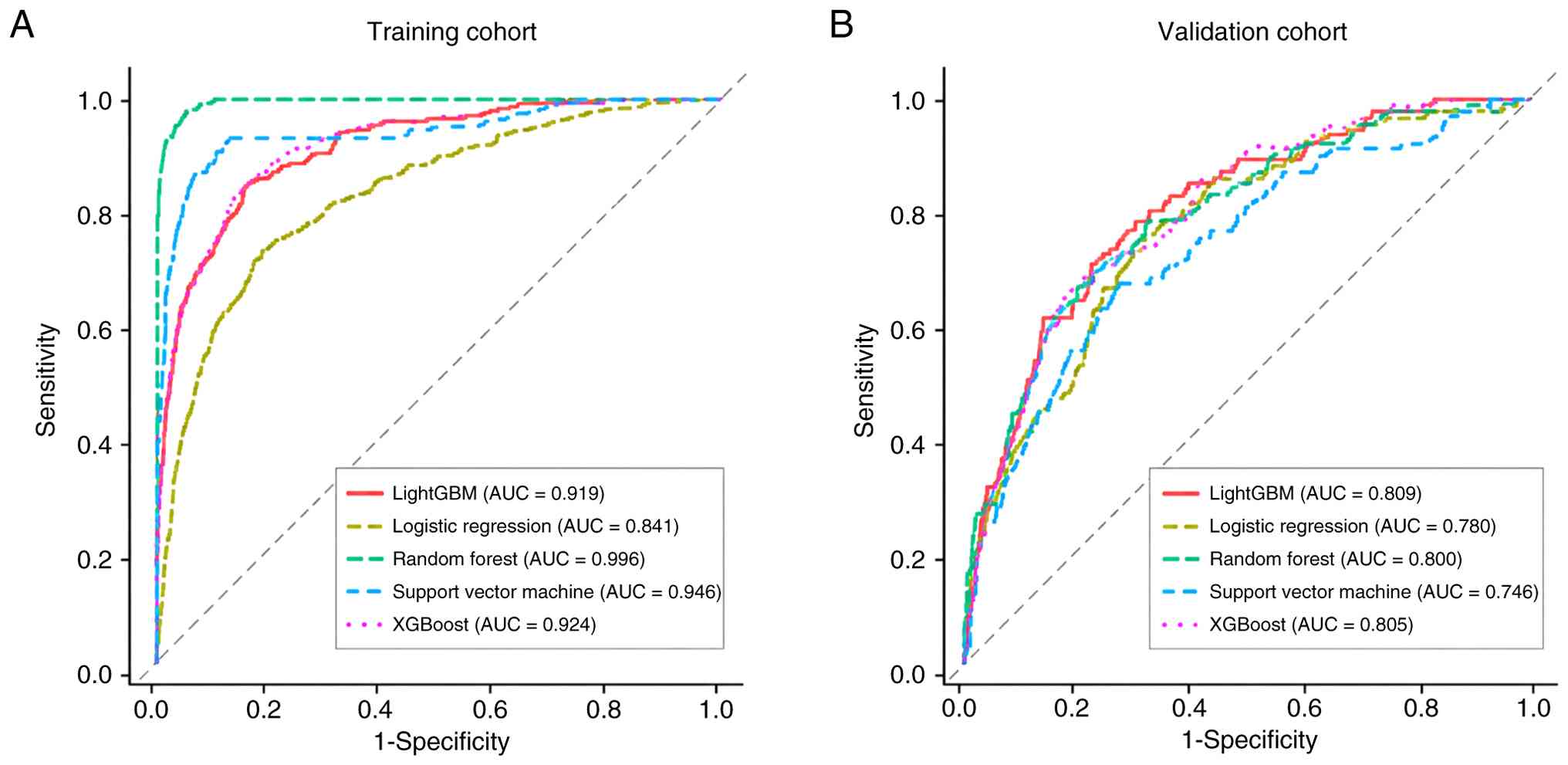 | Figure 1Receiver operating characteristic
curves of the five prediction models in the training and validation
cohorts. (A) Receiver operating characteristic curves of logistic
regression, random forest, support vector machine, XGBoost and
LightGBM models in the training cohort. (B) Receiver operating
characteristic curves of the five models in the internal validation
cohort. The AUC is shown for each model. Although random forest
showed the highest apparent discrimination in the training cohort,
its performance decreased in the validation cohort, suggesting
potential overfitting. In the validation cohort, LightGBM achieved
an AUC of 0.809 and XGBoost achieved an AUC of 0.805; the paired
DeLong test showed no statistically significant difference between
the two models (P=0.647). XGBoost was selected as the final model
because it showed higher sensitivity, negative predictive value and
F1 score, which were more closely aligned with the clinical
objective of identifying high-risk women and minimizing missed
high-risk cases. AUC, area under the receiver operating
characteristic curve; XGBoost, Extreme Gradient Boosting. |
| Table IIIPredictive performance of different
models in the training and validation cohorts. |
Table III
Predictive performance of different
models in the training and validation cohorts.
| Model | Cohort | AUC | AUC 95% CI | Accuracy | Sensitivity | Specificity | PPV | NPV | F1 score | Brier score |
|---|
| Logistic
regression | Training
cohort | 0.841 | 0.811-0.871 | 0.798 | 0.746 | 0.813 | 0.528 | 0.919 | 0.618 | 0.119 |
| | Validation
cohort | 0.780 | 0.729-0.830 | 0.738 | 0.602 | 0.776 | 0.431 | 0.874 | 0.502 | 0.143 |
| Random forest | Training
cohort | 0.996 | 0.994-0.998 | 0.959 | 0.982 | 0.952 | 0.852 | 0.995 | 0.912 | 0.055 |
| | Validation
cohort | 0.800 | 0.751-0.850 | 0.780 | 0.643 | 0.819 | 0.500 | 0.891 | 0.562 | 0.134 |
| Support vector
machine | Training
cohort | 0.946 | 0.927-0.966 | 0.922 | 0.877 | 0.935 | 0.791 | 0.964 | 0.832 | 0.073 |
| | Validation
cohort | 0.746 | 0.690-0.803 | 0.724 | 0.633 | 0.750 | 0.416 | 0.879 | 0.502 | 0.146 |
| XGBoost | Training
cohort | 0.924 | 0.904-0.943 | 0.837 | 0.877 | 0.825 | 0.585 | 0.960 | 0.702 | 0.089 |
| | Validation
cohort | 0.805 | 0.758-0.852 | 0.760 | 0.714 | 0.773 | 0.470 | 0.906 | 0.567 | 0.134 |
| LightGBM | Training
cohort | 0.919 | 0.900-0.939 | 0.844 | 0.860 | 0.840 | 0.601 | 0.955 | 0.708 | 0.093 |
| | Validation
cohort | 0.809 | 0.762-0.857 | 0.776 | 0.653 | 0.810 | 0.492 | 0.892 | 0.561 | 0.132 |
Calibration and decision curve
analysis of the XGBoost model
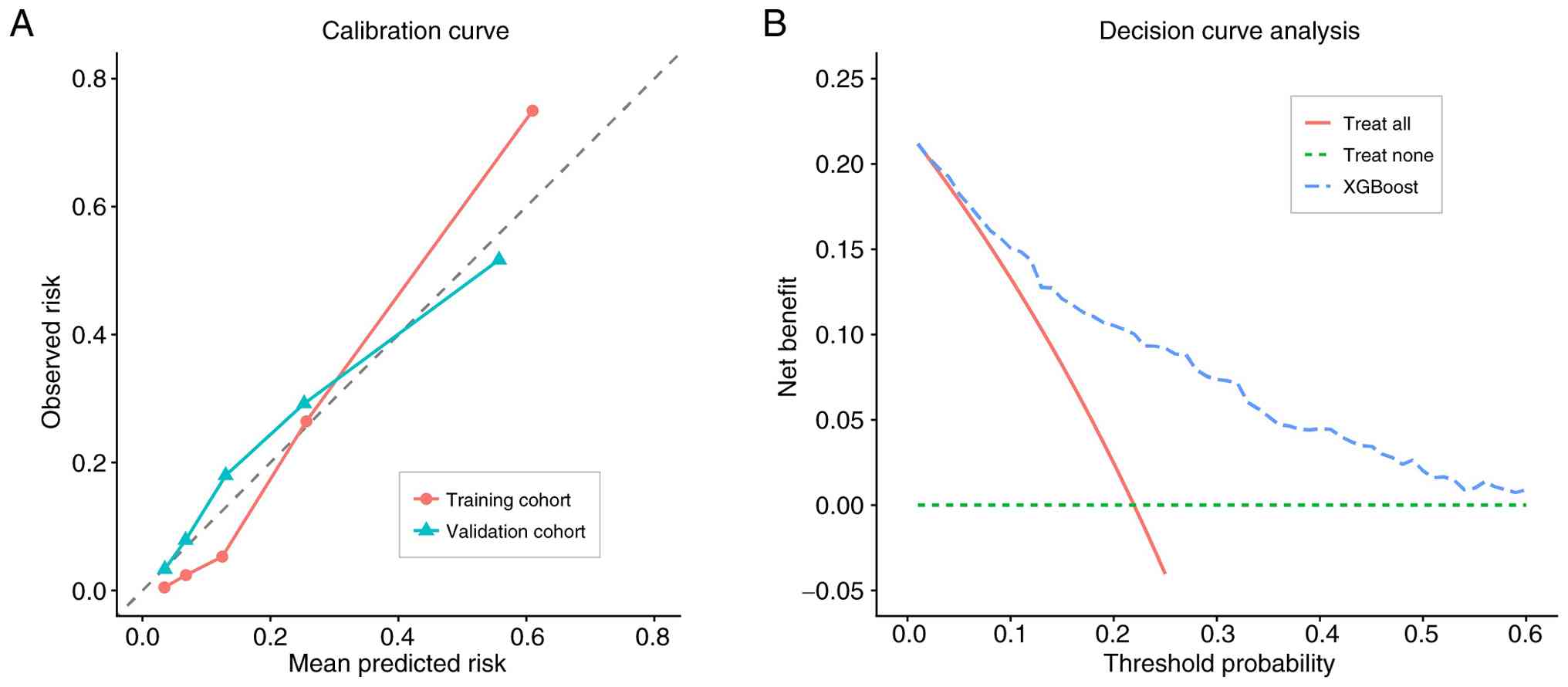
The calibration curve showed general agreement
between predicted and observed risks in the internal validation
cohort, although some deviation from ideal calibration was observed
at higher predicted probabilities. The validation calibration
intercept was 1.290 and the calibration slope was 2.161; the
corresponding optimism-corrected estimates were 1.268 and 2.137.
These findings suggest that calibration was not uniform across the
full predicted-risk range and should be reassessed in future
temporal and external validation. Decision curve analysis showed
that the XGBoost model provided higher estimated net benefit than
the treat-all and treat-none strategies across much of the
threshold range displayed in Fig.
2. Because the analysis was based on single-center internal
validation, it should be interpreted as preliminary
decision-analytic evidence rather than proof of clinical
utility.
SHAP-based interpretation of the final
XGBoost model
SHAP analysis was performed in the validation cohort
to interpret the final XGBoost model. The 10 highest-ranked
predictors according to mean absolute SHAP value, in descending
order, were postoperative pain NRS score at 2 h, emergency cesarean
delivery, time to first documented turning, lower limb numbness
within 0-4 h, systolic blood pressure at 2 h, body mass index,
preoperative hemoglobin, age, intraoperative fluid volume and
dizziness or orthostatic discomfort within 0-4 h. Postoperative
pain NRS score at 2 h had the highest mean absolute SHAP value
(0.6876). The SHAP summary plot indicated that higher pain scores,
emergency cesarean delivery, later time to first documented
turning, lower limb numbness, higher body mass index, lower
preoperative hemoglobin, lower systolic blood pressure and
dizziness or orthostatic discomfort generally shifted predictions
toward a higher estimated risk of ambulation failure. Although age
and intraoperative fluid volume did not show statistically
significant between-group differences in the univariable
comparisons presented in Table
II, they ranked among the 10 highest predictors by mean
absolute SHAP value in the multivariable XGBoost model. This is not
contradictory, because SHAP importance reflects a variable's
contribution to model predictions, including possible non-linear
and interaction effects, rather than statistical significance in
univariable hypothesis testing. No simple directional
interpretation was assigned to these variables because their SHAP
distributions did not demonstrate a sufficiently clear monotonic
pattern. These findings show that demographic, perioperative and
early postoperative nursing assessment variables contributed to
individualized risk predictions. SHAP values represent predictive
contributions rather than causal effects. The dependence plot
further showed that higher postoperative pain NRS scores at 2 h
were generally associated with higher SHAP values and greater
predicted risk (Fig. 3).
 | Figure 3SHAP-based interpretation of the final
XGBoost model. (A) SHAP importance plot showing the 10
highest-ranked predictors according to mean absolute SHAP value, in
descending order: postoperative pain NRS score at 2 h, emergency
cesarean delivery, time to first documented turning, lower limb
numbness within 0-4 h, systolic blood pressure at 2 h, body mass
index, preoperative hemoglobin, age, intraoperative fluid volume
and dizziness or orthostatic discomfort within 0-4 h. (B) SHAP
summary plot showing the distribution and direction of feature
contributions to model predictions. Higher postoperative pain
scores, emergency cesarean delivery, later time to first documented
turning, lower limb numbness, higher body mass index, lower
preoperative hemoglobin, lower systolic blood pressure and
dizziness or orthostatic discomfort generally shifted predictions
toward a higher estimated risk of failure of first ambulation. Age
and intraoperative fluid volume contributed to model predictions,
although their SHAP distributions did not indicate a simple
monotonic direction of association. SHAP values represent
predictive contributions and should not be interpreted as causal
effects. In particular, time to first documented turning was a
dynamically updated early recovery marker rather than an
independent causal determinant of ambulation failure. (C) SHAP
dependence plot for postoperative pain NRS score at 2 h, showing
that higher pain scores were generally associated with higher SHAP
values and greater predicted risk. NRS, numeric rating scale; SHAP,
SHapley Additive exPlanations. |
Discussion
In the present single-center retrospective cohort
study, five prediction models were developed and internally
validated for failure of first ambulation within 12 h after
cesarean delivery using routinely collected perioperative nursing
assessment data. The overall incidence of ambulation failure was
21.9%, indicating that ~1/5 women did not complete first ambulation
within the early postoperative window. Among the five models,
LightGBM achieved a marginally higher validation AUC and a lower
Brier score, whereas XGBoost achieved higher sensitivity, negative
predictive value and F1 score. The paired DeLong test showed no
statistically significant difference between the validation AUCs of
XGBoost and LightGBM, indicating comparable discrimination. Because
the clinical purpose of the model was to identify women at high
risk and minimize missed high-risk cases, XGBoost was selected as
the final model.
Early ambulation is a core element of enhanced
recovery pathways and is closely related to postoperative
functional recovery. Although enhanced recovery programs were
initially developed in general surgery, their principles have been
increasingly adopted in obstetric care to improve maternal
recovery, reduce unnecessary immobilization and promote earlier
return to self-care and infant care (15). Previous studies have suggested that
structured enhanced recovery pathways after cesarean delivery can
shorten postoperative length of stay, improve pain control and
increase maternal satisfaction when implemented with
multidisciplinary support (16,17).
However, early mobilization after cesarean delivery differs from
mobilization after numerous other surgical procedures because women
may experience residual neuraxial anesthesia effects, lower limb
weakness or numbness, uterine contraction pain, incision pain,
urinary catheter-related discomfort and orthostatic symptoms within
the first postoperative hours. Therefore, predicting failure of
early ambulation is clinically meaningful because it reflects the
interaction between surgical recovery, anesthesia recovery, pain
control, hemodynamic stability and bedside nursing assessment.
The incidence of failure of first ambulation in the
present study was 21.9%, which appears clinically plausible for a
12-h postoperative endpoint. Previous enhanced recovery studies
have reported improvements in early mobilization, but the exact
timing and definition of ambulation vary considerably across
institutions (18). Some studies
define early ambulation as sitting out of bed, standing, walking a
short distance or walking independently, whereas others consider
mobilization as a broader process that includes turning, sitting,
dangling, standing and walking (19). In the present study, the outcome
was defined as failure to complete first ambulation within 12 h or
discontinuation of an ambulation attempt because of documented
intolerance. This definition is practical for nursing documentation
because it captures both absence of ambulation and failed
ambulation attempts. It also better reflects real-world bedside
decision-making, where the reason for stopping ambulation is often
as important as the timing itself.
Among all predictors, postoperative pain NRS score
at 2 h was the most important contributor to the final XGBoost
model. This finding is consistent with the clinical observation
that inadequate pain control is one of the most direct barriers to
turning, sitting, standing and walking after cesarean delivery.
Acute post-cesarean pain is affected by incision pain, uterine
involution pain, visceral discomfort, anxiety and individual pain
sensitivity. Poorly controlled acute pain can limit respiratory
effort, reduce willingness to move, delay breastfeeding positioning
and impair maternal functional recovery (20). In addition, severe acute pain after
childbirth has been associated with persistent pain and postpartum
psychological morbidity, suggesting that early pain assessment
should not be regarded only as a comfort indicator but also as a
functional recovery marker (21).
The present finding supports the importance of pain-guided
mobilization planning. Women with high pain scores at 2 h may
benefit from timely analgesic optimization, nonpharmacological
comfort measures, abdominal support and stepwise assisted
mobilization rather than routine encouragement alone.
Emergency cesarean delivery was the second most
important predictor. Compared with elective cesarean delivery,
emergency cesarean delivery is often associated with greater
preoperative anxiety and psychological stress, reflecting the more
urgent and less predictable clinical circumstances surrounding
emergency delivery (22). These
factors may contribute to postoperative fatigue, anxiety, pain
perception, hemodynamic instability, and delayed readiness for
mobilization. Previous obstetric anesthesia and recovery studies
have shown that emergency cesarean delivery is associated with
higher perioperative stress and less predictable postoperative
recovery compared with scheduled procedures (23). In the present study, the high SHAP
ranking of emergency cesarean delivery suggests that procedure
context should be incorporated into nursing assessment. Women after
emergency cesarean delivery may need more proactive postoperative
education, reassurance, pain assessment and supervised
mobilization.
First turning time was another influential predictor
in the present XGBoost model. It was defined as the elapsed time
from completion of surgery to the earliest documented spontaneous
or assisted turning in bed and was treated as a dynamically updated
indicator of early functional recovery. Turning in bed is an early
nursing-observed activity that generally occurs before sitting,
standing and ambulation in progressive postoperative mobilization
pathways (24). However, delayed
first turning may itself reflect pain, residual motor or sensory
block, dizziness, fatigue, reduced activity tolerance or the need
for additional nursing assistance. It may therefore lie on the
recovery pathway leading to ambulation and should not be
interpreted as an independent causal determinant of ambulation
failure. Its SHAP importance indicates that it contributed to model
predictions but does not demonstrate that delayed turning caused
the outcome or that accelerating turning alone would reduce the
risk of ambulation failure. Clinically, delayed first turning may
instead serve as an early warning signal prompting reassessment of
pain, lower limb recovery, hemodynamic tolerance and readiness for
progressive mobilization.
Lower limb numbness within 0-4 h was also notably
associated with ambulation failure in the present study. This
finding is clinically reasonable because most cesarean deliveries
are performed under neuraxial anesthesia, and residual sensory or
motor block may impair balance, confidence and safety during
standing or walking. Although early ambulation is encouraged in
enhanced recovery pathways, mobilization should occur only after
adequate recovery of lower limb strength and sensation.
Inappropriate ambulation before full recovery may increase the risk
of falls or injury. Postoperative mobility assessment after
neuraxial anesthesia therefore requires careful evaluation of lower
limb sensation, muscle strength, dizziness and hemodynamic status
(25). The importance of lower
limb numbness in the present SHAP analysis highlights the need to
distinguish between unwillingness to ambulate and temporary
physiological inability to ambulate. For women with residual
numbness, nursing care should focus on reassessment, fall
prevention and delayed but supervised mobilization when safe.
Systolic blood pressure at 2 h and dizziness or
orthostatic discomfort within 0-4 h were also important predictors
in the present study, indicating that hemodynamic tolerance is a
key determinant of successful ambulation. Orthostatic intolerance
after surgery may manifest as dizziness, nausea, blurred vision,
weakness, sweating or hypotension during sitting or standing. These
symptoms may be related to neuraxial anesthesia, blood loss,
fasting, fluid shifts, vasodilation, pain and limited oral intake.
Previous perioperative studies have shown that orthostatic
intolerance is a frequent barrier to early mobilization and may
delay recovery even when surgical complications are absent
(26,27). In the present study, lower systolic
blood pressure and dizziness or orthostatic discomfort contributed
to higher predicted risk, supporting the need for structured
pre-ambulation assessment. Before first ambulation, nurses should
evaluate blood pressure, symptoms during position change, lower
limb strength, pain control and availability of assistance.
Body mass index and preoperative hemoglobin were
also included among the top SHAP predictors in the present
analysis. Higher body mass index may increase the physical
difficulty of turning, standing and walking after abdominal surgery
and may also be associated with longer operative time, higher
anesthetic complexity and greater postoperative discomfort. Obesity
has been associated with increased cesarean-related morbidity and
delayed functional recovery in several obstetric studies (28). Lower preoperative hemoglobin may
reflect reduced physiological reserve, anemia-related fatigue and
lower tolerance to blood loss, all of which may affect early
mobilization capacity. Postpartum anemia has been associated with
fatigue, reduced quality of life, impaired cognition and depressive
symptoms, which may indirectly influence willingness and ability to
ambulate (29). These findings
suggest that women with high BMI or anemia may require more
individualized recovery planning, including early support, gradual
mobilization, and close symptom monitoring.
A notable strength of the present study is that the
model was developed using routinely available perioperative and
nursing assessment data rather than specialized tests or complex
imaging. The 10 highest-ranked predictors included demographic
characteristics, perioperative variables and early postoperative
nursing observations, specifically postoperative pain NRS score at
2 h, emergency cesarean delivery, time to first documented turning,
lower limb numbness within 0-4 h, systolic blood pressure at 2 h,
body mass index, preoperative hemoglobin, age, intraoperative fluid
volume and dizziness or orthostatic discomfort within 0-4 h. Of
these variables, numerous are already recorded during routine
perioperative care, which may facilitate future workflow
integration. A risk estimate generated during the early
postoperative recovery period could help nurses prioritize patients
for reassessment, analgesic optimization, supervised mobilization,
fall-risk prevention and individualized health education. However,
the SHAP ranking reflects predictive importance and should not be
interpreted as demonstrating that each variable is independently
modifiable or causally related to ambulation failure.
The comparison among models also highlights the risk
of optimism and overfitting in flexible prediction algorithms. The
available sample size also warrants cautious interpretation.
Although the training cohort contained 228 outcome events for 26
prespecified candidate predictors, categorical encoding may have
increased the effective dimensionality, and the event count may
still be insufficient to exclude instability in flexible
machine-learning models. The use of cross-validation and
constrained boosting parameters reduced but did not eliminate the
risk of overfitting. Random forest achieved a markedly high
apparent training AUC of 0.996 but showed a notable decline in the
internal validation cohort, where its AUC was 0.800. This pattern
demonstrates why apparent training performance cannot be
interpreted as expected performance in new patients and highlights
the importance of adequate sample size and internal validation in
prediction-model development (30). The other machine learning models
may also retain some degree of optimism despite their smaller
apparent-to-validation performance gaps, because all models were
evaluated using an internal split from the same single-center
source population rather than an independent temporal or geographic
cohort. Among the two leading models, LightGBM achieved a
marginally higher validation AUC and a lower Brier score, whereas
XGBoost achieved higher sensitivity, negative predictive value and
F1 score. The paired DeLong test showed no statistically
significant difference between their validation AUCs (P=0.647),
indicating comparable discrimination. False-negative predictions
could lead to missed opportunities for reassessment, analgesic
optimization, fall-risk prevention, or supervised mobilization,
whereas false-positive predictions could increase nursing workload
or unnecessary assistance. Because the initial intended use is
risk-sensitive early screening, sensitivity, negative predictive
value and F1 score were prioritized after confirming comparable
discrimination. Therefore, XGBoost was retained as the final model,
while recognizing that its apparent performance and clinical impact
require temporal and external validation.
Calibration and decision curve analysis provided
additional information beyond discrimination. Discrimination alone
is insufficient for evaluating a prediction model because a model
with a high AUC may still produce poorly calibrated risk estimates
(31). In the present study, the
calibration curve showed acceptable agreement between predicted and
observed risks within the source population, and decision curve
analysis indicated a higher estimated net benefit than the
treat-all and treat-none strategies across a range of threshold
probabilities. Nevertheless, these results were derived from
single-center internal validation and cannot establish clinical
utility or readiness for bedside decision-making. Decision curve
analysis estimates potential net benefit under specified
assumptions but does not demonstrate that use of the model improves
nursing decisions or patient outcomes. Appropriate thresholds,
transportability, workflow feasibility and clinical impact should
therefore be evaluated prospectively in independent external
populations before implementation is considered.
The use of SHAP analysis provided transparent
descriptions of how recorded variables contributed to individual
model predictions. Explainability may help clinicians inspect
whether a prediction is consistent with the available clinical
record, but it does not establish causal effects, independent
determinants, modifiable treatment targets or improved patient
outcomes. This distinction is particularly important for
time-updated recovery indicators such as first turning time, which
may reflect the combined effects of pain, residual anesthesia,
activity tolerance and nursing assistance. In the present study,
SHAP-ranked variables should therefore be interpreted as predictive
markers of early postoperative recovery status. They may prompt
reassessment or safety checks, but the model does not establish
that changing pain, dizziness, turning time or any other highly
ranked feature will reduce ambulation failure. Interpretable
machine learning may facilitate model review and error detection,
but challenges involving usability, clinician trust, workflow
integration and prospective evaluation remain important before
implementation (32).
Transparent reporting and structured risk-of-bias
assessment are important for evaluating prediction models but do
not by themselves establish clinical implementation readiness
(13,33). Interpretive ‘spin’ may lead
preliminary or internally validated findings to be perceived as
demonstrating greater clinical benefit than the study design
supports (34). Prospective
registration can improve transparency in future validation and
implementation research (35).
Broader biomarker research further illustrates that the clinical
meaning of a predictive marker depends on its measurement context,
target population, reproducibility and intended decision pathway
(36-38).
Accordingly, the SHAP-ranked variables in the present study should
be interpreted as predictive markers of early postoperative
recovery status rather than independently causal or immediately
actionable intervention targets.
The present study has several limitations. First, it
was conducted in a single tertiary hospital, and local nursing
protocols, anesthesia practices, postoperative mobilization
routines, case mix and documentation habits may limit
transportability to other settings. The random training-validation
split assessed performance only within the same source population
and does not constitute temporal or geographic external validation.
Consequently, the model should not be regarded as clinically ready,
and its performance requires evaluation in independent multicenter
cohorts before implementation can be considered. Accordingly, the
model applies only to relatively stable postoperative women
considered clinically eligible for early mobilization and should
not be generalized to all women undergoing cesarean delivery. In
particular, it should not be extrapolated to women transferred to
intensive care, women with severe postpartum hemorrhage, women with
explicit medical restrictions on ambulation or women with severe
postoperative complications. Second, the retrospective design may
have introduced selection and information bias because eligibility,
predictors and outcomes depended on routine documentation. Although
the final analytic dataset contained no item-level missing values,
undocumented symptoms or ambulation attempts could still have
resulted in measurement error or outcome misclassification, and
exclusion of records with insufficient information may have
introduced selection bias. Third, time to first documented turning
was a dynamically updated recovery indicator rather than a
predictor available at a uniform fixed postoperative time point.
Its availability depended on when turning occurred and was
documented, which should be considered when interpreting the model
and designing prospective validation studies. Fourth, some
potentially relevant variables were unavailable, including detailed
neuraxial block regression time, exact analgesic dosing,
breastfeeding attempts, patient motivation, family support, sleep
quality and nurse-to-patient ratio. Fifth, decision curve analysis
estimates potential net benefit under specified assumptions but
does not demonstrate improved care or patient outcomes. Finally,
SHAP analysis does not establish causality. Predictors such as
pain, time to first documented turning and dizziness should be
interpreted as predictive markers of recovery status rather than
proven causal factors or independently modifiable intervention
targets. Future research should define a uniform prediction time,
undertake temporal and geographic external validation, assess
calibration and decision thresholds across settings, and
prospectively determine whether model-guided assessment improves
nursing decisions or postoperative recovery.
In summary, the present study developed and
internally validated an explainable XGBoost model for predicting
failure of first ambulation within 12 h after cesarean delivery
using routinely collected perioperative nursing assessment data.
The model demonstrated good discrimination and acceptable
calibration within this single-center retrospective cohort, and its
performance was comparable to or better than that of the other
evaluated models according to clinically relevant classification
metrics. The 10 highest-ranked predictors according to mean
absolute SHAP value were postoperative pain NRS score at 2 h,
emergency cesarean delivery, time to first documented turning,
lower limb numbness within 0-4 h, systolic blood pressure at 2 h,
body mass index, preoperative hemoglobin, age, intraoperative fluid
volume and dizziness or orthostatic discomfort within 0-4 h. Time
to first documented turning should be interpreted as a dynamically
updated marker of functional recovery rather than a causal
determinant of ambulation failure, and SHAP rankings represent
predictive contributions rather than causal effects. These findings
indicate that explainable machine learning may offer a useful
framework for early risk stratification and individualized
postoperative mobilization planning after cesarean delivery.
External and prospective validation are needed to determine its
transportability and clinical impact before routine
implementation.
Supplementary Material
Participant screening, exclusion and
cohort allocation. A total of 1,612 records were initially
screened, of which 126 were excluded according to the predefined
eligibility criteria. The final analytic cohort included 1,486
women, who were randomly allocated to the training cohort (n=1,040)
and internal validation cohort (n=446).
Acknowledgements
Not applicable.
Funding
Funding: No funding was received.
Availability of data and materials
The data generated in the present study may be
requested from the corresponding author.
Authors' contributions
LX, YJ and WL designed the study and collected the
clinical data. JX performed data preprocessing and statistical
analyses. HD supervised the study, interpreted the results and
revised the manuscript critically for important intellectual
content. LX and YJ confirm the authenticity of all the raw data.
All authors read and approved the final manuscript.
Ethics approval and consent to
participate
The present study was conducted in accordance with
the principles of The Declaration of Helsinki and was approved by
the Clinical Trial Ethics Committee of The Affiliated Hospital of
Southwest Medical University (approval no. KY2026314). As a
retrospective study using routinely collected medical records, the
requirement for written informed consent was waived by the Ethics
Committee. All patient data were anonymized prior to analysis to
ensure confidentiality and privacy.
Patient consent for publication
Not applicable.
Competing interests
The authors declare that they have no competing
interests.
References
|
1
|
Mackeen AD, Sullivan MV, Bender W, Di
Mascio D and Berghella V: Evidence-based cesarean delivery:
Postoperative care (part 10). Am J Obstet Gynecol MFM.
7(101549)2025.PubMed/NCBI View Article : Google Scholar
|
|
2
|
Lestari MI, Sari D, Chandra S, Purwoko P,
Isngadi I and Umar TP: Enhanced recovery after cesarean (ERAC)
versus conventional care: An expanded systematic review and
meta-analysis of 18,368 subjects. J Anaesthesiol Clin Pharmacol.
41:48–61. 2025.PubMed/NCBI View Article : Google Scholar
|
|
3
|
Zhao ZM, Yang JQ, Wang GX, Yu XJ and Feng
Y: A meta-analysis of the effects of multimodal intervention
measures on the recovery of postpartum women after cesarean
section. Front Med (Lausanne). 12(1690139)2025.PubMed/NCBI View Article : Google Scholar
|
|
4
|
Hooda R, Malik N, Pathak P, More H and
Singh V: Impact of postoperative pain on early initiation of
breastfeeding and ambulation after cesarean section: A randomized
trial. Breastfeed Med. 18:132–137. 2023.PubMed/NCBI View Article : Google Scholar
|
|
5
|
Sultan P, Monks DT, Sharawi N, Bamber J,
Panelli DM, Sauro KM, Shah PS, Muraca GM, Metcalfe A, Wood SL, et
al: Guidelines for postoperative care in cesarean delivery:
Enhanced recovery after surgery society recommendations (part
3)-2025 update. Am J Obstet Gynecol. 233:S184–S198. 2026.PubMed/NCBI View Article : Google Scholar
|
|
6
|
Saelmans A, Seinen T, Pera V, Markus AF,
Fridgeirsson E, John LH, Schiphof-Godart L, Rijnbeek P, Reps J and
Williams R: Implementation and updating of clinical prediction
models: A systematic review. Mayo Clin Proc Digit Health.
3(100228)2025.PubMed/NCBI View Article : Google Scholar
|
|
7
|
Giaxi P, Vivilaki V, Sarella A,
Harizopoulou V and Gourounti K: Artificial intelligence and machine
learning: An updated systematic review of their role in obstetrics
and midwifery. Cureus. 17(e80394)2025.PubMed/NCBI View Article : Google Scholar
|
|
8
|
Vasudevan L, Kibria MG, Kucirka LM, Shieh
K, Wei M, Masoumi S, Balasubramanian S, Victor A, Conklin JL,
Gurcan MN, et al: Machine learning models to predict risk of
maternal morbidity and mortality from electronic medical record
data: Scoping review. J Med Internet Res. 27(e68225)2025.PubMed/NCBI View
Article : Google Scholar
|
|
9
|
Grasch JL, Rojas JC, Sharifi M, McLaughlin
MM, Bhamidipalli SS and Haas DM: Impact of enhanced recovery after
surgery pathway for cesarean delivery on postoperative pain. AJOG
Glob Rep. 3(100169)2023.PubMed/NCBI View Article : Google Scholar
|
|
10
|
Ponce-Bobadilla AV, Schmitt V, Maier CS,
Mensing S and Stodtmann S: Practical guide to SHAP analysis:
Explaining supervised machine learning model predictions in drug
development. Clin Transl Sci. 17(e70056)2024.PubMed/NCBI View Article : Google Scholar
|
|
11
|
Wiens M, Verone-Boyle A, Henscheid N,
Podichetty JT and Burton J: A tutorial and use case example of the
eXtreme gradient boosting (XGBoost) artificial intelligence
algorithm for drug development applications. Clin Transl Sci.
18(e70172)2025.PubMed/NCBI View Article : Google Scholar
|
|
12
|
Deng L, Lu K and Hu H: An interpretable
LightGBM model for predicting coronary heart disease: Enhancing
clinical decision-making with machine learning. PLoS One.
20(e0330377)2025.PubMed/NCBI View Article : Google Scholar
|
|
13
|
Collins GS, Moons KGM, Dhiman P, Riley RD,
Beam AL, Van Calster B, Ghassemi M, Liu X, Reitsma JB, van Smeden
M, et al: TRIPOD+AI statement: Updated guidance for reporting
clinical prediction models that use regression or machine learning
methods. BMJ. 385(e078378)2024.PubMed/NCBI View Article : Google Scholar
|
|
14
|
Zhao L, Leng Y, Hu Y, Xiao J, Li Q, Liu C
and Mao Y: Understanding decision curve analysis in clinical
prediction model research. Postgrad Med J. 100:512–515.
2024.PubMed/NCBI View Article : Google Scholar
|
|
15
|
Ciechanowicz S, De Greef E, Van de Velde M
and Sultan P: Optimising recovery after caesarean delivery. Best
Pract Res Clin Anaesthesiol. 38:199–208. 2024.PubMed/NCBI View Article : Google Scholar
|
|
16
|
Walker M, Sobel M, Siddiqi N, Carvalho
JCA, Jahan N, Santini S, Watts N, Dart K, Wang S, Huszti E and
Thomas J: Implementation of enhanced recovery after surgery for
caesarean delivery: A quality improvement initiative. BMJ Open
Qual. 14(e003391)2025.PubMed/NCBI View Article : Google Scholar
|
|
17
|
de Oliveira TTC, Tapioca V, Pereira E,
Ferreira B, Soares T, Amaral S, Assis ML, Carvalho G, Curi JS and
Kumar K: Enhanced recovery after surgery for cesarean delivery: A
systematic review and meta-analysis of randomized trials with trial
sequential analysis. Braz J Anesthesiol. 76(844817)2026.PubMed/NCBI View Article : Google Scholar
|
|
18
|
Lin L, Chen P, Wan T, Xie G, Wang P, Yan
X, Li R, Chen W and Zhang W: Nurse-led evidence-based practice to
promote gastrointestinal function recovery in women after cesarean
delivery. Int J Womens Health. 17:4399–4408. 2025.PubMed/NCBI View Article : Google Scholar
|
|
19
|
Arslan E and Özkan S: Effects of
preoperative mobilization education using the teach-back method on
patient outcomes after gynecological surgery: A
randomized-controlled study. Nurs Health Sci.
27(e70151)2025.PubMed/NCBI View Article : Google Scholar
|
|
20
|
Gamez BH and Habib AS: Predicting severity
of acute pain after cesarean delivery: A narrative review. Anesth
Analg. 126:1606–1614. 2018.PubMed/NCBI View Article : Google Scholar
|
|
21
|
Yurashevich M, Cooter Wright M, Sims SC,
Tan HS, Berger M, Ji RR and Habib AS: Inflammatory changes in the
plasma and cerebrospinal fluid of patients with persistent pain and
postpartum depression after elective cesarean delivery: An
exploratory prospective cohort study. Can J Anaesth. 70:1917–1927.
2023.PubMed/NCBI View Article : Google Scholar
|
|
22
|
Ferede YA, Bizuneh YB, Workie MM and
Admass BA: ‘Prevalence and associated factors of preoperative
anxiety among obstetric patients who underwent cesarean section’: A
cross-sectional study. Ann Med Surg (Lond).
74(103272)2022.PubMed/NCBI View Article : Google Scholar
|
|
23
|
Orovou E and Antoniou E: Voices of women
with emergency cesarean section experience: A qualitative approach.
Cureus. 16(e53429)2024.PubMed/NCBI View Article : Google Scholar
|
|
24
|
Akkaya H and Ayhan H: The effect of in-bed
turning and mobilization training given to patients who undergo
lumbar disk surgery on postoperative first mobility level: A
single-blind, randomized controlled trial. Int J Orthop Trauma
Nurs. 50(101022)2023.PubMed/NCBI View Article : Google Scholar
|
|
25
|
Landau R and Sultan P: Neuraxial
anesthesia and pain management for cesarean delivery. Am J Obstet
Gynecol. 233:S135–S152. 2026.PubMed/NCBI View Article : Google Scholar
|
|
26
|
Yi H, Tang W, Shen Y, Tan L, Zeng F and
Yang S: Orthostatic intolerance during early mobilization following
thoracoscopic lung resection: A prospective observational study.
BMC Surg. 24(265)2024.PubMed/NCBI View Article : Google Scholar
|
|
27
|
Hardy PYJP, Tavano A, Jacquet SV, Monseur
JJ, Bastin ML, Kohnen LP, Haumann AE and Joris JL: The impact of
orthostatic intolerance on early ambulation following abdominal
surgery in an enhanced recovery programme. Acta Anaesthesiol Scand.
66:454–462. 2022.PubMed/NCBI View Article : Google Scholar
|
|
28
|
Zimmo K, Ching-Johnson J, Jones PM, Singh
SI, Dobrowlanski A, Symons YT, de Vrijer B, Sultan P, Carvalho B
and Sebbag I: Quality of recovery after cesarean delivery in
patients with class III obesity: A prospective observational cohort
study. Int J Obstet Anesth. 61(104312)2025.PubMed/NCBI View Article : Google Scholar
|
|
29
|
Neef V, Choorapoikayil S, Hof L, Meybohm P
and Zacharowski K: Current concepts in postpartum anemia
management. Curr Opin Anaesthesiol. 37:234–238. 2024.PubMed/NCBI View Article : Google Scholar
|
|
30
|
Martin GP, Riley RD, Ensor J and Grant SW:
Statistical primer: Sample size considerations for developing and
validating clinical prediction models. Eur J Cardiothorac Surg.
67(ezaf142)2025.PubMed/NCBI View Article : Google Scholar
|
|
31
|
Cabot JH and Ross EG: Evaluating
prediction model performance. Surgery. 174:723–726. 2023.
|
|
32
|
Abbas Q, Jeong W and Lee SW: Explainable
AI in clinical decision support systems: A meta-analysis of
methods, applications, and usability challenges. Healthcare
(Basel). 13(2154)2025.PubMed/NCBI View Article : Google Scholar
|
|
33
|
Wolff RF, Moons KGM, Riley RD, Whiting PF,
Westwood M, Collins GS, Reitsma JB, Kleijnen J and Mallett S:
PROBAST Group†. PROBAST: A tool to assess the risk of bias and
applicability of prediction model studies. Ann Intern Med.
170:51–58. 2019.PubMed/NCBI View
Article : Google Scholar
|
|
34
|
Boutron I, Haneef R, Yavchitz A, Baron G,
Novack J, Oransky I, Schwitzer G and Ravaud P: Three randomized
controlled trials evaluating the impact of ‘spin’ in health news
stories reporting studies of pharmacologic treatments on
patients’/caregivers’ interpretation of treatment benefit. BMC Med.
17(105)2019.PubMed/NCBI View Article : Google Scholar
|
|
35
|
Banno M, Tsujimoto Y and Kataoka Y:
Studies registered in non-ClinicalTrials.gov accounted for an
increasing proportion of protocol registrations in medical
research. J Clin Epidemiol. 116:106–113. 2019.PubMed/NCBI View Article : Google Scholar
|
|
36
|
Pizzimenti C, Fiorentino V, Ieni A, Rossi
ED, Germanà E, Giovanella L, Lentini M, Alessi Y, Tuccari G,
Campennì A, et al: BRAF-AXL-PD-L1 signaling axis as a possible
biological marker for RAI treatment in the thyroid cancer ATA
intermediate risk category. Int J Mol Sci. 24(10024)2023.PubMed/NCBI View Article : Google Scholar
|
|
37
|
Fiorentino V, Pizzimenti C, Franchina M,
Pepe L, Russotto F, Tralongo P, Micali MG, Militi GB and Lentini M:
Programmed cell death ligand 1 immunohistochemical expression and
cutaneous melanoma: A controversial relationship. Int J Mol Sci.
25(676)2024.PubMed/NCBI View Article : Google Scholar
|
|
38
|
Germanà E, Pepe L, Pizzimenti C, Ballato
M, Pierconti F, Tuccari G, Ieni A, Giuffrè G, Fadda G, Fiorentino V
and Martini M: Programmed cell death ligand 1 (PD-L1)
immunohistochemical expression in advanced urothelial bladder
carcinoma: An updated review with clinical and pathological
implications. Int J Mol Sci. 25(6750)2024.PubMed/NCBI View Article : Google Scholar
|