Introduction
Polymyalgia rheumatica (PMR) is a prevalent
inflammatory rheumatic disease predominantly affecting individuals
aged ≥50 years, characterized by pain in the muscles of the limbs
and joints, accompanied by a systemic inflammatory syndrome
(1). Clinically, PMR presents with
symmetrical pain and morning stiffness in the shoulder and pelvic
girdle muscles, often accompanied by systemic symptoms and elevated
acute-phase reactants. The condition is frequently associated with
giant cell arteritis (GCA) (2-4).
The incidence of PMR increases with age, and ~9% of patients
exhibit subclinical GCA, further complicating its diagnosis and
management (5).
The etiology and pathogenesis of PMR remain
incompletely understood. Current evidence suggests a multifactorial
origin involving genetic susceptibility, immune dysregulation (such
as imbalances in T-cell subsets and activation of pro-inflammatory
cytokines, including IL-6) and environmental triggers, such as
infections or vaccinations (6,7).
Regardless of the initiating factor, exposure to environmental
stimuli activates both innate and adaptive immune responses,
ultimately contributing to the development of PMR (8).
In recent years, the relationship between PMR and
malignancy has become a focus of clinical research, although a
definitive causal link remains controversial. A population-based
study in Sweden demonstrated a markedly increased risk of
malignancy within 1 year of PMR diagnosis, suggesting that PMR may
act as a paraneoplastic syndrome or as an inflammation-driven
comorbidity (9). By contrast, an
analysis using the UK General Practice Database found no direct
association between PMR and cancer risk (10). Notably, with the increasing use of
immunotherapy, cases of PMR induced by immune checkpoint inhibitors
(ICIs) [such as programmed cell death protein 1 (PD-1)/programmed
death-ligand 1 (PD-L1) inhibitors] have been reported, likely
resulting from autoimmune-like reactions mediated by T-cell
overactivation (11). Outside the
context of immunotherapy, secondary PMR following lung cancer
surgery remains extremely rare, and the potential roles of surgical
trauma and the tumor-associated inflammatory microenvironment in
disease onset have not been systematically investigated.
Lung cancer is among the most prevalent malignancies
worldwide (12), and the timely
identification and management of postoperative complications are
critical for patient outcomes. The present study reports the case
of a 73-year-old man who developed PMR following lung cancer
resection in the absence of immunotherapy. The diagnosis was
established based on clinical features, laboratory findings,
imaging characteristics and the American College of
Rheumatology-European Alliance of Associations for Rheumatology
(ACR-EULAR) 2012 classification criteria (13). Notably, the patient showed a
favorable response to the selective cyclooxygenase-2 (COX-2)
inhibitor celecoxib. The present report highlights a rare clinical
presentation and may contribute to improved recognition and
management of postoperative PMR, thereby reducing the risk of
misdiagnosis or delayed diagnosis.
Case report
A 73-year-old man with a medical history of
hypertension, type 2 diabetes mellitus and coronary artery disease
underwent coronary stent implantation in August 2016. In March
2024, the patient was diagnosed with left upper lobe lung cancer
(stage I; T1N0M0) according to the 8th edition of the TNM
Classification of Lung Cancer (14) and underwent surgical resection at
Shanghai Pulmonary Hospital (Shanghai, China). At 1 week after
surgery, the patient developed fever, chills, generalized myalgia,
fatigue and a mild cough with scant sputum.
Upon hospital admission, laboratory investigations
revealed notable leukocytosis (white blood cell count,
16.79x10⁹/l; reference range:
3.50-9.50x10⁹/l), neutrophilia (86.7%; reference range:
40.0-75.0%) and monocytosis (1.07x10⁹/l; reference
range: 0.10~0.60x10⁹/l). Biochemical analyses indicated
hypoalbuminemia (31.6 g/l; reference range: 40.0~55.0 g/l) and
hyperglycemia (15.27 mmol/l; reference range: 3.89~6.11 mmol/l),
alongside markedly elevated inflammatory markers, specifically
C-reactive protein (CRP; 156.00 mg/l; reference range: <10.00
mg/l) and interleukin-6 (IL-6; 75.80 pg/ml; reference range:
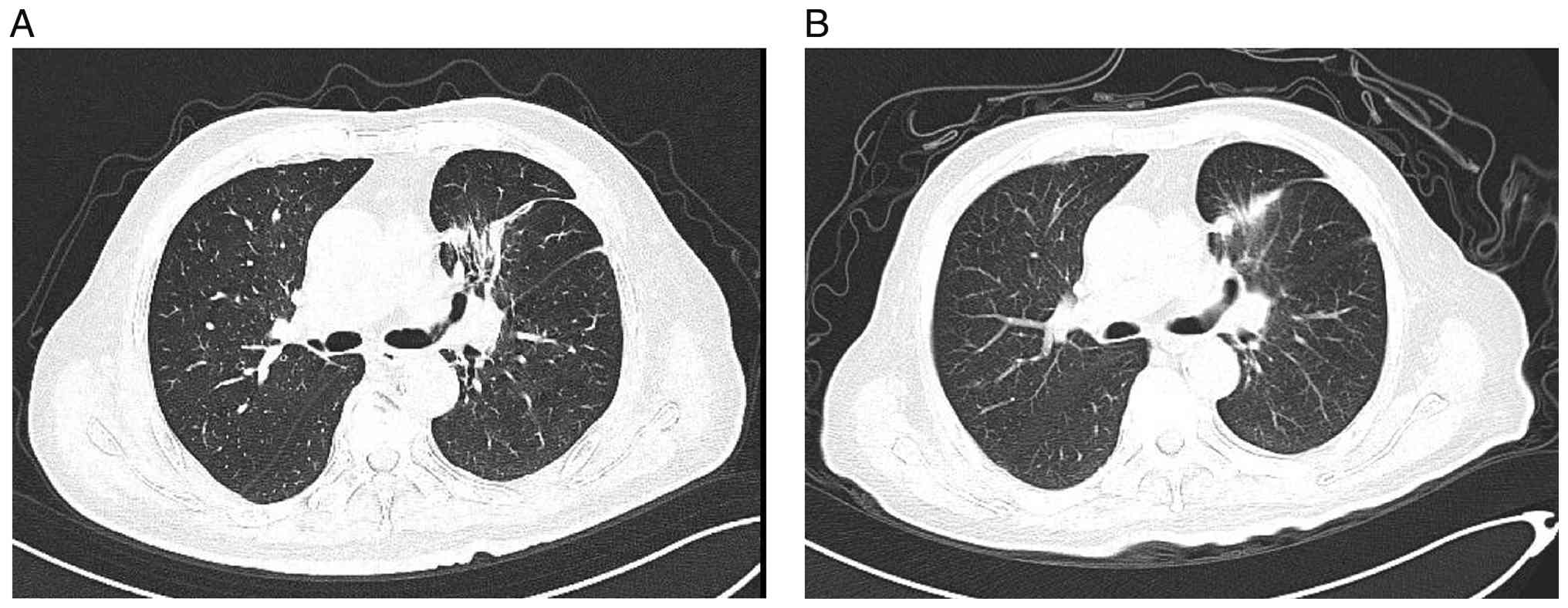
0.00-7.00 pg/ml). A chest computed tomography (CT) scan
demonstrated expected postoperative changes in the left lung, along
with small bilateral pulmonary nodules, mild interstitial
alterations and minimal pleural effusion (Fig. 1A). Initial microbiological cultures
and comprehensive respiratory pathogen testing yielded negative
results, effectively ruling out common infectious etiologies.
Due to the clinical presentation and elevated
inflammatory markers, an infectious etiology was initially
suspected. The patient received broad-spectrum antibiotic therapy
with piperacillin/tazobactam (4.5 g every 12 h), followed by
meropenem (1 g every 8 h) and linezolid (0.6 g every 12 h) due to
persistent symptoms (Fig. 2).
Despite antimicrobial therapy, the patient continued to experience
intermittent afternoon fevers ranging from 37.1 to 38.4˚C, and
inflammatory markers remained persistently elevated (Fig. 2; Table
I). Further investigations, including next-generation
sequencing for atypical pathogens, failed to identify any causative
infectious agents. Meanwhile, follow-up chest CT revealed no
appreciable differences relative to the imaging performed at
admission (Fig. 1B).
 | Table IChanges in inflammatory markers during
hospitalization. |
Table I
Changes in inflammatory markers during
hospitalization.
| Variable | Day 1
post-admission | Day 5
post-admission | Day 8
post-admission | Day 14
post-admission | Reference range |
|---|
| WBC count,
x109/l | 16.79 | 14.18 | 15.83 | 14.11 | 3.50-9.50 |
| Neutrophils, % | 86.70 | 90.50 | 86.30 | 86.80 | 40.00-75.00 |
| CRP, mg/l | 156.00 | 174.50 | >200.00 | 141.80 | <10.00 |
| IL-6, pg/ml | 75.80 | 157.41 | 306.42 | N/A | 0.00~7.00 |
| PCT, ng/ml | 0.761 | N/A | N/A | N/A | 0.000~0.500 |
| ESR, mm/h | N/A | N/A | N/A | 84.18 | 0.00~20.00 |
| Ferritin,
ng/ml | N/A | N/A | 2,095.47 | N/A | 23.90-336.20 |
At ~4 weeks post-surgery, the patient experienced a
persistent fever and severe myalgia and joint pain involving the
shoulders, hips and knees, despite broad-spectrum antibiotic
therapy and extensive negative infectious evaluations. However, no
clear infectious focus was identified. Given that the
musculoskeletal symptoms worsened with the fever, the patient was
diagnosed with PMR according to the ACR-EULAR 2012 classification
criteria (13). In the absence of
ultrasound evaluation, the scoring system ranges from 0 to 6
points; a score of ≥4 points is required for classification as PMR.
The criteria include morning stiffness lasting ≥45 min (2 points),
hip pain and/or limited range of motion (1 point), negative
rheumatoid factor and/or anti-cyclic citrullinated peptide antibody
results (2 points), and the absence of other joint involvement (1
point). In the present patient, morning stiffness lasting ≥45 min
(2 point), hip pain with limited range of motion (1 point), and
negative rheumatoid factor and anti-cyclic citrullinated peptide
antibody results were observed (2 points), while no other joint
involvement was identified. Accordingly, the patient obtained a
total score of 5 points, meeting the classification criteria for
PMR. Musculoskeletal ultrasound was not performed because the
patient declined further imaging examinations. Although PMR is
associated with an increased risk of GCA, the patient exhibited no
clinical manifestations suggestive of concomitant GCA, such as a
new-onset headache, visual disturbances or jaw claudication
(15).
The patient was treated with non-steroidal
anti-inflammatory therapy (200 mg celecoxib daily) for ~3 months,
which led to rapid and marked improvement. The fever resolved and
the muscle and joint pain gradually subsided. During a 6-month
follow-up, the patient was evaluated monthly. The myalgia was noted
to be nearly completely resolved, CRP and IL-6 levels had returned
to normal, and quality of life was notably improved. No recurrence
of PMR-related symptoms was observed during this period.
Discussion
The present study describes the case of a
73-year-old man with lung cancer who developed PMR 4 weeks after
surgical resection, without prior exposure to ICIs. This report
provides important insights into PMR pathogenesis in the tumor
environment, beyond the well-documented ICI-related cases (16-20).
By analyzing the unique triggering factors, potential mechanisms
and therapeutic implications, the present report enhances the
understanding of PMR as a complex interplay among malignant tumors,
surgical stress and systemic inflammation, ultimately guiding more
informed clinical decision-making.
PMR is generally considered an idiopathic
inflammatory disease, with pathogenesis primarily linked to genetic
susceptibility and immune dysregulation (21). Several studies have reported
associations between PMR and viral infections (such as parvovirus
B19 and parainfluenza virus) and bacterial infections
(Chlamydia and Mycoplasma) (22,23).
Additionally, PMR has been observed following vaccination,
suggesting a potential link between immunization and disease onset
(24,25). Recently, several cases of PMR
following COVID-19 vaccination have been reported, with onset
typically occurring within days to weeks after vaccination
(26,27) In the present patient, although a
COVID-19 vaccination was administered in 2021, no PMR-related
symptoms occurred after the vaccination, and the interval between
vaccination and PMR onset was ~3 years. Therefore, COVID-19
vaccination was considered unlikely to be the immediate trigger of
the PMR in the present case.
Most recently, PMR has increasingly been recognized
as an immune-related adverse event (irAE) in patients receiving
ICIs, such as anti-PD-1/PD-L1 therapies (28). Pharmacovigilance data indicate that
the risk of developing PMR in patients undergoing ICI therapy is
approximately five times higher than that in patients with cancer
not receiving similar immunotherapy (29). Several case reports highlight
ICI-associated PMR. For example, a patient with advanced non-small
cell lung cancer, without pre-existing diabetes mellitus or
autoimmune disease, received nivolumab as fifth-line therapy after
disease progression following chemotherapy. After 3 years and 3
months of nivolumab treatment, the patient developed polydipsia,
thirst and elevated blood glucose levels and was diagnosed with
diabetes mellitus. Nivolumab treatment was continued; at 4 years
and 5 months after initiation of therapy, the patient developed
bilateral shoulder and knee pain, elevated C-reactive protein
levels, normal creatine phosphokinase levels, and negative
autoimmune antibody tests, leading to a diagnosis of PMR (11). Another case involved a woman with
lung adenocarcinoma who developed PMR as an irAE after nivolumab
therapy (30). ICI-related PMR
typically presents acutely soon after therapy initiation and
responds well to glucocorticoids, reflecting the central role of
adaptive immune dysregulation (31).
However, PMR is not exclusively observed as an irAE
associated with ICI therapy. Previous reports have demonstrated
that other anticancer treatments may also trigger PMR or PMR-like
syndromes in patients with malignancies who have not received ICI
therapy. For example, PMR accompanied by remitting seronegative
symmetrical synovitis with pitting edema syndrome was reported in a
patient with bladder cancer following transurethral tumor resection
and subsequent intravesical Bacillus Calmette-Guérin instillation
therapy (32). In addition, cases
of PMR have been reported during treatment with multikinase
inhibitors (such as sorafenib and erlotinib) (33) and the PI3Kδ inhibitor idelalisib
(34). These observations suggest
that, beyond ICI therapy, anticancer treatments may potentially
induce PMR through mechanisms involving immune dysregulation.
Compared with drug-associated PMR, the development
of PMR following major surgery is rarer. To date, a limited number
of cases have been reported describing PMR onset after major
surgical procedures, including cases following robot-assisted
radical prostatectomy and cervical spine surgery (35-37).
These patients developed typical shoulder and/or pelvic girdle pain
accompanied by elevated inflammatory markers within several weeks
of surgery and demonstrated favorable responses to glucocorticoid
therapy. In the post-prostatectomy case, it was proposed that
surgery-induced inflammatory responses may represent an important
trigger for PMR development. It was further hypothesized that
perioperative elevations in inflammatory cytokines, particularly
IL-6, may contribute to the underlying pathogenesis (38). Furthermore, a case involving a
patient with long-standing PMR who underwent ascending aortic
aneurysm repair and aortic valve replacement revealed
histopathological evidence of GCA after surgery. This finding
further suggests a potential association between PMR-related
large-vessel inflammation and major thoracic surgical stress. It
also highlights the importance of careful perioperative assessment
of inflammatory activity and vascular involvement in patients with
PMR undergoing major surgical procedures (39).
In the present case, the patient neither received
ICI therapy nor was exposed to other anticancer agents previously
associated with PMR development. Instead, PMR developed 4 weeks
after curative surgical resection for lung cancer. Together with
the limited number of previously reported postoperative PMR cases,
the present case further supports the hypothesis that major
surgical procedures themselves may act as an independent
immunological trigger for PMR development through mechanisms
involving tissue injury, inflammatory cytokine release and
postoperative immune remodeling. Therefore, distinguishing
ICI-associated PMR from postoperative PMR is of clinical
importance, and the key differences between these two conditions
are summarized in Table II.
| Table IIDifferences between ICI-related and
postoperative PMR. |
Table II
Differences between ICI-related and
postoperative PMR.
| Dimension | ICI-associated
PMR | Lung cancer
post-resection PMR (present case) |
|---|
| Immune
dysregulation origin | Adaptive
immunity | Innate
immunity |
| Temporal
association | Acute (weeks after
ICI initiation) | Subacute (weeks
after surgery) |
| Temporal
association | Often concurrent
autoimmunity (rash and thyroiditis) | Isolated PMR (no
other autoimmune features) |
| Treatment
sensitivity |
Glucocorticoids | COX-2
inhibitors |
Further analysis of the potential mechanisms
underlying postoperative PMR in the present patient suggests a
‘predisposition and second-hit’ model. The patient's advanced age
and lung cancer-associated chronic inflammatory state may have
created an immune-susceptible background. Previous studies have
shown that lung cancer cells can produce pro-inflammatory
cytokines, such as IL-6, contributing to a systemic inflammatory
environment and potentially lowering the threshold for PMR
development (40,41). In this context, curative lung
cancer surgery may have served as a secondary trigger by inducing
tissue injury, releasing damage-associated molecular patterns and
promoting inflammatory cytokine production, including IL-6, IL-8
and VEGF (42). In the present
patient, the postoperative IL-6 level peaked at 306.42 pg/ml. IL-6
is considered a key mediator in the pathogenesis of PMR, as it
contributes to systemic inflammation and promotes inflammatory
responses in the synovial tissues, as well as the shoulder and
pelvic girdle regions (43).
Therefore, the postoperative inflammatory response may have acted
as a ‘second hit’ in an immune system already primed by
tumor-associated inflammation, ultimately triggering PMR. Moreover,
potential inflammatory crosstalk may exist between PMR and
malignancy. PMR-related inflammatory mediators, including IL-6, may
influence tumor progression and immune regulation, while persistent
tumor-associated inflammation may further sustain PMR-related
inflammatory responses. Although these mechanisms require further
validation, the present case highlights the potential contribution
of tumor-associated inflammation, surgical stress and age-related
immune alterations to postoperative PMR development.
The strong response of patients to celecoxib
provides mechanisms and clinical insights. COX-2 mediates
prostaglandin E2 (PGE2) synthesis (44), a key mediator of pain and
inflammation in musculoskeletal tissues affected by PMR. By
inhibiting COX-2, celecoxib directly targets PGE2-driven symptoms,
explaining the rapid resolution of the fever and myalgia in the
present patient. This contrasts with ICI-related PMR, which
typically requires glucocorticoids to suppress adaptive immune
overactivation (31,45). Although the present case supports
celecoxib as an effective therapeutic option, larger studies are
needed to validate its safety and efficacy in post-cancer resection
PMR, particularly regarding long-term tumor outcomes. Additionally,
the present case has several limitations. The patient declined
musculoskeletal ultrasound examination, resulting in a lack of
imaging-based supportive evidence, which may have limited further
confirmation of the PMR diagnosis. In the future, with appropriate
patient consent and clinical consideration, musculoskeletal
ultrasound should be incorporated more systematically and
comprehensively into the diagnostic evaluation of PMR to improve
diagnostic accuracy and enhance disease characterization.
In summary, the present case extends beyond a mere
clinical observation, highlighting the potential for PMR to arise
from the interplay between tumor-associated inflammation and
surgical trauma, independent of immunotherapy. Recognition of this
pathogenic pathway may enhance diagnostic accuracy and therapeutic
precision for clinicians, while providing researchers with a
conceptual framework to study PMR as a dysregulated aseptic
inflammatory disorder. The present report underscores that PMR
should not be considered in isolation, but rather as part of a
spectrum of age-related inflammatory processes influenced by
malignancy and its treatment.
Acknowledgements
Not applicable.
Funding
Funding: The present study was supported by the Jiangsu Province
Elderly Health Research Project (grant no. LKM2024056), the Suqian
Science and Technology Program (grant no. KY202309) and the Suqian
Talent ‘Xiongying Plan’ (grant no. SQXY202435).
Availability of data and materials
The data generated in the present study may be
requested from the corresponding author.
Authors' contributions
YW and YZ performed imaging, analyzed data, wrote
the manuscript and literature review. MW and PZ assisted with
patient follow-up, laboratory data interpretation and manuscript
revision. XJ conceived the study, provided clinical oversight for
patient management and supervised the manuscript preparation. YW
and XJ confirm the authenticity of all the raw data. All authors
have read and approved the final version of the manuscript.
Ethics approval and consent to
participate
This study was approved by the Ethics Committee of
Jiangsu Province (Suqian) Hospital (Suqian, China; approval no.
2026-SR-0009). The requirement for informed consent was waived by
the ethics committee.
Patient consent for publication
Written informed consent was obtained from the
patient for publication of the present case report and the
accompanying clinical images. All potentially identifiable
information was removed, and the relevant data were anonymized to
ensure the protection of patient privacy.
Competing interests
The authors declare that they have no competing
interests.
References
|
1
|
Rosenberg H, Halman S and Yadav K:
Polymyalgia rheumatica. CMAJ. 193(E1770)2021.PubMed/NCBI View Article : Google Scholar
|
|
2
|
González-Gay MA, Matteson EL and Castañeda
S: Polymyalgia rheumatica. Lancet. 390:1700–1712. 2017.PubMed/NCBI View Article : Google Scholar
|
|
3
|
De Miguel E, Macchioni P, Conticini E,
Campochiaro C, Karalilova R, Monti S, Ponte C, Klinowski G,
Monjo-Henry I, Falsetti P, et al: Prevalence and characteristics of
subclinical giant cell arteritis in polymyalgia rheumatica.
Rheumatology (Oxford). 63:158–164. 2024.PubMed/NCBI View Article : Google Scholar
|
|
4
|
Hemmig AK, Gozzoli D, Werlen L, Ewald H,
Aschwanden M, Blockmans D, Brouwer E, Buchanan RRC, Camellino D,
Campochiaro C, et al: Subclinical giant cell arteritis in new onset
polymyalgia rheumatica A systematic review and meta-analysis of
individual patient data. Semin Arthritis Rheum.
55(152017)2022.PubMed/NCBI View Article : Google Scholar
|
|
5
|
Moreel L, Boeckxstaens L, Betrains A,
Smans T, Molenberghs G, Van Laere K, De Langhe E, Vanderschueren S
and Blockmans D: Prevalence, characteristics, and outcome of
subclinical vasculitis in polymyalgia rheumatica: A retrospective
cohort study. Rheumatology (Oxford). 63:3331–3336. 2024.PubMed/NCBI View Article : Google Scholar
|
|
6
|
Carvajal Alegria G, Boukhlal S, Cornec D
and Devauchelle-Pensec V: The pathophysiology of polymyalgia
rheumatica, small pieces of a big puzzle. Autoimmun Rev.
19(102670)2020.PubMed/NCBI View Article : Google Scholar
|
|
7
|
Tomelleri A, van der Geest KSM, Khurshid
MA, Sebastian A, Coath F, Robbins D, Pierscionek B, Dejaco C,
Matteson E, van Sleen Y and Dasgupta B: Disease stratification in
GCA and PMR: State of the art and future perspectives. Nat Rev
Rheumatol. 19:446–459. 2023.PubMed/NCBI View Article : Google Scholar
|
|
8
|
Guggino G, Ferrante A, Macaluso F, Triolo
G and Ciccia F: Pathogenesis of polymyalgia rheumatica. Reumatismo.
70:10–17. 2018.PubMed/NCBI View Article : Google Scholar
|
|
9
|
Ji J, Liu X, Sundquist K, Sundquist J and
Hemminki K: Cancer risk in patients hospitalized with polymyalgia
rheumatica and giant cell arteritis: A follow-up study in Sweden.
Rheumatology (Oxford). 49:1158–1163. 2010.PubMed/NCBI View Article : Google Scholar
|
|
10
|
Pfeifer EC, Crowson CS, Major BT and
Matteson EL: Polymyalgia rheumatica and its association with
cancer. Rheumatology (Sunnyvale). (Suppl 6)(003)2015.PubMed/NCBI View Article : Google Scholar
|
|
11
|
Nakao M, Hirano A, Nakai M, Hayashi S,
Kuriyama M, Takeda N and Muramatsu H: Lung cancer with diabetes
mellitus and polymyalgia rheumatica during long? term nivolumab
treatment: A case report. Exp Ther Med. 29(109)2025.PubMed/NCBI View Article : Google Scholar
|
|
12
|
Jones GS and Baldwin DR: Recent advances
in the management of lung cancer. Clin Med (Lond). 18 (Suppl
2):S41–S46. 2018.PubMed/NCBI View Article : Google Scholar
|
|
13
|
Dasgupta B, Cimmino MA, Maradit-Kremers H,
Schmidt WA, Schirmer M, Salvarani C, Bachta A, Dejaco C, Duftner C,
Jensen HS, et al: 2012 provisional classification criteria for
polymyalgia rheumatica: A European League Against
Rheumatism/American College of Rheumatology collaborative
initiative. Ann Rheum Dis. 71:484–492. 2012.PubMed/NCBI View Article : Google Scholar
|
|
14
|
Goldstraw P, Chansky K, Crowley J,
Rami-Porta R, Asamura H, Eberhardt WE, Nicholson AG, Groome P,
Mitchell A, Bolejack , et al: The IASLC lung cancer staging
project: Proposals for revision of the TNM stage groupings in the
forthcoming (Eighth) edition of the TNM classification for lung
cancer. J Thorac Oncol. 11:39–51. 2016.PubMed/NCBI View Article : Google Scholar
|
|
15
|
Pioro MH: Primary Care Vasculitis:
Polymyalgia rheumatica and giant cell arteritis. Prim Care.
45:305–323. 2018.PubMed/NCBI View Article : Google Scholar
|
|
16
|
Teel A, Grebowicz A, Lytvyn Y, Garner S,
Appleton CT, Saltman AP, Khalidi N, Junek M and Khokhar F: Immune
checkpoint inhibitor associated vasculitis and polymyalgia
rheumatica: A case series and systematic review. BMC Rheumatol.
9(111)2025.PubMed/NCBI View Article : Google Scholar
|
|
17
|
Liew DFL, Mackie SL, Tison A, Sattui SE,
Yates M, Buchanan RRC and Owen CE: Immune checkpoint
Inhibitor-induced polymyalgia rheumatica. Rheum Dis Clin North Am.
50:255–267. 2024.PubMed/NCBI View Article : Google Scholar
|
|
18
|
Tsurui T, Ariizumi H, Kubota Y and Tsunoda
T: Severe polymyalgia Rheumatica-Like syndrome induced by immune
checkpoint inhibitor: A case report and literature review. Cureus.
16(e74474)2024.PubMed/NCBI View Article : Google Scholar
|
|
19
|
Betrains AE and Blockmans DE: Immune
checkpoint Inhibitor-associated polymyalgia Rheumatica/Giant cell
arteritis occurring in a patient after treatment with nivolumab. J
Clin Rheumatol. 27 (Suppl):S555–S556. 2021.PubMed/NCBI View Article : Google Scholar
|
|
20
|
Du Y, Liu XY and Zhang L: Combining
immune-checkpoint inhibitors with tocilizumab to treat a lung
adenocarcinoma patient with pre-existing polymyalgia rheumatica: A
case report. Thorac Cancer. 15:198–200. 2024.PubMed/NCBI View Article : Google Scholar
|
|
21
|
Michet CJ and Matteson EL: Polymyalgia
rheumatica. BMJ. 336:765–769. 2008.PubMed/NCBI View Article : Google Scholar
|
|
22
|
Elling P, Olsson AT and Elling H:
Synchronous variations of the incidence of temporal arteritis and
polymyalgia rheumatica in different regions of Denmark; association
with epidemics of Mycoplasma pneumoniae infection. J Rheumatol.
23:112–119. 1996.PubMed/NCBI
|
|
23
|
Drago F, Ciccarese G, Agnoletti AF,
Cogorno L, Muda A, Cozzani E and Parodi A: Remitting seronegative
symmetrical synovitis with pitting edema associated with parvovirus
B19 infection: Two new cases and review of the comorbidities. Int J
Dermatol. 54:e389–e393. 2015.PubMed/NCBI View Article : Google Scholar
|
|
24
|
Soriano A, Verrecchia E, Marinaro A,
Giovinale M, Fonnesu C, Landolfi R and Manna R: Giant cell
arteritis and polymyalgia rheumatica after influenza vaccination:
Report of 10 cases and review of the literature. Lupus. 21:153–157.
2012.PubMed/NCBI View Article : Google Scholar
|
|
25
|
Manzo C, Natale M and Castagna A:
Polymyalgia rheumatica as uncommon adverse event following
immunization with COVID-19 vaccine: A case report and review of
literature. Aging Med (Milton). 4:234–238. 2021.PubMed/NCBI View Article : Google Scholar
|
|
26
|
Yokote A, Fujioka S, Takahashi N, Mishima
T and Tsuboi Y: Polymyalgia rheumatica following COVID-19
vaccination. Intern Med. 61:1775–1777. 2022.PubMed/NCBI View Article : Google Scholar
|
|
27
|
Manzo C, Castagna A and Isetta M:
Polymyalgia rheumatica and polymyalgia-like syndromes as adverse
events following COVID-19 vaccines: Working notes from a narrative
review of published literature. Reumatologia. 60:142–147.
2022.PubMed/NCBI View Article : Google Scholar
|
|
28
|
Calabrese C, Cappelli LC, Kostine M,
Kirchner E, Braaten T and Calabrese L: Polymyalgia rheumatica-like
syndrome from checkpoint inhibitor therapy: Case series and
systematic review of the literature. RMD Open.
5(e000906)2019.PubMed/NCBI View Article : Google Scholar
|
|
29
|
Salem JE, Manouchehri A, Moey M,
Lebrun-Vignes B, Bastarache L, Pariente A, Gobert A, Spano JP,
Balko JM, Bonaca MP, et al: Cardiovascular toxicities associated
with immune checkpoint inhibitors: An observational, retrospective,
pharmacovigilance study. Lancet Oncol. 19:1579–1589.
2018.PubMed/NCBI View Article : Google Scholar
|
|
30
|
Kita T, Araya T, Sakai T, Uchida Y,
Matsuoka H and Kasahara K: Nivolumab-induced polymyalgia rheumatica
in a patient with lung adenocarcinoma. Am J Med Sci. 362:321–323.
2021.PubMed/NCBI View Article : Google Scholar
|
|
31
|
Hysa E, Casabella A, Gotelli E,
Campitiello R, Schenone C, Genova C, Tanda ET, Sulli A, Smith V,
Cimmino MA, et al: Polymyalgia rheumatica and giant cell arteritis
induced by immune checkpoint inhibitors: A systematic literature
review highlighting differences from the idiopathic forms.
Autoimmun Rev. 23(103589)2024.PubMed/NCBI View Article : Google Scholar
|
|
32
|
Manzo C: Polymyalgia rheumatica and
remitting seronegative symmetrical synovitis with pitting edema
following intravesical instillation of bacillus Calmette-Guerin.
Reumatologia. 57:249–252. 2019.PubMed/NCBI View Article : Google Scholar
|
|
33
|
Verhoeven F, Weil-Verhoeven D, Prati C, Di
Martino V and Wendling D: Polymyalgia rheumatica occurrence under
multikinase inhibitors (sorafenib and erlotinib) treatment. Joint
Bone Spine. 86:663–664. 2019.PubMed/NCBI View Article : Google Scholar
|
|
34
|
Sajawal S, Mackie SL, Hillmen P and
McGonagle D: Polymyalgia rheumatica development in a patient under
PI3K inhibitor therapy for chronic lymphocytic leukaemia. BMJ Case
Rep. 2017(bcr2017221065)2017.PubMed/NCBI View Article : Google Scholar
|
|
35
|
Deming MS: A Case of polymyalgia
rheumatica following Robotic-assisted radical prostatectomy for
high-grade prostate cancer. Am J Case Rep. 20:474–477.
2019.PubMed/NCBI View Article : Google Scholar
|
|
36
|
Kalambokis G, Christou L, Siaplaoura E and
Tsianos EV: Polymyalgia rheumatica associated with neck surgery.
South Med J. 102:1190–1191. 2009.PubMed/NCBI View Article : Google Scholar
|
|
37
|
Kanzaki A, Matsui K, Sukenaga T, Mase K,
Nishioka A, Tamori T, Kataoka S, Konya H, Mizutani S, Takeda A, et
al: Fever of unknown origin following parathyroidectomy prior to
onset of typical polymyalgia rheumatica symptoms: A case report.
Int J Gen Med. 11:307–311. 2018.PubMed/NCBI View Article : Google Scholar
|
|
38
|
Suntharasivam T and Gnanapragasam VJ:
Polymyalgia rheumatica following robotic radical prostatectomy. Int
J Surg Case Rep. 3:354–355. 2012.PubMed/NCBI View Article : Google Scholar
|
|
39
|
Hirota J, Kondo S, Yamabe T, Kondo T, Seto
Y and Suzuki S: Modified reduction aortoplasty with external
reinforcement of the ascending aortic aneurysm caused by giant cell
arteritis treated as polymyalgia rheumatica. Gen Thorac Cardiovasc
Surg. 61:226–230. 2013.PubMed/NCBI View Article : Google Scholar
|
|
40
|
An J, Gu Q, Cao L, Yang H, Deng P, Hu C
and Li M: Serum IL-6 as a vital predictor of severe lung cancer.
Ann Palliat Med. 10:202–209. 2021.PubMed/NCBI View Article : Google Scholar
|
|
41
|
Roche NE, Fulbright JW, Wagner AD, Hunder
GG, Goronzy JJ and Weyand CM: Correlation of interleukin-6
production and disease activity in polymyalgia rheumatica and giant
cell arteritis. Arthritis Rheum. 36:1286–1294. 1993.PubMed/NCBI View Article : Google Scholar
|
|
42
|
Kaczmarek M, Lagiedo M, Masztalerz A,
Kozlowska M, Nowicka A, Brajer B, Batura-Gabryel H and Sikora J:
Concentrations of SP-A and HSP70 are associated with polarization
of macrophages in pleural effusions of non-small cell lung cancer.
Immunobiology. 223:200–209. 2018.PubMed/NCBI View Article : Google Scholar
|
|
43
|
Yu R, Miao M, Li S, Li X, Yao H and Jia Y:
The clinical characteristics and significance of novel inflammatory
biomarkers in patients with polymyalgia rheumatica: A single-center
study from China. Cytokine. 192(156953)2025.PubMed/NCBI View Article : Google Scholar
|
|
44
|
Zhu J and Liang J: The role of COX2
deficiency attenuates cardiac damage in acute myocardial
infarction. BMC Cardiovasc Disord. 24(623)2024.PubMed/NCBI View Article : Google Scholar
|
|
45
|
Kreiner F, Langberg H and Galbo H:
Increased muscle interstitial levels of inflammatory cytokines in
polymyalgia rheumatica. Arthritis Rheum. 62:3768–3775.
2010.PubMed/NCBI View Article : Google Scholar
|