1. Introduction
Medication-related osteonecrosis of the jaw (MRONJ)
is a severe oral and maxillofacial complication associated with the
use of antiresorptive and antiangiogenic agents (Fig. 1). According to the American
Association of Oral and Maxillofacial Surgeons, the diagnosis of
MRONJ requires all three of the following criteria: i) Current or
previous treatment with antiresorptive therapy alone or in
combination with immune modulators or antiangiogenic medications;
ii) exposed bone or bone that can be probed through an intraoral or
extraoral fistula in the maxillofacial region that has persisted
for >8 weeks; and iii) no history of radiation therapy or
metastatic disease to the jaws (1). With the widespread use of
bisphosphonates, denosumab and antiangiogenic agents in the
management of conditions such as bone metastasis and osteoporosis,
increasing clinical attention has been directed toward MRONJ
(2,3). These medication classes act through
different biological pathways: Bisphosphonates suppress
osteoclast-mediated bone resorption, denosumab inhibits RANKL/RANK
signaling and antiangiogenic agents interfere with vascular
signaling (1,4). The clinical context of antiresorptive
therapy differs between patients with malignant diseases and those
with osteoporosis (5). Higher dose
and/or more frequent regimens are typically used in patients with
malignant diseases, whereas lower dose regimens are typically used
for osteoporosis (5). Differences
in the underlying disease, medication exposure and concomitant
therapies may consequently influence the risk and clinical
manifestation of MRONJ. The pathogenesis of MRONJ remains
incompletely understood. Accumulating evidence indicates that its
initiation and progression are associated with disruption of the
local pathological microenvironment (1,4).
This disruption involves interrelated processes, including
suppressed bone remodeling, impaired vascular supply, dysregulated
immune responses, microbial infection and inflammation and soft
tissue toxicity (4).
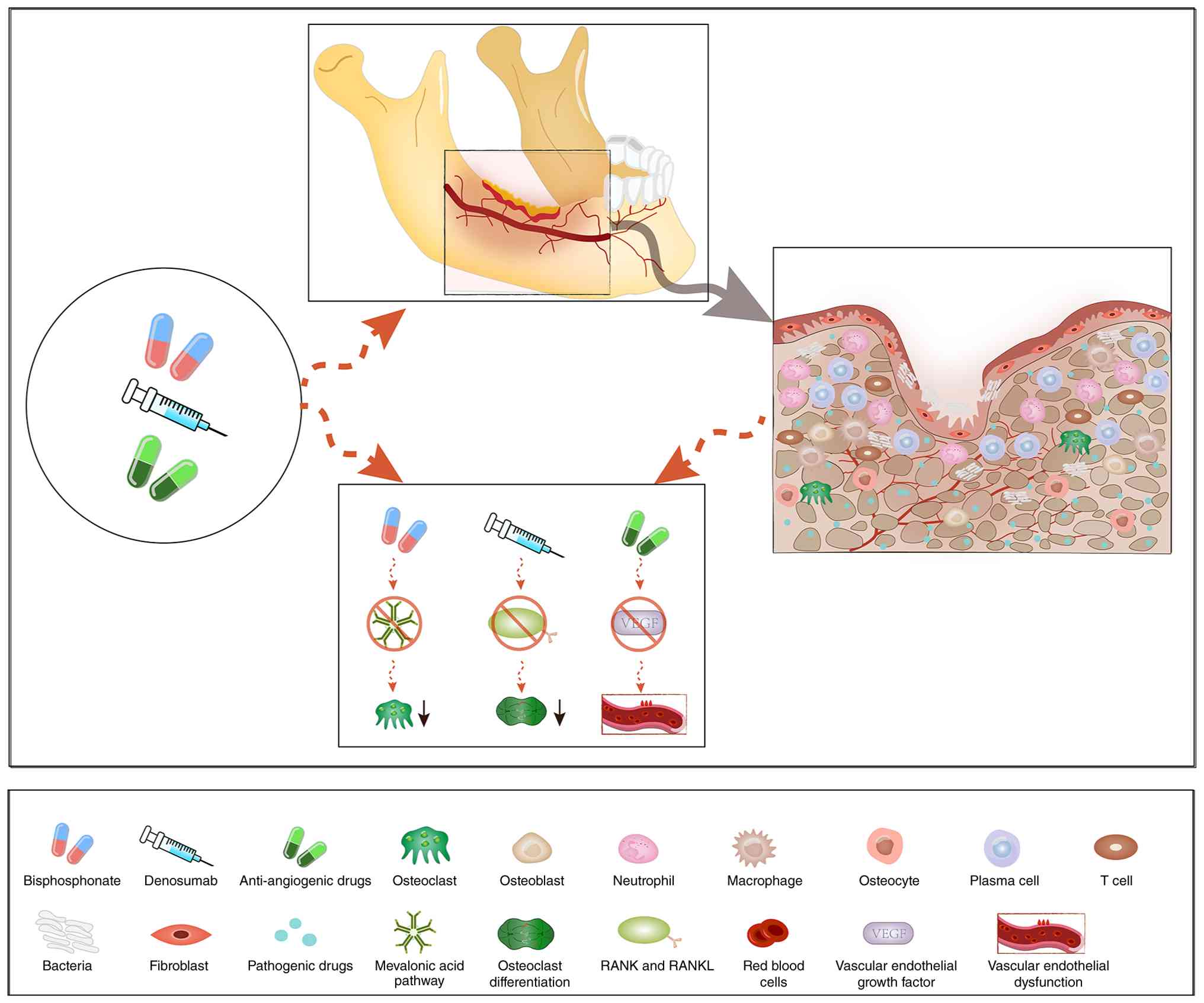 | Figure 1Overview of MRONJ. Medication classes
associated with the development of MRONJ include bisphosphonates,
denosumab and antiangiogenic agents. Diagnostic criteria for MRONJ
include current or previous exposure to antiresorptive therapy,
alone or in combination with immune-modulating or antiangiogenic
agents; exposed bone or bone that can be probed through an
intraoral or extraoral fistula in the maxillofacial region that
persists for >8 weeks; and no history of radiation therapy to
the jaw or obvious metastatic disease involving the jaw. Necrotic
bone is characterized by non-viable osteocytes and empty lacunae,
with reduced or absent osteoblastic and osteoclastic activity. The
surrounding tissue may exhibit infiltration by inflammatory cells,
including lymphocytes, plasma cells, neutrophils and macrophages,
together with fibroblast proliferation, bacterial colonization and
inflammatory or purulent exudate. Principal pathogenic mechanisms
associated with bisphosphonates, denosumab and antiangiogenic
agents include suppressed bone remodeling, impaired angiogenesis,
infection and inflammation, and soft tissue toxicity. MRONJ,
medication-related osteonecrosis of the jaw. |
Management of MRONJ is individualized according to
disease stage, symptoms, lesion extent and the patient overall
condition. Conservative management includes maintenance of oral
hygiene, local antimicrobial care, pain control and systemic
antibiotics when clinically indicated (1). Surgical treatment is an important
component of MRONJ management and may range from debridement and
sequestrectomy to more extensive resection, depending on the extent
of the lesion (6). Treatment
planning may require coordination between dental or oral and
maxillofacial specialists and physicians responsible for the
underlying disease and MRONJ-associated medication therapy.
Nevertheless, surgical management presents challenges. Determining
the appropriate resection margin for necrotic bone can be
difficult, while extensive debridement may result in substantial
soft tissue and osseous defects. Surgical morbidity may be greater
in medically compromised patients or those with multiple
comorbidities (7). Current
pharmacological management is primarily directed toward infection
control and symptom relief, whereas options that directly target
the pathological processes underlying MRONJ remain limited
(8).
The multifactorial nature of MRONJ has prompted
increasing interest in therapeutic strategies targeting different
components of its pathological microenvironment (9-11).
Current research encompasses pharmacological therapy, regenerative
approaches, biomaterial-based strategies and physical or adjunctive
intervention, addressing key pathological processes underlying
MRONJ, including dysregulated bone remodeling, vascular
dysfunction, aberrant inflammatory and immune response, microbial
involvement and defective tissue repair (9,11).
These advances have expanded the therapeutic landscape of MRONJ,
but differences remain among intervention strategies in terms of
clinical indication, strength of evidence and translational
maturity (10,11). Moreover, the relative contribution
of these pathological processes may vary between patients,
influenced by heterogeneity in underlying disease, medication
exposure, individual susceptibility and clinical characteristics,
further complicating therapeutic decision-making (3,5).
The present review examines therapeutic strategies
for MRONJ within the framework of microenvironment modulation,
their biological rationale, supporting evidence, clinical
applicability and current limitations. At the same time,
interpatient heterogeneity in disease characteristics and
therapeutic responses has fueled growing interest in more
individualized approaches to MRONJ management (12-15).
Integrating clinical, pharmacological, imaging, microbiological and
molecular information may facilitate more precise risk
stratification and tailored preventive and therapeutic strategies.
The present review further considers the potential role of
precision medicine in advancing individualized MRONJ management
(Fig. 2).
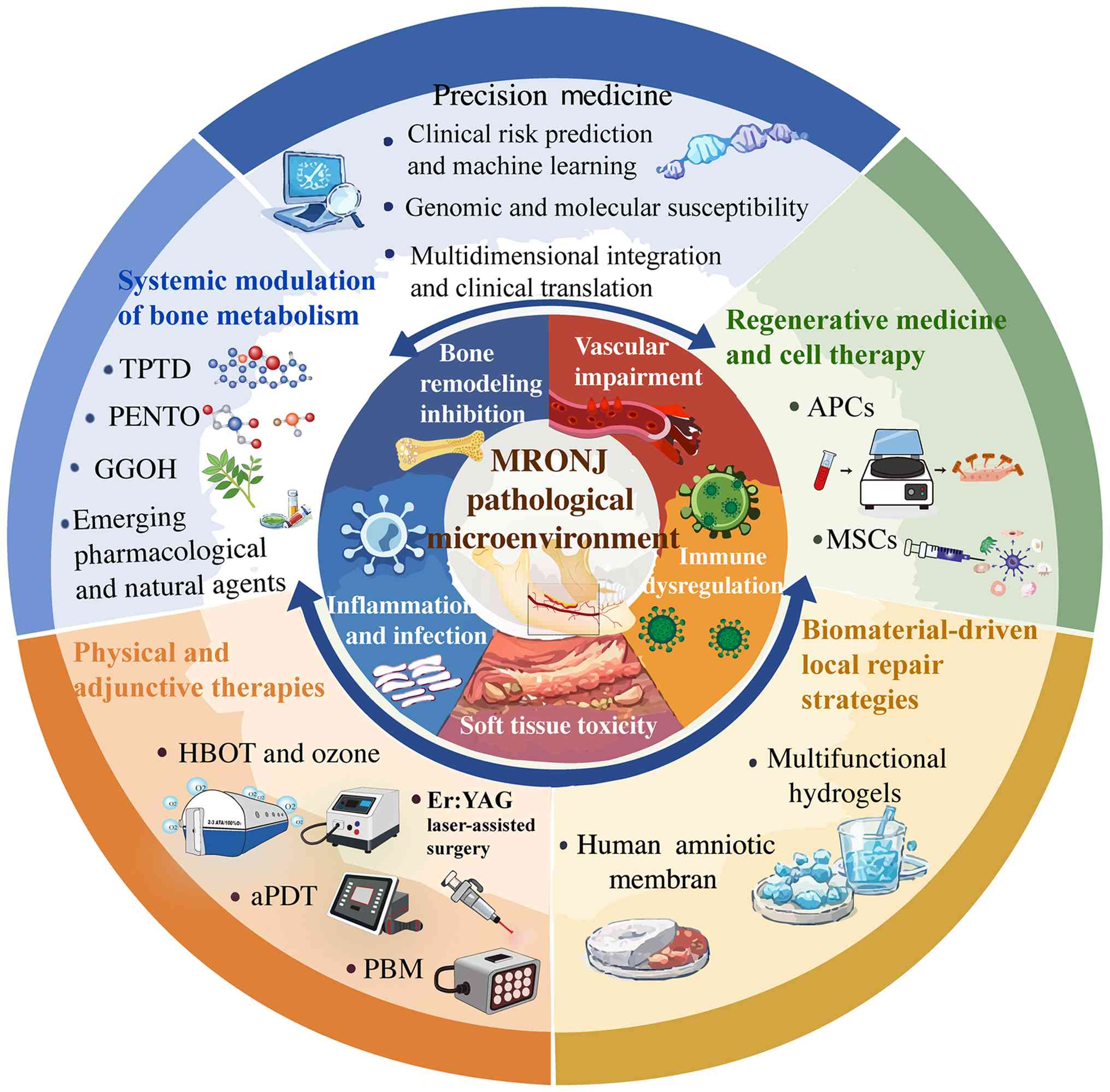 | Figure 2Pathological microenvironment and
therapeutic strategies for MRONJ. The development of MRONJ is
associated with a complex pathological microenvironment
characterized by suppressed bone remodeling, impaired angiogenesis,
infection and inflammation and soft tissue toxicity. Therapeutic
strategies aim to modulate these pathological processes through
multiple mechanisms. Precision medicine approaches may support
individualized risk assessment, prevention and treatment. MRONJ,
medication-related osteonecrosis of the jaw; APC, autologous
platelet concentrate; MSC, mesenchymal stem cell; HBOT, hyperbaric
oxygen therapy; Er:YAG, erbium-doped yttrium aluminum garnet; aPDT,
antimicrobial photodynamic therapy; PBM, photobiomodulation; TPTD,
teriparatide; PENTO, pentoxifylline and tocopherol; GGOH,
geranylgeraniol. |
2. Literature search strategy
A structured literature search was conducted. PubMed
(https://pubmed.ncbi.nlm.nih.gov/) and
Web of Science Core Collection (https://www.webofscience.com/wos/woscc/basic-search)
were searched for English-language articles published from January
2010 to March 2026. The final search was performed on March 31,
2026. The search strategy combined disease-related terms, including
‘medication-related osteonecrosis of the jaw’, ‘MRONJ’,
‘bisphosphonate-related osteonecrosis of the jaw’, ‘BRONJ’ and
‘osteonecrosis of the jaw’, with terms related to treatment and
clinical management, including ‘treatment’, ‘therapy’,
‘management’, ‘prevention’, ‘therapeutic strategy’, ‘surgery’,
‘adjunctive therapy’, ‘regenerative medicine’, ‘bone regeneration’,
‘tissue regeneration’, ‘drug therapy’, ‘cell therapy’ and
‘biomaterial’. Additional terms representing the major therapeutic
approaches discussed in this review included ‘teriparatide’,
‘pentoxifylline’, ‘tocopherol’, ‘geranylgeraniol’, ‘platelet-rich
plasma’, ‘platelet-rich fibrin’, ‘autologous platelet concentrate’,
‘mesenchymal stem cell’, ‘hydrogel’, ‘human amniotic membrane’,
‘hyperbaric oxygen therapy’, ‘ozone therapy’, ‘photobiomodulation’,
‘laser therapy’, ‘antimicrobial photodynamic therapy’, ‘precision
medicine’, ‘risk prediction’, ‘machine learning’, ‘genetic
susceptibility’ and ‘biomarker’. These terms were used individually
or in combinations according to the topic being searched. The
reference lists of relevant reviews and key primary studies were
screened to identify additional eligible publications. Landmark
studies published before 2010 were also included to provide
historical context for the development of specific therapeutic
approaches.
Publications relevant to the prevention, treatment
or adjunctive management of MRONJ were considered. Eligible
evidence included randomized and non-randomized clinical trials,
prospective and retrospective observational studies, case series
and reports, systematic reviews and meta-analyses, as well as
preclinical in vivo and in vitro studies when
clinical evidence was limited or mechanistic information was
required. Studies focusing exclusively on osteoradionecrosis or
osteonecrosis unrelated to medication exposure were excluded unless
they provided mechanistic or therapeutic information directly
relevant to MRONJ. Priority was given to primary studies, recent
evidence and studies providing clinically or mechanistically
relevant information. No formal meta-analysis or quantitative
risk-of-bias assessment was performed. Preclinical, observational
and interventional clinical evidence was interpreted according to
the respective study design and level of evidence to avoid equating
findings derived from different evidence hierarchies.
3. Modulation of the MRONJ
microenvironment
Therapeutic strategies for MRONJ target distinct but
interconnected components of its pathological microenvironment
(9-11).
Systemic modulation of bone metabolism focuses on restoring bone
remodeling balance, whereas regenerative strategies aim to promote
angiogenesis and tissue repair (9,10)
(Fig. 3). Bioactive materials
provide platforms for local delivery and regenerative support,
while physical and adjunctive therapy (Fig. 4) targets tissue oxygenation,
microbial control and wound healing (9-11).
These strategies are not mutually exclusive and may have
complementary roles in staged or multimodal management (10) (Table
I).
 | Figure 3Pharmacological and regenerative
strategies investigated for MRONJ, including GGOH, PENTO, TPTD,
APCs and MSC-based therapy. GGOH, geranylgeraniol; PENTO,
pentoxifylline and tocopherol; TPTD, teriparatide; APC, autologous
platelet concentrate; MSC, mesenchymal stem cell; MRONJ,
medication-related osteonecrosis of the jaw; bFGF, basic fibroblast
growth factor; PDGF, platelet-derived growth factor; PTH,
parathyroid hormone; IGF, insulin-like growth factor. |
 | Figure 4Physical and adjunctive therapeutic
approaches for MRONJ, including HBOT, ozone therapy, PBM, Er:YAG
laser-assisted surgery and aPDT. HBOT, hyperbaric oxygen therapy;
PBM, photobiomodulation; Er:YAG, erbium-doped yttrium aluminum
garnet; aPDT, antimicrobial photodynamic therapy; MRONJ,
medication-related osteonecrosis of the jaw; ROS, reactive oxygen
species. |
 | Table ITherapeutic strategies for MRONJ. |
Table I
Therapeutic strategies for MRONJ.
| A, Systemic
modulation of bone metabolism |
|---|
| Therapy | Primary
mechanism | Key findings | Advantages and
limitations | Evidence basis | Intended use | (Refs.) |
|---|
| Teriparatide | Restores coupled
bone remodeling and supports angiogenesis and bone repair through
intermittent PTH signaling | Clinical studies,
including a placebo-controlled randomized trial, suggest improved
lesion resolution and bone healing in selected patients | Systemic anabolic
effect with stronger clinical evidence; patient selection is key,
MRONJ-specific optimal treatment duration remains uncertain,
relevant contraindications and precautions must be considered | Randomized clinical
evidence, case reports, systematic review/meta-analysis, supporting
preclinical in vivo evidence | Adjunctive
treatment of established MRONJ in appropriately selected patients,
particularly those with osteoporosis | (16-23) |
| Pentoxifylline and
tocopherol | Improves
microcirculation and modulates inflammation, oxidative stress and
fibrosis | Prophylactic in
patients undergoing tooth extraction. In a therapeutic study of 43
patients with MRONJ at different stages, 46% achieved complete
remission | Non-invasive and
generally well tolerated; protocols and treatment duration vary,
therapeutic response may be slow and evidence for advanced disease
remains limited. Evidence from osteoradionecrosis should not be
directly extrapolated to MRONJ | Observational
clinical evidence and case series | Prevention around
dentoalveolar procedures in at-risk patients and non-surgical or
adjunctive treatment of established MRONJ | (24-31) |
| GGOH | Restores protein
prenylation disrupted by nitrogen-containing
bisphosphonate-mediated inhibition of the mevalonate pathway | Preclinical studies
using local delivery systems report restoration of osteoclast
function, attenuation of bisphosphonate-associated cell injury and
improved healing-associated response | Mechanistically
targeted to nitrogen-containing bisphosphonates and suitable for
local delivery; relevance to other medication classes remains
uncertain. Potential interference with intended bisphosphonate
effects and concentration-dependent cytotoxicity require
consideration | Preclinical in
vitro and in vivo; primarily
bisphosphonate-specific | Local prevention
and regenerative treatment of nitrogen-containing
bisphosphonate-associated jaw osteonecrosis investigated at the
preclinical level | (32-40) |
| Anabolic modulation
(AASs) | Promote anabolic
bone response and may enhance osteogenic signaling and tissue
repair | Methenolone
enanthate decreases osteonecrotic changes in a
bisphosphonate-associated rat model | Potential anabolic
support for bone repair; evidence remains preclinical and adverse
effects associated with prolonged AAS exposure limit
translation | Preclinical in
vivo evidence with supporting experimental mechanistic
evidence | Prevention or
attenuation of bisphosphonate-associated jaw osteonecrosis
investigated at the preclinical level | (41,48-50) |
| Antioxidant and
bone-modulatory approaches (RSV and melatonin) | Modulate oxidative
stress and inflammation and support bone homeostasis and
remodeling | RSV improves bone
formation indices and attenuated osteonecrotic changes in
bisphosphonate-associated models. Melatonin improves bone
remodeling and decreases osteonecrotic changes in a zoledronic
acid-induced BRONJ model | Target oxidative
and inflammatory components of disease; efficacy and safety in
patients with MRONJ remain unestablished | Preclinical in
vivo | Prevention or
attenuation of bisphosphonate-associated osteonecrotic changes
investigated at the preclinical level | (42-44,47) |
| Bioactive natural
products (Tualang honey and RJ) | Antimicrobial,
anti-inflammatory and tissue-protective effects supporting soft and
hard tissue repair | Tualang honey with
hydroxyapatite attenuates pamidronate-associated fibroblast
toxicity in vitro; RJ improves soft and hard tissue healing
in a bisphosphonate-associated rat model | Potentially
accessible bioactive agents, but active components, optimal dosing
and clinical efficacy remain undefined | Preclinical in
vitro and in vivo | Cytoprotection and
regenerative support for bisphosphonate-associated tissue injury
investigated at the preclinical level | (45,46) |
| B, Regenerative
medicine and cell therapy |
| Therapy | Primary
mechanism | Key findings | Advantages and
limitations | Evidence basis | Intended use | (Refs.) |
| PRP | Provides
platelet-derived growth factors and cytokines that support
angiogenesis, soft tissue repair and bone healing | Case series report
favorable healing when PRP is combined with bone resection;
systematic reviews have evaluated PRP/ APCs as adjunctive
strategies | Autologous and
readily integrated with surgery; notable heterogeneity in
preparation, surgical protocol, patient population and outcome
definitions limits comparison | Case series with
broader APC systematic review | Adjunct to surgical
treatment of established MRONJ | (51-54,62,63,67-71) |
| PRF/L-PRF | Provides a fibrin
scaffold with platelets and leukocytes and supports sustained
release of bioactive factors | Prospective and
retrospective studies report favorable healing when PRF/L-PRF is
combined with surgery | Simple autologous
preparation and fibrin scaffold; outcomes affected by
centrifugation protocol, patient factors, surgical technique and
disease characteristics | Prospective and
retrospective clinical evidence | Adjunct to surgical
treatment and postoperative wound healing in established MRONJ | (51,54-56,62,64-71,73-75) |
| CGF/i-PRF | Concentrated
platelets, fibrin and growth factors support angiogenesis and
tissue regeneration; injectable preparations facilitate local
delivery | MRONJ-specific
clinical evidence is limited primarily to CGF, including a case
series with long-term follow-up; i-PRF is supported by broader
regenerative evidence | Flexible local
application but MRONJ-specific clinical evidence is limited and
preparation protocols remain heterogeneous | Limited CGF
clinical evidence with broader review/ experimental evidence for
i-PRF | Adjunctive
regenerative support during surgical management of established
MRONJ | (57-61,72) |
| MSC-based cell
therapy | Primarily acts
through paracrine, immunomodulatory, proangiogenic and regenerative
signaling rather than sustained direct osteogenic
differentiation | Preclinical studies
show improved angiogenesis, immune regulation and bone repair;
limited clinical reports suggest potential benefit | Multimodal
regenerative potential but cell sourcing, expansion, viability,
delivery, manufacturing and regulatory requirements limit
translation | Preclinical in
vivo evidence with limited clinical evidence | Regenerative
treatment of established lesions and support of tissue repair | (76-83,85) |
| MSC-derived
extracellular vesicles/ exosomes | Deliver paracrine
bioactive cargo that modulates inflammation, angiogenesis and
tissue repair without viable cell transplantation | Preclinical studies
report improved vascularization, immune regulation and bone
regeneration in medication-associated jaw osteonecrosis models | Cell-free approach
may avoid limitations of viable cell transplantation; isolation,
characterization, dosing, storage and manufacturing standardization
remain unresolved | Preclinical in
vivo | Prevention and
regenerative repair investigated at the preclinical level | (86-88) |
| C,
Biomaterial-driven local repair strategies |
| Therapy | Primary
mechanism | Key findings | Advantages and
limitations | Evidence basis | Intended use | (Refs.) |
| Immunomodulatory,
angiogenic and regenerative hydrogels | Modulate the local
inflammatory/ regenerative microenvironment and promote
angiogenesis, osteogenesis and structural regeneration | Improved mucosal
and bone healing; magnesium-based hydrogel promotes mandibular
regeneration following debridement, while VEGF delivery decreases
osteonecrotic changes following extraction | Integrates
microenvironmental regulation with vascular and bone regeneration;
evidence is predominantly preclinical and
bisphosphonate-associated | Preclinical in
vivo evidence from bisphosphonate-associated models | Prevention,
treatment of experimental lesions and post-debridement regenerative
reconstruction, depending on the hydrogel system | (89-92) |
| Cell and
bioactive-factor delivery hydrogels | Local delivery of
cells and osteogenic factors within a three-dimensional
regenerative scaffold, with mechanical support where
applicable | Improved soft
tissue healing and bone reconstruction in experimentally
established medication-associated jaw osteonecrosis lesions | Combines local
cell/ factor delivery with structural support; cell-containing
systems complicate sterilization, storage, manufacturing,
scalability and regulation | Preclinical in
vivo | Regenerative
treatment of experimentally established lesions | (89,93,94) |
| Controlled release
and preventive hydrogels | Sustained local
release of bioactive factors or therapeutic agents, with
antimicrobial and cytoprotective functions | Hep/GelMA-PRF
improve osteomucosal healing and decrease post-extraction
osteonecrotic changes; clindamycin/ GGOH show combined
antimicrobial and cytoprotective effects in vitro | Enables localized
sustained delivery; oral retention, degradation, sterilization,
manufacturing reproducibility and long-term biosafety require
further evaluation | Preclinical,
including in vivo preventive and in vitro drug
delivery studies; predominantly bisphosphonate-specific | Post-extraction
prevention and localized preventive drug delivery investigated at
the preclinical level | (89,92,95,96) |
| Human amniotic
membrane | Provides a
biological scaffold with anti-inflammatory, antifibrotic,
proangiogenic and wound healing properties | Small clinical
studies report favorable mucosal healing and surgical outcomes;
systematic review/ meta-analysis findings are encouraging but based
on heterogeneous protocols and small studies | Biocompatible
biological scaffold and potential surgical adjunct; processing,
preservation, donor screening, storage, orientation, fixation and
regulatory requirements vary | Small
observational/ comparative clinical studies, pilot studies,
systematic review/ meta-analysis | Adjunct to surgical
treatment for wound coverage and postoperative soft tissue
healing | (99-105) |
| D, Physical and
adjunctive therapy |
| Therapy | Primary
mechanism | Key findings | Advantages and
limitations | Evidence basis | Intended use | (Refs.) |
| Hyperbaric oxygen
therapy | Increases tissue
oxygenation and may support angiogenesis, infection control and
wound repair | Clinical studies,
including randomized adjunctive evidence, suggest improvement in
lesion status and pain-related outcomes, but a definitive
complete-healing benefit has not been established | Non-invasive
adjunct, but requires specialized facilities and repeated sessions;
treatment burden, contraindications, adverse effects and optimal
patient selection remain concerns | Limited randomized
clinical evidence, observational/ case-based evidence, systematic
review | Adjunctive
treatment of established MRONJ/ BRONJ in selected patients | (106-113) |
| Ozone therapy | Antimicrobial,
anti-inflammatory and redox-modulating effects | Local
O2-O3 infiltration has been investigated in
established MRONJ, while randomized clinical evidence is available
for post-extraction prevention; ozonized oil has supporting
preclinical evidence | Multiple
formulations and delivery routes differ in dosing and safety;
protocol heterogeneity and limited MRONJ-specific evidence for
certain routes restrict interpretation | Randomized
preventive clinical evidence, limited case series, supporting
preclinical in vivo evidence | Post-extraction
prevention and adjunctive treatment of established MRONJ, depending
on the delivery approach | (114-118) |
| PBM | Non-thermal
photochemical modulation of cell metabolism, inflammation,
angiogenesis and tissue repair | Heterogeneous
clinical and preclinical studies report improved mucosal healing,
pain control, and bone-associated outcomes, particularly when PBM
is used with conventional treatment | Non-invasive and
repeatable; heterogeneity in wavelength, fluence, power, exposure
duration and treatment schedules limits reproducibility and
comparison | Preclinical and
heterogeneous clinical evidence, including retrospective and
prospective studies | Adjunctive
treatment of established MRONJ and support of postoperativewound
healing | (119-123) |
| Er:YAG
laser-assisted surgery | Ablation and
debridement of necrotic tissue through laser-tissue interaction,
with potential decrease of local microbial burden | Clinical series
report favorable outcomes when Er:YAG is incorporated into surgical
or multimodal treatment, including patients with stage I-III
disease | Precise tissue
ablation with limited thermal damage when appropriately used;
evidence is largely observational and treatment parameters
vary | Observational
clinical evidence, including retrospective and prospective clinical
studies | Laser-assisted
surgical debridement or ablation of established MRONJ | (121,124-127) |
| Antimicrobial
photodynamic therapy | Photosensitizer
activation by light in the presence of oxygen generates ROS with
local antimicrobial activity | Preventive
preclinical and small clinical studies report decreased
osteonecrotic changes; therapeutic evidence consists primarily of
case reports and small multimodal clinical series | Local antimicrobial
action with limited systemic exposure; efficacy depends on
photosensitizer, wavelength, fluence, oxygen availability, biofilm
characteristics and treatment protocol. Tissue penetration is
limited | Limited clinical
and experimental evidence, including preventive preclinical studies
and small clinical reports | Post-extraction
prevention and adjunctive antimicrobial treatment of established
MRONJ | (128-135) |
Systemic modulation of bone
metabolism. Teriparatide (TPTD)
TPTD is a recombinant active fragment of human
parathyroid hormone comprising amino acids 1-34 and is used in the
treatment of osteoporosis (16).
When administered intermittently, TPTD stimulates both osteoblast
and osteoclast activity, thereby enhancing bone remodeling
(17). In addition, TPTD
upregulates the expression of growth factors such as vascular
endothelial growth factor, which may contribute to a local
microenvironment conducive to bone repair (18).
Harper and Fung (19) provided an early clinical report of
intermittent low-dose parathyroid hormone therapy in
bisphosphonate-associated osteonecrosis of the mandible, suggesting
the potential of anabolic stimulation in jawbone healing.
Subsequent evidence has included both preclinical and clinical
studies (20-23).
In a zoledronic acid-associated MRONJ model in rice rats, Castillo
et al (20) demonstrated
that intermittent parathyroid hormone treatment enhances lesion
healing, providing preclinical support for its osteoregenerative
effects. A systematic review and meta-analysis of 26 publications
involving 111 MRONJ cases reported complete resolution in 59.5% of
patients receiving TPTD monotherapy and suggested a higher
likelihood of complete resolution when TPTD was combined with other
types of therapy, including surgery, antibiotic therapy and laser
therapy, although the evidence base consisted largely of case
reports and small clinical series (21). Kim et al (22) described two cases in which
adjunctive TPTD combined with surgical treatment resulted in
complete clinical and radiographic resolution. Importantly, Sim
et al (23) conducted a
randomized placebo-controlled trial of TPTD in patients with MRONJ
and reported a significantly greater rate of lesion resolution with
TPTD than with placebo. In the aforementioned trial, TPTD was
administered at 20 µg/day for 8 weeks, however, the optimal
treatment duration for MRONJ remains to be established (23). Collectively, these findings support
TPTD as a potential adjunctive treatment for selected patients,
although patient selection, underlying disease, indication for
antiresorptive therapy, treatment duration and relevant precautions
warrant consideration.
TPTD may be associated with adverse effects,
including nausea and transient alterations in calcium metabolism
(18). Its use in patients with
MRONJ requires careful patient selection and risk assessment. TPTD
should be used cautiously in individuals with disorders of calcium
metabolism and typically avoided in patients with an elevated
baseline risk of osteosarcoma. This population includes individuals
with bone metastasis, a history of skeletal malignancy or prior
skeletal radiation therapy (18).
The primary indication for antiresorptive therapy should be
considered, as patients receiving antiresorptive agents for
osteoporosis differ clinically from those receiving high-dose
therapy for malignant bone disease. Use of TPTD in MRONJ should be
individualized based on the underlying disease, extent of skeletal
involvement and overall risk-benefit profile (18,23).
Pentoxifylline (PTX) and tocopherol
(PENTO)
PTX, a methylxanthine derivative, is primarily used
to improve microcirculation in patients with peripheral vascular
disease (24). PTX improves
erythrocyte deformability, thereby facilitating microvascular
perfusion (25). Beyond its
hemorheological effects, PTX exerts immunomodulatory and
anti-inflammatory effects, which may contribute to reduced scar
formation (26,27). Tocopherol, a form of vitamin E,
exhibits antioxidant properties and may promote angiogenesis by
increasing the levels of pro-angiogenic growth factors (28).
PENTO was initially studied extensively for
radiation-associated tissue injury, particularly
osteoradionecrosis, and its use has been explored in MRONJ
(24,28). To the best of our knowledge,
clinical evidence regarding PENTO in MRONJ remains limited and
includes both prophylactic and therapeutic studies (28-31).
Evidence derived from osteoradionecrosis should not be directly
extrapolated to MRONJ because the two conditions differ in their
underlying etiology and pathophysiology (24,28).
In a case series of 17 patients with cancer receiving intravenous
bisphosphonates who underwent a total of 32 tooth extractions,
Magalhães et al (29)
evaluated PENTO as a prophylactic approach administered before and
after extraction. Stage I MRONJ developed in three patients
(17.6%), corresponding to 3/32 extraction sites (9.4%), and healing
was reported in all three cases (29). Słowik et al (30) evaluated daily PENTO therapy in 43
patients with MRONJ at different disease stages, with 46% achieving
complete remission. De Morais et al (31) summarized the PENTO regimens used
for osteoradionecrosis and MRONJ, with PTX doses ranging from 400
to 1,200 mg/day and tocopherol doses from 400 to 1,200 IU/day,
highlighting notable heterogeneity in the dosing regimens (31).
Despite its non-invasive nature and generally
favorable tolerability, the clinical role of PENTO in MRONJ remains
ill-defined (30,31). Treatment courses are typically
prolonged and substantial inter-study variability in dosing
regimens and treatment duration hinders the development of
standardized clinical protocols (30,31).
Potential adverse effects, including an increased bleeding risk
associated with PTX, warrant consideration, particularly with
prolonged treatment (27,31). Further controlled studies are
needed to identify patient subgroups most likely to benefit from
PENTO and to define the optimal timing and duration of PENTO
therapy.
Geranylgeraniol (GGOH)
GGOH occurs naturally in various plant-derived
sources, microorganisms and animal tissues, including annatto
(Bixa orellana), sunflower oil, olive oil and tomatoes
(32,33). Endogenous GGOH is generated via the
mevalonate pathway through dephosphorylation of geranylgeranyl
pyrophosphate (34). As a
downstream metabolite of this pathway, GGOH bypasses the inhibitory
effect of nitrogen-containing bisphosphonates on farnesyl
pyrophosphate synthase, thereby restoring protein prenylation and
improving osteoclast function (34,35).
GGOH has therefore been proposed as a functional antagonist of
nitrogen-containing bisphosphonates (23). GGOH has been investigated primarily
as a potential strategy for bisphosphonate-related osteonecrosis of
the jaw (BRONJ), particularly in experimental models involving
nitrogen-containing bisphosphonates (36-39).
To facilitate localized and sustained delivery of GGOH, it is
incorporated into biomaterials such as bone cement and collagen
membranes. In a preclinical model, Feldman et al (36) evaluated GGOH incorporated into bone
cement pellets and reported restoration of osteoclast viability and
resorptive function in bisphosphonate-treated osteoclasts in
vitro, together with improved early bone healing in the
GGOH-treated side compared with the control side in a rat model.
In vitro, Manzano-Moreno et al (37) investigated GGOH-loaded biomimetic
collagen membranes and demonstrated that GGOH supplementation
counteracts the adverse effects of zoledronate on osteoblast-like
cells. In a mouse model, Otto et al (38) reported that GGOH attenuates
zoledronate-induced impairment of angiogenesis. Similarly, Chen
et al (39) showed that
GGOH restored macrophage efferocytosis impaired by zoledronic acid
and improves bone healing in a BRONJ mouse model. Collectively,
these findings support the potential of GGOH as a therapeutic
strategy for nitrogen-containing bisphosphonate-associated MRONJ.
However, its applicability to denosumab- or antiangiogenic
agent-associated MRONJ remains unclear, as these agents act through
mechanisms distinct from those underlying the effects of GGOH
(34). GGOH may interfere with the
therapeutic effects of bisphosphonates used in the management of
tumors and osteoporosis. Therefore, its use should be considered in
the context of the underlying disease and available alternative
therapies. In addition, high doses of GGOH may exert cytotoxic
effects on gingival fibroblasts and bone cells (35,40).
Pharmacological and natural
agents
Emerging pharmacological and natural agents have
been investigated as potential therapeutic approaches for MRONJ,
including those that do not directly target antiresorptive
mechanisms (41-46).
These agents may exert indirect therapeutic effects by modulating
the local microenvironment and supporting tissue repair (41-47).
Anabolic modulation
Anabolic modulation is an experimental approach to
promote bone repair through mechanisms distinct from those of
antiresorptive therapy. Androgen-anabolic steroids (AASs) exert
skeletal anabolic actions and are associated with increased bone
formation (48). Preclinical
findings indicate that androgen-related modulation may influence
the osteogenic activity of mesenchymal stem cells (MSCs) (49). Gürses et al (41) reported that methenolone enanthate
decreases bone exposure and histopathological abnormality
associated with MRONJ in a bisphosphonate-treated rat model.
However, the evidence remains preclinical and the adverse effects
associated with prolonged AAS exposure may limit their
translational potential (50).
Antioxidant and bone-modulatory
agents
Resveratrol (RSV) is a phyto-oestrogen with
antioxidative and anti-inflammatory properties that may support
bone homeostasis through modulation of oxidative stress and
inflammation (47). Attar et
al (42) reported that RSV
improved bone-formation indices and reduced osteonecrosis at
extraction sites in bisphosphonate-treated rats. Vitale et
al (43) similarly found that
RSV attenuates, rather than completely prevents, osteonecrotic
changes in a zoledronic acid-associated rat model. Melatonin
represents another bone-modulatory agent with antioxidant
properties. Yadegari et al (44) evaluated melatonin in a zoledronic
acid-induced BRONJ rat model and reported a decreased incidence of
osteonecrosis, although osteonecrosis remained more frequent than
in the control group. To the best of our knowledge, evidence for
RSV and melatonin remains preclinical and their efficacy and safety
in patients with MRONJ have not been established.
Bioactive natural products
Bioactive natural products have been investigated as
potential adjunctive approaches for MRONJ management because of
their antimicrobial, anti-inflammatory and tissue-protective
properties: Fauzi et al (45) reported that the combination of
Tualang honey and hydroxyapatite partially attenuates
pamidronate-induced fibroblast toxicity and preserves cell
viability in vitro. Topan et al (46) assessed the therapeutic potential of
royal jelly, a complex mixture of bioactive constituents, in a
bisphosphonate-associated MRONJ rat model and reported improved
soft and hard tissue healing. These findings remain experimental,
and further research is needed to determine their potential for
clinical application.
Regenerative medicine and cell
therapy. Autologous platelet concentrates (APCs)
APCs are platelet-rich products prepared by
centrifugation of autologous blood and comprise preparations with
distinct biological characteristics and physical properties
(51). Among the commonly used
preparations, platelet-rich plasma (PRP) is typically obtained as a
plasma concentrate and commonly requires anticoagulation and
activation (52-55).
By contrast, platelet-rich fibrin (PRF) is prepared without
anticoagulants and forms a three-dimensional fibrin matrix that
entraps platelets, leukocytes and bioactive factors (51,54-55).
Leukocyte-rich PRF (L-PRF) is a solid PRF preparation characterized
by a leukocyte-containing fibrin network (55,56),
while concentrated growth factor (CGF) is produced using a specific
variable speed centrifugation protocol that generates a dense
fibrin-rich matrix (51,54,57,58).
Injectable PRF (i-PRF) is obtained using lower speed, shorter
centrifugation and remains injectable before fibrin polymerization,
facilitating its application to irregular defects or combination
with other biomaterials (59-61).
These differences in centrifugation parameters, cell distribution,
fibrin architecture and physical form can influence the retention
and release kinetics of platelet-derived bioactive factors. These
factors support soft and hard tissue repair by modulating
osteogenic activity, collagen production, inflammatory response and
angiogenesis (62).
Clinical evidence for APCs in MRONJ is derived
primarily from small prospective or retrospective observational
studies and case series, with most preparations used as adjuncts to
surgical treatment (63-71).
Early reports described the use of PRP in three patients with
bisphosphonate-associated osteonecrosis, as well as the application
of L-PRF during surgical management (63,64).
Clinical studies investigating PRF-based approaches report
generally favorable postoperative healing outcomes (65,66).
Systematic reviews have evaluated APCs as adjunctive strategies,
but interpretation is limited by heterogeneity in APC preparation,
surgical protocol, patient characteristics and outcome definitions
(67-71).
Among APC preparations, clinical evidence for CGF remains scarce:
Dipalma et al (72)
reported no recurrence during a 60-month follow-up of six patients
treated with a combination of CGF and piezosurgery.
Overall, current clinical evidence suggests APCs may
be useful as adjuncts to surgical management rather than as
independently established treatments for MRONJ (67-71).
Direct cross-study comparison of healing or success rates is not
reliable because of variability in APC preparation protocols,
surgical procedures, disease stages, patient characteristics,
follow-up duration and outcome definitions across studies (73-75).
Such heterogeneity limits reliable assessment of the comparative
efficacy of PRP, PRF/L-PRF, CGF and i-PRF. To the best of our
knowledge, adequately powered randomized comparative trials using
standardized preparation protocols and outcome definitions are
lacking.
MSC-based therapy. MSCs have been widely
investigated in regenerative medicine because of their multilineage
potential and ability to modulate inflammation and angiogenesis
(76-78).
Beyond their differentiation potential, MSCs secrete cytokines,
growth factors and other paracrine mediators that can regulate
immune responses, angiogenesis and endogenous tissue repair
(76). Increasing evidence
suggests these paracrine, immunomodulatory and proangiogenic
effects are major contributors to MSC-mediated tissue regeneration,
rather than sustained direct differentiation of transplanted cells
into bone-forming cells (77,79).
Bone marrow-derived MSCs (BMSCs) and adipose-derived
MSCs (ADSCs) are commonly investigated MSC sources for regenerative
and cell-based therapeutic applications (78). BMSCs possess notable osteogenic
potential, whereas ADSCs are relatively accessible and exhibit
favorable proliferative capacity in vitro (80). Nevertheless, the biological
characteristics and regenerative capacity of MSCs vary depending on
their tissue source and culture conditions.
MSC transplantation and cell sheet
approaches. The majority of available evidence supporting
MSC-based therapy for MRONJ is derived from preclinical
investigations (78,81-84).
Kikuiri et al (81)
demonstrated therapeutic effects of MSC administration in a
zoledronate/dexamethasone-induced BRONJ-like mouse model, with
immunomodulatory effects and improved bone healing (81). Cell sheet technology has been
explored as a means of maintaining MSCs within a structured
extracellular matrix and enhancing local tissue repair: Kaibuchi
et al (82) summarized
preclinical findings from rat and canine bisphosphonate-associated
models, in which local MSC sheet transplantation promoted mucosal
and bone healing; these findings warrant further investigation of
cell sheet approaches for MRONJ.
MSC-based approaches have also been investigated in
combination with PCs: Limited clinical reports have documented
mucosal healing and bone regeneration following administration of
MSC-containing preparations combined with PRP or PRF, although the
small sample sizes and multimodal treatment regimens preclude
definitive attribution of these outcomes to MSC therapy (83,84).
However, the clinical translation of MSC-based approaches is
limited by cell harvesting and expansion, manufacturing complexity,
high cost and patient selection. Autologous BMSCs may not represent
a viable option for certain patients with hematological malignancy,
particularly those with multiple myeloma-associated MRONJ (78,85).
MSC-derived exosomes. MSC-derived exosomes
are potential mediators of tissue repair and regeneration. These
nanoscale extracellular vesicles carry proteins, lipids and
regulatory nucleic acids that can modulate intercellular signaling
and contribute to tissue repair (86). Dong et al (87) evaluated exosomes derived from ADSCs
in a preclinical MRONJ model and reported enhanced gingival healing
and bone remodeling, together with decreased lesion development
(87). Evidence is limited to
preclinical studies, and further research is needed to establish
standardized protocols for exosome isolation, characterization,
dosing and storage before clinical translation (88).
Biomaterial-driven local repair
strategies. Hydrogels
Hydrogels are a class of bioactive material that
mimic the hydrated environment of soft tissue and provide a
three-dimensional matrix for cell survival and nutrient transport,
while facilitating local retention and controlled release of
bioactive molecules (89). These
properties support their application in drug delivery, tissue
engineering and wound healing. Hydrogel-based strategies for MRONJ
have been investigated predominantly at the preclinical level, with
many models involving bisphosphonate exposure (90-96).
Current designs focus on microenvironment regulation, angiogenesis
and osteogenesis, mechanical support, delivery of cells and
bioactive factors and sustained local release (90-96).
Immunomodulation, angiogenesis and structural
regeneration. One notable hydrogel-based strategy is to
regulate the local microenvironment while promoting vascular and
bone regeneration. Costa de Sousa et al (90) evaluated an Agaricus blazei
polysaccharide gel in a BRONJ model and found that local delivery
increases type I collagen production and promotes mucosal healing,
accompanied by activation of Wnt signaling and improved bone
remodeling. Guo et al (91)
developed a magnesium-based nanocomposite hydrogel for mandibular
reconstruction following debridement, which provides mechanical
support, promotes type H vessel formation, activates
Osterix-positive osteoprogenitors and modulates the inflammatory
and infectious microenvironment, thereby supporting mandibular
regeneration.
Angiogenic regulation has also been explored as a
preventive strategy: Sharma et al (92) assessed a VEGF-loaded hydrogel in
zoledronic acid-treated rats following tooth extraction and
demonstrated that sustained local VEGF delivery enhances
angiogenesis and lymphangiogenesis while decreasing osteonecrotic
changes. These findings suggest hydrogel-mediated vascular and
microenvironmental regulation may have applications in both
prevention and regenerative repair, depending on the timing and
design of the intervention.
Cell and bioactive factor delivery. A second
strategy uses hydrogel scaffolds as local delivery platforms for
regenerative cells and osteogenic factors. Tu et al
(93) established MRONJ-like
maxillary defects in rats treated with zoledronic acid and
dexamethasone and evaluated a gelatin methacryloyl
(GelMA)/polydopamine hydrogel containing alveolar mucosa-derived
stem cells and parathyroid hormone. The composite hydrogel promoted
soft tissue healing and bone regeneration at the defect sites
(93). Ning et al (94) developed a microfiber-reinforced
low-acyl gellan gum hydrogel incorporating rat ADSCs and bone
morphogenetic protein-2 and tested its therapeutic potential in
established rat MRONJ lesions. This engineered hydrogel combined
mechanical reinforcement with localized delivery of stem cells and
osteogenic factors, thereby promoting mucosal recovery and bone
reconstruction (94).
Together, the aforementioned studies support the
potential of cell-laden hydrogel systems to provide both structural
support and a localized regenerative environment for the repair of
established MRONJ lesions. Nevertheless, available evidence remains
limited to preclinical studies and further clinical studies are
needed to determine their safety and therapeutic efficacy.
Controlled release and preventive delivery.
Controlled local release is particularly relevant to preventive
hydrogel strategies as it can prolong the local availability of
bioactive factors at high-risk sites and thereby support the early
tissue-healing environment during the period when MRONJ may develop
(95). Tao et al (95) developed a photocrosslinked
heparin/GelMA hydrogel loaded with PRF and assessed its performance
in a rat MRONJ model established using zoledronic acid and
dexamethasone administration followed by tooth extraction. The
hydrogel was placed directly into the extraction socket, where it
exhibited relatively slow degradation and reached swelling
equilibrium, with its swelling ratio stabilizing within 24 h, while
enabling continuous release of PRF-derived growth factors for >4
weeks. This strategy promoted osteomucosal healing and decreased
osteonecrotic changes following tooth extraction (95).
Antimicrobial and cytoprotective functions can be
incorporated into preventive delivery systems. Sungkhaphan et
al (96) constructed an in
vitro clindamycin/GGOH-loaded hydrogel system for the
prevention of bisphosphonate-associated osteonecrosis. This
hydrogel provided sustained drug release and antibacterial activity
and attenuated zoledronate-induced cytotoxicity (96).
Collectively, the applications of hydrogel systems
vary across stages of MRONJ development and management. Preventive
applications focus on local delivery before or immediately
following a triggering procedure (92,95,96),
whereas regenerative strategies target established experimental
lesions (90,93,94)
or reconstruction following surgical debridement (91). Accordingly, hydrogel formulations
incorporate combinations of functions, including immunomodulation,
antimicrobial activity, angiogenesis, osteogenesis, cell delivery,
mechanical support and controlled release.
Translational challenges. Despite their
versatility, hydrogel-based systems face barriers to clinical
translation. In the oral cavity, implanted materials are exposed to
saliva, microorganisms and repeated mechanical loading, making
local retention and mechanical stability key considerations for
clinical application (89).
Material degradation kinetics must also be controlled to maintain
structural integrity and delivery functions throughout the
therapeutic period while ensuring appropriate degradation and
clearance (89,97).
Sterilization represents a challenge, especially for
hydrogels containing cells, proteins, growth factors or other
bioactive components (97).
Increasing material complexity raises concerns regarding
manufacturing reproducibility, batch consistency, scalability,
storage stability and quality control (97). Combination products that integrate
biomaterial scaffolds with therapeutic agents, cells or biological
factors may be subject to more complex regulatory requirements
(97). Long-term local and
systemic biosafety, including the effects of degradation
by-products and interactions with the oral microbiota, remains to
be assessed. Most hydrogel evidence relevant to MRONJ remains
preclinical and many experimental models are based specifically on
bisphosphonate exposure (90-95).
Standardized studies under clinically relevant oral conditions and
clinical investigations are therefore needed to determine their
translational potential.
Human amniotic membrane (hAM). hAM is a
naturally derived bioactive material obtained from placental
tissue. It exhibits low immunogenicity and good biocompatibility
and contains a rich extracellular matrix enriched with collagen,
laminin, fibronectin and multiple growth factors (98). These biological properties
contribute to epithelialization, modulation of inflammatory
responses and attenuation of scar formation (98).
In MRONJ, the biological properties of hAM may
address multiple pathological alterations within the local disease
microenvironment (98,99). hAM may alleviate local inflammation
by modulating pro-inflammatory cytokines such as TNF-α, IL-1β and
IL-6 (98,99). As a biological barrier and native
extracellular matrix scaffold, hAM may support mucosal coverage and
tissue integration (99). Its
angiogenic and antifibrotic properties contribute to wound healing
and tissue repair (99). Clinical
evidence for hAM in MRONJ is derived largely from small clinical
studies and evidence syntheses (100-103).
Çanakçi et al (100)
reported preliminary outcomes following hAM transplantation in
patients with stage II MRONJ, reporting a healing rate of 85%. In a
case-control study, Ragazzo et al (101) compared surgical treatment with
and without local hAM application and observed favorable
postoperative outcomes in the hAM group. Odet et al
(102) conducted a pilot study
evaluating cryopreserved hAM in patients with stage II-III MRONJ
and reported encouraging clinical outcomes. A systematic review and
meta-analysis including 91 patients reported an overall surgical
success rate of 91.2% following hAM application (103). Nevertheless, this pooled estimate
should be interpreted cautiously because of the limited sample
size, heterogeneity in treatment protocols and differences in study
designs.
The biological and handling properties of hAM are
partly determined by its processing and preservation. Fresh hAM
retains native tissue components but has a short storage period and
presents logistical challenges (99). By contrast, frozen or cryopreserved
membranes allow longer storage under controlled low temperature
conditions, although these preservation procedures may affect cell
viability and alter biological properties, such as the retention of
growth factors and extracellular matrix components (99). Dehydrated or lyophilized membranes
offer greater storage stability and easier handling; nevertheless,
processing may alter tissue structure and the content of bioactive
components (104). These
differences should be considered when comparing clinical outcomes
across studies using different hAM preparation protocols.
Successful clinical translation of hAM relies on
standardized protocols for donor screening, tissue processing,
storage and surgical handling. In the MRONJ pilot study by Odet
et al (102),
cryopreserved hAM was placed between the bone and mucosa, with a
resorbable collagen sponge used in selected cases to facilitate
graft handling and stabilization. Due to the inherent fragility of
hAM, graft fixation and wound closure strategies may need to be
adapted to the characteristics of the surgical defect (102). Furthermore, donor eligibility,
tissue processing, storage and release of hAM grafts are subject to
tissue-banking requirements intended to ensure the safety, quality
and traceability of donated tissues, as well as applicable
regulatory requirements, which may vary across jurisdictions
(105).
Overall, hAM represents a promising adjunct to
surgical management of MRONJ, facilitating wound coverage and
postoperative soft tissue healing rather than serving as an
established stand-alone therapy. Although current clinical findings
are encouraging, limited sample sizes, heterogeneous surgical
protocols and variations in hAM preparation methods limit
definitive conclusions (100-103).
Larger prospective comparative studies using standardized membrane
processing and application protocols are warranted to define its
clinical efficacy, safety and appropriate indications in MRONJ
management.
Physical and adjunctive therapy.
Hyperbaric oxygen therapy (HBOT)
HBOT increases tissue oxygen tension under elevated
atmospheric pressure, which may modulate inflammation, oxidative
stress, angiogenesis and wound repair (106). To date, clinical evidence for
HBOT in MRONJ remains limited and heterogeneous: Available
systematic reviews and clinical studies report variable healing
outcomes when HBOT was delivered as an adjunct to conventional
treatment, however, the overall quality of evidence was low and no
definitive therapeutic benefit has been established (107-110).
In a randomized controlled trial, Freiberger et al (111) evaluated HBOT as an adjunctive
therapy combined with surgical intervention and antibiotic
administration in patients with BRONJ. The HBOT group showed a
higher overall improvement rate and more rapid pain reduction,
together with a shorter time to improvement; however, no
significant intergroup difference was observed in complete gingival
healing (111). The
aforementioned study was insufficiently powered to draw definitive
conclusions regarding HBOT efficacy (111).
HBOT requires specialized facilities and repeated
treatment sessions, which imposes considerable clinical and
practical burdens on patients. Barotrauma and other oxygen- or
pressure-associated adverse effects have been reported in patients
undergoing HBOT (112,113). Treatment eligibility should be
determined following assessment of contraindications and the
patient overall condition. Given the limited and heterogeneous
evidence and uncertainty regarding optimal patient selection, HBOT
may be considered as an adjunctive option in selected patients
rather than a routine treatment for MRONJ.
Ozone therapy. Ozone therapy has shown
promising antimicrobial, anti-inflammatory and redox-modulating
effects (114,115). Ozone can be delivered via various
formulations and routes, including gaseous
O2-O3 mixtures, ozonated water and oil and
local tissue infiltration, as well as systemic approaches such as
autohemotherapy (114). These
modalities differ in ozone concentration, delivery method, tissue
exposure and safety profiles and should not be considered
interchangeable.
Clinical evidence supporting the use of ozone
therapy for MRONJ remains sparse: Di Fede et al (116) investigated
O2-O3 mucosal infiltration in seven patients
with stage II MRONJ who were considered unsuitable for surgery and
reported favorable mucosal healing outcomes. However, the small
uncontrolled case series limits conclusions regarding efficacy. At
the preclinical level, Silva et al (117) evaluated the effects of different
concentrations of ozonized oil in a zoledronate-induced mandibular
osteonecrosis model in senescent rats. All ozone-treated groups
exhibited decreased non-vital bone, with the 600
milliequivalents/kg concentration showing the greatest bone volume
and new bone formation (117).
O2-O3 infiltration has also been investigated
for MRONJ prevention: In a randomized, open-label phase II trial
involving 117 patients at risk of MRONJ who underwent tooth
extraction, Di Fede et al (118) reported improved wound healing
scores during the inflammatory and proliferative phases following
adjunctive O2-O3 infiltration. This supports
the potential preventive role of ozone therapy rather than its
efficacy in treating established MRONJ lesions. Overall,
differences in ozone formulation, concentration, administration
route, treatment frequency and clinical setting limit direct
comparison of outcomes across studies, while MRONJ-specific
evidence for certain ozone modalities, particularly ozonated water
and systemic autohemotherapy, remains insufficient.
Photonic therapy. Photobiomodulation
(PBM)
PBM uses low-intensity light irradiation to induce
non-thermal biological responses. PBM modulates mitochondrial
function and ATP synthesis, thereby influencing inflammatory
signaling, angiogenesis and tissue repair (119). These biological effects depend on
irradiation parameters, including wavelength, output power or
irradiance, fluence, pulse characteristics, exposure duration,
treatment frequency and irradiation technique (120).
Current clinical investigations have primarily
evaluated PBM as an adjunct to conventional management (120-122).
In a clinical study, Vescovi et al (121) analyzed 190 patients with BRONJ,
with 166 treated sites managed using medical and surgical protocols
with or without low-level laser therapy. Neodymium-doped yttrium
aluminum garnet (Nd:YAG) irradiation was used for low-level laser
therapy at 1.25 W and 15 Hz. Among the 97 surgically treated sites,
78 (80.4%) achieved complete mucosal healing (121). However, the use of multiple
treatment combinations, including antibiotic therapy, conventional
or erbium-doped yttrium aluminum garnet (Er:YAG)-assisted surgery,
and low-level laser therapy, limits the ability to determine the
independent contribution of PBM. In addition, the aforementioned
study was restricted to bisphosphonate-associated osteonecrosis,
limiting the generalizability of its findings. Michalak et
al (122) evaluated PBM in 31
patients with MRONJ, including 14 patients with stage I and 17 with
stage II-III disease; 10 patients had osteoporosis, whereas 21 were
receiving cancer treatment. PBM was delivered using a 635 nm diode
laser at 100 mW in continuous-wave mode, with four irradiation
sites treated for 20 sec/site. Clinical improvement was observed
during follow-up, although the absence of an untreated control
group and heterogeneity in disease stage and patient
characteristics limit definitive conclusions regarding efficacy
(122). At the preclinical level,
Ayhan et al (123)
compared PBM at 405, 445, 660 and 808 nm in a
bisphosphonate-associated model and reported wavelength-dependent
differences in clinical, radiological and histological responses
(123). These findings indicate
that treatment outcomes may vary according to the irradiation
protocol.
Notable heterogeneity exists across PBM studies,
including variations in wavelength, power, fluence, exposure
duration, pulse mode, treatment frequency, irradiation site,
combined therapeutic strategies and outcome definitions, limiting
cross-study comparisons and reproducibility (119,120). Standardized reporting of
irradiation parameters and treatment protocols is needed to define
the clinical role and appropriate application of PBM in MRONJ
management.
Laser-assisted surgical debridement and
ablation. Er:YAG laser irradiation at 2,940 nm is strongly
absorbed by water and hydroxyapatite, enabling controlled ablation
of mineralized tissue with limited thermal injury to adjacent
structures (124). These
characteristics support its use for necrotic bone removal and
conservative surgical debridement in MRONJ.
Clinical evidence was reported by Vescovi et
al (121) in 190 patients
with BRONJ, including 166 treated sites. Er:YAG-assisted surgery
was performed by bone resection or vaporization using variable
settings ranging from 250 mJ at 20 Hz to 300 mJ at 30 Hz. Surgical
treatment resulted in complete mucosal healing in 78 of 97 sites
(80.4%) and favorable outcomes were reported following
Er:YAG-assisted conservative surgery. Notably, the aforementioned
study involved different treatment combinations and was limited to
bisphosphonate-associated disease, which restricts direct
comparison between Er:YAG and conventional surgical approaches.
Porcaro et al (125)
included 57 patients with stage I-III MRONJ who were treated using
five protocols, including medical therapy, conventional surgery,
ozone therapy, Er:YAG-assisted surgery and combined ozone/Er:YAG
treatment. Patients were followed for ≥12 months and favorable
healing outcomes were reported in protocols incorporating Er:YAG.
However, the case series design, heterogeneous treatment regimens
and relatively small subgroups limit definitive assessment of the
independent contribution of Er:YAG.
Er:YAG has been incorporated into multimodal
treatment of advanced disease. Vescovi et al (126) reported a patient with stage III
MRONJ associated with denosumab treatment for metastatic breast
cancer who underwent piezoelectric surgery combined with Er:YAG
bone ablation and postoperative Nd:YAG PBM (126). Complete mucosal healing without
recurrence was maintained during long-term follow-up. Although the
aforementioned study demonstrates the feasibility of combining
laser-assisted surgery with other modalities in advanced MRONJ, the
single case design does not permit assessment of the individual
contribution of Er:YAG.
Overall, available clinical studies (121,125,126) report favorable outcomes with
Er:YAG-assisted surgical protocols, but differences in medication
exposure, disease stage, surgical technique, laser parameters,
concomitant intervention and outcome definitions limit direct
comparison across studies. Systematic reviews have similarly
highlighted heterogeneity in laser-assisted and
autofluorescence-guided surgical protocols (119,127). Further comparative clinical
studies using standardized surgical and laser parameters are
warranted.
Antimicrobial photodynamic therapy (aPDT).
aPDT exerts localized antimicrobial activity by combining a
photosensitizer, light of an appropriate wavelength and molecular
oxygen to generate reactive oxygen species (128). Unlike PBM, which induces
non-thermal biological modulation, aPDT targets microorganisms
primarily through photosensitizer-mediated oxidative reactions. Its
antimicrobial effect is influenced by multiple treatment
parameters, including photosensitizer type and concentration,
pre-irradiation incubation time, wavelength, fluence, oxygen
availability and treatment frequency (129,130). Biofilm characteristics, including
composition, density and extracellular matrix may further affect
photosensitizer penetration and microbial susceptibility to aPDT
(129).
In a preclinical bisphosphonate-associated rat
model, Ervolino et al (128) assessed the preventive efficacy of
butyl toluidine blue-mediated aPDT and reported a decreased
incidence of MRONJ-like osteonecrotic lesions. However, clinical
evidence remains limited: Poli et al (131) described a preventive case series
involving 11 non-oncological patients with osteoporosis who were
receiving non-intravenous antiresorptive therapy and underwent
dentoalveolar surgery. Methylene blue-based aPDT was applied using
a 660±10 nm diode laser at 100 mW following extraction and surgical
debridement; no clinical or radiographic evidence of MRONJ was
observed during the 6-month follow-up (131). Nevertheless, the absence of a
control group, small sample size and additional interventions,
including surgical closure and subsequent PBM, limit attribution of
the favorable outcomes specifically to aPDT.
aPDT has been reported as an adjunct in the
treatment of established MRONJ, although current clinical evidence
consists primarily of case reports and small series (132). For example, Schussel et al
(133) described a surgically
ineligible patient with BRONJ who was managed with a multimodal
regimen comprising aPDT, antibiotics and PENTO and showed decreased
pain, resolution of infection and a decrease in bone exposure
during follow-up. However, the multimodal treatment approach limits
the ability to determine the independent therapeutic contribution
of aPDT.
The clinical efficacy of aPDT is constrained by
limited light penetration and decreased availability of
photosensitizers and oxygen within mature or deep-seated biofilms.
Accordingly, treatment parameters cannot be readily extrapolated
across different photosensitizers, light sources, biofilm
conditions or clinical settings. Experimental studies have shown
that hypoxic microenvironments diminish the antimicrobial efficacy
of photodynamic treatment and microorganisms embedded in
multispecies biofilms may respond differently from planktonic
counterparts (134,135). Further clinical studies with
standardized reporting of photosensitizer concentration, incubation
time, wavelength, fluence, treatment frequency and microbiological
or clinical outcomes are warranted.
4. Precision medicine in MRONJ
Interindividual variability serves a key role in
the onset and progression of MRONJ, as only certain patients
exposed to antiresorptive and antiangiogenic medications develop
MRONJ (3). Clinical heterogeneity
provides a rationale for risk-stratified therapeutic strategies
that integrate clinical characteristics, medication exposure,
molecular features and other patient-specific factors. Precision
medicine aims to integrate this multidimensional information with
omics technologies and computational tools to refine individualized
risk assessment and inform tailored MRONJ management (136). However, precision medicine
approaches in MRONJ remain predominantly at the exploratory or
model development stage and their clinical validity and
translational utility have yet to be established.
Clinical risk prediction and machine
learning
Machine learning approaches have recently been
investigated for MRONJ risk prediction: Warin et al
(137) retrospectively analyzed
electronic medical records from 5,305 patients receiving
antiresorptive therapy, among whom 81 developed MRONJ (1.5%). Using
demographic, medical, pharmacological, laboratory and dental
variables, the aforementioned study developed and compared six
machine learning algorithms (137). The best-performing model achieved
an accuracy of 0.95 and an area under the receiver operating
characteristic curve (AUC) ranging from 0.89 to 0.90. However, the
low number of MRONJ events relative to the overall cohort and the
single-center retrospective design warrant caution when
interpreting model performance.
In a retrospective study, Kwack and Park (138) evaluated automated machine
learning models in 340 female patients with osteoporosis aged ≥55
years who received antiresorptive therapy and underwent tooth
extraction or implant treatment. Gradient boosting achieved an AUC
of 0.8283 in the training set and 0.7526 in the independent test
set, with medication duration, patient age, number of operated
teeth and surgical site identified as influential variables. These
findings support the feasibility of multivariable machine
learning-based MRONJ risk prediction, although existing models
remain insufficiently validated for routine clinical use.
To facilitate the clinical translation of
predictive models, standardized approaches to model development,
validation and outcome reporting are needed. Key considerations
include model discrimination and calibration, management of class
imbalance and overfitting, missing data handling and performance
evaluation in independent external cohorts. External validation is
key given inter-cohort variability in patient characteristics,
underlying disease, antiresorptive indication and dose, dental
procedure and healthcare settings. Furthermore, high discriminatory
performance alone does not establish clinical utility. Before
integration into routine clinical workflows, predictive models
should demonstrate the ability to inform individualized
decision-making, including the intensity of dental surveillance,
timing of invasive dental procedures and implementation of
risk-stratified preventive measures (139).
Genomic and molecular
susceptibility
Molecular and genomic studies (140-143)
have identified multiple candidate molecular signatures potentially
associated with susceptibility to jaw osteonecrosis, but these
findings represent different levels of evidence. Balachandran et
al (140) performed an
integrated bioinformatics analysis of BRONJ and identified seven
candidate hub genes, including fibronectin 1, TNF, Jun
proto-oncogene AP-1 transcription factor subunit, signal transducer
and activator of transcription 3, actin β,
glyceraldehyde-3-phosphate dehydrogenase and protein tyrosine
phosphatase receptor type C (140). Notably, these genes should be
regarded as exploratory molecular candidates rather than validated
biomarkers, as they were identified through in silico
analyses and require independent biological and clinical
validation.
Nicoletti et al (141) conducted a pharmacogenetic
genome-wide association study and identified an association between
RNA binding motif single stranded interacting protein 3 and
bisphosphonate-induced osteonecrosis of the jaw. The initial
genome-wide analysis included 30 cases and 17 treatment-tolerant
controls, with additional genetically matched population controls
incorporated in subsequent analyses. The limited sample size and
study population restrict the generalizability of the initial
genetic findings. Yang et al (142) identified a chromosome 8 locus
associated with MRONJ and validated the lead single-nucleotide
polymorphism rs2736308 in an osteoporosis cohort; the locus is
linked to B lymphoid tyrosine kinase, cathepsin B and
farnesyl-diphosphate farnesyltransferase 1. Although these findings
provide evidence for genetic susceptibility to MRONJ, the
identified genomic loci cannot by themselves be considered
clinically validated biomarkers. Genetic susceptibility may
interact with the pathological processes that characterize the
MRONJ microenvironment. For example, polymorphisms in VEGF/VEGFA, a
key regulator of angiogenesis, are associated with BRONJ
susceptibility (143). Together
with previously reported candidate genes implicated in
inflammatory, immune and bone-remodeling pathways (140,142), these findings suggest
interindividual molecular variation may influence biological
responses relevant to the local microenvironment. However, these
associations remain exploratory and do not establish definitive
causal mechanisms underlying MRONJ pathogenesis. Independent
replication across diverse populations, prospective evaluation and
demonstration of incremental predictive value beyond established
clinical risk factors are needed before genetic profiling can be
incorporated into routine MRONJ risk stratification and clinical
management.
Multidimensional integration and
clinical translation
Medication exposure is a key component of
individualized MRONJ risk assessment. Antiresorptive treatment
parameters, including treatment duration, cumulative exposure, drug
class and dose and therapeutic indication, should be considered
with underlying disease and other patient-associated factors
(144). In particular, patients
receiving high-dose antiresorptive therapy for malignancy have
distinct risk profiles from those receiving lower dose therapy for
osteoporosis. Dental assessment and risk-stratified management
should be performed before and during antiresorptive treatment
(1,145).
Future precision-medicine frameworks for MRONJ
should integrate multiple complementary domains rather than relying
on isolated biomarkers or single-algorithm prediction tools.
Clinical variables may include age, comorbidities, immune status,
oral hygiene and previous dental disease; pharmacological variables
may include drug class, dose, route, duration and cumulative
exposure; imaging may characterize local bone and soft tissue
changes; microbiological information may reflect the local
infectious environment; and genomic or molecular data may provide
information on individual susceptibility. Integration of these
multidimensional datasets into rigorously validated predictive
models may enable personalized risk stratification and inform
tailored preventive surveillance and treatment planning. However,
the independent contribution and incremental value of each domain
remain to be established.
Several practical barriers limit this transition.
Genomic and molecular testing incurs additional cost and may not be
equally accessible across healthcare settings, while the collection
of genomic and longitudinal clinical data raises privacy and data
governance concerns. Machine learning prediction algorithms may
also reflect biases in training cohorts, potentially limiting
generalizability when applied to different ethnic populations,
geographical regions or patient subgroups with oncological or
osteoporotic indications. Additional challenges include limited
model interpretability and technical barriers to integrating
predictive tools into electronic health record systems and routine
dental-medical workflows (146).
Clinically viable prediction tools should demonstrate tangible
benefits in preventive and therapeutic decision-making and improve
patient outcomes, rather than merely achieving high statistical
predictive performance.
5. Discussion and conclusion
MRONJ is increasingly recognized as a heterogeneous
disorder rather than a single pathological entity with a uniform
therapeutic response, which shapes the interpretation of emerging
intervention strategies (2,4,6,7).
Several approaches, including TPTD, PENTO, APCs and hAM, have
yielded preliminary clinical support in selected settings, but the
available studies are generally limited by small sample sizes,
heterogeneous protocols and inconsistent outcome definitions
(21,23,30,31,67,103). By contrast, GGOH, hydrogels, most
MSC-based or cell-derived approaches, melatonin and natural
products are predominantly confined to preclinical investigation
(34,36,44-46,78,83,87,91,93).
While their mechanistic rationales are well-substantiated by
experimental findings, robust clinical validation is lacking to
confirm translational efficacy. Collectively, these emerging
modalities should be regarded as promising complementary tools to
optimize established MRONJ management, rather than substitutes for
conservative care, antimicrobial management when indicated and
appropriate surgical intervention.
Future progress is unlikely to depend on a single
optimal therapy. Given the multifactorial nature of MRONJ, emerging
strategies may need to address multiple pathological processes
through complementary mechanisms, including modulation of
inflammation, angiogenesis, bone remodeling, infection and soft
tissue repair. However, greater biological complexity does not
necessarily translate into greater clinical value. Multifunctional
systems, such as hydrogels and cell-based platforms, introduce
challenges in reproducibility, manufacturing, storage, regulatory
classification and long-term safety. The central question is
therefore shifting from whether a treatment can modify a
pathological pathway to whether it produces a reproducible and
clinically meaningful benefit in a defined patient population.
This transition also links
microenvironment-directed therapy with precision medicine. The same
intervention is unlikely to have comparable effects across patients
with different underlying diseases, medication classes, cumulative
exposures, oral conditions and disease stages. Differences among
bisphosphonates, denosumab and antiangiogenic agents should also be
considered when evaluating therapeutic strategies and decisions
regarding medication interruption. Future MRONJ management may
require integration of clinical characteristics, pharmacological
exposure, imaging features, microbiological information and
validated molecular markers to refine risk stratification and
treatment selection. At present, however, machine learning models,
genomic associations and bioinformatics-derived candidates remain
investigational and should not be treated as clinically validated
decision tools. Their clinical value depends on external
validation, calibration, interpretability and demonstrated impact
on preventive or therapeutic decision-making. Prospective
multicenter studies with standardized outcome definitions,
appropriate controls, detailed treatment-parameter reporting,
stage-specific analyses and long-term follow-up are needed to
determine which approaches provide clinically meaningful benefits,
for which patients and at what stage of MRONJ management.
Acknowledgements
Not applicable.
Funding
Funding: The present study was funded by the Dongguan City Key
Science and Technology Project (grant no. 20231800936002) and Jinan
University-The Sixth Affiliated Hospital of Jinan University Joint
Medical Research Fund (grant no. YXZY2022033).
Availability of data and materials
Not applicable.
Authors' contributions
XLZ conceived the study and wrote and edited the
manuscript. XZZ and JJL conceived the study and edited the
manuscript. CYL, LWL, QH and TYC edited the manuscript. QTZ
conceived the study. JYL edited the manuscript. All authors have
read and approved the final manuscript. Data authentication is not
applicable.
Ethics approval and consent to
participate
Not applicable.
Patient consent for publication
Not applicable.
Competing interests
The authors declare that they have no competing
interests.
References
|
1
|
Ruggiero SL, Dodson TB, Aghaloo T, Carlson
ER, Ward BB and Kademani D: American association of oral and
maxillofacial surgeons' position paper on Medication-related
osteonecrosis of the jaws-2022 update. J Oral Maxillofac Surg.
80:920–943. 2022.PubMed/NCBI View Article : Google Scholar
|
|
2
|
Advisory Task Force on
Bisphosphonate-Related Ostenonecrosis of the Jaws, American
Association of Oral and Maxillofacial Surgeons. American
association of oral and maxillofacial Surgeons position paper on
bisphosphonate-related osteonecrosis of the jaws. J Oral Maxillofac
Surg. 65:369–376. 2007.PubMed/NCBI View Article : Google Scholar
|
|
3
|
Dodson TB: The frequency of
medication-related osteonecrosis of the jaw and its associated risk
factors. Oral Maxillofac Surg Clin North Am. 27:509–516.
2015.PubMed/NCBI View Article : Google Scholar
|
|
4
|
Bassan Marinho Maciel G, Marinho Maciel R,
Linhares Ferrazzo K and Cademartori Danesi C: Etiopathogenesis of
medication-related osteonecrosis of the jaws: A review. J Mol Med
(Berl). 102:353–364. 2024.PubMed/NCBI View Article : Google Scholar
|
|
5
|
Anastasilakis AD, Pepe J, Napoli N,
Palermo A, Magopoulos C, Khan AA, Zillikens MC and Body JJ:
Osteonecrosis of the jaw and antiresorptive agents in benign and
malignant diseases: A critical review organized by the ECTS. J Clin
Endocrinol Metab. 107:1441–1460. 2022.PubMed/NCBI View Article : Google Scholar
|
|
6
|
Zigmantavičius J, Kilinskaitė G and
Kubilius R: Surgical treatment methods of medication-related
osteonecrosis of the jaw. A systematic review. Stomatologija.
24:91–99. 2022.PubMed/NCBI
|
|
7
|
Vanpoecke J, Verstraete L, Smeets M, Ferri
J, Nicot R and Politis C: Medication-related osteonecrosis of the
jaw (MRONJ) stage III: Conservative and conservative surgical
approaches versus an aggressive surgical intervention: A systematic
review. J Craniomaxillofac Surg. 48:435–443. 2020.PubMed/NCBI View Article : Google Scholar
|
|
8
|
Hamid A, Thomas S, Bell C and Gormley M:
Case series of medication-related osteonecrosis of the jaw (MRONJ)
patients prescribed a drug holiday. Br J Oral Maxillofac Surg.
61:227–232. 2023.PubMed/NCBI View Article : Google Scholar
|
|
9
|
Lee K, Kim K, Kim JY, Kim JW, Kang YH, Kim
YH and Kim SJ: Mechanisms underlying medication-related
osteonecrosis of the jaw. Oral Dis. 31:1073–1083. 2025.PubMed/NCBI View Article : Google Scholar
|
|
10
|
He L, Sun X, Liu Z, Qiu Y and Niu Y:
Pathogenesis and multidisciplinary management of medication-related
osteonecrosis of the jaw. Int J Oral Sci. 12(30)2020.PubMed/NCBI View Article : Google Scholar
|
|
11
|
Chang J, Hakam AE and McCauley LK: Current
understanding of the pathophysiology of osteonecrosis of the jaw.
Curr Osteoporos Rep. 16:584–595. 2018.PubMed/NCBI View Article : Google Scholar
|
|
12
|
Wei LY, Chiu CM, Kok SH, Lin HY, Chiu WY,
Yang CW and Lee JJ: Prognostic indicators in medication-related
osteonecrosis of the jaw: A systematic review and meta-analysis.
Osteoporos Int. 36:969–979. 2025.PubMed/NCBI View Article : Google Scholar
|
|
13
|
McGowan K, McGowan T and Ivanovski S: Risk
factors for medication-related osteonecrosis of the jaws: A
systematic review. Oral Dis. 24:527–536. 2018.PubMed/NCBI View Article : Google Scholar
|
|
14
|
Bastida-Lertxundi N, Leizaola-Cardesa IO,
Hernando-Vázquez J, Muguerza-Iraola R, Aguilar-Salvatierra A,
Gómez-Moreno G and Crettaz JS: Pharmacogenomics in
medication-related osteonecrosis of the jaw: A systematic
literature review. Eur Rev Med Pharmacol Sci. 23:10184–10194.
2019.PubMed/NCBI View Article : Google Scholar
|
|
15
|
Yarom N, Abdalla-Aslan R, Migliorati C,
Livshits E, Rais MA, Park W, Fregnani ER, Bektas-Kayhan K, Epstein
J and Elad S: MASCC/ISOO clinical practice statement: Imaging and
clinical laboratory tests in the diagnosis and management of
medication-related osteonecrosis of the jaw. Support Care Cancer.
33(852)2025.PubMed/NCBI View Article : Google Scholar
|
|
16
|
Eastell R and Walsh JS: Anabolic treatment
for osteoporosis: Teriparatide. Clin Cases Miner Bone Metab.
14:173–178. 2017.PubMed/NCBI View Article : Google Scholar
|
|
17
|
Dayisoylu EH, Şenel FÇ, Üngör C, Tosun E,
Çankaya M, Ersöz S and Taskesen F: The effects of adjunctive
parathyroid hormone injection on bisphosphonate-related
osteonecrosis of the jaws: An animal study. Int J Oral Maxillofac
Surg. 42:1475–1480. 2013.PubMed/NCBI View Article : Google Scholar
|
|
18
|
Chopra K and Malhan N: Teriparatide for
the treatment of medication-related osteonecrosis of the jaw. Am J
Ther. 28:e469–e477. 2020.PubMed/NCBI View Article : Google Scholar
|
|
19
|
Harper RP and Fung E: Resolution of
bisphosphonate-associated osteonecrosis of the mandible: Possible
application for intermittent low-dose parathyroid hormone
[rhPTH(1-34)]. J Oral Maxillofac Surg. 65:573–580. 2007.PubMed/NCBI View Article : Google Scholar
|
|
20
|
Castillo EJ, Jiron JM, Croft CS, Freehill
DG, Castillo CM, Kura J, Yarrow JF, Bhattacharyya I, Kimmel DB and
Aguirre JI: Intermittent parathyroid hormone enhances the healing
of medication-related osteonecrosis of the jaw lesions in rice
rats. Front Med (Lausanne). 10(1179350)2023.PubMed/NCBI View Article : Google Scholar
|
|
21
|
Dos Santos Ferreira L, Abreu LG, Calderipe
CB, Martins MD, Schuch LF and Vasconcelos ACU: Is teriparatide
therapy effective for medication-related osteonecrosis of the jaw?
A systematic review and meta-analysis. Osteoporos Int.
32:2449–2459. 2021.PubMed/NCBI View Article : Google Scholar
|
|
22
|
Kim RY, Hong SO, Jung JW, Lee MH, Lee YK
and Jee YJ: Successful treatment of adjunctive teriparatide therapy
for medication-related osteonecrosis of the jaw: A report of two
cases. J Korean Assoc Oral Maxillofac Surg. 50:285–291.
2024.PubMed/NCBI View Article : Google Scholar
|
|
23
|
Sim IW, Borromeo GL, Tsao C, Hardiman R,
Hofman MS, Papatziamos Hjelle C, Siddique M, Cook GJR, Seymour JF
and Ebeling PR: Teriparatide promotes bone healing in
medication-related osteonecrosis of the jaw: A placebo-controlled,
randomized trial. J Clin Oncol. 38:2971–2980. 2020.PubMed/NCBI View Article : Google Scholar
|
|
24
|
Martos-Fernández M, Saez-Barba M,
López-López J, Estrugo-Devesa A, Balibrea-Del-Castillo JM and
Bescós-Atín C: Pentoxifylline, tocopherol, and clodronate for the
treatment of mandibular osteoradionecrosis: A systematic review.
Oral Surg Oral Med Oral Pathol Oral Radiol. 125:431–439.
2018.PubMed/NCBI View Article : Google Scholar
|
|
25
|
Seo MH, Eo MY, Myoung H, Kim SM and Lee
JH: The effects of pentoxifylline and tocopherol in jaw
osteomyelitis. J Korean Assoc Oral Maxillofac Surg. 46:19–27.
2020.PubMed/NCBI View Article : Google Scholar
|
|
26
|
Neuner P, Klosner G, Schauer E, Pourmojib
M, Macheiner W, Grünwald C, Knobler R, Schwarz A, Luger TA and
Schwarz T: Pentoxifylline in vivo down-regulates the release of
IL-1 beta, IL-6, IL-8 and tumour necrosis factor-alpha by human
peripheral blood mononuclear cells. Immunology. 83:262–267.
1994.PubMed/NCBI
|
|
27
|
Magnusson M, Gunnarsson M, Berntorp E,
Björkman S and Höglund P: Effects of pentoxifylline and its
metabolites on platelet aggregation in whole blood from healthy
humans. Eur J Pharmacol. 581:290–295. 2008.PubMed/NCBI View Article : Google Scholar
|
|
28
|
Lyons AJ and Brennan PA: Pentoxifylline-a
review of its use in osteoradionecrosis. Br J Oral Maxillofac Surg.
55:230–234. 2017.PubMed/NCBI View Article : Google Scholar
|
|
29
|
Magalhães JMI, da Motta Silveira FM,
Regueira LS, de Lima E Silva DF, de Andrade Veras SR and de Mello
MJG: Pentoxifylline and tocopherol as prophylaxis for osteonecrosis
of the jaw due to bone-modifying agents in patients with cancer
submitted to tooth extraction: A case series. Support Care Cancer.
31(462)2023.PubMed/NCBI View Article : Google Scholar
|
|
30
|
Słowik Ł, Totoń E, Nowak A, Wysocka-Słowik
A, Okła M and Ślebioda Z: Pharmacological treatment of
medication-related osteonecrosis of the jaw (MRONJ) with
pentoxifylline and tocopherol. J Clin Med. 14(974)2025.PubMed/NCBI View Article : Google Scholar
|
|
31
|
De Morais RPL, De Aguiar AWPB, Da Hora
Sales PH, Carvalho ADAT, Vescovi P, Meleti M and Leão JC: Is the
use of pentoxifylline and tocopherol effective in the treatment of
osteoradionecrosis of the jaws or for the treatment of medication
osteonecrosis of the jaw? An overview. J Stomatol Oral Maxillofac
Surg. 125(101959)2024.PubMed/NCBI View Article : Google Scholar
|
|
32
|
Pabst AM, Krüger M, Sagheb K, Ziebart T,
Jacobs C, Blatt S, Goetze E and Walter C: The influence of
geranylgeraniol on microvessel sprouting after bisphosphonate
substitution in an in vitro 3D-angiogenesis assay. Clin Oral
Investig. 21:771–778. 2017.PubMed/NCBI View Article : Google Scholar
|
|
33
|
Verdaguer IB, Crispim M, Hernández A and
Katzin AM: The biomedical importance of the missing pathway for
farnesol and geranylgeraniol salvage. Molecules.
27(8691)2022.PubMed/NCBI View Article : Google Scholar
|
|
34
|
Chin KY, Ekeuku SO and Trias A: The role
of geranylgeraniol in managing bisphosphonate-related osteonecrosis
of the jaw. Front Pharmacol. 13(878556)2022.PubMed/NCBI View Article : Google Scholar
|
|
35
|
Fliefel RM, Entekhabi SA, Ehrenfeld M and
Otto S: Geranylgeraniol (GGOH) as a mevalonate pathway activator in
the rescue of bone cells treated with zoledronic acid: An in vitro
study. Stem Cells Int. 2019(4351327)2019.PubMed/NCBI View Article : Google Scholar
|
|
36
|
Feldman G, Young D, Freeman T, Israel L,
Taub D and Diecidue R: Geranylgeraniol (GGOH), incorporated into a
bone cement pellet promotes osteoclast function and healing in a
model of medication-related osteonecrosis of the jaw. J Oral Biol
Craniofac Res. 14:126–132. 2024.PubMed/NCBI View Article : Google Scholar
|
|
37
|
Manzano-Moreno FJ, de Luna-Bertos E,
Toledano-Osorio M, Urbano-Arroyo P, Ruiz C, Toledano M and Osorio
R: Biomimetic collagen membranes as drug carriers of
geranylgeraniol to counteract the effect of zoledronate.
Biomimetics (Basel). 9(4)2023.PubMed/NCBI View Article : Google Scholar
|
|
38
|
Otto M, Weigel J, Ziebart T and Lemound J:
Significance of bisphosphonates on angiogenesis in vivo and their
effect under geranyl-geraniol addition-could it alter the treatment
of bisphosphonate-associated necrosis of the jaw? Oral Maxillofac
Surg. 27:263–268. 2023.PubMed/NCBI View Article : Google Scholar
|
|
39
|
Chen X, Zhu W, Xu R, Shen X, Fu Y, Cheng
J, Liu L and Jiang H: Geranylgeraniol restores zoledronic
acid-induced efferocytosis inhibition in bisphosphonate-related
osteonecrosis of the jaw. Front Cell Dev Biol.
9(770899)2021.PubMed/NCBI View Article : Google Scholar
|
|
40
|
Hagelauer N, Ziebart T, Pabst AM and
Walter C: Bisphosphonates inhibit cell functions of HUVECs,
fibroblasts and osteogenic cells via inhibition of protein
geranylgeranylation. Clin Oral Investig. 19:1079–1091.
2015.PubMed/NCBI View Article : Google Scholar
|
|
41
|
Gürses G, Sur E, Cengiz ZO and Körez MK:
Evaluation of methenolone enanthate efficacy in preventing MRONJ: A
randomized trial on rats. J Oral Pathol Med. 53:530–537.
2024.PubMed/NCBI View Article : Google Scholar
|
|
42
|
Movahedian Attar B, Razavi SM, Daneshmand
M and Davoudi A: Protective effects of resveratrol against
osteonecrosis at the extraction site in bisphosphonate-treated
rats. Int J Oral Maxillofac Surg. 49:1518–1522. 2020.PubMed/NCBI View Article : Google Scholar
|
|
43
|
Vitale M, Corrêa MG, Ervolino E, Cirano
FR, Ribeiro FV, Monteiro MF, Casati MZ and Pimentel SP: Resveratrol
for preventing medication-related osteonecrosis of the jaws in
rats. Oral Dis. 30:1462–1474. 2024.PubMed/NCBI View Article : Google Scholar
|
|
44
|
Yadegari A, Aminzadeh A, Seyyedkhamesi S
and Aminian M: The effect of melatonin on prevention of
bisphosphonate-related osteonecrosis of the jaw: An animal study in
rats. J Korean Assoc Oral Maxillofac Surg. 46:266–274.
2020.PubMed/NCBI View Article : Google Scholar
|
|
45
|
Fauzi MSA, Sabri MSA, Halim AAA and Abidin
SAIZ: Combinatorial effects of hydroxyapatite and tualang honey on
medication-related osteonecrosis of the jaw (MRONJ): An in vitro
study. J Stomatol Oral Maxillofac Surg. 126(101999)2025.PubMed/NCBI View Article : Google Scholar
|
|
46
|
Topan C, Bilge S, Demirbas AE, Ağyüz G and
Kara A: Royal jelly as a therapeutic intervention in
medication-related osteonecrosis of the jaw (MRONJ): An animal
model study. J Oral Pathol Med. 54:232–240. 2025.PubMed/NCBI View Article : Google Scholar
|
|
47
|
Mobasheri A and Shakibaei M: Osteogenic
effects of resveratrol in vitro: Potential for the prevention and
treatment of osteoporosis. Ann N Y Acad Sci. 1290:59–66.
2013.PubMed/NCBI View Article : Google Scholar
|
|
48
|
Need AG, Durbridge TC and Nordin BE:
Anabolic steroids in postmenopausal osteoporosis. Wien Med
Wochenschr. 143:392–395. 1993.PubMed/NCBI
|
|
49
|
Kaivosoja E, Sariola V, Chen Y and
Konttinen YT: The effect of pulsed electromagnetic fields and
dehydroepiandrosterone on viability and osteo-induction of human
mesenchymal stem cells. J Tissue Eng Regen Med. 9:31–40.
2015.PubMed/NCBI View Article : Google Scholar
|
|
50
|
Yeh SH and Chen PJ: Gender disparity of
hepatocellular carcinoma: The roles of sex hormones. Oncology. 78
(Suppl 1):S172–S179. 2010.PubMed/NCBI View Article : Google Scholar
|
|
51
|
Mijiritsky E, Assaf HD, Peleg O, Shacham
M, Cerroni L and Mangani L: Use of PRP, PRF and CGF in periodontal
regeneration and facial rejuvenation-a narrative review. Biology
(Basel). 10(317)2021.PubMed/NCBI View Article : Google Scholar
|
|
52
|
Dhillon RS, Schwarz EM and Maloney MD:
Platelet-rich plasma therapy-future or trend? Arthritis Res Ther.
14(219)2012.PubMed/NCBI View
Article : Google Scholar
|
|
53
|
Gupta S, Paliczak A and Delgado D:
Evidence-based indications of platelet-rich plasma therapy. Expert
Rev Hematol. 14:97–108. 2021.PubMed/NCBI View Article : Google Scholar
|
|
54
|
Giannotti L, Di Chiara Stanca B, Spedicato
F, Demitri C, Stanca E, Palermo A, Ferrante F, Damiano F, De Sangro
MA, Abbruzzese L and Siculella L: Progress in regenerative
medicine: Exploring autologous platelet concentrates and their
clinical applications. Genes (Basel). 14(1669)2023.PubMed/NCBI View Article : Google Scholar
|
|
55
|
Dohan Ehrenfest DM, Rasmusson L and
Albrektsson T: Classification of platelet concentrates: From pure
platelet-rich plasma (P-PRP) to leucocyte- and platelet-rich fibrin
(L-PRF). Trends Biotechnol. 27:158–167. 2009.PubMed/NCBI View Article : Google Scholar
|
|
56
|
Pavlovic V, Ciric M, Jovanovic V,
Trandafilovic M and Stojanovic P: Platelet-rich fibrin: Basics of
biological actions and protocol modifications. Open Med (Wars).
16:446–454. 2021.PubMed/NCBI View Article : Google Scholar
|
|
57
|
Chen J and Jiang H: A comprehensive review
of concentrated growth factors and their novel applications in
facial reconstructive and regenerative medicine. Aesthetic Plast
Surg. 44:1047–1057. 2020.PubMed/NCBI View Article : Google Scholar
|
|
58
|
Chen L, Cheng J, Cai Y, Zhang J, Yin X and
Luan Q: Efficacy of concentrated growth factor (CGF) in the
surgical treatment of oral diseases: A systematic review and
meta-analysis. BMC Oral Health. 23(712)2023.PubMed/NCBI View Article : Google Scholar
|
|
59
|
Farshidfar N, Jafarpour D, Firoozi P,
Sahmeddini S, Hamedani S, de Souza RF and Tayebi L: The application
of injectable platelet-rich fibrin in regenerative dentistry: A
systematic scoping review of in vitro and in vivo studies. Jpn Dent
Sci Rev. 58:89–123. 2022.PubMed/NCBI View Article : Google Scholar
|
|
60
|
Farshidfar N, Amiri MA, Estrin NE, Ahmad
P, Sculean A, Zhang Y and Miron RJ: Platelet-rich plasma (PRP)
versus injectable platelet-rich fibrin (i-PRF): A systematic review
across all fields of medicine. Periodontol. 2000:185–215.
2025.PubMed/NCBI View Article : Google Scholar
|
|
61
|
Miron RJ, Gruber R, Farshidfar N, Sculean
A and Zhang Y: Ten years of injectable platelet-rich fibrin.
Periodontol 2000. 94:92–113. 2024.PubMed/NCBI View Article : Google Scholar
|
|
62
|
Etulain J: Platelets in wound healing and
regenerative medicine. Platelets. 29:556–568. 2018.PubMed/NCBI View Article : Google Scholar
|
|
63
|
Curi MM, Cossolin GSI, Koga DH, Araújo SR,
Feher O, dos Santos MO and Zardetto C: Treatment of avascular
osteonecrosis of the mandible in cancer patients with a history of
bisphosphonate therapy by combining bone resection and autologous
platelet-rich plasma: Report of 3 cases. J Oral Maxillofac Surg.
65:349–355. 2007.PubMed/NCBI View Article : Google Scholar
|
|
64
|
Soydan SS and Uckan S: Management of
bisphosphonate-related osteonecrosis of the jaw with a
platelet-rich fibrin membrane: Technical report. J Oral Maxillofac
Surg. 72:322–326. 2014.PubMed/NCBI View Article : Google Scholar
|
|
65
|
Alrmali A, Saleh MHA, Kurdi SMS, Sabri H,
Meghil MM and Wang HL: Prevention and management of drug-induced
osteonecrosis of the jaws using platelet-rich fibrin: A clinical
feasibility study. Clin Exp Dent Res. 9:791–798. 2023.PubMed/NCBI View Article : Google Scholar
|
|
66
|
Aslam RD, Pitros P, Liew J and Besi E: The
adjunctive use of leukocyte-platelet rich fibrin (L-PRF) in the
management of medication related osteonecrosis of the jaw (MRONJ):
A retrospective observational study. Oral Maxillofac Surg.
28:1605–1615. 2024.PubMed/NCBI View Article : Google Scholar
|
|
67
|
Fortunato L, Bennardo F, Buffone C and
Giudice A: Is the application of platelet concentrates effective in
the prevention and treatment of medication-related osteonecrosis of
the jaw? A systematic review. J Craniomaxillofac Surg. 48:268–285.
2020.PubMed/NCBI View Article : Google Scholar
|
|
68
|
Del Fabbro M, Gallesio G and Mozzati M:
Autologous platelet concentrates for bisphosphonate-related
osteonecrosis of the jaw treatment and prevention. A systematic
review of the literature. Eur J Cancer. 51:62–74. 2015.PubMed/NCBI View Article : Google Scholar
|
|
69
|
Lopez-Jornet P, Sanchez Perez A, Amaral
Mendes R and Tobias A: Medication-related osteonecrosis of the jaw:
Is autologous platelet concentrate application effective for
prevention and treatment? A systematic review. J Craniomaxillofac
Surg. 44:1067–1072. 2016.PubMed/NCBI View Article : Google Scholar
|
|
70
|
Escobedo MF, Junquera S, Gonzalez C,
Vasatyuk S, Gallego L, Barbeito E and Junquera LM: Efficacy of
complementary treatment with autologous platelet concentrates
and/or mesenchymal stem cells in chemical osteonecrosis of the jaw.
Systematic review of the literature. J Stomatol Oral Maxillofac
Surg. 123:51–58. 2022.PubMed/NCBI View Article : Google Scholar
|
|
71
|
Bennardo F, Barone S, Antonelli A and
Giudice A: Autologous platelet concentrates as adjuvant in the
surgical management of medication-related osteonecrosis of the jaw.
Periodontol 2000. 97:287–307. 2025.PubMed/NCBI View Article : Google Scholar
|
|
72
|
Dipalma G, Inchingolo AM, Malcangi G,
Ferrara I, Viapiano F, Netti A, Patano A, Isacco CG, Inchingolo AD
and Inchingolo F: Sixty-month follow up of clinical MRONJ cases
treated with CGF and piezosurgery. Bioengineering (Basel).
10(863)2023.PubMed/NCBI View Article : Google Scholar
|
|
73
|
Wei Y, Cheng Y, Wang Y, Zhang X, Miron RJ
and Zhang Y: The effect of resting and compression time
post-centrifugation on the characteristics of platelet rich fibrin
(PRF) membranes. Clin Oral Investig. 26:5281–5288. 2022.PubMed/NCBI View Article : Google Scholar
|
|
74
|
Miron RJ, Dham A, Dham U, Zhang Y, Pikos
MA and Sculean A: The effect of age, gender, and time between blood
draw and start of centrifugation on the size outcomes of
platelet-rich fibrin (PRF) membranes. Clin Oral Investig.
23:2179–2185. 2019.PubMed/NCBI View Article : Google Scholar
|
|
75
|
Mamajiwala AS, Sethi KS, Raut CP, Karde PA
and Mangle NM: Impact of different platelet-rich fibrin (PRF)
procurement methods on the platelet count, antimicrobial efficacy,
and fibrin network pattern in different age groups: An in vitro
study. Clin Oral Investig. 24:1663–1675. 2020.PubMed/NCBI View Article : Google Scholar
|
|
76
|
Di Ianni M, Del Papa B, De Ioanni M,
Moretti L, Bonifacio E, Cecchini D, Sportoletti P, Falzetti F and
Tabilio A: Mesenchymal cells recruit and regulate T regulatory
cells. Exp Hematol. 36:309–318. 2008.PubMed/NCBI View Article : Google Scholar
|
|
77
|
Wobma HM, Liu D and Vunjak-Novakovic G:
Paracrine effects of mesenchymal stromal cells cultured in
three-dimensional settings on tissue repair. ACS Biomater Sci Eng.
4:1162–1175. 2018.PubMed/NCBI View Article : Google Scholar
|
|
78
|
Nifosì G, Nifosì L and Nifosì AF:
Mesenchymal stem cells in the treatment of osteonecrosis of the
jaw. J Korean Assoc Oral Maxillofac Surg. 47:65–75. 2021.PubMed/NCBI View Article : Google Scholar
|
|
79
|
Liang X, Ding Y, Zhang Y, Tse HF and Lian
Q: Paracrine mechanisms of mesenchymal stem cell-based therapy:
Current status and perspectives. Cell Transplant. 23:1045–1059.
2014.PubMed/NCBI View Article : Google Scholar
|
|
80
|
Zuk PA, Zhu M, Mizuno H, Huang J, Futrell
JW, Katz AJ, Benhaim P, Lorenz HP and Hedrick MH: Multilineage
cells from human adipose tissue: Implications for cell-based
therapies. Tissue Eng. 7:211–228. 2001.PubMed/NCBI View Article : Google Scholar
|
|
81
|
Kikuiri T, Kim I, Yamaza T, Akiyama K,
Zhang Q, Li Y, Chen C, Chen W, Wang S, Le AD and Shi S: Cell-based
immunotherapy with mesenchymal stem cells cures
bisphosphonate-related osteonecrosis of the jaw-like disease in
mice. J Bone Miner Res. 25:1668–1679. 2010.PubMed/NCBI View Article : Google Scholar
|
|
82
|
Kaibuchi N, Iwata T, Koga YK and Okamoto
T: Novel cell therapy using mesenchymal stromal cell sheets for
medication-related osteonecrosis of the jaw. Front Bioeng
Biotechnol. 10(902349)2022.PubMed/NCBI View Article : Google Scholar
|
|
83
|
Bouland CL, Javadian R, Gilis S, Yanni A,
Le Clercq M, Mestrallet P, Kampouridis S, Bron D, Lalmand M, Vanden
Eynden X, et al: Treatment of medication-related osteonecrosis of
the jaw with cell therapy. Front Cell Dev Biol.
12(1338376)2024.PubMed/NCBI View Article : Google Scholar
|
|
84
|
Bouland C, Meuleman N, Widelec J,
Keiani-Mothlagh K, Voisin C, Lagneaux L and Philippart P: Case
reports of medication-related osteonecrosis of the jaw (MRONJ)
treated with uncultured stromal vascular fraction and L-PRF. J
Stomatol Oral Maxillofac Surg. 122:212–218. 2021.PubMed/NCBI View Article : Google Scholar
|
|
85
|
On SW, Cho SW, Byun SH and Yang BE:
Various therapeutic methods for the treatment of medication-related
osteonecrosis of the jaw (MRONJ) and their limitations: A narrative
review on new molecular and cellular therapeutic approaches.
Antioxidants (Basel). 10(680)2021.PubMed/NCBI View Article : Google Scholar
|
|
86
|
Varderidou-Minasian S and Lorenowicz MJ:
Mesenchymal stromal/stem cell-derived extracellular vesicles in
tissue repair: Challenges and opportunities. Theranostics.
10:5979–5997. 2020.PubMed/NCBI View Article : Google Scholar
|
|
87
|
Dong X, Shen LH and Yi Z, He LH and Yi Z:
Exosomes from adipose-derived stem cells can prevent
medication-related osteonecrosis of the jaw. Med Sci Monit.
27(e929684)2021.PubMed/NCBI View Article : Google Scholar
|
|
88
|
Maumus M, Rozier P, Boulestreau J,
Jorgensen C and Noël D: Mesenchymal stem cell-derived extracellular
vesicles: Opportunities and challenges for clinical translation.
Front Bioeng Biotechnol. 8(997)2020.PubMed/NCBI View Article : Google Scholar
|
|
89
|
Chen A, Deng S, Lai J, Li J, Chen W, Varma
SN, Zhang J, Lei C, Liu C and Huang L: Hydrogels for oral tissue
engineering: Challenges and opportunities. Molecules.
28(3946)2023.PubMed/NCBI View Article : Google Scholar
|
|
90
|
Costa de Sousa V, Nunes Sousa FR, Felipe
Vasconcelos R, Angelino Barreto G, Martins CS, Romero Dias N, Costa
S, Chaves Bernardino MJ, de Almeida Silva G, Linhares N, et al:
Polysacharide of Agaricus blazei gel mitigates bone necrosis
in model of the jaws related to bisphosphonate via Wnt signaling.
Sci Rep. 14(8215)2024.PubMed/NCBI View Article : Google Scholar
|
|
91
|
Guo J, Yao H, Chang L, Zhu W, Zhang Y, Li
X, Yang B, Dai B, Chen X, Lei L, et al: Magnesium nanocomposite
hydrogel reverses the pathologies to enhance mandible regeneration.
Adv Mater. 37(e2312920)2025.PubMed/NCBI View Article : Google Scholar
|
|
92
|
Sharma D, Hamlet S, Vaquette C, Petcu EB,
Ramamurthy P and Ivanovski S: Local delivery of hydrogel
encapsulated vascular endothelial growth factor for the prevention
of medication-related osteonecrosis of the jaw. Sci Rep.
11(23371)2021.PubMed/NCBI View Article : Google Scholar
|
|
93
|
Tu CC, Chen MH, Lan GY, Lin YT, Lin YT,
Tai WC, Yu J and Chang PC: A GelMA/polydopamine hydrogel with PTH
and osteogenically stimulated alveolar mucosa-derived stem cells
promotes bone regeneration in MRONJ-affected wounds. Stem Cell Res
Ther. 16(524)2025.PubMed/NCBI View Article : Google Scholar
|
|
94
|
Ning H, Wu X, Wu Q, Yu W, Wang H, Zheng S,
Chen Y, Li Y and Su J: Microfiber-reinforced composite hydrogels
loaded with rat adipose-derived stem cells and BMP-2 for the
treatment of medication-related osteonecrosis of the Jaw in a rat
model. ACS Biomater Sci Eng. 5:2430–2443. 2019.PubMed/NCBI View Article : Google Scholar
|
|
95
|
Tao L, Gao Y, Li Y, Yang L, Yao J, Huang
H, Yu J, Han B, Wang B and Liu Z: The preventive effect of
photocrosslinked hep/GelMA hydrogel loaded with PRF on MRONJ. BMC
Oral Health. 24(1010)2024.PubMed/NCBI View Article : Google Scholar
|
|
96
|
Sungkhaphan P, Thavornyutikarn B,
Muangsanit P, Kaewkong P, Kitpakornsanti S, Pornsuwan S,
Singhatanadgit W and Janvikul W: Dual-functional drug delivery
system for bisphosphonate-related osteonecrosis prevention and its
bioinspired releasing model and in vitro assessment. ACS Omega.
8:26561–26576. 2023.PubMed/NCBI View Article : Google Scholar
|
|
97
|
Mandal A, Clegg JR, Anselmo AC and
Mitragotri S: Hydrogels in the clinic. Bioeng Transl Med.
5(e10158)2020.PubMed/NCBI View Article : Google Scholar
|
|
98
|
Malek A and Bersinger NA: Human placental
Stem cells: Biomedical potential and clinical relevance. J Stem
Cells. 6:75–92. 2011.PubMed/NCBI
|
|
99
|
Sabbatini M, Boffano P, Ferrillo M,
Migliario M and Renò F: The human amniotic membrane: A rediscovered
tool to improve wound healing in oral surgery. Int J Mol Sci.
26(8470)2025.PubMed/NCBI View Article : Google Scholar
|
|
100
|
Çanakçi FG, Er N, Duygu G and Varol GF:
Surgical management of stage-2 medication-related osteonecrosis of
the jaw with transplantation of human amniotic membrane:
Preliminary results. J Stomatol Oral Maxillofac Surg. 123:e28–e31.
2022.PubMed/NCBI View Article : Google Scholar
|
|
101
|
Ragazzo M, Val M, Montagner G, Trojan D,
Fusetti S and Guarda Nardini L: Human amniotic membrane: An
improvement in the treatment of medication-related osteonecrosis of
the jaw (MRONJ)? A case-control study. Cell Tissue Bank.
23:129–141. 2022.PubMed/NCBI View Article : Google Scholar
|
|
102
|
Odet S, Meyer C, Gaudet C, Weber E, Quenot
J, Derruau S, Laurence S, Bompy L, Girodon M, Chatelain B, et al:
Tips and tricks and clinical outcome of cryopreserved human
amniotic membrane application for the management of
medication-related osteonecrosis of the Jaw (MRONJ): A pilot study.
Front Bioeng Biotechnol. 10(936074)2022.PubMed/NCBI View Article : Google Scholar
|
|
103
|
Sacco R, Akintola O, Sacco N, Acocella A,
Calasans-Maia MD, Maranzano M and Olate S: The use of human
amniotic membrane (hAM) as a treatment strategy of
medication-related osteonecrosis of the jaw (MRONJ): A systematic
review and meta-analysis of the literature. Medicina (Kaunas).
59(968)2023.PubMed/NCBI View Article : Google Scholar
|
|
104
|
Dawiec G, Niemczyk W, Wiench R, Niemczyk S
and Skaba D: Introduction to amniotic membranes in maxillofacial
surgery-a scoping review. Medicina (Kaunas). 60(663)2024.PubMed/NCBI View Article : Google Scholar
|
|
105
|
Leal-Marin S, Kern T, Hofmann N, Pogozhykh
O, Framme C, Börgel M, Figueiredo C, Glasmacher B and Gryshkov O:
Human amniotic membrane: A review on tissue engineering,
application, and storage. J Biomed Mater Res B Appl Biomater.
109:1198–1215. 2021.PubMed/NCBI View Article : Google Scholar
|
|
106
|
De Wolde SD, Hulskes RH, Weenink RP,
Hollmann MW and Van Hulst RA: The effects of hyperbaric oxygenation
on oxidative stress, inflammation and angiogenesis. Biomolecules.
11(1210)2021.PubMed/NCBI View Article : Google Scholar
|
|
107
|
Heck T, Lohana D, Mallela D, Mandil O, Sun
L, Saxena P, Decker AM and Wang HL: Hyperbaric oxygen therapy as an
adjunct treatment of periodontitis, MRONJ, and ONJ: A systematic
literature review. Clin Oral Investig. 28(77)2024.PubMed/NCBI View Article : Google Scholar
|
|
108
|
Kobori T, Kimura T, Sakata KI, Ohga N,
Yanagawa-Matsuda A and Kobori Y: Medication-related osteonecrosis
successfully treated with hyperbaric oxygen therapy and
conservative treatment: A case report. Cureus.
17(e79213)2025.PubMed/NCBI View Article : Google Scholar
|
|
109
|
Kimura T, Kusano K, Sakata KI, Sato J and
Kitagawa Y: The effectiveness of hyperbaric oxygen therapy on older
patients with medication-related osteonecrosis of the jaws: A case
series. Cureus. 16(e69226)2024.PubMed/NCBI View Article : Google Scholar
|
|
110
|
Anand R, Kumar Y, Bhagat N, Chakarvarty K
and Jaiswal Y: Management of medication-related osteonecrosis of
the jaws with hyperbaric oxygen therapy: A case report. Cureus.
16(e70940)2024.PubMed/NCBI View Article : Google Scholar
|
|
111
|
Freiberger JJ, Padilla-Burgos R, McGraw T,
Suliman HB, Kraft KH, Stolp BW, Moon RE and Piantadosi CA: What is
the role of hyperbaric oxygen in the management of
bisphosphonate-related osteonecrosis of the jaw: A randomized
controlled trial of hyperbaric oxygen as an adjunct to surgery and
antibiotics. J Oral Maxillofac Surg. 70:1573–1583. 2012.PubMed/NCBI View Article : Google Scholar
|
|
112
|
Zhang Y, Zhou Y, Jia Y, Wang T and Meng D:
Adverse effects of hyperbaric oxygen therapy: A systematic review
and meta-analysis. Front Med (Lausanne). 10(1160774)2023.PubMed/NCBI View Article : Google Scholar
|
|
113
|
Heyboer Rd M, Wojcik SM, Smith G and
Santiago W: Effect of hyperbaric oxygen therapy on blood pressure
in patients undergoing treatment. Undersea Hyperb Med. 44:93–99.
2017.PubMed/NCBI View Article : Google Scholar
|
|
114
|
Franzini M, Tirelli U, Valdenassi L,
Vaiano F, Galoforo AC, Ricevuti G and Chirumbolo S: Oxygen-ozone
therapy in the medical sciences. State of art. Int Immunopharmacol.
137(112489)2024.PubMed/NCBI View Article : Google Scholar
|
|
115
|
Liu L, Zeng L, Gao L, Zeng J and Lu J:
Ozone therapy for skin diseases: Cellular and molecular mechanisms.
Int Wound J. 20:2376–2385. 2023.PubMed/NCBI View Article : Google Scholar
|
|
116
|
Di Fede O, Del Gaizo C, Panzarella V, La
Mantia G, Tozzo P, Di Grigoli A, Lo Casto A, Mauceri R and Campisi
G: Ozone infiltration for osteonecrosis of the jaw therapy: A case
series. J Clin Med. 11(5307)2022.PubMed/NCBI View Article : Google Scholar
|
|
117
|
Silva MC, Delamura IF, de Sá Simon ME,
Barbosa S, Ting DT, Bechara K, Shibli JA, Mourão CF, Bassi APF,
Ervolino E and Faverani LP: Is there an ideal concentration of
ozonized oil for the prevention and modulation of
zoledronate-induced mandibular osteonecrosis? A study on senescent
rats. J Funct Biomater. 15(353)2024.PubMed/NCBI View Article : Google Scholar
|
|
118
|
Di Fede O, La Mantia G, Del Gaizo C,
Mauceri R, Matranga D and Campisi G: Reduction of MRONJ risk after
exodontia by virtue of ozone infiltration: A randomized clinical
trial. Oral Dis. 30:5183–5194. 2024.PubMed/NCBI View Article : Google Scholar
|
|
119
|
Li FL, Wu CB, Sun HJ and Zhou Q:
Effectiveness of laser-assisted treatments for medication-related
osteonecrosis of the jaw: A systematic review. Br J Oral Maxillofac
Surg. 58:256–267. 2020.PubMed/NCBI View Article : Google Scholar
|
|
120
|
Hanna R, Miron IC, Dalvi S, Arany P,
Bensadoun RJ and Benedicenti S: A systematic review of laser
photobiomodulation dosimetry and treatment protocols in the
management of medications-related osteonecrosis of the jaws: A
rationalised consensus for future randomised controlled clinical
trials. Pharmaceuticals (Basel). 17(1011)2024.PubMed/NCBI View Article : Google Scholar
|
|
121
|
Vescovi P, Merigo E, Meleti M, Manfredi M,
Fornaini C and Nammour S: Surgical approach and laser applications
in BRONJ osteoporotic and cancer patients. J Osteoporos.
2012(585434)2012.PubMed/NCBI View Article : Google Scholar
|
|
122
|
Michalak F, Dominiak M, Grzech-Leśniak Z,
Kiryk J and Grzech-Leśniak K: Photobiomodulation in
medication-related osteonecrosis of the jaw: Outcomes in stage I
and its adjunctive role in advanced cases. Biomedicines.
13(1042)2025.PubMed/NCBI View Article : Google Scholar
|
|
123
|
Ayhan M, Gedik B, Kalelioglu EE,
Kundakcioglu A, Kucukgergin C, Turgut CT, Kocaelli H, Alatli FC,
Issever H, Ademoglu E and Yaltirik M: Comparison of the effects of
four laser wavelengths on medication-related osteonecrosis of the
jaw (MRONJ) in a murine model: An in vivo photobiomodulation study.
Int J Med Sci. 21:2959–2973. 2024.PubMed/NCBI View Article : Google Scholar
|
|
124
|
Sasaki KM, Aoki A, Ichinose S, Yoshino T,
Yamada S and Ishikawa I: Scanning electron microscopy and fourier
transformed infrared spectroscopy analysis of bone removal using
er:YAG and CO2 lasers. J Periodontol. 73:643–652. 2002.PubMed/NCBI View Article : Google Scholar
|
|
125
|
Porcaro G, Caccianiga P, Bader AA and
Caccianiga G: Treatment of medication-related osteonecrosis of the
jaw (MRONJ) with er:YaG laser and ozone therapy: A case series.
Inventions. 7(97)2022.
|
|
126
|
Vescovi P, De Francesco P, Giovannacci I,
Leão JC and Barone A: Piezoelectric surgery, er:YAG laser surgery
and nd:YAG laser photobiomodulation: A combined approach to treat
medication-related osteonecrosis of the jaws (MRONJ). Dent J
(Basel). 12(261)2024.PubMed/NCBI View Article : Google Scholar
|
|
127
|
Dipalma G, Inchingolo AD, Piras F,
Palmieri G, Pede CD, Ciocia AM, Siciliani RA, Olio FD, Inchingolo
AM, Palermo A, et al: Efficacy of guided autofluorescence laser
therapy in MRONJ: A systematic review. Eur Rev Med Pharmacol Sci.
27:11817–11831. 2023.PubMed/NCBI View Article : Google Scholar
|
|
128
|
Ervolino E, Olivo MB, Toro LF, Freire JOA,
Ganzaroli VF, Guiati IZ, Nuernberg MAA, Franciscon JPS, Ângelo
Cintra LT, Garcia VG, et al: Effectiveness of antimicrobial
photodynamic therapy mediated by butyl toluidine blue in preventing
medication-related osteonecrosis of the jaws in rats.
Photodiagnosis Photodyn Ther. 40(103172)2022.PubMed/NCBI View Article : Google Scholar
|
|
129
|
Li Y, Sun G, Xie J, Xiao S and Lin C:
Antimicrobial photodynamic therapy against oral biofilm:
Influencing factors, mechanisms, and combined actions with other
strategies. Front Microbiol. 14(1192955)2023.PubMed/NCBI View Article : Google Scholar
|
|
130
|
Jao Y, Ding SJ and Chen CC: Antimicrobial
photodynamic therapy for the treatment of oral infections: A
systematic review. J Dent Sci. 18:1453–1466. 2023.PubMed/NCBI View Article : Google Scholar
|
|
131
|
Poli PP, Souza FÁ, Ferrario S and Maiorana
C: Adjunctive application of antimicrobial photodynamic therapy in
the prevention of medication-related osteonecrosis of the jaw
following dentoalveolar surgery: A case series. Photodiagnosis
Photodyn Ther. 27:117–123. 2019.PubMed/NCBI View Article : Google Scholar
|
|
132
|
Tartaroti NC, Marques MM, Naclério-Homem M
da G, Migliorati CA and Zindel Deboni MC: Antimicrobial
photodynamic and photobiomodulation adjuvant therapies for
prevention and treatment of medication-related osteonecrosis of the
jaws: Case series and long-term follow-up. Photodiagnosis Photodyn
Ther. 29(101651)2020.PubMed/NCBI View Article : Google Scholar
|
|
133
|
Schussel JL, de Araújo AMM, Ballardin BS
and Torres-Pereira CC: Antimicrobial photodynamic therapy as a
treatment option for inoperable cases of medication-related
osteonecrosis of the jaws. Photodiagnosis Photodyn Ther.
39(102947)2022.PubMed/NCBI View Article : Google Scholar
|
|
134
|
Warrier A, Mazumder N, Prabhu S,
Satyamoorthy K and Murali TS: Photodynamic therapy to control
microbial biofilms. Photodiagnosis Photodyn Ther.
33(102090)2021.PubMed/NCBI View Article : Google Scholar
|
|
135
|
Maisch T, Baier J, Franz B, Maier M,
Landthaler M, Szeimies RM and Bäumler W: The role of singlet oxygen
and oxygen concentration in photodynamic inactivation of bacteria.
Proc Natl Acad Sci USA. 104:7223–7228. 2007.PubMed/NCBI View Article : Google Scholar
|
|
136
|
Hartl D, de Luca V, Kostikova A, Laramie
J, Kennedy S, Ferrero E, Siegel R, Fink M, Ahmed S, Millholland J,
et al: Translational precision medicine: An industry perspective. J
Transl Med. 19(245)2021.PubMed/NCBI View Article : Google Scholar
|
|
137
|
Warin K, Lochanachit S, Pavarangkoon P,
Techapanurak E and Somyanonthanakul R: Prediction of
medication-related osteonecrosis of the jaw in patients receiving
antiresorptive therapy using machine learning models. J Oral
Maxillofac Surg. 83:353–365. 2025.PubMed/NCBI View Article : Google Scholar
|
|
138
|
Kwack DW and Park SM: Prediction of
medication-related osteonecrosis of the jaw (MRONJ) using automated
machine learning in patients with osteoporosis associated with
dental extraction and implantation: A retrospective study. J Korean
Assoc Oral Maxillofac Surg. 49:135–141. 2023.PubMed/NCBI View Article : Google Scholar
|
|
139
|
Vickers AJ, Van Calster B and Steyerberg
EW: Net benefit approaches to the evaluation of prediction models,
molecular markers, and diagnostic tests. BMJ.
352(i6)2016.PubMed/NCBI View
Article : Google Scholar
|
|
140
|
Balachandran K, Ramli R, Karsani SA and
Abdul Rahman M: Identification of potential biomarkers and small
molecule drugs for bisphosphonate-related osteonecrosis of the jaw
(BRONJ): An integrated bioinformatics study using big data. Int J
Mol Sci. 24(8635)2023.PubMed/NCBI View Article : Google Scholar
|
|
141
|
Nicoletti P, Cartsos VM, Palaska PK, Shen
Y, Floratos A and Zavras AI: Genomewide pharmacogenetics of
bisphosphonate-induced osteonecrosis of the jaw: The role of RBMS3.
Oncologist. 17:279–287. 2012.PubMed/NCBI View Article : Google Scholar
|
|
142
|
Yang G, Singh S, McDonough CW, Lamba JK,
Hamadeh I, Holliday LS, Wang D, Katz J, Lakatos PA, Balla B, et al:
Genome-wide association study identified chromosome 8 locus
associated with medication-related osteonecrosis of the jaw. Clin
Pharmacol Ther. 110:1558–1569. 2021.PubMed/NCBI View Article : Google Scholar
|
|
143
|
Kim JW, Yee J, Oh SH, Kim SH, Kim SJ,
Chung JE and Gwak HS: Machine learning approaches for predicting
bisphosphonate-related osteonecrosis in women with osteoporosis
using VEGFA gene polymorphisms. J Pers Med. 11(541)2021.PubMed/NCBI View Article : Google Scholar
|
|
144
|
Boston B, Ipe D, Capitanescu B, Gresita A,
Hamlet S, Love R, Hadjiargyrou M, Huang CL, Nusem I, Miroiu RI, et
al: Medication-related osteonecrosis of the jaw: A disease of
significant importance for older patients. J Am Geriatr Soc.
71:2640–2652. 2023.PubMed/NCBI View Article : Google Scholar
|
|
145
|
Bedogni A, Mauceri R, Fusco V, Bertoldo F,
Bettini G, Di Fede O, Lo Casto A, Marchetti C, Panzarella V, Saia
G, et al: Italian position paper (SIPMO-SICMF) on
medication-related osteonecrosis of the jaw (MRONJ). Oral Dis.
30:3679–3709. 2024.PubMed/NCBI View Article : Google Scholar
|
|
146
|
Caterson J, Lewin A and Williamson E: The
application of explainable artificial intelligence (XAI) in
electronic health record research: A scoping review. Digit Health.
10(20552076241272657)2024.PubMed/NCBI View Article : Google Scholar
|