Introduction
Fractures constitute a major public health concern
in pediatrics, with 30-50% of children experiencing at least one
fracture before adulthood, imposing significant clinical and
economic burdens (1,2). Vitamin D is fundamental for skeletal
integrity, primarily by regulating calcium and phosphate
homeostasis to facilitate bone mineralization (3). Its classic deficiency leads to
rickets and osteomalacia. Mounting evidence indicates that
suboptimal vitamin D status, often defined as serum
25-hydroxyvitamin D [25(OH)D] <50 nmol/l (20 ng/ml), is highly
prevalent globally among youth, even in sun-rich regions, with
puberty being a period of heightened physiological demand (4-6).
Despite a plausible biological mechanism, the
epidemiological link between vitamin D status and fracture risk in
children and adolescents remains inconsistent. Recent case-control
studies report conflicting findings, from a strong association to
null results, potentially due to variations in study design,
population characteristics [such as body mass index (BMI) or
puberty], geography, and definitions of deficiency (7-9).
A previous meta-analysis by Yang et al (10) synthesized evidence up to mid-2020,
confirming an association but with substantial heterogeneity
(I²=73.9%), partially attributed to latitude and season. Another
relevant systematic review and meta-analysis published by Zheng
et al (11) yielded
consistent positive associations based on an updated body of
literature. Since then, several new, methodologically robust
studies have emerged, including investigations into specific
subgroups and diverse geographical settings, which were not
comprehensively addressed previously (8,9,12).
Therefore, an updated and comprehensive
meta-analysis is warranted. The present study aimed to synthesize
the most current evidence to: i) Re-evaluate the association
between serum 25(OH)D levels and fracture risk in children and
adolescents; ii) quantify the pooled odds ratio for fractures
comparing individuals with vitamin D deficiency/insufficiency to
those with sufficient levels using standardized thresholds; and
iii) systematically explore potential sources of heterogeneity,
including latitude, season, trauma energy, and age group. By
incorporating recent studies and conducting thorough subgroup and
meta-regression analyses, this meta-analysis provided a more
precise and contemporary estimate of this association, offering
crucial insights for clinical practice regarding screening and
nutritional interventions in at-risk pediatric populations.
Materials and methods
Search strategies
According to PRISMA statement (13), two review authors independently
conducted a systematic electronic and manual search in PubMed
(https://pubmed.ncbi.nlm.nih.gov/),
Cochrane (https://www.cochranelibrary.com/) and Embase
(https://www.embase.com/) databases to identify
observational studies that had compared the serum vitamin D levels
in a population of children and adolescents with and without
fracture. All the available literature without language
restrictions was retrieved, with the last search made on October 1,
2025. Search terms included ‘vitamin D’, ‘25-hydroxyvitamin D2’,
‘children’ and ‘fractures’. A combination search using the subject
terms (Medical Subject Heading, MeSH) and free terms was carried
out. The references of these full-text assessed articles were also
reviewed.
A combination search in PubMed revealed the
following: (‘vitamin D’ [Title/Abstract] OR ‘vitamin D’ [MeSH
Terms] OR ‘cholecalciferol’ [Title/Abstract] OR
‘hydroxycholecalciferols’ [Title/Abstract] OR ‘25 hydroxyvitamin
D2’ [Title/Abstract] OR ‘dihydrotachysterol’ [Title/Abstract]) AND
(‘fractures, bone’ [MeSH Terms] OR ‘fractures bone’
[Title/Abstract]) AND (‘adolescent’ [MeSH Terms] OR ‘adolescents’
[Title/Abstract] OR ‘adolescence’ [Title/Abstract] OR ‘youth’
[Title/Abstract] OR ‘youths’ [Title/Abstract] OR ‘teens’
[Title/Abstract] OR ‘teen’ [Title/Abstract] OR ‘teenagers’
[Title/Abstract] OR ‘teenager’ [Title/Abstract OR ‘pediatric’
[Title/Abstract] OR ‘child’ [MeSH Terms] OR ‘child’
[Title/Abstract] OR ‘children’ [Title/Abstract]). Corresponding
search strategies adapted for Embase (Emtree thesaurus, :ti,ab
field labels) and Cochrane Library (MeSH terminology, :ti,ab field
labels) were developed with identical core search concepts,
free-text synonyms and Boolean logic to the PubMed search string.
The full search formulas for Embase and Cochrane Library are
presented in Table SI.
Grey literature including clinical trial registry
records, conference abstracts, dissertations and unpublished
research reports was not retrieved in this meta-analysis. Most grey
literature lacked complete standardized data of serum 25(OH)D and
fracture outcomes and their inconsistent methodological quality
would introduce substantial heterogeneity to pooled analyses and
reduce the reliability of synthetic results.
The eligibility criteria
Studies were included if they met the following
strict criteria: i) Compared the vitamin D level between fracture
and non-fracture groups; ii) involved only children and adolescents
population.
Study design
Prospective or retrospective case-control studies,
cross-sectional studies.
Data extraction
For each study, two independent reviewers (BT and
JM) extracted the following information: Surname of the first
author, publication year, country where the study was conducted,
design of the study, sample size, latitude, altitude, season,
ethnicity, fracture site, trauma energy and Newcastle-Ottawa Scale
(NOS).
Statistical analysis
Review Manager statistical software (version RevMan
5.4; https://revman.cochrane.org/) and R
software (version 4.4.3; https://www.r-project.org/) were used to analyze all
the datasets. The mean difference (MD) was used to compare
measurement data. The odds ratio (OR) was calculated for counting
data. Cochran's Q χ2 test was employed to assess
statistical heterogeneity across studies. In accordance with the
Cochrane Handbook, the selection between fixed-effect and
random-effects models should not be guided by the results of
statistical heterogeneity tests. The present study therefore
employed the random-effects model consistently across all analyses.
The heterogeneous studies were analyzed, univariate and further
multivariate meta-regression analysis was performed to isolate the
possible factors causing heterogeneity. For the subgroup analyses,
if a study exhibited marked clinical heterogeneity (such as
markedly different baseline characteristics) compared with the
other studies within the same stratum, it was manually excluded
from the pooled subgroup estimates to avoid misleading results.
These excluded studies are clearly marked as having zero weight or
labelled as ‘Not estimable’ in the corresponding forest plots,
ensuring the clinical homogeneity of the specific subgroup
analyses. If heterogeneity between the 2 groups was still
significant, descriptive statistics were employed. All the
statistical tests were two-sided. P<0.05 was considered to
indicate a statistically significant difference.
Publications assessment
The methodological quality of the included studies
was assessed using the NOS (14).
This tool employs a ‘star system’ to appraise studies across three
domains: i) The selection of study groups, ii) the comparability of
groups and iii) the ascertainment of exposure (for case-control
studies) or outcome (for cohort studies). Based on the total star
score, studies were categorized as high quality (≥7 stars),
moderate quality (5-6 stars), or low quality (≤4 stars). Two review
authors independently performed the assessments, with any
discrepancies resolved through discussion until consensus was
reached.
Results
Selection of publications
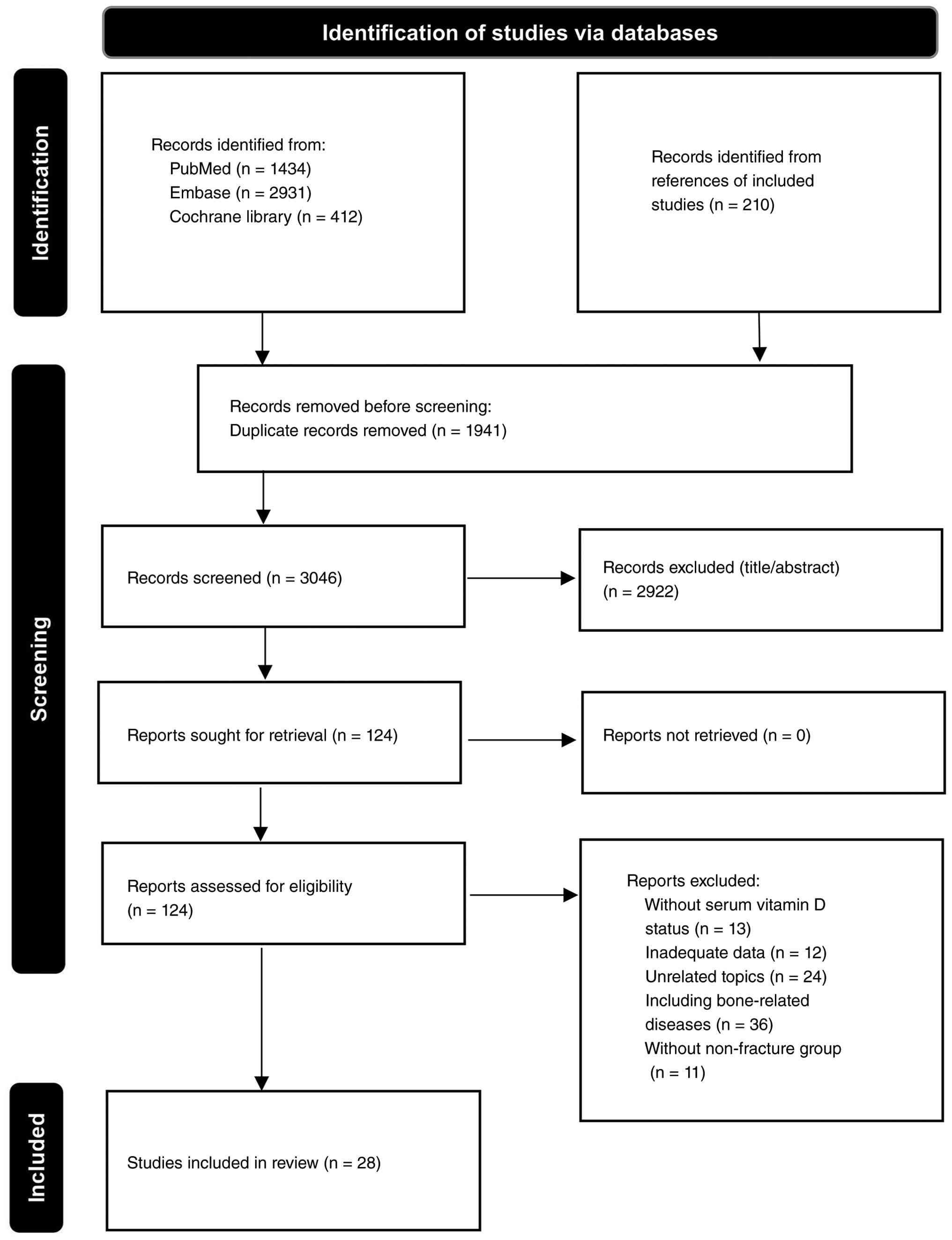
In total, 4,987 literature sources were retrieved
from PubMed, Cochrane and Embase Databases. A total of 3,046
literature articles were left for further evaluation after the
removal of duplicates. 124 literatures were screened out through
title and abstract evaluation, and 28 studies were finally included
according to the inclusion criteria (7-9,12,15-38)
(Fig. 1).
This systematic review and meta-analysis included a
total of 28 observational studies, comprising five cross-sectional
and 23 case-control designs. The pooled analysis encompassed 4,135
pediatric and adolescent patients with fractures and 6,344 age- and
sex-matched controls. The included studies were conducted across
diverse geographical regions: Nine from the United States, three
from Turkiye, two from Lebanon, two from Poland and one each from
Romania, Ireland, New Zealand, China, Iran, Canada, Egypt, Jordan,
Greece, Finland, Switzerland and Saudi Arabia (Table I).
 | Table IBasic characteristics of included
studies. |
Table I
Basic characteristics of included
studies.
| First author/s,
year | Design | City | Country | Latitude | Altitude, m | Season | Sample size
(n) | Age, years | Sex (M/F) | Ethnicity | Fracture site | Trauma energy | NOS | (Refs.) |
|---|
| Assaf et al,
2024 | Case-con | Byblos | Lebanon | 34˚ N | 20 | May to October | 107 | Trial: 7.4± 3.7
Con: 7.8±4.6 | Trial: 30/7 Con:
42/28 | Unclear | Upper and lower
limb | Low | 6 | (7) |
| Segal et al,
2023 | Retros
case-con | Cincinnati | USA | 39˚ N | 150 | All | 103 | 15.9±2.2 | 48/55 | Mixed | Mixed | Low or middle | 7 | (9) |
| Matcovic et
al, 2023 | Pros case-con | Columbus | USA | 40˚ N | 275 | All | 856 | Trial: 6-17 Con:
6.7-17.6 | Unclear | Mainly White | Distal forearm | Low or middle | 7 | (8) |
| Herdea et
al, 2023 | Pros case-con | Bucharest | Romania | 44˚ N | 70 | All | 1577 | 2-17 | Trial: 399/289 Con:
439/450 | Unclear | Upper limb | Low | 6 | (12) |
| Varkal et
al, 2022 | Pros Case-con | Istanbul | Turkiye | 41˚ N | 40 | All | Trial: 76 Con:
50 | 9.2± 4.1
(2-18) | Trial:4 8/28 Con:
24/26 | Unclear | Mixed | Low | 6 | (38) |
| Moore et al,
2022 | Pros case-con | Dublin | Ireland | 53˚ N | 20 | All | Trial: 58 Con:
58 | Trial: 8.0±4.2 Con:
8.9±4.4 | Trial: 39/19 Con:
31/27 | Mainly White | Mixed | Mixed | 6 | (37) |
| Talmac et
al, 2021 | Pros case-con | Istanbul | Turkiye | 41˚ N | 40 | Feb to May | Trial: 50 Con:
50 | Trial: 8.3±2.8
(5-15) Con: 7.9 ± 3.4 (5-15) | Trial: 32/18 Con:
34/16 | Unclear | Distal radius | Low | 5 | (36) |
| Delshad et
al, 2020 |
Cross-sectional | Auckland | New Zealand | 36˚ S | 200 | Aug | 647 | 9.8±0.7 (8-12) | 293/354 | Mixed | Mixed | Mainly low or
middle | 4 | (35) |
| Liu et al,
2019 | Case-con | Shen yang | China | 41˚ N | 55 | All | Trial: 695 Con:
224 | Trial: 7.1±2.8
(1-15) Con: 7.8±3.4 (1-15) | Trial: 448/247 Con:
113/111 | Chinese | Upper limb | Low or middle | 5 | (34) |
| Younes et
al, 2019 |
Cross-sectional | GB and ML | Lebanon | 34˚ N | 50-2000 | May to October | Trial: 165 Con:
809 | 13.37±2.92
(8-18) | 508/466 | Lebanese | Mixed | Unclear | 5 | (33) |
| Popko et al,
2018 | Case-con | Bialystok | Poland | 53˚ N | 120 | May to Aug | Trial: 20 Con:
19 | Trial: 12 (5-15)
Con: 13.5 (7-17) | Trial: 14/6 Con:
9/10 | unclear | unclear | Low | 6 | (32) |
| Ramirez et
al, 2018 | Case-con | Mayaguez | USA | 18˚ N | 7 | Jan to Jul | Trial: 107 Con:
94 | 8.6±4.0 (1-18) | Trial: 64/43 Con:
48/46 | Hispanic | Upper and lower
limb | Low | 4 | (31) |
| Saglam et
al, 2017 | Case-con | Istanbul | Turkiye | 41˚ N | 40 | Jun to Aug | 60 | Trial: 8.2±2.6 Con:
7.7±2.1 | Trial: 18/12 Con:
14/16 | Unclear | Forearm | Unclear | 3 | (30) |
| Minkowitz et
al, 2017 | Case-con | Morristown | USA | 40˚ N | 110 | Unclear | Trial: 369 Con:
662 | Trial: 10.7±4.1
Con: 12.2±4.8 | 530/486 | Mainly White | Mixed | Mixed | 4 | (29) |
| Thompson et
al, 2017 | Pros case-con | Chicago | USA | 42˚ N | 179 | All | 120 | Trial: 5.8±2.8 Con:
7.5±4.4 | Trial: 33/27 Con:
25/35 | Mixed | Mainly long
bone | Low | 5 | (28) |
| Jeddi et al,
2017 |
Cross-sectional | Kawar | Iran | 30˚ N | 1600 | Unclear | 478 | 13.7±2.6 | 241/237 | Iranian | Mixed | Mixed | 4 | (27) |
| Karpinski et
al, 2017 | Case-con | Bialystok | Poland | 53˚ N | 120 | Apr to Sep | 227 | 11.6±3.7
(3-18) | 161/66 | unclear | Unclear | Low | 5 | (26) |
| Andersan et
al, 2017 | Case-con | Toronto | Canada | 43˚ N | 76 | All | 549 | 3.5±1.5
(<6) | 307/242 | Mainly White | Upper and lower
limb | Low | 5 | (25) |
| El-Sakka et
al, 2016 | Pros case-con | Cairo | Egypt | 30˚ N | 23 | Dec to Jun | Trial: 23 Con:
23 | Trial: 6.7±2.3 Con:
7.7±1.7 | Trial: 14/9 Con:
14/9 | Egyptian | Forearm | Unclear | 5 | (24) |
| Jahmani et
al, 2017 | Case-con | Ar-Ramtha | Jordan | 32˚ N | 525 | Unclear | 119 | 6.5±4.6 | 70/49 | Unclear | Mixed | Unclear | 2 | (23) |
| AL-Daghri et
al, 2016 |
Cross-sectional | Riyadh | Saudi Arabia | 25˚ N | 600 | All | Trial: 234 Con:
1022 | Trial: 14.07±1.39
Con: 14.03±1.81 | Trial:148/86
Con:476/546 | Saudi Arab | Mixed | Low or middle | 4 | (22) |
| Contreras et
al, 2014 | Pros case-con | Winston-Salem | USA | 36˚ N | 300 | Oct to Jan | Trial: 100 Con:
100 | Trial: 10.1
(9.2-11) Con: 11 (10.0-11.9) | Trial: 70/30 Con:
50/50 | Mixed | Mixed | Low | 4 | (21) |
| Papaefthymiou et
al, 2014 | Case-con | Athens | Greece | 38˚ N | 70 | All | Trial: 21 Con:
42 | Trial: 14.10±2.15
Con: 13.47±2.12 | All male | Greek | Mixed | Traumatic | 4 | (20) |
| Mäyränpää et
al, 2012 | Pros case-con | Helsinki | Finland | 60˚ N | 10 | All | Trial: 66 Con:
64 | Trial: 10.7
(4.4-16.8) Con: 11.2 | Trial: 44/22 Con:
43/21 | Mainly Finnish | Mixed | Low | 6 | (19) |
| Ryan et al,
2012 | Case-con | Washington DC | USA | 39˚ N | 125 | All | Trial: 70 Con:
71 | Trial: 6.9±1.4 Con:
7.0±1.5 | Trial: 44/32 Con:
40/34 | African
American | Forearm | Low | 5 | (18) |
| Ceroni et
al, 2012 | Pros
cross-sectional | Geneva | Switzerland | 46˚ N | 375 | Unclear | Trial1: 50 Trial2:
50 Con: 50 | Trial1: 12.9±1.7
Trial2: 3.0±1.7 Con: 12.7±2.3 | Unclear | Swiss
Caucasian | Appendicular | Low or middle | 5 | (17) |
| Olney et al,
2008 | Case-con | Jacksonville | USA | 40˚ N | 5 | Unclear | Trial: 68 Con:
57 | Trial: 12.0±3.0
Con: 11.1±3.2 | Trial:48/20 Con:
34/23 | Mainly White | Mixed | Low | 4 | (16) |
| Chan et al,
1984 | Case-con | SLC | USA | 30˚ N | 1300 | Unclear | Trial: 17 Con:
17 | Trial: 6.4±0.8 Con:
6.4±0.8 | Trial: 9/8 Con:
9/8 | Unclear | limb | Accidental | 4 | (15) |
Quality assessment of included
studies
Based on the NOS ‘star system’, the 28 included
studies were predominantly moderate in methodological quality.
Specifically, two studies achieved a rating of seven stars, six
received six stars, nine were assessed as five stars, another nine
as four stars, while one study was rated three stars and one two
stars. Notably, a primary factor contributing to the relatively
lower NOS scores in certain studies was insufficient documentation
of seasonal factors, particularly the unclear comparability of
vitamin D blood sampling seasons between the fracture and
non-fracture groups. This methodological limitation consequently
diminished the overall methodological rigor and the reliability of
their respective findings.
Egger test and funnel plot for
publication bias
The results of Egger's linear regression test
indicated that the intercept term was not statistically significant
(P=0.53; 95% CI: -2.16 to 1.08), suggesting no significant
asymmetry in the funnel plot and thus no evidence of substantial
publication bias. Through a combination of funnel plot
visualization and Egger's test, the present study did not detect
significant publication bias, indicating a low risk of bias among
the included studies and supporting the reliability of the pooled
effect estimate (Fig. 2).
Sensitivity analysis
The sensitivity analysis results of the present
study demonstrated that upon the sequential removal of any single
study, the direction and statistical significance of the pooled
effect size remained unchanged, with minimal fluctuation in
heterogeneity (<5%; Fig. 3).
Leave-one-out sensitivity analysis included low-quality studies
rated two or three stars; sequential individual omission of each
low-quality study did not materially change the pooled effect
estimate or its statistical significance. This indicates that the
core conclusion of the present study, that adolescents in the
fracture group have significantly lower vitamin D levels than those
in the control group (pooled MD~ -1.95), exhibits good robustness
and is not unduly influenced by individual studies. Even after
excluding the studies with the largest sample sizes [such as Herdea
2023(12), Matcovic 2023(8)], the pooled effect size remained
stable (MD=-1.78 to -1.94), indicating that large-sample studies
did not disproportionately influence the overall results. This
minimized the risk of ‘weight bias’ interfering with the
conclusions. In summary, the findings of this meta-analysis were
robust and reliable. The core conclusions possess strong external
validity and can provide stable evidence to support clinical
practice and public health decision-making.
Comparison of serum vitamin D levels
between the fracture and the non-fracture groups
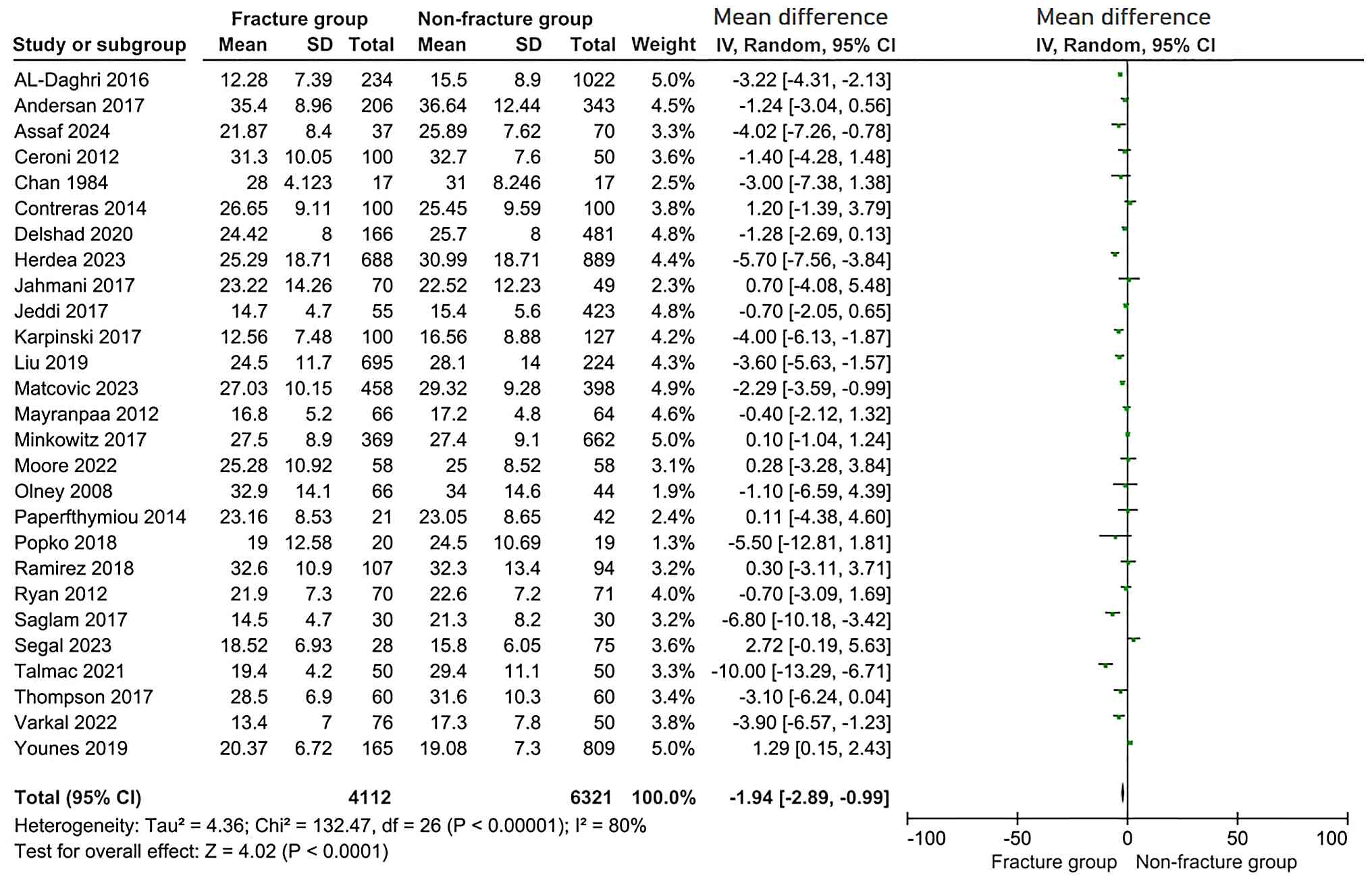
A total of 27 studies involving 10,433 adolescent
participants were included, comprising 4,112 in the fracture group
and 6,321 in the non-fracture group. The mean vitamin D levels
ranged from 12.28-35.4 ng/ml in the fracture group and from
15.08-36.64 ng/ml in the non-fracture group. Considerable variation
in sample sizes was observed across studies, with the smallest
study including 34 participants [Chan 1984(15)] and the largest including 1,577
[Herdea 2023(12)]. Study weights
were evenly distributed (range: 3.1-5.0%), indicating that no
single study unduly influenced the pooled results. Three studies
[Contreras 2014(21), Younes
2019(33), Segal 2023(9)] reported slightly higher vitamin D
levels in the fracture group compared to the non-fracture group.
However, the effect sizes were small (MD=0.10-2.72), and only the
result from Younes 2019 reached statistical significance (MD=1.29;
95% CI: 0.15-2.43). The overall effect of these studies on the
pooled results was limited. Meta-analysis revealed that the mean
vitamin D level was significantly lower in the fracture group than
in the non-fracture group (MD=-1.94 [-2.89-0.99]; P<0.00001;
I2=80%). However, this finding requires cautious
interpretation due to significant heterogeneity (Fig. 4).
Comparison of risk of serum vitamin D
deficiency between the fracture and the non-fracture groups
A total of 17 studies, comprising 5,473 adolescent
participants (2,488 in the fracture group and 2,985 in the
non-fracture group), were included in this analysis on the
correlation of vitamin D deficiency (vitamin D level ≤20 ng/ml)
with fracture (Fig. 5). Within
these studies, vitamin D deficiency was reported in 1,620
participants from the fracture group and 1,894 from the
non-fracture group. The distribution of study weights varied, with
the highest weight assigned to Herdea 2023(12) (34.9%) and the lowest to Saglam
2017(30) (0.5%). Importantly, no
single study contributed >50% of the total weight, thus
mitigating the risk of any individual study exerting undue
influence on the pooled result. Of the 17 studies, 13 reported a
positive association between vitamin D deficiency and fracture risk
in adolescents (OR>1), with eight reaching statistical
significance, the strongest effect was observed in the study by
Saglam et al (30)
(OR=13.14; 95% CI: 3.84-45.02), indicating a 13.14-fold higher
fracture risk among adolescents with vitamin D deficiency in that
study. The studies with the highest statistical weights, Herdea
2023(12) (OR=2.42; 95% CI:
1.94-3.01) and Liu 2019(34)
(OR=1.78; 95% CI: 1.30-2.45); both supported the conclusion that
vitamin D deficiency increases fracture risk, further validating
the robustness of the pooled result.
The pooled analysis revealed that adolescents with
vitamin D deficiency (vitamin D level≤20 ng/ml) had a significantly
higher risk of fracture compared to those with sufficient vitamin D
levels (OR=1.71 [1.29-2.27]; P<0.0001; I²=65%). This result
indicates that vitamin D deficiency is associated with a 71%
increased risk of fracture in adolescents, confirming a significant
positive association between vitamin D deficiency and fracture risk
in this population. Similarly, this result should be interpreted
with caution owing to substantial heterogeneity (Fig. 5).
Building upon the previous unadjusted analyses, the
present study further incorporated studies that explicitly reported
adjusted ORs to focus on the independent association between
vitamin D deficiency and fracture risk in adolescents. Statistical
analysis was performed using the metafor package in R software
version 4.4.3 (https://www.r-project.org/). Adjusted ORs with their
corresponding 95% CI served as the core effect measure to evaluate
the strength of the independent association. The pooled analysis
demonstrated that, even after adjusting for potential confounders,
vitamin D deficiency remained significantly associated with an
increased risk of fracture [OR=2.41 (95% CI: 1.74-3.34);
P<0.0001; I²=11.11%; P=0.3373; Fig.
6]. This result suggested that, independent of confounding
factors such as age and altitude, adolescents with vitamin D
deficiency face a 2.41 times higher risk of fracture compared to
those with sufficient levels, further confirming the independence
and robustness of this association.
Univariate and multi-variate
meta-regression analysis on the heterogeneity
Given the considerable number of original studies,
the present study further conducted meta-regression to explore
sources of heterogeneity. Metafor package in R software was mainly
employed to perform the univariate regression analysis, the results
demonstrated that age, altitude, latitude, and season could
markedly explain the heterogeneity (Table II). Subsequent multivariate
meta-regression indicated that a model combining age and altitude
sufficiently accounted for the heterogeneity, while latitude and
season also contributed partially to explaining its sources
(Table III). The two variables
with the strongest explanatory power in the univariate analysis
(age and altitude, both accounting for 100% of the heterogeneity)
remained capable of fully explaining the heterogeneity within the
multivariate core model, confirming their central moderating roles.
Variables with weaker explanatory power in the univariate analysis
(such as Study design and Trauma energy) were not included in the
multivariate model. Since the core model already explained 100% of
the heterogeneity, the addition of Latitude and Season did not
alter the model's explanatory power or the AIC value, indicating
that these variables are either collinear with the core variables
(age/altitude) or that their moderating effects are encompassed by
the core variables.
| Table IIUnivariate meta-regression analysis
on the heterogeneity. |
Table II
Univariate meta-regression analysis
on the heterogeneity.
|
Variable/subgroup | Coefficient
(β) | Explained
heterogeneity, % | Standard error | Q-Model test
P-value |
|---|
| Age, years | | | | |
|
8.3 | -6.10 | 100 | 2.16 | 0.0048 |
|
9.5 | -5.81 | 100 | 2.49 | 0.0191 |
|
13.37 | 2.23 | 100 | 0.64 | 0.0005 |
|
15.9 | 3.66 | 100 | 1.51 | 0.0151 |
| Altitude, m | | | | |
|
≥600 | -2.28 | 100 | 0.61 | 0.0002 |
|
120 | -3.18 | 100 | 1.07 | 0.0031 |
|
40 | -2.96 | 100 | 1.39 | 0.0329 |
| Latitude, ˚N | | | | |
|
>40 | -5.18 | 94.18 | 1.94 | 0.0076 |
|
≤40 | -1.41 | 94.18 | 1.34 | 0.2930 |
| Season | | | | |
|
May-Oct | -15.25 | 64.84 | 2.85 | 0.0001 |
|
Dec-Mar | 1.59 | 64.84 | 3.95 | 0.6880 |
| Study design | | | | |
|
Case-control | 0.32 | 26.42 | 0.49 | 0.5140 |
|
Cross-sectional | -0.18 | 26.42 | 0.53 | 0.7330 |
| Trauma energy
low | -0.45 | 31.93 | 0.38 | 0.2370 |
| Newcastle-Ottawa
Scale | -0.02 | 0.31 | 0.07 | 0.7891 |
| Fracture site:
Upper limb | -0.57 | 29.07 | 0.41 | 0.1640 |
| Table IIIMulti-variate meta-regression
analysis on the heterogeneity. |
Table III
Multi-variate meta-regression
analysis on the heterogeneity.
| Model | Heterogeneity
explained, % | Number of
studies | Residual
heterogeneity, % | Q-Model test
P-value | Akaike Information
Criterion value |
|---|
| Core model (age +
altitude) | 100 | 27 | 0 | <0.0001 | 105.6369 |
| Core + latitude
model | 100 | 27 | 0 | <0.0001 | 105.6369 |
| Core + latitude +
season model | 100 | 27 | 0 | <0.0001 | 105.6369 |
The multivariate regression model further delineated
the specific moderating effects of age and altitude, the age groups
of 8.3 and 9.5 years were identified as high-risk periods for
fracture (β=-6.1; P=0.0048; and β=-5.81, P=0.0191, respectively),
indicating that the association between vitamin D deficiency and
fracture risk is significantly stronger in these age groups
compared to others. For ≥600 m altitude regions, the regression
coefficient was β=-2.28 (P=0.0002), indicating a stronger
correlational pattern linking vitamin D deficiency and fracture
risk among adolescents living aforementioned 600 m, alongside
observations of higher fracture prevalence in this subgroup.
Subgroup analyses
To explore potential sources of heterogeneity, the
present study conducted prespecified subgroup analyses using
random-effects models, stratified by latitude, season/month, trauma
energy and study design (Figs.
S1, S2, S3 and S4). All forest plots present subgroup
analyses performed using a random-effects model. Studies exhibiting
substantial clinical heterogeneity within the same stratum were
manually excluded from the pooled estimates; these excluded studies
are displayed with zero weight or labelled as ‘not estimable’ in
the respective plots.
In the latitude-based analysis, studies at ≤40 ˚N
showed no significant fracture benefit from vitamin D after
excluding Al-Daghri 2016(22)
(unique Saudi ethnicity) and Matcovic 2023(8) (distal forearm fractures only), with
heterogeneity dropping from 74-44% (P=0.73). Conversely, among
studies at >40˚N, excluding Herdea 2023(12) (pandemic period), Mäyränpää
2012(19) (60˚N; low winter
sunlight) and Talmac 2021(36)
(February-May) reduced heterogeneity from 78-47%, and revealed a
significant protective effect of vitamin D on fractures
(P<0.00001).
In the seasonal subgroup analysis (18 of 27 studies
with clear seasonal data), studies conducted from May to October
showed a significant fracture benefit after excluding Delshad 2020
(Southern Hemisphere) and Younes 2019 (wide altitude range), with
heterogeneity falling from 87-0% (P<0.00001). In the
December-April subgroup, after removing Talmac 2021(36) (late winter/early spring, lowest
solar radiation) and extreme exposure conditions, heterogeneity
decreased from 93-0%, with no significant fracture benefit
(P=0.41). In the full-year subgroup, excluding Herdea 2023(12) (pandemic) and Segal 2023(9) (age up to 15.9 years) reduced
heterogeneity from 61-46% and showed a significant effect
(P<0.00001).
In the trauma energy stratification (24 studies with
clear energy data), the low-energy subgroup showed reduced
heterogeneity from 79-38% after excluding seasonally or temporally
conflicting studies (P=0.01). The low-or-moderate subgroup
exhibited a marked fracture benefit, with heterogeneity dropping
from 72-0% (P<0.00001). The mixed-energy subgroup (three
studies) showed 0% heterogeneity and no significant benefit
(P=0.57), and the unintentional injury subgroup (two studies) also
showed 0% heterogeneity and no significant benefit (P=0.35).
In the study design analysis, cross-sectional
studies demonstrated significant fracture risk reduction after
excluding the two largest studies, which were the primary sources
of heterogeneity; heterogeneity decreased from 87-0% (P=0.03).
Discussion
The main finding of the present systematic review
and meta-analysis was that children aged 8.3-9.5 or those residing
at altitudes (≥600 m) were at higher fracture risk. Univariate
regression results indicated that age and altitude are complete
explanatory factors for heterogeneity, capable of eliminating all
heterogeneity independently. This finding was strongly supported by
recent large-scale epidemiological studies and aligns with the
physiology of skeletal development and geographical influences on
vitamin D synthesis. Adolescents aged 8.3-9.5 years are in a peak
period of bone growth, where the skeletal demand for vitamin D
increases sharply. Vitamin D deficiency during this stage directly
impairs calcium absorption and bone mineralization, leading to
reduced bone strength and consequently amplifying fracture risk.
Therefore, the strong negative moderating effect observed for
specific ages ~9 years likely captures the beginning of this
critical high-risk window. Although the absolute between-group
disparities in serum 25(OH)D levels identified in this
meta-analysis appear modest, with a pooled weighted mean difference
of -1.94 ng/ml (95% CI: -2.89 to -0.99), such minor differences
carry clear clinical relevance for pediatric and adolescent
populations experiencing rapid bone turnover. Small shifts in
circulating 25(OH)D can shift the overall population distribution
of vitamin D status, raising the share of youth meeting clinical
thresholds for insufficiency or deficiency. Within the growing
skeleton, sustained subtle deficits in vitamin D correlate with
gradual reductions in calcium absorption efficiency and slowed bone
mineral accrual over childhood and adolescence. For the high-risk
subgroups highlighted in the present study, children aged 8.3-9.5
years and adolescents living at altitudes ≥600 m, these modest
disparities collectively correspond to altered fracture risk
patterns at a population level, reinforcing the clinical value of
targeted vitamin D monitoring and preventive supplementation for
these vulnerable groups. A large Brazilian study involving
>413,000 children and adolescents demonstrated a clear inverse
relationship between age and vitamin D status. The prevalence of
deficiency [25(OH)D <20 ng/ml] was lowest in children <2
years (4.5%) and increased progressively with age, peaking at 18.4%
in adolescents (11-18 years). Notably, among female adolescents,
the deficiency rate reached 20.1%, and in a high-risk subset
(southern region, winter months), it soared to 36%, with 5%
experiencing severe deficiency (<12 ng/ml) (39). This pattern is corroborated by the
study by Yang et al (40),
which found that children aged 6-8 years had the highest vitamin D
levels and sufficiency rates, while levels markedly declined in
older age groups.
Girls may experience an earlier onset of the
pubertal growth spurt, a period of rapid bone elongation where
mineralization may lag behind, temporarily increasing bone
fragility. Concurrently, lifestyle factors such as greater use of
sunscreen, more indoor-oriented activities, and potentially lower
dietary calcium intake may exacerbate vitamin D deficiency.
However, the association between vitamin D status and fracture risk
among female adolescents has shown considerable heterogeneity
across studies. The study by Delshad et al (35) provided more detailed insights,
indicating that while high sugar-sweetened beverage intake and
family history of osteoporosis were the primary predictors of
fractures in girls, the association between vitamin D levels and
fracture history did not reach statistical significance in this
population. By contrast, the aforementioned two studies reported a
higher risk profile among females (39,40).
This may be explained by the fact that the direct link with
fracture risk is modulated by other factors, such as calcium intake
and consumption of sugar-sweetened beverages. In the present
meta-analysis, due to the limited availability of stratified data
reporting vitamin D levels and fracture risk by sex, it was not
possible to conduct a corresponding pooled analysis to further
investigate whether adolescent females indeed face a higher
fracture risk compared to males.
The univariate meta-regression analysis identifies
altitude (≥600 m) as a significant and independent explanatory
factor for heterogeneity, accounting for 100% of the variance with
a strong negative coefficient (β=-2.28; P=0.0002). The persistent
vitamin D deficiency observed at high altitudes, despite increased
ultraviolet B radiation, can be attributed to several
interconnected factors. Studies in high-altitude populations, such
as those in Saudi Arabia and the Andes, demonstrate that local
environmental and lifestyle factors offset the potential benefits
of elevated ultraviolet radiation, alongside a high prevalence of
vitamin D deficiency in these groups (41,42).
When combined with age in the multivariate model, altitude remains
a core determinant, explaining all residual heterogeneity. This
suggests that high-altitude residence exhibits a profound,
consistent correlational link with altered vitamin D status,
alongside parallel correlations with modified bone metabolism and
elevated fracture risk among adolescents living in such regions.
Thus, altitude should be considered a critical, independent
variable in assessing vitamin D status and its health consequences
in youth. The present subgroup analyses revealed that the
protective association of vitamin D with fracture risk was not
consistent across all strata, but was conditional on several
factors, including geographic latitude, season and trauma energy.
Significant effects were detected in high-latitude regions, during
the May-October period, and among low to moderate-energy fractures.
The observation that a significant association also emerged during
sunnier months is noteworthy, as it implies that seasonal sunlight
exposure alone may not fully compensate for suboptimal vitamin D
status in fracture-prone populations. Michaëlsson et al
(43) also supports this view,
finding that individuals with insufficient accumulation of vitamin
D reserves during the summer may remain deficient throughout the
year, thereby increasing fracture risk. These findings support a
targeted rather than universal approach to vitamin D
supplementation, with consideration of latitude, season, and injury
mechanism.
Notwithstanding the strong explanatory power of age
and altitude in the regression models of the present study, it is
acknowledged that residual unmeasured heterogeneity and multiple
unadjusted confounding factors may still constrain the
generalizability of the findings. First, heterogeneity originating
from disparate 25(OH)D testing assays [immunoassay vs. liquid
chromatography-tandem mass spectrometry (LC-MS/MS)], inconsistent
trauma energy classification standards and absent stratification by
fracture site could not be fully captured by the regression
covariates. Second, key confounders including long-term calcium
intake, daily outdoor activity volume and sugar-sweetened beverage
consumption were incompletely reported and rarely uniformly
adjusted across primary studies; these unbalanced covariates may
interfere with the true magnitude of the vitamin D-fracture
association. Additionally, insufficient sex-stratified data
restricted the ability to parse sex-specific effect differences,
which represents another source of residual variation that could
not be eliminated in the current pooled analysis.
In summary, the present meta-analysis advanced prior
syntheses by systematically identifying both age and altitude
residence as core, independent moderators explaining heterogeneity
in the vitamin D-fracture association among adolescents. While
previous reviews have noted age or latitude as factors, the present
study uniquely integrates altitude, a significant yet often
neglected environmental determinant, and pinpoints a critical
high-risk window (ages 8.3-9.5 years). This dual identification
enables more precise risk stratification, moving beyond broad
geographic generalizations. The findings underscored the necessity
of context-specific public health strategies, advocating for
targeted vitamin D screening and supplementation prioritization for
young children and residents of high-altitude regions to mitigate
fracture risk.
Several limitations of the present meta-analysis
warrant consideration. The evidence primarily derived from
observational, predominantly case-control studies, which are
susceptible to selection bias, residual confounding and cannot
establish causality. The overall quality of included studies, as
assessed by the NOS, was moderate, indicating potential
methodological weaknesses. Notably, substantial between-study
heterogeneity existed in multiple aspects. First, 25(OH)D was
measured using different laboratory assays across studies,
including immunoassay and LC-MS/MS, which may introduce measurement
discrepancies. Second, studies varied in the classification of
trauma energy, as well as the adjustment for key confounders such
as precise sunlight exposure, dietary intake and physical activity.
Beyond these factors, BMI, calcium intake, outdoor activity and
skin pigmentation were also insufficiently adjusted in most primary
studies. Third, the majority of original studies failed to perform
stratified analyses according to fracture site and trauma energy.
All the aforementioned issues may have influenced the accuracy of
pooled estimates. Future prospective cohort studies or
well-designed trials are required to confirm the associations
observed in this analysis.
In conclusion, the present meta-analysis confirmed
and extended prior evidence by demonstrating a significant positive
association between vitamin D deficiency and fracture risk in
children and adolescents. The identification of specific age
windows (8.3-9.5 years) and altitude residence (≥600 m) as key
effect modifiers provides a novel framework for clinical and public
health risk stratification. Despite limitations inherent to
observational data, such as potential residual confounding and the
inability to establish causality, these findings strongly advocated
for targeted public health strategies. These include prioritized
screening for vitamin D status and consideration of supplementation
programs for children in early adolescence and those living in
high-altitude regions. Future research should focus on prospective
cohort studies to clarify causal relationships and on intervention
trials to assess the efficacy of targeted vitamin D supplementation
in reducing fracture incidence in these identified high-risk
subgroups.
Supplementary Material
Forest plot of subgroup analysis
stratified by latitude. SD, standard deviation; IV, inverse
variance; CI, confidence interval; Tau2, Tau-squared;
Chi2, Chi-squared; df, degrees of freedom;
I2, I-squared; Z, Z-statistic.
Forest plot of subgroup analysis
stratified by season. SD, standard deviation; IV, inverse variance;
CI, confidence interval; Tau2, Tau-squared;
Chi2, Chi-squared; df, degrees of freedom;
I2, I-squared; Z, Z-statistic.
Forest plot of subgroup analysis
stratified by trauma energy. SD, standard deviation; IV, inverse
variance; CI, confidence interval; Tau2, Tau-squared;
Chi2, Chi-squared; df, degrees of freedom;
I2, I-squared; Z, Z-statistic.
Forest plot of subgroup analysis
stratified by study design. SD, standard deviation; IV, inverse
variance; CI, confidence interval; Tau2, Tau-squared;
Chi2, Chi-squared; df, degrees of freedom;
I2, I-squared; Z, Z-statistic.
Full search formulae.
Acknowledgements
Not applicable.
Funding
Funding: No funding was received.
Availability of data and materials
The data generated in the present study may be
requested from the corresponding author.
Authors' contributions
ZCD was responsible for the conception and design of
the study. BT and JHM independently reviewed the full-text versions
of all the articles retrieved from the literature and were
responsible for the data analysis and drafting of the manuscript.
ZJZ was responsible for constructing the comprehensive search
strategy, performing the Newcastle-Ottawa Scale quality assessment
and providing statistical support for the meta-regression analysis.
JHM and ZJZ were involved in revising the manuscript critically for
important intellectual content. JHM and ZJZ confirm the
authenticity of all the raw data. All authors read and approved the
final manuscript.
Ethics approval and informed consent
Not applicable.
Patient consent for publication
Not applicable.
Competing interests
The authors declare that they have no competing
interests.
References
|
1
|
Hedström EM, Svensson O, Bergström U and
Michno P: Epidemiology of fractures in children and adolescents.
Acta Orthop. 81:148–153. 2010.PubMed/NCBI View Article : Google Scholar
|
|
2
|
Hailer YD, Wallin ME and Wolf O:
Epidemiology and treatment of forearm fractures in Swedish children
and adolescents. Eur J Trauma Emerg Surg. 51(342)2025.PubMed/NCBI View Article : Google Scholar
|
|
3
|
Holick MF: Vitamin D deficiency. N Engl J
Med. 357:266–281. 2007.PubMed/NCBI View Article : Google Scholar
|
|
4
|
Mansbach JM, Ginde AA and Camargo CA Jr:
Serum 25-hydroxyvitamin D levels among US children aged 1 to 11
years: Do children need more vitamin D? Pediatrics. 124:1404–1410.
2009.PubMed/NCBI View Article : Google Scholar
|
|
5
|
Cashman KD: Global differences in vitamin
D status and dietary intake: A review of the data. Endocr Connect.
11(e210282)2022.PubMed/NCBI View Article : Google Scholar
|
|
6
|
Weaver CM, Gordon CM, Janz KF, Kalkwarf
HJ, Lappe JM, Lewis R, O'Karma M, Wallace TC and Zemel BS: The
National Osteoporosis Foundation's position statement on peak bone
mass development and lifestyle factors: A systematic review and
implementation recommendations. Osteoporos Int. 27:1281–1386.
2016.PubMed/NCBI View Article : Google Scholar
|
|
7
|
Assaf E, Nicolas G, Hoyek F, Abi Fares G,
Lahoud JC, Hajj R, Mohs E, Dally FJ, Hetjens S, Gravius S and
Darwich A: Vitamin D level and low-energy fracture risk in children
and adolescents: A population-based case-control study of 45 cases.
J Pediatr Orthop B. 33:392–398. 2024.PubMed/NCBI View Article : Google Scholar
|
|
8
|
Matkovic V, Goel P, Mobley SL,
Badenhop-Stevens NE, Ha EJ, Li B, Skugor M and Clairmont A:
Decreased bone mass in adolescents with bone fragility fracture but
not in young children: A case-control study. Front Endocrinol
(Lausanne). 14(1124896)2023.PubMed/NCBI View Article : Google Scholar
|
|
9
|
Segal D, Ziv A, Meisman A, Fry J, Altaye M
and Gordon CM: Relationship between hypovitaminosis D and fractures
among adolescents with overweight or obesity. Clin Pediatr (Phila).
62:107–114. 2023.PubMed/NCBI View Article : Google Scholar
|
|
10
|
Yang G, Lee WYW, Hung ALH, Tang MF, Li X,
Kong APS, Leung TF, Yung PSH, To KKW, Cheng JCY and Lam TP:
Association of serum 25 (OH)Vit-D levels with risk of pediatric
fractures: A systematic review and meta-analysis. Osteoporos Int.
32:1287–1300. 2021.PubMed/NCBI View Article : Google Scholar
|
|
11
|
Zheng C, Li H, Rong S, Liu L, Zhen K and
Li K: Vitamin D level and fractures in children and adolescents: A
systematic review and meta-analysis. J Bone Miner Metab.
39:851–857. 2021.PubMed/NCBI View Article : Google Scholar
|
|
12
|
Herdea A, Ionescu A, Dragomirescu MC and
Ulici A: Vitamin D-A risk factor for bone fractures in children: A
population-based prospective case-control randomized
cross-sectional study. Int J Environ Res Public Health.
20(3300)2023.PubMed/NCBI View Article : Google Scholar
|
|
13
|
Moher D, Liberati A, Tetzlaff J and Altman
DG: PRISMA Group. Preferred reporting items for systematic reviews
and meta-analyses: the PRISMA statement. PLoS Med.
6(e1000097)2009.PubMed/NCBI View Article : Google Scholar
|
|
14
|
Carra MC, Romandini P and Romandini M:
Risk of bias evaluation of cross-sectional studies: Adaptation of
the newcastle-ottawa scale. J Periodontal Res 28: doi:
10.1111/jre.13405, 2025.
|
|
15
|
Chan GM, Hess M, Hollis J and Book LS:
Bonemineral status in childhood accidental fractures. Am J Dis
Child. 138:569–570. 1984.PubMed/NCBI View Article : Google Scholar
|
|
16
|
Olney RC, Mazur JM, Pike LM, Froyen MK,
Ramirez-Garnica G, Loveless EA, Mandel DM, Hahn GA, Neal KM and
Cummings RJ: Healthy children with frequent fractures: How much
evaluation is needed? Pediatrics. 121:890–897. 2008.PubMed/NCBI View Article : Google Scholar
|
|
17
|
Ceroni D, de la Llana RD, Martin X, Lamah
L, De Coulon G, Turcot K and Dubois-Ferriere V: Prevalence of
vitamin D insufficiency in Swiss teenagers with appendicular
fractures: A prospective study of 100 cases. J Child Orthop.
6:497–503. 2012.PubMed/NCBI View Article : Google Scholar
|
|
18
|
Ryan LM, Teach SJ, Singer SA, Wood R,
Freishtat R, Wright JL, Mc Carter R, Tosi L and Chamberlain JM:
Bone mineral density and vitamin D status among African American
children with forearm fractures. Pediatrics. 130:e553–e560.
2012.PubMed/NCBI View Article : Google Scholar
|
|
19
|
Mayranpaa MK, Viljakainen HT,
Toiviainen-Salo S, Kallio PE and Makitie O: Impaired bone health
and asymptomatic vertebral compressions in fracture-prone children:
A case-control study. J Bone Miner Res. 27:1413–1424.
2012.PubMed/NCBI View Article : Google Scholar
|
|
20
|
Papaefthymiou MA, Bakoula C, Sarra A,
Papassotiriou I, Chrousos GP and Bacopoulou F: Influence of
hormonal param, bone mineral density and bone turnover on fracture
risk in healthy male adolescents: A case control study. J Pediatr
Endocrinol Metab. 27:685–692. 2014.PubMed/NCBI View Article : Google Scholar
|
|
21
|
Contreras JJ, Hiestand B, O'Neill JC,
Schwartz R and Nadkarni M: Vitamin D deficiency in children with
fractures. Pediatr Emerg Care. 30:777–781. 2014.PubMed/NCBI View Article : Google Scholar
|
|
22
|
Al-Daghri NM, Aljohani N, Rahman S, Sabico
S, Al-Attas OS, Alokail MS, Al-Ajlan A and Chrousos GP: Serum
25-hydroxyvitamin D status among Saudi children with and without a
history of fracture. J Endocrinol Invest. 39:1125–1130.
2016.PubMed/NCBI View Article : Google Scholar
|
|
23
|
Jahmani R, Raffee L, Ali AMB, Alorjani M,
Bashaireh KM, Ziad A and Radaideh A: Associated of vitamin D level
with children fractures: A prospective cohort study. Res J Med Sci.
11:208–211. 2017.
|
|
24
|
El-Sakka A, Penon C, Hegazy A, Elbatrawy
S, Gobashy A and Moreira A: Evaluating bone health in Egyptian
children with forearm fractures: A case control study. Int J
Pediatr. 2016(7297092)2016.PubMed/NCBI View Article : Google Scholar
|
|
25
|
Anderson LN, Heong SW, Chen Y, Thorpe KE,
Adeli K, Howard A, Sochett E, Birken CS, Parkin PC and Maguire JL:
TARGet kids collaboration. Vitamin D and fracture risk in early
childhood: A case-control study. Am J Epidemiol. 185:1255–1262.
2017.PubMed/NCBI View Article : Google Scholar
|
|
26
|
Karpiński M, Galicka A, Milewski R, Popko
J, Badmaev V and Stohs SJ: Association between vitamin D receptor
polymorphism and serum vitamin D levels in children with low-energy
fractures. J Am Coll Nutr. 36:64–71. 2017.PubMed/NCBI View Article : Google Scholar
|
|
27
|
Jeddi M, Dabbaghmanesh MH, Kharmandar A,
Omrani GR and Bakhshayeshkaram M: Prevalence of fracture in healthy
iranian children aged 9-18 years and associated risk factors; a
population based study. Bull Emerg Trauma. 5:29–35. 2017.PubMed/NCBI
|
|
28
|
Thompson RM, Dean DM, Goldberg S, Kwasny
MJ, Langman CB and Janicki JA: Vitamin D insufficiency and fracture
risk in urban children. J Pediatr Orthop. 37:368–373.
2017.PubMed/NCBI View Article : Google Scholar
|
|
29
|
Minkowitz B, Cerame B, Poletick E, Nguyen
JT, Formoso ND, Luxenberg SL, Lee BH and Lane JM: Morris-Essex
Pediatric Bone Health Group. Low vitamin D levels are associated
with need for surgical correction of pediatric fractures. J Pediatr
Orthop. 37:23–29. 2017.PubMed/NCBI View Article : Google Scholar
|
|
30
|
Saglam Y, Kizildag H, Toprak G, Alp NB and
Yalcinkaya EY: Prevalence of vitamin D insufficiency in children
with forearm fractures. J Child Orthop. 11:180–184. 2017.PubMed/NCBI View Article : Google Scholar
|
|
31
|
Ramirez N, Ortiz-Fullana JL, Arciniegas N,
Fullana A, Valentin P, Orengo JC, Iriarte I and Carlo S: Vitamin D
levels and fracture risk among Hispanic children. Eur J Orthop Surg
Traumatol. 29:531–536. 2019.PubMed/NCBI View Article : Google Scholar
|
|
32
|
Popko J, Karpiński M, Chojnowska S, Maresz
K, Milewski R, Badmaev V and Schurgers LJ: Decreased levels of
circulating carboxylated osteocalcin in children with low energy
fractures: A pilot study. Nutrients. 10(734)2018.PubMed/NCBI View Article : Google Scholar
|
|
33
|
Younes N, El Hajj MA, Bizdikian AJ and
Gannagé-Yared MH: An epidemiological evaluation of fractures and
its determinants among Lebanese schoolchildren: A cross-sectional
study. Arch Osteoporos. 14(9)2019.PubMed/NCBI View Article : Google Scholar
|
|
34
|
Liu T, Wang E, Li Q and Li L: High
prevalence of vitamin D insufficiency in Chinese children with
upper limb fractures. Genes Dis. 7:408–413. 2019.PubMed/NCBI View Article : Google Scholar
|
|
35
|
Delshad M, Beck KL, Conlon CA, Mugridge O,
Kruger MC and von Hurst PR: Fracture risk factors among children
living in New Zealand. J Steroid Biochem Mol Biol.
200(105655)2020.PubMed/NCBI View Article : Google Scholar
|
|
36
|
Talmac MA, Gorgel MA, Varol A, Ak S,
Kilinc BE and Ozdemir HM: Serum levels of vitamin D in children
with or without isolated distal radius fractures: A prospective
clinical study. Rev Bras Ortop (Sao Paulo). 56:351–355.
2021.PubMed/NCBI View Article : Google Scholar
|
|
37
|
Moore DM, O'Sullivan M, Kiely P, Noel J,
O'Toole P, Kennedy J, Moore DP and Kelly P: Vitamin D levels in
Irish children with fractures: A prospective case-control study
with 5 year follow-up. Surgeon. 20:71–77. 2022.PubMed/NCBI View Article : Google Scholar
|
|
38
|
Varkal MA, Gulenc B, Yildiz I, Kandemir I,
Bilgili F, Toprak S, Kilic A and Unuvar E: Vitamin D level, body
mass index and fracture risk in children: Vitamin D deficiency and
fracture risk. J Pediatr Orthop B. 31:e264–e270. 2022.PubMed/NCBI View Article : Google Scholar
|
|
39
|
Radonsky V, Lazaretti-Castro M, Chiamolera
MI, Biscolla RPM, Junior JV, Vieira JGH, Brandão CMA, Ramalho RF,
Maeda SS and Cavichio MWE: Alert for the high prevalence of vitamin
D deficiency in adolescents in a large Brazilian sample. J Pediatr
(Rio J). 100:360–366. 2024.PubMed/NCBI View Article : Google Scholar
|
|
40
|
Yang Y, Chen L, Ruan Y, Su W, Wan Q and
Liu Z: Vitamin D status and relevant factors of children and
adolescent aged 6-17 in Yunnan Province from 2016 to 2017. Wei
Sheng Yan Jiu. 54:776–783. 2025.PubMed/NCBI View Article : Google Scholar : (In Chinese).
|
|
41
|
Abdelsalam M, Nagy E, Abdalbary M, Alsayed
MA, Ali AAS, Ahmed RM, Alsuliamany ASM, Alyami AH, Althaqafi RMM,
Alsaqqa RM, et al: Prevalence and associated factors of vitamin D
deficiency in high altitude region in Saudi Arabia: Three-Year
retrospective study. Int J Gen Med. 16:2961–2970. 2023.PubMed/NCBI View Article : Google Scholar
|
|
42
|
Mata-Greenwood E, Westenburg HCA, Zamudio
S, Illsley NP and Zhang L: Decreased vitamin D levels and altered
placental vitamin D gene expression at high altitude: Role of
genetic ancestry. Int J Mol Sci. 24(3389)2023.PubMed/NCBI View Article : Google Scholar
|
|
43
|
Michaëlsson K, Byberg L, Svennblad B,
Larsson SC, Baron JA and Melhus H: Serum 25-hydroxyvitamin D is
associated with fracture risk only during periods of seasonally
high levels in women with a high body mass index. J Bone Miner Res.
36:1957–1966. 2020.PubMed/NCBI View Article : Google Scholar
|